




MP Board is conducting the Class 10 Social Science Board Exam 2026 on March 2, 2026. Class 10 Social Science Question Paper with Solution PDF is available here for download.
The official question paper of MP Board Class 10 Social Science Board Exam 2026 is provided below. Students can download the official paper in PDF format for reference.
MP Board Class 10 2026 Social Science Question Paper with Solution PDF
| MP Board Class 10 2026 Social Science Question Paper with Solution PDF | Download PDF | Check Solutions |
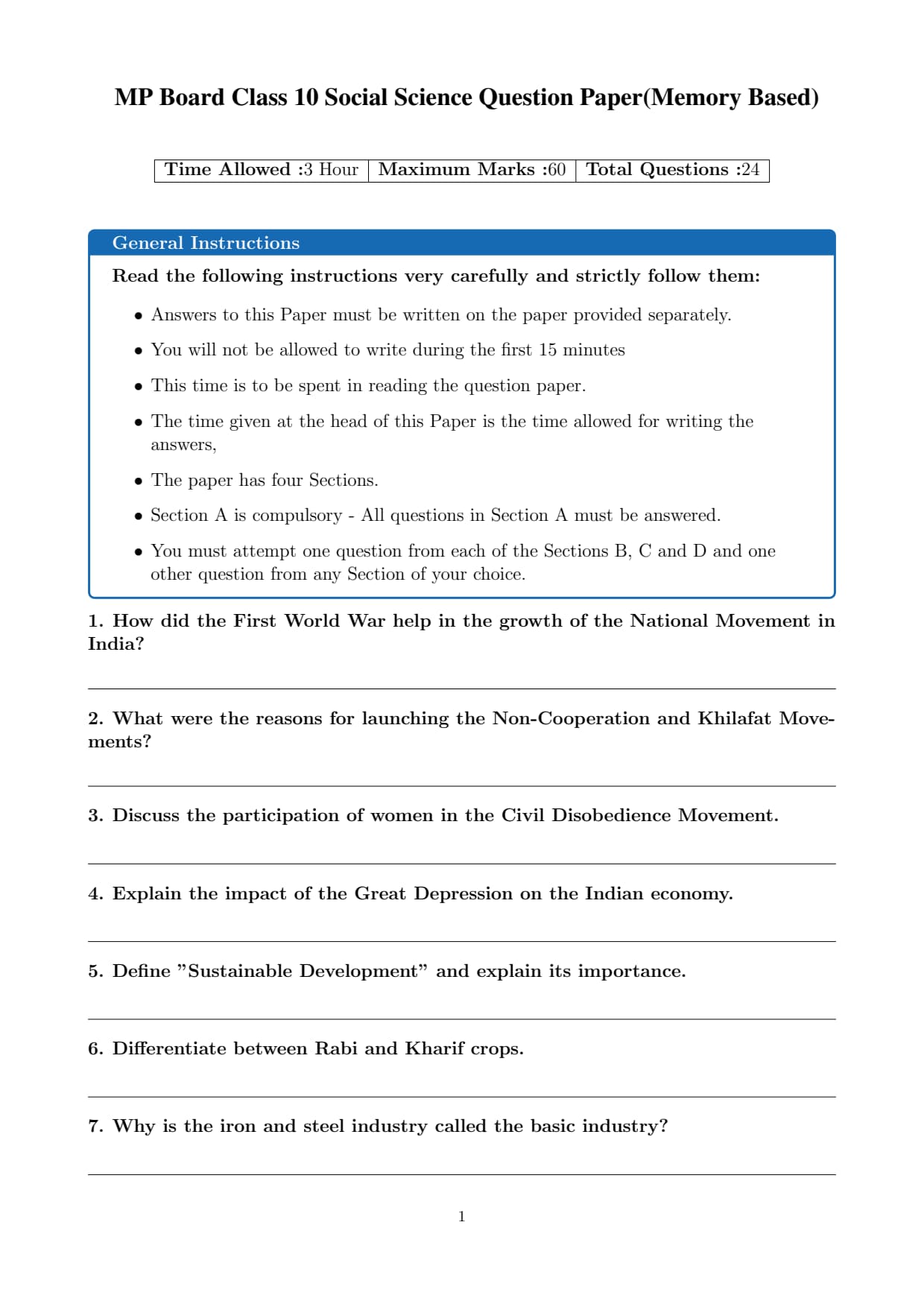
How did the First World War help in the growth of the National Movement in India?
View Solution
Concept:
The First World War (1914–1918) had a profound impact on India. Although India supported the British war effort, the war led to economic, political, and social changes that accelerated the growth of nationalism.
Step 1: Economic hardships.
The war caused heavy economic strain:
Rise in taxes and forced war loans
Inflation and increase in prices of essential goods
Shortage of food and basic necessities
These hardships created widespread resentment among the masses.
Step 2: Increased exploitation by the British.
India supplied soldiers, raw materials, and financial support to Britain. However, Indians received little political benefit, exposing the exploitative nature of colonial rule.
Step 3: Political awakening.
Indian leaders expected political concessions in return for their support. When reforms were limited and repressive measures like the Rowlatt Act were introduced, nationalist sentiments intensified.
Step 4: Growth of mass nationalism.
The post-war period saw:
Emergence of new leaders like Mahatma Gandhi
Launch of mass movements such as the Non-Cooperation Movement
Participation of peasants, workers, and middle classes
Step 5: International influence.
The war promoted ideas of self-determination and democracy worldwide, inspiring Indians to demand independence.
Conclusion:
The First World War created economic distress, political awareness, and mass dissatisfaction with British rule, which significantly accelerated the growth of the Indian National Movement. Quick Tip: World War I exposed British exploitation and caused economic hardship, leading to political awakening and the rise of mass nationalism in India.
What were the reasons for launching the Non-Cooperation and Khilafat Movements?
View Solution
Concept:
The Non-Cooperation Movement (1920–22) led by Mahatma Gandhi and the Khilafat Movement led by Indian Muslim leaders emerged in the post–World War I period as a united mass struggle against British rule.
Step 1: The Rowlatt Act (1919).
The British passed the Rowlatt Act, allowing detention without trial and curbing civil liberties. This created widespread anger and distrust among Indians.
Step 2: Jallianwala Bagh Massacre.
The brutal killing of hundreds of unarmed civilians at Amritsar in 1919 shocked the nation and exposed the oppressive nature of British rule, intensifying nationalist feelings.
Step 3: Economic hardships after World War I.
Post-war inflation, heavy taxation, and unemployment created discontent among peasants, workers, and the middle class, making them receptive to mass movements.
Step 4: The Khilafat issue.
Indian Muslims were upset over the dismemberment of the Ottoman Empire and the weakening of the Turkish Caliph, who was regarded as a spiritual leader of Muslims. British policies hurt Muslim sentiments.
Step 5: Need for Hindu–Muslim unity.
Gandhi supported the Khilafat Movement to unite Hindus and Muslims in a common anti-colonial struggle, strengthening the national movement.
Conclusion:
The Non-Cooperation and Khilafat Movements were launched as a response to British repression, political injustice, and religious grievances, marking the beginning of a united mass struggle against colonial rule. Quick Tip: The movements were driven by the Rowlatt Act, Jallianwala Bagh massacre, post-war hardships, and Muslim anger over the Khilafat issue.
Discuss the participation of women in the Civil Disobedience Movement.
View Solution
Concept:
The Civil Disobedience Movement (1930–34), launched by Mahatma Gandhi, marked a turning point in mass participation. For the first time, large numbers of women from different social backgrounds actively took part in the freedom struggle.
Step 1: Participation in Salt Satyagraha.
Women joined the Salt March and local salt satyagrahas by making and selling salt in defiance of British laws. Leaders like Sarojini Naidu played a prominent role.
Step 2: Picketing and boycotts.
Women actively picketed liquor shops and foreign cloth stores, promoting Swadeshi and discouraging the use of imported goods.
Step 3: Civil disobedience and arrests.
Many women courted arrest by participating in protests, processions, and defying colonial laws. Their willingness to suffer imprisonment inspired others to join the movement.
Step 4: Spread to rural areas.
Participation was not limited to urban elites. Rural women also joined protests, especially in regions like Gujarat, Maharashtra, and Bengal.
Step 5: Impact on society.
Broke traditional social barriers restricting women’s public roles
Strengthened the mass character of the national movement
Encouraged future participation of women in politics and social reform
Conclusion:
Women’s participation in the Civil Disobedience Movement significantly broadened the national movement and challenged traditional gender norms, making the struggle more inclusive and powerful. Quick Tip: Women played a vital role in the Civil Disobedience Movement through salt satyagrahas, picketing, and courting arrests, expanding the mass base of nationalism.
Explain the impact of the Great Depression on the Indian economy.
View Solution
Concept:
The Great Depression (1929–1933) was a global economic crisis that severely affected colonial economies like India. Since India depended heavily on agriculture and exports, the downturn had widespread consequences.
Step 1: Fall in agricultural prices.
Prices of agricultural commodities like wheat, cotton, and jute declined sharply. Farmers received very low returns for their produce, leading to severe rural distress.
Step 2: Increased burden on peasants.
While incomes fell, land revenue and taxes remained unchanged. Peasants struggled to repay loans and many fell into debt traps with moneylenders.
Step 3: Decline in exports.
Global demand for raw materials dropped, reducing Indian exports. This hurt plantation owners, traders, and workers dependent on export industries.
Step 4: Unemployment and poverty.
Industrial slowdown and reduced trade led to job losses and wage cuts, worsening poverty across both rural and urban areas.
Step 5: Political consequences.
Economic hardships intensified resentment against British policies and encouraged participation in nationalist movements like the Civil Disobedience Movement.
Conclusion:
The Great Depression had a devastating impact on the Indian economy, deepening rural distress, reducing trade, and strengthening anti-colonial sentiments. Quick Tip: The Great Depression caused falling crop prices, rural indebtedness, reduced exports, and increased poverty in colonial India.
Define "Sustainable Development" and explain its importance.
View Solution
Concept:
Sustainable development is a holistic approach to growth that balances economic progress, environmental conservation, and social well-being. It aims to ensure long-term prosperity without degrading natural resources.
Step 1: Definition.
Sustainable development means meeting the needs of the present without compromising the ability of future generations to meet their own needs. The concept was popularized by the Brundtland Commission (1987).
Step 2: Key pillars of sustainable development.
Economic sustainability: Promoting growth and employment without resource depletion
Environmental sustainability: Protecting ecosystems, biodiversity, and natural resources
Social sustainability: Ensuring equity, health, education, and quality of life
Step 3: Importance of sustainable development.
Resource conservation: Prevents overexploitation of natural resources
Environmental protection: Reduces pollution and climate change impacts
Intergenerational equity: Ensures fairness between present and future generations
Balanced growth: Integrates economic progress with ecological balance
Improved quality of life: Promotes inclusive and long-term development
Conclusion:
Sustainable development is essential for ensuring that economic advancement and human well-being continue without harming the environment or depriving future generations of resources. Quick Tip: Sustainable development balances economic growth, environmental protection, and social equity for present and future generations.
Differentiate between Rabi and Kharif crops.
View Solution
Concept:
In India, agricultural crops are broadly classified based on the season in which they are grown. The two main crop seasons are Rabi and Kharif.
Step 1: Rabi crops.
Sown in winter (October–December)
Harvested in spring (March–April)
Require cool climate during growth and warm weather at harvest
Depend mainly on irrigation or winter rainfall
Examples: Wheat, barley, mustard, gram
Step 2: Kharif crops.
Sown with the onset of monsoon (June–July)
Harvested in autumn (September–October)
Require hot and wet climate
Depend on monsoon rainfall
Examples: Rice, maize, cotton, jute
Step 3: Key Differences.
Season: Rabi — winter; Kharif — monsoon.
Water requirement: Rabi — less rainfall, more irrigation; Kharif — heavy rainfall.
Temperature: Rabi needs cooler climate; Kharif needs warm and humid climate.
Examples: Wheat (Rabi) vs Rice (Kharif).
Conclusion:
Rabi and Kharif crops differ mainly in their growing seasons, climatic requirements, and crop types, reflecting India’s monsoon-based agricultural cycle. Quick Tip: Rabi = winter crops (wheat, mustard); Kharif = monsoon crops (rice, cotton).
Why is the iron and steel industry called the basic industry?
View Solution
Concept:
The iron and steel industry plays a fundamental role in industrialization. It produces iron and steel, which are key inputs for infrastructure, machinery, and manufacturing sectors.
Step 1: Supplier of raw materials.
Iron and steel are used as basic raw materials in several industries such as construction, automobile manufacturing, shipbuilding, railways, and engineering.
Step 2: Foundation of industrial growth.
The level of iron and steel production is often considered an indicator of a country’s industrial development, as most industries depend on it for machinery and tools.
Step 3: Linkages with other industries.
It has strong backward and forward linkages:
Backward linkages with mining (iron ore, coal, limestone)
Forward linkages with manufacturing and infrastructure sectors
Step 4: Role in infrastructure development.
Iron and steel are essential for building roads, bridges, railways, buildings, and industrial plants, making them crucial for economic growth.
Conclusion:
Since many industries depend on iron and steel as a core input, it forms the backbone of industrialization and is therefore called the basic industry. Quick Tip: Iron and steel industry is called the basic industry because it supplies essential raw materials to most other industries.
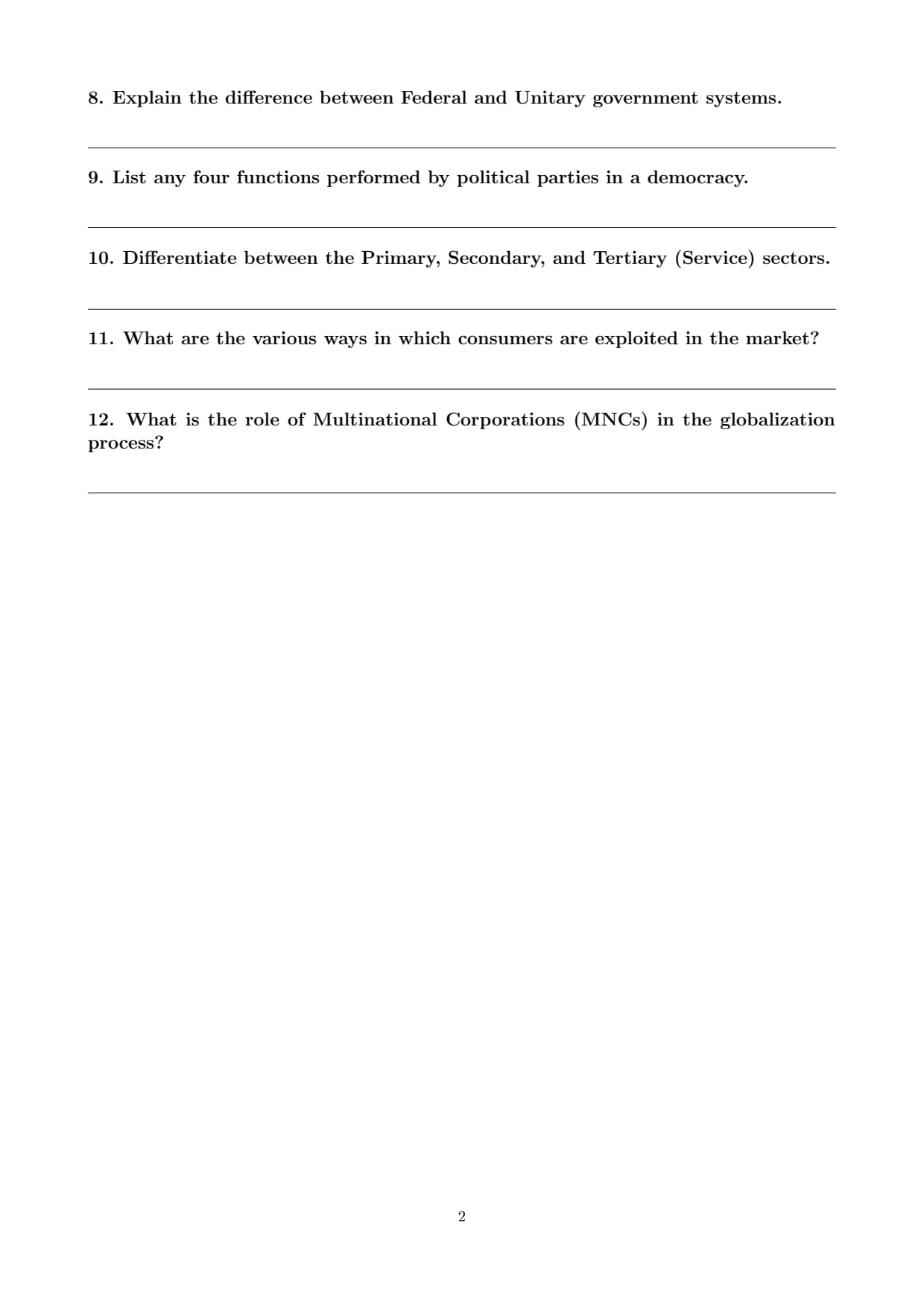
Explain the difference between Federal and Unitary government systems.
View Solution
Concept:
Government systems are classified based on how political power is distributed between central and regional authorities. The two main forms are federal and unitary systems.
Step 1: Federal Government System.
In a federal system, powers are divided between the central government and state or regional governments by a written constitution.
Both levels have independent authority
Constitution is supreme
Power-sharing is clearly defined
Example: India, USA, Australia
Step 2: Unitary Government System.
In a unitary system, all powers are concentrated in the central government, and regional authorities derive their powers from it.
Central government is supreme
Regional bodies have limited autonomy
Constitution may be flexible
Example: United Kingdom, France
Step 3: Key Differences.
Distribution of power:
Federal — divided between centre and states;
Unitary — concentrated at the centre.
Constitution:
Federal systems have a rigid and written constitution;
Unitary systems may have flexible constitutions.
Autonomy of regions:
States enjoy autonomy in federal systems;
Limited autonomy in unitary systems.
Examples:
India (federal) vs UK (unitary).
Conclusion:
Federal systems promote power-sharing and regional autonomy, whereas unitary systems emphasize centralized authority and uniform governance. Quick Tip: Federal = power divided between centre and states; Unitary = power concentrated in central government.
List any four functions performed by political parties in a democracy.
View Solution
Concept:
Political parties are essential institutions in a democracy. They organize political life, represent public interests, and ensure the functioning of democratic governance.
Step 1: Contest elections.
Political parties nominate candidates and contest elections to gain political power and represent citizens in legislative bodies.
Step 2: Form and run governments.
The party or coalition that wins a majority forms the government and makes laws and policies for governance.
Step 3: Shape public opinion.
Political parties raise and highlight important social and political issues through campaigns, debates, and media, influencing public opinion.
Step 4: Act as a link between people and government.
They communicate people’s demands to the government and explain government policies to citizens, ensuring effective representation.
Additional functions:
Provide political education
Offer policy alternatives
Promote leadership and political participation
Conclusion:
Political parties play a vital role in democratic systems by facilitating elections, governance, representation, and political awareness. Quick Tip: Key functions: contest elections, form governments, shape public opinion, and link citizens with the government.
Differentiate between the Primary, Secondary, and Tertiary (Service) sectors.
View Solution
Concept:
Economic activities are classified into sectors based on the nature of work performed. The three main sectors are primary, secondary, and tertiary sectors.
Step 1: Primary Sector.
This sector involves extraction and utilization of natural resources directly from the earth.
Activities: Agriculture, fishing, mining, forestry
Nature: Produces raw materials
Depends heavily on natural conditions
Step 2: Secondary Sector.
This sector involves processing raw materials into finished or semi-finished goods.
Activities: Manufacturing, construction, industries
Nature: Adds value to raw materials
Uses machinery and industrial processes
Step 3: Tertiary (Service) Sector.
This sector provides services that support production and consumption.
Activities: Banking, transport, education, healthcare, tourism
Nature: Provides services rather than goods
Supports both primary and secondary sectors
Step 4: Key Differences.
Nature of work:
Primary — extraction; Secondary — manufacturing; Tertiary — services.
Output:
Primary produces raw materials; Secondary produces goods; Tertiary provides services.
Examples:
Farming (primary), factories (secondary), banking (tertiary).
Conclusion:
The three sectors represent different stages of economic activity, from resource extraction to manufacturing and service provision, together forming the backbone of an economy. Quick Tip: Primary = extraction (agriculture), Secondary = manufacturing (industries), Tertiary = services (banking, transport).
What are the various ways in which consumers are exploited in the market?
View Solution
Concept:
Consumer exploitation occurs when sellers or producers take unfair advantage of buyers due to lack of awareness, weak regulations, or unequal bargaining power.
Step 1: Overpricing.
Traders may charge prices higher than the Maximum Retail Price (MRP) or take advantage of scarcity to sell goods at inflated rates.
Step 2: Adulteration.
Mixing inferior or harmful substances with goods (e.g., food adulteration) reduces quality and can be dangerous for health.
Step 3: Substandard or defective goods.
Producers may sell low-quality or defective products that do not meet safety standards.
Step 4: False or misleading advertisements.
Advertisements may exaggerate product features, misleading consumers into buying unsuitable or ineffective products.
Step 5: Underweight and incorrect measures.
Using faulty weighing machines or incorrect measurements cheats consumers by giving less quantity than paid for.
Step 6: Lack of proper information.
Consumers may not be informed about product ingredients, expiry dates, or risks, preventing informed decision-making.
Conclusion:
Consumer exploitation takes many forms, highlighting the need for awareness, consumer rights protection, and strict enforcement of consumer protection laws. Quick Tip: Common exploitation: overpricing, adulteration, defective goods, false ads, underweight measures, and lack of information.
What is the role of Multinational Corporations (MNCs) in the globalization process?
View Solution
Concept:
Multinational Corporations (MNCs) are companies that operate in more than one country. They play a central role in globalization by connecting national economies through investment, production, and trade.
Step 1: Foreign investment.
MNCs invest capital in developing countries by setting up factories, offices, and infrastructure. This brings financial resources and boosts economic activity.
Step 2: Technology transfer.
They introduce advanced technology, modern machinery, and efficient management practices, helping improve productivity and industrial growth.
Step 3: Integration of markets.
MNCs link local markets with global markets by producing goods in one country and selling them worldwide, promoting economic integration.
Step 4: Employment generation.
Establishment of industries and service centers creates job opportunities, both directly and indirectly, supporting local economies.
Step 5: Promotion of global trade.
MNCs expand exports and imports through global supply chains, increasing the flow of goods and services across borders.
Step 6: Development of local industries.
They often collaborate with local companies, leading to growth of small and medium enterprises through outsourcing and partnerships.
Conclusion:
Multinational Corporations act as key agents of globalization by facilitating investment, technology exchange, global trade, and integration of economies. Quick Tip: MNCs promote globalization through foreign investment, technology transfer, job creation, and linking local economies with global markets.



Comments