




MP Board is conducting the Class 10 Mathematics Basic Board Exam 2026 on February 24, 2026. Class 10 Mathematics Basic Question Paper with Solution PDF is available here for download.
The official question paper of MP Board Class 10 Mathematics Basic Board Exam 2026 is provided below. Students can download the official paper in PDF format for reference.
MP Board Class 10 2026 Mathematics Basic Question Paper with Solution PDF - Memory Based
| MP Board Class 10 2026 Mathematics Basic Question Paper with Solution PDF | Download PDF | Check Solutions |
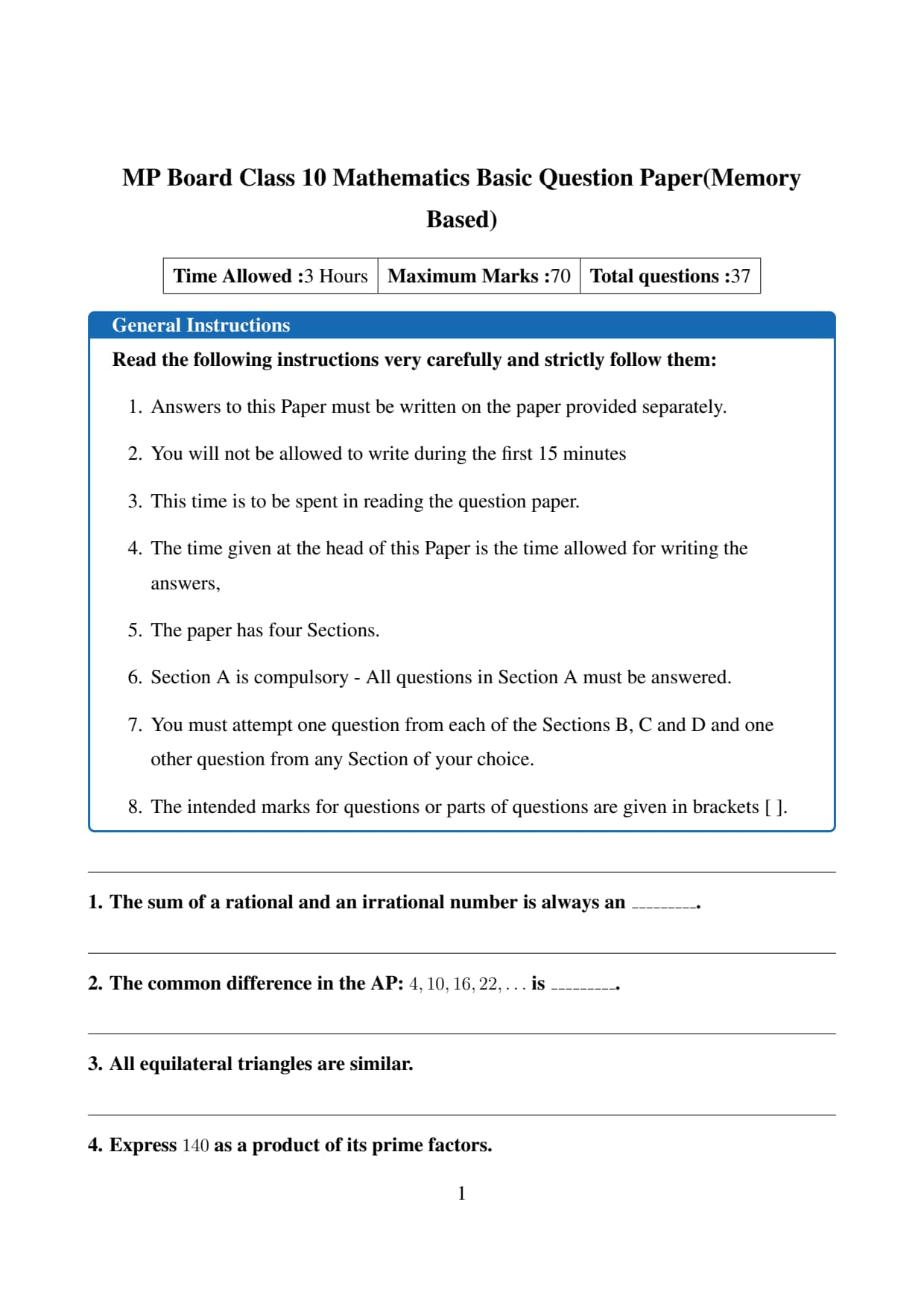
The sum of a rational and an irrational number is always an _________.
View Solution
Concept:
A rational number can be written in the form \(\frac{p}{q}\), where \(p, q\) are integers and \(q \ne 0\).
An irrational number cannot be written in fractional form (e.g., \(\sqrt{2}, \pi\)).
Explanation:
Let: \[ r = rational number, \quad x = irrational number \]
Assume their sum is rational: \[ r + x = y \quad (rational) \]
Then, \[ x = y - r \]
Since the difference of two rational numbers is rational, this would imply \(x\) is rational.
But this contradicts the fact that \(x\) is irrational.
Conclusion:
Hence, the sum of a rational and an irrational number is always: \[ \boxed{Irrational} \] Quick Tip: Key results to remember: Rational + Irrational = Irrational Rational \(\times\) Irrational = Irrational (generally) Irrational + Irrational may be rational or irrational These are common exam fill-in-the-blanks.
The common difference in the AP: \(4, 10, 16, 22, \ldots\) is _________.
View Solution
Concept:
In an Arithmetic Progression (A.P.), the common difference is the difference between any two consecutive terms: \[ d = a_2 - a_1 \]
Step 1: Identify first two terms \[ a_1 = 4, \quad a_2 = 10 \]
Step 2: Find the common difference \[ d = 10 - 4 = 6 \]
Verification: \[ 16 - 10 = 6, \quad 22 - 16 = 6 \]
So, the difference is constant.
Conclusion: \[ \boxed{6} \] Quick Tip: To find common difference quickly: \[ d = second term - first term \] Always check one more pair to confirm it is an A.P.
All equilateral triangles are similar.
View Solution
Concept:
Two triangles are similar if:
Their corresponding angles are equal (AAA similarity), or
Their corresponding sides are proportional.
Explanation:
In an equilateral triangle:
All three sides are equal.
All three angles are \(60^\circ\).
Consider any two equilateral triangles: \[ \triangle ABC \quad and \quad \triangle PQR \]
Then, \[ \angle A = \angle B = \angle C = 60^\circ \] \[ \angle P = \angle Q = \angle R = 60^\circ \]
So, corresponding angles are equal.
Using AAA similarity criterion:
If all corresponding angles of two triangles are equal, then the triangles are similar.
Hence, \[ \triangle ABC \sim \triangle PQR \]
Conclusion:
All equilateral triangles have the same angles, so they are always similar.
\[ \boxed{All equilateral triangles are similar.} \] Quick Tip: Remember: Equilateral triangle → all angles \(60^\circ\). Same angles ⇒ AAA similarity ⇒ triangles are similar. But they may not be congruent (sizes can differ).
Express \(140\) as a product of its prime factors.
View Solution
Concept:
Prime factorization means expressing a number as a product of prime numbers only.
Step 1: Divide by smallest prime number \[ 140 \div 2 = 70 \]
Step 2: Divide again by 2 \[ 70 \div 2 = 35 \]
Step 3: Divide by next prime \[ 35 \div 5 = 7 \]
Step 4: Final prime \[ 7 \div 7 = 1 \]
So, prime factors are: \[ 2, 2, 5, 7 \]
Step 5: Write in exponential form \[ 140 = 2^2 \times 5 \times 7 \]
Final Answer: \[ \boxed{2^2 \times 5 \times 7} \] Quick Tip: For prime factorization: Start dividing by 2, then 3, 5, 7, etc. Stop when quotient becomes 1. Write repeated primes using powers. This is useful for HCF and LCM problems.
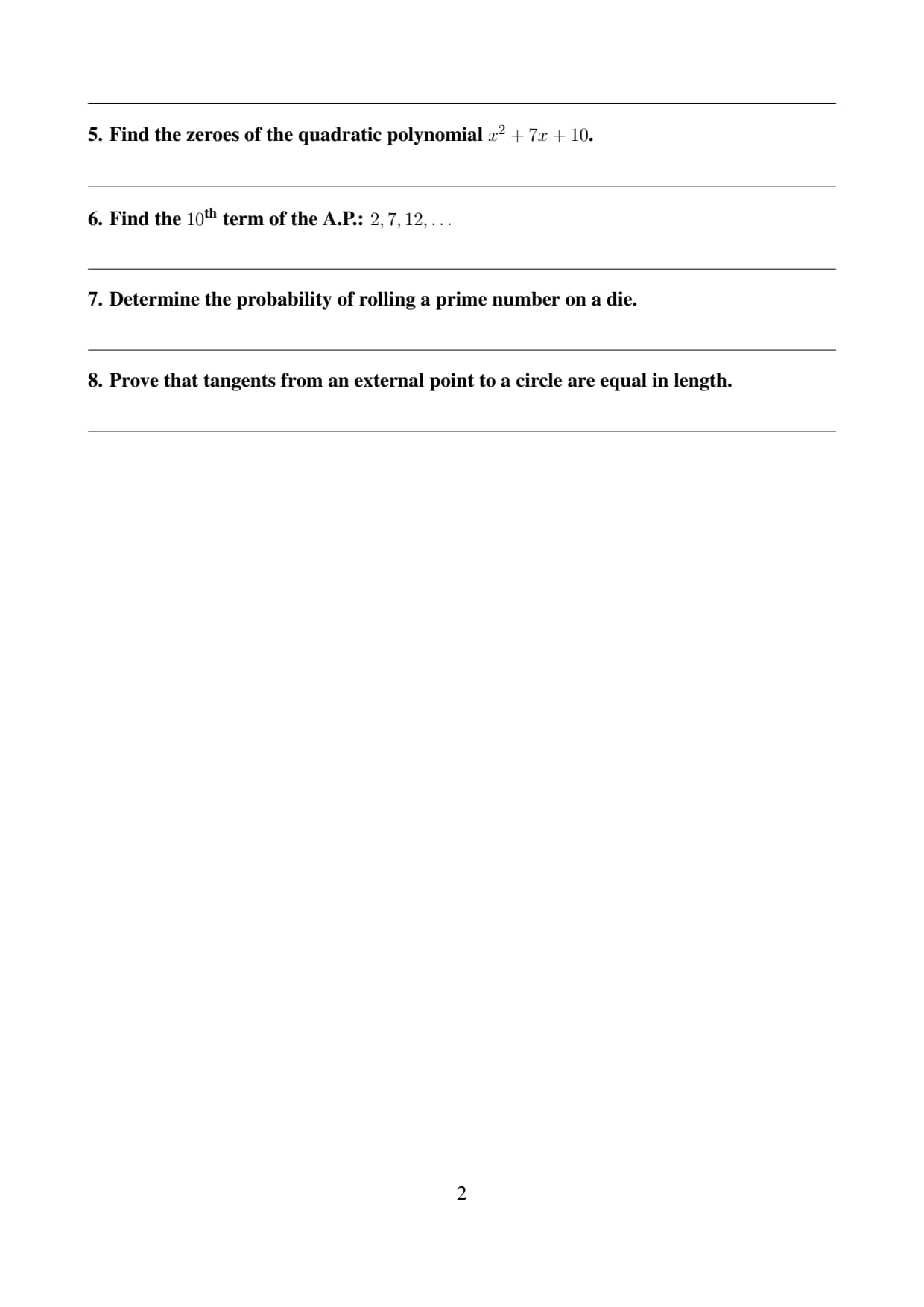
Find the zeroes of the quadratic polynomial \(x^2 + 7x + 10\).
View Solution
Concept:
The zeroes of a quadratic polynomial are the values of \(x\) that make the polynomial equal to zero.
We solve: \[ x^2 + 7x + 10 = 0 \]
Step 1: Factorize the quadratic
We need two numbers whose:
Sum = 7
Product = 10
These numbers are \(5\) and \(2\).
Step 2: Split the middle term \[ x^2 + 5x + 2x + 10 = 0 \]
Step 3: Factor by grouping \[ x(x + 5) + 2(x + 5) = 0 \]
\[ (x + 5)(x + 2) = 0 \]
Step 4: Find zeroes \[ x + 5 = 0 \Rightarrow x = -5 \] \[ x + 2 = 0 \Rightarrow x = -2 \]
Final Answer: \[ \boxed{x = -5, \; -2} \] Quick Tip: For quick factorization: Find two numbers whose sum = middle coefficient. Product = constant term. If factorization is difficult, use quadratic formula.
Find the \(10^{th}\) term of the A.P.: \(2, 7, 12, \ldots\)
View Solution
Concept:
The \(n^{th}\) term of an Arithmetic Progression (A.P.) is given by: \[ a_n = a + (n-1)d \]
where:
\(a\) = first term
\(d\) = common difference
Step 1: Identify values \[ a = 2, \quad d = 7 - 2 = 5, \quad n = 10 \]
Step 2: Apply formula \[ a_{10} = 2 + (10 - 1)\times 5 \]
\[ = 2 + 9 \times 5 \]
\[ = 2 + 45 = 47 \]
Final Answer: \[ \boxed{47} \] Quick Tip: To find any term of an A.P.: \[ a_n = a + (n-1)d \] This is one of the most frequently used formulas in A.P. problems.
Determine the probability of rolling a prime number on a die.
View Solution
Concept:
Probability is defined as: \[ Probability = \frac{Number of favourable outcomes}{Total number of possible outcomes} \]
A standard die has 6 faces numbered: \[ 1, 2, 3, 4, 5, 6 \]
Step 1: Identify prime numbers on a die
Prime numbers are numbers greater than 1 that have only two factors (1 and itself).
Prime numbers between 1 and 6: \[ 2, 3, 5 \]
Step 2: Count favourable outcomes
Number of prime numbers = 3
Step 3: Total outcomes
Total outcomes when rolling a die = 6
Step 4: Find probability \[ P(prime number) = \frac{3}{6} = \frac{1}{2} \]
Final Answer: \[ \boxed{\frac{1}{2}} \] Quick Tip: Steps for probability: List all possible outcomes. Identify favourable outcomes. Use \(\frac{favourable}{total}\). Always simplify the fraction to lowest form.
Prove that tangents from an external point to a circle are equal in length.
View Solution
Concept:
A tangent to a circle is perpendicular to the radius at the point of contact.
We prove the result using congruent triangles.
Given:
Let \(P\) be an external point, and \(PA\) and \(PB\) be tangents to a circle with center \(O\), touching the circle at \(A\) and \(B\) respectively.
To Prove: \[ PA = PB \]
Construction:
Join \(OA\), \(OB\), and \(OP\).
Proof:
Step 1: Radius is perpendicular to tangent \[ OA \perp PA \quad and \quad OB \perp PB \]
So, \[ \angle OAP = \angle OBP = 90^\circ \]
Step 2: Consider triangles \(\triangle OAP\) and \(\triangle OBP\)
We have:
\(OA = OB\) (radii of the same circle)
\(OP = OP\) (common side)
\(\angle OAP = \angle OBP = 90^\circ\)
Step 3: Apply RHS congruence \[ \triangle OAP \cong \triangle OBP \quad (RHS) \]
Step 4: Corresponding parts are equal \[ PA = PB \]
Conclusion:
Hence, tangents drawn from an external point to a circle are equal in length. Quick Tip: To prove tangent properties: Join center to points of contact. Use radius ⟂ tangent property. Apply RHS congruence. This is a standard geometry proof.



Comments