




UP Board is conducting the Class 10 Science Board Exam 2026 on February 25, 2026. Class 10 Science Question Paper with Solution PDF is available here for download.
The official question paper of UP Board Class 10 Science Board Exam 2026 is provided below. Students can download the official paper in PDF format for reference.
UP Board Class 10 2026 Science Question Paper with Solution PDF
| UP Board Class 10 2026 Science Question Paper with Solution PDF | Download PDF | Check Solutions |
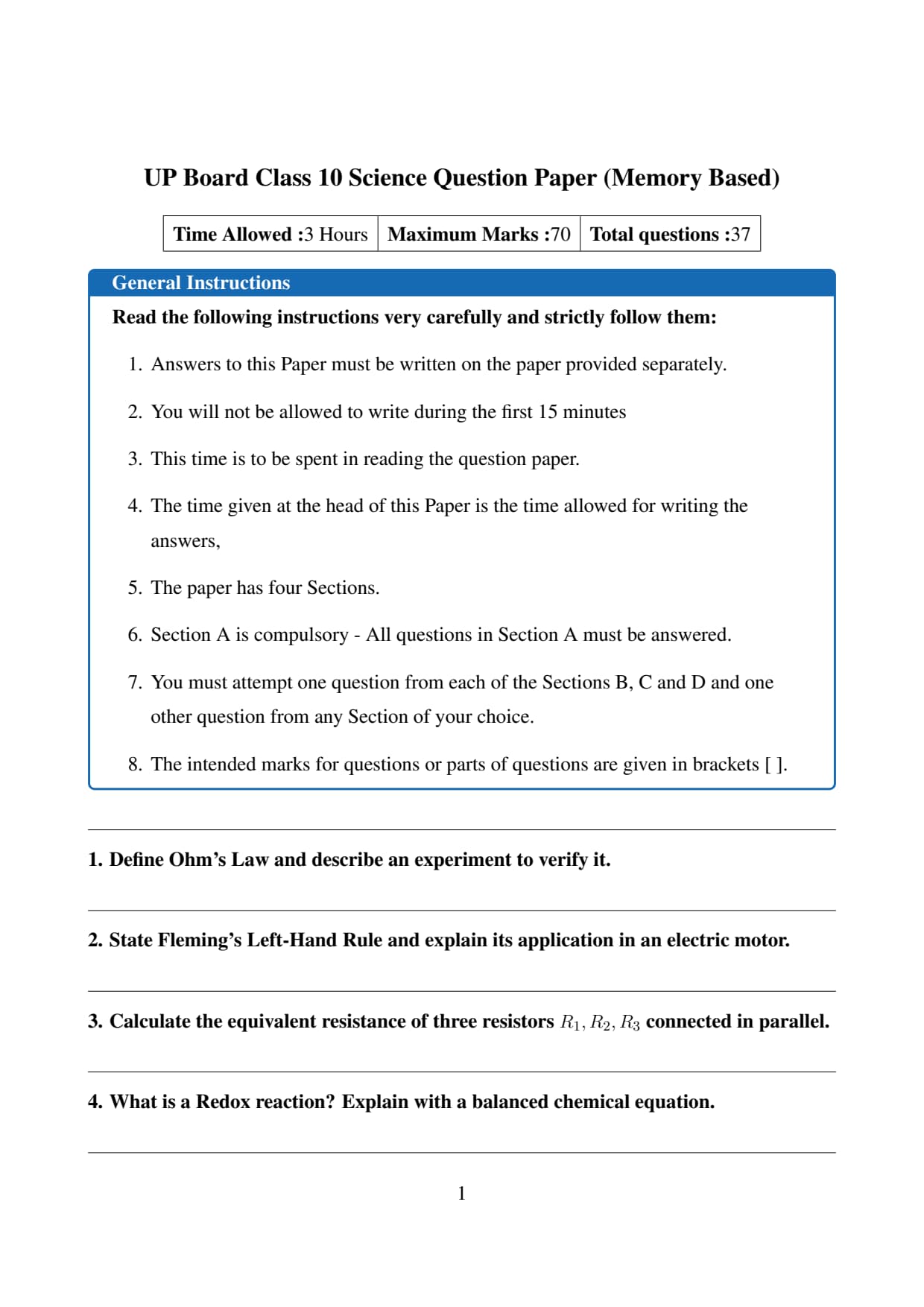
Define Ohm’s Law and describe an experiment to verify it.
View Solution
Concept:
Ohm’s Law is a fundamental principle in electricity that relates current, voltage, and resistance in an electrical conductor. It states that the current flowing through a conductor is directly proportional to the potential difference across its ends, provided the temperature and other physical conditions remain constant.
Mathematically,
[
V \propto I \quad \Rightarrow \quad V = IR
]
where:
( V ) = Potential difference (Volts)
( I ) = Current (Amperes)
( R ) = Resistance (Ohms)
Thus, the ratio \[ \frac{V}{I} = R \] remains constant and is equal to the resistance of the conductor.
Experimental Verification of Ohm’s Law:
Apparatus Required:
Battery or DC power supply
Rheostat (variable resistor)
Ammeter
Voltmeter
Resistance wire (nichrome wire)
Plug key and connecting wires
Circuit Diagram:
The ammeter is connected in series with the resistor and battery, while the voltmeter is connected in parallel across the resistor.
Procedure:
Connect the circuit as described: battery, rheostat, ammeter, and resistor in series.
Connect the voltmeter in parallel across the resistor.
Close the key and adjust the rheostat to allow a small current to flow.
Note the readings of the ammeter (current) and voltmeter (voltage).
Change the rheostat setting to vary the current and record multiple sets of ( V ) and ( I ) readings.
Tabulate the observations.
Observation and Result:
For each set of readings, calculate the ratio ( \frac{V{I ).
It is found that the ratio remains nearly constant for all observations.
Alternatively, plotting a graph between voltage (V) and current (I) gives a straight line passing through the origin. This confirms:
[
V \propto I
]
Hence, Ohm’s Law is verified experimentally.
Conclusion:
The experiment shows that the current through a conductor is directly proportional to the potential difference across it when temperature remains constant. The slope of the ( V-I ) graph gives the resistance of the conductor. Quick Tip: To verify Ohm’s Law: * Keep temperature constant, * Take multiple readings of voltage and current, * A straight-line ( V\text{-I ) graph through origin confirms Ohmic behavior.
State Fleming’s Left-Hand Rule and explain its application in an electric motor.
View Solution
Concept:
Fleming’s Left-Hand Rule gives the direction of the force acting on a current-carrying conductor placed in a magnetic field. It is based on the interaction between magnetic field and electric current, which produces mechanical force.
Statement of Fleming’s Left-Hand Rule:
If we stretch the thumb, forefinger, and middle finger of the left hand mutually perpendicular to each other, then:
Forefinger represents the direction of the magnetic field (B),
Middle finger represents the direction of current (I),
Thumb represents the direction of force or motion (F) acting on the conductor.
Application in an Electric Motor:
An electric motor works on the principle that a current-carrying conductor placed in a magnetic field experiences a force.
Explanation:
In a simple DC motor, a rectangular coil is placed between the poles of a magnet.
When current flows through the coil, each side of the coil experiences a force due to the magnetic field.
According to Fleming’s Left-Hand Rule, the direction of force on the two sides of the coil is opposite.
These opposite forces form a couple, causing the coil to rotate.
The split ring commutator reverses the direction of current after every half rotation, ensuring continuous rotation of the coil.
Conclusion:
Fleming’s Left-Hand Rule helps determine the direction of motion of the coil in an electric motor. It explains how electrical energy is converted into mechanical energy. Quick Tip: Left Hand = Motor Rule. Thumb → Motion, Forefinger → Magnetic Field, Middle Finger → Current.
Calculate the equivalent resistance of three resistors \( R_1, R_2, R_3 \) connected in parallel.
View Solution
Concept:
When resistors are connected in parallel, the potential difference across each resistor is the same, but the current divides among the branches. The total current is equal to the sum of currents through each resistor.
Using Ohm’s Law: \[ I = \frac{V}{R} \]
Derivation of Equivalent Resistance:
Let the equivalent resistance of the parallel combination be \( R_{eq} \).
If a potential difference \( V \) is applied across the combination:
Current through each resistor: \[ I_1 = \frac{V}{R_1}, \quad I_2 = \frac{V}{R_2}, \quad I_3 = \frac{V}{R_3} \]
Total current in the circuit: \[ I = I_1 + I_2 + I_3 \] \[ I = \frac{V}{R_1} + \frac{V}{R_2} + \frac{V}{R_3} \]
But from Ohm’s Law for the equivalent resistance: \[ I = \frac{V}{R_{eq}} \]
Equating both expressions for total current: \[ \frac{V}{R_{eq}} = \frac{V}{R_1} + \frac{V}{R_2} + \frac{V}{R_3} \]
Dividing both sides by \( V \): \[ \frac{1}{R_{eq}} = \frac{1}{R_1} + \frac{1}{R_2} + \frac{1}{R_3} \]
Final Result: \[ R_{eq} = \left( \frac{1}{R_1} + \frac{1}{R_2} + \frac{1}{R_3} \right)^{-1} \]
Thus, the reciprocal of the equivalent resistance is equal to the sum of reciprocals of individual resistances. Quick Tip: For resistors in parallel: - Voltage is same across each resistor, - Current divides, - Equivalent resistance is always less than the smallest resistor.
What is a Redox reaction? Explain with a balanced chemical equation.
View Solution
Concept:
A Redox reaction (Reduction-Oxidation reaction) is a chemical reaction in which oxidation and reduction occur simultaneously. These reactions involve the transfer of electrons between substances.
Definitions:
Oxidation: Loss of electrons or addition of oxygen or removal of hydrogen.
Reduction: Gain of electrons or removal of oxygen or addition of hydrogen.
Since electrons lost by one substance are gained by another, oxidation and reduction always occur together in a redox reaction.
Example with Balanced Chemical Equation:
Consider the reaction between zinc and copper(II) sulphate solution: \[ Zn + CuSO_4 \rightarrow ZnSO_4 + Cu \]
Explanation:
Zinc loses electrons to form zinc ions:
\[ Zn \rightarrow Zn^{2+} + 2e^- \quad (Oxidation) \]
Copper ions gain electrons to form copper metal:
\[ Cu^{2+} + 2e^- \rightarrow Cu \quad (Reduction) \]
Thus, zinc is oxidized and copper ions are reduced.
Conclusion:
A redox reaction involves simultaneous oxidation and reduction through transfer of electrons. Such reactions are common in corrosion, respiration, photosynthesis, and electrochemical cells. Quick Tip: Remember: OIL RIG rule — Oxidation Is Loss (of electrons), Reduction Is Gain (of electrons).
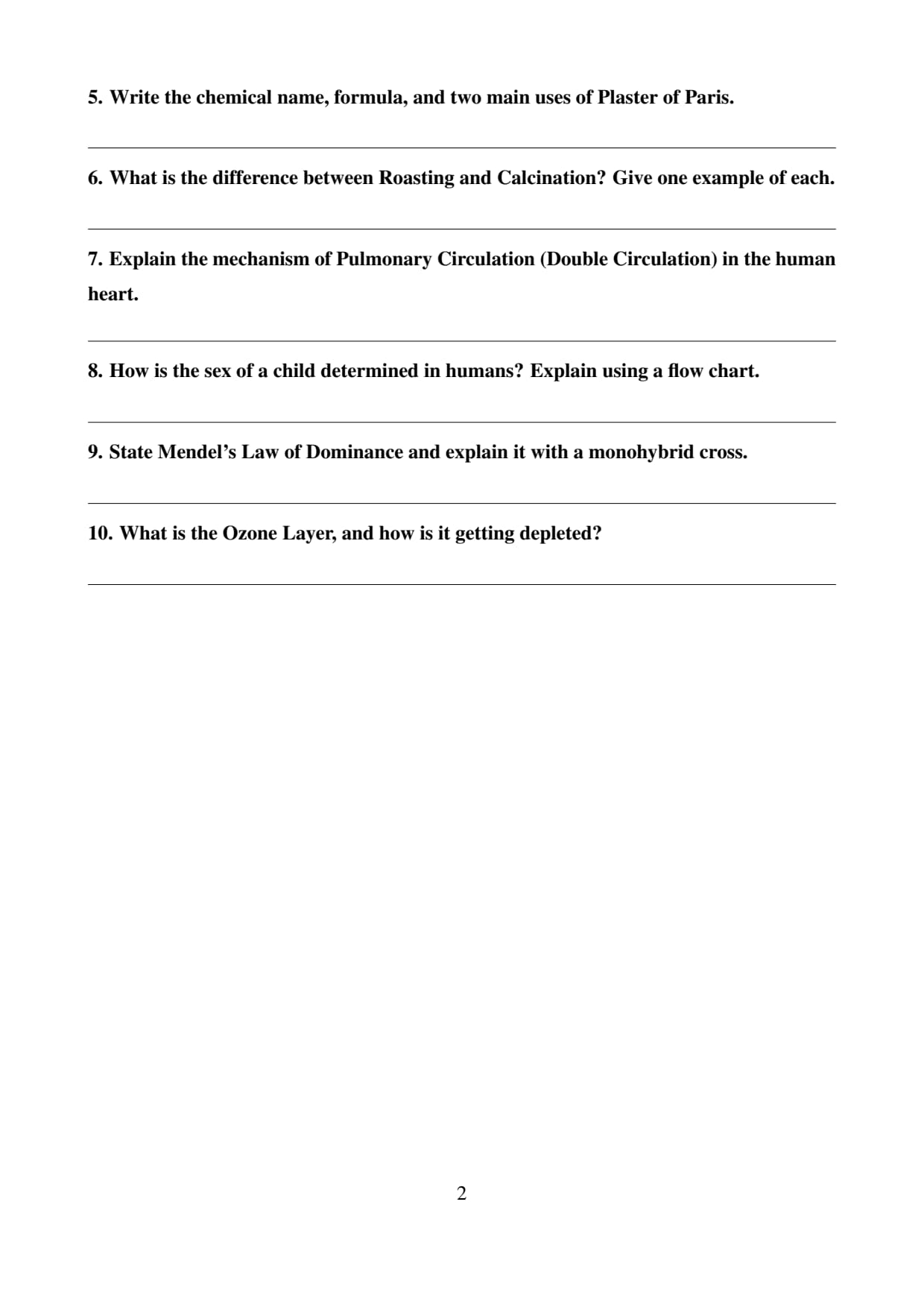
Write the chemical name, formula, and two main uses of Plaster of Paris.
View Solution
Concept:
Plaster of Paris (POP) is a white powder obtained by heating gypsum at a controlled temperature. It is widely used due to its property of setting quickly when mixed with water.
Chemical Name and Formula:
Chemical Name: Calcium sulphate hemihydrate
Chemical Formula: \( CaSO_4 \cdot \frac{1}{2}H_2O \)
It is prepared by heating gypsum: \[ CaSO_4 \cdot 2H_2O \xrightarrow{100^\circ C - 120^\circ C} CaSO_4 \cdot \frac{1}{2}H_2O + \frac{3}{2}H_2O \]
Main Uses of Plaster of Paris:
Medical Use:
Used for making casts to support fractured bones because it sets quickly and becomes hard.
Decorative and Moulding Work:
Used in making statues, toys, decorative items, and moulds for pottery and ceramics.
Conclusion:
Plaster of Paris is calcium sulphate hemihydrate, widely used in medicine and moulding due to its quick-setting property. Quick Tip: POP sets quickly when mixed with water and converts back to gypsum. That is why it is ideal for casts and moulds.
What is the difference between Roasting and Calcination? Give one example of each.
View Solution
Concept:
Roasting and calcination are metallurgical processes used to convert ores into oxides before extracting metals. They involve heating ores under different conditions of air supply.
Difference between Roasting and Calcination:
\begin{tabular{|c|c|c|
\hline
Basis & Roasting & Calcination
\hline
Definition & Heating ore in excess air & Heating ore in limited or no air
\hline
Type of ores & Sulphide ores & Carbonate or hydrated ores
\hline
Gas released & Produces \( SO_2 \) gas & Produces \( CO_2 \) or water vapour
\hline
Purpose & Converts sulphides into oxides & Removes moisture and volatile impurities
\hline
\end{tabular
Example of Roasting:
Heating zinc sulphide in excess air: \[ 2ZnS + 3O_2 \rightarrow 2ZnO + 2SO_2 \]
Example of Calcination:
Heating calcium carbonate in absence of air: \[ CaCO_3 \xrightarrow{\Delta} CaO + CO_2 \]
Conclusion:
Roasting is used mainly for sulphide ores in presence of excess air, while calcination is used for carbonate or hydrated ores in limited or no air. Both processes help convert ores into oxides for easier metal extraction. Quick Tip: Roasting = Sulphide ores + excess air. Calcination = Carbonate ores + limited air.
Explain the mechanism of Pulmonary Circulation (Double Circulation) in the human heart.
View Solution
Concept:
Double circulation is a characteristic feature of the human circulatory system in which blood passes through the heart twice during one complete cycle. It consists of:
Pulmonary circulation (heart ↔ lungs)
Systemic circulation (heart ↔ body)
Pulmonary circulation specifically refers to the flow of deoxygenated blood from the heart to the lungs and back to the heart after oxygenation.
Mechanism of Pulmonary Circulation:
Step-by-step process:
Entry of Deoxygenated Blood into Right Atrium:
Deoxygenated blood from different parts of the body enters the right atrium through the superior and inferior vena cava.
Flow into Right Ventricle:
The right atrium contracts and pushes blood into the right ventricle through the tricuspid valve.
Pumping to Lungs:
The right ventricle contracts and pumps deoxygenated blood into the pulmonary artery through the pulmonary valve.
Oxygenation in Lungs:
In the lungs, carbon dioxide is released and oxygen is absorbed by the blood in the alveoli through gaseous exchange.
Return of Oxygenated Blood:
Oxygen-rich blood returns to the heart through pulmonary veins and enters the left atrium.
Why it is called Double Circulation:
In one complete cycle of blood flow:
First circulation: Heart → Lungs → Heart (Pulmonary circulation)
Second circulation: Heart → Body → Heart (Systemic circulation)
Thus, blood passes through the heart twice in one complete cycle, hence the term double circulation.
Significance:
Ensures complete separation of oxygenated and deoxygenated blood.
Maintains high efficiency of oxygen supply to body tissues.
Supports high metabolic activity in humans.
Conclusion:
Pulmonary circulation carries deoxygenated blood from the right side of the heart to the lungs for oxygenation and returns oxygenated blood to the left side of the heart. Together with systemic circulation, it forms the double circulation system of humans. Quick Tip: Pulmonary circulation = Right heart → Lungs → Left heart. Double circulation = Blood passes through heart twice in one cycle.
How is the sex of a child determined in humans? Explain using a flow chart.
View Solution
Concept:
In humans, sex determination depends on the type of sex chromosomes contributed by the parents during fertilization. Humans have 23 pairs of chromosomes, out of which one pair is the sex chromosomes.
Females: XX (homogametic)
Males: XY (heterogametic)
The mother always contributes an X chromosome, while the father can contribute either X or Y chromosome. Hence, the sex of the child is determined by the father.
Explanation:
All ova (eggs) produced by the mother carry only X chromosome.
Sperms produced by the father are of two types:
X-bearing sperm
Y-bearing sperm
Fertilization outcome:
X sperm + X ovum → XX (Female child)
Y sperm + X ovum → XY (Male child)
Flow Chart Representation:
\[ Father (XY) \quad + \quad Mother (XX) \]
\[ \begin{array}{c} Father produces two types of sperms
\downarrow
X-sperm \quad \quad Y-sperm \end{array} \]
\[ \begin{array}{c} Mother produces ova (only X)
\downarrow \end{array} \]
\[ \begin{array}{ccc} X (ovum) + X (sperm) & \Rightarrow & XX (Girl)
X (ovum) + Y (sperm) & \Rightarrow & XY (Boy) \end{array} \]
Conclusion:
The sex of a child in humans is determined by the type of sperm (X or Y) that fertilizes the ovum. Therefore, the father is responsible for determining the sex of the child. Quick Tip: Mother always gives X chromosome. Father gives X or Y. XX = Girl, XY = Boy.
State Mendel’s Law of Dominance and explain it with a monohybrid cross.
View Solution
Concept:
Mendel’s Law of Dominance is one of the fundamental principles of heredity proposed by Gregor Mendel. It explains how traits are expressed when two contrasting alleles are present in an organism.
Statement of Mendel’s Law of Dominance:
When two contrasting traits are present in an organism, only one trait is expressed in the F\(_1\) generation. The expressed trait is called the dominant trait, while the suppressed trait is called the recessive trait.
Explanation using Monohybrid Cross:
A monohybrid cross involves the inheritance of a single pair of contrasting characters.
Example: Height in pea plants
Tall plant (TT) — Dominant
Dwarf plant (tt) — Recessive
Parental Generation (P): \[ TT (Tall) \times tt (Dwarf) \]
Gametes formed: \[ T, T \quad and \quad t, t \]
F\(_1\) Generation: \[ Tt, Tt, Tt, Tt \]
All offspring are tall because the dominant allele (T) masks the recessive allele (t).
F\(_2\) Generation (Selfing F\(_1\)): \[ Tt \times Tt \]
Punnett Square: \[ \begin{array}{c|cc} & T & t
\hline T & TT & Tt
t & Tt & tt
\end{array} \]
Results:
Genotypic ratio: 1 TT : 2 Tt : 1 tt
Phenotypic ratio: 3 Tall : 1 Dwarf
The appearance of dwarf plants in F\(_2\) shows that the recessive trait was present but masked in F\(_1\).
Conclusion:
Mendel’s Law of Dominance states that in a pair of contrasting traits, only the dominant trait is expressed in the F\(_1\) generation, while the recessive trait remains hidden but reappears in the F\(_2\) generation. Quick Tip: Dominant trait appears in F\(_1\), Recessive trait hides but reappears in F\(_2\). Monohybrid cross shows 3:1 phenotypic ratio.
What is the Ozone Layer, and how is it getting depleted?
View Solution
Concept:
The ozone layer is a region of the Earth's stratosphere that contains a high concentration of ozone gas (\( O_3 \)). It plays a vital role in protecting life on Earth by absorbing harmful ultraviolet (UV) radiation from the Sun.
What is the Ozone Layer?
Located in the stratosphere at an altitude of about 10–50 km above the Earth’s surface.
Contains ozone molecules (\( O_3 \)) formed by the action of UV rays on oxygen.
Acts as a protective shield by absorbing most of the harmful UV-B radiation.
Ozone Layer Depletion:
Ozone depletion refers to the thinning of the ozone layer due to destruction of ozone molecules by certain human-made chemicals.
Main Causes:
Chlorofluorocarbons (CFCs):
Used in refrigerators, air conditioners, aerosol sprays, and foam packaging. In the stratosphere, UV rays break CFCs to release chlorine atoms that destroy ozone.
Halons and Nitrogen Oxides:
Found in fire extinguishers and industrial emissions; they also contribute to ozone breakdown.
Aerosols and Industrial Pollution:
Release ozone-depleting substances into the atmosphere.
Mechanism of Ozone Destruction (Simplified): \[ CFC \xrightarrow{UV} Cl + Other products \] \[ Cl + O_3 \rightarrow ClO + O_2 \] \[ ClO + O \rightarrow Cl + O_2 \]
The chlorine atom is regenerated and continues destroying more ozone molecules.
Effects of Ozone Depletion:
Increased UV radiation reaching Earth.
Skin cancer and eye damage in humans.
Harm to plants and marine ecosystems.
Global warming imbalance.
Conclusion:
The ozone layer is essential for protecting life from harmful UV radiation. Human activities releasing CFCs and other pollutants are causing its depletion, making environmental protection measures crucial. Quick Tip: Ozone layer = UV shield of Earth. CFCs release chlorine that destroys ozone repeatedly. Less ozone → More harmful UV rays.



Comments