




Kerala Plus Two 2025 Business Studies (SY-648) Model Question Paper with solutions PDFs are now available for download. The Kerala Plus Two Physics Model Examination 2025 was conducted by the Directorate of Higher Secondary Education (DHSE), Kerala, to help students prepare for the final board exams. The paper is designed as per the latest syllabus and exam pattern prescribed for the academic year 2025–26.
Kerala Plus Two 2025 Business Studies (SY-648) Model Question Paper with solutions
| Kerala Plus Two 2025 Business Studies (SY-648) Model Question Paper |  Download Download |
Check Solutions |

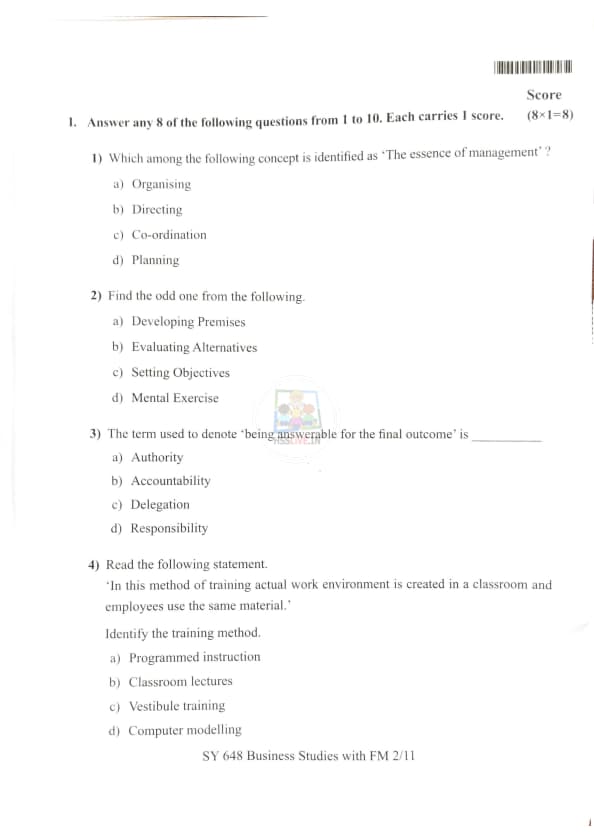
Which among the following concept is identified as ‘The essence of management’?
View Solution
Step 1: Understanding the concept of co-ordination
Co-ordination is often referred to as the essence of management. It involves the process of aligning the efforts of individuals and teams in an organisation towards a common goal. Effective co-ordination ensures that the organisation's activities are harmonious and efficient.
Step 2: Explanation of each option
- Organising: Organising involves arranging resources and tasks in a systematic way. While important, it is not the essence of management.
- Directing: Directing refers to leading and motivating the team to carry out tasks. It plays a key role but is not considered the essence of management.
- Co-ordination: Co-ordination ensures smooth and efficient functioning by integrating all efforts and resources towards a common goal, making it the essence of management.
- Planning: Planning is fundamental to management but does not have the same integrating role as co-ordination.
Step 3: Conclusion
While all functions are crucial, co-ordination is considered the essence of management because it synchronises all activities within an organisation.
Final Answer:
Co-ordination Quick Tip: Co-ordination is the key to ensuring all activities in an organisation work together smoothly, making it the essence of management.
Find the odd one from the following.
View Solution
Step 1: Understanding the terms
- Developing Premises: Premises are the underlying assumptions or conditions on which planning is based. This is part of the planning process.
- Evaluating Alternatives: This is part of the decision-making process, which involves considering different options and choosing the best one.
- Setting Objectives: Setting objectives is the initial step in the planning process, where clear goals are defined to guide the organisation.
- Mental Exercise: This refers to an activity that involves mental effort, but it is not directly related to the formal steps of the planning or decision-making process. It stands apart from the strategic or operational processes involved in planning and decision-making.
Step 2: Conclusion
While all the other options are part of strategic decision-making and planning processes, "Mental Exercise" does not belong to the same category. It is unrelated to formal planning and decision-making steps.
Final Answer:
Mental Exercise Quick Tip: In decision-making and planning, developing premises, evaluating alternatives, and setting objectives are key steps, while mental exercise is not directly related to these processes.
The term used to denote ‘being answerable for the final outcome’ is
View Solution
Step 1: Understanding the concept of accountability
Accountability refers to being answerable for the outcomes of a task or responsibility. In a managerial context, when someone is accountable, they are held responsible for the final results and must explain their actions and decisions.
Step 2: Explanation of the other terms
- Authority: Authority refers to the power or right to make decisions, give orders, and enforce rules. It does not directly imply being answerable for outcomes.
- Delegation: Delegation involves assigning tasks and responsibilities to others, but it does not inherently mean being answerable for the results of those tasks.
- Responsibility: Responsibility refers to the duty or obligation to complete tasks, but accountability goes a step further by holding someone answerable for the final outcome.
Step 3: Conclusion
Accountability is the term used to denote being answerable for the final outcome, as it involves the obligation to report on the results and actions.
Final Answer:
Accountability Quick Tip: Accountability is about being answerable for the results, whereas responsibility refers to the duties assigned.
Read the following statement.
'In this method of training, actual work environment is created in a classroom and employees use the same material.'
Identify the training method.
View Solution
Step 1: Understanding vestibule training
Vestibule training is a method where employees are trained in an environment that closely simulates the actual work environment. In this method, trainees use the same equipment and materials they will use on the job, but they are in a classroom or training setting. This allows employees to practice skills in a controlled environment before moving to the actual workplace.
Step 2: Explanation of other methods
- Programmed instruction: This is a self-paced training method where learners work through materials at their own speed, often with immediate feedback. It does not involve simulating an actual work environment.
- Classroom lectures: This is a traditional teaching method where information is presented in a lecture format, but it does not simulate actual work conditions.
- Computer modelling: This method involves using computer simulations to model real-world scenarios, but it does not necessarily provide the same hands-on experience as vestibule training.
Step 3: Conclusion
Since the description matches creating a real work environment in a classroom, the correct answer is vestibule training.
Final Answer:
Vestibule training Quick Tip: Vestibule training allows employees to learn using the same equipment and materials in a controlled setting before applying their skills in the real workplace.
The integration of various economies of the world leading towards the emergence of a global economy is known as ________.
View Solution
The integration of various economies of the world leading towards the emergence of a global economy is known as Globalization.
Globalization refers to the process of increased interconnectedness and interdependence of the world's markets and businesses. This integration has led to the movement of goods, services, people, information, and ideas across international borders, creating a more global economy.
Globalization has been fueled by advances in technology, communication, and transportation, allowing economies to become more closely linked. It has also led to increased trade, investment, and cultural exchange. However, globalization also brings challenges such as income inequality, environmental degradation, and cultural homogenization.
Thus, the correct term for the integration of economies across the world is Globalization. Quick Tip: Globalization has made the world more interconnected, but it also presents challenges such as inequality and environmental issues.
Which one of the following is not a principle of directing?
View Solution
Step 1: Understanding the principles of directing
Directing is one of the key functions of management, involving guiding and supervising the activities of employees to achieve organizational goals. The principles of directing include:
- Harmony of objectives: This principle ensures that the goals of the organization and the employees align, leading to increased motivation and productivity.
- Follow through: This principle emphasizes that managers must ensure that plans and instructions are properly implemented and followed.
- Managerial communication: Effective communication between management and employees is crucial for successful directing, as it helps convey instructions and feedback.
Step 2: Explanation of the odd one
- Discipline: While discipline is important in an organization, it is not specifically a principle of directing. It is more of a foundational element for maintaining order and ensuring compliance with organizational norms.
Step 3: Conclusion
Discipline is essential for maintaining control, but it is not considered a principle of directing.
Final Answer:
Discipline Quick Tip: The principles of directing focus on guiding employees towards achieving organizational objectives, while discipline ensures order and compliance.
Planning and _______ are the two inseparable twin functions of management.
View Solution
The two inseparable twin functions of management are Planning and Organizing.
Planning:
- Planning is the foundational function of management. It involves setting objectives, determining the strategies to achieve those objectives, and establishing the actions required to reach those objectives.
- It involves thinking ahead and deciding the best course of action for achieving specific goals. It also involves allocating resources efficiently and ensuring that all areas of an organization are aligned to work towards common goals.
- Planning provides a clear sense of direction, reduces uncertainty, and ensures that organizational resources are used effectively. It serves as a roadmap for action and sets the stage for other management functions.
Organizing:
- Organizing is the process of arranging tasks, people, and resources to achieve the goals set out in the planning phase. It involves determining what tasks need to be done, who will do them, how the tasks will be accomplished, and who reports to whom.
- Organizing ensures that the required resources—such as people, capital, technology, and information—are in place to execute the plan efficiently. It also involves creating a structure for coordination and control.
- The organizing function ensures that each person or team has clear responsibilities, enabling smooth and effective execution of the plan. It helps in avoiding confusion and ensures that all resources are allocated optimally.
Relationship Between Planning and Organizing:
- Planning and Organizing are closely linked. Without a clear plan, organizing becomes a random and ineffective process, and without proper organizing, plans cannot be implemented effectively.
- For instance, when a company plans to launch a new product, the planning phase would involve defining the product, setting marketing strategies, estimating production costs, and setting goals. After this, the organizing function would involve arranging the necessary resources (e.g., production teams, marketing department, suppliers) to make the launch happen. Without effective organizing, the plan might not materialize.
- In essence, planning defines what needs to be done, while organizing determines how to do it and with which resources. Together, they help an organization achieve its objectives efficiently. Quick Tip: Planning and organizing work together as twin functions. Planning sets the goals, and organizing ensures that the necessary resources and structure are in place to achieve those goals.
Fill in the blanks.
et working capital = ______ - Current liabilities.
View Solution
The correct formula for Net Working Capital (NWC) is: \[ Net working capital = Current assets - Current liabilities. \]
This formula is a key measure of a company’s short-term financial health and operational efficiency. Let’s understand the components involved:
Current Assets:
- Current assets are assets that are expected to be converted into cash, sold, or consumed within one year or within the company’s operating cycle. These typically include:
- Cash and cash equivalents: Money available in the form of cash or assets that are easily convertible to cash.
- Accounts receivable: Money owed to the company by customers for goods or services already delivered.
- Inventory: Raw materials, work-in-progress, and finished goods that the company expects to sell within a year.
- Prepaid expenses: Payments made for services or goods to be received in the future, like insurance.
Current Liabilities:
- Current liabilities are obligations that a company needs to settle within one year. These typically include:
- Accounts payable: Amounts owed to suppliers for goods or services received but not yet paid for.
- Short-term loans: Borrowed money that must be repaid within a year.
- Accrued expenses: Expenses that have been incurred but not yet paid, such as wages or taxes.
Net Working Capital (NWC):
- Net working capital measures the company's ability to cover its short-term liabilities with its short-term assets. It gives a snapshot of the company’s liquidity and operational efficiency.
- A positive net working capital indicates that the company can cover its short-term debts with its short-term assets, which is generally a sign of good financial health.
- A negative net working capital indicates that the company might struggle to meet its short-term obligations and could face liquidity problems.
In essence, the formula for net working capital provides a clear picture of the company’s short-term financial position and its ability to manage cash flows effectively.
Thus, the formula for Net Working Capital is: \[ \boxed{Net working capital = Current assets - Current liabilities.} \] Quick Tip: Net working capital is crucial for assessing a company’s ability to pay off its short-term debts and manage day-to-day operations.
A brand or part of a brand that is given legal protection is called
View Solution
A trademark is a legally protected symbol, name, or design that distinguishes goods or services. It grants the owner exclusive rights to use it and prevents others from using a similar mark. This legal protection helps safeguard the brand's identity and prevent imitation or unauthorized use.
Step 1: Explanation of other options
- Label: A label provides information about the product, such as its contents, manufacturer, or instructions, but it does not provide legal protection.
- Brand name: A brand name is the name used to identify a brand, but it may not necessarily be legally protected unless it is trademarked.
- Brand mark: A brand mark refers to the logo or symbol representing the brand, but legal protection is granted through a trademark, not the brand mark itself.
Step 2: Conclusion
A trademark is the correct term for a brand or part of a brand that is given legal protection.
Final Answer:
Trademark Quick Tip: A trademark offers legal protection to a brand or symbol, helping prevent others from using it without permission.
Complete the circle in relation to marketing mix.
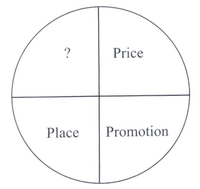
View Solution
In the marketing mix, there are four essential elements known as the "4 P's of Marketing": \[ \boxed{Product} \quad Price \quad Place \quad Promotion. \]
- Product: This refers to the goods or services a company offers to satisfy customer needs or wants. It includes everything from the product's features, design, quality, packaging, and after-sales services.
- Price: This is the amount of money customers must pay to acquire the product. Pricing strategies are essential and can vary based on factors such as demand, competition, and perceived value.
- Place: This refers to the distribution channels used to deliver the product to the consumer. It encompasses decisions regarding the locations where the product will be sold, whether it's in stores, online, or through other means.
- Promotion: This involves the marketing strategies and communications used to inform, persuade, and remind customers about the product. Promotion includes advertising, sales promotions, public relations, and personal selling.
The missing part of the circle is Product, completing the 4 P's of the marketing mix. Quick Tip: The 4 P's of marketing (Product, Price, Place, Promotion) are the key elements of any marketing strategy.
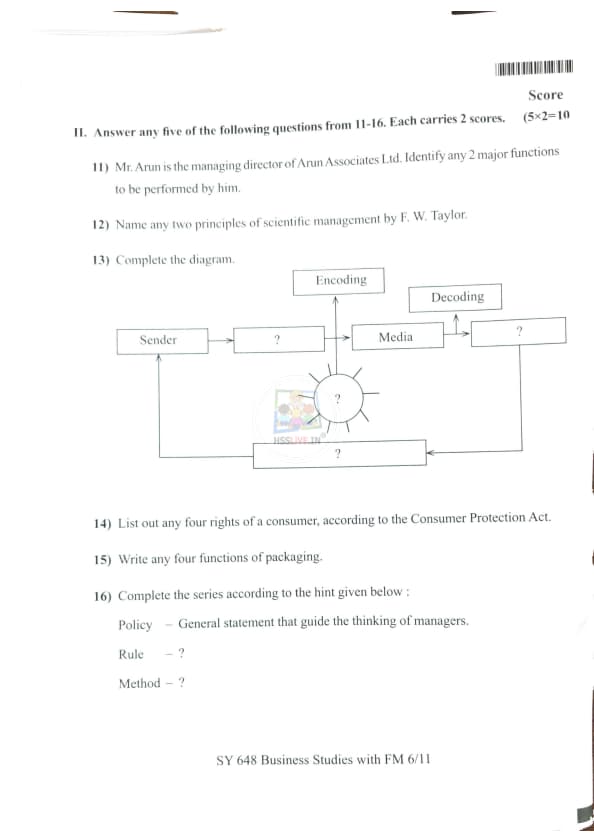
Mr. Arun is the managing director of Arun Associates Ltd. Identify any 2 major functions to be performed by him.
View Solution
As the Managing Director of Arun Associates Ltd, Mr. Arun would have multiple responsibilities to ensure the smooth functioning and growth of the organization. Two major functions that he would perform are:
1. Strategic Decision Making:
As the top executive in the company, Mr. Arun would be responsible for setting the long-term strategic direction of the company. He would need to make crucial decisions related to the company’s growth, expansion plans, new product development, market positioning, mergers, and acquisitions. These decisions are made based on detailed analysis, forecasting, and keeping the company aligned with its goals. Strategic decision-making involves considering future trends, economic conditions, and technological advancements.
In this function, Mr. Arun would work closely with the board of directors and other senior leaders to ensure that the company is positioned well in the market, remains competitive, and achieves long-term success.
2. Overseeing Operations and Managing Resources:
Another important function of Mr. Arun would be to oversee the daily operations of the company and ensure that resources are utilized efficiently. As a managing director, he would be responsible for ensuring that the company's operations are running smoothly and meeting performance expectations. This includes managing teams, supervising the production processes, ensuring effective use of equipment and human resources, and maintaining quality standards.
Mr. Arun would also need to monitor the performance of various departments and managers, evaluate key performance indicators (KPIs), and implement necessary changes to optimize operations. By ensuring that day-to-day operations align with the company’s goals, he would be able to contribute to increased productivity and profitability.
Thus, these two functions reflect his leadership role in both strategic planning and operational execution, helping the company achieve its goals. Quick Tip: The role of a Managing Director encompasses both high-level strategic decision-making and detailed operational oversight to ensure the company's long-term success and operational efficiency.
Name any two principles of scientific management by F. W. Taylor.
View Solution
F. W. Taylor, widely regarded as the father of scientific management, introduced several principles aimed at improving efficiency, productivity, and workers' performance in organizations. Two of his key principles are:
1. Scientific Selection and Training of Workers:
Taylor emphasized that workers should not be selected randomly or arbitrarily, but instead, scientific methods should be used to select the most suitable individuals for specific jobs. This principle focuses on identifying the most qualified individuals for the tasks at hand, based on their skills, abilities, and performance. After selection, the workers should be trained systematically in the best methods of performing the tasks. Taylor believed that scientific selection and training would lead to better productivity, job satisfaction, and reduced errors in work.
This principle ensures that workers are not only competent but also consistently improving in their work performance. For example, in a factory, workers would undergo specific training programs designed to increase their efficiency in performing repetitive tasks.
2. Standardization of Tools and Work Methods:
One of Taylor's most impactful principles was the standardization of tools, work methods, and equipment. He proposed that workers should be provided with the most efficient tools and methods for performing their tasks. By eliminating variations in how tasks are performed, the work can be done more efficiently and consistently. This principle emphasizes the importance of creating uniform work standards, such as establishing standard operating procedures, fixing the best tools for a task, and using time and motion studies to determine the most efficient way of performing a job.
For example, in a manufacturing process, all workers would use the same type of machinery, follow the same procedures, and have the same tools, ensuring that work is done efficiently with minimal variation. This principle minimizes waste, reduces confusion, and improves productivity.
Together, these principles of scientific management revolutionized the way organizations manage workers and resources, leading to greater efficiency and productivity. Quick Tip: Scientific management principles, such as the scientific selection and training of workers, and the standardization of tools and methods, aim to optimize worker performance and improve overall organizational efficiency.
Complete the diagram.
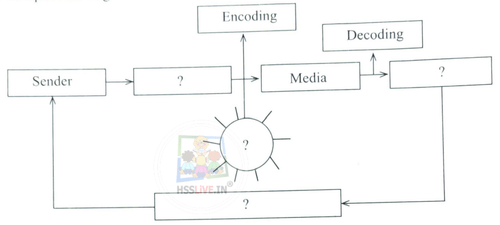
View Solution
The diagram represents the communication process, which is crucial in effective communication strategies. Below is the completion of the diagram:
- Sender: The individual or entity that originates the message. In communication, the sender is responsible for initiating the message and deciding its content.
- Encoding: This is the process through which the sender translates their thoughts or ideas into a message, typically using symbols, words, or gestures.
- Message: The message is the content of the communication, the information that is being conveyed from the sender to the receiver.
- Media: This is the medium or channel through which the message is transmitted, such as face-to-face conversation, email, phone, or social media.
- Decoding: This is the process through which the receiver interprets or makes sense of the message, turning the symbols, words, or gestures back into thoughts or understanding.
- Receiver: The person or entity who receives and interprets the message. The receiver then provides feedback to the sender.
- Feedback: The reaction or response from the receiver to the sender. Feedback can be verbal, non-verbal, or through actions that indicate how the message was understood.
Thus, the completed diagram would look like this:
\[ Sender \rightarrow Encoding \rightarrow Message \rightarrow Media \rightarrow Decoding \rightarrow Receiver \rightarrow Feedback. \] Quick Tip: The communication process involves the sender, encoding, message, media, decoding, receiver, and feedback. Each part plays a key role in ensuring effective communication.
List out any four rights of a consumer, according to the Consumer Protection Act.
View Solution
According to the Consumer Protection Act, consumers have the following four rights:
1. Right to Safety: Consumers have the right to be protected against the marketing of goods and services that are hazardous to life and property.
2. Right to Information: Consumers have the right to be informed about the quality, quantity, potency, purity, price, and standard of goods and services.
3. Right to Choose: Consumers have the right to choose from a variety of products and services at competitive prices without any unfair trade practices.
4. Right to Redressal: Consumers have the right to seek redressal against unfair trade practices or exploitation, such as defects in products or poor services.
These rights ensure that consumers are protected from exploitation and that they can make informed choices while purchasing goods and services. Quick Tip: Consumer rights empower individuals to make informed decisions and protect them from unsafe, deceptive, or unfair business practices.
Write any four functions of packaging.
View Solution
Packaging serves multiple functions, which play a crucial role in the protection, presentation, and distribution of products. The four major functions of packaging are:
1. Protection:
Packaging helps protect the product from external elements such as dust, moisture, light, and physical damage during transportation, storage, and handling. For example, a sealed plastic container can protect food from contamination.
2. Containment:
Packaging ensures that the product is properly contained, particularly for liquids and powders. It keeps the product in one place, preventing spillage or leakage. For instance, a bottle containing liquid detergent ensures that it does not spill.
3. Communication:
Packaging communicates essential information to the consumer, including product details such as ingredients, usage instructions, warnings, and expiration dates. The label on a medicine bottle provides all necessary information regarding dosage and side effects.
4. Convenience:
Packaging also makes it easier to store, use, and transport the product. Easy-to-open packaging, such as resealable bags or twist-off caps, enhances the user experience by providing convenience. For example, a ready-to-use food pack is more convenient than bulk packaging.
These functions ensure that packaging not only protects the product but also adds value to both manufacturers and consumers. Quick Tip: Packaging serves several vital functions, from protecting the product to making it easier to use and transport. It also plays a key role in branding and consumer communication.
Complete the series according to the hint given below:
Policy - General statement that guides the thinking of managers.
Rule - ?
Method - ?
View Solution
The series is based on the level of specificity or guidance that each term provides in the decision-making process. Here is the completion:
1. Rule:
A rule is a specific directive that mandates how certain tasks or operations should be performed. It is more specific than a policy and is designed to ensure consistency in practice. For example, a rule may state, "Employees must clock in by 9:00 AM."
2. Method:
A method refers to the established, standardized process for performing a task or procedure. It describes the specific steps or techniques used to achieve a goal. For example, a method for assembling a product might include detailed instructions, such as "First, attach part A to part B using screws, then tighten the screws using a wrench."
Thus, the complete series is:
- Policy - General statement that guides the thinking of managers.
- Rule - A directive that provides specific instructions or guidelines.
- Method - A set of steps or procedures used to complete a task.
Quick Tip: Policies are broad guidelines, rules are specific instructions, and methods are the step-by-step processes used to implement the rules.
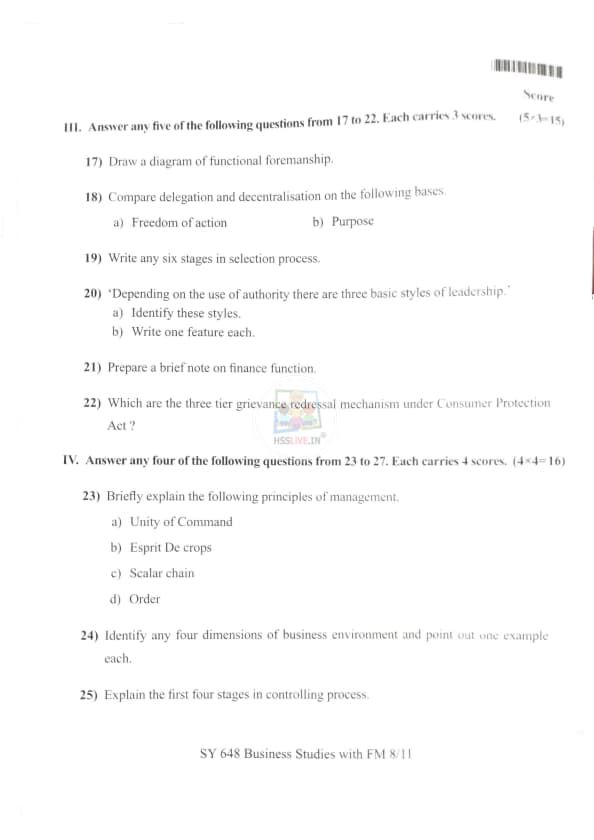
Draw a diagram of functional foremanship.
View Solution
Functional foremanship is a concept introduced by Frederick Taylor, a pioneer of scientific management. It involves the division of responsibilities for a worker's supervision into different specialized roles. This model divides the functions of a foreman into eight distinct roles, each focusing on one aspect of the worker's performance.
Below is the diagram of functional foremanship:
\[ \begin{array}{|c|c|c|} \hline \textbf{Planning} & \textbf{Production} & \textbf{Quality}
\hline Instruction Card Clerk & Gang Boss & Inspector
Route Clerk & Speed Boss & Repair Boss
Time and Cost Clerk & Shop Boss & Maintenance Boss
\hline \end{array} \]
In the above diagram:
- Planning Functions: Instruction Card Clerk, Route Clerk, Time and Cost Clerk.
- Production Functions: Gang Boss, Speed Boss, Shop Boss.
- Quality Functions: Inspector, Repair Boss, Maintenance Boss.
Each function is performed by a different specialist, creating a system where multiple foremen control different aspects of work to improve efficiency. Quick Tip: Functional foremanship divides the supervision of workers into specialized roles for better management and efficiency.
Compare delegation and decentralisation on the following bases.
a) Freedom of action
b) Purpose
View Solution
Comparison between Delegation and Decentralization:
a) Freedom of action:
- Delegation: In delegation, the authority to make decisions is transferred from a superior to a subordinate for specific tasks or activities. However, the ultimate responsibility remains with the superior. The subordinate has limited freedom of action since they must follow the guidelines set by the superior.
- Decentralization: In decentralization, the decision-making authority is distributed across various levels of management. Subordinates at different levels have greater freedom of action and the power to make decisions within their areas of responsibility. It allows for more autonomy than delegation.
b) Purpose:
- Delegation: The primary purpose of delegation is to assign specific tasks and responsibilities to subordinates, ensuring that work is done efficiently while maintaining control at higher levels of management. Delegation helps distribute workload but does not result in a significant shift of power or control.
- Decentralization: The purpose of decentralization is to give more power and authority to lower levels of management, promoting decision-making at multiple levels. It is aimed at creating a more flexible and responsive organization by reducing the burden on top management. Decentralization is usually done to improve efficiency, motivate managers, and improve responsiveness to local needs.
Thus, the key differences are that delegation involves transferring specific tasks and responsibilities, whereas decentralization involves a more substantial transfer of authority and decision-making power. Quick Tip: Delegation is task-specific and retains control with higher management, while decentralization distributes authority more broadly, offering greater autonomy at lower levels.
Write any six stages in the selection process.
View Solution
The selection process is a crucial part of human resource management. It involves several stages to ensure that the right candidate is selected for the job. The six stages in the selection process are:
1. Receipt of Application:
The first stage in the selection process is receiving applications from candidates. These applications can be received through advertisements, online portals, or referrals.
2. Screening of Applications:
In this stage, the applications are reviewed, and candidates who meet the basic qualifications and job requirements are shortlisted for the next stage.
3. Preliminary Interview:
A preliminary interview is conducted to further assess the qualifications of the candidates. It is typically a short conversation to filter out unsuitable candidates and schedule them for the main interview.
4. Testing:
Candidates are often required to undergo various tests to assess their skills, aptitude, and knowledge related to the job. These can include written tests, personality tests, or technical assessments.
5. Final Interview:
This is the main interview where candidates are asked detailed questions about their qualifications, experience, and skills. The goal is to evaluate the candidate’s suitability for the role and their potential fit within the company.
6. Job Offer and Appointment:
Once the best candidate is selected, a job offer is extended to them. If the candidate accepts, they are formally appointed to the position, and the recruitment process is completed.
These stages ensure that the organization selects the most qualified candidate for the job and reduces the chances of hiring errors. Quick Tip: The selection process helps organizations choose the right candidate by using a systematic and structured approach that includes testing and interviews.
'Depending on the use of authority, there are three basic styles of leadership.'
a) Identify these styles.
b) Write one feature each.
View Solution
There are three main styles of leadership, each of which is defined by the level of authority used by the leader in decision-making and managing subordinates. The three styles are:
1. Autocratic Leadership:
In this style, the leader has complete control over decisions and does not seek input from subordinates. The leader makes decisions independently, and the subordinates are expected to comply without question.
Feature: The leader has total control and expects compliance from followers without any input or feedback.
2. Democratic Leadership:
Democratic leaders involve subordinates in the decision-making process. The leader seeks input from the team and makes decisions based on group consensus. The focus is on collaboration and sharing authority.
Feature: The leader encourages participation and collaboration from the team and values input from subordinates.
3. Laissez-Faire Leadership:
Laissez-faire leadership is a hands-off approach where the leader allows subordinates to make decisions. The leader provides little to no direction and gives employees autonomy in their work.
Feature: The leader provides minimal supervision and allows employees to make decisions and solve problems independently.
Each leadership style has its strengths and weaknesses, and the best style depends on the organizational context and the task at hand. Quick Tip: Autocratic leadership is suitable for quick decision-making, while democratic and laissez-faire styles are more effective in fostering team collaboration and employee autonomy.
Prepare a brief note on finance function.
View Solution
The finance function within an organization is primarily responsible for managing its financial resources and ensuring the business achieves its financial objectives. This function involves several activities that are crucial to the organization's operations and long-term success.
1. Financial Planning and Budgeting:
The finance function plays a central role in the planning process. It ensures that the organization has sufficient financial resources to meet its strategic goals. Budgeting is a critical component, as it allocates resources to various departments, projects, or functions. The budget also serves as a control mechanism, ensuring that expenditures remain within prescribed limits.
2. Investment Decisions:
The finance function also involves making decisions about capital investments. These are long-term investments that can significantly impact the organization’s future performance. This may involve evaluating potential investment opportunities, such as purchasing new assets or expanding operations. Investment decisions are based on detailed financial analysis, including the evaluation of risks and returns.
3. Capital Structure and Financing Decisions:
The finance function is responsible for determining the optimal mix of debt and equity financing for the organization. This involves selecting appropriate sources of capital—such as issuing shares, bonds, or obtaining loans—to meet the organization’s funding needs. The decision on capital structure affects the company's cost of capital and overall financial risk.
4. Risk Management:
Another vital aspect of the finance function is managing financial risks. This involves identifying, assessing, and minimizing risks that can impact the organization's financial stability. Risks could be related to currency fluctuations, interest rates, or credit. Effective risk management strategies include using hedging techniques or diversification to reduce exposure to risk.
5. Financial Reporting and Analysis:
The finance function ensures accurate financial reporting in compliance with accounting standards and regulations. Financial statements, such as the balance sheet, income statement, and cash flow statement, are prepared regularly to provide management, investors, and regulatory bodies with insights into the organization's financial performance. Financial analysis is also performed to evaluate performance and support decision-making.
6. Ensuring Liquidity and Solvency:
The finance function ensures that the organization has sufficient liquidity to meet its short-term obligations. This is achieved through effective cash management strategies, such as maintaining a balance between cash inflows and outflows. Additionally, the finance team must ensure that the company remains solvent, meaning it can meet its long-term debt obligations.
In summary, the finance function is integral to the overall management of an organization. It directly impacts decision-making, resource allocation, and financial planning, contributing significantly to the organization’s growth, profitability, and sustainability. Quick Tip: The finance function plays a critical role in guiding organizations towards financial stability and growth, making informed decisions on investment, capital structure, and risk management.
Which are the three-tier grievance redressal mechanism under Consumer Protection Act?
View Solution
The Consumer Protection Act in India provides a three-tier grievance redressal mechanism to address consumer complaints. The system is designed to resolve disputes between consumers and service providers in a structured manner. This mechanism includes the following tiers:
1. District Forum:
The District Forum is the first level of the grievance redressal mechanism. It handles complaints where the value of goods or services and compensation does not exceed Rs. 20 Lakhs. Consumers can file their complaints at the District Forum if they believe they have been wronged by a product or service. The District Forum operates at the district level, making it easily accessible to consumers.
The forum’s function includes receiving complaints, conducting hearings, and passing orders for the redressal of consumer grievances. The District Forum is expected to resolve complaints swiftly, often within a few months of filing.
2. State Commission:
The State Commission handles cases where the value of the claim exceeds Rs. 20 Lakhs but is below Rs. 1 Crore. It also acts as an appellate authority for complaints that have been rejected or unsatisfactorily resolved by the District Forum. Consumers who are dissatisfied with the decision of the District Forum can approach the State Commission for further resolution.
The State Commission is located at the state capital and has jurisdiction over all consumer complaints within the state. It operates with a more formalized procedure than the District Forum and deals with more complex cases, such as those involving larger sums of money or disputes requiring expert analysis.
3. National Commission:
The National Commission is the apex body for the grievance redressal mechanism under the Consumer Protection Act. It addresses complaints where the value of the claim exceeds Rs. 1 Crore. In addition, the National Commission hears appeals from the State Commission regarding decisions made at the state level.
The National Commission is located in New Delhi and is the final appellate authority in the consumer grievance redressal process. It has the authority to issue rulings that are binding on all parties involved. In addition to consumer complaints, the National Commission also plays an advisory role in the interpretation of consumer protection laws and regulations.
The three-tier system ensures that consumers have access to a structured, escalating process for the resolution of their grievances. This system aims to ensure fairness, accountability, and transparency in resolving consumer disputes, with each level offering an opportunity for consumers to seek redress and for businesses to resolve issues before reaching the higher levels. Quick Tip: The three-tier grievance redressal mechanism under the Consumer Protection Act ensures fair and accessible resolution for consumer complaints, starting from District Forums to the National Commission.
Briefly explain the following principles of management.
(a) Unity of Command:
(b) Esprit De Corps:
(c) Scalar Chain:
(d) Order:
View Solution
a) Unity of Command:
The principle of unity of command states that an employee should receive orders and instructions from only one superior or boss. This helps avoid confusion, overlapping authority, and conflicting orders. If an employee has multiple bosses, it can lead to misunderstandings and inefficiency in performing tasks. This principle is essential for maintaining clear lines of authority and responsibility.
b) Esprit De Corps:
Esprit de corps is a French term meaning "team spirit." This principle emphasizes the importance of fostering harmony, unity, and cooperation among all members of the organization. A positive organizational culture where employees work together with mutual respect leads to higher productivity and morale. It encourages collective teamwork, which strengthens the organization’s effectiveness and builds a sense of belonging.
c) Scalar Chain:
The scalar chain refers to the chain of authority and communication within an organization. It is the vertical line of authority from the top level to the bottom level of the organization. The principle suggests that there should be a clear and established chain of command that employees should follow for communication and decision-making. A direct and efficient scalar chain ensures proper flow of instructions and information within the organization.
d) Order:
The principle of order stresses the importance of having a proper arrangement of resources and people within the organization. This means that there should be a place for everything and everyone should know their designated space or role. Order helps maintain an organized and systematic approach to work, which leads to better efficiency and avoids chaos in operations. Quick Tip: Principles like unity of command, esprit de corps, scalar chain, and order are essential for efficient management and smooth organizational functioning.
Identify any four dimensions of business environment and point out one example each.
View Solution
There are various dimensions of the business environment, which influence business operations. Four important dimensions are:
1. Economic Environment:
The economic environment includes factors such as inflation rates, interest rates, GDP growth, and unemployment. These factors directly impact businesses as they affect purchasing power, consumer demand, and business costs.
Example: The 2008 global financial crisis impacted businesses worldwide, leading to decreased consumer spending and economic slowdown.
2. Political Environment:
The political environment encompasses the government policies, political stability, taxation policies, and trade regulations. Political decisions can greatly affect the ease of doing business, industry regulations, and government support.
Example: Changes in taxation policies or the introduction of new tariffs by governments can affect international trade and business operations.
3. Technological Environment:
Technological changes and innovations play a significant role in shaping business practices. Advances in technology can lead to increased efficiency, new product development, and new business models.
Example: The rise of e-commerce platforms like Amazon, enabled by technological innovations in logistics and payment systems, has transformed the retail industry.
4. Social and Cultural Environment:
The social and cultural environment includes the values, beliefs, customs, and social behaviors of a society. These cultural aspects influence consumer preferences, demand for products, and organizational practices.
Example: In many countries, there is an increasing preference for environmentally friendly and sustainable products due to growing awareness of environmental issues. Quick Tip: The business environment is influenced by economic, political, technological, and social factors that impact a company's decision-making and operations.
Explain the first four stages in controlling process.
View Solution
Step 1: Setting Performance Standards.
The first stage in the controlling process is setting performance standards, which involves establishing clear and measurable objectives for performance. These standards serve as benchmarks to compare actual performance.
Step 2: Measuring Actual Performance.
The second stage involves monitoring and measuring actual performance against the set standards. This helps identify any deviations from the expected outcomes.
Step 3: Comparing Performance with Standards.
The third stage involves comparing actual performance with the established standards. Any discrepancies between the two are noted, and corrective actions are considered.
Step 4: Taking Corrective Action.
If there is a significant deviation between actual and expected performance, corrective actions are taken to realign performance with the set standards. This may involve modifying strategies or addressing issues that hinder performance. Quick Tip: In the controlling process, it's crucial to have accurate measurements and regular comparisons with the set standards to take timely corrective actions and achieve desired results.
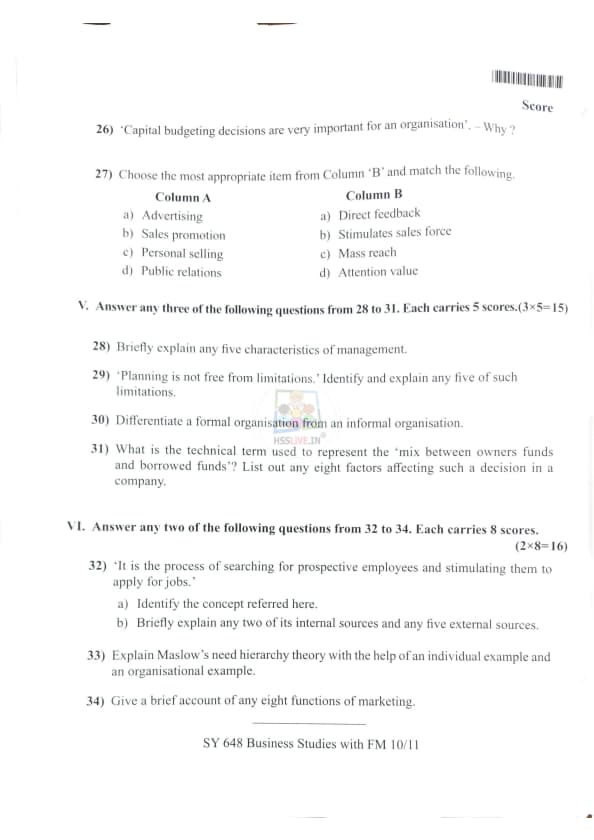
‘Capital budgeting decisions are very important for an organisation’ – Why?
View Solution
Capital budgeting decisions are crucial for an organization as they involve planning and managing long-term investments in assets, projects, or initiatives that require significant financial resources. These decisions impact the future financial stability and growth of the organization. Here are the key reasons why capital budgeting is important:
1. Long-term Impact: Capital budgeting decisions typically involve substantial investments in fixed assets or major projects that will affect the company's operations for many years. Properly made decisions lead to profitable long-term outcomes, while poor decisions may result in significant financial losses.
2. Resource Allocation: Capital budgeting ensures that the organization allocates its limited resources to the most beneficial and profitable projects. It helps prioritize investment in projects that maximize returns and align with strategic objectives.
3. Risk Management: It helps assess the risks associated with long-term investments and ensures that the organization does not commit to projects that have an excessively high risk relative to potential returns.
4. Maximizing Shareholder Wealth: Capital budgeting decisions directly affect the profitability and overall value of the company, which is important for maximizing shareholder wealth. Strategic investment decisions can increase the company’s competitiveness and market value.
In essence, these decisions help determine the company’s future direction and stability, ensuring that it grows sustainably and profitably. Quick Tip: Capital budgeting is critical because it influences the long-term success, growth, and profitability of an organization.
Choose the most appropriate item from Column ‘B’ and match the following.
View Solution
We will match each item from Column A with the most appropriate item from Column B based on the marketing practices described:
\[ \begin{array}{|c|c|} \hline \textbf{Column A} & \textbf{Column B}
\hline a) Advertising & c) Mass reach
b) Sales promotion & b) Stimulates sales force
c) Personal selling & a) Direct feedback
d) Public relations & d) Attention value
\hline \end{array} \]
Explanation of the Matches:
- a) Advertising: Advertising is designed to reach a large audience to create awareness or promote a product. This requires mass reach, so the correct match is c) Mass reach.
- b) Sales promotion: Sales promotions are short-term strategies used to encourage purchases, often involving sales personnel. These promotions stimulate the sales force to push for higher sales, so the correct match is b) Stimulates sales force.
- c) Personal selling: Personal selling involves direct interaction between a salesperson and a customer. This provides direct feedback to the company about the customer’s needs, preferences, and objections, so the correct match is a) Direct feedback.
- d) Public relations: Public relations involve activities aimed at building and maintaining a positive public image. It generally focuses on creating attention value and attracting public interest to improve the company’s reputation, so the correct match is d) Attention value. Quick Tip: Marketing activities such as advertising, sales promotion, personal selling, and public relations play distinct roles in reaching target audiences, gathering feedback, and influencing public perception.
Briefly explain any five characteristics of management.
View Solution
Management is an essential part of any organization, aiming to achieve organizational goals through efficient use of resources. The five key characteristics of management are:
1. Goal-Oriented Process:
Management is focused on achieving organizational objectives. Every activity, decision, and resource allocation is directed towards attaining specific goals set by the organization. For example, a company’s management focuses on increasing sales, improving customer satisfaction, or expanding market share.
2. Continuous Process:
Management is a continuous and ongoing process. It involves constant planning, organizing, leading, and controlling, which are interrelated and happen simultaneously. For example, a manager continuously plans for new projects, organizes resources, leads the team, and evaluates performance to achieve organizational goals.
3. Integration of Resources:
Management integrates and coordinates various resources, such as human, financial, physical, and informational, to achieve organizational objectives. Managers are responsible for efficiently utilizing these resources by assigning tasks and delegating responsibilities.
4. Universal Application:
Management is applicable to all types of organizations, regardless of their size, nature, or location. Whether it is a business firm, non-profit organization, or government agency, management functions remain essential for success.
5. Dynamic Function:
Management is dynamic, meaning it adapts to changes in the environment. External factors like technology, government policies, and competition may require managers to adjust their strategies. The ability to adapt to changes and overcome challenges is vital for the organization’s success.
These characteristics highlight that management is not just about directing work but is a continuous, dynamic, and goal-oriented process aimed at utilizing resources effectively. Quick Tip: Effective management involves continuous effort to coordinate and utilize resources efficiently while adapting to changes in the organizational environment.
‘Planning is not free from limitations.’ Identify and explain any five such limitations.
View Solution
Although planning is essential for an organization's success, it is not free from limitations. Several challenges can affect the planning process, including:
1. Uncertainty:
One of the biggest limitations of planning is the uncertainty of the future. Changes in market conditions, government policies, and economic factors can disrupt the best-laid plans. For example, sudden changes in consumer behavior or unforeseen crises like the COVID-19 pandemic can render the plan ineffective.
2. Complexity:
Plans can become overly complex, especially in large organizations. In such cases, it becomes difficult to foresee all possible outcomes and manage all aspects of the plan effectively. This can result in confusion, miscommunication, and delays in execution.
3. Time Consuming:
Planning requires a significant amount of time, particularly for complex projects. Organizations must allocate resources to the planning process, which can delay implementation. The time spent on planning might reduce the time available for actual work and action.
4. Resistance to Change:
Employees and managers may resist changes proposed in the planning phase, especially if they are not involved in the process. Resistance to new ideas or methods can lead to poor implementation of the plan. For example, a new strategy might face opposition from employees who are accustomed to old methods of working.
5. Limited Resources:
Even with the best planning, organizations may be constrained by limited resources. For instance, a well-crafted plan may require more financial or human resources than the organization can allocate, leading to compromised execution. Resource constraints can result in partial or incomplete implementation of the plan.
Despite these limitations, proper planning helps organizations remain focused on their goals and improve their chances of success by identifying potential risks and preparing for them. Quick Tip: While planning is critical for organizational success, it's important to be aware of limitations like uncertainty and resource constraints that can affect its implementation.
Differentiate a formal organisation from an informal organisation.
View Solution
A formal organisation and an informal organisation differ in several ways. Here are the key differences:
1. Definition:
- A formal organisation is a structured system with defined roles, rules, and responsibilities. It operates within a framework of authority and is focused on achieving specific objectives.
- An informal organisation is based on personal relationships, social interactions, and the network of people within an organisation. It is not governed by formal rules or policies.
2. Structure:
- A formal organisation has a hierarchical structure with clearly defined roles, positions, and authority levels. It follows a vertical chain of command.
- An informal organisation lacks a clear structure and is based on social relationships and interactions between individuals. The structure is more flexible and fluid.
3. Purpose:
- The primary purpose of a formal organisation is to achieve specific organisational goals and objectives.
- The purpose of an informal organisation is to foster social interactions, build relationships, and create a sense of belonging.
4. Communication:
- Communication in a formal organisation follows a set structure and typically flows vertically or according to the defined hierarchy.
- In an informal organisation, communication is more spontaneous and informal, and it often occurs horizontally among peers.
5. Rules and Regulations:
- A formal organisation operates under strict rules and regulations that guide behaviour and decision-making.
- An informal organisation does not have formal rules or regulations; interactions are based on mutual understanding and personal relationships.
6. Flexibility:
- A formal organisation is less flexible, as it operates based on set policies and procedures.
- An informal organisation is more flexible, allowing for open, unstructured interactions among members.
In summary, formal organisations are structured and focused on achieving organizational goals, while informal organisations are based on social connections and relationships. Quick Tip: Formal organisations follow a clear structure with defined roles and responsibilities, while informal organisations are based on social relationships and interactions.
What is the technical term used to represent the ‘mix between owners' funds and borrowed funds’? List out any eight factors affecting such a decision in a company.
View Solution
The technical term used to represent the mix between owners' funds and borrowed funds is called the capital structure. Capital structure refers to the way a company finances its operations and growth through a combination of debt (borrowed funds) and equity (owners' funds).
The eight factors that affect the capital structure decision in a company are:
1. Business Risk:
Companies operating in industries with higher business risk typically have a lower proportion of debt in their capital structure to avoid the burden of fixed interest payments.
2. Financial Risk:
The level of financial risk increases with the use of debt, as it creates an obligation to make regular interest payments. Companies need to balance debt with their ability to meet these obligations.
3. Control:
Issuing more equity may dilute the control of existing shareholders, while using debt does not affect ownership but increases the financial risk.
4. Tax Considerations:
Interest payments on debt are tax-deductible, which can reduce the overall tax burden for the company. This tax shield makes debt financing more attractive in certain circumstances.
5. Cost of Debt:
The cost of debt is determined by interest rates, which can vary depending on market conditions and the company's creditworthiness. Higher interest rates can discourage excessive borrowing.
6. Flexibility:
Companies with high levels of debt may find it more difficult to raise additional funds if needed, reducing their financial flexibility.
7. Growth Opportunities:
Companies with high growth potential may prefer equity financing to avoid the constraints of fixed interest payments, allowing them to reinvest in the business.
8. Market Conditions:
The overall economic and market conditions affect the cost and availability of debt and equity. In a favorable market, companies may prefer to issue debt, while in a volatile market, they may rely more on equity financing.
In conclusion, the capital structure decision depends on a careful evaluation of these factors to balance the benefits and risks associated with debt and equity financing. Quick Tip: Capital structure decisions balance the mix of debt and equity financing to optimize the company's performance, taking into account risks, costs, and market conditions.
‘It is the process of searching for prospective employees and stimulating them to apply for jobs.’
a) Identify the concept referred here.
b) Briefly explain any two of its internal sources and any five external sources.
View Solution
Step 1: Identifying the Concept.
The process described is known as Recruitment. Recruitment involves attracting and encouraging potential employees to apply for available job positions. This process is vital for organizations to find suitable candidates for open positions.
Step 2: Explaining Internal and External Sources.
Internal Sources:
1. Employee Referrals: Employees can recommend qualified individuals they know for job openings. This is a low-cost source and often results in high-quality candidates.
2. Internal Job Postings: Organizations can post job vacancies within the company, encouraging current employees to apply for higher positions or lateral moves. This provides growth opportunities for existing staff.
External Sources:
1. Job Portals: Websites like LinkedIn, Indeed, and Monster where employers can post job advertisements and receive applications from a large pool of potential candidates.
2. Campus Recruitment: Visiting colleges and universities to hire fresh graduates or interns for various positions.
3. Recruitment Agencies: Outsourcing the recruitment process to professional agencies that specialize in finding candidates for specific roles.
4. Social Media: Platforms like Facebook, Twitter, and LinkedIn are used to advertise job openings and attract applicants.
5. Job Fairs and Events: Organizations participate in career fairs and job expos to meet potential candidates and conduct on-the-spot interviews. Quick Tip: Recruitment involves a combination of internal and external sources to find the best candidates. Internal sources offer the advantage of utilizing existing knowledge of employees, while external sources provide a wider pool of applicants.
Explain Maslow’s need hierarchy theory with the help of an individual example and an organizational example.
View Solution
Maslow's Need Hierarchy Theory is a motivational theory in psychology that suggests individuals are motivated by a series of hierarchical needs, starting from basic physiological needs to higher psychological and self-fulfillment needs. The theory is represented as a pyramid with five levels of needs:
1. Physiological Needs: Basic necessities required for survival such as food, water, shelter, and sleep. These are the most fundamental needs.
2. Safety Needs: Once physiological needs are met, individuals seek safety and security, such as financial stability, health, and physical protection from harm.
3. Social Needs (Love and Belonging): This level includes the need for social relationships, friends, family, and belonging to a group. Humans seek affection, companionship, and acceptance.
4. Esteem Needs: After social needs are fulfilled, individuals seek respect, self-esteem, recognition, and a sense of accomplishment. This includes feeling valued and appreciated by others.
5. Self-Actualization Needs: This is the highest level, where individuals seek personal growth, fulfillment, and realizing their potential. It involves striving to become the best version of oneself.
Individual Example:
- Physiological Needs: A person working a minimum-wage job might prioritize earning enough money to meet their basic needs, like buying food and paying for housing.
- Safety Needs: After securing basic necessities, they might aim for job security and a stable home environment.
- Social Needs: The individual might seek companionship and relationships, wanting to feel loved and part of a community.
- Esteem Needs: Over time, they may seek recognition at work or in their personal life, valuing achievements and being respected.
- Self-Actualization: Eventually, this person may focus on personal growth, like pursuing a passion or a higher level of education, seeking to fulfill their true potential.
Organizational Example:
- Physiological Needs: In an organization, employees need fair compensation, breaks, and a comfortable work environment to meet their basic needs.
- Safety Needs: After securing basic necessities, organizations provide job security, health benefits, and a safe workplace to address safety needs.
- Social Needs: Teamwork, social activities, and positive workplace culture help fulfill employees' social needs.
- Esteem Needs: Recognition programs, promotions, and praise for achievements help employees feel valued and respected.
- Self-Actualization: Providing opportunities for career development, training, and personal growth enables employees to reach their fullest potential.
Thus, Maslow’s theory shows that individuals and organizations must first address basic needs before moving to higher-level motivations for self-improvement and fulfillment. Quick Tip: Maslow’s hierarchy suggests that lower-level needs must be satisfied before individuals can move on to higher-level psychological and self-fulfillment needs.
Give a brief account of any eight functions of marketing.
View Solution
There are various functions of marketing, each contributing to the effective promotion and sale of goods and services. The following are the eight important functions of marketing:
1. Product Planning and Development: This function involves identifying consumer needs and designing products that meet those needs. It includes decisions regarding product features, design, packaging, and branding.
2. Market Research: Market research helps businesses understand customer preferences, behaviors, and trends. It involves collecting data on the target market to make informed decisions about product development, pricing, and promotion.
3. Pricing: Pricing is a critical function that involves determining the price at which a product or service will be sold. This involves considering production costs, competitor prices, and perceived value by consumers.
4. Advertising: Advertising is a form of communication used to inform, persuade, and remind customers about a product. It includes print, digital, television, and social media ads aimed at increasing product awareness and demand.
5. Sales Promotion: Sales promotions include short-term incentives aimed at encouraging customers to purchase products. This can include discounts, coupons, contests, and samples.
6. Personal Selling: Personal selling involves direct communication between a sales representative and potential customers. It aims to influence customers' purchasing decisions through one-on-one interaction and personalized presentations.
7. Distribution (Place): Distribution involves the movement of products from manufacturers to consumers. This includes selecting distribution channels, managing logistics, and ensuring that products are available at the right place and time.
8. Public Relations (PR): Public relations involve activities aimed at building and maintaining a positive image of the company in the eyes of the public. It includes managing media relations, community outreach, and addressing customer concerns.
These functions help businesses create value for their customers, manage their products and services, and establish long-term relationships with their target market. Quick Tip: Effective marketing functions help businesses reach their target audience, create customer satisfaction, and ultimately increase sales and market share.




Comments