




The Kerala Board Class 12 Home Science Question Paper with Solution PDF is available for download here. The Kerala Class 12 Home Science exam was held on March 7, 2026, during the morning session from 9:30 AM to 12:15 PM.
The Kerala Board Class 12 Home Science exam for 2026 will cover topics like nutrition, health, hygiene, textile design, family and child development, and home management. The paper will include MCQs, short-answer, and long-answer questions, testing both theoretical knowledge and practical application. Students should focus on understanding key concepts, practicing structured answers, and applying knowledge to real-life situations. The official question paper for reference will be available for download in PDF format.
Kerala Board Class 10, 2026 Home Science Question Paper with Solution PDF
| Kerala Board Class 12, 2026 Home Science Question Paper with Solution Pdf | Download PDF | Check Solution |
In Dale's cone of experience, which one is most effective in the learning process?
View Solution
Step 1: Understanding Dale's cone of experience.
Dale's Cone of Experience illustrates the effectiveness of different learning experiences in the learning process. The cone suggests that experiences closer to the base (e.g., direct experience) are more impactful and lead to better retention of information.
Step 2: Analyzing the options.
(A) Direct purposeful experience: Correct. According to Dale's Cone of Experience, direct purposeful experiences, such as hands-on activities or real-life experiences, are the most effective and lead to better learning.
(B) Visual symbols: Incorrect. Visual symbols (such as pictures and diagrams) are effective, but they are further up the cone and less effective than direct experience.
(C) Exhibits: Incorrect. Exhibits, such as displays or demonstrations, are also effective but still fall higher on the cone than direct experience.
(D) Verbal symbols: Incorrect. Verbal symbols (such as spoken or written words) are the least effective in the learning process according to Dale's Cone, as they are farthest from the base of the cone.
Step 3: Conclusion.
Direct purposeful experience is the most effective in the learning process as it involves active engagement and the highest level of interaction, according to Dale's Cone of Experience.
Final Answer: Direct purposeful experience. Quick Tip: Dale's Cone of Experience emphasizes that direct experience leads to the highest retention and most effective learning, while more abstract methods such as verbal symbols have lower effectiveness.
Analyse the statement given below and choose the incorrect one.
View Solution
Step 1: Understanding each statement.
- (A) Nutrients are indeed lost during various processes in cooking, especially during high-heat cooking, boiling, and frying. This is a true statement.
- (B) Iodised salt is not an example of fermented food. Iodised salt is regular salt with iodine added to it for nutritional purposes. Fermented foods include items like yogurt, pickles, and kimchi, which are the result of fermentation processes.
- (C) Junk food typically lacks many essential nutrients and is often high in fats, sugars, and salts, making this statement true.
- (D) Germinated foods can reduce cooking time because germination breaks down starches into simpler sugars, making them easier to cook. This is a true statement.
Step 2: Analyzing the incorrect statement.
Statement (B) is incorrect because iodised salt is not a fermented food.
Final Answer: (B) Iodised salt is an example for fermented food. Quick Tip: Iodised salt is regular salt enriched with iodine for nutritional benefits, while fermented foods involve the transformation of food by microorganisms.
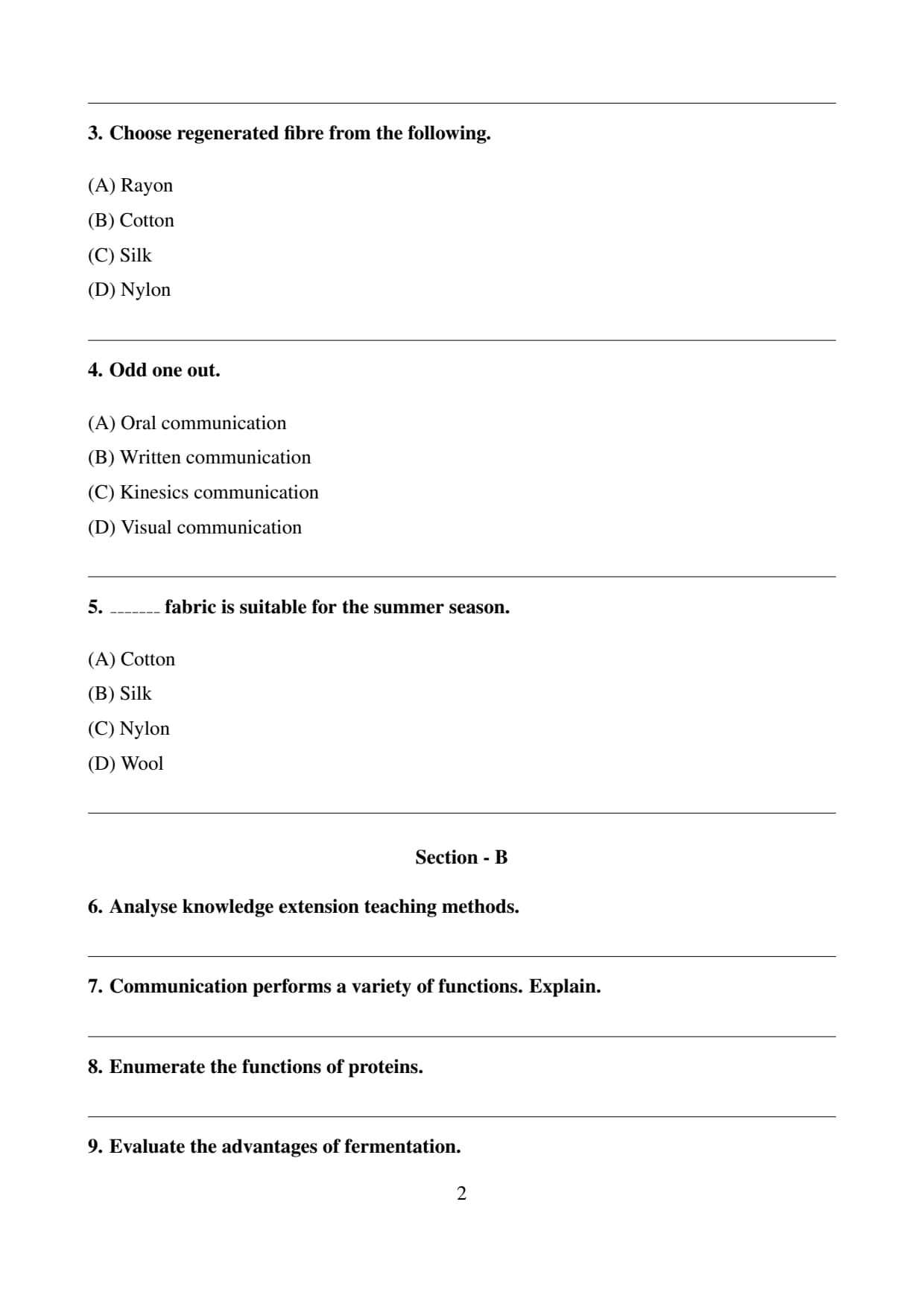
Choose regenerated fibre from the following.
View Solution
Step 1: Understanding regenerated fibres.
Regenerated fibres are made from natural materials that are processed and converted into fibres. These fibres are chemically treated to change their form, but they are still derived from natural sources.
Step 2: Analyzing the options.
(A) Rayon: Correct. Rayon is a regenerated fibre made from cellulose derived from wood pulp or cotton. It is chemically processed to form a fibre.
(B) Cotton: Incorrect. Cotton is a natural fibre, not a regenerated fibre.
(C) Silk: Incorrect. Silk is a natural protein fibre produced by silkworms, not a regenerated fibre.
(D) Nylon: Incorrect. Nylon is a synthetic fibre, not a regenerated fibre.
Step 3: Conclusion.
Since Rayon is derived from natural cellulose and undergoes a chemical process to form fibre, it is considered a regenerated fibre.
Final Answer: Rayon. Quick Tip: Regenerated fibres like Rayon are chemically processed from natural cellulose, whereas synthetic fibres like Nylon are made from petrochemical sources.
Odd one out.
View Solution
Step 1: Understanding the options.
- (A) Oral communication: This refers to communication through spoken words, often face-to-face or through telecommunication methods.
- (B) Written communication: This is the use of written symbols to convey information, such as letters, emails, and documents.
- (C) Kinesics communication: Kinesics refers to body language and non-verbal communication through gestures, postures, and facial expressions. While important, it is not a direct form of communication like oral, written, or visual communication.
- (D) Visual communication: This refers to conveying ideas through visual elements, such as images, charts, videos, and signs.
Step 2: Identifying the odd one out.
The odd one out is (C) Kinesics communication because it is non-verbal body language, unlike the other options, which are all modes of verbal or written communication.
Final Answer: (C) Kinesics communication. Quick Tip: Kinesics communication is non-verbal, while the other options are verbal or written forms of communication.
_______ fabric is suitable for the summer season.
View Solution
Step 1: Understanding fabric types.
- (A) Cotton: Cotton fabric is breathable, light, and comfortable, making it ideal for the summer season as it helps keep the body cool.
- (B) Silk: Silk is a luxurious fabric, but it is not as breathable as cotton and can be less comfortable in hot, humid weather.
- (C) Nylon: Nylon is a synthetic fabric and is not the best for hot weather as it doesn't allow the skin to breathe, which can cause discomfort in the summer.
- (D) Wool: Wool is heavy and is more suitable for colder weather. It is not ideal for the summer season.
Step 2: Identifying the suitable fabric for summer.
Cotton is the most suitable fabric for the summer season because it is lightweight, breathable, and helps absorb sweat.
Final Answer: (A) Cotton.
Quick Tip: When selecting fabrics for hot weather, look for breathable and lightweight materials like cotton that allow air circulation and help keep you cool.
Analyse knowledge extension teaching methods.
View Solution
Step 1: Define Knowledge Extension.
Knowledge extension refers to the process of expanding knowledge and skills through various methods, aimed at improving the learning process and enhancing the practical application of knowledge.
Step 2: Identify Teaching Methods.
Teaching methods in knowledge extension include various approaches like lectures, workshops, group discussions, role plays, field visits, and practical exercises. These methods are designed to actively engage learners and make the transfer of knowledge effective.
Step 3: Explain the role of these methods.
Each method offers unique advantages. For example, field visits provide real-world exposure, while group discussions encourage critical thinking. Hands-on activities and role plays help learners practice new skills in a controlled environment.
Step 4: Evaluate their effectiveness.
The effectiveness of these methods depends on the context, learner needs, and objectives of the learning program. A combination of these methods often works best for comprehensive knowledge extension. Quick Tip: In knowledge extension, a variety of teaching methods are used to engage learners actively and improve practical application. A combination of methods often leads to better learning outcomes.
Communication performs a variety of functions. Explain.
View Solution
Step 1: Define Communication Functions.
Communication is a process that involves the exchange of information between individuals or groups. It serves several functions, including informative, persuasive, and expressive roles.
Step 2: Identify the different functions.
1. Informative function: This function helps in transferring knowledge, facts, and data from one person or group to another.
2. Persuasive function: It aims to influence the behavior, beliefs, or attitudes of others. It is commonly used in advertising and politics.
3. Expressive function: Communication is used to express emotions, feelings, or ideas. It helps individuals to share their personal thoughts and feelings.
Step 3: Explain the importance of each function.
Each function plays a vital role in the process of communication. The informative function is crucial in education, the persuasive function is key in marketing and leadership, while the expressive function fosters personal connections and emotional expression. Quick Tip: Communication serves multiple purposes: to inform, persuade, and express. Understanding these functions helps to enhance the effectiveness of communication in various contexts.
Enumerate the functions of proteins.
View Solution
Step 1: Structural support.
Proteins provide structure and support to cells and tissues. For example, collagen in connective tissues provides strength and elasticity.
Step 2: Enzymatic activity.
Proteins act as enzymes, which speed up chemical reactions. Enzymes are crucial for digestion, energy production, and many other cellular processes.
Step 3: Transport.
Some proteins, like hemoglobin, are responsible for transporting substances (such as oxygen) within the body.
Step 4: Immune defense.
Proteins play a key role in immune defense, such as antibodies that help fight off infections.
Step 5: Hormonal regulation.
Proteins also function as hormones, which regulate various physiological processes, like insulin regulating blood sugar. Quick Tip: Proteins serve multiple vital roles, including structural support, enzymatic activity, transport, immune defense, and hormonal regulation.
Evaluate the advantages of fermentation.
View Solution
Step 1: Energy production.
Fermentation is a process by which cells generate energy (ATP) in the absence of oxygen. It is an anaerobic process that helps organisms survive without oxygen.
Step 2: Preservation of food.
Fermentation is widely used in food production to preserve food by inhibiting the growth of harmful microorganisms, making products like yogurt, cheese, and sauerkraut.
Step 3: Production of valuable products.
Fermentation produces valuable by-products like alcohol and organic acids, which have commercial and industrial applications, such as in the production of alcoholic beverages and biofuels.
Step 4: Improvement of digestibility.
Fermentation can improve the digestibility of certain foods by breaking down complex compounds like lactose, making fermented products easier to digest.
Step 5: Nutrient enhancement.
Fermentation can increase the nutrient content of food, enhancing vitamins and other essential nutrients. Quick Tip: Fermentation is beneficial for energy production, food preservation, the creation of valuable products, improved digestibility, and enhanced nutrition.
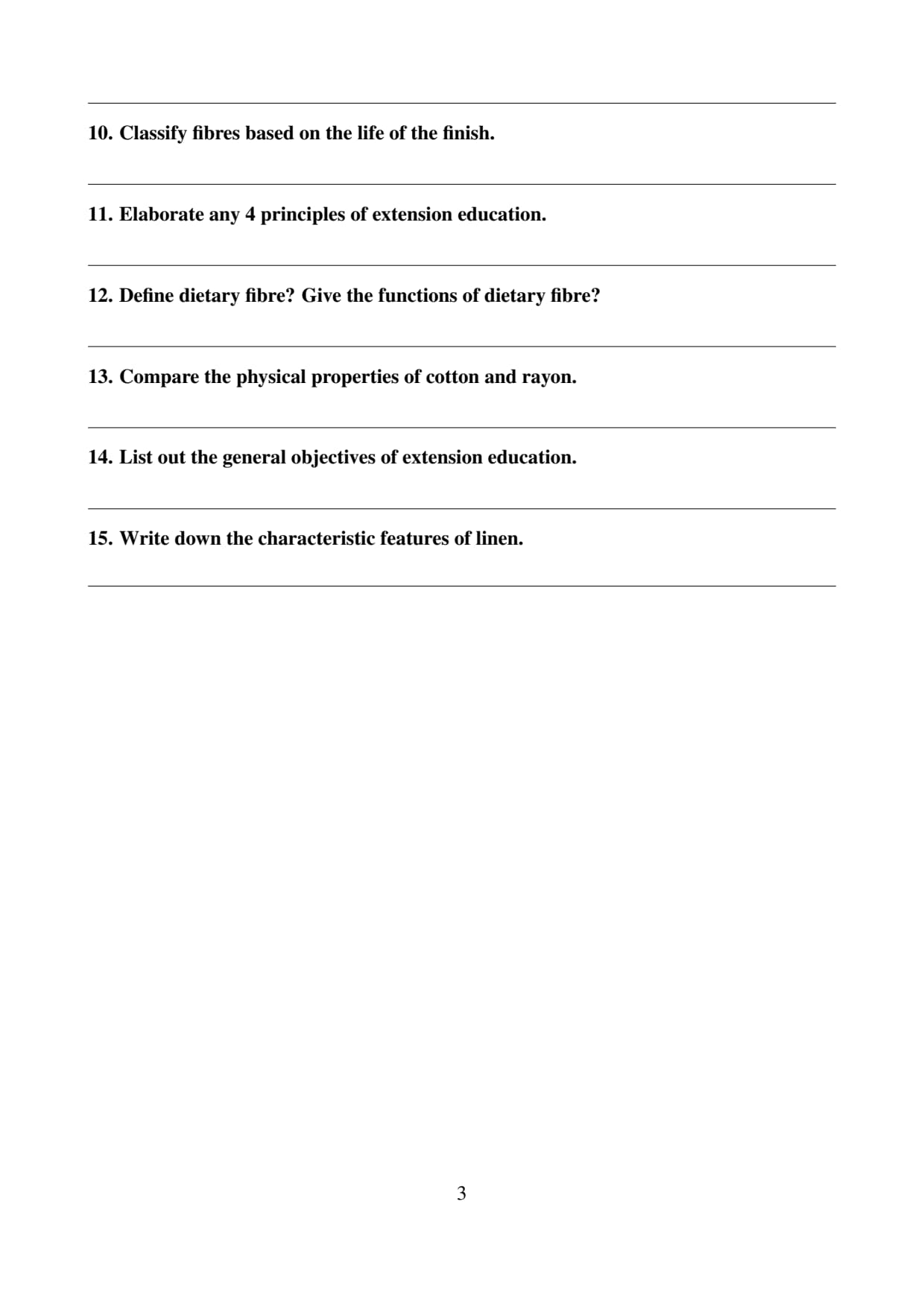
Classify fibres based on the life of the finish.
View Solution
Step 1: Define the concept of "life of the finish."
The life of the finish refers to how long the finish or coating on the fibres remains effective before it starts to deteriorate. It can be classified based on the duration of the finish’s efficacy.
Step 2: Classify fibres based on life of finish.
Fibres can be classified into two categories based on the life of the finish:
1. Permanent finish: These finishes remain effective for the lifetime of the fibre, providing long-lasting protection or appearance. Examples include durable water-repellent finishes.
2. Temporary finish: These finishes are effective only for a limited period. They wear off after several washes or usage. Examples include sizing agents or starch finishes.
Step 3: Explanation of classifications.
- Permanent finishes are generally more expensive but are designed to last for the entire lifecycle of the textile.
- Temporary finishes are commonly used for aesthetic purposes or to provide short-term characteristics to fabrics. Quick Tip: Understanding the life of finishes helps in selecting the right fibre treatments for specific purposes—whether long-term durability or short-term functionality.
Elaborate any 4 principles of extension education.
View Solution
Step 1: Define Extension Education.
Extension education refers to educational practices that aim to provide knowledge, skills, and values to people, especially in rural and underprivileged areas, through informal methods.
Step 2: Identify the principles of extension education.
Some key principles of extension education include:
1. Voluntary Participation: Extension education encourages voluntary participation, meaning that learners are motivated and willing to engage with the educational process.
2. Learning by Doing: Practical experience and hands-on learning are emphasized to ensure that the knowledge gained can be applied directly to real-life situations.
3. Local Relevance: The content of extension education is tailored to the local context, ensuring that it is relevant and addresses the specific needs of the community.
4. Community-Based Approach: Extension education emphasizes the involvement of the community in decision-making, ensuring that the solutions are collectively supported and sustainable.
Step 3: Explain the importance of these principles.
These principles ensure that the learning process is effective, sustainable, and empowering, allowing individuals and communities to use the knowledge they gain in practical ways to improve their lives. Quick Tip: Extension education thrives on local engagement, practical learning, and community collaboration to ensure that the knowledge imparted is both useful and applicable.
Define dietary fibre? Give the functions of dietary fibre?
View Solution
Step 1: Define Dietary Fibre.
Dietary fibre refers to the indigestible part of plant foods that provides numerous health benefits. It includes cellulose, hemicellulose, pectin, and other polysaccharides that the human digestive system cannot fully digest.
Step 2: List the functions of dietary fibre.
The functions of dietary fibre include:
1. Promotes Digestive Health: Fibre adds bulk to stool, helping prevent constipation and promoting regular bowel movements.
2. Reduces Risk of Heart Disease: Fibre, especially soluble fibre, helps lower blood cholesterol levels, reducing the risk of heart disease.
3. Aids in Weight Management: Fibre helps control hunger by adding bulk to meals without adding extra calories, which can help with weight management.
4. Regulates Blood Sugar Levels: Dietary fibre slows the absorption of sugar, helping to maintain steady blood glucose levels, especially beneficial for people with diabetes. Quick Tip: Fibre is a key part of a healthy diet, contributing to digestive health, heart health, and weight management. Including a variety of fibre-rich foods in your diet is essential for overall wellness.
Compare the physical properties of cotton and rayon.
View Solution
Step 1: Define Cotton and Rayon.
- Cotton is a natural fibre obtained from the cotton plant, primarily made of cellulose.
- Rayon is a semi-synthetic fibre made from regenerated cellulose, often derived from wood pulp or cotton linters.
Step 2: Compare the physical properties.
1. Strength: Cotton is strong, durable, and able to withstand wear and tear. Rayon, while softer, is weaker and can be damaged more easily, especially when wet.
2. Moisture Absorption: Both fibres absorb moisture well, but cotton absorbs more moisture and dries slower than rayon, which dries faster due to its smoother surface.
3. Texture: Cotton has a natural rough texture, while rayon feels smoother and silkier, often used as a substitute for silk.
4. Appearance: Cotton has a matte appearance, whereas rayon can have a shiny or glossy finish, making it suitable for more formal wear.
Step 3: Summary of comparison.
Cotton is a strong, breathable fibre that is great for everyday wear, whereas rayon offers a softer, shinier appearance suitable for formal clothing, though it is less durable than cotton. Quick Tip: Cotton is known for its strength and moisture absorption, while rayon is preferred for its soft texture and glossy appearance. Consider the intended use of the fabric when choosing between the two.
List out the general objectives of extension education.
View Solution
Step 1: Dissemination of knowledge.
The primary objective of extension education is to disseminate scientific and technical knowledge to the community, especially to rural and underprivileged sections, to improve their living standards.
Step 2: Skill development.
Extension education aims to develop the skills of individuals and communities, enabling them to solve their own problems and improve their productivity in various sectors like agriculture, health, and education.
Step 3: Empowerment of people.
It works to empower people by making them aware of their rights and responsibilities and helping them become more independent and self-reliant.
Step 4: Improvement of quality of life.
The ultimate goal of extension education is to improve the quality of life by fostering better educational practices, promoting health and nutrition, and enhancing economic opportunities.
Step 5: Community participation.
It encourages active participation of communities in the planning and implementation of development activities, ensuring that the needs of the community are met. Quick Tip: Extension education focuses on knowledge dissemination, skill development, empowerment, quality of life improvement, and community participation.
Write down the characteristic features of linen.
View Solution
Step 1: Natural fiber.
Linen is a natural fiber derived from the flax plant. It is one of the oldest textiles known to humankind.
Step 2: Durability.
Linen is known for its strength and durability. It is one of the strongest fibers and becomes even stronger when wet, making it highly durable and long-lasting.
Step 3: Breathability.
Linen is highly breathable and has excellent moisture-wicking properties, making it ideal for hot and humid climates. It helps to keep the body cool by allowing air to pass through the fabric.
Step 4: Smooth texture.
Linen has a smooth and crisp texture that becomes softer with each wash, adding to its comfort and wearability.
Step 5: Wrinkling.
One of the key characteristics of linen is its tendency to wrinkle easily. However, many people appreciate this as it adds to the fabric's natural, casual look. Quick Tip: Linen is valued for its strength, breathability, smooth texture, and natural appearance, though it tends to wrinkle easily.




Comments