




The Directorate of Higher Secondary Education (DHSE), Kerala successfully conducted the Class 12 Psychology Exam 2026 on March 17, 2026. The Kerala Board Class 12 Psychology Question Paper with Solution PDF is now available for download.
The Kerala Board Class 12 Psychology paper covered key topics from psychological concepts, human development, mental health, and research methods. Students should focus on understanding psychological theories, human behavior, and research techniques. The exam is marked out of 100, with 70 marks for the theory paper and 30 for internal assessment.
Kerala Board Class 12 2026 Psychology Question Paper with Solution PDF
| Kerala Board Class 12 Psychology Question Paper 2026 | Download PDF | Check Solution |

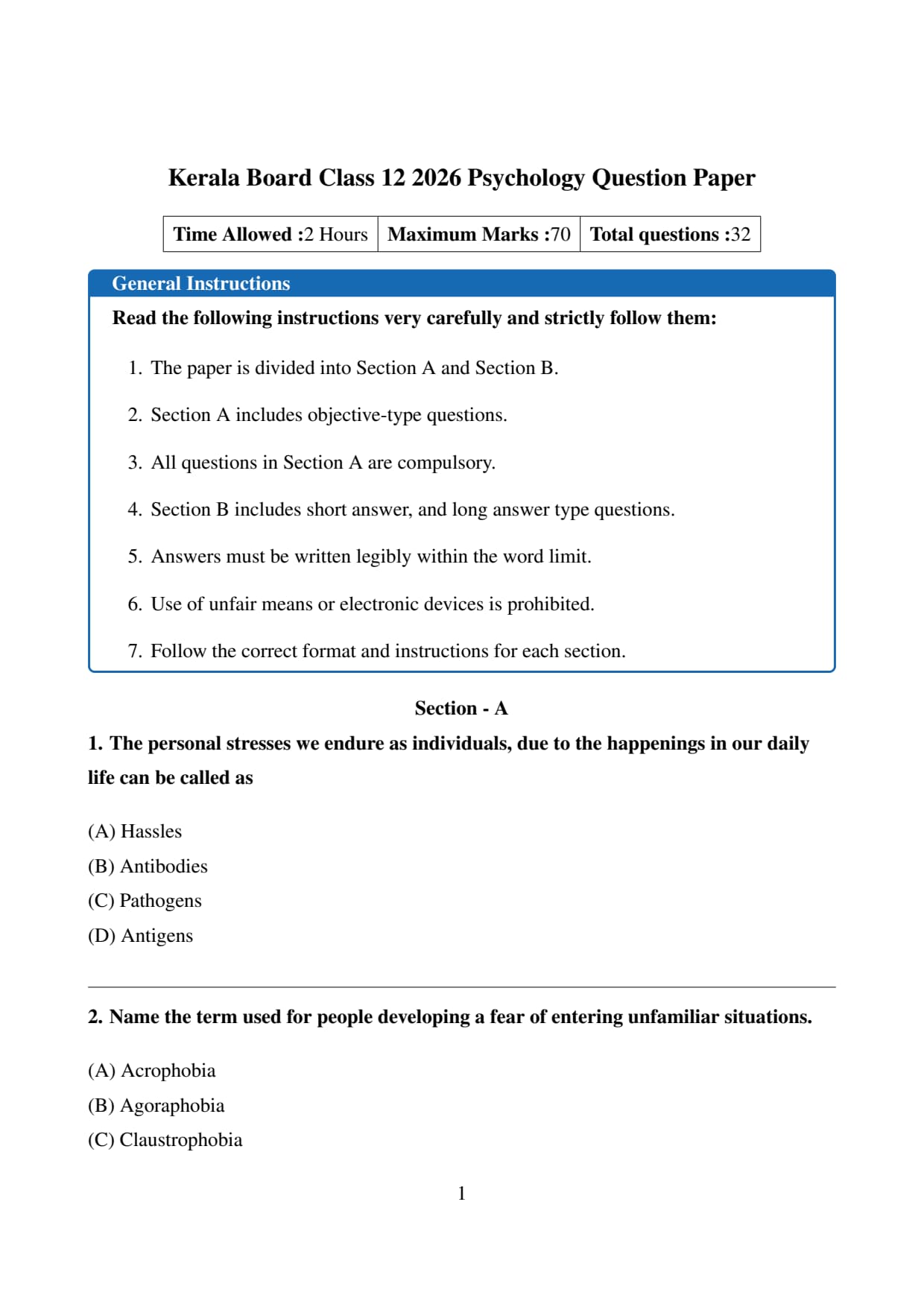
The personal stresses we endure as individuals, due to the happenings in our daily life can be called as
View Solution
Step 1: Understanding the context.
The term 'hassles' refers to minor stresses and frustrations that we encounter in our daily lives, such as deadlines, traffic, or small annoyances.
Step 2: Explanation of options.
(A) Hassles: Correct. Hassles are everyday stressors and the term most appropriate for the given context.
(B) Antibodies: Incorrect. Antibodies are proteins in the immune system that protect against pathogens.
(C) Pathogens: Incorrect. Pathogens are microorganisms that cause disease, not stressors in daily life.
(D) Antigens: Incorrect. Antigens are substances that trigger an immune response, not stressors.
Step 3: Conclusion.
Hassles are the most fitting term for the daily stressors described in the question.
Final Answer: Hassles. Quick Tip: Hassles refer to everyday stressors, whereas antibodies and antigens are related to the immune system.
Name the term used for people developing a fear of entering unfamiliar situations.
View Solution
Step 1: Understanding the types of phobias.
Phobias are irrational fears of specific objects, activities, or situations. In this case, the term refers to a fear of unfamiliar situations, such as being outside in crowds or in public spaces.
Step 2: Explanation of options.
(A) Acrophobia: Incorrect. Acrophobia is the fear of heights, not unfamiliar situations.
(B) Agoraphobia: Correct. Agoraphobia refers to the fear of being in situations where escape might be difficult, such as unfamiliar places or crowded environments.
(C) Claustrophobia: Incorrect. Claustrophobia is the fear of confined spaces, not unfamiliar situations.
(D) Zoophobia: Incorrect. Zoophobia is the fear of animals, not unfamiliar situations.
Step 3: Conclusion.
The correct term for the fear of unfamiliar situations is agoraphobia.
Final Answer: Agoraphobia. Quick Tip: Agoraphobia involves a fear of situations where escape may be difficult, including unfamiliar places or crowded areas.
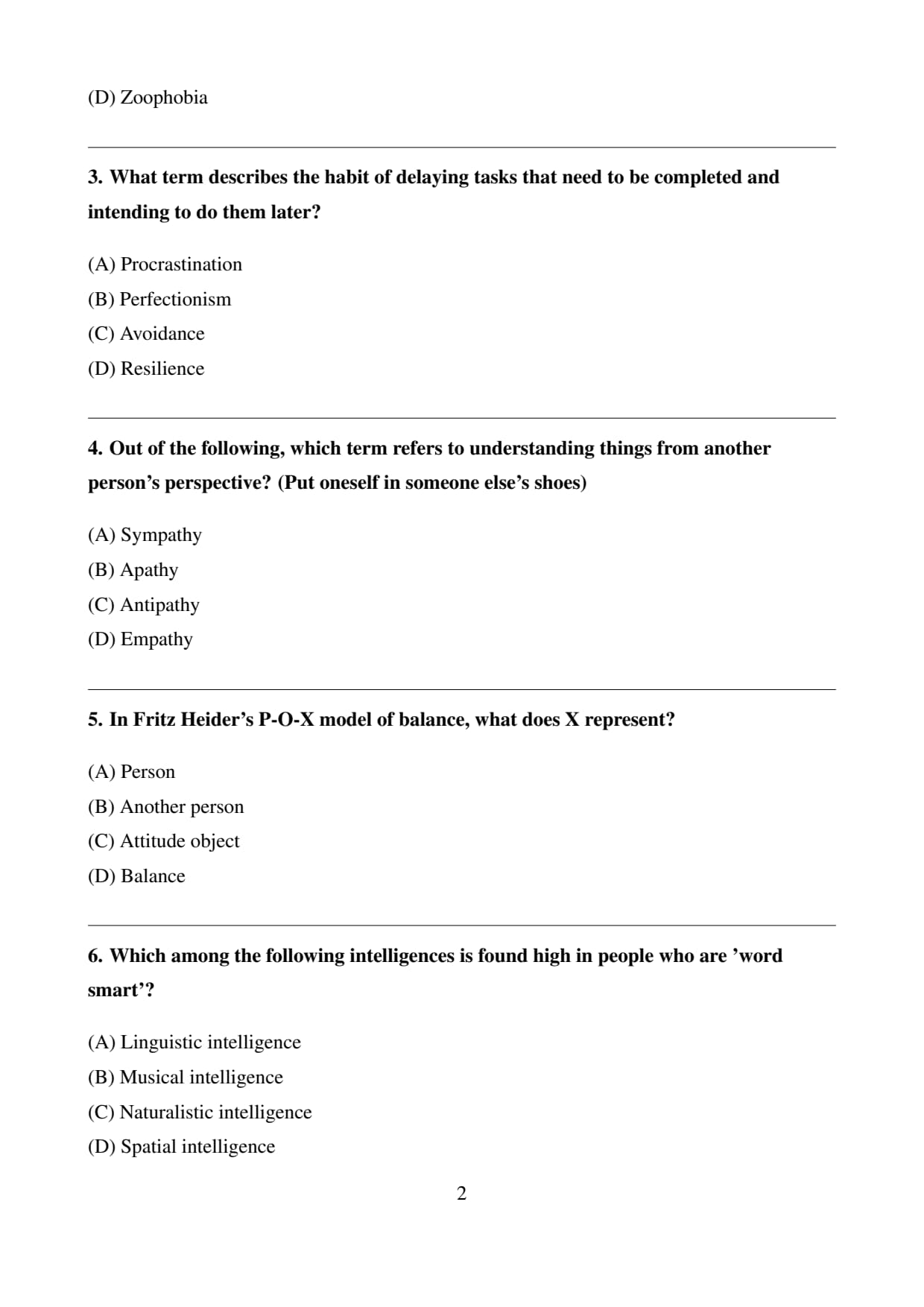
What term describes the habit of delaying tasks that need to be completed and intending to do them later?
View Solution
Step 1: Understanding procrastination.
Procrastination is the act of delaying tasks that should be done, often due to a lack of motivation or avoidance of unpleasant tasks.
Step 2: Explanation of options.
(A) Procrastination: Correct. Procrastination is the habit of putting off tasks until later, often unnecessarily.
(B) Perfectionism: Incorrect. Perfectionism is the desire to achieve perfection in tasks, not necessarily delaying them.
(C) Avoidance: Incorrect. Avoidance is the act of avoiding tasks, but procrastination specifically involves delaying them to later without any immediate avoidance.
(D) Resilience: Incorrect. Resilience is the ability to bounce back from setbacks, not the delay of tasks.
Step 3: Conclusion.
The term that best describes the act of delaying tasks is procrastination.
Final Answer: Procrastination. Quick Tip: Procrastination is often driven by avoidance of discomfort or lack of motivation, while resilience is about bouncing back from challenges.
Out of the following, which term refers to understanding things from another person's perspective? (Put oneself in someone else's shoes)
View Solution
Step 1: Understanding the term 'Empathy'.
Empathy refers to the ability to understand and share the feelings of another person, essentially putting oneself in someone else's shoes.
Step 2: Explanation of options.
(A) Sympathy: Incorrect. Sympathy is feeling pity or sorrow for someone's misfortune, but it doesn't involve understanding their perspective.
(B) Apathy: Incorrect. Apathy is a lack of interest, emotion, or concern, not understanding someone else’s feelings.
(C) Antipathy: Incorrect. Antipathy refers to a deep-seated dislike or aversion, which is the opposite of empathy.
(D) Empathy: Correct. Empathy involves understanding and sharing the feelings of others.
Step 3: Conclusion.
Empathy is the term that best fits the definition of understanding things from another person's perspective.
Final Answer: Empathy. Quick Tip: Empathy is crucial for healthy social interactions and emotional intelligence, as it allows individuals to connect deeply with others.
In Fritz Heider's P-O-X model of balance, what does X represent?
View Solution
Step 1: Understanding Fritz Heider's P-O-X model.
Fritz Heider’s P-O-X model of balance theory is a psychological theory that explains how people maintain balance in their attitudes. In this model, P represents the person, O represents another person, and X represents the attitude object (the object or idea towards which the person has an attitude).
Step 2: Explanation of options.
(A) Person: Incorrect. The person (P) is the individual whose attitude is being analyzed in the model.
(B) Another person: Incorrect. Another person (O) is another individual who is involved in the relationship being analyzed.
(C) Attitude object: Correct. X refers to the attitude object, which is the thing, idea, or concept toward which the attitudes are directed.
(D) Balance: Incorrect. Balance is the outcome or goal of the theory, not what X represents.
Step 3: Conclusion.
In the P-O-X model, X represents the attitude object, the central focus of the person's attitude.
Final Answer: Attitude object. Quick Tip: Fritz Heider’s P-O-X model helps explain how people strive for balance in their attitudes toward others and attitude objects.
Which among the following intelligences is found high in people who are 'word smart'?
View Solution
Step 1: Understanding the concept of 'word smart'.
People who are 'word smart' are typically good with words, language, and verbal expression. This refers to individuals who have high linguistic intelligence, which enables them to use language effectively for reading, writing, and speaking.
Step 2: Understanding linguistic intelligence.
Linguistic intelligence is one of Howard Gardner's multiple intelligences, which refers to the ability to effectively use language. This intelligence is highly developed in individuals who excel in activities involving language such as storytelling, writing, and learning languages.
Step 3: Analysis of other options.
(A) Linguistic intelligence: Correct. This is the intelligence related to 'word smart' individuals who have a natural affinity for language.
(B) Musical intelligence: Incorrect. Musical intelligence pertains to the ability to recognize and compose music, which is not related to linguistic abilities.
(C) Naturalistic intelligence: Incorrect. This intelligence is about understanding and interacting with nature, not language.
(D) Spatial intelligence: Incorrect. Spatial intelligence involves the ability to visualize and manipulate objects in space, which is unrelated to language skills.
Step 4: Conclusion.
Based on the explanation of linguistic intelligence, it is clear that people who are 'word smart' have high linguistic intelligence.
Final Answer: Linguistic intelligence. Quick Tip: Linguistic intelligence is essential for people who excel in reading, writing, speaking, and language-related activities.
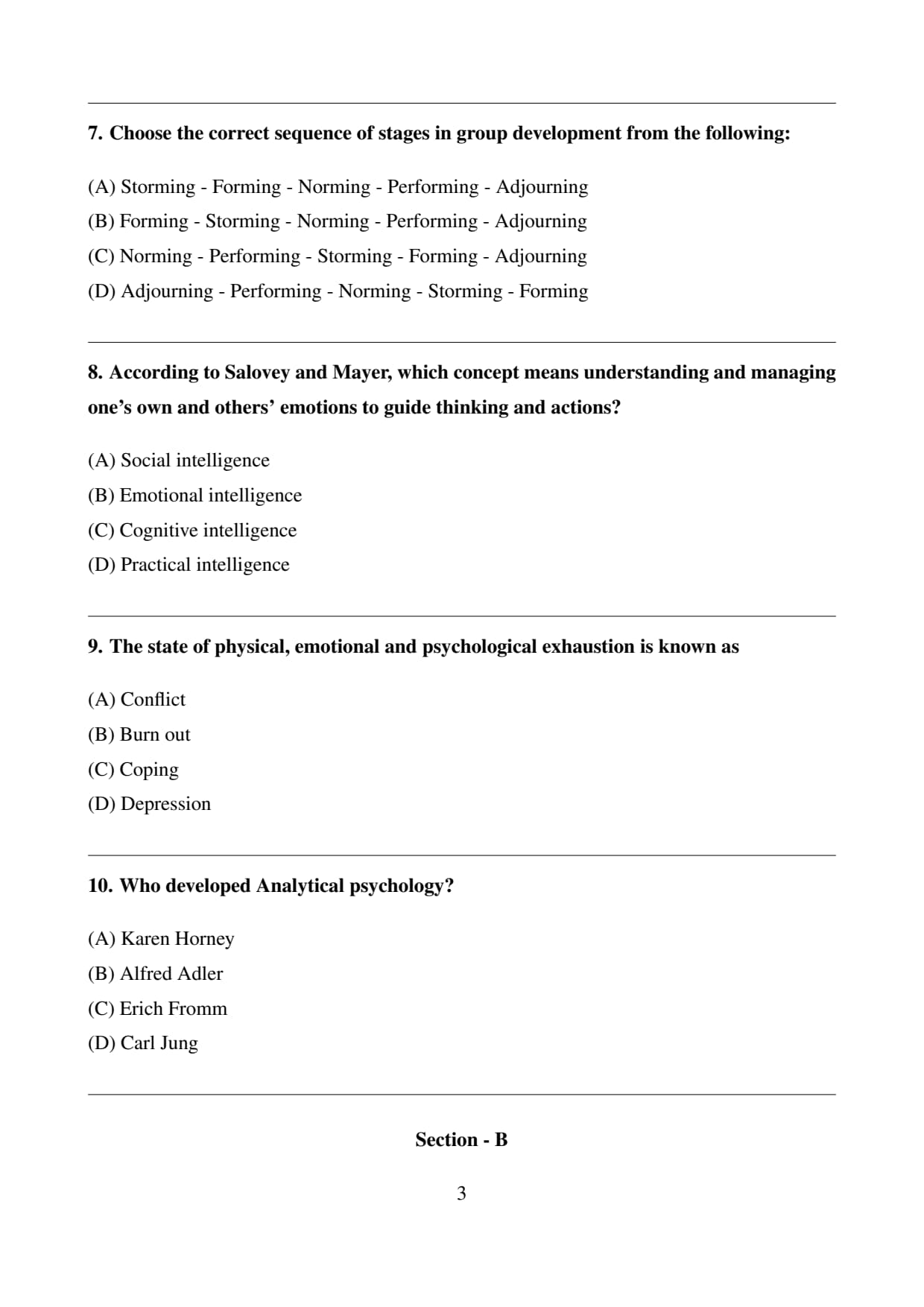
Choose the correct sequence of stages in group development from the following:
View Solution
Step 1: Understanding the stages of group development.
The stages of group development as proposed by Bruce Tuckman are: Forming, Storming, Norming, Performing, and Adjourning. These stages represent the typical sequence through which a group goes while working together.
Step 2: Sequence explanation.
The correct sequence starts with the group coming together (Forming), followed by disagreements and conflicts (Storming), establishing norms (Norming), performing tasks (Performing), and finally, the group disbands (Adjourning).
Step 3: Conclusion.
Therefore, the correct sequence of stages is Forming - Storming - Norming - Performing - Adjourning.
Final Answer: Forming - Storming - Norming - Performing - Adjourning. Quick Tip: The stages of group development are an essential part of teamwork. Keep in mind the importance of resolving conflicts (Storming) before reaching an efficient team dynamic (Performing).
According to Salovey and Mayer, which concept means understanding and managing one’s own and others’ emotions to guide thinking and actions?
View Solution
Step 1: Understanding Emotional Intelligence.
Emotional intelligence (EI) is the ability to recognize, understand, manage, and influence one’s own and others’ emotions. Salovey and Mayer developed the concept of EI, highlighting its significance in guiding thinking and actions.
Step 2: Comparison with other options.
(A) Social intelligence: Incorrect. Social intelligence involves understanding and managing social relationships, but it does not focus primarily on emotions.
(B) Emotional intelligence: Correct. Emotional intelligence specifically deals with managing and understanding emotions to guide thoughts and behaviors.
(C) Cognitive intelligence: Incorrect. Cognitive intelligence, or IQ, involves logical reasoning and problem-solving, but it is not focused on emotions.
(D) Practical intelligence: Incorrect. Practical intelligence refers to the ability to solve everyday problems, but it does not specifically address emotional regulation.
Step 3: Conclusion.
The correct answer is Emotional intelligence, as it directly involves understanding and managing emotions to guide thinking and actions.
Final Answer: Emotional intelligence. Quick Tip: Emotional intelligence is a critical skill for effective leadership and personal growth. Practice being aware of your emotions and those of others to make better decisions.
The state of physical, emotional and psychological exhaustion is known as
View Solution
Step 1: Understanding burnout.
Burnout refers to the state of emotional, physical, and mental exhaustion caused by excessive and prolonged stress. It is often associated with work but can occur in other areas of life as well.
Step 2: Explanation of options.
(A) Conflict: Incorrect. Conflict refers to a disagreement or clash between opposing ideas, interests, or people, not exhaustion.
(B) Burn out: Correct. Burnout is a state of physical, emotional, and psychological exhaustion due to chronic stress.
(C) Coping: Incorrect. Coping refers to the strategies used to manage stress, not the state of exhaustion caused by stress.
(D) Depression: Incorrect. Depression is a mental health condition that can involve feelings of sadness and hopelessness, but it is not specifically the same as burnout.
Step 3: Conclusion.
Burnout is the term that best describes the state of exhaustion from prolonged stress.
Final Answer: Burn out. Quick Tip: Burnout can be prevented or mitigated by regular stress management, self-care, and setting healthy boundaries in work and life.
Who developed Analytical psychology?
View Solution
Step 1: Understanding Analytical Psychology.
Analytical psychology is a psychological theory that emphasizes the importance of the unconscious and its influence on the psyche. It was developed by Carl Jung, who explored the concepts of archetypes, the collective unconscious, and individuation.
Step 2: Comparison with other options.
(A) Karen Horney: Incorrect. Horney is known for her work in psychoanalysis and the development of a more humanistic approach, but she did not develop analytical psychology.
(B) Alfred Adler: Incorrect. Adler is the founder of Individual Psychology, which focuses on the feelings of inferiority and the pursuit of personal goals, not analytical psychology.
(C) Erich Fromm: Incorrect. Fromm was a social psychologist known for his work on humanistic psychoanalysis, but he is not the founder of analytical psychology.
(D) Carl Jung: Correct. Carl Jung is the founder of Analytical Psychology, and his work introduced key concepts such as the collective unconscious, archetypes, and individuation.
Step 3: Conclusion.
The correct answer is (D) Carl Jung, who developed Analytical Psychology, a theory that heavily influenced modern psychology and psychotherapy.
Final Answer: Carl Jung. Quick Tip: Carl Jung's work on the collective unconscious and archetypes is foundational to Analytical Psychology. Remember that it differs from Freud's theories by placing greater emphasis on the unconscious and its influence on personal growth.
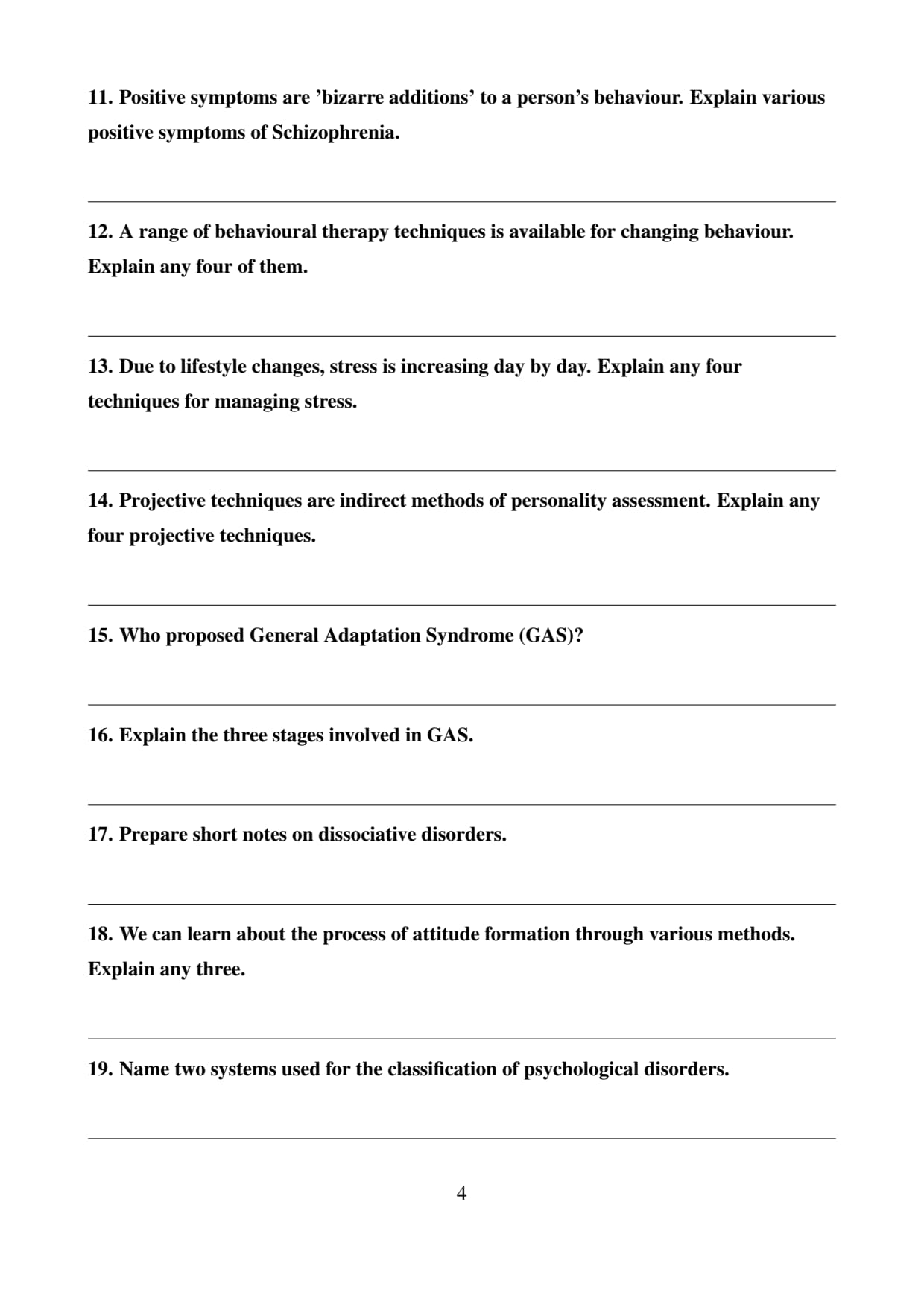
Positive symptoms are 'bizarre additions' to a person’s behaviour. Explain various positive symptoms of Schizophrenia.
View Solution
Step 1: Define Positive Symptoms of Schizophrenia.
Positive symptoms refer to excesses or distortions of normal functioning, such as delusions, hallucinations, and disorganized thinking. These symptoms are considered 'additions' to a person's behavior.
Step 2: Discuss Delusions.
Delusions are false beliefs that are not based in reality. For example, a person with schizophrenia may believe they are being persecuted or that they have special powers or abilities.
Step 3: Describe Hallucinations.
Hallucinations are false perceptions that can affect any of the five senses. The most common type is auditory hallucinations, where a person hears voices that are not there.
Step 4: Explain Disorganized Thinking.
Disorganized thinking refers to a person’s inability to maintain a logical flow of thought. This can result in incoherent speech, where a person may speak in ways that are difficult to understand.
Step 5: Mention Other Positive Symptoms.
Other positive symptoms include grossly disorganized or abnormal motor behavior, which can manifest as unpredictable agitation or inappropriate actions. Quick Tip: Remember: Positive symptoms are additions to normal behavior, such as delusions, hallucinations, and disorganized thinking.
A range of behavioural therapy techniques is available for changing behaviour. Explain any four of them.
View Solution
Step 1: Define behavioural therapy.
Behavioural therapy is a form of psychotherapy that aims to change unwanted behaviours through techniques such as reinforcement, conditioning, and exposure.
Step 2: Technique 1 - Classical Conditioning.
Classical conditioning involves associating a neutral stimulus with a stimulus that produces a natural response. Over time, the neutral stimulus alone triggers the response. This technique is useful in treating phobias and anxiety disorders.
Step 3: Technique 2 - Operant Conditioning.
Operant conditioning involves modifying behaviour through reinforcement (positive or negative) or punishment. This technique is effective in promoting desired behaviours or reducing undesirable ones.
Step 4: Technique 3 - Cognitive Behavioural Therapy (CBT).
CBT focuses on changing negative thought patterns that influence behaviour. It helps individuals recognize and challenge irrational thoughts and replace them with healthier, more realistic ones.
Step 5: Technique 4 - Systematic Desensitization.
Systematic desensitization is used to treat phobias by gradually exposing individuals to anxiety-inducing stimuli while teaching relaxation techniques to reduce the fear response. Quick Tip: Remember: Behavioural therapy techniques aim to modify behaviour through various methods like conditioning, reinforcement, and cognitive restructuring.
Due to lifestyle changes, stress is increasing day by day. Explain any four techniques for managing stress.
View Solution
Step 1: Understand Stress Management.
Stress management techniques are strategies to help cope with stress and reduce its negative effects on the body and mind.
Step 2: Discuss Relaxation Techniques.
Relaxation techniques, such as deep breathing exercises and progressive muscle relaxation, help reduce stress by calming the nervous system.
Step 3: Talk About Exercise.
Regular physical activity, such as walking, yoga, or aerobic exercises, is a powerful way to manage stress. It releases endorphins, which improve mood and reduce anxiety.
Step 4: Explain Time Management.
Effective time management, such as prioritizing tasks and setting boundaries, helps reduce stress by preventing feeling overwhelmed by responsibilities.
Step 5: Mention Social Support.
Building a network of supportive friends, family, or colleagues is an important way to manage stress. Sharing feelings and getting advice can provide relief. Quick Tip: Remember: Managing stress involves using strategies like relaxation, exercise, time management, and social support.
Projective techniques are indirect methods of personality assessment. Explain any four projective techniques.
View Solution
Step 1: Understand Projective Techniques.
Projective techniques are methods of personality assessment where individuals are presented with ambiguous stimuli, and their responses are believed to reflect their unconscious thoughts, feelings, and motives.
Step 2: Discuss Rorschach Inkblot Test.
The Rorschach test involves showing individuals inkblot images and asking them to describe what they see. The responses help reveal underlying thought patterns and emotional functioning.
Step 3: Explain Thematic Apperception Test (TAT).
In the TAT, individuals are shown ambiguous pictures and asked to tell a story about them. Their narrative provides insight into their personal concerns and social attitudes.
Step 4: Describe Sentence Completion Test.
In this test, individuals complete a series of incomplete sentences. Their responses help assess personality traits, emotional problems, and interpersonal relationships.
Step 5: Mention Draw-a-Person Test.
In the Draw-a-Person test, individuals are asked to draw a person. The way they draw the figure can reveal information about their self-image and psychological state. Quick Tip: Remember: Projective techniques are used to uncover hidden aspects of personality by analyzing responses to ambiguous stimuli.
Who proposed General Adaptation Syndrome (GAS)?
View Solution
Step 1: Define GAS.
General Adaptation Syndrome (GAS) is a model that describes the body's short-term and long-term reactions to stress.
Step 2: Identify the proposer.
GAS was proposed by Hans Selye, a Canadian endocrinologist, in 1936. He developed the theory to describe how the body responds to stress through a series of physiological changes.
Step 3: Clarify the significance.
Selye’s work highlighted the body's adaptive responses to stressors, marking a significant contribution to understanding stress and its impact on health. Quick Tip: Remember: Hans Selye proposed General Adaptation Syndrome to explain how the body reacts to stress in stages.
Explain the three stages involved in GAS.
View Solution
Step 1: Stage 1 - Alarm Reaction.
The alarm stage is the initial reaction to a stressor. In this stage, the body recognizes the stressor and activates the fight-or-flight response, triggering the release of stress hormones like adrenaline and cortisol.
Step 2: Stage 2 - Resistance.
In the resistance stage, the body attempts to adapt to the stressor by maintaining a high level of alertness. The body tries to cope with and overcome the stressor, and it utilizes resources to maintain homeostasis.
Step 3: Stage 3 - Exhaustion.
If the stressor persists for a long period, the body enters the exhaustion stage. At this point, the body’s resources are depleted, and the individual may experience fatigue, burnout, and reduced immunity, leading to greater vulnerability to illness. Quick Tip: Remember: The three stages of GAS are Alarm, Resistance, and Exhaustion, representing the body's response to stress.
Prepare short notes on dissociative disorders.
View Solution
Step 1: Define Dissociative Disorders.
Dissociative disorders involve a disruption in the normally integrated functions of consciousness, memory, identity, or perception. These disorders often manifest when an individual experiences a sense of detachment or disconnection from their surroundings or self.
Step 2: Discuss Types of Dissociative Disorders.
There are several types of dissociative disorders, including:
- **Dissociative Amnesia**: Inability to recall important autobiographical information, usually after a stressful or traumatic event.
- **Dissociative Identity Disorder (DID)**: Characterized by the presence of two or more distinct identities or personality states that control behavior at different times.
- **Depersonalization-Derealization Disorder**: A recurring feeling of detachment from one's body or surroundings.
Step 3: Discuss Causes and Risk Factors.
The exact cause of dissociative disorders is not fully understood, but factors like trauma, stress, and abuse during childhood are considered contributing factors. They are often a way for the mind to cope with overwhelming emotional stress.
Step 4: Treatment Approaches.
Treatment for dissociative disorders often involves psychotherapy, particularly cognitive-behavioral therapy, to address trauma-related issues and integrate fragmented memories and identities. Quick Tip: Remember: Dissociative disorders often arise from trauma, and therapy focuses on reintegrating the fractured aspects of memory and identity.
We can learn about the process of attitude formation through various methods. Explain any three.
View Solution
Step 1: Define Attitude Formation.
Attitude formation is the process through which people develop opinions, feelings, and beliefs about various objects, people, or events. It can occur through direct experiences or indirect influences.
Step 2: Discuss the Learning Theory.
One method of attitude formation is through **learning theory**, where attitudes are learned from experiences, rewards, and punishments. This includes both classical and operant conditioning, where individuals develop attitudes based on positive or negative reinforcement.
Step 3: Explain Social Influence.
Another method of attitude formation occurs through **social influence**, where individuals form attitudes based on the behaviors and opinions of others. Peer pressure, social norms, and authority figures all play a role in shaping an individual's attitudes.
Step 4: Discuss Cognitive Dissonance.
The **cognitive dissonance theory** suggests that when people experience discomfort due to conflicting beliefs or attitudes, they tend to adjust their attitudes to reduce this dissonance. This is another important method of attitude formation, especially when trying to align behavior with beliefs. Quick Tip: Remember: Attitude formation is influenced by direct experiences, social interactions, and cognitive processes that help resolve conflicts or dissonance.
Name two systems used for the classification of psychological disorders.
View Solution
Step 1: DSM (Diagnostic and Statistical Manual of Mental Disorders).
The DSM is a widely used system for classifying psychological disorders. Published by the American Psychiatric Association, it categorizes mental health conditions and provides diagnostic criteria for each disorder.
Step 2: ICD (International Classification of Diseases).
The ICD is another system used globally for the classification of diseases, including psychological disorders. Published by the World Health Organization (WHO), it is used for both epidemiological and clinical purposes. Quick Tip: Remember: DSM is used mainly in the United States, while ICD is used internationally for classifying psychological and physical health conditions.
What are the various sources of prejudice?
View Solution
Step 1: Social Categorization.
Prejudice often arises from categorizing people into groups based on characteristics like race, gender, or religion. This leads to stereotypes and biased attitudes towards those outside one's own group.
Step 2: Ingroup vs. Outgroup Dynamics.
People tend to favor their ingroup (the group to which they belong) and view members of outgroups negatively. This bias creates prejudice towards those perceived as different or part of the outgroup.
Step 3: Socioeconomic Factors.
Economic disparity and competition for resources can contribute to prejudice. People may develop negative attitudes towards others based on their social or economic status, leading to discrimination.
Step 4: Cultural and Historical Influences.
Cultural beliefs and historical events (such as past conflicts or colonization) can perpetuate prejudice across generations. These influences shape societal attitudes towards different groups. Quick Tip: Remember: Prejudice arises from social, psychological, and historical factors that promote group-based discrimination.
What is group polarisation?
View Solution
Step 1: Define Group Polarisation.
Group polarisation refers to the tendency for a group to make decisions that are more extreme than the initial inclination of its individual members. This phenomenon often occurs during group discussions, where individuals' opinions become more pronounced and lead to a more extreme collective decision.
Step 2: Explain the Process.
When individuals in a group share their views, they often validate and reinforce each other’s opinions, leading to a stronger conviction about a particular decision. This effect can push group decisions to be riskier (risky shift) or more cautious (cautious shift), depending on the group's initial tendency.
Step 3: Discuss Factors Influencing Group Polarisation.
Group polarisation can be influenced by several factors such as group size, the homogeneity of group members, and the presence of strong persuasive arguments that support a particular point of view. Quick Tip: Remember: Group polarisation occurs when a group’s collective decisions are more extreme than the individual decisions before the discussion.
Identify any four alternative therapy techniques for treating psychological distress.
View Solution
Step 1: Define Alternative Therapy Techniques.
Alternative therapy techniques are non-conventional methods used to treat psychological distress. These methods often focus on mind-body connections and can complement traditional therapeutic practices.
Step 2: Discuss Meditation.
Meditation is a relaxation technique that focuses on achieving a state of deep relaxation and heightened awareness. It helps reduce stress, anxiety, and depression by promoting a calm and centered state of mind.
Step 3: Explain Cognitive Behavioral Therapy (CBT).
Cognitive Behavioral Therapy (CBT) is a structured, goal-oriented therapy that helps individuals change negative thought patterns and behaviors that contribute to psychological distress, such as anxiety and depression.
Step 4: Describe Art Therapy.
Art therapy uses creative expression through various art forms like painting, drawing, or sculpture to help individuals explore emotions and cope with stress. It provides a safe outlet for expression and helps individuals process their feelings.
Step 5: Discuss Acupuncture.
Acupuncture involves inserting fine needles into specific points of the body to help balance energy flow. It has been found to help manage stress, anxiety, and physical symptoms associated with psychological distress. Quick Tip: Remember: Alternative therapies like meditation, CBT, art therapy, and acupuncture are valuable methods for reducing psychological distress and promoting overall well-being.
Define intelligence.
View Solution
Step 1: Define Intelligence.
Intelligence is generally defined as the ability to learn from experience, adapt to new situations, understand and handle abstract concepts, and apply knowledge to solve problems. It encompasses various cognitive abilities such as memory, reasoning, problem-solving, and the capacity for learning.
Step 2: Clarify Theories of Intelligence.
Intelligence can be viewed from different theoretical perspectives, including:
- **General Intelligence (g)**: A concept introduced by Charles Spearman that refers to a general cognitive ability that influences performance on various mental tasks.
- **Multiple Intelligences**: Proposed by Howard Gardner, this theory suggests that intelligence is not a single ability but a set of multiple intelligences, such as linguistic, logical-mathematical, spatial, and interpersonal intelligence. Quick Tip: Remember: Intelligence involves the ability to adapt and apply knowledge in various contexts, and can be understood in multiple ways.
Write the formula for finding IQ.
View Solution
Step 1: Define IQ.
IQ (Intelligence Quotient) is a measure of a person's intellectual abilities in relation to others. It is calculated by dividing the individual's mental age by their chronological age and multiplying by 100.
Step 2: IQ Formula.
The formula for calculating IQ is:
\[ IQ = \frac{Mental Age}{Chronological Age} \times 100 \]
Step 3: Explanation.
Mental age refers to the age at which an individual performs intellectually, while chronological age refers to their actual age. The formula helps determine how an individual's intelligence compares to the average person of the same age. Quick Tip: Remember: IQ is a ratio of mental age to chronological age, multiplied by 100 to standardize the score.
List out various levels of intellectual deficiencies.
View Solution
Step 1: Define Intellectual Deficiency.
Intellectual deficiency, also known as intellectual disability, refers to below-average intellectual functioning and limitations in adaptive behaviors. These deficiencies are typically identified before the age of 18.
Step 2: Discuss Levels of Intellectual Deficiency.
Intellectual disabilities are categorized into various levels based on IQ scores:
- Mild**: IQ between 50-70. Individuals may achieve academic and vocational skills with some support.
- Moderate**: IQ between 35-50. Individuals may need significant support in daily activities and are likely to require assistance in academics and job tasks.
- Severe**: IQ between 20-35. Individuals typically need extensive support in all areas of daily life and may only develop limited communication skills.
- Profound**: IQ below 20. Individuals have severe limitations in all areas, and typically require lifelong support for daily activities. Quick Tip: Remember: Intellectual disabilities are classified into mild, moderate, severe, and profound levels based on IQ and the need for support.
Briefly explain the theory of multiple intelligence by Gardner.
View Solution
Step 1: Define the theory of multiple intelligences.
The theory of multiple intelligences, proposed by Howard Gardner, suggests that intelligence is not a single, general ability but rather a collection of distinct, independent abilities.
Step 2: Identify the different types of intelligence.
Gardner identified several types of intelligence, including linguistic, logical-mathematical, spatial, musical, bodily-kinesthetic, interpersonal, intrapersonal, and naturalistic intelligence.
Step 3: Explain the implication of the theory.
Gardner's theory emphasizes that individuals possess unique combinations of these intelligences, which means that traditional IQ tests may not fully capture an individual's intellectual strengths. Quick Tip: Remember: Gardner's theory highlights that intelligence is diverse and includes various domains beyond traditional cognitive abilities.
What is trait? Explain Cattell’s trait theory.
View Solution
Step 1: Define trait.
A trait is a consistent and enduring pattern of behavior, thoughts, and emotions that characterizes an individual. Traits are relatively stable over time and influence how individuals respond to different situations.
Step 2: Explain Cattell’s trait theory.
Cattell’s trait theory suggests that personality can be described using 16 primary traits, such as warmth, reasoning, emotional stability, dominance, and liveliness. These traits were identified through factor analysis, a method that reduces a large set of variables into smaller, manageable categories.
Step 3: Discuss the significance of Cattell's theory.
Cattell's theory was one of the first attempts to provide a systematic way of describing and measuring personality using a scientific approach. The 16PF (16 Personality Factor) questionnaire, based on his theory, remains a widely used tool in personality assessment. Quick Tip: Remember: Cattell identified 16 primary traits that form the foundation of personality, using a data-driven approach.
Describe General Adaptation Syndrome suggested by Selye.
View Solution
Step 1: Define General Adaptation Syndrome (GAS).
General Adaptation Syndrome (GAS), proposed by Hans Selye, describes the body’s response to stress in three stages: Alarm, Resistance, and Exhaustion. GAS explains how prolonged stress can affect an individual's health and well-being.
Step 2: Stage 1 - Alarm Reaction.
In the alarm stage, the body reacts to a stressor with a "fight or flight" response, releasing stress hormones such as adrenaline and cortisol, which prepare the body for immediate action.
Step 3: Stage 2 - Resistance.
In the resistance stage, the body attempts to adapt to the stressor by maintaining a high level of alertness. The physiological systems are activated to cope with the stressor.
Step 4: Stage 3 - Exhaustion.
In the exhaustion stage, if the stressor persists, the body’s resources are depleted, leading to physical and emotional exhaustion. Chronic stress can lead to burnout, illness, or even death. Quick Tip: Remember: GAS involves three stages: Alarm, Resistance, and Exhaustion, showing the body’s response to prolonged stress.
Discuss the main components of an attitude.
View Solution
Step 1: Define attitude.
An attitude is a psychological tendency to evaluate something positively or negatively. Attitudes are shaped by an individual’s beliefs, feelings, and behaviors toward a particular object, person, or idea.
Step 2: The three components of an attitude.
The three main components of an attitude are:
Cognitive component: This refers to the beliefs and thoughts an individual has about the attitude object.
Affective component: This refers to the emotional reactions or feelings towards the attitude object.
Behavioral component: This refers to how an individual’s attitude influences their actions or behaviors towards the attitude object.
Step 3: Example.
For example, if a person holds a positive attitude toward exercise (cognitive), enjoys it (affective), and regularly exercises (behavioral), all three components are aligned. Quick Tip: Remember: An attitude has three components—cognitive, affective, and behavioral—that work together to shape our evaluation of objects and ideas.
Describe Freud’s Psychosexual stages of personality development.
View Solution
Step 1: Overview of Freud's Psychosexual stages.
Freud's theory of psychosexual development proposes that personality develops through a series of stages during childhood, each centered around a different erogenous zone.
Step 2: Stage 1 - Oral Stage.
The oral stage (0-1 year) is centered on the mouth, and pleasure is derived from activities such as sucking and biting. Fixation at this stage can lead to issues such as smoking or overeating later in life.
Step 3: Stage 2 - Anal Stage.
The anal stage (1-3 years) focuses on control and elimination. Children gain pleasure from controlling their bladder and bowels. Fixation can result in obsessive or messy behavior in adulthood.
Step 4: Stage 3 - Phallic Stage.
The phallic stage (3-6 years) involves the child discovering their genitals and developing an attraction to the opposite-sex parent. Freud believed this stage contributes to the development of the Oedipus or Electra complex.
Step 5: Stage 4 - Latency Stage.
The latency stage (6-puberty) is marked by a period of sexual calm, where children focus on developing skills and interests, with no further psychosexual development.
Step 6: Stage 5 - Genital Stage.
The genital stage (puberty onward) involves the development of mature sexual relationships and is focused on the healthy expression of sexual desires. Quick Tip: Remember: Freud's stages of development emphasize the role of unconscious desires and childhood experiences in shaping personality.
Name the two approaches on which theories of intelligence can be broadly classified.
View Solution
Step 1: Identify the Two Approaches.
Theories of intelligence can generally be classified into two broad approaches: the **Psychometric Approach** and the **Cognitive Approach**.
Step 2: Discuss the Psychometric Approach.
The psychometric approach focuses on measuring intelligence through standardized tests and assessments. It primarily aims at quantifying intelligence in terms of measurable variables, such as IQ scores, and compares individual performance against norms.
Step 3: Explain the Cognitive Approach.
The cognitive approach, on the other hand, emphasizes understanding the internal mental processes involved in problem-solving, reasoning, and learning. It focuses on how people acquire, process, and apply information, rather than just measuring the outcome of intelligence. Quick Tip: Remember: Intelligence theories can be classified into the psychometric approach (measuring intelligence) and the cognitive approach (understanding mental processes).
Enumerate any three types of groups.
View Solution
Step 1: Define group.
A group is defined as two or more individuals who interact with each other, share common goals, and have a sense of unity and belonging.
Step 2: Three types of groups.
1. Primary Groups: These are small, close-knit groups, often characterized by intimate, long-term relationships, such as family and close friends.
2. Secondary Groups: These are larger, more formal groups, where relationships are usually task-oriented and temporary, such as work teams or professional organizations.
3. Reference Groups: These are groups that individuals use as a standard for evaluating themselves, even if they are not part of the group, such as role models or peer groups. Quick Tip: Remember: Groups can be classified based on their size, structure, and purpose, with primary and secondary groups being the most common types.




Comments