




The Karnataka 2nd PUC (Class 12) Economics Exam 2026, conducted by KSEAB, is scheduled for March 10, 2026, as part of the main board exams running from Feb 28 to March 17, 2026. The exam lasts 3 hours, from 10:15 a.m. to 1:30 p.m. (or 10:30 am start). Key topics include Microeconomics, Macroeconomics, National Income, and Money/Banking.
The official question paper of Karnataka Board Class 12 Economics Board Exam 2026 is provided below. Students can download the official paper in PDF format for reference.
Karnataka Board Class 12 Economics 2026 Question Paper with Solution PDF
| Karnataka Board Class 12 Economics 2026 Question Paper with Solution PDF | Download PDF | Check Solutions |

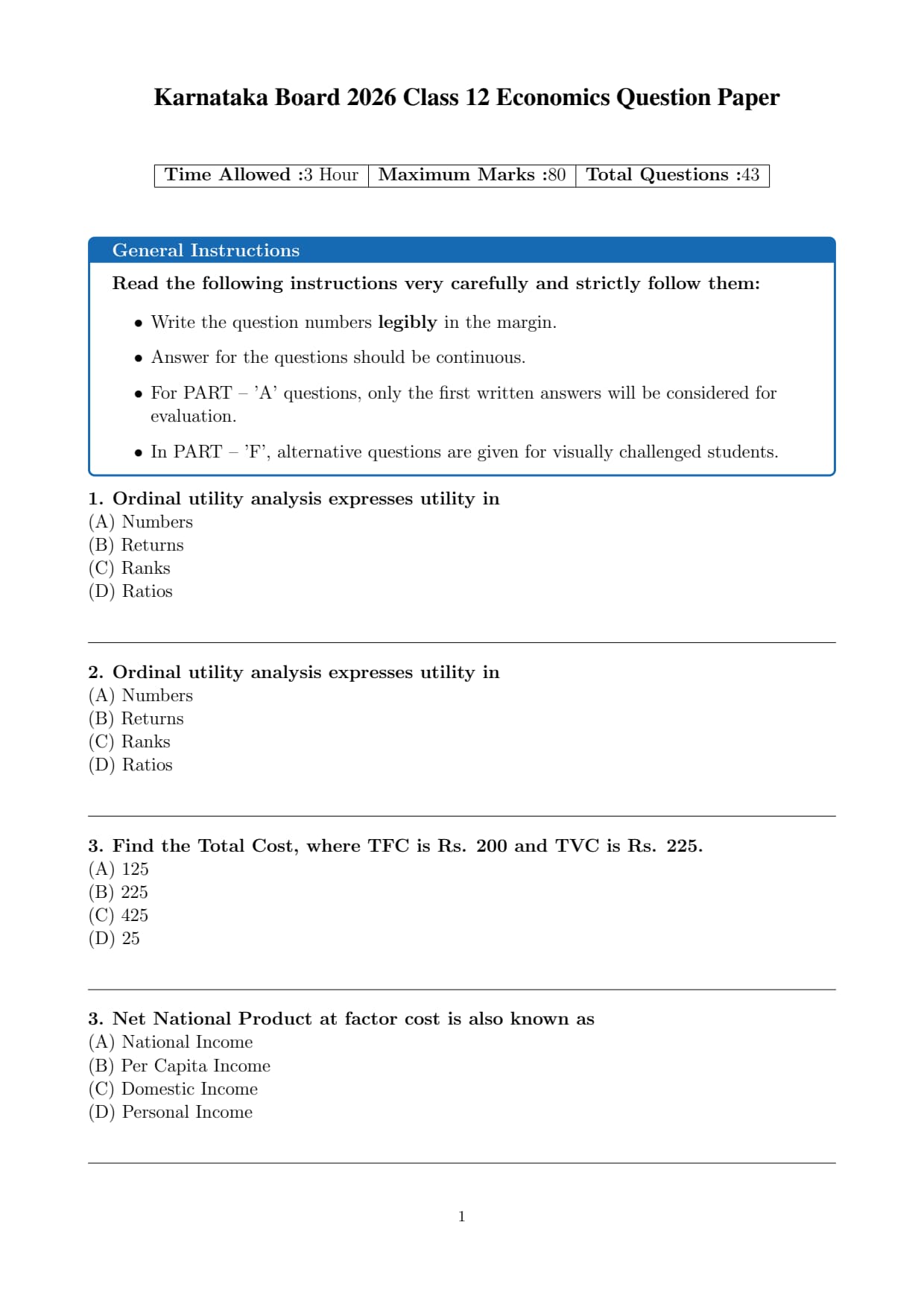
Ordinal utility analysis expresses utility in
View Solution
Concept:
Utility refers to the satisfaction derived by a consumer from consuming goods and services.
There are two approaches to measuring utility in economics:
Cardinal Utility Approach: Utility can be measured in absolute numerical units called utils.
Ordinal Utility Approach: Utility cannot be measured in exact numbers; instead, consumers can only \textit{rank their preferences among different bundles of goods.
The ordinal approach was developed by economists such as \textit{Hicks and \textit{Allen. It assumes that consumers are able to compare alternatives and express preferences in terms of order or ranking rather than numerical measurement.
Step 1: {\color{redUnderstanding the meaning of ordinal measurement.
In ordinal utility analysis, the consumer only indicates whether one bundle of goods is preferred over another. For example:
\[ Bundle A \succ Bundle B \succ Bundle C \]
This means Bundle A gives more satisfaction than Bundle B, and Bundle B gives more satisfaction than Bundle C.
However, the consumer does not specify \textit{how much more satisfaction is obtained.
Thus, utility is expressed only in terms of ranking or ordering of preferences.
Step 2: Evaluating the options.
(A) Numbers → Used in cardinal utility analysis.
(B) Returns → Not related to utility measurement.
(C) Ranks → Correct, since ordinal utility ranks preferences.
(D) Ratios → Not used in ordinal analysis.
Therefore, ordinal utility analysis expresses utility in ranks. Quick Tip: Remember the key difference:
\textbf{Cardinal Utility → Measured in numbers (utils).
\textbf{Ordinal Utility → Measured by ranking or ordering of preferences.}
Find the Total Cost, where TFC is Rs. 200 and TVC is Rs. 225.
View Solution
Concept:
In cost analysis, the total cost of production is composed of two main components:
Total Fixed Cost (TFC): Costs that remain constant regardless of the level of output, such as rent, salaries, and insurance.
Total Variable Cost (TVC): Costs that change with the level of output, such as raw materials, labor wages, and electricity used in production.
The relationship between these costs is given by the formula:
\[ TC = TFC + TVC \]
where \(TC\) represents Total Cost.
Step 1: {\color{redUse the Total Cost formula.
Given: \[ TFC = 200, \qquad TVC = 225 \]
Substitute these values into the formula:
\[ TC = 200 + 225 \]
\[ TC = 425 \]
Step 2: Identify the correct option.
Among the given options, \(425\) corresponds to option (C).
Therefore, the Total Cost is Rs. 425. Quick Tip: Always remember the basic cost identity in microeconomics: \[ Total Cost (TC) = Total Fixed Cost (TFC) + Total Variable Cost (TVC) \] Fixed costs do not change with output, while variable costs increase as production increases.
Net National Product at factor cost is also known as
View Solution
Concept:
National income accounting measures the total income earned by the factors of production in an economy during a given period. One of the important measures of national income is Net National Product at Factor Cost (NNP\(_{FC}\)).
Net National Product (NNP): It is obtained by subtracting depreciation from Gross National Product (GNP).
Factor Cost: It refers to the cost of production from the perspective of factor payments (wages, rent, interest, and profit), excluding indirect taxes and including subsidies.
Thus, when NNP is measured at factor cost, it represents the total income earned by all the factors of production in an economy.
\[ NNP_{FC} = National Income \]
Step 1: {\color{redUnderstanding the relationship.
Net National Product at Factor Cost represents the total earnings of labor, land, capital, and entrepreneurship within a country during a year. Hence, it is referred to as National Income.
Step 2: Evaluating the options.
(A) National Income → Correct, because \(NNP_{FC}\) is the standard definition of national income.
(B) Per Capita Income → National income divided by population.
(C) Domestic Income → Refers to income generated within domestic territory.
(D) Personal Income → Income actually received by individuals after adjustments.
Therefore, Net National Product at factor cost is also known as National Income. Quick Tip: \[ National Income = NNP_{FC} \] Also remember the relation: \[ NNP_{FC} = GNP_{MP} - Depreciation - Net Indirect Taxes \] This represents the total factor income earned in an economy.
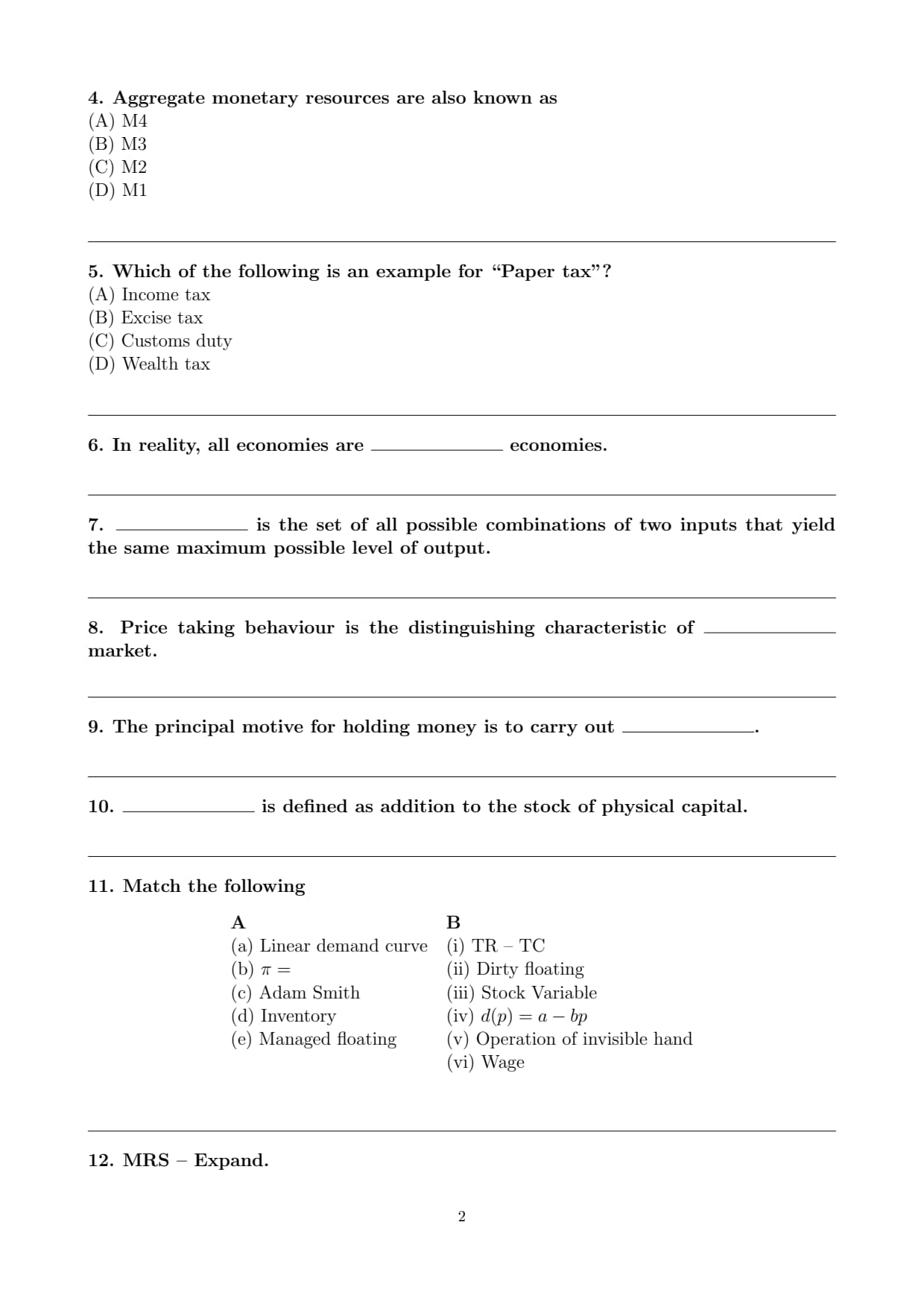
Aggregate monetary resources are also known as
View Solution
Concept:
Money supply refers to the total stock of monetary assets available in an economy at a particular time. In India, the Reserve Bank of India classifies money supply into four main aggregates:
\(M_1\) – Narrow Money
\(M_2\) – Narrow Money + Savings deposits with Post Office Savings Banks
\(M_3\) – Broad Money
\(M_4\) – Broad Money + Total deposits with Post Office Savings Banks
Among these measures, \(M_3\) represents the most commonly used indicator of total money supply because it includes currency with the public as well as bank deposits.
\[ M_3 = M_1 + Time Deposits with Commercial Banks \]
Thus, \(M_3\) represents the aggregate monetary resources available in the economy.
Step 1: {\color{redUnderstanding aggregate monetary resources.
Aggregate monetary resources refer to the broad measure of money supply including both currency and bank deposits available to the public.
Since \(M_3\) includes currency with the public, demand deposits, and time deposits with commercial banks, it represents the total monetary resources in the economy.
Step 2: Evaluating the options.
(A) \(M_4\) → Includes post office deposits as well, but not the commonly used aggregate.
(B) \(M_3\) → Correct; also known as Broad Money and represents aggregate monetary resources.
(C) \(M_2\) → Limited measure including post office savings deposits.
(D) \(M_1\) → Narrow money including currency and demand deposits only.
Therefore, aggregate monetary resources are also known as \(M_3\). Quick Tip: Money supply measures in India: \(M_1\) = Currency + Demand Deposits (Narrow Money) \(M_2\) = \(M_1\) + Post Office Savings Deposits \(M_3\) = \(M_1\) + Time Deposits with Banks (Broad Money) \(M_4\) = \(M_3\) + Total Post Office Deposits \textbf{\(M_3\) is the most widely used measure of money supply and represents aggregate monetary resources.}
Which of the following is an example for ``Paper tax''?
View Solution
Concept:
Taxes can be classified based on the method through which they are assessed and collected. One such classification refers to “Paper Taxes.”
Paper Taxes: These are taxes that are assessed based on written declarations, documents, or returns submitted by taxpayers. The calculation and payment of such taxes mainly depend on financial records and paperwork.
They are generally direct taxes because the burden of the tax falls on the same person who pays it.
Examples of paper taxes include taxes that require filing returns or maintaining financial records.
Step 1: {\color{redUnderstanding the nature of paper taxes.
Income tax is calculated based on income statements, financial records, and tax returns filed by individuals or firms. Since the tax is determined through documented information and paperwork, it is referred to as a paper tax.
Step 2: Evaluating the options.
(A) Income tax → Correct, because it is assessed through tax returns and documents.
(B) Excise tax → Indirect tax imposed on production of goods.
(C) Customs duty → Indirect tax on imports and exports.
(D) Wealth tax → Direct tax, but not typically classified as paper tax in this context.
Therefore, the correct answer is Income tax. Quick Tip: \textbf{Paper Tax:} A tax assessed through written records, documents, or tax returns. \textbf{Examples:} Income Tax Corporate Tax Indirect taxes like excise duty and customs duty are collected through transactions rather than paperwork.
In reality, all economies are \rule{3cm}{0.15mm} economies.
View Solution
Concept:
Economic systems describe the way resources are allocated and economic activities are organized in a country. Broadly, there are three types of economic systems:
Capitalist Economy: Resources are owned and controlled by private individuals, and market forces determine production and prices.
Socialist Economy: The government owns and controls the major means of production and distribution.
Mixed Economy: Both the government and private sector participate in economic activities.
In practice, no country follows a completely pure capitalist or pure socialist system. Most countries adopt a combination of both systems.
Step 1: {\color{redUnderstanding the practical economic system.
In reality, economies combine elements of both private enterprise and government intervention. The government regulates markets, provides public goods, and ensures social welfare, while private firms operate businesses and industries.
Thus, real-world economies function as mixed economies.
Step 2: Conclusion.
Since both public and private sectors coexist in most countries, the statement becomes:
\[ In reality, all economies are mixed economies. \] Quick Tip: \textbf{Mixed Economy = Public Sector + Private Sector} Most modern economies such as India, the USA, and the UK operate as mixed economies where both market forces and government policies influence economic activities.
\rule{3cm}{0.15mm} is the set of all possible combinations of two inputs that yield the same maximum possible level of output.
View Solution
Concept:
In production theory, firms combine different inputs such as labour and capital to produce output. An important concept used to analyze this relationship is the Isoquant.
An Isoquant represents different combinations of two inputs that produce the same level of output.
The term isoquant is derived from:
Iso meaning equal
\textit{Quant meaning quantity of output
Thus, an isoquant curve shows combinations of inputs that yield the same maximum possible level of production.
Step 1: {\color{redUnderstanding the definition of an isoquant.
Suppose a firm uses labour (\(L\)) and capital (\(K\)) to produce goods. Different combinations of these inputs may produce the same output level.
For example:
\[ (L_1, K_1), \quad (L_2, K_2), \quad (L_3, K_3) \]
All these combinations may produce the same quantity of output. The curve joining these combinations is called an Isoquant.
Step 2: Conclusion.
Since the statement describes the set of all combinations of two inputs producing the same output level, it refers to an Isoquant.
Therefore,
\[ Isoquant is the set of all possible combinations of two inputs that yield the same level of output. \] Quick Tip: \textbf{Isoquant Curve: Shows combinations of two inputs producing the same output. Similar to an indifference curve in consumer theory. Always slopes downward and is convex to the origin.
Price taking behaviour is the distinguishing characteristic of \rule{3cm}{0.15mm} market.
View Solution
Concept:
Market structures describe the nature and degree of competition in a market. One important type of market structure is Perfect Competition.
In a perfectly competitive market, there are a large number of buyers and sellers.
Each firm produces a homogeneous product.
Firms have no control over price.
Because individual firms are too small to influence the market price, they must accept the price determined by the overall market demand and supply.
Step 1: {\color{redUnderstanding price-taking behaviour.
A price taker is a firm that accepts the market price as given and cannot influence it. If a firm tries to charge a higher price, consumers will simply buy from other sellers.
Thus, firms in such a market adjust their output according to the prevailing market price rather than setting their own price.
Step 2: Identifying the market structure.
Price-taking behaviour is the key characteristic of a perfectly competitive market. Hence, the statement becomes:
\[ Price taking behaviour is the distinguishing characteristic of a perfectly competitive market. \] Quick Tip: \textbf{Perfect Competition Key Features:} Large number of buyers and sellers Homogeneous products Free entry and exit Firms are \textbf{price takers} Other market structures like monopoly or oligopoly have \textbf{price-making} firms.
The principal motive for holding money is to carry out \rule{3cm}{0.15mm}.
View Solution
Concept:
According to the Keynesian theory of demand for money, people hold money for three main motives:
Transaction Motive
Precautionary Motive
Speculative Motive
Among these, the most important and primary reason for holding money is the transaction motive. People require money to carry out day-to-day economic activities such as buying goods and services and making payments.
Step 1: {\color{redUnderstanding the transaction motive.
Individuals and firms hold money mainly to meet their routine expenditures. Since income is received at intervals while spending occurs continuously, people need money to bridge this gap.
Thus, money is held primarily to conduct transactions.
Step 2: Conclusion.
Therefore, the statement becomes:
\[ The principal motive for holding money is to carry out transactions. \] Quick Tip: \textbf{Keynes' Motives for Holding Money:} \textbf{Transaction Motive} – For everyday purchases and payments. \textbf{Precautionary Motive} – For unexpected expenses. \textbf{Speculative Motive} – To take advantage of future investment opportunities. The \textbf{transaction motive} is considered the primary reason for holding money.
\rule{3cm}{0.15mm} is defined as addition to the stock of physical capital.
View Solution
Concept:
In macroeconomics, investment refers to the increase in the stock of capital goods in an economy. Capital goods include machines, tools, buildings, factories, and equipment used for production.
Investment is therefore the expenditure made to create new capital assets or to add to the existing stock of physical capital.
\[ Investment = Addition to the stock of physical capital \]
Step 1: {\color{redUnderstanding the meaning of investment.
When firms purchase new machinery, construct factories, or increase inventories, they increase the productive capacity of the economy. This increase represents an addition to the stock of physical capital.
Thus, such activities are classified as investment.
Step 2: Conclusion.
Therefore, the statement becomes:
\[ Investment is defined as addition to the stock of physical capital. \] Quick Tip: \textbf{Investment in Economics:} Purchase of new machinery and equipment Construction of factories and buildings Increase in inventories All these activities lead to an \textbf{increase in the stock of physical capital}, which is called investment.
Match the following
\begin{tabular{ll
A & B
(a) Linear demand curve & (i) TR -- TC
(b) \(\pi =\) & (ii) Dirty floating
(c) Adam Smith & (iii) Stock Variable
(d) Inventory & (iv) \(d(p) = a - bp\)
(e) Managed floating & (v) Operation of invisible hand
& (vi) Wage
\end{tabular
(a) -- (iv), \quad (b) -- (i), \quad (c) -- (v), \quad (d) -- (iii), \quad (e) -- (ii)
View Solution
Concept:
This question involves matching important concepts from microeconomics and macroeconomics with their correct definitions or expressions.
Linear Demand Curve represents a straight-line demand function.
Profit (\(\pi\)) is defined as the difference between total revenue and total cost.
Adam Smith introduced the idea of the invisible hand in market economies.
Inventory refers to goods stored by firms and is considered a stock variable.
Managed Floating Exchange Rate is also known as dirty floating.
Step 1: {\color{redMatching each item correctly.
(a) Linear demand curve \(\rightarrow\) Demand function represented as \[ d(p) = a - bp \]
Hence, (a) -- (iv)
(b) \(\pi =\) Profit is defined as: \[ \pi = TR - TC \]
Hence, (b) -- (i)
(c) Adam Smith \(\rightarrow\) Known for the concept of the operation of invisible hand.
Hence, (c) -- (v)
(d) Inventory \(\rightarrow\) It is measured at a point of time and therefore is a stock variable.
Hence, (d) -- (iii)
(e) Managed floating \(\rightarrow\) Also called dirty floating exchange rate system.
Hence, (e) -- (ii)
Step 2: Final matching.
\[ (a)-(iv), \quad (b)-(i), \quad (c)-(v), \quad (d)-(iii), \quad (e)-(ii) \] Quick Tip: \textbf{Important Microeconomic Identities:} Profit: \(\pi = TR - TC\) Linear Demand Function: \(d(p) = a - bp\) Inventory is a \textbf{stock variable} Adam Smith introduced the concept of the \textbf{Invisible Hand} Managed Floating Exchange Rate = \textbf{Dirty Floating}
MRS -- Expand.
View Solution
Concept:
In consumer theory, the Marginal Rate of Substitution (MRS) refers to the rate at which a consumer is willing to substitute one good for another while maintaining the same level of satisfaction or utility.
It represents the trade-off between two goods in the consumption bundle.
\[ MRS = \frac{Marginal Utility of Good X}{Marginal Utility of Good Y} \]
Step 1: {\color{redUnderstanding the expansion of MRS.
The abbreviation MRS stands for Marginal Rate of Substitution. It indicates how much of one good a consumer is willing to give up to obtain an additional unit of another good without changing the level of utility.
Step 2: Interpretation.
On an indifference curve, the slope of the curve at any point represents the marginal rate of substitution between two goods.
Thus,
\[ MRS = Marginal Rate of Substitution \] Quick Tip: \textbf{Marginal Rate of Substitution (MRS):} Measures the rate of exchange between two goods. Indicates the slope of the indifference curve. Shows how much of one good a consumer sacrifices for another while keeping utility constant.
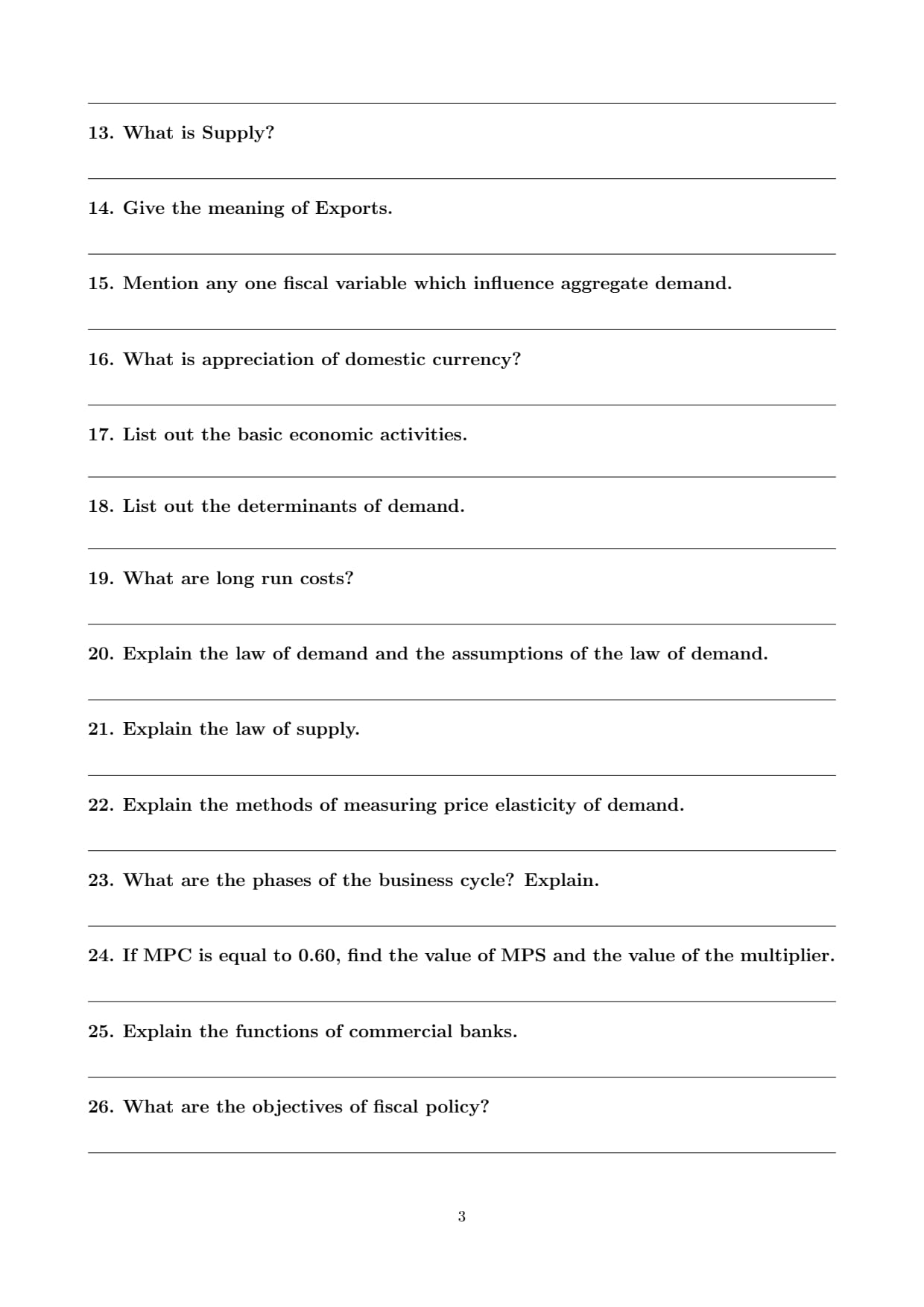
What is Supply?
View Solution
Concept:
In economics, supply describes the relationship between the price of a good and the quantity that producers are willing to sell in the market.
Supply reflects the producer's willingness and ability to produce and offer goods for sale at different price levels over a specific time period.
Step 1: {\color{redUnderstanding the definition of supply.
Supply can be defined as the amount of a commodity that producers are willing and able to sell in the market at different prices during a given period of time, other factors remaining constant.
\[ Supply \propto Price \]
This indicates that generally, as price increases, producers are willing to supply more goods.
Step 2: Key elements of supply.
Quantity of the commodity
Price of the commodity
Willingness and ability of producers
A given time period
Thus, supply explains how much of a good producers are prepared to sell at different prices. Quick Tip: \textbf{Important Points about Supply:} Supply refers to the seller's side of the market. It depends mainly on the price of the commodity. Higher price generally leads to higher quantity supplied.
Give the meaning of Exports.
View Solution
Concept:
In international trade, countries exchange goods and services with one another. When a country sells its domestically produced goods or services to foreign countries, it is known as exports.
Exports help countries earn foreign exchange and expand their markets beyond domestic boundaries.
Step 1: {\color{redUnderstanding the meaning of exports.
Exports can be defined as the sale of goods and services produced within a country to buyers located in other countries.
These transactions involve the movement of goods from the domestic economy to foreign markets.
Step 2: Importance of exports.
Earn foreign exchange for the country.
Promote economic growth.
Increase production and employment.
Improve the balance of trade.
Thus, exports play an important role in international trade and economic development. Quick Tip: \textbf{Exports vs Imports} \textbf{Exports:} Goods and services sold to other countries. \textbf{Imports:} Goods and services purchased from other countries. Remember: \textbf{Exports bring foreign exchange into the country.}
Mention any one fiscal variable which influence aggregate demand.
View Solution
Concept:
Fiscal policy refers to the use of government spending and taxation to influence the level of economic activity in an economy. These fiscal variables directly affect aggregate demand.
Aggregate demand represents the total demand for goods and services in an economy at a given price level and time.
\[ AD = C + I + G + (X - M) \]
where \(C\) = Consumption, \(I\) = Investment, \(G\) = Government Expenditure, \(X-M\) = Net Exports.
Step 1: {\color{redIdentifying a fiscal variable affecting aggregate demand.
One important fiscal variable is Government Expenditure. When the government increases spending on infrastructure, welfare programs, or public services, it directly increases the demand for goods and services in the economy.
Step 2: Explanation.
An increase in government expenditure raises income and employment, which further increases consumption and overall aggregate demand.
Thus, government expenditure is a fiscal variable that influences aggregate demand. Quick Tip: \textbf{Major Fiscal Variables affecting Aggregate Demand:} Government Expenditure Taxes Public Borrowing An increase in government spending generally \textbf{raises aggregate demand}, while higher taxes may reduce it.
What is appreciation of domestic currency?
View Solution
Concept:
In the foreign exchange market, the value of a country's currency may change relative to other currencies. When the value of the domestic currency rises compared to foreign currencies, it is known as currency appreciation.
This means that more foreign currency can be purchased with the same unit of domestic currency.
Step 1: {\color{redUnderstanding appreciation of domestic currency.
Appreciation occurs when the exchange rate changes in such a way that the domestic currency becomes stronger.
For example,
\[ 1 USD = ₹80 \quad \rightarrow \quad 1 USD = ₹75 \]
Here, fewer rupees are required to buy one US dollar. This indicates that the Indian rupee has appreciated.
Step 2: Effects of currency appreciation.
Imports become cheaper.
Exports become relatively more expensive.
The purchasing power of the domestic currency increases in international markets.
Thus, appreciation of domestic currency means a rise in the value of the domestic currency relative to foreign currencies. Quick Tip: \textbf{Appreciation vs Depreciation} \textbf{Appreciation:} Domestic currency value increases. \textbf{Depreciation:} Domestic currency value decreases. Example: If ₹80 per dollar changes to ₹75 per dollar, the rupee has \textbf{appreciated}.
List out the basic economic activities.
View Solution
Concept:
Economic activities refer to activities that are undertaken to produce goods and services, distribute them among people, and consume them to satisfy human wants. These activities form the foundation of any economic system.
The three basic economic activities are:
Production
Distribution
Consumption
Step 1: {\color{redUnderstanding the basic economic activities.
Production: It refers to the process of creating goods and services using various factors of production such as land, labour, capital, and entrepreneurship.
Distribution: It refers to the process of sharing the income generated from production among the factors of production in the form of wages, rent, interest, and profit.
Consumption: It refers to the use of goods and services by individuals to satisfy their wants and needs.
Step 2: Conclusion.
Therefore, the basic economic activities are:
\[ Production, Distribution and Consumption \] Quick Tip: \textbf{Three Basic Economic Activities:} Production – Creation of goods and services Distribution – Sharing of income among factors of production Consumption – Use of goods and services to satisfy wants These activities together explain how an economy functions.
List out the determinants of demand.
View Solution
Concept:
Demand refers to the quantity of a commodity that consumers are willing and able to purchase at various prices during a given period of time. Demand for a product is influenced by several factors known as the determinants of demand.
Step 1: {\color{redUnderstanding the determinants of demand.
The major determinants of demand include:
Price of the Commodity: Generally, when price falls, demand increases and when price rises, demand decreases.
Income of Consumers: Higher income increases demand for normal goods, while demand for inferior goods may decrease.
Prices of Related Goods: Demand for a product may change depending on the prices of substitutes and complementary goods.
Tastes and Preferences: Changes in fashion, habits, and consumer preferences influence demand.
Expectations about Future Prices: If consumers expect prices to rise in the future, current demand may increase.
Number of Consumers: An increase in population or number of buyers increases demand.
Step 2: Conclusion.
Thus, the main determinants of demand are price, income, prices of related goods, tastes and preferences, expectations, and number of consumers. Quick Tip: \textbf{Important Determinants of Demand:} Price of the commodity Income of consumers Prices of related goods Tastes and preferences Expectations about future prices Number of buyers Remember: These factors cause \textbf{shifts in the demand curve}.
What are long run costs?
View Solution
Concept:
In production theory, costs are analyzed in two time periods: the short run and the long run.
In the short run, at least one factor of production is fixed.
In the long run, all factors of production are variable.
Therefore, long run costs represent the costs incurred when a firm has sufficient time to change all inputs such as labour, capital, machinery, and plant size.
Step 1: {\color{redUnderstanding long run costs.
In the long run, firms are not restricted by fixed factors. They can expand or reduce the scale of production by adjusting all inputs.
Thus, long run costs refer to the total cost of producing output when all inputs are variable.
Step 2: Types of long run costs.
Long Run Total Cost (LRTC)
Long Run Average Cost (LRAC)
Long Run Marginal Cost (LRMC)
These costs help firms determine the most efficient scale of production. Quick Tip: \textbf{Key Difference:} Short Run → Some factors are fixed. Long Run → All factors of production are variable. Hence, long run costs arise when firms can change plant size and all production inputs.
Explain the law of demand and the assumptions of the law of demand.
View Solution
Concept:
The Law of Demand is one of the fundamental principles of economics. It explains the inverse relationship between the price of a commodity and the quantity demanded.
According to this law, when the price of a good decreases, consumers tend to buy more of it, and when the price increases, consumers tend to buy less, assuming other factors remain constant.
Step 1: {\color{redStatement of the Law of Demand.
The law of demand states that:
\[ Price \uparrow \quad \Rightarrow \quad Demand \downarrow \]
\[ Price \downarrow \quad \Rightarrow \quad Demand \uparrow \]
Thus, there is an inverse relationship between price and quantity demanded.
Step 2: Assumptions of the Law of Demand.
The law of demand holds true only when certain conditions remain constant. These conditions are called the assumptions of the law of demand.
Income of consumers remains constant
Tastes and preferences remain unchanged
Prices of related goods remain constant
No change in expectations about future prices
Population or number of consumers remains constant
Quality of the commodity remains unchanged
If any of these factors change, the demand curve may shift.
Step 3: Conclusion.
Therefore, the law of demand explains that quantity demanded varies inversely with price, provided other factors remain constant. Quick Tip: \textbf{Key Idea of Law of Demand:} Price and demand have an \textbf{inverse relationship}. When price falls → demand increases. When price rises → demand decreases. Remember: The phrase \textbf{``other things remaining constant''} is called \textbf{ceteris paribus}.
Explain the law of supply.
View Solution
Concept:
The Law of Supply explains the relationship between the price of a commodity and the quantity supplied by producers. It shows how producers respond to changes in the price of goods in the market.
According to this law, there is a direct relationship between price and quantity supplied.
Step 1: {\color{redStatement of the Law of Supply.
The law of supply states that, other things remaining constant, the quantity supplied of a commodity increases when its price rises and decreases when its price falls.
\[ Price \uparrow \quad \Rightarrow \quad Supply \uparrow \]
\[ Price \downarrow \quad \Rightarrow \quad Supply \downarrow \]
Thus, there is a positive relationship between price and quantity supplied.
Step 2: Reason for the Law of Supply.
Higher prices encourage producers to supply more goods because it increases profit.
Lower prices discourage production since profits decrease.
Therefore, producers tend to increase supply when prices rise.
Step 3: Conclusion.
Hence, the law of supply states that the quantity supplied of a commodity varies directly with its price, assuming other factors remain constant. Quick Tip: \textbf{Key Idea of Law of Supply: Price and supply have a \textbf{direct relationship}. Higher price → Higher supply. Lower price → Lower supply. Remember: The supply curve generally slopes \textbf{upward from left to right}.
Explain the methods of measuring price elasticity of demand.
View Solution
Concept:
Price Elasticity of Demand measures the degree of responsiveness of quantity demanded to a change in the price of a commodity.
\[ E_d = \frac{%\ Change in Quantity Demanded}{%\ Change in Price} \]
Several methods are used in economics to measure price elasticity of demand.
Step 1: {\color{redTotal Outlay (Expenditure) Method.
This method was developed by Alfred Marshall. It measures elasticity by observing the change in total expenditure (price × quantity).
If price falls and total expenditure increases → Demand is elastic.
If price falls and total expenditure decreases → Demand is inelastic.
If price falls and total expenditure remains constant → Demand is unitary elastic.
Step 2: {\color{redProportionate (Percentage) Method.
In this method, elasticity is calculated using percentage changes in quantity demanded and price.
\[ E_d = \frac{%\ Change in Quantity Demanded}{%\ Change in Price} \]
If \(E_d > 1\), demand is elastic; if \(E_d < 1\), demand is inelastic; if \(E_d = 1\), demand is unitary elastic.
Step 3: {\color{redPoint Elasticity Method.
Point elasticity measures elasticity at a specific point on the demand curve.
\[ E_d = \frac{dQ}{dP} \times \frac{P}{Q} \]
It is mainly used when very small changes in price and quantity occur.
Step 4: {\color{redArc Elasticity Method.
Arc elasticity measures elasticity between two points on a demand curve when there are larger changes in price and quantity.
\[ E_d = \frac{\Delta Q}{\Delta P} \times \frac{P_1 + P_2}{Q_1 + Q_2} \]
This method gives an average elasticity between two points on the demand curve.
Step 5: Conclusion.
Thus, price elasticity of demand can be measured using total outlay method, proportionate method, point elasticity method, and arc elasticity method. Quick Tip: \textbf{Methods of Measuring Price Elasticity of Demand:} Total Outlay (Expenditure) Method Percentage (Proportionate) Method Point Elasticity Method Arc Elasticity Method Remember: Elasticity measures the \textbf{responsiveness of demand to price changes}.
What are the phases of the business cycle? Explain.
View Solution
Concept:
A business cycle refers to the periodic fluctuations in economic activity that occur in an economy over time. These fluctuations involve changes in production, income, employment, and prices.
Economic activity does not grow at a constant rate; instead, it moves through different phases known as the phases of the business cycle.
Step 1: {\color{redExpansion (Prosperity).
Expansion is the phase where economic activity increases. During this stage:
Production and output increase
Employment opportunities rise
Income and investment grow
Consumer demand increases
This phase reflects economic growth and prosperity.
Step 2: {\color{redPeak.
The peak is the highest point of economic activity in the business cycle.
Output and employment reach their maximum levels
Prices may rise due to high demand
The economy operates at full capacity
After this stage, the economy begins to slow down.
Step 3: {\color{redRecession.
Recession is the phase where economic activity begins to decline.
Production and investment decrease
Unemployment begins to rise
Consumer spending falls
Business profits decline
This phase represents a slowdown in economic growth.
Step 4: {\color{redDepression (Trough).
Depression or trough is the lowest point of the business cycle.
Output and employment reach very low levels
Demand for goods and services falls sharply
Many businesses may close
The economy experiences severe downturn
After the trough, the economy gradually begins to recover and the cycle starts again.
Step 5: Conclusion.
Thus, the business cycle consists of four major phases: expansion, peak, recession, and depression. Quick Tip: \textbf{Phases of Business Cycle:} Expansion (Prosperity) Peak Recession Depression (Trough) These phases repeat over time, causing cyclical fluctuations in economic activity.
If MPC is equal to 0.60, find the value of MPS and the value of the multiplier.
View Solution
Concept:
In Keynesian macroeconomics, Marginal Propensity to Consume (MPC) and Marginal Propensity to Save (MPS) describe how additional income is divided between consumption and saving.
The relationship between MPC and MPS is:
\[ MPC + MPS = 1 \]
The investment multiplier measures the effect of a change in investment on national income and is given by:
\[ k = \frac{1}{MPS} = \frac{1}{1 - MPC} \]
Step 1: {\color{redFinding the value of MPS.
Given:
\[ MPC = 0.60 \]
Using the relation:
\[ MPC + MPS = 1 \]
\[ 0.60 + MPS = 1 \]
\[ MPS = 1 - 0.60 = 0.40 \]
Step 2: {\color{redFinding the value of the multiplier.
The formula for the multiplier is:
\[ k = \frac{1}{MPS} \]
Substitute the value of MPS:
\[ k = \frac{1}{0.40} \]
\[ k = 2.5 \]
Step 3: Conclusion.
Thus,
\[ MPS = 0.40 \]
\[ Multiplier = 2.5 \] Quick Tip: \textbf{Important Relationships:} \[ MPC + MPS = 1 \] \[ k = \frac{1}{MPS} = \frac{1}{1 - MPC} \] Higher MPC leads to a \textbf{larger multiplier effect} in the economy.
Explain the functions of commercial banks.
View Solution
Concept:
A commercial bank is a financial institution that accepts deposits from the public and provides loans and other financial services. It plays an important role in the financial system by mobilizing savings and facilitating investment.
The functions of commercial banks can be broadly classified into primary functions and secondary functions.
Step 1: {\color{redPrimary Functions of Commercial Banks.
Accepting Deposits: Commercial banks accept deposits from the public in different forms such as savings deposits, current deposits, and fixed deposits.
Granting Loans and Advances: Banks provide loans to individuals and businesses in the form of cash credit, overdrafts, and term loans.
Credit Creation: Commercial banks create credit by lending a portion of the deposits they receive, which increases the money supply in the economy.
Step 2: {\color{redSecondary Functions of Commercial Banks.
Agency Services: Banks act as agents for customers by collecting cheques, paying bills, and handling financial transactions.
General Utility Services: Banks provide services such as safe deposit lockers, money transfer facilities, ATM services, and issuance of credit cards and debit cards.
Step 3: Conclusion.
Thus, commercial banks perform important functions such as accepting deposits, granting loans, creating credit, and providing various financial and utility services to the public. Quick Tip: \textbf{Major Functions of Commercial Banks:} Accepting Deposits Granting Loans and Advances Credit Creation Agency Services General Utility Services Commercial banks play a key role in \textbf{mobilizing savings and promoting economic development}.
What are the objectives of fiscal policy?
View Solution
Concept:
Fiscal policy refers to the policy of the government regarding taxation, public expenditure, and public borrowing in order to influence economic activity in the country.
The main objective of fiscal policy is to achieve economic stability and promote economic development.
Step 1: {\color{redObjectives of Fiscal Policy.
Economic Growth: Fiscal policy aims to promote economic growth by encouraging investment and increasing production through government spending and tax policies.
Price Stability: The government uses fiscal tools to control inflation and maintain stable prices in the economy.
Full Employment: Fiscal policy seeks to create employment opportunities by increasing government expenditure and promoting economic activities.
Equitable Distribution of Income: Through progressive taxation and welfare expenditure, fiscal policy helps reduce income inequalities.
Economic Stability: Fiscal policy helps stabilize the economy during periods of recession and inflation by adjusting taxes and government spending.
Step 2: Conclusion.
Thus, fiscal policy aims to achieve economic growth, price stability, full employment, equitable distribution of income, and overall economic stability. Quick Tip: \textbf{Key Objectives of Fiscal Policy:} Economic growth Price stability Full employment Equitable distribution of income Economic stability Fiscal policy uses \textbf{taxation and government expenditure} as its main instruments.



Comments