




The Karnataka School Examination and Assessment Board (KSEAB) successfully conducted the 2nd PUC Political Science Exam 2026 on March 13, 2026. Karnataka Class 12 Political Science Question Paper with Solution PDF is now available for download.
The Karnataka Class 12 Political Science paper covered key topics from Indian politics, political theories, international relations, and political institutions. Students should focus on understanding political theories, the structure of political systems, and analyzing contemporary political issues. The exam is marked out of 100, with 20 marks for MCQs, 60 for descriptive questions, and 20 for internal assessments and practical applications.
Karnataka Class 12 2026 Political Science Question Paper with Solution PDF
| Karnataka Class 12 Political Science Question Paper 2026 | Download PDF | Check Solution |
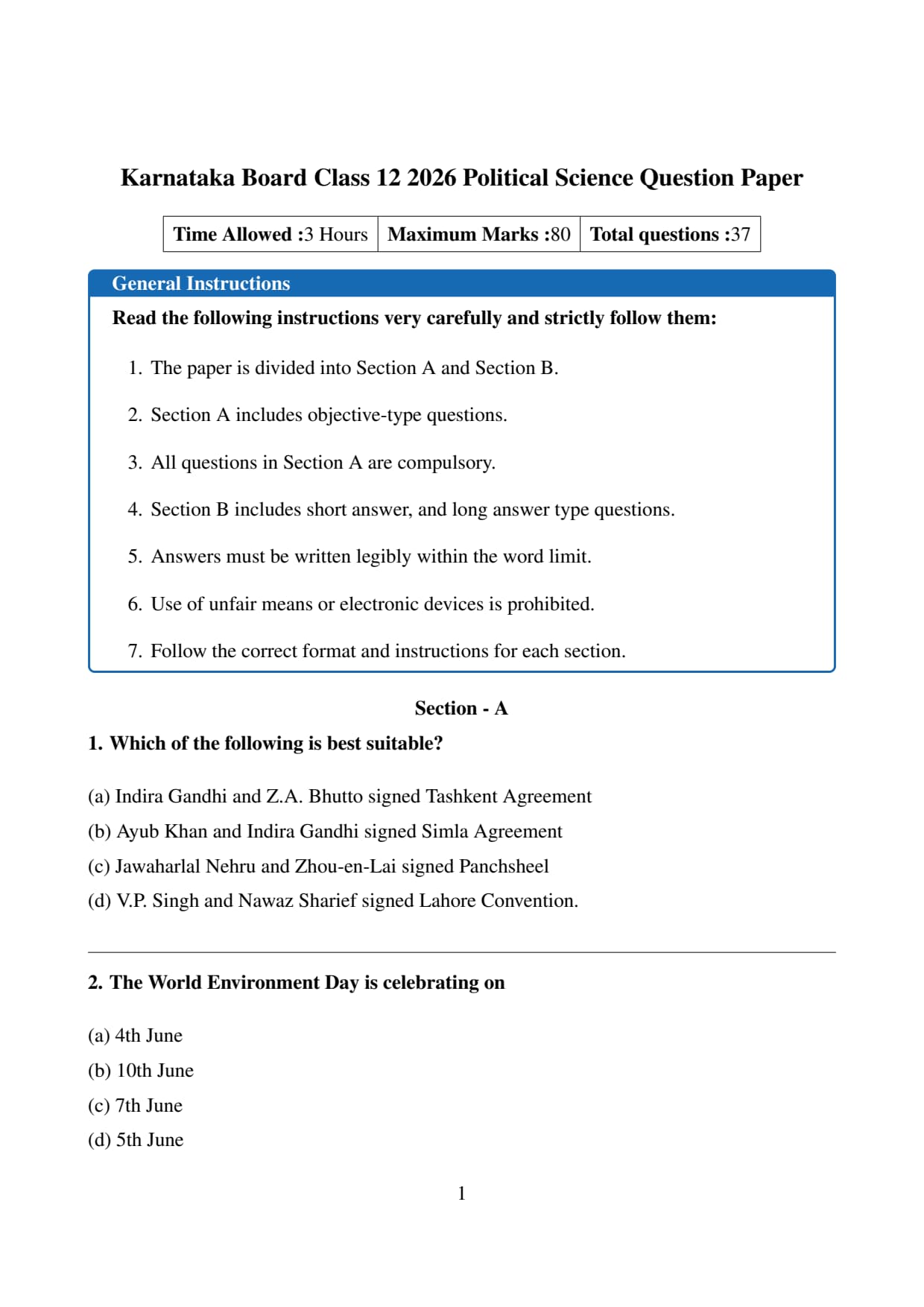
Which of the following is best suitable?
View Solution
Step 1: Analyse options.
- (a) Indira Gandhi and Z.A. Bhutto signed Tashkent Agreement: This is incorrect. The Tashkent Agreement was signed between Indira Gandhi and Z.A. Bhutto in 1966, not as an example in this question. The Tashkent Agreement was related to post-1965 war relations.
- (b) Ayub Khan and Indira Gandhi signed Simla Agreement: This is incorrect. The Simla Agreement was signed in 1972 between Indira Gandhi and Zulfikar Ali Bhutto (not Ayub Khan).
- (c) Jawaharlal Nehru and Zhou-en-Lai signed Panchsheel: Correct. The Panchsheel Agreement was signed in 1954 between Jawaharlal Nehru and Zhou-en-Lai, which established mutual respect for sovereignty, non-aggression, non-interference, and peaceful coexistence.
- (d) V.P. Singh and Nawaz Sharief signed Lahore Convention: This is incorrect. The Lahore Convention was signed between Atal Bihari Vajpayee and Nawaz Sharief in 1999, not V.P. Singh.
Step 2: Conclusion.
The correct answer is (c), as the Panchsheel Agreement was signed between Jawaharlal Nehru and Zhou-en-Lai.
Final Answer: (c) Jawaharlal Nehru and Zhou-en-Lai signed Panchsheel. Quick Tip: The Panchsheel Agreement, signed in 1954, is a key diplomatic agreement between India and China, emphasizing mutual respect for sovereignty and peaceful coexistence.
The World Environment Day is celebrating on
View Solution
Step 1: Understanding World Environment Day.
World Environment Day, established by the United Nations (UN) in 1972, is celebrated globally on June 5th every year. The purpose of this day is to raise awareness about environmental issues, promote sustainability, and encourage actions to protect the environment. It serves as a platform to discuss global environmental challenges such as climate change, deforestation, pollution, and loss of biodiversity.
Step 2: History and Significance.
The first World Environment Day was celebrated in 1974 with the theme "Only One Earth." Over the years, this day has gained immense importance and has been marked by various events such as campaigns, clean-up drives, and policy discussions. Each year, a new theme is introduced to focus on specific environmental issues, with participation from governments, non-governmental organizations (NGOs), and individuals across the globe.
Step 3: Why June 5th?
The date of June 5th was chosen to commemorate the opening of the Stockholm Conference on the Human Environment, held in 1972, where global attention was drawn to environmental concerns and sustainable development. Thus, June 5th was formally designated as World Environment Day.
Step 4: Analyzing the Options.
(a) 4th June: Incorrect. The UN specifically designates 5th June as World Environment Day, not 4th June.
(b) 10th June: Incorrect. The celebration is held annually on 5th June.
(c) 7th June: Incorrect. Again, World Environment Day is celebrated on 5th June, not on 7th June.
(d) 5th June: Correct. World Environment Day is celebrated globally every year on 5th June.
Step 5: Conclusion.
The correct answer is (d) 5th June. This date has been designated by the United Nations for the global celebration of environmental awareness and action.
Final Answer: 5th June.
Quick Tip: World Environment Day serves as a global platform to raise awareness and promote sustainable actions to address the environmental challenges facing our planet.
Name the Dictator of Libya.
View Solution
Step 1: Understanding the context.
Muammar Gaddafi (also spelled as Quaddafi) was the leader of Libya for over four decades. He was born in 1942 and came to power in 1969 after leading a military coup that ousted King Idris I, the ruler of Libya at that time. Gaddafi's rule was marked by his unique form of governance, which he described as a "third universal theory" – a mix of socialism, Arab nationalism, and Islamic principles, referred to as the Green Book.
Step 2: Gaddafi’s Leadership.
Under Gaddafi’s rule, Libya became a one-party state, and he centralized political power while exercising strict control over the economy. He implemented a form of socialism, where the state controlled key industries, and he promoted economic policies aimed at redistributing wealth and providing services like free healthcare and education. However, his leadership was also characterized by authoritarianism, lack of political freedoms, and the use of military force to suppress opposition.
Gaddafi's regime was known for its severe violations of human rights, suppression of political dissidents, and controversial policies on the international stage. His support for various militant groups and his involvement in several terrorist acts led to his isolation by much of the international community, including sanctions by the United Nations and the United States.
Step 3: Gaddafi’s Downfall.
In 2011, Gaddafi's rule was challenged by the Libyan Civil War, which was part of the larger wave of Arab Spring protests. The protests escalated into a full-scale civil war, and Gaddafi's regime was ultimately overthrown with the help of NATO airstrikes. After months of fighting, Gaddafi was captured and killed by rebel forces in October 2011. His death marked the end of his 42-year rule.
Step 4: Analyzing the Options.
(a) Abdul Hafiz Ghogya: Incorrect. Abdul Hafiz Ghogya was not the dictator of Libya. He was a Libyan official, but not the leader.
(b) Muammar Quaddafi: Correct. Muammar Gaddafi ruled Libya for over 40 years before his overthrow and death in 2011.
(c) Mustafa Abdul Jalil: Incorrect. Mustafa Abdul Jalil was the head of the National Transitional Council of Libya during the Libyan Civil War and after Gaddafi's fall.
(d) Mohammad Morsi: Incorrect. Mohammad Morsi was the president of Egypt, not Libya.
Step 5: Conclusion.
The correct answer is (b) Muammar Quaddafi, who ruled Libya with an iron fist for over four decades before his downfall in 2011.
Final Answer: Muammar Quaddafi.
Quick Tip: Muammar Gaddafi’s regime was known for its controversial policies and authoritarian rule, which lasted until his downfall in 2011 during the Libyan Civil War.
Speaker of the first Lok Sabha.
View Solution
Step 1: Understanding the Role of the Speaker.
In a parliamentary system, the Speaker is the presiding officer of the Lok Sabha, the lower house of the Indian Parliament. The Speaker is responsible for maintaining order during debates, ensuring that parliamentary procedures are followed, and representing the house in its relations with the President and other authorities.
Step 2: The First Speaker of the Lok Sabha.
The first Speaker of the Lok Sabha was G.V. Mavalankar. He served from 1952 to 1956 and played a significant role in shaping the functions of the Lok Sabha after India’s independence. His leadership style was widely respected, and he helped establish many of the parliamentary practices still in use today.
Step 3: Clarifying the Other Options.
- Dr. B.R. Ambedkar: Dr. Ambedkar was a key architect of the Indian Constitution and the first law minister of India, but he was never the Speaker of the Lok Sabha.
- Dr. Rajendra Prasad: Dr. Rajendra Prasad was the first President of India and not the Speaker of the Lok Sabha.
- Jawaharlal Nehru: Nehru was the first Prime Minister of India and did not hold the position of the Speaker.
Step 4: Conclusion.
The correct answer is (b) G.V. Mavalankar, as he was the first Speaker of the Lok Sabha.
Final Answer: G.V. Mavalankar.
Quick Tip: The Speaker of the Lok Sabha is an important constitutional position and is elected by the members of the Lok Sabha. The Speaker ensures that parliamentary procedures are followed, maintaining order and decorum.
An election to fill a vacancy caused by the death, resignation or disqualification of an elected member.
View Solution
Step 1: Understanding the concept of Byelections.
A byelection (also called a by-election) is a type of election held to fill a vacancy in a legislative body that occurs between regular elections. The vacancy may arise due to the death, resignation, or disqualification of a sitting member before the completion of their term.
Step 2: Types of Elections.
- General Elections: General elections are held to elect members to the entire legislative body (such as the Lok Sabha or State Assemblies) in a country or region. These elections occur at regular intervals (e.g., every five years in India). General elections are not held to fill individual vacancies but to elect representatives for the full legislative body.
- Reelection: Reelection refers to the act of holding another election for the same position after the previous election. This term is often used when a candidate who was previously elected is reelected. However, this term does not apply specifically to filling vacancies.
- Byelections: A byelection is held when there is a need to fill a specific vacancy caused by the death, resignation, or disqualification of a sitting member of a legislative body. These elections are held in a specific constituency, and only one seat is up for election.
- Interim Elections: This is not a standard term used in the election process. The correct term is byelection to fill vacancies, not "interim elections."
Step 3: Analyzing the options.
(a) General elections: Incorrect. General elections are held for the entire legislative body, not to fill individual vacancies.
(b) Reelection: Incorrect. Reelection refers to the act of electing the same officeholder again, not filling a vacancy.
(c) Byelections: Correct. Byelections are specifically held to fill vacancies caused by the death, resignation, or disqualification of a member.
(d) Interim elections: Incorrect. The term interim elections is not typically used. The correct term is byelection.
Step 4: Conclusion.
The correct answer is (c) Byelections because it specifically refers to elections held to fill vacancies caused by the death, resignation, or disqualification of a member.
Final Answer: Byelections.
Quick Tip: Byelections are used to fill vacancies between general elections. They are held in a specific constituency and only for the vacant seat, not the entire legislative body.
The word 'International Relations' was first used by
View Solution
Step 1: Understanding the term 'International Relations'.
The term International Relations refers to the study and practice of political, economic, and social interactions between sovereign states and other international actors. It examines the way countries interact with one another and the nature of their relationships.
Step 2: Who first used the term?
The term 'International Relations' was first used by the philosopher Jeremy Bentham in the late 18th century. Bentham, an English philosopher and jurist, applied the term in his works discussing the legal and political relationships between nations.
Step 3: Clarifying the other options.
- (a) Jeremy Randam: Incorrect. There is no record of someone named Jeremy Randam using this term in the context of International Relations.
- (c) Jean Bodin: Incorrect. Jean Bodin was a French philosopher and jurist who made important contributions to the theory of sovereignty but did not coin the term "International Relations."
- (d) Pamer & Perkins: Incorrect. Pamer & Perkins did not use this term in the context of International Relations.
Step 4: Conclusion.
The correct answer is (b) Jeremy Bentham, as he was the first to use the term 'International Relations' in his writings.
Final Answer: Jeremy Bentham.
Quick Tip: Jeremy Bentham is considered one of the first to use the term 'International Relations' in his legal and philosophical works.
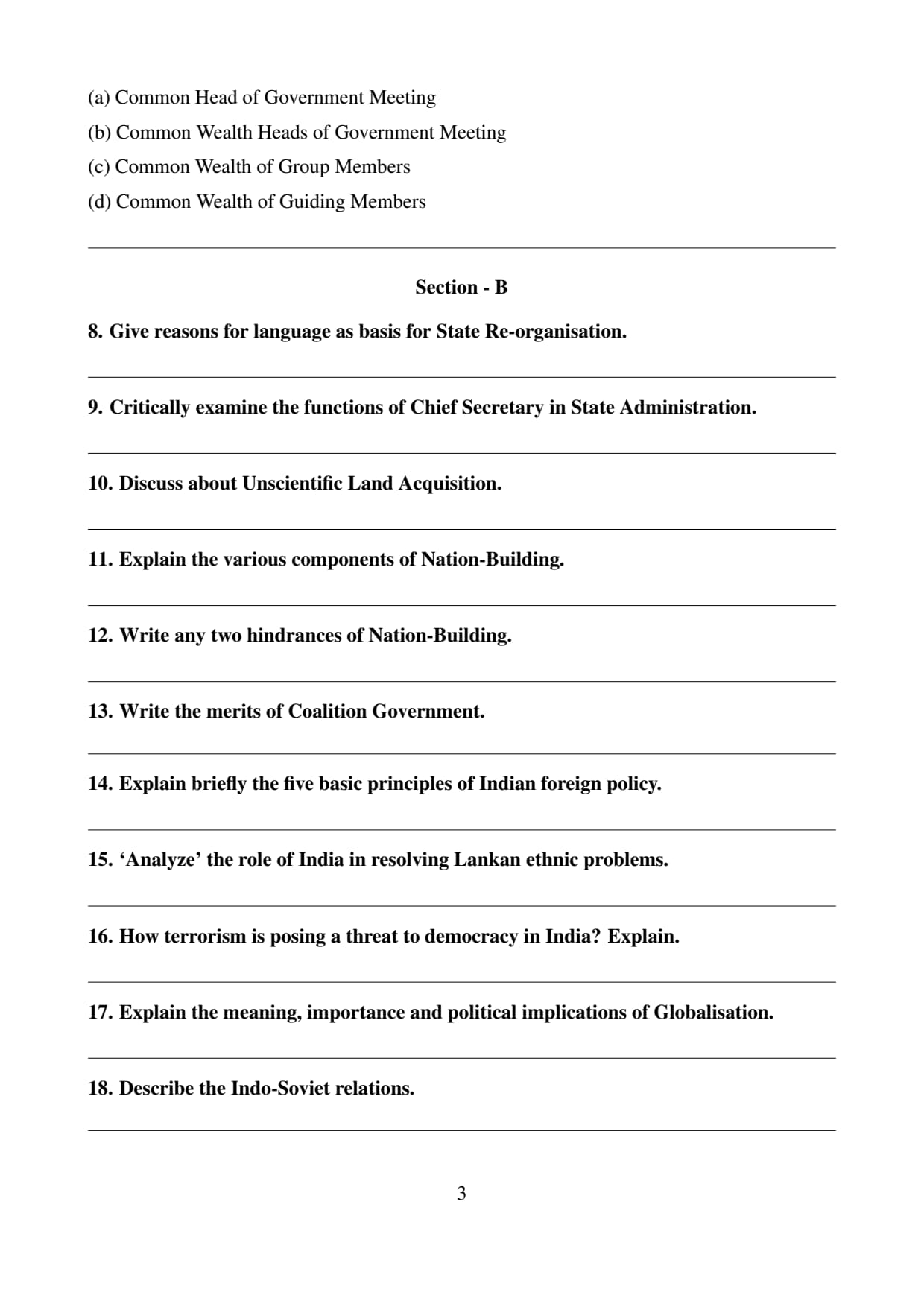
Expansion of CHOGM (Average)
View Solution
Step 1: Understanding CHOGM.
CHOGM stands for the Commonwealth Heads of Government Meeting. It is a biennial summit that brings together the leaders of the Commonwealth of Nations. The meeting allows leaders to discuss issues of mutual concern, share ideas, and collaborate on policies for mutual development.
Step 2: Analyzing the Options.
- (a) Common Head of Government Meeting: Incorrect. This is not the correct expansion of CHOGM.
- (b) Common Wealth Heads of Government Meeting: Correct. CHOGM stands for the Commonwealth Heads of Government Meeting, where the leaders of the Commonwealth countries gather to discuss key issues.
- (c) Common Wealth of Group Members: Incorrect. This is not the correct expansion of CHOGM.
- (d) Common Wealth of Guiding Members: Incorrect. This is not the correct expansion of CHOGM.
Step 3: Conclusion.
The correct answer is (b) Common Wealth Heads of Government Meeting.
Final Answer: Common Wealth Heads of Government Meeting.
Quick Tip: CHOGM is a key event for Commonwealth leaders to meet and discuss mutual issues and strategies for global cooperation.
Give reasons for language as basis for State Re-organisation.
View Solution
Step 1: The Role of Language in State Formation.
Language has been an important factor in the reorganisation of states in many countries, particularly in India. The demand for linguistic states emerged because language forms an essential part of a community's identity, culture, and history. Linguistic unity helps in better governance, social cohesion, and communication among the people within a state.
Step 2: Impact of Language in Administrative Efficiency.
Administrative efficiency is often improved when people of a common linguistic background can understand and communicate better with each other. Language fosters a sense of belonging, and when a state is formed on linguistic lines, the people feel more connected and motivated to contribute towards its progress.
Step 3: Social and Economic Development.
Linguistic states help in promoting social and economic development by ensuring that education, governance, and public policies are aligned with the language of the people. It helps in reducing communication barriers, making governance more accessible and inclusive.
Step 4: Example from Indian Context.
In India, the States Reorganisation Act of 1956 led to the formation of states based on language, such as Tamil Nadu for Tamil speakers and Andhra Pradesh for Telugu speakers, which has helped in promoting better governance and social unity. Quick Tip: Language is a powerful tool for fostering unity and improving governance. It is one of the most effective bases for reorganisation, as it directly impacts communication and cultural ties within a state.
Critically examine the functions of Chief Secretary in State Administration.
View Solution
Step 1: The Role of Chief Secretary.
The Chief Secretary is the senior-most civil servant in the state government. They act as the principal advisor to the Chief Minister and play a crucial role in coordinating the functioning of various government departments. The Chief Secretary is responsible for the smooth administration of the state and ensures the implementation of government policies and decisions.
Step 2: Key Functions of Chief Secretary.
Some of the key functions of the Chief Secretary include:
- \textit{Advising the Chief Minister and Cabinet: The Chief Secretary assists the Chief Minister in formulating policies and provides administrative support for their implementation.
- \textit{Coordinating between Departments: They ensure coordination among various government departments, facilitating inter-departmental communication to achieve the state's goals.
- \textit{Overseeing State Administration: The Chief Secretary oversees the functioning of the state secretariat and ensures the smooth operation of the administrative machinery.
- \textit{Managing Crisis Situations: During emergencies, the Chief Secretary plays a central role in managing the state’s response, such as coordinating relief efforts during natural disasters.
Step 3: Criticism and Challenges.
Despite the importance of the Chief Secretary, there are criticisms and challenges in their functioning:
- \textit{Lack of Political Autonomy: The Chief Secretary is a civil servant and is often seen as being influenced by political pressures, which can affect the impartiality of their work.
- \textit{Overburdened Role: The Chief Secretary is responsible for a wide range of duties, which can make the role overburdened and less efficient.
- \textit{Coordination Issues: Despite their coordinating role, there can sometimes be a lack of effective coordination among departments, leading to delays and inefficiencies.
Step 4: Conclusion.
The Chief Secretary holds a critical position in state administration, with significant responsibilities for ensuring smooth governance. However, challenges like political interference and administrative overload can hinder their effectiveness. Quick Tip: The Chief Secretary is the backbone of the state administration, but their role must be free from political interference to ensure effective governance.
Discuss about Unscientific Land Acquisition.
View Solution
Step 1: Define Unscientific Land Acquisition.
Unscientific land acquisition refers to the process of acquiring land for developmental purposes without proper planning, consideration of environmental impact, or the needs of the affected communities. It is characterized by hasty and ill-planned decisions, often resulting in the displacement of people and destruction of natural habitats.
Step 2: Problems of Unscientific Land Acquisition.
The problems associated with unscientific land acquisition include:
- \textit{Displacement of local populations, including farmers and indigenous communities, without adequate rehabilitation or compensation.
- \textit{Environmental degradation due to deforestation, loss of biodiversity, and soil erosion.
- \textit{Unbalanced development, where large-scale projects such as industries or housing complexes benefit a few while leaving the local communities with little or no gain.
- \textit{Social unrest and protests, as people resist the acquisition of their land without sufficient consultation or fair compensation.
Step 3: Solutions for Scientific Land Acquisition.
To address unscientific land acquisition, governments and developers must engage in \textit{scientific land acquisition by:
- Proper \textit{impact assessments, including environmental, social, and economic analyses.
- Ensuring that displaced populations are \textit{properly rehabilitated and compensated.
- Encouraging \textit{community participation in decision-making processes to ensure that their needs and concerns are considered.
Quick Tip: Unscientific land acquisition can lead to long-term social, environmental, and economic problems. Proper planning and consideration of all factors are necessary for sustainable development.
Explain the various components of Nation-Building.
View Solution
Step 1: Define Nation-Building.
Nation-building refers to the process of constructing or structuring a national identity using the power of the state. It involves the development of institutions, the establishment of social, political, and economic unity, and the promotion of a sense of national pride among citizens.
Step 2: Components of Nation-Building.
The key components of nation-building include:
1. \textit{Political Unity: Establishing stable and effective political institutions that represent all citizens and ensure fair governance.
2. \textit{Economic Development: Building an economy that provides opportunities for all citizens, including access to resources, employment, and improved living standards.
3. \textit{Social Integration: Promoting social cohesion through the integration of various communities, ensuring that all ethnic, religious, and cultural groups feel included and valued.
4. \textit{Cultural Identity: Fostering a shared sense of history, language, and cultural heritage, which unites the people and promotes national pride.
5. \textit{Education and Literacy: Ensuring access to education for all citizens, which helps in the development of informed, engaged, and productive members of society.
6. \textit{Infrastructure Development: Building physical infrastructure such as roads, healthcare facilities, and public services to improve the quality of life and stimulate economic growth.
Step 3: Challenges in Nation-Building.
Nation-building faces several challenges, such as overcoming ethnic and religious divisions, addressing economic inequality, and fostering national unity in the face of diversity. However, with effective leadership, cooperation, and policies, a nation can successfully overcome these challenges and build a strong, cohesive identity. Quick Tip: Nation-building is a complex and long-term process that requires inclusive, sustainable policies and the active involvement of all citizens to foster unity and growth.
Write any two hindrances of Nation-Building.
View Solution
Step 1: Define Nation-Building.
Nation-building refers to the process of constructing or structuring a national identity using the power of the state. It involves efforts to promote unity, peace, and economic prosperity while balancing diversity within a nation.
Step 2: Hindrances to Nation-Building.
Two key hindrances to nation-building are:
- \textit{Ethnic and Religious Divisions: Deep ethnic, religious, and linguistic differences within a population can lead to social fragmentation, resulting in conflict and hindering efforts for unity and nation-building. These divisions can lead to separatism, communal violence, or even civil war.
- \textit{Economic Inequality: Disparities in wealth and access to resources can lead to social unrest and dissatisfaction among the population, weakening the collective identity of a nation and hindering progress. Economic inequality often leads to a lack of trust in the government, further destabilizing the nation-building process. Quick Tip: Social divisions and economic inequality are two major challenges in the process of nation-building, as they undermine unity and stability.
Write the merits of Coalition Government.
View Solution
Step 1: Define Coalition Government.
A coalition government is a government formed by multiple political parties who agree to work together to form a majority in the legislature. This type of government is often formed when no single party has enough seats to govern alone.
Step 2: Merits of Coalition Government.
The merits of a coalition government include:
- \textit{Inclusive Decision-Making: Coalition governments often bring together diverse perspectives, allowing for more inclusive decision-making that represents a broader segment of society. This can lead to policies that cater to different groups.
- \textit{Checks and Balances: Coalition governments tend to have internal checks and balances due to the presence of multiple parties, preventing any one group from dominating decision-making and fostering greater accountability.
- \textit{Stability in Diverse Societies: In countries with multiple ethnic, religious, or ideological groups, coalition governments can provide a means to accommodate the interests of various communities, promoting political stability and national unity.
- \textit{Promotes Consensus Building: Coalition governments require collaboration and compromise among different political parties, which can lead to a more cooperative political culture and less extreme policy-making. Quick Tip: While coalition governments promote inclusivity and stability, they can sometimes lead to slow decision-making due to the need for compromise among parties.
Explain briefly the five basic principles of Indian foreign policy.
View Solution
Step 1: Overview of the Five Basic Principles.
The five basic principles of Indian foreign policy, also known as the "Panchsheel Agreement," were formulated to guide India’s diplomatic relations with other countries. These principles are:
1. \textit{Mutual respect for each other's territorial integrity and sovereignty.
2. \textit{Non-aggression and non-interference in each other's internal affairs.
3. \textit{Non-interference in each other’s domestic issues and recognition of each other’s independence.
4. \textit{Equality and mutual benefit in relations.
5. \textit{Peaceful coexistence based on mutual respect.
Step 2: Application of these principles.
These principles form the basis of India’s foreign policy, aiming at peaceful coexistence with its neighbors and maintaining good diplomatic and economic relations with countries around the world. They emphasize mutual respect, equality, and non-interference. Quick Tip: The Panchsheel principles promote peace, non-aggression, and mutual benefit, and are fundamental to India’s foreign policy framework.
‘Analyze’ the role of India in resolving Lankan ethnic problems.
View Solution
Step 1: Historical background of Lankan ethnic problems.
Sri Lanka faced significant ethnic tensions, primarily between the Sinhalese majority and the Tamil minority. These tensions led to a violent civil conflict that lasted several decades, with the Tamils seeking greater autonomy and recognition of their rights.
Step 2: India’s role in the conflict.
India played a key role in attempting to resolve the conflict. India’s involvement included diplomatic efforts, support for peace talks, and military intervention:
- \textit{Peacekeeping Forces: India sent the Indian Peace Keeping Force (IPKF) in 1987, as part of the Indo-Sri Lanka Accord, to maintain peace between the Sinhalese and Tamils.
- \textit{Diplomatic Efforts: India tried to mediate between the Sri Lankan government and Tamil groups, advocating for a political solution that would ensure equal rights for Tamils.
- \textit{Humanitarian Support: India also provided humanitarian aid to Tamil refugees and supported the Sri Lankan government in its efforts to rebuild affected regions.
Step 3: Challenges faced by India.
Despite these efforts, India faced challenges in achieving a lasting peace. The IPKF’s presence in Sri Lanka was controversial and met with resistance, both from Sri Lankan government forces and the Tamil Tigers. The conflict eventually ended in 2009, but India’s involvement remains a key part of Sri Lanka’s post-war history. Quick Tip: India’s role in resolving the Sri Lankan ethnic problems highlights the complexities of peacekeeping in civil conflicts and the challenges of balancing diplomatic and military involvement.
How terrorism is posing a threat to democracy in India? Explain.
View Solution
Step 1: Define Terrorism.
Terrorism is the unlawful use of violence and intimidation, especially against civilians, in the pursuit of political aims. In India, terrorism has posed a significant threat to the democratic system by undermining peace, stability, and the rule of law.
Step 2: Impact of terrorism on democracy in India.
Terrorism in India, particularly in Jammu and Kashmir, the northeast, and other regions, has led to:
- \textit{Loss of lives and property, which destabilizes communities and creates fear among the general population.
- \textit{Erosion of civil liberties, as the government may impose emergency measures, curfews, or restrictions to combat terrorism, which hampers individual freedoms.
- \textit{Distrust in democratic institutions, as terrorist activities often lead to a sense of insecurity, questioning the effectiveness of government structures in maintaining law and order.
Step 3: Conclusion.
Terrorism poses a threat to democracy by disrupting the normal functioning of the democratic system, creating divisions in society, and hindering social and economic progress. It challenges the values of freedom, justice, and equality, which are fundamental to a democratic society. Quick Tip: Terrorism can destabilize governments, disrupt peace, and erode democratic principles like freedom and justice, leading to long-term social and political consequences.
Explain the meaning, importance and political implications of Globalisation.
View Solution
Step 1: Define Globalisation.
Globalisation refers to the process of increasing interconnectedness and interdependence among countries through trade, technology, culture, and the exchange of ideas. It involves the flow of goods, services, information, and people across borders.
Step 2: Importance of Globalisation.
Globalisation has significant importance in the modern world as it has:
- \textit{Boosted economic growth by providing access to global markets, creating job opportunities, and increasing trade and investment.
- \textit{Fostered technological advancements through the global exchange of knowledge and innovations.
- \textit{Promoted cultural exchange, leading to greater understanding and appreciation of different cultures and ideas.
Step 3: Political Implications of Globalisation.
Politically, globalisation has led to:
- \textit{Reduction in national sovereignty as countries must align with international norms and regulations, sometimes at the expense of domestic policies.
- \textit{Increased geopolitical competition as nations compete for influence in global trade and political alliances.
- \textit{Changes in governance as international organizations, such as the United Nations, World Trade Organization, and International Monetary Fund, gain more influence over national affairs. Quick Tip: Globalisation connects the world but also presents challenges, including the need for balancing national interests with global cooperation and trade agreements.
Describe the Indo-Soviet relations.
View Solution
Step 1: Background of Indo-Soviet Relations.
Indo-Soviet relations were characterized by close diplomatic, political, and military ties during the Cold War period. India and the Soviet Union shared common interests in promoting peace, non-alignment, and social justice.
Step 2: Key Features of Indo-Soviet Relations.
1. \textit{Strategic Partnership: The Soviet Union supported India in its quest for regional stability and security, particularly in its disputes with Pakistan and China.
2. \textit{Economic Cooperation: The Soviet Union helped India in the areas of industrialization and technology transfer, including the establishment of heavy industries and nuclear energy programs.
3. \textit{Military Assistance: The Soviet Union provided India with advanced military equipment, including aircraft and tanks, which significantly bolstered India’s defense capabilities.
Step 3: Conclusion.
The Indo-Soviet relationship was mutually beneficial during the Cold War, as it helped India strengthen its defense, enhance its industrial capacity, and maintain a non-aligned stance in the global arena. Quick Tip: Indo-Soviet relations were instrumental in shaping India’s foreign policy during the Cold War, with the Soviet Union providing crucial military, economic, and diplomatic support.




Comments