




The Himachal Pradesh Board of School Education (HPBOSE) successfully conducted the Class 12 Economics Exam 2026 on March 7, 2026. For students aiming to verify their graphical analysis and numerical calculations, the complete HP Board Class 12 Economics Question Paper with Solution PDF is now available for download.
The HPBOSE Economics paper was a balanced mix of Microeconomics and Macroeconomics, testing students on core concepts like consumer equilibrium, national income accounting, and government budget.
- Objective and MCQ Section: This part evaluated fundamental definitions of demand, supply, and types of market structures.
- Numerical and Analytical Section: Students were required to solve problems related to GDP calculation, elasticity of demand, and the multiplier effect.
- Descriptive Section: Higher-weightage questions focused on the central bank’s functions, fiscal policy measures, and the determination of income and employment.
HP Board Class 12 Economics Question Paper with Solution PDF
| HP Board Class 12 Economics Question Paper with Solution PDF | Download PDF | Check Solution |

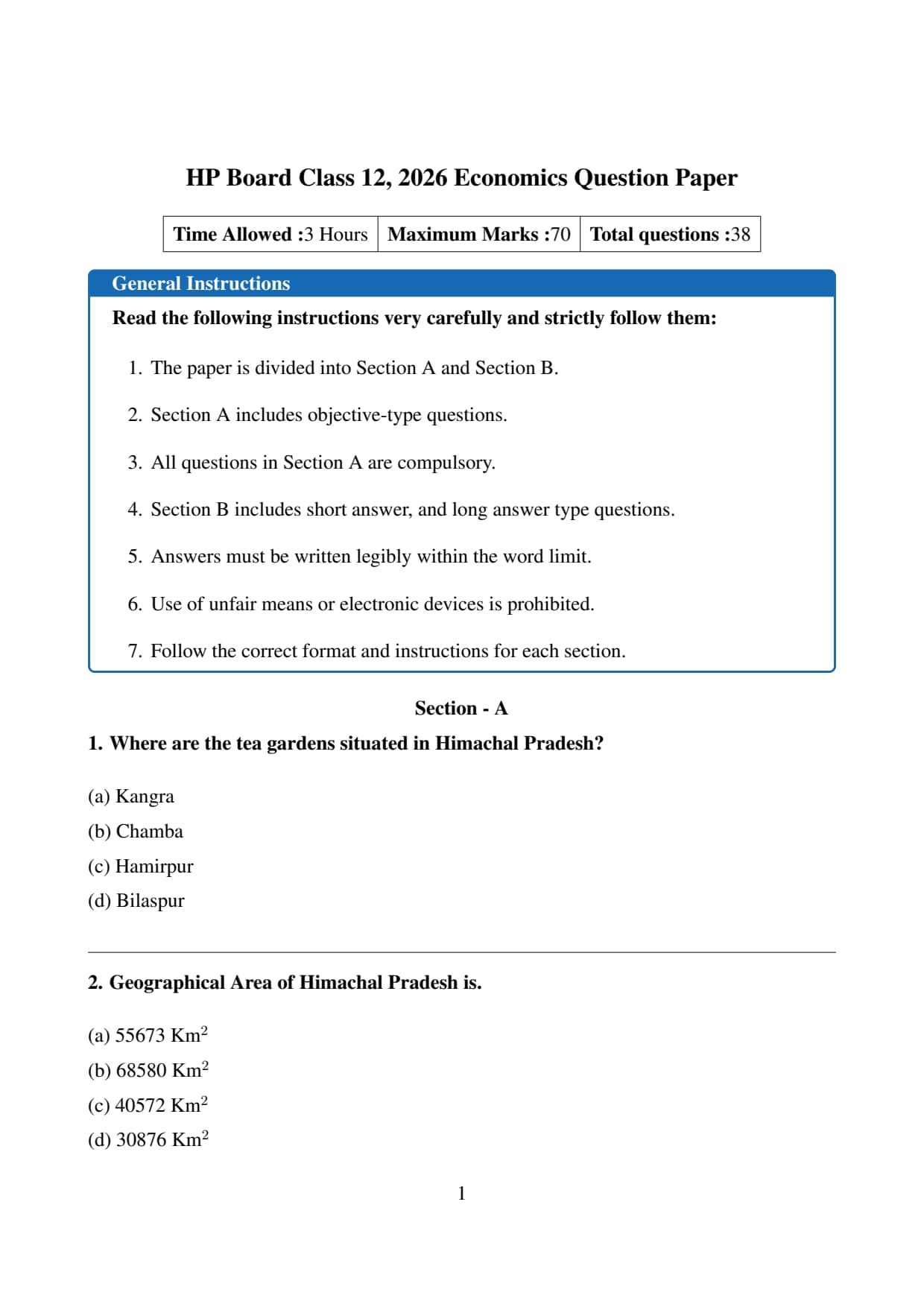
Where are the tea gardens situated in Himachal Pradesh?
View Solution
Step 1: Understanding the tea gardens in Himachal Pradesh.
The Kangra Valley in Himachal Pradesh is famous for its tea gardens. The region has favorable climatic conditions for tea cultivation, making it the largest tea-producing region in the state.
Step 2: Analyzing the options.
(a) Kangra: Correct. Kangra is known for its tea gardens, and it is the most famous tea-producing area in Himachal Pradesh.
(b) Chamba: Incorrect. Chamba is not known for tea gardens; it is known for its beautiful landscapes and temples.
(c) Hamirpur: Incorrect. Hamirpur is not a prominent area for tea cultivation.
(d) Bilaspur: Incorrect. Bilaspur is also not known for tea gardens.
Step 3: Conclusion.
Kangra is the region in Himachal Pradesh known for its tea gardens, making option (a) the correct answer.
Final Answer: Kangra. Quick Tip: Kangra tea is known for its unique taste and is one of the premium teas in India. The tea gardens in Kangra produce some of the finest quality tea.
Geographical Area of Himachal Pradesh is.
View Solution
Step 1: Understanding the geographical area of Himachal Pradesh.
The geographical area of Himachal Pradesh is 55,673 square kilometers, which is the total land area of the state.
Step 2: Analyzing the options.
(a) 55673 Km\(^2\): Correct. The total area of Himachal Pradesh is 55,673 square kilometers.
(b) 68580 Km\(^2\): Incorrect. This is not the correct area of Himachal Pradesh.
(c) 40572 Km\(^2\): Incorrect. This value is too small for the area of Himachal Pradesh.
(d) 30876 Km\(^2\): Incorrect. This is also not the correct geographical area.
Step 3: Conclusion.
The geographical area of Himachal Pradesh is 55,673 square kilometers, making option (a) the correct answer.
Final Answer: 55673 Km\(^2\). Quick Tip: The state of Himachal Pradesh covers an area of 55,673 square kilometers, making it one of the smaller states in India in terms of land area.
How many taxes were abolished during the formation of Himachal Pradesh?
View Solution
Step 1: Understanding the abolition of taxes.
During the formation of Himachal Pradesh, the state government abolished several taxes to ease the financial burden on the people and promote economic growth. A total of 25 taxes were abolished during this period.
Step 2: Analyzing the options.
(a) 15: Incorrect. The correct number of taxes abolished was 25, not 15.
(b) 25: Correct. 25 taxes were abolished during the formation of Himachal Pradesh.
(c) 48: Incorrect. 48 taxes were not abolished.
(d) 27: Incorrect. The number of taxes abolished was not 27.
Step 3: Conclusion.
The correct number of taxes abolished during the formation of Himachal Pradesh is 25, making option (b) the correct answer.
Final Answer: 25. Quick Tip: During the formation of Himachal Pradesh, the abolition of taxes helped in simplifying the financial system and reducing the burden on the people.
What was the tenure of the twelfth five year plan in India?
View Solution
Step 1: Understanding the Five-Year Plans.
The Five-Year Plans in India were initiated to ensure economic growth and development. The 12th Five-Year Plan in India spanned from 2012 to 2017, focusing on achieving sustainable and inclusive growth.
Step 2: Analyzing the options.
(a) 1951-1956: Incorrect. This was the period for India's first Five-Year Plan.
(b) 1961-1966: Incorrect. This was the period for India's second Five-Year Plan.
(c) 1992-1997: Incorrect. This was the period for India's eighth Five-Year Plan.
(d) 2012-2017: Correct. The twelfth Five-Year Plan of India was from 2012 to 2017.
Step 3: Conclusion.
The tenure of India's twelfth Five-Year Plan was 2012-2017, making option (d) the correct answer.
Final Answer: 2012-2017. Quick Tip: The 12th Five-Year Plan (2012-2017) aimed for faster, sustainable, and more inclusive growth, focusing on areas like education, healthcare, and infrastructure.
Which Tax is paid by buyer?
View Solution
Step 1: Understanding the taxes paid by the buyer.
The Goods and Service Tax (GST) is the primary tax paid by the buyer during a transaction. Income tax is not generally paid by the buyer on the goods purchased, making GST the correct answer.
Step 2: Analyzing the options.
(A) Income Tax: Incorrect. Income tax is not typically paid by the buyer during a transaction for goods and services.
(B) Goods and Service Tax: Correct. GST is the main tax paid by the buyer for goods and services in many countries.
(C) (A) \& (B) Both: Incorrect. Only GST is paid by the buyer, not income tax.
(D) None of the above: Incorrect. The correct answer is Goods and Service Tax (GST).
Step 3: Conclusion.
GST is the tax paid by the buyer, making option (B) the correct answer.
Final Answer: Goods and Service Tax. Quick Tip: In most countries, Goods and Service Tax (GST) is paid by the buyer on goods and services, while income tax is a separate tax based on earnings, not purchases.
Foreign Exchange Reserves increases.
View Solution
Step 1: Understanding foreign exchange reserves.
Foreign exchange reserves increase primarily through export trade, as the country earns foreign currency from the goods and services it exports.
Step 2: Analyzing the options.
(A) By Import Trade: Incorrect. Import trade results in an outflow of domestic currency, which reduces foreign exchange reserves.
(B) By Export Trade: Correct. Export trade brings in foreign currency, thus increasing foreign exchange reserves.
(C) By National Level Trade: Incorrect. While national level trade involves both imports and exports, it is the export side that increases reserves.
(D) By Domestic Trade: Incorrect. Domestic trade does not involve foreign currency and does not impact foreign exchange reserves.
Step 3: Conclusion.
Foreign exchange reserves increase through export trade, making option (B) the correct answer.
Final Answer: By Export Trade. Quick Tip: Foreign exchange reserves grow primarily through exports, as they bring in foreign currency to the country.
Which of these is Indirect Tax?
View Solution
Step 1: Understanding indirect tax.
Indirect taxes are taxes that are levied on goods and services rather than on income or profits. The taxes are typically collected by intermediaries (such as businesses) who pass the tax burden on to consumers.
Step 2: Analyzing the options.
(A) Sales Tax: Correct. Sales tax is an indirect tax imposed on the sale of goods and services.
(B) Production Tax: Correct. Production tax is a type of indirect tax imposed on the production of goods.
(C) Import-export Tax: Correct. Import-export taxes are indirect taxes imposed on goods traded across borders.
(D) All These: Correct. All the listed taxes are examples of indirect taxes.
Step 3: Conclusion.
All the options listed are indirect taxes, making option (D) the correct answer.
Final Answer: All These. Quick Tip: Indirect taxes include taxes like sales tax, production tax, and import-export tax, which are paid by the consumer but collected by intermediaries.
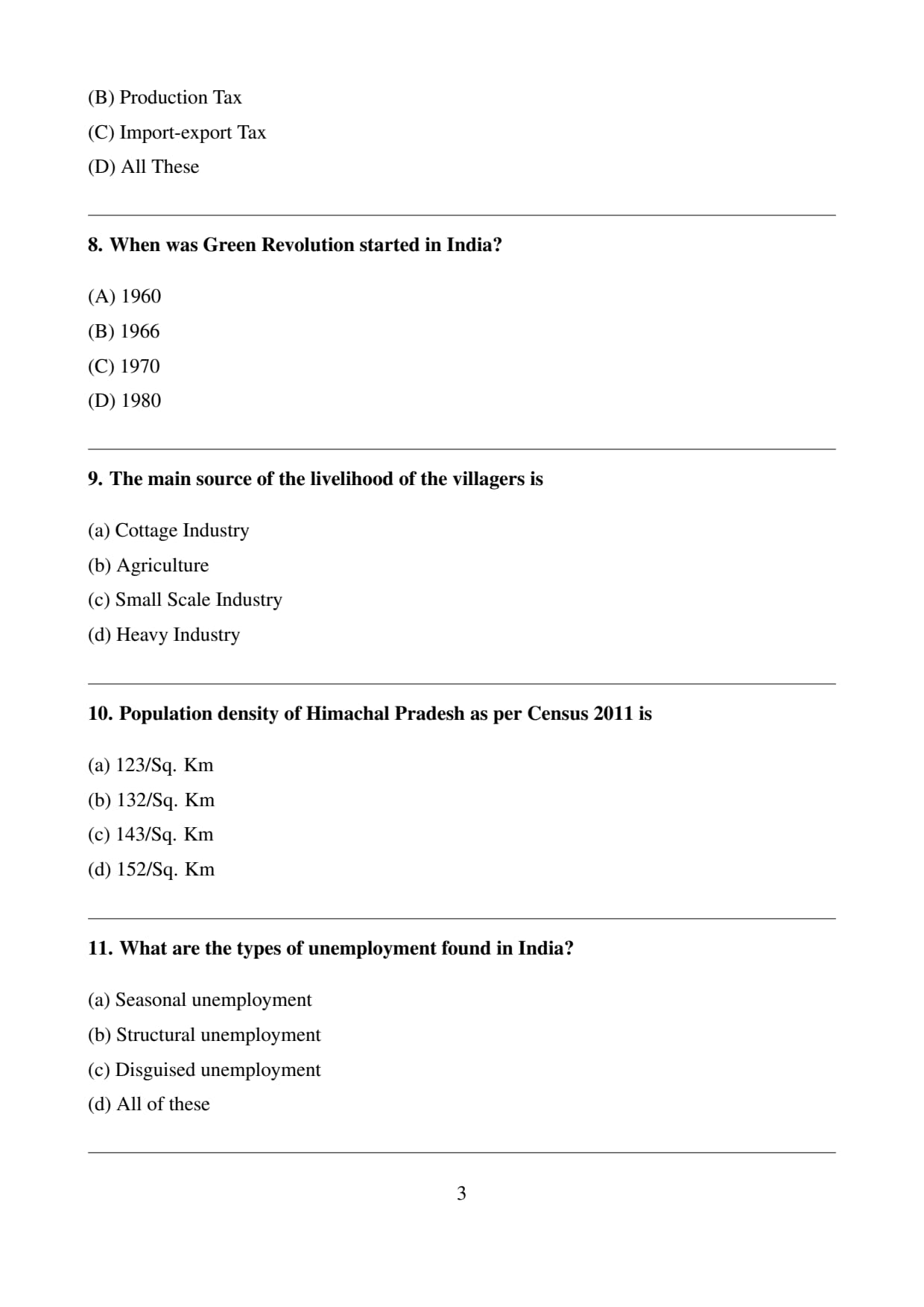
When was Green Revolution started in India?
View Solution
Step 1: Understanding the Green Revolution.
The Green Revolution in India was a period of agricultural transformation that began in the late 1960s. It involved the introduction of high-yielding varieties of crops, chemical fertilizers, and advanced irrigation techniques to increase food production.
Step 2: Analyzing the options.
(A) 1960: Incorrect. The Green Revolution began in India after the mid-1960s.
(B) 1966: Incorrect. The Green Revolution began later, in the early 1970s.
(C) 1970: Correct. The Green Revolution started in India around 1970 with the introduction of high-yielding varieties of wheat and rice.
(D) 1980: Incorrect. By 1980, the Green Revolution was already in progress, but it began in the early 1970s.
Step 3: Conclusion.
The Green Revolution in India started in 1970, making option (C) the correct answer.
Final Answer: 1970. Quick Tip: The Green Revolution in India started in the 1970s and was instrumental in making India self-sufficient in food production, particularly in wheat and rice.
The main source of the livelihood of the villagers is
View Solution
Step 1: Understanding the main source of livelihood.
In many rural areas, especially in developing countries, the primary source of livelihood for villagers is agriculture, as it provides food, income, and employment.
Step 2: Analyzing the options.
(a) Cottage Industry: Incorrect. While cottage industries may provide some livelihood, they are typically smaller and not the primary source in rural areas.
(b) Agriculture: Correct. Agriculture is the main livelihood source for villagers, as it supports their basic needs.
(c) Small Scale Industry: Incorrect. Small-scale industries contribute, but agriculture is generally the dominant livelihood in rural areas.
(d) Heavy Industry: Incorrect. Heavy industries are typically found in urban areas and not a primary livelihood source for rural villagers.
Step 3: Conclusion.
The main source of livelihood for villagers is agriculture, making option (b) the correct answer.
Final Answer: Agriculture. Quick Tip: Agriculture remains the backbone of the rural economy in many countries, providing the majority of jobs and livelihoods for the population.
Population density of Himachal Pradesh as per Census 2011 is
View Solution
Step 1: Understanding population density.
Population density is the number of people living per unit of area, typically measured in people per square kilometer. According to the 2011 Census of India, Himachal Pradesh had a population density of 132 people per square kilometer.
Step 2: Analyzing the options.
(a) 123/Sq. Km: Incorrect. The population density of Himachal Pradesh as per the 2011 Census was higher than 123 per square kilometer.
(b) 132/Sq. Km: Correct. The correct population density of Himachal Pradesh as per the 2011 Census was 132 per square kilometer.
(c) 143/Sq. Km: Incorrect. This value is too high compared to the actual figure.
(d) 152/Sq. Km: Incorrect. This value is also higher than the actual population density.
Step 3: Conclusion.
The correct population density of Himachal Pradesh according to the 2011 Census is 132 per square kilometer, making option (b) the correct answer.
Final Answer: 132/Sq. Km. Quick Tip: Population density is a key demographic measure, and understanding it helps in planning resources, infrastructure, and public services in the region.
What are the types of unemployment found in India?
View Solution
Step 1: Understanding types of unemployment.
In India, there are various forms of unemployment, including seasonal unemployment, structural unemployment, and disguised unemployment. All of these are common types of unemployment in the country.
Step 2: Analyzing the options.
(a) Seasonal unemployment: Correct. Seasonal unemployment occurs when people are employed only during certain seasons, such as agricultural laborers during the harvest season.
(b) Structural unemployment: Correct. Structural unemployment happens when there is a mismatch between the skills of the labor force and the needs of the economy.
(c) Disguised unemployment: Correct. Disguised unemployment occurs when more people are employed than necessary, typically seen in rural agricultural areas.
(d) All of these: Correct. All the mentioned types are prevalent in India.
Step 3: Conclusion.
All the listed types of unemployment—seasonal, structural, and disguised—are found in India, so option (d) is the correct answer.
Final Answer: All of these. Quick Tip: Unemployment in India is diverse, with structural and disguised unemployment being particularly significant in rural areas, while seasonal unemployment is linked to agriculture.
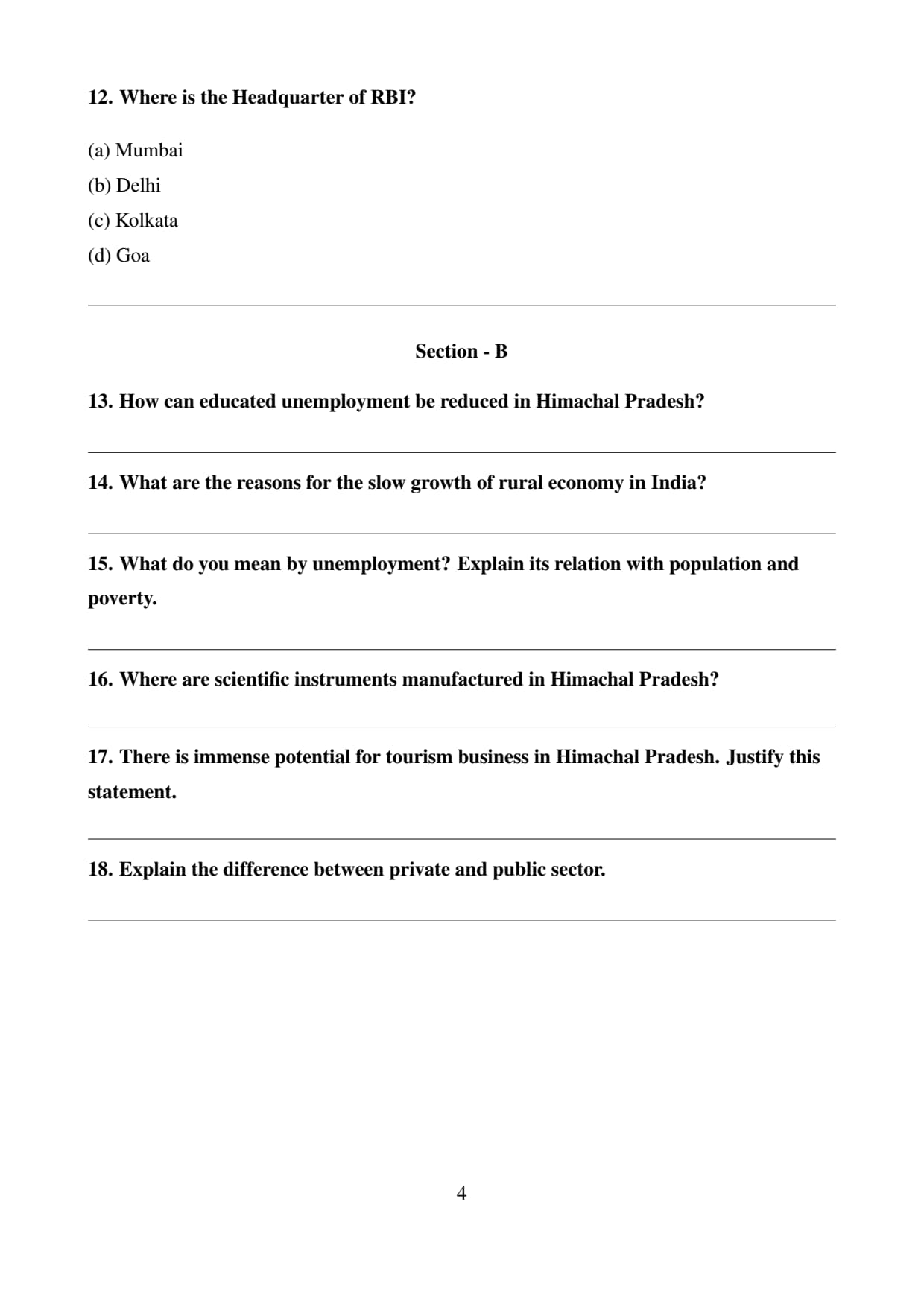
Where is the Headquarter of RBI?
View Solution
Step 1: Understanding RBI's headquarters.
The Reserve Bank of India (RBI) is the central banking institution of India, and its headquarters is located in Mumbai, Maharashtra.
Step 2: Analyzing the options.
(a) Mumbai: Correct. The RBI's headquarters is located in Mumbai.
(b) Delhi: Incorrect. Delhi is not the headquarters of the RBI, though it has a branch.
(c) Kolkata: Incorrect. Kolkata is home to one of the RBI's regional offices, but not the headquarters.
(d) Goa: Incorrect. Goa does not have the RBI's headquarters.
Step 3: Conclusion.
The headquarters of RBI is in Mumbai, so option (a) is the correct answer.
Final Answer: Mumbai. Quick Tip: The Reserve Bank of India (RBI), as the central bank of India, has its headquarters in Mumbai, which is the financial capital of the country.
How can educated unemployment be reduced in Himachal Pradesh?
View Solution
Step 1: Identify the problem of educated unemployment.
Educated unemployment is a situation where individuals who have completed formal education are unable to find suitable jobs. In Himachal Pradesh, this problem is particularly prominent due to limited job opportunities in the region, especially for the educated youth.
Step 2: Solutions to reduce educated unemployment.
1. Skill Development Programs: Implementing vocational training and skill development programs will equip the youth with practical skills required in various industries such as tourism, agriculture, and technology, reducing the gap between education and employment.
2. Promotion of Entrepreneurship: Encouraging young people to start their own businesses through financial support, training, and mentoring can reduce the dependency on government jobs.
3. Improving Education-to-Employment Linkages: Strengthening the collaboration between educational institutions and industries will help in aligning the education curriculum with the needs of the job market.
4. Incentives for Industry Establishment: Offering subsidies and incentives to companies that set up businesses in Himachal Pradesh can create more job opportunities for educated youth in the region. Quick Tip: To reduce educated unemployment, it is crucial to bridge the gap between education and available job opportunities through skill development, entrepreneurship, and better education-industry linkages.
What are the reasons for the slow growth of rural economy in India?
View Solution
Step 1: Understand the issue of slow rural economic growth.
The slow growth of the rural economy in India is a multifaceted issue with several contributing factors. The rural economy relies heavily on agriculture and limited industrial activity, leading to stagnation in growth.
Step 2: Key reasons for slow growth of rural economy.
1. Dependency on Agriculture: A large portion of the rural economy is dependent on agriculture, which is often subject to unpredictable weather patterns, poor infrastructure, and outdated farming practices.
2. Lack of Industrialization: The absence of significant industrial development in rural areas limits employment opportunities and diversification of income sources.
3. Poor Infrastructure: Inadequate infrastructure, such as poor roads, insufficient electricity, and limited access to technology, hampers the economic potential of rural regions.
4. Limited Access to Credit and Finance: Rural farmers and small business owners often face difficulty accessing credit and financial services, which hinders investment in agricultural productivity and business development.
5. Underdeveloped Education and Skill Training: The lack of quality education and vocational training centers in rural areas prevents the youth from acquiring skills needed for modern jobs, leading to a cycle of unemployment and underemployment.
Step 3: Solutions to improve rural economic growth.
1. Promoting Rural Entrepreneurship: Encouraging rural entrepreneurs by providing access to capital, training, and markets can stimulate local economies.
2. Enhancing Infrastructure: Improving transportation, electricity, and internet connectivity will help integrate rural areas with urban markets and services.
3. Investing in Education and Skill Development: Establishing more vocational training centers and improving the quality of rural education can equip the rural workforce with the necessary skills for better employment. Quick Tip: The growth of the rural economy in India can be accelerated by investing in agriculture modernization, infrastructure, education, and rural entrepreneurship.
What do you mean by unemployment? Explain its relation with population and poverty.
View Solution
Step 1: Definition of unemployment.
Unemployment is the condition where people who are capable of working, and are actively seeking work, are unable to find any work. It is often measured by the unemployment rate in a given area or country.
Step 2: Relation with population.
Unemployment is closely related to population growth. As the population increases, especially in developing countries, the number of people seeking jobs rises. However, if economic growth does not keep pace with population growth, there will be insufficient job opportunities, leading to higher unemployment.
Step 3: Relation with poverty.
Unemployment and poverty are often linked. When people are unable to find work, they face a lack of income, which leads to poverty. High unemployment rates in a country can contribute significantly to widespread poverty, especially in regions with limited social safety nets. Quick Tip: Unemployment, population growth, and poverty are interconnected. A growing population without corresponding job creation leads to higher unemployment, which in turn exacerbates poverty.
Where are scientific instruments manufactured in Himachal Pradesh?
View Solution
Step 1: Manufacturing in Himachal Pradesh.
Himachal Pradesh is known for manufacturing various scientific instruments, especially in the city of Solan. Solan is home to the Indian Institute of Advanced Study (IIAS) and various scientific research institutes that support the production of such instruments.
Step 2: Leading manufacturing hubs.
The state has specialized manufacturing units producing precision instruments, electronic devices, and other scientific tools, contributing to the development of science and technology in the region.
Step 3: Prominent industries.
Prominent companies in Himachal Pradesh, especially in the industrial hubs like Baddi and Parwanoo, also manufacture scientific instruments, including devices used in healthcare, research, and laboratories. Quick Tip: Himachal Pradesh, particularly Solan, Baddi, and Parwanoo, is home to several industries that manufacture scientific instruments and devices.
There is immense potential for tourism business in Himachal Pradesh. Justify this statement.
View Solution
Step 1: Define tourism potential.
Himachal Pradesh, known for its picturesque landscapes, historical sites, and cultural heritage, holds immense potential for the growth of the tourism industry. The state's diverse terrain offers opportunities for eco-tourism, adventure tourism, cultural tourism, and spiritual tourism.
Step 2: Factors supporting tourism in Himachal Pradesh.
1. Natural Beauty: The state's valleys, mountains, rivers, and forests attract tourists seeking scenic beauty and outdoor activities like trekking, skiing, and paragliding.
2. Cultural Heritage: Himachal Pradesh has a rich cultural heritage, with ancient temples, monasteries, and traditional fairs that attract visitors interested in exploring the local culture.
3. Adventure Tourism: The varied landscape provides opportunities for adventure sports like trekking, skiing, river rafting, and mountaineering, making it a prime destination for adventure enthusiasts.
4. Religious Tourism: The state is home to numerous temples and pilgrimage sites, including the famous Vaishno Devi Temple and the Golden Temple in Amritsar, attracting religious tourists.
Step 3: Challenges and solutions for tourism development.
- Infrastructure Development: The development of better transportation networks, accommodation facilities, and tourism-friendly amenities can further boost the tourism industry.
- Sustainability: To ensure long-term growth, there should be an emphasis on sustainable tourism that respects the environment and local culture. Quick Tip: Himachal Pradesh has great tourism potential. Proper infrastructure development, promotion of sustainable tourism, and highlighting its unique attractions can further boost the sector.
Explain the difference between private and public sector.
View Solution
Step 1: Define Private Sector.
The private sector refers to businesses and organizations that are owned and operated by individuals or groups of private individuals. The aim of private sector businesses is usually to make profits, and they operate with limited government control. Examples include companies like Apple, Microsoft, and local businesses.
Step 2: Define Public Sector.
The public sector refers to government-owned organizations that provide public services. These entities are funded by taxes and aim to serve the public interest rather than making profits. Examples include government agencies, public schools, and public hospitals.
Step 3: Key Differences between Private and Public Sector.
1. Ownership:
- Private Sector: Owned and controlled by private individuals or companies.
- Public Sector: Owned and controlled by the government.
2. Profit Motive:
- Private Sector: Primarily driven by profit generation.
- Public Sector: Focuses on providing services and benefits to the public, not primarily on making profits.
3. Funding:
- Private Sector: Funded by private investments, loans, or sales.
- Public Sector: Funded by taxes collected from the public.
4. Decision-Making:
- Private Sector: Decisions are made by private owners or shareholders.
- Public Sector: Decisions are made by government officials and are subject to public policy. Quick Tip: The private sector focuses on profit-driven activities, while the public sector aims to provide services that benefit society, with government involvement in decision-making and funding.




Comments