




MP Board is conducting the Class 12 Sociology Board Exam 2026 on March 2, 2026. Class 12 Sociology Question Paper with Solution PDF is available here for download.
The official question paper of MP Board Class 12 Sociology Board Exam 2026 is provided below. Students can download the official paper in PDF format for reference.
MP Board Class 12, 2026 Sociology Question Paper with Solution PDF
| MP Board Class 12 Sociology Question Paper 2026 | Download PDF | Check Solution |
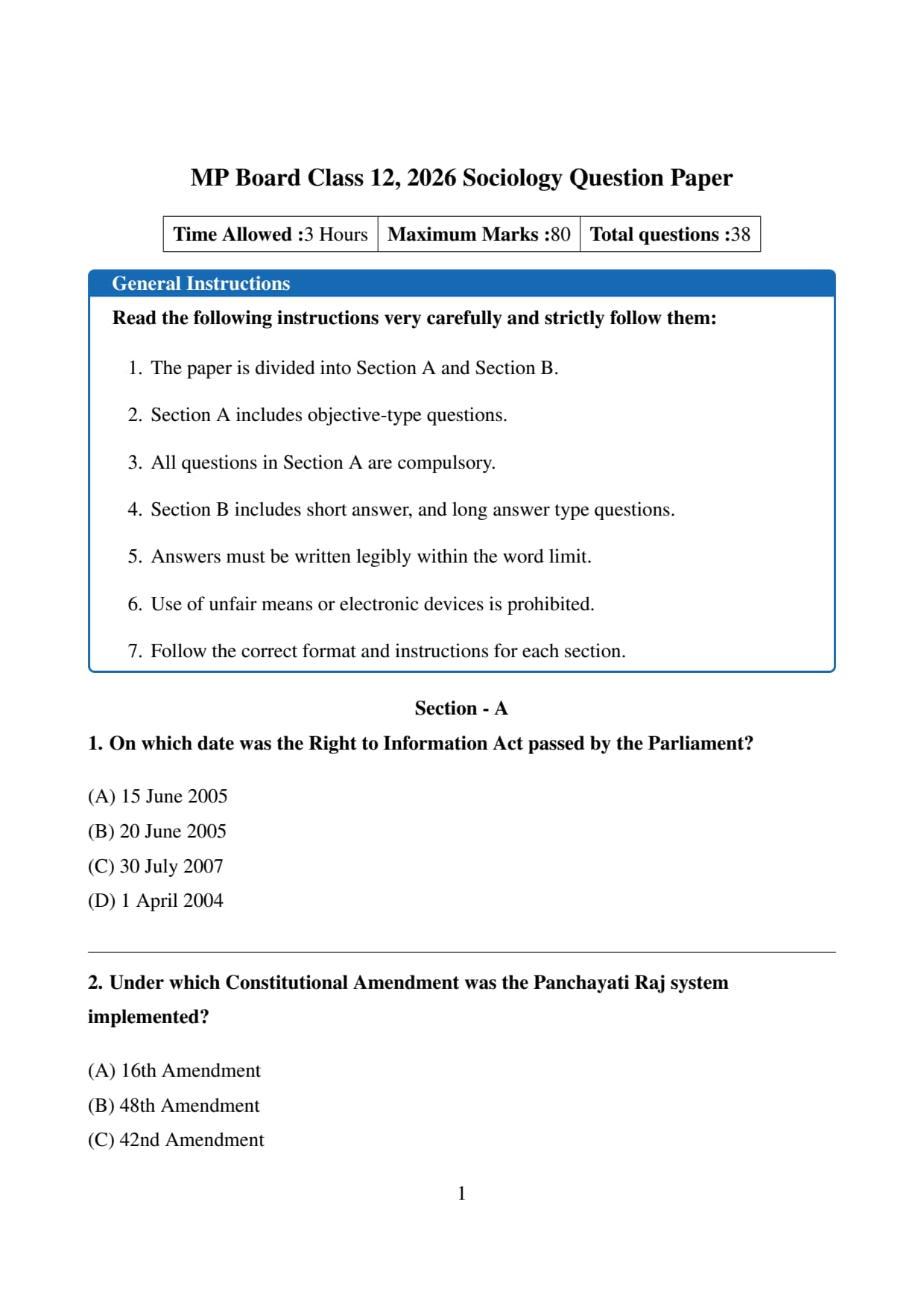
On which date was the Right to Information Act passed by the Parliament?
View Solution
Step 1: Understanding the RTI Act.
The Right to Information (RTI) Act is a significant legislation in India that empowers citizens to seek information from public authorities. It promotes transparency and accountability in the working of the government.
Step 2: Historical Background.
The RTI Act was passed by the Indian Parliament on 15 June 2005. Later, it came into full effect on 12 October 2005.
Step 3: Analysis of the options.
(A) 15 June 2005: Correct. This is the official date when the Act was passed by Parliament.
(B) 20 June 2005: Incorrect. This is not the correct passing date.
(C) 30 July 2007: Incorrect. This date does not relate to the passing of the Act.
(D) 1 April 2004: Incorrect. The Act was not passed in 2004.
Step 4: Conclusion.
Therefore, the Right to Information Act was passed on 15 June 2005.
Final Answer: 15 June 2005. Quick Tip: Remember: RTI Act was passed on 15 June 2005 and came into force on 12 October 2005.
Under which Constitutional Amendment was the Panchayati Raj system implemented?
View Solution
Step 1: Understanding Panchayati Raj.
The Panchayati Raj system was introduced to establish a three-tier system of local self-government in rural areas of India. It aims to decentralize power and promote grassroots democracy.
Step 2: Constitutional Background.
The 73rd Constitutional Amendment Act, 1992 provided constitutional status to Panchayati Raj Institutions (PRIs). It came into effect on 24 April 1993.
Step 3: Analysis of the options.
(A) 16th Amendment: Incorrect. This amendment is not related to Panchayati Raj.
(B) 48th Amendment: Incorrect. It does not establish the Panchayati Raj system.
(C) 42nd Amendment: Incorrect. Although important, it is not related to Panchayati Raj implementation.
(D) 73rd Amendment: Correct. It gave constitutional status to Panchayati Raj Institutions.
Step 4: Conclusion.
Thus, the Panchayati Raj system was implemented under the 73rd Constitutional Amendment.
Final Answer: 73rd Amendment. Quick Tip: The 73rd Amendment relates to Panchayati Raj (rural local bodies), while the 74th Amendment relates to Municipalities (urban local bodies).
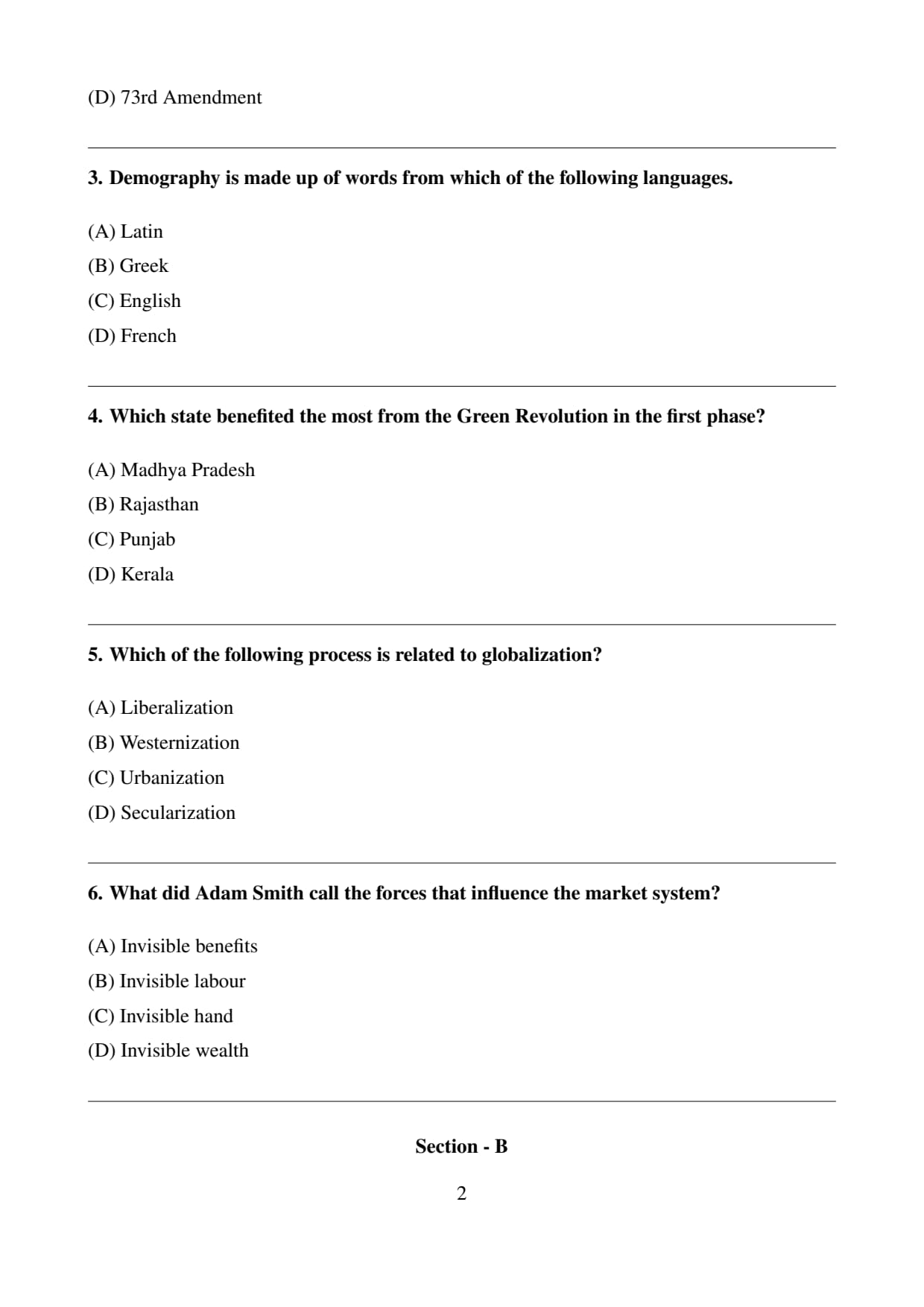
Demography is made up of words from which of the following languages.
View Solution
Step 1: Understanding the term ‘Demography’.
The word "Demography" is derived from two Greek words — “Demos” meaning people and “Graphy” meaning description or study. Therefore, demography literally means the study of population.
Step 2: Analysis of the options.
(A) Latin: Incorrect. The term does not originate from Latin.
(B) Greek: Correct. Both parts of the word are derived from Greek language.
(C) English: Incorrect. English adopted the word but it is not the origin.
(D) French: Incorrect. The origin is not French.
Step 3: Conclusion.
Since the word is derived from Greek words, the correct answer is (B) Greek.
Final Answer: Greek. Quick Tip: Many academic terms ending with “-graphy” or “-logy” are derived from Greek language.
Which state benefited the most from the Green Revolution in the first phase?
View Solution
Step 1: Understanding the Green Revolution.
The Green Revolution refers to the introduction of High Yielding Variety (HYV) seeds, modern irrigation methods, chemical fertilizers, and pesticides in India during the 1960s to increase agricultural production, especially food grains like wheat and rice.
Step 2: Impact during the first phase.
The first phase of the Green Revolution mainly focused on wheat production and was concentrated in states with good irrigation facilities and fertile soil. Punjab had well-developed irrigation systems and adopted modern farming techniques quickly, leading to a massive increase in wheat production.
Step 3: Analysis of the options.
(A) Madhya Pradesh: Incorrect. It did not benefit the most in the initial phase.
(B) Rajasthan: Incorrect. Limited irrigation reduced its early impact.
(C) Punjab: Correct. Punjab gained the maximum benefit during the first phase.
(D) Kerala: Incorrect. Kerala was not a major beneficiary of the Green Revolution initially.
Step 4: Conclusion.
Therefore, Punjab benefited the most from the Green Revolution in its first phase.
Final Answer: Punjab. Quick Tip: Punjab and Haryana were the leading states during the first phase of the Green Revolution due to better irrigation and adoption of HYV seeds.
Which of the following process is related to globalization?
View Solution
Step 1: Understanding Globalization.
Globalization refers to the increasing integration of economies, markets, cultures, and policies across the world. It involves reducing trade barriers and promoting free flow of goods, services, capital, and technology between countries.
Step 2: Role of Liberalization.
Liberalization means removal of government restrictions and regulations in the economy. It allows private participation, foreign investment, and free trade, which are key components of globalization.
Step 3: Analysis of the options.
(A) Liberalization: Correct. It directly supports and promotes globalization.
(B) Westernization: Incorrect. It relates to adopting Western culture, not necessarily economic integration.
(C) Urbanization: Incorrect. It refers to growth of cities.
(D) Secularization: Incorrect. It relates to separation of religion from state affairs.
Step 4: Conclusion.
Hence, Liberalization is the process closely related to globalization.
Final Answer: Liberalization. Quick Tip: Globalization is supported by three major processes: Liberalization, Privatization, and Global integration of markets.
What did Adam Smith call the forces that influence the market system?
View Solution
Step 1: Understanding Adam Smith’s concept.
Adam Smith, known as the father of modern economics, introduced the concept of the “Invisible Hand” in his book *The Wealth of Nations*. He explained that individuals pursuing their own self-interest unintentionally contribute to the overall benefit of society through market mechanisms.
Step 2: Analysis of the options.
(A) Invisible benefits: Incorrect. This is not the term used by Adam Smith.
(B) Invisible labour: Incorrect. Labour is a factor of production but not the term he used.
(C) Invisible hand: Correct. This is the famous term used to describe market forces.
(D) Invisible wealth: Incorrect. This is not a recognized concept by Adam Smith.
Step 3: Conclusion.
Adam Smith called the forces that regulate the market system the “Invisible Hand”.
Final Answer: Invisible hand. Quick Tip: The “Invisible Hand” explains how free markets regulate themselves through demand and supply without direct government control.
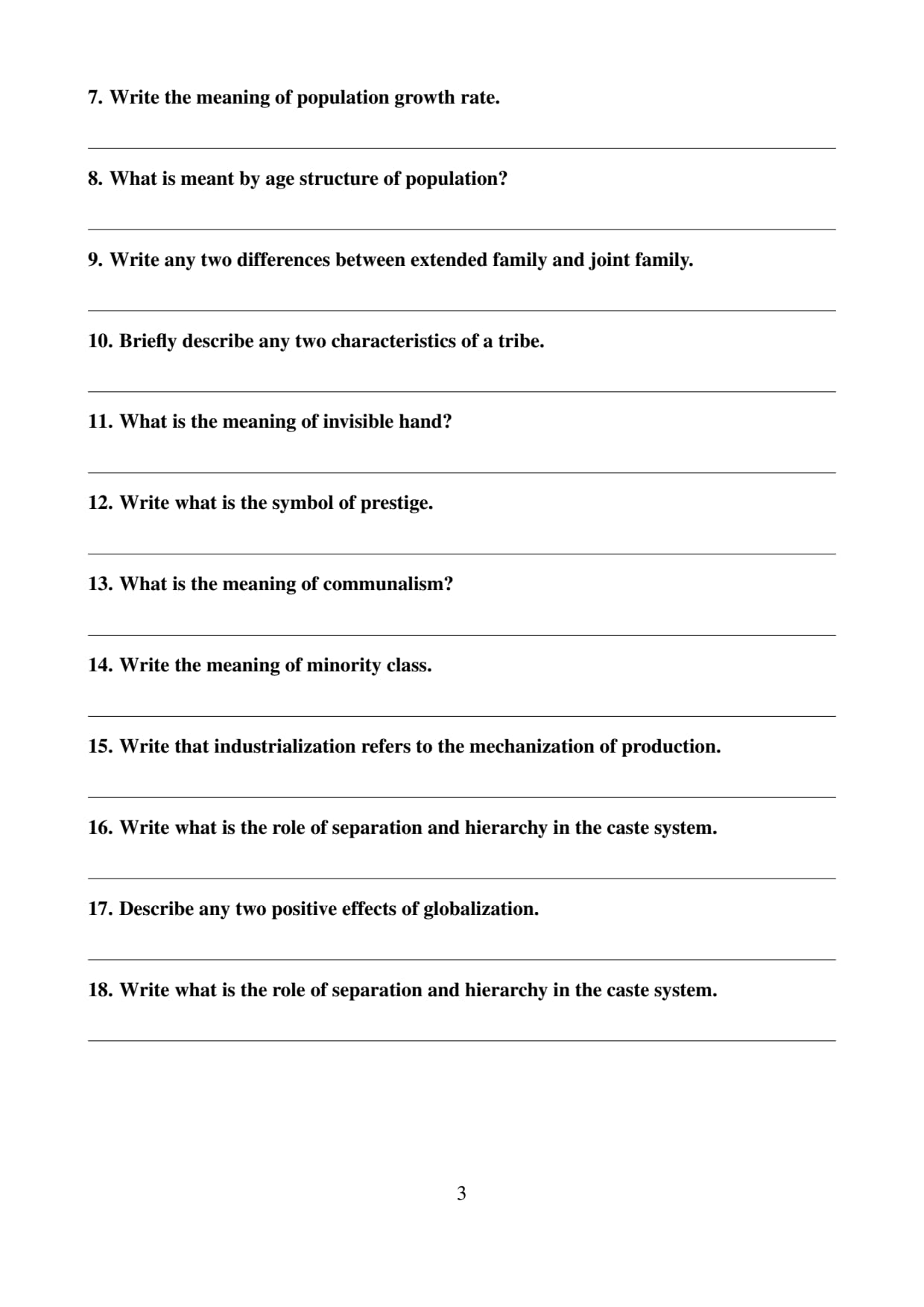
Write the meaning of population growth rate.
View Solution
Population growth rate is the rate at which the number of individuals in a population increases or decreases over a specific period of time, usually one year. It indicates how fast a population is expanding or shrinking.
The growth of a population depends mainly on four important factors: birth rate, death rate, immigration, and emigration. Birth rate increases the population as new individuals are added. Death rate decreases the population as individuals die. Immigration adds people to the population from outside areas, while emigration reduces the population when people move out.
If the number of births and immigrants is greater than the number of deaths and emigrants, the population shows a positive growth rate. If deaths and emigration are higher, the growth rate becomes negative. When births and deaths are equal and migration is balanced, the population remains stable.
Population growth rate is generally expressed as a percentage. It can be calculated using the formula:
Population Growth Rate = (Births + Immigration − Deaths − Emigration) ÷ Total Population × 100
Thus, population growth rate helps in understanding population trends and planning for resources such as food, housing, education, and healthcare. Quick Tip: A positive growth rate means population is increasing, a negative growth rate means it is decreasing, and zero growth rate means it is stable.
What is meant by age structure of population?
View Solution
Age structure of population refers to the classification and distribution of people into different age groups within a country or region at a particular point of time. It shows how many people belong to the young, adult, and old age categories. In other words, it helps us understand the composition of a population based on age.
The age structure is generally divided into three broad groups:
Pre-reproductive Age Group (0–14 years):
This group includes children who are not yet capable of reproduction. They are economically dependent on the working population for their basic needs such as food, education, and healthcare. A large proportion in this category usually indicates future population growth.
Reproductive or Working Age Group (15–59 years):
This group consists of adults who are capable of working and earning. They contribute to the economic development of the country and support both the young and the elderly population. A higher percentage in this group is considered beneficial for economic growth.
Post-reproductive Age Group (60 years and above):
This group includes elderly people who are generally not economically active. They depend on the working population for support. A higher proportion in this group indicates an ageing population.
The age structure is important because it helps in planning for schools, employment opportunities, healthcare facilities, pensions, and other social services. It also indicates whether a population is growing, stable, or declining. For example, a population with a broad base in its age pyramid (more children) shows rapid growth, while a narrow base indicates slow or negative growth.
Therefore, age structure is a key demographic indicator that helps governments and policymakers in making economic and social development plans. Quick Tip: The age structure of a population is often represented through a population pyramid, which visually shows the proportion of different age groups in a country.
Write any two differences between extended family and joint family.
View Solution
The two main differences between extended family and joint family are:
Structure and Living Arrangement:
An extended family includes relatives beyond the nuclear family such as grandparents, uncles, aunts, and cousins. They may or may not live together in the same house.
In contrast, a joint family consists of parents, their children, and other close relatives like grandparents, uncles, and aunts who usually live together under one roof.
Property and Decision-Making:
In an extended family, members may live separately and manage their own income and property independently.
In a joint family, property and income are generally shared among members, and decisions are often taken collectively by the head of the family. Quick Tip: Joint family always lives together and shares property, while extended family may live separately and does not necessarily share income.
Briefly describe any two characteristics of a tribe.
View Solution
A tribe is a social group of people who live together in a particular geographical area and share common cultural, social, and economic features. The following are two important characteristics of a tribe:
Common Culture and Traditions:
Members of a tribe share a common culture, language, customs, beliefs, and traditions. They follow similar religious practices, rituals, festivals, and social norms. This shared culture creates a strong sense of unity and identity among the tribal members.
Close Relationship with Nature:
Tribal communities generally live in forests, hills, or remote areas and depend directly on nature for their livelihood. Activities such as hunting, gathering, fishing, and shifting cultivation are common among tribes. Their lifestyle is simple and closely connected to natural resources.
Thus, tribes are distinct social groups with unique cultural practices and a strong bond with their natural environment. Quick Tip: Tribes are usually small, self-sufficient communities with strong kinship ties and a common ancestor.
What is the meaning of invisible hand?
View Solution
The term “invisible hand” is an economic concept introduced by the famous economist Adam Smith in his book \textit{The Wealth of Nations. It refers to the unseen market forces that regulate demand and supply in a free market economy without direct government intervention.
According to this concept, individuals in an economy act according to their own self-interest. For example, producers aim to maximize their profits by producing goods and services that are in demand, while consumers try to maximize their satisfaction by purchasing goods at the lowest possible price. Although each individual is acting for personal benefit, their actions unintentionally contribute to the overall welfare of society.
The invisible hand works through the mechanism of demand and supply. When demand for a product increases, prices rise. Higher prices encourage producers to increase production. As supply increases, prices eventually stabilize. Similarly, if demand falls, prices decrease, leading producers to reduce output. In this way, the market automatically adjusts itself without the need for central planning.
Thus, the invisible hand explains how self-regulating market forces guide economic activities, allocate resources efficiently, and promote economic growth in a free market system. Quick Tip: The invisible hand represents automatic market adjustment through demand and supply, where individual self-interest leads to collective economic benefit.
Write what is the symbol of prestige.
View Solution
Prestige refers to the respect, honor, and social status that a person enjoys in society. A symbol of prestige is something that represents a person’s high position, success, or reputation in the community.
Common symbols of prestige include wealth, luxurious houses, branded clothes, expensive cars, high educational qualifications, and important job positions such as doctors, engineers, officers, or business leaders. These symbols reflect a person’s social standing and influence in society.
In many societies, power, authority, and recognition are also considered symbols of prestige. For example, holding a high government post or receiving awards and honors increases a person’s prestige.
Thus, a symbol of prestige is any visible or recognized sign that indicates a person’s high social status and respect in society. Quick Tip: Prestige is linked to social status, respect, and recognition, and is often reflected through wealth, occupation, education, and lifestyle.
What is the meaning of communalism?
View Solution
Communalism refers to a social and political ideology in which a group of people give more importance to their own religious or ethnic community than to the nation as a whole. It arises when individuals identify strongly with their religious or community group and believe that their group’s interests are separate from, or even opposed to, the interests of other communities.
In simple terms, communalism occurs when religion is used as the basis for political mobilization or when people of one religion consider themselves superior to others. It often leads to misunderstandings, conflicts, and tensions between different religious or social groups.
Communalism can take different forms. In its mild form, it promotes the belief that people belonging to the same religion share common social, economic, and political interests. In its extreme form, it can result in hatred, violence, and riots between communities. Such divisions weaken national unity and disturb social harmony.
Therefore, communalism is considered harmful to a democratic society because it promotes division instead of unity and creates barriers between different sections of society. Quick Tip: Communalism emphasizes loyalty to one’s own religious group over national unity and often leads to social conflict.
Write the meaning of minority class.
View Solution
The term minority class refers to a group of people in a society who are smaller in number compared to the majority population. This group may differ from the majority on the basis of religion, language, culture, ethnicity, or social identity.
A minority class does not necessarily mean a group with less power, but often such groups may face social, economic, or political disadvantages. For example, religious minorities, linguistic minorities, or ethnic minorities are groups that have distinct identities and are fewer in number within a country or region.
Governments often provide special rights and protections to minority classes to ensure equality, preserve their culture, and protect them from discrimination.
Thus, a minority class is a smaller group in society that has distinct cultural, religious, or social characteristics different from the majority population. Quick Tip: Minority refers to numerical strength, not necessarily power. A group can be small in number but still socially influential.
Write that industrialization refers to the mechanization of production.
View Solution
Industrialization refers to the process by which production activities shift from manual labour to machine-based manufacturing. In simple words, it means the mechanization of production.
Before industrialization, most goods were produced by hand in small workshops or homes. Production was slow and limited in quantity. With the introduction of machines, factories were established where large-scale production became possible. Machines replaced human and animal labour, which increased efficiency and speed.
Mechanization of production means using machines, technology, and modern equipment to manufacture goods instead of relying mainly on human effort. This leads to mass production, better quality goods, lower cost of production, and higher economic growth.
Therefore, industrialization is the transformation of an economy from agriculture-based production to machine-based industrial production. Quick Tip: Industrialization = Use of machines in production leading to large-scale manufacturing.
Write what is the role of separation and hierarchy in the caste system.
View Solution
Separation and hierarchy are two important features of the caste system that determine the social structure of society.
Role of Separation:
Separation refers to the social division of people into different caste groups with strict rules regarding interaction. Each caste maintains social distance from others. There are restrictions on marriage, food sharing, occupation, and social relations. People are generally expected to marry within their own caste (endogamy). This separation creates boundaries between different groups and limits social mobility.
Role of Hierarchy:
Hierarchy refers to the ranking of castes in a graded order from higher to lower status. Some castes are considered superior, while others are treated as inferior. This ranking determines social status, occupation, privileges, and access to resources. The hierarchical structure leads to inequality, as higher castes enjoy more power and respect compared to lower castes.
Thus, separation maintains division among different caste groups, while hierarchy establishes inequality and ranking within society. Together, they shape the functioning of the caste system. Quick Tip: Separation creates social divisions, while hierarchy creates social ranking and inequality in the caste system.
Describe any two positive effects of globalization.
View Solution
Globalization refers to the process of increasing interaction and integration among countries through trade, investment, technology, and cultural exchange. It has several positive effects. Two important positive effects are:
Increase in Employment Opportunities:
Globalization encourages foreign companies to invest in different countries. This leads to the establishment of new industries, factories, and service centers, which create more job opportunities for people. As a result, income levels improve and the standard of living rises.
Access to Better Technology and Goods:
Through globalization, countries can access advanced technology, modern machinery, and high-quality products from other nations. Consumers benefit from a greater variety of goods at competitive prices. It also improves productivity and efficiency in various sectors such as agriculture, industry, and services.
Thus, globalization promotes economic growth, improves living standards, and enhances technological development across countries. Quick Tip: Globalization connects countries through trade, investment, and communication, leading to economic growth and cultural exchange.
Write what is the role of separation and hierarchy in the caste system.
View Solution
Separation and hierarchy are two important features of the caste system that determine the social structure of society.
Role of Separation:
Separation refers to the social division of people into different caste groups with strict rules regarding interaction. Each caste maintains social distance from others. There are restrictions on marriage, food sharing, occupation, and social relations. People are generally expected to marry within their own caste (endogamy). This separation creates boundaries between different groups and limits social mobility.
Role of Hierarchy:
Hierarchy refers to the ranking of castes in a graded order from higher to lower status. Some castes are considered superior, while others are treated as inferior. This ranking determines social status, occupation, privileges, and access to resources. The hierarchical structure leads to inequality, as higher castes enjoy more power and respect compared to lower castes.
Thus, separation maintains division among different caste groups, while hierarchy establishes inequality and ranking within society. Together, they shape the functioning of the caste system. Quick Tip: Separation creates social divisions, while hierarchy creates social ranking and inequality in the caste system.



Comments