




MP Board is conducting the Class 12 Mathematics Board Exam 2026 on February 25, 2026. Class 12 Mathematics Question Paper with Solution PDF is available here for download.
The official question paper of MP Board Class 12 Mathematics Board Exam 2026 is provided below. Students can download the official paper in PDF format for reference.
MP Board Class 12, 2026 Mathematics Question Paper with Solution PDF
| Class 12 Mathematics Question Paper 2026 | Download PDF | Check Solutions |

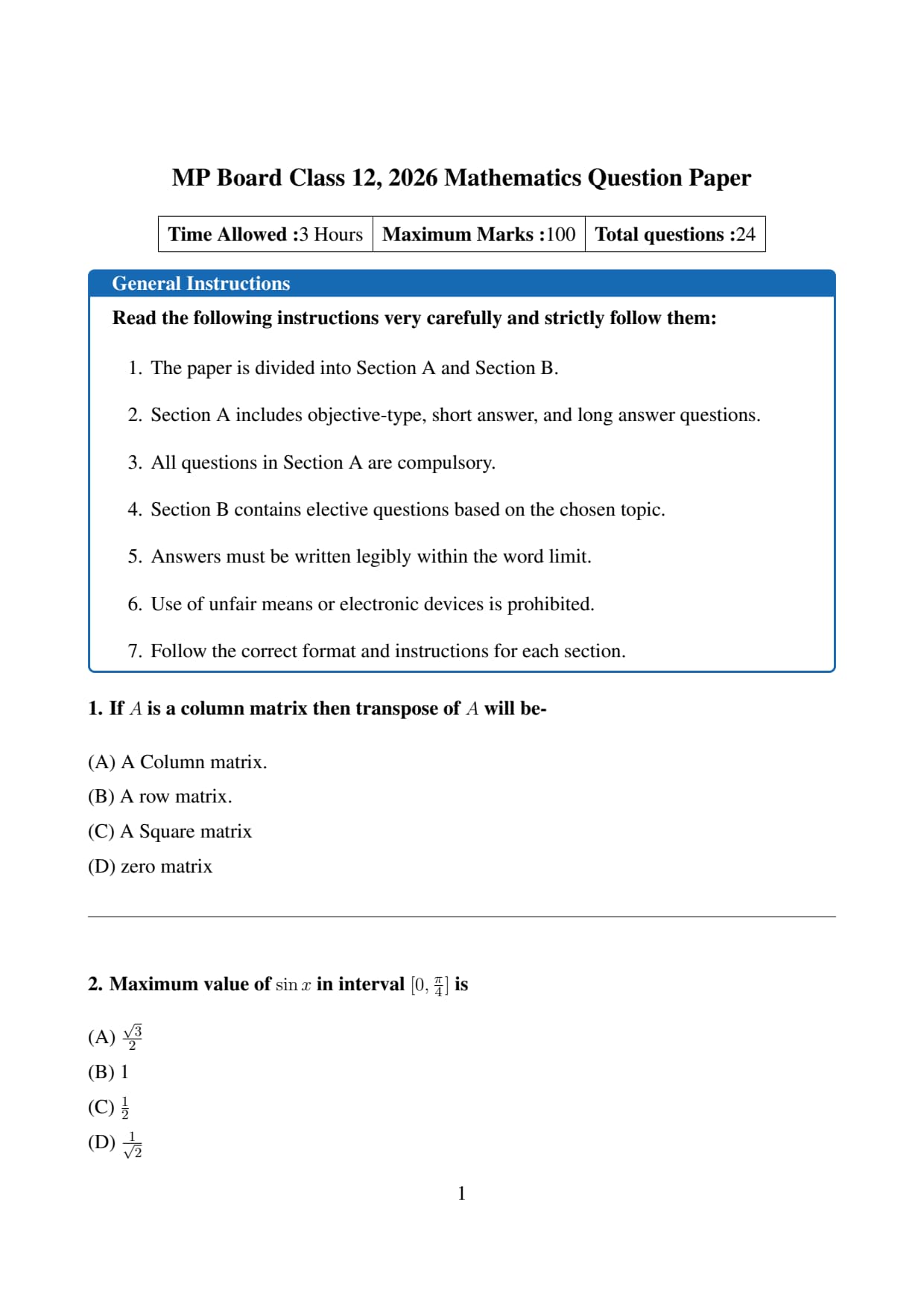
If \( A \) is a column matrix then transpose of \( A \) will be-
View Solution
\textcolor{red{Step 1: Understanding column matrix.
A column matrix is a matrix that has only one column but may have multiple rows. If \( A \) is a column matrix of order \( m \times 1 \), it has \( m \) rows and 1 column.
\textcolor{red{Step 2: Understanding transpose of a matrix.
The transpose of a matrix is obtained by interchanging its rows and columns. If \( A \) is of order \( m \times n \), then \( A' \) (or \( A^T \)) is of order \( n \times m \).
\textcolor{red{Step 3: Transpose of a column matrix.
If \( A \) is a column matrix of order \( m \times 1 \), then its transpose \( A' \) will have order \( 1 \times m \), which is a row matrix.
\textcolor{red{Step 4: Example.
Let \( A = \begin{bmatrix} a_1
a_2
a_3 \end{bmatrix} \) (3 × 1 column matrix)
Then \( A' = \begin{bmatrix} a_1 & a_2 & a_3 \end{bmatrix} \) (1 × 3 row matrix)
\textcolor{red{Step 5: Analysis of options.
(A) Column matrix: Incorrect. Transpose of a column matrix becomes a row matrix.
(B) Row matrix: \textcolor{red{Correct. Transpose of a column matrix is always a row matrix.
(C) Square matrix: Incorrect. Square matrices have equal number of rows and columns, which is not necessarily true here.
(D) Zero matrix: Incorrect. Transpose of a column matrix is not necessarily zero.
\textcolor{red{ Final Answer: (B) A row matrix. Quick Tip: Column matrix (\(m \times 1\)) ⟶ Transpose ⟶ Row matrix (\(1 \times m\))
Row matrix (\(1 \times n\)) ⟶ Transpose ⟶ Column matrix (\(n \times 1\))
Maximum value of \( \sin x \) in interval \([0, \frac{\pi}{4}]\) is
View Solution
\textcolor{red{Step 1: Understanding the sine function.
The sine function, \( \sin x \), is increasing in the interval \([0, \frac{\pi}{2}]\). As x increases from 0 to \(\frac{\pi}{2}\), \(\sin x\) increases from 0 to 1.
\textcolor{red{Step 2: Given interval.
The given interval is \([0, \frac{\pi}{4}]\). Since \(\frac{\pi}{4} < \frac{\pi}{2}\), the function is increasing throughout this interval.
\textcolor{red{Step 3: Finding maximum value.
For an increasing function, the maximum value occurs at the right endpoint of the interval.
At \( x = \frac{\pi}{4} \): \[ \sin\left(\frac{\pi}{4}\right) = \frac{1}{\sqrt{2}} \]
\textcolor{red{Step 4: Analysis of options.
(A) \(\frac{\sqrt{3}}{2}\): Incorrect. This is \(\sin\frac{\pi}{3} \approx 0.866\), which is outside the given interval.
(B) 1: Incorrect. This is \(\sin\frac{\pi}{2}\), but \(\frac{\pi}{2}\) is not in \([0, \frac{\pi}{4}]\).
(C) \(\frac{1}{2}\): Incorrect. This is \(\sin\frac{\pi}{6} \approx 0.5\), which is less than \(\sin\frac{\pi}{4}\).
(D) \(\frac{1}{\sqrt{2}}\): \textcolor{red{Correct. This is \(\sin\frac{\pi}{4}\), the maximum value in the given interval.
\textcolor{red{ Final Answer: (D) \(\frac{1}{\sqrt{2}}\) Quick Tip: Remember key sine values: \(\sin 0 = 0\) \(\sin\frac{\pi}{6} = \frac{1}{2}\) \(\sin\frac{\pi}{4} = \frac{1}{\sqrt{2}}\) \(\sin\frac{\pi}{3} = \frac{\sqrt{3}}{2}\) \(\sin\frac{\pi}{2} = 1\)
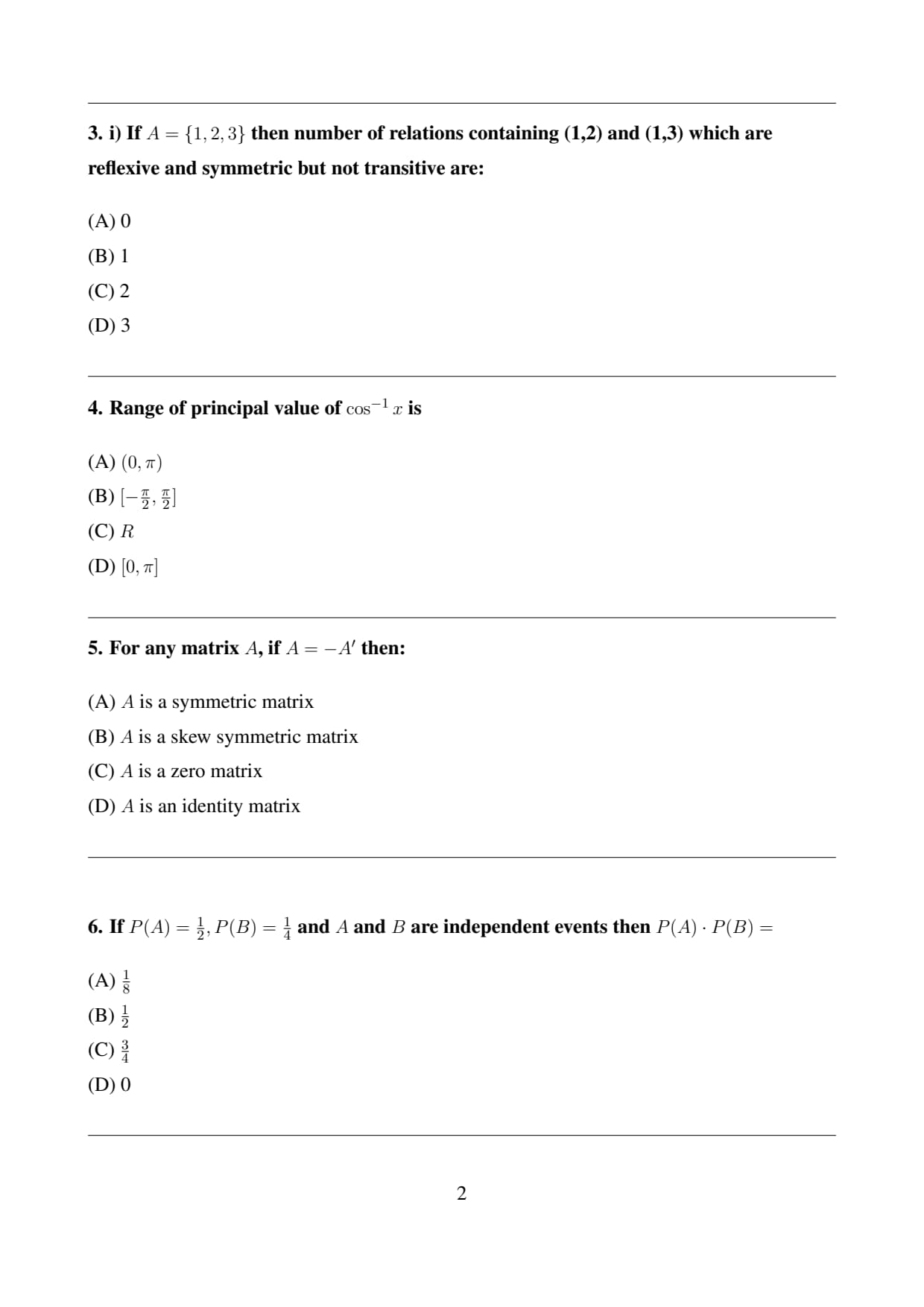
i) If \( A = \{1, 2, 3\} \) then number of relations containing (1,2) and (1,3) which are reflexive and symmetric but not transitive are:
View Solution
\textcolor{red{Step 1: Understanding the requirements.
We need a relation R on set A = \{1, 2, 3\ that:
Contains (1,2) and (1,3)
Is reflexive
Is symmetric
Is NOT transitive
\textcolor{red{Step 2: Reflexive condition.
For reflexivity, all pairs (a,a) must be in R for every a ∈ A.
Therefore, (1,1), (2,2), (3,3) must be in R.
\textcolor{red{Step 3: Symmetric condition.
Given (1,2) is in R, symmetry requires (2,1) to be in R.
Given (1,3) is in R, symmetry requires (3,1) to be in R.
\textcolor{red{Step 4: Current elements in R.
So far, R must contain:
(1,1), (2,2), (3,3) [reflexive]
(1,2), (2,1) [given and symmetric]
(1,3), (3,1) [given and symmetric]
\textcolor{red{Step 5: Checking transitivity.
Now we need to ensure the relation is NOT transitive.
Consider: We have (2,1) and (1,3) in R. For transitivity, we would need (2,3) in R.
Similarly, we have (3,1) and (1,2) in R. For transitivity, we would need (3,2) in R.
If we include both (2,3) and (3,2), the relation becomes transitive.
\textcolor{red{Step 6: Constructing the non-transitive relation.
To make it NOT transitive, we must exclude at least one of (2,3) or (3,2).
The relation R = \{(1,1), (2,2), (3,3), (1,2), (2,1), (1,3), (3,1)\ is:
Reflexive ✓
Symmetric ✓
Not transitive ✗ (since (2,1) and (1,3) are present but (2,3) is missing)
We cannot add any other pairs without affecting these properties.
\textcolor{red{Step 7: Conclusion.
There is exactly one such relation.
\textcolor{red{ Final Answer: (B) 1 Quick Tip: For non-transitive relations, ensure that for some a,b,c with (a,b) and (b,c) in R, (a,c) is NOT in R, while maintaining reflexivity and symmetry.
Range of principal value of \( \cos^{-1}x \) is
View Solution
\textcolor{red{Step 1: Understanding inverse trigonometric functions.
The inverse cosine function, denoted as \(\cos^{-1}x\) or \(\arccos x\), gives the angle whose cosine is x.
\textcolor{red{Step 2: Principal value branch.
Since cosine is not one-to-one on its entire domain, we restrict it to a specific interval called the principal value branch to define its inverse.
\textcolor{red{Step 3: Principal value range for \(\cos^{-1}x\).
For \(\cos^{-1}x\), the principal value range is \([0, \pi]\). This means:
The output (angle) lies between 0 and \(\pi\) inclusive
For x = 1, \(\cos^{-1}(1) = 0\)
For x = -1, \(\cos^{-1}(-1) = \pi\)
For x = 0, \(\cos^{-1}(0) = \frac{\pi}{2}\)
\textcolor{red{Step 4: Analysis of options.
(A) \( (0, \pi) \): Incorrect. This is open interval, but endpoints 0 and \(\pi\) are included.
(B) \( [-\frac{\pi}{2}, \frac{\pi}{2}] \): Incorrect. This is the range for \(\sin^{-1}x\).
(C) \( R \): Incorrect. Inverse cosine gives bounded values.
(D) \( [0, \pi] \): \textcolor{red{Correct. This is the principal value range.
\textcolor{red{ Final Answer: (D) \( [0, \pi] \) Quick Tip: Principal value ranges: \(\sin^{-1}x\): \([-\frac{\pi}{2}, \frac{\pi}{2}]\) \(\cos^{-1}x\): \([0, \pi]\) \(\tan^{-1}x\): \((-\frac{\pi}{2}, \frac{\pi}{2})\)
For any matrix \( A \), if \( A = -A' \) then:
View Solution
\textcolor{red{Step 1: Understanding matrix transpose.
The transpose of a matrix \( A \), denoted by \( A' \) or \( A^T \), is obtained by interchanging its rows and columns.
\textcolor{red{Step 2: Definition of symmetric and skew-symmetric matrices.
Symmetric matrix: \( A = A' \)
Skew-symmetric matrix: \( A = -A' \)
\textcolor{red{Step 3: Given condition.
The given condition is \( A = -A' \), which matches exactly the definition of a skew-symmetric matrix.
\textcolor{red{Step 4: Properties of skew-symmetric matrices.
For a skew-symmetric matrix:
Diagonal elements are always zero: \( a_{ii} = 0 \) for all i
\( a_{ij} = -a_{ji} \) for i ≠ j
\textcolor{red{Step 5: Analysis of options.
(A) Symmetric matrix: Incorrect. Symmetric matrices satisfy \( A = A' \), not \( A = -A' \).
(B) Skew symmetric matrix: \textcolor{red{Correct. This directly satisfies the given condition \( A = -A' \).
(C) Zero matrix: Incorrect. While a zero matrix is both symmetric and skew-symmetric, the condition \( A = -A' \) defines all skew-symmetric matrices, not just zero matrix.
(D) Identity matrix: Incorrect. Identity matrix satisfies \( I = I' \), not \( I = -I' \).
\textcolor{red{ Final Answer: (B) \( A \) is a skew symmetric matrix Quick Tip: Remember: Symmetric: \( A = A' \) (e.g., \( \begin{bmatrix} 1 & 2
2 & 3 \end{bmatrix} \)) Skew-symmetric: \( A = -A' \) (e.g., \( \begin{bmatrix} 0 & 2
-2 & 0 \end{bmatrix} \))
If \( P(A) = \frac{1}{2}, P(B) = \frac{1}{4} \) and \( A \) and \( B \) are independent events then \( P(A) \cdot P(B) = \)
View Solution
\textcolor{red{Step 1: Understanding independent events.
Two events A and B are independent if the occurrence of one does not affect the probability of occurrence of the other.
\textcolor{red{Step 2: Multiplication rule for independent events.
For independent events, the probability of both events occurring together is: \[ P(A \cap B) = P(A) \cdot P(B) \]
\textcolor{red{Step 3: Given probabilities.
\[ P(A) = \frac{1}{2}, \quad P(B) = \frac{1}{4} \]
\textcolor{red{Step 4: Calculating \( P(A) \cdot P(B) \).
\[ P(A) \cdot P(B) = \frac{1}{2} \times \frac{1}{4} = \frac{1}{8} \]
\textcolor{red{Step 5: Analysis of options.
(A) \( \frac{1}{8} \): \textcolor{red{Correct. This is the product of the given probabilities.
(B) \( \frac{1}{2} \): Incorrect. This is just \( P(A) \).
(C) \( \frac{3}{4} \): Incorrect. This might be \( P(A) + P(B) \) but not the product.
(D) 0: Incorrect. This would be the case for mutually exclusive events, not independent events.
\textcolor{red{ Final Answer: (A) \( \frac{1}{8} \) Quick Tip: For independent events: \( P(A \cap B) = P(A) \times P(B) \)
For mutually exclusive events: \( P(A \cap B) = 0 \)
Don't confuse independence with mutual exclusivity!
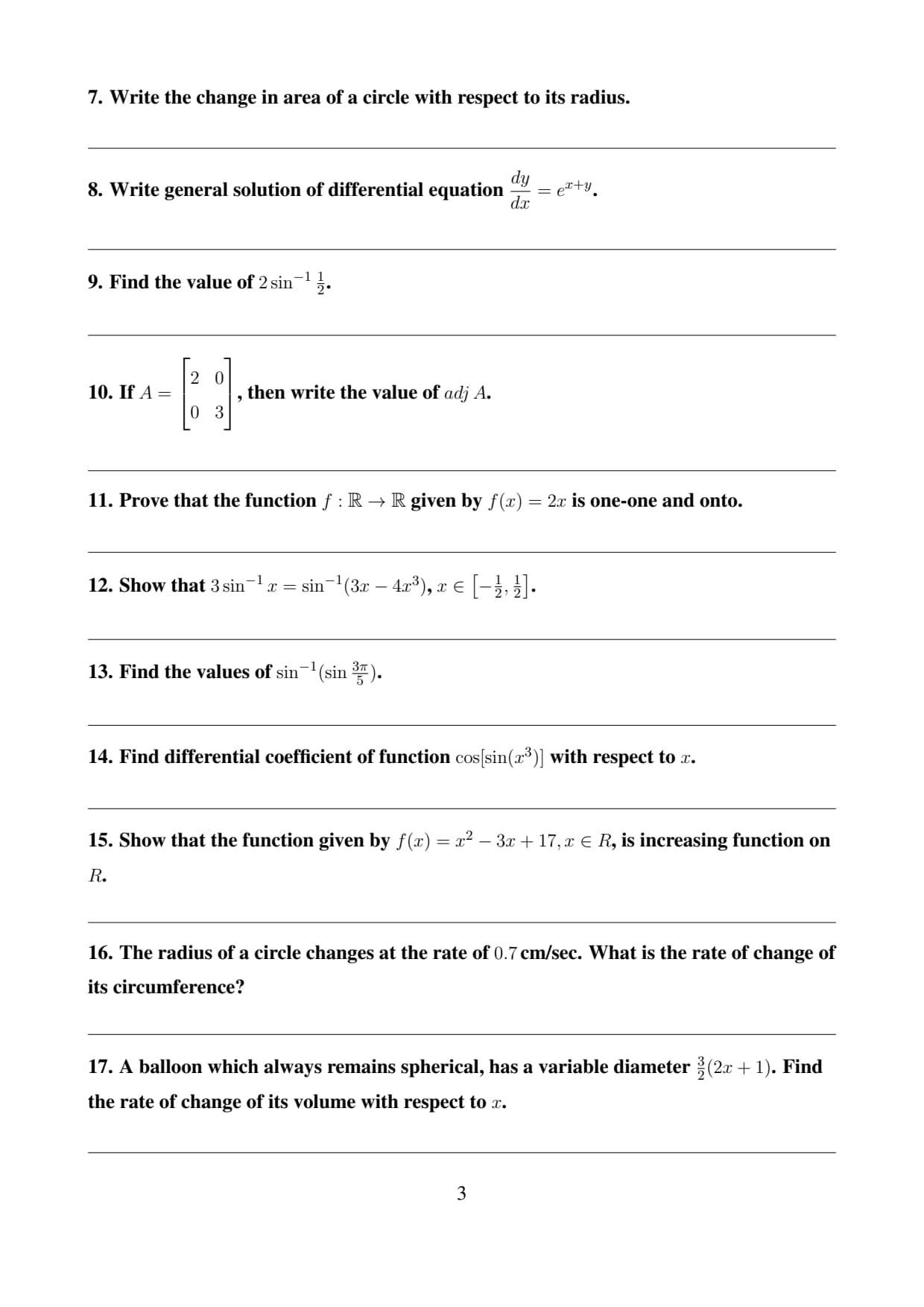
Write the change in area of a circle with respect to its radius.
View Solution
\textcolor{red{Step 1: Recall the formula for area of a circle.
The area \(A\) of a circle with radius \(r\) is given by: \[ A = \pi r^2 \]
\textcolor{red{Step 2: Understand what "change in area with respect to radius" means.
The phrase "change in area with respect to radius" refers to the rate at which the area changes as the radius changes. Mathematically, this is the derivative of area \(A\) with respect to radius \(r\), i.e., \(\frac{dA}{dr}\).
\textcolor{red{Step 3: Differentiate the area formula.
Differentiating \(A = \pi r^2\) with respect to \(r\): \[ \frac{dA}{dr} = \frac{d}{dr}(\pi r^2) = \pi \cdot 2r = 2\pi r \]
\textcolor{red{Step 4: Interpret the result.
The change in area of a circle with respect to its radius is \(2\pi r\), which is exactly the circumference of the circle. This means that for a small change in radius \(dr\), the corresponding change in area \(dA\) is approximately equal to the circumference times \(dr\): \[ dA = 2\pi r \cdot dr \]
\textcolor{red{Step 5: Final answer.
\[ \boxed{\frac{dA}{dr} = 2\pi r} \] Quick Tip: The derivative of area (\(\pi r^2\)) with respect to radius gives circumference (\(2\pi r\)). This makes intuitive sense: adding a thin ring of thickness \(dr\) around the circle increases area by (circumference) \(\times\) \(dr\).
Write general solution of differential equation \(\displaystyle \frac{dy}{dx} = e^{x+y}\).
View Solution
\textcolor{red{Step 1: Write the given differential equation.
The given differential equation is: \[ \frac{dy}{dx} = e^{x+y} \]
\textcolor{red{Step 2: Use the property of exponents to separate variables.
Recall that \(e^{x+y} = e^x \cdot e^y\). Therefore: \[ \frac{dy}{dx} = e^x \cdot e^y \]
\textcolor{red{Step 3: Separate the variables.
Bring terms containing \(y\) to one side and terms containing \(x\) to the other side: \[ \frac{dy}{e^y} = e^x \, dx \] \[ e^{-y} \, dy = e^x \, dx \]
\textcolor{red{Step 4: Integrate both sides.
\[ \int e^{-y} \, dy = \int e^x \, dx \] \[ -e^{-y} = e^x + C \]
where \(C\) is the constant of integration.
\textcolor{red{Step 5: Simplify to get the general solution.
Multiply both sides by \(-1\): \[ e^{-y} = -e^x - C \]
Let \(C_1 = -C\) (where \(C_1\) is an arbitrary constant). Then: \[ e^{-y} = -e^x + C_1 \]
\textcolor{red{Step 6: Alternative form using natural logarithm.
Taking natural logarithm on both sides: \[ -y = \ln(C_1 - e^x) \] \[ y = -\ln(C_1 - e^x) \]
\textcolor{red{Step 7: Another common form of the solution.
We can also write the solution as: \[ e^{-y} + e^x = C \]
where \(C\) is an arbitrary constant. This is a compact form of the general solution.
\textcolor{red{Step 8: Final answer.
The general solution of the differential equation \(\frac{dy}{dx} = e^{x+y}\) is: \[ \boxed{e^{-y} + e^x = C} \quad or \quad \boxed{y = -\ln(C - e^x)} \]
where \(C\) is an arbitrary constant. Quick Tip: For \(\frac{dy}{dx} = e^{x+y}\), use \(e^{x+y} = e^x e^y\) to separate variables: \(e^{-y} dy = e^x dx\). Integrate to get \(-e^{-y} = e^x + C\), which simplifies to \(e^{-y} + e^x = C\).
Find the value of \( 2\sin^{-1}\frac{1}{2} \).
View Solution
\textcolor{red{Step 1: Recall the principal value of \(\sin^{-1}\frac{1}{2}\).
We know that \(\sin\frac{\pi}{6} = \frac{1}{2}\). The principal value branch of \(\sin^{-1}x\) is \(\left[-\frac{\pi}{2}, \frac{\pi}{2}\right]\). Since \(\frac{\pi}{6}\) lies in this interval: \[ \sin^{-1}\frac{1}{2} = \frac{\pi}{6} \]
\textcolor{red{Step 2: Alternative form in degrees.
\(\frac{\pi}{6}\) radians = \(30^\circ\). So: \[ \sin^{-1}\frac{1}{2} = 30^\circ \]
\textcolor{red{Step 3: Multiply by 2.
\[ 2\sin^{-1}\frac{1}{2} = 2 \times \frac{\pi}{6} = \frac{2\pi}{6} = \frac{\pi}{3} \]
\textcolor{red{Step 4: Express in degrees (optional).
\[ \frac{\pi}{3} radians = 60^\circ \]
\textcolor{red{Step 5: Final answer.
\[ \boxed{\frac{\pi}{3}} \quad or \quad \boxed{60^\circ} \] Quick Tip: Remember: \(\sin^{-1}\frac{1}{2} = \frac{\pi}{6}\) (30°). Multiplying by 2 gives \(\frac{\pi}{3}\) (60°). Always use principal value range for inverse trigonometric functions.
If \( A = \begin{bmatrix} 2 & 0 \\
0 & 3 \end{bmatrix} \), then write the value of \( adj \, A \).
View Solution
\textcolor{red{Step 1: Recall the formula for adjoint of a \(2 \times 2\) matrix.
For a \(2 \times 2\) matrix: \[ A = \begin{bmatrix} a & b
c & d \end{bmatrix} \]
The adjoint of \(A\) (denoted \(adj\,A\)) is given by: \[ adj\,A = \begin{bmatrix} d & -b
-c & a \end{bmatrix} \]
(Note: This is the transpose of the cofactor matrix.)
\textcolor{red{Step 2: Identify the elements of the given matrix.
Given: \[ A = \begin{bmatrix} 2 & 0
0 & 3 \end{bmatrix} \]
Here, \(a = 2\), \(b = 0\), \(c = 0\), \(d = 3\).
\textcolor{red{Step 3: Apply the adjoint formula.
\[ adj\,A = \begin{bmatrix} d & -b
-c & a \end{bmatrix} = \begin{bmatrix} 3 & -0
-0 & 2 \end{bmatrix} \]
\textcolor{red{Step 4: Simplify.
\[ adj\,A = \begin{bmatrix} 3 & 0
0 & 2 \end{bmatrix} \]
\textcolor{red{Step 5: Verify using cofactor method.
Cofactor of \(a_{11} = 2\) is \(C_{11} = +d = 3\)
Cofactor of \(a_{12} = 0\) is \(C_{12} = -c = 0\)
Cofactor of \(a_{21} = 0\) is \(C_{21} = -b = 0\)
Cofactor of \(a_{22} = 3\) is \(C_{22} = +a = 2\)
The cofactor matrix is \(\begin{bmatrix} 3 & 0
0 & 2 \end{bmatrix}\).
The adjoint is the transpose of the cofactor matrix: \[ adj\,A = \begin{bmatrix} 3 & 0
0 & 2 \end{bmatrix}^T = \begin{bmatrix} 3 & 0
0 & 2 \end{bmatrix} \]
This matches our result.
\textcolor{red{Step 6: Final answer.
\[ \boxed{adj\,A = \begin{bmatrix} 3 & 0
0 & 2 \end{bmatrix}} \] Quick Tip: For a diagonal matrix \(\begin{bmatrix} a & 0
0 & d \end{bmatrix}\), the adjoint is \(\begin{bmatrix} d & 0
0 & a \end{bmatrix}\). Just swap the diagonal elements!
Prove that the function \( f: \mathbb{R} \to \mathbb{R} \) given by \( f(x) = 2x \) is one-one and onto.
View Solution
\textcolor{red{Step 1: Understanding the function.
We are given a function \( f: \mathbb{R} \to \mathbb{R} \) defined by \( f(x) = 2x \). This means the domain is all real numbers, the codomain is all real numbers, and every input \( x \) is mapped to an output \( 2x \).
\textcolor{red{Step 2: Proving that \( f \) is one-one (injective).
A function is one-one (injective) if different inputs always produce different outputs. That is, for any \( x_1, x_2 \in \mathbb{R} \): \[ If f(x_1) = f(x_2) , then x_1 = x_2. \]
Assume \( f(x_1) = f(x_2) \): \[ 2x_1 = 2x_2 \]
Divide both sides by 2 (which is non-zero): \[ x_1 = x_2 \]
Thus, \( f(x_1) = f(x_2) \) implies \( x_1 = x_2 \). Therefore, the function \( f \) is one-one.
\textcolor{red{Step 3: Alternative method for one-one.
We can also check using the derivative or the fact that it's a strictly increasing function. Since \( f'(x) = 2 > 0 \) for all \( x \), the function is strictly increasing, which implies it is one-one.
\textcolor{red{Step 4: Proving that \( f \) is onto (surjective).
A function is onto (surjective) if every element in the codomain has a pre-image in the domain. That is, for every \( y \in \mathbb{R} \) (codomain), there exists some \( x \in \mathbb{R} \) (domain) such that \( f(x) = y \).
Let \( y \) be an arbitrary real number in the codomain. We need to find \( x \) such that: \[ f(x) = y \implies 2x = y \]
Solving for \( x \): \[ x = \frac{y}{2} \]
\textcolor{red{Step 5: Verify that \( x \) belongs to the domain.
Since \( y \) is a real number, \( \frac{y}{2} \) is also a real number. Therefore, \( x = \frac{y}{2} \in \mathbb{R} \) (domain).
\textcolor{red{Step 6: Check that \( f(x) = y \).
\[ f(x) = f\left(\frac{y}{2}\right) = 2 \times \frac{y}{2} = y \]
Thus, for every \( y \in \mathbb{R} \), there exists \( x = \frac{y}{2} \in \mathbb{R} \) such that \( f(x) = y \). Therefore, the function \( f \) is onto.
\textcolor{red{Step 7: Conclusion.
Since \( f \) is both one-one and onto, it is a bijective function.
\[ \boxed{The function f(x)=2x is both one-one and onto.} \] Quick Tip: For linear functions \( f(x) = ax + b \) with \( a \neq 0 \):
- One-one: If \( a \neq 0 \), it's always one-one (strictly increasing if \( a>0 \), decreasing if \( a<0 \)).
- Onto: For \( f: \mathbb{R} \to \mathbb{R} \), it's onto if the range equals all real numbers, which happens when \( a \neq 0 \).
Show that \( 3 \sin^{-1} x = \sin^{-1}(3x - 4x^3) \), \( x \in \left[-\frac{1}{2}, \frac{1}{2}\right] \).
View Solution
\textcolor{red{Step 1: Recall the trigonometric identity for \(\sin 3\theta\).
We know the triple angle formula for sine: \[ \sin 3\theta = 3\sin\theta - 4\sin^3\theta \]
\textcolor{red{Step 2: Substitute \(\theta = \sin^{-1} x\).
Let \(\theta = \sin^{-1} x\). Then by definition: \[ \sin\theta = x \quad and \quad \theta \in \left[-\frac{\pi}{2}, \frac{\pi}{2}\right] \]
\textcolor{red{Step 3: Apply the identity.
Using the triple angle formula: \[ \sin(3\theta) = 3\sin\theta - 4\sin^3\theta = 3x - 4x^3 \]
\textcolor{red{Step 4: Take inverse sine on both sides.
\[ \sin^{-1}(\sin(3\theta)) = \sin^{-1}(3x - 4x^3) \]
\textcolor{red{Step 5: Determine when \(\sin^{-1}(\sin(3\theta)) = 3\theta\).
The property \(\sin^{-1}(\sin y) = y\) holds only when \(y\) lies in the principal value branch of \(\sin^{-1}\), i.e., \(y \in \left[-\frac{\pi}{2}, \frac{\pi}{2}\right]\).
Here, \(y = 3\theta = 3\sin^{-1}x\). We need to check whether \(3\sin^{-1}x \in \left[-\frac{\pi}{2}, \frac{\pi}{2}\right]\) for the given domain of \(x\).
\textcolor{red{Step 6: Analyze the range of \(3\sin^{-1}x\) for \(x \in \left[-\frac{1}{2}, \frac{1}{2}\right]\).
When \(x \in \left[-\frac{1}{2}, \frac{1}{2}\right]\): \[ \sin^{-1}x \in \left[-\frac{\pi}{6}, \frac{\pi}{6}\right] \]
Multiplying by 3: \[ 3\sin^{-1}x \in \left[-\frac{\pi}{2}, \frac{\pi}{2}\right] \]
\textcolor{red{Step 7: Verify the endpoints.
At \(x = \frac{1}{2}\): \(\sin^{-1}\frac{1}{2} = \frac{\pi}{6}\), so \(3\sin^{-1}x = \frac{\pi}{2}\), which is within \(\left[-\frac{\pi}{2}, \frac{\pi}{2}\right]\).
At \(x = -\frac{1}{2}\): \(\sin^{-1}\left(-\frac{1}{2}\right) = -\frac{\pi}{6}\), so \(3\sin^{-1}x = -\frac{\pi}{2}\), which is within \(\left[-\frac{\pi}{2}, \frac{\pi}{2}\right]\).
Thus, for all \(x \in \left[-\frac{1}{2}, \frac{1}{2}\right]\), \(3\sin^{-1}x\) lies in the principal value branch \(\left[-\frac{\pi}{2}, \frac{\pi}{2}\right]\).
\textcolor{red{Step 8: Apply the inverse sine property.
Since \(3\sin^{-1}x \in \left[-\frac{\pi}{2}, \frac{\pi}{2}\right]\), we have: \[ \sin^{-1}(\sin(3\sin^{-1}x)) = 3\sin^{-1}x \]
\textcolor{red{Step 9: Complete the proof.
From Step 3, \(\sin(3\sin^{-1}x) = 3x - 4x^3\). Therefore: \[ \sin^{-1}(3x - 4x^3) = \sin^{-1}(\sin(3\sin^{-1}x)) = 3\sin^{-1}x \]
\textcolor{red{Step 10: Final statement.
Thus, for \(x \in \left[-\frac{1}{2}, \frac{1}{2}\right]\): \[ \boxed{3\sin^{-1}x = \sin^{-1}(3x - 4x^3)} \] Quick Tip: The identity \(3\sin^{-1}x = \sin^{-1}(3x - 4x^3)\) holds for \(x \in \left[-\frac{1}{2}, \frac{1}{2}\right]\) because in this interval, \(3\sin^{-1}x\) lies within the principal value range \(\left[-\frac{\pi}{2}, \frac{\pi}{2}\right]\), allowing us to cancel \(\sin^{-1}(\sin(3\theta)) = 3\theta\).
Find the values of \( \sin^{-1}(\sin\frac{3\pi}{5}) \).
View Solution
\textcolor{red{Step 1: Recall the principal value branch of \(\sin^{-1}x\).
The principal value branch of \(\sin^{-1}x\) is \(\left[-\frac{\pi}{2}, \frac{\pi}{2}\right]\). For any real number \(y\), \(\sin^{-1}(\sin y) = y\) only if \(y\) lies in this interval. Otherwise, we need to find an equivalent angle in \(\left[-\frac{\pi}{2}, \frac{\pi}{2}\right]\) that has the same sine value.
\textcolor{red{Step 2: Analyze the given angle.
Given: \(y = \frac{3\pi}{5}\)
First, convert to degrees for better understanding: \[ \frac{3\pi}{5} = \frac{3 \times 180^\circ}{5} = 108^\circ \]
\textcolor{red{Step 3: Check if \(108^\circ\) lies in the principal value branch.
The principal value branch in degrees is \([-90^\circ, 90^\circ]\). Since \(108^\circ > 90^\circ\), it does not lie in this interval. Therefore, \(\sin^{-1}(\sin\frac{3\pi}{5}) \neq \frac{3\pi}{5}\).
\textcolor{red{Step 4: Find an angle in \(\left[-\frac{\pi}{2}, \frac{\pi}{2}\right]\) with the same sine value.
We know that \(\sin(180^\circ - \theta) = \sin\theta\).
\[ \sin(108^\circ) = \sin(180^\circ - 108^\circ) = \sin(72^\circ) \]
In radians: \[ \sin\left(\frac{3\pi}{5}\right) = \sin\left(\pi - \frac{3\pi}{5}\right) = \sin\left(\frac{5\pi - 3\pi}{5}\right) = \sin\left(\frac{2\pi}{5}\right) \]
\textcolor{red{Step 5: Check if \(\frac{2\pi}{5}\) lies in the principal value branch.
\[ \frac{2\pi}{5} = \frac{2 \times 180^\circ}{5} = 72^\circ \] \(72^\circ\) lies in \([-\frac{\pi}{2}, \frac{\pi}{2}]\) (i.e., \([-90^\circ, 90^\circ]\)). Therefore, \(\frac{2\pi}{5}\) is in the principal value branch.
\textcolor{red{Step 6: Apply the property of inverse sine.
Since \(\frac{2\pi}{5} \in \left[-\frac{\pi}{2}, \frac{\pi}{2}\right]\) and \(\sin\left(\frac{2\pi}{5}\right) = \sin\left(\frac{3\pi}{5}\right)\), we have: \[ \sin^{-1}\left(\sin\frac{3\pi}{5}\right) = \sin^{-1}\left(\sin\frac{2\pi}{5}\right) = \frac{2\pi}{5} \]
\textcolor{red{Step 7: Verify using the property \(\sin^{-1}(\sin y) = \pi - y\) for \(y \in \left[\frac{\pi}{2}, \pi\right]\).
Another approach: For \(y \in \left[\frac{\pi}{2}, \pi\right]\), we have the identity: \[ \sin^{-1}(\sin y) = \pi - y \]
Here, \(y = \frac{3\pi}{5} \approx 1.884\) radians, which lies in \(\left[\frac{\pi}{2}, \pi\right] \approx [1.57, 3.14]\).
Applying the identity: \[ \sin^{-1}\left(\sin\frac{3\pi}{5}\right) = \pi - \frac{3\pi}{5} = \frac{5\pi - 3\pi}{5} = \frac{2\pi}{5} \]
This matches our previous result.
\textcolor{red{Step 8: Final answer.
\[ \boxed{\frac{2\pi}{5}} \] Quick Tip: For finding \(\sin^{-1}(\sin y)\), first check if \(y\) is in \(\left[-\frac{\pi}{2}, \frac{\pi}{2}\right]\). If not, use identities: \(\sin^{-1}(\sin y) = \pi - y\) for \(y \in [\frac{\pi}{2}, \pi]\) \(\sin^{-1}(\sin y) = y - 2\pi\) for large \(y\), etc. Always ensure the answer lies in the principal value branch.
Find differential coefficient of function \( \cos[\sin(x^3)] \) with respect to \( x \).
View Solution
\textcolor{red{Step 1: Identify the function and the rule to apply.
We have \( y = \cos[\sin(x^3)] \). This is a composite function (function of a function). We need to find \( \frac{dy}{dx} \). We will use the chain rule for differentiation.
The chain rule states: \[ \frac{dy}{dx} = \frac{dy}{du} \cdot \frac{du}{dx} \]
For a composition of multiple functions, we apply the chain rule repeatedly.
\textcolor{red{Step 2: Break down the composite function.
Let's define intermediate variables: \[ y = \cos(u) \quad where \quad u = \sin(v) \quad and \quad v = x^3 \]
So we have: \( y = \cos(u) \), \( u = \sin(v) \), \( v = x^3 \).
\textcolor{red{Step 3: Apply the chain rule.
\[ \frac{dy}{dx} = \frac{dy}{du} \times \frac{du}{dv} \times \frac{dv}{dx} \]
\textcolor{red{Step 4: Differentiate each part.
\( \frac{dy}{du} = \frac{d}{du}[\cos(u)] = -\sin(u) \)
\( \frac{du}{dv} = \frac{d}{dv}[\sin(v)] = \cos(v) \)
\( \frac{dv}{dx} = \frac{d}{dx}[x^3] = 3x^2 \)
\textcolor{red{Step 5: Substitute back.
\[ \frac{dy}{dx} = [-\sin(u)] \times [\cos(v)] \times [3x^2] \]
\textcolor{red{Step 6: Replace \(u\) and \(v\) in terms of \(x\).
We have \( u = \sin(v) = \sin(x^3) \) and \( v = x^3 \).
Therefore: \[ \frac{dy}{dx} = -\sin(\sin(x^3)) \times \cos(x^3) \times 3x^2 \]
\textcolor{red{Step 7: Simplify the expression.
\[ \frac{dy}{dx} = -3x^2 \cos(x^3) \sin(\sin(x^3)) \]
\textcolor{red{Step 8: Final answer.
\[ \boxed{\frac{dy}{dx} = -3x^2 \cos(x^3) \sin(\sin(x^3))} \] Quick Tip: For composite functions like \( \cos(\sin(x^3)) \), use the chain rule from outside to inside: Differentiate outer function (cos) → multiply by derivative of middle (sin) → multiply by derivative of inner (\(x^3\)). Remember: derivative of \(\cos\) is \(-\sin\), derivative of \(\sin\) is \(\cos\), and derivative of \(x^3\) is \(3x^2\).
Show that the function given by \( f(x) = x^2 - 3x + 17, x \in R \), is increasing function on \( R \).
View Solution
\textcolor{red{Step 1: Recall the condition for a function to be increasing.
A function \( f(x) \) is said to be increasing on an interval if for any \( x_1 < x_2 \) in that interval, we have \( f(x_1) < f(x_2) \).
For differentiable functions, a simpler condition is: \[ f'(x) \geq 0 \quad for all x in the interval \]
If \( f'(x) > 0 \) for all \( x \), the function is strictly increasing.
\textcolor{red{Step 2: Find the derivative of \( f(x) \).
Given: \( f(x) = x^2 - 3x + 17 \)
Differentiating with respect to \( x \): \[ f'(x) = \frac{d}{dx}(x^2) - \frac{d}{dx}(3x) + \frac{d}{dx}(17) \] \[ f'(x) = 2x - 3 + 0 \] \[ f'(x) = 2x - 3 \]
\textcolor{red{Step 3: Analyze the sign of \( f'(x) \).
\( f'(x) = 2x - 3 \) is a linear function. Its sign depends on \( x \):
When \( x > \frac{3}{2} \), \( 2x - 3 > 0 \) ⇒ \( f'(x) > 0 \)
When \( x = \frac{3}{2} \), \( 2x - 3 = 0 \) ⇒ \( f'(x) = 0 \)
When \( x < \frac{3}{2} \), \( 2x - 3 < 0 \) ⇒ \( f'(x) < 0 \)
\textcolor{red{Step 4: Interpret the result.
Since \( f'(x) < 0 \) for \( x < \frac{3}{2} \), the function is decreasing on \( (-\infty, \frac{3}{2}) \).
Since \( f'(x) > 0 \) for \( x > \frac{3}{2} \), the function is increasing on \( (\frac{3}{2}, \infty) \).
At \( x = \frac{3}{2} \), the function has a critical point (local minimum).
\textcolor{red{Step 5: Conclusion about the statement.
The function \( f(x) = x^2 - 3x + 17 \) is not increasing on the entire \( \mathbb{R} \). It is increasing only for \( x > \frac{3}{2} \). For \( x < \frac{3}{2} \), it is decreasing.
Therefore, the given statement is false.
\textcolor{red{Step 6: Correct interpretation (if the question meant to check monotonicity).
If the question intended to ask about the nature of the function, we can say:
The function is decreasing on \( (-\infty, \frac{3}{2}] \)
The function is increasing on \( [\frac{3}{2}, \infty) \)
The function is not monotonic on \( \mathbb{R} \) (it has a minimum at \( x = \frac{3}{2} \))
\textcolor{red{Step 7: Final answer.
\[ \boxed{The function is not increasing on \mathbb{R}. It is increasing only for x > \frac{3}{2}.} \] Quick Tip: For a quadratic function \( ax^2 + bx + c \) with \( a > 0 \), it is decreasing for \( x < -\frac{b}{2a} \) and increasing for \( x > -\frac{b}{2a} \). It is never increasing or decreasing on the entire real line.
The radius of a circle changes at the rate of \( 0.7 \, cm/sec \). What is the rate of change of its circumference?
View Solution
\textcolor{red{Step 1: Identify the given information.
Let \( r \) be the radius of the circle (in cm).
Given: The rate of change of radius with respect to time: \[ \frac{dr}{dt} = 0.7 \, cm/sec \]
We need to find the rate of change of circumference \( C \) with respect to time, i.e., \( \frac{dC}{dt} \).
\textcolor{red{Step 2: Recall the formula for circumference of a circle.
The circumference \( C \) of a circle with radius \( r \) is given by: \[ C = 2\pi r \]
\textcolor{red{Step 3: Differentiate with respect to time \( t \).
Using the chain rule: \[ \frac{dC}{dt} = \frac{dC}{dr} \cdot \frac{dr}{dt} \] \[ \frac{dC}{dr} = \frac{d}{dr}(2\pi r) = 2\pi \]
Therefore: \[ \frac{dC}{dt} = 2\pi \cdot \frac{dr}{dt} \]
\textcolor{red{Step 4: Substitute the given value.
\[ \frac{dC}{dt} = 2\pi \times 0.7 \] \[ \frac{dC}{dt} = 1.4\pi \, cm/sec \]
\textcolor{red{Step 5: Calculate numerical value (optional).
Using \( \pi \approx 3.14 \): \[ \frac{dC}{dt} \approx 1.4 \times 3.14 = 4.396 \, cm/sec \]
Rounded to two decimal places: \[ \frac{dC}{dt} \approx 4.40 \, cm/sec \]
\textcolor{red{Step 6: Final answer.
The rate of change of circumference is: \[ \boxed{1.4\pi \, cm/sec} \quad or approximately \quad \boxed{4.40 \, cm/sec} \] Quick Tip: For a circle, circumference \( C = 2\pi r \). Since \( \frac{dC}{dr} = 2\pi \) is constant, the rate of change of circumference is simply \( 2\pi \) times the rate of change of radius: \( \frac{dC}{dt} = 2\pi \frac{dr}{dt} \).
A balloon which always remains spherical, has a variable diameter \( \frac{3}{2}(2x + 1) \). Find the rate of change of its volume with respect to \( x \).
View Solution
\textcolor{red{Step 1: Identify the given information.
The balloon is spherical, so its volume \( V \) is given by the formula for volume of a sphere: \[ V = \frac{4}{3}\pi r^3 \]
where \( r \) is the radius of the sphere.
We are given the diameter \( D \) as a function of \( x \): \[ D = \frac{3}{2}(2x + 1) \]
\textcolor{red{Step 2: Find the radius in terms of \( x \).
Since radius \( r = \frac{D}{2} \): \[ r = \frac{1}{2} \times \frac{3}{2}(2x + 1) = \frac{3}{4}(2x + 1) \]
\textcolor{red{Step 3: Write the volume in terms of \( x \).
Substitute \( r \) into the volume formula: \[ V = \frac{4}{3}\pi \left[\frac{3}{4}(2x + 1)\right]^3 \]
\textcolor{red{Step 4: Simplify the expression.
First, simplify the cube: \[ \left[\frac{3}{4}(2x + 1)\right]^3 = \left(\frac{3}{4}\right)^3 (2x + 1)^3 = \frac{27}{64} (2x + 1)^3 \]
Now multiply by \( \frac{4}{3}\pi \): \[ V = \frac{4}{3}\pi \times \frac{27}{64} (2x + 1)^3 \] \[ V = \pi \times \frac{4}{3} \times \frac{27}{64} (2x + 1)^3 \] \[ V = \pi \times \frac{108}{192} (2x + 1)^3 \]
Simplify \( \frac{108}{192} \) by dividing numerator and denominator by 12: \[ \frac{108}{192} = \frac{9}{16} \]
Therefore: \[ V = \frac{9\pi}{16} (2x + 1)^3 \]
\textcolor{red{Step 5: Find the rate of change of volume with respect to \( x \).
We need \( \frac{dV}{dx} \). Differentiate \( V \) with respect to \( x \): \[ \frac{dV}{dx} = \frac{9\pi}{16} \cdot \frac{d}{dx}[(2x + 1)^3] \]
Using the chain rule: \( \frac{d}{dx}[(2x + 1)^3] = 3(2x + 1)^2 \cdot \frac{d}{dx}(2x + 1) = 3(2x + 1)^2 \cdot 2 = 6(2x + 1)^2 \)
\textcolor{red{Step 6: Complete the differentiation.
\[ \frac{dV}{dx} = \frac{9\pi}{16} \times 6(2x + 1)^2 \] \[ \frac{dV}{dx} = \frac{54\pi}{16} (2x + 1)^2 \]
Simplify \( \frac{54}{16} \) by dividing numerator and denominator by 2: \[ \frac{54}{16} = \frac{27}{8} \]
\textcolor{red{Step 7: Final expression.
\[ \frac{dV}{dx} = \frac{27\pi}{8} (2x + 1)^2 \]
\textcolor{red{Step 8: Final answer.
The rate of change of volume with respect to \( x \) is: \[ \boxed{\frac{dV}{dx} = \frac{27\pi}{8} (2x + 1)^2} \] Quick Tip: When given diameter \( D(x) \), first find radius \( r = D/2 \), then use sphere volume formula \( V = \frac{4}{3}\pi r^3 \). Differentiate carefully using the chain rule, remembering to multiply by the derivative of the inner function.
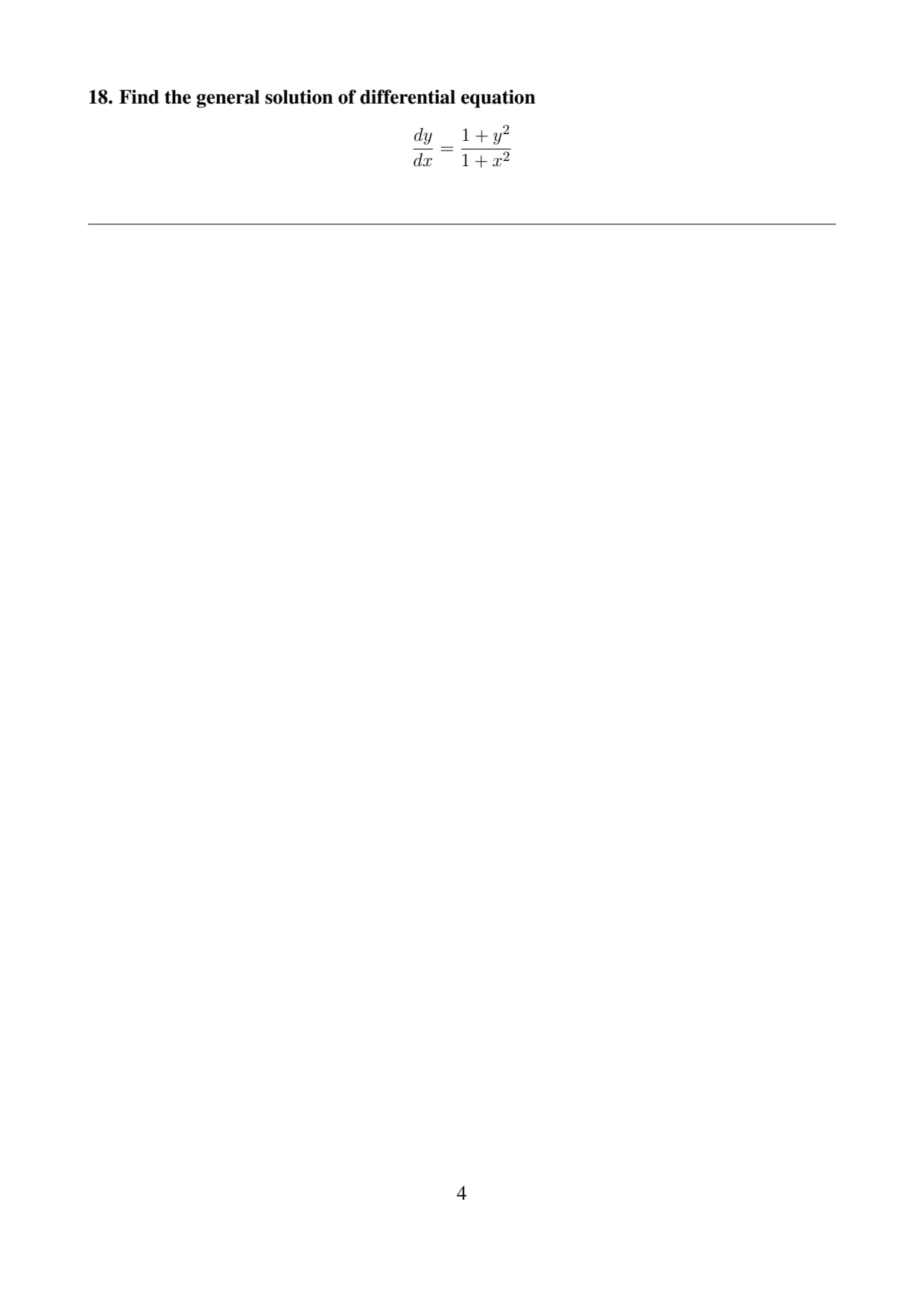
Find the general solution of differential equation \[\frac{dy}{dx} = \frac{1+y^2}{1+x^2}\]
View Solution
\textcolor{red{Step 1: Identify the type of differential equation.
The given differential equation is: \[ \frac{dy}{dx} = \frac{1+y^2}{1+x^2} \]
This is a first-order differential equation where the variables can be separated.
\textcolor{red{Step 2: Separate the variables.
Bring terms containing \(y\) to one side and terms containing \(x\) to the other side: \[ \frac{dy}{1+y^2} = \frac{dx}{1+x^2} \]
\textcolor{red{Step 3: Integrate both sides.
\[ \int \frac{dy}{1+y^2} = \int \frac{dx}{1+x^2} \]
We know the standard integral: \[ \int \frac{du}{1+u^2} = \tan^{-1}u + C \]
\textcolor{red{Step 4: Apply the integration formula.
\[ \tan^{-1}y = \tan^{-1}x + C \]
where \(C\) is the constant of integration.
\textcolor{red{Step 5: Simplify to get the general solution.
\[ \tan^{-1}y - \tan^{-1}x = C \]
We can also write this as: \[ \tan^{-1}y = \tan^{-1}x + C \]
\textcolor{red{Step 6: Alternative form using tangent addition formula.
Taking tangent on both sides: \[ y = \tan(\tan^{-1}x + C) \]
Using the formula \(\tan(A+B) = \frac{\tan A + \tan B}{1 - \tan A \tan B}\): \[ y = \frac{x + \tan C}{1 - x \tan C} \]
Let \(k = \tan C\), where \(k\) is an arbitrary constant. Then: \[ y = \frac{x + k}{1 - kx} \]
\textcolor{red{Step 7: Final answer.
The general solution of the differential equation can be written in multiple forms:
\[ \boxed{\tan^{-1}y = \tan^{-1}x + C} \]
or equivalently, \[ \boxed{y = \frac{x + k}{1 - kx}, \quad where k is an arbitrary constant} \] Quick Tip: For \(\frac{dy}{dx} = \frac{1+y^2}{1+x^2}\), separate variables to get \(\frac{dy}{1+y^2} = \frac{dx}{1+x^2}\). Integrate using \(\int \frac{du}{1+u^2} = \tan^{-1}u + C\). The solution is \(\tan^{-1}y = \tan^{-1}x + C\).



Comments