




MP Board 12th Economics Question Paper 2023 with Answer Key pdf is available for download here. The exam was conducted by Madhya Pradesh Board of Secondary Education, MPBSE on March 6, 2023 in the Morning Session 9 AM to 12 PM. The question paper comprised a total of 23 questions.
MP Board 12th Economics Question Paper 2023 with Answer Key
| GATE 2025 English XH – C2 Question Paper with Solutions PDF | Download PDF | Check Solutions |
(i) Opportunity cost is:
View Solution
Step 1: Understanding opportunity cost.
Opportunity cost refers to the value of the next best alternative that is forgone when making a decision. It is an essential concept in economics, representing the trade-off between different choices.
Step 2: Conclusion.
Thus, the correct answer is option (3) "Cost of next best alternative." Quick Tip: Opportunity cost helps in decision-making by considering what is given up in exchange for the chosen option.
(ii) Non-tax revenue is:
View Solution
Step 1: Understanding non-tax revenue.
Non-tax revenue is the income generated by the government through sources other than taxes. This includes income from dividends, interest, and other fees or charges.
Step 2: Conclusion.
Thus, the correct answer is option (3) Dividend. Quick Tip: Non-tax revenue is a significant source of government funding, including income from public sector enterprises.
(iii) Keynes theory is associated with:
View Solution
Step 1: Understanding Keynesian theory.
John Maynard Keynes' economic theory emphasizes the role of government intervention in managing economic cycles. The theory involves effective demand, the propensity to consume, and the propensity to save.
Step 2: Conclusion.
Thus, the correct answer is option (4) All the above. Quick Tip: Keynes' theory highlights the importance of aggregate demand in determining economic output and employment.
(iv) The slope of the budget line is:
View Solution
Step 1: Understanding the budget line.
The budget line shows the combinations of two goods that a consumer can afford given their income and the prices of the goods. The slope of the budget line is given by the ratio of the prices of the goods, which is \(-P_2/P_1\), where \(P_1\) is the price of the first good and \(P_2\) is the price of the second good.
Step 2: Conclusion.
Thus, the correct answer is option (1) \(-P_2/P_1\). Quick Tip: The slope of the budget line represents the rate at which a consumer must give up one good to gain more of the other, given their budget constraint.
(v) Which of the following agency is responsible for using Rs. 1 currency note in India?
View Solution
Step 1: Identifying the responsible agency.
In India, the Reserve Bank of India (RBI) is responsible for issuing currency notes. The Ministry of Finance oversees the overall economic policy, but the actual issuance of currency is the responsibility of the RBI.
Step 2: Conclusion.
Thus, the correct answer is option (1) Reserve Bank of India. Quick Tip: The Reserve Bank of India is responsible for issuing all denominations of currency, including Rs. 1 notes.
(vi) Which cost cannot be zero?
View Solution
Step 1: Understanding the costs.
Fixed costs are costs that do not change with the level of output, such as rent or salaries. These costs cannot be zero in the short term, even if no production takes place.
Step 2: Conclusion.
Thus, the correct answer is option (2) Fixed cost. Quick Tip: Fixed costs remain constant regardless of the level of output, while variable costs change with production.
(vii) Micro economics is related to -
View Solution
Step 1: Understanding microeconomics.
Microeconomics is the branch of economics that studies the behavior of individual consumers, firms, and markets. It focuses on the decisions made by individuals and the allocation of limited resources.
Step 2: Conclusion.
Thus, the correct answer is option (1) Individual quantities. Quick Tip: Microeconomics deals with the smaller scale economic factors like individuals and firms, as opposed to macroeconomics which focuses on aggregate measures.
(i) Standard rates of GST are _______.
View Solution
Step 1: Understanding GST.
The Goods and Services Tax (GST) is a single tax on the supply of goods and services in India. The standard GST rate is 18%, which applies to most goods and services unless specifically exempted.
Step 2: Conclusion.
Thus, the correct answer is 18%. Quick Tip: GST rates may vary for different goods and services. 18% is the most common rate, but there are exemptions and reduced rates for specific items.
(ii) The _______ are factors of production.
View Solution
Step 1: Identifying the factors of production.
The four main factors of production are:
- Land: Natural resources used in the production process.
- Labor: Human effort and skills involved in production.
- Capital: Machinery, tools, and equipment used in production.
- Entrepreneurship: The initiative to combine the other factors to produce goods and services.
Step 2: Conclusion.
Thus, the correct answer is Land, labor, capital, and entrepreneurship. Quick Tip: The factors of production are essential for the production of goods and services and are the foundation of economic activity.
(iii) In perfect competition, producers should sell _______ product in the market.
View Solution
Step 1: Understanding perfect competition.
In perfect competition, all firms sell identical or homogeneous products. This means that consumers cannot differentiate between the products sold by different producers.
Step 2: Conclusion.
Thus, the correct answer is Homogeneous. Quick Tip: In perfect competition, the product is homogeneous, meaning there is no differentiation between the goods offered by different firms.
(iv) _______ price is a fluctuating phenomenon.
View Solution
Step 1: Understanding market price fluctuations.
Market prices fluctuate due to changes in demand and supply. When demand increases, prices tend to rise, and when supply increases, prices may fall.
Step 2: Conclusion.
Thus, the correct answer is Market. Quick Tip: Market prices fluctuate based on the interaction of supply and demand. External factors such as government policies and global events also influence prices.
(v) National income is computed _______.
View Solution
Step 1: Understanding national income computation.
National income can be computed using different approaches, such as:
- The production approach: Adding up the value of all goods and services produced in the economy.
- The income approach: Summing up all the incomes earned in the economy.
- The expenditure approach: Adding up all expenditures on final goods and services.
Step 2: Conclusion.
Thus, the correct answer is By all the above. Quick Tip: National income can be measured in multiple ways, but all methods aim to quantify the total value of goods and services in the economy.
(vi) \(M_1\) and \(M_2\) are known as _______ money.
View Solution
Step 1: Understanding money supply.
\( M_1 \) represents the narrow money supply, which includes currency and demand deposits. \( M_2 \) includes \( M_1 \) plus savings deposits, making it a broader measure of money supply.
Step 2: Conclusion.
Thus, the correct answer is Broad. Quick Tip: Broad money includes both narrow money (liquid forms) and less liquid assets such as savings deposits.
Write True or False:
(i) Investment is defined as addition to the stock of physical capital.
(ii) Foreign Exchange Rate also called Forex Rate.
(iii) Law of demand is also applicable on Giffen's goods.
(iv) Fixed cost is also known as supplementary cost.
(v) Variable cost can be zero.
(vi) The perfect competition consists of a large number of buyers and sellers.
(vii) Full employment never means zero unemployment.
View Solution
Step 1: Understanding each statement.
- (i) Investment is indeed the addition to physical capital, so this statement is True.
- (ii) The Foreign Exchange Rate is often called Forex rate, so this is also True.
- (iii) The law of demand does not apply to Giffen goods, where the demand increases with an increase in price. This is False.
- (iv) Fixed cost is not referred to as supplementary cost; it remains constant regardless of output. This is False.
- (v) Variable cost is directly related to production, and it cannot be zero unless no production occurs. This is False.
- (vi) Perfect competition indeed consists of a large number of buyers and sellers. This is True.
- (vii) Full employment doesn't mean zero unemployment, as frictional and structural unemployment still exists. This is True.
Step 2: Conclusion.
The answers are:
(i) True, (ii) True, (iii) False, (iv) False, (v) False, (vi) True, (vii) True. Quick Tip: Remember, Giffen goods are exceptions to the law of demand, and fixed costs do not vary with production levels.
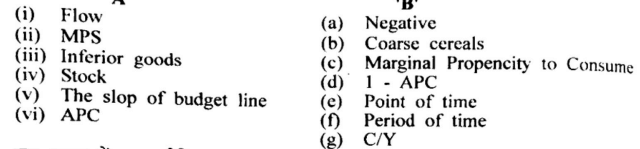
Match the columns:
View Solution
Step 1: Matching the columns.
- (i) Flow corresponds to (f) Period of time, as flow represents a measure over time.
- (ii) MPS corresponds to (g) C/Y, since Marginal Propensity to Save is the complement of the Marginal Propensity to Consume.
- (iii) Inferior goods corresponds to (a) Negative, because inferior goods have a negative income elasticity, meaning their demand decreases as income increases.
- (iv) Stock corresponds to (e) Point of time, because stock refers to a quantity measured at a particular point in time.
- (v) The slope of the budget line corresponds to (d) 1 - APC, as the slope of the budget line is the rate at which the consumer can trade off one good for another, related to consumption.
- (vi) APC corresponds to (c) Marginal Propensity to Consume, as APC is related to total consumption divided by income, representing the proportion of income spent.
Step 2: Conclusion.
Thus, the correct matches are:
(i) - (f), (ii) - (g), (iii) - (a), (iv) - (e), (v) - (d), (vi) - (c). Quick Tip: The slope of the budget line relates to the trade-off between two goods, while the APC is the proportion of income spent on consumption.
Answer in one sentence:
(i) What is errors and omissions?
(ii) Who determine the Minimum Support Price?
(iii) What is inflation?
(iv) Write the name of method of National Income.
(v) What is marginal propensity to consume?
(vi) What is ex ante investment?
View Solution
Step 1: Understanding the questions.
- (i) Errors and omissions refer to mistakes or items that have been left out, often in the context of statistical data or reports.
- (ii) The Minimum Support Price (MSP) is determined by the Government of India, specifically the Ministry of Agriculture and Farmers' Welfare.
- (iii) Inflation is the rate at which the general level of prices for goods and services rises, leading to a decrease in purchasing power.
- (iv) The methods of calculating National Income include the income method, expenditure method, and output method.
- (v) The marginal propensity to consume (MPC) is the proportion of an additional amount of income that is spent on consumption rather than saved.
- (vi) Ex-ante investment refers to the planned or expected investment, as opposed to actual investment which may differ.
Step 2: Conclusion.
These definitions provide a brief overview of each concept in economic terms. Quick Tip: Ex-ante investment is the intended level of investment, while ex-post investment refers to the actual amount invested.
(i) What is ceiling price?
View Solution
Step 1: Understanding ceiling price.
Ceiling price refers to the maximum price set by the government or regulatory authority that sellers can charge for a product or service. It is typically implemented to protect consumers from excessively high prices, especially in essential goods and services.
Step 2: Conclusion.
Thus, the ceiling price is the maximum allowable price for goods or services in a market. Quick Tip: Ceiling prices are commonly imposed in markets like housing or essential goods to prevent price gouging during emergencies.
(ii) What is 'Invisible Hand'?
View Solution
Step 1: Understanding the Invisible Hand.
The term "Invisible Hand" was coined by economist Adam Smith. It refers to the self-regulating nature of a free market economy. In this system, individuals pursuing their own self-interest unintentionally contribute to the overall economic well-being of society through the production of goods and services that others need.
Step 2: Conclusion.
Thus, the "Invisible Hand" concept explains how individual actions in a market economy, driven by self-interest, can lead to positive social outcomes. Quick Tip: The Invisible Hand suggests that economic prosperity is often the result of individuals seeking to maximize their own benefit, inadvertently benefiting society as a whole.
(i) What is the market equilibrium price?
View Solution
Step 1: Understanding market equilibrium.
The market equilibrium price is the price at which the quantity of a good or service demanded by consumers is equal to the quantity supplied by producers. At this price, there is neither a surplus nor a shortage in the market.
Step 2: Conclusion.
Thus, the market equilibrium price is the price at which the forces of supply and demand are in balance. Quick Tip: At equilibrium, the market clears, meaning all goods produced are sold at the equilibrium price.
(ii) What is marginal revenue product of labour?
View Solution
Step 1: Understanding marginal revenue product of labour.
The marginal revenue product (MRP) of labour is the additional revenue generated by employing one more unit of labour. It is calculated as the marginal product of labour (MPL) multiplied by the price of the good produced. The formula is: \[ MRP_L = MPL \times P \]
where \( MPL \) is the additional output produced by an additional worker, and \( P \) is the price of the product.
Step 2: Conclusion.
Thus, the marginal revenue product of labour represents the value of an additional unit of labour in terms of the revenue it generates for the firm. Quick Tip: The MRP of labour is used by firms to determine how many workers to hire, as it helps assess the value of additional labour.
(i) What is consumption goods?
View Solution
Step 1: Understanding consumption goods.
Consumption goods are goods that are used by consumers for their immediate satisfaction or to fulfill their needs. These goods are typically consumed directly and do not contribute to the production of other goods. Examples include food, clothing, and household items.
Step 2: Conclusion.
Thus, consumption goods are products purchased and consumed by individuals to meet their immediate needs. Quick Tip: Consumption goods are goods that do not contribute to the production of other goods but are directly used by consumers.
(ii) What is capital goods?
View Solution
Step 1: Understanding capital goods.
Capital goods are goods that are used in the production of other goods and services. These goods are not consumed directly but are used to manufacture consumption goods or to facilitate production. Examples include machinery, equipment, and buildings used in factories.
Step 2: Conclusion.
Thus, capital goods are essential for the production process and contribute to the creation of other goods and services. Quick Tip: Capital goods are long-term goods used in the production process, unlike consumption goods which are directly consumed.
(i) What is personal income?
View Solution
Step 1: Understanding personal income.
Personal income refers to the total income received by individuals or households in a given period. It includes wages, salaries, investments, and any other income sources before taxes and deductions.
Step 2: Conclusion.
Thus, personal income is the total amount of income available to individuals, including all forms of earnings from various sources. Quick Tip: Personal income is the income received by individuals or households, including wages, salaries, interest, and dividends before any taxes are deducted.
(ii) What is Net National Product?
View Solution
Step 1: Understanding Net National Product (NNP).
Net National Product (NNP) is the total market value of all final goods and services produced by a country's residents in a given period, minus the depreciation of capital goods. It is calculated as: \[ NNP = GNP - Depreciation \]
where GNP is Gross National Product.
Step 2: Conclusion.
Thus, NNP accounts for the depreciation of capital and provides a measure of the actual productive capacity of the economy. Quick Tip: Net National Product (NNP) adjusts the Gross National Product (GNP) by subtracting depreciation to reflect the real productive capacity.
(i) What is SLR?
View Solution
Step 1: Understanding SLR.
SLR stands for Statutory Liquidity Ratio. It is the minimum percentage of a commercial bank's net demand and time liabilities (NDTL) that it must maintain in the form of liquid assets such as cash, gold, or government-approved securities. This ratio is set by the central bank, i.e., the Reserve Bank of India (RBI) in India.
Step 2: Conclusion.
Thus, SLR is a requirement that banks must fulfill to ensure liquidity and control credit expansion. Quick Tip: SLR is used by central banks to control inflation, regulate credit, and ensure the liquidity of commercial banks.
(ii) What is High Powered Money?
View Solution
Step 1: Understanding High Powered Money.
High Powered Money, also known as Base Money or Reserve Money, refers to the total currency in circulation in the economy, including the currency held by the public and the reserves held by commercial banks with the central bank. It is the money that the central bank uses to control money supply in the economy.
Step 2: Conclusion.
Thus, High Powered Money forms the foundation of the monetary base in an economy, which is used by commercial banks to create credit. Quick Tip: High Powered Money plays a vital role in influencing the money supply and credit creation in the economy.
(i) What is consumption function?
View Solution
Step 1: Understanding Consumption Function.
Consumption function refers to the relationship between total consumption and total income. It indicates the amount of consumption that occurs at different levels of income. The consumption function typically has the form: \[ C = C_0 + C_1 Y \]
where \( C \) is total consumption, \( C_0 \) is autonomous consumption (consumption when income is zero), \( C_1 \) is the marginal propensity to consume (MPC), and \( Y \) is total income.
Step 2: Conclusion.
The consumption function is an essential concept in economics that helps understand how consumption behavior changes with income. Quick Tip: The consumption function is fundamental in Keynesian economics and helps in predicting the effect of income changes on consumption.
(ii) Write two components of aggregate demand.
View Solution
Step 1: Understanding Aggregate Demand.
Aggregate demand (AD) is the total quantity of goods and services demanded in the economy at different price levels. It is the sum of consumption expenditure, investment expenditure, government spending, and net exports. Two important components of aggregate demand are:
1. Consumption (C): This is the total expenditure on goods and services by households.
2. Investment (I): This includes expenditure on capital goods by businesses, such as machinery, buildings, and inventories.
Step 2: Conclusion.
Thus, consumption and investment are two key components of aggregate demand. Quick Tip: Aggregate demand plays a crucial role in determining the overall economic activity and price levels in an economy.
(i) Write two reasons of deficient demand?
View Solution
Step 1: Understanding Deficient Demand.
Deficient demand occurs when the demand for goods and services in the economy is less than the supply at the prevailing price level. Two reasons for deficient demand are:
1. Low Income: When the income of individuals in the economy is low, they are unable to afford goods and services, which leads to deficient demand.
2. High Prices: If the price levels are too high, consumers may not be able to purchase enough goods and services, leading to a lack of demand.
Step 2: Conclusion.
Thus, low income and high prices are the key reasons for deficient demand in an economy. Quick Tip: Deficient demand can lead to economic slowdown as it signals underutilization of resources in the economy.
(ii) Write the meaning of excess demand.
View Solution
Step 1: Understanding Excess Demand.
Excess demand occurs when the demand for goods and services in the economy exceeds the supply at the current price level. This often leads to inflationary pressures in the economy.
Step 2: Conclusion.
Excess demand signifies an imbalance where consumers wish to buy more than what is available, which can push prices higher in the economy. Quick Tip: Excess demand can result in inflation as businesses may raise prices to match the high demand.
(i) What is effective demand?
View Solution
Step 1: Understanding Effective Demand.
Effective demand refers to the total demand for goods and services in an economy at a particular price level, which is backed by the actual purchasing power of consumers. It is the demand that is backed by sufficient income or credit to buy goods and services.
Step 2: Conclusion.
Thus, effective demand occurs when consumers have the ability to pay for the goods they demand. Quick Tip: Effective demand is a crucial concept in Keynesian economics, as it determines the level of economic output and employment.
(ii) What is the assumption of ceteris paribus?
View Solution
Step 1: Understanding Ceteris Paribus.
Ceteris paribus is a Latin term meaning "all other things being equal." In economics, it is used to isolate the effect of one variable by assuming that all other factors remain constant. This assumption helps in analyzing the relationship between two variables without interference from other factors.
Step 2: Conclusion.
Thus, the assumption of ceteris paribus simplifies the study of economic models by focusing on one variable at a time. Quick Tip: Ceteris paribus is essential in economic modeling, as it allows for the examination of individual effects without the complexity of multiple influencing factors.
(i) What is the Market Economy?
View Solution
Step 1: Understanding the Market Economy.
A market economy is an economic system where the production and distribution of goods and services are determined by the free market, based on supply and demand. In this system, prices are set by the market, and there is minimal government intervention.
Step 2: Conclusion.
Thus, in a market economy, decisions about investment, production, and distribution are driven by market forces. Quick Tip: In a market economy, businesses and consumers interact freely, and prices fluctuate according to market demand and supply.
(ii) What is positive economics analysis?
View Solution
Step 1: Understanding Positive Economics.
Positive economics refers to the branch of economics that deals with objective analysis and facts. It focuses on describing, explaining, and predicting economic phenomena without making judgments or offering prescriptions. Positive economics seeks to understand what is, rather than what ought to be.
Step 2: Conclusion.
Thus, positive economics is concerned with verifiable data and the cause-and-effect relationships in the economy. Quick Tip: Positive economics focuses on empirical data and objective analysis, as opposed to normative economics, which deals with value judgments and what should be.
(i) What is profit?
View Solution
Step 1: Understanding profit.
Profit is the financial gain obtained when the revenue from goods or services exceeds the expenses or costs incurred in producing them. It is the difference between total revenue and total cost.
Step 2: Conclusion.
Thus, profit is the reward for the risk-taking and entrepreneurial activity involved in producing goods and services. Quick Tip: Profit is essential for business growth and sustainability. It reflects the success of business operations.
(ii) What is average product?
View Solution
Step 1: Understanding average product.
Average product refers to the output produced per unit of input, calculated by dividing total output by the quantity of input used. It is a key concept in production theory and helps in analyzing the efficiency of input usage.
Step 2: Conclusion.
Thus, average product is defined as the total product divided by the number of units of the variable factor. Quick Tip: Average product helps determine the productivity of the input used in production.
(i) Write three relationships between total utility and marginal utility.
View Solution
Step 1: Understanding total and marginal utility.
Total utility is the total satisfaction or benefit received from consuming a certain quantity of goods or services. Marginal utility is the additional satisfaction obtained from consuming one more unit of a good or service.
Step 2: Relationships.
1. Total utility increases as marginal utility is positive.
2. Total utility reaches its maximum when marginal utility becomes zero.
3. Total utility decreases when marginal utility is negative (i.e., when consumption leads to a decrease in satisfaction).
Step 3: Conclusion.
Thus, the relationship between total and marginal utility is crucial in understanding consumer behavior. Quick Tip: As more units of a good are consumed, marginal utility tends to decrease, which is known as the law of diminishing marginal utility.
(ii) Explain briefly the perfectly elastic demand and perfectly inelastic demand.
View Solution
Step 1: Understanding perfectly elastic demand.
Perfectly elastic demand refers to a situation where the quantity demanded of a good or service changes infinitely in response to even the slightest change in price. The demand curve is horizontal, indicating that any increase in price will lead to zero quantity demanded.
Step 2: Understanding perfectly inelastic demand.
Perfectly inelastic demand refers to a situation where the quantity demanded does not change at all regardless of changes in price. The demand curve is vertical, meaning that consumers will buy the same quantity regardless of price changes.
Step 3: Conclusion.
Thus, perfectly elastic demand shows infinite sensitivity to price, while perfectly inelastic demand is completely insensitive to price. Quick Tip: Perfectly elastic demand is rarely observed in the real world, while perfectly inelastic demand may apply to essential goods like life-saving medicines.
Compute the total revenue, marginal revenue and average revenue schedules in the following table. Market price of each unit of the good is Rs. 10.

View Solution
Step 1: Understanding the terms.
- Total Revenue (TR) is the total income from sales, calculated by multiplying the quantity sold by the price per unit.
- Marginal Revenue (MR) is the change in total revenue when an additional unit is sold, i.e., the difference in TR as the quantity increases.
- Average Revenue (AR) is the total revenue divided by the quantity sold, i.e., \( AR = \frac{TR}{Quantity} \).
Step 2: Calculation.
\[ TR = Price per unit \times Quantity Sold \]
\[ MR = \Delta TR / \Delta Quantity Sold \]
\[ AR = \frac{TR}{Quantity Sold} \]
Step 3: Filling the table.
For each quantity, calculate TR, MR, and AR using the formulas above:
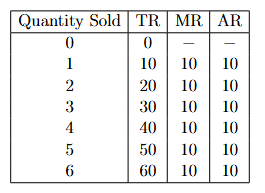
Step 4: Conclusion.
The calculations for TR, MR, and AR for each quantity are completed as shown in the table. Quick Tip: In a perfectly competitive market, the marginal revenue is constant and equal to the price per unit, as shown in this example.
Write three conditions of profit maximisation.
View Solution
Step 1: Condition 1 – Marginal Revenue equals Marginal Cost.
Profit is maximised when the additional revenue from selling one more unit (MR) is equal to the additional cost of producing that unit (MC).
Step 2: Condition 2 – Total Revenue exceeds Total Cost.
Profit is maximised when the total revenue generated from sales is greater than the total cost of production. This ensures positive profit.
Step 3: Condition 3 – Diminishing Returns.
As production continues, the marginal product of inputs begins to decline. Profit maximisation occurs when the firm adjusts its production level to balance costs and revenues effectively. Quick Tip: To maximise profit, a firm must produce at the output level where MR = MC and ensure that total revenue exceeds total costs.
What role of RBI is known as 'lender of last resort'?
View Solution
Step 1: Understanding the role of RBI.
The Reserve Bank of India (RBI) is referred to as the 'lender of last resort' because it provides emergency funding to financial institutions that are facing liquidity crises and are unable to secure funds from other sources. This is a critical function in maintaining the stability of the financial system.
Step 2: Conclusion.
Thus, the RBI's role as the 'lender of last resort' ensures that it can provide financial support to institutions in times of crisis, preventing the collapse of the banking system. Quick Tip: The 'lender of last resort' function of central banks helps maintain confidence in the financial system by ensuring liquidity during emergencies.
Write three policy tools to control money supply.
View Solution
Step 1: Open Market Operations (OMO).
The central bank buys or sells government securities in the open market to regulate the money supply. Buying securities increases the money supply, while selling them reduces it.
Step 2: Cash Reserve Ratio (CRR).
CRR is the percentage of a bank’s total deposits that it must keep as reserves with the central bank. By increasing the CRR, the RBI reduces the amount of money available for lending, thereby reducing the money supply.
Step 3: Repo Rate.
The repo rate is the rate at which commercial banks borrow money from the central bank. By increasing the repo rate, the RBI can reduce the money supply by making borrowing more expensive for banks. Quick Tip: The RBI uses tools like CRR, OMO, and repo rates to control the money supply, aiming to maintain economic stability and control inflation.
Write distinguish between substitutes goods and complementary goods.
View Solution
Step 1: Understanding Substitute Goods.
Substitute goods are those goods that can replace each other in consumption. When the price of one good rises, the demand for its substitute increases. For example, tea and coffee are substitutes; when the price of tea increases, the demand for coffee may rise.
Step 2: Understanding Complementary Goods.
Complementary goods are those goods that are used together. An increase in the price of one good leads to a decrease in the demand for its complement. For example, cars and fuel are complementary goods; if the price of cars rises, the demand for fuel may decrease.
Step 3: Conclusion.
Substitute goods fulfill the same need, whereas complementary goods are used together to satisfy a demand. Quick Tip: Substitute goods satisfy similar needs, while complementary goods are often used together to meet a particular need.
Write any three factors affecting a commodity of demand.
View Solution
Step 1: Price of the Good.
The price of a commodity is one of the major factors affecting its demand. Generally, if the price of a good increases, the demand decreases (law of demand), and if the price decreases, the demand increases.
Step 2: Consumer's Income.
A change in the consumer’s income directly affects the demand for goods. With an increase in income, the demand for normal goods increases, while demand for inferior goods decreases.
Step 3: Consumer Preferences.
Changes in consumer preferences can increase or decrease demand. If consumers prefer a product more, the demand will rise, and if they prefer a substitute or complementary product, the demand for the original product will fall. Quick Tip: Price, income, and preferences are the key determinants of demand for any commodity.
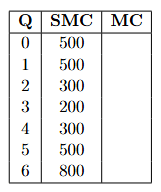
A firm’s SMC schedule is shown in the following table. The total fixed cost of the firm is Rs. 100. Find the TVC, TC and SAC schedules of the firm.
View Solution
Step 1: Understanding the cost schedules.
In this question, we are given the firm's SMC (Short-run Marginal Cost) schedule and asked to compute the TVC (Total Variable Cost), TC (Total Cost), and SAC (Short-run Average Cost) schedules. The firm's total fixed cost (TFC) is given as Rs. 100.
Step 2: Calculate Total Variable Cost (TVC).
We know that: \[ TVC_Q = SMC_Q \times Quantity Sold (Q) \]
For each quantity (Q), calculate TVC by multiplying the SMC with the corresponding Q.
Step 3: Calculate Total Cost (TC).
Total cost (TC) is the sum of total fixed cost (TFC) and total variable cost (TVC). Hence, \[ TC = TFC + TVC \]
Step 4: Calculate Short-run Average Cost (SAC).
SAC is the total cost (TC) divided by the quantity sold (Q). \[ SAC = \frac{TC}{Q} \] Quick Tip: Remember that SAC can help in determining whether a firm is operating efficiently in the short run. A falling SAC indicates increasing efficiency, while a rising SAC indicates the opposite.
Write four distinguish between total variable cost and total fixed cost.
View Solution
Step 1: Understand Total Variable Cost (TVC).
Total Variable Cost (TVC) refers to the cost that changes with the level of output. It increases as production increases and decreases when production decreases. Examples include labor and raw materials.
Step 2: Understand Total Fixed Cost (TFC).
Total Fixed Cost (TFC) is the cost that does not change with the level of output. It remains constant even if production increases or decreases. Examples include rent, salaries of permanent staff, and depreciation of machinery.
Step 3: Comparison.
- TVC varies with the level of output, while TFC remains constant regardless of output.
- TVC includes costs for inputs that are used in the production process, while TFC includes costs that are incurred even when production is zero.
- TVC is associated with variable inputs, while TFC is related to fixed inputs.
- TVC can be reduced by cutting back on production, while TFC cannot be reduced without altering the scale of operations. Quick Tip: In the short run, a firm cannot change its fixed costs, but it can change its variable costs based on output levels.
Distinguish between revenue expenditure and capital expenditure.
View Solution
Step 1: Understand Revenue Expenditure.
Revenue expenditure refers to the costs incurred in the day-to-day operations of the government, which are used up within the year. These do not result in the creation of assets or liabilities. Examples include salaries, subsidies, interest payments, etc.
Step 2: Understand Capital Expenditure.
Capital expenditure refers to spending on the creation of assets or investments. This expenditure results in the acquisition of new physical assets or investments that will provide benefits over the long term. Examples include building infrastructure, buying machinery, etc.
Step 3: Key Differences.
- Revenue expenditure is for the routine functioning of the government, while capital expenditure is for creating new assets or investing in long-term assets.
- Revenue expenditure is short-term, whereas capital expenditure is long-term.
- Revenue expenditure does not add to the assets of the government, while capital expenditure does. Quick Tip: Revenue expenditure is like the cost of running day-to-day operations, while capital expenditure is like investment in future growth and assets.
What is the meaning of deficit budget? Explain its types briefly.
View Solution
Step 1: Understanding Deficit Budget.
A deficit budget occurs when the government’s total expenditures exceed its total revenues in a given period, resulting in a budget deficit. The government borrows funds to cover the gap between its expenditure and revenue.
Step 2: Types of Deficit Budget.
- **Revenue Deficit:** When the government’s revenue expenditure exceeds its revenue receipts, it leads to a revenue deficit.
- **Fiscal Deficit:** This is the excess of total expenditure (both revenue and capital) over total receipts (excluding borrowings) in a given fiscal year. It shows the total borrowing requirements of the government.
- **Primary Deficit:** This is the fiscal deficit excluding the interest payments on previous borrowings. It reflects the government’s borrowing needs, excluding the cost of servicing past debt. Quick Tip: A deficit budget is an indicator of fiscal imbalance, but it can also be used as a tool for stimulating economic growth through increased government spending.
Write 4 distinguish between balance of trade and balance of payment.
View Solution
Step 1: Understand Balance of Trade.
Balance of trade refers to the difference between the value of a country's exports and imports of goods. It is a part of the balance of payments that focuses specifically on the trade of physical goods.
Step 2: Understand Balance of Payment.
Balance of payment is a broader concept that includes not only the balance of trade but also other financial transactions like investments, loans, and transfers. It records all economic transactions between a country and the rest of the world.
Step 3: Key Differences.
- Balance of trade refers only to exports and imports of goods, while balance of payments includes goods, services, and financial transactions.
- Balance of trade affects only the current account, while balance of payments affects both current and capital accounts.
- A positive balance of trade indicates a surplus, while a positive balance of payments may or may not indicate a surplus.
- Balance of trade is more focused on trade in goods, while balance of payments covers all economic transactions. Quick Tip: The balance of payments includes a more comprehensive range of financial and trade transactions, while the balance of trade only considers goods.
Write in brief two merits and two demerits of Fixed Exchange Rate.
View Solution
Step 1: Understand Fixed Exchange Rate.
A fixed exchange rate system is one where the value of a country's currency is pegged to another major currency (like the US Dollar or Euro) or a basket of currencies. The government or central bank intervenes to maintain the fixed rate.
Step 2: Merits of Fixed Exchange Rate.
- **Stability in International Trade:** A fixed exchange rate provides certainty for businesses and traders as they can easily predict the costs of transactions across borders.
- **Prevention of Inflation:** With a fixed exchange rate, the country’s currency is less likely to devalue, which helps in controlling inflation.
Step 3: Demerits of Fixed Exchange Rate.
- **Requires Large Reserves:** A fixed exchange rate requires a country to maintain large foreign exchange reserves to maintain the pegged rate.
- **Limited Flexibility:** A country loses flexibility in adjusting its monetary policy to suit domestic economic conditions since it must maintain the fixed exchange rate. Quick Tip: The fixed exchange rate system provides stability but comes at the cost of flexibility and high reserves.
Consider the demand for a good. At price 5, the demand for the goods is 15 units. Suppose the price of the goods increases to Rs. 7 and as a result, the demand for the goods falls 12 units. Calculate the price elasticity.
View Solution
Step 1: Formula for Price Elasticity of Demand (PED).
The formula for price elasticity of demand is: \[ PED = \frac{% change in quantity demanded}{% change in price} \]
Where: \[ % change in quantity demanded = \frac{Q_2 - Q_1}{Q_1} \times 100, \quad % change in price = \frac{P_2 - P_1}{P_1} \times 100 \]
Step 2: Applying the values from the question.
Given: \( P_1 = 5, \quad P_2 = 7, \quad Q_1 = 15, \quad Q_2 = 12 \)
First, calculate the percentage change in quantity demanded: \[ % change in quantity demanded = \frac{12 - 15}{15} \times 100 = \frac{-3}{15} \times 100 = -20% \]
Next, calculate the percentage change in price: \[ % change in price = \frac{7 - 5}{5} \times 100 = \frac{2}{5} \times 100 = 40% \]
Step 3: Calculating PED.
Now substitute these values into the PED formula: \[ PED = \frac{-20}{40} = -0.5 \]
Step 4: Conclusion.
Since the absolute value of PED is less than 1 (\( |PED| = 0.5 \)), the demand is inelastic. This means that the percentage change in quantity demanded is less than the percentage change in price. Quick Tip: When the price elasticity of demand (PED) is less than 1, demand is inelastic, meaning that consumers are less responsive to price changes.
Explain with diagram of the law of demand, in brief.
View Solution
Step 1: Understanding the Law of Demand.
The law of demand states that, ceteris paribus, as the price of a good or service increases, the quantity demanded decreases, and vice versa. In other words, there is an inverse relationship between price and quantity demanded.
Step 2: Explanation with Diagram.
The law of demand is typically represented by a downward sloping demand curve on a graph where the x-axis represents quantity demanded and the y-axis represents price. As price decreases, the quantity demanded increases, which results in a negative slope for the demand curve.

Step 3: Conclusion.
Thus, the law of demand shows that there is a negative relationship between price and quantity demanded, meaning that demand rises as prices fall, and demand decreases as prices rise. Quick Tip: The demand curve typically slopes downward from left to right, illustrating the inverse relationship between price and quantity demanded.



Comments