




MP Board 12th Chemistry Question Paper 2023 with Answer Key pdf is available for download here. The exam was conducted by Madhya Pradesh Board of Secondary Education, MPBSE on March 18, 2023 in the Morning Session 9 AM to 12 PM. The question paper comprised a total of 19 questions.
MP Board 12th Chemistry Question Paper 2023 with Answer Key
| MP Board 12th Chemistry Question Paper 2023 with Answer Key PDF | Download PDF | Check Solutions |
i. Formula of Osmotic pressure is:
View Solution
Step 1: Formula for osmotic pressure.
Osmotic pressure (\( \pi \)) is the pressure required to stop osmosis. The formula is derived from the ideal gas law and given by: \[ \pi = \frac{nRT}{V} \]
where:
- \( n \) is the number of moles of solute,
- \( R \) is the gas constant,
- \( T \) is the temperature in Kelvin,
- \( V \) is the volume of the solution.
Step 2: Conclusion.
The correct formula for osmotic pressure is \( \pi = \frac{nRT}{V} \), which corresponds to option (1). Quick Tip: The formula for osmotic pressure is derived from the ideal gas law and applies when a solvent passes through a semipermeable membrane due to a concentration gradient.
ii. Order of reaction for rate = \( K[A]^{1/2} [B]^{3/2} \) is:
View Solution
Step 1: Understanding the rate law.
The rate law is given by: \[ Rate = K[A]^{1/2}[B]^{3/2} \]
The order of the reaction is the sum of the exponents of the concentration terms in the rate law. In this case:
- The exponent for \( [A] \) is \( \frac{1}{2} \),
- The exponent for \( [B] \) is \( \frac{3}{2} \).
Step 2: Calculate the total order.
The total order is: \[ Total order = \frac{1}{2} + \frac{3}{2} = \frac{4}{3}. \]
Step 3: Conclusion.
The order of the reaction is \( \frac{4}{3} \), which corresponds to option (2). Quick Tip: The order of a reaction is found by adding the exponents of the concentration terms in the rate law.
iii. Inner transition element is:
View Solution
Step 1: Understanding inner transition elements.
Inner transition elements are the elements that are found in the lanthanide and actinide series. These elements have their f-orbitals being filled.
Step 2: Identifying the element.
Among the given options, Cerium (Ce) is an inner transition element, as it belongs to the lanthanide series.
Step 3: Conclusion.
The correct answer is Ce, which corresponds to option (4). Quick Tip: Inner transition elements are located in the f-block of the periodic table and include the lanthanides and actinides.
iv. The oxidation number of Fe in \( K_2[Fe(CN)_6] \) is:
View Solution
Step 1: Understanding the complex.
In the complex \( K_2[Fe(CN)_6] \), the cyanide ion (CN) has a charge of \( -1 \). Since there are 6 cyanide ions, the total charge contributed by cyanides is \( -6 \).
Step 2: Determine the oxidation state of Fe.
Let the oxidation state of Fe be \( x \). The total charge on the complex is \( 0 \), and the charges from the cyanides and potassium ions are: \[ 2(+1) + x + 6(-1) = 0 \quad \Rightarrow \quad 2 + x - 6 = 0 \quad \Rightarrow \quad x = +4. \]
Step 3: Conclusion.
The oxidation state of Fe is \( +4 \), which corresponds to option (2). Quick Tip: To find the oxidation state of an element in a complex, balance the charges from the ions and the metal.
v. Alkyl iodides are often prepared by the reaction of alkyl chloride/bromides with NaI in dry acetone. This reaction is known as:
View Solution
Step 1: Understanding the Finkelstein reaction.
The Finkelstein reaction is a halogen exchange reaction where alkyl chlorides or bromides react with sodium iodide (NaI) in acetone. In this reaction, the halide ion (Cl\(^{-}\) or Br\(^{-}\)) is replaced by the iodide ion (I\(^{-}\)).
Step 2: Identifying the correct reaction.
This type of reaction is specifically called the Finkelstein reaction.
Step 3: Conclusion.
The correct reaction is the Finkelstein reaction, which corresponds to option (1). Quick Tip: In the Finkelstein reaction, NaI is used to replace halogens like Cl or Br with I, typically in acetone as a solvent.
vi. Alcohols react with sodium to form:
View Solution
Step 1: Reaction of alcohols with sodium.
When alcohols react with sodium, they form alkoxide ions (RONa) and hydrogen gas (H\(_2\)). The general reaction is: \[ 2R-OH + 2Na \rightarrow 2RONa + H_2. \]
Step 2: Conclusion.
The product of the reaction is \( RONa \), which corresponds to option (2). Quick Tip: Alcohols react with sodium to form alkoxides (RONa) and hydrogen gas.
vii. Which of the following is most acidic?
View Solution
Step 1: Understanding the effect of substituents.
The acidity of carboxylic acids increases with the electronegativity of the substituent attached to the aromatic ring or the alpha-carbon. The electron-withdrawing effect of fluorine (in CF\(_3\)) is stronger than that of chlorine (in CCl\(_3\) or CHCl\(_2\)) or hydrogen (in CH\(_3\)).
Step 2: Identifying the most acidic compound.
Among the given acids, CF\(_3\)COOH has the strongest electron-withdrawing group (CF\(_3\)), which increases its acidity.
Step 3: Conclusion.
The most acidic compound is CF\(_3\)COOH, which corresponds to option (1). Quick Tip: Electronegative substituents, like CF\(_3\), increase the acidity of carboxylic acids by stabilizing the negative charge on the conjugate base.
(i) Molarity of water is _______
View Solution
Step 1: Molarity of water.
Molarity is the number of moles of solute per liter of solution. The molarity of pure water is calculated as follows:
- Molarity = \( \frac{Density of water}{Molar mass of water} \).
- Given that water's molar mass is \( 18 \, g/mol \) and its density is approximately \( 1 \, g/cm^3 \), we calculate the molarity as: \[ \frac{1000 \, g/L}{18 \, g/mol} = 55.56 \, mol/L. \]
Step 2: Conclusion.
Thus, the molarity of water is 55.56 mol/litre. Quick Tip: The molarity of pure water is derived using its density and molar mass.
(ii) The value of potential of standard hydrogen electrode is _______
View Solution
Step 1: Standard hydrogen electrode potential.
The standard hydrogen electrode (SHE) is defined as the electrode with a potential of zero volts. It is used as a reference electrode for measuring other electrode potentials.
Step 2: Conclusion.
The potential of the standard hydrogen electrode is 0 volts. Quick Tip: The standard hydrogen electrode is the reference for all electrode potentials and is assigned a potential of zero.
(iii) The colour of Ni\(^{2+}\) is _______
View Solution
Step 1: Colour of Ni\(^{2+}\).
The color of Ni\(^{2+}\) ions in aqueous solution is green. This is due to the electronic transitions in the \( d \)-orbitals of the Ni\(^{2+}\) ion.
Step 2: Conclusion.
The color of Ni\(^{2+}\) is green. Quick Tip: Transition metal ions often show color due to electronic transitions in their d-orbitals.
(iv) The chemical name of EDTA is _______
View Solution
Step 1: Understanding EDTA.
EDTA stands for ethylenediaminetetraacetic acid, a chelating agent that binds metal ions. Its chemical formula is \( C_{10}H_{16}N_2O_8 \).
Step 2: Conclusion.
The chemical name of EDTA is Ethylenediaminetetraacetic acid. Quick Tip: EDTA is widely used in chemistry for sequestering metal ions due to its ability to form stable complexes with metal ions.
(v) Anisole reacts with concentrated H\(_2\)SO\(_4\) and HNO\(_3\) to yield a mixture of _______
View Solution
Step 1: Understanding the reaction.
Anisole (methoxybenzene) reacts with concentrated H\(_2\)SO\(_4\) and HNO\(_3\) to undergo nitration, which substitutes a nitro group (-NO\(_2\)) on the aromatic ring. The reaction typically gives a mixture of ortho and para products due to the electron-donating effect of the methoxy group.
Step 2: Conclusion.
The reaction yields a mixture of ortho and para products. Quick Tip: Methoxy groups (like in anisole) are activating groups that direct electrophilic substitution to the ortho and para positions on the benzene ring.
(vi) Methyl amine is _______ and _______ basic than ammonia.
View Solution
Step 1: Basicity of amines.
Methyl amine (CH\(_3\)NH\(_2\)) is more basic than ammonia (NH\(_3\)) because the methyl group is an electron-donating group. This increases the electron density on the nitrogen atom, making it more available to accept protons.
Step 2: Conclusion.
Methyl amine is more basic than ammonia. Quick Tip: Electron-donating groups like methyl increase the basicity of amines by increasing the electron density on the nitrogen atom.
(vii) Chemical name of vitamin B\(_2\) is _______
View Solution
Step 1: Understanding Vitamin B\(_2\).
Vitamin B\(_2\) is also known as riboflavin. It is an essential nutrient that helps in the metabolism of carbohydrates, fats, and proteins. It is involved in energy production.
Step 2: Conclusion.
The chemical name of vitamin B\(_2\) is Riboflavin. Quick Tip: Riboflavin (vitamin B\(_2\)) is vital for cell function and energy production.
Match the pairs correctly:
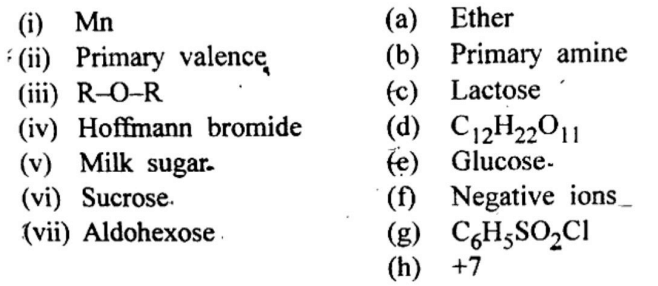
View Solution
Step 1: Understand the pairs.
The matching of pairs is based on chemical and common names of compounds, ions, and structures.
Step 2: Match the pairs.
- (i) Sucrose is a disaccharide and its chemical formula is \( C_{12}H_{22}O_{11} \).
- (ii) Aldohexose refers to glucose, a six-carbon sugar with an aldehyde group.
- (iii) Mn in the +7 oxidation state is typically seen in permanganates.
- (iv) Primary valence refers to the charge associated with an ion, and for many metals, it relates to the negative ions they can form.
- (v) R-O-R is the general structure for ethers, where R represents an alkyl group.
- (vi) Hoffmann bromide is used in the Hofmann degradation reaction, which produces a primary amine.
- (vii) Milk sugar is lactose, a disaccharide composed of glucose and galactose.
Step 3: Conclusion.
The pairs are correctly matched as follows: \[ (i) - C_{12}H_{22}O_{11}, \quad (ii) - Glucose, \quad (iii) - +7, \quad (iv) - Negative ions, \quad (v) - Ether, \] \[(vi) - Primary amine, \quad (vii) - Lactose.\] Quick Tip: Matching terms in chemistry often involves recognizing functional groups, molecular formulas, and oxidation states.
(i) Write the formula of molar conductivity _______
View Solution
Step 1: Molar conductivity formula.
Molar conductivity is the conductivity of a solution per mole of solute. The formula for molar conductivity is: \[ \Lambda_m = \kappa \times V \]
where \( \kappa \) is the conductivity and \( V \) is the volume of the solution.
Step 2: Conclusion.
Thus, the formula for molar conductivity is \( \Lambda_m = \kappa \times V \). Quick Tip: The molar conductivity formula is derived from conductivity and volume.
(ii) Write the unit of rate constant for zero order reaction _______
View Solution
Step 1: Rate constant units.
For a zero-order reaction, the rate law is \( Rate = k[A]^0 \), where the rate constant \( k \) has the unit of \( mol L^{-1} s^{-1} \).
Step 2: Conclusion.
Thus, the unit of the rate constant for a zero-order reaction is \( mol L^{-1} s^{-1} \). Quick Tip: For zero-order reactions, the unit of rate constant is derived from the rate law.
(iii) Write the electronic configuration of Scandium _______
View Solution
Step 1: Electronic configuration of Scandium.
Scandium (atomic number 21) has the following electronic configuration: \[ 1s^2 2s^2 2p^6 3s^2 3p^6 4s^2 3d^1 \]
Step 2: Conclusion.
The electronic configuration of Scandium is \( 1s^2 2s^2 2p^6 3s^2 3p^6 4s^2 3d^1 \). Quick Tip: The electronic configuration can be found by filling the orbitals according to the Aufbau principle.
(iv) Write the chemical name of DDT _______
View Solution
Step 1: Chemical name of DDT.
DDT stands for Dichlorodiphenyltrichloroethane, a well-known insecticide.
Step 2: Conclusion.
The chemical name of DDT is Dichlorodiphenyltrichloroethane. Quick Tip: DDT is widely used as an insecticide but is now banned in many countries due to its environmental impact.
(v) Write the chemical reaction of coupling reaction _______
View Solution
Step 1: Coupling reaction.
Coupling reactions involve the reaction of two aromatic compounds, often involving a diazonium ion as an intermediate. An example is the formation of \( p \)-hydroxy azobenzene from an aromatic amine and a diazonium salt.
Step 2: Conclusion.
An example of a coupling reaction produces \( p \)-hydroxy azobenzene. Quick Tip: Coupling reactions are commonly used in azo dye synthesis.
(vi) Write the formula of Hinsberg's reagent _______
View Solution
Step 1: Formula of Hinsberg's reagent.
Hinsberg's reagent is \( C_6H_5SO_2Cl \), a sulfonyl chloride used to identify primary and secondary amines.
Step 2: Conclusion.
The formula of Hinsberg's reagent is \( C_6H_5SO_2Cl \). Quick Tip: Hinsberg's reagent is used in the Hinsberg test to differentiate between primary, secondary, and tertiary amines.
(vii) Write the name of monomer of proteins _______
View Solution
Step 1: Monomer of proteins.
The monomer of proteins is an amino acid. Amino acids are the building blocks of proteins, linked by peptide bonds.
Step 2: Conclusion.
The name of the monomer of proteins is Amino Acids. Quick Tip: Proteins are formed by the polymerization of amino acids through peptide bonds.
Write the definition of mole fraction.
View Solution
Step 1: Definition of Mole Fraction.
Mole fraction is the ratio of the number of moles of a component to the total number of moles of all components in the mixture. It is represented as: \[ x_i = \frac{n_i}{n_{total}} \]
where \( x_i \) is the mole fraction of component \( i \), \( n_i \) is the number of moles of component \( i \), and \( n_{total} \) is the total number of moles of all components in the mixture.
Step 2: Conclusion.
Mole fraction is a unitless quantity and is often used in the calculation of colligative properties. Quick Tip: Mole fraction is particularly useful for calculating the vapor pressure and boiling point elevation in solutions.
Write the definition of solution.
View Solution
Step 1: Definition of Solution.
A solution is a homogeneous mixture of two or more substances. In a solution, one substance is dissolved in another, with the substance present in the greater amount being the solvent, and the substance present in the lesser amount being the solute.
Step 2: Conclusion.
Solutions can be in any phase: solid, liquid, or gas. Common examples include salt dissolved in water (aqueous solution) or air (gas solution). Quick Tip: Solutions are homogeneous mixtures, meaning their composition is uniform throughout.
Write the functions of salt bridge.
View Solution
Step 1: Functions of salt bridge.
The salt bridge is an essential component in electrochemical cells. It serves the following functions:
- It completes the electrical circuit by allowing the flow of ions between the two half-cells.
- It maintains electrical neutrality in the two half-cells by preventing the buildup of charge that would otherwise stop the flow of electrons.
- It ensures that the cell reaction proceeds by enabling the movement of counter-ions to balance the flow of electrons.
Step 2: Conclusion.
Thus, the salt bridge helps maintain the continuity of the reaction in the electrochemical cell. Quick Tip: Salt bridges are typically filled with a gel containing an inert electrolyte such as KCl or NaCl to prevent mixing of solutions.
Write the first law of Faraday of electrolysis.
View Solution
Step 1: First law of Faraday.
The first law of Faraday of electrolysis states that:
"The amount of substance liberated at an electrode during electrolysis is directly proportional to the quantity of charge passed through the electrolyte."
Mathematically, it is expressed as: \[ m = \frac{Q \cdot M}{F \cdot z} \]
where:
- \( m \) is the mass of the substance liberated at the electrode,
- \( Q \) is the total charge passed (in coulombs),
- \( M \) is the molar mass of the substance,
- \( F \) is Faraday’s constant (approximately 96500 C/mol),
- \( z \) is the valency of the ion.
Step 2: Conclusion.
This law relates the amount of substance deposited during electrolysis to the charge passed, which is fundamental to understanding electroplating and other electrochemical processes. Quick Tip: Faraday's laws are used in the calculation of the amount of substance deposited during electrolysis.
Write any two differences between Molecularity of reaction and Order of reaction.
View Solution
Step 1: Difference between Molecularity and Order of Reaction.
1. **Molecularity of reaction** refers to the number of reacting species (atoms, molecules, or ions) involved in a single step of a reaction. It is always a whole number and can only be determined from the reaction mechanism.
**Order of reaction**, on the other hand, refers to the power to which the concentration of a reactant is raised in the rate law equation. It is an empirical value that may not necessarily be a whole number.
2. **Molecularity** is defined for elementary reactions, i.e., a single-step reaction, while **Order of reaction** is determined experimentally and can apply to both elementary and complex reactions.
Step 2: Conclusion.
Thus, molecularity is associated with the reaction mechanism, and order is determined from experimental data. Quick Tip: Molecularity applies only to elementary reactions, while the order of reaction can be determined for both elementary and complex reactions.
Write any two differences between Rate of reaction and Rate constant.
View Solution
Step 1: Difference between Rate of Reaction and Rate Constant.
1. **Rate of reaction** is the change in concentration of a reactant or product per unit time during a chemical reaction. It is expressed in terms of concentration/time (e.g., mol/L·s).
**Rate constant (k)** is a proportionality constant in the rate law equation that relates the rate of reaction to the concentration of reactants. It depends on temperature and the nature of the reaction but is independent of concentration.
2. **Rate of reaction** varies with the concentration of the reactants and temperature, while **Rate constant** is constant at a given temperature for a specific reaction and does not change with the concentration of reactants.
Step 2: Conclusion.
The rate of reaction is variable and depends on conditions, while the rate constant is a fixed value at a given temperature for a specific reaction. Quick Tip: The rate constant is specific to the reaction and temperature, while the rate of reaction is influenced by factors like concentration and temperature.
Write the IUPAC names of the following coordination compound: (i) \([Co(NH_3)_6]Cl_3\)
View Solution
Step 1: Identify the ligands.
The ligand in this compound is ammonia \((NH_3)\), which is a neutral ligand.
Step 2: Identify the oxidation state of the metal.
Cobalt (Co) in this compound is in the +3 oxidation state, because the three chloride ions \((Cl^-)\) each carry a -1 charge, and the six ammonia molecules are neutral. Thus, the total charge on the complex is +3.
Step 3: Write the IUPAC name.
The IUPAC name is: **Hexaamminecobalt(III) chloride**. Quick Tip: When naming coordination compounds, always use the prefix to describe the number of identical ligands and the oxidation state of the metal.
(ii) \(K_2[Ni(CN)_4]\)
View Solution
Step 1: Identify the ligands.
The ligand in this compound is cyanide \((CN^-)\), which is a monodentate ligand.
Step 2: Identify the oxidation state of the metal.
Nickel (Ni) in this compound is in the +2 oxidation state, because the four cyanide ions \((CN^-)\) each carry a -1 charge, and the overall charge of the complex is 0. Thus, the charge on Ni must be +2.
Step 3: Write the IUPAC name.
The IUPAC name is: **Tetrachloronickel(II)**. Quick Tip: When naming coordination complexes, remember to include the oxidation state of the central metal and the number of ligands.
Define oxidation number of central metal atom with example.
View Solution
Step 1: Define oxidation number.
The oxidation number (or oxidation state) of an atom in a molecule or ion represents the number of electrons that the atom can donate or accept when forming a bond. In coordination compounds, the oxidation number of the central metal atom is determined by considering the charges of the ligands and the overall charge of the complex.
Step 2: Example.
In the complex \( [Fe(CN)_6]^{4-} \), the cyanide \(CN^-\) ligand has a charge of -1. Since there are six cyanide ions, the total charge contributed by the ligands is -6. For the overall complex to have a charge of -4, the oxidation state of iron (Fe) must be +2. Thus, the oxidation number of the central metal atom (Fe) is +2.
Step 3: Conclusion.
The oxidation number of the central metal atom is the charge it has in a given complex. Quick Tip: The oxidation number is determined by the charges on the ligands and the overall charge of the coordination complex.
Define coordination number with example.
View Solution
Step 1: Coordination Number Definition.
The coordination number of a metal atom or ion in a coordination compound is the number of ligands directly bonded to it. It indicates the number of coordination bonds formed between the metal ion and the surrounding ligands.
Step 2: Example.
In the complex \( [Co(NH_3)_6]^{3+} \), the coordination number of the central metal ion \( Co^{3+} \) is 6 because it is surrounded by six ammonia molecules \((NH_3)\), which are the ligands.
Step 3: Conclusion.
Thus, the coordination number is an important feature in coordination compounds and is determined by the number of ligands attached to the central metal atom. Quick Tip: Coordination number helps to determine the geometry and stability of a coordination complex.
Write the definition of hydrate isomerism with example.
View Solution
Step 1: Hydrate Isomerism Definition.
Hydrate isomerism occurs when two or more isomers exist for a coordination compound due to the different ways in which water molecules can be incorporated into the complex. Hydrate isomers differ by the number of water molecules directly bonded to the metal ion versus those that are present in the crystal lattice.
Step 2: Example.
An example is the complex \( [CoCl_2(H_2O)_4] \) and \( [Co(H_2O)_6]Cl_2 \). In the first complex, four water molecules are directly coordinated to the cobalt ion, while in the second, six water molecules are coordinated, and two chloride ions are in the crystal lattice.
Step 3: Conclusion.
Hydrate isomerism is a type of isomerism where water molecules are arranged differently within the complex, resulting in different compounds with distinct properties. Quick Tip: Hydrate isomerism can be observed when different numbers of water molecules are coordinated to the metal center or present in the lattice.
Write the Etard reaction with chemical equation.
View Solution
Step 1: Etard Reaction.
The Etard reaction is a chemical reaction in which an aromatic aldehyde (usually toluene) reacts with chromium (VI) chloride (\(CrO_2Cl_2\)) to form an aromatic aldehyde. The reaction is used to introduce an aldehyde group into the aromatic ring.
The reaction is: \[ Toluene + CrO_2Cl_2 \xrightarrow{HCl} Benzaldehyde + CrCl_3 \]
Step 2: Conclusion.
The Etard reaction is important in organic synthesis for the oxidation of methyl groups to form aldehydes. Quick Tip: The Etard reaction is typically used to convert methyl groups into aldehyde groups on aromatic rings.
Write two uses of Carboxylic Acid.
View Solution
Step 1: Uses of Carboxylic Acids.
1. **In the preparation of soaps:** Carboxylic acids, such as fatty acids (e.g., stearic acid), are used in the production of soaps through saponification, where they react with alkalis to form salts.
2. **As preservatives:** Carboxylic acids like acetic acid are used as preservatives in food (e.g., vinegar) to prevent the growth of bacteria and mold.
Step 2: Conclusion.
Carboxylic acids are widely used in industries, especially in the production of soaps and as food preservatives. Quick Tip: Carboxylic acids are versatile in chemical reactions, especially in making esters, soaps, and as pH regulators.
Write only chemical equation for following conversion: \[ CH_3-CH_2-Cl \rightarrow CH_3-CH_2-NH_2 \]
View Solution
Step 1: Chemical equation.
The conversion involves the nucleophilic substitution of the chloride ion (\(Cl^-\)) by an amine group (\(NH_2\)) to form an amine. The reaction is as follows: \[ CH_3-CH_2-Cl + NH_3 \rightarrow CH_3-CH_2-NH_2 + HCl \]
Step 2: Conclusion.
This is a nucleophilic substitution reaction where ethyl chloride reacts with ammonia to form ethylamine and hydrochloric acid. Quick Tip: Nucleophilic substitution reactions are common in organic chemistry where a nucleophile (like \(NH_3\)) replaces a leaving group (like \(Cl^-\)).
Write the reason, Ethylamine is more basic than Ammonia.
View Solution
Step 1: Basicity of Ethylamine and Ammonia.
Ethylamine (\(C_2H_5NH_2\)) is more basic than ammonia (\(NH_3\)) because the ethyl group (\(C_2H_5\)) is an electron-donating group. It pushes electron density towards the nitrogen atom, making it more nucleophilic and able to donate a lone pair of electrons more readily than ammonia.
Step 2: Conclusion.
Thus, ethylamine is more basic than ammonia due to the electron-donating effect of the ethyl group. Quick Tip: Electron-donating groups (like alkyl groups) increase the basicity of amines by increasing the electron density on the nitrogen atom.
Write any two differences between Fibrous Protein and Globular Protein.
View Solution
Step 1: Difference between Fibrous and Globular Proteins.
1. **Fibrous Proteins** are elongated, insoluble in water, and have a structural role in cells. Examples include collagen and keratin.
**Globular Proteins**, on the other hand, are spherical, soluble in water, and have functional roles such as enzymes and antibodies. Examples include hemoglobin and enzymes.
2. **Fibrous Proteins** have repetitive sequences of amino acids and provide structural strength, while **Globular Proteins** have complex, irregular sequences that are involved in catalytic and transport functions.
Step 2: Conclusion.
Fibrous proteins serve a structural role, while globular proteins have a more dynamic role in cellular functions. Quick Tip: Fibrous proteins are typically structural, while globular proteins are functional and involved in metabolic processes.
Write any two differences between DNA and RNA.
View Solution
Step 1: Difference between DNA and RNA.
1. **DNA (Deoxyribonucleic Acid)** is a double-stranded molecule that carries genetic information, while **RNA (Ribonucleic Acid)** is single-stranded and plays a role in protein synthesis.
2. **DNA** contains the sugar deoxyribose, while **RNA** contains the sugar ribose. The difference in the sugar molecule contributes to the structural differences between the two.
Step 2: Conclusion.
DNA stores genetic information, while RNA helps in the translation of genetic information into proteins. Quick Tip: DNA and RNA differ in their structure, function, and the type of sugar they contain, which are crucial for their roles in the cell.
The vapour pressure of pure benzene at a certain temperature is 0.850 bar and 0.5 gm of a non-volatile non-electrolyte solid weighing is added to 39.0 gm of benzene (Molar mass 78 g mol\(^{-1}\)) then the vapour pressure of the solution is 0.845 bar. What is the molar mass of the solid substance?
View Solution
Step 1: Use Raoult's Law.
Raoult's law states that the reduction in vapour pressure is proportional to the mole fraction of the solute in the solution: \[ \Delta P = P_0 - P = P_0 \times X_{solute} \]
where:
- \( P_0 \) is the vapour pressure of pure benzene (0.850 bar),
- \( P \) is the vapour pressure of the solution (0.845 bar),
- \( X_{solute} \) is the mole fraction of the solute.
Step 2: Calculate the mole fraction of the solute.
The decrease in vapour pressure is: \[ \Delta P = 0.850 - 0.845 = 0.005 \, bar \]
From Raoult's law: \[ X_{solute} = \frac{\Delta P}{P_0} = \frac{0.005}{0.850} = 0.00588 \]
Step 3: Calculate the moles of benzene.
The number of moles of benzene is: \[ n_{benzene} = \frac{39.0}{78} = 0.5 \, mol \]
Step 4: Calculate the moles of solute.
The mole fraction \( X_{solute} \) is also equal to: \[ X_{solute} = \frac{n_{solute}}{n_{solute} + n_{benzene}} \]
Substitute the values: \[ 0.00588 = \frac{n_{solute}}{n_{solute} + 0.5} \]
Solving for \( n_{solute} \): \[ n_{solute} = \frac{0.00588 \times 0.5}{1 - 0.00588} = 0.00296 \, mol \]
Step 5: Calculate the molar mass of the solute.
The molar mass of the solute is: \[ M_{solute} = \frac{mass of solute}{n_{solute}} = \frac{0.5}{0.00296} = 169.9 \, g/mol \]
Step 6: Conclusion.
Thus, the molar mass of the solid substance is approximately 169.9 g/mol. Quick Tip: Raoult's law is useful for calculating the molar mass of a non-volatile solute by observing the change in vapour pressure of a solution.
18 gm glucose \(C_6H_{12}O_6\) is dissolved in 1 kg of water in a saucepan. At what temperature will water boil at 1.013 bar? Kb for water is 0.52 K kg mol\(^{-1}\).
View Solution
Step 1: Use the formula for boiling point elevation.
The boiling point elevation is given by: \[ \Delta T_b = K_b \times m \]
where:
- \( \Delta T_b \) is the change in boiling point,
- \( K_b \) is the ebullioscopic constant for water (0.52 K kg mol\(^{-1}\)),
- \( m \) is the molality of the solution.
Step 2: Calculate the molality.
Molality \( m \) is given by: \[ m = \frac{moles of solute}{mass of solvent in kg} \]
The moles of glucose is: \[ n_{glucose} = \frac{18}{180} = 0.1 \, mol \]
Since the mass of water is 1 kg, the molality is: \[ m = \frac{0.1}{1} = 0.1 \, mol/kg \]
Step 3: Calculate the change in boiling point.
\[ \Delta T_b = 0.52 \times 0.1 = 0.052 \, K \]
Step 4: Calculate the boiling point.
The boiling point of water is 100°C at 1 atm. The boiling point at 1.013 bar is: \[ T_b = 100 + \Delta T_b = 100 + 0.052 = 100.052°C \]
Step 5: Conclusion.
Thus, the boiling point of the solution at 1.013 bar is 100.052°C. Quick Tip: Boiling point elevation depends on the molality of the solution and the ebullioscopic constant.
Write the unit of rate constant for first order of reaction and second order of reaction.
View Solution
Step 1: Unit of rate constant for first order reaction.
For a first order reaction, the rate law is: \[ Rate = k[A] \]
where \( k \) is the rate constant and \( [A] \) is the concentration of the reactant. The unit of rate is mol/L·s, and the unit of concentration is mol/L. Thus, the unit of \( k \) for a first-order reaction is: \[ Unit of k = \frac{mol}{L \cdot s} \times \frac{L}{mol} = \frac{1}{s} \]
Step 2: Unit of rate constant for second order reaction.
For a second order reaction, the rate law is: \[ Rate = k[A]^2 \]
where \( k \) is the rate constant and \( [A] \) is the concentration of the reactant. The unit of rate is mol/L·s, and the unit of concentration is mol/L. Thus, the unit of \( k \) for a second-order reaction is: \[ Unit of k = \frac{mol}{L \cdot s} \times \frac{1}{\left(\frac{mol}{L}\right)^2} = \frac{1}{mol \cdot L \cdot s} \]
Step 3: Conclusion.
Thus, the unit of rate constant for a first-order reaction is \( \frac{1}{s} \), and for a second-order reaction, it is \( \frac{1}{mol \cdot L \cdot s} \). Quick Tip: The unit of rate constant depends on the order of the reaction, with higher order reactions having more complex units.
Write the following with definition:
View Solution
Step 1: Rate Determining Step.
The rate determining step (RDS) is the slowest step in a reaction mechanism. It controls the overall rate of the reaction because the other steps occur much faster and do not limit the overall reaction rate.
Step 2: Order of Reaction.
The order of reaction refers to the power to which the concentration of a reactant is raised in the rate law. It is determined experimentally and may not necessarily be a whole number. The order of reaction gives us information about the relationship between the concentration of reactants and the rate of the reaction.
Step 3: Conclusion.
Thus, the rate determining step is the slowest step in a reaction, while the order of reaction describes the dependence of the rate on the concentration of reactants. Quick Tip: The rate determining step is crucial for understanding the overall rate of a reaction, and the order helps to predict how concentration changes will affect the rate.
Write any three differences between d-block and f-block elements.
View Solution
Step 1: Difference between d-block and f-block elements.
1. **d-block elements** are also known as transition elements, and they are found in groups 3 to 12 of the periodic table. **f-block elements** are the lanthanides and actinides, and they are placed in the two rows below the main body of the periodic table.
2. **d-block elements** have incomplete d-orbitals in their valence shell, while **f-block elements** have incomplete f-orbitals.
3. **d-block elements** generally exhibit multiple oxidation states, whereas **f-block elements** mostly show a fixed oxidation state, either +3 or +2 in the case of lanthanides.
Step 2: Conclusion.
Thus, the d-block and f-block elements differ in their position, electron configuration, and oxidation states. Quick Tip: The key difference between the d-block and f-block elements lies in the type of orbitals that are being filled (d-orbitals vs. f-orbitals).
Write any three differences between Lanthanoid and Actinoid.
View Solution
Step 1: Difference between Lanthanoid and Actinoid.
1. **Lanthanoids** are the 15 elements with atomic numbers 57 to 71, from Lanthanum (La) to Lutetium (Lu), and are also known as the rare earth elements. **Actinoids**, on the other hand, are the 15 elements with atomic numbers 89 to 103, from Actinium (Ac) to Lawrencium (Lr).
2. **Lanthanoids** are less radioactive compared to **Actinoids**, and many of the actinoids are highly radioactive, with elements like Uranium and Thorium being used as nuclear fuel.
3. **Lanthanoids** generally exhibit a +3 oxidation state, while **Actinoids** can exhibit a wider range of oxidation states, including +3, +4, and even +5.
Step 2: Conclusion.
The lanthanoids and actinoids differ in their atomic number range, radioactivity, and oxidation states. Quick Tip: Lanthanoids are known for their applications in optics and magnets, while actinoids are critical in nuclear energy and weapons.
Write only chemical equation for the following reactions:
View Solution
(i) Alkyl halide reacts with sodium alkoxide.
The reaction between an alkyl halide (e.g., ethyl chloride) and sodium alkoxide (e.g., sodium ethoxide) results in the formation of an ether (e.g., ethyl ether) and the release of sodium chloride. The chemical equation is: \[ R-Cl + R'-O^- \rightarrow R-O-R' + Cl^- \]
(ii) Phenol heated with Zn (zinc) powder.
When phenol is heated with zinc powder, it undergoes reduction to form benzene. The chemical equation is: \[ C_6H_5OH + Zn \xrightarrow{heat} C_6H_6 + ZnO \]
(iii) Ethyl alcohol is treated with H\(_2\)SO\(_4\) at 413 K.
When ethyl alcohol is treated with concentrated sulfuric acid at 413 K, it undergoes dehydration to form ethene. The chemical equation is: \[ C_2H_5OH \xrightarrow{H_2SO_4, 413 \, K} C_2H_4 + H_2O \] Quick Tip: In organic chemistry, reactions involving alcohols, alkyl halides, and phenols often result in the formation of ethers, alkenes, and aromatic compounds through nucleophilic substitution and elimination reactions.
Write the structure of following compound:
(i) 4-chloro 2, 3 dimethyl pentan 1-ol.
(ii) 2-ethoxy propane.
(iii) 2, 6 dimethyl phenol.
View Solution
(i) 4-chloro 2, 3 dimethyl pentan 1-ol.
The structure of 4-chloro 2, 3 dimethyl pentan 1-ol is: \[ CH_3CH_2C(Cl)CH(CH_3)CH_2OH \]
where the chloro group is on the fourth carbon, and two methyl groups are on the second and third carbon atoms.
(ii) 2-ethoxy propane.
The structure of 2-ethoxy propane is: \[ CH_3CH_2OCH_2CH_3 \]
where the ethoxy group (\(CH_3CH_2O-\)) is attached to the second carbon of propane.
(iii) 2, 6 dimethyl phenol.
The structure of 2, 6 dimethyl phenol is: \[ C_6H_3(CH_3)_2OH \]
where two methyl groups are attached to the second and sixth positions on the phenol ring. Quick Tip: When drawing organic structures, remember the positioning of substituents on the carbon chain or aromatic ring, which defines the compound’s identity.
Write the mechanism of SN1 and SN2 reactions.
View Solution
Step 1: SN1 Mechanism.
The SN1 (Substitution Nucleophilic Unimolecular) reaction involves two main steps:
1. **Formation of carbocation:** The leaving group (e.g., halide ion) departs from the carbon atom, forming a positively charged carbocation.
2. **Nucleophilic attack:** A nucleophile (e.g., water or alcohol) attacks the carbocation, leading to the substitution product.
The rate-determining step is the formation of the carbocation, which is why SN1 reactions are typically favored in polar protic solvents.
\[ R-Cl \xrightarrow{polar solvent} R^+ + Cl^- \quad and then \quad R^+ + Nu^- \rightarrow R-Nu \]
Step 2: SN2 Mechanism.
The SN2 (Substitution Nucleophilic Bimolecular) reaction occurs in a single step. The nucleophile directly attacks the electrophilic carbon while the leaving group departs simultaneously. This leads to the inversion of configuration at the carbon center.
The rate-determining step involves both the nucleophile and the leaving group, so the rate of the reaction is affected by the concentration of both reactants.
\[ R-Cl + Nu^- \rightarrow R-Nu + Cl^- \]
Step 3: Conclusion.
SN1 involves a two-step mechanism with a carbocation intermediate, whereas SN2 occurs in one step with a simultaneous bond formation and breaking. Quick Tip: The key difference between SN1 and SN2 reactions lies in the mechanism: SN1 forms a carbocation intermediate, while SN2 occurs in a single, concerted step.
Write the following reactions with chemical equation:
View Solution
(i) Sandmeyer's Reaction.
Sandmeyer's reaction is used to replace a diazonium group (\(ArN_2^+\)) with a halogen (Cl or Br) using copper(I) chloride or copper(I) bromide. The chemical equation for Sandmeyer's reaction is: \[ ArN_2^+ + CuCl \rightarrow ArCl + Cu_2Cl_2 \]
(ii) Fittig Reaction.
The Fittig reaction is a coupling reaction where an aryl halide reacts with an alkyl halide in the presence of sodium metal to form a biaryl. The chemical equation for the Fittig reaction is: \[ C_6H_5Cl + C_6H_5CH_3 \xrightarrow{Na} C_6H_5-C_6H_4-CH_3 \] Quick Tip: In Sandmeyer's reaction, the diazonium ion is replaced by a halide ion, while the Fittig reaction involves the formation of biaryl compounds using sodium metal.
Draw the labelled diagram of Electro-chemical cell and write its structure and chemical reaction.
View Solution
Step 1: Electrochemical Cell Diagram.
An electrochemical cell consists of two half-cells connected by a salt bridge or a porous barrier. Each half-cell consists of a metal electrode immersed in a solution of its ions. A typical diagram for a Daniell cell is shown below: \[ Zn (solid) \vert Zn^{2+} \, \vert \vert Cu^{2+} \vert Cu (solid) \]
The salt bridge (represented by \(\vert \vert\)) connects the two half-cells, allowing ions to flow and maintain electrical neutrality.
Step 2: Chemical Reaction in the Electrochemical Cell.
The overall chemical reaction in a Daniell cell is: \[ Zn (solid) + Cu^{2+} \rightarrow Zn^{2+} + Cu (solid) \]
Here, zinc undergoes oxidation at the anode (losing electrons), and copper ions are reduced at the cathode (gaining electrons). Quick Tip: In electrochemical cells, oxidation occurs at the anode, and reduction occurs at the cathode. The flow of electrons from the anode to the cathode is what powers the cell.
Write and derive Nernst equation.
View Solution
Step 1: Nernst Equation.
The Nernst equation relates the cell potential to the concentration of the ions involved in the reaction. It is given by: \[ E = E^0 - \frac{0.0592}{n} \log Q \]
where:
- \( E \) is the cell potential under non-standard conditions,
- \( E^0 \) is the standard cell potential,
- \( n \) is the number of electrons transferred in the reaction,
- \( Q \) is the reaction quotient (the ratio of concentrations of products to reactants).
Step 2: Derivation of the Nernst Equation.
The Nernst equation can be derived from the Gibbs free energy equation. The change in Gibbs free energy is related to the cell potential as: \[ \Delta G = -nFE \]
where \( F \) is the Faraday constant, \( n \) is the number of moles of electrons, and \( E \) is the cell potential.
At standard conditions, \( \Delta G^0 = -nFE^0 \), where \( E^0 \) is the standard electrode potential.
The relationship between \( \Delta G \) and the reaction quotient \( Q \) is given by: \[ \Delta G = \Delta G^0 + RT \ln Q \]
Substituting the expressions for \( \Delta G \) and \( \Delta G^0 \) into the equation, we get: \[ -nFE = -nFE^0 + RT \ln Q \]
Rearranging the terms, we obtain the Nernst equation: \[ E = E^0 - \frac{RT}{nF} \ln Q \]
At room temperature (298 K), \( \frac{RT}{F} \approx 0.0592 \) V, and the Nernst equation becomes: \[ E = E^0 - \frac{0.0592}{n} \log Q \]
Step 3: Conclusion.
The Nernst equation is essential for calculating the electrode potential of a cell under non-standard conditions. Quick Tip: The Nernst equation allows us to calculate the potential of an electrochemical cell when concentrations of the reactants and products are not at standard conditions.
How will you prepare the following from acetic acid \((CH_3COOH\)?
Write the Chemical equations:
View Solution
(i) Acetic Anhydride.
Acetic anhydride is prepared by the dehydration of acetic acid with a dehydrating agent like phosphorus pentachloride \((PCl_5)\) or acyl chlorides. The chemical equation is: \[ 2 CH_3COOH \xrightarrow{PCl_5} (CH_3CO)_2O + POCl_3 \]
(ii) Ethyl Acetate.
Ethyl acetate is prepared by the esterification reaction between acetic acid and ethanol in the presence of an acid catalyst (e.g., sulfuric acid). The chemical equation is: \[ CH_3COOH + C_2H_5OH \xrightarrow{H_2SO_4} CH_3COOC_2H_5 + H_2O \]
(iii) Acetyl Chloride.
Acetyl chloride is prepared by the chlorination of acetic acid with thionyl chloride \((SOCl_2)\). The chemical equation is: \[ CH_3COOH + SOCl_2 \rightarrow CH_3COCl + SO_2 + HCl \]
(iv) Ethyl Alcohol.
Ethyl alcohol is prepared by the reduction of acetic acid using reducing agents like lithium aluminum hydride \((LiAlH_4)\). The chemical equation is: \[ CH_3COOH + LiAlH_4 \rightarrow CH_3CH_2OH \]
(v) Acetamide.
Acetamide is prepared by reacting acetic acid with ammonia. The chemical equation is: \[ CH_3COOH + NH_3 \rightarrow CH_3CONH_2 + H_2O \] Quick Tip: Acetic acid can be transformed into various organic compounds by using appropriate reagents like dehydrating agents, alcohols, and reducing agents.
Complete and write the following reactions:

View Solution
(i)
The reaction of an aldehyde with Tollen's reagent (ammoniacal \(AgNO_3\)) results in the reduction of the aldehyde to a carboxylate anion, and the silver ion is reduced to metallic silver. The chemical equation is: \[ CH_3CH_2CHO + Ag(NH_3)_2^+ \rightarrow CH_3CH_2COOH + 2Ag \]
(ii)
The reaction of an aldehyde with zinc amalgam (Zn-Hg) in the presence of hydrochloric acid (HCl) undergoes reduction to the corresponding alkane. The chemical equation is: \[ RCHO + Zn-Hg \xrightarrow{HCl} RH \]
(iii)
When chlorobenzene is reduced with hydrogen in the presence of palladium on barium sulfate \((Pd-BaSO_4)\), it produces benzene. The chemical equation is: \[ C_6H_5Cl + H_2 \xrightarrow{Pd-BaSO_4} C_6H_6 + HCl \]
(iv)
In this reaction, nitriles (RCN) undergo reduction with diisobutylaluminum hydride \((AlH(i-Bu)_2)\) to form the corresponding amine. The chemical equation is: \[ RCN + AlH(i-Bu)_2 \rightarrow RCH_2NH_2 \]
(v)
When acyl chloride (R-CCl) reacts with anhydrous aluminum chloride \((AlCl_3)\), it undergoes a Friedel-Crafts acylation to form an aromatic ketone. The chemical equation is: \[ R-CCl + AlCl_3 \rightarrow R-C=O-Ar \] Quick Tip: In organic reactions, reducing agents like Zn-Hg and \(AlH(i-Bu)_2\) are commonly used for reducing aldehydes, ketones, and nitriles, while reagents like Tollen’s and Friedel-Crafts catalysts play a vital role in oxidation and acylation reactions.



Comments