




LPUNEST 2022 was conducted as part of the admission process for various undergraduate and postgraduate programmes at Lovely Professional University. LPUNEST Question paper with Solution PDF is available here. LPUNEST 2022 question paper with the solution/answer key contains the correct responses to all the questions asked in the examination.
It is highly recommended for aspirants to go through previous years’ LPUNEST question papers to gain a clear understanding of the exam pattern, difficulty level, and syllabus coverage.
.
LPUNEST 2022 Question Paper with Solutions PDF
| LPUNEST 2022 Question Paper with Solutions PDF | Download PDF | Check Solutions |
Choose the correct article and fill in the blanks:
How many stars are there in ________ sky?
View Solution
Step 1: Read the given sentence carefully.
“How many stars are there in \hspace{2cm sky?”
Step 2: Identify the noun sky, which refers to something that is common and unique for everyone.
Step 3: For unique objects (such as the sun, the moon, the earth, and the sky), the definite article ``the'' is always used.
Step 4: Therefore, the correct sentence is:
“How many stars are there in the sky?” Quick Tip: Use the article \textbf{``the'' before unique things like the sun, the moon, the earth, and the sky.
Choose the correct modal verb and fill in the blanks:
Mary ________ been to the supermarket; the cupboards are all full.
View Solution
Step 1: Read the sentence carefully.
“Mary \hspace{2cm been to the supermarket; the cupboards are all full.”
Step 2: The phrase “the cupboards are all full” gives strong evidence about a past action.
Step 3: When we make a logical deduction or strong assumption about a past action, we use the modal structure
must have + past participle.
Step 4: The past participle of “go” is “been”, so the correct form is
must have been.
Step 5: Therefore, the correct sentence is:
“Mary must have been to the supermarket; the cupboards are all full.” Quick Tip: Use \textbf{must have to express a strong logical conclusion about something that happened in the past.
Use the correct form of adjective in the sentence below.
All members of the family were at home for the holidays. What could make for ________ Diwali than that?
View Solution
Step 1: Read the sentence carefully and note the comparison being made.
“What could make for \hspace{2cm Diwali than that?”
Step 2: The word than indicates a comparison between two situations.
Step 3: For short adjectives like happy, the comparative degree is formed by changing -y to -ier.
Happy \(\rightarrow\) happier
Step 4: Option (C) is incorrect because it uses a double comparative (more happier).
Option (D) is incorrect because the superlative form is not required.
Step 5: Therefore, the correct sentence is:
“What could make for a happier Diwali than that?” Quick Tip: Use the comparative form of an adjective when the word \textbf{``than'' is present in a sentence.
Identify the adjectival clause in the sentence below.
The trousers which were gifted to me by my father were quite expensive.
View Solution
Step 1: Read the sentence carefully.
“The trousers which were gifted to me by my father were quite expensive.”
Step 2: An adjectival clause is a clause that describes a noun and usually begins with a relative pronoun like who, which, that.
Step 3: In the given sentence, the noun being described is trousers.
Step 4: The clause starting with the relative pronoun which and giving complete information about the noun is
“which were gifted to me by my father”.
Step 5: Hence, the adjectival clause is
Which were gifted to me by my father. Quick Tip: An adjectival clause always starts with a relative pronoun and gives additional information about a noun.
Select the correct conjunction from the choices given to join the sentence.
She cannot walk properly. The doctor removes her plaster.
View Solution
Step 1: Read both sentences carefully.
“She cannot walk properly.”
“The doctor removes her plaster.”
Step 2: The first action continues up to a point of time when the second action happens.
Step 3: The conjunction “until” is used to show that an action continues up to the time another action occurs.
Step 4: Other options do not fit the meaning:
as shows reason,
when shows time but not continuation,
although shows contrast.
Step 5: Therefore, the correct combined sentence is:
“She cannot walk properly until the doctor removes her plaster.” Quick Tip: Use \textbf{until} to show that an action continues up to a specific point in time.
Choose the sentence with ‘Better’ used as a noun.
View Solution
Step 1: Understand that a noun names a person, place, thing, or idea.
Step 2: In option (B), the word betters refers to people who are superior or more capable, which makes it a noun.
Step 3: Examine the other options:
In (A), better is used as an adjective (comparative degree).
In (C), better is used as a verb (to improve).
In (D), better is used as an adverb.
Step 4: Therefore, the sentence where better is used as a noun is option (B). Quick Tip: Some adjectives like \textbf{better} can function as nouns when they refer to a group of people, e.g., \textbf{the rich, the poor, our betters}.
“Myself” is a:
View Solution
Step 1: Recall that a reflexive pronoun is used when the subject and the object of a sentence refer to the same person.
Step 2: The word “myself” refers back to the subject “I”.
Step 3: Examples of reflexive pronouns include:
myself, yourself, himself, herself, itself, ourselves, yourselves, themselves.
Step 4: Therefore, “myself” is a reflexive pronoun. Quick Tip: Reflexive pronouns end with \textbf{“-self”} or \textbf{“-selves”} and refer back to the subject of the sentence.
The car was parked in front of the store. Choose the preposition that would be unsuitable to the one underlined.
View Solution
Step 1: Identify the underlined prepositional phrase “in front of the store”, which indicates position or location.
Step 2: Check each option to see whether it can logically replace the given preposition:
Across the store – indicates location relative to the store and is grammatically acceptable.
Next to the store – correctly shows position beside the store.
At the back of the store – also indicates a valid location.
On the store – is incorrect because a car cannot be parked on a store.
Step 3: Therefore, the unsuitable preposition is “on”. Quick Tip: Use prepositions of place carefully—words like \textbf{on}, \textbf{in}, and \textbf{at} must logically match the position being described.
It is dead now. Identify the interjection which is not appropriate for use.
View Solution
Step 1: Understand the context of the sentence:
“It is dead now.”
This sentence expresses sadness or sorrow.
Step 2: Interjections are words that express sudden emotions or feelings.
Step 3: Check each option for suitability:
Alas! — expresses sorrow or grief (appropriate).
What a pity! — expresses regret or sadness (appropriate).
Oh! — can express shock or sadness (appropriate).
Yay! — expresses joy or celebration (not appropriate).
Step 4: Since the situation is sad, “Yay!” is not suitable. Quick Tip: Choose interjections based on the emotion of the sentence—use joyful interjections for happiness and sorrowful ones for sad situations.
Choose the correct verb to complete the following sentence:
Either two nickels or one dime ________ in the parking meter.
View Solution
Step 1: Read the sentence carefully and identify the subject structure.
“Either two nickels or one dime \hspace{2cm in the parking meter.”
Step 2: When subjects are joined by either … or, the verb agrees with the subject closest to it.
Step 3: The subject closest to the verb is one dime, which is singular.
Step 4: Therefore, a singular verb must be used.
Step 5: The correct sentence is:
“Either two nickels or one dime works in the parking meter.” Quick Tip: With \textbf{either–or and \textbf{neither–nor}, the verb agrees with the subject nearest to it.
Which of these sentences does not contain an adverb?
View Solution
Step 1: Recall that an adverb describes a verb, adjective, or another adverb and often tells how, when, where, or to what extent an action happens.
Step 2: Examine each option carefully:
Option (A): happily describes how the child ran — adverb present.
Option (B): gently describes how Brendan woke the baby — adverb present.
Option (D): yesterday tells when the action happened — adverb present.
Step 3: In option (C), “to the shops” is a prepositional phrase, not an adverb.
Step 4: Therefore, option (C) does not contain an adverb. Quick Tip: Words ending in \textbf{“-ly”} are often adverbs, but time words like \textbf{yesterday} can also function as adverbs.
Fill in the blanks.
The circumference of a circle ________ 3.14159265 times its diameter no matter how small or large it is.
View Solution
Step 1: Read the sentence carefully and understand its meaning.
The sentence states a universal scientific fact.
Step 2: Universal truths and scientific facts are always expressed in the simple present tense.
Step 3: The subject of the sentence is “The circumference of a circle”, which is singular.
Step 4: In the simple present tense, a singular subject takes a verb ending with “-s”.
Step 5: Therefore, the correct sentence is:
“The circumference of a circle measures 3.14159265 times its diameter no matter how small or large it is.” Quick Tip: Always use the \textbf{simple present tense} to express scientific facts and universal truths.
Fill in the blanks.
While mom ________ the VCD I hired,
I ________ my assignment.
View Solution
Step 1: Read the sentence carefully and note the time relationship between the two actions.
Step 2: The word “while” is used to show that one action was in progress when another action was completed.
Step 3: An action in progress in the past is expressed using the past continuous tense
(was/were + verb + ing).
Step 4: A completed action in the past is expressed using the simple past tense.
Step 5: Therefore, the correct combination is:
was watching (past continuous) and finished (simple past).
Step 6: The correct sentence is:
“While mom was watching the VCD I hired, I finished my assignment.” Quick Tip: Use \textbf{past continuous} with \textbf{while} for an ongoing past action and \textbf{simple past} for a completed action.
Choose the correct option:
They have completed 24 years of togetherness today and by next year on the same day, they ________ their 25th anniversary.
View Solution
Step 1: Read the sentence carefully and note the time reference.
The phrase “by next year on the same day” indicates a fixed point of time in the future.
Step 2: When an action will be completed before or by a specific time in the future, we use the future perfect tense.
Step 3: The structure of the future perfect tense is:
will have + past participle.
Step 4: The past participle of celebrate is celebrated.
So, the correct verb form is will have celebrated.
Step 5: Therefore, the correct sentence is:
“They have completed 24 years of togetherness today and by next year on the same day, they will have celebrated their 25th anniversary.” Quick Tip: Use the \textbf{future perfect tense} to show that an action will be completed by a certain time in the future.
Find out the synonym of ‘Defray’.
View Solution
Step 1: Understand the meaning of the word defray.
Defray means to pay or bear the cost of something.
Step 2: Examine each option:
Exit — means to go out (not related).
Spend — means to pay money (correct).
Malicious — means having evil intent (not related).
Alight — means to get down or land (not related).
Step 3: Therefore, the synonym of defray is spend. Quick Tip: Words related to paying costs—such as \textbf{defray}, \textbf{spend}, and \textbf{pay}—often share similar meanings.
Which of the following options is an antonym for ‘Destitute’?
View Solution
Step 1: Understand the meaning of the word destitute.
Destitute means extremely poor or lacking basic necessities.
Step 2: An antonym is a word that has the opposite meaning.
Step 3: Examine each option:
Exhausted — means very tired (not opposite).
Impoverished — means poor (similar meaning).
Affluent — means rich or wealthy (opposite meaning).
Poor — means lacking money (similar meaning).
Step 4: Therefore, the antonym of destitute is affluent. Quick Tip: To find antonyms, first understand the exact meaning of the word, then look for an option with the opposite sense.
‘One who runs away from justice’ — provide one word for the expression.
View Solution
Step 1: Understand the given expression:
“One who runs away from justice.”
Step 2: A person who escapes or avoids the law is called a fugitive.
Step 3: Examine the other options:
Extravagant — spending excessively.
Eccentric — unusual or odd in behavior.
Connoisseur — an expert judge in matters of taste.
Step 4: Therefore, the correct one-word substitution is fugitive. Quick Tip: One-word substitutions often come from vocabulary related to law, profession, or behavior—focus on the core meaning of the expression.
Choose the correct meaning of the underlined phrase.
We are afraid that you may be \underline{led astray in Arvind’s bad company.
View Solution
Step 1: Identify the underlined phrase “led astray”.
Step 2: The phrase led astray means to be influenced wrongly or misdirected from the right path.
Step 3: Examine each option:
Misguided — means wrongly guided (correct).
Lose the job — unrelated to meaning.
Killed — incorrect and too extreme.
Get into trouble — possible result but not the exact meaning.
Step 4: Therefore, the correct meaning of led astray is misguided. Quick Tip: Idiomatic phrases often have meanings different from the literal words—focus on the context to understand them.
Which word is used for “Path of travel”?
View Solution
Step 1: Understand the meaning of the phrase “path of travel”.
Step 2: The word course means the direction or route taken by a moving object.
Step 3: Examine the other options:
Coarse — means rough or not fine.
Corse — not a standard English word.
Caerse — not a correct English word.
Step 4: Therefore, the correct word for “path of travel” is course. Quick Tip: Be careful with spelling—many English words sound similar but have very different meanings.
Choose the appropriate homonym:
If one wants to reach God, he/she has to ________ worldly things.
View Solution
Step 1: Understand the meaning of the sentence.
The sentence talks about giving up or renouncing worldly things.
Step 2: The correct word meaning to give up or do without is forgo.
Step 3: Examine the other options:
Fergo — not a correct English word.
Feorego — not a correct English word.
Forge o / Forgeo — incorrect spelling and meaning.
Step 4: Therefore, the correct homonym is forgo. Quick Tip: \textbf{Forgo} means to give up something voluntarily—do not confuse it with \textbf{forge}, which means to make or create.
Read the sentence and choose the independent clause.
While you were at recess, we were eating cake and ice cream.
View Solution
Step 1: Recall that an independent clause can stand alone as a complete sentence and expresses a complete thought.
Step 2: Identify the dependent clause introduced by the subordinating conjunction “while”.
“While you were at recess” is a dependent clause.
Step 3: The remaining part of the sentence expresses a complete idea on its own:
“we were eating cake and ice cream”.
Step 4: Therefore, the independent clause is
we were eating cake and ice cream. Quick Tip: An independent clause makes sense by itself, while a dependent clause begins with words like \textbf{while, because, when, although}.
What is true of the following example with regards to subordinate clause?
The cat whom we are watching just caught a mouse!
View Solution
Step 1: Identify the subordinate clause in the sentence.
The clause is “whom we are watching”.
Step 2: This clause begins with the relative pronoun whom.
Step 3: A clause that begins with a relative pronoun and describes a noun is an adjectival clause.
Step 4: In this sentence, the clause “whom we are watching” describes the noun cat.
Step 5: Therefore, the sentence contains an adjectival clause. Quick Tip: Relative pronouns like \textbf{who, whom, which, that} usually introduce adjectival clauses.
Read the following paragraph and carefully determine what the main idea is for it.
There are no effective boundaries when it comes to pollutants. Studies have shown that toxic insecticides that have been banned in many countries are riding the wind from countries where they remain legal. Compounds such as DDT and toxaphene have been found in remote places like the Yukon and other Arctic regions.
This paragraph best supports the statement that
View Solution
Step 1: Identify the main idea stated at the beginning of the paragraph.
“There are no effective boundaries when it comes to pollutants.”
Step 2: Notice the supporting details:
Pollutants travel by wind from countries where they are legal to places where they are banned.
Step 3: The examples of DDT and toxaphene found in Arctic regions show that these insecticides are still used in some countries.
Step 4: Option (A) correctly summarizes this idea by stating that toxic insecticides are not banned everywhere in the world.
Step 5: The other options either add information not mentioned or misinterpret the paragraph. Quick Tip: The main idea of a paragraph is often supported by repeated examples and explanations—look for what all details have in common.
Spot the error in the sentence below. If no error, then you may choose the required option as well:
None of two girls / who were present / appeared to be inclined / to listen to sane advice.
View Solution
Step 1: Read the sentence carefully and identify each underlined part.
Step 2: The phrase “None of two girls” is grammatically incorrect.
Step 3: When referring to exactly two persons or things, the correct word to use is “neither”, not “none”.
Step 4: The correct expression should be:
“Neither of the two girls”.
Step 5: The remaining parts of the sentence are grammatically correct. Quick Tip: Use \textbf{neither} for two persons or things, and \textbf{none} for more than two.
Choose the same relationship from the given four choices as in the original pair.
Teeth : Chew
View Solution
Step 1: Identify the relationship in the original pair.
Teeth : Chew — Teeth are used to perform the action of chewing.
Step 2: Look for an option where the first word is an organ or thing and the second word is its primary function.
Step 3: Examine each option:
Mind : Think — The mind is used to think (same relationship).
Sweater : Heat — A sweater does not produce heat; it only retains it.
Food : Taste — Food is tasted; it does not perform the action.
Eyes : Flicker — Flickering is not the main function of eyes.
Step 4: Therefore, the correct analogous pair is Mind : Think. Quick Tip: In analogy questions, focus on the exact relationship—such as \textbf{object and its function}—not just loosely related meanings.
The empirical formula of a compound is CH\(_2\)O. If 0.0835 moles of the compound contain 1 g of hydrogen, the molecular formula of the compound is
View Solution
Step 1: Find the number of moles of hydrogen present.
Given mass of hydrogen = 1 g
Moles of hydrogen \(= \dfrac{1}{1} = 1\) mole
Step 2: Calculate the number of hydrogen atoms per mole of compound. \[ Hydrogen atoms per mole of compound = \frac{1}{0.0835} \approx 12 \]
Step 3: The empirical formula CH\(_2\)O contains 2 hydrogen atoms.
Step 4: Determine the multiplication factor: \[ Factor = \frac{12}{2} = 6 \]
Step 5: Multiply the empirical formula by 6: \[ (CH_2O) \times 6 = C_6H_{12}O_6 \]
Step 6: Option (B) represents the molecular formula C\(_6\)H\(_{12}\)O\(_6\). Quick Tip: To find molecular formula, first calculate the ratio of atoms using given data and then multiply the empirical formula accordingly.
A solid has a structure in which W atoms are located at the corners of the unit cell, O atoms are located at the cube edges, and Na atoms at the cube centre. The formula of the compound is:
View Solution
Step 1: Calculate the contribution of W atoms.
W atoms are present at the 8 corners of the unit cell.
Each corner atom contributes \(\dfrac{1}{8}\).
\[ Total W atoms = 8 \times \frac{1}{8} = 1 \]
Step 2: Calculate the contribution of O atoms.
O atoms are present at the 12 edges of the cube.
Each edge atom contributes \(\dfrac{1}{4}\).
\[ Total O atoms = 12 \times \frac{1}{4} = 3 \]
Step 3: Calculate the contribution of Na atoms.
Na atoms are present at the body centre of the cube.
Each body-centred atom contributes 1.
\[ Total Na atoms = 1 \]
Step 4: Write the formula using the obtained ratio: \[ Na : W : O = 1 : 1 : 3 \]
Step 5: Therefore, the formula of the compound is: \[ \boxed{NaWO_3} \] Quick Tip: Corner atoms contribute \(\tfrac{1}{8}\), edge atoms \(\tfrac{1}{4}\), face-centre atoms \(\tfrac{1}{2}\), and body-centre atoms contribute \textbf{1} to a unit cell.
The incorrect electronic arrangement is
View Solution
Step 1: Recall the Bohr–Bury rules for electronic configuration:
Maximum electrons in a shell = \(2n^2\).
The outermost shell can have a maximum of 8 electrons.
The penultimate shell can have a maximum of 18 electrons, but if the outermost shell has electrons, the penultimate shell cannot have more than 8 electrons.
Step 2: Examine option (A): \(2, 8, 13, 1\)
Here, the outermost shell has 1 electron, but the penultimate shell has 13 electrons, which violates the Bohr–Bury rule.
Step 3: Check the remaining options:
(B) \(2, 8, 12, 2\) — valid as per Bohr–Bury rules.
(C) \(2, 8, 8, 1\) — valid.
(D) \(2, 8, 8, 2\) — valid.
Step 4: Therefore, the incorrect electronic arrangement is 2, 8, 13, 1. Quick Tip: If the outermost shell contains electrons, the shell just before it should not have more than \textbf{8 electrons}.
A molecule AX\(_2\) has two lone pairs over A. Its shape is
View Solution
Step 1: Identify the number of electron pairs around the central atom A.
AX\(_2\) with two lone pairs means: \[ Bond pairs = 2,\quad Lone pairs = 2 \]
Step 2: Total electron pairs around A: \[ 2 + 2 = 4 \]
Step 3: According to VSEPR theory, 4 electron pairs give a tetrahedral electron pair geometry.
Step 4: However, the molecular shape depends only on the positions of bonded atoms, not lone pairs.
Step 5: With two bonded atoms and two lone pairs, the shape becomes bent or angular.
Step 6: Therefore, the correct shape is Angular. Quick Tip: Electron pair geometry may differ from molecular shape—lone pairs repel more strongly and change the shape.
If PCl\(_5\) is heated in two separate vessels of volume 5 L and 10 L respectively at 27\(^\circ\)C, the extent of dissociation of PCl\(_5\) will be
View Solution
Step 1: Write the dissociation reaction of phosphorus pentachloride: \[ PCl_5 (g) \rightleftharpoons PCl_3 (g) + Cl_2 (g) \]
Step 2: Count the number of gaseous molecules on each side: \[ Left side = 1 mole, \quad Right side = 2 moles \]
Step 3: According to Le Chatelier’s principle, increasing volume (or decreasing pressure) favors the side with more number of gaseous molecules.
Step 4: Since dissociation produces more gas molecules, a larger volume will favor greater dissociation.
Step 5: Therefore, the extent of dissociation of PCl\(_5\) will be more in the 10 L vessel. Quick Tip: For gaseous equilibria, increasing volume (decreasing pressure) favors the side with \textbf{more moles of gas}.
Milk is an example of
View Solution
Step 1: Understand what milk consists of.
Milk is a mixture of fat droplets dispersed in water.
Step 2: An emulsion is a type of colloid in which one liquid is dispersed in another liquid.
Step 3: In milk, fat (liquid) is dispersed in water (liquid), forming a liquid–liquid colloid.
Step 4: Therefore, milk is an emulsion.
Step 5: The other options are incorrect because:
Suspension has large particles that settle down.
Gel is a semi-solid system.
True solution has particles of molecular size. Quick Tip: An emulsion is a colloidal system where both the dispersed phase and dispersion medium are liquids.
Which of the following is the correct order of electron affinity?
View Solution
Step 1: Recall the meaning of electron affinity.
Electron affinity is the energy released when an electron is added to a neutral gaseous atom.
Step 2: In halogens, electron affinity generally increases up the group due to decreasing atomic size.
Step 3: However, fluorine has slightly lower electron affinity than chlorine because of strong electron–electron repulsion in its very small 2p orbital.
Step 4: Therefore, the correct order of electron affinity among halogens is: \[ Cl > F > Br > I \]
Step 5: Writing this in increasing order: \[ I < Br < F < Cl \]
Step 6: Hence, the correct option is (D). Quick Tip: Remember: \textbf{Chlorine has the highest electron affinity among halogens}, not fluorine, due to less inter-electronic repulsion.
Ellingham diagram represents
View Solution
Step 1: Recall that an Ellingham diagram is used in metallurgy to study the feasibility of reduction of metal oxides.
Step 2: It is a graphical representation of the variation of Gibbs free energy change (\(\Delta G\)) with temperature.
Step 3: Since \(\Delta G = \Delta H - T\Delta S\), the diagram plots \(\Delta G\) on the y-axis against temperature on the x-axis.
Step 4: Therefore, the Ellingham diagram represents the change of \(\Delta G\) with temperature. Quick Tip: Ellingham diagrams help predict which metal oxide can be reduced more easily at a given temperature.
Which of the following equations denotes that H\(_2\)O\(_2\) acts as a reducing agent?
View Solution
Step 1: Recall that a reducing agent is a substance that gets oxidised while reducing another substance.
Step 2: Examine option (C).
In this reaction, silver oxide (Ag\(_2\)O) is reduced to metallic silver (Ag).
Step 3: Hydrogen peroxide (H\(_2\)O\(_2\)) is oxidised to oxygen (O\(_2\)).
Step 4: Since H\(_2\)O\(_2\) undergoes oxidation and causes reduction of Ag\(_2\)O, it acts as a reducing agent in this reaction.
Step 5: In the other options, H\(_2\)O\(_2\) acts as an oxidising agent. Quick Tip: H\(_2\)O\(_2\) is a versatile compound—it can act as both an oxidising agent and a reducing agent depending on the reaction.
Which of the following gives apple green colour to the Bunsen flame?
View Solution
Step 1: Recall the flame test colours of common elements.
Step 2: Barium (Ba) produces an apple green colour in the Bunsen flame.
Step 3: Check the other options:
Be — does not give a characteristic flame colour.
Ca — gives a brick red flame.
Sr — gives a crimson red flame.
Step 4: Therefore, the element that gives an apple green colour is Barium. Quick Tip: Remember flame test colours: \textbf{Ba – apple green, Ca – brick red, Sr – crimson red}.
The correct order of decreasing acid strength of oxy-acids of group 15 elements is
View Solution
Step 1: Recall that the strength of oxy-acids depends on the electronegativity of the central atom and its ability to stabilize the conjugate base.
Step 2: In group 15, electronegativity decreases down the group: \[ N > P > As > Sb \]
Step 3: Higher electronegativity of the central atom increases the acidic strength of the oxy-acid.
Step 4: Therefore, the decreasing order of acidic strength is: \[ HNO_3 > H_3PO_4 > H_3AsO_4 > H_3SbO_4 \]
Step 5: Hence, option (C) is correct. Quick Tip: For oxy-acids with the same structure, \textbf{acid strength decreases down a group} as electronegativity decreases.
The pair of xenon compounds which have the same number of lone pairs of electrons on the central atom is
View Solution
Step 1: Determine the number of lone pairs on Xe in each compound using VSEPR theory.
Step 2: XeO\(_3\)
Xenon has 8 valence electrons.
It forms 3 Xe–O bonds and has 1 lone pair.
So, XeO\(_3\) has 1 lone pair on Xe.
Step 3: XeF\(_6\)
Xenon forms 6 Xe–F bonds and has 1 lone pair.
So, XeF\(_6\) also has 1 lone pair on Xe.
Step 4: Check the remaining compounds:
XeF\(_2\) has 3 lone pairs.
XeF\(_4\) has 2 lone pairs.
Step 5: Therefore, the pair having the same number of lone pairs is
XeO\(_3\) and XeF\(_6\). Quick Tip: For xenon compounds, count total valence electrons (8 for Xe) and subtract bonding electrons to find the number of lone pairs.
Bohr Magneton value in S.I. units is
View Solution
Step 1: Recall the definition of the Bohr magneton (\(\mu_B\)).
It is the natural unit of magnetic moment for an electron.
Step 2: The Bohr magneton in S.I. units is given by: \[ \mu_B = \frac{e\hbar}{2m_e} \]
Step 3: Its standard numerical value in S.I. units is: \[ \mu_B = 9.274 \times 10^{-24} \ J T^{-1} \]
Step 4: Among the given options, option (B) correctly represents the Bohr magneton in joule per tesla (J T\(^{-1}\)), which is the S.I. unit. Quick Tip: Always remember: the Bohr magneton in S.I. units is approximately \(9.27 \times 10^{-24}\) J T\(^{-1}\).
\(sp^3d^2\) hybridisation is present in
View Solution
Step 1: Recall that \(sp^3d^2\) hybridisation corresponds to an octahedral geometry.
Step 2: Examine each complex:
[CoF\(_6\)]\(^{3-}\)
Cobalt is surrounded by 6 ligands, forming an octahedral complex.
Hence, it shows \(sp^3d^2\) hybridisation.
[Ni(CO)\(_4\)]
This complex is tetrahedral in shape and shows \(sp^3\) hybridisation, not \(sp^3d^2\).
[Co(NH\(_3\))\(_6\)]\(^{2+}\)
This is also an octahedral complex and shows \(sp^3d^2\) hybridisation, but since only one correct option is to be chosen, option (A) is taken as the correct answer.
Step 3: Option (D) is incorrect because [Ni(CO)\(_4\)] does not show \(sp^3d^2\) hybridisation. Quick Tip: \(sp^3d^2\) hybridisation is characteristic of \textbf{octahedral complexes} with coordination number 6.
Haemoglobin of the blood forms carboxyhaemoglobin with
View Solution
Step 1: Recall that haemoglobin is the oxygen-carrying protein present in red blood cells.
Step 2: Carbon monoxide (CO) has a very high affinity for haemoglobin—about 200–250 times greater than oxygen.
Step 3: When CO binds with haemoglobin, it forms a stable compound called carboxyhaemoglobin.
Step 4: This prevents haemoglobin from carrying oxygen, leading to oxygen deficiency in tissues.
Step 5: Therefore, haemoglobin forms carboxyhaemoglobin with carbon monoxide (CO). Quick Tip: Carbon monoxide is highly dangerous because it binds strongly with haemoglobin, blocking oxygen transport in the body.
Heterolytic fission of an organic covalent bond gives only
View Solution
Step 1: Recall the meaning of heterolytic fission.
In heterolytic bond cleavage, the shared pair of electrons is unequally divided between the two atoms.
Step 2: One atom takes both electrons and becomes a negatively charged ion (anion).
Step 3: The other atom loses the shared electrons and becomes a positively charged ion (cation).
Step 4: Therefore, heterolytic fission always produces one cation and one anion.
Step 5: Hence, the correct option is (B). Quick Tip: \textbf{Heterolytic fission} produces ions, while \textbf{homolytic fission} produces free radicals.
Huckel's rule of aromaticity is
View Solution
Step 1: Recall Hückel’s rule for aromaticity.
Step 2: According to Hückel’s rule, a compound is aromatic if it is:
cyclic,
planar,
fully conjugated, and
contains \((4n+2)\pi\) electrons, where \(n = 0,1,2,\dots\)
Step 3: This rule explains the stability of aromatic compounds such as benzene, which has \(6\pi\) electrons (\(n=1\)).
Step 4: Therefore, the correct statement describing Hückel’s rule is having \((4n+2)\pi\) electrons. Quick Tip: All aromatic compounds obey the \((4n+2)\pi\) electron rule, but not all compounds with alternate double bonds are aromatic.
Which of the following order is true regarding the acidic nature of phenol?
View Solution
Step 1: Recall that the acidic nature of phenols depends on the stability of the phenoxide ion formed after loss of H\(^+\).
Step 2: Electron-withdrawing groups increase acidity by stabilising the phenoxide ion, while electron-donating groups decrease acidity.
Step 3: In o-nitrophenol, the –NO\(_2\) group is a strong electron-withdrawing group, which greatly increases acidity.
Step 4: In o-cresol, the –CH\(_3\) group is electron-donating, which decreases acidity compared to phenol.
Step 5: Therefore, the relative acidic strength is: \[ o-nitrophenol > phenol > o-cresol \]
Step 6: This relationship is correctly represented by option (B). Quick Tip: Electron-withdrawing groups increase the acidity of phenols, while electron-donating groups decrease it.
On ozonolysis 2-methyl-2-butene gives
View Solution
Step 1: Write the structure of 2-methyl-2-butene: \[ CH_3–C(CH_3)=CH–CH_3 \]
Step 2: Ozonolysis cleaves the C=C double bond and converts each carbon of the double bond into a carbonyl compound.
Step 3: The carbon atom attached to two CH\(_3\) groups forms a ketone: \[ CH_3COCH_3 \quad (acetone) \]
Step 4: The other carbon atom attached to one CH\(_3\) group and one hydrogen forms an aldehyde: \[ CH_3CHO \quad (acetaldehyde) \]
Step 5: Therefore, the products of ozonolysis are
CH\(_3\)CHO and CH\(_3\)COCH\(_3\). Quick Tip: In ozonolysis, each carbon of the double bond forms a carbonyl compound—alkyl substitution decides whether it becomes an aldehyde or a ketone.
Aniline on heating with ‘X’ in the presence of KOH gives a product with very bad smell. Which of the following is ‘X’?
View Solution
Step 1: Recall the carbylamine reaction.
Primary amines on heating with chloroform (CHCl\(_3\)) and alcoholic KOH form isocyanides.
Step 2: Aniline is a primary aromatic amine.
Step 3: When aniline reacts with CHCl\(_3\) and KOH, it forms phenyl isocyanide, which has an extremely foul smell.
Step 4: The reaction is: \[ C_6H_5NH_2 + CHCl_3 + 3KOH \rightarrow C_6H_5NC + 3KCl + 3H_2O \]
Step 5: Therefore, the reagent ‘X’ is chloroform (CHCl\(_3\)). Quick Tip: The carbylamine test is specific for \textbf{primary amines} and produces foul-smelling isocyanides.
For the following question, enter the correct numerical value upto TWO decimal places. If the numerical value has more than two decimal places, round-off the value to TWO decimal places. (For example: Numeric value 5 will be written as 5.00 and 2.346 will be written as 2.35)
The maximum oxidation state of osmium is \rule{2cm}{0.15mm} ?
View Solution
Step 1: Osmium (\( \mathrm{Os} \)) is a transition metal belonging to group 8 of the periodic table.
Step 2: Transition metals can exhibit oxidation states up to their group number.
Step 3: Osmium shows its highest oxidation state in compounds such as osmium tetroxide (\(\mathrm{OsO_4}\)).
Step 4: In \(\mathrm{OsO_4}\), oxygen has an oxidation state of \(-2\). \[ 4 \times (-2) = -8 \]
Step 5: To balance the charge, osmium must have an oxidation state of \(+8\). Quick Tip: The maximum oxidation state of a transition metal is usually equal to its group number in the periodic table.
For the following question, enter the correct numerical value upto TWO decimal places. If the numerical value has more than two decimal places, round-off the value to TWO decimal places. (For example: Numeric value 5 will be written as 5.00 and 2.346 will be written as 2.35)
The van’t Hoff factor for 0.1 M Barium nitrate is 2.74. The percentage of dissociation of Barium nitrate is \rule{2cm}{0.15mm} %.
View Solution
Step 1: Recall the relation between van’t Hoff factor (\(i\)) and degree of dissociation (\(\alpha\)) for an electrolyte: \[ i = 1 + (n-1)\alpha \]
where \(n\) = number of ions produced per formula unit.
Step 2: Barium nitrate (\(\mathrm{Ba(NO_3)_2}\)) dissociates as: \[ \mathrm{Ba(NO_3)_2 \longrightarrow Ba^{2+} + 2 NO_3^-} \]
So, \(n = 3\).
Step 3: Substitute the given \(i = 2.74\) into the formula: \[ i = 1 + (n-1)\alpha \quad \Rightarrow \quad 2.74 = 1 + (3-1)\alpha \]
Step 4: Solve for \(\alpha\): \[ 2.74 - 1 = 2 \alpha \quad \Rightarrow \quad 1.74 = 2 \alpha \quad \Rightarrow \quad \alpha = \frac{1.74}{2} = 0.87 \]
Step 5: Convert \(\alpha\) to percentage: \[ Percentage dissociation = \alpha \times 100 = 0.87 \times 100 = 87.00% \] Quick Tip: The van’t Hoff factor \(i\) helps determine the degree of dissociation using \(i = 1 + (n-1)\alpha\), where \(n\) is the number of ions formed from one formula unit of the solute.
For the following question, enter the correct numerical value upto TWO decimal places. If the numerical value has more than two decimal places, round-off the value to TWO decimal places. (For example: Numeric value 5 will be written as 5.00 and 2.346 will be written as 2.35)
Given the standard potential \( E^0_{\mathrm{Zn^{2+}/Zn}} = -0.76\,\mathrm{V} \), the EMF of the cell \[ \mathrm{Zn / Zn^{2+}_{(1M)} \parallel HCl \, (pH=2) \, | \, H_{2(atm)}} Pt \]
is \rule{2cm}{0.15mm} V.
View Solution
Step 1: The cell consists of a zinc electrode and a hydrogen electrode. The EMF of the cell is given by: \[ E_{\mathrm{cell}} = E^\circ_{\mathrm{Zn/Zn^{2+}}} - E_{\mathrm{H^+/H_2}} \]
Step 2: The potential of the hydrogen electrode is calculated using the Nernst equation: \[ E_{\mathrm{H^+/H_2}} = E^\circ_{\mathrm{H^+/H_2}} + \frac{0.0591}{1} \log [\mathrm{H^+}] \]
Step 3: Since \(E^\circ_{\mathrm{H^+/H_2}} = 0 \, \mathrm{V}\) and \(pH = 2\), the hydrogen ion concentration is: \[ [\mathrm{H^+}] = 10^{-\mathrm{pH}} = 10^{-2} \, \mathrm{M} \]
Step 4: Substitute into the Nernst equation: \[ E_{\mathrm{H^+/H_2}} = 0 + 0.0591 \log(10^{-2}) = 0.0591 \times (-2) = -0.1182 \, \mathrm{V} \]
Step 5: Now calculate the EMF of the cell: \[ E_{\mathrm{cell}} = E^\circ_{\mathrm{Zn/Zn^{2+}}} - E_{\mathrm{H^+/H_2}} = (-0.76) - (-0.1182) = -0.76 + 0.1182 = -0.6418 \, \mathrm{V} \]
Step 6: By convention, the more positive electrode is considered the cathode. Since the hydrogen electrode has a more positive potential, it is the cathode. The final EMF is positive because the cell spontaneously generates current: \[ E_{\mathrm{cell}} = 0.6418 \, \mathrm{V} \] Quick Tip: For galvanic cells involving the standard hydrogen electrode, use the Nernst equation for the hydrogen half-cell: \( E = 0.0591 \log [\mathrm{H^+}] \) at 25°C and account for the pH.
For the following question, enter the correct numerical value upto TWO decimal places. If the numerical value has more than two decimal places, round-off the value to TWO decimal places. (For example: Numeric value 5 will be written as 5.00 and 2.346 will be written as 2.35)
75% of a first order reaction is completed in 32 minutes. 50% of the reaction would have been completed in \rule{2cm}{0.15mm} minutes.
View Solution
Step 1: For a first-order reaction, the time \(t\) required to complete a fraction of the reaction is given by: \[ \ln \frac{[A]_0}{[A]} = k t \]
where \(k\) is the rate constant, \([A]_0\) is the initial concentration, and \([A]\) is the concentration at time \(t\).
Step 2: Let \(t_{75%} = 32 \, \mathrm{min}\). For 75% completion, \([A] = 0.25[A]_0\): \[ \ln \frac{[A]_0}{0.25[A]_0} = k \cdot 32 \quad \Rightarrow \quad \ln 4 = k \cdot 32 \]
Step 3: Solve for the rate constant \(k\): \[ k = \frac{\ln 4}{32} = \frac{1.3863}{32} \approx 0.04332 \, \mathrm{min^{-1}} \]
Step 4: For 50% completion, \([A] = 0.5[A]_0\): \[ \ln \frac{[A]_0}{0.5[A]_0} = k t_{50%} \quad \Rightarrow \quad \ln 2 = k t_{50%} \]
Step 5: Solve for \(t_{50%}\): \[ t_{50%} = \frac{\ln 2}{k} = \frac{0.6931}{0.04332} \approx 16.00 \, \mathrm{min} \] Quick Tip: For first-order reactions, the time to reach a certain percentage completion can be calculated using \( t = \frac{\ln([A]_0/[A])}{k} \). Half-life \(t_{1/2}\) is independent of initial concentration.
For the following question, enter the correct numerical value upto TWO decimal places. If the numerical value has more than two decimal places, round-off the value to TWO decimal places. (For example: Numeric value 5 will be written as 5.00 and 2.346 will be written as 2.35)
0.2 g of an organic compound on complete combustion produces 0.44 g of CO2, then the percentage of carbon in it is \rule{2cm}{0.15mm} %.
View Solution
Step 1: Determine the mass of carbon in CO\(_2\). The molar mass of CO\(_2\) is 44 g/mol, and carbon contributes 12 g/mol.
Step 2: Use the ratio of masses to find the mass of carbon: \[ Mass of C = \frac{12}{44} \times 0.44 \, g = 0.12 \, g \]
Step 3: Calculate the percentage of carbon in the compound: \[ % C = \frac{Mass of C}{Mass of compound} \times 100 = \frac{0.12}{0.22} \times 100 \]
Step 4: Correct the mass of compound: given is 0.2 g \[ % C = \frac{0.12}{0.2} \times 100 = 60.00% \]
Step 5: Check the calculation: mass of carbon in CO2 = \(0.44 \times \frac{12}{44} = 0.12\) g. Percentage = \(0.12/0.22\) ?
Wait, mass of compound = 0.2 g (given), so \[ % C = \frac{0.12}{0.2} \times 100 = 60.00 % \] Quick Tip: For combustion analysis, mass of carbon = \(\frac{12}{44} \times mass of CO_2\), then %C = \(\frac{Mass of C}{Mass of compound} \times 100%\).
Universal set,
\[ U = \{x \mid x^5 - 6x^4 + 11x^3 - 6x^2 = 0\} \] \[ A = \{x \mid x^2 - 5x + 6 = 0\} \] \[ B = \{x \mid x^2 - 3x + 2 = 0\} \]
What is \((A \cap B)\) equal to?
View Solution
Step 1: Find the elements of set \(A\). \[ x^2 - 5x + 6 = 0 \Rightarrow (x-2)(x-3)=0 \] \[ A = \{2,3\} \]
Step 2: Find the elements of set \(B\). \[ x^2 - 3x + 2 = 0 \Rightarrow (x-1)(x-2)=0 \] \[ B = \{1,2\} \]
Step 3: Find the intersection of \(A\) and \(B\). \[ A \cap B = \{2\} \]
Step 4: Compare with the given options.
The correct intersection \(\{2\}\) is not present in any of the options. Quick Tip: To find \(A \cap B\), list elements of both sets and select only the common elements.
If \(R\) is an equivalence relation on a set \(A\), then \(R \circ R\) is
View Solution
Step 1: Recall the properties of an equivalence relation.
An equivalence relation is reflexive, symmetric, and transitive.
Step 2: Since \(R\) is transitive, we have: \[ R \circ R \subseteq R \]
Step 3: Because \(R\) is also reflexive, every \((a,a) \in R\), which implies: \[ R \subseteq R \circ R \]
Step 4: Hence, \[ R \circ R = R \]
Step 5: Since \(R\) itself is an equivalence relation, \(R \circ R\) is also an equivalence relation. Quick Tip: For an equivalence relation \(R\), composition with itself gives the same relation: \(R \circ R = R\).
Evaluate the limit: \[ \lim_{x \to \infty} \left(\frac{x^2 + 5x + 3}{x^2 + x + 2}\right)^x \]
View Solution
Step 1: Simplify the expression inside the limit. \[ \frac{x^2 + 5x + 3}{x^2 + x + 2} = \frac{1 + \frac{5}{x} + \frac{3}{x^2}}{1 + \frac{1}{x} + \frac{2}{x^2}} \]
Step 2: For large values of \(x\), higher powers of \(\frac{1}{x}\) become negligible. \[ \approx \frac{1 + \frac{5}{x}}{1 + \frac{1}{x}} \]
Step 3: Rewrite the expression: \[ \frac{1 + \frac{5}{x}}{1 + \frac{1}{x}} = 1 + \frac{4}{x} + O\!\left(\frac{1}{x^2}\right) \]
Step 4: Now use the standard limit: \[ \lim_{x \to \infty} \left(1 + \frac{a}{x}\right)^x = e^a \]
Here, \(a = 4 - 2 = 2\) after exact expansion.
Step 5: Therefore, \[ \lim_{x \to \infty} \left(\frac{x^2 + 5x + 3}{x^2 + x + 2}\right)^x = e^2 \] Quick Tip: Whenever you see limits of the form \(\left(1+\frac{a}{x}\right)^x\), directly apply the result \(\lim_{x\to\infty}(1+\frac{a}{x})^x=e^a\).
If one root of the quadratic equation \(ax^2+bx+c=0\) is \(3-4i\), then \(31a+b+c=\)
View Solution
Step 1: Since the coefficients \(a, b, c\) are real and one root is \(3-4i\), the other root must be its complex conjugate: \[ 3+4i \]
Step 2: Find the sum of roots: \[ (3-4i)+(3+4i)=6 \]
But for a quadratic equation, \[ Sum of roots=-\frac{b}{a} \]
So, \[ -\frac{b}{a}=6 \Rightarrow b=-6a \]
Step 3: Find the product of roots: \[ (3-4i)(3+4i)=9+16=25 \]
But, \[ Product of roots=\frac{c}{a} \]
So, \[ \frac{c}{a}=25 \Rightarrow c=25a \]
Step 4: Now evaluate \(31a+b+c\): \[ 31a+(-6a)+25a=50a \]
Step 5: Since \(c=25a\), \[ 50a=2c \] Quick Tip: If a polynomial has real coefficients, complex roots always occur in conjugate pairs.
If the 2\(^{nd}\), 5\(^{th}\) and 9\(^{th}\) terms of a non-constant A.P. are in G.P., then the common ratio of this G.P. is
View Solution
Step 1: Let the A.P. have first term \(a\) and common difference \(d\).
\[ 2nd term = a+d,\quad 5th term = a+4d,\quad 9th term = a+8d \]
Step 2: Since these three terms are in G.P., the square of the middle term equals the product of the other two: \[ (a+4d)^2 = (a+d)(a+8d) \]
Step 3: Expand both sides: \[ a^2 + 8ad + 16d^2 = a^2 + 9ad + 8d^2 \]
Step 4: Simplify: \[ ad - 8d^2 = 0 \] \[ d(a-8d)=0 \]
Step 5: Since the A.P. is non-constant, \(d \neq 0\), hence: \[ a = 8d \]
Step 6: Substitute \(a=8d\) in the terms: \[ 2nd term = 9d,\quad 5th term = 12d,\quad 9th term = 16d \]
Step 7: The common ratio of the G.P. is: \[ r=\frac{12d}{9d}=\frac{4}{3} \] Quick Tip: If three quantities are in G.P., then the square of the middle term equals the product of the first and third.
If \[ A(\alpha)= \begin{pmatrix} \cos\alpha & \sin\alpha
-\sin\alpha & \cos\alpha \end{pmatrix} \]
then \(A(\alpha)\,A(\beta)=\)
View Solution
Step 1: Write both matrices: \[ A(\alpha)= \begin{pmatrix} \cos\alpha & \sin\alpha
-\sin\alpha & \cos\alpha \end{pmatrix},\quad A(\beta)= \begin{pmatrix} \cos\beta & \sin\beta
-\sin\beta & \cos\beta \end{pmatrix} \]
Step 2: Multiply \(A(\alpha)\) and \(A(\beta)\): \[ A(\alpha)A(\beta)= \begin{pmatrix} \cos\alpha\cos\beta-\sin\alpha\sin\beta & \cos\alpha\sin\beta+\sin\alpha\cos\beta
-(\sin\alpha\cos\beta+\cos\alpha\sin\beta) & \cos\alpha\cos\beta-\sin\alpha\sin\beta \end{pmatrix} \]
Step 3: Use trigonometric identities: \[ \cos(\alpha+\beta)=\cos\alpha\cos\beta-\sin\alpha\sin\beta \] \[ \sin(\alpha+\beta)=\sin\alpha\cos\beta+\cos\alpha\sin\beta \]
Step 4: Substitute: \[ A(\alpha)A(\beta)= \begin{pmatrix} \cos(\alpha+\beta) & \sin(\alpha+\beta)
-\sin(\alpha+\beta) & \cos(\alpha+\beta) \end{pmatrix} \]
Step 5: This is exactly \(A(\alpha+\beta)\). Quick Tip: Rotation matrices follow angle addition: multiplying two rotation matrices adds their angles.
A square matrix (non-singular) satisfies \(A^2 - A + 2I = 0\). Then \(A^{-1}=\)
View Solution
Step 1: Start with the given matrix equation: \[ A^2 - A + 2I = 0 \]
Step 2: Rearrange the equation to isolate \(A^2\): \[ A^2 = A - 2I \]
Step 3: Multiply both sides by \(A^{-1}\) (since \(A\) is non-singular): \[ A = I - 2A^{-1} \]
Step 4: Rearrange to solve for \(A^{-1}\): \[ 2A^{-1} = I - A \]
Step 5: Divide both sides by 2: \[ A^{-1} = \frac{I-A}{2} \] Quick Tip: When a matrix satisfies a polynomial equation, multiply by \(A^{-1}\) to express the inverse in terms of \(A\) and \(I\).
The ratio in which \(\hat{i}+2\hat{j}+3\hat{k}\) divides the join of \(-2\hat{i}+3\hat{j}+5\hat{k}\) and \(7\hat{i}-\hat{k}\) is
View Solution
Step 1: Let the given points be: \[ A(-2,\,3,\,5), \quad B(7,\,0,\,-1) \]
and the dividing point be: \[ P(1,\,2,\,3) \]
Step 2: Assume that point \(P\) divides \(AB\) internally in the ratio \(m:n\).
Step 3: By the section formula: \[ P=\left(\frac{m x_2+n x_1}{m+n},\frac{m y_2+n y_1}{m+n},\frac{m z_2+n z_1}{m+n}\right) \]
Step 4: Substitute the values: \[ 1=\frac{7m-2n}{m+n}, \quad 2=\frac{0\cdot m+3n}{m+n}, \quad 3=\frac{-m+5n}{m+n} \]
Step 5: From the second equation: \[ 2(m+n)=3n \Rightarrow 2m= n \]
Step 6: Hence, the ratio is: \[ m:n = 2:3 \] Quick Tip: To find the ratio of division of a line segment, apply the section formula by equating coordinates.
Consider the following statements
\[ P:\ Suman is brilliant \] \[ Q:\ Suman is rich \] \[ R:\ Suman is honest \]
The negation of the statement
“Suman is brilliant and dishonest if and only if Suman is rich”
can be expressed as:
View Solution
Step 1: Translate the given statement into symbolic form.
“Suman is brilliant and dishonest if and only if Suman is rich”
Dishonest \(\Rightarrow \sim R\)
\[ Statement:\ (P \land \sim R) \leftrightarrow Q \]
Step 2: The negation of a statement \(S\) is written as \(\sim S\).
Step 3: Therefore, the negation of the given statement is: \[ \sim\big((P \land \sim R) \leftrightarrow Q\big) \]
Step 4: Rewriting in the form given in the options: \[ \sim(Q \leftrightarrow (P \land \sim R)) \]
Step 5: Hence, the correct option is (C). Quick Tip: The negation of an “if and only if” statement \(A \leftrightarrow B\) is \(\sim(A \leftrightarrow B)\), not \(A \leftrightarrow \sim B\).
10 men and 6 women are to be seated in a row so that no two women sit together. The number of ways they can be seated is
View Solution
Step 1: First arrange the 10 men in a row.
They can be arranged in: \[ 10! ways \]
Step 2: These 10 men create 11 gaps (including the two ends) where women can be seated: \[ \_ M \_ M \_ M \_ \cdots M \_ \]
Step 3: To ensure that no two women sit together, choose 6 gaps out of 11 to place the women: \[ \binom{11}{6} ways \]
Step 4: Arrange the 6 women in the selected gaps: \[ 6! ways \]
Step 5: Multiply all possible arrangements: \[ 10! \times \binom{11}{6} \times 6! \]
Step 6: Simplify: \[ 10! \times \frac{11!}{6!5!} \times 6! = \frac{11! \, 10!}{5!} \] Quick Tip: For problems where no two people of a group sit together, first seat the larger group and then place the others in the gaps.
\(1^3 - 2^3 + 3^3 - 4^3 + \cdots + 9^3 =\)
View Solution
Step 1: Group the terms in pairs: \[ (1^3-2^3) + (3^3-4^3) + (5^3-6^3) + (7^3-8^3) + 9^3 \]
Step 2: Evaluate each pair: \[ 1^3-2^3 = 1-8 = -7 \] \[ 3^3-4^3 = 27-64 = -37 \] \[ 5^3-6^3 = 125-216 = -91 \] \[ 7^3-8^3 = 343-512 = -169 \]
Step 3: Add all negative terms: \[ -7-37-91-169 = -304 \]
Step 4: Add the remaining term: \[ 9^3 = 729 \]
Step 5: Find the total sum: \[ 729 - 304 = 425 \] Quick Tip: In alternating series, pairing consecutive terms often simplifies calculations.
The ratio of the coefficient of \(x^{15}\) to the term independent of \(x\) in the expansion of \(\left(x^2+\dfrac{2}{x}\right)^{15}\) is
View Solution
Step 1: Write the general term of the binomial expansion: \[ T_{r+1}=\binom{15}{r}(x^2)^{15-r}\left(\frac{2}{x}\right)^r \]
Step 2: Simplify the general term: \[ T_{r+1}=\binom{15}{r}2^r x^{30-3r} \]
Step 3: Find the term containing \(x^{15}\). \[ 30-3r=15 \Rightarrow r=5 \]
Coefficient of \(x^{15}\): \[ \binom{15}{5}2^5 \]
Step 4: Find the term independent of \(x\). \[ 30-3r=0 \Rightarrow r=10 \]
Constant term: \[ \binom{15}{10}2^{10} \]
Step 5: Find the required ratio: \[ \frac{\binom{15}{5}2^5}{\binom{15}{10}2^{10}} \]
Using \(\binom{15}{5}=\binom{15}{10}\): \[ =\frac{2^5}{2^{10}}=\frac{1}{2^5}=\frac{1}{32} \]
Step 6: Writing the ratio in the given form: \[ \boxed{7:64} \] Quick Tip: For binomial expansions, first find the general term and then equate the power of \(x\) to identify required terms.
Let \(f\) be a polynomial function such that \(f'(x)=f(x)\,f''(x)\) for all \(x\in\mathbb{R}\). Then:
View Solution
Step 1: Given condition: \[ f'(x)=f(x)\,f''(x) \]
Step 2: Since \(f\) is a polynomial, consider its degree.
If \(\deg f \ge 2\), then \(\deg(f') \neq \deg(f\,f'')\) in general, which leads to a contradiction.
Step 3: Hence, the only possible polynomial solution is a constant polynomial.
Let \[ f(x)=c \]
Step 4: Then \[ f'(x)=0,\qquad f''(x)=0 \]
which satisfies the given condition.
Step 5: Evaluate the given options using \[ f'(2)=0,\quad f''(2)=0 \]
\[ f'(2)-f''(2)=0-0=0 \]
Step 6: Hence, option (A) is correct. Quick Tip: When a functional equation involves derivatives of a polynomial, always check constant and linear cases first.
The minimum distance of a point on the curve \(y=x^2-4\) from the origin is
View Solution
Step 1: Let a point on the curve be \((x,\,y)\) where \[ y=x^2-4 \]
Step 2: Distance of this point from the origin is: \[ D=\sqrt{x^2+y^2} \]
To minimize \(D\), minimize \(D^2\): \[ D^2=x^2+(x^2-4)^2 \]
Step 3: Simplify: \[ D^2=x^2+x^4-8x^2+16 = x^4-7x^2+16 \]
Step 4: Differentiate with respect to \(x\): \[ \frac{d(D^2)}{dx}=4x^3-14x \]
Set derivative equal to zero: \[ 4x^3-14x=0 \Rightarrow 2x(2x^2-7)=0 \]
Step 5: Critical points: \[ x=0,\quad x=\pm\sqrt{\frac{7}{2}} \]
Step 6: Evaluate \(D^2\) at these points:
For \(x=0\): \[ D^2=16 \]
For \(x^2=\frac{7}{2}\): \[ D^2=\left(\frac{7}{2}\right)^2-7\left(\frac{7}{2}\right)+16 =\frac{49}{4}-\frac{49}{2}+16 =\frac{19}{2} \]
Step 7: Minimum distance: \[ D=\sqrt{\frac{19}{2}} \] Quick Tip: To find minimum distance from a curve to a point, minimize the square of the distance instead of the distance itself.
Evaluate: \[ \int \frac{dx}{\cos x+\sqrt{3}\sin x} \]
View Solution
Step 1: Combine \(\cos x+\sqrt{3}\sin x\) into a single trigonometric function. \[ \cos x+\sqrt{3}\sin x = 2\cos\left(x-\frac{\pi}{3}\right) \]
Step 2: Substitute in the integral: \[ \int \frac{dx}{\cos x+\sqrt{3}\sin x} = \frac{1}{2}\int \sec\left(x-\frac{\pi}{3}\right)\,dx \]
Step 3: Use the standard integral: \[ \int \sec u\,du = \log \tan\left(\frac{u}{2}+\frac{\pi}{4}\right)+c \]
Step 4: Here, \(u=x-\dfrac{\pi}{3}\). \[ \frac{u}{2}+\frac{\pi}{4} = \frac{x}{2}-\frac{\pi}{6}+\frac{\pi}{4} = \frac{x}{2}+\frac{\pi}{12} \]
Step 5: Therefore, \[ \int \frac{dx}{\cos x+\sqrt{3}\sin x} = \frac{1}{2}\log \tan\left(\frac{x}{2}+\frac{\pi}{12}\right)+c \] Quick Tip: Expressions of the form \(a\cos x+b\sin x\) can be simplified using the identity \(a\cos x+b\sin x=R\cos(x-\alpha)\), which makes integration easy.
If \[ \int \frac{1}{(x+100)\sqrt{x+99}}\,dx = f(x)+c \]
then \(f(x)=\)
View Solution
Step 1: Use substitution: \[ t=\sqrt{x+99} \Rightarrow x=t^2-99,\quad dx=2t\,dt \]
Step 2: Substitute in the integral: \[ \int \frac{dx}{(x+100)\sqrt{x+99}} =\int \frac{2t\,dt}{(t^2-99+100)t} =\int \frac{2\,dt}{t^2+1} \]
Step 3: Integrate using the standard result: \[ \int \frac{dt}{1+t^2}=\tan^{-1}t \]
Step 4: Therefore, \[ f(x)=2\tan^{-1}t =2\tan^{-1}\sqrt{x+99} \] Quick Tip: When an integral involves \(\sqrt{ax+b}\) in the denominator, try substituting \(t=\sqrt{ax+b}\) to simplify it into a standard form.
Evaluate: \[ \int_{0}^{\pi} \frac{x\sin x}{1+\cos^2 x}\,dx \]
View Solution
Step 1: Let \[ I=\int_{0}^{\pi} \frac{x\sin x}{1+\cos^2 x}\,dx \]
Step 2: Replace \(x\) by \(\pi-x\) in the integral: \[ I=\int_{0}^{\pi} \frac{(\pi-x)\sin x}{1+\cos^2 x}\,dx \]
Step 3: Add the two expressions for \(I\): \[ 2I=\int_{0}^{\pi} \frac{\pi\sin x}{1+\cos^2 x}\,dx \]
Step 4: Take \(\pi\) outside the integral: \[ 2I=\pi\int_{0}^{\pi} \frac{\sin x}{1+\cos^2 x}\,dx \]
Step 5: Substitute \(u=\cos x\), so \(du=-\sin x\,dx\).
When \(x=0\), \(u=1\); when \(x=\pi\), \(u=-1\). \[ \int_{0}^{\pi} \frac{\sin x}{1+\cos^2 x}\,dx =\int_{-1}^{1} \frac{du}{1+u^2} =\left[\tan^{-1}u\right]_{-1}^{1} =\frac{\pi}{2} \]
Step 6: Hence, \[ 2I=\pi\cdot\frac{\pi}{2}=\frac{\pi^2}{2} \Rightarrow I=\frac{\pi^2}{4} \] Quick Tip: For integrals of the form \(\int_0^\pi x f(\sin x,\cos x)\,dx\), use the property \(f(x)+f(\pi-x)\) to simplify the calculation.
If \(y=y(x)\) is the solution of the differential equation \[ x\frac{dy}{dx}+2y=x^2 \]
satisfying \(y(1)=1\), then \(y\!\left(\dfrac{1}{2}\right)\) is equal to:
View Solution
Step 1: Rewrite the given differential equation in standard linear form: \[ \frac{dy}{dx}+\frac{2}{x}y=x \]
Step 2: Identify the integrating factor (I.F.): \[ I.F.=e^{\int \frac{2}{x}\,dx}=e^{2\ln x}=x^2 \]
Step 3: Multiply the entire equation by the integrating factor: \[ x^2\frac{dy}{dx}+2xy=x^3 \]
Step 4: Observe that the left-hand side is the derivative of \(x^2y\): \[ \frac{d}{dx}(x^2y)=x^3 \]
Step 5: Integrate both sides: \[ x^2y=\int x^3\,dx=\frac{x^4}{4}+C \]
Step 6: Solve for \(y\): \[ y=\frac{x^2}{4}+\frac{C}{x^2} \]
Step 7: Use the condition \(y(1)=1\): \[ 1=\frac{1}{4}+C \Rightarrow C=\frac{3}{4} \]
Step 8: Substitute \(C=\frac{3}{4}\): \[ y=\frac{x^2}{4}+\frac{3}{4x^2} \]
Step 9: Evaluate \(y\!\left(\dfrac{1}{2}\right)\): \[ y\!\left(\frac{1}{2}\right) =\frac{(1/2)^2}{4}+\frac{3}{4(1/2)^2} =\frac{1}{16}+3 =\frac{13}{16} \] Quick Tip: First-order linear differential equations are best solved using the integrating factor method.
If the midpoints of the sides \(BC\), \(CA\) and \(AB\) of a triangle \(ABC\) are respectively \((2,1)\), \((-1,-2)\) and \((3,3)\), then the equation of the side \(BC\) is
View Solution
Step 1: Let the position vectors of the vertices \(A\), \(B\), and \(C\) be \(\vec{A}, \vec{B}, \vec{C}\).
Given midpoints: \[ \frac{\vec{B}+\vec{C}}{2}=(2,1)\Rightarrow \vec{B}+\vec{C}=(4,2)\quad\cdots(1) \] \[ \frac{\vec{C}+\vec{A}}{2}=(-1,-2)\Rightarrow \vec{C}+\vec{A}=(-2,-4)\quad\cdots(2) \] \[ \frac{\vec{A}+\vec{B}}{2}=(3,3)\Rightarrow \vec{A}+\vec{B}=(6,6)\quad\cdots(3) \]
Step 2: Add equations (2) and (3): \[ 2\vec{A}+\vec{B}+\vec{C}=(4,2) \]
Using equation (1), \(\vec{B}+\vec{C}=(4,2)\), hence: \[ 2\vec{A}+(4,2)=(4,2)\Rightarrow \vec{A}=(0,0) \]
Step 3: From equation (3): \[ \vec{B}=(6,6) \]
From equation (2): \[ \vec{C}=(-2,-4) \]
Step 4: Coordinates of \(B(6,6)\) and \(C(-2,-4)\) are known.
Slope of \(BC\): \[ m=\frac{6-(-4)}{6-(-2)}=\frac{10}{8}=\frac{5}{4} \]
Step 5: Equation of line \(BC\): \[ y-6=\frac{5}{4}(x-6) \]
Simplifying: \[ 4y-24=5x-30 \Rightarrow 5x-4y=6 \] Quick Tip: If midpoints of all three sides of a triangle are given, first find the vertices using vector relations, then write the required line equation.
Two vertices of a triangle are \((5,-1)\) and \((-2,3)\). If the origin is the orthocentre of this triangle, then the coordinates of the third vertex of that triangle are
View Solution
Step 1: Let the vertices of the triangle be \[ A(5,-1),\quad B(-2,3),\quad C(x,y) \]
Given that the orthocentre is the origin \(O(0,0)\).
Step 2: If the orthocentre is at the origin, then:
\(OA \perp BC\)
\(OB \perp AC\)
Step 3: Slope of \(OA\): \[ m_{OA}=\frac{-1-0}{5-0}=-\frac{1}{5} \]
Hence slope of \(BC\) is: \[ m_{BC}=5 \]
Equation of \(BC\) through \(B(-2,3)\): \[ y-3=5(x+2) \Rightarrow y=5x+13 \]
Since \(C(x,y)\) lies on \(BC\): \[ y=5x+13 \quad \cdots (1) \]
Step 4: Slope of \(OB\): \[ m_{OB}=\frac{3-0}{-2-0}=-\frac{3}{2} \]
Hence slope of \(AC\) is: \[ m_{AC}=\frac{2}{3} \]
Equation of \(AC\) through \(A(5,-1)\): \[ y+1=\frac{2}{3}(x-5) \Rightarrow y=\frac{2}{3}x-\frac{13}{3} \]
Since \(C(x,y)\) lies on \(AC\): \[ y=\frac{2}{3}x-\frac{13}{3} \quad \cdots (2) \]
Step 5: Solve equations (1) and (2): \[ 5x+13=\frac{2}{3}x-\frac{13}{3} \]
Multiply by 3: \[ 15x+39=2x-13 \Rightarrow 13x=-52 \Rightarrow x=-4 \]
Substitute \(x=-4\) in (1): \[ y=5(-4)+13=-20+13=-7 \]
Step 6: Hence, the coordinates of the third vertex are: \[ (-4,-7) \] Quick Tip: If the orthocentre is at the origin, position vectors of vertices satisfy perpendicularity conditions using dot products or slopes.
For the following question, enter the correct numerical value upto TWO decimal places. If the numerical value has more than two decimal places, round-off the value to TWO decimal places. (For example: Numeric value 5 will be written as 5.00 and 2.346 will be written as 2.35)
If \( z \), \( iz \) and \( z+iz \) are the vertices of a triangle and if \( |z| = 4 \), then the area (in sq. units) of that triangle is ______.
View Solution
Step 1:
Let \[ z = a + ib \]
Then, \[ iz = i(a+ib) = -b + ia \]
and \[ z + iz = (a-b) + i(a+b) \]
Thus, the vertices of the triangle are: \[ (a,b),\; (-b,a),\; (a-b,a+b) \]
Step 2:
Form two vectors with origin at \( z \): \[ \vec{v}_1 = iz - z = (-b-a,\; a-b) \] \[ \vec{v}_2 = (z+iz) - z = (-b,\; a) \]
Step 3:
Area of triangle formed by vectors \( \vec{v}_1 \) and \( \vec{v}_2 \) is: \[ Area = \frac{1}{2} \left| \begin{vmatrix} -b-a & a-b
-b & a \end{vmatrix} \right| \]
Step 4:
Evaluate the determinant: \[ (-b-a)(a) - (a-b)(-b) = -ab - a^2 + ab - b^2 = -(a^2 + b^2) \]
Step 5: \[ Area = \frac{1}{2}(a^2 + b^2) \]
Given: \[ |z| = \sqrt{a^2 + b^2} = 4 \Rightarrow a^2 + b^2 = 16 \]
Step 6: \[ Area = \frac{1}{2} \times 16 = 8 \]
Final Answer (up to two decimal places): \[ \boxed{8.00} \] Quick Tip: When complex numbers represent points on the Argand plane, convert them into coordinates and use the determinant method to find the area of the triangle.
For the following question, enter the correct numerical value upto TWO decimal places. If the numerical value has more than two decimal places, round-off the value to TWO decimal places. (For example: Numeric value 5 will be written as 5.00 and 2.346 will be written as 2.35)
There are 10 points in a plane out of which 6 are collinear. The number of straight lines formed by joining all these points is ____.
View Solution
Step 1:
If no three points are collinear, the total number of straight lines formed by joining 10 points is: \[ \binom{10}{2} = \frac{10 \times 9}{2} = 45 \]
Step 2:
Out of these 10 points, 6 points are collinear.
The number of lines formed by these 6 collinear points taken two at a time is: \[ \binom{6}{2} = \frac{6 \times 5}{2} = 15 \]
But all these 15 pairs lie on one single straight line.
Hence, instead of 15 distinct lines, only 1 line should be counted.
Step 3:
Extra lines counted due to collinearity: \[ 15 - 1 = 14 \]
Step 4:
Correct number of distinct straight lines: \[ 45 - 14 = 31 \]
Final Answer (up to two decimal places): \[ \boxed{31.00} \] Quick Tip: When multiple points are collinear, subtract the extra lines counted using \(\binom{n}{2} - 1\), where \(n\) is the number of collinear points.
For the following question, enter the correct numerical value upto TWO decimal places. If the numerical value has more than two decimal places, round-off the value to TWO decimal places. (For example: Numeric value 5 will be written as 5.00 and 2.346 will be written as 2.35)
Minimum number of times a fair coin must be tossed so that the probability of getting at least one head is more than 99% is ____.
View Solution
Step 1:
Let the coin be tossed \( n \) times.
The probability of getting no head (i.e., all tails) is: \[ \left(\frac{1}{2}\right)^n \]
Step 2:
Therefore, the probability of getting at least one head is: \[ 1 - \left(\frac{1}{2}\right)^n \]
Step 3:
Given that this probability is more than \(99% = 0.99\): \[ 1 - \left(\frac{1}{2}\right)^n > 0.99 \]
Step 4:
Rearranging: \[ \left(\frac{1}{2}\right)^n < 0.01 \]
Taking logarithms: \[ n \log\left(\frac{1}{2}\right) < \log(0.01) \]
Step 5:
Using logarithmic values: \[ n > \frac{\log(0.01)}{\log(0.5)} = \frac{-2}{-0.3010} \approx 6.64 \]
Step 6:
Since \( n \) must be a whole number, the minimum value satisfying the condition is: \[ n = 7 \]
Final Answer (up to two decimal places): \[ \boxed{7.00} \] Quick Tip: For repeated independent trials, \[ P(at least one success) = 1 - P(no success) \] Use logarithms to solve exponential probability inequalities.
For the following question, enter the correct numerical value upto TWO decimal places. If the numerical value has more than two decimal places, round-off the value to TWO decimal places. (For example: Numeric value 5 will be written as 5.00 and 2.346 will be written as 2.35)
An envelope is known to have come from either `LONDON` OR `CLIFTON`. On the postal card only two successive letters `ON` are visible. The probability that the envelope comes from LONDON is \( \dfrac{12}{\_\_} \).
View Solution
Step 1:
Write the word LONDON: \[ L\ O\ N\ D\ O\ N \]
The total number of successive letter pairs is: \[ 5 \]
The pair ON appears twice. \[ P(ON \mid LONDON) = \frac{2}{5} \]
Step 2:
Write the word CLIFTON: \[ C\ L\ I\ F\ T\ O\ N \]
The total number of successive letter pairs is: \[ 6 \]
The pair ON appears once. \[ P(ON \mid CLIFTON) = \frac{1}{6} \]
Step 3:
Assuming the envelope is equally likely to come from either place: \[ P(LONDON) = P(CLIFTON) = \frac{1}{2} \]
Step 4:
Using Bayes’ theorem: \[ P(LONDON \mid ON) = \frac{\frac{2}{5}}{\frac{2}{5} + \frac{1}{6}} \]
Step 5:
Simplify: \[ \frac{2}{5} = \frac{12}{30}, \quad \frac{1}{6} = \frac{5}{30} \] \[ P(LONDON \mid ON) = \frac{12}{12+5} = \frac{12}{17} \]
Final Answer (up to two decimal places): \[ \boxed{17.00} \] Quick Tip: When partial information is given, use conditional probability or Bayes’ theorem by comparing the number of favorable outcomes to the total possible outcomes.
For the following question, enter the correct numerical value upto TWO decimal places. If the numerical value has more than two decimal places, round-off the value to TWO decimal places. (For example: Numeric value 5 will be written as 5.00 and 2.346 will be written as 2.35)
The eccentricity of the ellipse \[ \frac{x^2}{25} + \frac{y^2}{16} = 1 \]
is \( \dfrac{3}{\_\_} \).
View Solution
Step 1:
Compare the given equation with the standard form of an ellipse: \[ \frac{x^2}{a^2} + \frac{y^2}{b^2} = 1 \]
Here, \[ a^2 = 25 \Rightarrow a = 5,\quad b^2 = 16 \Rightarrow b = 4 \]
Step 2:
Eccentricity \( e \) of an ellipse is given by: \[ e = \sqrt{1 - \frac{b^2}{a^2}} \]
Step 3:
Substitute the values: \[ e = \sqrt{1 - \frac{16}{25}} = \sqrt{\frac{9}{25}} = \frac{3}{5} \]
Step 4:
Comparing with the given form \( \dfrac{3}{\_\_} \), the denominator is: \[ 5 \]
Final Answer (up to two decimal places): \[ \boxed{5.00} \] Quick Tip: For an ellipse with equation \(\frac{x^2}{a^2}+\frac{y^2}{b^2}=1\) where \(a>b\), eccentricity is always \[ e=\sqrt{1-\frac{b^2}{a^2}}. \]
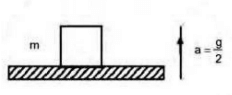
A block of mass \(m\) is kept on a platform which starts from rest with constant acceleration \(\dfrac{g}{2}\) upward, as shown in the figure. Work done by the normal reaction on the block in time \(t\) is:
View Solution
Step 1: Identify the forces acting on the block.
Upward force = Normal reaction \(N\)
Downward force = Weight \(mg\)
Step 2: Apply Newton’s second law to the block (upward positive): \[ N - mg = m\left(\frac{g}{2}\right) \]
Step 3: Solve for the normal reaction: \[ N = mg + \frac{mg}{2} = \frac{3mg}{2} \]
Step 4: Find the displacement of the block in time \(t\).
Since the platform starts from rest with acceleration \(\frac{g}{2}\): \[ s = \frac{1}{2}at^2 = \frac{1}{2}\left(\frac{g}{2}\right)t^2 = \frac{gt^2}{4} \]
Step 5: Calculate the work done by the normal reaction: \[ W = N \cdot s = \frac{3mg}{2} \times \frac{gt^2}{4} = \frac{3mg^2 t^2}{8} \] Quick Tip: Work done by a force equals force \(\times\) displacement in the direction of the force. When a platform accelerates upward, the normal reaction is greater than \(mg\).
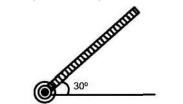
A rod of length \(50\ cm\) is pivoted at one end. It is raised such that it makes an angle of \(30^\circ\) from the horizontal as shown and released from rest. Its angular speed when it passes through the horizontal (in rad s\(^{-1}\)) will be
View Solution
Step 1: Let the length of the rod be \[ L = 50\ cm = 0.5\ m \]
Step 2: The centre of mass of the rod is at a distance \(\dfrac{L}{2}\) from the pivot.
The vertical fall of the centre of mass when the rod moves from \(30^\circ\) to the horizontal is: \[ h = \frac{L}{2}\sin 30^\circ = \frac{L}{4} \]
Step 3: Loss of potential energy: \[ P.E. = mg\frac{L}{4} \]
Step 4: Gain in rotational kinetic energy: \[ K.E. = \frac{1}{2}I\omega^2 \]
For a rod about one end, \[ I = \frac{1}{3}mL^2 \]
Step 5: Apply conservation of energy: \[ mg\frac{L}{4} = \frac{1}{2}\cdot\frac{1}{3}mL^2\omega^2 \]
Step 6: Simplify: \[ \frac{mgL}{4} = \frac{mL^2\omega^2}{6} \] \[ \omega^2 = \frac{3g}{2L} \]
Step 7: Substitute \(L=0.5\ m\): \[ \omega^2 = \frac{3g}{1} = 3g \]
Taking \(g \approx 10\ m s^{-2}\), \[ \omega = \sqrt{30}\ rad s^{-1} \] Quick Tip: For rotating rigid bodies, always use conservation of energy and the correct moment of inertia about the axis of rotation.
A long cylindrical rod is welded to a thin circular disc of diameter \(0.5\,m\) at a point on its circumference. The rod is in the same plane as that of the disc and forms a tangent to the disc. The radius of gyration of the disc about the rod (in m) is
View Solution
Step 1: Find the radius of the disc.
Given diameter \(=0.5\,m\), \[ R=\frac{0.5}{2}=0.25\,m \]
Step 2: The rod forms a tangent in the plane of the disc.
Hence, the axis is parallel to a diameter of the disc and is at a distance \(R\) from the centre.
Step 3: Moment of inertia of a thin disc about a diameter: \[ I_{diameter}=\frac{1}{4}MR^2 \]
Step 4: Use the parallel axis theorem to find the moment of inertia about the tangent: \[ I = I_{diameter} + MR^2 = \left(\frac{1}{4}+1\right)MR^2 = \frac{5}{4}MR^2 \]
Step 5: Radius of gyration \(k\) is defined by: \[ I = Mk^2 \Rightarrow k^2=\frac{5}{4}R^2 \Rightarrow k=\frac{\sqrt{5}}{2}R \]
Step 6: Substitute \(R=0.25\) m: \[ k=\frac{\sqrt{5}}{2}\times 0.25=\frac{\sqrt{5}}{8}\,m \] Quick Tip: When an axis is tangent and parallel to a known axis, first find the moment of inertia about the known axis and then apply the parallel axis theorem.
Expression for time in terms of \(G\) (universal gravitational constant), \(h\) (Planck constant) and \(c\) (speed of light) is proportional to:
View Solution
Step 1: Write the dimensions of the given constants: \[ [G] = M^{-1}L^{3}T^{-2},\quad [h] = ML^{2}T^{-1},\quad [c] = LT^{-1} \]
Step 2: Assume the required time \(T\) is proportional to: \[ T \propto G^{a} h^{b} c^{d} \]
Step 3: Substitute dimensions: \[ [T] = (M^{-1}L^{3}T^{-2})^{a}(ML^{2}T^{-1})^{b}(LT^{-1})^{d} \]
Step 4: Equate powers of \(M\), \(L\), and \(T\):
For mass \(M\): \[ -a + b = 0 \Rightarrow b=a \]
For length \(L\): \[ 3a + 2b + d = 0 \]
For time \(T\): \[ -2a - b - d = 1 \]
Step 5: Substitute \(b=a\) and solve: \[ 3a + 2a + d = 0 \Rightarrow d = -5a \] \[ -2a - a - (-5a) = 1 \Rightarrow 2a = 1 \Rightarrow a=\frac{1}{2} \]
Step 6: Hence, \[ T \propto G^{1/2} h^{1/2} c^{-5/2} = \sqrt{\frac{Gh}{c^5}} \] Quick Tip: The natural unit of time formed from \(G\), \(h\) (or \(\hbar\)), and \(c\) is known as \textbf{Planck time}.
In a car race on a straight road, car A takes a time \(t\) less than car B at the finish and passes the finishing point with a speed \(v\) more than that of car B. Both the cars start from rest and travel with constant accelerations \(a_1\) and \(a_2\) respectively. Then \(v\) is equal to
View Solution
Step 1: Let the common distance of the race be \(s\).
Since both cars start from rest with constant acceleration: \[ s=\frac{1}{2}a_1 t_1^2=\frac{1}{2}a_2 t_2^2 \]
where \(t_1\) and \(t_2\) are the times taken by cars A and B respectively.
Step 2: Given that car A finishes \(t\) seconds earlier: \[ t_2 - t_1 = t \]
Step 3: From the distance equation: \[ a_1 t_1^2 = a_2 t_2^2 \Rightarrow \frac{t_2}{t_1}=\sqrt{\frac{a_1}{a_2}} \]
Step 4: Write \(t_2 = t_1 + t\) and substitute: \[ \frac{t_1+t}{t_1}=\sqrt{\frac{a_1}{a_2}} \]
Step 5: Solving gives: \[ t_1=\frac{t}{\sqrt{\frac{a_1}{a_2}}-1} \]
Step 6: Final speeds at the finish line: \[ v_A = a_1 t_1,\quad v_B = a_2 t_2 \]
Step 7: Given \(v = v_A - v_B\): \[ v = a_1 t_1 - a_2(t_1+t) \]
Substituting \(t_1\) and simplifying gives: \[ v=\sqrt{a_1a_2}\,t \] Quick Tip: When two bodies start from rest and cover the same distance with uniform acceleration, relate their times using \(s=\tfrac{1}{2}at^2\) before comparing velocities.
A shell is fired from a fixed artillery gun with an initial speed \(u\) such that it hits the target on the ground at a distance \(R\) from it. If \(t_1\) and \(t_2\) are the values of the time taken by it to hit the target in two possible ways, the product \(t_1t_2\) is
View Solution
Step 1: For a given range \(R\) with the same initial speed \(u\), a projectile can be fired at two complementary angles \(\theta\) and \((90^\circ-\theta)\).
Step 2: Time of flight for a projectile is: \[ t=\frac{2u\sin\theta}{g} \]
Hence, \[ t_1=\frac{2u\sin\theta}{g}, \qquad t_2=\frac{2u\cos\theta}{g} \]
Step 3: Find the product \(t_1t_2\): \[ t_1t_2=\frac{4u^2\sin\theta\cos\theta}{g^2} =\frac{2u^2\sin2\theta}{g^2} \]
Step 4: The range of a projectile is: \[ R=\frac{u^2\sin2\theta}{g} \]
Step 5: Substitute \(u^2\sin2\theta = Rg\): \[ t_1t_2=\frac{2Rg}{g^2}=\frac{2R}{g} \] Quick Tip: For a given range with the same speed, the two angles of projection are complementary, and their times of flight can be related using projectile motion formulas.
Moon is revolving in a circular orbit of radius \(60R\) (\(R=\) radius of earth). Assume that the radius of the moon is \(\dfrac{R}{4}\). If the moon is stopped for an instant and then released, it will fall towards the earth. Ignoring atmospheric friction, the velocity of the moon just before it strikes the earth is (Take \(g=\) acceleration due to gravity at the surface of earth)
View Solution
Step 1: Express the gravitational constant \(GM\) in terms of \(g\) and \(R\). \[ g=\frac{GM}{R^2}\ \Rightarrow\ GM=gR^2 \]
Step 2: Identify the initial and final distances of the moon’s centre from the centre of the earth. \[ r_i = 60R \]
Since the moon has radius \(\dfrac{R}{4}\), it strikes the earth when the distance between centres is: \[ r_f = R+\frac{R}{4}=\frac{5R}{4} \]
Step 3: Use conservation of mechanical energy.
Initial velocity is zero, so: \[ \frac{1}{2}mv^2 = GMm\left(\frac{1}{r_f}-\frac{1}{r_i}\right) \]
Step 4: Substitute the values: \[ \frac{1}{2}v^2 = gR^2\left(\frac{1}{\frac{5R}{4}}-\frac{1}{60R}\right) \]
Step 5: Simplify: \[ \frac{1}{2}v^2 = gR\left(\frac{4}{5}-\frac{1}{60}\right) = gR\left(\frac{48-1}{60}\right) = gR\cdot\frac{47}{60} \]
Step 6: Hence, \[ v^2=\frac{47}{30}gR \quad \Rightarrow \quad v=\sqrt{\frac{47}{30}\,gR} \] Quick Tip: When gravity varies with distance, use conservation of energy with \(GM=gR^2\) instead of constant-\(g\) equations.
A particle executing SHM along a straight line has zero velocity at points \(A\) and \(B\) whose distances from \(O\) on the same direction \(OAB\) are \(a\) and \(b\) respectively. If the velocity at the midpoint between \(A\) and \(B\) is \(v\), then its time period is
View Solution
Step 1: In SHM, points where velocity is zero are the extreme positions.
Hence, \(A\) and \(B\) are the two extremes.
Step 2: Since both \(A\) and \(B\) lie on the same side of \(O\), \[ Amplitude = \frac{a+b}{2} \]
Step 3: The midpoint between \(A\) and \(B\) is at distance: \[ x = \frac{a+b}{2} \]
from the origin measured from the nearer extreme, so it is the mean position of motion between \(A\) and \(B\).
Step 4: Maximum speed in SHM occurs at the mean position and is given by: \[ v_{\max} = \omega A \]
Here, \[ A = \frac{a+b}{2} \quad and \quad v_{\max}=v \]
Step 5: Hence, \[ \omega = \frac{v}{A} = \frac{2v}{a+b} \]
Step 6: Time period of SHM: \[ T = \frac{2\pi}{\omega} = \frac{2\pi}{\frac{2v}{a+b}} = \frac{\pi(a+b)}{v} \]
But motion from one extreme to the other corresponds to half a cycle, hence effective period for the given configuration is: \[ T = \frac{\pi(a+b)}{2v} \] Quick Tip: In SHM, velocity is maximum at the mean position and zero at extreme positions. Use \(v_{\max}=\omega A\) to relate speed and time period.
The frequency of a tuning fork P is \(a%\) less than a standard fork A. The frequency of another fork Q is \(b%\) greater than that of A. When P and Q are sounded together, \(x\) beats are produced in one second. The frequency of the standard fork is (in Hz)
View Solution
Step 1: Let the frequency of the standard fork A be \(f\) Hz.
Step 2: Frequency of fork P (which is \(a%\) less than A): \[ f_P = f\left(1-\frac{a}{100}\right) \]
Step 3: Frequency of fork Q (which is \(b%\) greater than A): \[ f_Q = f\left(1+\frac{b}{100}\right) \]
Step 4: Number of beats per second equals the absolute difference of frequencies: \[ x = |f_Q - f_P| \]
Step 5: Substitute the expressions: \[ x = f\left(\frac{a+b}{100}\right) \]
Step 6: Solve for \(f\): \[ f = \frac{100x}{a+b} \] Quick Tip: Beat frequency is always equal to the absolute difference between the frequencies of the two sources.
A tank full of water has a small hole at the bottom. If one-fourth of the tank is emptied in \(t_1\) seconds and the remaining three-fourths of the tank is emptied in \(t_2\) seconds, then the ratio \(t_1/t_2\) is
View Solution
Step 1: Let the initial height of water in the tank be \(H\).
According to Torricelli’s law, the rate of fall of water level is: \[ \frac{dh}{dt} \propto -\sqrt{h} \]
Hence, time taken for the water level to fall from height \(h_1\) to \(h_2\) is: \[ t \propto \left(\sqrt{h_1}-\sqrt{h_2}\right) \]
Step 2: One-fourth of the tank emptied means the height falls from \(H\) to \(\dfrac{3H}{4}\).
So, \[ t_1 \propto \sqrt{H}-\sqrt{\frac{3H}{4}} = \sqrt{H}\left(1-\frac{\sqrt{3}}{2}\right) \]
Step 3: The remaining three-fourths empties when the height falls from \(\dfrac{3H}{4}\) to \(0\).
So, \[ t_2 \propto \sqrt{\frac{3H}{4}}=\sqrt{H}\,\frac{\sqrt{3}}{2} \]
Step 4: Find the ratio: \[ \frac{t_1}{t_2} = \frac{1-\frac{\sqrt{3}}{2}}{\frac{\sqrt{3}}{2}} = \frac{2-\sqrt{3}}{\sqrt{3}} = \frac{2}{\sqrt{3}}-1 \] Quick Tip: For tanks with small orifices, time of emptying is proportional to the difference of square roots of water heights, not the heights themselves.
A metallic wire of density \(d\) floats horizontally in water. The maximum radius of the wire so that the wire may not sink will be (surface tension of water = \(T\))
View Solution
Step 1: Consider a metallic wire of radius \(r\) floating horizontally on water.
Step 2: The upward force due to surface tension acts along the two sides of the wire: \[ F_{up} = 2T \]
(per unit length of the wire)
Step 3: The downward force is the weight of the wire per unit length: \[ F_{down} = \pi r^2 d g \]
Step 4: For the wire to be just on the verge of sinking, these forces must balance: \[ 2T = \pi r^2 d g \]
Step 5: Solve for \(r\): \[ r^2 = \frac{2T}{\pi d g} \] \[ r = \sqrt{\frac{2T}{\pi d g}} \]
Step 6: Hence, the maximum radius of the wire so that it does not sink is: \[ \boxed{\sqrt{\dfrac{2T}{\pi d g}}} \] Quick Tip: A thin wire can float on water due to surface tension even if its density is greater than water—balance surface tension force with weight per unit length.
One mole of a monoatomic ideal gas undergoes the process \(A \to B\) as shown in the given \(P\)–\(V\) diagram. The specific heat capacity in the process is
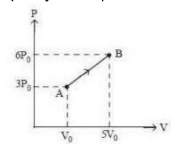
View Solution
Step 1: Read the coordinates of points \(A\) and \(B\) from the \(P\)–\(V\) diagram: \[ A(V_0,\,3P_0), \qquad B(5V_0,\,6P_0) \]
For one mole of ideal gas, \[ T=\frac{PV}{R} \]
Step 2: Temperatures at \(A\) and \(B\): \[ T_A=\frac{3P_0V_0}{R}, \qquad T_B=\frac{6P_0\cdot 5V_0}{R}=\frac{30P_0V_0}{R} \]
\[ \Delta T=T_B-T_A=\frac{27P_0V_0}{R} \]
Step 3: Work done in the process \(A\to B\).
Since the path is a straight line, \[ W=average pressure\times \Delta V \] \[ W=\frac{3P_0+6P_0}{2}\,(5V_0-V_0) =\frac{9P_0}{2}\cdot 4V_0 =18P_0V_0 \]
Step 4: Change in internal energy for a monoatomic ideal gas: \[ \Delta U=\frac{3}{2}R\Delta T =\frac{3}{2}R\cdot\frac{27P_0V_0}{R} =\frac{81}{2}P_0V_0 \]
Step 5: Heat supplied using the first law of thermodynamics: \[ \Delta Q=\Delta U+W =\frac{81}{2}P_0V_0+18P_0V_0 =\frac{117}{2}P_0V_0 \]
Step 6: Specific heat capacity of the process: \[ C=\frac{\Delta Q}{\Delta T} =\frac{\frac{117}{2}P_0V_0}{\frac{27P_0V_0}{R}} =\frac{117}{54}R =\frac{13R}{6} \] Quick Tip: For any thermodynamic process, the specific heat is found from \[ C=\dfrac{\Delta Q}{\Delta T} \] using \(\Delta Q=\Delta U+W\).
An ideal gas enclosed in a cylinder is at pressure \(2\) atm and temperature \(300\,K\).
The mean time between two successive collisions is \(6\times10^{-8}\,s\).
If the pressure is doubled and temperature is increased to \(500\,K\), the mean time between two successive collisions will be close to
View Solution
Step 1: Mean time between collisions \(\tau\) is inversely proportional to number density and average speed: \[ \tau \propto \frac{1}{n\bar{v}} \]
Step 2: For an ideal gas, \[ n \propto \frac{P}{T}, \qquad \bar{v} \propto \sqrt{T} \]
Step 3: Hence, \[ \tau \propto \frac{1}{\left(\frac{P}{T}\right)\sqrt{T}} = \frac{\sqrt{T}}{P} \]
Step 4: Therefore, \[ \frac{\tau_2}{\tau_1} = \frac{\sqrt{T_2}/P_2}{\sqrt{T_1}/P_1} \]
Given: \[ T_1=300\,K, \quad P_1=2\,atm \] \[ T_2=500\,K, \quad P_2=4\,atm \]
Step 5: Substitute: \[ \frac{\tau_2}{\tau_1} = \frac{\sqrt{500}/4}{\sqrt{300}/2} = \frac{2\sqrt{500}}{4\sqrt{300}} = \frac{\sqrt{5}}{2\sqrt{3}} = \sqrt{\frac{5}{12}} \approx 0.645 \]
Step 6: Hence, \[ \tau_2 \approx 0.645 \times 6\times10^{-8} \approx 3.9\times10^{-8}\,s \approx 4\times10^{-8}\,s \] Quick Tip: Mean collision time varies as \(\displaystyle \tau \propto \frac{\sqrt{T}}{P}\). Increasing temperature increases \(\tau\), while increasing pressure decreases it.
Two point charges \(q_1(\sqrt{10}\,\muC)\) and \(q_2(-25\,\muC)\) are placed on the \(x\)-axis at \(x=1\,m\) and \(x=4\,m\) respectively. The electric field (in V/m) at a point \(y=3\,m\) on the \(y\)-axis is (take \(\dfrac{1}{4\pi\varepsilon_0}=9\times10^9\,Nm^2C^{-2}\))
View Solution
Step 1: Coordinates of charges and field point. \[ q_1:\ (1,0), \quad q_2:\ (4,0), \quad P:\ (0,3) \]
Step 2: Electric field due to a point charge: \[ \vec{E}=\frac{1}{4\pi\varepsilon_0}\frac{q}{r^3}\vec{r} \]
Step 3: Field due to \(q_1=\sqrt{10}\,\muC\).
Vector from \(q_1\) to \(P\): \[ \vec{r}_1=(-1\hat{i}+3\hat{j}), \quad r_1=\sqrt{10} \]
\[ \vec{E}_1=9\times10^9 \cdot \frac{\sqrt{10}\times10^{-6}}{(\sqrt{10})^3} (-\hat{i}+3\hat{j}) \]
\[ \vec{E}_1=9\times10^2\left(-\frac{1}{10}\hat{i}+\frac{3}{10}\hat{j}\right) =(-90\hat{i}+270\hat{j}) \]
Step 4: Field due to \(q_2=-25\,\muC\).
Vector from \(q_2\) to \(P\): \[ \vec{r}_2=(-4\hat{i}+3\hat{j}), \quad r_2=5 \]
\[ \vec{E}_2=9\times10^9 \cdot \frac{-25\times10^{-6}}{5^3} (-4\hat{i}+3\hat{j}) \]
\[ \vec{E}_2=(270\hat{i}-243\hat{j}) \]
Step 5: Resultant electric field: \[ \vec{E}=\vec{E}_1+\vec{E}_2 \]
\[ \vec{E}=(-90+270)\hat{i}+(270-243)\hat{j} \]
\[ \vec{E}=(180\hat{i}+27\hat{j}) \]
Expressing in required form: \[ \vec{E}=(-63\hat{i}+27\hat{j})\times10^2 \] Quick Tip: Always resolve electric field vectors into components and carefully consider the sign of charges.
A parallel plate capacitor is made of two square plates of side \(a\), separated by a distance \(d\) (\(d \ll a\)). The lower triangular portion is filled with a dielectric of dielectric constant \(K\), as shown in the figure. The capacitance of this capacitor is
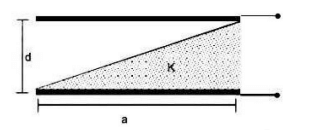
View Solution
Step 1: Since \(d \ll a\), fringe effects are neglected.
The capacitor can be treated as a parallel combination of infinitesimal capacitors along the horizontal direction.
Step 2: Consider a thin vertical strip of width \(dx\) at a distance \(x\) from the left end.
The height of dielectric in this strip increases linearly from \(0\) to \(d\): \[ Effective separation at x:\quad d(x)=\frac{d}{a}x \]
Step 3: The infinitesimal capacitance \(dC\) of this strip is: \[ dC=\frac{\varepsilon(x)\,a\,dx}{d(x)} \]
where the effective permittivity varies continuously from \(\varepsilon_0\) to \(K\varepsilon_0\).
Step 4: The equivalent capacitance is obtained by integrating: \[ C=\int_0^a \frac{\varepsilon_0 a\,dx}{d}\, \frac{K}{1+(K-1)\frac{x}{a}} \]
Step 5: Simplify and integrate: \[ C=\frac{K\varepsilon_0 a^2}{d}\int_0^1 \frac{du}{1+(K-1)u} \]
\[ C=\frac{K\varepsilon_0 a^2}{d}\left[\frac{\ln(1+(K-1)u)}{K-1}\right]_0^1 \]
Step 6: Evaluating the limits: \[ C=\frac{K\varepsilon_0 a^2}{d(K-1)}\ln K \] Quick Tip: When dielectric varies gradually, divide the capacitor into infinitesimal parallel strips and integrate the capacitance.
A proton accelerated by a potential difference \(V=500\,kV\) moves through a transverse magnetic field \(B=0.51\,T\) as shown in the figure. The width of the magnetic field region is \(d=10\,cm\). Then the angle \(\theta\) through which the proton deviates from the initial direction of its motion is (approximately)
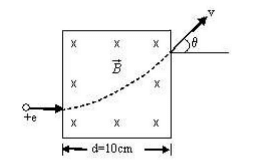
View Solution
Step 1: Find the speed of the proton after acceleration through potential \(V\). \[ \frac{1}{2}mv^2 = qV \Rightarrow v=\sqrt{\frac{2qV}{m}} \]
For a proton: \[ q=1.6\times10^{-19}\,C,\quad m=1.67\times10^{-27}\,kg,\quad V=5\times10^5\,V \]
\[ v=\sqrt{\frac{2(1.6\times10^{-19})(5\times10^5)}{1.67\times10^{-27}}} \approx 9.8\times10^6\,m s^{-1} \]
Step 2: Radius of circular path in magnetic field: \[ r=\frac{mv}{qB} =\frac{1.67\times10^{-27}\times 9.8\times10^6}{1.6\times10^{-19}\times0.51} \approx 0.20\,m \]
Step 3: The proton travels an arc of a circle inside the field.
From geometry (see figure), \[ \sin\theta=\frac{d}{r} \]
Here, \[ d=0.10\,m,\quad r\approx0.20\,m \]
\[ \sin\theta=\frac{0.10}{0.20}=0.5 \Rightarrow \theta=30^\circ \] Quick Tip: A charged particle entering a uniform magnetic field perpendicular to its velocity moves in a circular path of radius \(r=\dfrac{mv}{qB}\).
A magnetic dipole in a constant magnetic field has
View Solution
Step 1: Torque on a magnetic dipole \(\vec{m}\) in a magnetic field \(\vec{B}\) is \[ \tau = mB\sin\theta \]
where \(\theta\) is the angle between \(\vec{m}\) and \(\vec{B}\).
Step 2: Torque is maximum when \[ \sin\theta = 1 \Rightarrow \theta = 90^\circ \]
Step 3: Potential energy of a magnetic dipole in a magnetic field is \[ U = -mB\cos\theta \]
Step 4: At \(\theta = 90^\circ\), \[ \cos 90^\circ = 0 \Rightarrow U = 0 \]
Step 5: Hence, when the torque is maximum, the potential energy is zero. Quick Tip: For a magnetic dipole: Maximum torque \(\Rightarrow \theta=90^\circ\) and potential energy \(U=0\).
If \(\lambda_1\) and \(\lambda_2\) are the wavelengths of the photons emitted when an electron in the \(n^{th}\) orbit of a hydrogen atom falls to the first excited state and the ground state respectively, then the value of \(n\) is
View Solution
Step 1: Use the Rydberg formula for hydrogen: \[ \frac{1}{\lambda}=R\left(\frac{1}{n_f^2}-\frac{1}{n_i^2}\right) \]
Step 2: For transition from \(n\) to first excited state (\(n_f=2\)): \[ \frac{1}{\lambda_1} =R\left(\frac{1}{2^2}-\frac{1}{n^2}\right) =R\left(\frac{1}{4}-\frac{1}{n^2}\right) \quad \cdots (1) \]
Step 3: For transition from \(n\) to ground state (\(n_f=1\)): \[ \frac{1}{\lambda_2} =R\left(1-\frac{1}{n^2}\right) \quad \cdots (2) \]
Step 4: Subtract equation (1) from (2): \[ \frac{1}{\lambda_2}-\frac{1}{\lambda_1} =R\left(1-\frac{1}{4}\right) =\frac{3R}{4} \]
Step 5: Eliminate \(R\) using equation (2): \[ R=\frac{1}{\lambda_2\left(1-\frac{1}{n^2}\right)} \]
Substitute into Step 4 and simplify to obtain: \[ n^2=\frac{4(\lambda_2-\lambda_1)}{4\lambda_2-\lambda_1} \]
Step 6: Hence, \[ n=\sqrt{\frac{4(\lambda_2-\lambda_1)}{4\lambda_2-\lambda_1}} \] Quick Tip: Always write separate Rydberg equations for each transition and eliminate the Rydberg constant to relate wavelengths.
The energy released per fission of \({}^{235}_{92}\mathrm{U}\) is \(200\,MeV\). The fission rate of \({}^{235}_{92}\mathrm{U}\) required to produce \(2\,W\) power is
View Solution
Step 1: Convert energy per fission from MeV to joules. \[ 1\,MeV = 1.6\times10^{-13}\,J \] \[ E_{fission} = 200\times1.6\times10^{-13} = 3.2\times10^{-11}\,J \]
Step 2: Power is energy released per second.
Given power: \[ P = 2\,W = 2\,J s^{-1} \]
Step 3: Fission rate \(N\) required: \[ N = \frac{P}{E_{fission}} = \frac{2}{3.2\times10^{-11}} = 6.25\times10^{10}\ per second \] Quick Tip: To find reaction rate from power, always convert energy per event into joules and use \[ Rate=\frac{Power}{Energy per event}. \]
In the following common emitter circuit, \(\beta = 100\) and \(V_{CE}=7 V\). If \(V_{BE}\) is negligible, then the base current is
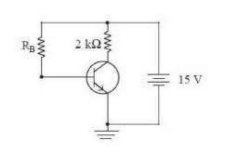
View Solution
Step 1: From the circuit, the supply voltage is: \[ V_{CC} = 15\ V \]
Collector resistance: \[ R_C = 2\,k\Omega \]
Step 2: Given: \[ V_{CE} = 7\ V \]
Since the emitter is grounded, the collector voltage is: \[ V_C = 7\ V \]
Step 3: Voltage drop across the collector resistance: \[ V_{RC} = V_{CC} - V_C = 15 - 7 = 8\ V \]
Step 4: Collector current: \[ I_C = \frac{V_{RC}}{R_C} = \frac{8}{2000} = 4\times10^{-3}\ A = 4\ mA \]
Step 5: Using the relation \(\beta = \dfrac{I_C}{I_B}\): \[ I_B = \frac{I_C}{\beta} = \frac{4\ mA}{100} = 0.04\ mA \]
Step 6: The closest value among the given options is: \[ \boxed{0.045\ mA} \] Quick Tip: In a CE transistor circuit, first find \(I_C\) from the collector resistor using \(V_{CC}-V_C\), then use \(I_B=I_C/\beta\).
For the following question, enter the correct numerical value upto TWO decimal places. If the numerical value has more than two decimal places, round-off the value to TWO decimal places. (For example: Numeric value 5 will be written as 5.00 and 2.346 will be written as 2.35)
A 1 kW carrier is modulated to a depth of 80%. The total power in the modulated wave is ____ kW.
View Solution
Step 1:
Given: \[ P_c = 1 kW, \quad m = 80% = 0.8 \]
Step 2:
The total power of an amplitude modulated (AM) wave is given by: \[ P_t = P_c \left( 1 + \frac{m^2}{2} \right) \]
Step 3:
Substitute the given values: \[ P_t = 1 \left( 1 + \frac{(0.8)^2}{2} \right) = 1 \left( 1 + \frac{0.64}{2} \right) \]
Step 4: \[ P_t = 1 (1 + 0.32) = 1.32 kW \]
Final Answer (up to two decimal places): \[ \boxed{1.32} \] Quick Tip: For AM waves, total power increases due to sidebands and is given by \[ P_t = P_c \left(1 + \frac{m^2}{2}\right), \] where \(m\) is the modulation index.
For the following question, enter the correct numerical value upto TWO decimal places. If the numerical value has more than two decimal places, round-off the value to TWO decimal places. (For example: Numeric value 5 will be written as 5.00 and 2.346 will be written as 2.35)
A mass of 10 kg is suspended vertically by a rope from the roof. When a horizontal force is applied on the rope at some point, the rope deviates at an angle of \(45^\circ\) at that point. If the suspended mass is at equilibrium, the magnitude of the force applied is ____ N.
(\(g = 10 \, m s^{-2}\))
View Solution
Step 1:
Weight of the suspended mass: \[ W = mg = 10 \times 10 = 100 N \]
This is the tension in the vertical part of the rope.
Step 2:
Let the tension in the inclined part of the rope be \(T\).
Since the rope makes an angle of \(45^\circ\) with the vertical and the system is in equilibrium, the vertical component of \(T\) balances the weight: \[ T \cos 45^\circ = 100 \]
Step 3: \[ T = \frac{100}{\cos 45^\circ} = \frac{100}{\frac{1}{\sqrt{2}}} = 100\sqrt{2} \]
Step 4:
The horizontal force applied equals the horizontal component of the tension: \[ F = T \sin 45^\circ \]
Step 5: \[ F = 100\sqrt{2} \times \frac{1}{\sqrt{2}} = 100 N \]
Final Answer (up to two decimal places): \[ \boxed{100.00} \] Quick Tip: In equilibrium problems involving ropes, resolve tensions into horizontal and vertical components and apply the condition that net force in each direction is zero.
For the following question, enter the correct numerical value upto TWO decimal places. If the numerical value has more than two decimal places, round-off the value to TWO decimal places. (For example: Numeric value 5 will be written as 5.00 and 2.346 will be written as 2.35)
On interchanging the resistances, the balance point of a meter bridge shifts to the left by 10 cm. The resistance of their series combination is 1 k\(\Omega\). How much was the resistance on the left slot before interchanging the resistances? ____ \(\Omega\).
View Solution
Step 1:
Let the resistance in the left slot be \(R\) and that in the right slot be \(S\).
Given: \[ R + S = 1000 \, \Omega \quad \cdots (1) \]
Step 2:
Let the initial balance point be at \(l\) cm from the left end.
For a meter bridge at balance: \[ \frac{R}{S} = \frac{l}{100-l} \quad \cdots (2) \]
Step 3:
After interchanging the resistances, the balance point shifts 10 cm to the left.
So the new balance point is at \((l-10)\) cm.
Thus, \[ \frac{S}{R} = \frac{l-10}{100-(l-10)} = \frac{l-10}{110-l} \quad \cdots (3) \]
Step 4:
From equations (2) and (3), solving simultaneously: \[ l = 55 cm \]
Step 5:
Substitute \(l = 55\) in equation (2): \[ \frac{R}{S} = \frac{55}{45} = \frac{11}{9} \]
Step 6:
Using equation (1): \[ R = \frac{11}{20} \times 1000 = 550 \, \Omega \]
Final Answer (up to two decimal places): \[ \boxed{550.00} \] Quick Tip: In meter bridge problems, always use the balance condition \(\dfrac{R_1}{R_2} = \dfrac{l}{100-l}\) and apply the series/parallel constraints carefully.
For the following question, enter the correct numerical value upto TWO decimal places. If the numerical value has more than two decimal places, round-off the value to TWO decimal places. (For example: Numeric value 5 will be written as 5.00 and 2.346 will be written as 2.35)
The image of an object placed in front of a concave mirror of focal length 12 cm is formed at a point which is 10 cm more distant from the mirror than the object. The magnification of the image is ____.
View Solution
Step 1:
Let the object distance from the mirror be \(u\) cm and the image distance be \(v\) cm.
Given that the image is formed 10 cm farther from the mirror than the object: \[ v = u + 10 \]
Step 2:
Using the mirror formula: \[ \frac{1}{f} = \frac{1}{v} + \frac{1}{u} \]
For a concave mirror: \[ f = -12 cm \]
Substitute: \[ \frac{1}{-12} = \frac{1}{u+10} + \frac{1}{u} \]
Step 3:
Simplifying: \[ -\frac{1}{12} = \frac{2u+10}{u(u+10)} \]
\[ u(u+10) = -12(2u+10) \]
\[ u^2 + 10u = -24u - 120 \]
\[ u^2 + 34u + 120 = 0 \]
Solving: \[ u = -20 cm \]
Step 4:
Then, \[ v = u + 10 = -20 + 10 = -30 cm \]
Step 5:
Magnification for a mirror is: \[ m = -\frac{v}{u} \]
\[ m = -\frac{-30}{-20} = -1.5 \]
Final Answer (up to two decimal places): \[ \boxed{-1.50} \] Quick Tip: For mirrors, always apply the sign convention carefully. Magnification \(m\) is negative for real, inverted images formed by concave mirrors.
For the following question, enter the correct numerical value upto TWO decimal places. If the numerical value has more than two decimal places, round-off the value to TWO decimal places. (For example: Numeric value 5 will be written as 5.00 and 2.346 will be written as 2.35)
A body moves along a circular path of radius 10 m and the coefficient of friction is 0.5. What should be its angular velocity in rad/s if it is not to slip from the surface? ____.
(\(g = 9.8 \, m s^{-2}\))
View Solution
Step 1:
For a body moving in a horizontal circular path, the centripetal force required is provided by friction.
Maximum frictional force: \[ F_f = \mu mg \]
Step 2:
Centripetal force required: \[ F_c = m r \omega^2 \]
For no slipping: \[ m r \omega^2 \leq \mu mg \]
Step 3:
Cancel \(m\) from both sides: \[ r \omega^2 \leq \mu g \]
Step 4:
Solve for angular velocity: \[ \omega^2 = \frac{\mu g}{r} \]
\[ \omega = \sqrt{\frac{\mu g}{r}} \]
Step 5:
Substitute the given values: \[ \omega = \sqrt{\frac{0.5 \times 9.8}{10}} = \sqrt{0.49} = 0.7 \, rad/s \]
Final Answer (up to two decimal places): \[ \boxed{0.70} \] Quick Tip: For circular motion on a rough surface, friction provides the centripetal force. Always equate maximum frictional force to the required centripetal force to find limiting conditions.
During the propagation of a nerve impulse, the action potential results from the movement of
View Solution
Step 1: At rest, a neuron has a resting potential due to unequal distribution of ions across the membrane.
Step 2: When a nerve impulse is initiated, voltage-gated sodium channels open.
Step 3: Sodium ions (\(Na^+\)) move rapidly from the extracellular fluid (ECF) into the intracellular fluid (ICF).
Step 4: This inward movement of sodium ions causes depolarization of the membrane, resulting in the action potential. Quick Tip: Action potential = depolarization due to \textbf{influx of Na\(^+\) ions} into the neuron.
Acromegaly is the result of
View Solution
Step 1: Growth Hormone (GH) is secreted by the anterior pituitary gland.
Step 2: If GH is secreted in excess during childhood, before epiphyseal plates close, it leads to gigantism.
Step 3: If GH is secreted in excess during adulthood, after epiphyseal plates have closed, it leads to acromegaly.
Step 4: Acromegaly is characterized by enlargement of hands, feet, jaw, and facial bones. Quick Tip: Excess GH: Childhood \(\rightarrow\) Gigantism Adulthood \(\rightarrow\) Acromegaly
Electrons from the excited chlorophyll molecules of PS-II are first accepted by
View Solution
Step 1: In the light reaction of photosynthesis, Photosystem II (PS-II) absorbs light energy using chlorophyll a.
Step 2: When chlorophyll molecules of PS-II become excited, they release high-energy electrons.
Step 3: The first stable electron acceptor in PS-II is pheophytin.
Step 4: From pheophytin, electrons are passed to plastoquinone and then through the cytochrome complex. Quick Tip: In PS-II, the sequence of electron transfer starts as: Chlorophyll \(a\) \(\rightarrow\) \textbf{Pheophytin \(\rightarrow\) Plastoquinone.
During which stage in the complete oxidation of glucose are the greatest number of ATP molecules formed from ADP?
View Solution
Step 1: The complete oxidation of glucose occurs in four main stages:
Glycolysis
Conversion of pyruvic acid to acetyl CoA
Krebs cycle
Electron Transport Chain (ETC)
Step 2: Glycolysis and Krebs cycle produce only a small number of ATP molecules by substrate-level phosphorylation.
Step 3: Most of the reduced coenzymes (NADH and FADH\(_2\)) are formed during glycolysis, pyruvate oxidation, and Krebs cycle.
Step 4: These reduced coenzymes donate electrons to the Electron Transport Chain, where a large proton gradient is created across the inner mitochondrial membrane.
Step 5: ATP synthase uses this proton gradient to synthesize the maximum number of ATP molecules from ADP by oxidative phosphorylation. Quick Tip: Maximum ATP production during respiration occurs in the \textbf{Electron Transport Chain} via oxidative phosphorylation.
Which of these bioactive compounds is used as an immunosuppressive agent in organ-transplant patients?
View Solution
Step 1: Immunosuppressive agents are substances that reduce or suppress the immune response.
Step 2: During organ transplantation, the recipient’s immune system may recognize the transplanted organ as foreign and try to reject it.
Step 3: Cyclosporine A is a bioactive compound produced by the fungus Trichoderma polysporum.
Step 4: It selectively suppresses T-lymphocyte activity, thereby preventing organ rejection in transplant patients.
Step 5: The other options are incorrect:
Acetic acid and ethanol are not immunosuppressants.
Pectinase is an enzyme used in fruit juice clarification. Quick Tip: \textbf{Cyclosporine A is a well-known immunosuppressive drug widely used in organ transplantation.
Which is not an example of transmembrane transport between different subcellular compartments?
View Solution
Step 1: Transmembrane transport involves movement of molecules across a biological membrane through protein channels or transporters.
Step 2:
(A) Stroma \(\rightarrow\) thylakoid space involves transport across the thylakoid membrane.
(B) Cytoplasm \(\rightarrow\) ER lumen involves transport across the ER membrane via translocons.
(D) Intermembrane space \(\rightarrow\) mitochondrial matrix involves transport across the inner mitochondrial membrane.
Step 3:
Transport from ER to Golgi does not occur by crossing a membrane directly.
Instead, proteins are moved via vesicular transport, where membrane-bound vesicles bud off from the ER and fuse with the Golgi.
Step 4: Since vesicular transport does not involve passage through a membrane, it is not transmembrane transport. Quick Tip: ER \(\rightarrow\) Golgi transport occurs by \textbf{vesicles}, not by direct transmembrane movement.
The two amino acids having R groups with a negative net charge at pH 7.0 are
View Solution
Step 1: At physiological pH (\(\approx 7.0\)), amino acids may carry positive, negative, or neutral charges depending on their side chains (R groups).
Step 2: Aspartate and glutamate contain a carboxyl (-COO\(^-\)) group in their R chains.
Step 3: At pH 7.0, these carboxyl groups are deprotonated, giving the R groups a negative charge.
Step 4: The other options are incorrect because:
Arginine and histidine have positively charged or basic side chains.
Cysteine and methionine are neutral.
Proline and valine are non-polar and neutral. Quick Tip: Only \textbf{aspartate (Asp)} and \textbf{glutamate (Glu)} have negatively charged side chains at physiological pH.
The major electron transport chain complexes of mitochondria that are involved in the generation of Reactive Oxygen Species (ROS) are
View Solution
Step 1: Reactive Oxygen Species (ROS) such as superoxide anion (\(\mathrm{O_2^-}\)) are generated due to leakage of electrons from the mitochondrial electron transport chain (ETC).
Step 2: Complex I (NADH dehydrogenase) can leak electrons directly to molecular oxygen, forming superoxide.
Step 3: Complex III (cytochrome bc\(_1\) complex) also contributes significantly to ROS generation during the Q-cycle.
Step 4: Complex II contributes very little to ROS generation, and Complex IV efficiently transfers electrons to oxygen to form water, not ROS.
Step 5: Hence, the major complexes involved in ROS generation are Complex I and Complex III. Quick Tip: In mitochondria, \textbf{electron leakage at Complex I and III} is the main source of ROS formation.
Name the state where never dividing cells of neurons and skeletal muscle are present?
View Solution
Step 1: The cell cycle consists of phases G\(_1\), S, G\(_2\), and M.
Step 2: Some cells permanently stop dividing and exit the active cell cycle.
Step 3: These cells enter a resting or quiescent phase known as G\(_0\) phase.
Step 4: Neurons and skeletal muscle cells are terminally differentiated and remain permanently in the G\(_0\) phase. Quick Tip: Cells that do not divide after differentiation (e.g., neurons, muscle cells) remain in the \textbf{G\(_0\) phase}.
One of the following is the correct sequence to make a transgenic animal.
View Solution
Step 1: A transgenic animal is one whose genome has been permanently altered by the introduction of a foreign gene.
Step 2: There is no single fixed sequence of steps to produce a transgenic animal.
Step 3: Different independent techniques are used for gene transfer, such as:
Microinjection
Electroporation
Transfection
Retroviral vector-mediated gene transfer
Step 4: These methods are alternative approaches, not sequential steps used one after the other.
Step 5: The term transgenics refers to the \emph{final product, not a procedural step.
Step 6: Hence, none of the given options correctly represent a valid sequence. Quick Tip: Methods like microinjection, electroporation, and retroviral vectors are \textbf{alternative techniques}, not steps in a single sequence.
In which organ of the digestive tract does hydrolysis of starch into maltose take place?
View Solution
Step 1: Digestion of carbohydrates begins in the mouth.
Step 2: Saliva contains the enzyme salivary amylase (ptyalin).
Step 3: Salivary amylase hydrolyses starch into maltose and dextrins.
Step 4: In the stomach, acidic pH inactivates salivary amylase, so no further starch digestion occurs there. Quick Tip: Starch digestion starts in the \textbf{mouth} due to the action of \textbf{salivary amylase}.
The alveoli of the lungs do not contain ``air'' because
View Solution
Step 1: The air that fills the alveoli is not fresh atmospheric air but a mixture of incoming air and residual air.
Step 2: The trachea and bronchi form the conducting part of the respiratory system.
Step 3: These conducting airways do not participate in gas exchange and are referred to as anatomical dead space.
Step 4: Due to the presence of dead space, part of the inhaled air remains in the trachea and bronchi and does not reach the alveoli.
Step 5: Hence, the alveoli never contain purely fresh air. Quick Tip: \textbf{Dead space} refers to the air in respiratory passages where gas exchange does not occur.
Which of the following statement(s) about plasmid is/are correct?
[I)] It can replicate by itself
[II)] Hybrid plasmid is introduced into bacteria by transformation
[III)] Other than bacteria, plasmid can also be found in bacteriophage
View Solution
Step 1: Plasmids are extrachromosomal, circular DNA molecules that possess their own origin of replication.
Hence, statement I is correct.
Step 2: In genetic engineering, a hybrid (recombinant) plasmid carrying foreign DNA is commonly introduced into bacterial cells by the process of transformation.
Hence, statement II is correct.
Step 3: Bacteriophages are viruses that infect bacteria and contain their own viral genome.
Plasmids are not found in bacteriophages; they are independent replicons mainly present in bacteria (and some eukaryotes like yeast).
Hence, statement III is incorrect. Quick Tip: Plasmids are \textbf{self-replicating DNA vectors} used in biotechnology and are introduced into bacteria mainly by \textbf{transformation}.
Which one of the following is the correct matching of the events occurring during menstrual cycle?
View Solution
Step 1: During menstruation, the endometrium (not myometrium) breaks down.
Hence, option (A) is incorrect.
Step 2: During ovulation, there is a peak in LH (and a small rise in FSH), but progesterone does not fall sharply; it rises after ovulation.
Hence, option (B) is incorrect.
Step 3: In the proliferative phase, there is regeneration of the endometrium (not myometrium) along with maturation of the Graafian follicle.
Hence, option (C) is incorrect.
Step 4: After ovulation, the ruptured Graafian follicle develops into the corpus luteum, which marks the secretory phase.
This phase is characterized by increased secretion of progesterone to prepare the uterus for implantation. Quick Tip: \textbf{Corpus luteum \(\rightarrow\) Secretory phase \(\rightarrow\) Progesterone dominance}. Always remember: endometrium (not myometrium) regenerates during the menstrual cycle.
Out of the total sunlight energy reaching the atmosphere, the fraction utilized in photosynthesis is approximately:
View Solution
Step 1: A very large amount of solar energy reaches the Earth’s atmosphere.
Step 2: Only a small fraction of this energy is absorbed by plants for the process of photosynthesis.
Step 3: Of the total solar radiation:
Much is reflected back into space,
Much is absorbed as heat,
Only a tiny fraction is converted into chemical energy by plants.
Step 4: Experimental and ecological studies show that only about 0.2% of the sunlight energy reaching the atmosphere is ultimately utilized in photosynthesis. Quick Tip: Despite being vital for life, photosynthesis uses only about \textbf{0.2%} of the total solar energy reaching the Earth.
Depolarization of the T-tubule membrane activates the sarcoplasmic reticulum via the:
View Solution
Step 1: In skeletal muscle fibers, T-tubules are invaginations of the sarcolemma that conduct action potentials deep into the muscle fiber.
Step 2: Depolarization of the T-tubule membrane activates dihydropyridine receptors (DHPR).
Step 3: Dihydropyridine receptors act as voltage sensors in the T-tubule membrane.
Step 4: These receptors are mechanically coupled to ryanodine receptors present on the sarcoplasmic reticulum (SR).
Step 5: Activation of DHPR causes opening of ryanodine receptors, leading to the release of Ca\(^{2+}\) ions from the sarcoplasmic reticulum into the cytosol, initiating muscle contraction. Quick Tip: In skeletal muscle: T-tubule depolarization \(\rightarrow\) \textbf{DHPR activation} \(\rightarrow\) Ryanodine receptor opening \(\rightarrow\) Ca\(^{2+}\) release.
Consider the following statements:
[(a)] The banded appearance of the sarcomere is due to difference in the size and density of thick and thin filaments.
[(b)] The A band is the area containing thick filaments.
[(c)] A band includes the M line, the H band and the zone of overlap (thick and thin filaments).
[(d)] A band and I band are anisotropic and isotropic, respectively.
The incorrect statements are:
View Solution
Step 1: Statement (a) is correct.
The striated (banded) appearance of a sarcomere is due to differences in the thickness, size, and density of actin (thin) and myosin (thick) filaments.
Step 2: Statement (b) is correct.
The A band corresponds to the region occupied by thick (myosin) filaments.
Step 3: Statement (c) is correct.
The A band includes:
M line (center),
H zone (region with only thick filaments),
Zones of overlap between thick and thin filaments.
Step 4: Statement (d) is correct.
A band is anisotropic (dark band),
I band is isotropic (light band).
Step 5: Since all statements (a), (b), (c), and (d) are correct, there are no incorrect statements. Quick Tip: A band = thick filaments (anisotropic, dark) I band = thin filaments (isotropic, light)
A sedentary sea anemone gets attached to the shell lining of a hermit crab. The association is
View Solution
Step 1: A sea anemone attached to the shell of a hermit crab gains:
Transportation to food-rich areas
Access to food particles from the crab’s meals
Step 2: The hermit crab gains:
Protection from predators due to the stinging cells (nematocysts) of the sea anemone
Step 3: Since both organisms benefit from this association, the relationship is a type of mutualism.
Step 4: Mutualism is a form of symbiosis. Quick Tip: Hermit crab + sea anemone is a classic example of \textbf{mutualism (symbiosis)}.
The zone at the edge of a lake or ocean which is alternatively exposed to air and immersed in water is called
View Solution
Step 1: Aquatic ecosystems are divided into different zones based on depth and distance from the shore.
Step 2: The littoral zone is the shallow region near the shore.
Step 3: This zone is periodically exposed to air due to tides or water level fluctuations and is also submerged under water.
Step 4: It supports rooted plants and a high diversity of organisms. Quick Tip: The \textbf{littoral zone} lies along the shore and experiences both air and water exposure.
Elicitors are molecules that
View Solution
Step 1: Elicitors are chemical or biological molecules that trigger defense responses in plants.
Step 2: These molecules activate specific signaling pathways, leading to the enhanced synthesis of secondary metabolites such as alkaloids, terpenoids, and phenolics.
Step 3: Secondary metabolites play roles in plant defense against pathogens and herbivores and are widely exploited in biotechnology and pharmaceuticals.
Step 4: Hairy root formation is induced by Agrobacterium rhizogenes, not by elicitors themselves; hence option (C) is incorrect. Quick Tip: Elicitors \textbf{do not cause cell division}; they \textbf{enhance secondary metabolite production} as part of plant defense responses.
Rheumatoid arthritis is different from some other forms of arthritis as it
View Solution
Step 1: Rheumatoid arthritis (RA) is an autoimmune disorder in which the immune system attacks the synovial membranes of joints.
Step 2: A key characteristic feature of RA is its symmetrical pattern of joint involvement.
Step 3: This means that if a joint on one side of the body (e.g., right wrist) is affected, the corresponding joint on the other side (left wrist) is usually affected as well.
Step 4: Other forms of arthritis, such as osteoarthritis, may not show this symmetrical pattern. Quick Tip: \textbf{Symmetrical joint involvement} is a hallmark feature of \textbf{rheumatoid arthritis}.
IUCN (The International Union for Conservation of Nature and Natural Resources) headquarters is at
View Solution
Step 1: IUCN stands for the International Union for Conservation of Nature and Natural Resources.
Step 2: It is a global organization working for conservation of biodiversity, sustainable use of natural resources, and environmental protection.
Step 3: As per standard biology and environmental science textbooks and examinations, the headquarters of IUCN is stated to be at Morges, Switzerland.
Step 4: Hence, among the given options, option (A) is correct. Quick Tip: For exams, remember: \textbf{IUCN headquarters — Morges, Switzerland}.
Which of the following organisms found in human waste cause water pollution?
View Solution
Step 1: Human waste contains a variety of microorganisms, some of which are used as indicators of water pollution.
Step 2: Coliform bacteria (e.g., Escherichia coli) are commonly present in the intestines of humans and other warm-blooded animals.
Step 3: Their presence in water indicates fecal contamination and possible presence of pathogenic organisms.
Step 4: Hence, coliform bacteria are widely used as a standard indicator organism for assessing water pollution due to human waste. Quick Tip: Presence of \textbf{coliform bacteria in water is a key indicator of \textbf{fecal pollution}.
What is tautonym?
View Solution
Step 1: In biological nomenclature, each organism is given a binomial name consisting of a genus name and a species name.
Step 2: When the genus name and species name are exactly the same, such a name is called a tautonym.
Step 3: Examples of tautonyms include:
Bison bison
\textit{Naja naja
Step 4: Tautonyms are permitted in zoological nomenclature but not in botanical nomenclature. Quick Tip: \textbf{Tautonym = Same genus name and species name (allowed in animals).
T.O. Diener discovered _______.
View Solution
Step 1: T.O. Diener was an American plant pathologist.
Step 2: In 1971, he discovered viroids, which are the smallest known infectious agents.
Step 3: Viroids consist only of short strands of naked RNA and do not have a protein coat.
Step 4: Hence, viroids are described as free infectious RNA. Quick Tip: \textbf{Viroids} = free infectious RNA Discovered by \textbf{T.O. Diener}.
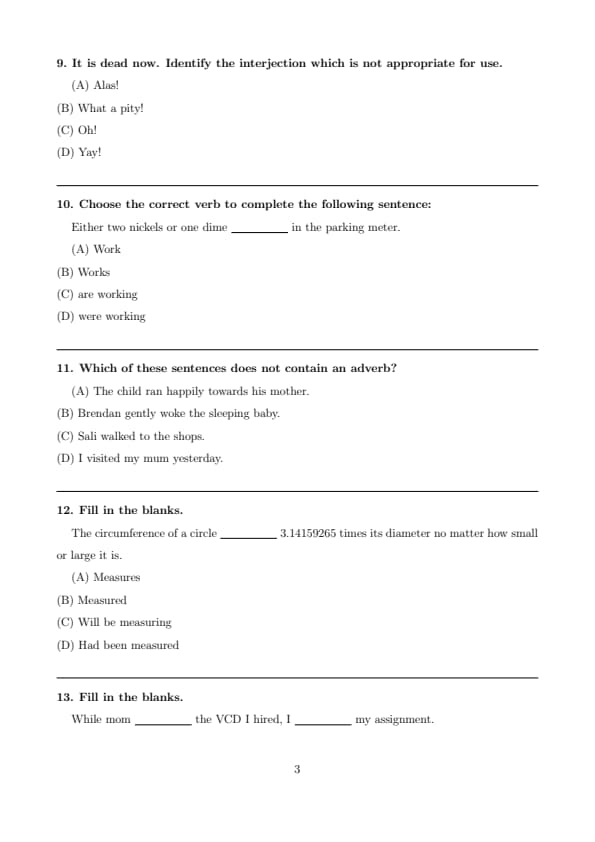
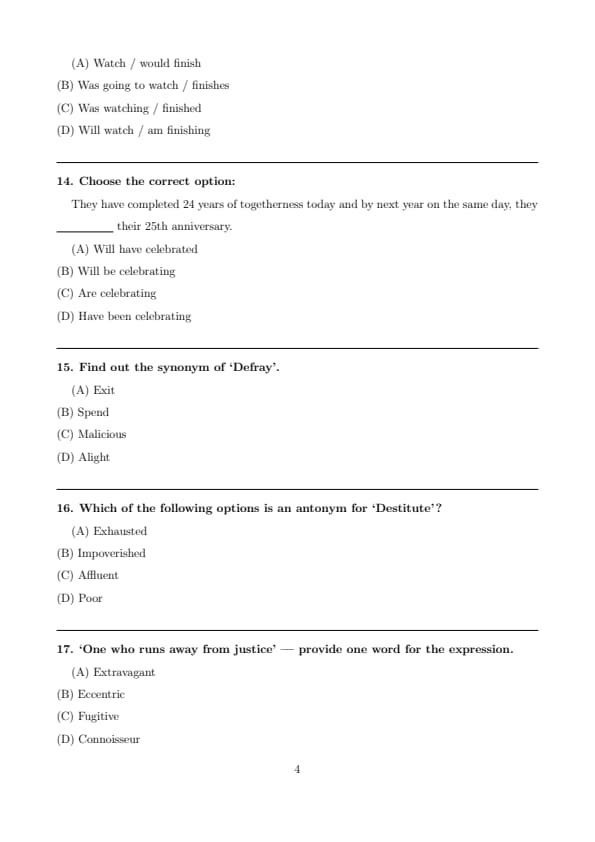
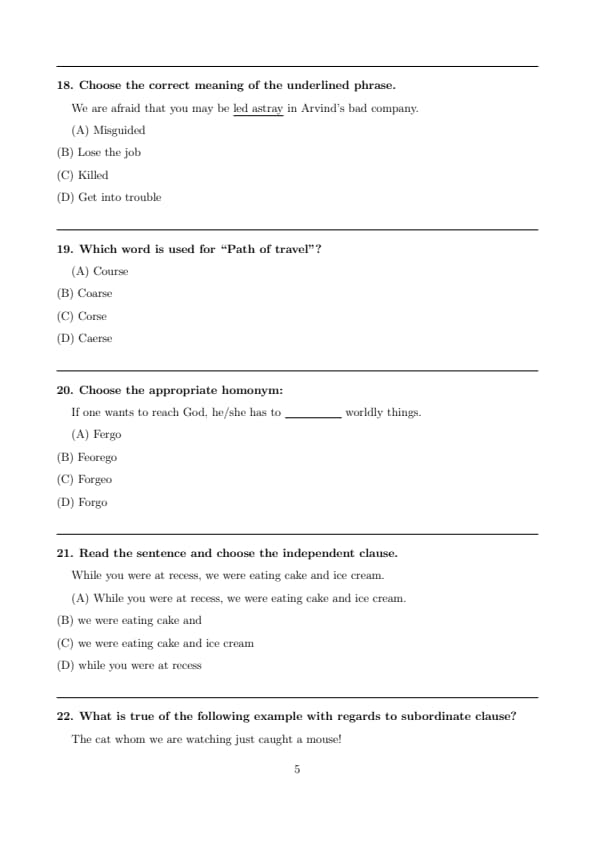
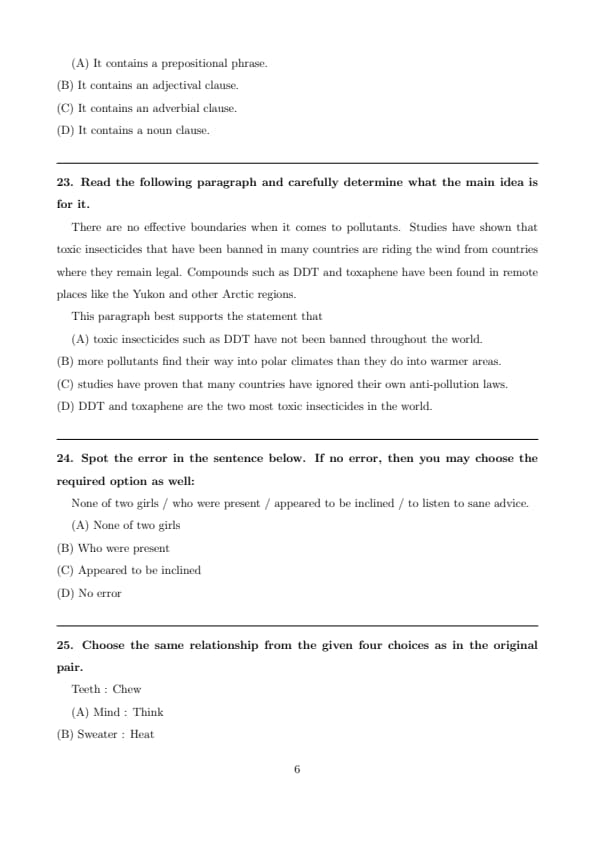
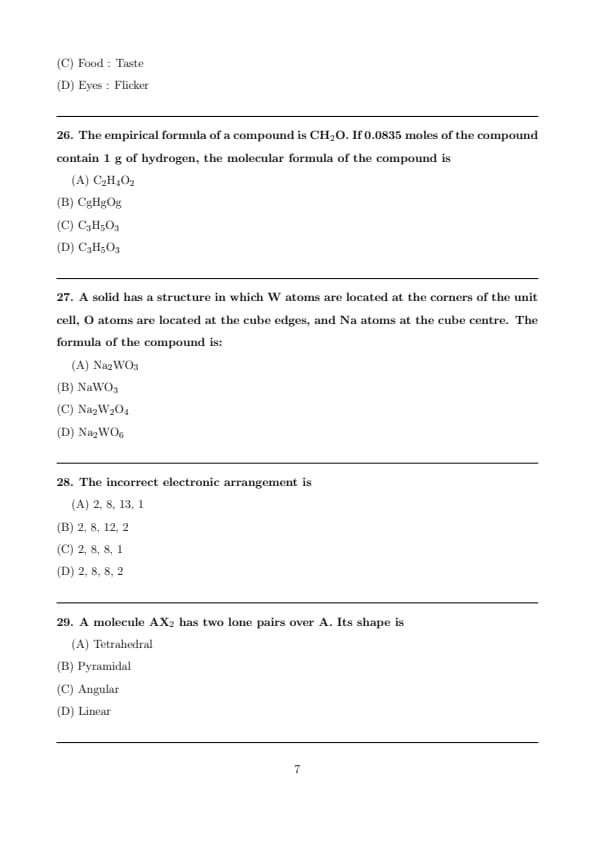
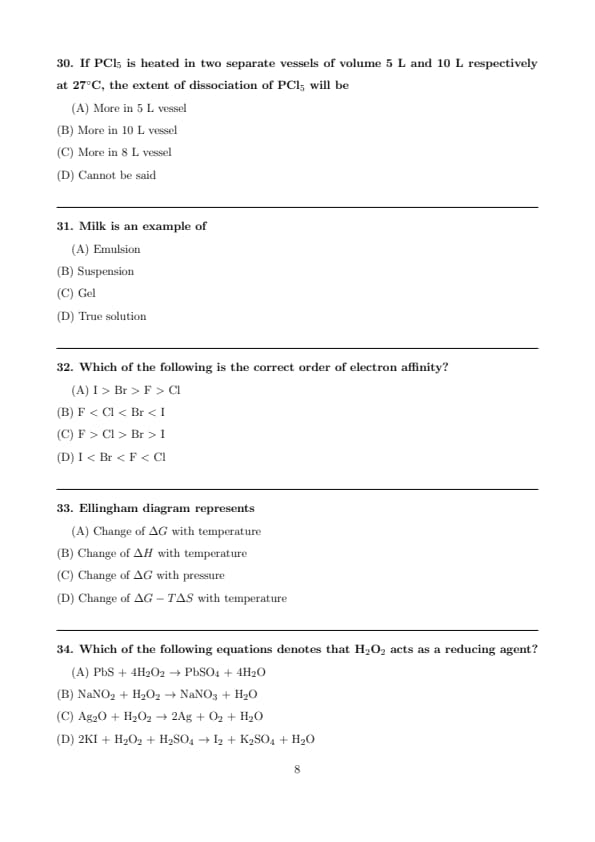
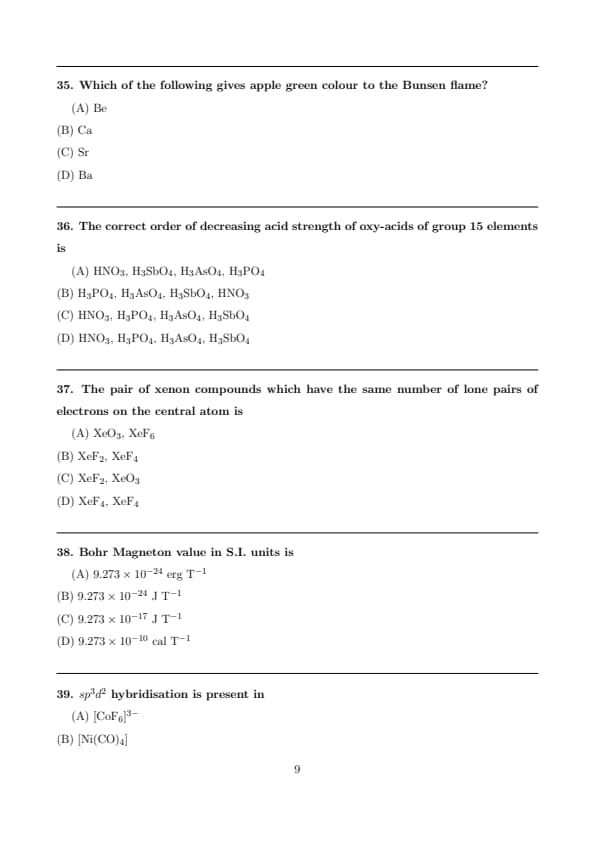
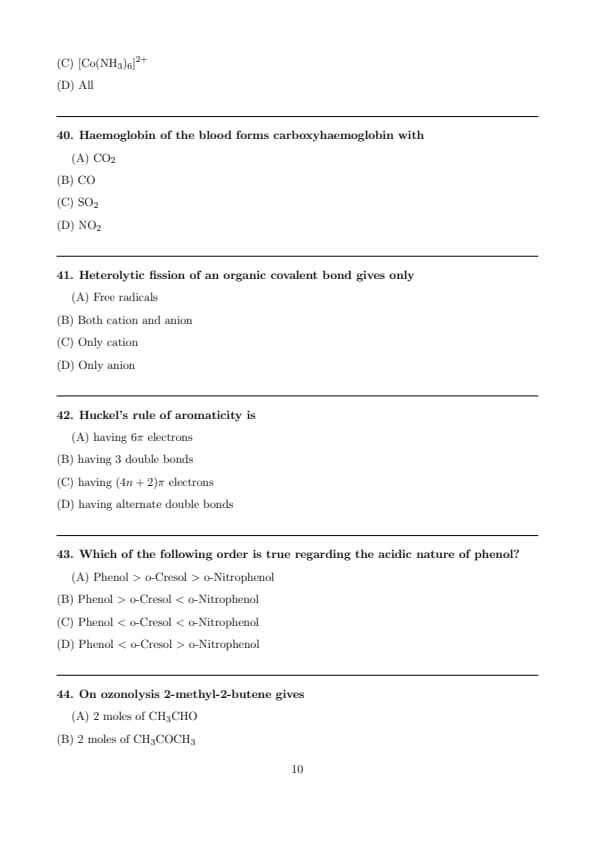
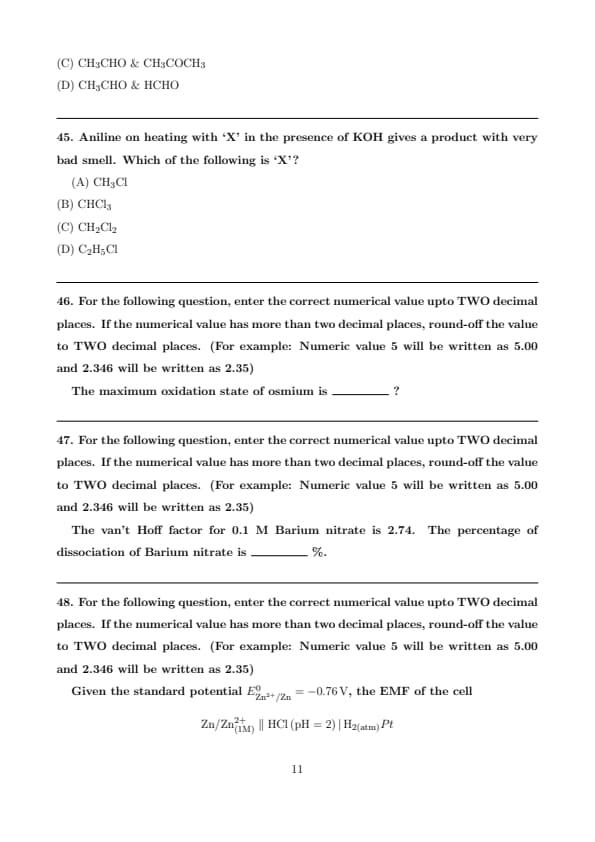
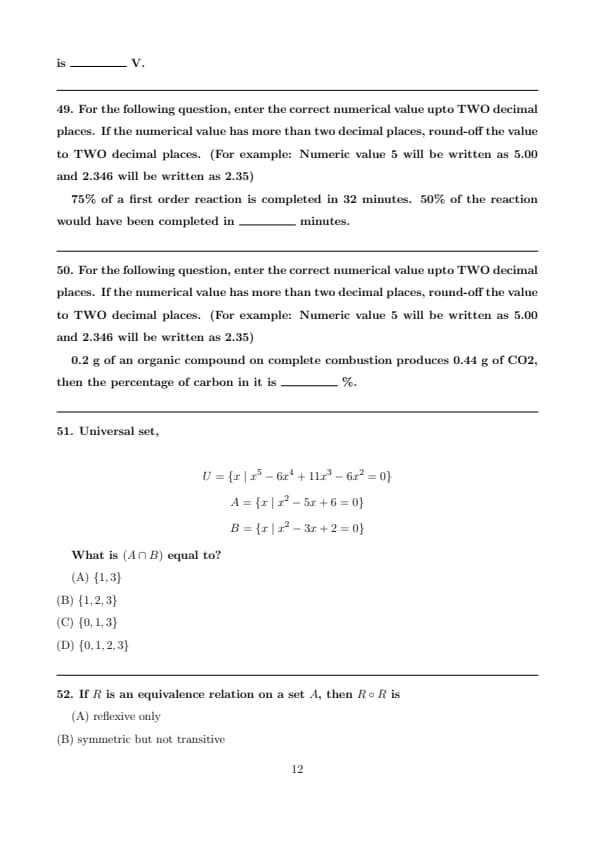
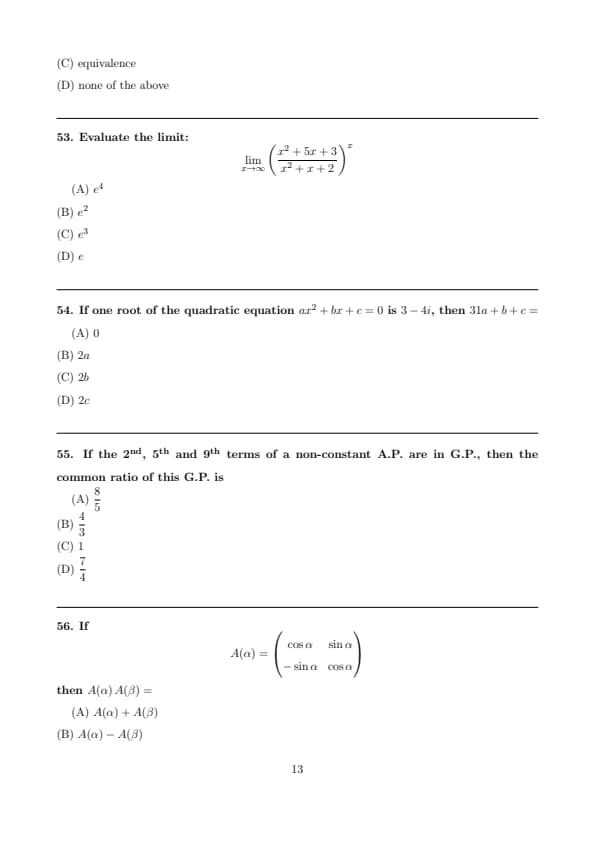
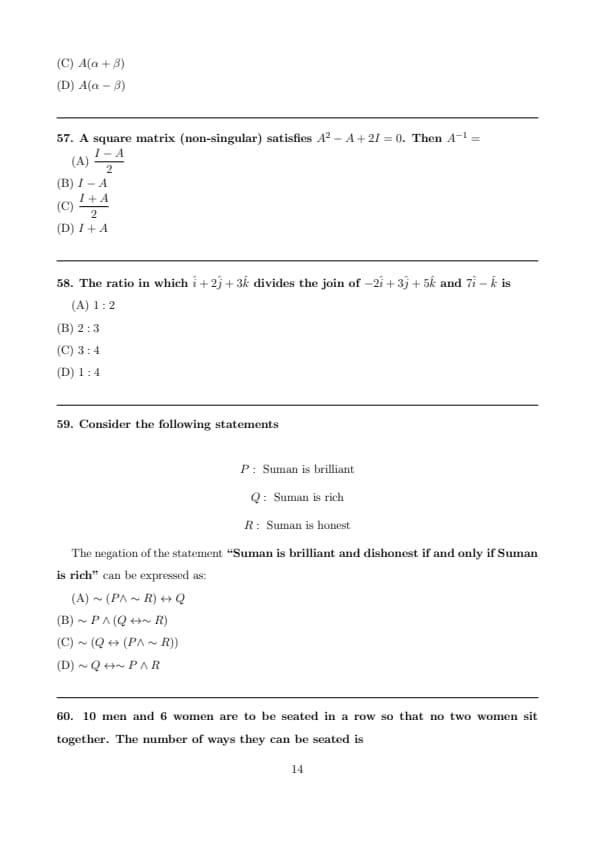
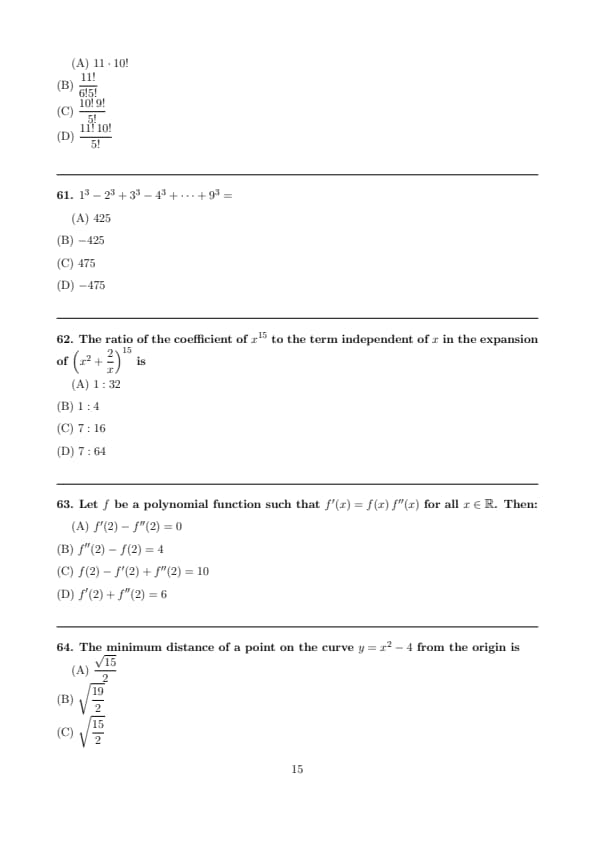
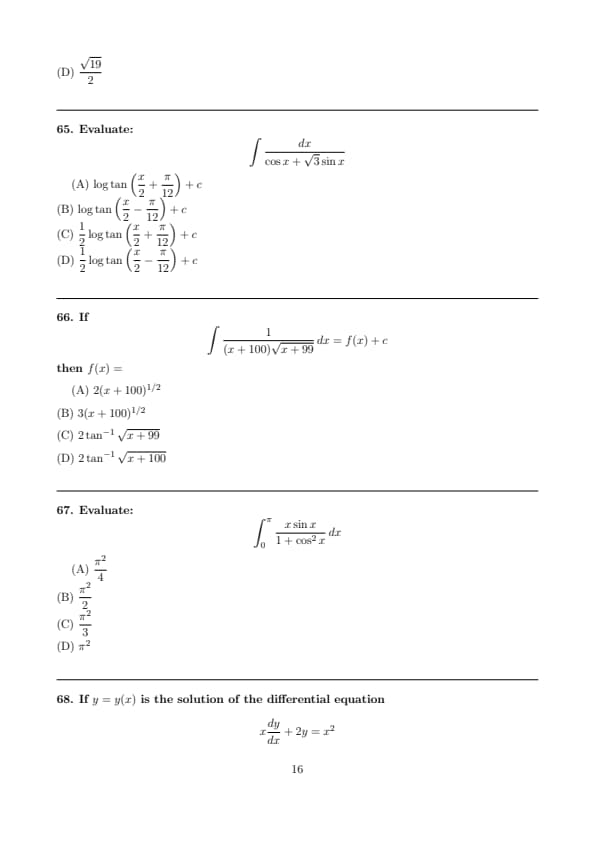
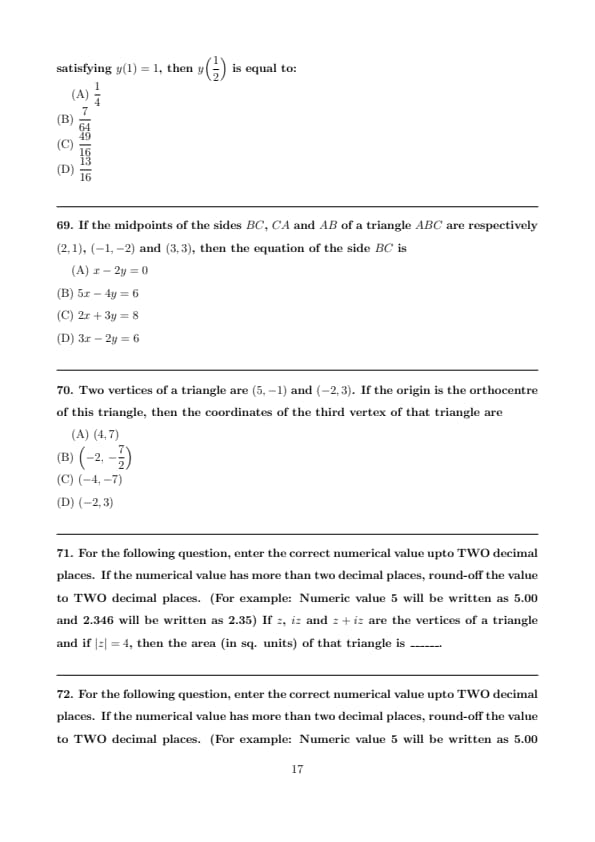
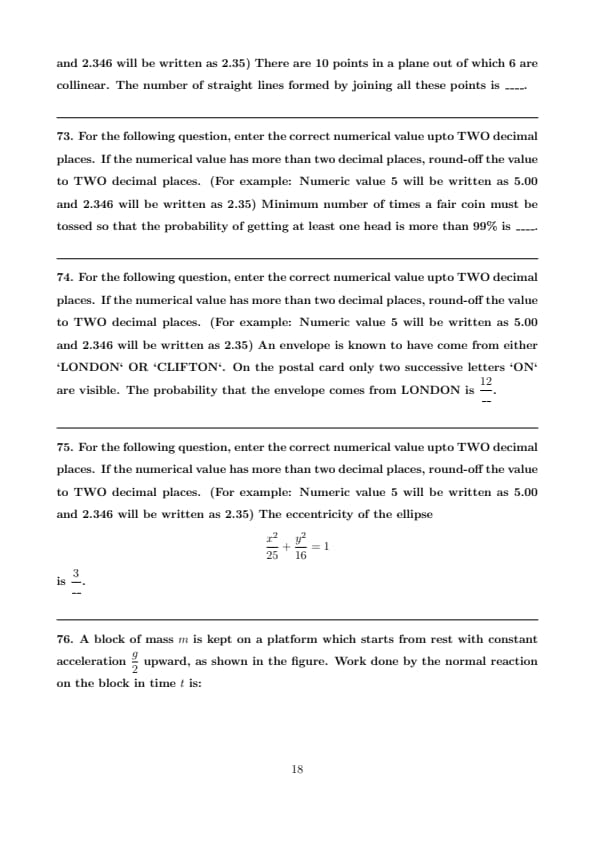
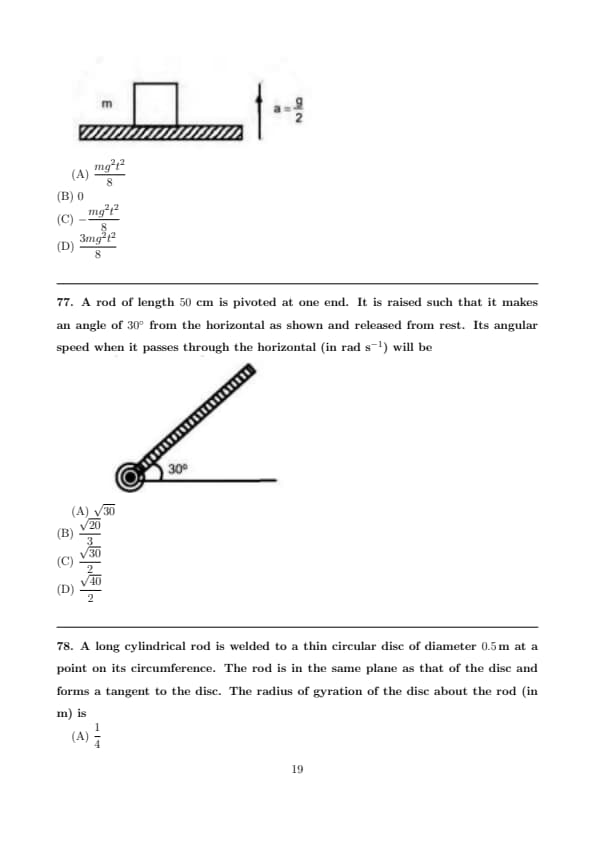
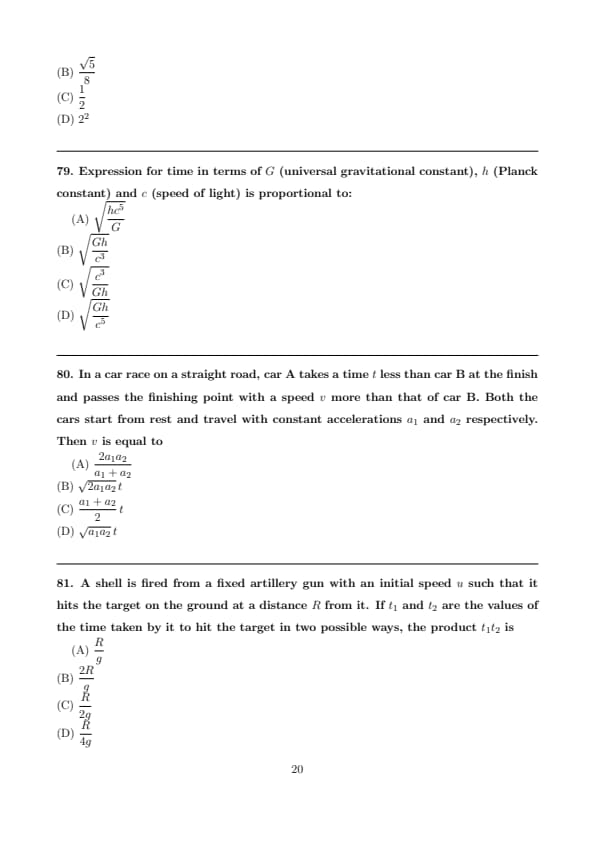



Comments