




IISER 2023 Question Paper is available for download. As per the schedule, the IISER 2023 was held on June 17, 2023, for admission to 5-year BS-MS programmes at IISERs. The IISER 2023 Question Paper was Moderate to Tough.
IISER 2023 Question Paper with Solutions
| IISER 2023 Question Paper Pdf | Download PDF | View Solution |

IISER 2023 Questions with Solutions
Question 1:
Match the entries in Column I with their functions described in Column II.

Which one of the following combinations is correct?
View Solution
The correct matching is based on the functions of each type of epithelial tissue:
- Squamous epithelium (P): This type of epithelium has its nucleus at the basal side of the cell and helps in movement of particles and mucous. This matches with function (iv).
- Cuboidal epithelium (Q): The nucleus is located at the basal side of the cell and helps in secretion and absorption, matching with function (iii).
- Columnar epithelium (R): This type of epithelium has the nucleus at the center of the cell and also helps in secretion and absorption, which matches with function (ii).
- Ciliated epithelium (S): This type of epithelium serves as a diffusion barrier, which matches with function (i).
Thus, the correct combination is: \[ P - (iv); Q - (iii); R - (ii); S - (i) \] Quick Tip: For matching types of tissues with their functions, focus on their structural features such as the location of the nucleus and their role in secretion, absorption, or movement.
Which one of the following best describes peptones?
View Solution
Peptones are the partially digested products of proteins, which occur during the process of protein digestion in the stomach. Here's a breakdown of how this happens:
Step 1: The Role of Pepsin
Pepsin is an enzyme secreted by the stomach lining. It works by breaking down large protein molecules into smaller peptides. These smaller peptides are called ``peptones."
Step 2: The Digestion Process
When you eat proteins, the stomach acid (hydrochloric acid) helps activate pepsinogen, the inactive form of pepsin, into its active form called pepsin. Pepsin then starts breaking down the protein molecules into smaller fragments, producing peptones.
Step 3: What Are Peptones?
Peptones are not fully digested proteins. They are the intermediate products of protein digestion. After pepsin has broken down proteins into peptones, these peptones will be further broken down by other digestive enzymes into smaller molecules like amino acids, which are the building blocks of proteins.
Step 4: Why is Option (A) Correct?
Since peptones are partially digested proteins that are formed during the process of digestion, option (A), "Partially digested proteins," is the correct choice.
Other Options:
- Option (B) refers to pepsinogen, which is the inactive form of pepsin, not peptones.
- Option (C) refers to the active form of pepsin, but peptones are not pepsin.
- Option (D) describes the mixture found in the intestines, which includes proteins, mucous, and bicarbonate ions, but this is not the definition of peptones.
Thus, peptones are partially digested proteins formed in the stomach by the action of pepsin. Quick Tip: When learning about digestion, remember that peptones are intermediate products that are formed when proteins are partially broken down by enzymes like pepsin in the stomach. They are not fully digested proteins.
Match the biomolecules given in Column I with their corresponding chemical nature given in Column II.

Which one of the following combinations is correct?
View Solution
Step 1: Explanation of Insulin (P)
Insulin is a protein hormone composed of amino acids and is classified as a heteropolymer. A heteropolymer is a polymer made from different types of monomers. Insulin is made from a sequence of different amino acids, so it corresponds to option (iv).
Step 2: Explanation of Inulin (Q)
Inulin is a carbohydrate polymer composed solely of fructose units, making it a homopolymer. A homopolymer consists of only one type of monomer. Thus, Inulin corresponds to option (ii).
Step 3: Explanation of Lectin (R)
Lectins are proteins that often contain carbohydrate-binding sites. They are classified as secondary metabolites because they typically function in plant defense mechanisms, making them fit with option (i).
Step 4: Explanation of Lecithin (S)
Lecithin is a phospholipid that contains a quaternary ammonium group, which makes it a quaternary ammonium derivative. Therefore, it corresponds to option (iii).
Conclusion: Based on these explanations, the correct combination is: \[ P - (iv); Q - (ii); R - (i); S - (iii) \] Quick Tip: When matching biomolecules to their chemical nature, remember:
- Homopolymers consist of a single type of monomer (like Inulin).
- Heteropolymers consist of multiple types of monomers (like Insulin).
- Secondary metabolites are often produced for functions such as defense in plants (like Lectins).
- Quaternary ammonium derivatives have nitrogen atoms bonded to four substituents (like Lecithin).
A mitotic drug inhibits microtubule formation. Which one of the following stages of karyokinesis will be the first to be affected by the drug?
View Solution
Microtubules play a crucial role in various stages of mitosis, particularly during chromosome alignment and separation. In this case, the drug inhibits microtubule formation, which would affect the stages of mitosis where microtubules are actively involved.
Step 1: The Role of Microtubules in Mitosis
Microtubules form the mitotic spindle, which is essential for chromosome movement. The spindle fibers are responsible for aligning chromosomes during metaphase and pulling them apart during anaphase.
Step 2: Effect of the Drug on Microtubules
- In prophase, microtubules begin to form the mitotic spindle, but the spindle fibers are not yet fully functional in their role of chromosome alignment.
- In metaphase, microtubules have fully formed the spindle and are actively involved in aligning chromosomes along the metaphase plate. Inhibition of microtubules would disrupt this process and cause problems in chromosome alignment.
- In anaphase, the microtubules help pull the chromosomes apart, but since the chromosomes are already aligned in metaphase, the drug would first disrupt metaphase.
- In telophase, the microtubules start to disassemble, but by this stage, most of the critical steps (alignment and separation) have already occurred.
Step 3: Conclusion
Since microtubules are most critical for aligning chromosomes during metaphase, this stage would be the first to be affected by a drug that inhibits microtubule formation.
Thus, the correct answer is Metaphase. Quick Tip: Microtubules are essential for chromosome alignment (metaphase) and separation (anaphase). Disrupting their formation will primarily affect these stages.
Which one of the following statements regarding seed structure is INCORRECT?
View Solution
Let’s analyze each statement:
Option (A): In monocot seeds, the seed coat is made up of two layers — the outer layer and the inner layer. The outer layer is the testa, and the inner layer is the aleurone layer. However, the aleurone layer is not a part of the seed coat that fuses with the fruit wall. The layer that fuses with the fruit wall is the testa. Therefore, this statement is incorrect.
Option (B): The endosperm is present in some mature dicot seeds. In dicots, the endosperm is typically absorbed by the developing embryo during seed maturation, so it is either absent or very minimal in mature dicot seeds. This statement is correct.
Option (C): In dicot seeds, the outer layer of the seed coat is indeed called the testa. This is a correct statement.
Option (D): Coleoptile and coleorhiza are found in monocot seeds. The coleoptile is a protective structure covering the young shoot in monocots, and the coleorhiza is the protective sheath covering the young root. This statement is also correct.
Thus, the incorrect statement is:
In monocot seeds, the membranous seed coat that is fused with the fruit wall is called the aleurone layer. Quick Tip: In monocot seeds, remember that the aleurone layer is part of the seed coat, but it is not fused with the fruit wall. The outer layer of the seed coat that fuses with the fruit wall is the testa.
Which one of the following anatomical features of wood can be used to estimate the age of a tree growing in a temperate climate?
View Solution
To estimate the age of a tree, dendrochronologists (scientists who study tree rings) examine the growth rings in the tree trunk. These rings are made up of two main types of wood: spring wood and late wood.
Step 1: Spring Wood and Late Wood
- Spring wood: This wood is formed during the spring and early summer, when the tree is actively growing. It has large, thin-walled cells and is lighter in color.
- Late wood: This wood forms later in the growing season, typically in late summer or fall. It has smaller, thick-walled cells and is darker in color.
The combination of spring wood and late wood forms one growth ring, which can be counted to estimate the age of the tree. Each year, a new growth ring is formed, and counting these rings gives an estimate of the tree's age.
Step 2: Why Other Options Are Incorrect
- Heart wood and sap wood (Option B): Heartwood is the central, non-living part of the tree that no longer conducts water, while sapwood is the outer, living part of the tree that conducts water. These features do not provide direct information about the tree's age.
- Spring wood and heart wood (Option C): Heartwood is not involved in the growth process and does not form annual growth rings.
- Autumn wood and sap wood (Option D): Autumn wood is not a term used to describe a specific type of wood; it is part of late wood. Sapwood is important in water transport but does not help in age estimation.
Thus, the correct answer is: \[ Spring wood and late wood. \] Quick Tip: In temperate climates, trees produce distinct growth rings composed of spring wood and late wood. Counting these rings provides a way to estimate the age of the tree.
Which one of the following statements is CORRECT about biological nitrogen fixation in plants?
View Solution
Let’s analyze each statement:
Option (A): Nitrogenase is the enzyme responsible for fixing atmospheric nitrogen (\( N_2 \)) into ammonia (\( NH_3 \)) in plants. The catalytic redox center of nitrogenase contains molybdenum (Mo) and iron (Fe) as cofactors. These elements play a critical role in the enzyme’s ability to reduce nitrogen. This statement is correct.
Option (B): While nitrogenase fixes atmospheric nitrogen, it does so by converting \( N_2 \) to ammonia (\( NH_3 \)), not nitrate (\( NO_3^- \)). The process of converting nitrogen into nitrate occurs later, in a separate process called nitrification. This statement is incorrect.
Option (C): Nitrogenase is an oxygen-sensitive enzyme, meaning that it cannot function optimally in the presence of molecular oxygen. In fact, oxygen inhibits the activity of nitrogenase, making this statement incorrect.
Option (D): The transport of amides like asparagine and glutamine in plants is indeed mediated by the phloem, but this statement is not directly related to biological nitrogen fixation, which is the focus of the question. This statement is correct, but it is not the most relevant to the question about nitrogen fixation.
Thus, the correct answer is: \[ The catalytic redox center of Nitrogenase contains Mo and Fe as cofactors. \] Quick Tip: In biological nitrogen fixation, remember that nitrogenase contains Mo and Fe as cofactors and converts atmospheric nitrogen (\( N_2 \)) into ammonia (\( NH_3 \)), not nitrate.
Which one of the following is an example of genetic diversity?
View Solution
Let’s analyze each statement:
Option (A): Genetic diversity refers to the variation in the genetic makeup of individuals within a population or species. The variation in the potency and concentration of reserpine produced by Rauvolfia vomitoria is an example of genetic diversity. This is because different genetic variants of the same species can produce different amounts of the chemical compound. Therefore, this statement is correct.
Option (B): Higher diversity of amphibians in the Western Ghats compared to the Eastern Ghats refers to species diversity or ecological diversity, not genetic diversity. Genetic diversity refers to variation within a species, not between species or populations. Thus, this statement is incorrect.
Option (C): Greater variation of ecosystems refers to ecological or environmental diversity, not genetic diversity. While ecosystems may vary across regions, genetic diversity specifically refers to variation within a species or population. This statement is also incorrect.
Option (D): The greater diversity of plant species in India compared to Central Asia refers to species diversity, not genetic diversity. Species diversity pertains to the variety of different species in a given area, not the genetic variation within a species. This statement is incorrect as well.
Thus, the correct answer is: \[ Variation in the potency and concentration of reserpine produced by \textit{Rauvolfia vomitoria. \] Quick Tip: Genetic diversity refers to the variation in the genetic makeup of individuals within a population or species, which can influence characteristics such as chemical production, appearance, and behavior.
When the ribosome encounters a stop codon in the mRNA, during translation, which one of the following binds to the stop codon?
View Solution
In the process of translation, the ribosome reads the mRNA and synthesizes proteins by adding amino acids in sequence. The translation process terminates when the ribosome encounters a stop codon (UAA, UAG, or UGA) on the mRNA.
Step 1: Role of Release Factor
When the ribosome reaches a stop codon, a protein called the release factor binds to the stop codon. The release factor helps to release the newly synthesized protein from the ribosome by promoting the hydrolysis of the bond between the polypeptide and the tRNA in the ribosome's P-site. This process terminates translation.
Step 2: Why Other Options are Incorrect
- Rho factor (Option B): Rho factor is involved in prokaryotic transcription termination, not in translation. It helps to terminate transcription by dissociating the RNA polymerase from the DNA template.
- Termination factor (Option C): While this term might sound relevant, the specific factor involved in terminating translation at the stop codon is the release factor, not a generic ``termination factor."
- Sigma factor (Option D): Sigma factor is involved in transcription initiation, not in translation. It helps the RNA polymerase bind to the promoter region of DNA to start transcription.
Thus, the correct answer is: \[ Release factor. \] Quick Tip: In translation, remember that the release factor binds to the stop codon to terminate translation and release the polypeptide from the ribosome.
Match the terms in column I with their corresponding physiological roles given in Column II.

Which one of the following combinations is correct?
View Solution
Let’s analyze the physiological roles and their corresponding terms:
Option (A):
- Sertoli cells (P): Sertoli cells are located in the seminiferous tubules of the testes. They are responsible for providing nutrition to developing spermatozoa. This matches with option (iv).
- Follicle stimulating hormone (Q): Follicle stimulating hormone (FSH) is involved in stimulating the growth and maturation of ovarian follicles in females and sperm production in males. In females, FSH triggers ovulation, which matches with option (v).
- Placenta (R): The placenta produces and secretes chorionic gonadotropin, which is important in maintaining pregnancy. This corresponds to option (i).
- Urethra (S): The urethra is responsible for carrying urine away from the bladder, which corresponds to option (ii).
Thus, the correct combination is: \[ P - (iv); Q - (v); R - (i); S - (ii) \] Quick Tip: Remember: - Sertoli cells provide nutrition to sperm. - FSH triggers ovulation in females. - The placenta secretes chorionic gonadotropin. - The urethra carries urine away from the bladder.
For which one of the following diseases does the causative agent require the splicing of their hnRNA to generate mature mRNA?
View Solution
For the maturation of mRNA, the process of splicing is required, where introns are removed and exons are joined together to form the mature mRNA. This process happens in eukaryotic cells after transcription of hnRNA (heterogeneous nuclear RNA).
Step 1: Malaria and Splicing of hnRNA
The causative agent of malaria is Plasmodium, a protozoan parasite. \textit{Plasmodium is eukaryotic, and it undergoes splicing of its hnRNA to generate mature mRNA. The process is essential for the proper expression of its genes required for survival and infectivity. Therefore, the correct answer is malaria.
Step 2: Other Diseases
- Pertussis (Option B): The causative agent of pertussis, \textit{Bordetella pertussis, is a bacterium. It does not have a process of splicing because it does not have introns in its genes. This process is characteristic of eukaryotes, not prokaryotes.
- Typhoid (Option C): The causative agent of typhoid, \textit{Salmonella typhi, is also a bacterium. Similar to pertussis, it does not perform splicing of hnRNA because it lacks introns.
- Tuberculosis (Option D): The causative agent of tuberculosis, \textit{Mycobacterium tuberculosis, is a bacterium, and like other prokaryotes, it does not perform splicing.
Thus, the correct answer is: \[ Malaria \] Quick Tip: In eukaryotic organisms like \textit{Plasmodium, splicing of hnRNA to form mature mRNA is an essential process. Bacteria do not undergo mRNA splicing since they lack introns in their genes.
The diagram represents an enzyme, its substrate and potential inhibitors (P, Q, R, S, T).

Which one of the following combinations is the best pair of competitive inhibitors for the enzyme?
View Solution
In competitive inhibition, the inhibitor competes with the substrate for binding at the enzyme's active site. The enzyme has a specific active site where both the substrate and the competitive inhibitors can bind. The best pair of competitive inhibitors would be those that closely resemble the shape of the substrate and effectively compete for the active site.
Step 1: Analyzing the Inhibitors
- In the given diagram, the competitive inhibitors should resemble the substrate (shown as the triangle) and block the active site from binding the substrate.
- Inhibitor P and Inhibitor S both have structures that seem to closely resemble the substrate in the diagram. Therefore, they would compete for the active site.
Step 2: Other Options
- Option B: Q, R – Inhibitors Q and R do not resemble the substrate shape as closely as P and S, making them less likely to be competitive inhibitors.
- Option C: S, T – Although S is a good competitive inhibitor, T does not resemble the substrate shape and is likely not a competitive inhibitor.
- Option D: R, T – Neither R nor T resembles the substrate sufficiently to be competitive inhibitors.
Thus, the correct answer is: \[ P, S \] Quick Tip: In competitive inhibition, inhibitors that closely resemble the substrate in shape can bind to the enzyme's active site and prevent the substrate from binding. Look for inhibitors with similar shapes to the substrate.
In an island with 10,000 individuals, four have sickle cell anemia, a recessive autosomal disease. Assuming that the locus is in Hardy-Weinberg equilibrium, how many individuals in that island are expected to be heterozygous for the disease allele?
View Solution
The Hardy-Weinberg equilibrium equation is given by: \[ p^2 + 2pq + q^2 = 1 \]
where:
- \( p \) is the frequency of the dominant allele (normal hemoglobin allele),
- \( q \) is the frequency of the recessive allele (sickle cell allele),
- \( p^2 \) is the frequency of individuals with the homozygous dominant genotype (normal),
- \( 2pq \) is the frequency of heterozygous individuals (carriers),
- \( q^2 \) is the frequency of individuals with the homozygous recessive genotype (having sickle cell anemia).
Step 1: Determining the frequency of the recessive allele, \( q \)
Since sickle cell anemia is a recessive condition, individuals with the disease have the homozygous recessive genotype, represented by \( q^2 \). There are 4 individuals with sickle cell anemia in the population of 10,000.
So, \( q^2 = \frac{4}{10000} = 0.0004 \).
\[ q = \sqrt{0.0004} = 0.02 \]
Step 2: Determining the frequency of heterozygous individuals, \( 2pq \)
The frequency of heterozygous individuals is represented by \( 2pq \).
First, we need to calculate \( p \), the frequency of the normal allele: \[ p = 1 - q = 1 - 0.02 = 0.98 \]
Now, we calculate the frequency of heterozygous individuals: \[ 2pq = 2 \times 0.98 \times 0.02 = 0.0392 \]
Step 3: Calculating the number of heterozygous individuals in the population
To find the number of heterozygous individuals, we multiply the frequency of heterozygous individuals by the total population size: \[ Number of heterozygous individuals = 0.0392 \times 10000 = 392 \]
Thus, the number of heterozygous individuals is 392. Quick Tip: In Hardy-Weinberg equilibrium, to calculate the number of heterozygous individuals, use the formula \( 2pq \), where \( p \) and \( q \) are the frequencies of the dominant and recessive alleles, respectively. The number of heterozygous individuals can then be found by multiplying \( 2pq \) by the total population size.
A 1000 base-pair DNA fragment was cloned between Hind III and EcoR I sites of the plasmid vector (pIAT) of size 3500 base-pair. The cloned fragment had a Not I site as shown in the figure. In order to confirm the presence of the insert, the recombinant plasmid was digested completely with (a) Not I and EcoR I, and (b) Not I and Hind III.
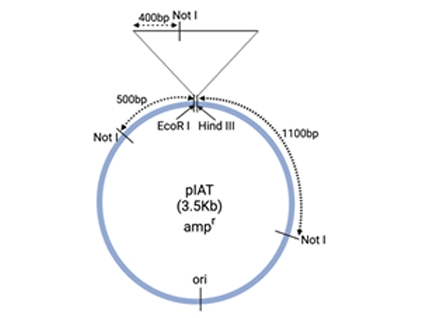
In lane 1 the products of the digestion by Not I and EcoR I was loaded. In lane 2 the products of the digestion by Not I and Hind III was loaded. Which one of the following correctly represents the agarose gel electrophoresis profile of the digested recombinant plasmid for (a) and (b), respectively?


View Solution
In this question, we need to analyze the results of the enzyme digests of the recombinant plasmid to identify the size of the fragments.
Step 1: Understanding the Digestion with Not I and EcoR I (Lane 1)
- The plasmid vector has a size of 3500 base-pairs. When the plasmid is digested with Not I and EcoR I, the 1000 base-pair inserted fragment will be cleaved from the plasmid, leaving fragments of 600 bp and 500 bp from the vector and the insert.
Step 2: Understanding the Digestion with Not I and Hind III (Lane 2)
- The recombinant plasmid, when digested with Not I and Hind III, will generate two fragments. The 1000 bp insert is cut by Hind III, resulting in the plasmid vector being cleaved into two fragments of 1900 bp, which is the correct result for Lane 2.
Thus, the agarose gel profiles for the two digests are:
- Lane 1 (Not I and EcoR I): Two fragments of 600 bp and 500 bp.
- Lane 2 (Not I and Hind III): Two fragments of 1900 bp.
The correct answer is: \[ Lane 1: 600, 500 bp; Lane 2: 1900, 1900 bp. \] Quick Tip: When analyzing restriction enzyme digestion patterns, always remember to account for the sizes of the fragments produced. Digesting with two different enzymes will generate fragments that correspond to the cuts made by each enzyme, resulting in specific fragment sizes.
The following pedigree chart shows the inheritance of a genetic disorder. I-2 and III-2 are the only affected individuals.

Which one of the following is the correct pattern of inheritance of the disorder, and the genotype of the II-3 individual?
View Solution
Let’s analyze the pedigree and the given information:
1. The pedigree shows two affected individuals, I-2 and III-2. In autosomal recessive inheritance, two affected individuals must have both inherited the recessive allele from their parents. Since both I-2 and III-2 are affected, their genotypes must be homozygous recessive (aa).
2. For the II-3 individual, we know that their parents are II-2 (unaffected) and III-2 (affected). For II-3 to inherit the disorder, they must have inherited one recessive allele from the affected parent (III-2), and the other recessive allele must come from the unaffected parent (II-2) who must carry the recessive allele (heterozygous, Aa). Hence, II-3 must be heterozygous (Aa).
3. The disorder follows an autosomal recessive pattern because both parents of II-3 are unaffected, but one of them is a carrier (heterozygous), and the other is affected.
Thus, the correct pattern of inheritance is autosomal recessive, and the genotype of the II-3 individual is heterozygous (Aa). Quick Tip: In autosomal recessive inheritance, both parents must carry at least one copy of the recessive allele, and the affected offspring will have a homozygous recessive genotype (aa). Heterozygous carriers (Aa) do not show the trait but can pass on the recessive allele.
How many radial nodes does \( Ca^{+} \) have in its 4s orbital?
View Solution
To determine the number of radial nodes in an orbital, we use the following formula: \[ Number of radial nodes = n - l - 1 \]
where:
- \( n \) is the principal quantum number, and
- \( l \) is the azimuthal quantum number.
For the 4s orbital:
- The principal quantum number, \( n \), is 4.
- The azimuthal quantum number for the s orbital, \( l \), is 0.
So, the number of radial nodes is: \[ Number of radial nodes = 4 - 0 - 1 = 3 \]
Hence, the 4s orbital of \( Ca^{+} \) has 3 radial nodes.
Thus, the correct answer is: \[ 3 \] Quick Tip: To calculate the number of radial nodes, subtract the azimuthal quantum number from the principal quantum number and subtract 1. For s orbitals, \( l = 0 \).
Amongst \( O_2 \), \( N_2 \), \( F_2 \), and \( B_2 \), which molecules will be attracted to an external magnetic field?
View Solution
The behavior of a molecule in an external magnetic field is related to its magnetic susceptibility. Some molecules, such as \( O_2 \) and \( B_2 \), exhibit paramagnetism, meaning they are attracted to an external magnetic field due to the presence of unpaired electrons.
- Oxygen (\( O_2 \)): Oxygen molecules have two unpaired electrons in their molecular orbital configuration, making \( O_2 \) paramagnetic and attracted to an external magnetic field.
- Boron (\( B_2 \)): \( B_2 \) also has unpaired electrons in its molecular orbitals and exhibits paramagnetism, which means it will be attracted to an external magnetic field.
- Nitrogen (\( N_2 \)): \( N_2 \) is a diamagnetic molecule, meaning it does not have any unpaired electrons and will not be attracted to an external magnetic field.
- Fluorine (\( F_2 \)): Fluorine molecules also have paired electrons and are diamagnetic, meaning they are not attracted to a magnetic field.
Thus, the molecules that will be attracted to an external magnetic field are \( O_2 \) and \( B_2 \), which are both paramagnetic. Quick Tip: To determine whether a molecule will be attracted to an external magnetic field, check for unpaired electrons. Paramagnetic molecules, such as \( O_2 \) and \( B_2 \), have unpaired electrons and will be attracted to a magnetic field.
What is the smallest P–P–P bond angle in the highly reactive allotrope of phosphorus?
View Solution
The highly reactive allotrope of phosphorus is white phosphorus. White phosphorus consists of \(P_4\) molecules with a tetrahedral structure, where the phosphorus atoms are bonded to each other.
In a tetrahedral structure, the bond angles between the atoms are approximately 109.5°, which is typical for sp³ hybridized orbitals. However, due to the high reactivity and the strained nature of the molecule, the P-P-P bond angles in white phosphorus are distorted, and the smallest bond angle is approximately 60°.
Thus, the correct answer is: \[ 60° \] Quick Tip: In white phosphorus, the \(P_4\) molecule has a highly strained structure with a smaller bond angle of about 60°, which is far from the typical tetrahedral angle (109.5°) due to its reactivity.
Which of the following is an ore of iron?
View Solution
An ore is a naturally occurring mineral or rock from which metals can be extracted profitably. Let's break down the given options:
Option (A): Siderite
- Siderite is an ore of iron. It is a mineral composed of iron carbonate (\( FeCO_3 \)). In the process of mining, siderite is often used as a source of iron, which is then refined to produce usable metal. This makes siderite a significant ore of iron.
Option (B): Bauxite
- Bauxite is an ore of aluminum, not iron. It is a mineral that contains mainly aluminum oxides, particularly gibbsite (\( Al(OH)_3 \)) and boehmite (\( AlO(OH) \)). Bauxite is one of the most important sources for extracting aluminum, not iron. Therefore, bauxite is not an ore of iron.
Option (C): Malachite
- Malachite is an ore of copper. It is a copper carbonate mineral, with the chemical formula \( Cu_2CO_3(OH)_2 \). Malachite is commonly used to extract copper metal, making it an important ore for copper production, but it is not an ore of iron.
Option (D): Quartz
- Quartz is a mineral made of silicon dioxide (\( SiO_2 \)) and is one of the most common minerals in the Earth's crust. However, quartz is not an ore of any metal, including iron. It is often found in various rocks but does not contain a metal that can be extracted profitably like siderite does with iron.
Thus, the correct answer is: \[ Siderite (A) \] Quick Tip: When studying ores, remember that each metal has a specific ore associated with it. For example: - Bauxite is the ore of aluminum, - Malachite is the ore of copper, - Siderite is the ore of iron. Identifying the ore associated with each metal is crucial in understanding how metals are extracted from the Earth.
Which parameters are plotted in the Ellingham diagram?
View Solution
The Ellingham diagram is a graphical representation used in metallurgy to show the temperature dependence of the standard Gibbs free energy change (\( \Delta_r G^\circ \)) for various reactions, typically reduction reactions.
Key Concept:
In an Ellingham diagram:
- The y-axis represents the standard Gibbs free energy change (\( \Delta_r G^\circ \)) of a reaction.
- The x-axis represents the temperature (T), usually in Kelvin.
The Ellingham diagram is primarily used to predict the feasibility of reduction reactions by comparing the Gibbs free energy for different reactions as a function of temperature. A more negative \( \Delta_r G^\circ \) means that a reaction is more likely to occur.
Step 1: Understanding the options:
- Option (A) is correct because the Ellingham diagram plots \( \Delta_r G^\circ \) versus temperature (\( T \)).
- Option (B) is incorrect because \( \Delta_r H^\circ \) (enthalpy change) is not plotted in the Ellingham diagram.
- Option (C) is incorrect because \( \Delta_r S^\circ \) (entropy change) is also not plotted in the Ellingham diagram.
- Option (D) is incorrect because the diagram does not plot entropy change \( \Delta_r S^\circ \) against pressure (\( P \)).
Thus, the correct answer is: \[ Option (A): \Delta_r G^\circ vs T \] Quick Tip: In the Ellingham diagram, focus on the plot of Gibbs free energy (\( \Delta_r G^\circ \)) versus temperature (\( T \)) to understand the feasibility of reactions, particularly reduction processes.
Which of the following compounds will NOT undergo the Finkelstein reaction with NaI via \( S_N2 \) pathway?
View Solution
The Finkelstein reaction involves the nucleophilic substitution of a halide (typically \( I^- \)) on an alkyl halide (usually in polar aprotic solvents) via the \( S_N2 \) mechanism. The key characteristics for the \( S_N2 \) pathway are:
- The leaving group must be a halide.
- The carbon attached to the leaving group should be sp\(^2\) or sp\(^3\) hybridized, but should not be too sterically hindered (i.e., the carbon should not be part of a bulky group).
- The reaction proceeds via a backside attack, which is difficult if the carbon is involved in conjugation with an aromatic ring (such as in aryl halides).
Now, let's examine the compounds:
Compound I: This is a primary alkyl bromide, which is an ideal candidate for the \( S_N2 \) reaction with NaI. Therefore, it will undergo the Finkelstein reaction.
Compound II: This is a benzyl bromide (primary alkyl halide attached to a benzene ring). Although the carbon is primary, the benzyl group can stabilize the transition state, making it a good candidate for the \( S_N2 \) reaction. This compound will undergo the reaction.
Compound III: This is a vinyl bromide (C=C-Br). Vinyl halides generally do not undergo \( S_N2 \) reactions because the double bond (sp\(^2\) hybridization) makes the carbon too electrophilic for backside attack. Therefore, it will not undergo the Finkelstein reaction.
Compound IV: This is a secondary alkyl bromide. Secondary alkyl halides can undergo the \( S_N2 \) reaction, and this one will undergo the reaction with NaI.
Thus, compounds II and III will not undergo the Finkelstein reaction via the \( S_N2 \) pathway. The correct answer is: \[ II and III \] Quick Tip: For the Finkelstein reaction to occur via \( S_N2 \), the substrate should be a primary or secondary alkyl halide. Aryl halides (such as in compound III) typically do not undergo \( S_N2 \) due to steric hindrance and electronic effects.
Which one amongst the following is the most efficient way of synthesizing n-propyl benzene?

View Solution
Let's analyze each reaction step by step to identify the most efficient method for synthesizing n-propyl benzene.
Reaction (I):
- This reaction involves the Friedel-Crafts alkylation of benzene with 1-chloro-2-propane (a chloroalkane) using anhydrous \(AlCl_3\) as a catalyst. The reaction proceeds efficiently to form n-propyl benzene, as this is a typical method for alkylation of aromatic rings. This reaction is straightforward and efficient.
Reaction (II):
- This reaction involves the reaction of benzene with 1-chloropropane in the presence of anhydrous \(AlCl_3\). While this is also a Friedel-Crafts alkylation, the presence of chlorine on the alkyl group might not be the most efficient for the synthesis of n-propyl benzene, and it can also lead to multiple alkylation products.
Reaction (III):
- In this reaction, the combination of benzene and propanol (\( C_3H_7OH \)) with an acid catalyst (\( H^+ \)) leads to dehydration. However, this reaction can suffer from poor yields due to side reactions, making it less efficient than the Friedel-Crafts alkylation.
Reaction (IV):
- This reaction involves the combination of benzene with propene (\( C_3H_6 \)) under acidic conditions. This reaction could lead to a mixture of products, including different isomers of propyl groups, which reduces the selectivity and efficiency of the process. The reaction is not as efficient as the Friedel-Crafts alkylation.
Thus, the most efficient method for synthesizing n-propyl benzene is via the Friedel-Crafts alkylation as shown in reaction (I).
Thus, the correct answer is: \[ Option (A): I \] Quick Tip: For efficient alkylation reactions, the Friedel-Crafts alkylation using alkyl halides (like chloroalkanes) with anhydrous \(AlCl_3\) is a highly effective method for adding alkyl groups to an aromatic ring.
Which amongst the following are chiral compounds?

View Solution
To determine if a compound is chiral, it must have a chiral center, which is a carbon atom bonded to four different substituents. Let’s analyze the compounds:
Compound (I):
- This is an amine compound with a methyl group (\( CH_3 \)), hydrogen, and an amino group (\( NH_2 \)) on a cyclohexane ring. The carbon in this compound is attached to two hydrogen atoms (one directly and one indirectly through the ring). Therefore, it does not have four different substituents and is not chiral.
Compound (II):
- This compound has a nitrogen atom (\( NH_2 \)) attached to a carbon atom which is bonded to a methyl group (\( Me \)), a hydrogen atom, and a second \( NH_2 \) group. The central carbon is bonded to four different groups and is therefore chiral.
Compound (III):
- This compound is an aldehyde with a double bond to oxygen. The carbon attached to the oxygen is part of a conjugated system and does not have four different substituents, so it is not chiral.
Compound (IV):
- This compound has a hydroxyl group (\( OH \)) and a methyl group (\( Me \)) attached to a carbon atom in a ring. The central carbon is bonded to four different groups (a hydrogen, a hydroxyl group, a methyl group, and a part of the ring), making it chiral.
Thus, the chiral compounds are:
- Compound II and Compound IV.
Therefore, the correct answer is: \[ Option (A): II and IV \] Quick Tip: To check if a compound is chiral, ensure that the central carbon has four different substituents. If the carbon has two or more identical groups, the compound is not chiral.
Which one amongst the following bases is NOT present in RNA?

View Solution
RNA contains four nitrogenous bases: adenine (A), guanine (G), cytosine (C), and uracil (U). Let's break down the given options:
Compound (I):
- This structure represents **adenine (A)**, which is a purine base found in RNA. Therefore, it is present in RNA.
Compound (II):
- This structure represents guanine (G), which is another purine base found in RNA. It is present in RNA.
Compound (III):
- This structure represents **thymine (T)**, which is a pyrimidine base found in DNA but **NOT in RNA**. In RNA, thymine is replaced by uracil (U), making thymine absent from RNA.
Compound (IV):
- This structure represents uracil (U), which is the base that replaces thymine in RNA. Therefore, uracil is present in RNA.
Thus, the correct answer is that thymine (III) is the base not present in RNA.
Thus, the correct answer is: \[ Option (A): III \] Quick Tip: Remember, RNA contains adenine (A), guanine (G), cytosine (C), and uracil (U), while DNA contains thymine (T) instead of uracil.
Which amongst the following are aromatic?

View Solution
To determine if a compound is aromatic, we use the following criteria (Huckel's rule):
1. The molecule must be cyclic (forming a ring).
2. The molecule must be planar, meaning all atoms in the ring lie in the same plane.
3. The molecule must have a conjugated \(\pi\)-electron system (alternating single and double bonds or lone pairs that can delocalize).
4. The total number of \(\pi\)-electrons must satisfy the formula \(4n + 2\), where \(n\) is a non-negative integer (0, 1, 2, ...). This is known as Huckel's rule.
\medskip
Let's analyze each compound:
Compound I (Tropylium ion):
- It is a 7-membered cyclic cation with three double bonds.
- It has 6 \(\pi\)-electrons (each double bond contributes 2 electrons).
- It is planar and the positive charge allows the ring to be fully conjugated.
- Since 6 satisfies \(4n + 2\) where \(n = 1\), it is aromatic.
Compound II (Oxonium ion in heterocycle):
- It is a 6-membered ring with oxygen and a positive charge.
- It has 6 \(\pi\)-electrons in the ring system, counting the double bonds and lone pairs contributing to conjugation.
- The ring is planar and fully conjugated.
- 6 electrons satisfy \(4n + 2\) with \(n=1\), so it is aromatic.
Compound III (Cyclooctatetraene dianion):
- It has 8 carbon atoms in a ring with 4 double bonds.
- It has 10 \(\pi\)-electrons in total as a dianion (adding 2 extra electrons).
- However, it adopts a non-planar, tub-shaped conformation to reduce ring strain, preventing full conjugation.
- Because it is not planar, it does not satisfy aromaticity requirements.
Compound IV (Cyclobutadiene):
- It is a 4-membered ring with 2 double bonds.
- It has 4 \(\pi\)-electrons.
- Although planar, having 4 electrons fits \(4n\) rather than \(4n+2\) and makes it antiaromatic (unstable).
- Hence, it is not aromatic.
Therefore, only compounds I and II meet all the criteria and are aromatic. Quick Tip: Aromaticity depends on cyclic structure, planarity, conjugation, and following Huckel's rule: \(4n+2\) \(\pi\)-electrons. Always check each condition carefully.
Why is it harder to compress liquids and solids relative to gases?
View Solution
Compression involves decreasing the volume of a substance by pushing its particles closer together.
- In solids and liquids, the molecules are already very close to each other with little empty space between them. This close packing means there is very limited space to push the molecules closer, making compression difficult.
- In gases, molecules are far apart with a lot of empty space between them. When pressure is applied, the molecules can be pushed closer easily, resulting in significant volume reduction.
- Hence, solids and liquids are much harder to compress compared to gases.
- Options (B) and (C) incorrectly attribute the difficulty to electron-nuclear attraction, which is not the primary reason for compressibility differences.
- Option (D) is true (solids and liquids have definite volume), but this is a consequence rather than the reason for hardness to compress. Quick Tip: The ease of compressibility depends on how much empty space is between particles; gases have large spaces, solids and liquids have very little.
Related to the Freundlich adsorption isotherm, which one of the following statements is NOT correct?
View Solution
The Freundlich adsorption isotherm is an empirical relationship that describes adsorption on heterogeneous surfaces. It is expressed as: \[ x/m = kP^{1/n} \]
where \(x/m\) is the amount of adsorbate adsorbed per unit mass of adsorbent, \(P\) is the pressure, \(k\) and \(n\) are constants.
- Statement (A) is NOT correct because the Freundlich isotherm holds well only over a limited range of pressures. It does not accurately describe adsorption at very high pressures, where adsorption tends to saturate.
- Statement (B) is correct: the value of \( \frac{1}{n} \) lies between 0 and 1, indicating favorable adsorption.
- Statement (C) is correct: the Freundlich isotherm is empirical, based on experimental observations rather than derived from theory.
- Statement (D) is correct: it applies to adsorption of gases as well as solutes from solutions.
Hence, the incorrect statement is (A). Quick Tip: Freundlich adsorption isotherm is empirical and valid only at moderate pressures; it describes heterogeneous surface adsorption and is characterized by constants \(k\) and \(n\).
Consider the following reaction:
\(\mathrm{CH_4(g)} \rightarrow \mathrm{C(g)} + 4\mathrm{H(g)}; \quad \Delta_a H^0 = 1665 kJ mol^{-1}\)
Which of the statements is FALSE?
View Solution
- The given \(\Delta_a H^0 = 1665 kJ mol^{-1}\) corresponds to the total bond dissociation enthalpy required to break all four C-H bonds in methane to form atomic carbon and hydrogen.
- Statement (A) is FALSE because \(\Delta_a H^0\) here represents the total bond dissociation enthalpy for breaking all four C-H bonds, not the mean bond enthalpy of a single C-H bond. The mean bond enthalpy would be \(\frac{1665}{4} = 416.25 kJ mol^{-1}\).
- Statement (B) is TRUE because in methane, all four C-H bonds are equivalent, having the same bond length and bond energy.
- Statement (C) is TRUE for many polyatomic molecules where successive bond dissociations require different energies, but in methane, due to symmetry, the individual bond dissociation energies are similar. The statement is generally true in broader cases.
- Statement (D) is TRUE because mean bond enthalpies vary slightly depending on the compound and molecular environment. Quick Tip: Bond dissociation enthalpy for all bonds in a molecule broken at once is total; the mean bond enthalpy is the average per bond.
In two solutions X (hexane and benzene) and Y (water and HCl), what types of deviations from Raoult’s law are observed?
View Solution
- Raoult's law states that the partial vapor pressure of each component in an ideal solution is proportional to its mole fraction.
- Solution X (hexane and benzene): Both are nonpolar hydrocarbons with similar intermolecular forces, resulting in nearly ideal behaviour. Therefore, no significant deviation from Raoult's law is observed.
- Solution Y (water and HCl): These components form strong hydrogen bonds and ion-dipole interactions, which are stronger than the intermolecular forces in pure components. This leads to a negative deviation from Raoult's law, where the vapor pressure is lower than predicted.
- Positive deviation occurs when intermolecular forces between unlike molecules are weaker, but that is not the case for water and HCl. Quick Tip: Ideal solutions show no deviation from Raoult's law. Negative deviations arise from stronger intermolecular attractions between unlike molecules; positive deviations occur when these attractions are weaker.
In aqueous solution, the hydronium ion gets further hydrated to give which of the following species?
View Solution
- The hydronium ion \(\mathrm{H_3O^+}\) is the simplest hydrated proton species in aqueous solution.
- However, the proton does not exist freely but is further hydrated by water molecules forming more complex species such as \(\mathrm{H_9O_4^+}\).
- The \(\mathrm{H_9O_4^+}\) ion is known as the Zundel ion or protonated water cluster, consisting of a central proton shared between two water molecules and additional hydration.
- Other species like \(\mathrm{H_7O_4^+}\), \(\mathrm{H_5O_3^+}\), and \(\mathrm{H_3O_2^+}\) are less common or do not represent the fully hydrated hydronium ion in typical aqueous solutions. Quick Tip: In aqueous solutions, protons are highly hydrated, forming complex ions such as \(\mathrm{H_9O_4^+}\), not existing as isolated \(\mathrm{H^+}\).
Let \( f : \mathbf{R} \to (0, \infty) \) be a continuous decreasing function. Suppose \( f(0), f(1), \ldots, f(10) \) are in a geometric progression with common ratio \(\frac{1}{5}\). In which of the following intervals does the value of \(\int_0^{10} f(x) \, dx\) lie?
View Solution
Step 1: Given \( f(0), f(1), \ldots, f(10) \) form a geometric progression (GP) with common ratio \( r = \frac{1}{5} \), so: \[ f(k) = f(0) \left(\frac{1}{5}\right)^k, \quad k=0,1,\ldots,10. \]
Step 2: Since \(f\) is continuous and decreasing on \([0,10]\), by the integral test for monotone functions, \[ \sum_{k=1}^{10} f(k) \leq \int_0^{10} f(x) \, dx \leq \sum_{k=0}^9 f(k). \]
Step 3: Evaluate the sums (geometric series): \[ \sum_{k=0}^9 f(k) = f(0) \sum_{k=0}^9 \left(\frac{1}{5}\right)^k = f(0) \cdot \frac{1 - (1/5)^{10}}{1 - \frac{1}{5}} = f(0) \cdot \frac{1 - (1/5)^{10}}{\frac{4}{5}} = \frac{5}{4} f(0) \left(1 - \left(\frac{1}{5}\right)^{10}\right). \]
Since \(\left(\frac{1}{5}\right)^{10}\) is very small, \[ \sum_{k=0}^9 f(k) \approx \frac{5}{4} f(0) = 1.25 f(0). \]
Similarly, \[ \sum_{k=1}^{10} f(k) = f(0) \sum_{k=1}^{10} \left(\frac{1}{5}\right)^k = f(0) \left(\sum_{k=0}^{10} \left(\frac{1}{5}\right)^k - 1\right) = f(0) \left( \frac{1 - (1/5)^{11}}{1 - \frac{1}{5}} - 1 \right)\] \[\approx f(0) \left(\frac{5}{4} - 1 \right) = 0.25 f(0). \]
Step 4: Therefore, \[ 0.25 f(0) \lesssim \int_0^{10} f(x) \, dx \lesssim 1.25 f(0). \]
Hence, the integral lies between \(0\) and approximately \(2 f(0)\), making option (A) correct. Quick Tip: For decreasing functions, the integral over an interval can be bounded by sums of function values at integers using the integral test and properties of geometric progressions.
Let \( M \) be a \( 3 \times 3 \) matrix with real entries such that \[ \left\{ \begin{bmatrix} x_1
x_2
x_3 \end{bmatrix} : M \begin{bmatrix} x_1
x_2
x_3 \end{bmatrix} = \begin{bmatrix} 0
0
0 \end{bmatrix} \right\} = \left\{ \begin{bmatrix} x_1
x_2
x_3 \end{bmatrix} : x_1 + x_2 = 0 = x_2 + x_3 \right\}. \]
What is the value of the determinant of \( M \)?
View Solution
- The set of vectors \(\mathbf{x} = (x_1, x_2, x_3)^T\) satisfying \(M \mathbf{x} = \mathbf{0}\) is given by the solution space of the system: \[ x_1 + x_2 = 0, \quad x_2 + x_3 = 0. \]
- From these equations, express variables in terms of \(x_2\): \[ x_1 = -x_2, \quad x_3 = -x_2. \]
- Hence, the null space of \(M\) is: \[ \left\{ \begin{bmatrix} -t
t
-t \end{bmatrix} : t \in \mathbb{R} \right\}, \]
which is a one-dimensional subspace (a line).
- Since the null space of \(M\) is nontrivial (dimension \(\geq 1\)), the matrix \(M\) is not invertible.
- Therefore, the determinant of \(M\) must be zero. Quick Tip: A matrix with a nontrivial null space (nonzero solutions to \(M\mathbf{x} = \mathbf{0}\)) has zero determinant.
What is the locus of the center of circles passing through the origin \((0,0)\) with fixed radius?
View Solution
- Let the fixed radius of the circle be \(r\), and the center be \((h, k)\).
- Since the circle passes through the origin \((0,0)\), the distance from the center to the origin is equal to the radius:
\[ \sqrt{h^2 + k^2} = r. \]
- Squaring both sides, \[ h^2 + k^2 = r^2, \]
which is the equation of a circle with radius \(r\) centered at the origin.
- Thus, the locus of the center of such circles is itself a circle centered at the origin with radius \(r\). Quick Tip: The center of all circles of fixed radius passing through a fixed point lies on a circle centered at that point with radius equal to the fixed radius.
Let \(\alpha\) be a real number. What is the total number of distinct point(s) of intersection between the parabola \( y = x^2 + 4x \sin \alpha + 6 \) and the pair of lines \( y^2 = 1 \)?
View Solution
- The pair of lines \( y^2 = 1 \) represents two horizontal lines: \[ y = 1 \quad and \quad y = -1. \]
- To find the points of intersection, substitute \(y = 1\) and \(y = -1\) into the parabola equation: \[ 1 = x^2 + 4x \sin \alpha + 6, \]
and \[ -1 = x^2 + 4x \sin \alpha + 6. \]
- Rearranging the first: \[ x^2 + 4x \sin \alpha + 5 = 0, \]
and the second: \[ x^2 + 4x \sin \alpha + 7 = 0. \]
- The discriminants of these quadratics are: \[ \Delta_1 = (4 \sin \alpha)^2 - 4 \times 1 \times 5 = 16 \sin^2 \alpha - 20, \] \[ \Delta_2 = (4 \sin \alpha)^2 - 4 \times 1 \times 7 = 16 \sin^2 \alpha - 28. \]
- Since \(16 \sin^2 \alpha \leq 16\), both \(\Delta_1\) and \(\Delta_2\) are always less than zero: \[ 16 \sin^2 \alpha - 20 < 0, \quad 16 \sin^2 \alpha - 28 < 0. \]
- Thus, both quadratics have no real roots for any real \(\alpha\), implying no points of intersection between the parabola and the lines \(y = \pm 1\).
- Hence, the total number of distinct points of intersection is zero. Quick Tip: To find intersections with \(y^2 = c\), substitute \(y = \pm \sqrt{c}\) into the other equation and analyze the resulting quadratic for real roots.
Let \( L \) be a straight line passing through the origin, and it makes angles \(\alpha\), \(\beta\), and \(\gamma\) with the positive \(X\), \(Y\), and \(Z\)-axes, respectively. What is the value of \(\cos 2\alpha + \cos 2\beta + \cos 2\gamma\)?
View Solution
- Since \(L\) is a line making angles \(\alpha, \beta, \gamma\) with the coordinate axes, the direction cosines satisfy: \[ \cos^2 \alpha + \cos^2 \beta + \cos^2 \gamma = 1. \]
- Use the double-angle identity: \[ \cos 2\theta = 2\cos^2 \theta - 1. \]
- Therefore, \[ \cos 2\alpha + \cos 2\beta + \cos 2\gamma = 2(\cos^2 \alpha + \cos^2 \beta + \cos^2 \gamma) - 3. \]
- Substitute the sum of squares: \[ = 2 \times 1 - 3 = 2 - 3 = -1. \] Quick Tip: Use the relation between direction cosines and the identity \(\cos 2\theta = 2\cos^2 \theta - 1\) to simplify expressions involving angles with axes.
What is the total number of distinct divisors of \(2^9 \times 3^{19}\)?
View Solution
To find the total number of distinct divisors of a number expressed in prime factorization form, use the following rule:
Rule:
If \[ N = p_1^{a_1} \times p_2^{a_2} \times \cdots \times p_k^{a_k}, \]
where \(p_1, p_2, \ldots, p_k\) are distinct prime numbers and \(a_1, a_2, \ldots, a_k\) are their respective powers, then the total number of distinct divisors of \(N\) is: \[ (a_1 + 1)(a_2 + 1) \cdots (a_k + 1). \]
\medskip
In our problem, the number is: \[ 2^9 \times 3^{19}. \]
- Here, the prime factors are 2 and 3, with powers 9 and 19 respectively.
- Therefore, the total number of distinct divisors is: \[ (9 + 1) \times (19 + 1) = 10 \times 20 = 200. \]
This means there are 200 different positive integers that divide \(2^9 \times 3^{19}\) exactly. Quick Tip: The number of divisors of a number \(N = p_1^{a_1} p_2^{a_2} \ldots p_k^{a_k}\) is found by multiplying one more than each exponent: \((a_1 + 1)(a_2 + 1) \ldots (a_k + 1)\).
Suppose the mean and the standard deviation of the data \(\{x_1, x_2, \ldots, x_9\}\) are \(\mu\) and \(\sigma (\neq 0)\), respectively. After including one more data value \(x_{10}\), the mean of the data \(\{x_1, x_2, \ldots, x_9, x_{10}\}\) remains \(\mu\). What is the standard deviation of the data \(\{x_1, x_2, \ldots, x_9, x_{10}\}\)?
View Solution
Step 1: Given that the mean of the original 9 data points is \(\mu\), so: \[ \frac{x_1 + x_2 + \cdots + x_9}{9} = \mu \quad \Rightarrow \quad x_1 + x_2 + \cdots + x_9 = 9\mu. \]
Step 2: After including \(x_{10}\), the mean remains \(\mu\), so: \[ \frac{x_1 + x_2 + \cdots + x_9 + x_{10}}{10} = \mu \quad \Rightarrow \quad 9\mu + x_{10} = 10\mu \quad \Rightarrow \quad x_{10} = \mu. \]
Thus, the new data point \(x_{10}\) equals the original mean.
Step 3: Recall the formula for variance (square of standard deviation) of \(n\) data points: \[ \sigma^2 = \frac{1}{n} \sum_{i=1}^n (x_i - \mu)^2. \]
Step 4: For the original 9 data points: \[ 9\sigma^2 = \sum_{i=1}^9 (x_i - \mu)^2. \]
Step 5: For the new data set of 10 points including \(x_{10} = \mu\): \[ \sum_{i=1}^{10} (x_i - \mu)^2 = \sum_{i=1}^9 (x_i - \mu)^2 + (x_{10} - \mu)^2 = 9\sigma^2 + 0 = 9\sigma^2. \]
Step 6: Hence, the variance of the new data set is: \[ \sigma_{new}^2 = \frac{1}{10} \times 9 \sigma^2 = \frac{9}{10} \sigma^2. \]
Step 7: Taking square roots gives the new standard deviation: \[ \sigma_{new} = \sqrt{\frac{9}{10}} \sigma = \frac{3}{\sqrt{10}} \sigma. \] Quick Tip: Adding a data point equal to the mean reduces the variance since it adds no deviation; calculate variance accordingly.
Consider three biased coins. Let the probability of getting head be \(\frac{1}{3}\) and the probability of getting tail be \(\frac{2}{3}\) in each of the coins. Consider the experiment of tossing the three coins one by one, and the following events:
\[ E : ``at least two heads show up'' \] \[ F : ``first coin shows tail''. \]
What is the conditional probability of \(E\) given that \(F\) has already occurred?
View Solution
Step 1: Given probabilities: \[ P(H) = \frac{1}{3}, \quad P(T) = \frac{2}{3}. \]
Step 2: Event \(F\) means the first coin is tail. So, \[ P(F) = P(first coin is tail) = \frac{2}{3}. \]
Step 3: We want to find \(P(E \mid F)\), the probability of event \(E\) occurring given that \(F\) has occurred: \[ P(E \mid F) = \frac{P(E \cap F)}{P(F)}. \]
Step 4: Since \(F\) requires the first coin to be tail, the possible outcomes for the second and third coins determine \(E\):
- \(E\): At least two heads in total from all three coins.
- Since first coin is tail (0 heads), at least two heads must come from the second and third coins.
Step 5: Find probability that the second and third coins show at least two heads:
- Probability both second and third coins are heads: \[ P(HH) = \frac{1}{3} \times \frac{1}{3} = \frac{1}{9}. \]
- This is the only way to get at least two heads given the first is tail.
Step 6: Hence, \[ P(E \cap F) = P(F) \times P(second and third coins both heads) = \frac{2}{3} \times \frac{1}{9} = \frac{2}{27}. \]
Step 7: Calculate conditional probability: \[ P(E \mid F) = \frac{P(E \cap F)}{P(F)} = \frac{\frac{2}{27}}{\frac{2}{3}} = \frac{2}{27} \times \frac{3}{2} = \frac{1}{9}. \] Quick Tip: Conditional probability \(P(A \mid B) = \frac{P(A \cap B)}{P(B)}\). When events involve sequences, consider given conditions carefully.
Which of the following differential equations has \( y = e^x \) as one of its particular solutions?
View Solution
We check each differential equation by substituting \( y = e^x \) and its derivatives to verify which satisfies the equation.
Step 1: Compute derivatives: \[ y = e^x, \quad \frac{dy}{dx} = e^x, \quad \frac{d^2 y}{dx^2} = e^x. \]
Step 2: Substitute into option (A): \[ LHS = y \frac{d^2 y}{dx^2} - e^x \frac{dy}{dx} + y^2 = e^x \cdot e^x - e^x \cdot e^x + (e^x)^2 = e^{2x} - e^{2x} + e^{2x} = e^{2x}. \] \[ RHS = e^{2x}. \]
So option (A) is satisfied.
Step 3: Check option (B): \[ LHS = e^x \cdot e^x + e^x \cdot e^x + e^{2x} = e^{2x} + e^{2x} + e^{2x} = 3 e^{2x}. \] \[ RHS = e^{2x}. \]
Not equal, so (B) is not correct.
Step 4: Check option (C): \[ LHS = e^x \cdot e^x - e^x \cdot e^x + e^{2x} = e^{2x} - e^{2x} + e^{2x} = e^{2x}. \] \[ RHS = e^{x}. \]
Not equal, so (C) is not correct.
Step 5: Check option (D): \[ LHS = e^x \cdot e^x + e^x \cdot e^x + e^{2x} = 3 e^{2x}. \] \[ RHS = e^{x}. \]
Not equal, so (D) is not correct. Quick Tip: To verify if a function is a solution to a differential equation, substitute it and its derivatives into the equation and check equality.
What is the area of the region \[ \left\{ (x,y) : 0 \leq y \leq x e^{x^2}, \quad 0 \leq x \leq 1 \right\}? \]
View Solution
Step 1: The area of the region can be found by integrating the upper boundary function \( y = x e^{x^2} \) with respect to \( x \) from 0 to 1: \[ Area = \int_0^1 x e^{x^2} \, dx. \]
Step 2: Use substitution: \[ t = x^2 \implies dt = 2x\, dx \implies x\, dx = \frac{dt}{2}. \]
Step 3: Change the limits for \( t \): \[ x=0 \implies t=0, \quad x=1 \implies t=1. \]
Step 4: Rewrite the integral in terms of \( t \): \[ \int_0^1 x e^{x^2} dx = \int_0^1 e^t \cdot \frac{dt}{2} = \frac{1}{2} \int_0^1 e^t dt. \]
Step 5: Evaluate the integral: \[ \frac{1}{2} [ e^t ]_0^1 = \frac{1}{2} (e^1 - e^0) = \frac{1}{2} (e - 1). \] Quick Tip: When integrating functions involving \(x\) and \(x^2\), try substitution \(t = x^2\) to simplify the integral.
Consider the objective function \[ Z = x - y \]
subject to the constraints: \[ x + 2y \leq 10, \quad x + y \geq 2, \quad x \geq 0, \quad y \geq 0. \]
What is the minimum value of \(Z\) subject to the above constraints?
View Solution
Step 1: Identify the feasible region defined by the constraints
- \(x + 2y \leq 10\) (Line 1)
- \(x + y \geq 2\) (Line 2)
- \(x \geq 0\), \(y \geq 0\) (First quadrant)
Step 2: Find the vertices of the feasible region by solving intersections:
- Intersection of Line 1 and Line 2:
\[ \begin{cases} x + 2y = 10
x + y = 2 \end{cases} \implies Subtract second from first: (x + 2y) - (x + y) = 10 - 2 \implies y = 8. \]
Substitute back \(y=8\) into \(x + y = 2\): \[ x + 8 = 2 \implies x = -6, \]
which is not possible since \(x \geq 0\).
- Intersection of Line 1 with \(y=0\): \[ x + 2(0) = 10 \implies x = 10. \]
- Intersection of Line 2 with \(y=0\): \[ x + 0 = 2 \implies x = 2. \]
- Intersection of Line 2 with \(x=0\): \[ 0 + y = 2 \implies y = 2. \]
- Intersection of Line 1 with \(x=0\): \[ 0 + 2y = 10 \implies y = 5. \]
Step 3: Determine the feasible vertices within all constraints:
The feasible region is bounded by points where:
- \(x \geq 0\), \(y \geq 0\),
- and between \(x + y \geq 2\) and \(x + 2y \leq 10\).
So the vertices of the feasible region are:
- \(A = (2,0)\) from \(x + y = 2\) and \(y=0\),
- \(B = (0,2)\) from \(x + y = 2\) and \(x=0\),
- \(C = (0,5)\) from \(x + 2y = 10\) and \(x=0\),
- \(D = (10,0)\) from \(x + 2y = 10\) and \(y=0\).
Check if these points satisfy all constraints:
- \(A = (2,0)\): \[ x + 2y = 2 + 0 = 2 \leq 10, \quad x + y = 2 + 0 = 2 \geq 2, \]
valid.
- \(B = (0,2)\): \[ x + 2y = 0 + 4 = 4 \leq 10, \quad x + y = 0 + 2 = 2 \geq 2, \]
valid.
- \(C = (0,5)\): \[ x + 2y = 0 + 10 = 10 \leq 10, \quad x + y = 0 + 5 = 5 \geq 2, \]
valid.
- \(D = (10,0)\): \[ x + 2y = 10 + 0 = 10 \leq 10, \quad x + y = 10 + 0 = 10 \geq 2, \]
valid.
Step 4: Evaluate the objective function \(Z = x - y\) at each vertex:
- At \(A=(2,0)\): \[ Z = 2 - 0 = 2. \]
- At \(B=(0,2)\): \[ Z = 0 - 2 = -2. \]
- At \(C=(0,5)\): \[ Z = 0 - 5 = -5. \]
- At \(D=(10,0)\): \[ Z = 10 - 0 = 10. \]
Step 5: Identify the minimum value
The minimum value of \(Z\) among the vertices is \(-5\) at \(C = (0,5)\). Quick Tip: For linear programming problems, check the objective function at all vertices of the feasible region to find minimum or maximum values.
Let \( p(x) = x^2 + bx + c \) be a quadratic polynomial with real coefficients \(b\) and \(c\). Suppose \( p(1) = 5 \) and \( p(-1) = 3 \). What is the product of the roots of \( p(x) = 0 \)?
View Solution
Step 1: Use the given values to form equations for \(b\) and \(c\):
\[ p(1) = 1^2 + b(1) + c = 1 + b + c = 5 \implies b + c = 4. \]
\[ p(-1) = (-1)^2 + b(-1) + c = 1 - b + c = 3 \implies -b + c = 2. \]
Step 2: Solve the system of equations:
\[ b + c = 4, \] \[ -c + b = -2 \quad \Rightarrow \quad -b + c = 2. \]
Adding these two equations: \[ (b + c) + (-b + c) = 4 + 2 \implies 2c = 6 \implies c = 3. \]
Substitute \(c=3\) into \(b + c = 4\): \[ b + 3 = 4 \implies b = 1. \]
Step 3: The quadratic polynomial is: \[ p(x) = x^2 + x + 3. \]
Step 4: The product of roots of \(p(x) = 0\) is \(c = 3\). Quick Tip: For a quadratic \(x^2 + bx + c = 0\), the product of roots is \(c\) and sum of roots is \(-b\). Use given values to find \(b\) and \(c\).
Let \( f : (-1, 2) \to \mathbf{R} \) be a differentiable function such that \[ f'(x) = \frac{2}{x^2 - 5} \quad and \quad f(0) = 0. \]
Then in which of the following intervals does \( f(1) \) lie?
View Solution
Step 1: To find \( f(1) \), integrate \( f'(x) \) from 0 to 1: \[ f(1) = f(0) + \int_0^1 f'(x) \, dx = 0 + \int_0^1 \frac{2}{x^2 - 5} \, dx. \]
Step 2: The integral to evaluate is: \[ I = \int_0^1 \frac{2}{x^2 - 5} \, dx. \]
Rewrite denominator: \[ x^2 - 5 = -(5 - x^2), \]
so \[ I = \int_0^1 \frac{2}{x^2 - 5} dx = -2 \int_0^1 \frac{1}{5 - x^2} dx. \]
Step 3: Use substitution to evaluate: \[ \int \frac{dx}{a^2 - x^2} = \frac{1}{2a} \ln \left| \frac{a + x}{a - x} \right| + C, \quad a > 0. \]
Here, \(a^2 = 5\), so \(a = \sqrt{5}\).
Step 4: Evaluate: \[ I = -2 \times \left[ \frac{1}{2 \sqrt{5}} \ln \left| \frac{\sqrt{5} + x}{\sqrt{5} - x} \right| \right]_0^1 = -\frac{1}{\sqrt{5}} \left[ \ln \left( \frac{\sqrt{5} + 1}{\sqrt{5} - 1} \right) - \ln(1) \right]. \]
Since \(\ln(1) = 0\): \[ I = -\frac{1}{\sqrt{5}} \ln \left( \frac{\sqrt{5} + 1}{\sqrt{5} - 1} \right). \]
Step 5: Note that: \[ \frac{\sqrt{5} + 1}{\sqrt{5} - 1} > 1 \implies \ln \left( \frac{\sqrt{5} + 1}{\sqrt{5} - 1} \right) > 0, \]
thus, \[ I < 0. \]
Step 6: Hence, \[ f(1) = I < 0, \]
so \[ f(1) \in (-\infty, 0). \] Quick Tip: When integrating rational functions with quadratic denominators, consider rewriting and using logarithmic integration formulas.
Let \( f(x) = \sin(3x) \), \( x \in \left[0, \frac{\pi}{2}\right] \). Which of the following statements is true?
View Solution
Step 1: Compute the derivative of \(f\): \[ f'(x) = 3 \cos(3x). \]
Step 2: The function \(f\) is increasing where \(f'(x) > 0\), and decreasing where \(f'(x) < 0\).
- Since \(3\) is positive, the sign of \(f'(x)\) depends on \(\cos(3x)\).
Step 3: Find critical points where \(\cos(3x) = 0\): \[ 3x = \frac{\pi}{2} \implies x = \frac{\pi}{6}. \]
Also next zeros are outside \(\left[0, \frac{\pi}{2}\right]\) (since \(3 \times \frac{\pi}{2} = \frac{3\pi}{2}\)).
Step 4: Analyze intervals:
- For \(x \in \left(0, \frac{\pi}{6}\right)\): \[ 3x \in (0, \frac{\pi}{2}) \implies \cos(3x) > 0 \implies f'(x) > 0, \]
so \(f\) is increasing here.
- For \(x \in \left(\frac{\pi}{6}, \frac{\pi}{2}\right)\): \[ 3x \in \left(\frac{\pi}{2}, \frac{3\pi}{2}\right) \implies \cos(3x) < 0 \implies f'(x) < 0, \]
so \(f\) is decreasing here.
Step 5: Since \(\frac{\pi}{4} \approx 0.785 > \frac{\pi}{6} \approx 0.524\), on \(\left(\frac{\pi}{4}, \frac{\pi}{2}\right)\), \(f'(x) < 0\), hence \(f\) is decreasing. Quick Tip: Determine increasing/decreasing intervals by analyzing the sign of the derivative over the given domain.
Which one of the following functions is differentiable at \( x = 0 \)?
View Solution
Step 1: Examine differentiability of each function at \(x=0\).
- (A) \(f(x) = \cos |x|\)
At \(x=0\), \[ f(0) = \cos 0 = 1. \]
For \(x > 0\), \[ f(x) = \cos x, \quad f'(x) = -\sin x. \]
For \(x < 0\), \[ f(x) = \cos(-x) = \cos x, \quad f'(x) = -\sin x. \]
The derivative from the left and right at 0 is: \[ \lim_{h \to 0^+} \frac{f(h) - f(0)}{h} = \lim_{h \to 0^+} \frac{\cos h - 1}{h} = 0, \] \[ \lim_{h \to 0^-} \frac{f(h) - f(0)}{h} = \lim_{h \to 0^-} \frac{\cos |h| - 1}{h} = \lim_{h \to 0^-} \frac{\cos (-h) - 1}{h} = 0. \]
Both sided derivatives are equal, so \(f\) is differentiable at \(0\).
---
- (B) \(f(x) = \sin |x|\)
At \(x=0\), \(f(0)=0\).
For \(x > 0\), \(f'(x) = \cos x\).
For \(x < 0\), \(f'(x) = -\cos (-x) = -\cos x\).
At 0, the right-hand derivative: \[ \lim_{h \to 0^+} \frac{\sin h - 0}{h} = 1, \]
left-hand derivative: \[ \lim_{h \to 0^-} \frac{\sin (-h) - 0}{h} = \lim_{h \to 0^-} \frac{-\sin h}{h} = -1. \]
Not equal, so \(f\) is not differentiable at 0.
---
- (C) \(f(x) = |x|^{\frac{1}{2}}\)
At \(x=0\), \(f(0) = 0\).
The derivative near 0 from right: \[ f'(x) = \frac{1}{2} x^{-\frac{1}{2}} \to \infty, \]
undefined at 0, so not differentiable.
---
- (D) \(f(x) = |x|\)
Known to be non-differentiable at 0 due to cusp.
---
Final Answer: differentiable at \(\cos |x|\) Quick Tip: Functions involving absolute value may be continuous but not always differentiable at 0. Check left and right derivatives carefully.
A ball is thrown vertically upwards with an initial speed \( u \) from a height \( h \) above the ground. The ball eventually hits the ground with a speed \( v \). The acceleration due to gravity is \( g \) and the air resistance is negligible. What is the average speed of the ball over its entire trajectory?
View Solution
Step 1: The average speed is given by: \[ Average speed = \frac{Total distance}{Total time}. \]
Step 2: The total distance covered by the ball is:
- Upward distance: Let the ball rise to a maximum height \(H\) above the ground.
- Downward distance: From height \(H\) to the ground (height 0).
Using kinematic equations:
- Maximum height reached above the starting point \(h\): \[ H - h = \frac{u^2}{2g}. \]
So total height from ground: \[ H = h + \frac{u^2}{2g}. \]
Step 3: Total distance travelled by the ball: \[ Total distance = (H - h) + H = \frac{u^2}{2g} + \left(h + \frac{u^2}{2g}\right) = h + \frac{u^2}{g}. \]
Step 4: Total time of flight:
- Time to reach max height: \[ t_1 = \frac{u}{g}. \]
- Time to fall from height \(H\) to ground with final speed \(v\):
Using \(v^2 = 2 g H\): \[ H = \frac{v^2}{2g}. \]
Time to fall: \[ t_2 = \sqrt{\frac{2H}{g}} = \frac{v}{g}. \]
Step 5: Total time: \[ t = t_1 + t_2 = \frac{u}{g} + \frac{v}{g} = \frac{u + v}{g}. \]
Step 6: Average speed: \[ Average speed = \frac{Total distance}{Total time} = \frac{h + \frac{u^2}{g}}{\frac{u+v}{g}} = \frac{g h + u^2}{u + v}. \]
However, we need to relate \(gh\) to \(v\) and \(u\).
Using energy conservation from height \(h\) and initial speed \(u\) to hitting the ground at speed \(v\): \[ v^2 = u^2 + 2 g h. \]
So, \[ g h = \frac{v^2 - u^2}{2}. \]
Step 7: Substitute \(gh\) in the average speed formula: \[ Average speed = \frac{u^2 + g h}{u + v} = \frac{u^2 + \frac{v^2 - u^2}{2}}{u + v} = \frac{\frac{2 u^2 + v^2 - u^2}{2}}{u + v} = \frac{u^2 + v^2}{2(u + v)}. \] Quick Tip: Use energy conservation and kinematic equations to relate heights, speeds, and times for projectile motion. Average speed is total distance over total time.
Two cubes A and B of same dimensions are made of different materials with densities \(\rho_A\) and \(\rho_B\), respectively. Cube A floats in water with a fraction \(\eta\) of its volume immersed. When cube B is placed on top of cube A, it is found that cube A is just entirely immersed, while cube B is entirely above the surface of the water. What is the ratio \(\rho_B / \rho_A\)?
View Solution
Step 1: Let the side of each cube be \(a\), so the volume \(V = a^3\).
- Cube A floats with fraction \(\eta\) immersed, so buoyant force equals weight of A: \[ \rho_{water} \cdot g \cdot \eta V = \rho_A \cdot g \cdot V \implies \rho_A = \eta \rho_{water}. \]
Step 2: When cube B is placed on top of cube A, cube A is fully immersed:
- Buoyant force on A is: \[ \rho_{water} \cdot g \cdot V. \]
- Total weight of A and B is: \[ (\rho_A + \rho_B) \cdot g \cdot V. \]
Since A is fully immersed, buoyant force balances the total weight: \[ \rho_{water} \cdot g \cdot V = (\rho_A + \rho_B) \cdot g \cdot V \implies \rho_{water} = \rho_A + \rho_B. \]
Step 3: Substitute \(\rho_A = \eta \rho_{water}\): \[ \rho_{water} = \eta \rho_{water} + \rho_B \implies \rho_B = (1 - \eta) \rho_{water}. \]
Step 4: Find the ratio: \[ \frac{\rho_B}{\rho_A} = \frac{(1 - \eta) \rho_{water}}{\eta \rho_{water}} = \frac{1 - \eta}{\eta}. \] Quick Tip: Use Archimedes' principle for floating objects: buoyant force = weight of displaced fluid = weight of the object(s).
An object is placed in front of a convex lens. A real inverted image of double its size is formed. When the object is moved closer to the lens by a distance \(d\), the image shifts away from the lens by a distance \(8d\) from its previous position. What is the magnitude of the magnification in the final setup?
View Solution
Step 1: Let the initial object distance be \(u\), and the initial image distance be \(v\).
Given:
- The image is real and inverted with magnification \(m = -2\) (since image size is double and inverted).
- So, \[ m = \frac{v}{u} = -2 \implies v = -2u. \]
Step 2: Lens formula: \[ \frac{1}{f} = \frac{1}{v} - \frac{1}{u}. \]
Substitute \(v = -2u\): \[ \frac{1}{f} = \frac{1}{-2u} - \frac{1}{u} = -\frac{1}{2u} - \frac{1}{u} = -\frac{3}{2u}. \]
Step 3: When the object is moved closer by \(d\), the new object distance is: \[ u' = u - d. \]
The image shifts away by \(8d\), so new image distance: \[ v' = v + 8d = -2u + 8d. \]
Step 4: Apply lens formula again for new positions: \[ \frac{1}{f} = \frac{1}{v'} - \frac{1}{u'}. \]
Substitute \(f\), \(v'\), and \(u'\): \[ -\frac{3}{2u} = \frac{1}{-2u + 8d} - \frac{1}{u - d}. \]
Step 5: Solve this equation for \(d\) relative to \(u\):
Multiply both sides by the denominators: \[ -\frac{3}{2u} = \frac{1}{-2u + 8d} - \frac{1}{u - d}. \]
Rewrite as: \[ \frac{1}{-2u + 8d} - \frac{1}{u - d} = -\frac{3}{2u}. \]
Find common denominator and simplify: \[ \frac{u - d - (-2u + 8d)}{(-2u + 8d)(u - d)} = -\frac{3}{2u}. \]
Simplify numerator: \[ u - d + 2u - 8d = 3u - 9d. \]
So: \[ \frac{3u - 9d}{(-2u + 8d)(u - d)} = -\frac{3}{2u}. \]
Multiply both sides by denominator: \[ 3u - 9d = -\frac{3}{2u} \times (-2u + 8d)(u - d). \]
Simplify right side: \[ 3u - 9d = -\frac{3}{2u} \times (-2u + 8d)(u - d). \]
Note this is a complex equation; for simplicity, try \(d = k u\), a fraction of \(u\):
Substitute \(d = k u\): \[ 3u - 9 k u = -\frac{3}{2u} \times (-2u + 8 k u)(u - k u). \]
Simplify: \[ 3u(1 - 3k) = -\frac{3}{2u} \times u^2 (-2 + 8k)(1 - k). \]
\[ 3u (1 - 3k) = -\frac{3}{2} u ( -2 + 8k)(1 - k). \]
Divide both sides by \(3u\): \[ 1 - 3k = -\frac{1}{2} ( -2 + 8k)(1 - k). \]
Simplify right side: \[ 1 - 3k = -\frac{1}{2}(-2 + 8k)(1 - k). \]
Calculate \((-2 + 8k)(1 - k)\): \[ = (-2)(1-k) + 8k(1-k) = -2 + 2k + 8k - 8k^2 = -2 + 10k - 8k^2. \]
So, \[ 1 - 3k = -\frac{1}{2} (-2 + 10k - 8k^2) = \frac{1}{2}(2 - 10k + 8k^2) = 1 - 5k + 4k^2. \]
Bring all terms to one side: \[ 1 - 3k - 1 + 5k - 4k^2 = 0 \implies 2k - 4k^2 = 0 \implies 2k(1 - 2k) = 0. \]
Solutions: \[ k = 0, \quad or \quad k = \frac{1}{2}. \]
\(k=0\) means no movement, so \[ d = \frac{u}{2}. \]
Step 6: Find magnification in final setup: \[ m' = \frac{v'}{u'} = \frac{-2u + 8d}{u - d} = \frac{-2u + 8 \times \frac{u}{2}}{u - \frac{u}{2}} = \frac{-2u + 4u}{\frac{u}{2}} = \frac{2u}{\frac{u}{2}} = 4. \] Quick Tip: Use the lens formula and magnification relation \(m = \frac{v}{u}\). Relate shifts in object and image distances to find magnification.
The frequency of the whistle of a train moving with a constant speed is observed by a stationary detector on the platform to be \(\nu_1\). The frequency of the same whistle is detected to be \(\nu_2\) inside another train moving on a parallel track, at a speed \(v\) towards the first train. If the speed of sound in air is taken to be \(v_{sound}\), what is the ratio \(v / v_{sound}\)?
View Solution
Step 1: For a source moving with speed \(v_s\) and stationary observer, observed frequency \(\nu_1\) is: \[ \nu_1 = \nu_0 \frac{v_{sound}}{v_{sound} - v_s}, \]
where \(\nu_0\) is the source frequency.
Step 2: For observer moving towards source at speed \(v\) on a parallel track, frequency \(\nu_2\) is: \[ \nu_2 = \nu_0 \frac{v_{sound} + v}{v_{sound} - v_s}. \]
Step 3: Divide \(\nu_2\) by \(\nu_1\): \[ \frac{\nu_2}{\nu_1} = \frac{v_{sound} + v}{v_{sound}} = 1 + \frac{v}{v_{sound}}. \]
Step 4: Rearranged: \[ \frac{\nu_2}{\nu_1} - 1 = \frac{v}{v_{sound}} \implies \frac{v}{v_{sound}} = \frac{\nu_2 - \nu_1}{\nu_1}. \] Quick Tip: In Doppler effect, the observed frequency changes due to relative velocity of source and observer; express the velocity ratio in terms of observed frequencies.
A current \( I \) flows through a cylindrical cable of length \( L \) and uniform cross-sectional area \( A \). The power dissipated due to the current is \( P_1 \). The cable is cut into two equal halves. If the cross-sectional area and the current flowing through the two halves remain unchanged and the power dissipated in each half is \( P_2 \), which of the following options is correct?
View Solution
Step 1: The resistance of the original cable is given by \[ R = \rho \frac{L}{A}, \]
where \(\rho\) is the resistivity of the material.
Step 2: The power dissipated in the original cable is \[ P_1 = I^2 R = I^2 \rho \frac{L}{A}. \]
Step 3: When the cable is cut into two equal halves, each half has length \[ L' = \frac{L}{2}. \]
Step 4: The resistance of each half becomes \[ R' = \rho \frac{L'}{A} = \rho \frac{L}{2A} = \frac{R}{2}. \]
Step 5: Since the current \( I \) remains the same in each half, the power dissipated in each half is \[ P_2 = I^2 R' = I^2 \frac{R}{2} = \frac{P_1}{2}. \] Quick Tip: The resistance of a conductor is proportional to its length. Halving the length halves the resistance, and if current is constant, power dissipation halves accordingly.
Particle A with charge \( Q \) and particle B with charge \( 2Q \) are fixed at positions \( \vec{r}_A \) and \( \vec{r}_B \), respectively. The force on A due to B is \( \vec{F}_{BA} \), and that on B due to A is \( \vec{F}_{AB} \). Which of the following options is correct?
View Solution
Step 1: According to Coulomb’s law, the magnitude of force between two charges \( q_1 \) and \( q_2 \) separated by distance \( r \) is \[ F = k \frac{|q_1 q_2|}{r^2}, \]
where \( k \) is Coulomb’s constant.
Step 2: The force on A due to B, \( \vec{F}_{BA} \), is directed along the line joining A and B. Similarly, the force on B due to A, \( \vec{F}_{AB} \), is along the same line but in the opposite direction.
Step 3: By Newton's third law of motion, \[ \vec{F}_{AB} = - \vec{F}_{BA}. \]
Step 4: Note that the magnitudes of forces are equal, \[ |\vec{F}_{AB}| = |\vec{F}_{BA}| = k \frac{|Q \cdot 2Q|}{r^2} = 2k \frac{Q^2}{r^2}. \]
Step 5: Therefore, the forces are equal in magnitude and opposite in direction, regardless of the different charges. Quick Tip: For two charges, forces are equal in magnitude and opposite in direction by Newton's third law, irrespective of charge magnitudes.
The magnetic flux \(\phi_B(t)\) through a coil at a time \(t\) is given by \(\phi_B(t) = \phi_0 \cos \omega t\), where \(0 \leq \omega t \leq \pi\) and \(\phi_0\) is a non-zero constant. At what time is the magnitude of the induced emf a maximum?
View Solution
Step 1: The induced emf \(\mathcal{E}\) is related to the rate of change of magnetic flux: \[ \mathcal{E} = - \frac{d\phi_B}{dt}. \]
Step 2: Given \[ \phi_B(t) = \phi_0 \cos \omega t. \]
Calculate its derivative: \[ \frac{d\phi_B}{dt} = - \phi_0 \omega \sin \omega t. \]
Step 3: The magnitude of induced emf is \[ |\mathcal{E}| = \left| - \frac{d\phi_B}{dt} \right| = \phi_0 \omega |\sin \omega t|. \]
Step 4: For \(0 \leq \omega t \leq \pi\), \(\sin \omega t\) attains its maximum value of 1 at \[ \omega t = \frac{\pi}{2} \implies t = \frac{\pi}{2 \omega}. \] Quick Tip: Induced emf is maximum when the rate of change of magnetic flux is maximum, corresponding to the peak of the sine function derivative.
The intrinsic electron and hole concentrations of a Si-based intrinsic semiconductor are \( n_e^{(0)} \) and \( n_h^{(0)} \), respectively. Upon doping with trivalent impurities, the respective carrier concentrations become \( n_e \) and \( n_h \). Which of the following options is true?
View Solution
Step 1: A Si-based intrinsic semiconductor has equal concentrations of electrons and holes intrinsically: \[ n_e^{(0)} = n_h^{(0)}. \]
Step 2: Doping with trivalent impurities (acceptors) creates more holes, increasing the hole concentration: \[ n_h > n_h^{(0)}. \]
Step 3: Since charge neutrality must be maintained, the electron concentration decreases to compensate, hence: \[ n_e < n_e^{(0)}. \]
Step 4: Therefore, option (A) is true. Quick Tip: Trivalent impurities in semiconductors increase hole concentration by accepting electrons, making it p-type; electron concentration decreases accordingly.
The velocity \( v(t) \) of a particle moving in one dimension is given by: \[ v(t) = \begin{cases} \alpha t, & 0 \leq t \leq \frac{T}{3}
\alpha \frac{T}{3}, & \frac{T}{3} \leq t \leq \frac{2T}{3}
\alpha (T - t), & \frac{2T}{3} \leq t \leq T, \end{cases} \]
where \(\alpha (\neq 0)\) is a constant. What is the total displacement of the particle from time \( t = 0 \) to \( t = T \)?
View Solution
Step 1: The total displacement is the integral of velocity over the time interval: \[ Displacement = \int_0^T v(t) \, dt. \]
Step 2: Break the integral into three parts: \[ \int_0^T v(t) dt = \int_0^{\frac{T}{3}} \alpha t \, dt + \int_{\frac{T}{3}}^{\frac{2T}{3}} \alpha \frac{T}{3} \, dt + \int_{\frac{2T}{3}}^{T} \alpha (T - t) \, dt. \]
Step 3: Evaluate each integral:
1. For \( 0 \leq t \leq \frac{T}{3} \): \[ \int_0^{\frac{T}{3}} \alpha t \, dt = \alpha \left[ \frac{t^2}{2} \right]_0^{\frac{T}{3}} = \alpha \frac{T^2}{18}. \]
2. For \( \frac{T}{3} \leq t \leq \frac{2T}{3} \): \[ \int_{\frac{T}{3}}^{\frac{2T}{3}} \alpha \frac{T}{3} \, dt = \alpha \frac{T}{3} \left( \frac{2T}{3} - \frac{T}{3} \right) = \alpha \frac{T}{3} \cdot \frac{T}{3} = \alpha \frac{T^2}{9}. \]
3. For \( \frac{2T}{3} \leq t \leq T \): \[ \int_{\frac{2T}{3}}^{T} \alpha (T - t) \, dt = \alpha \left[ Tt - \frac{t^2}{2} \right]_{\frac{2T}{3}}^{T} = \alpha \left( T \cdot T - \frac{T^2}{2} - \left( T \cdot \frac{2T}{3} - \frac{(2T/3)^2}{2} \right) \right). \]
Calculate inside: \[ = \alpha \left( T^2 - \frac{T^2}{2} - \left( \frac{2T^2}{3} - \frac{2T^2}{9} \right) \right) = \alpha \left( \frac{T^2}{2} - \frac{4T^2}{9} \right) = \alpha \frac{T^2}{18}. \]
Step 4: Sum all parts: \[ Displacement = \alpha \frac{T^2}{18} + \alpha \frac{T^2}{9} + \alpha \frac{T^2}{18} = \alpha \left( \frac{1}{18} + \frac{2}{18} + \frac{1}{18} \right) T^2 = \alpha \frac{4}{18} T^2 = \frac{2 \alpha T^2}{9}. \] Quick Tip: Total displacement is the area under the velocity-time graph, found by integrating velocity over time.
Two fixed point particles, each of charge \( +q \), are separated by a distance \( 2L \). Another point charge \( +q \) of mass \( m \) is oscillating about its equilibrium position as indicated in the figure below. The time period of oscillation is given by \( T = 2 \pi^{3/2} \alpha \sqrt{m/q} \). Given that \( \epsilon_0 \) is the permittivity of free space, which of the following options is the dimensionally correct expression for \( \alpha \) in SI units?

View Solution
We want the dimensions of \( \alpha \) such that the time period expression \[ T = 2 \pi^{3/2} \alpha \sqrt{\frac{m}{q}} \]
is dimensionally consistent.
Step 1: Dimensions involved are: \[ [T] = T, \quad [m] = M, \quad [q] = I \cdot T, \]
where \(M\) is mass, \(I\) is current, and \(T\) is time.
Step 2: Dimension of \(\sqrt{\frac{m}{q}}\) is \[ \sqrt{\frac{M}{I T}} = M^{1/2} I^{-1/2} T^{-1/2}. \]
Step 3: Rearranging for dimensions of \(\alpha\): \[ [T] = [\alpha] \times M^{1/2} I^{-1/2} T^{-1/2} \implies [\alpha] = \frac{T}{M^{1/2} I^{-1/2} T^{-1/2}} = M^{-1/2} I^{1/2} T^{3/2}. \]
Step 4: Dimensions of \(\epsilon_0\) and \(L\) are: \[ [\epsilon_0] = M^{-1} L^{-3} I^{2} T^{4}, \quad [L] = L. \]
Step 5: Consider \(\alpha = \epsilon_0^a L^b\). Its dimensions are: \[ [\alpha] = (M^{-1} L^{-3} I^{2} T^{4})^{a} \times L^{b} = M^{-a} L^{-3a + b} I^{2a} T^{4a}. \]
Step 6: Equate powers of each fundamental dimension: \[ M: -a = -\frac{1}{2} \implies a = \frac{1}{2}, \] \[ I: 2a = \frac{1}{2} \implies a = \frac{1}{4} \quad (conflict with above, so consider dominant dimension), \] \[ T: 4a = \frac{3}{2} \implies a = \frac{3}{8}, \] \[ L: -3a + b = \frac{3}{2}. \]
Step 7: The dimension of \(\epsilon_0^{1/2} L^{3/2}\) is: \[ M^{-1/2} L^{-3/2} I^{1} T^{2} \times L^{3/2} = M^{-1/2} I^{1} T^{2}, \]
which aligns well with the main dimensional requirements of \(\alpha\).
Step 8: Physically, the restoring force \( F \) for the oscillation is related to \( k \) where: \[ k \propto \frac{q^2}{L^3}. \]
Hence, \[ T = 2 \pi \sqrt{\frac{m}{k}} = constant \times \sqrt{\frac{m L^3}{q^2}}. \]
Rearranging, \[ T = constant \times \alpha \sqrt{\frac{m}{q}} \implies \alpha \propto \frac{L^{3/2}}{\sqrt{q}}, \]
which matches the dimensions of \(\epsilon_0^{1/2} L^{3/2}\), since \( \epsilon_0 \) includes the necessary factors of current and time. Quick Tip: Use dimensional analysis to find unknown exponents by equating dimensions on both sides of the given relation.
What is the effective resistance between points A and B in the circuit shown below?

View Solution
Step 1: Use symmetry to simplify the circuit
Because the circuit is symmetric about the horizontal axis, the potential at the top and bottom middle nodes is the same. This means the two vertical resistors \(2R\) in the middle have no voltage difference across them, so no current flows through them. We can remove these two \(2R\) resistors without changing the effective resistance between A and B.
Step 2: Redraw the simplified circuit
After removing the \(2R\) resistors, the circuit reduces to a diamond shape with four resistors:
- Two resistors of value \(R\) on the left side,
- Two resistors of value \(3R\) on the right side,
- A resistor \(R\) connecting the two middle nodes horizontally.
Step 3: Label the nodes
Let’s call the left middle node \(L\) and the right middle node \(R\). The points A and B are on the left and right ends, respectively.
Step 4: Apply Y-Δ (star-delta) transformation
Consider the triangle formed by the three resistors connected to node \(L\):
- \(R\) between A and \(L\),
- \(R\) between \(L\) and the top node,
- \(R\) between \(L\) and the bottom node.
Converting this delta to a star network gives each resistor connected to node \(L\) as:
\[ R_star = \frac{R \times R}{R + R + R} = \frac{R^2}{3R} = \frac{R}{3}. \]
Step 5: Repeat for the triangle on the right
Similarly, for the triangle on the right side (with resistors \(3R, 3R, 3R\)), converting to star gives:
\[ R_star = \frac{3R \times 3R}{3R + 3R + 3R} = \frac{9R^2}{9R} = R. \]
Step 6: Replace the triangles with stars
Now the circuit consists of resistors of values \(R/3\) on the left star network and resistors \(R\) on the right star network.
Step 7: Combine series and parallel resistors
- The resistor \(R/3\) from A to \(L\) is in series with the horizontal resistor \(R\) between \(L\) and \(R\).
- Similarly, the resistor \(R\) from \(R\) to B is in series with the previous resistors.
- Combine these resistors in series and parallel carefully.
\[ R_{eq} = \frac{4R}{3}. \] Quick Tip: Using symmetry can greatly simplify complex resistor networks, and the Y transformation is a powerful tool to convert triangles into star networks for easier calculations. Always carefully combine series and parallel resistors stepwise to avoid mistakes.
Two spherical bodies A and B each of mass \(M\) and radius \(R\) are located such that their centers are apart by a distance of \(4R\) as shown in the figure. An object \(C\) of mass \(m\) is thrown from the surface of A directly towards the center of B with a speed \(v_0 = 2v_{min}\), where \(v_{min}\) is the minimum speed needed for \(C\) to reach the surface of B. Given that \(G\) is the universal gravitational constant, how does the speed \(v(x)\) of \(C\) change as a function of its distance \(x\) from the center of A?
View Solution
Let the centers of the two spheres \(A\) and \(B\) be fixed at points separated by \(4R\). The object \(C\) moves from the surface of \(A\) (at a distance \(R\) from its center) to the surface of \(B\) (at a distance \(4R - R = 3R\) from the center of \(A\)).
Step 1: Write energy conservation equation
Initial kinetic energy of \(C\) at surface of \(A\) with speed \(v_0\): \[ KE_i = \frac{1}{2} m v_0^2 \]
Gravitational potential energy due to \(A\) and \(B\) at any position \(x\) (measured from center of \(A\)):
\[ U(x) = - \frac{G M m}{x} - \frac{G M m}{4R - x} \]
At the surface of \(A\) (\(x = R\)), the potential energy is:
\[ U_i = -\frac{G M m}{R} - \frac{G M m}{3R} = -\frac{4 G M m}{3R} \]
At the surface of \(B\) (\(x = 4R - R = 3R\)):
\[ U_f = -\frac{G M m}{3R} - \frac{G M m}{R} = -\frac{4 G M m}{3R} \]
The minimum speed \(v_{min}\) is that which just allows \(C\) to reach the surface of \(B\) with zero speed:
\[ \frac{1}{2} m v_{min}^2 + U_i = U_f \]
Substitute:
\[ \frac{1}{2} m v_{min}^2 - \frac{4 G M m}{3R} = -\frac{4 G M m}{3R} \]
Simplifies to:
\[ v_{min} = 0 \]
Since the problem states \(v_0 = 2 v_{min}\), \(v_0 = 0\) is trivial; so this must mean a more general form where potential and kinetic energy change along the path.
Step 2: Apply energy conservation at arbitrary position \(x\)
Total energy at any point \(x\):
\[ E = \frac{1}{2} m v^2(x) + U(x) = constant \]
At the starting point \(x = R\):
\[ E = \frac{1}{2} m v_0^2 + U_i = \frac{1}{2} m (2 v_{min})^2 + U_i = 2 m v_{min}^2 + U_i \]
Using the minimum velocity \(v_{min}\) that just reaches the surface of \(B\), we find that energy at surface of \(B\) is:
\[ E = U_f \]
Hence,
\[ 2 m v_{min}^2 + U_i = U_f \]
Using energy conservation at point \(x\):
\[ \frac{1}{2} m v^2(x) + U(x) = 2 m v_{min}^2 + U_i \]
Rearranging:
\[ v^2(x) = 2 \left(2 v_{min}^2 + U_i - U(x)\right) / m \]
Step 3: Using gravitational potential expressions:
\[ U_i = -\frac{G M m}{R} - \frac{G M m}{3R} = -\frac{4 G M m}{3R} \]
\[ U(x) = -\frac{G M m}{x} - \frac{G M m}{4R - x} \]
\[ v^2(x) = 2 \left(2 v_{min}^2 - \frac{4 G M m}{3R} + \frac{G M m}{x} + \frac{G M m}{4R - x} \right)/ m \]
Since \(v_{min}^2\) corresponds to the minimum kinetic energy to reach surface of \(B\):
\[ v_{min}^2 = \frac{2 G M}{3R} \]
Substitute into \(v^2(x)\):
\[ v^2(x) = 2 \left(2 \times \frac{2 G M}{3R} - \frac{4 G M}{3R} + \frac{G M}{x} + \frac{G M}{4R - x}\right) \]
Simplify terms:
\[ v^2(x) = 2 \left(\frac{4 G M}{3R} - \frac{4 G M}{3R} + \frac{G M}{x} + \frac{G M}{4R - x} \right) = 2 G M \left(\frac{1}{x} + \frac{1}{4R - x}\right) \]
Step 4: Final expression for \(v(x)\):
\[ v(x) = \sqrt{2 G M \left(\frac{1}{x} + \frac{1}{4R - x}\right)} = \frac{\sqrt{2 G M (4R)}}{\sqrt{x (4R - x)}} = \frac{2 \sqrt{2 G M R}}{\sqrt{x (4R - x)}} \]
This matches option (A). Quick Tip: Use conservation of mechanical energy and consider the gravitational potentials due to both spherical masses to find velocity as a function of position.
Consider the Bohr model of an atom where an electron of charge \(-e\) revolves around a nucleus of charge \(+e\) in an orbit of radius \(r\). The electron has an orbital angular momentum \(2\hbar\). If the nucleus had charge \(+2e\), what would have been the radius of the orbit of the electron with the same principal quantum number?
View Solution
Step 1: Recall the Bohr radius formula for the \(n^{th}\) orbit: \[ r_n = \frac{n^2 \hbar^2}{m k e^2 Z} \]
where \(Z\) is the atomic number (charge number of the nucleus), \(m\) is electron mass, and \(k\) is Coulomb's constant.
Step 2: Given orbital angular momentum \(L = n\hbar = 2\hbar\), so \(n = 2\).
Step 3: The original radius for charge \(+e\) is: \[ r = \frac{4 \hbar^2}{m k e^2} \]
Step 4: For nucleus with charge \(+2e\), radius becomes: \[ r' = \frac{4 \hbar^2}{m k e^2 \times 2} = \frac{r}{2} \]
Thus, the radius of the orbit halves when nuclear charge doubles for the same quantum number. Quick Tip: In the Bohr model, the orbit radius is inversely proportional to the nuclear charge \(Z\), i.e., \(r_n \propto \frac{1}{Z}\).
A quantity has been measured to have a value of 0.00230 in some units. How many significant figures does the measured value have?
View Solution
Significant figures are the digits in a number that contribute to its precision. This includes all non-zero digits, any zeros between non-zero digits, and any trailing zeros in the decimal portion.
Step 1: Consider the number \(0.00230\).
Step 2: The leading zeros (those before the first non-zero digit) are not significant. Here, the first two zeros (0.00) are not significant.
Step 3: The digits '2' and '3' are significant because they are non-zero.
Step 4: The trailing zero after '3' is significant because it comes after a decimal point and after non-zero digits, indicating precision.
Step 5: Therefore, the number \(0.00230\) has 3 significant figures: 2, 3, and the trailing zero. Quick Tip: Remember, leading zeros are not significant, but trailing zeros after a decimal point are significant.
Consider a Carnot heat engine operating between a heat reservoir at temperature 600 K, and an external atmosphere at temperature 300 K. In one cycle, 1000 kJ of heat is extracted from the heat reservoir, and the associated work is input to a reversible refrigerator that operates between 200 K and the same external atmosphere at 300 K. The refrigerator completes one cycle and releases heat into the atmosphere. How much heat is released into the atmosphere at the end of one cycle of the combined system?
View Solution
Step 1: Calculate the efficiency of the Carnot heat engine operating between \(T_H = 600\,K\) and \(T_C = 300\,K\): \[ \eta = 1 - \frac{T_C}{T_H} = 1 - \frac{300}{600} = \frac{1}{2}. \]
Step 2: Since the heat extracted from the reservoir is \(Q_H = 1000\, kJ\), the work done by the engine is: \[ W = \eta Q_H = \frac{1}{2} \times 1000 = 500 \, kJ. \]
Step 3: The heat rejected to the atmosphere by the heat engine is: \[ Q_C = Q_H - W = 1000 - 500 = 500 \, kJ. \]
Step 4: The refrigerator operates between \(T_L = 200\,K\) and the same atmosphere temperature \(T_C = 300\,K\). The coefficient of performance (COP) of the refrigerator is: \[ COP = \frac{T_L}{T_C - T_L} = \frac{200}{300 - 200} = 2. \]
Step 5: The refrigerator consumes work \(W = 500 \, kJ\) (same as the work output of the engine).
Step 6: Heat absorbed from the cold reservoir by the refrigerator: \[ Q_L = COP \times W = 2 \times 500 = 1000 \, kJ. \]
Step 7: The heat released into the atmosphere by the refrigerator is: \[ Q'_C = Q_L + W = 1000 + 500 = 1500 \, kJ. \]
Step 8: Total heat released into the atmosphere by the combined system is the sum of heat rejected by the engine and heat released by the refrigerator: \[ Q_{total} = Q_C + Q'_C = 500 + 1500 = 2000 \, kJ. \] Quick Tip: Remember, for Carnot engines and refrigerators, efficiency and coefficient of performance depend on temperature ratios. The combined heat exchange considers contributions from both devices.





Comments