




Maharashtra Board Class 12 Electronics Question Paper 2026 with Solutions PDFs is available here for download. Maharashtra Board conducted the Class 12 Electronics Exam 2026 on Feb 10, 2026. Maharashtra Board Class 12 the examination was held in the first half from 11:00 AM to 2:00 PM. The official question paper of Maharashtra Board Class 12 Electronics Exam 2026 is provided below. Students can download the official paper in PDF format for reference.
Maharashtra Board Class 12 Electronics Question Paper 2026 with Solutions PDF
| Maharashtra Board Class 12 Electronics 2026 Question Paper With Solution PDF | Download PDF | Check Solutions |
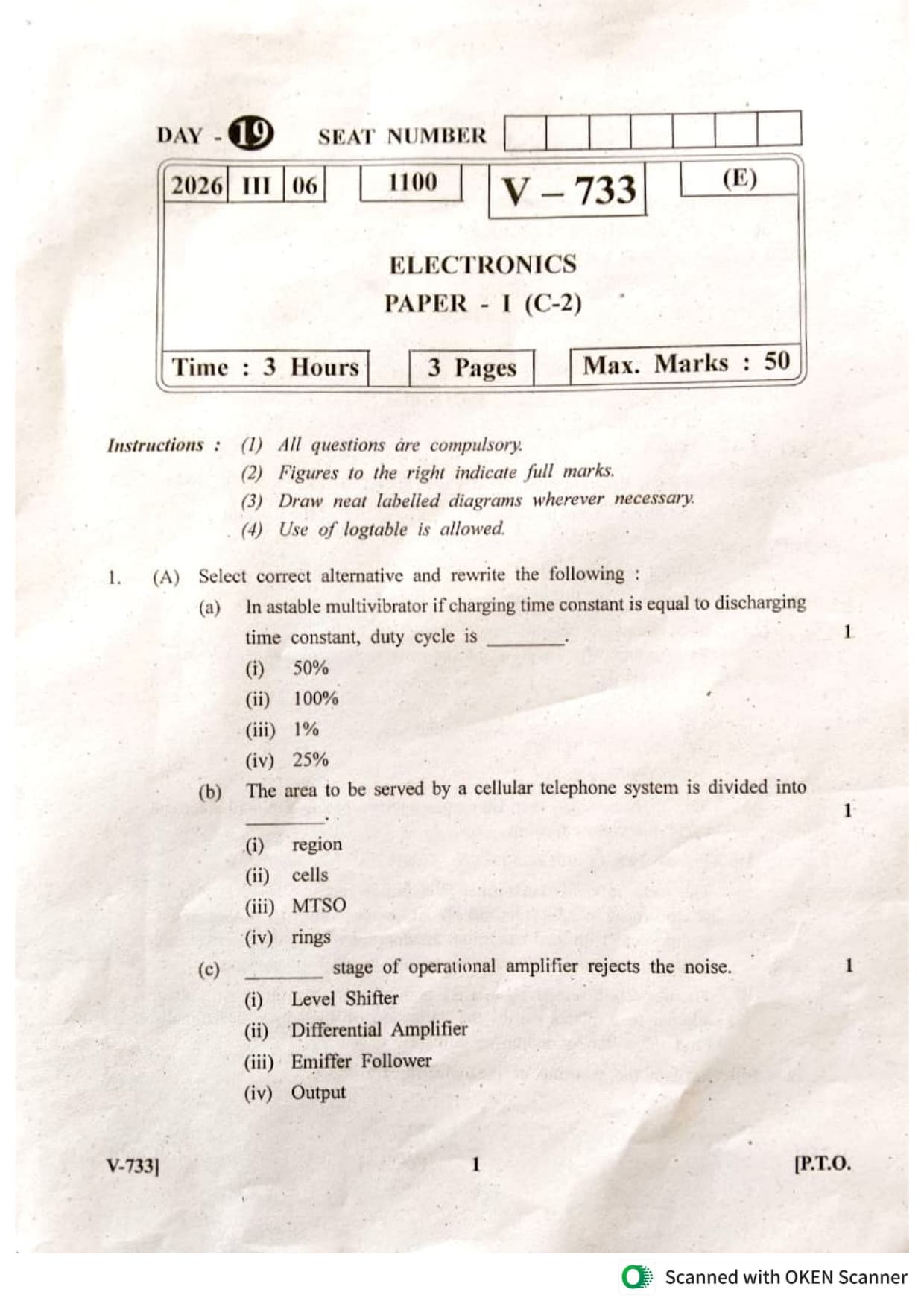
In astable multivibrator if charging time constant is equal to discharging time constant, duty cycle is ________.
View Solution
Step 1: Understanding the Concept:
The duty cycle of a multivibrator is defined as the ratio of the time the output is in its 'ON' (high) state to the total period of the cycle. In an astable multivibrator, the time spent in each state is determined by the charging and discharging time constants of the RC network.
Step 2: Key Formula or Approach:
The Duty Cycle (\(D\)) is given by: \[ D = \frac{T_{ON}}{T_{ON} + T_{OFF}} \times 100% \]
Where \(T_{ON}\) is the charging time and \(T_{OFF}\) is the discharging time.
Step 3: Detailed Explanation:
If the charging time constant is equal to the discharging time constant, then \(T_{ON} = T_{OFF}\). Substituting this into the formula: \[ D = \frac{T_{ON}}{T_{ON} + T_{ON}} \times 100% = \frac{T_{ON}}{2T_{ON}} \times 100% = 0.5 \times 100% = 50% \]
This results in a perfect square wave.
Step 4: Final Answer:
Therefore, the duty cycle is 50%. Quick Tip: A 50% duty cycle always indicates a symmetric wave where the "High" duration equals the "Low" duration.
The area to be served by a cellular telephone system is divided into ________.
View Solution
Step 1: Understanding the Concept:
The fundamental principle of a cellular network is to replace a single, high-power transmitter with many low-power transmitters to cover a large geographic area.
Step 2: Defining the Structure:
To manage radio frequency reuse and provide continuous coverage, the service area is divided into smaller geographic units.
Step 3: Identifying the Term:
These geographic units are called cells, which are typically represented as hexagons in network planning to avoid gaps or overlaps.
Step 4: Final Answer:
The area is divided into cells. Quick Tip: The hexagonal shape is chosen for cells because it is the closest regular polygon to a circle that can "tile" (tessellate) a plane without leaving any gaps!
________ stage of operational amplifier rejects the noise.
View Solution
Step 1: Understanding the Concept:
Noise in electronic systems often appears as a "common-mode signal," meaning it affects both input lines equally.
Step 2: Function of the Differential Stage:
The input stage of an Op-Amp is a Differential Amplifier. Its job is to amplify the difference between the two input voltages (\(V_2 - V_1\)).
Step 3: Common-Mode Rejection:
Since noise is common to both inputs, it is subtracted out by the differential nature of the circuit. This property is known as CMRR (Common-Mode Rejection Ratio).
Step 4: Final Answer:
The Differential Amplifier stage rejects the noise. Quick Tip: CMRR is a key figure of merit for Op-Amps. The higher the CMRR, the better the amplifier is at ignoring noise and "hum" from power lines.
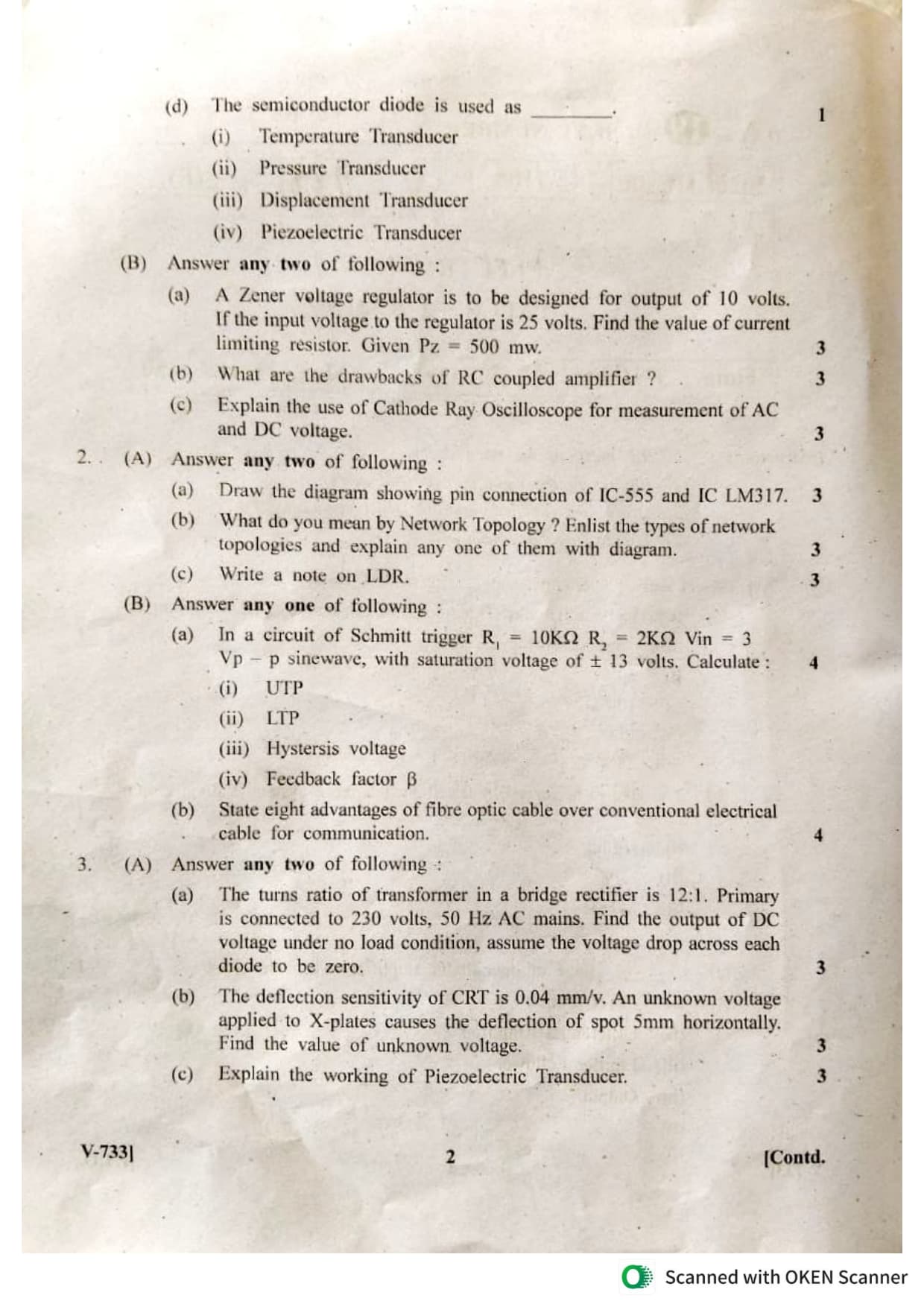
The semiconductor diode is used as ________.
View Solution
Step 1: Understanding the Concept:
A transducer is a device that converts one form of energy/physical parameter into an electrical signal.
Step 2: Diode Sensitivity:
The forward voltage drop (\(V_f\)) of a silicon diode is highly sensitive to temperature. Specifically, for a constant current, \(V_f\) decreases by approximately 2.2 mV for every \(1^\circC\) increase in temperature.
Step 3: Application:
Because of this predictable, linear relationship between temperature and voltage, diodes can be used as simple and effective temperature sensors.
Step 4: Final Answer:
The semiconductor diode is used as a Temperature Transducer. Quick Tip: This temperature sensitivity is also why electronic components can "run away" thermally if not properly cooled—as they get hotter, they allow more current to flow!
A Zener voltage regulator is to be designed for output of 10 volts. If the input voltage to the regulator is 25 volts. Find the value of current limiting resistor. Given \(P_z = 500\) mW.
View Solution
Step 1: Understanding the Concept:
A Zener diode acts as a voltage regulator by maintaining a constant voltage across its terminals when operated in the reverse breakdown region. The current limiting resistor (\(R_S\)) protects the Zener from excessive current.
Step 2: Determining Maximum Zener Current (\(I_Z\)):
Given Zener Power dissipation \(P_Z = 500\) mW = 0.5 W and Zener Voltage \(V_Z = 10\) V.
Using the formula \(P_Z = V_Z \cdot I_Z\): \(I_{Z(max)} = \frac{P_Z}{V_Z} = \frac{0.5}{10} = 0.05\) A = 50 mA.
Step 3: Calculating Resistance (\(R_S\)):
The voltage drop across the series resistor is \(V_{in} - V_Z\). \(V_{drop} = 25 V - 10 V = 15 V\).
Using Ohm's Law (\(R = V/I\)) and assuming no-load condition for maximum safety: \(R_S = \frac{V_{in} - V_Z}{I_Z} = \frac{15}{0.05} = 300\ \Omega\).
Step 4: Final Answer:
The value of the current limiting resistor required is 300 \(\Omega\). Quick Tip: Always choose a resistor with a power rating higher than \(I^2R\) to prevent it from overheating in a real-world design!
What are the drawbacks of RC coupled amplifier?
View Solution
Step 1: Understanding the Concept:
An RC coupled amplifier uses a capacitor and a resistor to connect the output of one stage to the input of the next. While popular for its low cost, it has specific physical limitations.
Step 2: Frequency Response Issues:
At very low frequencies, the reactance of the coupling capacitor is high, leading to a drop in gain. At very high frequencies, the internal capacitance of the transistor reduces the gain.
Step 3: Impedance Matching and Noise:
RC coupled amplifiers have poor impedance matching, making them inefficient for power transfer to low-impedance loads (like speakers). They also tend to become noisy over time due to aging of the resistors and capacitors.
Step 4: Final Answer:
The main drawbacks are poor frequency response at extremes, lack of impedance matching, and low power gain compared to transformer-coupled amplifiers. Quick Tip: RC coupled amplifiers are excellent for voltage amplification in the "mid-band" (audio range), but they are never used as power amplifiers!
Explain the use of Cathode Ray Oscilloscope for measurement of AC and DC voltage.
View Solution
Step 1: Understanding the Concept:
A Cathode Ray Oscilloscope (CRO) is a visual voltmeter. It displays the magnitude of voltage as a vertical displacement of a luminous spot on a fluorescent screen.
Step 2: Measurement of DC Voltage:
To measure DC, set the input coupling to "DC." Observe the vertical shift of the trace from the ground reference line. \(Voltage = (Vertical shift in divisions) \times (Volts/Div setting)\).
Step 3: Measurement of AC Voltage:
For AC, the screen displays a waveform (usually a sine wave). Measure the number of vertical divisions from the positive peak to the negative peak (\(V_{p-p}\)). \(V_{p-p} = (Peak-to-peak divisions) \times (Volts/Div setting)\).
Step 4: Final Answer:
The CRO measures voltage by multiplying the deflection (divisions) by the sensitivity (Volts/Div); it is unique because it shows the peak-to-peak value and the waveform shape simultaneously. Quick Tip: To find the RMS value from a CRO reading, remember: \(V_{RMS} = \frac{V_{p-p}}{2\sqrt{2}}\). The CRO itself only "sees" the peak values!
Draw the diagram showing pin connection of IC-555 and IC LM317.
View Solution

Step 1: Understanding the Concept:
Integrated Circuits (ICs) are packaged with specific pin layouts. The IC-555 is a highly popular timer IC, while the LM317 is a versatile adjustable voltage regulator.
Step 2: Describing IC-555 Pinout:
The IC-555 is an 8-pin Dual In-line Package (DIP). The functions are:
Pin 1: Ground (GND)
Pin 2: Trigger
Pin 3: Output
Pin 4: Reset
Pin 5: Control Voltage
Pin 6: Threshold
Pin 7: Discharge
Pin 8: Supply Voltage (\(V_{CC}\))
Step 3: Describing IC LM317 Pinout:
The LM317 usually comes in a TO-220 package for heat dissipation. It consists of 3 pins:
Pin 1: Adjust (ADJ)
Pin 2: Output Voltage (\(V_{out}\))
Pin 3: Input Voltage (\(V_{in}\))
Step 4: Final Answer:
The pin connections provide the necessary interface for power, ground, and signal processing in electronic circuits. Quick Tip: On a TO-220 package like the LM317, the metal tab is often internally connected to Pin 2 (Output). Be careful when mounting it to a heatsink!
What do you mean by Network Topology? Enlist the types of network topologies and explain any one of them with diagram.
View Solution
Step 1: Understanding the Concept:
Network Topology is the schematic description of a network's arrangement, including its nodes and connecting lines. It can be physical (the actual layout of cables) or logical (how data flows).
Step 2: Listing Types of Topologies:
The primary types are:
Bus: All nodes connected to a single central cable.
Star: All nodes connected to a central hub/switch.
Ring: Each node connects to exactly two other nodes, forming a pathway.
Mesh: Every node is connected to every other node.
Tree: A hybrid of Star and Bus layouts.
Step 3: Explaining Bus Topology:
In a Bus Topology, all the workstations are connected to a single main cable called the "backbone." Both ends of the cable have terminators to absorb signals and prevent reflections.
Step 4: Final Answer:
Network topology defines how computers are linked; while Bus is simple to set up, Star is preferred today for its better fault tolerance. Quick Tip: In a Bus topology, if the main backbone cable fails, the entire network goes down! This is why modern offices almost exclusively use Star topology.
Write a note on LDR.
View Solution
Step 1: Understanding the Concept:
An LDR (Light Dependent Resistor), also known as a photoresistor, is a passive component whose resistance changes based on the intensity of light falling on it.
Step 2: Working Principle:
It works on the principle of "Photoconductivity." When light falls on the semiconductor material (usually Cadmium Sulphide), electrons are released, which increases the conductivity and decreases the resistance.
Step 3: Characteristics:
In total darkness, the LDR has a very high resistance (Mega-ohms). Under bright light, the resistance drops significantly (to a few hundred ohms). This non-linear relationship makes it ideal for light-sensing applications.
Step 4: Final Answer:
LDRs are widely used in automatic street lights, alarm clocks, and light intensity meters due to their low cost and simplicity. Quick Tip: LDRs have a "latency" or "memory effect," meaning they take a small fraction of a second to react to sudden changes in light. They aren't suitable for high-speed fiber-optic data!
In a circuit of Schmitt trigger \(R_1 = 10k\Omega\), \(R_2 = 2k\Omega\), \(V_{in} = 3\ V_{p-p}\) sinewave, with saturation voltage of \(\pm 13\) volts. Calculate:
(i) UTP
(ii) LTP
(iii) Hysteresis voltage
(iv) Feedback factor \(\beta\)
View Solution
Step 1: Understanding the Concept:
A Schmitt trigger is a comparator circuit with hysteresis implemented by applying positive feedback to the non-inverting input of an op-amp. This creates two distinct threshold levels, UTP and LTP, which prevent noise from causing multiple output transitions.
Step 2: Calculating the Feedback Factor (\(\beta\)):
The feedback factor \(\beta\) represents the fraction of the output voltage fed back to the input. It is determined by the voltage divider ratio: \[ \beta = \frac{R_2}{R_1 + R_2} \]
Substituting the given values: \[ \beta = \frac{2k\Omega}{10k\Omega + 2k\Omega} = \frac{2}{12} = \frac{1}{6} \approx 0.1667 \]
Step 3: Calculating Thresholds and Hysteresis:
The threshold points are calculated based on the saturation voltage (\(V_{sat} = 13V\)):
(i) UTP (Upper Threshold Point) \(= +\beta V_{sat} = \frac{1}{6} \times 13V = 2.167V\)
(ii) LTP (Lower Threshold Point) \(= -\beta V_{sat} = \frac{1}{6} \times (-13V) = -2.167V\)
(iii) Hysteresis Voltage (\(V_H\)) \(= UTP - LTP = 2.167 - (-2.167) = 4.334V\)
Step 4: Final Answer:
The calculated values are: (i) 2.167 V, (ii) -2.167 V, (iii) 4.334 V, and (iv) 0.1667.
Note: Since the input is only \(1.5V\) peak (\(3\ V_{p-p\)), it is smaller than the UTP, meaning the circuit will not switch states with this specific input. Quick Tip: The Hysteresis voltage (\(V_H\)) can also be calculated directly using the formula \(V_H = 2 \beta V_{sat}\). It represents the "dead zone" where the output remains in its current state.
State eight advantages of fibre optic cable over conventional electrical cable for communication.
View Solution
Step 1: Understanding the Concept:
Fibre optic technology uses light pulses to transmit information through thin glass strands, whereas conventional cables use electrical signals through copper wires. This fundamental difference in the carrier (photons vs. electrons) leads to several physical advantages.
Step 2: Listing Transmission Advantages:
Greater Bandwidth: Can carry significantly more data over higher frequencies.
Low Attenuation: Signal loss is very low, allowing for longer distances without repeaters.
Immunity to EMI: Since they are made of glass, they are not affected by electromagnetic interference.
Step 3: Listing Physical and Security Advantages:
[4.] Electrical Isolation: No risk of sparks or short circuits; safe for use in hazardous environments.
[5.] Lightweight and Thin: Much easier to install in congested conduits compared to heavy copper bundles.
[6.] Enhanced Security: Extremely difficult to "tap" into the signal without being detected.
[7.] No Crosstalk: Signals in adjacent fibers do not interfere with one another.
[8.] Resource Abundance: Silica (sand) used to make glass is far more abundant than copper.
Step 4: Final Answer:
Fibre optic cables are superior due to their high bandwidth, low loss, immunity to noise, and safety in communication networks. Quick Tip: The core principle behind fibre optics is Total Internal Reflection (TIR). This allows light to stay trapped inside the glass core even when the cable is bent!
The turns ratio of transformer in a bridge rectifier is 12:1. Primary is connected to 230 volts, 50 Hz AC mains. Find the output DC voltage under no load condition, assume the voltage drop across each diode to be zero.
View Solution
Step 1: Understanding the Concept:
A bridge rectifier converts AC to DC. The output DC voltage (\(V_{dc}\)) for a full-wave bridge rectifier is related to the peak secondary voltage (\(V_m\)) of the transformer.
Step 2: Calculating Secondary RMS Voltage (\(V_{s(rms)}\)):
The turns ratio (\(N_p/N_s\)) is \(12:1\). The primary voltage \(V_p = 230\) V. \[ V_{s(rms)} = \frac{V_p}{Turns Ratio} = \frac{230}{12} \approx 19.17 V \]
Step 3: Calculating Peak Secondary Voltage (\(V_m\)):
The peak voltage is \(\sqrt{2}\) times the RMS voltage: \[ V_m = V_{s(rms)} \times \sqrt{2} = 19.17 \times 1.414 \approx 27.11 V \]
Step 4: Final Answer:
For a full-wave rectifier, \(V_{dc} = \frac{2V_m}{\pi}\). \[ V_{dc} = \frac{2 \times 27.11}{3.142} \approx \frac{54.22}{3.142} = 17.26 V \]
The output DC voltage is 17.26 V. Quick Tip: In a bridge rectifier, two diodes conduct at any given time. If we had not assumed zero drop, we would have subtracted \(1.4V\) (two silicon diode drops) from \(V_m\) before calculating \(V_{dc}\)!
The deflection sensitivity of CRT is 0.04 mm/V. An unknown voltage applied to X-plates causes the deflection of spot 5 mm horizontally. Find the value of unknown voltage.
View Solution
Step 1: Understanding the Concept:
Deflection sensitivity (\(S\)) is the ratio of the deflection of the spot on the screen (\(D\)) to the voltage applied to the deflection plates (\(V\)). It represents how many millimeters the spot moves per volt applied.
Step 2: Identifying the Formula:
The relationship is given by: \[ S = \frac{D}{V} \implies V = \frac{D}{S} \]
Step 3: Calculating the Unknown Voltage:
Given \(D = 5\) mm and \(S = 0.04\) mm/V: \[ V = \frac{5 mm}{0.04 mm/V} \] \[ V = \frac{500}{4} = 125 V \]
Step 4: Final Answer:
The value of the unknown voltage is 125 V. Quick Tip: Deflection sensitivity is the inverse of the "Deflection Factor." If the sensitivity is low, you need a much higher voltage to move the spot a significant distance!
Explain the working of Piezoelectric Transducer.
View Solution
Step 1: Understanding the Concept:
A piezoelectric transducer is an active transducer that works on the "Piezoelectric Effect." This effect is found in certain crystals like Quartz, Rochelle salt, and Barium Titanate.
Step 2: The Working Mechanism:
When mechanical stress or pressure is applied to the surface of a piezoelectric crystal, it undergoes a physical deformation. This deformation causes a displacement of charges within the crystal lattice, resulting in an electric potential (voltage) across its opposite faces.
Step 3: Inverse Effect and Applications:
The process is reversible (Inverse Piezoelectric Effect): applying an electric field causes the crystal to change shape. Because of this, these transducers can measure dynamic changes in pressure, acceleration, and force.
Step 4: Final Answer:
The piezoelectric transducer converts mechanical energy into electrical energy via charge displacement, making it ideal for sensing high-frequency vibrations and pressure spikes. Quick Tip: Piezoelectric sensors are "active," meaning they generate their own voltage and don't require an external power supply to produce a signal!
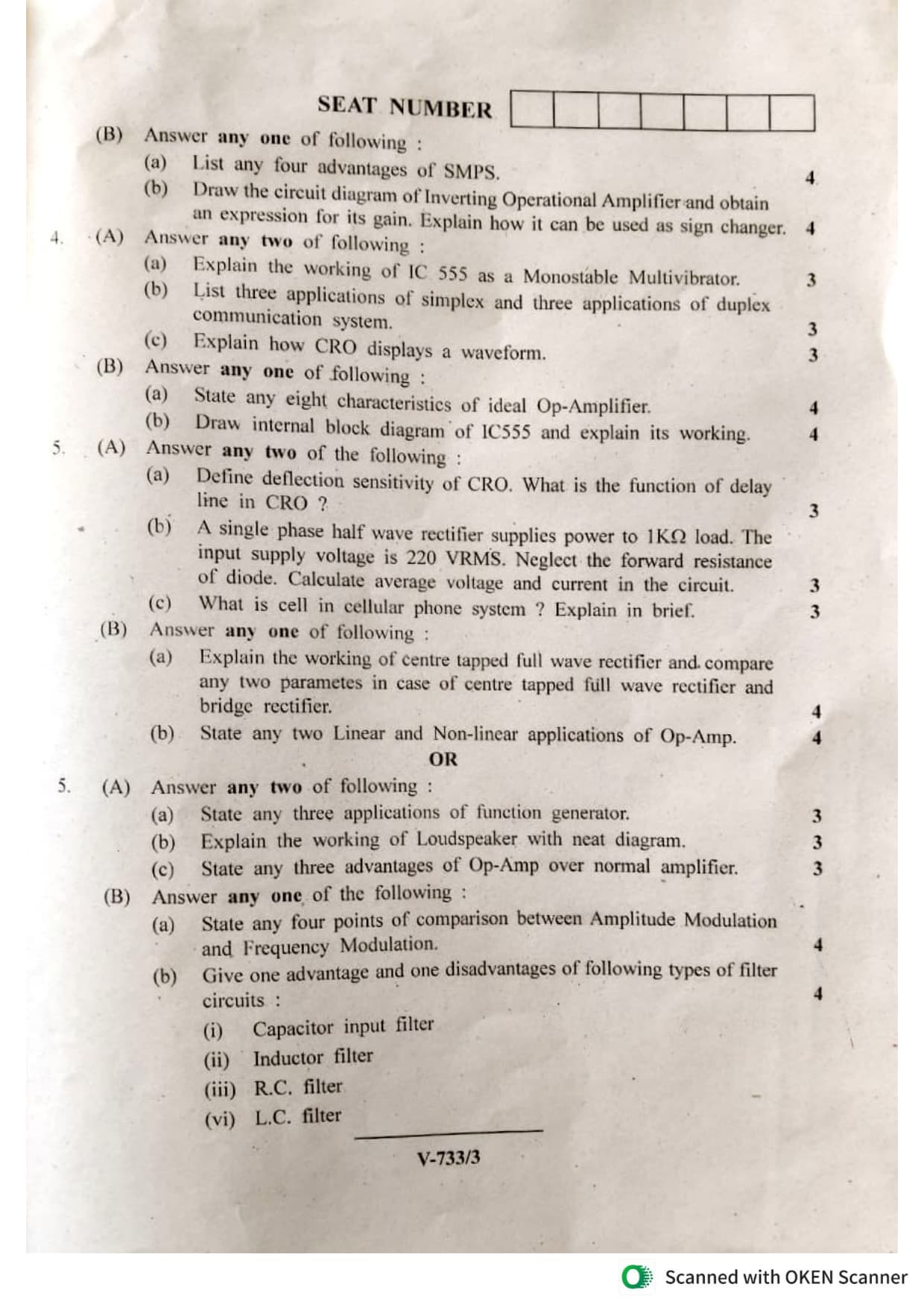
Explain how CRO displays a waveform.
View Solution
Step 1: Understanding the Concept:
A Cathode Ray Oscilloscope (CRO) displays a waveform by plotting the amplitude of an input signal against time on a two-dimensional screen. This is achieved by the coordinated movement of an electron beam across the horizontal (\(X\)) and vertical (\(Y\)) axes.
Step 2: Vertical Deflection (Y-axis):
The input signal to be observed is applied to the vertical deflection plates. After being amplified, this voltage creates an electric field that moves the electron beam up and down. The vertical displacement is directly proportional to the instantaneous amplitude of the input signal.
Step 3: Horizontal Deflection and Synchronization (X-axis):
To see the signal as a function of time, a "Sawtooth wave" (time-base signal) is applied to the horizontal deflection plates. This causes the beam to sweep across the screen from left to right at a uniform speed and then fly back quickly to the start. A trigger circuit ensures the horizontal sweep starts at the exact same point of the input signal cycle.
Step 4: Final Answer:
The CRO displays a waveform by combining the vertical movement (signal amplitude) and the horizontal movement (time-base sweep) on a fluorescent screen, allowing the user to visualize the electrical signal in real-time. Quick Tip: If the time-base (sweep) frequency doesn't match the signal frequency, the waveform will appear to "run" across the screen. This is why the "Trigger" adjustment is so important!
State any eight characteristics of ideal Op-Amplifier.
View Solution
Step 1: Understanding the Concept:
An Operational Amplifier (Op-Amp) is a high-gain DC coupled electronic voltage amplifier with differential inputs. An "ideal" Op-Amp is a theoretical model used to simplify circuit analysis.
Step 2: Input and Output Characteristics:
Infinite Open-loop Gain (\(A_{vol} = \infty\)): It can amplify even the smallest input difference to a large output.
Infinite Input Impedance (\(R_{in} = \infty\)): It draws zero current from the input source, preventing loading effects.
Zero Output Impedance (\(R_{out} = 0\)): It can drive any load without a drop in output voltage.
Step 3: Performance Characteristics:
[4.] Infinite Bandwidth (\(BW = \infty\)): It can amplify signals of any frequency (from DC to infinity) equally.
[5.] Zero Offset Voltage (\(V_{os} = 0\)): If the input difference is zero, the output is exactly zero.
[6.] Infinite Common Mode Rejection Ratio (CMRR = \(\infty\)): It perfectly rejects any noise common to both input terminals.
[7.] Infinite Slew Rate (\(SR = \infty\)): The output changes instantaneously in response to input changes.
[8.] Zero Power Supply Rejection Ratio (PSRR): The output is completely independent of variations in the supply voltage.
Step 4: Final Answer:
The eight characteristics are infinite gain, infinite input impedance, zero output impedance, infinite bandwidth, zero offset, infinite CMRR, infinite slew rate, and perfect thermal stability (zero drift). Quick Tip: While real Op-Amps (like the \textmu A741) aren't "perfect," they are close enough that assuming ideal characteristics makes solving most complex circuits much easier!
Explain the working of IC 555 as a Monostable Multivibrator.
View Solution
Step 1: Understanding the Concept:
A monostable multivibrator, also known as a "one-shot" circuit, has only one stable state (LOW). When triggered, it switches to an unstable state (HIGH) for a specific duration before automatically returning to its stable state.
Step 2: The Triggering Process:
Initially, the output is LOW and the internal discharge transistor is ON, keeping the external capacitor \(C\) shorted to ground. When a negative-going pulse is applied to the Trigger pin (Pin 2) and falls below \(1/3 V_{CC}\), the internal flip-flop is set. This turns OFF the discharge transistor and makes the output HIGH.
Step 3: The Charging and Resetting Phase:
The capacitor \(C\) begins to charge through resistor \(R\) toward \(V_{CC}\). When the capacitor voltage reaches \(2/3 V_{CC}\), the Threshold pin (Pin 6) triggers the internal comparator, which resets the flip-flop. The discharge transistor turns ON, rapidly discharging the capacitor, and the output returns to LOW.
Step 4: Final Answer:
The time duration for which the output remains HIGH is determined by the formula \(T = 1.1 \times R \times C\). Quick Tip: To ensure a stable output, the trigger pulse must be shorter than the desired output pulse width \(T\). If the trigger stays low longer than \(T\), the output will stay high!
List three applications of simplex and three applications of duplex communication system.
View Solution
Step 1: Understanding the Concept:
Communication systems are categorized by the direction of data flow. Simplex is one-way only, while Duplex (Full-Duplex) allows simultaneous two-way communication.
Step 2: Applications of Simplex System:
In a simplex system, the sender can only send, and the receiver can only receive.
Radio and Television Broadcasting: Information flows from the station to the public.
Keyboard to Computer: Data only travels from the keyboard to the CPU.
Pager Systems: Traditional pagers only receive short text or numeric messages.
Step 3: Applications of Duplex System:
In a full-duplex system, both parties can talk and listen at the same time.
Mobile/Telephone Networks: Both callers can speak simultaneously.
Video Conferencing (Zoom/Skype): Participants interact in real-time.
Modern Computer Networks (Ethernet/Fiber): Data is uploaded and downloaded at the same time.
Step 4: Final Answer:
Simplex is used for unidirectional broadcasting and input devices, while Duplex is essential for bidirectional interactive telecommunications. Quick Tip: Don't confuse Full-Duplex with Half-Duplex! A Walkie-Talkie is "Half-Duplex" because you have to wait for the other person to finish (Push-to-Talk) before you can reply.
Explain how CRO displays a waveform.
View Solution
Step 1: Understanding the Concept:
The Cathode Ray Oscilloscope (CRO) is a sophisticated voltmeter that graphs voltage over time. It uses an electron beam that hits a phosphor-coated screen to create a visible spot.
Step 2: Vertical and Horizontal Movement:
The input voltage moves the beam up and down via the Vertical Deflection Plates. Simultaneously, an internal time-base circuit generates a sawtooth wave that moves the beam from left to right at a constant speed via the Horizontal Deflection Plates.
Step 3: Pattern Formation:
When the horizontal sweep is synchronized with the vertical signal, the spot traces the exact path of the voltage changes. Because the sweep repeats rapidly and the screen has "persistence," the moving spot appears as a solid, continuous waveform.
Step 4: Final Answer:
The display is a result of combined electrostatic deflection: the Y-axis represents voltage magnitude and the X-axis represents time. Quick Tip: If you turn off the "Time Base" (X-Y mode), the CRO can be used to compare two different signals to create complex shapes known as "Lissajous Patterns."
State any four advantages of SMPS.
View Solution
Step 1: Understanding the Concept:
A Switched-Mode Power Supply (SMPS) is an electronic power supply that incorporates a switching regulator to convert electrical power efficiently. Unlike linear power supplies, SMPS uses a switching element that is either fully on or fully off.
Step 2: Efficiency and Size Advantages:
High Efficiency: Since the switching transistor dissipates very little power in the ON and OFF states, SMPS typically achieves 80% to 95% efficiency.
Compact Size and Lightweight: Because it operates at high frequencies (kHz to MHz), much smaller and lighter transformers and capacitors are required compared to 50/60 Hz linear supplies.
Step 3: Operational Advantages:
[3.] Wide Input Voltage Range: SMPS can handle a wide range of input AC voltages while maintaining a stable DC output, making it ideal for international use.
[4.] Reduced Heat Dissipation: Due to high efficiency, less energy is wasted as heat, reducing the need for large heatsinks or intensive cooling systems.
Step 4: Final Answer:
The four key advantages of SMPS are high efficiency, small physical size, lightweight, and versatile input voltage handling. Quick Tip: While SMPS is superior in efficiency, it generates high-frequency "switching noise" (EMI). This is why you'll often see ferrite beads on the cables of your laptop charger!
Draw the circuit diagram of Inverting Operational Amplifier and obtain an expression for its gain. Explain how it can be used as sign changer.
View Solution

Step 1: Understanding the Concept:
In an inverting amplifier, the input signal is applied to the inverting (\(-\)) terminal through a resistor, while the non-inverting (\(+\)) terminal is grounded. This configuration results in an output that is \(180^\circ\) out of phase with the input.
Step 2: Deriving the Gain Expression:
Assuming an ideal Op-Amp, the voltage at the inverting terminal (\(V_2\)) is at "Virtual Ground" (\(V_2 = 0\)) because the non-inverting terminal is grounded.
Applying Kirchhoff’s Current Law at node \(V_2\): \[ I_{in} = I_f \implies \frac{V_{in} - 0}{R_i} = \frac{0 - V_{out}}{R_f} \]
Rearranging to find the gain (\(A_v = V_{out} / V_{in}\)): \[ \frac{V_{in}}{R_i} = -\frac{V_{out}}{R_f} \implies A_v = -\frac{R_f}{R_i} \]
Step 3: Explanation as a Sign Changer:
A sign changer (or inverter) is a special case where the magnitude of the signal remains the same, but the polarity is reversed. If we choose resistors such that \(R_f = R_i\), then: \[ A_v = -\frac{R}{R} = -1 \]
The output becomes \(V_{out} = -V_{in}\).
Step 4: Final Answer:
The voltage gain is given by \(A_v = -R_f/R_i\). By setting \(R_f = R_i\), the circuit acts as a sign changer, perfectly inverting the input signal. Quick Tip: The "Virtual Ground" concept is the most powerful tool for Op-Amp analysis. It exists because the infinite gain of the Op-Amp tries to keep the difference between the two input terminals at zero!
Define deflection sensitivity of CRO. What is the function of delay line in CRO?
View Solution
Step 1: Understanding the Concept:
The Cathode Ray Oscilloscope (CRO) uses electrostatic deflection to move an electron beam. The deflection sensitivity is a measure of how effectively the plates can move the beam for a given amount of applied voltage.
Step 2: Defining Deflection Sensitivity:
Deflection sensitivity (\(S\)) is defined as the vertical (or horizontal) displacement of the spot on the screen per unit deflection voltage. It is typically measured in mm/V or cm/V. \[ S = \frac{D}{V} \]
Where \(D\) is the deflection on the screen and \(V\) is the applied voltage.
Step 3: Function of the Delay Line:
In a CRO, the signal to be observed is split into two paths: the vertical deflection system and the horizontal trigger system. The trigger and sweep generator circuits take a finite amount of time to start the horizontal sweep.
If the vertical signal reached the plates immediately, the leading edge of the signal would be lost before the sweep started. The delay line is placed in the vertical section to slow down the signal by a few nanoseconds, ensuring the horizontal sweep is already moving when the vertical signal arrives.
Step 4: Final Answer:
Deflection sensitivity is the displacement per volt, and the delay line ensures the entire leading edge of the waveform is visible on the screen. Quick Tip: Without a delay line, high-frequency pulses would appear "cut off" at the beginning because the electron beam wouldn't start moving horizontally until after the pulse had already started!
A single phase half wave rectifier supplies power to 1k\(\Omega\) load. The input supply voltage is 220 V RMS. Neglect the forward resistance of diode. Calculate average voltage and current in the circuit.
View Solution
Step 1: Understanding the Concept:
A half-wave rectifier allows only one half-cycle of the AC input to pass. The "average" value in a rectifier circuit refers to the DC component of the output waveform.
Step 2: Calculating Peak Voltage (\(V_m\)):
Given \(V_{rms} = 220\) V. The peak voltage \(V_m\) is: \[ V_m = \sqrt{2} \times V_{rms} = 1.414 \times 220 \approx 311.13 V \]
Step 3: Calculating Average (DC) Voltage (\(V_{avg}\)):
For a half-wave rectifier, the average voltage is: \[ V_{avg} = \frac{V_m}{\pi} = \frac{311.13}{3.1416} \approx 99.04 V \]
Step 4: Final Answer:
To find the average current (\(I_{avg}\)), use Ohm's Law with the load resistance \(R = 1k\Omega\): \[ I_{avg} = \frac{V_{avg}}{R} = \frac{99.04}{1000} = 0.099 A = 99 mA \]
The average voltage is 99.04 V and average current is 99 mA. Quick Tip: The DC voltage of a half-wave rectifier is only about 31.8% of the peak voltage. This makes it very inefficient for high-power applications compared to a full-wave rectifier!
What is cell in cellular phone system? Explain in brief.
View Solution
Step 1: Understanding the Concept:
In mobile communications, a "cell" is the basic geographic unit of a cellular network. The concept of cells allows for frequency reuse and high capacity.
Step 2: Definition and Shape:
A cell is a small geographic area covered by a specific base station (cell tower). Although signal coverage is circular, cells are represented as hexagons in network planning because hexagons can be tiled together without gaps or overlaps.
Step 3: How it Works:
When a user moves from one cell to another during a call, the system automatically switches the connection to the new cell's base station. This process is called a Handover (or Handoff). Because each cell uses low-power transmitters, the same frequencies can be used again in a nearby (but not adjacent) cell.
Step 4: Final Answer:
A cell is the geographic service area of a single base station; its primary purpose is to enable frequency reuse to accommodate millions of users. Quick Tip: Small cells (Microcells or Femtocells) are used in crowded areas like stadiums or malls to provide high data speeds to many people at once!
Explain the working of centre tapped full wave rectifier and compare any two parameters in case of centre tapped full wave rectifier and bridge rectifier.
View Solution
Step 1: Understanding the Concept:
A center-tapped full-wave rectifier uses a transformer with a secondary winding that is divided into two equal halves by a center tap. This configuration allows both halves of the AC cycle to be rectified using only two diodes.
Step 2: Working Mechanism:
During the positive half-cycle of AC, the top end of the secondary is positive and the bottom is negative relative to the center tap. Diode \(D_1\) is forward-biased and conducts, while \(D_2\) is reverse-biased. Current flows through the load.
During the negative half-cycle, the polarities reverse. \(D_1\) becomes reverse-biased and \(D_2\) becomes forward-biased and conducts. Current flows through the load in the same direction as before.
Step 3: Comparison of Parameters:
We can compare these two rectifiers based on Peak Inverse Voltage (PIV) and Transformer Utilization:
\begin{tabular{|l|c|c|
\hline
Parameter & Center-Tapped & Bridge Rectifier
\hline
Peak Inverse Voltage (PIV) & \(2V_m\) & \(V_m\)
\hline
Number of Diodes & 2 & 4
\hline
\end{tabular
Step 4: Final Answer:
The center-tapped rectifier provides full-wave rectification using two diodes but requires a specialized transformer and diodes with higher PIV ratings compared to a bridge rectifier. Quick Tip: The Bridge Rectifier is generally preferred in modern electronics because it doesn't require a center-tapped transformer and has a lower PIV requirement, making the diodes cheaper and smaller!
State any two Linear and Non-linear applications of Op-Amp.
View Solution
Step 1: Understanding the Concept:
Operational Amplifiers (Op-Amps) function differently depending on the feedback applied. Linear applications usually involve negative feedback, keeping the Op-Amp within its linear region, while non-linear applications often use positive feedback or no feedback at all.
Step 2: Linear Applications:
In these applications, the output is directly proportional to the input.
Inverting/Non-Inverting Amplifier: Used to increase the voltage magnitude of a signal.
Summing Amplifier (Adder): Used to combine multiple input voltages into a single output.
Step 3: Non-linear Applications:
In these applications, the output does not vary linearly with the input, often switching between saturation levels.
Comparator: Compares two voltages and outputs a HIGH or LOW signal based on which is larger.
Schmitt Trigger: A comparator with hysteresis used to convert noisy signals into clean square waves.
Step 4: Final Answer:
Two linear applications are Inverting Amplifiers and Summing Amplifiers, while two non-linear applications are Comparators and Schmitt Triggers. Quick Tip: A quick way to tell the difference: If there is a resistor connecting the output back to the \textbf{negative (\(-\)) input}, it is likely a linear application!
State any three applications of function generator.
View Solution
Step 1: Understanding the Concept:
A function generator is a versatile electronic test instrument used to generate different types of electrical waveforms (such as sine, square, triangular, and pulse waves) over a wide range of frequencies.
Step 2: Testing and Calibration:
One primary application is the testing and repair of electronic circuits. It provides a known input signal to an amplifier or filter so that the output can be measured to check for distortion or proper gain.
Step 3: Research and Development:
It is used as a signal source for research and development. Engineers use it to simulate various sensors or input signals when designing new electronic systems, allowing them to verify how a circuit handles different frequencies and wave shapes.
Step 4: Final Answer:
Three key applications are: (1) Testing the frequency response of amplifiers, (2) Providing clock signals for digital circuits, and (3) Serving as a signal source for troubleshooting electronic equipment. Quick Tip: Most modern function generators are "DDS" (Direct Digital Synthesis) based, allowing them to produce extremely stable and precise frequencies with very low distortion!
Explain the working of Loudspeaker with neat diagram.
View Solution
Step 1: Understanding the Concept:
A loudspeaker is an electro-acoustic transducer that converts an electrical signal into sound waves. The most common type is the permanent-magnet moving-coil loudspeaker.
Step 2: Component Interaction:
The main components are a permanent magnet, a voice coil, and a cone (diaphragm). The voice coil is placed within the magnetic field of the permanent magnet and is attached to the cone.
Step 3: Electromagnetic Principle:
When an alternating electrical signal (audio) flows through the voice coil, it creates a varying magnetic field. According to Lorentz Force, the interaction between this electromagnetic field and the permanent magnet's field causes the coil to move rapidly back and forth.
Step 4: Final Answer:
The rapid vibration of the coil moves the attached cone, which pushes the surrounding air to create pressure waves (sound) that correspond to the frequency and amplitude of the electrical input. Quick Tip: The "Spider" in a loudspeaker is actually a flexible part that keeps the voice coil centered in the magnet gap while allowing it to move freely forward and backward!
State any three advantages of Op-Amp over normal amplifier.
View Solution
Step 1: Understanding the Concept:
A "normal" or discrete amplifier consists of individual transistors and resistors, whereas an Operational Amplifier (Op-Amp) is a high-performance integrated circuit designed to perform mathematical operations on voltages.
Step 2: Impedance and Gain Advantages:
Op-Amps have an extremely high input impedance, meaning they draw almost no current from the source, and a very low output impedance, which allows them to drive heavy loads without signal loss.
Step 3: Stability and Flexibility:
Due to the use of negative feedback, the gain of an Op-Amp circuit depends only on external resistors, making it highly stable regardless of temperature or transistor variations. They also have a very high Common Mode Rejection Ratio (CMRR), effectively canceling out noise.
Step 4: Final Answer:
Three major advantages are: (1) Higher stability and reliability, (2) Better noise rejection (CMRR), and (3) Ease of design and smaller physical size. Quick Tip: Because Op-Amps are integrated circuits, thousands of them can be manufactured with nearly identical characteristics, something that is nearly impossible to achieve with discrete transistors!
State any four points of comparison between Amplitude Modulation and Frequency Modulation.
View Solution
Step 1: Understanding the Concept:
Modulation is the process of varying a property of a high-frequency carrier wave (like amplitude or frequency) in accordance with the instantaneous value of a low-frequency message signal.
Step 2: Comparison of Signal Characteristics:
In Amplitude Modulation (AM), the amplitude of the carrier changes while frequency remains constant. In Frequency Modulation (FM), the frequency of the carrier changes while the amplitude remains constant.
Step 3: Tabulating Differences:
\begin{tabular{|l|l|l|
\hline
Feature & Amplitude Modulation (AM) & Frequency Modulation (FM)
\hline
1. Noise Immunity & Poor (sensitive to noise) & Excellent (less affected by noise)
\hline
2. Bandwidth & Low (2 \(\times\) Signal Frequency) & High (depends on modulation index)
\hline
3. Circuit Complexity & Simple and low cost & Complex and more expensive
\hline
4. Range & Long range (due to lower freq) & Short range (Line of sight)
\hline
\end{tabular
Step 4: Final Answer:
The key differences lie in noise immunity (better in FM), bandwidth (lower in AM), circuit complexity (simpler in AM), and transmission range (higher in AM). Quick Tip: FM is used for high-quality music broadcasting because most natural noise (like lightning or electrical sparks) changes the amplitude of a wave, which FM receivers simply ignore!
Give one advantage and one disadvantage of the following types of filter circuits:
(i) Capacitor input filter
(ii) Inductor filter
(iii) R.C. filter
(iv) L.C. filter
View Solution
Step 1: Understanding the Concept:
Filter circuits are used after rectifiers to remove AC components (ripple) and provide a smooth DC output. They use reactive components like capacitors (which block DC) and inductors (which block AC).
Step 2: Analyzing C and L Filters:
(i) Capacitor Input Filter:
Advantage: Provides high DC output voltage (close to peak voltage \(V_m\)).
Disadvantage: Poor voltage regulation; the output drops significantly as the load current increases.
(ii) Inductor Filter:
Advantage: Excellent for high load currents; the ripple factor decreases as the load increases.
Disadvantage: Provides a lower DC output voltage and is physically bulky/heavy.
Step 3: Analyzing RC and LC Filters:
(iii) R.C. Filter:
Advantage: Very low cost and compact; suitable for low-current applications.
Disadvantage: Large voltage drop across the resistor, leading to power loss and heat.
(iv) L.C. Filter:
Advantage: Combines the benefits of L and C, providing very low ripple and good regulation.
Disadvantage: More expensive and can lead to "ringing" or oscillations if not damped properly.
Step 4: Final Answer:
The choice of filter depends on the required output smoothness, cost, and the amount of load current the power supply must provide. Quick Tip: For very high-quality power supplies, we often use a \(\pi\)-filter (C-L-C), which provides the highest level of ripple reduction by using two capacitors and one inductor.



Comments