




Maharashtra Board is conducting the Class 12 Defence Studies Board Exam 2026 on March 2, 2026. Class 12 Defence Studies Question Paper with Solution PDF is available here for download.
The official question paper of Maharashtra Board Class 12 Defence Studies Board Exam 2026 is provided below. Students can download the official paper in PDF format for reference.
Maharashtra Board Class 12 2026 Defence Studies Question Paper with Solution PDF
| Maharashtra Board Class 12 2026 Defence Studies Question Paper with Solution PDF | Download PDF | Check Solutions |
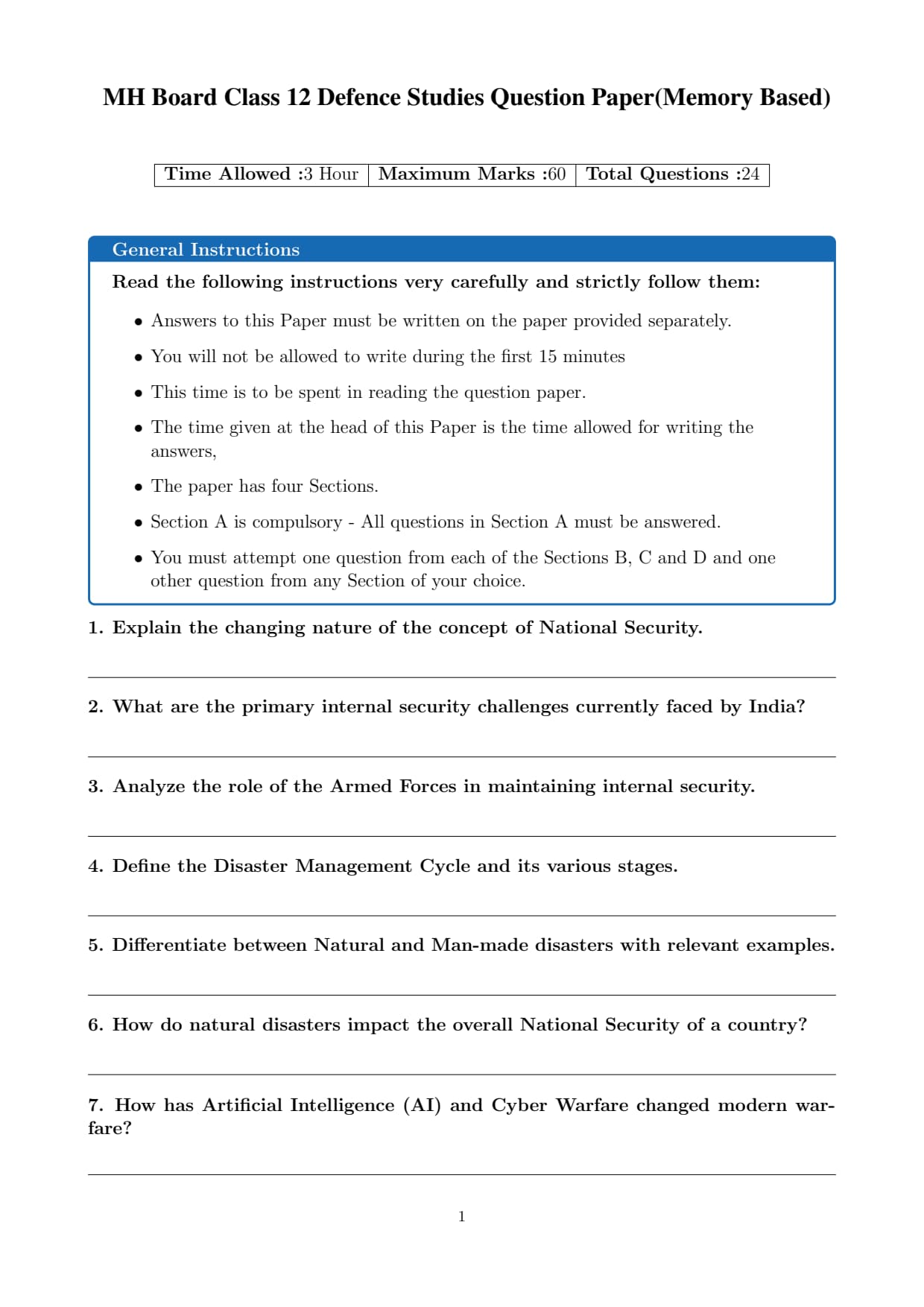
Explain the changing nature of the concept of National Security.
View Solution
Concept:
National security refers to the protection of a nation’s sovereignty, territorial integrity, and citizens from threats. Over time, the idea of national security has expanded beyond traditional military defense to include multiple dimensions.
Step 1: Traditional view of national security.
Earlier, national security was mainly associated with:
Protection from external military threats
Defense of borders and sovereignty
Strong armed forces and strategic alliances
Security was largely state-centric and military-focused.
Step 2: Post-Cold War transformation.
After the Cold War, new types of threats emerged:
Internal conflicts and terrorism
Ethnic violence and civil wars
Political instability
This led to a broader understanding of security beyond inter-state wars.
Step 3: Non-traditional security threats.
Modern national security includes:
Economic security (globalization, financial crises)
Environmental security (climate change, disasters)
Health security (pandemics like COVID-19)
Cyber security and technological threats
Step 4: Human security perspective.
The focus has shifted from state security to human security:
Protection of individuals and communities
Food, water, and energy security
Human rights and development
Step 5: Global cooperation.
Many modern threats are transnational and require cooperation among nations through international organizations and agreements.
Conclusion:
The concept of national security has evolved from a narrow military notion to a multidimensional framework that includes economic stability, environmental sustainability, technological safety, and human well-being. Quick Tip: Modern national security includes not only military defense but also economic, environmental, cyber, and human security concerns.
What are the primary internal security challenges currently faced by India?
View Solution
Concept:
Internal security refers to protection of a nation from threats arising within its borders. India, due to its diversity and geopolitical position, faces multiple internal security challenges.
Step 1: Terrorism.
India faces threats from both cross-border and home-grown terrorism. Attacks target civilians, infrastructure, and security forces, especially in regions like Jammu and Kashmir.
Step 2: Insurgency and separatist movements.
Certain regions face insurgencies driven by ethnic, political, or regional aspirations. Notable areas include parts of the Northeast and Jammu \& Kashmir.
Step 3: Left-Wing Extremism (Naxalism).
Naxalite movements operate mainly in central and eastern India. These groups exploit socio-economic inequalities and challenge state authority.
Step 4: Communal and social tensions.
Communal violence, caste conflicts, and regional disputes can disrupt social harmony and pose serious law-and-order challenges.
Step 5: Cyber security threats.
With increasing digitization, cyber attacks on government systems, financial institutions, and data networks have become a major concern.
Step 6: Organized crime and illegal activities.
Activities such as drug trafficking, human trafficking, money laundering, and smuggling threaten internal stability and governance.
Step 7: Border management issues.
Illegal migration, infiltration, and cross-border smuggling also contribute to internal security concerns.
Conclusion:
India’s internal security challenges are diverse and evolving, requiring coordinated efforts involving security forces, governance reforms, technology, and inclusive development. Quick Tip: Major internal security threats in India include terrorism, insurgency, Naxalism, cyber threats, communal tensions, and organized crime.
Analyze the role of the Armed Forces in maintaining internal security.
View Solution
Concept:
Although the primary role of the Armed Forces is external defense, they also play a crucial supporting role in maintaining internal security when civil administration and police forces require assistance.
Step 1: Aid to civil authorities.
The Armed Forces are deployed during serious law-and-order breakdowns, riots, or large-scale disturbances when local police and paramilitary forces are overwhelmed.
Step 2: Counter-terrorism and insurgency operations.
They conduct operations against terrorism and insurgency in sensitive regions such as Jammu and Kashmir and parts of the Northeast, often working alongside paramilitary forces.
Step 3: Disaster management and humanitarian aid.
The Armed Forces provide rapid response during natural disasters like floods, earthquakes, cyclones, and pandemics by conducting rescue, relief, and rehabilitation operations.
Step 4: Protection of strategic assets.
They help secure vital installations such as nuclear facilities, key infrastructure, and borders to prevent internal and external threats.
Step 5: Support in border areas.
Effective border management reduces infiltration, smuggling, and illegal migration, indirectly strengthening internal security.
Step 6: Role under democratic framework.
The Armed Forces operate under strict civilian control and legal frameworks, ensuring that their involvement in internal security remains limited and accountable.
Conclusion:
The Armed Forces play a vital but supportive role in maintaining internal security by assisting civil authorities, tackling insurgencies, and providing disaster relief while upholding democratic principles. Quick Tip: The Armed Forces mainly defend against external threats but assist internal security through counter-terror operations, disaster relief, and aid to civil authorities.
Define the Disaster Management Cycle and its various stages.
View Solution
Concept:
The Disaster Management Cycle refers to a systematic and continuous approach to dealing with disasters before, during, and after they occur. It helps minimize damage and ensure effective recovery.
Step 1: Mitigation.
Mitigation involves measures taken to reduce the risk and impact of disasters before they occur.
Building earthquake-resistant structures
Flood control measures
Environmental protection and planning
Step 2: Preparedness.
Preparedness focuses on planning and readiness to respond effectively.
Early warning systems
Emergency drills and training
Stockpiling relief materials
Step 3: Response.
Response includes immediate actions taken during and just after a disaster to save lives and property.
Search and rescue operations
Medical aid and evacuation
Providing food, shelter, and relief
Step 4: Recovery.
Recovery refers to restoring normalcy after the disaster.
Reconstruction of infrastructure
Rehabilitation of affected communities
Economic and social recovery
Step 5: Continuous cycle.
The cycle is ongoing, as lessons learned from one disaster help improve mitigation and preparedness for future events.
Conclusion:
The Disaster Management Cycle ensures a holistic approach to disaster handling by integrating prevention, readiness, response, and recovery strategies. Quick Tip: Disaster Management Cycle = Mitigation → Preparedness → Response → Recovery (continuous process).
Differentiate between Natural and Man-made disasters with relevant examples.
View Solution
Concept:
Disasters are catastrophic events that cause large-scale loss of life, property, and environment. Based on their origin, they are broadly classified into natural and man-made disasters.
Step 1: Natural Disasters.
Natural disasters are caused by natural processes of the Earth without direct human involvement.
Originate from natural forces like tectonic activity, weather patterns, or biological processes
Difficult to prevent but impact can be reduced through preparedness
Examples: Earthquakes, floods, cyclones, tsunamis, volcanic eruptions, droughts
Step 2: Man-made Disasters.
Man-made disasters occur due to human negligence, technological failure, or intentional acts.
Often preventable with proper safety measures
Result from industrialization, conflict, or environmental misuse
Examples: Industrial accidents (Bhopal Gas Tragedy), oil spills, nuclear accidents, wars, terrorism
Step 3: Key Differences.
Origin:
Natural — caused by nature;
Man-made — caused by human activities.
Predictability:
Natural disasters are sometimes predictable (cyclones), but not always (earthquakes);
Man-made disasters are largely preventable.
Control:
Limited control over natural disasters;
Greater control and responsibility in man-made disasters.
Examples:
Flood (natural) vs Industrial accident (man-made).
Conclusion:
Natural disasters arise from environmental forces, while man-made disasters stem from human actions. Effective disaster management requires preparedness for natural hazards and strict regulation to prevent man-made disasters. Quick Tip: Natural disasters are nature-driven (earthquakes, floods), while man-made disasters result from human actions (industrial accidents, wars).
How do natural disasters impact the overall National Security of a country?
View Solution
Concept:
National security is not limited to military strength; it also includes economic stability, social cohesion, and the protection of citizens. Natural disasters can significantly weaken these pillars.
Step 1: Damage to infrastructure.
Natural disasters destroy roads, bridges, communication systems, and critical facilities. This hampers mobility of security forces and emergency response.
Step 2: Economic disruption.
Large-scale destruction of industries, agriculture, and trade leads to economic losses, weakening the nation’s ability to invest in defense and development.
Step 3: Human and social instability.
Loss of lives, displacement, and humanitarian crises create social unrest and internal instability, affecting law and order.
Step 4: Strain on governance and resources.
Governments must divert funds and manpower toward relief and rehabilitation, reducing focus on strategic and defense priorities.
Step 5: Increased vulnerability.
Disasters can expose borders, disrupt surveillance, and create opportunities for illegal activities, infiltration, or insurgent exploitation.
Step 6: Impact on critical services.
Breakdown of healthcare, energy, and communication networks can reduce resilience during emergencies, including security threats.
Conclusion:
Natural disasters pose serious non-traditional threats to national security by undermining economic strength, social stability, and institutional capacity, highlighting the need for strong disaster preparedness and resilience planning. Quick Tip: Natural disasters affect national security by damaging infrastructure, weakening the economy, creating instability, and straining state resources.
How has Artificial Intelligence (AI) and Cyber Warfare changed modern warfare?
View Solution
Concept:
Modern warfare has evolved significantly with technological advancements. Artificial Intelligence (AI) and cyber warfare have shifted conflicts from traditional battlefields to digital and autonomous domains.
Step 1: Use of Artificial Intelligence.
AI enables:
Autonomous drones and robotic weapons
Real-time surveillance and target identification
Predictive analytics for military strategy
This enhances precision and reduces human risk.
Step 2: Faster decision-making.
AI processes massive data quickly, helping commanders make faster and more informed decisions in dynamic combat situations.
Step 3: Cyber warfare capabilities.
Cyber warfare involves attacks on digital infrastructure:
Hacking communication networks
Disrupting power grids and financial systems
Stealing sensitive data
Step 4: Information and psychological warfare.
AI-driven misinformation, deepfakes, and propaganda campaigns influence public opinion and destabilize societies without direct combat.
Step 5: Shift to non-traditional battlefields.
Wars are no longer confined to physical borders. Cyberspace has become a new battlefield where attacks can be launched remotely.
Step 6: Reduced human involvement.
Automation reduces the need for large troop deployments but raises ethical concerns about autonomous lethal systems.
Step 7: Challenges and risks.
Cyber vulnerabilities and data breaches
Arms race in AI technologies
Lack of global regulations
Conclusion:
AI and cyber warfare have revolutionized modern warfare by introducing intelligent automation, digital battlefields, and new strategic challenges, making conflicts more complex and technology-driven. Quick Tip: Modern warfare is increasingly digital — AI enables autonomous systems, while cyber warfare targets networks, data, and infrastructure.
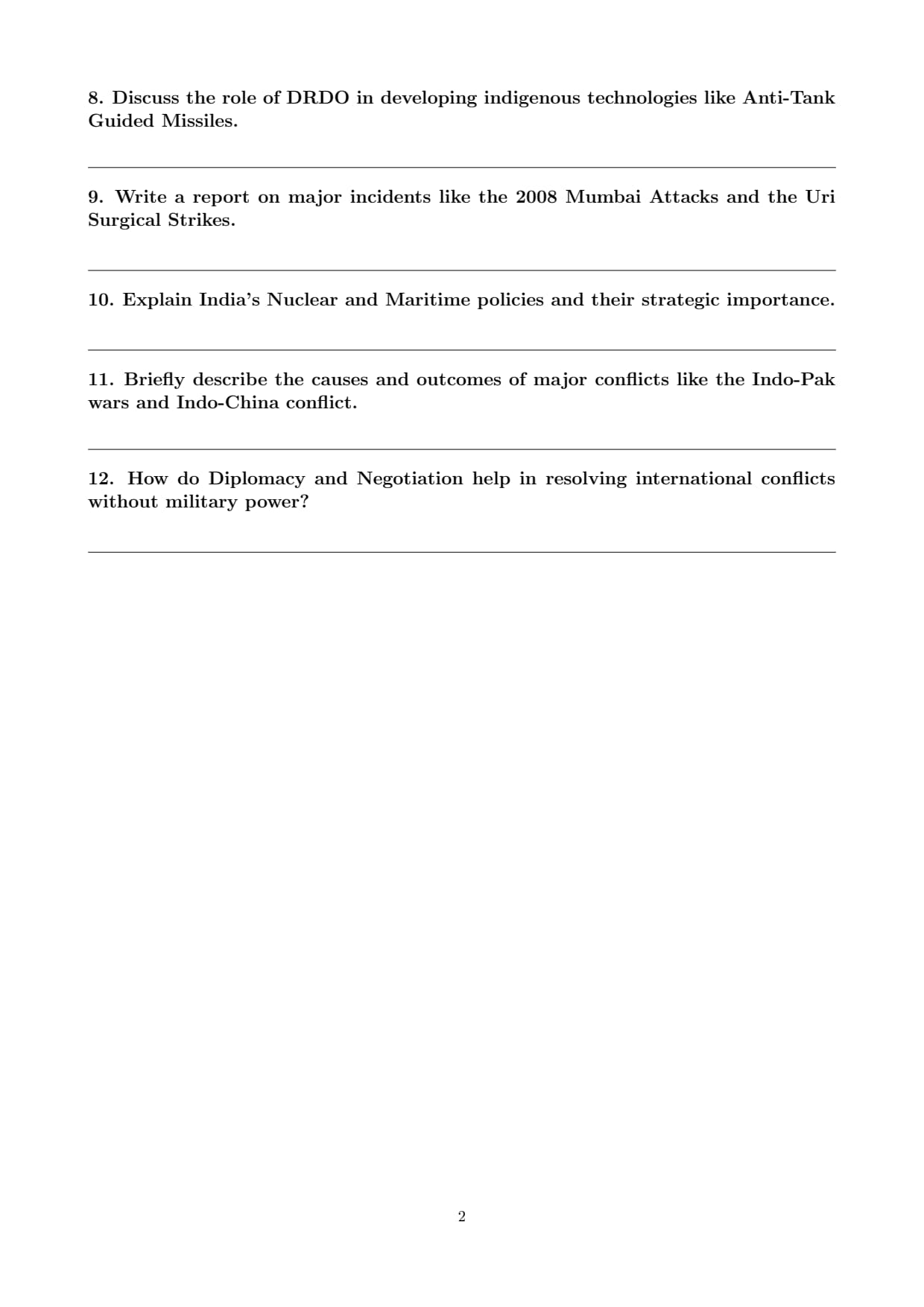
Discuss the role of DRDO in developing indigenous technologies like Anti-Tank Guided Missiles.
View Solution
Concept:
The Defence Research and Development Organisation (DRDO) is India's premier defense R\&D agency. It focuses on developing indigenous military technologies to reduce dependence on foreign imports and enhance national security.
Step 1: Promotion of self-reliance.
DRDO supports the vision of \textit{Atmanirbhar Bharat by designing and producing indigenous weapons and systems, including Anti-Tank Guided Missiles (ATGMs), reducing reliance on foreign suppliers.
Step 2: Development of Anti-Tank Guided Missiles.
DRDO has developed advanced ATGMs such as:
Nag Missile: Third-generation fire-and-forget missile with high accuracy
HELINA/Dhruvastra: Helicopter-launched variants
MPATGM: Man-portable anti-tank guided missile for infantry use
These systems enhance battlefield effectiveness against armored threats.
Step 3: Technological innovation.
DRDO integrates cutting-edge technologies like:
Infrared imaging seekers
Precision guidance systems
Lightweight composite materials
Step 4: Collaboration with industry.
It works closely with public and private sector industries and startups, fostering defense manufacturing ecosystems within India.
Step 5: Strategic advantages.
Indigenous missile systems:
Reduce foreign dependency
Improve operational readiness
Strengthen export potential
Step 6: Contribution to national security.
By developing advanced weapon systems, DRDO enhances the combat capability of Indian armed forces and ensures technological sovereignty.
Conclusion:
DRDO plays a pivotal role in strengthening India’s defense preparedness by developing indigenous technologies like Anti-Tank Guided Missiles, fostering innovation, and promoting self-reliance in defense production. Quick Tip: DRDO develops indigenous weapons like Nag and MPATGM, boosting self-reliance and strengthening India's defense capabilities.
Write a report on major incidents like the 2008 Mumbai Attacks and the Uri Surgical Strikes.
View Solution
Concept:
Major security incidents play a crucial role in shaping a nation’s defense policies and counter-terrorism strategies. The 2008 Mumbai Attacks and the Uri Surgical Strikes are two landmark events in India’s recent security history.
Step 1: 2008 Mumbai Attacks (26/11).
Date: November 26–29, 2008
Nature: Coordinated terrorist attacks carried out by Lashkar-e-Taiba militants
Targets: Taj Hotel, Oberoi Trident, CST railway station, Nariman House, and other locations
Casualties: Over 160 people killed, including civilians and security personnel
Impact:
Exposed gaps in urban security and intelligence coordination
Led to establishment of the National Investigation Agency (NIA)
Strengthened coastal security and counter-terror frameworks
Step 2: Uri Terror Attack (2016).
Date: September 18, 2016
Location: Indian Army brigade headquarters in Uri, Jammu \& Kashmir
Casualties: 19 Indian soldiers killed
Significance: One of the deadliest attacks on Indian armed forces in recent years
Step 3: Uri Surgical Strikes (2016).
Date: September 29, 2016
Action: Indian Army conducted surgical strikes across the Line of Control (LoC)
Objective: Target terrorist launch pads used for infiltration into India
Features:
Precision military operation
Demonstrated India’s proactive counter-terror approach
Sent a strong deterrence message
Step 4: Strategic significance.
Shift from defensive to proactive security strategy
Enhanced global awareness of cross-border terrorism
Strengthened military preparedness and intelligence coordination
Step 5: Lessons learned.
Need for integrated intelligence and rapid response systems
Importance of technological surveillance and border management
Emphasis on joint military and diplomatic responses
Conclusion:
The 2008 Mumbai Attacks exposed India’s internal security vulnerabilities, while the Uri Surgical Strikes demonstrated a decisive shift toward proactive counter-terrorism. Together, these incidents significantly influenced India’s modern security doctrine and response strategies. Quick Tip: 26/11 highlighted security gaps, while the Uri Surgical Strikes marked India’s shift toward proactive and precise counter-terror operations.
Explain India’s Nuclear and Maritime policies and their strategic importance.
View Solution
Concept:
India’s nuclear and maritime policies are key pillars of its national security strategy. They aim to ensure strategic deterrence, protect territorial integrity, and secure economic and geopolitical interests.
Step 1: India’s Nuclear Policy.
India follows a responsible and restrained nuclear doctrine:
No First Use (NFU): India pledges not to use nuclear weapons first but will retaliate if attacked with nuclear weapons.
Credible Minimum Deterrence: Maintains a limited but effective nuclear arsenal sufficient to deter adversaries.
Civilian control: Nuclear weapons remain under strict political authority.
Second-strike capability: Development of nuclear triad (land, air, sea-based delivery systems).
Strategic importance:
Prevents nuclear coercion
Ensures strategic stability in South Asia
Enhances global credibility as a responsible nuclear power
Step 2: India’s Maritime Policy.
India’s maritime strategy focuses on safeguarding its extensive coastline and sea interests:
Protection of Sea Lines of Communication (SLOCs)
Maritime security in the Indian Ocean Region (IOR)
Anti-piracy and coastal security measures
Expansion of naval capabilities and blue-water navy
Strategic importance:
Secures trade routes (major share of India’s trade is sea-borne)
Counters maritime threats and piracy
Enhances regional influence and power projection
Protects offshore resources and maritime borders
Step 3: Integration of nuclear and maritime strategies.
The development of nuclear-powered submarines strengthens India’s nuclear triad and ensures survivable deterrence through sea-based second-strike capability.
Conclusion:
India’s nuclear policy ensures strategic deterrence and stability, while its maritime policy secures economic lifelines and regional influence. Together, they form a comprehensive framework for safeguarding national security and advancing geopolitical interests. Quick Tip: India’s nuclear policy = NFU + credible deterrence; Maritime policy = securing sea lanes and strengthening naval dominance in the Indian Ocean.
Briefly describe the causes and outcomes of major conflicts like the Indo-Pak wars and Indo-China conflict.
View Solution
Concept:
India has faced several major conflicts since independence that shaped its defense policies and geopolitical outlook. The most significant among them are the Indo-Pak wars and the Indo-China conflict.
Step 1: Indo-Pak Wars — Causes.
Territorial dispute over Jammu and Kashmir
Political rivalry and cross-border tensions
Support for insurgencies and military confrontations
Major wars:
1947–48 War: Triggered by tribal invasion in Kashmir after partition.
1965 War: Initiated by Pakistani infiltration (Operation Gibraltar).
1971 War: Result of Bangladesh Liberation Movement and refugee crisis.
1999 Kargil Conflict: Pakistani intrusion across the Line of Control.
Outcomes of Indo-Pak conflicts:
Division of Kashmir along Line of Control (LoC)
Creation of Bangladesh in 1971
Strengthened Indian military preparedness
Persistent rivalry and regional instability
Step 2: Indo-China Conflict (1962) — Causes.
Border disputes in Aksai Chin and Arunachal Pradesh
Differing interpretations of the McMahon Line
Strategic mistrust and geopolitical tensions
Outcomes of Indo-China conflict:
India suffered military setbacks and loss of territory in Aksai Chin
Exposed gaps in India’s defense preparedness
Led to major military reforms and modernization
Long-term border tensions continue
Step 3: Strategic significance.
Strengthened India’s focus on defense modernization
Led to development of nuclear and missile capabilities
Influenced foreign policy and strategic alliances
Conclusion:
The Indo-Pak wars and the Indo-China conflict were driven by territorial disputes and geopolitical tensions. Their outcomes reshaped India’s defense strategy, leading to stronger military capabilities and long-term strategic vigilance. Quick Tip: Indo-Pak wars centered on Kashmir, while the 1962 Indo-China war arose from border disputes — both shaped India’s modern defense strategy.
How do Diplomacy and Negotiation help in resolving international conflicts without military power?
View Solution
Concept:
Diplomacy and negotiation are peaceful tools used by nations to manage disputes and maintain global stability. They emphasize dialogue, mutual understanding, and cooperation instead of armed conflict.
Step 1: Promoting dialogue and communication.
Diplomacy creates channels of communication between conflicting nations, helping reduce misunderstandings and build trust.
Step 2: Conflict resolution through negotiation.
Negotiation allows parties to discuss grievances, identify common interests, and reach mutually acceptable compromises without violence.
Step 3: Use of treaties and agreements.
Formal agreements such as peace treaties, ceasefires, and trade deals help institutionalize peaceful solutions and prevent future conflicts.
Step 4: Mediation and international organizations.
Neutral third parties like the United Nations or other countries can mediate disputes and facilitate peaceful settlements.
Step 5: Confidence-building measures.
Diplomatic initiatives such as cultural exchanges, economic cooperation, and arms control agreements reduce hostility and foster long-term stability.
Step 6: Cost-effective and humane approach.
Peaceful conflict resolution avoids loss of life, economic destruction, and humanitarian crises associated with war.
Conclusion:
Diplomacy and negotiation provide effective non-military means of resolving international conflicts by encouraging dialogue, cooperation, and compromise, thereby maintaining global peace and stability. Quick Tip: Diplomacy resolves conflicts through dialogue and agreements, helping nations avoid war and maintain global peace.



Comments