



Education Journalist | Study Abroad Lead
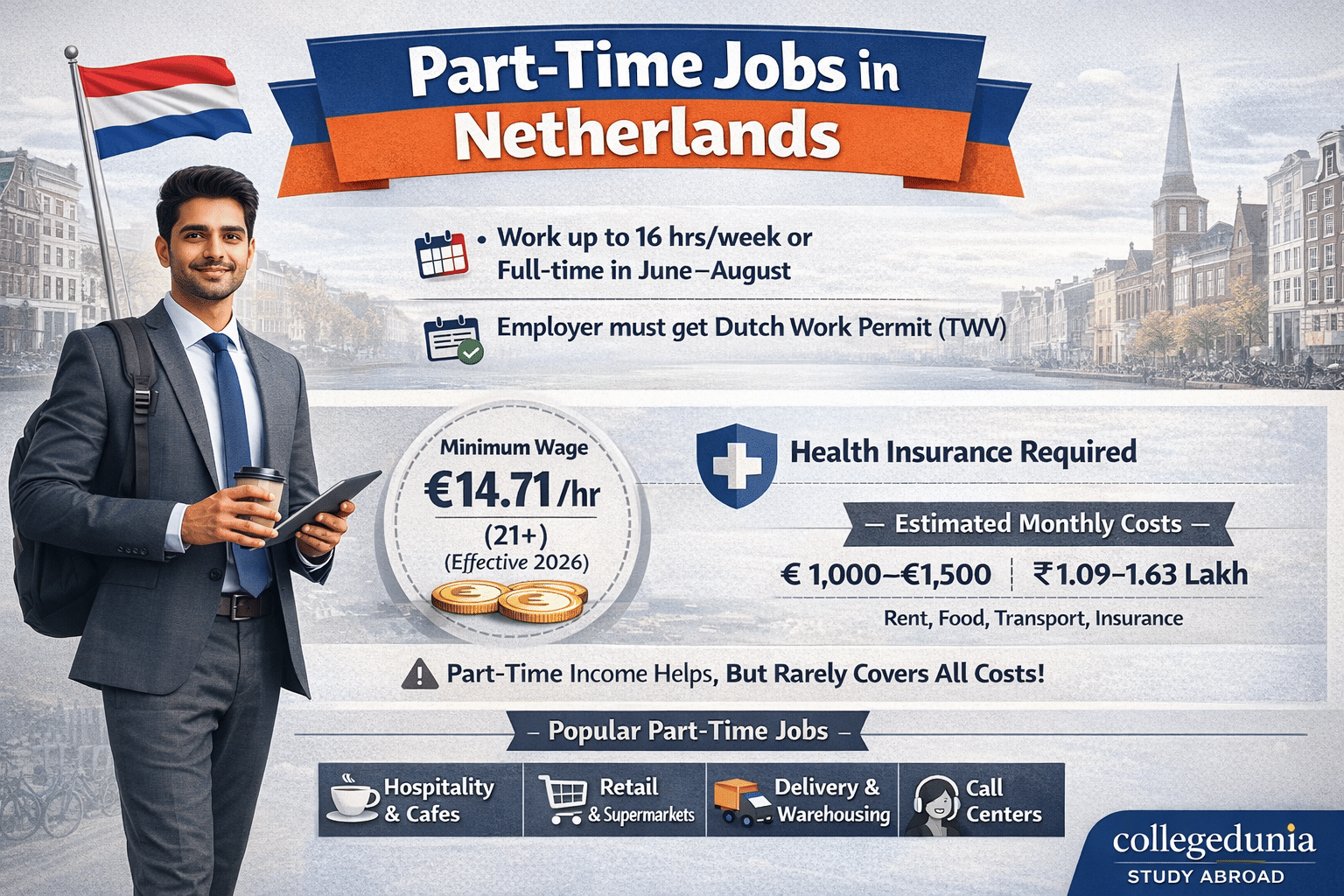
Part-time jobs in the Netherlands can help international students (including Indian students) offset living costs, build local work experience, and improve employability. This matters because typical student living costs in the Netherlands are often estimated at INR 1.09 Lakh to 1.63 Lakh (€1,000–€1,500 per month) for rent, food, transport, insurance, etc. The IND’s financial requirement for higher education students is €1,130.77 (INR 1.19 Lakhs) per month (valid 1 January 2026 to 30 June 2026)—a reminder that part-time income may not fully replace proof-of-funds expectations. With the statutory minimum wage rising to €14.71/hour from 1 January 2026, understanding realistic earnings and legal limits is essential before you job-hunt. Younger students (18–20) are subject to lower youth minimum wages.
Conversion note (for INR in this article): €1 = ₹105.40
Check Out: Study in Netherlands – Guide for Indian Students
- Can international students work part-time in the Netherlands
- How much can you earn from part-time work in the Netherlands?
- What kinds of part-time jobs are most common for international students?
- Where to find part-time jobs in the Netherlands?
- How do Indian students get hired legally in Netherlands?
- Health insurance rules when you work part-tim
- Can part-time income in Netherlands cover monthly costs?
- Self-employed/freelance work: Is it allowed for international students?
- Common mistakes that can create immigration or financial issue
- FAQs
Can international students work part-time in the Netherlands?
Yes, but your work rights depend mainly on your nationality and the conditions of your residence permit. For most non-EU/EEA students (including Indian students) on a Dutch study residence permit:
- Your employer must obtain a work permit (TWV) for you.
- You can work either:
- Up to 16 hours per week during the year, or
- Full-time in June, July, and August.
Note: The TWV is applied for by the employer at UWV, not by the student.
EU/EEA and Swiss nationals generally have fewer restrictions and typically do not need a TWV.
Work rules snapshot for Indian and other international students
| Student nationality/status | Do you need a TWV (work permit)? | Work-hour rule while studying | Notes |
|---|---|---|---|
| EU/EEA/Swiss | Usually no | Often no special student-hour cap under TWV rules | Work permit rules differ because free movement applies. |
| Non-EU/EEA (e.g., India) on a study residence permit | Yes (employer must apply) | Max 16 hours/week OR full-time in Jun–Aug | IND/NL Labour Authority state these limits; UWV handles TWV issuance. |
How much can you earn from part-time work in the Netherlands?
Your actual pay depends on age, sector, role, and collective labour agreements (CAOs). However, the legal floor is the statutory minimum wage.
- The Dutch statutory minimum hourly wage for 21+ rises to €14.71/hour from 1 January 2026.
- Since 2024, the Netherlands has used an hourly minimum wage system (not fixed monthly minimums).
Estimated gross earnings scenarios (illustrative)
| Scenario | Hours | Minimum wage basis | Estimated gross pay (EUR) | Estimated gross pay (INR) |
|---|---|---|---|---|
| Part-time during term | 16 hrs/week | €14.71/hr | ~€1,019/month | ~₹1,07,414/month |
| Summer full-time (example) | 40 hrs/week | €14.71/hr | ~€2,548/month | ~₹2,68,535/month |
Important: These are gross illustrations. Net pay will be lower after payroll tax/insurance deductions, and actual hours/month can vary by contract.
What kinds of part-time jobs are most common for international students?
International students typically find roles where:
- Shifts are flexible,
- English is accepted (especially in bigger cities and international workplaces),
- Hiring demand is steady.
Common student-friendly sectors include:
- Hospitality: cafés, restaurants, hotels (often more English-friendly in major cities)
- Retail and supermarkets
- Warehousing/order picking and logistics
- Delivery rider/courier work
- Customer support/call-centre roles (sometimes multilingual)
- University or campus roles (limited openings, competitive)
Some city portals explicitly note that bars/restaurants can be a common starting point and that English is used in parts of the service sector in international cities.
Where to find part-time jobs in the Netherlands?
A practical approach is to combine university resources + student job boards + English-language search engines.
University and city resources
- University career services, career fairs, faculty networks (often the best route for campus-adjacent work).
Student job boards and portals (examples)
- Student-focused English listings (example: StudentJob “English-speaking jobs”).
- English job aggregators that filter for “no Dutch required” roles (e.g., EnglishJobSearch).
Employer career pages (good for delivery/logistics)
Some courier/delivery employers advertise English-speaking roles in large cities (always verify student permit compatibility before applying).
How do Indian students get hired legally in Netherlands?
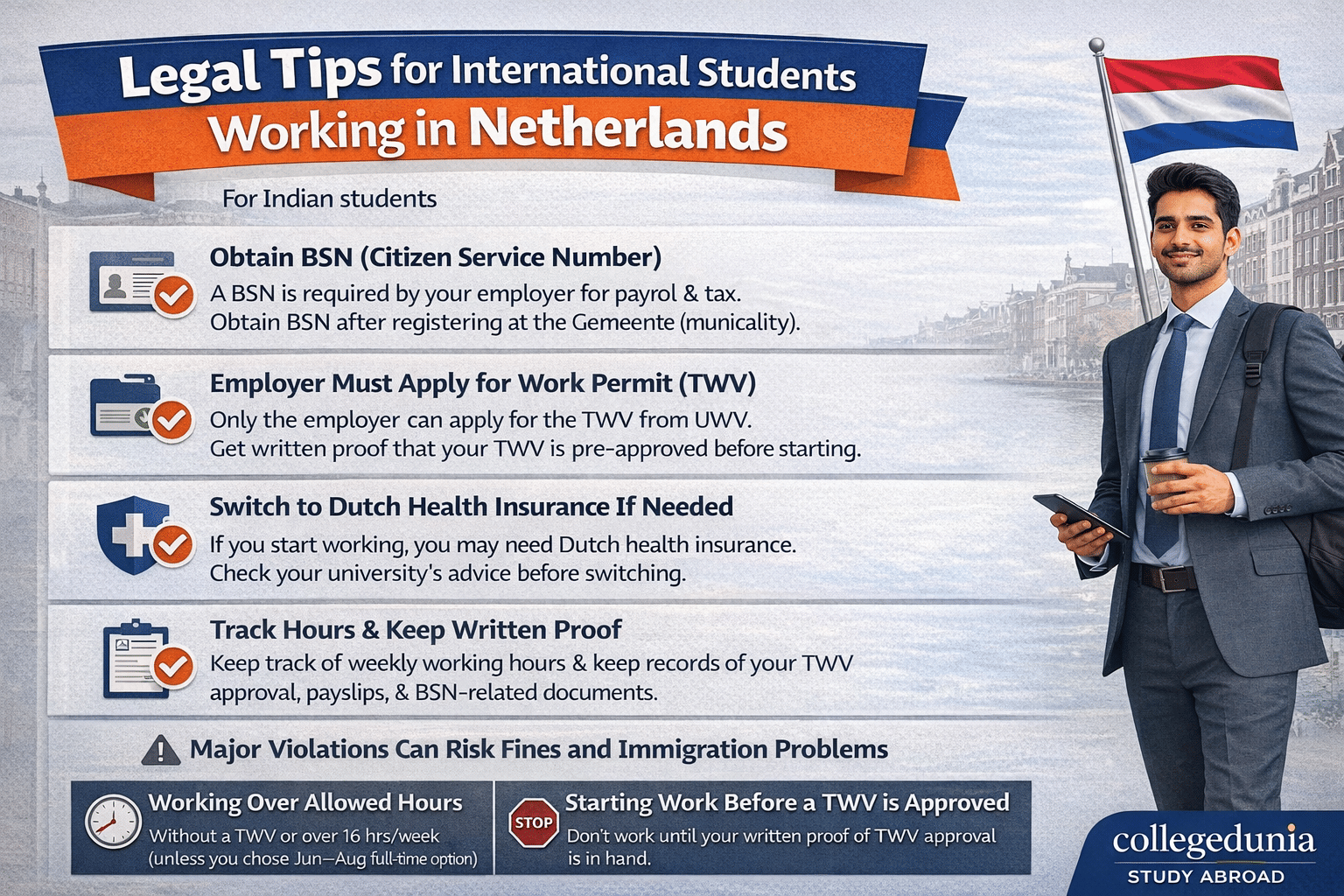
Indian students studying in the Netherlands need:
- A TWV for paid employment (applied by the employer), and
- Compliance with 16 hours/week OR full-time Jun–Aug.
Get a BSN (Citizen Service Number)
A BSN is essential for salary administration and is routinely required by employers.
- Dutch Tax Administration (Belastingdienst) notes that an employee needs a BSN for work/payroll contexts.
- Erasmus University Rotterdam also states that employers need your BSN to start your job/internship, and you receive it upon municipal registration.
Make sure your employer applies for the TWV early
UWV (Employee Insurance Agency in NL) issues the TWV, and some universities indicate the process can take several weeks (commonly cited around 4–5 weeks) —so employers should apply well before your intended start date.
Keep written proof and track your hours
IND states the Labour Inspectorate checks TWV compliance and that working more than allowed or without a TWV can lead to enforcement actions (including fines for the employer and reporting to IND).
Health insurance rules when you work part-time
This is one of the most common “surprise” costs for international students.
- Government.nl explains that if you come to live or work in the Netherlands, you are required to take out Dutch health insurance (with specific rules and timelines).
- Study in NL explains international students have different rules by situation and notes that students in NL for study-only are not allowed to take out Dutch public health insurance, but situations change when you work.
- University pages also warn that if you work alongside studies, you may need Dutch health insurance even if already insured elsewhere.
Practical takeaway: Before starting paid work, check your university’s insurance guidance and confirm whether you must switch to Dutch basic health insurance (and whether you need an assessment of your Wlz insurance position).
Taxes: what students should expect
In most student jobs, your employer withholds payroll taxes from your salary.
- Belastingdienst explains payroll taxes cover wage tax and may include reductions/tax credits depending on your situation and written requests.
- Government.nl states you may need to file a tax return to pay tax or receive a refund if you paid too much.
- Business.gov.nl describes the annual filing framework (and when filing is mandatory if you receive a tax letter)
Tip for Indian students: Keep your payslips and annual statement (jaaropgaaf). If you’ve overpaid through withholding, you may be eligible for a refund depending on your final income and filing position.
Can part-time income in Netherlands cover monthly costs?
Study in NL estimates average student monthly expenses at €1,000–€1,500, and gives a typical room rent range of €450–€1,000 depending on the city and arrangements.
| Item (typical estimate) | Amount (EUR) | Amount (INR) |
|---|---|---|
| Monthly student expenses (overall) | €1,000–€1,500 | ₹1,05,400–₹1,58,100 |
| Monthly room rent (range) | €450–€1,000 | ₹47,430–₹1,05,400 |
What this means in practice: A 16-hr/week job at minimum wage (gross) may cover a meaningful portion of living costs, but it may not fully cover monthly expenses—especially in higher-rent cities—once taxes and insurance are considered.
Self-employed/freelance work: Is it allowed for international students?
Some Dutch institutions state that international students on a study residence permit can do self-employed work without a TWV and without hour restrictions, provided you still meet study obligations and residence permit requirements.
City guidance also notes that non-EU/EEA students have been allowed to be self-employed without a work permit (policy context).
Important caution: “Self-employed” usually involves registrations and tax obligations (e.g., Chamber of Commerce registration in many cases). Don’t assume “freelancing” is simpler than employment—do compliance checks first.
Always confirm with your university’s immigration team or IND-linked guidance before starting any freelance or ZZP activity.
Common mistakes that can create immigration or financial issues
- Starting paid work before the employer has the TWV (for non-EU/EEA students).
- Exceeding the 16 hours/week limit (if you chose term-time work rather than summer full-time).
- Forgetting to sort health insurance correctly once you begin working.
- Not arranging a BSN early, which can delay onboarding and salary payments.
Indian Student Experiences
Based on Reddit discussions, language is a recurring theme: people who do not speak Dutch often ask the community what part-time options exist and how realistic it is to find work with English only, suggesting that students should prioritise English-friendly sectors and cities, and treat Dutch learning as a long-term advantage.
Budgeting against rent and insurance is as important as finding the job itself.
Final student tip:
Don’t plan your finances assuming you’ll immediately find a part-time job. Jobs take time, TWVs take weeks, and insurance can add costs. Treat part-time work as support—not your main survival plan.
FAQs
Ques. Can Indian students work part-time in the Netherlands while studying?
Ans. Yes. Most Indian students are non-EU/EEA and can work part-time if the employer obtains a TWV (work permit) and the student stays within the limit of 16 hours/week during the year or works full-time in June–August.
Ques. Who applies for the Dutch work permit (TWV) for international students?
Ans. The employer applies for the TWV through UWV; students cannot apply for it themselves for a standard job.
Ques. What is the minimum wage in the Netherlands in 2026?
Ans. From 1 January 2026, the statutory minimum wage for employees aged 21 and over is €14.71 per hour (gross).
Ques. Do international students need a BSN to work in the Netherlands?
Ans. In practice, yes—employers use your BSN for payroll administration, and you generally receive it after registering with the municipality.
Ques. Do I need Dutch health insurance if I start a part-time job?
Ans. Often, yes. Official guidance notes that people who live or work in the Netherlands must take out Dutch health insurance, and university guidance commonly warns students that working can trigger Dutch insurance obligations even if already insured elsewhere.



Comments