



Education Journalist | Study Abroad Lead | Updated On - Jul 13, 2026
dMAT registration for the September 2026 sitting opened on 29 June 2026 and closes on 15 September 2026, with the exam scheduled for 26 September and certificates released on 12 October 2026. The Digital Master Assessment Test is compulsory for Indian graduates in Engineering, Commerce, Business and related streams applying to German Masters programmes from Summer Semester 2027 onwards. The €150 test is booked through the g.a.s.t. portal and its result is submitted alongside APS documents.
- Time-sensitive window: missing 15 September locks applicants out of the Summer 2027 intake entirely.
- Eligibility is bounded: only Engineering, IT, Commerce, Finance, Economics and Business degrees currently trigger the test.
- Additive, not substitutive: the score sits on top of APS document verification, it does not replace it.
- Score visibility matters more than pass or fail: universities see the raw score, so preparation pays off even though a low result does not block the certificate.
Read More: Germany Adds dMAT Test to APS Process from Summer 2027
The test has no fixed syllabus and rewards timed practice on figure sequences, mathematical equations and Latin squares. That format catches most first-time takers off guard, which is why registering early and using the remaining weeks before 26 September for mock rounds decides most outcomes.
The Summer 2027 intake is the first cycle where a German Masters admission for an eligible Indian applicant is impossible without a valid dMAT score, making this registration the single most time-critical action of the entire application year.
Quick Facts on dMAT Registration
| Parameter | Detail |
|---|---|
| Registration opens | 29 June 2026 |
| Registration deadline | 15 September 2026 |
| Exam date | 26 September 2026 |
| Results and certificate | 12 October 2026 |
| Registration fee | €150 (around INR 16,340) |
| Test language | English |
| Test duration | 3.5 hours including break |
| Test centres in India | 10 cities |
| Score scale | 0 to 200, mean of 100 |
| Certificate validity | Indefinite |
- Quick Facts on dMAT Registration
- Who Needs to Register for dMAT
- dMAT Registration Dates and Deadlines
- How to Complete dMAT Registration
- dMAT Registration Fee and Refund Rules
- Where to Register for dMAT in India
- dMAT Exam Format After Registration
- What Happens After You Register for dMAT
- Common dMAT Registration Mistakes to Avoid
- FAQs on dMAT Registration
Who Needs to Register for dMAT
dMAT registration is compulsory for Indian graduates whose Bachelor’s degree falls in Engineering, Computer Science, IT, Commerce, Accounting, Finance, Economics, Business or Management and who plan to start a German Masters programme in Summer Semester 2027 or later. The rule was introduced by APS India on 29 June 2026 and applies only to fresh applicants who had not begun their APS process before that date.
Applicants who filed APS certificate documentation online or in person before 29 June 2026 remain on the old rules and are not asked to sit the test. Source: aps-india.de official notice.
Streams that trigger the requirement
- Bachelor of Engineering or Bachelor of Technology across all specialisations.
- Bachelor of Computer Applications, BSc IT and BSc Computer Science.
- Bachelor of Commerce, Chartered Accountancy graduates and BBA.
- Bachelor of Economics, BSc Economics and BSc Finance.
- Bachelor of Business Administration and Bachelor of Management Studies.
Who is exempt from dMAT registration
- Applicants to Bachelor’s programmes in Germany.
- PhD candidates, exchange students and double-degree entrants.
- Applicants whose UG degree is in sciences, humanities, arts, medicine, law or architecture.
- Anyone confirmed for the Winter 2026 or Winter 2026/27 intake.
The list of covered streams is expected to widen for the Summer 2028 cycle. Applicants planning further ahead should track APS India notices through the year rather than assume a permanent exemption. See the Masters in Germany requirements for Indian students overview for current stream coverage.
dMAT Registration Dates and Deadlines
The dMAT registration window for the first sitting runs from 29 June 2026 to 15 September 2026, followed by the exam on 26 September and results on 12 October 2026. These four dates form the only cycle for Summer 2027 admissions in most German universities.
Full timeline for the first sitting
| Milestone | Date |
|---|---|
| Registration opens on g.a.s.t. portal | 29 June 2026 |
| Registration deadline (all cities) | 15 September 2026 |
| Refund cutoff (14 days from registration) | rolling by registration date |
| Exam day at all Indian centres | 26 September 2026 |
| Results and downloadable certificate | 12 October 2026 |
| Deadline to file with APS India for early German intakes | from mid-October 2026 onwards |
Source: dMAT India programme page (d-mat.de) and APS India dMAT notice.
Key Insight: The 12 October results date is what makes September the drop-dead month. Many German universities close Summer 2027 applications between mid-January and mid-March, so the certificate must be in hand for APS submission, which itself takes three to four weeks after dMAT results.
Anyone applying for a mid-March 2027 deadline should aim to sit dMAT in September and have the APS bundle submitted no later than mid-November. Applicants targeting January deadlines have almost no cushion at all.
If the September window is missed
- The next confirmed sitting is expected in the January to March 2027 window, but exact dates have not been published.
- A second sitting will push APS submission into February or March, which risks missing Summer 2027 deadlines for competitive programmes.
- A Winter 2027/28 shift is the safest fallback, but that also means adding four to six months of gap year to the plan.
Applicants who need extra runway on academic prep should reference the Germany application timeline for Indian students to lock a realistic month-by-month sequence.
How to Complete dMAT Registration
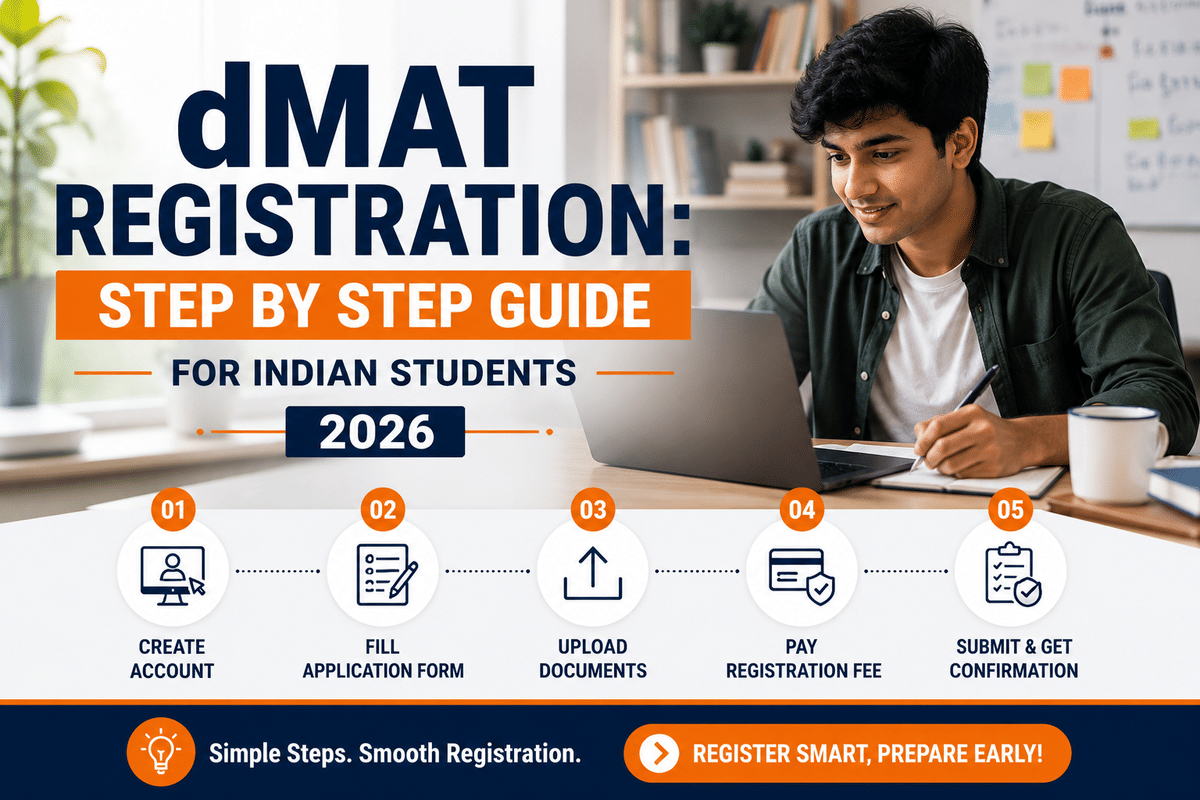
dMAT registration is a fully online process handled by g.a.s.t. (not by APS India), and it takes 25 to 40 minutes if the passport, photo and payment details are ready. The steps below reflect the flow published on the g.a.s.t. dMAT portal at gast.de as of July 2026.
Step 1: Open the g.a.s.t. dMAT portal
Go to gast.de/portal and open the dMAT exam search under the centre-search section. Filter by India to see the ten available test cities. If a city is not visible, that centre has already sold its seats and cannot be selected. Source: g.a.s.t. registration portal.
Step 2: Create a participant account
Register with a personal email and a strong password. The account has to be linked to a mobile number and remains the only route to the certificate later, so applicants should not use a college or consultancy-shared email.
Step 3: Enter personal details exactly as they appear on the passport
Name, date of birth and passport number must match the physical passport character for character. On exam day, g.a.s.t. staff verify the passport against the registration record and refuse entry on any mismatch.
Step 4: Pick a test centre and confirm the seat
Seats are allocated on a first come, first served basis across Ahmedabad, Bengaluru, Bhopal, Chandigarh, Chennai, Kolkata, Mananthavady, Mumbai, New Delhi and Pune. Applicants in metros with heavy demand (Bengaluru, Delhi, Mumbai) should book within the first two weeks of the window opening.
Step 5: Pay the €150 fee and download the confirmation
Payment is by international debit or credit card at the point of registration. Once the transaction clears, a booking confirmation and admit slip become available in the portal dashboard. Screenshot both and store a PDF copy for the APS file.
Step 6: Verify the confirmation email
The confirmation email lands within 24 hours. If it does not, applicants must write to kontakt@gast.de with the transaction reference rather than assume the seat is booked.
Anyone still choosing programmes at this stage should shortlist first through the complete MS in Germany guide so the dMAT slot aligns with the university deadlines that actually matter.
dMAT Registration Fee and Refund Rules
The dMAT registration fee is a flat €150, which works out to around INR 16,340 at the current exchange rate. The fee is paid once to g.a.s.t. at the time of registration and is entirely separate from the INR 18,000 that APS India charges for its own certificate.
Total cash outlay for the full APS plus dMAT bundle
| Component | Payable to | Amount |
|---|---|---|
| dMAT registration fee | g.a.s.t. Germany | €150 (around INR 16,340) |
| APS India certificate fee | APS India, New Delhi | INR 18,000 |
| Passport photograph and courier | local vendors | INR 500 to INR 1,200 |
| Total for a first-time applicant | Around INR 34,900 |
Conversions based on a EUR-INR rate of INR 108.93 as of July 13, 2026. Rates fluctuate; check the current rate before financial planning.
The dMAT amount is charged in Euros, so a weak rupee week can push the actual card statement up by INR 300 to INR 500. Applicants using an international student card should budget a small forex mark-up on top of the base fee. Source: dMAT India programme page.
Refund rules and cancellation window
Key Insight: If a refund is needed, then the request must reach kontakt@gast.de within 14 calendar days of registration, in writing, with the transaction reference and a reason. Requests after day 14 are refused except in rare, documented emergencies (medical or bereavement).
- Full refund: available if cancellation is made within 14 days of the original registration.
- No refund: from day 15 onwards, including no-shows on 26 September and technical failures at the applicant’s end.
- Test centre change: permitted only if the alternative centre still has seats and the request is made before the 15 September deadline.
- Retake: allowed at the next official sitting with the full €150 charged again.
Loan-funded applicants planning to bundle the fee into an education loan should check the Germany blocked account and pre-departure cost breakdown to see how dMAT sits within the wider budget.
Where to Register for dMAT in India
The dMAT is offered at ten g.a.s.t.-licensed centres across India, and the choice locks in during registration on the gast.de portal. There is no home-based option: the test is proctored on-site and requires biometric ID verification at the centre.
Confirmed test cities for September 2026
| Region | Test cities |
|---|---|
| North India | New Delhi, Chandigarh |
| West India | Mumbai, Pune, Ahmedabad |
| South India | Bengaluru, Chennai, Mananthavady (Kerala) |
| East India | Kolkata |
| Central India | Bhopal |
Source: d-mat.de India programme page. The final licensed centre address for each city is revealed only inside the registration flow, not on the public marketing page.
How to pick the right centre
- Metros fill first: Delhi, Mumbai and Bengaluru run out of seats within the first three to four weeks of the window opening.
- Tier-2 buffer: Bhopal, Chandigarh and Mananthavady tend to hold seats through August and are the safer choice for late registrants.
- Travel logistics: the test runs 3.5 hours, so a same-day flight back is risky. Applicants from Tier-3 cities should book an overnight stay near the centre.
- ID rules are strict: centre entry requires a valid Indian passport, so applicants using an expired or damaged passport should renew it before booking.
There is no dMAT at-home option and no plan to add one for the September 2026 sitting. Applicants who cannot travel to any of the ten cities have to defer to the next window and shift their target intake.
dMAT Exam Format After Registration
Once dMAT registration is confirmed, the exam runs 3.5 hours in total across two modules: a Core Module measuring general cognitive skills, and a Subject Module that tests academic reasoning. All Indian APS applicants sit the General Academic Module regardless of undergraduate stream.
Core Module: three cognitive subtests
- Figure sequences: pick the next figure in an abstract visual pattern by identifying the underlying rule.
- Mathematical equations: solve numerical logic problems that reward reasoning speed, not heavy calculation.
- Latin squares: fill missing elements in a grid using row and column constraints.
Subject Module: General Academic
The General Academic Module tests the ability to read short academic passages, extract data from charts and apply reasoning under time pressure. It is not a knowledge test; the questions do not assume any specific subject preparation from the UG degree.
Scoring and interpretation
| Attribute | Detail |
|---|---|
| Score scale | 0 to 200 |
| Mean score | 100 |
| Passing threshold | No pass or fail; every applicant gets a score |
| Score validity | Indefinite |
| University access | Score visible on the APS certificate |
Source: d-mat.de scoring documentation. A score under 100 does not block APS certification but weighs against competitive programmes at TU Munich, RWTH Aachen, TU Berlin and similar top-tier schools.
What dMAT gives and what it does not cover
- What it gives: a standard academic-aptitude signal that German universities can compare across all Indian applicants.
- What it gives: a permanent certificate that can be reused for later intakes or a second application year.
- What it does not cover: the language requirement; IELTS, TOEFL, TestDaF or DSH scores are still needed on top.
- What it does not cover: the APS document verification itself; transcripts and degree certificates still go through the standard APS review.
Applicants uncertain about language routes can compare their options through the study in Germany without IELTS pathway before committing to a test schedule.
What Happens After You Register for dMAT
After dMAT registration confirms, the applicant enters a two-week to three-month runway that ends with the exam, followed by a 16-day wait for results and then an APS submission of three to four weeks. The order matters: dMAT results have to reach APS India before the certificate is issued.
Post-registration checklist
- Save the g.a.s.t. confirmation email and admit slip in two separate locations (cloud and offline).
- Book travel and accommodation to the test centre at least 10 days before 26 September.
- Complete two to three timed mock tests on figure sequences, mathematical equations and Latin squares.
- Keep the passport, admit slip and a backup photo ID ready in a single folder.
- Arrive at the centre by 08:30 for a 09:30 start, since late entry is refused.
What happens between exam day and APS submission
- 26 September to 12 October: results processed by g.a.s.t.; certificate appears in the portal on 12 October.
- Mid-October onwards: download the PDF certificate and attach it to the APS India online application.
- Three to four weeks after APS submission: APS certificate is issued, cleared for university applications.
Key Insight: If the target intake has a January or early February deadline, then the dMAT-to-APS-to-university sequence has to be pre-planned; there is no room for a resubmission or a corrected APS if any single document is wrong.
Applicants with a stronger academic profile can use the extra time between exam day and APS clearance to work on SOPs and LORs. The one-year Masters options in Germany tend to have earlier deadlines and are worth mapping first.
Common dMAT Registration Mistakes to Avoid
Most failed dMAT registrations trace back to five preventable errors: name mismatches, missed refund windows, wrong centre picks, delayed payment and skipped confirmation checks. Each of these is fixable if caught within 14 days, and each is expensive if missed.
Mistake 1: passport name mismatch
Registration must use the exact spelling on the passport biometric page, including middle names and expansions. A shortened first name or an initial-only middle name is grounds for refusal at the centre. Source: g.a.s.t. exam-day identification rules.
Mistake 2: booking a centre without checking the seat map
Applicants routinely book Delhi or Mumbai in July and only realise in August that seat availability has moved to smaller cities. The g.a.s.t. portal shows a live seat count; refresh it before committing to travel plans.
Mistake 3: paying from a low-limit card
The €150 charge sometimes fails on domestic debit cards without an international transaction flag. If the payment errors out, the seat is not held and can be lost to the next registrant.
Mistake 4: missing the 14-day refund window
Anyone who registers early and then changes plans (deferral, intake shift, family reasons) has only 14 calendar days to email kontakt@gast.de for a refund. Missing that window means the €150 is gone.
Mistake 5: assuming APS handles dMAT
APS India does not manage dMAT registration, does not sell seats and does not handle refunds. Every registration query, ID correction or refund request has to go directly to g.a.s.t. Attempting to route it through APS wastes days that count against the September deadline. Applicants can cross-check the official dMAT exam guide for the current split of responsibilities.
Also Check:
dMAT registration looks straightforward on paper, but the compressed timeline between the 15 September deadline and the January to March university cut-offs turns small delays into missed intakes. Every eligible Indian applicant for Summer 2027 should treat 26 September as a hard commitment and use the intervening weeks to prep the Core Module formats under a stopwatch. The €150 fee is a small price for entering the German Masters pipeline on time, and the certificate remains valid for future application cycles too.
FAQs on dMAT Registration
Ques. When does dMAT registration close for the September 2026 exam?
Ans. 15 September 2026 is the last date to register for the first Indian sitting. Registration opened on 29 June 2026 and runs through 15 September, with the exam held on 26 September and certificates released on 12 October 2026. Missing the deadline pushes the applicant to the next window, which is expected between January and March 2027.
Ques. How much is the dMAT registration fee for Indian students?
Ans. The dMAT registration fee is €150 (around INR 16,340), paid directly to g.a.s.t. during online registration. The fee is separate from the INR 18,000 APS India certificate charge, so total outlay for a fresh applicant works out to roughly INR 34,900 before travel and photograph costs.
Ques. Who is exempt from dMAT registration in 2026?
Ans. Applicants for Bachelor’s, PhD, exchange and double-degree programmes are exempt, along with Indian students who filed APS documents before 29 June 2026. UG streams outside Engineering, IT, Commerce, Finance, Economics and Business are also outside the current scope. Winter 2026 or Winter 2026/27 intake applicants do not need the test.
Ques. Can I get a refund if I cancel dMAT registration?
Ans. Yes, within 14 calendar days of the original registration. The request must be sent in writing to kontakt@gast.de with the transaction reference. After day 15, refunds are refused except in rare medical or bereavement cases with supporting documents.
Ques. How many dMAT test centres are there in India?
Ans. Ten cities host the dMAT: Ahmedabad, Bengaluru, Bhopal, Chandigarh, Chennai, Kolkata, Mananthavady, Mumbai, New Delhi and Pune. Seat allocation is first come, first served, and metros usually fill within the first three to four weeks of the registration window opening.
Ques. Can I retake the dMAT exam if I score poorly?
Ans. Yes. There is no ban and no lifetime cap on attempts, but each retake carries the full €150 fee and the applicant has to wait for the next official sitting. The most recent score is what applicants typically submit, though universities can see previous attempts if requested.
Ques. Do I need to register with APS India separately from dMAT?
Ans. Yes. dMAT registration goes through g.a.s.t. at gast.de; APS certification is a separate application at aps-india.de. The dMAT score is uploaded to the APS file once the certificate arrives on 12 October, and APS India then issues the final certificate in three to four weeks.
Ques. What documents do I need for dMAT registration?
Ans. A valid Indian passport is the only mandatory document at the registration stage. Details entered online must match the passport character for character. A recent digital photograph, an international-transaction-enabled debit or credit card and a working email address complete the requirements.
Ques. Can I take the dMAT exam from home?
Ans. No. There is no home-based dMAT option for Indian applicants in the September 2026 sitting. The test is proctored on-site at licensed g.a.s.t. centres with biometric ID checks. Applicants who cannot travel to any of the ten cities have to defer to a later window.
Ques. Does a low dMAT score block admission to German universities?
Ans. No. A low score does not block the APS certificate and does not automatically reject any application. The score is visible on the APS certificate, so competitive Masters programmes at TU Munich, RWTH Aachen and TU Berlin do weigh it during selection, but decisions still rest on the university’s own admission criteria.



Comments