




The Indian Institute of Technology (IIT) Bombay has released the UCEED Cutoff 2026 for Part A on 5th February 2026 on its official website, uceed.iitb.ac.in. It includes the mean and standard deviation, which are 70.86 and 25.77.
IIT Bombay first releases the Part A qualifying cutoff. The admission cutoff is later announced as category-wise opening and closing ranks for each round of UCEED seat allotment.
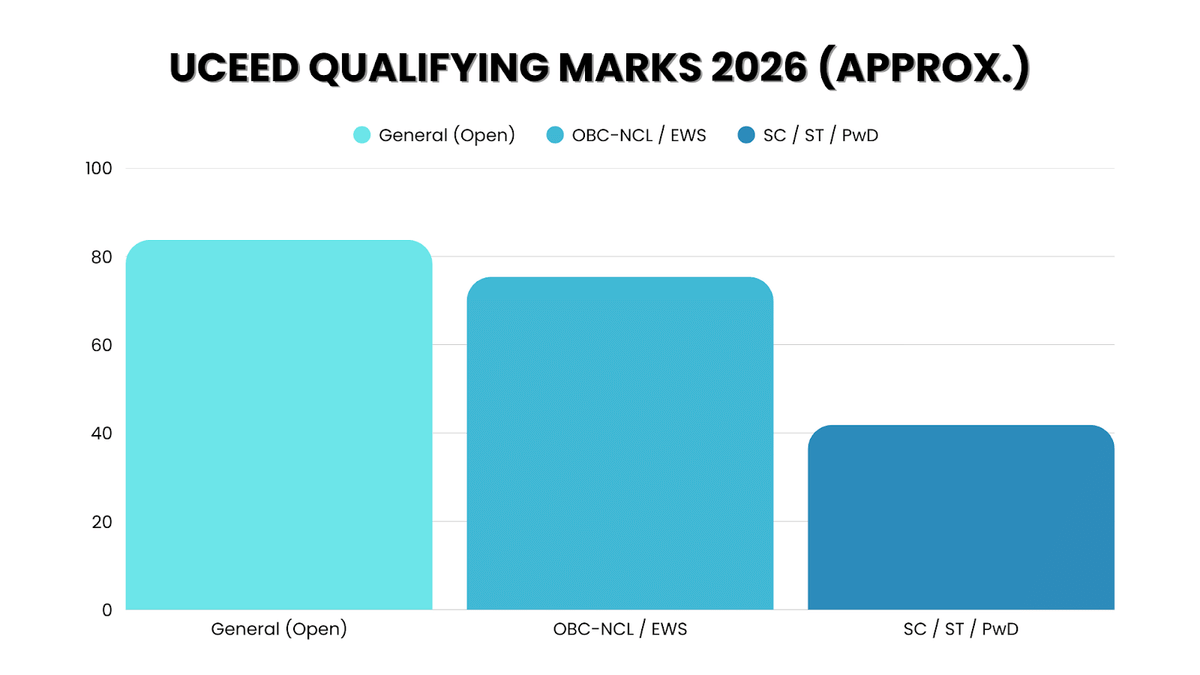
As per the UCEED Cutoff of Part A, the expected cutoff of the different categories will be:
- For the General (CRL) Category, candidates will need at least 83.7 marks to qualify.
- For the OBC/EWS Category, around 75.37 cutoff marks are required.
- For candidates in the SC/ST/PwD Category, a cutoff of 41.87 marks is needed.
Related Links:
- UCEED Seat Matrix 2026: Seat Intake, Category-wise Seat Distribution, Participating Institutes
- Top Colleges in India Accepting UCEED Based on 2026 Ranking

What is the UCEED Cutoff?
The UCEED Cutoff refers to the minimum qualifying marks that a candidate must score in the UCEED exam to be eligible for counselling and seat allotment for B.Des (Bachelor of Design) in participating institutes like IIT Bombay, IIT Delhi, and IIT Guwahati.
There are 2 types of the UCEED Cutoff:
- Score Cutoff (Qualifying Marks): The minimum marks a candidate needs to qualify for UCEED.
- Rank Cutoff (Admission Cutoff): The All-India Rank (AIR) below which seats are allotted during counselling.
The IIT Bombay releases UCEED cutoff for 2 parts: Part A - Computer-based (objective + NAT + MSQ) and Part B - Offline drawing/design aptitude test.
If you do not clear Part A cutoff, your Part B will not be evaluated, and you will not get a rank.
| Concept | Meaning |
|---|---|
| Part A Cutoff | Minimum marks required to qualify for rank list |
| Part B Cutoff | No separate cutoff; score added to Part A |
| Real Competition | Happens in final rank calculation |
UCEED Qualifying Marks 2026
Candidates must achieve the following minimum marks and percentage in Part A to qualify, which varies as per the different categories
| Category | UCEED Qualifying Marks (Approx.) |
|---|---|
| General (Open) | 83.75 |
| OBC-NCL / EWS | 75.37 |
| SC / ST / PwD | 41.87 |
Ques. I am getting 94 in part A and expecting 65 in Part B... will I be able to get in DTU?
Ans. If you have scored 94 in part A and 65 in Part B, then your total expected score will be around 159, with this marks range you will have a competitive rank within top 100-150 overall.
So, with this marks range you can get DTU easily.
Ques. What does it mean, as the cutoff given for Part A of UCEED 2026 is 68.35? Is it that this year it is overall low scoring for all candidates?
Ans. That number refers to the minimum qualifying marks in Part A required to: evaluate your Part B and be included in the rank list. It is not the IIT admission cutoff.
A cutoff this high generally suggests the paper was moderate to easy or that candidates performed well overall, not that it was a low-scoring year.
Ques. I scored 62 marks in the UCEED 2025. Do I have any chance of getting into any IIT?
Ans. If 62 is your total score (Part A + Part B), then your chances of getting admission into IIT are very unlikely, as per previous years data, the safe scores for IIT B.Des will start around 110+ even higher for top IITs.
UCEED Cutoff of Part A
The Part A cutoff is the minimum qualifying marks in Part A, which are required to evaluate the candidate’s answer sheet of Part B and for inclusion in the rank list.
How is Part A Cutoff Calculated?
It is statistically determined using:
- Mean (μ) of Part A marks, which is 70.86
- Standard Deviation (σ) of Part A marks is 25.77

Source - uceed.iitb.ac.in/2026
Also Read
UCEED 2026 Part A Cutoff: Mean and Standard Deviation ReleasedWhat is the formula for the UCEED cutoff?
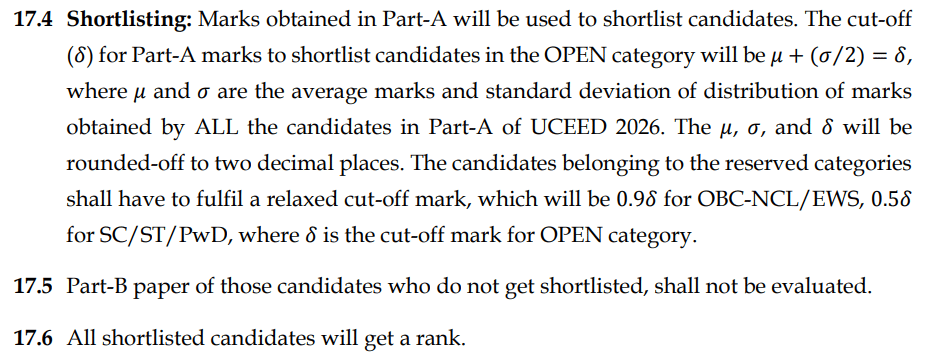
IIT Bombay has provided the formula to calculate the UCEED cutoff in its official Information Bulletin:
- General (Open Category) - Cutoff = μ + (0.5 × σ)
- OBC-NCL / EWS - Cutoff = 0.9 × (General Cutoff)
- SC / ST / PwD- Cutoff = 0.5 × (General Cutoff)
Source - UCEED 2026 Information Bulletin
Final Computed UCEED Part A Cutoffs
The UCEED Part A cutoff shows that this year the competition was quite strong, with a mean (average) score of 70.86.
The high standard deviation, i.e., 25.77, shows that marks were widely spread out, with a big gap between high and low scorers, which pushed the cutoff higher.
- The General category cutoff of 83.75 marks is about 13 marks higher than the average, meaning students had to score well above average to qualify.
- The OBC/EWS cutoff (75.37) is slightly above the average but lower than the General cutoff, giving some relaxation.
- The SC/ST/PwD cutoff (41.87) is much lower, allowing more candidates from these categories to qualify.
| Category | Formula Applied | Applying Mean and Standard Deviation | Final Cutoff (Approx.) |
|---|---|---|---|
| General (Open) | μ + (0.5 × σ) | 70.86 + (0.5 × 25.77) | 83.75 |
| OBC-NCL / EWS | 0.9 × General | 0.9 × 83.75 | 75.37 |
| SC / ST / PwD | 0.5 × General | 0.5 × 83.75 | 41.87 |
These cutoffs are expected benchmarks for shortlisting candidates for rank list inclusion and counselling eligibility.
Also Read
Check UCEED 2026 Expected Final Cut-off ranks for OBC-NCL CandidatesUCEED Cutoff Part B
There is NO separate official “Part B cutoff” score announced independently.
Once you clear part A, then your part B is evaluated, and your final rank is calculated using this formula:
Total Score = Part A + Part B
Final admission depends on All India Rank (AIR), category, institute preference, and seat availability, not just the qualifying cutoff.
UCEED Part-B Evaluation Process
| Condition | Action |
|---|---|
| The difference in marks between two evaluators <= 10 marks | Take a simple average of the two evaluations. |
| Difference in marks > 10 | A third evaluator will be consulted, and the evaluation continues until the difference <= 10 marks. |
| After several evaluations, if the difference remains > 10 | A moderator will examine the answers. |
| Moderator's Evaluation | If the moderator's evaluation differs from the two previous ones, the higher average of the closest evaluations will be considered. |
Final Calculation of UCEED Score
- The total UCEED score is the sum of the marks obtained in Part-A and Part-B.
- This total score is used to determine the final result/rank.
Ques. Is there any cutoff marks for UCEED part b
Ans. No, there is no separate sectional cutoff for Part B in UCEED. However, there is a minimum overall qualifying criterion to be included in the UCEED rank list.
Part B is evaluated only for candidates who qualify Part A cutoff
Ques. How many marks atleast I require to clear UCEED exam to get good institute?
Ans. To qualify for the UCEED and get a rank the general category needs around 120+ marks minimum. The OBC/EWS candidates will require 95–105+ marks to get admission into good institute.
UCEED 2026 Expected Category-Wise Final Cutoff Ranks
IIT Bombay is the most competitive, with Open category ranks closing within 1–15, followed by IIT Delhi (~15–40).
There is a clear preference trend, as top IITs close within 40 ranks, while mid-tier institutes like IIT Indore and IIT Roorkee extend beyond 100.
IIITDM Jabalpur has the widest closing range (Open up to ~200), indicating comparatively lower competition.
UCEED Cutoff for IIT Bombay
| Category | Expected Final Rank |
|---|---|
| Open (All India) | 1–15 |
| EWS | 1–5 |
| OBC-NCL | 4–14 |
| SC | 1–7 |
| ST | 1–5 |
UCEED Cutoff for IIT Delhi
| Category | Expected Final Rank |
|---|---|
| Open (All India) | ~15–40 |
| EWS | ~8–16 |
| OBC-NCL | ~15–30 |
| SC | ~8–12 |
| ST | ~7–10 |
UCEED Cutoff for IIT Guwahati
| Category | Expected Final Rank |
|---|---|
| Open (All India) | ~20–90 |
| EWS | ~7–22 |
| OBC-NCL | ~25–55 |
| SC | ~10–28 |
| ST | ~4–9 |
UCEED Cutoff for IIT Hyderabad
| Category | Expected Final Rank |
|---|---|
| Open (All India) | ~20–65 |
| EWS | ~10–20 |
| OBC-NCL | ~25–45 |
| SC | ~5–20 |
| ST | ~8–12 |
UCEED Cutoff for IIT Roorkee
| Category | Expected Final Rank |
|---|---|
| Open (All India) | ~80–110 |
| EWS | ~15–20 |
| OBC-NCL | ~45–60 |
| SC | ~25–35 |
| ST | ~9–13 |
UCEED Cutoff for IIT Indore
| Category | Expected Final Rank |
|---|---|
| Open (All India) | ~70–130 |
| EWS | ~20–25 |
| OBC-NCL | ~50–65 |
| SC | ~25–35 |
| ST | ~10–15 |
UCEED Cutoff for IIITDM Jabalpur
| Category | Expected Final Rank |
|---|---|
| Open (All India) | ~90–200 |
| EWS | ~20–40 |
| OBC-NCL | ~80–130 |
| SC | ~30–60 |
| ST | ~15–25 |
Also Check:
- How Many Marks are Required for IIT Bombay UCEED 2026 for General?
- Safe Score for IIT Guwahati UCEED 2026 for General: Check Category-wise Safe Score
Ques. What will be the expected OBC-NCL closing ranks for IIT Hyderabad/Guwahati?
Ans. As per the UCEED 2025 Counselling Closing ranks, and experts analysis for the UCEED 2026, the IIT Guwahati will have around 50 closing rank and IIT Hyderabad is expected to have about 44 for OBC-NCL.
| Institute | OBC-NCL Closing Rank (UCEED 2025) |
|---|---|
| IIT Guwahati | ~50 |
| IIT Hyderabad | ~44 |
Ques. With OBC rank ~107-150, what are expected closing ranks for IIT Guwahati/Roorkee?
Ans. With the rank around 107-150 in OBC-NCL, it is generally below the final allotment cutoff for IIT Guwahati, but likely above the Roorkee i.e., 50 and 56, respectively.
UCEED 2025 OBC-NCL Closing Ranks by IIT (Final Round)
| Institute | OBC-NCL Closing Rank (Final Round) |
|---|---|
| IIT Guwahati | ~50 |
| IIT Roorkee | ~56 |
What is a good score for UCEED?
As per the analysis of the previous years trends a score ranging between 170-199 is considered a good score which can get you rank between top 50-120, which is competitive for institutes like IIT Guwahati, IIT Hyderabad, and IIITDM Jabalpur.
| Score Range | Expected Rank Range | Admission Chances | Performance Level |
|---|---|---|---|
| 220+ | Top 1–20 | Very high chance for IIT Bombay, IIT Delhi | Excellent |
| 200–219 | Top 20–50 | Strong chance for top IITs | Very Good |
| 170–199 | Top 50–120 | Good chance for IIT Guwahati, IIT Hyderabad | Good |
| 150–169 | Top 120–250 | Possible admission in participating institutes | Competitive |
| 130–149 | 250+ | Limited IIT chances, other design colleges possible | Average |
| Below 130 | 400+ | Low chances for top IITs | Below Average |
Ques. Do I get direct admission in B.Des in Lovely Professional University with a good UCEED score?
Ans. Yes, a good UCEED score can directly get admission into the B.Des program at Lovely Professional University, but with some criteria:
- LPU is a result-sharing institute that accepts UCEED scores for B.Des admissions.
- That means your UCEED 2026 result can be used instead of other tests like LPUNEST for eligibility.
However, admission is not completely automatic just because you have a good UCEED score.
- For that you are required to apply separately to LPU through its admission portal (UCEED Counselling at IITs does not include LPU)
- Meet the eligibility criteria of LPU which is 50% in Class 12 with English.
Ques. Do I need to give an interview after clearing the UCEED exam for a B.Des...?
Ans. Not for the UCEED Counselling with IITs/IITDM, but yes for the private institutes that accept the UCEED scores.
UCEED Seat Matrix 2026
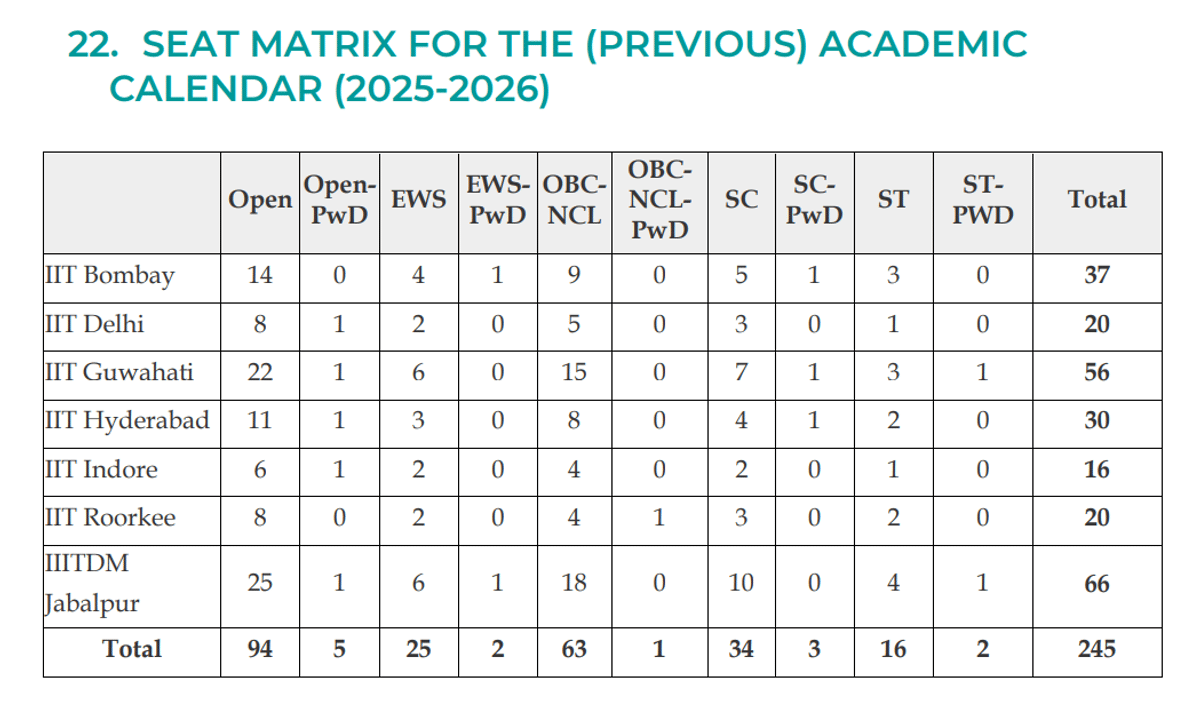
The UCEED 2025–26 seat matrix shows that there are 245 total B.Des seats available across seven institutes.
IIITDM Jabalpur (66 seats) and IIT Guwahati (56 seats) have the highest number of seats, which means students may have slightly better chances there compared to institutes like IIT Indore (16 seats) or IIT Delhi (20 seats), where seats are fewer.
Source - UCEED 2026 Information Bulletin
Ques. Is the UCEED 2026 seat matrix released?
Ans. Yes, the UCEED 2026 seat matrix has been officially published for the B.Des admissions on the UCEED official website by IIT Bombay, where the total seats are 245 across all Institutes.
The seat matrix shows institute-wise & category-wise seat allocation across all participating IITs and IIITDM Jabalpur for the academic year 2025-26, which is used for UCEED 2026 admissions.
Ques. How many seats for General in top IITs?
Ans. The UCEED general category is divided into 2 sub-categories: Open/Open-PwD. So the total number of seats for general (Open + Open-PwD) is 99 seats across all participating institutes.
General Category Seats Total (UCEED 2026)
- Open: 94 seats
- Open-PwD: 5 seats
| Institute | Open | Open-PwD | General Total |
|---|---|---|---|
| IIT Bombay | 14 | 0 | 14 |
| IIT Delhi | 8 | 1 | 9 |
| IIT Guwahati | 22 | 1 | 23 |
| IIT Hyderabad | 11 | 1 | 12 |
| IIT Roorkee | 8 | 0 | 8 |
| IIITDM Jabalpur | 25 | 1 | 26 |
| IIT Indore | 6 | 1 | 7 |
Ques. With only ~37 at Bombay and high competition, what's the realistic seat matrix split for General vs reserved?
Ans. If IIT Bombay has only 37 seats, only 14 of those are general seats, which means that the majority of seats are reserved category seats.
This means roughly 40% seats are open to all candidates irrespective of reservation, while ~60% are reserved for various reserved categories (EWS, OBC-NCL, SC, ST, etc.)
| Category | Seats | % of Total (245) |
|---|---|---|
| General (Open + Open-PwD) | 99 | ~40% |
| Reserved (EWS + OBC-NCL + SC + ST & PwD) | 146 | ~60% |
UCEED Cutoff 2025: Category-wise Opening and Closing Ranks
| Institute | Open | EWS | OBC-NCL | SC | ST |
|---|---|---|---|---|---|
| IIT Bombay | 1–14 | 1–4 | 5–13 | 1–7 | 2–5 |
| IIT Delhi | 15–41 | 9–15 | 16–28 | 8–11 | 8–8 |
| IIT Guwahati | 19–96 | 7–21 | 22–50 | 9–27 | 1–7 |
| IIT Hyderabad | 23–61 | 13–19 | 24–44 | 3–19 | 10–11 |
| IIT Indore | 67–119 | 22–23 | 52–61 | 24–31 | 13–13 |
| IIT Roorkee | 87–111 | 17–18 | 51–56 | 26–33 | 9–12 |
| IIITDM Jabalpur | 93–267 | 24–39 | 63–104 | 36–51 | 14–19 |
UCEED Cutoff 2024: Category-wise Opening and Closing Ranks
| Category | IIT Bombay | IIT Delhi | IIT Guwahati | IIT Hyderabad | IIT Roorkee | IITDM Jabalpur |
|---|---|---|---|---|---|---|
| Open | 1-14 | 15-32 | 22-75 | 18-55 | 73-94 | 76-147 |
| EWS | 1-4 | 7-8 | 5-15 | 6-13 | 16-18 | 19-26 |
| OBC-NCL | 5-14 | 20-26 | 25-46 | 21-36 | 49-63 | 47-75 |
| SC | 1-5 | 8-10 | 7-22 | 6-15 | 23-25 | 17-38 |
| ST | 1-3 | 5-6 | 4-11 | 7-10 | 14-15 | 12-21 |
| Open-PwD | 1 | 3 | - | - | 7 | 4 |
| EWS-PwD | - | - | 2 | - | - | - |
| OBC-NCL PwD | 1 | - | - | 2 | - | 3 |
| SC-PwD | - | - | 1 | - | - | - |
| FN | - | - | 60 | - | - | - |
UCEED Cutoff 2023 (All Rounds)
| Institute | Category | Opening Rank | Closing Rank |
|---|---|---|---|
| IIT Bombay | Open | 1 | 16 |
| EWS | 1 | 4 | |
| OBC-NCL | 4 | 14 | |
| SC | 1 | 5 | |
| ST | 1 | 3 | |
| IIT Delhi | Open | 18 | 35 |
| EWS | 6 | 7 | |
| OBC-NCL | 15 | 20 | |
| OBC-NCL-PWD | 2 | 2 | |
| SC | 6 | 9 | |
| ST | 4 | 8 | |
| IIT Guwahati | Open | 19 | 70 |
| Open-PWD | 1 | 1 | |
| EWS | 5 | 12 | |
| OBC-NCL | 21 | 42 | |
| OBC-NCL-PWD | 1 | 1 | |
| SC | 7 | 25 | |
| ST | 5 | 11 | |
| IIT Hyderabad | Open | 20 | 57 |
| EWS | 13 | 15 | |
| OBC-NCL | 17 | 44 | |
| SC | 10 | 20 | |
| ST | 9 | 10 | |
| IIITDM Jabalpur | Open | 67 | 120 |
| Open-PWD | 2 | 2 | |
| EWS | 16 | 25 | |
| OBC-NCL | 46 | 68 | |
| OBC-NCL-PWD | 3 | 3 | |
| SC | 15 | 33 | |
| ST | 12 | 17 |
UCEED 2022 Cutoff (All Rounds)
| Institute | Category | Round 1 (Opening-Closing) | Round 2 (Opening-Closing) | Round 3 (Opening-Closing) |
|---|---|---|---|---|
| IIT Bombay | Open | 1-14 | 1-14 | 1-14 |
| Open-PwD | 1-2 | 1-2 | 1-2 | |
| EWS | 3-7 | 3-7 | 3-7 | |
| OBC-NCL | 3-13 | 3-13 | 3-13 | |
| SC | 1-5 | 1-5 | 1-5 | |
| ST | 1-3 | 1-3 | 1-3 | |
| IIT Delhi | Open | 5-22 | 5-22 | 5-22 |
| Open-PwD | 3-3 | 3-3 | 3-3 | |
| EWS | 12-14 | 12-14 | 12-14 | |
| OBC-NCL | 19-29 | 19-29 | 19-29 | |
| SC | 6-13 | 6-16 | 6-16 | |
| ST | 5-6 | 5-6 | 5-6 | |
| IIT Guwahati | Open | 17-59 | 17-59 | 17-59 |
| Open-PwD | 5-12 | 5-12 | 5-12 | |
| EWS | 8-17 | 8-17 | 8-17 | |
| OBC-NCL | 14-39 | 14-39 | 14-39 | |
| SC | 7-17 | 7-20 | 7-20 | |
| ST | 4-11 | 4-11 | 4-11 | |
| FN | 34-34 | 34-34 | 34-34 | |
| IIT Hyderabad | Open | 23-43 | 23-43 | 23-43 |
| Open-PwD | 4-4 | 4-4 | 4-4 | |
| EWS | 15-16 | 15-16 | 15-16 | |
| OBC-NCL | 18-40 | 18-41 | 18-41 | |
| SC | 12-19 | 12-19 | 12-19 | |
| ST | 8-9 | 8-9 | 8-9 | |
| FN | 39-39 | 39-39 | 39-39 | |
| IIITDM Jabalpur | Open | 30-92 | 30-92 | 30-93 |
| Open-PwD | 16-24 | 16-28 | 16-28 | |
| EWS | 18-27 | 18-29 | 18-29 | |
| OBC-NCL | 41-65 | 42-72 | 42-73 | |
| OBC-NCL-PwD | 3-3 | 3-3 | 3-3 | |
| SC | 20-35 | 21-37 | 21-39 | |
| ST | 12-19 | 12-19 | 12-19 | |
| FN | - | - | - |
UCEED Cutoff 2026 FAQs
Ques. What is the B.Des cutoff mark for UCEED in IITs, and what minimum marks are needed to get into IITs?
Ans. The B.Des cutoff for UCEED varies every year, which depends on the exam difficulty, number of applicants, and seat availability.
- For the General (Open) category, a safe score to get into top IITs like IIT Bombay or IIT Delhi is usually 200+ marks, which will place you in a rank within Top 50–70.
- A score between 170–190 marks is considered competitive and can help secure seats in IIT Guwahati, IIT Hyderabad, or IIT Roorkee.
The minimum qualifying marks (to be included in the rank list) are much lower than admission cutoffs and vary by category.
Ques. How many seats are in IIT through UCEED?
Ans. The UCEED exam provides the admission into IITs in their B.Des programs, In recent years, the total number of seats across IIT Bombay, IIT Delhi, IIT Guwahati, IIT Hyderabad, IIT Roorkee, and IIITDM Jabalpur has been approximately 225–245 seats combined.
Ques. What rank is required for IIT Guwahati in UCEED?
Ans. For IIT Guwahati B.Des, the General category closing rank will fall between 60-100, for the general category it is safer to score under 70-80 and for reserved categories:
- OBC/EWS: Closing ranks may extend up to 150–200
- SC/ST: Closing ranks usually go even higher due to reservation benefits
Ques. Is there a separate cutoff for UCEED Part B?
Ans. Yes, UCEED has a separate cutoff for UCEED Part B, it is mandatory for candidates to clear both.
- Overall cutoff (Part A + Part B combined score)
- Minimum marks in Part B (drawing section)
If a candidate fails to meet the minimum Part B requirement, they will not be included in the rank list, even if their Part A score is high.
Ques. What are my chances of getting into an IIT with a specific AIR in a reserved category (e.g., SC AIR 90)?
Ans. Your chances depend on both your category rank and overall seat availability. For example, an SC AIR 90 is generally considered a strong position.
With SC AIR 90, you may have:
- Good chances at IIT Guwahati, IIT Hyderabad, IIT Roorkee
- Possible chances at IIT Bombay or IIT Delhi, depending on the year’s competition



Comments