



Content Curator
Joint is considered a point of contact in between cartilage and a bone or a point where two or more bones meet each other. In the human body there are a total of 206 bones that provide protection to internal organs, provide structural scaffolding and also facilitate locomotion (movements of the body).
What is a Joint?
A joint is considered a point of contact in between a cartilage and a bone or a point where two or more bones meet each other. It acts as a pivot and the muscles present around them produce the required force for the movement of the body part.

Classification of Joints
Joints are classified on the basis of the tissues which hold the bones together and the range of motion these bones exhibit. On the basis of this we can classify them into two groups:
- Functional Classification
- Structural Classification
Functional Classification of Joints
Functional classification can be described by the degree of movement which is allowed by the joint. We can further divide it into three types:
Freely movable Joints (or diarthrosis)
In this case, the joints present in the body are freely movable joints and are known as Synovial joints. Maximum mobility is provided to these joints and they are mainly found in the limbs. These joints can be again divided into three parts on the basis of the number of axes of motion allowed by these joints.
(i) Uniaxial Joint: This allows movement only in a particular plane. Example: Elbow joints for Straightening & bending purposes.
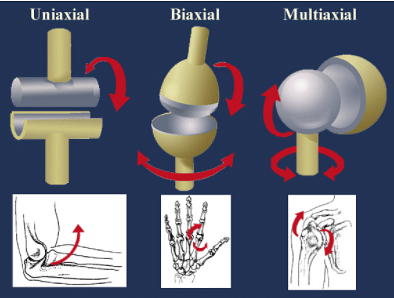
(ii) Biaxial Joint: This allows movement in two planes. Example: knuckles joints which allow bending, straightening and spreading of fingers
(iii) Multiaxial Joint: This joint allows movements in all three axes. Example: Hip & shoulder joint where forward-backwards direction, sideways and rotating movements are possible.
Immovable Joint (or Synarthrosis): These are the joints that do not provide any mobility and are cartilaginous or fibrous joints to just protect the internal organs like the heart and brain. Example: The fibrous joint structures of the cranium for protecting the brain. The manubriosternal joint connects the bones of the manubrium and sternum to protect the heart.

Slightly Movable Joint (or Amphiarthrosis): These are mainly cartilaginous joints that allow very little movement or mobility. These joints are found in between the vertebra. Because of the presence of these joints, the entire vertebral column is able to move.

Structural Classification of Joints
In structural Joints, bones are connected to a cartilage or to a fibrous tissue within which there is a fluid cavity. They can be further divided into three types as follows:
- Fibrous Joint
- Cartilaginous Joint
- Synovial Joint
Fibrous Joint
These are basically the fixed joints or the immovable joints. These joints are found in specific areas where bones are not at all flexible and the bones are fused with each other in a way that they are totally fixed.

The most prominent example is the skull. Other examples include rib cage, pelvic bone, upper jaw, etc.
Cartilaginous Joint
These joints have the ability to move partially and they comprise synchondrosis joints or symphysis joints. Synchondrosis joints are present in younger children and they are temporary which last till the end of puberty.

Examples are symphysis or secondary cartilaginous joints, pubic symphysis, spinal column and rib cage.
Synovial Joints
Synovial Joints are the joints which have the ability to move. These joints have a fluid-filled cavity known as the synovial cavity where the two bones are connected to each other. This fluid helps in joint lubrication and also prevents wear & tear due to friction in the bones.

Thus, free movement of bones can take place. Some of the common examples are neck joint, shoulder joint, knee joint, wrist joint, upper and lower limb joints, etc. The synovial joint can be divided into six types as follows:
(i) Pivot Joint: This type of joint allows the bones to rotate on a single axis. This is also a uniaxial joint. Example: Joint in between first and second cervical vertebrae which allows our head to turn side from side.

(ii) Saddle Joint: These joints usually have one bone turned in an inward direction and the other turned in an outward direction. The joint looks as if a rider is on a saddle. The movements that these joints allow are bending, side to side, rotation, straightening. It is also called a biaxial joint. The ligaments & muscles present are also important for the movement of this joint.
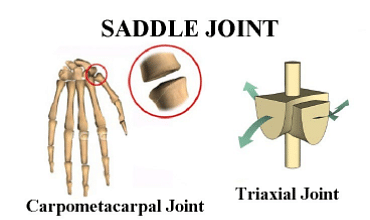
Example: Joints in between palm and thumb.
(iii) Ellipsoid Joint: It is also known as a condyloid joint that allows movements like rotatory, side to side, bending and straightening. Ellipsoid joints are also biaxial joints as the movement in these joints are in two planes. One bone having an oval or convex end fits into the depression or concave end of another bone.
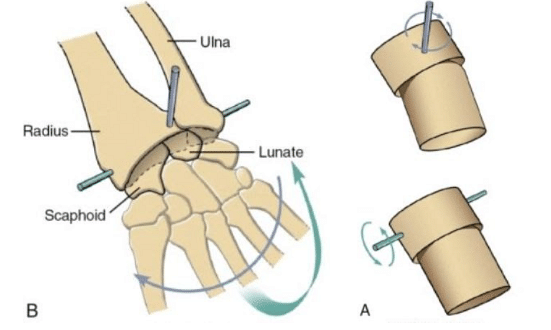
Example: Joints in the wrist bones and forearm.
(iv) Ball and Socket Joint: This type of joint allows movement in all directions including rotatory movement. These joints are multiaxial joints. The head of one bone is fitted to the depression of another bone exactly like a ball is fitted into a socket. Example: Shoulder and hip joints.

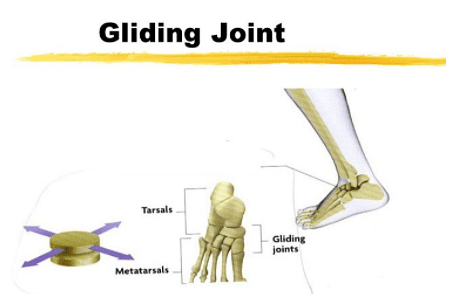
Gliding Joint: These joints are also known as plane joints because of their same size and flat appearance. They slide past each other in a gliding manner. The gliding joint is non-axial as it does not have a rotating motion on any axis. Example: Joints between the tarsal of the foot and the carpals of the wrist.
Hinge Joint: These types of joints allow movement in only one direction. They are uniaxial joints and are found in the knee, ankle and elbow.

Things to Remember
- The union of two or more bones or a bone and cartilage is known as a joint.
- In the human body, there are a total of 206 bones.
- The ability to live beings to move from place to place is called locomotion. The factors responsible for locomotion are muscles and bones.
- Joints can be classified in four ways of joint movement: Gliding movement, biaxial movement, uniaxial movement, multiaxial or polyaxial movement.
- Joints allow various types of movement which are Side to side, straightening, rotatory and bending.
Sample Questions
Ques. How many types are there in Synovial Joints? (2 marks)
Ans. There are six types of synovial joints found in the human body. They are:
- Condyloid joints or Ellipsoid Joints
- Saddle Joints
- Pivot Joints
- Planar joints or Gliding joints
- Ball & Socket Joints
- Hinge Joints
Ques. State the functions of the joints. (2 marks)
Ans. The primary joints are responsible for the movement of our body and the body parts and also to bear weight. Some joints which are fixed also help in the protection of the internal organs like the brain and heart. Joints also provide the structure to the human body.
Ques. Where do we find the Synovial Joints? (2 marks)
Ans. In the human body, Synovial Joints are present in:
- Elbow
- Neck
- Knee
- Shoulder
- Thumb
- Hip
- Wrist
- Intercarpal joints
Ques. Where are the ball and socket joints found in the human body? (2 marks)
Ans. The ball and socket joints exactly look like a ball fitted in a socket which allows flexible movement of few body parts. These joints are mainly found in Hip, sternoclavicular joints and shoulder joints.
Ques. Name the types of Fibrous Joints. (2 marks)
Ans. The fibrous joints are known as immovable or fixed joints. They are of three types:
- Sutures
- Syndesmosis
- Gomphosis
Ques. What is dislocation and fracture of a bone? What precaution should one take when one gets a fracture? (2 marks)
Ans. Dislocation and fracture: Any careless, sudden movement—a jump, fall or knock—may cause an injury to the skeleton. It may be a dislocation or a fracture. In case of dislocation, the bones at the joint are dislodged from their normal position. The ligaments may be torn apart or injuries causing pain and swelling.

A fracture is a break in the bone. The break may be of a hairline crack or serious break in one or more points (Fig. 8.13). Fracture also causes pain and swelling. In all these cases, the patient should soon be taken to a doctor or a hospital.
Ques. How a bone is formed? What kind of food should we take for proper growth and upkeep of bones? (2 marks)
Ans. Before our birth, the skeleton forms as soft and elastic pieces of cartilage. Some of these cartilages, not all, are changed to bones. With the deposition of a substance containing calcium and phosphorus, the bones become hard and strong. When a baby is born its skeleton is soft. At old age, the bones become hard and brittle.
For proper growth and upkeep of bones, we need to take food which are rich in calcium, phosphorus, vitamins and proteins. Milk, curd, fruits, vegetables and eggs ^contain the needed nutrient.
Ques. What is bone marrow? Give its main function. (2 marks)
Ans. The long bones such as the thigh bone, upper arm bones have hollow spaces inside which contains bone marrow. The bone marrow produces red blood cells. They also form some kinds of white blood cells.

Ques. Discuss the mechanism of bone movement. What is the role of muscles in the movement of bones? (2 marks)
Ans. Two muscles work for the movement of a bone. When one muscle contracts, it becomes shorter, stiffer and thicker. It pulls the bone in that direction. The other muscle of the pair relaxes. A muscle can only pull. It cannot push. Hence to move the bone in opposite direction, the relaxed muscle contracts to pull the bone towards its original position, while the first relax.

Ques. Differentiate between bone and cartilage with examples. (2 marks)
Ans. Bone: They are hard and rigid structures in our body that cannot be bent but give shape to our body, e.g. pelvic bone, shoulder bone, etc.
Cartilage: They are semi-hard structures that are elastic tissue and present in an animal body. e.g., the upper part of the ear, etc.
Ques. What is a bone joint? Describe various kinds of joints found in our body. (5 marks)
Ans. Joints: The place where two or more bones meet together is called a joint. There are five main types of joints in our body.
(i) Fixed joints: Some attachments of bones do not allow movement. They are fixed joints. The joint of the cranium is a fixed joint.

(ii) Ball and socket joints: The rounded end of one bone fits into the hollow space of the other bone. Such a kind of joint allows movements in all directions and is called a ball and socket joint. For example, the joint between the upper arm and the shoulder; the thigh and the hip.

(iii) Pivotal joints: The skull is joined to the first two vertebrae of the backbone like a ball to a stick. This type of joint allows movements in many planes -up and down, to the side and all other planes.
(iv) Hinge joints: These joints allow movement only in one plane like a door hinge and not more than 180 degrees. For example, the fingers, the knee. The wrist is a double hinge joint.

(v) Gliding joints: These joints allow only a limited amount of movement of the sliding nature of cartilages. For example, the joints in the backbone.
Ques. Do bones at the top of the skull move? (2 marks)
Ans. The bones on top of the skull form a structure similar to the structure of teeth. They are joined strongly with one another. So these bones are also fixed. These bones do not move.
Ques. What is the function of the skeleton? (2 marks)
Ans. The function of the skeleton is:
- It forms the framework of the body,
- It gives shape and structure to the body.
- It protects the internal organs.
- It helps in the movement and keeping the body erect.
- Ribs of the chest help in breathing.



Comments