




The Tripura Joint Engineering Entrance Examination, TJEE 2026, exam pattern is expected to be similar to last year. There will be a total of 90 questions asked in the Tripura JEE 2026 exam.
- As per the TJEE 2026 exam pattern, questions will be available in both English & Bengali languages.
- There will be three sections in the exam, which include Physics, Chemistry, & Mathematics.
- Each section carries 120 marks, contributing to a total of 360 marks in the TJEE 2026 exam pattern.
- Physics, Chemistry and Mathematics are required for engineering or technical courses. Biology is required for medical and allied courses.
Candidates must have a science background to appear for the Tripura JEE examination.
Also Check:

Key Summary
- The Tripura JEE will be conducted in pen-and-paper mode.
- The total marks of the examination depend on the group of subjects you select.
- There will be three groups, named A, B, and C, consisting of subjects based on the targeted course.
- Each group will have 3 subjects, except group C, which has 4 subjects.
What is the Tripura JEE Exam Pattern 2026?
Tripura Joint Board of Entrance Examination organises the JEE exam for aspiring candidates who wish to join engineering, agriculture and medical colleges of Tripura.
- The TJEE 2026 exam pattern includes multiple choice questions from Physics, Chemistry, Mathematics and Biology of classes 11th and 12th.
- As the Tripura JEE exam is in pen and paper mode, students will be provided an OMR sheet to mark their answers.
- All the questions will be in multiple-choice format based on the latest syllabus of TJEE 2026.
- Each question in the TJEE 2026 exam will carry four marks. There will be 30 questions in each section.
- Candidates should fill in the correct circle in the appropriate area of the OMR sheet.
Check the YouTube video on the Tripura Board of Joint Entrance Examination, including Pattern, Syllabus, & Important Instructions by @Tripura Study Life given below:
Tripura JEE 2026 Exam Pattern: Highlights
The table below shows the exam pattern of Tripura JEE 2026 highlights:
| Particulars | Details |
|---|---|
| Mode of the Exam | Offline ( Pen and Paper Mode) |
| Number of Papers | 3 |
| Total number of Sections and Subjects | Group A - Physics, Chemistry and Biology Group B- Physics, Chemistry, Biology Group C- Physics, Chemistry, Mathematics and Biology |
| Question Type | Multiple Choice Questions |
| Duration of Exam | 3 hours |
| Number of questions | 30 questions for every subject 10 modules for each question (3 questions in one module) |
| Total Marks | 120 marks for each subject |
| Marking Scheme | 4 marks for every correct answer 1 mark will be deducted for every incorrect response |
Also Read: Tripura JEE previous year papers
Tripura JEE 2026 Exam Pattern: Group Codes
The Tripura JEE 2026 exam pattern is divided into three groups, consisting of three subjects, except group C, which consists of four subjects. The table below will provide you with a clear outline:
| Group Code | Selected Course | Subjects |
|---|---|---|
| Group A | Engineering/ Technological Degree courses | Physics, Chemistry and Biology |
| Group B | Medical/ Agricultural/ Veterinary/ Fishery | Physics, Chemistry and Biology |
| Group C | Both group A and B | Physics, Chemistry, Mathematics and Biology |
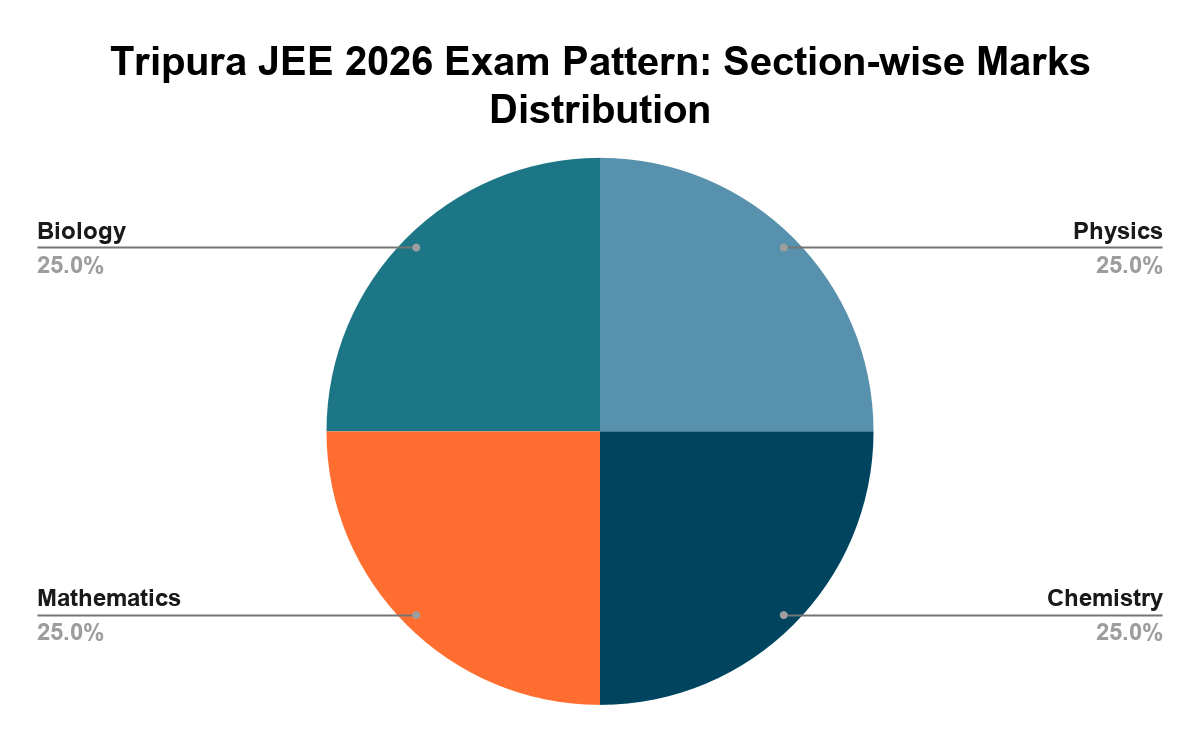
Tripura JEE 2026 Exam Pattern: Section-wise Marks Distribution
The table below shows the TJEE 2026 questions Distribution:
| Subjects | Number of Questions | Marks | Total Marks |
|---|---|---|---|
| Physics | 30 | 4 | 120 |
| Chemistry | 30 | 4 | 120 |
| Mathematics | 30 | 4 | 120 |
| Biology | 30 | 4 | 120 |
Also Check: Tripura Eligibility Criteria
Tripura JEE 2026 Exam Pattern: Marking Criteria
Previously, this exam had no negative marking. For the first time, negative marking has been introduced to increase competitiveness. The TJEE 2026 marking criteria are displayed below:
| Mark per question | +4 for each correct answer |
|---|---|
| Negative marking | -1 for every wrong answer. |
| No marking | Zero mark for unattempted question |
Also Check: Tripura JEE Result 2026
Tripura JEE 2026 Exam Pattern: OMR Sheet Instruction
Candidates are advised to follow the guidelines whenever marking their answers on the OMR sheet. Make sure to fill the circle properly; any mistake can cause you to lose your candidature.
- First, write your roll number and test booklet number, name of the subject and the circle accordingly.
- Mark your response by darkening the circle properly.
- Any kind of correction, like a Whitener, eraser and blade, is not allowed.
- Candidates are strictly not allowed to mark more than one circle. Marking more than one circle will result in zero marks.
- Do not cut or fold the OMR sheet.
- Do not do any rough work on the OMR sheet, as it causes the disqualification of candidature.
- Candidates must sign in two places, one on the OMR sheet and the other on the attendance sheet.
- The OMR sheet will not be reevaluated.
- Applicants must return the OMR sheet before leaving the exam hall.
- Any unfair means inside the examination hall will cause cancellation of the TJEE 2026 exam.
- The signature and photograph of the candidates must match the uploaded signature and photograph.
Tripura JEE 2026 Exam Pattern: Important Topics
Before starting your preparation for the Tripura JEE 2026 exam, it is important to go through the syllabus so that it is easy for the applicants to know what to study:
| Subject | Important Topics |
|---|---|
| Physics | Units and Measurements, Kinematics, Laws of Motion, Work, Energy and Power, Gravitation, Thermodynamics, Oscillations and Waves, Electrostatics, Current Electricity, Magnetic Effects of Current, Electromagnetic Induction, Optics, Modern Physics |
| Chemistry | Atomic Structure, Chemical Bonding, Periodic Table, States of Matter, Thermodynamics, Equilibrium, Redox Reactions, Organic Chemistry Basics, Hydrocarbons, Alcohols and Ethers, Biomolecules, Environmental Chemistry |
| Mathematics | Sets and Relations, Trigonometry, Quadratic Equations, Complex Numbers, Permutation and Combination, Binomial Theorem, Coordinate Geometry. Limits and Derivatives, Integral Calculus, Probability, Vectors and 3D Geometry. |
| Biology | Cell Structure and Function, Plant Physiology, Human Physiology, Genetics and Evolution, Biotechnology, Reproduction, Ecology and Environment, Diversity in the Living World. |
Tripura JEE 2026 Exam Pattern: Recommended Books
Books play a crucial role if you want to ace the Tripura JEE 2026 exam on your first attempt. Knowing which books to study will boost your preparation. It is important for students to refer to the NCERT Science and Mathematics Books of classes 11th and 12th to score maximum marks.
| Subject | Name of the book |
|---|---|
| Physics |
|
| Chemistry |
|
| Mathematics |
|
| Biology |
|
FAQs
Ques. Is the Tripura JEE 2026 exam pattern available on the website?
Ans. As per the latest updates, the exam pattern will be available on the official website soon. The Tripura Board of Joint Entrance will publish it in a few weeks.
Ques. Is Biology necessary for the Tripura JEE 2026 exam?
Ans. No, Biology is required for those candidates who want to pursue a medical course.
Ques. Can students with a commerce background appear for the Tripura JEE examination?
Ans. No, only students with a science background can appear for the Tripura JEE examination.
Ques. From which classes is the Tripura JEE syllabus prepared?
Ans. The syllabus for the Tripura JEE is prepared from the class 11th and 12th curriculum of recognised boards.



Comments