


Content Curator
Synapse play a crucial role in the transfer of nerve impulses from one neuron to the next. Synapses are the connections between neurons that allow them to send messages to specific target cells. The signal-passing neuron's plasma membrane (the presynaptic neuron) comes into close contact with the membrane of the target (postsynaptic) cell at a synapse. Both the presynaptic and postsynaptic locations have a large amount of molecular machinery that connects two membranes and permits the signaling process to occur.
| Table of Content |
Keyterms: Cell, Nerve impulse, Postsynaptic, Plasma membrane, Neuron, Synapse, Muscle cell, Muscle, Axon
Read Also: Control and Coordination Important Notes
What is a Synapse?
[Click Here for Sample Questions]
A synapse connects two neurons or a neuron to a target or effector cell like a muscle cell. It allows electrical or chemical impulses to be transmitted. Between presynaptic and postsynaptic neurons, a synapse is produced. The neuromuscular junction is the connection between a neuron and a muscle. A synapse is a structure that allows nerve impulses to pass from one neuron's axon terminal to the dendrites of the next neuron. It could be electrical or chemical.
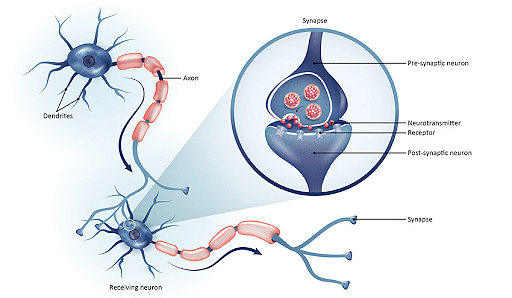
Synapse
The presynaptic portion of many synapses is found on an axon, whereas the postsynaptic portion is found on a dendrite or soma. Astrocytes also communicate with synaptic neurons, responding to synaptic activity and altering neurotransmission as a result. Synaptic adhesion molecules (SAMs) extend from both the pre-and post-synaptic neuron and stick together where they overlap stabilize synapses (at least chemical synapses); SAMs may also aid in the development and function of synapses.
Read More:
| Chapter Related Topics | ||
|---|---|---|
| Nerve Impulse | Nervous System Diseases | Receptors |
| Hypothalamus | Corpora Quadrigemina | Difference between neurosis and psychosis |
Chemical Synapse
[Click Here for Previous Year Questions]
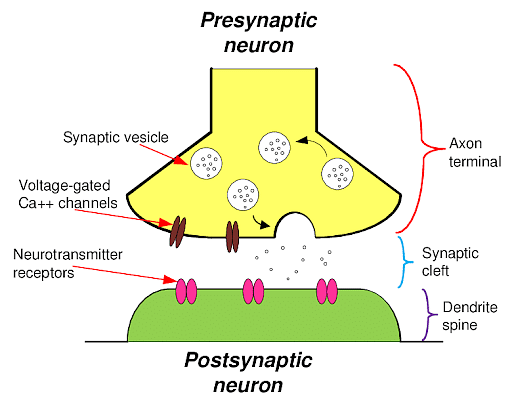
Synapses formed by chemicals are more common. Neurotransmitters are responsible for the transmission of nerve impulses through chemical synapses. Between the two neurons is a fluid-filled region known as the synaptic cleft. The nerve impulse is unable to jump from one neuron to the next.

Nerve Impulse in Neuron
Synaptic vesicles are found in a knob-like shape at axon terminals. Synaptic vesicles from the terminal of the presynaptic neuron release neurotransmitters at the synaptic cleft when the action potential reaches the terminals. The receptors in the postsynaptic membrane bind neurotransmitters. This causes voltage-gated channels to open, allowing ions to flow. The polarity of the postsynaptic membrane changes as a result and the electric signal is sent across the synapse.
Inhibitory and excitatory neurotransmitters exist. Various cells can respond to the same neurotransmitter in different ways. The neurotransmitter is excitatory if there is a net flow of positively charged ions inside the cell, which leads to the generation of the action potential. EPSP, or excitatory postsynaptic potential, is the term for this.

Chemical Synapse Process
When the membrane potential falls below zero, the membrane becomes hyperpolarized, and the neurotransmitter's activity becomes inhibitory. IPSP, or inhibitory postsynaptic potential, is produced by them. Once connected to the receptor, neurotransmitters are either acted on by enzymes or taken back and recycled to end the signal after it has been transmitted forward.
Read More: Medulla Oblongata
Electrical Synapse
[Click Here for Sample Questions]
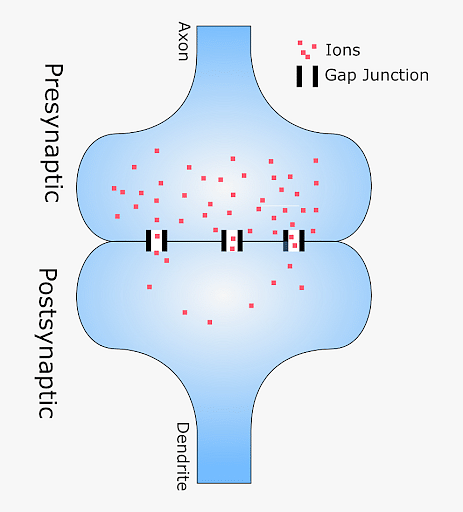
The membranes of the presynaptic and postsynaptic cells are joined in an electrical synapse by unique channels called gap junctions, which can pass an electric current and cause voltage changes in the presynaptic cell to generate voltage changes in the postsynaptic cell. The fundamental benefit of an electrical synapse is the speed with which signals are transferred from one cell to the next.
Presynaptic and Postsynaptic Neuron
Synaptic communication varies from ephaptic coupling, which happens when neurons interact by indirect electric fields. When the axon of one neuron synapses onto the dendrites of another neuron, it produces an autapse, which is a chemical or electrical synapse.
- Chemical synapses take longer to form than electrical synapses.
- Gap junctions arise when presynaptic and postsynaptic neurons are in close contact.
- Protein channels form a physical link between pre-and postsynaptic neurons at the gap junction.
- The transmission of an electric signal across the electrical synapse is analogous to the conduction of impulse in an axon because these gap junctions enable direction passage.
- Electrical synapses are less adaptable than chemical synapses since they can't switch from excitatory to inhibitory signals.
- It can be found in a variety of lower invertebrates. It is discovered between glial cells in humans.
- In this way, the synapse ensures that nerve impulses are transmitted in the correct direction and that random stimulation is avoided.
Presynaptic and Postsynaptic Neuron
Check out Important Difference between Active and Passive Immunity
Synaptic Polarization
[Click Here for Previous Year Questions]
The polarity of neurons determines their function. Nerve cells have a unique structure that permits action potentials to move in one direction (from dendrites to cell body down the axon) to be accepted and carried on by post-synaptic neurons or effector cells. The mechanisms driving the polarized localisation of synaptic chemicals have long been studied in nerve cells as models for cellular polarization. Synaptic polarity is influenced by PIP2 signalling, which is regulated by IMPase.

Synaptic Components
Phosphoinositides (PIP, PIP2, and PIP3) have been demonstrated to influence neuronal polarity. In Caenorhabditis elegans, a gene (ttx-7) was discovered that encodes Myo-inositol monophosphatase (IMPase), an enzyme that dephosphorylates inositol phosphate to generate inositol. Mutant ttx-7 genes resulted in behavioural and localization abnormalities, which were corrected by IMPase expression.
This led to the conclusion that IMPase is essential for proper synaptic protein component localisation. Phospholipase Cβ (PLCβ) is an enzyme that cleaves PIP2. The egl-8 gene encodes a homolog of Cβ (PLCβ). The abnormalities induced by the faulty ttx-7 gene were largely reversed when ttx-7 mutants also carried a mutant egl-8 gene. PIP2 signalling establishes polarized localisation of synaptic components in live neurons, according to our findings.
Also Read:
Things to Remember
- A synapse connects two neurons or a neuron to a target or effector cell like a muscle cell. It allows electrical or chemical impulses to be transmitted. Between presynaptic and postsynaptic neurons, a synapse is produced. The neuromuscular junction is the connection between a neuron and a muscle.
- The presynaptic portion of many synapses is found on an axon, whereas the postsynaptic portion is found on a dendrite or soma. Astrocytes also communicate with synaptic neurons, responding to synaptic activity and altering neurotransmission as a result.
- The membranes of the presynaptic and postsynaptic cells are joined in an electrical synapse by unique channels called gap junctions, which can pass an electric current and cause voltage changes in the presynaptic cell to generate voltage changes in the postsynaptic cell. The fundamental benefit of an electrical synapse is the speed with which signals are transferred from one cell to the next.
- The polarity of neurons determines their function. Nerve cells have a unique structure that permits action potentials to move in one direction (from dendrites to cell body down the axon) to be accepted and carried on by post-synaptic neurons or effector cells. The mechanisms driving the polarized localisation of synaptic chemicals have long been studied in nerve cells as models for cellular polarization.
Previous Year Questions
- Receptor sites for neurotransmitters are present on :…..[NEET 2017]
- A diagram showing axon terminal and synapse is given. Identify correctly at least two of A-D...[NEET 2013]
- Injury to vagus nerve in human is not likely to affect...[NEET 2004]
- A gymnast is able to balance his body upside down even in the total darkness because of..[NEET 2015]
- Bowman's glands are located in the...[NEET 2007]
- Function of iris is to...[NEET 1993]
- Good vision depends on adequate intake of carotene rich food : Select the best option from the following statements...[NEET 2017]
- Injury localized to the hypothalamus would most likely disrupt...[NEET 2014]
- Iris is part of...[NEET 1993]
- Myelin sheath is produced by….[NEET 2017]
- Nerve impulse transmission at neuromuscular junction requires…....[AMUEEE 2013]
- Pressure sensitises...[AMUEEE 2013]
- The one way of unidirectional transmission of nerve cells is maintained by….[JKCET 2007]
- The amount of CSF in the cranial cavity is...[WBJEE 2011]
- Which of the following does not act as a neurotransmitter?….[WBJEE 2009]
Sample Questions
Ques. Describe the nerves' structure and function in the nervous system. (5 marks)
Ans.
- The brain and spinal cord make up the central nervous system.
- The peripheral nervous system is a system of nerves that runs throughout the body.
- Electrical signals are initiated by receptor cells in sense organs, which travel along sensory neurones to the central nervous system.
- Electrical signals are carried around the central nervous system by relay neurones.
- Motor neurones transmit electrical impulses from the central nervous system to effectors such as muscles and glands.
- Synapses are the gaps between neurones.
- Electrical signals flow along axons, which are long extensions of neurones.
- To speed up electrical signals, axons are shielded by myelin sheaths.
Ques. Explain how well a nerve impulse is transferred across a chemical synapse. (4 marks)
Ans. A synapse is a small gap between the final segment of one neuron's axon and the dendrite of the next neuron. Vesicles containing a chemical substance or neurotransmitter, such as acetylcholine, fuse with the plasma membrane when an impulse reaches the axon's endplate. This chemical passes through the cleft and binds to chemoreceptors on the dendritic membrane of the following neuron. The depolarization of the membrane caused by chemical binding to chemoreceptors causes a nerve impulse across the nerve fibre. The enzyme acetylcholinesterase inactivates the molecule acetylcholine. The enzyme is found in the dendrite's postsynaptic membrane. It breaks down acetylcholine, allowing the membrane to repolarize.
Ques. What is responsible for nerve impulse transmission across the synapse? (2 marks)
Ans. The release of neurotransmitters allows nerve impulses to be sent across the synapse. They are the molecules that allow signals to go across synapses from one neuron to the next. It works by changing the polarity of the membrane of neuroreceptors, which aids nerve communication.
Ques. What are neuroreceptors? (2 marks)
Ans. A neurotransmitter is a signalling substance that a neuron or glial cell secretes to affect another cell across a synapse. The target cell, which receives the signal, could be another neuron, but it could also be a gland or muscle cell.
Neurotransmitters are released from synaptic vesicles and received by neurotransmitter receptors on the target cell in the synaptic cleft. Many neurotransmitters are made from simple and abundant precursors such as amino acids, which are easily available and take only a few biosynthetic steps to convert.
Ques. What is Purinergic Signalling? (2 marks)
Ans. Purinergic signalling, which is mediated by purine nucleotides and nucleosides like adenosine and ATP, is a type of extracellular signalling. Purinergic receptors in the cell and/or neighbouring cells are activated, allowing the cell to regulate its actions. The "purinome" is a term used to describe a cell's purinergic signalling complex.
Ques. What criteria are used to identify neurotransmitters? (2 marks)
Ans. Identification of neurotransmitters is based on four major criteria:
- The chemical must either be generated in the neuron or be present in it otherwise.
- When the cell is active, the chemical must be released, causing some targets to respond.
- When the chemical is placed on the target in an experiment, the same response must be produced.
- After the chemical's work is completed, a method must exist to remove it from its activation site.
Ques. Is it true that new synapses are formed in the adult brain? (2 marks)
Ans. Synaptogenesis is the word for the process that occurs after long-term potentiation in the hippocampus. Long-term memories are established by this technique. Synaptogenesis happens far more quickly in the developing brain of a child, but this amount of flexibility is not beneficial for an adult because it may impair established neural circuit function.
Ques. When neurotransmitters enter the synapse, how long do they stay there? (3 marks)
Ans. The neuron's cell body produces neurotransmitters, which are then carried down the axon to the axon terminal. Neurotransmitter molecules are kept in vesicles, which are microscopic "packages." When neurotransmitter vesicles "fuse" with the axon terminal membrane, spilling the neurotransmitter into the synaptic cleft, the neurotransmitter is released.
Nitric Oxide (NO) is not kept in synaptic vesicles like other neurotransmitters. Rather, NO is released and diffuses out of the neuron shortly after it is generated. NO then travels to a different cell, where it activates enzymes that produce "second messengers."

Ques. What is a silent synapse? (2 marks)
Ans. Silent synapses are glutamatergic synapses in which the presynaptic neuron releases glutamate as usual, but the post-synaptic locations only have NMDA receptors rather than the more common AMPA receptors. To be completely accurate, they do have AMPA receptors, but they stay inside the post-synaptic cell (by endocytosis) and just hang around there until they're needed. The NMDA receptor is more complicated than the typical ionotropic receptor.
Ques. Is it true that synapses in the brain are placed at random? (3 marks)
Ans. The concepts of chemical cues guiding axons and axons connecting 'randomly' are not mutually exclusive. The reason for this is that thermal noise and other types of fluctuation will always result in unpredictability and, as a result, randomness. As a result, a chemical gradient can create a distribution of probable destinations for the axon, with the peak indicating the most likely axon termination location.
However, you can argue that synaptic distribution is changeable and that this variability is not entirely governed by genetics or chemical gradients. Variability in temperature and quantum state will always play a role.
Do Check-Out:



Comments