



Arts and Board Exam Specialist
Sycon is a calcareous marine sponge, also known as the Crown Sponge, and belongs to the phylum Porifera. This is an important topic covered in the NCERT Class 11 Biology Textbook under the chapter "Animal Kingdom." Based on the previous year's exam (NEET & CUET), Animal Kingdom is considered a high-weightage topic covering 5–7 questions every year.
Sycon is a simple-living animal that resides in cooler waters and attaches itself to rock or shells. Furthermore, there are approximately 5,000 living species of sponges which are present in the world. These are further divided into 3 different groups based on the presence or composition of spicules or spongin. They are- Calcaria, Hexactinellida and Demospongiae.
This article covers complete details of Sycon classification, habitat, external and internal structure, physiological characteristics, reproduction, development and significance with extra points not usually found in standard sources.
Related Links:
- Taxonomic Classification of Sycon
- Habitat and Distribution of Sycon
- External Morphology and Structure of Sycon
- Types of Canal Systems in Porifera
- Skeleton of Sycon
- Physiology of Sycon
- Reproduction in Sycon
- Regeneration and Economic Importance
- Short Answer Type Questions (2 Marks)
- Long Answer Type Questions (3 Marks)
- Very Long Answer Type Questions (5 Marks)
Taxonomic Classification of Sycon
Sycons are typically small animals; thus, they generally range from 2.5 cm to 7.5 cm in height. These tube-shaped structures look like water vessels. In certain cases, they are also referred to as crown sponges as a consequence of the spicules they possess, which are arranged in the form of a crown, while in certain other cases, they are referred to as Q-tip or “Pineapple” sponges based on their resemblance. The classification of Sycon under the Animal Kingdom Class 11 is given below:
| Level | Classification |
|---|---|
| Kingdom | Animalia |
| Phylum | Porifera |
| Class | Calcarea |
| Order | Leucosolenida |
| Family | Sycettidae |
| Genus | Sycon |
| Species | Ciliatum, gelatinosum,etc. |
Important NEET Point: All members of class Calcerea (including Sycon) have spicules made of calcium carbonate, whereas Hexactinellida have siliceous spicules, and Demospongiae have spongin or siliceous spicules or both.
In short, Calcarea = Calcium (Chalk) Spicules, Hexactinellida = Glass (Silica) spicules, Demospongia = Spongin 土 Glass Spicules.
Habitat and Distribution of Sycon
Numerous species of sponges placed under this genus generally do not tend to thrive deeper in the ocean. Therefore, Sycons thrive well in slow-wave and low tides. The following are the key points for the habitat and distribution of Sycon in the living world:
- Sycon is a marine, sessile, and sedentary sponge.
- Found attached to rocks, shells, corals, and other submerged objects in shallow coastal waters (intertidal to 100 m depth).
- Widely distributed in the Mediterranean Sea, Atlantic Ocean, Indian Ocean, and Arabian Sea.
- Prefers clean, well-aerated water with moderate water current.
- It can tolerate slight variations in salinity but is strictly marine (never found in freshwater).
Cellular Structure and Types of Cells in Sycon
The cell type of Sycon determines its location and function. Here are some important cellular structures and types of cells in Sycon mentioned below, along with their function in detail:
| Cell Type | Location | Function |
|---|---|---|
| Myocytes | Around osculum & ostia | Contract to close openings |
| Choanocytes | Flagellated chambers(radial canals) | Create a water current, phagocytosis |
| Amoebocytes (Archaeocytes) | Mesohyl | Digestion, spicule formation, and gamete |
| Pinacocytes | Outer surface (pinacoderm) | Protection, contraction, regeneration |
| Porocytes | From Ostia | Regulate the entry of water |
| Gland cells | Around osculum | Secrete mucus |
| Thesocytes | Mesohyl | Store reserve food |
External Morphology and Structure of Sycon
- The outer body of Sycon is greyish-white or light brown when alive; becomes white after preservation.
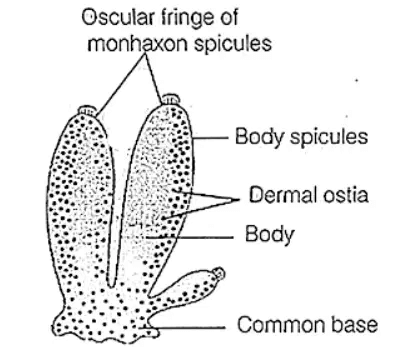
- The body surface is covered with numerous small ostia (incurrent pores) and a single large terminal opening called an osculum at the top.
- The wall is folded to form radial canals, giving a characteristic “crown-like” appearance when viewed from the top.
- A fringe of long monaxon spicules projects around the osculum, forming a crown. Thus, sycons are also called crown sponges.
Source: NCERT Class 11 Biology Book
Types of Canal Systems in Porifera
Sponges of the phylum Porifera are characterised by their unique canal system. Water flow in the sycon begins at a small opening called an ostium and progresses to a terminal point called an osculum. The complete process is illustrated below:
| Ostia – Incurrent canal — Radial canal (lined by choanocytes) — Spongocoel – Osculum |
Composition of the canal system
- Ostia: These are the dermal pores, which are lined by thin membranes. These possess two openings, of which one is used for entry and the other for exit. Additionally, the closing and opening of Ostia for water flow are regulated by myocytes.
- Sponogocoel/Paragastric or Gastral Cavity: The Osculum leads to a large central canal known as the spongocoel. This osculum is then encircled by a layer of cells, known as myocytes, acting as sphincters. They are contractile in nature. Spongocoel seems to be open to the outside through the osculum
- Radial Canals: These are the evaginations of the body wall. The outer end is closed, whereas the inner end of the radical canal is open, mediating with the spongocoel via the excurrent canal.
- Incurrent Canal: It is a tubular structure which is found between two successive radial canals. Thus, it is alternately arranged. Ostia is located on the pore membrane, which is controlled by contractile myocytes acting as sphincters, thereby regulating the openings.
- Prosopyles: These minute pores are found between the radial and incurrent canals. Each of these pores is considered an intercellular channel in Sycons, through which the incurrent canals open into the radial canals to mediate with the spongocoel and are wide and short canals whose walls are lined by pinacocytes.
- Apopyles: Apopyles are encircled by contractile myocytes. They are the openings of the radial canals in the spongocoel.
Types of Canal System:
The following are the important types of canal systems mentioned below along with their suitable examples and characteristic features:
| Type ofCanal System | Complexity | Example | Characteristic Feature |
|---|---|---|---|
| Ascon type | Simplest | Leucosolenia | No folding of the body wall |
| Sycon type | Intermediate | Sycon, Grantia | The body wall is folded to form radial canals |
| Leucon type | Most complex | Spongilla, Euspongia | Extensive folding — flegellated chambers |
| Rhagon type | Modified leucon | Level stage of some Demospongiae | Conical projection of choanocytes |
Skeleton of Sycon
The skeleton of Sycon is exclusively composed of calcareous spicules (CaCO3). Spicules are arranged in a definite pattern to give mechanical support.
| Type of Spicule | Axis | Number of rays | Location |
|---|---|---|---|
| Monaxon (needle–like) | 1-axis | 2 rays | Dermal cortex, gastric layer |
| Triaxon | 3-axis | 6 rays | Rare |
| Tetraxon | 4-axis | 4 rays | Around osculum |
Physiology of Sycon
- Feeding: Filter feeder ( microphagous); feeds on detritus, plankton, and bacteria.
- Respiration & Excretion: By simple diffusion across the body surface.
- Water current regulation is maintained by the beating of flagella of choanocytes; current can be reversed in adverse conditions.
- Response to stimuli: Shows slow contraction and relaxation (no nervous system).
Reproduction in Sycon
Asexual Reproduction
- External budding (common in Sycon ciliatum).
- Gemmule formation (rare/absent in Sycone; common in freshwater sponges like Spongilla)
Sexual Reproduction
- Sycon is hermaphrodite (monoecious) but protandrous (sperms mature first).
- Fertilisation: Internal, cross-fertilisation predominates.
- Cleavage: Holoblastic, unequal.
- Larval state: Amphiblastula larva (characteristic of Calcarea)
Development of Amphiblastula Larva
- Flagellated half (macromeres) – becomes choanocytes of adults.
- Non-flagellated half (macromeres) – become pinacocytes and other cells.
Regeneration and Economic Importance
- High power of regeneration – can regenerate the whole body from small fragments.
- Used in the bath sponges industry — No (only Demospongiae like Euspongia are used)
- Ecological role: Act as biofilters, increasing water clarity.
Short Answer Type Questions (2 Marks)
Ques: Why is Sycon placed in class Calcarea?
Ans: Sycon is placed in class Calcarea because its spicules are composed of calcium carbonate (calcareous spicules) and it possesses a sycon-type of canal system.
Ques: Differentiate between asconoid and syconoid canal systems.
Ans: In asconoid (Leucosolenia), the body wall is not folded, and choanocytes line the spongocoel, whereas in syconoid (Sycon,n), the body wall is folded, forming radial canals and choanocytes are restricted to radial canals only.
Ques: Name the larva of Sycon and mention its characteristic feature.
Ans: The larva of Sycon is an amphibole astula larva. It has one half made of flagellated cells and the other half made of non-flagellated cells.
Ques: Which cells in Sycon are responsible for the formation of spicules?
Ans: Scleroblasts (a type of amoebocytes or archaeocytes) secrete and deposit calcium carbonate to form spicules.
Ques: State two differences between choanocytes and pinacocytes in Sycon.
Ans:
- Choanocytes are flattened cells present in radial canals and create a water current.
- Pinacocytes are flattened cells that form the outer pinacoderm and provide protection.
Long Answer Type Questions (3 Marks)
Ques: Describe the path of the water current in the sycon type of canal system.
Ans: Water enters through numerous ostia – passes into incurrent canals – enters radial canals (flagellated chambers) through prosopyles – flagellar movement pushes water into central spongocoel through apopyles – finally exits through osculum. This path ensures food capture and gaseous exchange.
Ques: Explain the structure of the amphibole astula larva of Sycon.
Ans: Amphiblastula is a free-swimming, over larva. The anterior half is composed of small flagellated micromeres, the posterior half consists of larger non-flagellated micromeres. A cavity is present in the centre. After attachment, flagellated cells invaginate and finally become choanocytes of the adult sponge.
Ques: Give an account of the types of cells found in Sycon.
Ans: (i) Pinacocytes – form pinacoderm, (ii) choanocytes – flagellated, form lining of radial canals, (iii) Porocytes – tubular cells forming ostia, (iv) Amoebocytes – totipotent, perform digestion, transport, spicule formation, (v) Myocytes – help in contraction of openings.
Ques: Write short notes on the skeleton of Sycon.
Ans: Skeleton is made up of calcareous spicules only. Spicules are monaxon (one axis), triaxon (three axes) and tetraxon (four axes). Monaxon spicules are most abundant. They are arranged in the cortex and around the granular layer to provide support and projection.
Ques: Mention the asexual and sexual methods of reproduction in Sycon.
Ans: Asexual: External budding (formation of buds on the body surface).
Sexual: Sycon is a hermaphrodite. Sperms and ova are produced by the same individual. Cross-fertilisation occurs. Development involves an amphibole astula larva.
Very Long Answer Type Questions (5 Marks)
Ques: Describe in detail the structure of Sycon with special reference to its canal system.
Ans: Sycon is a cylindrical, marine sponge (2–8 cm) with a narrow base and broad upper end. The body wall shows folding forming incurrent and radial canals.
Canal system: Sycon type (Sycoid). Numerous dermal ostia open into incorrect canals — incorrect canals open into radial canals via prosopyles — radial canals are lined by choanocytes — water enters spongocoel through apopyles — exits via a single osculum. This folding increases surface area for choanocytes, making it more efficient than the asconoid type. Spongocoel is lined by pinacocytes (not choanocytes).
Ques: Give a detailed account of reproduction and development in Sycon.
Ans:
- Asexual: By external budding; the bud grows and may detach or remain attached, forming a colony.
- Sexual: Monoecious (hermaphrodite), protandrous. Sperms released into water enter another individual through ostia, and fertilise ova in the mesophyll.
- Development: Holoblastic unequal cleavage – blastula – amphibol astula larva (half flagellated , half non-flagellated) — larva swims — young sponge (olynthus state) — adult Sycon. Regeneration power is very high.
Ques: Classify the phylum Porifera up to class level and explain why Sycon is considered an advanced porifera over Leocosolenia.
Ans:
Classification of Porifera:
- Class 1: Calcarea (calcareous spicules) –ex. Sycon, Leucosolenia
- Class 2: Hexactinellida (six–rayed siliceous spicules) –ex.Hyalonema
- Class 3: Demospongiae (siliceous spicules or spongin) – ex. Spongilla, Euspongia
Sycon is advanced over Leucosolenia because:
(i) Leucosolenia has the simplest asconoid canal system. Sycon has a more complex syconoid canal system with a folded body wall.
(ii) Choanocytes are present throughout the spongocoel in Leucosolenia but are restricted to radial canals in Sycon, increasing efficiency.
(iii) Body size and surface area for filter feeding are larger in Sycon due to folding.
Thus, Sycon represents an evolutionary advancement towards the leoconoid type seen in higher sponges.



Comments