




The SET Exam 2027 is expected to consist of 60 MCQs carrying 60 marks with the entire paper to be completed within 60 minutes. The examination will be conducted in CBT mode with no sectional time limit, allowing candidates to switch between sections freely.
- The marking scheme of SET Exam 2027 is likely to give 1 mark for each correct answer while there will be no negative marking for the wrong answers.
- The paper will have General English, Quantitative Aptitude, General Awareness and Analytical & Logical Reasoning sections.
- General English, Quantitative Aptitude and General Awareness are expected to have 16 questions each making it a total of 48 questions and 48 marks.
- Analytical & Logical Reasoning is expected to have 12 questions carrying 12 marks.
- Since there is no negative marking, candidates can attempt all questions and hence both accuracy and time management become equally important.
Related Articles:
- SET Exam Pattern: Section-wise Syllabus, Total Marks, Duration, and Recommended Books
- SET Syllabus- Check Section-Wise Syllabus, Marking Scheme, Exam Pattern, Weightage, Preparation Plan
Key Summary
- General Awareness was the toughest section in SET 2026 with a Moderate to Tough difficulty level.
- The SET 2027 syllabus will be the same as the SET 2026 syllabus until there is an official notification by SIU.
- Candidates must solve papers from the previous years to get an idea about the difficulty level of the examination.
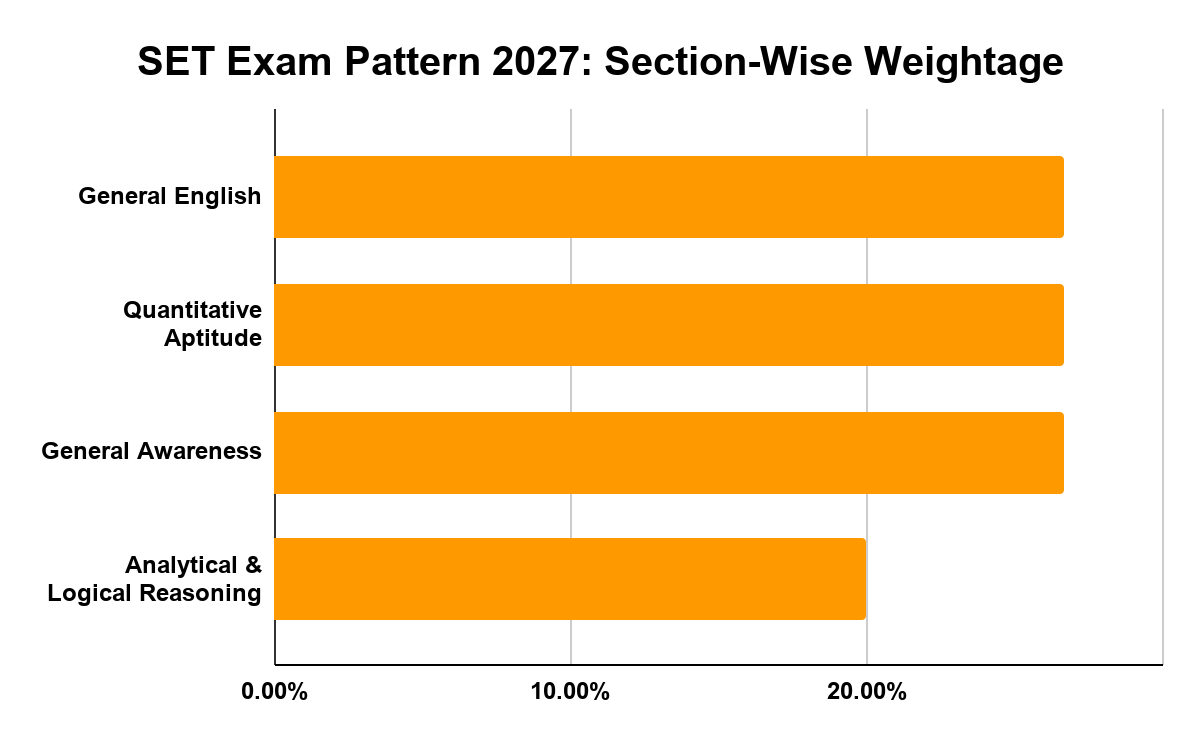
- Analytical & Logical Reasoning carries the lowest weightage contributing 20% of the total paper.
- Preparation for SET 2027 needs to be done in areas which carry high weightage through revision and analysis of mock tests.
- SET 2027 is expected to follow the same exam pattern as SET 2026 unless Symbiosis International announces any changes in the official notification.
SET Exam Pattern 2027 Highlights
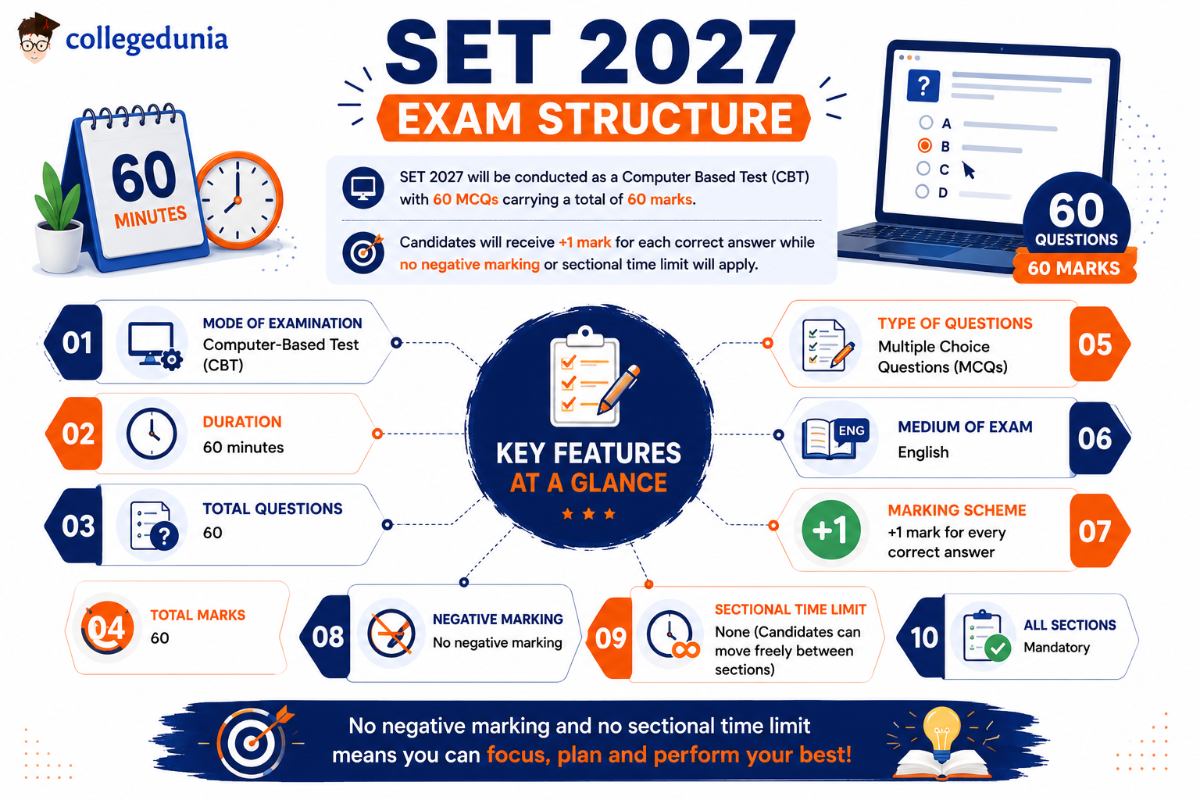
SET 2027 is expected to be conducted as a Computer-Based Test (CBT) comprising 60 multiple-choice questions for a total of 60 marks. Candidates will receive one mark for every correct answer, while no negative marking or sectional time limit is expected to apply.
| Feature | Details |
|---|---|
| Mode of Examination | Computer-Based Test (CBT) |
| Duration | 60 minutes |
| Total Questions | 60 |
| Total Marks | 60 |
| Type of Questions | Multiple Choice Questions (MCQs) |
| Medium of Exam | English |
| Marking Scheme | +1 mark for every correct answer |
| Negative Marking | No negative marking |
| Sectional Time Limit | None (Candidates can move freely between sections) |
| All Sections | All four sections are compulsory |
Note: The expected SET Exam Pattern 2027 is based on the latest pattern followed by Symbiosis International (Deemed University). Any changes announced in the official notification will be updated accordingly.
Important Point: Since there is no sectional time limit, candidates can manage their time across all four sections, revisit unanswered questions and return to difficult questions before submitting the test.
Source: SET Official Site
Ques. What is the pattern of the SET exam?
Ans. SET 2027 is expected to be conducted as a Computer-Based Test (CBT) comprising 60 MCQs carrying a total of 60 marks and to be completed in 60 minutes. The exam includes General English, Quantitative Aptitude, General Awareness, and Analytical & Logical Reasoning, with no negative marking and no sectional time limit.
Ques. Is there a separate passing mark for each section in SET 2027?
Ans. No. SET 2027 does not prescribe section-wise passing marks. Admission shortlisting is based on the overall selection process of the respective Symbiosis institute rather than separate sectional qualifying marks.
SET Exam Pattern 2027: Section-Wise Weightage
General English, Quantitative Aptitude and General Awareness are expected to carry the highest weightage in SET Exam 2027 with 16 questions each. Analytical & Logical Reasoning is expected to have 12 questions, making it the smallest section by weightage.
| Section | Number of Questions | Marks | Weightage (%) |
|---|---|---|---|
| General English | 16 | 16 | 26.67% |
| Quantitative Aptitude | 16 | 16 | 26.67% |
| General Awareness | 16 | 16 | 26.67% |
| Analytical & Logical Reasoning | 12 | 12 | 20.00% |
| Total | 60 | 60 | 100% |
Note: The section-wise distribution is based on the latest SET examination pattern followed by Symbiosis International (Deemed University). Any revision in the official notification will be reflected here.
Source: SET Official Site
Important Point: Since General English, Quantitative Aptitude, and General Awareness together account for 80% of the question paper, candidates should prioritise these sections during preparation while continuing regular practice for Analytical & Logical Reasoning.
Ques. Which section has the highest weightage in SET Exam 2027?
Ans. In SET Exam 2027, General English, Quantitative Aptitude, and General Awareness carry the highest weightage, with 16 questions and 16 marks each (26.67%). Analytical & Logical Reasoning carries 12 questions and 12 marks (20%).
Ques. What is the pattern of the SET exam?
Ans. The SET 2027 exam pattern consists of four sections. General English, Quantitative Aptitude, and General Awareness are expected to carry 16 questions each, while Analytical & Logical Reasoning is expected to have 12 questions, making it the section with the lowest weightage. The paper contains 60 questions for 60 marks and has no sectional time limit or negative marking.
SET Exam Pattern 2027: Total Marks and Marking Scheme
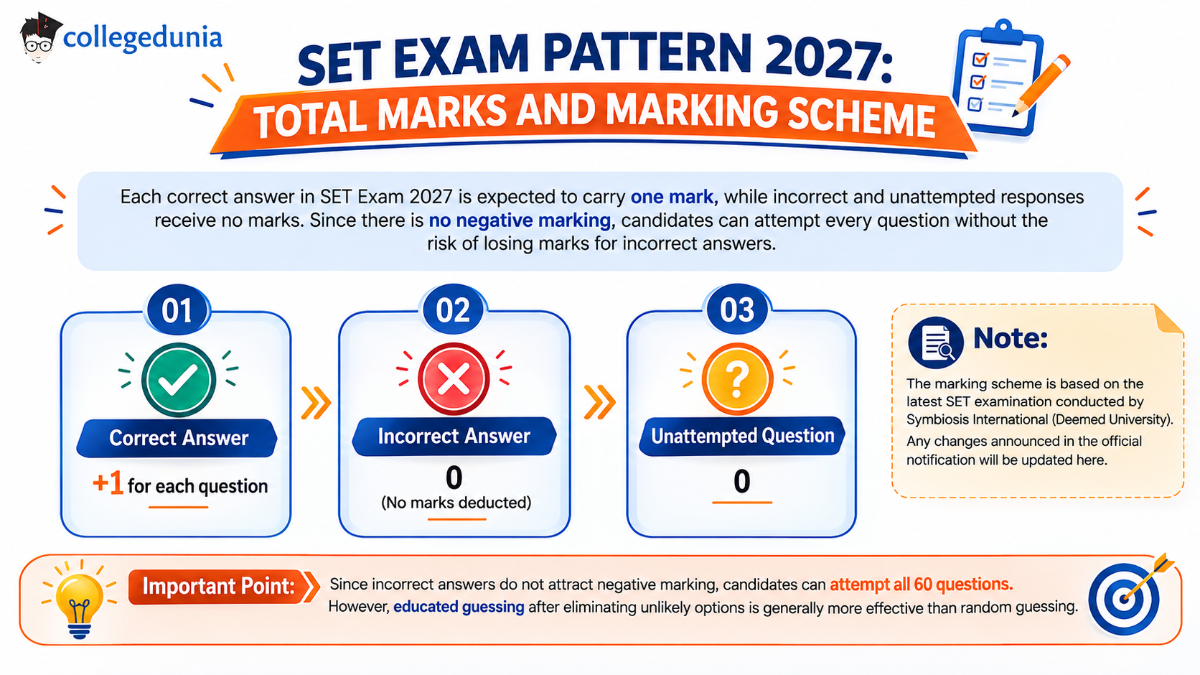
Each correct answer in SET Exam 2027 is expected to carry one mark, while incorrect and unattempted responses receive no marks. Since there is no negative marking, candidates can attempt every question without the risk of losing marks for incorrect answers.
| Type of Response | Marks Awarded |
|---|---|
| Correct Answer | +1 for each question |
| Incorrect Answer | 0 (No marks deducted) |
| Unattempted Question | 0 |
Note: The marking scheme is based on the latest SET examination conducted by Symbiosis International (Deemed University). Any changes announced in the official notification will be updated here.
Important Point: Since incorrect answers do not attract negative marking, candidates can attempt all 60 questions. Eliminating unlikely options before selecting an answer is generally more effective than making random guesses.
Source: SET Official Site
Also Check: Symbiosis SET Sample Paper; Previous Year Question Papers & Mock Test
Ques. Is 40 a good score in SET?
Ans. Yes. A score of 40 out of 60 is generally considered very good in SET and can improve a candidate's chances of meeting the cutoff for several Symbiosis institutes. However, final admission depends on the programme, institute-wise cutoff, and Personal Interview (PI).
Ques. Is SET a tough exam?
Ans. SET is generally considered a moderate-level entrance exam. The paper tests General English, Quantitative Aptitude, General Awareness, and Analytical & Logical Reasoning. Candidates with consistent preparation, regular mock tests, and revision can achieve a competitive score.
SET Exam Pattern 2027: Important Topics
In SET Exam 2027, Quantitative Aptitude is expected to include 16 questions from Arithmetic, Algebra, Data Interpretation, Geometry and Probability.
- General Awareness is expected to cover Current Affairs of 6–8 months while Reasoning includes Coding-Decoding, Puzzles and Syllogisms.
| Section | Important Topics |
|---|---|
| General English (16 Questions) |
|
| Quantitative Aptitude (16 Questions) |
|
| General Awareness (16 Questions) |
|
| Analytical & Logical Reasoning (12 Questions) |
|
Note: The important topics listed below are based on the latest SET syllabus and previous years' question papers. Any revision announced by Symbiosis International (Deemed University) will be updated here.
Important Point: While the official syllabus remains broad, candidates should prioritise frequently tested topics such as Reading Comprehension, Arithmetic, Current Affairs, and Coding-Decoding before moving to less frequently asked areas.
Also Check: Symbiosis SET 2026 Question Paper; Download Answer Key with Solution PDF
Ques. What should I study for a SET exam?
Ans. Candidates should prepare General English, Quantitative Aptitude, General Awareness, and Analytical & Logical Reasoning for SET 2027. Regular mock tests, previous year papers, and Current Affairs from the last 8–10 months are important for improving performance.
Ques. What is a good score in SET Symbiosis?
Ans. A score of 35–40 marks or above is generally considered good in SET. However, the required score varies each year depending on the exam difficulty, institute, programme, category, and admission cutoff.
SET Exam Pattern 2027: Previous Year Paper Analysis
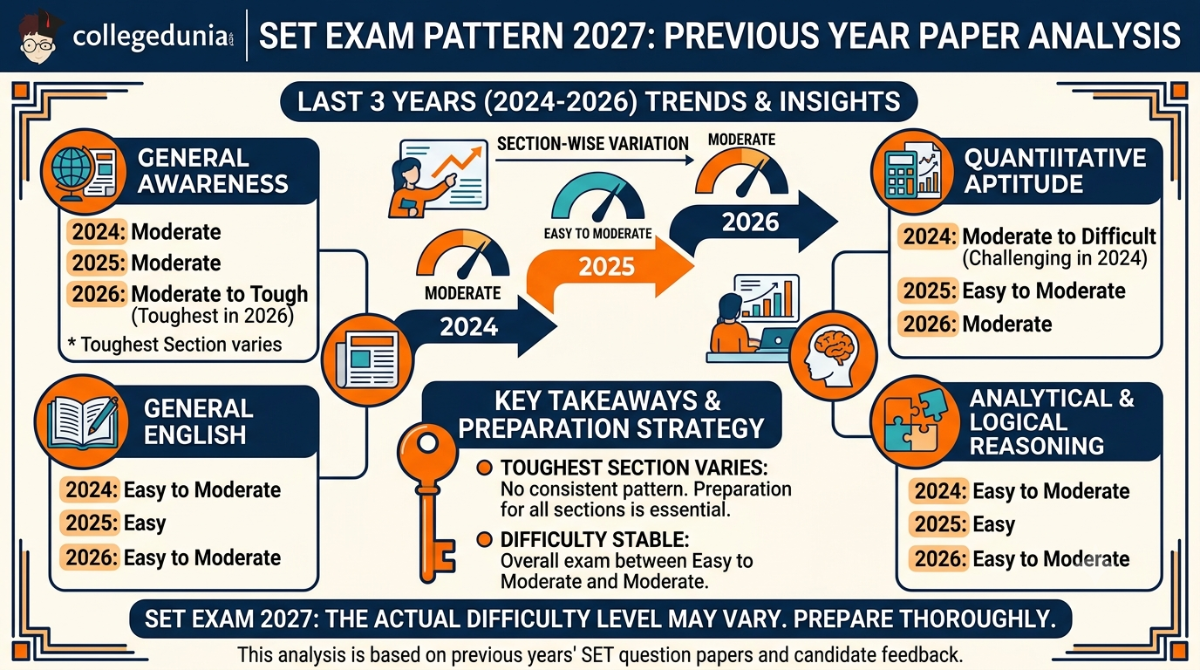
The overall difficulty level of the SET exam has remained between Easy to Moderate and Moderate over the last three years.
- While General Awareness emerged as the toughest section in SET 2026, Quantitative Aptitude was comparatively more challenging in SET 2024, indicating that the most difficult section can vary from year to year.
| Year | Overall Difficulty | General English | Quantitative Aptitude | General Awareness | Analytical & Logical Reasoning |
|---|---|---|---|---|---|
| 2026 | Moderate | Easy to Moderate | Moderate | Moderate to Tough | Easy to Moderate |
| 2025 | Easy to Moderate | Easy | Easy to Moderate | Moderate | Easy |
| 2024 | Moderate | Easy to Moderate | Moderate to Difficult | Moderate | Easy to Moderate |
Note: The analysis below is based on previous years' SET question papers and candidate feedback. The actual difficulty level of SET 2027 may vary.
Important Point: Since the toughest section has changed across recent years, candidates should prepare all four sections thoroughly rather than relying on previous difficulty trends.
Ques. Is 36 a good score in SET?
Ans. Yes. A score of 36 out of 60 is generally considered a good score in SET and can make candidates competitive for admission to several Symbiosis institutes. However, the final cutoff varies each year depending on the programme, institute, exam difficulty, category, and seat availability.
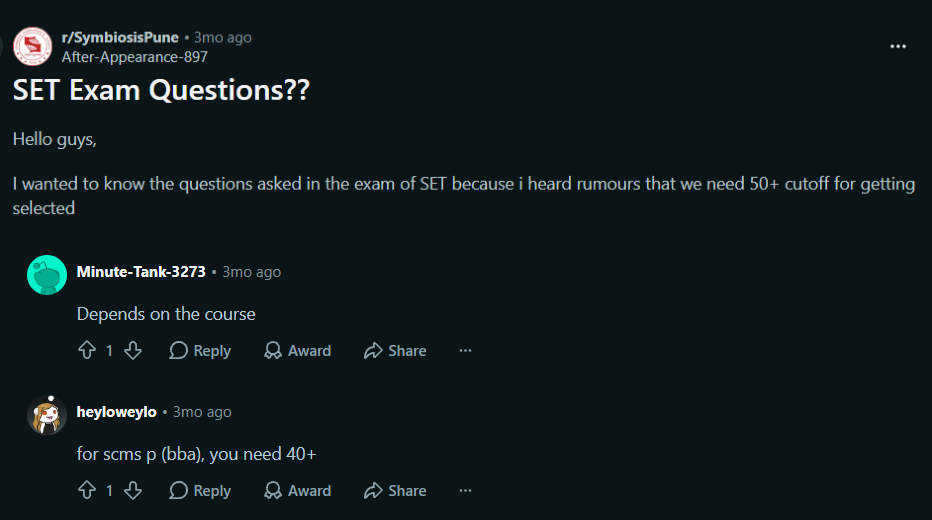
According to discussions on Reddit, several candidates described the overall SET paper as manageable and debated whether a score above 40 marks would be sufficient for admission to institutes such as SCMS Pune. While these discussions provide useful candidate perspectives, the actual cutoff varies by programme, category, institute, and admission cycle.
Source: Reddit
Preparation Tips for SET Exam 2027
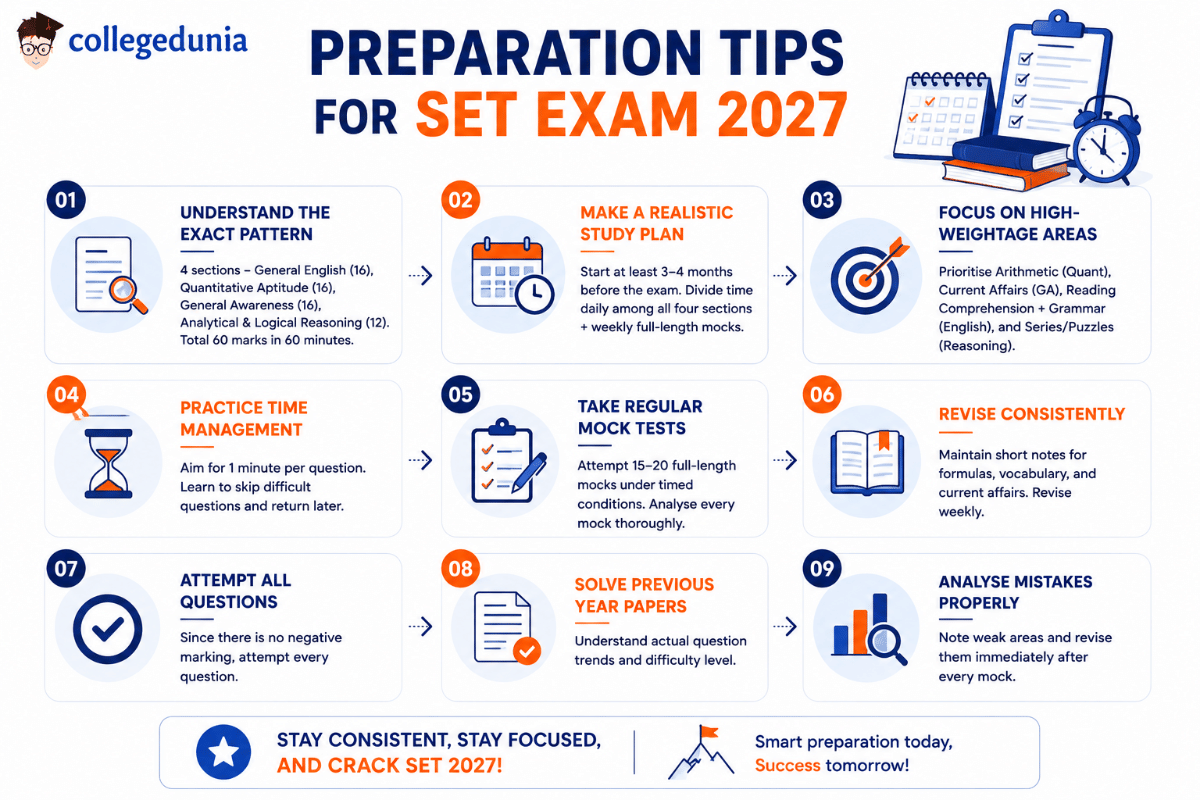
A well-planned preparation strategy can significantly improve performance in SET Exam 2027. Candidates should combine regular mock tests, previous years' question papers, and section-wise revision to build speed, accuracy, and confidence before the examination.
| Tip | Details |
|---|---|
| Understand the Exact Pattern | 4 sections – General English (16), Quantitative Aptitude (16), General Awareness (16), Analytical & Logical Reasoning (12). Total 60 marks in 60 minutes. |
| Make a Realistic Study Plan | Start at least 3–4 months before the exam. Divide time daily among all four sections + weekly full-length mocks. |
| Focus on High-Weightage Areas | Prioritise Arithmetic (Quant), Current Affairs (GA), Reading Comprehension + Grammar (English), and Series/Puzzles (Reasoning). |
| Practice Time Management | Aim for 1 minute per question. Learn to skip difficult questions and return later. |
| Take Regular Mock Tests | Attempt multiple full-length mock tests under timed conditions and analyse every mock thoroughly. |
| Revise Consistently | Maintain short notes for formulas, vocabulary, and current affairs. Revise weekly. |
| Attempt All Questions | Since there is no negative marking, attempt every question. |
| Solve Previous Year Papers | Understand actual question trends and difficulty level. |
| Analyse Mistakes Properly | Note weak areas and revise them immediately after every mock. |
Note: These preparation tips are based on the latest SET exam pattern, previous years' question papers, and commonly followed preparation strategies.
Also Check: Symbiosis SET Registration, Exam Dates, Process, Eligibility Criteria & Fees
Ques. Are previous year question papers enough for SET 2027 preparation?
Ans. No. While SET previous year question papers help candidates understand the exam pattern and difficulty level, they should also take mock tests, revise current affairs, and practise section-wise questions for comprehensive preparation.
Ques. How can I best prepare for the SET exam?
Ans. Candidates can prepare effectively for SET Exam 2027 by understanding the syllabus and exam pattern, following a 2–3 month study plan, practising previous year papers and 15–20 mock tests, revising regularly, and preparing Current Affairs from the last 8–10 months. Consistent mock analysis helps improve speed and accuracy.
SET Exam Pattern 2027: Frequently Asked Questions (FAQs)
Ques. How many months are enough to prepare for SET 2027?
Ans. Most candidates begin SET 2027 preparation 3–4 months before the exam. A structured study plan with daily section-wise practice, weekly mock tests, revision, and previous year paper analysis is generally sufficient to cover the expected syllabus.
Ques. What is the cutoff of the SET exam?
Ans. There is no common cutoff for the SET exam. Each participating Symbiosis institute releases its own cutoff after the results. Based on recent trends, General category cutoffs for many programmes are expected to range between 34–40 marks, while top institutes may require higher scores depending on competition and seat availability.
Ques. How to crack SET exam in the first attempt?
Ans. Candidates can crack SET 2027 in the first attempt by completing the syllabus early, following a structured study plan, solving previous year papers, attempting 15–20 mock tests, revising regularly, and preparing Current Affairs from the last 8–10 months.
Ques. Is it easy to crack the SET exam?
Ans. Yes. SET is generally considered a moderate-level entrance exam. Candidates who prepare consistently, practise mock tests, revise key topics, and manage time effectively have a good chance of securing a competitive score in the first attempt.
Ques. How many attempts are allowed for the SET exam?
Ans. Candidates can appear for up to two SET tests (Test 1 and Test 2) in the same admission cycle, if both are conducted. If a candidate takes both tests, the higher score is considered for the admission process. There is no lifetime limit on the number of attempts.



Comments