




The NIPER JEE Exam Pattern 2027 is expected to have 200 MCQs for 100 marks in a computer-based test. NIPER JEE Exam Pattern 2027 has not been officially released yet at niper.gov.in. The exam lasts 2 hours and is conducted only in English. Each correct answer gives 0.5 marks, with a negative marking of 0.125 or 0.25 marks for wrong answers
- NIPER JEE 2027 is used for admission to M.S. (Pharm), M.Pharm., M.Tech (Pharm) and MBA (Pharm) programmes with the same entrance examination structure.
- The paper is expected to cover General Aptitude, English, Reasoning and General Knowledge along with B.Pharm level Pharmaceutical Sciences.
- Pharmacy Sciences may account for around 120 questions covering Pharmaceutics, Pharmacology, Pharmaceutical Chemistry and Pharmaceutical Analysis.
- Candidates preparing for PhD programmes may face subject-specific questions from Pharmaceutical, Chemical or Biological Sciences depending on the selected stream.
- The expected paper duration is 150 minutes with no sectional time limit, allowing candidates to manage the two sections within the overall exam duration.
- The NIPER JEE Exam 2027 is expected to be conducted in English, with all questions presented as objective-type questions.
Related Links:
- NIPER JEE Registration: Check Application Form, Steps to Apply, Details to be Filled, Application Fees
- NIPER JEE Sample Paper PDF: Direct Link, Solutions, and Its Importance
- NIPER JEE Question Paper: Download Previous Years’ Question Paper and Answer Key PDFs

Key Summary
- Candidates should account for negative marking while attempting questions and avoid random guessing when the answer is uncertain.
- The official NIPER JEE exam pattern and information brochure are expected to be released in March to April 2027.
- NIPER JEE Exam Pattern 2027 is expected to have 2 sections covering Subject and General Aptitude, with no sectional time limit.
- NIPER JEE Exam Pattern 2027 is expected to use single correct MCQs with no numerical, passage based or descriptive questions.
- Seven NIPER institutes are expected to participate including Mohali, Hyderabad, Ahmedabad, Kolkata, Raebareli, Guwahati and Hajipur.
NIPER JEE Exam Pattern 2027: Overview
| Particulars | Details |
|---|---|
| Exam Name | National Institute of Pharmaceutical Education and Research Joint Entrance Exam (NIPER JEE) |
| Conducting Body | NIPER Mohali |
| Exam Mode | Computer-Based Test (CBT) |
| Exam Duration | 150 minutes (2.5 Hours) |
| Total Questions | 200 MCQs |
| Total Marks - (Masters & PhD) | 100 |
| Marks per Correct Answer | +0.5 Marks |
| Negative Marking | −0.125 (Masters & PhD) |
| Unattempted Questions | 0 Marks |
| Number of Sections | 2 (Subject + General Aptitude) |
| Section-wise Time Limit | None |
| Medium | English |
| Participating Institutes | 7 (Mohali, Hyderabad, Ahmedabad, Kolkata, Raebareli, Guwahati, Hajipur) |
Ques. What is the exam pattern for the NIPER JEE exam?
Ans. NIPER JEE is a computer-based exam with 200 MCQs for master's programmes. The duration is 2 hours, with negative marking for incorrect answers.
NIPER JEE Exam Pattern 2027: Year-Wise Changes
No official change to the NIPER JEE Exam Pattern 2027 has been announced yet. NIPER JEE Exam Pattern has changed the marking scheme in 2025 which is from +1/–0.25 marks to +0.5/–0.125 marks.
- The NIPER JEE Exam duration was increased to 150 minutes from 2026 while Section A questions were increased to 80 from 40.
- The total marks also changed from 200 marks to 100 marks in the NIPER JEE Exam Pattern 2025 for Master's.
- NIPER JEE Exam pattern 2027 is expected to be the same as 2026 pattern which is of 200 MCQs with duration of 150 minutes and +0.5 and –0.125 marking scheme.
| Parameter | 2024 | 2025 | 2026 |
|---|---|---|---|
| Mode | Computer-Based Test (CBT) | Computer-Based Test (CBT) | Computer-Based Test (CBT) |
| Total Questions | 200 MCQs | 200 MCQs | 200 MCQs |
| Total Marks | 200 | 100 | 100 |
| Duration | 120 minutes (2 hours) | 120 minutes (2 hours) | 150 minutes (2.5 hours) |
| Section A (General Aptitude / English / Reasoning / GK) | Not clearly specified in sources | 40 questions | 80 questions |
| Section B (Pharmaceutical Sciences / B.Pharm) | Not clearly specified | 160 questions | 120 questions |
| Marks per Correct Answer | +1 | +0.5 | +0.5 |
| Negative Marking | –0.25 | –0.125 | –0.125 |
| Unattempted Questions | 0 | 0 | 0 |
| Question Type | MCQs only | MCQs only | MCQs only |
| Medium | English | English | English |
| Sectional Time Limit | No | No | No |
Note: Always refer to the official brochure on niper.gov.in for the final confirmed pattern of any year.
Also Check: NIPER Kolkata MS Pharma Cutoff: Expected Qualifying Marks
Candidates can check this YouTube video for more information :
- NIPER JEE 2026 has returned to a single entrance exam for different Master's programmes, including M.Pharm, M.S., M.Tech and MBA.
- The exam has 200 MCQs, with 80 questions from non-pharma areas and 120 questions from the B.Pharm syllabus.
- The non-pharma weightage has increased from the earlier 25% to 40%, making English, Aptitude, Reasoning and General Knowledge more important.
- The exam duration has been increased to 150 minutes without a break, giving candidates more time to attempt the revised paper.
- The marking scheme remains +0.5 for a correct answer and −0.125 for an incorrect answer, while unattempted questions carry zero marks.
- Candidates should give additional preparation time to non-pharma topics because the revised distribution increases their share of the NIPER JEE paper.
Ques. How much rank is required for a NIPER?
Ans. Candidates should aim for a NIPER JEE rank within 200 for a good chance of admission. For top institutes such as NIPER Mohali and NIPER Hyderabad, a rank within 100–150 is generally considered more competitive. The required rank varies by institute, course, category, and seat availability.
NIPER JEE Exam Pattern 2027 for Masters Programs
NIPER JEE Exam Pattern 2027 for Masters Program is expected to follow the 80+120 question structure used in NIPER JEE 2026.
- B.Pharm section in NIPER JEE exam pattern 2027 is expected to carry 60 marks out of 100 which is the largest section of the paper.
- The NIPER JEE exam pattern 2027 for Masters program is expected to have no sectional time limit with 150 minutes available for both sections.
| Section | Subject | Expected Questions | Marks per Question | Expected Total Marks |
|---|---|---|---|---|
| Section 1 | General English,Aptitude, Reasoning, General Knowledge, etc. | 80 | +0.5 | 40 |
| Section 2 | B. Pharm | 120 | +0.5 | 60 |
| Total | 200 | - | 100 Marks |
Note: The NIPER JEE Exam Pattern 2027 is based on the 2026 pattern and will be confirmed with the official notification.
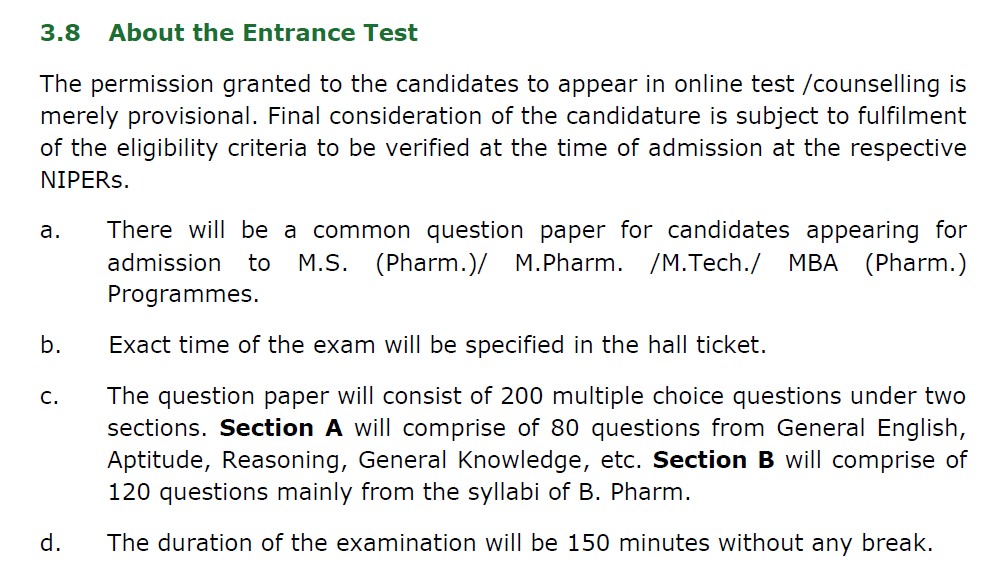
Source: NIPER Official Website
NIPER JEE Exam Pattern For Masters Program: Section A Question Paper Break-up
| Topic Area | Approximate Questions | Approximate Weightage | Remarks |
|---|---|---|---|
| Quantitative Aptitude | 20–25 | 25–31% | Arithmetic, percentages, ratios, data interpretation |
| Logical Reasoning | 20–25 | 25–31% | Series, coding-decoding, blood relations, direction sense, puzzles |
| English Language | 15–20 | 19–25% | Grammar, vocabulary, comprehension, sentence correction |
| General Knowledge / Current Affairs | 10–15 | 12–19% | Pharma-related GK, science, current affairs |
| Total | 80 |
NIPER JEE Exam Pattern For Masters Program: Section B Question Paper Break-up
| Subject / Area | Approximate Questions | Approximate Weightage | Remarks |
|---|---|---|---|
| Pharmacology & Toxicology | 25–30 | 20–25% | Highest weightage; mechanisms, receptors, clinical applications |
| Pharmaceutical Chemistry / Medicinal Chemistry | 20–25 | 17–21% | Spectroscopy, reaction mechanisms, SAR, stereochemistry |
| Pharmaceutics | 18–22 | 15–18% | Dosage forms, biopharmaceutics, NDDS, industrial pharmacy |
| Pharmaceutical Analysis | 15–20 | 12–17% | Chromatography, spectroscopy, quality control |
| Pharmacognosy & Natural Products | 10–15 | 8–12% | Phytochemistry, alkaloids, extraction methods |
| Biotechnology / Biochemistry / Microbiology | 10–15 | 8–12% | Molecular biology, recombinant DNA, enzymes |
| Other / Interdisciplinary | 5–10 | 4–8% | Regulatory affairs, clinical pharmacy, etc. |
| Total | 120 | 100% |
Also Check: NIPER JEE Pharmacy Sample Paper PDF: Direct Link, Solutions, and Its Importance
Ques. Is NIPER JEE tougher than GPAT?
Ans. NIPER JEE is generally considered more competitive and difficult than GPAT because of its limited seats and emphasis on in-depth pharmacy concepts.
Ques. How many questions does the Masters paper carry in NIPER JEE Exam Pattern 2027?
Ans. Based on the confirmed 2026 structure, Masters applicants are expected to attempt 200 questions in which 160 from Pharmaceutical Sciences and 40 from General Aptitude.
NIPER JEE Exam Pattern 2027 for PhD Programs
NIPER JEE Exam Pattern 2027 PhD Programs is expected to have 120 subject specific questions and 30 General Aptitude questions.
- For PhD applicants, each correct answer is expected to carry +0.5 mark which is same as NIPER JEE exam pattern 2027 for Masters.
- In NIPER JEE exam pattern 2027, PhD paper is expected to carry 100 marks.
- In NIPER JEE exam pattern 2027, both Masters and PhD papers are expected to have 200 questions.
| Section | Subject | Expected Questions | Marks per Question | Expected Total Marks |
|---|---|---|---|---|
| Section A | General Aptitude, General English, Reasoning,etc. | 80 | +0.5 | 40 |
| Section B | Chemical Sciences, Biological Sciences orPharmaceutical Sciences. | 120 | +0.5 | 60 |
| Total | 200 | - | 100 Marks |
Note: The NIPER JEE Exam Pattern 2027 is based on the 2026 pattern and will be confirmed with the official notification.
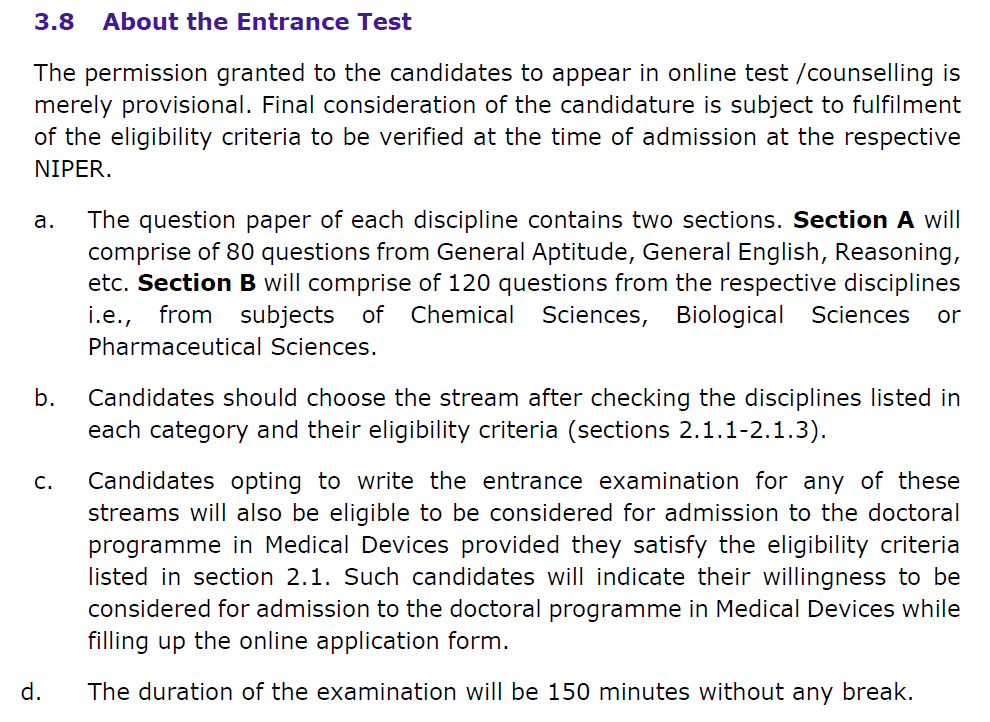
Source: NIPER Official Website
NIPER JEE Exam Pattern For PhD Program: Section A Question Paper Break-up
| Topic Area | Approximate Questions | Approximate Weightage | Remarks |
|---|---|---|---|
| Quantitative Aptitude | 20–25 | 25–31% | Arithmetic, percentages, ratios, data interpretation |
| Logical Reasoning | 20–25 | 25–31% | Series, coding-decoding, puzzles, blood relations, direction sense |
| English Language | 15–20 | 19–25% | Grammar, vocabulary, comprehension, sentence correction |
| General Knowledge / Current Affairs | 10–15 | 12–19% | Science, current affairs, basic general awareness |
| Total | 80 |
NIPER JEE Exam Pattern For PhD Program: Section B Question Paper Break-up
NIPER JEE Exam Pattern for PhD Program in Pharmaceutical Sciences Stream
| Subject / Area | Approximate Questions | Approximate Weightage | Remarks |
|---|---|---|---|
| Pharmacology & Toxicology | 28–32 | 23–27% | Highest weightage; mechanisms & clinical applications |
| Pharmaceutical Chemistry / Medicinal Chemistry | 22–26 | 18–22% | Spectroscopy, SAR, reaction mechanisms |
| Pharmaceutics | 18–22 | 15–18% | Biopharmaceutics, NDDS, formulation |
| Pharmaceutical Analysis | 15–18 | 12–15% | Chromatography & spectroscopy |
| Pharmacognosy + Others | 12–17 | 10–14% | Natural products & interdisciplinary |
| Total | 120 | 100% |
NIPER JEE Exam Pattern for PhD Program in Chemical Sciences Stream
| Subject / Area | Approximate Questions | Approximate Weightage | Remarks |
|---|---|---|---|
| Organic Chemistry | 40–45 | 33–38% | Mechanisms, synthesis, spectroscopy (highest focus) |
| Inorganic & Physical Chemistry | 25–28 | 21–23% | Coordination chemistry, thermodynamics |
| Process Chemistry & Analytical | 25–28 | 21–23% | Industrial processes & instrumentation |
| Medicinal / Applied Chemistry | 15–20 | 12–17% | Pharma-linked topics |
| Total | 120 | 100% |
NIPER JEE Exam Pattern for PhD Program in Biological Sciences Stream
| Subject / Area | Approximate Questions | Approximate Weightage | Remarks |
|---|---|---|---|
| Molecular Biology & Genetics | 30–35 | 25–29% | Gene expression, recombinant DNA |
| Biochemistry | 25–30 | 21–25% | Enzymes, metabolism, biomolecules |
| Microbiology & Biotechnology | 25–28 | 21–23% | Fermentation, microbial techniques |
| Cell Biology & Others | 20–25 | 17–21% | Cell signaling, immunology basics |
| Total | 120 | 100% |
Note: NIPER has not officially released any subject-wise numerical break-up for Section B. The figures above are approximate estimates based on previous years’ trends and actual distribution can vary.
Also Check: NIPER JEE General Aptitude Sample Paper PDF: Direct Link, Solutions, and Its Importance
Ques. What PhD programs are offered at NIPER JEE Exam?
Ans. NIPER offers PhD programmes in Medicinal Chemistry, Natural Products, Pharmacoinformatics, Biotechnology, Pharmacology & Toxicology, Pharmaceutics, Pharmaceutical Analysis, Pharmaceutical Management, and Pharmaceutical Technology (Process Chemistry). Medical Devices is also offered at some NIPERs. The programmes vary by institute.
NIPER JEE 2027 Marking Scheme
NIPER JEE 2027 Marking Scheme is expected to have the same marking rules for Masters and PhD applicants.
- The negative marking ratio in NIPER JEE 2027 Marking Scheme is expected to be 1:4 in both categories with the deduction set against the marks for a correct answer.
- Unattempted questions are expected to carry no penalty in either category in NIPER JEE 2027 Marking Scheme.
- Candidates can avoid unnecessary deductions by attempting selective questions instead of making random guesses in NIPER JEE 2027 Exam.
| Program Category | Marks for Correct Answer | Marks for Wrong Answer | Marks for Unattempted |
|---|---|---|---|
| Masters (M.S. Pharm / M.Pharm / M.Tech / MBA) | +0.5 | −0.125 | 0 |
| PhD Programs | +0.5 | −0.125 | 0 |
NIPER JEE 2027 Marking Scheme: Masters Program
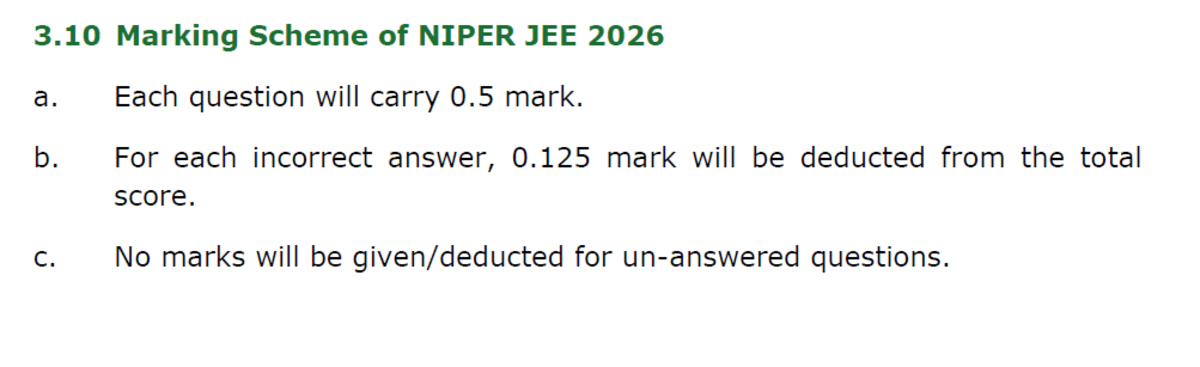
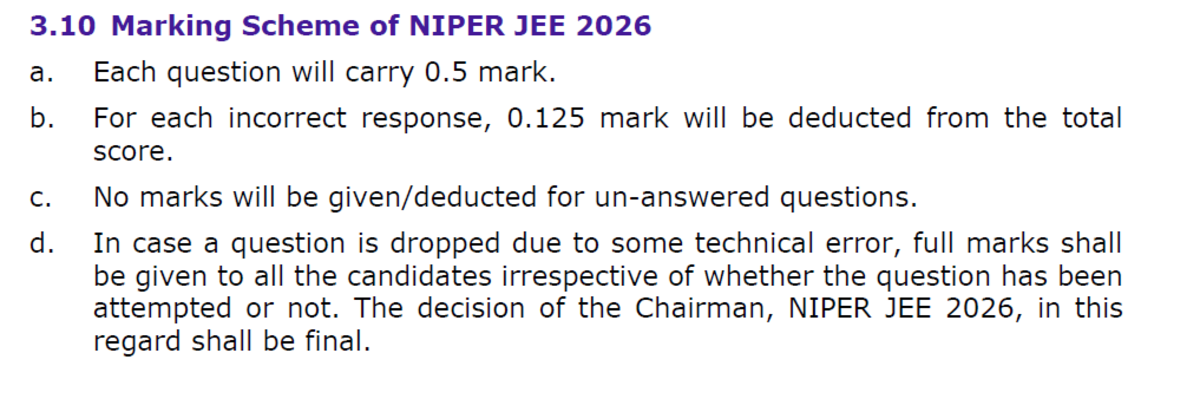
Source: NIPER Official Website
How to Calculate Your NIPER JEE Exam 2027 Score?
| Score = (Number of Correct Answers x 0.5) - (Number of Incorrect Answers x 0.125) |
Step 1: Count the number of questions which are answered correctly.
Step 2: Count the number of questions which are answered incorrectly.
Step 3: Multiply the number of correct answers by 0.5.
Step 4: Multiply the incorrect answer by 0.125.
Step 5: Subtract the value obtained in Step 4 from the value obtained in Step 3.
Step 6: The final number is NIPER JEE Score out of 100.
For example,
Suppose a candidate attempts 180 MCQs, in which correct answers is 142 and incorrect answers are 38 while unattempted questions are 20.
- Correct answers: 142 x 0.5 = 71
- Incorrect answers: 38 x 0.125 = 4.75
- Final Score: 71 - 4.75 = 66.25
Key Insights for NIPER JEE Aspirants:
- Accuracy is important because every incorrect answer can reduce the score by 0.125 marks under the expected marking scheme.
- Unattempted questions carry no penalty so candidates can avoid random attempts when they are unsure about an answer.
Also Check: NIPER JEE Question Paper 2025 (Available): Download Solution Pdf with Answer Key
Ques. What is the marking scheme for the NIPER JEE exam?
Ans. In NIPER JEE, each question carries 0.5 marks, while 0.125 marks are deducted for every incorrect answer. Unanswered questions receive no marks. The same marking scheme was specified in the latest available official NIPER JEE brochure.
NIPER JEE 2027 Types of Questions
NIPER JEE 2027 Types of Questions are expected to remain objective with every question presented as a single correct MCQ.
- In NIPER JEE Question Types 2027, it is not expected to include numerical, integer type, assertion-reason, passage based or descriptive questions.
- The CBT interface is expected to let candidates flag and revisit questions before submitting the paper.
- Only the last selected option in NIPER JEE 2027 Exam is expected to be recorded when a candidate changes an answer.
| Question Type | Format | Applies To | Expected Negative Marking |
|---|---|---|---|
| MCQ (Single Correct) | 4 options, 1 correct answer | All sections, both categories | −0.125 |
Also Check: NIPER JEE 2020 Question Paper (Available) :Download Solution Pdf with Answer Key
Ques. How many questions are there in the NIPER JEE exam?
Ans. The NIPER JEE Master's exam has 200 multiple-choice questions. Section A contains 40 questions, while Section B has 160 questions from the relevant pharmacy syllabus. The exam duration is 2 hours.
NIPER JEE 2027 Duration
NIPER JEE 2027 Duration is expected to remain 150 minutes, based on the duration followed in recent years. The exact NIPER JEE 2027 exam timings will be mentioned on the Hall Ticket.
| Particular | Details |
|---|---|
| Total Duration | 150 minutes (2 hours 30 minutes) |
| Break | No break |
| Sectional Time Limit | None (candidates can switch freely between sections) |
| Mode | Computer Based Test (CBT) |
| Applicable For | Master’s programmes (M.S. Pharm / M.Pharm / M.Tech / MBA Pharm) and PhD Programmes |
Note: Expected based on the official NIPER JEE 2026 brochure. The official 2027 brochure has not been released yet as of August 2026, candidates need to verify on the official website once available
Also Check: NIPER JEE 2017 Question Paper with Answer Key PDFs
Ques. Is NIPER JEE tough?
Ans. Yes. NIPER JEE is generally considered moderate to difficult, with Pharmaceutical Chemistry and General Aptitude being challenging areas. The 2026 paper was reported as moderate to difficult overall.
NIPER JEE Exam Pattern 2027 Difficulty Level
NIPER JEE Exam Pattern 2027 Difficulty Level for Masters Programs
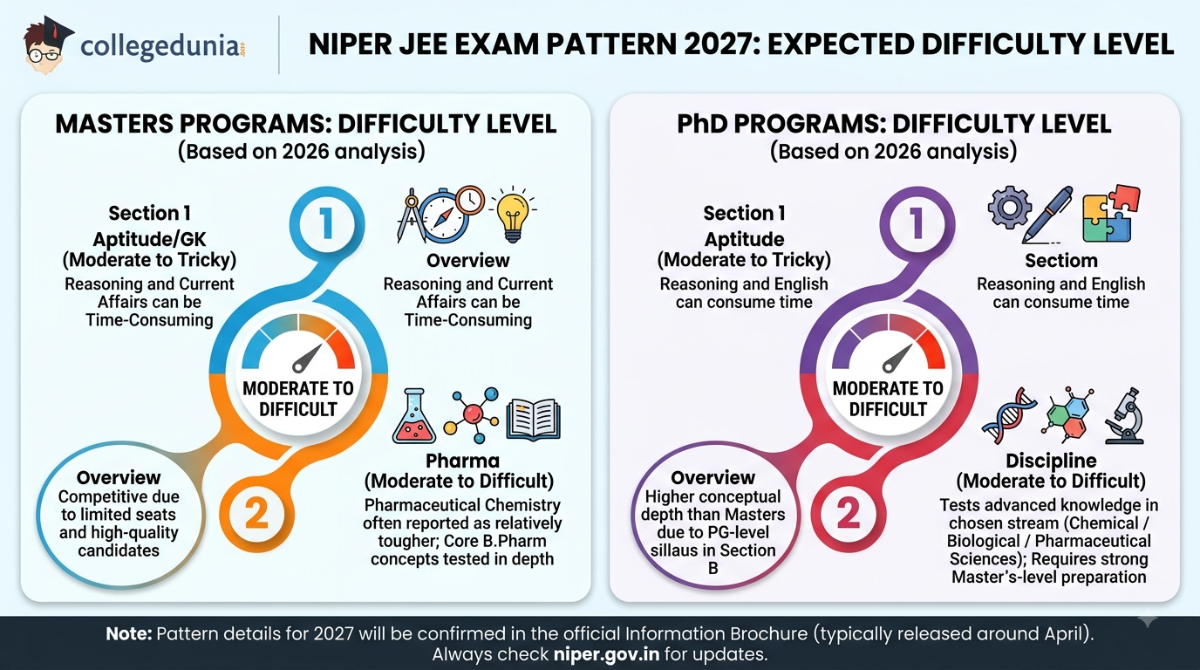
NIPER JEE Exam Pattern 2027 Difficulty Level for Masters Programs is expected to remain moderate to difficult based on the 2026 paper analysis.
- Pharmaceutical Chemistry and Aptitude were among the sections reported as more challenging in the NIPER JEE 2026 Exam analysis.
| Aspect | Difficulty Level | Remarks |
|---|---|---|
| Overall | Moderate to Difficult | Competitive due to limited seats and high quality of candidates |
| Section A (Aptitude/GK) | Moderate to Tricky | Reasoning and current affairs can be time-consuming |
| Section B (Pharma) | Moderate to Difficult | Pharmaceutical Chemistry often reported as relatively tougher; core B.Pharm concepts tested in depth |
Note: Pattern details for 2027 will be confirmed in the official PhD Information Brochure (typically released around April). Always check niper.gov.in for updates.
NIPER JEE Exam Pattern 2027 Difficulty Level for PhD Programs
NIPER JEE Exam Pattern 2027 Difficulty Level for PhD Programs was rated moderate to difficult in the 2026 analysis.
- Section B tested deeper PG-level concepts across Chemical, Biological and Pharmaceutical Sciences streams.
| Aspect | Difficulty Level | Remarks |
|---|---|---|
| Overall | Moderate to Difficult | Higher conceptual depth than Masters due to PG-level syllabus in Section B |
| Section A (Aptitude) | Moderate to Tricky | Reasoning and English can consume time |
| Section B (Discipline) | Moderate to Difficult | Tests advanced knowledge in chosen stream (Chemical / Biological / Pharmaceutical Sciences); requires strong Master’s-level preparation |
Note: Pattern details for 2027 will be confirmed in the official PhD Information Brochure (typically released around April). Always check niper.gov.in for updates.
Also Check: NIPER JEE 2018 Question Paper with Answer Key PDFs
Ques. What is the total number of marks you can get in the NIPER JEE exam?
Ans. The NIPER JEE Master’s exam has 200 questions. As per the latest official marking scheme, each correct answer carries 0.5 marks, making the maximum score 100 marks.
Exam Pattern Comparison: NIPER JEE 2027 vs GPAT 2027
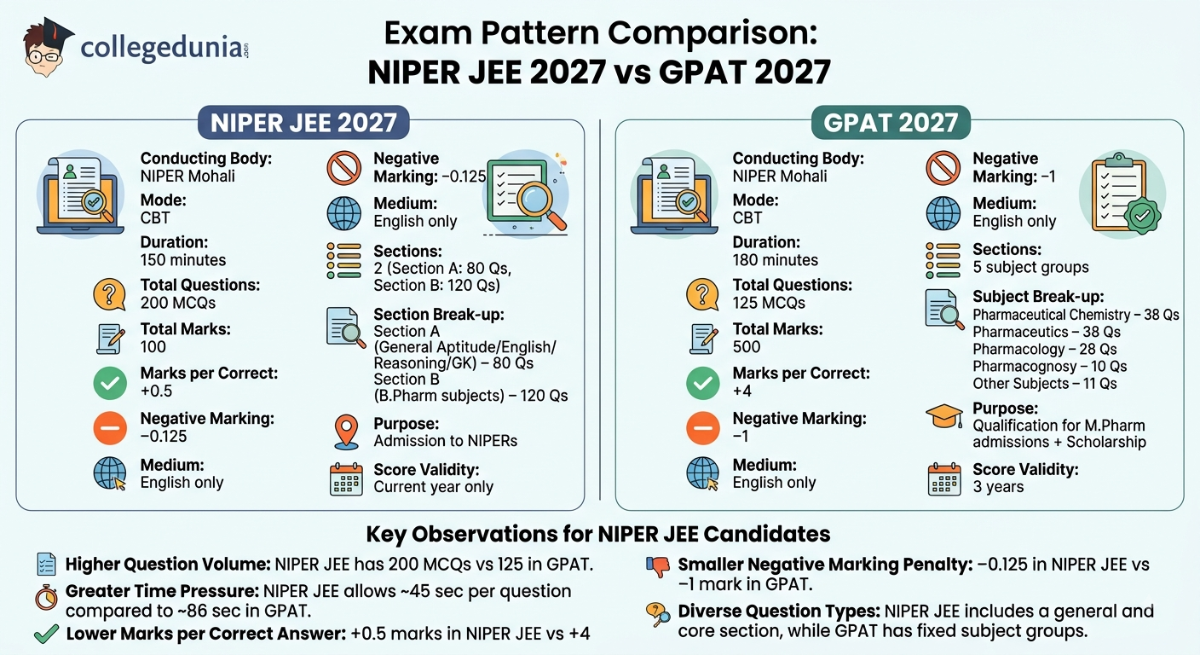
The NIPER JEE Exam Pattern 2027 differs from the GPAT exam pattern 2027 in terms of questions, duration, marks and subject distribution. The table below compares the latest available NIPER JEE pattern with the GPAT pattern to highlight the major differences.
| Parameter | NIPER JEE 2026 (Masters) | GPAT 2026 |
|---|---|---|
| Conducting Body | NIPER Mohali | NIPER Mohali |
| Mode of Exam | Computer Based Test (CBT) | Computer Based Test (CBT) |
| Duration | 150 minutes (2 hours 30 min) | 180 minutes (3 hours) |
| Total Questions | 200 MCQs | 125 MCQs |
| Total Marks | 100 | 500 |
| Marks per Correct Answer | +0.5 | +4 |
| Negative Marking | –0.125 | –1 |
| Unattempted Questions | 0 | 0 |
| Medium | English only | English only |
| Sections | 2 (Section A: 80 + Section B: 120) | 5 subject groups (no strict sectional limit in older pattern; some years had time-bound sections) |
| Section / Subject Break-up | Section A (General Aptitude/English/Reasoning/GK) – 80 QsSection B (B.Pharm subjects) – 120 Qs | Pharmaceutical Chemistry – 38 QsPharmaceutics – 38 QsPharmacology – 28 QsPharmacognosy – 10 QsOther Subjects – 11 Qs |
| Purpose | Admission to NIPERs (M.S./M.Pharm/M.Tech/MBA/PhD) | Qualification for M.Pharm admissions + Scholarship |
| Score Validity | Current year only | 3 years (for scholarship) |
Key Observations for NIPER JEE Exam Candidates:
- NIPER JEE has fewer marks but more questions with 200 MCQs to be attempted compared with 125 questions in GPAT.
- NIPER JEE is more time pressured with around 45 seconds per question compared with about 86 seconds in GPAT.
- The marks per question in GPAT are higher with +4 marks for correct answers as compared to +0.5 marks in NIPER JEE.
- NIPER JEE has a smaller negative marking penalty with –0.125 for a wrong answer compared with –1 mark in GPAT.
- NIPER JEE includes a general section and a core pharmaceutical section while GPAT divides questions across major pharmacy subject groups.
Ques. Are the GPAT and NIPER exams the same or different?
Ans. GPAT and NIPER JEE are different exams. GPAT is a national-level exam for admission to M.Pharm programmes and scholarships, while NIPER JEE is conducted for admission to postgraduate and PhD programmes at NIPER institutes. GPAT is conducted by NBEMS while NIPER JEE 2026 was conducted by NIPER Mohali as the organising institute.
How to Prepare Based on NIPER JEE Exam Pattern 2027
Candidates should plan preparation according to the NIPER JEE Exam Pattern 2027, with focus on speed, accuracy, pharmaceutical subjects and non-pharma topics.
- Time Management: Practise solving 200 questions in 120 minutes to build the speed required for the NIPER JEE examination.
- Pharma Preparation: Revise the pharmaceutical subjects already covered for GPAT and focus on concepts, one liner questions and previous year MCQs.
- Non-Pharma Preparation: Give separate preparation time to English, General Knowledge, Reasoning and other non pharma topics included in the examination.
- Previous Year Questions: Solve NIPER JEE previous year questions regularly because the transcript highlights direct, topic focused questions as an important part of preparation.
- Mock Tests: Attempt regular mock tests and analyse mistakes, accuracy and time taken to improve performance before the examination.
- Revision Plan: Complete the first phase with revision, use the next phase for intensive MCQ practice and non-pharma preparation and reserve the final phase for revision and mock tests.
Source: Youtube
Ques. How to crack NIPER JEE?
Ans. Candidates should first cover the B.Pharm core subjects, then focus on PYQs, important topics, and mock tests. Regular revision of Pharmaceutics, Pharmacology, Pharmaceutical Chemistry, Pharmacognosy, Analysis, and Biotechnology can help improve preparation.
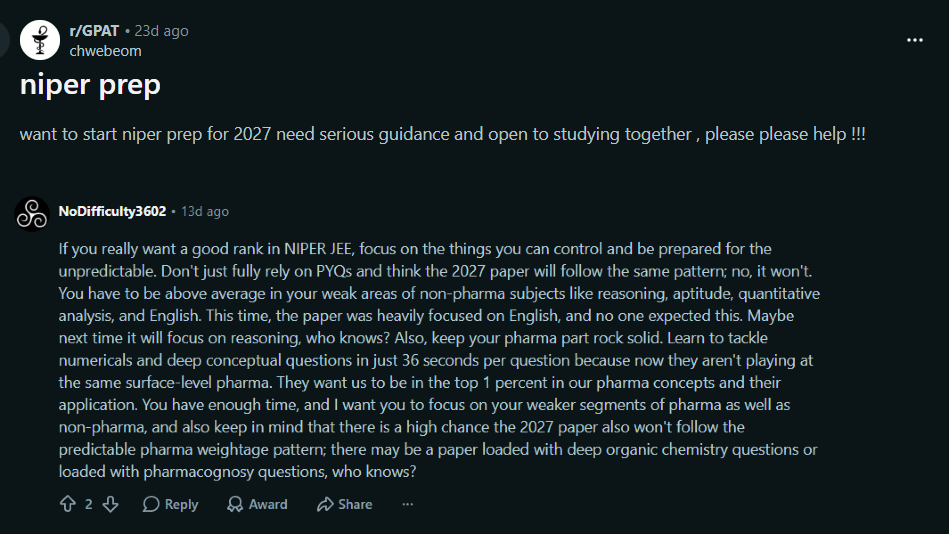
According to a Reddit discussion, candidates discussed NIPER JEE 2027 preparation strategy, especially how to prepare for an unpredictable paper pattern.
The discussion focused on not relying only on PYQs, strengthening Pharma and non-Pharma subjects and preparing for conceptual and numerical questions.
Source: Reddit
NIPER JEE Exam Pattern 2027: Frequently Asked Questions (FAQs)
Ques. What is a good rank in NIPER JEE Exam?
Ans. A rank within 200 is generally considered a good rank in NIPER JEE for admission to top NIPERs. The required rank varies by institute, programme, category, and seat availability.
Ques. Which Masters programs use this NIPER JEE exam pattern 2027?
Ans. M.S. (Pharm.), M.Pharm., M.Tech. (Pharm.), and MBA (Pharm.) applicants all sit the same 200-question, 100-mark paper under NIPER JEE Exam Pattern 2027.
Ques. What is the PhD stipend for NIPER JEE students?
Ans. The NIPER PhD stipend varies by institute and funding category. At NIPER Hyderabad, PhD students receive ₹25,000 per month + HRA in the first two years and ₹28,000 per month + HRA from the third year.
For NIPER Mohali, the latest 2026 PhD brochure should be checked for the applicable fellowship amount and conditions.
Ques. Who is conducting NIPER JEE 2026?
Ans. NIPER Mohali is the organising institute for NIPER JEE 2026. The exam was conducted on June 13, 2026 for Master's and PhD admissions.
Ques. How many seats are available in a NIPER?
Ans. For NIPER JEE 2026, around 994 Master’s seats are available across the participating NIPERs. The seats are divided among M.S. (Pharm.), M.Pharm., M.Tech. and MBA (Pharm.) programmes and vary by institute and specialisation.



Comments