




NEST 2026 counseling is currently underway with separate processes for NISER Bhubaneswar and UM-DAE CEBS Mumbai. The Expression of Interest (EoI) submission date closed on July 6, 2026, for NISER Bhubaneswar and July 8, 2026, for UM-DAE CEBS (Mumbai).
- The UM DAE CEBS NEST merit list 2026 will be released on July 17, July 21, July 24, July 29, and August 1 for Round 1, 2, 3, and 4, respectively.
- The NISER Bhubaneswar has released the NEST merit list 2026 on June 24.
NEST 2026 results was declared on June 24, 2026 at the official website nestexam.in. The National Entrance Screening Test (NEST) is jointly conducted by NISER Bhubaneswar and UM-DAE CEBS Mumbai for admission to the 5-year Integrated MSc program in science disciplines. Candidates who appeared in the NEST 2026 exam on June 6, 2026 can now log in to the official portal to check their merit rank and section-wise scores.
- Scorecard: NEST 2026 individual scorecard will be available for download from June 25, 2026 at nestexam.in. Candidates need their application number and password to access section-wise marks and percentile.
- Seat Allotment: The first round of NEST 2026 seat allotment is expected by late July 2026 for 257 total seats — 200 at NISER Bhubaneswar and 57 at UM-DAE CEBS Mumbai across four science disciplines.
Also Read
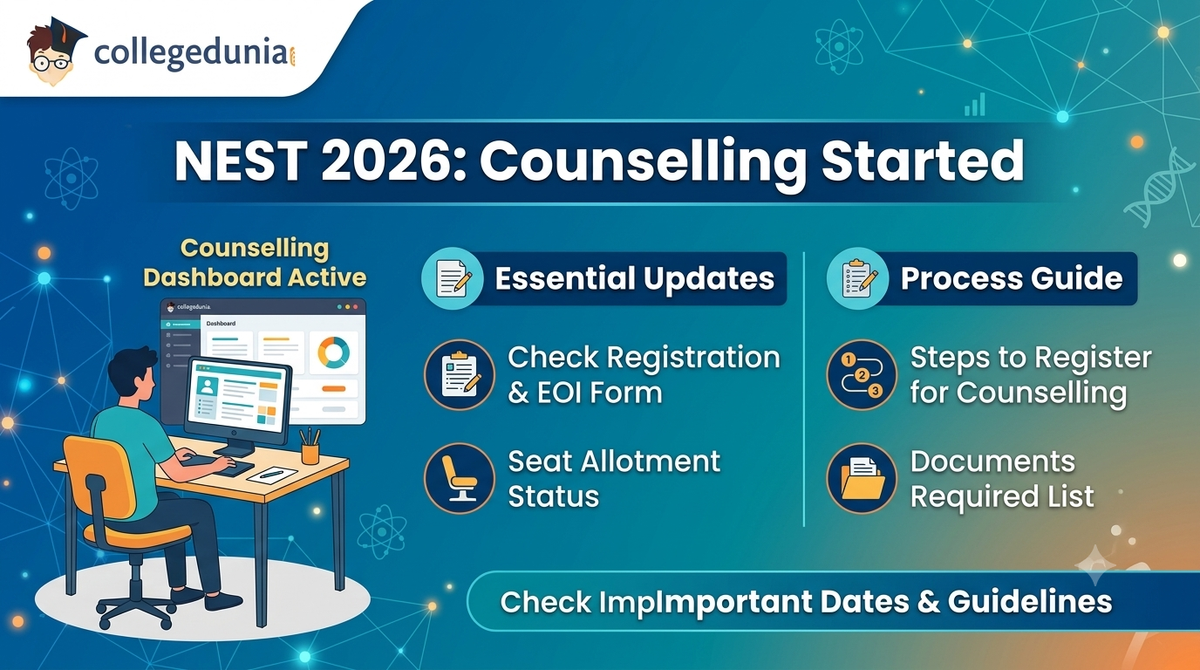
What is NEST Counselling Process 2026?
Candidates who are selected in the NEST 2026 merit lists will be eligible to participate in the NEST counseling. They will receive an email and SMS regarding the Expression of Interest (EoI), which refers to confirming whether they are interested in admission to NISER Bhubaneswar or UM DAE CEBS Mumbai. Interested candidates must reply to the EoI email. Thereafter, they will have to follow these steps:
- Fill out the NEST counseling registration form.
- After the NEST counseling registration, the admission queue will be released.
- Selected candidates will have to visit NISER Bhubaneswar or DAE CEBS Mumbai and submit the required educational documents along with copies of ID proofs.
- They must pay the admission fee to confirm their admission.
Key Highlights of NEST 2026
| Particulars | Details |
|---|---|
| Exam Name | National Entrance Screening Test (NEST) 2026 |
| Conducting Bodies | NISER Bhubaneswar and UM-DAE CEBS Mumbai |
| Under | Department of Atomic Energy (DAE), Government of India |
| Exam Level | National |
| Exam Mode | Computer-Based Test (CBT / Online) |
| Exam Date | June 6, 2026 (Saturday) |
| Exam Duration | 3 hours (2:00 PM to 5:00 PM) |
| Total Sections | 4 (Biology, Chemistry, Mathematics, Physics) |
| Total Questions | 80 (20 per section) |
| Total Marks (Full Exam) | 240 (60 marks per section × 4 sections) |
| Marks Used for Merit | 180 maximum (best 3 of 4 sections × 60 marks) |
| Total Seats | 257 (200 at NISER Bhubaneswar + 57 at UM-DAE CEBS Mumbai) |
| Programme Offered | 5-year Integrated MSc in science disciplines |
| Result Date | June 24, 2026 (Out) |
| Official Website | nestexam.in |
NEST 2026 Result: Declared on June 24
The NEST 2026 result has been declared today, June 24, 2026, at the official website nestexam.in. Candidates who appeared for the exam on June 6, 2026 can now log in using their application number and password to check their merit rank and section-wise performance. The result is based on the final answer key released on June 18, 2026.
NEST 2026 individual scorecards are available separately from June 25, 2026. The June 24 result release contains the merit list and ranks — not the detailed scorecard. Download your scorecard from nestexam.in starting June 25.
How to Check NEST 2026 Result
- Go to the official website: nestexam.in
- Click on the "Candidate Login" link or the "Result" tab on the homepage
- Enter your Application Number and Password
- Your NEST 2026 result will appear on screen showing your merit rank and marks
- Download the result page and save it for future reference during counselling
What Does the NEST 2026 Result Contain?
The NEST 2026 result shows the following details for each qualifying candidate:
- Section-wise marks scored in Biology, Chemistry, Mathematics, and Physics (each out of 60)
- Merit rank based on the sum of the best 3 section scores (out of a maximum of 180 marks)
- Percentile scores in each section and overall
- Whether the candidate qualifies — i.e., has met both the SMAS and MAP criteria
NEST 2026 Merit List
A single combined NEST 2026 merit list is prepared for admissions to both NISER Bhubaneswar and UM-DAE CEBS Mumbai. Candidates who meet the SMAS (Section-wise Minimum Admissible Score) threshold in each section they attempted and also meet the MAP (Minimum Admissible Percentile — top 20th percentile of all test-takers) are ranked in this list. The rank you receive today determines your eligibility and priority during counselling in July 2026.
Based on previous years, roughly 2,000 to 2,500 candidates out of 27,000+ test-takers make it to the NEST merit list. Of these, only 257 ultimately secure seats — meaning even a merit rank does not guarantee admission. Your rank position and category determine your actual chances at each institute and discipline.
NEST 2026 Counselling Important Dates
The NEST 2026 calendar below lists all events with upcoming dates first. Candidates who have received a merit rank today should act on the scorecard download (June 25) and keep track of the counselling registration window, expected in the third week of July 2026.
NISER Bhubaneswar Counselling Dates 2026
| Events | Dates |
|---|---|
| Release of NISER Merit List | June 24 |
| Emails sent regarding Expression of Interest (EoI) | June 25 |
| Last date of submitting EoI | July 6 |
| Creation of admission queue | July 10 |
| First round admission at NISER | July 28 |
| Release of waitlisted candidates list | July 29 |
UMDAE CEBS Counselling Dates 2026
| Events | Dates |
|---|---|
| Collection of Expression of Interest (EoI) starts | July 1 |
| Collection of Expression of Interest (EoI) closes | July 8 |
| Declaration of admission queue on CEBS website | July 10 |
| 1st round of admissions | July 17 to 20 |
| Declaration of 1st Merit List (online) | July 17 |
| Payment window for 1st Merit List closes | July 20 |
| 2nd round of admissions | July 21 to 23 |
| Declaration of 2nd Merit List (online) | July 21 |
| Payment window for 2nd Merit List closes | July 23 |
| 3rd round of admissions | July 24 to 28 |
| Declaration of 3rd Merit List (online) | July 24 |
| Payment window for 3rd Merit List closes | July 28 |
| 4th round of admissions | July 29 to 31 |
| Declaration of 4th Merit List (online) | July 29 |
| Payment window for 4th Merit List closes | July 31 |
| 5th round of admissions | August 1 to 4 |
| Declaration of 5th Merit List (online) | August 1 |
| Payment window for 5th Merit List closes | August 4 |
| Last date for reporting on campus* | August 10 |
| Declaration of available seat matrix for final round of admission | August 11 |
| Final round of admission (offline) | August 18 |
NEST Counselling 2026 Registration Process: How to Apply Online
NEST 2026 counseling is ongoing. The entire process runs online through nestexam.in. Only candidates who appear in the NEST 2026 merit list — having met both SMAS and MAP criteria — are eligible to register and participate in NEST 2026 counseling.
Step-by-Step NEST 2026 Counselling Process
- Step 1 — Counselling Registration: Merit-ranked candidates must register separately for NEST 2026 counselling on the official portal. This is a separate step from the original exam application — missing the registration deadline forfeits your chance at a seat even if you have a high merit rank.
- Step 2 — Institute and Discipline Preference Filling: After registering, fill in preferences for your preferred institute (NISER Bhubaneswar or UM-DAE CEBS Mumbai) and preferred science discipline (Biological Sciences, Chemical Sciences, Mathematical Sciences, or Physical Sciences). Fill multiple preferences in priority order — earlier choices are allotted first.
- Step 3 — Document Verification: Upload scanned copies of all required documents. Provisional seat allotment is subject to successful document verification.
- Step 4 — Seat Allotment: Seats are allotted based on your NEST 2026 merit rank, category, and the preferences you submitted. The allotment is published online on the NEST portal on the scheduled date.
- Step 5 — Seat Acceptance and Fee Payment: If allotted a seat, pay the acceptance fee within the deadline. Not paying on time means the seat goes to the next candidate on the merit list.
- Step 6 — Second Round (If Applicable): Seats that remain unfilled after Round 1 are offered again in Round 2. Candidates from the waiting list may receive allotments. NISER and CEBS may run their second rounds independently after Round 1 closes.

Documents Required for NEST 2026 Counselling
- Class 10 mark sheet or passing certificate (for date of birth proof)
- Class 12 mark sheet or passing certificate
- NEST 2026 scorecard (available from June 25, 2026)
- Category certificate — SC/ST/OBC-NCL/EWS (current, issued by a competent authority)
- PwD (Divyangjan) certificate, if applicable
- Passport-size photograph (recent)
- Valid government-issued ID or Aadhaar card
Candidates currently appearing in Class 12 boards in 2026 who have not yet received their final marksheet may be provisionally allotted a seat. Final admission at NISER or UM-DAE CEBS will only be confirmed after submitting the actual Class 12 marksheet showing the required minimum aggregate — 60% for UR/OBC-NCL, 55% for SC/ST/PwD.
Also Read
Colleges Accepting NEST 2026 Score: NISER and UM-DAE CEBS
Only two institutions admit students through NEST 2026: NISER Bhubaneswar and UM-DAE CEBS Mumbai. Both are autonomous institutions under the Department of Atomic Energy (DAE), Government of India. Both are widely regarded as among the most research-intensive science programmes available to undergraduate students in India, with paid stipends, funded internships, and direct pathways to BARC and other national research centres.
NISER Bhubaneswar
- Full name: National Institute of Science Education and Research
- Location: Bhubaneswar, Odisha — fully residential campus
- Total seats through NEST 2026: 200
- Disciplines: Biological Sciences, Chemical Sciences, Mathematical Sciences, Physical Sciences
- Programme: 5-year Integrated MSc
- All enrolled students receive a monthly stipend of ₹4,000–₹5,000
- DISHA scholarship of ₹60,000 per year available for economically weaker students, plus ₹20,000 per year for summer internships under the Department of Atomic Energy
- Students participate in projects and internships at BARC, TIFR, IISc, and other national research institutes
- Top-performing graduates are directly eligible to appear for the BARC Training School interview
UM-DAE CEBS Mumbai
- Full name: University of Mumbai — Department of Atomic Energy Centre for Excellence in Basic Sciences
- Location: Kalina campus, University of Mumbai, Mumbai
- Total seats through NEST 2026: 57
- Disciplines: Biological Sciences, Chemical Sciences, Mathematical Sciences, Physical Sciences
- Programme: 5-year Integrated MSc
- Students have access to University of Mumbai’s library, research infrastructure, and Mumbai’s broader scientific community
- Monthly stipend and other scholarship benefits similar to NISER
- Higher competition than NISER due to only 57 seats and the Mumbai location advantage
Also Read
List of Top Colleges in India Accepting NEST Based on 2026 RankingNEST 2026 Marks vs Rank
Your NEST 2026 merit rank is based on the best 3 of 4 section scores, with a maximum of 180 marks. The table below maps approximate marks scored to expected merit ranks based on NEST 2025 trends. Candidates who received their result today can use this to estimate where they stand before counselling begins.
NEST 2026 Expected Marks vs Rank
| Marks Scored (out of 180) | Expected Merit Rank (Approx.) | Likely Admission Outcome |
|---|---|---|
| 155 and above | Rank 1–50 | Excellent — first-choice discipline at NISER or CEBS likely secured |
| 140–154 | Rank 51–100 | Very good — NISER in most disciplines; CEBS also in range |
| 125–139 | Rank 101–200 | Good — NISER admission in most discipline choices |
| 110–124 | Rank 201–300 | Moderate — NISER for reserved categories; UR candidates may miss out |
| 90–109 | Rank 301–500 | Low for UR; some reserved category seats may still be available |
| Below 90 | Rank 500+ | Very low chance; may fall below the UR qualifying threshold |
Note: These are estimates based on NEST 2025 analysis. Actual 2026 ranks depend on paper difficulty and the overall performance distribution among this year’s candidates.
Also Read
How Negative Marking Shapes Your Final Score
Because of the 3:1 risk-reward structure in NEST, accuracy matters more than coverage. A candidate who attempts 60 questions across the best 3 sections and gets all 60 correct scores 180 marks. Another who attempts 75 questions, gets 65 right and 10 wrong, earns 195 – 10 = 185 raw — but merit is capped at 180 anyway. The key message: wrong answers at –1 each cut significantly into your score. Answering only when at least 60–70% confident is the smarter NEST strategy, and it is why top NEST scorers often leave several questions unattempted.
NEST 2026 Counselling: Seat Intake
| Category | Seat Intake at NISER | Seat Intake at CEBS |
|---|---|---|
| General | 101 | 23 |
| Economically Weaker Sections (EWS) of the General category | NA (to be confirmed at the time of admission process only) | 06 |
| Other Backward Classes (OBC) – Non-Creamy Layer | 54 | 15 |
| Scheduled Caste (SC) | 30 | 09 |
| Scheduled Tribes (ST) | 15 | 04 |
| Divyangjan | 5% of seats in each category above | 5% of seats in each category |
| Total | 200 | 57 |
NEST 2026 Seat Matrix: Category-wise Distribution
| Institute | Total Seats | UR (50%) | OBC-NCL (27%) | SC (15%) | ST (7.5%) |
|---|---|---|---|---|---|
| NISER Bhubaneswar | 200 | 100 | 54 | 30 | 15 |
| UM-DAE CEBS Mumbai | 57 | 29 | 15 | 9 | 4 |
| Total | 257 | 129 | 69 | 39 | 19 |
Note: 5% horizontal reservation for PwD (Divyangjan) applies across all categories. EWS (Economically Weaker Section) reservation of 10% also applies per Government of India norms. These seat figures are approximate — always check the official NEST 2026 brochure at nestexam.in for the exact seat matrix.
Also Read
NEST Counselling 2026: Reservation Criteria
NISER and CEBS will offer reservations to the reserved category candidates applying for admission.
- 27% of the total seats are reserved in the admission process for candidates of the OBC-NCL category.
- Candidates belonging to the OBC category are not considered eligible for reservation. They are treated the same as General category candidates.
- 15% of the total seats are reserved for candidates of SC category
- 7.5% of seats will be reserved for candidates of ST category.
- Candidates of PwD category will have 5% of the total seats reserved for them.
Supernumerary Quota for students from Jammu and Kashmir
Two supernumerary seats at both NISER Bhubaneswar and UMDAE-CBS will be reserved for candidates from Jammu and Kashmir.

Also Read
NEST 2026 Eligibility Criteria
NEST 2026 eligibility is determined by your academic qualifications, the subjects you studied in Class 12, minimum marks obtained, and year of passing. You must meet all criteria to be considered for admission to NISER Bhubaneswar or UM-DAE CEBS Mumbai.
Academic Qualification and Year of Passing
- You must have passed Class 12 (10+2) from any recognized board in 2024 or 2025, or be currently appearing in the Class 12 board examination in 2026
- Students who passed Class 12 before 2024 are generally not eligible for NEST 2026
- Candidates appearing in 2026 boards can apply provisionally; final admission is confirmed only after submitting proof of meeting the minimum percentage requirement
Subject Requirements at Class 12 Level
- Physics and Chemistry are mandatory — you must have studied both at the Class 11–12 level
- Along with Physics and Chemistry, you must have also studied either Mathematics or Biology (or both)
- PCM students can attempt Chemistry, Mathematics, and Physics sections in NEST (and optionally Biology if they have background)
- PCB students can attempt Biology, Chemistry, and Physics sections (and optionally Mathematics)
- PCMB students who studied all four subjects have maximum flexibility — they can attempt all four sections and benefit from the best 3 rule automatically
Minimum Marks in Class 12
| Category | Minimum Aggregate (in Science Subjects) |
|---|---|
| UR / General / OBC-NCL / EWS | 60% in Physics, Chemistry, and best of Mathematics or Biology |
| SC / ST / Divyangjan (PwD) | 55% in Physics, Chemistry, and best of Mathematics or Biology |
Age Limit
NEST 2026 does not have an upper age limit. Any candidate who meets the academic eligibility requirements — regardless of age — can appear for the exam.
Special Provision for PwD (Divyangjan) Candidates
Divyangjan candidates are given compensatory time of 20 minutes per hour of exam duration as per Government of India guidelines. For the 3-hour NEST exam, PwD candidates receive an additional 60 minutes of total exam time.
NEST 2026 Application Process
The NEST 2026 application process was entirely online at nestexam.in. The registration window ran from January 5, 2026 to April 6, 2026, and is now closed. The information below is for reference for candidates planning for future cycles and to understand what the process involved.
NEST 2026 Application Fee
| Category | Application Fee |
|---|---|
| Male — General / OBC-NCL / EWS | ₹1,400 |
| Female — All Categories | ₹700 |
| Male — SC / ST / Divyangjan (PwD) | ₹700 |
The NEST 2026 application fee was non-refundable. Payment was accepted online through debit card, credit card, net banking, and UPI (including RuPay, Visa, and Mastercard).
Steps to Fill the NEST 2026 Application Form
- Step 1 — New Registration: Visit nestexam.in and create a new account with a valid email ID and mobile number to get an application number and password
- Step 2 — Personal and Academic Details: Log in and fill in your personal information, Class 10 and Class 12 details, and select your preferred exam city from available centres across 387 cities
- Step 3 — Section Choice: Select the subject sections you want to attempt (Biology, Chemistry, Mathematics, Physics) based on your Class 12 stream
- Step 4 — Document Upload: Upload scanned photograph, signature, and relevant educational certificates in the required format and file size
- Step 5 — Fee Payment and Submission: Pay the application fee online, review the filled form, and submit. Save the confirmation page for your records.
A form correction window was open from April 13 to 14, 2026 for candidates who needed to correct any submitted details before the exam.
NEST 2026 Exam Pattern
The NEST 2026 exam pattern has four subject sections, each with 20 MCQs, and a critical "best 3 of 4 sections" scoring rule for merit. Understanding this structure — including the negative marking and SMAS qualifying threshold — is essential for planning your exam strategy.
NEST 2026 Exam Structure: Sections and Marks
| Section | Subject | Number of Questions | Maximum Marks per Section |
|---|---|---|---|
| Section 1 | Biology | 20 | 60 |
| Section 2 | Chemistry | 20 | 60 |
| Section 3 | Mathematics | 20 | 60 |
| Section 4 | Physics | 20 | 60 |
| Total | All 4 Subjects | 80 | 240 (60 × 4) |
Marking Scheme
- +3 marks for each correct answer
- –1 mark for each wrong answer (negative marking applies)
- 0 marks for unattempted questions — no penalty for leaving a question blank
- All 80 questions are MCQs with four options and one correct answer
- Question paper is available in both English and Hindi
The "Best 3 of 4" Scoring Rule for Merit
Your NEST 2026 merit rank is not based on all 4 section scores. Only your top 3 section scores are counted. The maximum marks for the merit list is therefore 180 (3 × 60), not 240. The section in which you scored lowest is automatically dropped from the merit calculation.
This gives strategic flexibility. A PCM student who has not studied Biology can attempt all 4 sections, and the Biology score will simply be excluded if it is the weakest section. You can use the full 3 hours without any section hurting your merit points.
SMAS and MAP: The Two Qualifying Thresholds
To appear in the NEST 2026 merit list, every candidate must clear both these thresholds:
- SMAS (Section-wise Minimum Admissible Score): You must score at least a minimum in each section you attempt. The SMAS is set at 20% of the average of the top 100 scores in that section. Approximately, UR candidates need about 9–10 marks per section, OBC-NCL candidates need about 8 marks, and ST candidates need around 4–5 marks (out of 60 per section). Failing SMAS in even one attempted section removes you from the merit list entirely.
- MAP (Minimum Admissible Percentile): You must be in the top 20th percentile of all NEST 2026 test-takers. Roughly 8–10% of all appearing candidates each year manage to qualify based on both SMAS and MAP together.
Qualifying for the merit list (SMAS + MAP) only means you receive a rank. Getting a seat at NISER or CEBS requires a rank high enough to be selected during counselling — only 257 of the 2,000+ merit-listed candidates ultimately secure admission.
NEST 2026 Answer Key
NISER released the NEST 2026 provisional answer key on June 8, 2026 — two days after the exam held on June 6. Along with the key, the NEST 2026 response sheet became available on June 10, 2026, allowing candidates to compare their submitted answers against the published answers.
Candidates could raise objections from June 10 to June 12, 2026 by submitting challenges with supporting justification and paying ₹200 per question as an objection fee. After reviewing all valid objections, NISER released the NEST 2026 final answer key on June 18, 2026. The result declared today (June 24, 2026) is entirely based on this final answer key — all accepted objections have already been factored into the final scores and merit ranks.
NEST 2026 Answer Key Timeline
- Provisional Answer Key: June 8, 2026 (Released)
- Response Sheet Available: June 10, 2026 (Released)
- Objection Submission Window: June 10–12, 2026 (Over)
- Final Answer Key: June 18, 2026 (Released)
Accepted objections change marks for every candidate who attempted the challenged question. In NEST, where a single mark can separate hundreds of merit-list candidates, even one or two changed answers from the objection review can meaningfully shift ranks.
NEST 2026 Cutoff
NEST 2026 has two types of cutoff: the qualifying cutoff (SMAS + MAP), which determines who receives a merit rank; and the admission cutoff, which is the score or rank at which seats fill up at NISER and UM-DAE CEBS during counselling. The admission cutoff for NEST 2026 will be known only after counselling concludes in July–August 2026.
Qualifying Cutoff: SMAS and MAP
- SMAS (Section-wise Minimum Admissible Score) is the minimum marks required in each section you attempt. Failing to meet SMAS in even one section disqualifies you from the merit list regardless of your total score. The threshold is set at 20% of the average of the top 100 scores in each section — a low but mandatory hurdle.
- MAP (Minimum Admissible Percentile) requires you to be within the top 20% of all NEST 2026 test-takers. Meeting SMAS alone is not enough — you must also meet MAP to receive a merit rank. Roughly 8–10% of all appearing candidates qualify each year based on both criteria together.
NEST 2025 Admission Cutoff: Previous Year Reference
Since the NEST 2026 admission cutoffs will only be declared after counselling, the table below uses 2025 data as a benchmark for candidates assessing their chances today.
| Institute | Category | Approximate Marks Required (out of 180) |
|---|---|---|
| NISER Bhubaneswar | UR / General | 90–95 |
| NISER Bhubaneswar | OBC-NCL | 82–90 |
| NISER Bhubaneswar | SC | 68–75 |
| NISER Bhubaneswar | ST | 60–70 |
| UM-DAE CEBS Mumbai | UR / General | Higher than NISER — typically top-100 merit rank needed |
| UM-DAE CEBS Mumbai | OBC-NCL | Higher cutoff than NISER OBC due to fewer seats |
Note: These are indicative figures from 2025 trends. NEST 2026 cutoffs may vary based on this year’s exam difficulty and the performance distribution of appearing candidates.
Why Is UM-DAE CEBS Cutoff Higher Than NISER?
UM-DAE CEBS Mumbai has only 57 seats versus 200 at NISER Bhubaneswar. With far fewer seats and the appeal of a Mumbai location, CEBS draws strong applicants across all categories. A General category candidate typically needs a top-100 merit rank to clear the first allotment round at CEBS. NISER, with 200 seats spread across four disciplines, can accommodate candidates with ranks up to 200–300 (category-dependent), giving it a much wider effective access pool.
FAQs
Ques. Is the NEST 2026 result out?
Ans. Yes, the NEST 2026 result has been declared on June 24, 2026 at the official website nestexam.in. Candidates can log in using their application number and password to check their merit rank and section-wise scores. Individual scorecards are available separately for download from June 25, 2026.
Ques. How to download the NEST 2026 scorecard?
Ans. The NEST 2026 scorecard is available for download from June 25, 2026 at nestexam.in. Go to the candidate login section on the official website, enter your application number and password, and download the scorecard PDF. The scorecard shows section-wise marks, percentile, and merit rank — all of which you need for counselling registration.
Ques. What is the NEST 2026 cutoff?
Ans. The NEST 2026 admission cutoff will be declared after counselling rounds end in July–August 2026. Based on 2025 trends, UR candidates needed approximately 90–95 marks out of 180 for NISER Bhubaneswar. UM-DAE CEBS Mumbai requires a higher score — typically a top-100 merit rank for General category — due to its 57-seat limit.
Ques. How many seats are available in NEST 2026?
Ans. NEST 2026 offers a total of 257 seats — 200 at NISER Bhubaneswar and 57 at UM-DAE CEBS Mumbai. Seats are distributed across four science disciplines: Biological Sciences, Chemical Sciences, Mathematical Sciences, and Physical Sciences. Reservation norms apply: OBC-NCL 27%, SC 15%, ST 7.5%, EWS 10%, with 5% horizontal reservation for PwD (Divyangjan) candidates.
Ques. What is SMAS in NEST 2026?
Ans. SMAS stands for Section-wise Minimum Admissible Score. To appear in the NEST 2026 merit list, you must score at least the SMAS threshold in each section you attempt. It is set at 20% of the average of the top 100 scores in that section — roughly 9–10 marks per section for UR candidates, about 8 marks for OBC-NCL, and 4–5 marks for ST candidates (out of 60 per section). Failing SMAS in even one attempted section removes you from the merit list, regardless of your total score.
Ques. Is NEST 2026 very difficult?
Ans. NEST is considered moderately to highly difficult. Questions are NCERT-based but application-oriented — you need deep conceptual understanding, not just memorisation. Physics and Mathematics difficulty is comparable to JEE Advanced. Since only about 8–10% of all appearing candidates qualify for the merit list each year and only 257 seats are available, thorough and concept-first preparation is essential.
Ques. Can PCM students appear for NEST 2026?
Ans. Yes, PCM (Physics, Chemistry, Mathematics) students are fully eligible for NEST 2026. They can attempt the Physics, Chemistry, and Mathematics sections. Since only the best 3 of 4 sections count for merit, PCM students can focus on these three subjects without needing Biology knowledge. They may also optionally attempt the Biology section — if it is the weakest score, it will be automatically excluded from the merit calculation.
Ques. What is the age limit for NEST 2026?
Ans. NEST 2026 has no upper age limit. Any candidate who has passed Class 12 in 2024 or 2025, or is currently appearing in 2026, with Physics and Chemistry plus either Mathematics or Biology, and a minimum of 60% aggregate (55% for SC/ST/PwD), is eligible to appear — regardless of age.
Ques. When will NEST 2026 counselling begin?
Ans. NEST 2026 counselling is expected to begin in the third week of July 2026. The entire process is online through nestexam.in. Eligible candidates must register separately for counselling, fill in institute and discipline preferences, complete document verification, and then receive their seat allotment. In 2025, NEST counselling began on July 22 and ran through two rounds.
Ques. What is the 5-year Integrated MSc programme at NISER and CEBS?
Ans. The 5-year Integrated MSc offered at NISER Bhubaneswar and UM-DAE CEBS Mumbai is a combined undergraduate and postgraduate science degree. Students choose one of four disciplines: Biological Sciences, Chemical Sciences, Mathematical Sciences, or Physical Sciences. The programme is research-oriented, with lab work, projects, and summer internships at national institutes. All enrolled students receive a monthly stipend of approximately ₹4,000–₹5,000, with additional DISHA scholarship support of ₹60,000 per year for economically weaker students.
Ques. What is UM-DAE CEBS and how is it different from NISER?
Ans. UM-DAE CEBS stands for University of Mumbai — Department of Atomic Energy Centre for Excellence in Basic Sciences, located on the Kalina campus of the University of Mumbai in Mumbai. Both NISER and CEBS are DAE institutions, use the same NEST score, and offer the same 5-year Integrated MSc programme. The main differences are: location (Bhubaneswar vs Mumbai), total seats (200 at NISER vs 57 at CEBS), and competition level (CEBS cutoff is significantly higher due to fewer seats and Mumbai’s appeal).
Ques. Is scholarship available for students admitted through NEST 2026?
Ans. Yes. All students enrolled at NISER Bhubaneswar and UM-DAE CEBS Mumbai through NEST receive a monthly stipend of approximately ₹4,000–₹5,000. In addition, the DISHA scholarship — funded by the Department of Atomic Energy — provides ₹60,000 per year to economically weaker students and ₹20,000 per year for summer internship support. This financial support makes the programme accessible and allows students to focus entirely on science without financial pressure.
Disclaimer: The information provided in this article about NEST 2026 is based on official notifications, publicly available data from nestexam.in, and previous year trends. Dates, seat counts, and cutoff figures are subject to change based on official announcements by NISER Bhubaneswar and UM-DAE CEBS Mumbai. Always verify the latest information directly on the official NEST portal at nestexam.in before taking any decisions related to result, counselling, or admission.







Comments
Found 1 Comment
The notification for the regsitration process of NEST 2023 has not been released yet. The registration process for NEST 2023 is expected to begin in February 2023 and the examination to be conducted in June 2023.