




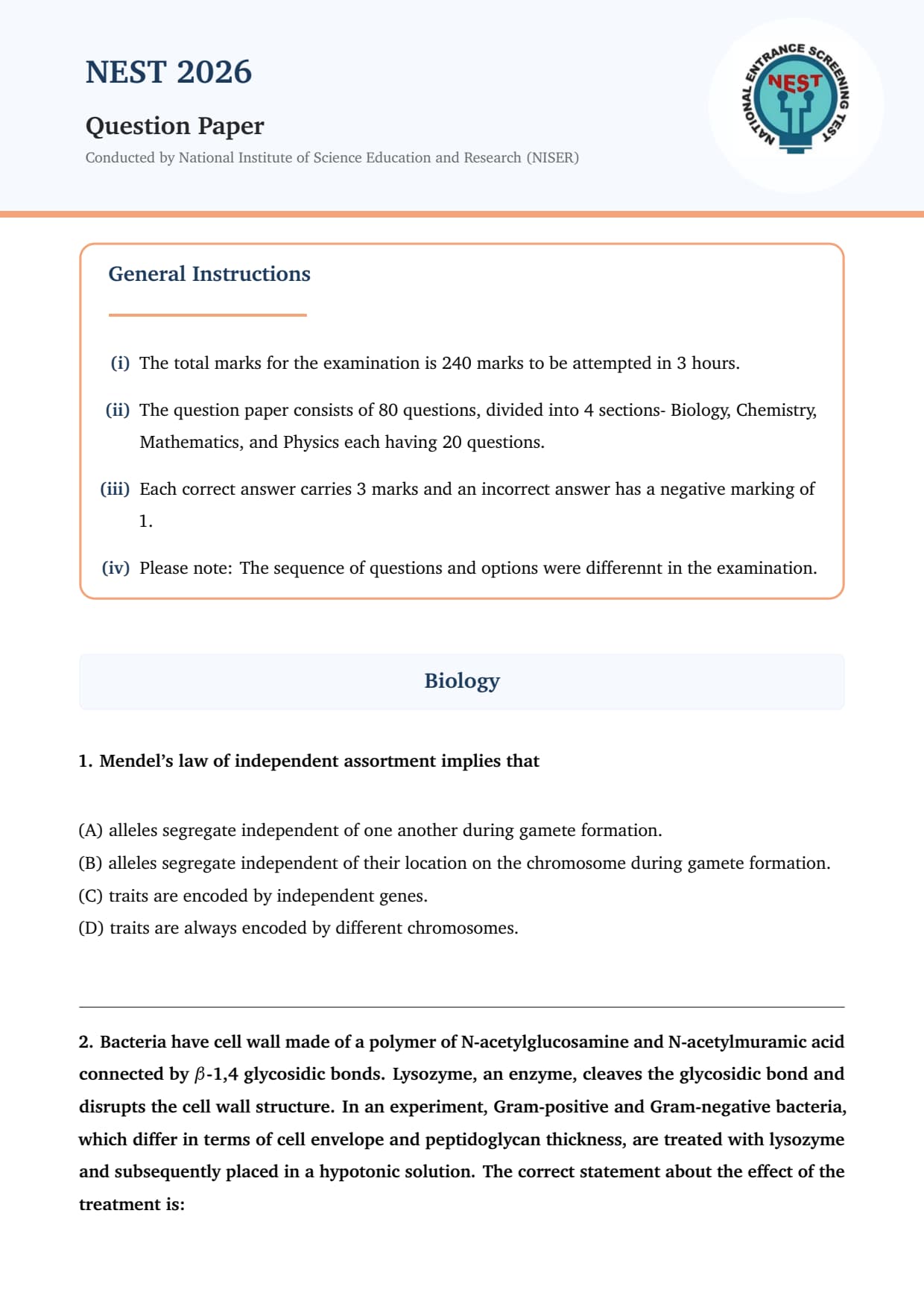
NEST 2026 Question Paper is available for download here. National Institute of Science Education and Research (NISER) conducted NEST 2026 exam on June 6 from 2 PM to 5 PM. NEST Question Paper consists of 80 questions for 240 marks to be attempted in 3 hours.
- NEST Question Paper 2026 is divided into 4 sections- Biology, Chemistry, Mathematics, and Physics each having 20 questions.
- Each correct answer carries 3 marks and an incorrect answer has a negative marking of 1.
Candidates can download NEST 2026 Question Paper with Answer Key and Solutions PDF from the links provided below.
NEST 2026 Question Paper with Solution PDF
| NEST Question Paper 2026 | Download PDF | Check Solutions |
Mendel's law of independent assortment implies that
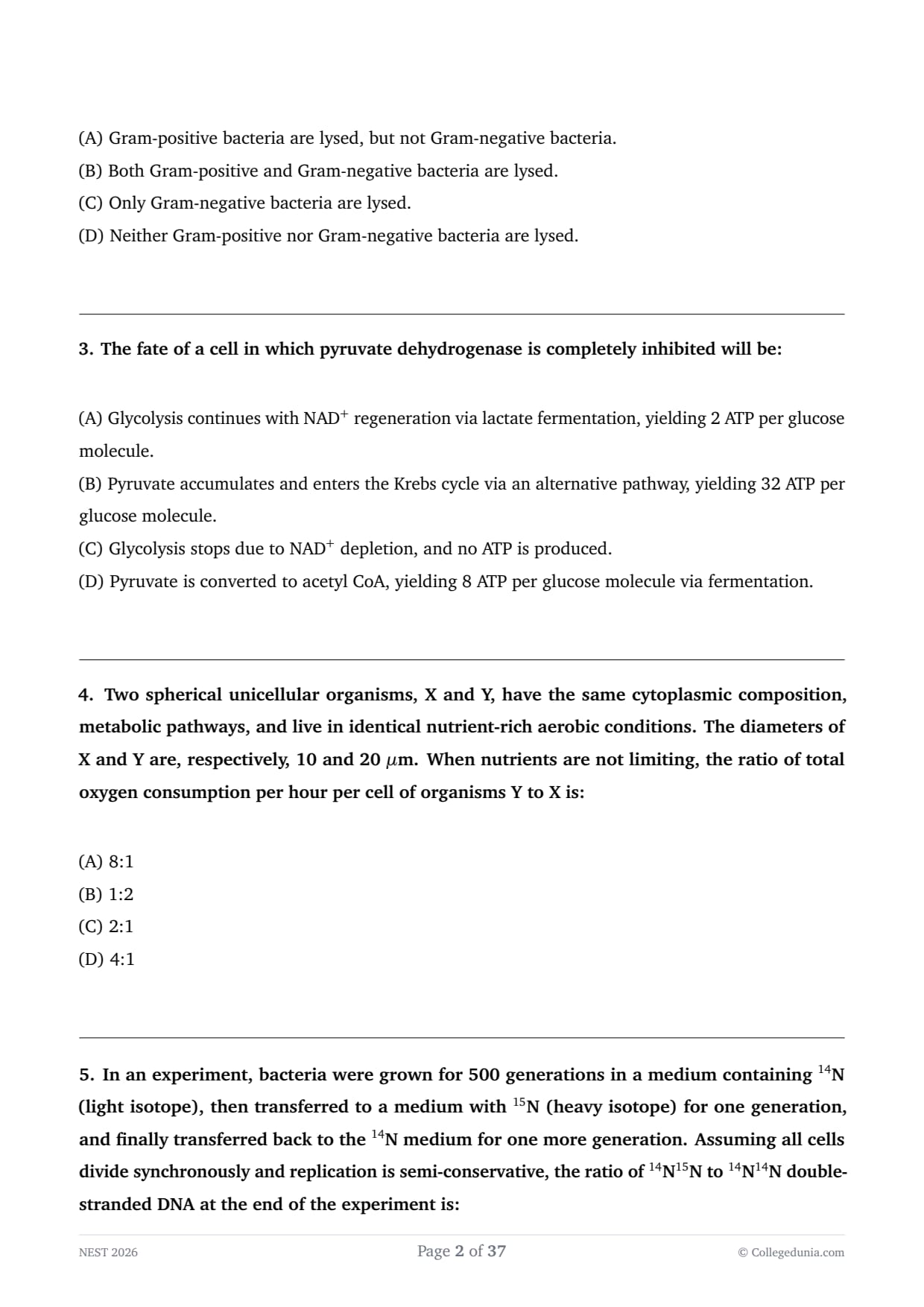
Bacteria have cell wall made of a polymer of N-acetylglucosamine and N-acetylmuramic acid connected by \(\beta\)-1,4 glycosidic bonds. Lysozyme, an enzyme, cleaves the glycosidic bond and disrupts the cell wall structure. In an experiment, Gram-positive and Gram-negative bacteria, which differ in terms of cell envelope and peptidoglycan thickness, are treated with lysozyme and subsequently placed in a hypotonic solution. The correct statement about the effect of the treatment is:
The fate of a cell in which pyruvate dehydrogenase is completely inhibited will be:
Two spherical unicellular organisms, X and Y, have the same cytoplasmic composition, metabolic pathways, and live in identical nutrient-rich aerobic conditions. The diameters of X and Y are, respectively, 10 and 20 \(\mu m\). When nutrients are not limiting, the ratio of total oxygen consumption per hour per cell of organisms Y to X is:
In an experiment, bacteria were grown for 500 generations in a medium containing \(^{14}N\) (light isotope), then transferred to a medium with \(^{15}N\) (heavy isotope) for one generation, and finally transferred back to the \(^{14}N\) medium for one more generation. Assuming all cells divide synchronously and replication is semi-conservative, the ratio of \(^{14}N^{15}N\) to \(^{14}N^{14}N\) double-stranded DNA at the end of the experiment is:
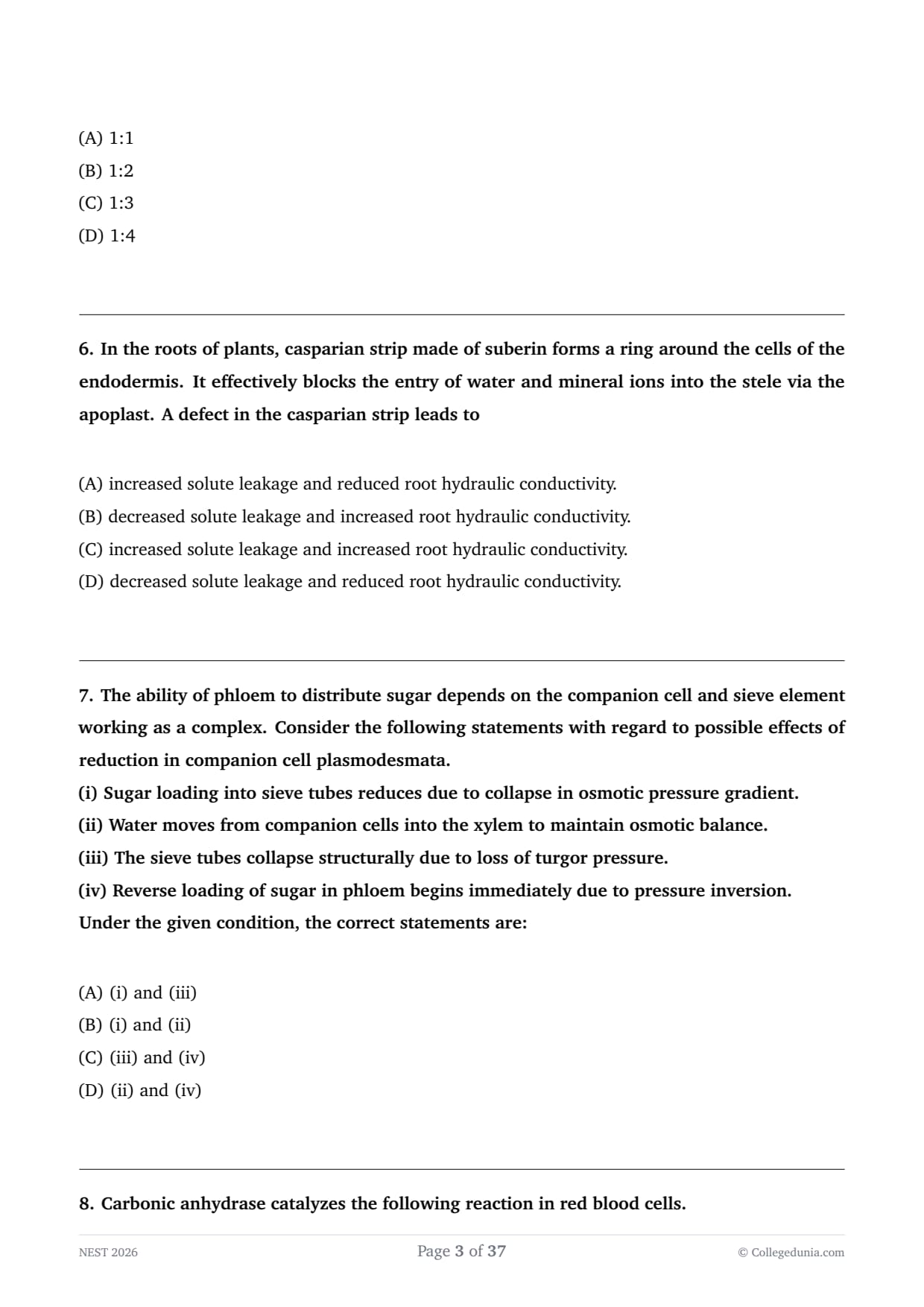
In the roots of plants, casparian strip made of suberin forms a ring around the cells of the endodermis. It effectively blocks the entry of water and mineral ions into the stele via the apoplast. A defect in the casparian strip leads to
The ability of phloem to distribute sugar depends on the companion cell and sieve element working as a complex. Consider the following statements with regard to possible effects of reduction in companion cell plasmodesmata.
(i) Sugar loading into sieve tubes reduces due to collapse in osmotic pressure gradient.
(ii) Water moves from companion cells into the xylem to maintain osmotic balance.
(iii) The sieve tubes collapse structurally due to loss of turgor pressure.
(iv) Reverse loading of sugar in phloem begins immediately due to pressure inversion.
Under the given condition, the correct statements are:
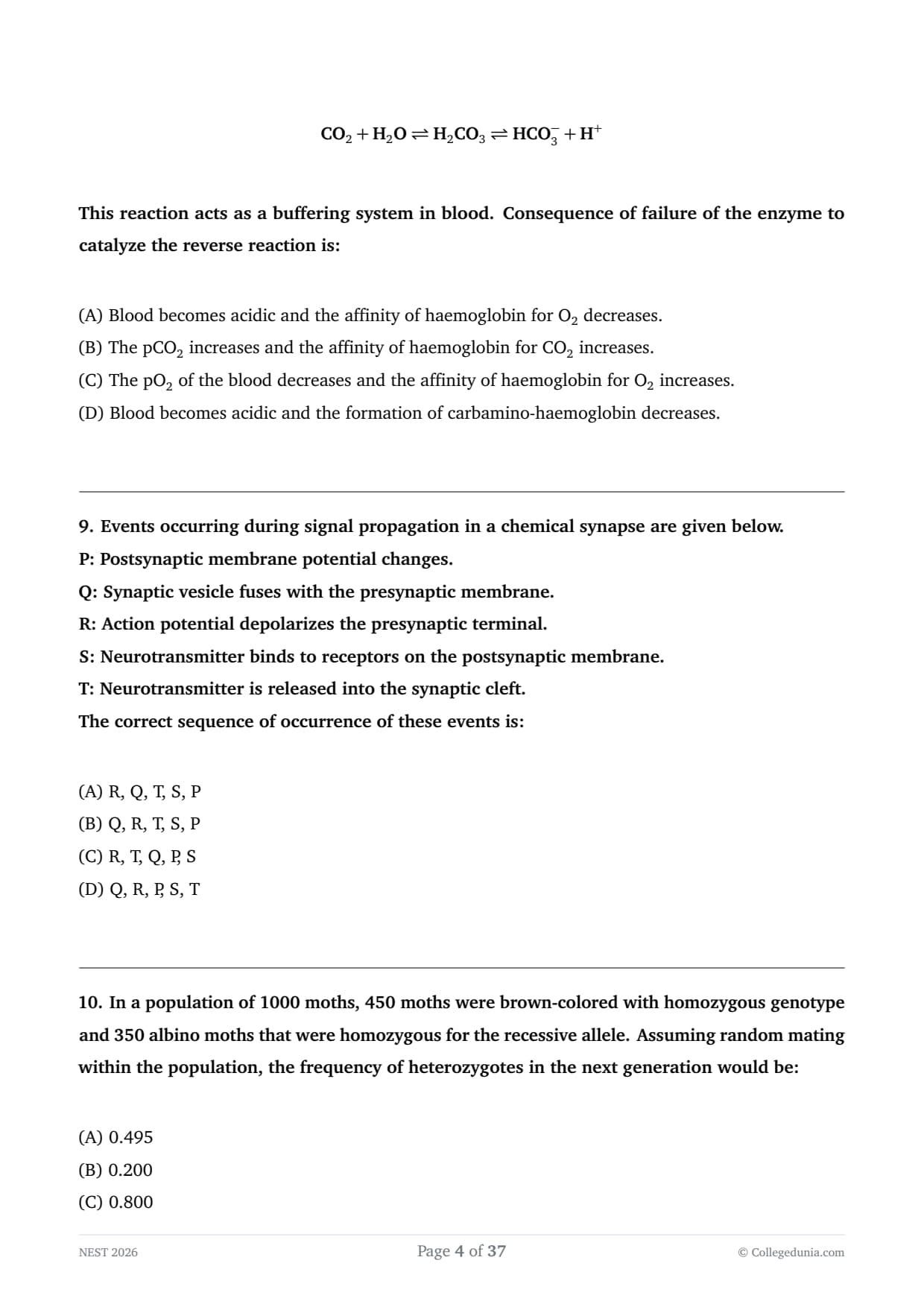
Carbonic anhydrase catalyzes the following reaction in red blood cells.
\[ CO_2 + H_2O \rightleftharpoons H_2CO_3 \rightleftharpoons HCO_3^- + H^+ \]
This reaction acts as a buffering system in blood. Consequence of failure of the enzyme to catalyze the reverse reaction is:
Events occurring during signal propagation in a chemical synapse are given below.
P: Postsynaptic membrane potential changes.
Q: Synaptic vesicle fuses with the presynaptic membrane.
R: Action potential depolarizes the presynaptic terminal.
S: Neurotransmitter binds to receptors on the postsynaptic membrane.
T: Neurotransmitter is released into the synaptic cleft.
The correct sequence of occurrence of these events is:
In a population of 1000 moths, 450 moths were brown-colored with homozygous genotype and 350 albino moths that were homozygous for the recessive allele. Assuming random mating within the population, the frequency of heterozygotes in the next generation would be:
In a haplodiploid ant species, sons are haploid and produced from unfertilized eggs, while daughters are diploid and produced from fertilized eggs. A single queen establishes a colony after mating with three different unrelated males. The queen uses the sperm from all three males equally to produce her female offspring. The average genetic relatedness between two randomly selected female offspring in this colony will be:
In the axon of a giant squid neuron,
(i) The resting membrane potential is -70 mV.
(ii) At the equilibrium potential of \(Na^+\) (\(E_{Na^+} = +55\) mV) there is no net movement of \(Na^+\) ions across the membrane.
In an experiment, when the axon is stimulated, the voltage-gated \(Na^+\) channels open. The membrane potential peaks at +30 mV, where the resistance of the axonal membrane for \(Na^+\) flow is \(1 \times 10^6\ \Omega\). The net \(Na^+\) current (\(I_{Na^+}\)) across the membrane and the direction of ionic movement at the peak is:
Consider a mitochondrion in which the \(F_0\) subunit of ATP synthase is mutated, such that it can still passively conduct protons but is mechanically uncoupled from the \(F_1\) subunit. If such a mitochondrion is provided with succinate, ADP, and Pi in aerobic conditions, the correct outcome based on chemiosmotic theory is:
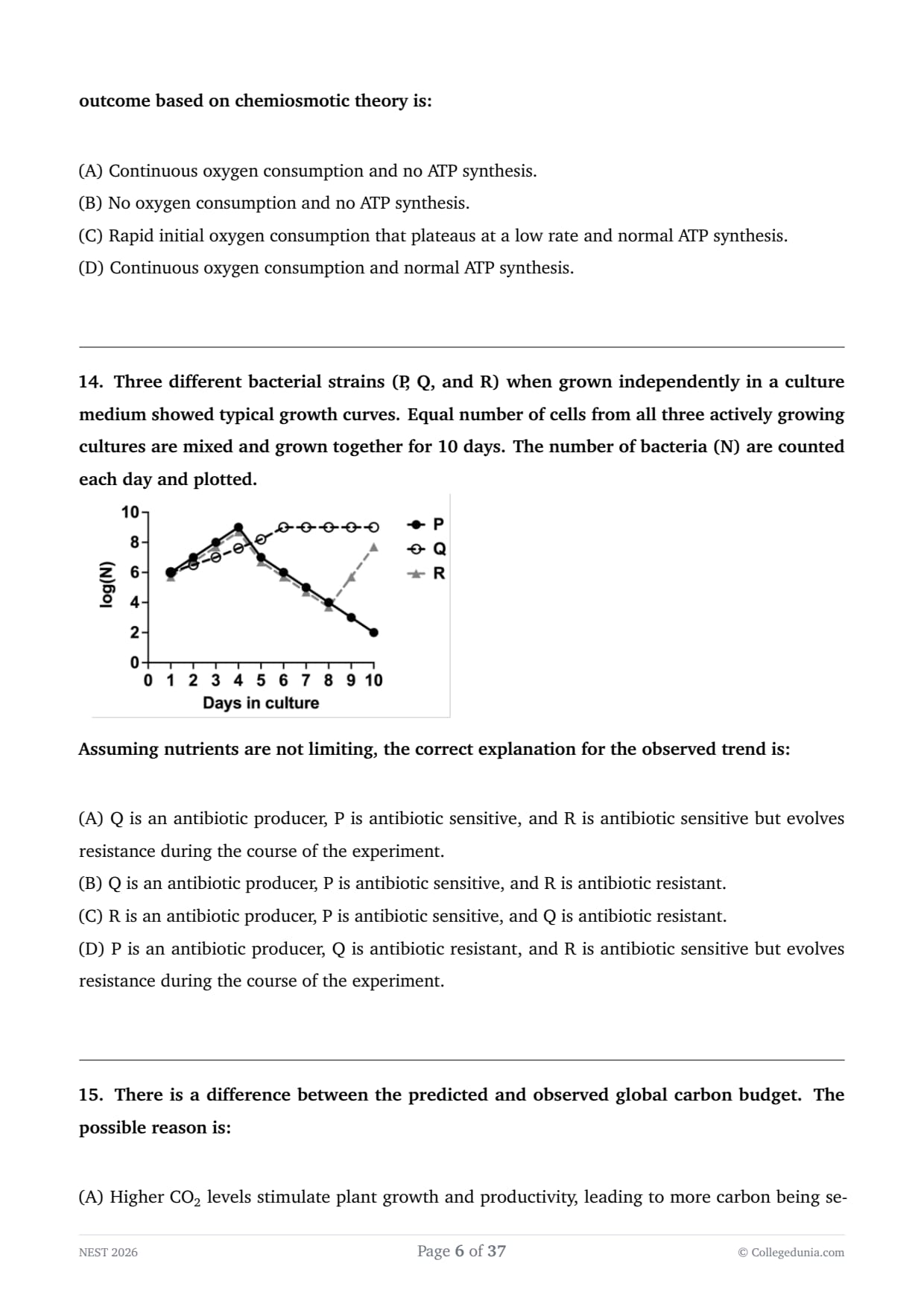
Three different bacterial strains (P, Q, and R) when grown independently in a culture medium showed typical growth curves. Equal number of cells from all three actively growing cultures are mixed and grown together for 10 days. The number of bacteria (N) are counted each day and plotted.

Assuming nutrients are not limiting, the correct explanation for the observed trend is:
There is a difference between the predicted and observed global carbon budget. The possible reason is:
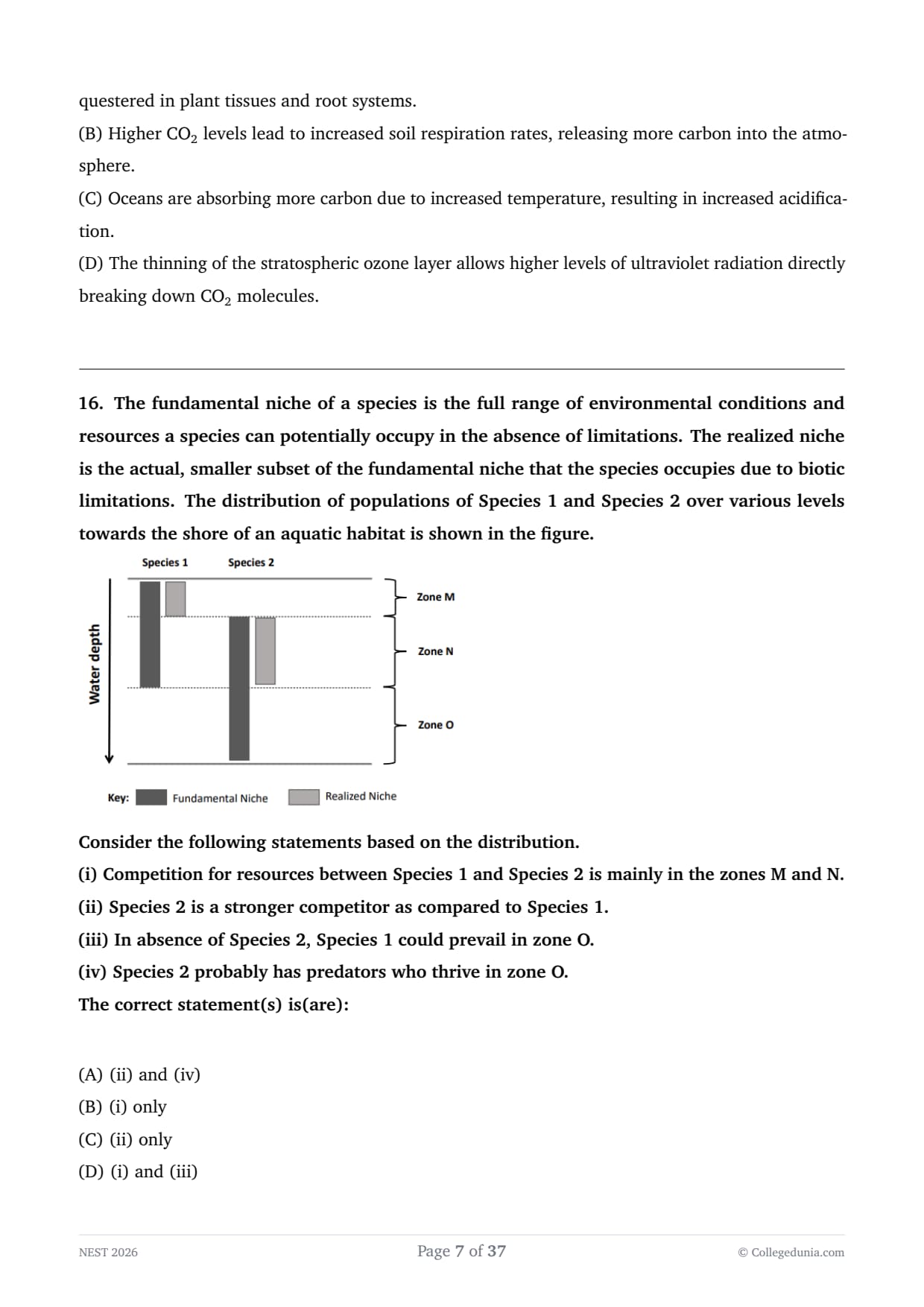
The fundamental niche of a species is the full range of environmental conditions and resources a species can potentially occupy in the absence of limitations. The realized niche is the actual, smaller subset of the fundamental niche that the species occupies due to biotic limitations. The distribution of populations of Species 1 and Species 2 over various levels towards the shore of an aquatic habitat is shown in the figure.

Consider the following statements based on the distribution.
(i) Competition for resources between Species 1 and Species 2 is mainly in the zones M and N.
(ii) Species 2 is a stronger competitor as compared to Species 1.
(iii) In absence of Species 2, Species 1 could prevail in zone O.
(iv) Species 2 probably has predators who thrive in zone O.
The correct statement(s) is(are):
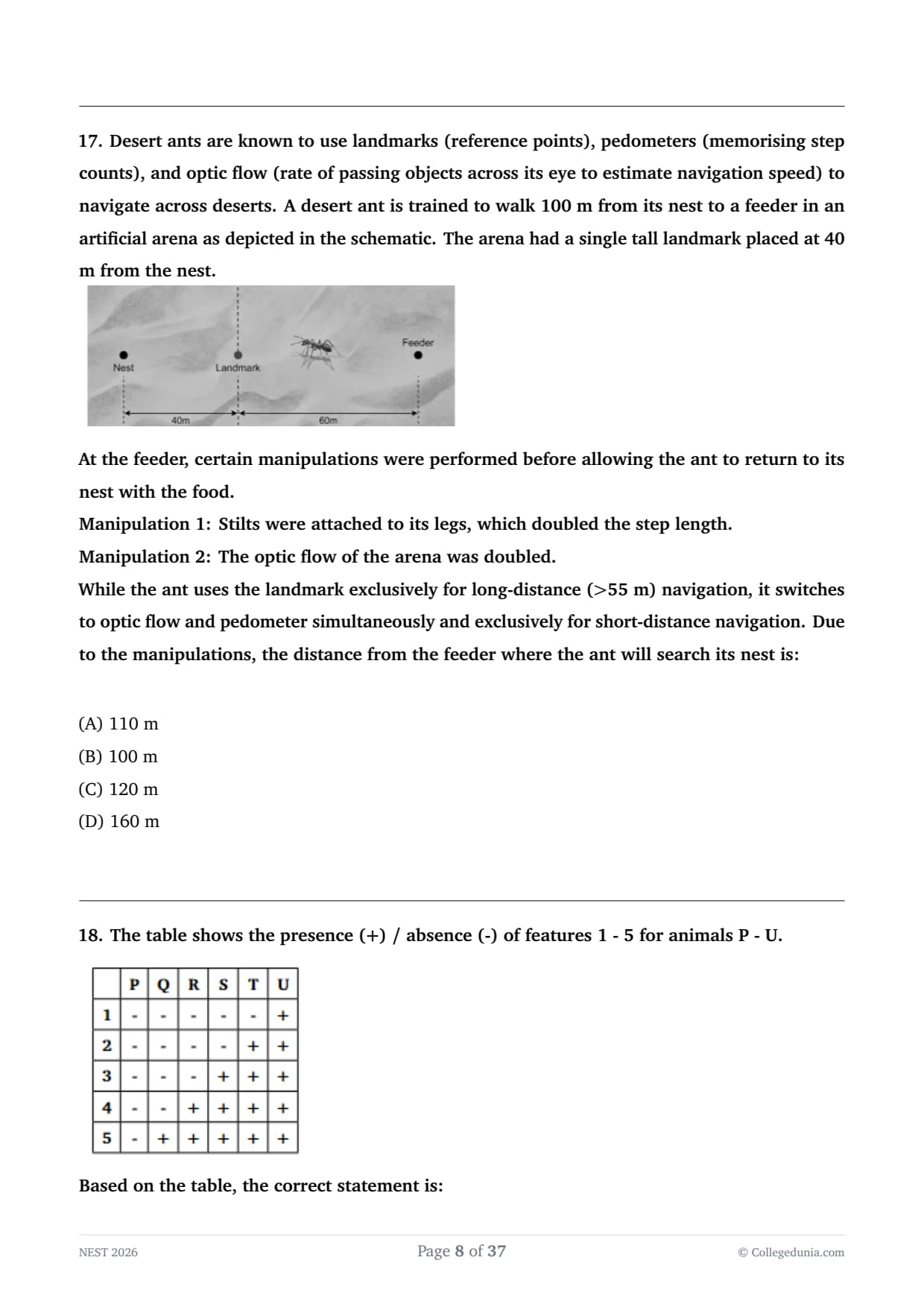
Desert ants are known to use landmarks (reference points), pedometers (memorising step counts), and optic flow (rate of passing objects across its eye to estimate navigation speed) to navigate across deserts. A desert ant is trained to walk 100 m from its nest to a feeder in an artificial arena as depicted in the schematic. The arena had a single tall landmark placed at 40 m from the nest.

At the feeder, certain manipulations were performed before allowing the ant to return to its nest with the food.
Manipulation 1: Stilts were attached to its legs, which doubled the step length.
Manipulation 2: The optic flow of the arena was doubled.
While the ant uses the landmark exclusively for long-distance (\(>\)55 m) navigation, it switches to optic flow and pedometer simultaneously and exclusively for short-distance navigation. Due to the manipulations, the distance from the feeder where the ant will search its nest is:
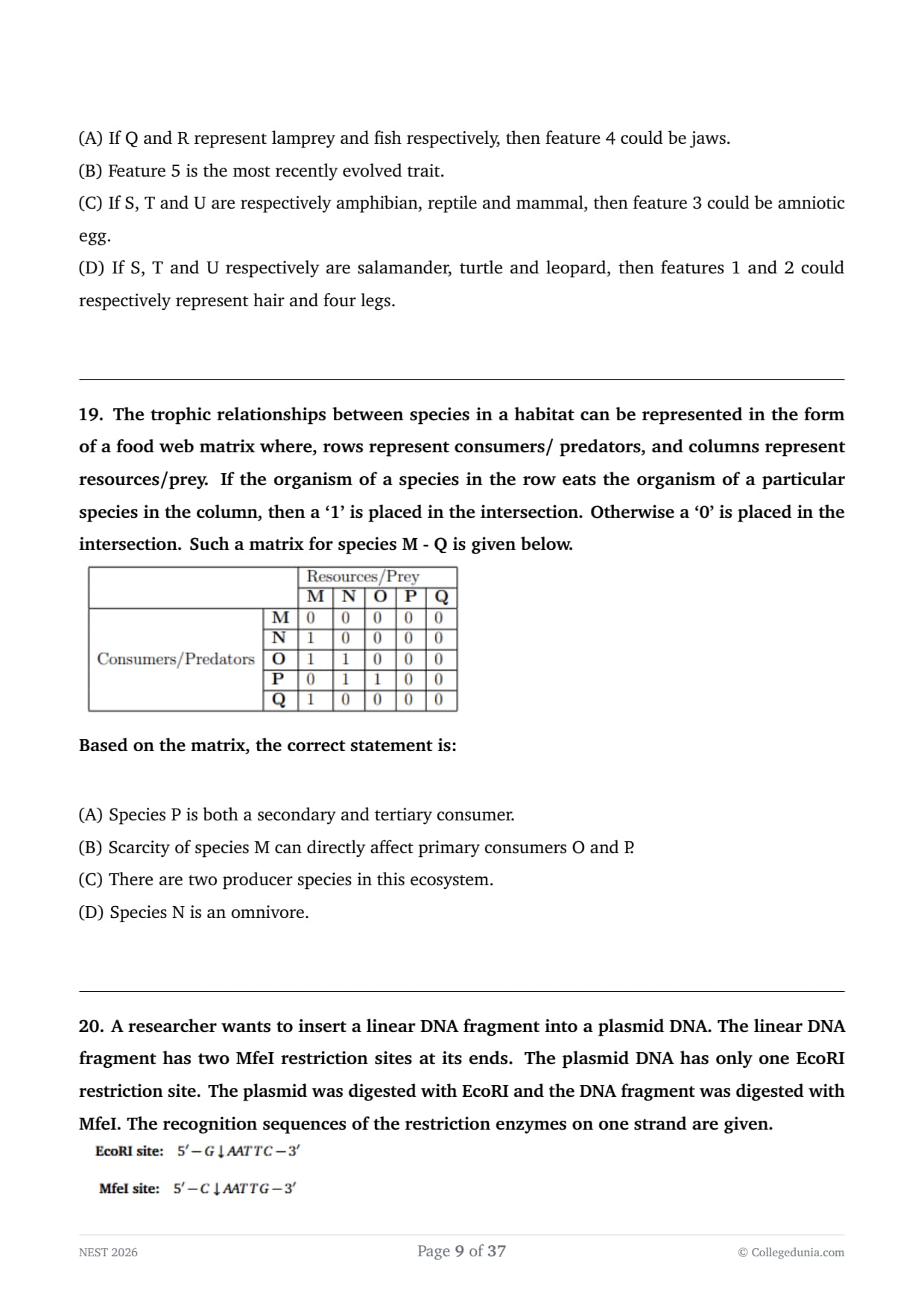
The table shows the presence (+) / absence (-) of features 1 - 5 for animals P - U.

Based on the table, the correct statement is:
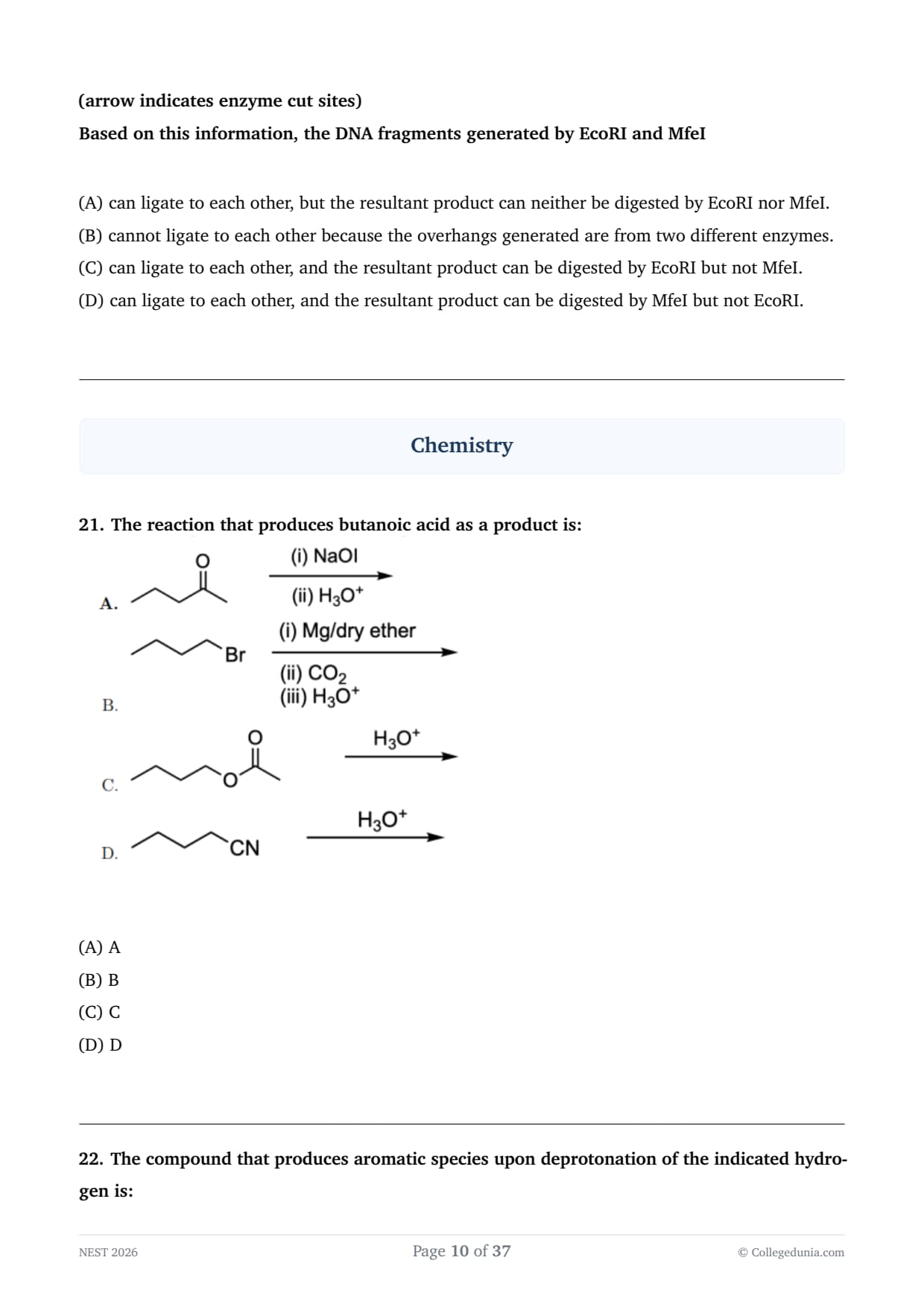
The trophic relationships between species in a habitat can be represented in the form of a food web matrix where, rows represent consumers/ predators, and columns represent resources/prey. If the organism of a species in the row eats the organism of a particular species in the column, then a `1' is placed in the intersection. Otherwise a `0' is placed in the intersection. Such a matrix for species M - Q is given below.

Based on the matrix, the correct statement is:
A researcher wants to insert a linear DNA fragment into a plasmid DNA. The linear DNA fragment has two MfeI restriction sites at its ends. The plasmid DNA has only one EcoRI restriction site. The plasmid was digested with EcoRI and the DNA fragment was digested with MfeI. The recognition sequences of the restriction enzymes on one strand are given.

(arrow indicates enzyme cut sites)
Based on this information, the DNA fragments generated by EcoRI and MfeI
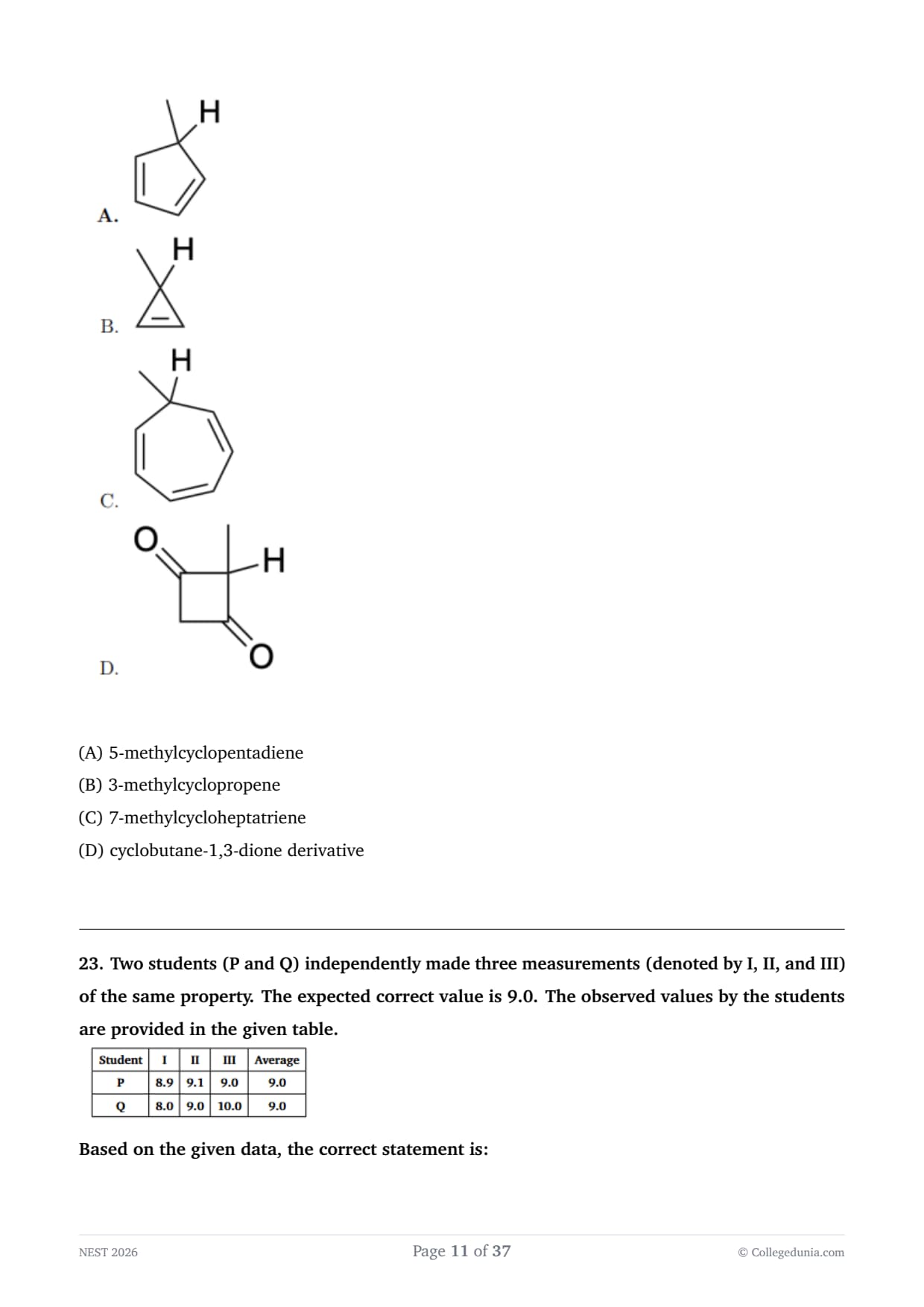
The reaction that produces butanoic acid as a product is:

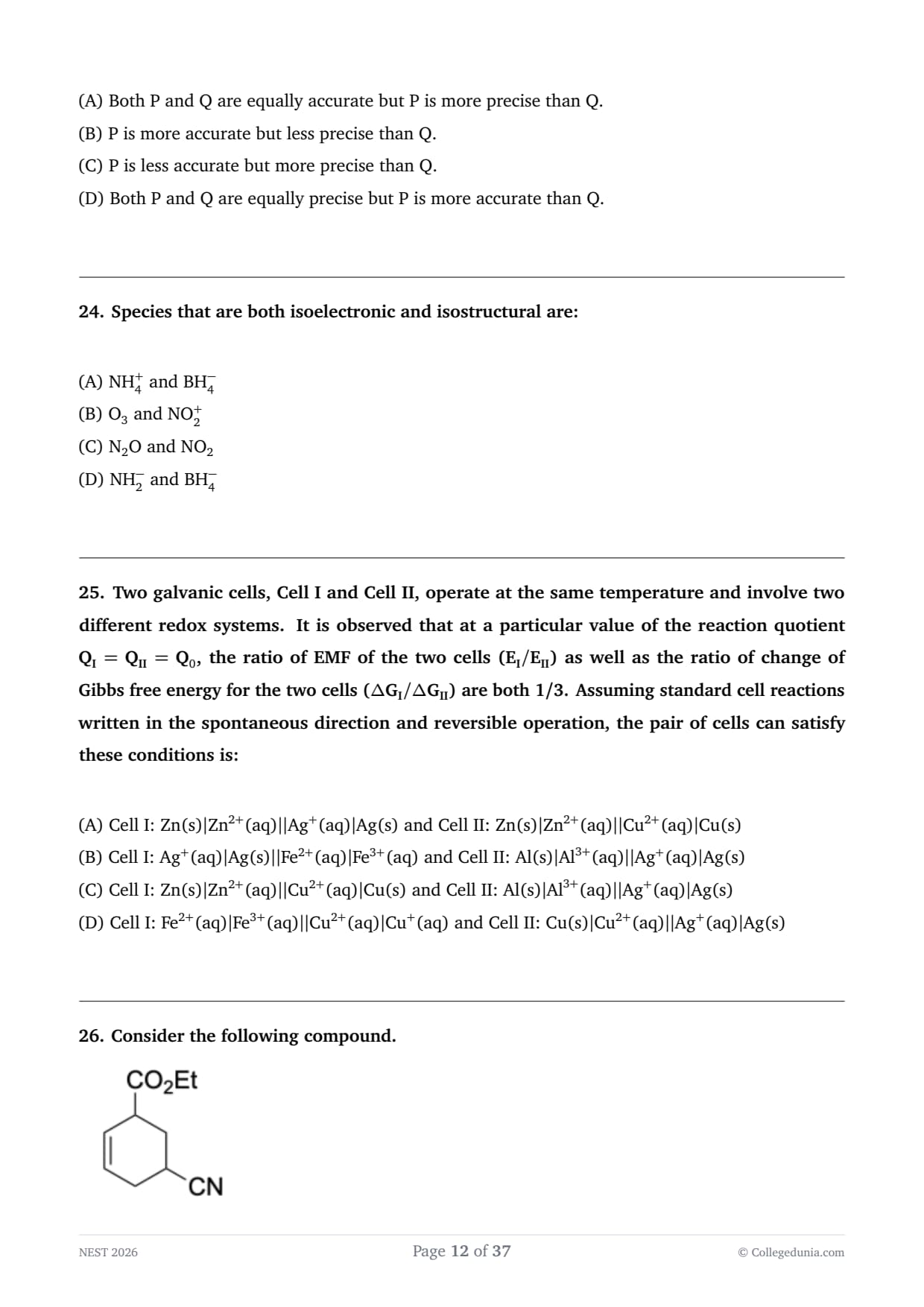
The compound that produces aromatic species upon deprotonation of the indicated hydrogen is:

Two students (P and Q) independently made three measurements (denoted by I, II, and III) of the same property. The expected correct value is 9.0. The observed values by the students are provided in the given table.

Based on the given data, the correct statement is:
Species that are both isoelectronic and isostructural are:
Two galvanic cells, Cell I and Cell II, operate at the same temperature and involve two different redox systems. It is observed that at a particular value of the reaction quotient \(Q_{I} = Q_{II} = Q_0\), the ratio of EMF of the two cells (\(E_{I}/E_{II}\)) as well as the ratio of change of Gibbs free energy for the two cells (\(\Delta G_{I}/\Delta G_{II}\)) are both 1/3. Assuming standard cell reactions written in the spontaneous direction and reversible operation, the pair of cells can satisfy these conditions is:
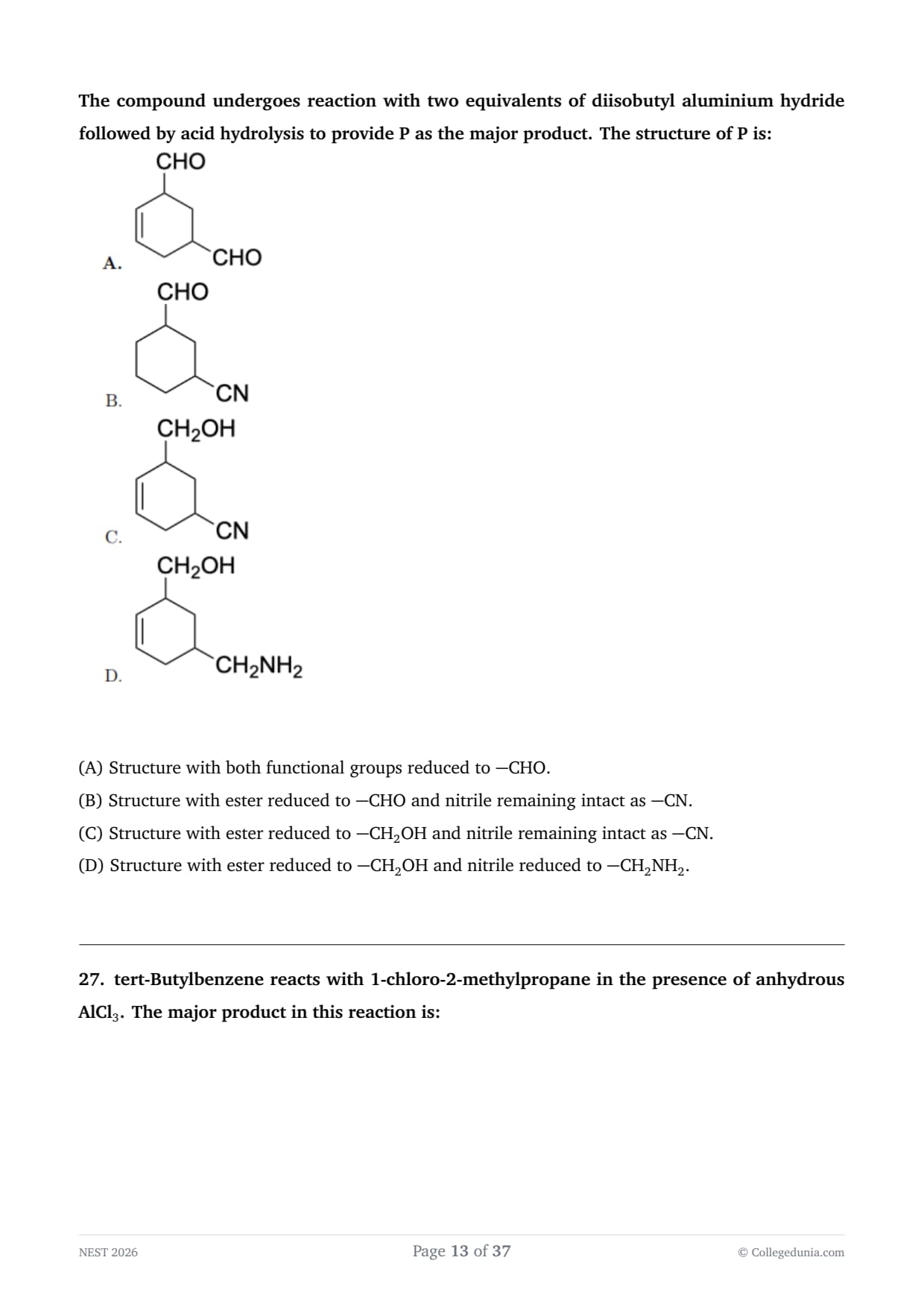
Consider the following compound.

The compound undergoes reaction with two equivalents of diisobutyl aluminium hydride followed by acid hydrolysis to provide P as the major product. The structure of P is:

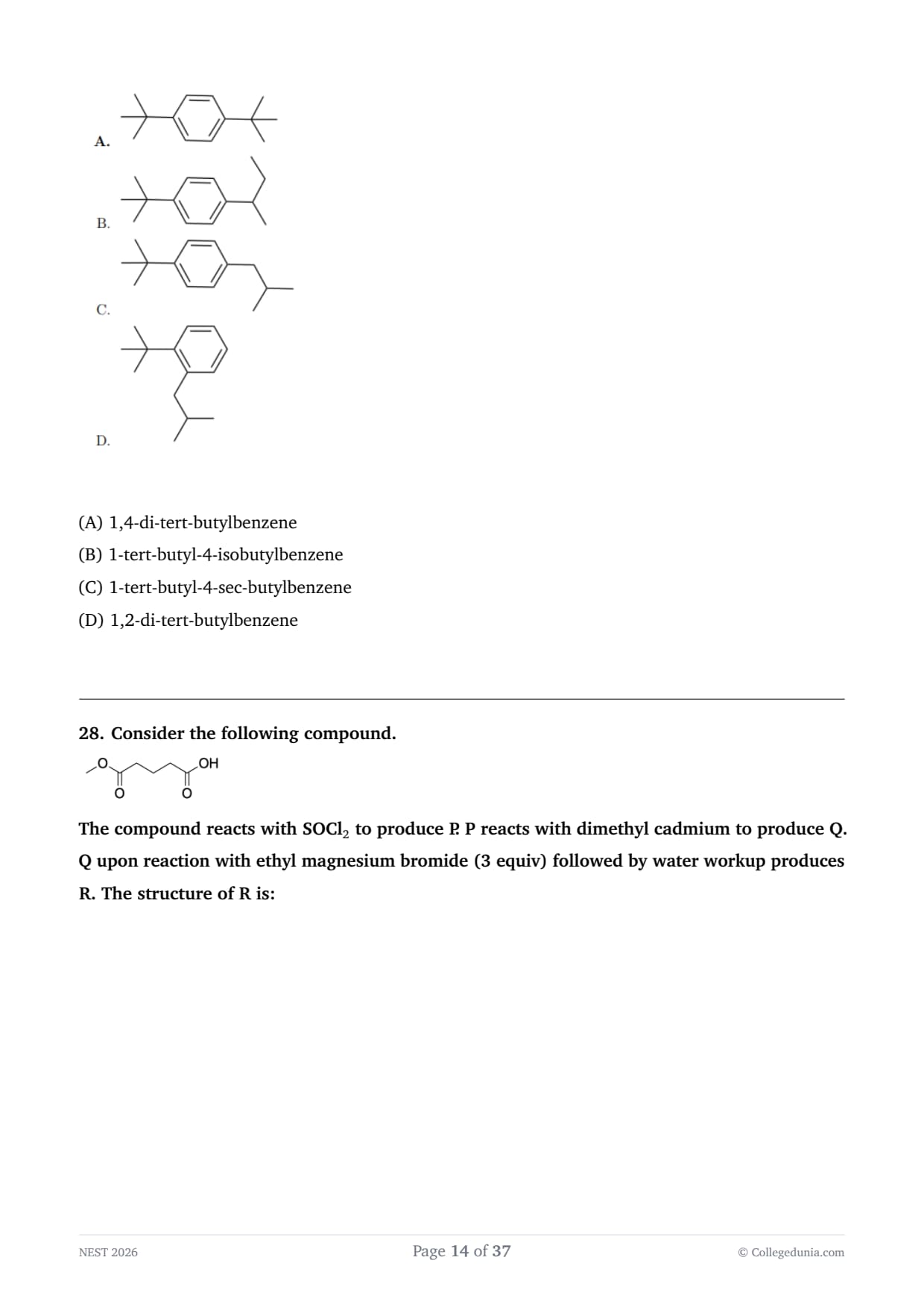
tert-Butylbenzene reacts with 1-chloro-2-methylpropane in the presence of anhydrous \(AlCl_3\). The major product in this reaction is:

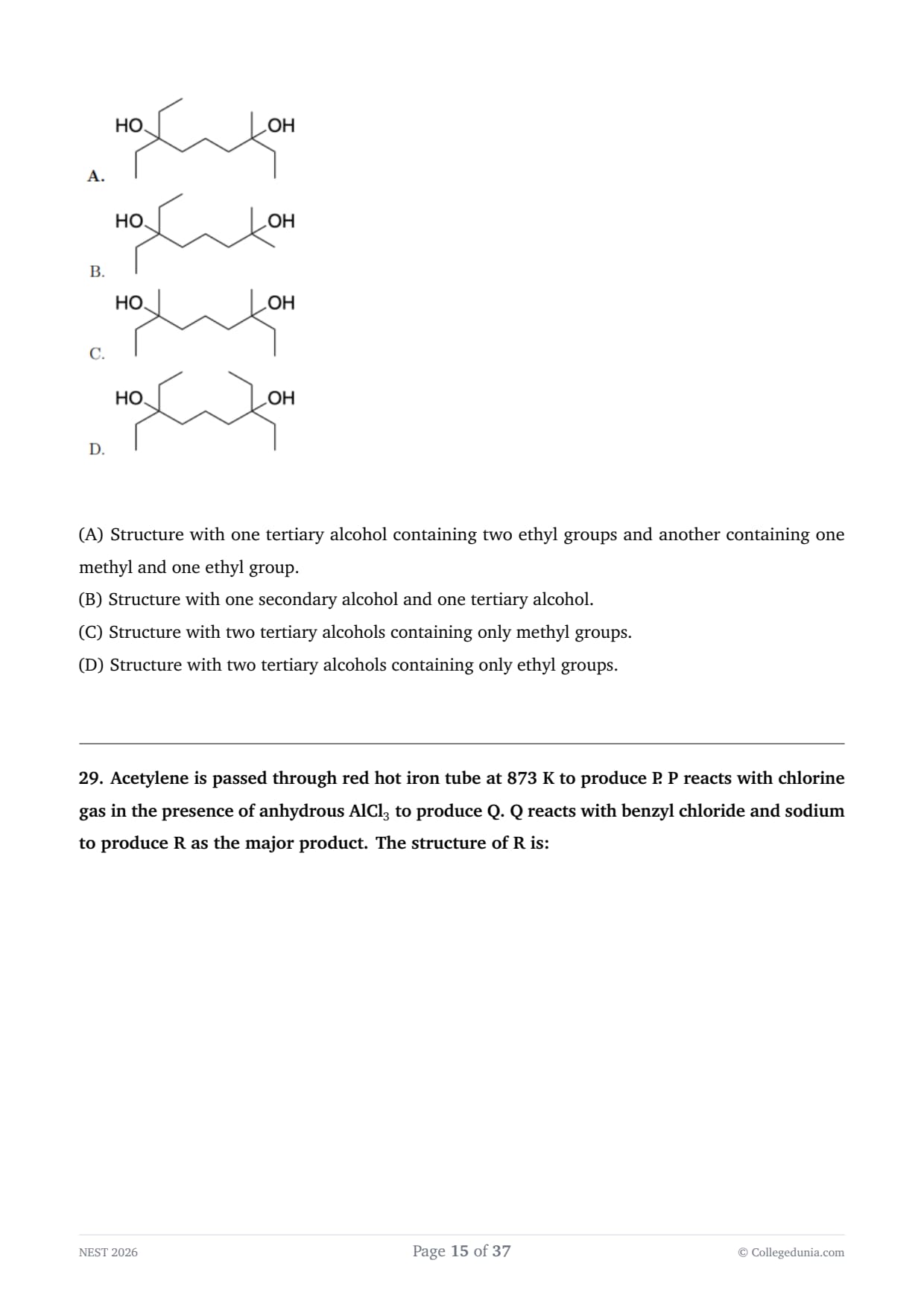
Consider the following compound.

The compound reacts with \(SOCl_2\) to produce P. P reacts with dimethyl cadmium to produce Q. Q upon reaction with ethyl magnesium bromide (3 equiv) followed by water workup produces R. The structure of R is:

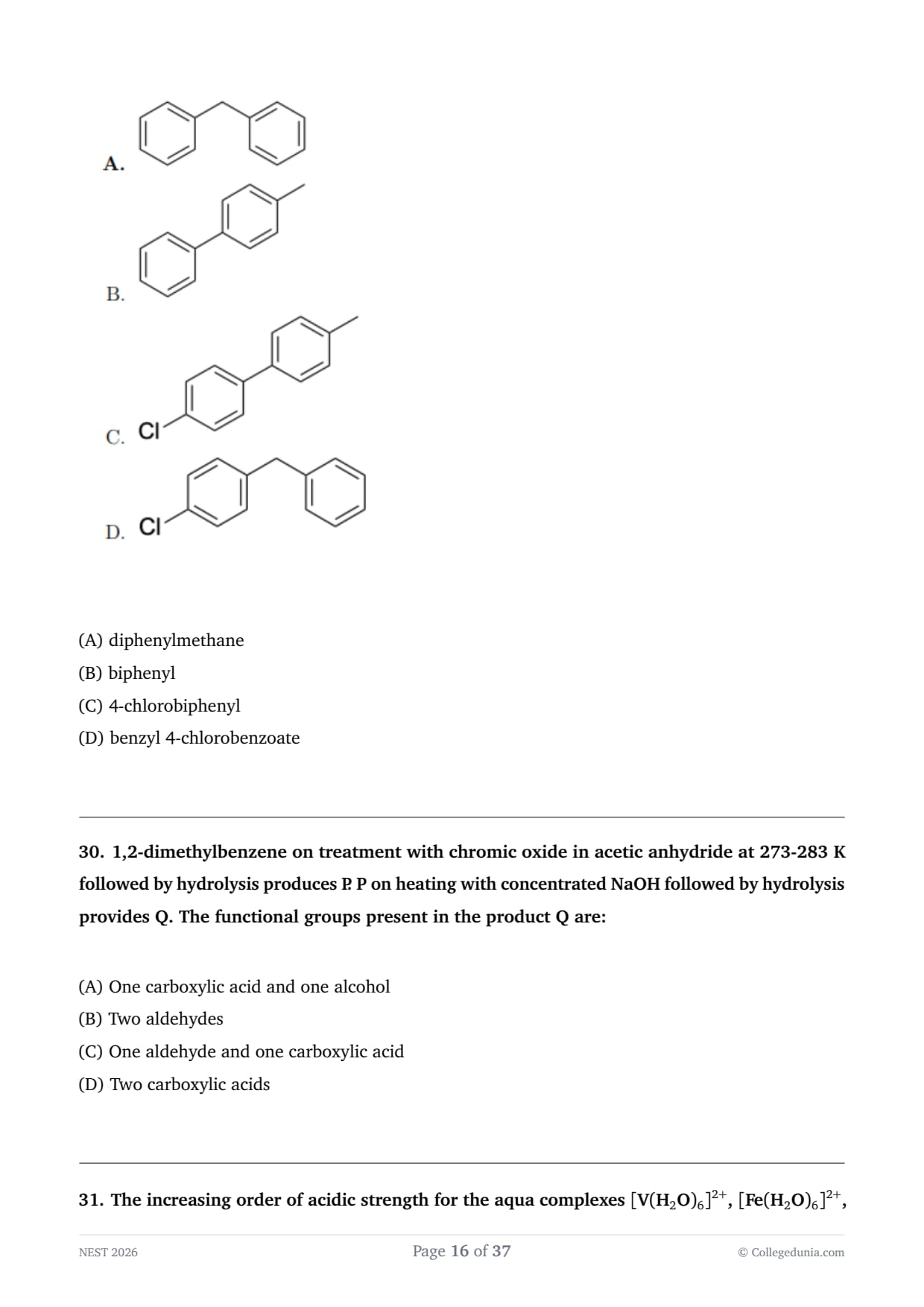
Acetylene is passed through red hot iron tube at 873 K to produce P. P reacts with chlorine gas in the presence of anhydrous \(AlCl_3\) to produce Q. Q reacts with benzyl chloride and sodium to produce R as the major product. The structure of R is:

1,2-dimethylbenzene on treatment with chromic oxide in acetic anhydride at 273-283 K followed by hydrolysis produces P. P on heating with concentrated \(NaOH\) followed by hydrolysis provides Q. The functional groups present in the product Q are:
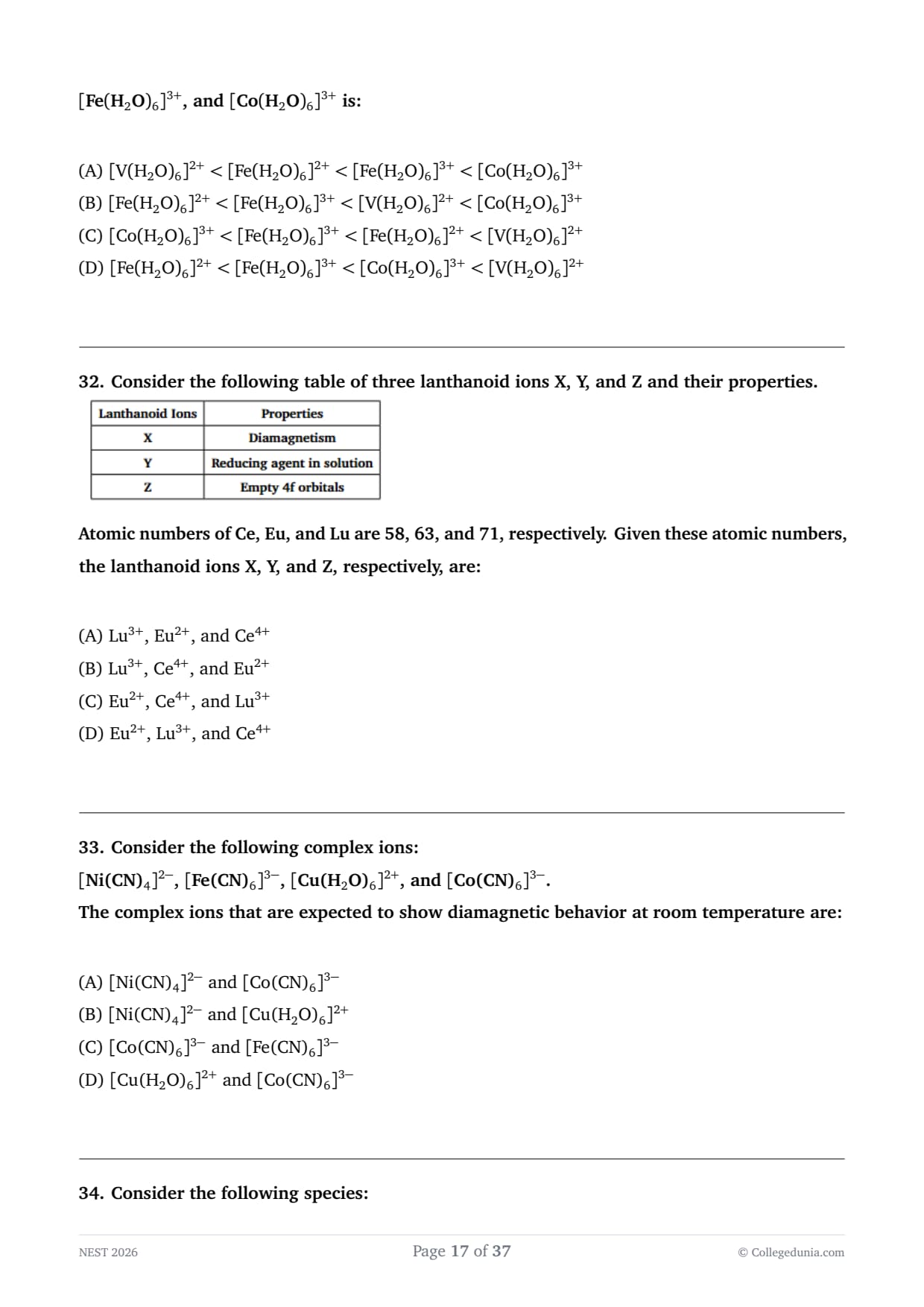
The increasing order of acidic strength for the aqua complexes \([V(H_2O)_6]^{2+}\), \([Fe(H_2O)_6]^{2+}\), \([Fe(H_2O)_6]^{3+}\), and \([Co(H_2O)_6]^{3+}\) is:
Consider the following table of three lanthanoid ions X, Y, and Z and their properties.

Atomic numbers of Ce, Eu, and Lu are 58, 63, and 71, respectively. Given these atomic numbers, the lanthanoid ions X, Y, and Z, respectively, are:
Consider the following complex ions:
\([Ni(CN)_4]^{2-}\), \([Fe(CN)_6]^{3-}\), \([Cu(H_2O)_6]^{2+}\), and \([Co(CN)_6]^{3-}\).
The complex ions that are expected to show diamagnetic behavior at room temperature are:
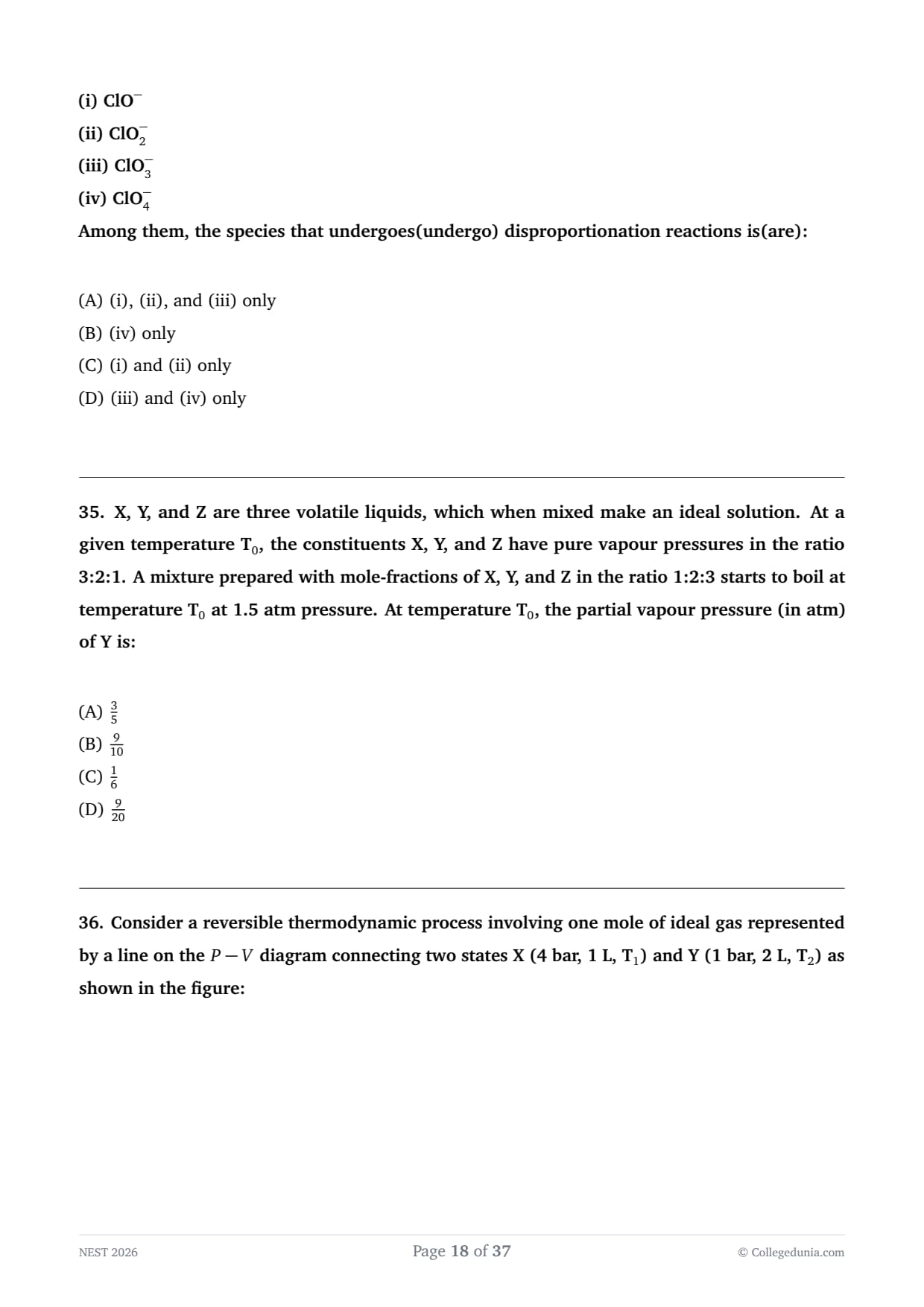
Consider the following species:
(i) \(ClO^-\)
(ii) \(ClO_2^-\)
(iii) \(ClO_3^-\)
(iv) \(ClO_4^-\)
Among them, the species that undergoes(undergo) disproportionation reactions is(are):
X, Y, and Z are three volatile liquids, which when mixed make an ideal solution. At a given temperature \(T_0\), the constituents X, Y, and Z have pure vapour pressures in the ratio 3:2:1. A mixture prepared with mole-fractions of X, Y, and Z in the ratio 1:2:3 starts to boil at temperature \(T_0\) at 1.5 atm pressure. At temperature \(T_0\), the partial vapour pressure (in atm) of Y is:
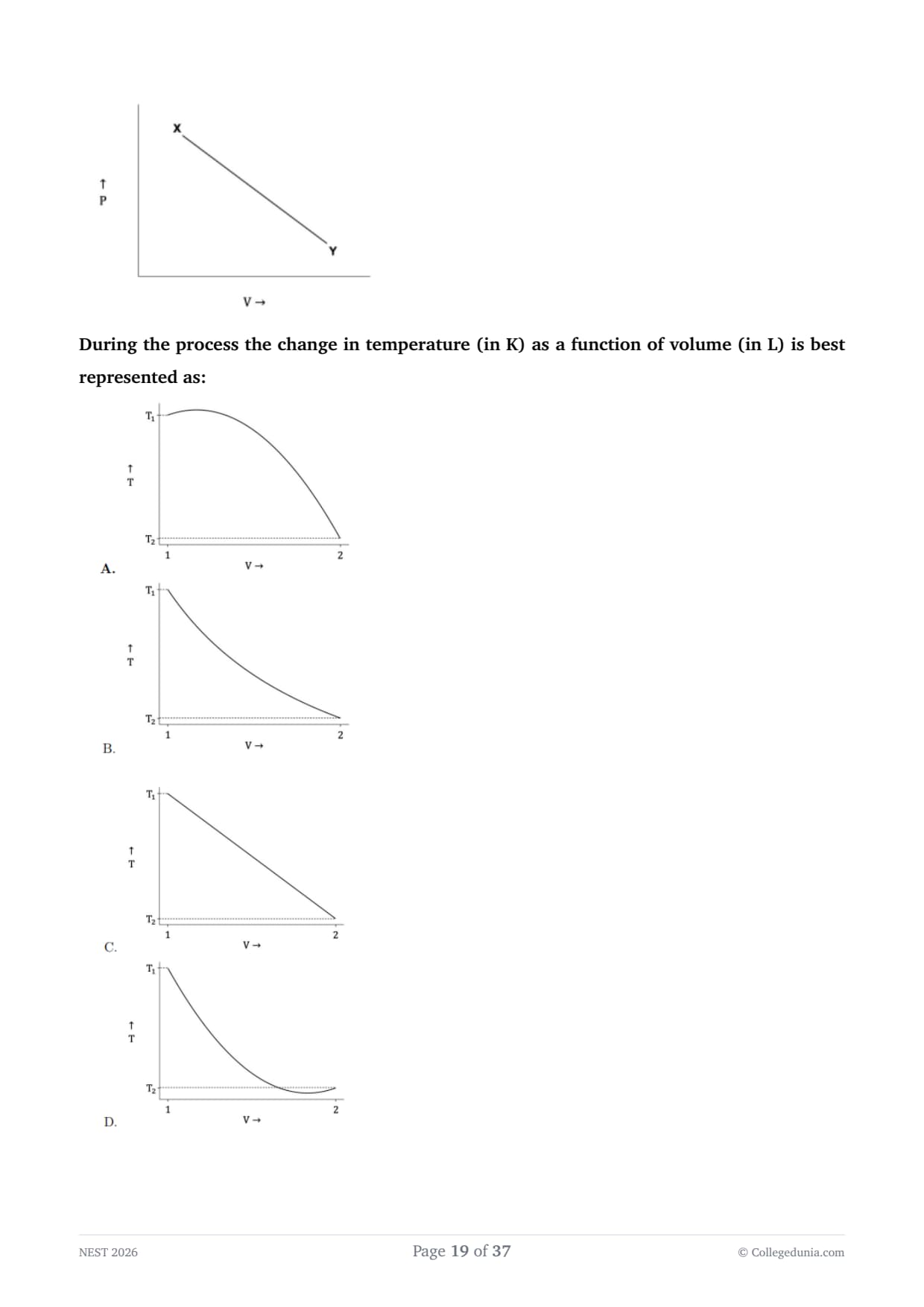
Consider a reversible thermodynamic process involving one mole of ideal gas represented by a line on the \(P-V\) diagram connecting two states X (4 bar, 1 L, \(T_1\)) and Y (1 bar, 2 L, \(T_2\)) as shown in the figure:

During the process the change in temperature (in K) as a function of volume (in L) is best represented as:


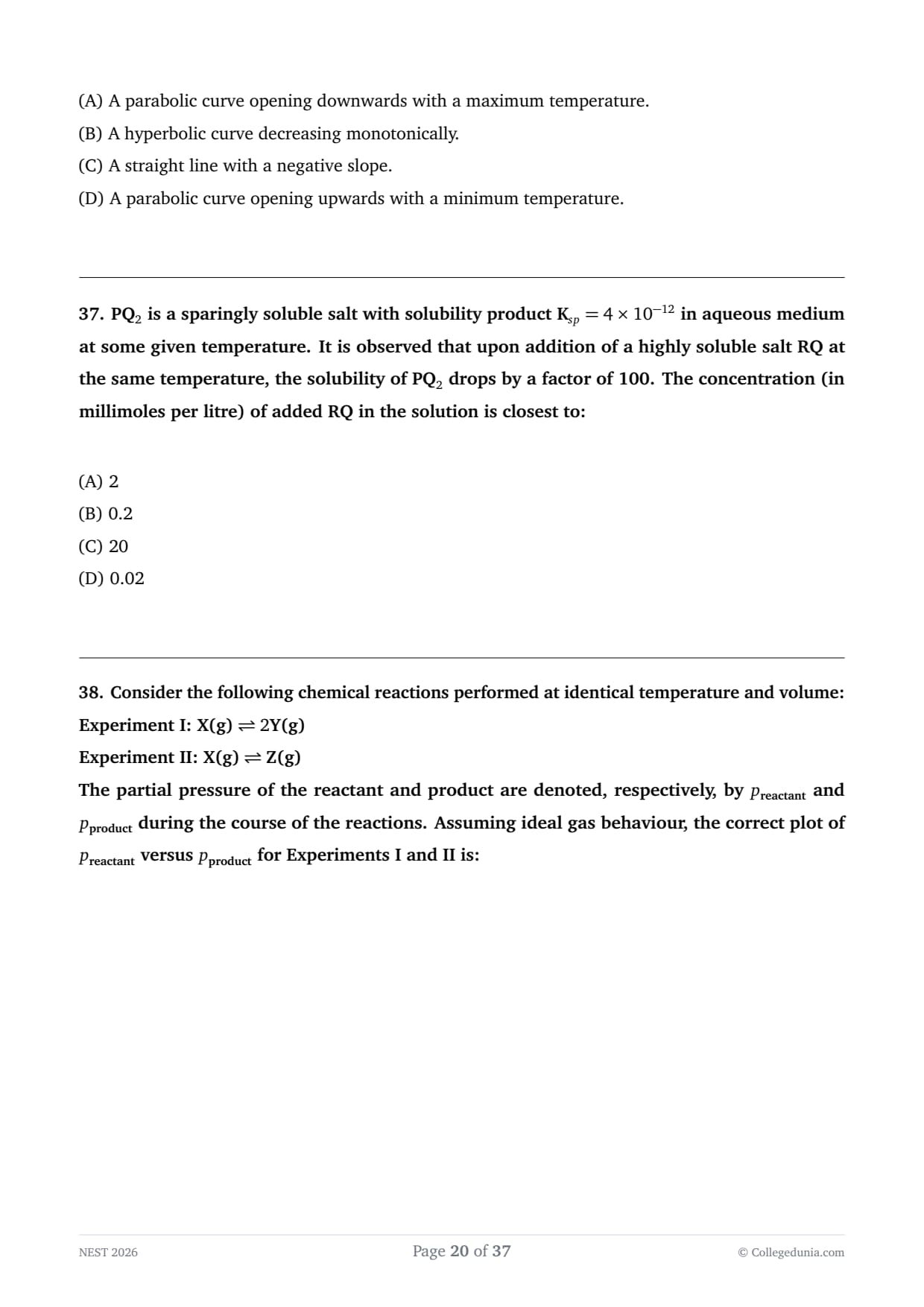
\(PQ_2\) is a sparingly soluble salt with solubility product \(K_{sp} = 4 \times 10^{-12}\) in aqueous medium at some given temperature. It is observed that upon addition of a highly soluble salt RQ at the same temperature, the solubility of \(PQ_2\) drops by a factor of 100. The concentration (in millimoles per litre) of added RQ in the solution is closest to:
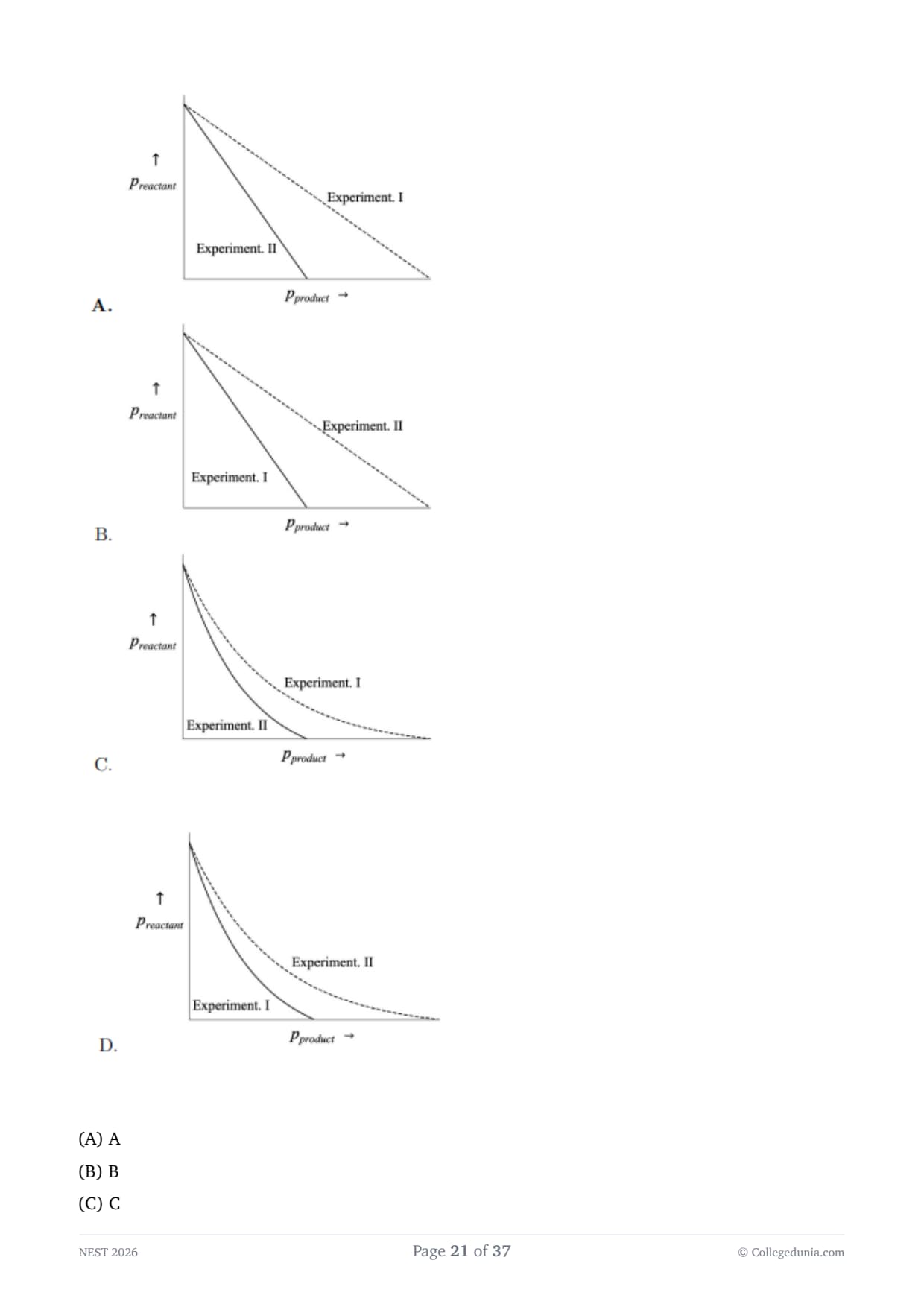
Consider the following chemical reactions performed at identical temperature and volume:
Experiment I: \(X(g) \rightleftharpoons 2Y(g)\)
Experiment II: \(X(g) \rightleftharpoons Z(g)\)
The partial pressure of the reactant and product are denoted, respectively, by \(p_{reactant}\) and \(p_{product}\) during the course of the reactions. Assuming ideal gas behaviour, the correct plot of \(p_{reactant}\) versus \(p_{product}\) for Experiments I and II is:


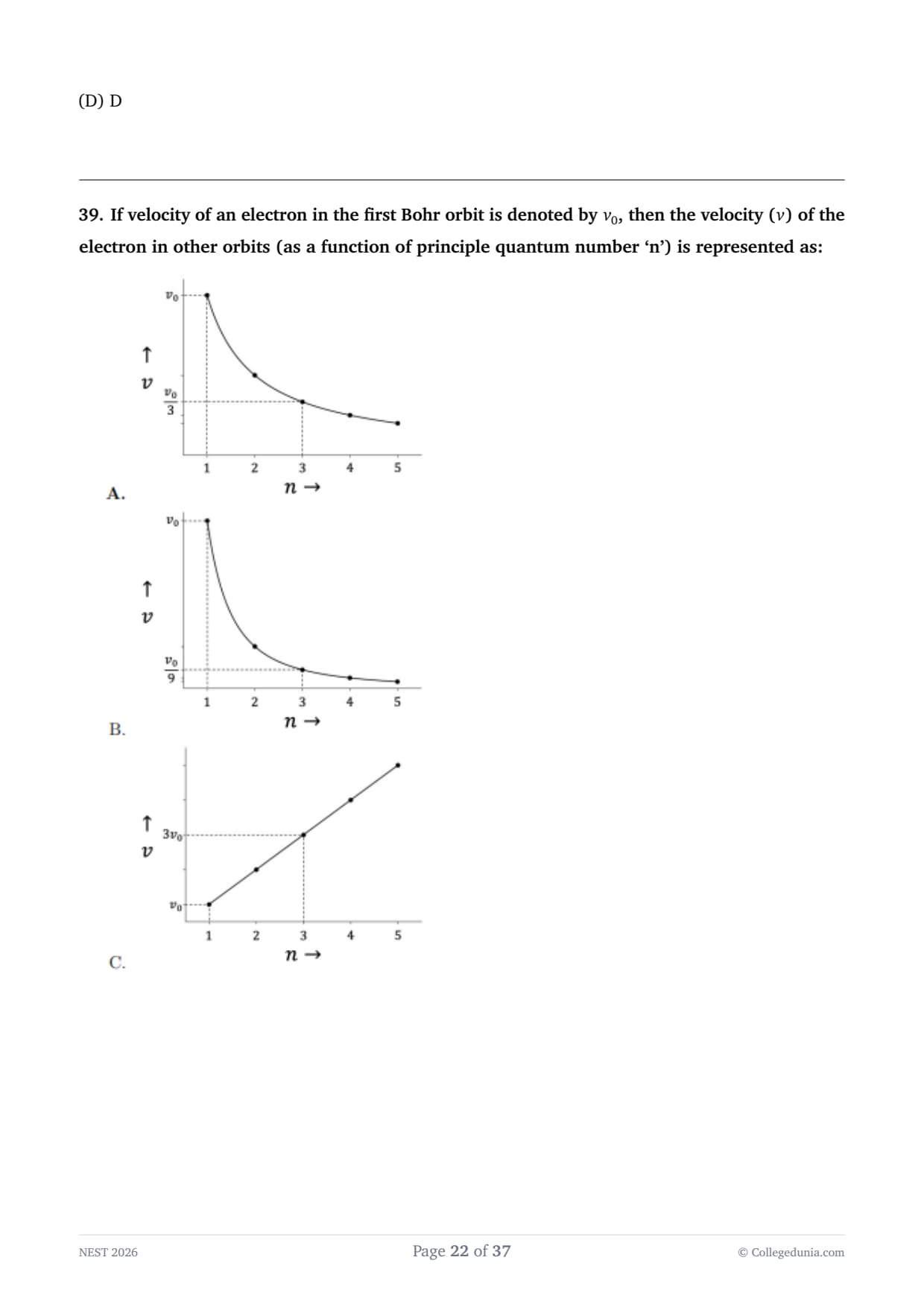
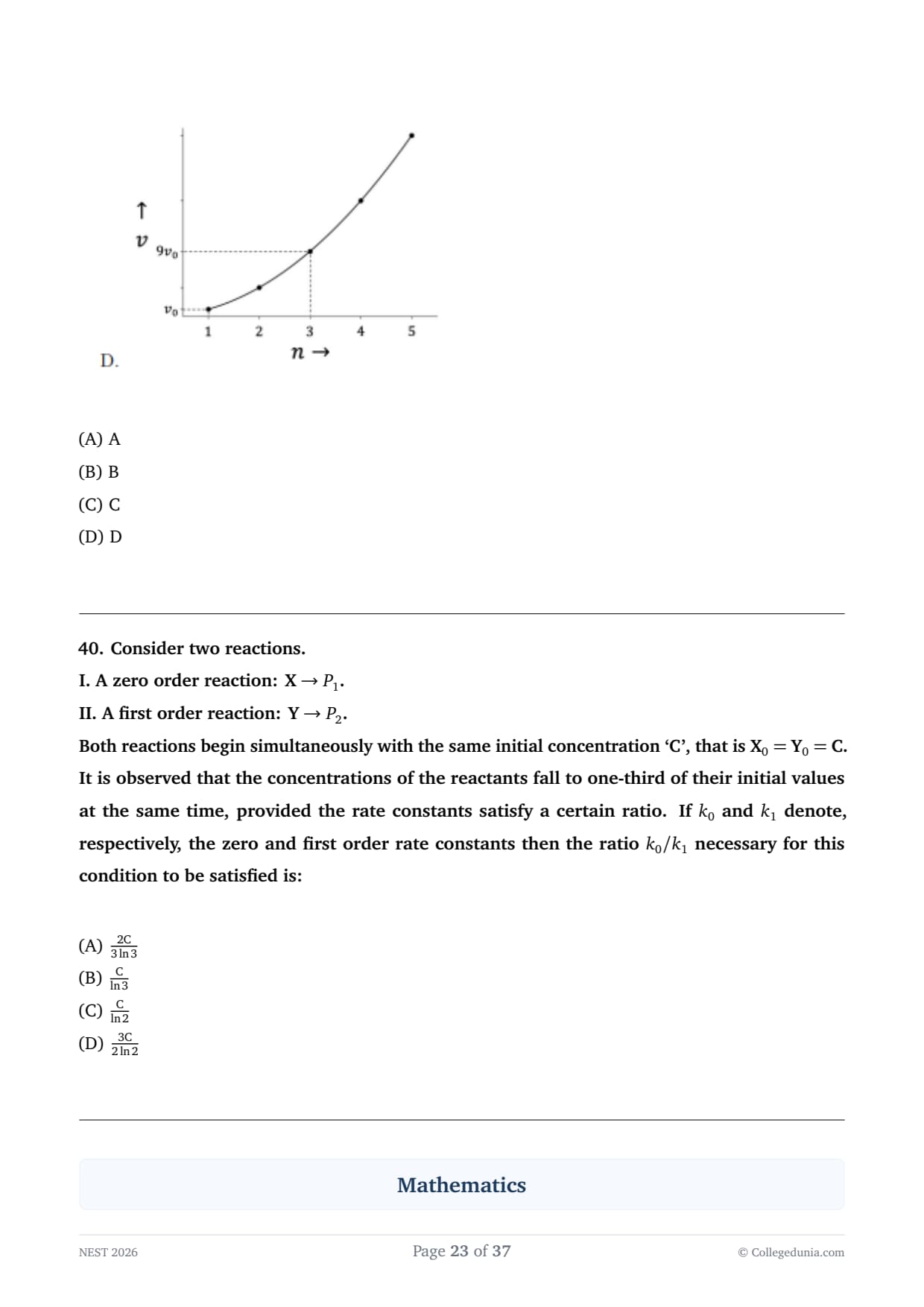
If velocity of an electron in the first Bohr orbit is denoted by \(v_0\), then the velocity (\(v\)) of the electron in other orbits (as a function of principle quantum number `n') is represented as:


Consider two reactions.
I. A zero order reaction: \(X \rightarrow P_1\).
II. A first order reaction: \(Y \rightarrow P_2\).
Both reactions begin simultaneously with the same initial concentration `C', that is \(X_0 = Y_0 = C\). It is observed that the concentrations of the reactants fall to one-third of their initial values at the same time, provided the rate constants satisfy a certain ratio. If \(k_0\) and \(k_1\) denote, respectively, the zero and first order rate constants then the ratio \(k_0/k_1\) necessary for this condition to be satisfied is:
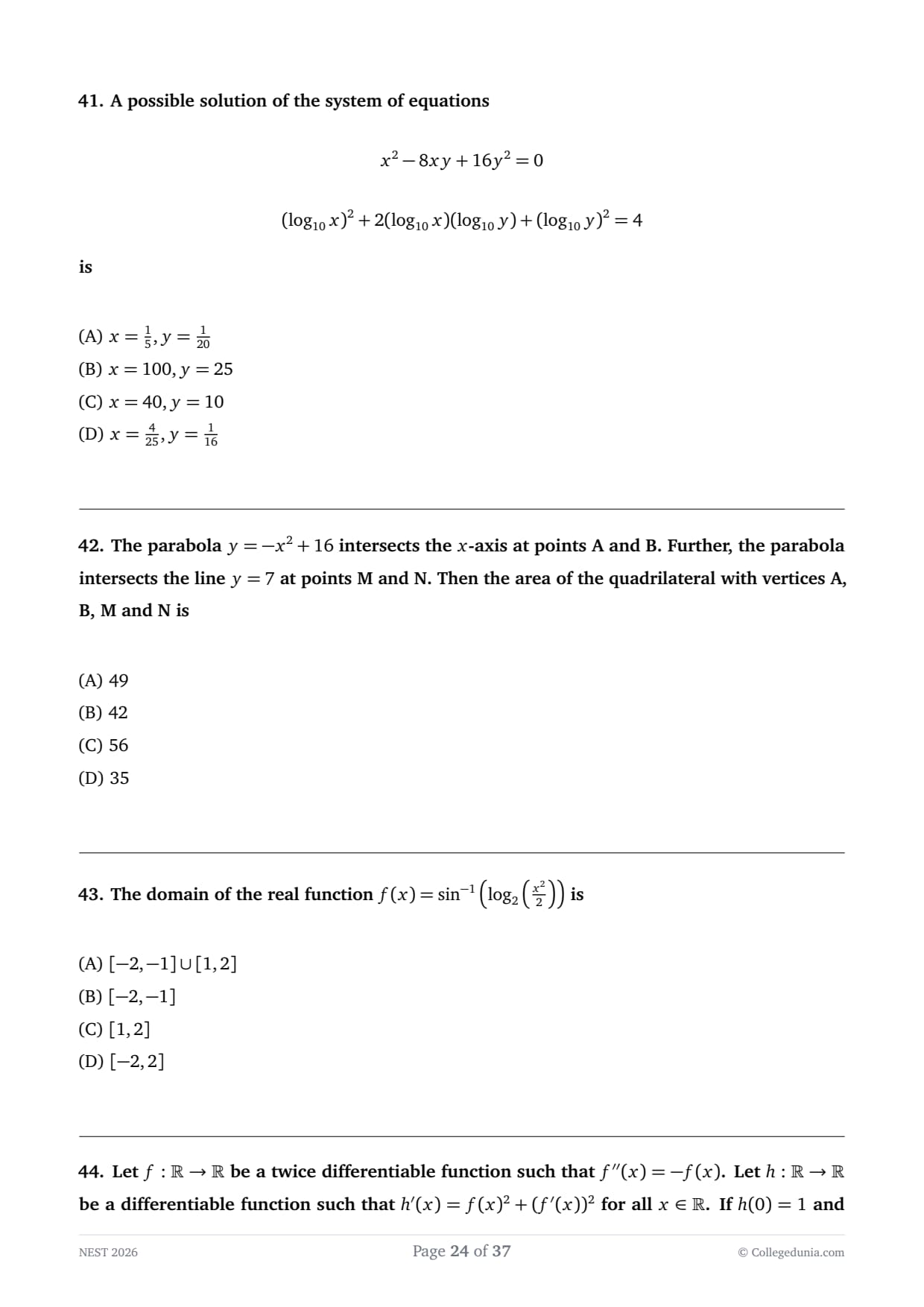
A possible solution of the system of equations \[ x^2 - 8xy + 16y^2 = 0 \] \[ (\log_{10} x)^2 + 2(\log_{10} x)(\log_{10} y) + (\log_{10} y)^2 = 4 \]
is
The parabola \(y = -x^2 + 16\) intersects the \(x\)-axis at points A and B. Further, the parabola intersects the line \(y = 7\) at points M and N. Then the area of the quadrilateral with vertices A, B, M and N is
The domain of the real function \(f(x) = \sin^{-1}\left(\log_2\left(\frac{x^2}{2}\right)\right)\) is
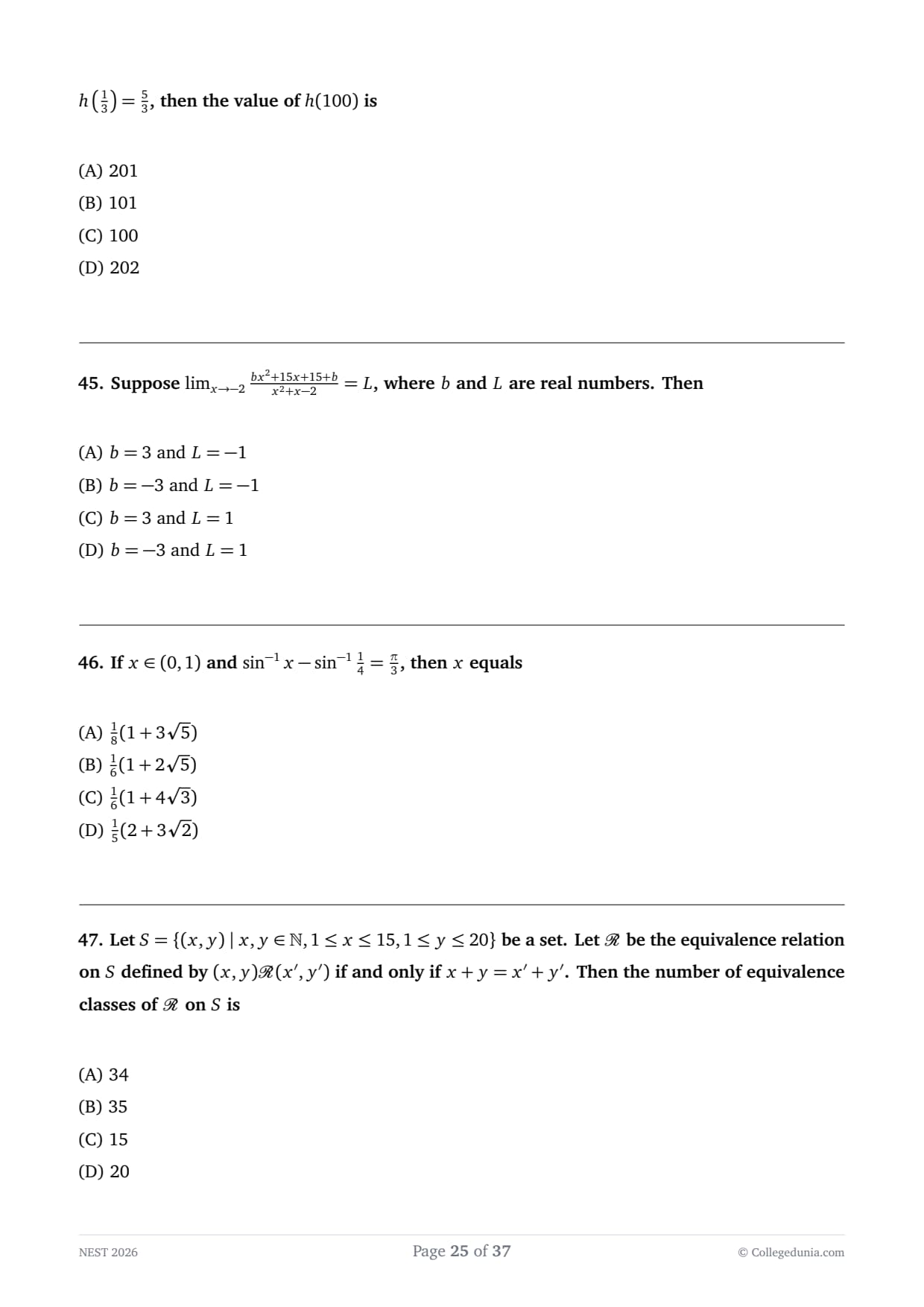
Let \(f : \mathbb{R} \to \mathbb{R}\) be a twice differentiable function such that \(f''(x) = -f(x)\). Let \(h : \mathbb{R} \to \mathbb{R}\) be a differentiable function such that \(h'(x) = f(x)^2 + (f'(x))^2\) for all \(x \in \mathbb{R}\). If \(h(0) = 1\) and \(h\left(\frac{1}{3}\right) = \frac{5}{3}\), then the value of \(h(100)\) is
Suppose \(\lim_{x \to -2} \frac{bx^2 + 15x + 15 + b}{x^2 + x - 2} = L\), where \(b\) and \(L\) are real numbers. Then
If \(x \in (0, 1)\) and \(\sin^{-1} x - \sin^{-1} \frac{1}{4} = \frac{\pi}{3}\), then \(x\) equals
Let \(S = \{(x, y) \mid x, y \in \mathbb{N}, 1 \le x \le 15, 1 \le y \le 20\}\) be a set. Let \(\mathcal{R}\) be the equivalence relation on \(S\) defined by \((x, y) \mathcal{R} (x', y')\) if and only if \(x + y = x' + y'\). Then the number of equivalence classes of \(\mathcal{R}\) on \(S\) is
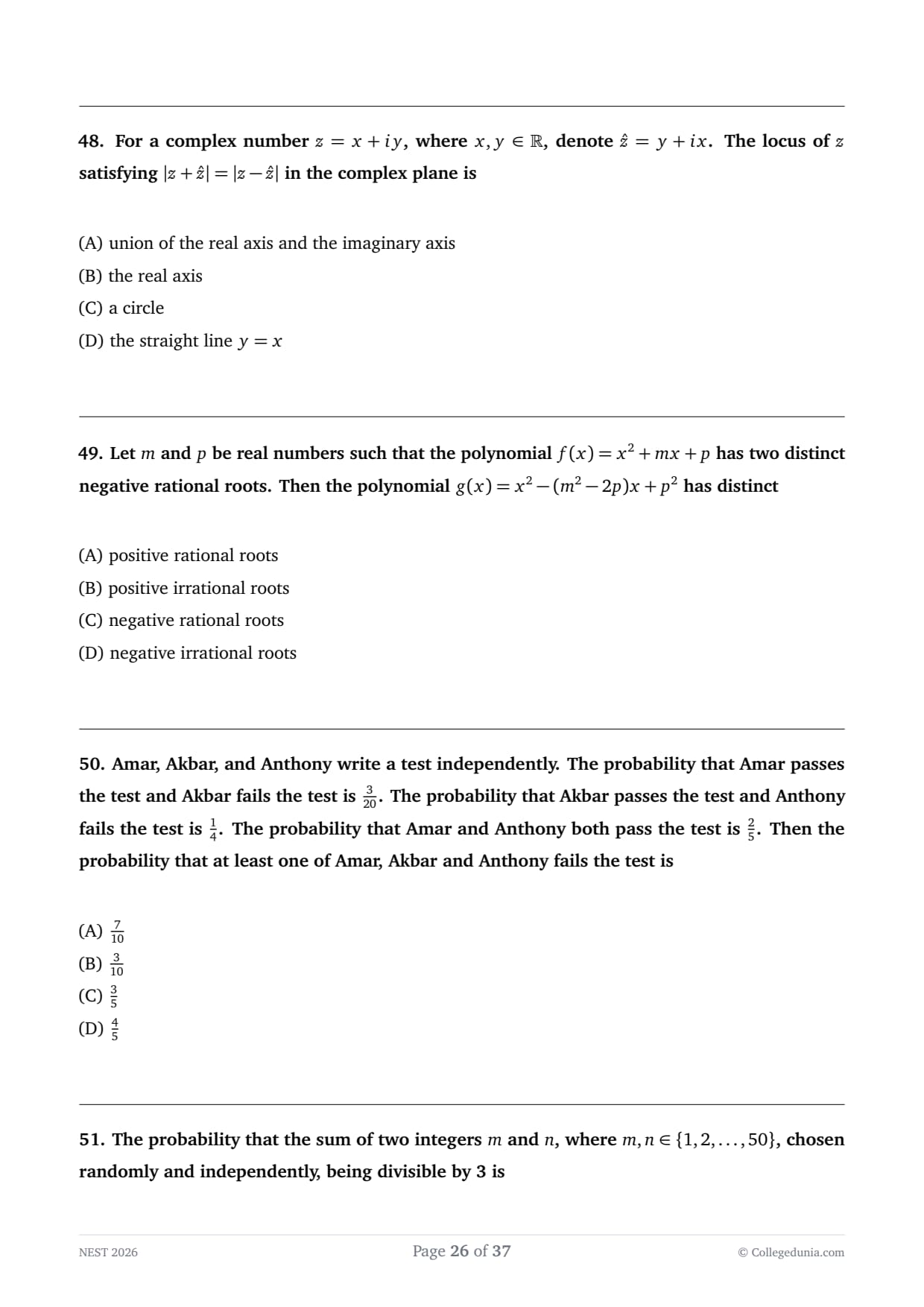
For a complex number \(z = x + iy\), where \(x, y \in \mathbb{R}\), denote \(\hat{z} = y + ix\). The locus of \(z\) satisfying \(|z + \hat{z}| = |z - \hat{z}|\) in the complex plane is
Let \(m\) and \(p\) be real numbers such that the polynomial \(f(x) = x^2 + mx + p\) has two distinct negative rational roots. Then the polynomial \(g(x) = x^2 - (m^2 - 2p)x + p^2\) has distinct
Amar, Akbar, and Anthony write a test independently. The probability that Amar passes the test and Akbar fails the test is \(\frac{3}{20}\). The probability that Akbar passes the test and Anthony fails the test is \(\frac{1}{4}\). The probability that Amar and Anthony both pass the test is \(\frac{2}{5}\). Then the probability that at least one of Amar, Akbar and Anthony fails the test is
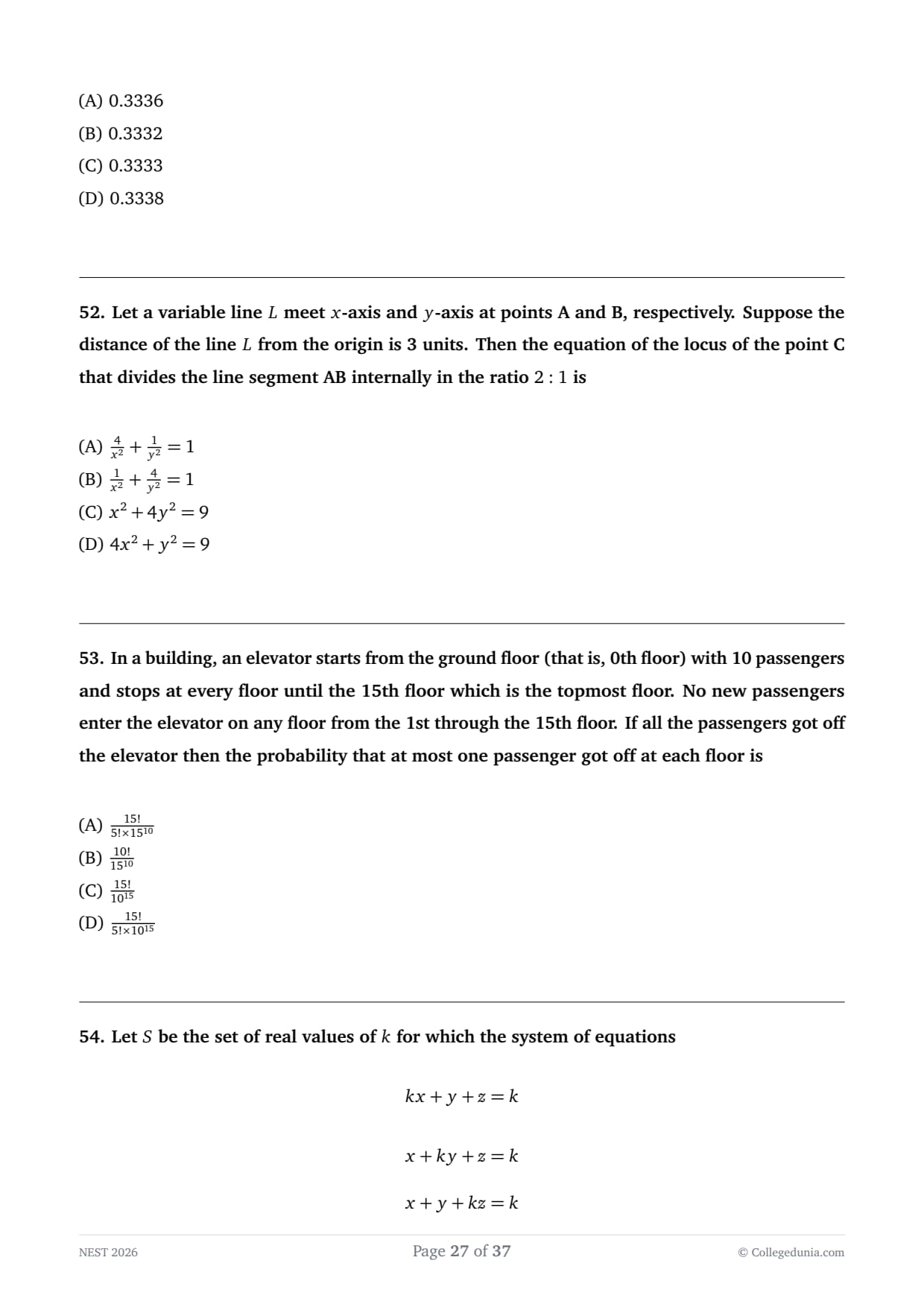
The probability that the sum of two integers \(m\) and \(n\), where \(m, n \in \{1, 2, \dots, 50\}\), chosen randomly and independently, being divisible by 3 is
Let a variable line \(L\) meet \(x\)-axis and \(y\)-axis at points A and B, respectively. Suppose the distance of the line \(L\) from the origin is 3 units. Then the equation of the locus of the point C that divides the line segment AB internally in the ratio \(2 : 1\) is
In a building, an elevator starts from the ground floor (that is, 0th floor) with 10 passengers and stops at every floor until the 15th floor which is the topmost floor. No new passengers enter the elevator on any floor from the 1st through the 15th floor. If all the passengers got off the elevator then the probability that at most one passenger got off at each floor is
Let \(S\) be the set of real values of \(k\) for which the system of equations \[ kx + y + z = k \] \[ x + ky + z = k \] \[ x + y + kz = k \]
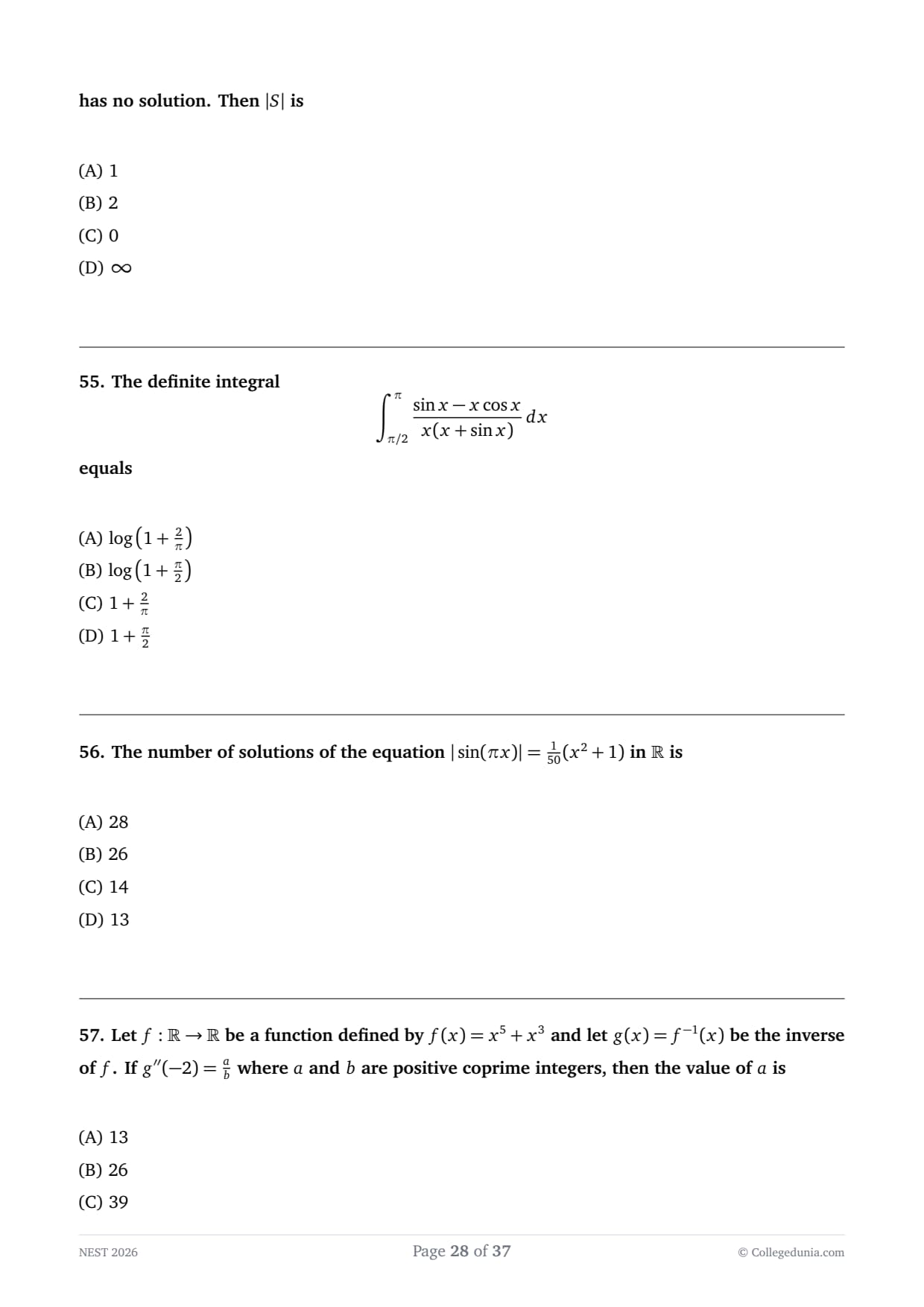
has no solution. Then \(|S|\) is
The definite integral \[ \int_{\pi/2}^{\pi} \frac{\sin x - x \cos x}{x(x + \sin x)} \, dx \]
equals
The number of solutions of the equation \(|\sin(\pi x)| = \frac{1}{50}(x^2 + 1)\) in \(\mathbb{R}\) is
Let \(f : \mathbb{R} \to \mathbb{R}\) be a function defined by \(f(x) = x^5 + x^3\) and let \(g(x) = f^{-1}(x)\) be the inverse of \(f\). If \(g''(-2) = \frac{a}{b}\) where \(a\) and \(b\) are positive coprime integers, then the value of \(a\) is
Let \(S_1\) and \(S_2\) be two circles drawn inside a unit square ABCD, touching each other externally. Further, the circle \(S_1\) touches the sides AD and DC; and the circle \(S_2\) touches the sides AB and BC. If the area of \(S_2\) is twice the area of \(S_1\), then the radius of \(S_1\) is
Let \(f : \mathbb{R} \to \mathbb{R}\) be a function defined by \[ f(x) = \begin{cases} x \left( \frac{e^{1/x} - e^{-1/x}}{e^{1/x} + e^{-1/x}} \right) & if x \neq 0
0 & if x = 0 \end{cases} \]
Then
The limit \[ \lim_{n \to \infty} \frac{1}{\sqrt{n}} \left[ 1 + \frac{1}{\sqrt{2}} + \frac{1}{\sqrt{3}} + \dots + \frac{1}{\sqrt{n}} \right] \]
The angular speed of the Earth’s rotation is \(7.3 \times 10^{-5} rad\cdot s^{-1}\). Take the radius of the Earth at the equator to be \(6400 km\). Then the ratio (\(a_c / g\)) of the magnitude of the centripetal acceleration \(a_c\) at a point on the equator to \(g\), is of the order
An electromagnetic wave travels from vacuum into a non-magnetic dielectric medium with permittivity \(\epsilon = 4\epsilon_0\). If the ratio (\(E_0 / B_0\)) of the electric field amplitude \(E_0\) to the magnetic field amplitude \(B_0\) in vacuum is equal to the speed of light \(c\), then the corresponding ratio in the given medium is
Among the following, the waves responsible for energy transfer in vacuum are
Let \(A\) be the mass number, \(Z\) be the atomic number and \(N\) be the neutron number of a nucleus. Then the statement which is always true, is
Two wave pulses, one rectangular and other triangular, approach each other as shown in the figure below.

They overlap at the point P at time \(t\). The diagram best representing the appearance of the wave pulses at a time \(t' > t\) is

Ice on land mass melting into ocean, due to global warming, is estimated to be around \(1.3 \times 10^{15} kg\) per year. The density of sea water is \(1025 kg \cdot m^{-3}\). Assuming that the melting rate of ice remains constant and the effective surface area covered by the oceans is \(3.6 \times 10^{14} m^2\), the estimated average rise in sea level (in m) in the next 75 years will be closest to
A spherical glass bottle having negligible wall thickness is placed in air. When the bottle is completely filled with water, its focal length is \(f\). If the water is replaced by another transparent liquid of higher refractive index, then the focal length changes to \(f'\). Then the correct option is
Physicist Luis Alvarez and his collaborators hypothesised that the extinction of dinosaurs was due to the impact of an asteroid with the Earth. They estimated the mass and the radius of the asteroid to be about \(2 \times 10^{15} kg\) and \(10 km\) respectively. Take the mass of the Earth to be \(6 \times 10^{24} kg\). The gravitational acceleration (in SI units) of the Earth due to the asteroid just before the impact would be of the order
An infinitely long straight wire with uniform line charge density \(\lambda\) lies at a perpendicular distance \(d\) from a point O. The total electric flux through the surface of a sphere of radius \(R > d\) centred at O, is
A sphere made of a material with density \(12 kg \cdot m^{-3}\) and weighing \(100 N\) in vacuum is immersed in a container of gas. Its weight in gas is \(85 N\). The density of the gas in \(kg \cdot m^{-3}\) is closest to
One mole of a monatomic ideal gas undergoes a transformation from an initial state with temperature \(290 K\) and volume \(30 litres\) to a final state with temperature \(310 K\) and volume \(16 litres\). On the pressure–volume (\(P - V\)) diagram, this process is represented by a straight line path. The magnitude of the work done (in joules) during this process is close to
The electron in the hydrogen atom is in the third excited state. Its potential energy (in eV) is
A sphere is given an initial push so that it starts rolling (without slipping) up an inclined plane. During its climb
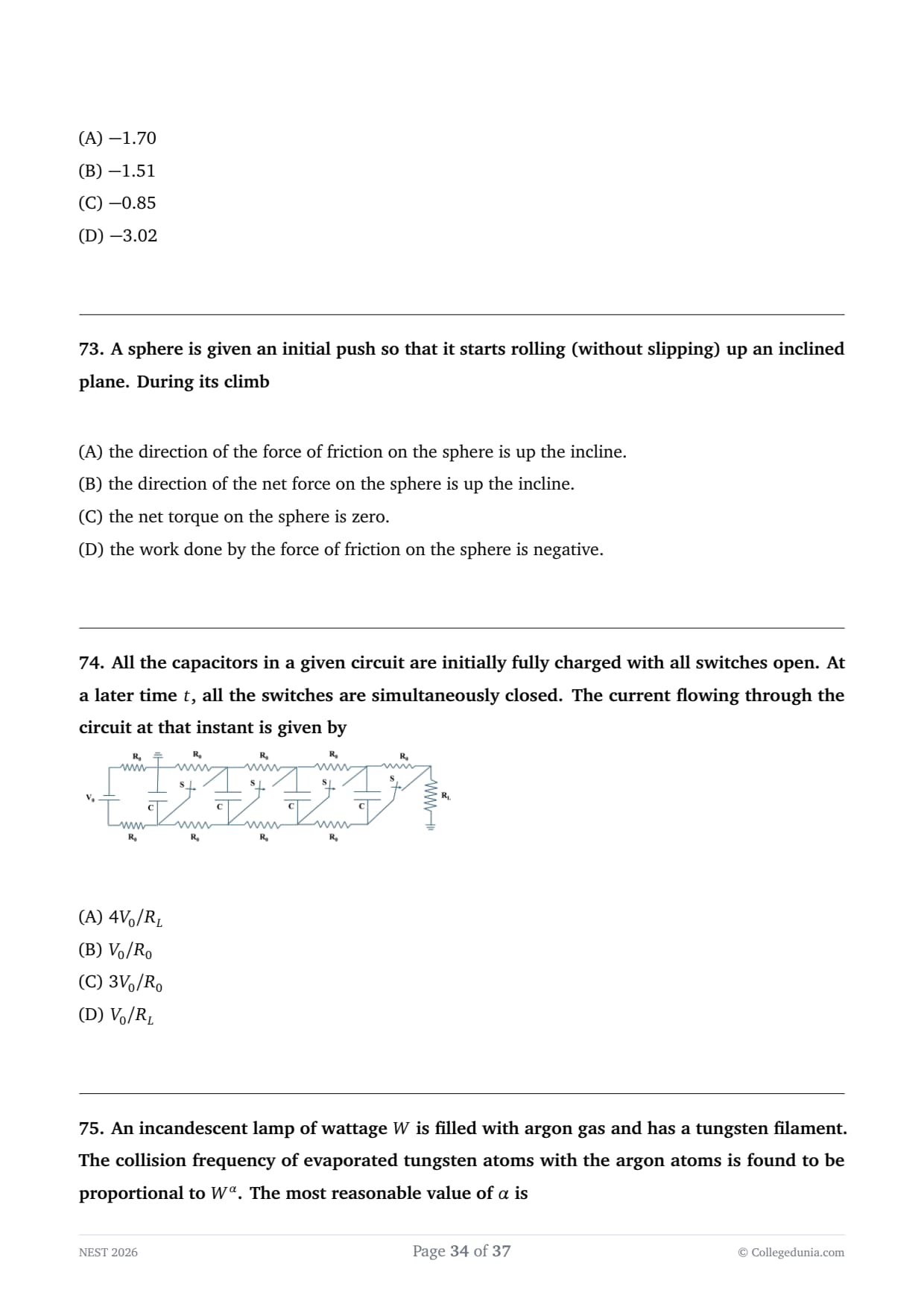
All the capacitors in a given circuit are initially fully charged with all switches open. At a later time \(t\), all the switches are simultaneously closed. The current flowing through the circuit at that instant is given by

An incandescent lamp of wattage \(W\) is filled with argon gas and has a tungsten filament. The collision frequency of evaporated tungsten atoms with the argon atoms is found to be proportional to \(W^\alpha\). The most reasonable value of \(\alpha\) is
Two protons are separated by a distance of 1 nanometer. The magnitudes of gravitational, electromagnetic and strong nuclear forces between them are denoted by \(F_G\), \(F_E\) and \(F_S\) respectively. Select the correct option.
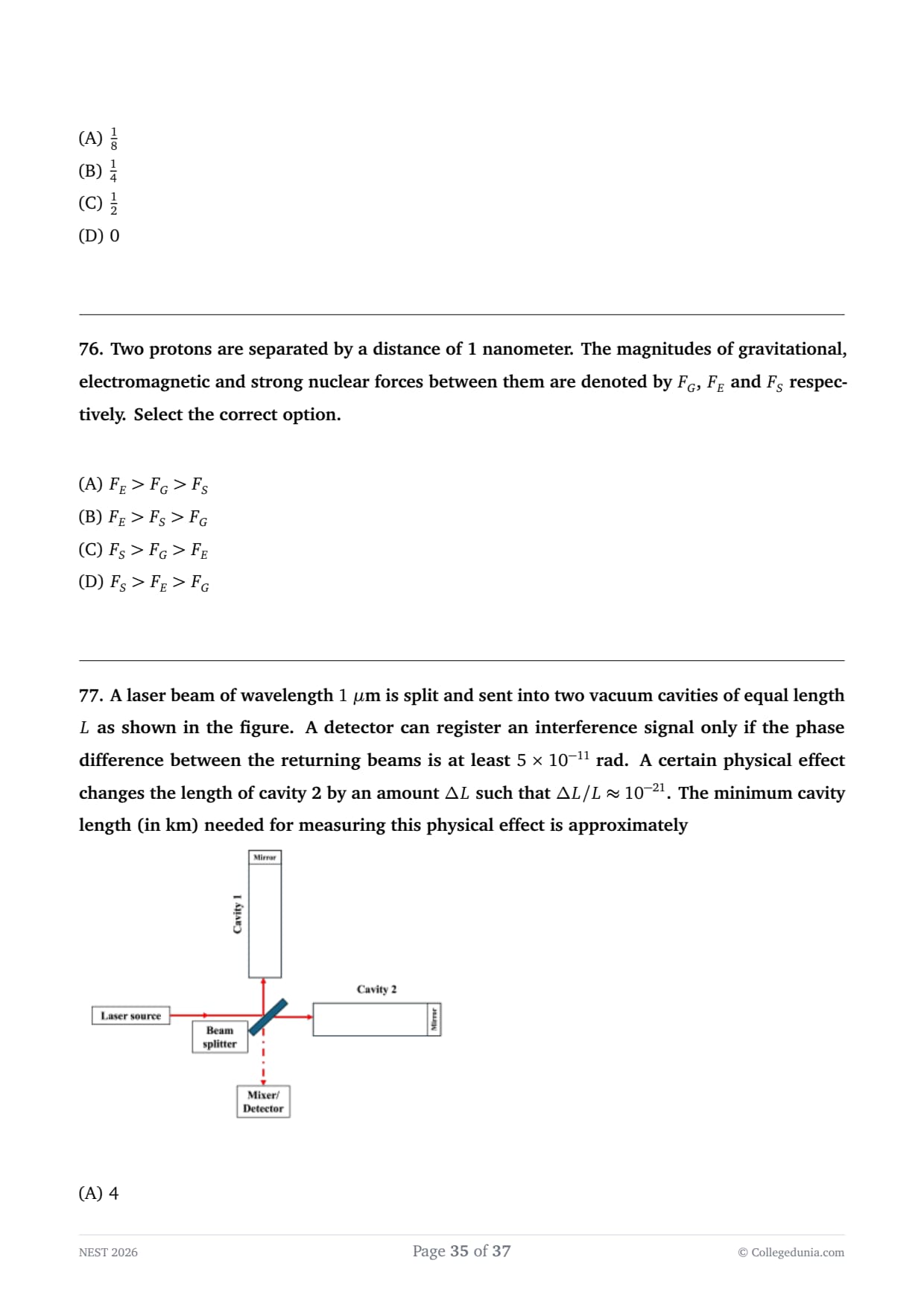
A laser beam of wavelength \(1 \mu m\) is split and sent into two vacuum cavities of equal length \(L\) as shown in the figure. A detector can register an interference signal only if the phase difference between the returning beams is at least \(5 \times 10^{-11} rad\). A certain physical effect changes the length of cavity 2 by an amount \(\Delta L\) such that \(\Delta L / L \approx 10^{-21}\). The minimum cavity length (in km) needed for measuring this physical effect is approximately

The critical electric field required to produce electron-positron pairs depends on the physical constants \(h\), \(c\), \(m_e\) and \(e\). Use dimensional analysis and assume that the dimensionless coefficient is of order one. The magnitude of the critical electric field, in SI units, is of the order
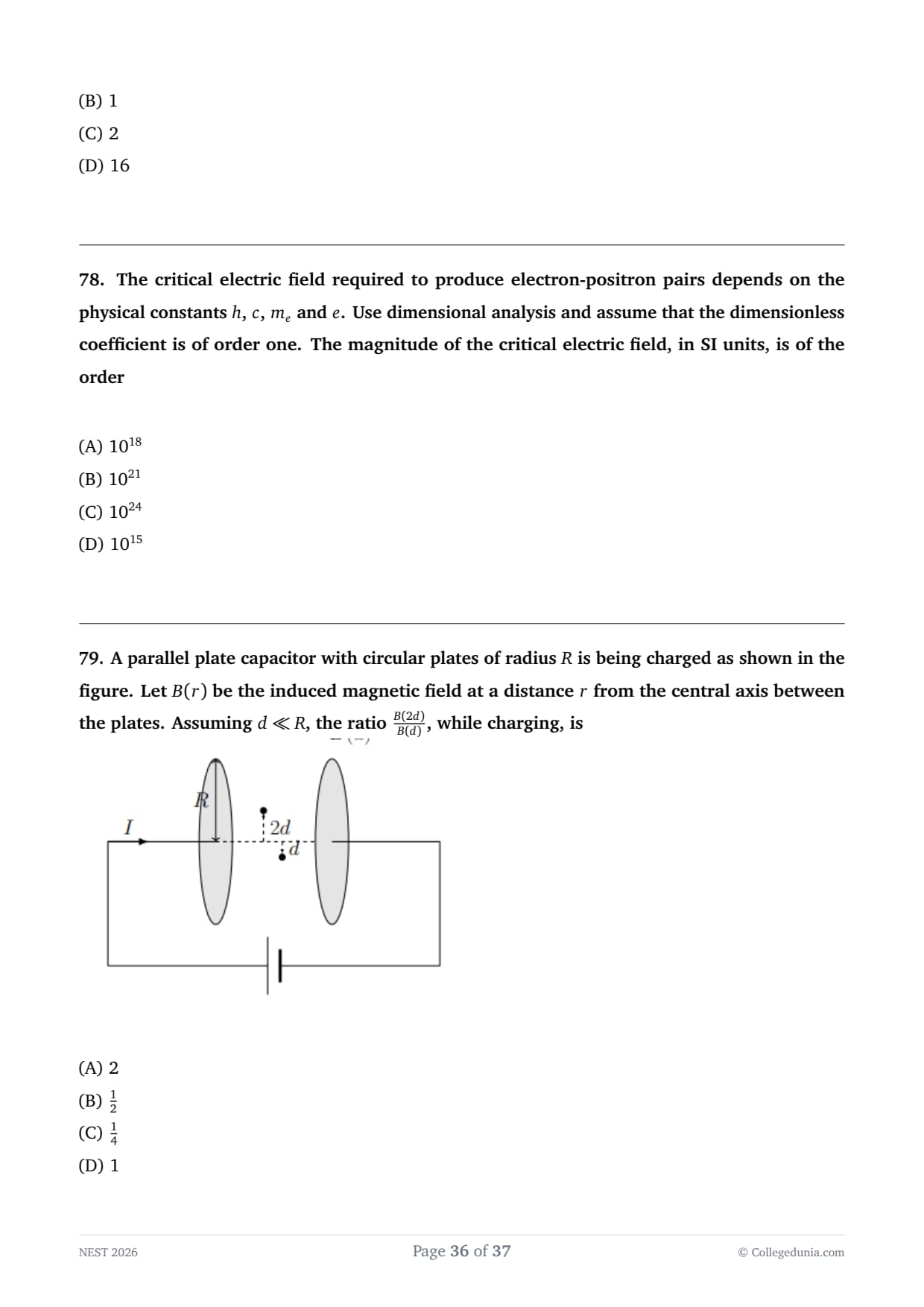
A parallel plate capacitor with circular plates of radius \(R\) is being charged as shown in the figure. Let \(B(r)\) be the induced magnetic field at a distance \(r\) from the central axis between the plates. Assuming \(d \ll R\), the ratio \(\frac{B(2d)}{B(d)}\), while charging, is

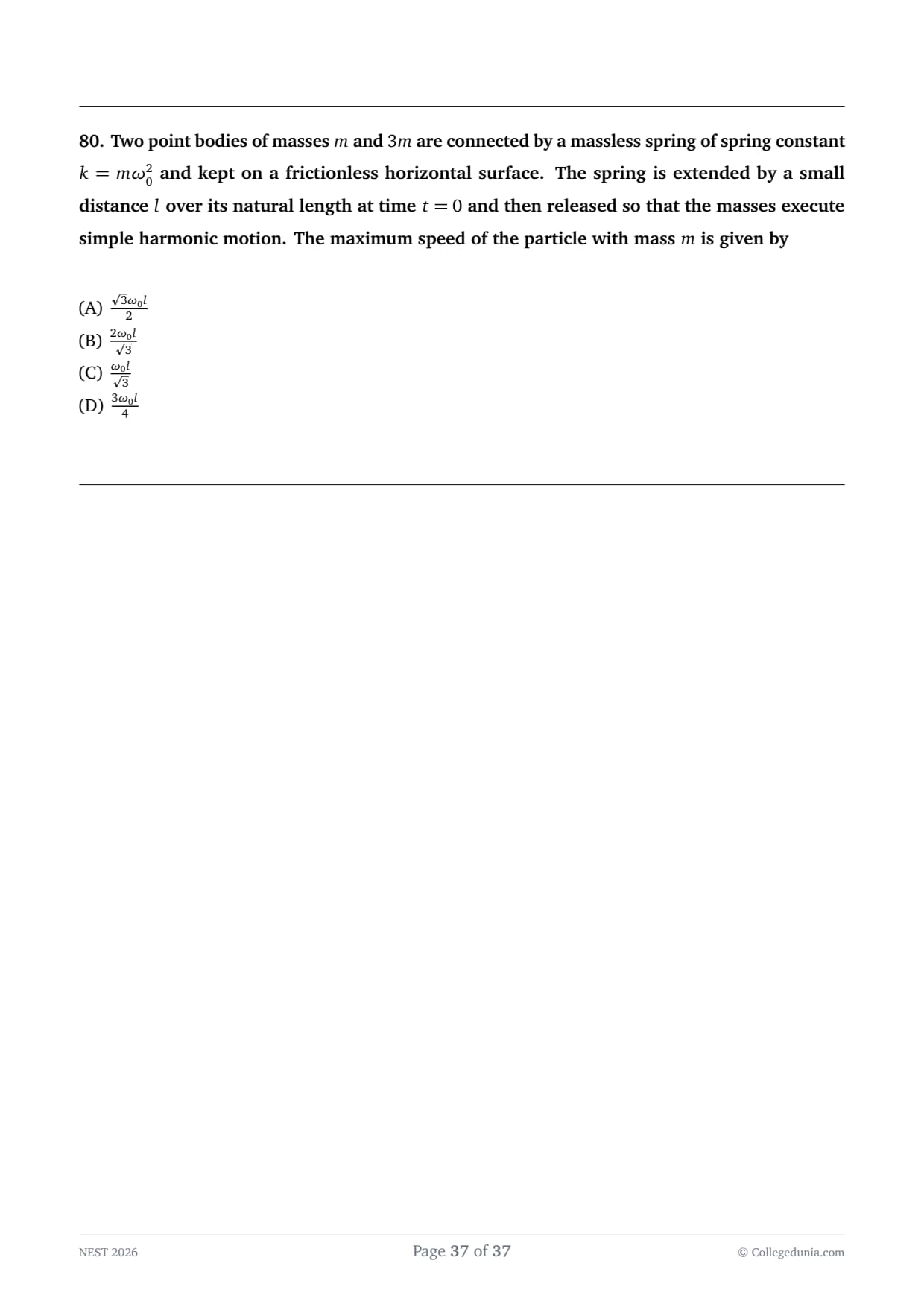
Two point bodies of masses \(m\) and \(3m\) are connected by a massless spring of spring constant \(k = m\omega_0^2\) and kept on a frictionless horizontal surface. The spring is extended by a small distance \(l\) over its natural length at time \(t = 0\) and then released so that the masses execute simple harmonic motion. The maximum speed of the particle with mass \(m\) is given by
NEST 2026 Exam Pattern
| Particulars | Details |
|---|---|
| Name of the exam | NEST 2026 |
| Full Form | National Entrance Screening Test 2026 |
| Mode of the exam | Online-proctored and Computer-Based Test (CBT) |
| Number of Papers | 1 |
| Number of Sections | 4 |
| Name of the Subjects | Biology, Chemistry, Mathematics, and Physics |
| Type of Questions | Multiple Choice Questions (objective type) |
| Marks Distribution | 60 Marks for each of 4 sections |
| Total Marks | 240 |
| Duration of the exam | 3 hours |



Comments