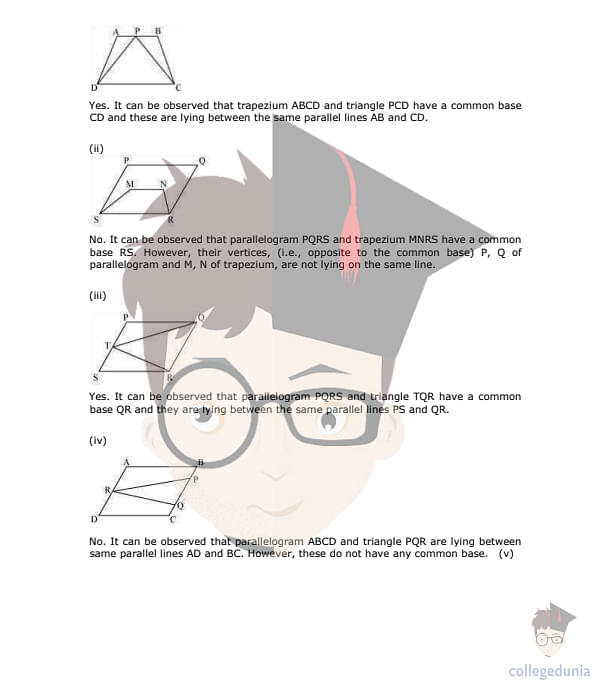
NCERT Solutions for Class 9 Maths Chapter 9 Exercise 9.1 Solutions

Collegedunia Team logo

Collegedunia Team

Content Curator

NCERT Solutions for Class 9 Maths Chapter 9 Areas of Parallelograms and Triangles Exercise 9.1 Solutions are based on the introduction of the topic.

Download PDF: NCERT Solutions for Class 9 Maths Chapter 9 Exercise 9.1 Solutions

Check out NCERT Solutions for Class 9 Maths Chapter 9 Exercise 9.1 Solutions
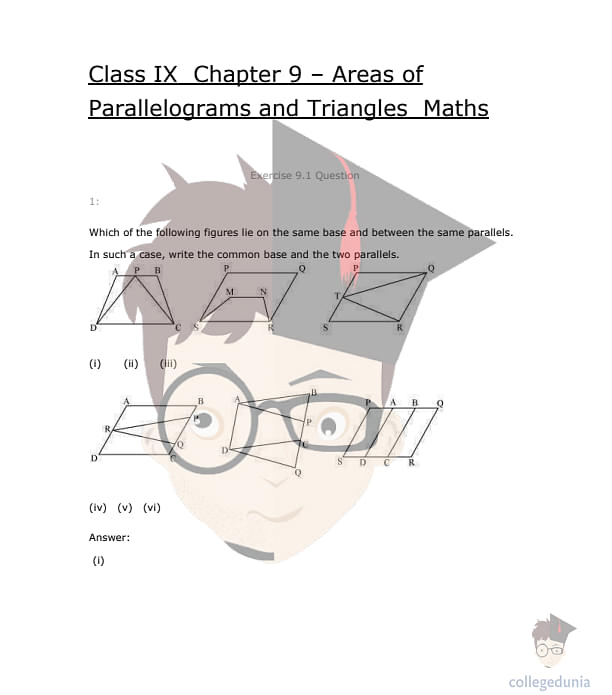
Read More: NCERT Solutions For Class 9 Maths Chapter 9 Areas Of Parallelograms And Triangles

Exercise Solutions of Class 9 Maths Chapter 9 Areas Of Parallelograms And Triangles 

Also check other Exercise Solutions of Class 9 Maths Chapter 9 Areas Of Parallelograms And Triangles

Also Check:

Also check:

CBSE X Related Questions

  • 1.
    In the given figure, PA and PB are tangents to a circle centred at O. If \( \angle AOB = 130^\circ \), then \( \angle APB \) is equal to :

      • \( 130^\circ \)
      • \( 50^\circ \)
      • \( 120^\circ \)
      • \( 90^\circ \)

    • 2.
      In a class test, the sum of Anamika's marks obtained in Maths and Science is 30. Had she got 2 marks more in Maths and 3 marks less in Science, the product of the marks would have been 210. Find the marks she got in the two subjects.


        • 3.
          In the given figure, \(AB \parallel EF\). If \(AB = 24\) cm, \(EF = 36\) cm and \(DA = 7\) cm, then \(AE\) equals

            • \(2.5\) cm
            • \(10.5\) cm
            • \(3.5\) cm
            • \(\frac{14}{3}\) cm

          • 4.
            There are two sections A and B of Grade X. There are 28 students in Section A and 30 students in Section B. What is the minimum number of books you will acquire for the class library so that they can be distributed equally among students of Section A or Section B ?

              • 144
              • 2
              • 420
              • 272

            • 5.
              A bag contains 25 balls. Some of them are yellow and others are green. One ball is drawn at random. If probability of getting a green ball is \(3/5\), then find the number of yellow balls.


                • 6.
                  The natural number 1 is :

                    • a prime number.
                    • a composite number.
                    • prime as well as composite.
                    • neither prime nor composite.

                  Comments


                  No Comments To Show