




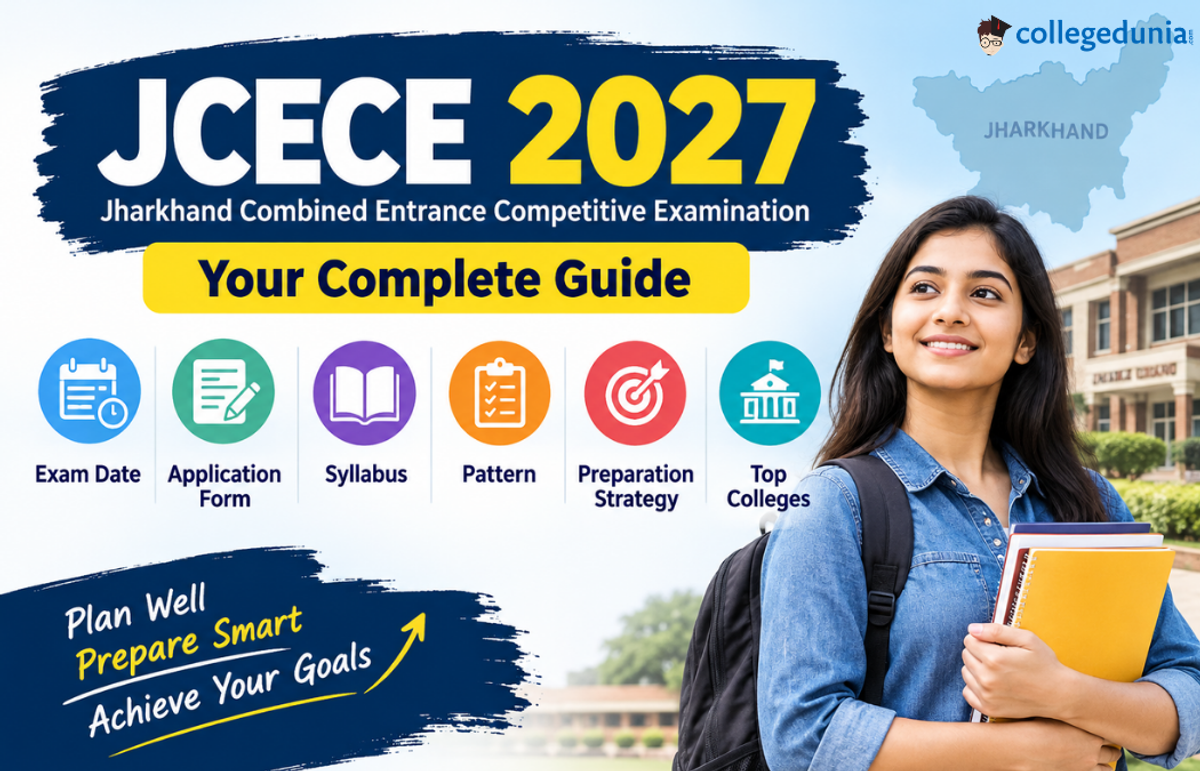
The JCECE 2027 (Jharkhand Combined Entrance Competitive Examination) is conducted by the Jharkhand Combined Entrance Competitive Examination Board (JCECEB) for admission to undergraduate agriculture and other allied courses in Jharkhand. The JCECE 2027 application form is expected to be released in 2027 in online mode through the official JCECEB website.
- The examination is conducted in objective-type mode, with candidates choosing the PCM, PCB or PCMB subject group according to the course they wish to pursue.
- Candidates applying for PCM can be considered for courses such as B.Tech Agriculture Engineering, B.Tech Dairy Technology, B.Sc Horticulture and B.Sc Forestry, while PCB applies to courses including B.Sc Agriculture, B.V.Sc & A.H., B.F.Sc and related programmes.
- The PCM and PCB groups contain 150 questions, with 50 questions each from Physics, Chemistry and Mathematics/Biology. The PCMB group contains 200 questions.
- Each correct answer carries 1 mark, while 0.25 marks are deducted for an incorrect answer. No marks are deducted for unanswered questions.
- The question paper is available in English and Hindi, with the English version treated as final in case of any translation ambiguity.
- Before final submission, applicants must upload a recent photograph, signature and left-thumb impression in the prescribed format; the 2026 guidelines specified 10–100 KB for the photograph and 5–50 KB for the signature.
- Candidates should verify all details before submitting and paying the fee, since incorrect payment or incomplete submission can lead to rejection.
- After successful submission, the system sends the registration number and password via SMS/email. Candidates should keep these details safe for future logins and application-related activities.
Related Links:
- JCECE 2027 Registration: Expected Application Dates, Eligibility, Fee and How to Apply
- JCECE 2027 Eligibility Criteria, Tuition Fee Waiver Scheme, Local Resident Certificate
JCECE 2027 Overview
| Particulars | Details |
|---|---|
| Exam Name | Jharkhand Combined Entrance Competitive Examination (JCECE) 2027 |
| Conducting Body | Jharkhand Combined Entrance Competitive Examination Board (JCECEB) |
| Exam Level | State Level |
| Courses Offered | Agriculture, Horticulture, Forestry, Veterinary Science, Fisheries, Dairy Technology, Agricultural Engineering, etc. |
| Exam Mode | Offline (OMR-based) |
| Question Type | Objective-type MCQs |
| Subject Groups | PCM, PCB and PCMB |
| Total Questions | 150 (PCM/PCB); 200 (PCMB) |
| Total Marks | 150 (PCM/PCB); 200 (PCMB) |
| Duration | 3 hours (PCM/PCB); 4 hours (PCMB) |
| Marking Scheme | +1 for correct; −0.25 for incorrect |
| Medium | English and Hindi |
| JCECE 2027 Application | Expected in 2027; dates to be announced |
| Official Website | JCECEB official website |
JCECE 2027 Exam Dates
The JCECE 2027 exam is expected in late June or early July 2027, probably June 18, 2027. In 2026, the exam was held on 28 June 2026, while in 2025 it took place around mid-to-late June.
| Event | JCECE 2027 Expected Date |
|---|---|
| Notification | May 5, 2027 |
| Application Form Release | May 19, 2027 |
| Last Date to Apply | June 12, 2027 |
| Application Correction | June 13–14, 2027 |
| Admit Card | June 15, 2027 |
| JCECE 2027 Exam | June 18, 2027 |
| Provisional Answer Key | June 23, 2027 |
| Objection Window | June 24–26, 2027 |
| Final Answer Key | July 2027 |
| Result | Last week of July 2027 |
| Counselling | Late July–August 2027 |
JCECE 2027 Eligibility Criteria
The JCECE 2027 eligibility criteria will vary according to the course selected by the candidate. Based on the latest 2026 criteria, candidates must fulfil the required educational qualification, subject combination, age limit and Jharkhand residential requirements.
| Course | Educational Qualification | Age Limit |
|---|---|---|
| B.V.Sc. & A.H. | 10+2 with Physics, Chemistry, Biology and English; General candidates need 50% in these subjects | 17–25 years as on Dec 31, 2027; 5-year relaxation for SC/ST/OBC |
| B.Sc. (Hons.) Agriculture | 10+2 with PCB or PCM | 17–22 years as on July 1, 2027; 5-year relaxation for SC/ST/OBC |
| B.Sc. (Hons.) Forestry | 10+2 with PCB or PCM | 17–22 years; 5-year relaxation for SC/ST/OBC |
| B.Tech. Agricultural Engineering | 10+2 with Physics, Chemistry and Mathematics (PCM) | As prescribed by JCECEB |
| B.Tech. Dairy Technology | 10+2 with PCM | As prescribed by JCECEB |
| B.F.Sc. | 10+2 with PCMB/PCB/Intermediate in Agriculture | As prescribed by JCECEB |
| B.Sc. (Hons.) Horticulture | 10+2 with PCB, PCMB, PCM, PC Forestry or Intermediate in Agriculture | As prescribed by JCECEB |

Source: Quora
A JCECE candidate on Quora has put forward a question asking, “Are another state’s students eligible for the Jharkhand Combined (JCECE)?”
Ans. Yes, students from other states can apply for JCECE, but admission eligibility depends on the course and seat category. However, Jharkhand-specific reservation benefits and state-quota seats are generally available only to candidates meeting the prescribed Jharkhand local/residential criteria. Candidates from other states should check the latest JCECEB notification for course-wise admission rules.
Also Read: JCECE 2027 Eligibility Criteria, Tuition Fee Waiver Scheme, Local Resident Certificate
JCECE 2027: Registration
The JCECE 2027 registration process is expected to begin in May 2027, based on the registration timeline followed in the latest cycle.
- Applicants can register online through the official JCECEB website.
- Candidates should keep their photograph, signature, educational details and other required documents ready in the prescribed format before applying.
- Applicants should carefully verify all details before submitting the application form and paying the required application fee.
How to Register for TS EAMCET 2027?
Candidates can complete the TS EAMCET 2027 (TG EAPCET) registration online through the official website. The step-by-step process is expected to be as follows:
- Visit the official website: Go to the TS EAMCET/TG EAPCET official website.
- Pay the application fee: Click on the application fee payment link and complete the payment using the available online payment options.
- Check payment status: Confirm that the fee payment has been successfully processed before proceeding.
- Fill the application form: Enter personal, contact, academic and examination-related details carefully.
- Upload documents: Upload the required photograph and signature in the prescribed format.
- Select exam details: Choose the applicable stream and enter the required examination preferences.
- Submit the application: Submit the completed application form and note the application/registration number.
- Download the form: Save and take a printout of the submitted application form for future reference.
Last 5 Years' Registration Date Trend in JCECE 2027
JCECE registration has generally been conducted around May–June in recent years.
The JCECE 2027 registration is tentatively expected to begin around May 19, 2027, and continue until mid-June 2027. The exact registration dates will be confirmed by JCECEB in the official notification.
| Year | Registration Start Date | Last Date to Apply |
|---|---|---|
| 2027 | May 19, 2027 (Expected) | June 12, 2027 (Expected) |
| 2026 | May 19, 2026 | June 7, 2026 |
| 2025 | May 29, 2025 | June 13, 2025 |
| 2024 | May 2024 | June 2024 |
| 2023 | May 2023 | June 2023 |
Documents Required to Register for JCECE 2027
For the JCECE 2027 Exam, candidates should keep their recent photograph, signature, academic details & applicable category/domicile certificates ready before starting the online application.
| Document/Details | Purpose |
|---|---|
| Recent Passport-size Photograph | Upload in the prescribed format |
| Scanned Signature | Upload for application authentication |
| Aadhaar Card/Valid ID Proof | Candidate identification |
| Class 10 Certificate/Marksheet | Proof of date of birth |
| Class 12 Marksheet/Certificate | Qualifying examination details |
| Category Certificate | To claim reservation, if applicable |
| Jharkhand Residential Certificate | To establish state/local eligibility, if applicable |
| Disability/PwD Certificate | For candidates claiming PwD benefits |
| Active Mobile Number & Email ID | Registration and official communication |
| Academic Details | Required while filling the application form |
JCECE 2027 Application Fee
The TS EAMCET 2027 application fee varies depending on the candidate’s category and the selected stream.
- The application fee can be paid online through the payment modes available on the official TS EAMCET/TG EAPCET website.
- The application fee is non-refundable once the payment has been successfully made.
| Category | PCM | PCB | PCMB |
|---|---|---|---|
| General / EWS / BC-I / BC-II | ₹900 | ₹900 | ₹1,000 |
| SC / ST / Female Candidates | ₹450 | ₹450 | ₹500 |
| PwD Candidates | Exempted | Exempted | Exempted |
Also Read: JCECE 2027 Registration: Expected Application Dates, Eligibility, Fee and How to Apply
JCECE 2027: Exam Pattern
The JCECE 2027 exam pattern is expected to follow the offline OMR-based format, with separate subject groups for different agriculture and allied courses.
- PCM: The paper is expected to have 150 questions for 150 marks, comprising Physics, Chemistry and Mathematics.
- PCB: The paper is expected to have 150 questions for 150 marks, comprising Physics, Chemistry and Biology.
- PCMB: The paper is expected to have 200 questions for 200 marks, comprising Physics, Chemistry, Biology and Mathematics.
- The exam is expected to be conducted in English and Hindi, with 1 mark for each correct answer and 0.25 marks deducted for each incorrect answer.
| Particulars | PCM | PCB | PCMB |
|---|---|---|---|
| Mode | Offline (OMR) | Offline (OMR) | Offline (OMR) |
| Subjects | Physics, Chemistry, Mathematics | Physics, Chemistry, Biology | Physics, Chemistry, Biology, Mathematics |
| Questions | 150 | 150 | 200 |
| Total Marks | 150 | 150 | 200 |
| Questions per Subject | 50 | 50 | 50 |
| Question Type | MCQs | MCQs | MCQs |
| Marks per Correct Answer | +1 | +1 | +1 |
| Negative Marking | −0.25 | −0.25 | −0.25 |
| Unanswered Question | No deduction | No deduction | No deduction |
| Medium | English & Hindi | English & Hindi | English & Hindi |
| Duration | 3 hours | 3 hours | 4 hours |
Also Read: JCECE Exam Pattern 2027: Marking Scheme, Sections, Duration and Total Marks
JCECE 2027: Marking Scheme
The JCECE 2027 marking scheme is expected to remain similar to the previous year. Each correct answer carries 1 mark, while 0.25 marks are deducted for every incorrect answer. No marks are awarded or deducted for unanswered questions.
| Response | Marks |
|---|---|
| Correct answer | +1 mark |
| Incorrect answer | −0.25 mark |
| Unattempted question | 0 mark |
| More than one option marked | Considered incorrect |
JCECE 2027: Syllabus
The JCECE 2027 syllabus is expected to follow the latest syllabus prescribed by JCECEB. The questions are based on the CBSE Class 11 and 12 common syllabus and cover Physics, Chemistry, Mathematics and Biology, depending on the selected subject group.
Also Read: JCECE Syllabus 2027: Subject-wise Topics, Topic-wise Weightage and PDF Download
JCECE 2027 High-weightage Topics
JCECE 2027 high-weightage areas include chapters such as Rotational Motion, Ray Optics, Chemical Bonding, Chemical Kinetics, Integral Calculus, Parabola, Genetics and Cell Division.
| Subject | High-Weightage Topic / Unit | Approx. % of Subject Questions | Estimated Qs (out of 50/subject) |
|---|---|---|---|
| Physics | Mechanics (Kinematics, Laws of Motion, Work, Power, Energy, Rotation) | 28% – 32% | 14 – 16 |
| Electrodynamics (Electrostatics, Current Electricity, EMI & AC) | 24% – 28% | 12 – 14 | |
| Modern Physics & Semiconductors | 16% – 20% | 8 – 10 | |
| Optics (Ray & Wave) | 12% – 14% | 6 – 7 | |
| Thermodynamics, SHM & Waves | 10% – 12% | 5 – 6 | |
| Chemistry | Inorganic Chemistry (Chemical Bonding, Coordination Compounds, p/d/f Block) | 32% – 36% | 16 – 18 |
| Physical Chemistry (Chemical Kinetics, Equilibrium, Electrochemistry, Solutions) | 30% – 34% | 15 – 17 | |
| General Organic Chemistry (GOC) & Isomerism | 14% – 18% | 7 – 9 | |
| Hydrocarbons & Functional Organic Compounds | 12% – 16% | 6 – 8 | |
| Mathematics | Calculus (Limits, Derivatives, Integration, Differential Equations) | 30% – 35% | 15 – 17 |
| Vectors & 3D Geometry | 16% – 20% | 8 – 10 | |
| Algebra (Matrices, Determinants, Complex Numbers, P&C, Probability) | 24% – 28% | 12 – 14 | |
| Coordinate Geometry (Circles, Straight Lines, Conic Sections) | 16% – 20% | 8 – 10 | |
| Biology | Human Physiology | 22% – 26% | 11 – 13 |
| Genetics & Molecular Biology | 20% – 24% | 10 – 12 | |
| Plant Physiology & Cell Biology | 20% – 22% | 10 – 11 | |
| Ecology & Environment | 14% – 18% | 7 – 9 | |
| Reproduction & Evolution | 12% – 14% | 6 – 7 |
Also Read:
JCECE 2027 Preparation Tips
A focused preparation strategy is important for the JCECE 2027 Exam. Candidates need to manage 150 or 200 questions within the allotted subject-wise exam schedule, making speed, accuracy and regular practice crucial.
| Preparation Tip | How to Follow It |
|---|---|
| Know the syllabus | Go through the Class 11 and 12 syllabus and identify important chapters for your PCM/PCB/PCMB group. |
| Build strong concepts | Focus on understanding formulas, concepts and fundamentals instead of only memorising answers. |
| Follow a study schedule | Divide your daily study time among all subjects and keep separate slots for revision. |
| Practise MCQs regularly | Solve topic-wise and previous-year questions to improve accuracy and speed. |
| Take mock tests | Attempt full-length OMR-based tests regularly to get comfortable with the exam format. |
| Revise frequently | Maintain short notes and revise formulas, reactions, diagrams and important concepts at regular intervals. |
| Avoid blind guessing | Since JCECE has 0.25-mark negative marking, attempt questions only when you can eliminate incorrect options with reasonable confidence. |
| Analyse mistakes | After every mock or practice test, identify weak topics and revise them before attempting another test. |

Source: Quora
A students on Quora has posed an interesting question on securing a particular number of marks to secure admission in JCECE, “How do I prepare for JCECE for securing 90+?”
Ans. For 90+ in JCECE, focus on NCERT concepts first, especially the high-weightage topics in Physics, Chemistry and Mathematics/Biology. Create a realistic daily timetable and dedicate the last few weeks to revision and solving previous-year papers. Take regular mock tests to improve speed, accuracy and time management, and analyse every mistake. Avoid collecting too many books—stick to NCERT + one reliable question bank/test series and revise repeatedly.

Source: Quora
Another student on Quora has asked another important question which is “What are the important chapters for the JCECE which I should prepare well to score high in the JCECE?”
Ans. Don’t try to skip entire subjects just because some chapters seem less important—JCECE questions can come from across the syllabus. For extra focus, prioritise Modern Physics, Optics and Current Electricity in Physics; Chemical Bonding, Coordination Compounds and Organic Chemistry in Chemistry; and Calculus, Matrices, 3D Geometry and Probability in Mathematics. For Biology, give more time to Human/Plant Physiology, Genetics, Reproduction and Ecology. Study these chapters thoroughly from NCERT, then solve PYQs and timed MCQs—knowing fewer chapters extremely well is better than superficially covering everything.
| Subject | Important Chapters | Practical Preparation Tip |
|---|---|---|
| Physics | Modern Physics, Optics, Current Electricity, Electrostatics, Semiconductor | Understand formulas and concepts, then practise numerical-based MCQs and PYQs. |
| Chemistry | Chemical Bonding, Coordination Compounds, Organic Chemistry, Thermodynamics, Equilibrium | Revise NCERT thoroughly and maintain a short formula/reaction sheet. |
| Mathematics | Calculus, Matrices & Determinants, 3D Geometry, Probability, Coordinate Geometry | Focus on repeated question types and practise timed problems regularly. |
| Biology | Human & Plant Physiology, Genetics, Reproduction, Ecology, Cell Biology | Read NCERT line-by-line and practise diagram- and fact-based MCQs. |
| All Subjects | Previous-Year Questions, Mock Tests, Revision | Don’t ignore the rest of the syllabus; use these chapters for priority-based preparation, then cover remaining topics systematically. |
JCECE 2027: Admit Card
The JCECE 2027 admit card is expected to be released in July 2027, shortly before the JCECE examination. Candidates will be able to download it by logging in with their application number and other required login credentials on the official JCECEB website.
How to Download the JCECE Admit Card 2027?
Candidates can download the JCECE 2027 admit card from the official JCECEB website by following these steps. The board provides an online admit card download facility where candidates need to select the examination and enter their application details.
- Visit the official JCECEB website.
- Click on the “Admit Card” link under the relevant examination section.
- Select JCECE 2027 from the list of examinations.
- Enter your Application ID/required login credentials.
- Click on “Download Admit Card”.
- The JCECE 2027 admit card will appear on the screen.
- Download and save the admit card for future reference.
- Take a clear printout of the admit card and carry it to the examination centre.
Last 5 Years' Admit Card Release Date Trend for JCECE 2027
The recent trend shows that the JCECE admit card is generally released a few days before the examination, although the schedule can vary significantly from year to year. Based on the recent cycle, the JCECE 2027 admit card is expected around July 20, 2027, assuming the exam is conducted in late July.
| Year | Admit Card Release Date | JCECE Exam Date | Gap |
|---|---|---|---|
| 2027 (Expected) | July 20, 2027 | July 25, 2027 (Expected) | 5 days |
| 2026 | July 22, 2026 | July 26, 2026 | 4 days |
| 2025 | June 13, 2025 | June 15, 2025 | 2 days |
| 2024 | April 23/24, 2024 | April 28, 2024 | 4–5 days |
Also Read: JCECE Admit Card 2027: Expected June 2027, Download Link and Login Steps
JCECE 2027 Exam Day Guidelines
Candidates appearing for JCECE 2027 should follow the instructions mentioned on their admit card and reach the examination centre well before the reporting time.
- Carry the admit card: Bring a printed copy of the JCECE 2027 admit card to the examination centre.
- Carry a valid ID: Bring a valid photo ID proof as specified in the exam instructions.
- Reach early: Report well before the scheduled time to complete verification and security checks.
- Check the exam centre: Visit the allotted centre beforehand, if possible, to avoid last-minute delays.
- Avoid prohibited items: Do not carry mobile phones, smartwatches, calculators, electronic gadgets, or other unauthorised items inside the examination hall.
- Follow OMR instructions: Read the instructions carefully and mark answers on the OMR sheet as directed by the invigilator.
- Manage negative marking: Since 0.25 marks are deducted for an incorrect answer, avoid random guessing.
- Follow invigilator instructions: Candidates must follow all instructions given by the examination staff throughout the test.
JCECE 2027: Provisional Answer Key
The JCECE 2027 provisional answer key is expected to be released a few days after the entrance examination. Candidates will be able to use the provisional key and their response sheets to calculate their probable scores. JCECEB is also expected to provide an objection window for candidates who wish to challenge any answer.
| Event | Expected Date |
|---|---|
| JCECE 2027 Exam | May/June 2027* |
| Provisional Answer Key | A few days after the exam |
| Response Sheet | Along with/around the provisional answer key |
| Objection Window | 2–3 days after answer key release |
| Final Answer Key | After reviewing objections |
| JCECE 2027 Result | Shortly after the final answer key |
JCECE 2027: Objection Window
After the release of the JCECE 2027 provisional answer key, candidates may be provided a limited window to raise objections against any incorrect answers or questions.
- Candidates will have to submit their objections online through the official JCECEB website within the specified deadline.
- Objections should be supported with valid explanations or relevant references, wherever required.
- After reviewing the objections, JCECEB will prepare the final answer key, which will be considered for preparing the JCECE 2027 result.
JCECE 2027: Final Answer Key
The JCECE 2027 final answer key will be released by the Jharkhand Combined Entrance Competitive Examination Board (JCECEB) after reviewing the objections raised against the provisional answer key.
- The final answer key will incorporate any necessary corrections based on valid objections.
- Candidates can use the final answer key to calculate their probable scores.
- The final answer key will be considered while preparing the JCECE 2027 result and merit list.
JCECE 2027: Result
The JCECE 2027 result is expected to be declared a few weeks after the entrance examination. Candidates will be able to check their results online through the official JCECEB website using their login credentials.
- The result will contain the candidate's marks, qualifying status and rank/merit position, wherever applicable.
- Candidates should download and preserve their JCECE 2027 result/scorecard for use during the counselling and admission process.
How to Check the JCECE Result 2027?
Candidates will be able to check their JCECE 2027 result online through the official JCECEB website. The process is expected to be as follows:
- Visit the official website: Go to the JCECEB website.
- Click on the result link: Select the “JCECE 2027 Result” link.
- Enter login details: Enter the required credentials, such as application number/roll number and date of birth.
- Submit the details: Click on the submit button to view the result.
- Download the result: Check your marks and rank/merit position and download the result.
- Take a printout: Keep multiple copies of the result for JCECE counselling and admission purposes.
Also Read: JCECE 2027 Result: Check Dates, Answer Key, Download Scorecard, Merit List
JCECE 2027: Merit List/Rank
The JCECE 2027 merit list/rank list is expected to be released by the Jharkhand Combined Entrance Competitive Examination Board (JCECEB) after the declaration of the result. It will contain the names and ranks of candidates who qualify for the admission process.
- The merit list will be prepared based on candidates' performance in JCECE 2027 and the applicable tie-breaking rules.
- Candidates securing higher marks are likely to be placed at better ranks in the merit list.
- JCECEB may prepare separate merit lists for different groups/courses or categories, wherever applicable.
- The merit/rank list will be used for JCECE counselling, seat allotment and admission to participating institutions.
- Candidates should download and preserve their rank/merit details for the counselling process.
Also Read: JCECE Merit List 2027: Expected July 2027, Category-wise List and Tie-Breaking Rules
JCECE 2027: Cutoff
In the JCECE 2027 Exam, General category candidates targeting top B.Sc. Agriculture seats (e.g., BAU Ranchi) should aim for 205–215+ marks out of 450 to stay competitive, while reserved categories will see proportionally lower thresholds based on multi-year trends.
| Category | Reservation Quota | Expected Cutoff Marks | Safe Score Threshold |
|---|---|---|---|
| General / Unreserved | ~40% | 65 – 80 marks | 75+ |
| OBC-I (BC-I) | 11% | 55 – 68 marks | 62+ |
| OBC-II (BC-II) | 3% | 50 – 65 marks | 58+ |
| EWS | 10% | 55 – 68 marks | 60+ |
| Scheduled Caste (SC) | 10% | 40 – 52 marks | 48+ |
| Scheduled Tribe (ST) | 26% | 30 – 45 marks | 40+ |
| PwD | Horizontal | 25 – 40 marks | 35+ |
Also Read:
JCECE 2027: Counselling
The Jharkhand Combined Entrance Competitive Examination Board (JCECEB) will conduct JCECE 2027 counselling for candidates who qualify the entrance examination. The counselling process will be conducted online and will include registration, choice filling, seat allotment & admission-related activities.
JCECE 2027 Counselling Process
- Counselling Registration: Qualified candidates will register online on the official JCECEB website and pay the applicable counselling fee.
- Choice Filling: Candidates will select their preferred courses and colleges/institutions in order of preference.
- Seat Allotment: JCECEB will allot seats based on the candidate's merit/rank, category, choices filled, & seat availability.
- Provisional Seat Allotment: Candidates can check their allotment result online and download the provisional allotment letter, if allotted a seat.
- Document Verification: Candidates will report to the designated centre/institute with the required original documents and their photocopies for verification.
- Fee Payment & Admission: Candidates accepting the allotted seat will have to pay the prescribed admission fee and complete the admission formalities within the specified deadline.
- Upgradation/Next Counselling Round: Candidates may get an opportunity to participate in subsequent counselling rounds for seat upgradation, subject to the applicable JCECEB rules and seat availability.
Documents Required for JCECE Counselling 2027
Candidates should generally keep the following documents ready:
- JCECE 2027 admit card
- JCECE 2027 result/scorecard or rank details
- Class 10 and 12 marksheets and certificates
- Valid photo ID proof
- Category certificate, if applicable
- Jharkhand domicile/residential certificate, wherever applicable
- Recent passport-size photographs
- Migration/transfer certificate, if required
- Other documents specified by JCECEB in the counselling notification
Also Read: JCECE Counselling 2027: Registration Expected July, Choice Filling and Round-Wise Seat Allotment
JCECE 2027: Seat Allotment
The JCECE 2027 seat allotment will be conducted by the Jharkhand Combined Entrance Competitive Examination Board (JCECEB) as part of the counselling process. Seats will be allotted to eligible candidates based on their JCECE rank, category, choices filled, seat availability and applicable reservation rules.
- Candidates will be able to check their seat allotment result online through the official JCECEB website.
- Those allotted a seat will have to download the provisional seat allotment letter and complete the required admission formalities within the specified deadline.
- Candidates who are satisfied with the allotted seat can proceed with fee payment and document verification/admission.
- Depending on the counselling rules, candidates may also be allowed to participate in subsequent rounds for upgradation to a higher-preference seat.
- If a candidate fails to complete the required formalities within the stipulated period, the allotted seat may be cancelled.
JCECE 2027 Participating Institutions
The top 10 JCECE participating institutions form the core academic backbone for professional technical, agricultural, and allied science education in Jharkhand, with Birsa Agricultural University (BAU) and BIT Sindri acting as the anchor state institutions.
| Institute Name | Location | Primary Streams Offered | Status / Affiliation |
|---|---|---|---|
| Ranchi Veterinary College (BAU) | Kanke, Ranchi | B.V.Sc. & A.H. | Government (Birsa Agricultural University) |
| Ranchi Agriculture College (BAU) | Kanke, Ranchi | B.Sc. (Hons) Agriculture | Government (Birsa Agricultural University) |
| BIT Sindri | Dhanbad | B.Tech (Engineering) | Government |
| College of Forestry (BAU) | Ranchi | B.Sc. (Hons) Forestry | Government (Birsa Agricultural University) |
| College of Agricultural Engineering | Kanke, Ranchi | B.Tech Agricultural Engineering | Government (Birsa Agricultural University) |
| Phulo Jhano Dairy Technology College | Hansdiha, Dumka | B.Tech Dairy Technology | Government |
| College of Fisheries Science | Gumla | B.F.Sc. (Fisheries Science) | Government |
| College of Horticulture | Khuntpani, Chaibasa | B.Sc. (Hons) Horticulture | Government |
| University College of Engineering and Technology (UCET) | Hazaribagh | B.Tech (Engineering) | State University (Vinoba Bhave University) |
| RVS College of Engineering and Technology (RVSCET) | Jamshedpur | B.Tech (Engineering) | Private / AICTE Approved |
Also Read: List of Top Colleges in India Accepting JCECE Based on 2027 Ranking
JCECE 2027 FAQs
Ques. Who is eligible for the JCECE 2027?
Ans. Candidates who have passed Class 12 or an equivalent examination with the required subjects are eligible for JCECE 2027, subject to the course-specific requirements. They must fulfil the prescribed age, domicile and educational qualification criteria specified by JCECEB. The eligibility requirements may vary for PCM, PCB and other subject groups. Candidates should check the official notification for the final eligibility criteria.
Ques. Can a Bihar student apply for JCECE?
Ans. Yes, a Bihar student can apply for JCECE 2027 if they meet the prescribed eligibility criteria. However, Jharkhand domicile/residential requirements may affect eligibility for certain seats, courses or reservation benefits. Candidates from Bihar may therefore be considered under the applicable non-local/open category, subject to JCECEB rules.
Ques. How long does the JCECE exam last?
Ans. The JCECE 2027 exam duration is expected to be 2 hours for the respective paper/group. Candidates should report to the examination centre well before the reporting time for verification and other formalities. The exact exam duration and shift timings will be confirmed in the official JCECE 2027 notification.
Ques. What degree programs and courses are offered through JCECE 2027?
Ans. JCECE primarily serves candidates seeking admission into professional undergraduate degree programs across Jharkhand, including:
- PCB Group: B.V.Sc. & A.H. (Veterinary Science), B.Sc. (Hons) Agriculture, B.Sc. (Hons) Forestry, B.Sc. (Hons) Horticulture, and B.F.Sc. (Fisheries Science).
- PCM Group: B.Tech in Dairy Technology and B.Tech in Agricultural Engineering.
Ques. Is Jharkhand domicile mandatory?
Ans. Yes, holding a valid Jharkhand domicile (Local/Permanent Resident Certificate) is mandatory to claim seats through JCECE counselling for government colleges and state quota seats. Non-domicile candidates can only apply for a limited number of management or open-quota seats in select private institutions, provided the participating college permits open All-India admissions.




Comments
Found 3 Comments
which type of exam is jcece?
Jharkhand Combined Entrance Competitive Examination (JCECE) is a state-level entrance examination specifically designed for Jharkhand, which serves as a gateway for admission to various undergraduate courses in fields such as Horticulture, Agriculture Engineering, Dairy Technology, and Fisheries Science. Students who aspire to pursue these courses can appear for the JCECE exam and secure admission in institutions within Jharkhand. To be eligible for JCECE, students must have completed their Class 12 from a recognized board.
Jharkhand Combined Entrance Competitive Examination (JCECE) offers several benefits to students who apply for it. Below are some of these advantages:
In summary, applying for JCECE provides students with a chance to pursue their desired undergraduate courses, gain specialized knowledge, and contribute to the growth of various sectors within Jharkhand.
Two separate merit lists, Combined merit list and Category-wise merit list, will be released for JCECE. You can check the steps to check the merit lists from JCECE Results.