




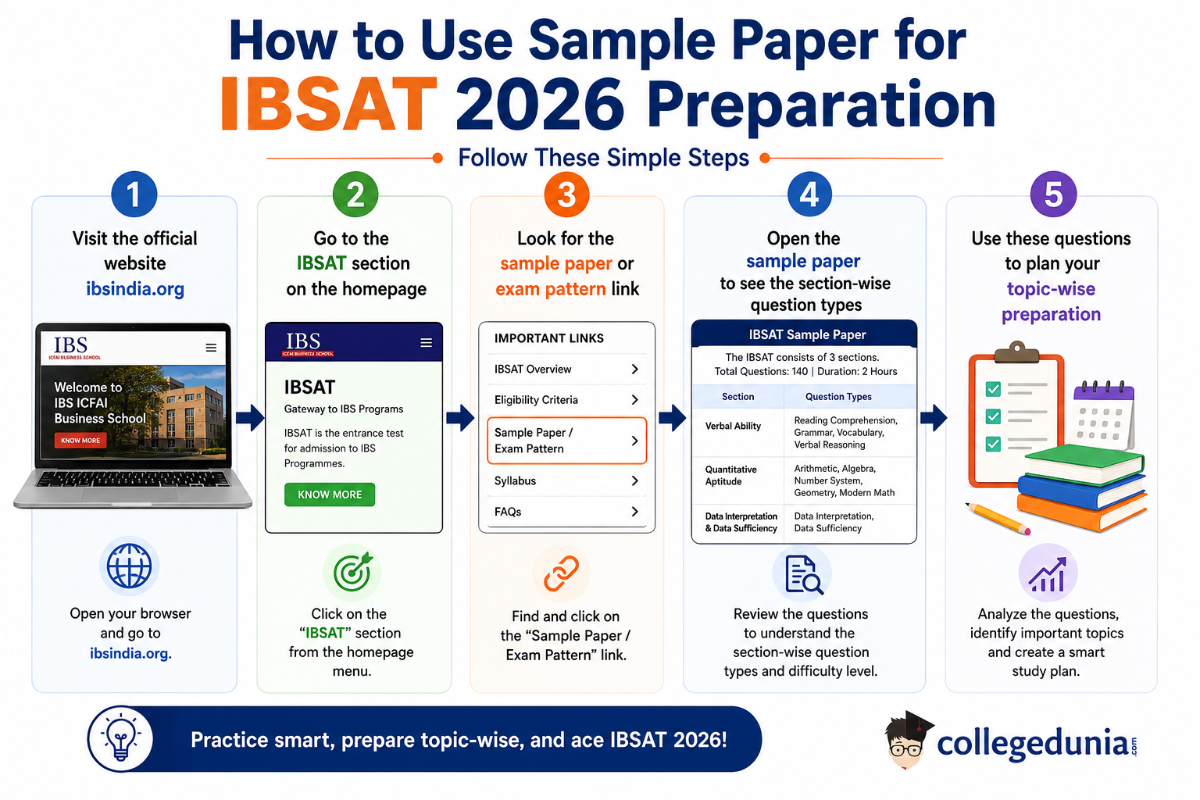
The IBSAT Syllabus 2026 is set by the ICFAI Foundation for Higher Education and is available on the official website at ibsindia.org. The syllabus is split into 4 key sections: Verbal Ability, Reading Comprehension, Quantitative Aptitude, & Data Adequacy & Data Interpretation.
- Verbal Ability carries the highest weightage with 50 out of 140 questions.
- From the Data Adequacy & Data Interpretation (DA-DI) portion, 30 questions are asked.
- Most questions are of an easy-to-moderate level.
- With a well-planned study schedule, candidates can usually finish the IBSAT syllabus within three to four months.
Related Links:
- IBSAT Exam Pattern 2026: Total Questions, Marking Scheme, Duration, & Section-Wise Weightage
- IBSAT Sample Papers 2026: Last 5 Years PYQs PDF Download and Subject Wise Weightage
- IBSAT Preparation 2026: Check Strategy for VARC, QA, DI, Last Minute Tips and Tricks
Key Summary
- The IBSAT 2026 syllabus is the same as previous years, with no changes.
- The exam has four sections: Verbal Ability, Reading Comprehension, Quant, and Data Interpretation.
- Verbal Ability has the highest weightage at around 36%.
- There is no official syllabus PDF from ICFAI Business School.
- Focus on CAT-level basics and solve IBSAT sample papers for practice.
IBSAT Syllabus 2026 Overview
The ICFAI Foundation for Higher Education's IBSAT Syllabus 2026 tests candidates' language skills, mathematical aptitude, and data interpretation abilities.
- It focuses on aptitude and problem-solving skills rather than theoretical knowledge.
- There are no sectional time limits or negative markings in the IBSAT exam.
- Candidates can manage their own pace and attempt all 140 questions to maximize their overall score.
- The IBSAT syllabus covers four sections that test your language, math, and data skills.
- The topics are close to the CAT syllabus, so the CAT and XAT study material also works for IBSAT.
The table below shows the four sections and their focus areas.
| Section | Focus Area | Questions |
|---|---|---|
| Verbal Ability | Grammar, vocabulary, sentence skills | 50 |
| Reading Comprehension | Passage reading and analysis | 30 |
| Quantitative Aptitude | Basic math and problem-solving | 30 |
| Data Adequacy and Data Interpretation | Reading and using data | 30 |
How to Access the IBSAT Syllabus 2026?
Also Check:
IBSAT Syllabus 2026: Verbal Ability and Reading Comprehension
Verbal Ability and Reading Comprehension together make up 80 of the 140 questions.
- This makes them the most important part of the IBSAT syllabus.
- A strong score in this section can lift students' total marks fast.
IBSAT Verbal Ability Syllabus
The Verbal Ability section has 50 questions.
- It tests your grammar, vocabulary, and sentence skills.
- Daily reading and word practice help you score well here.
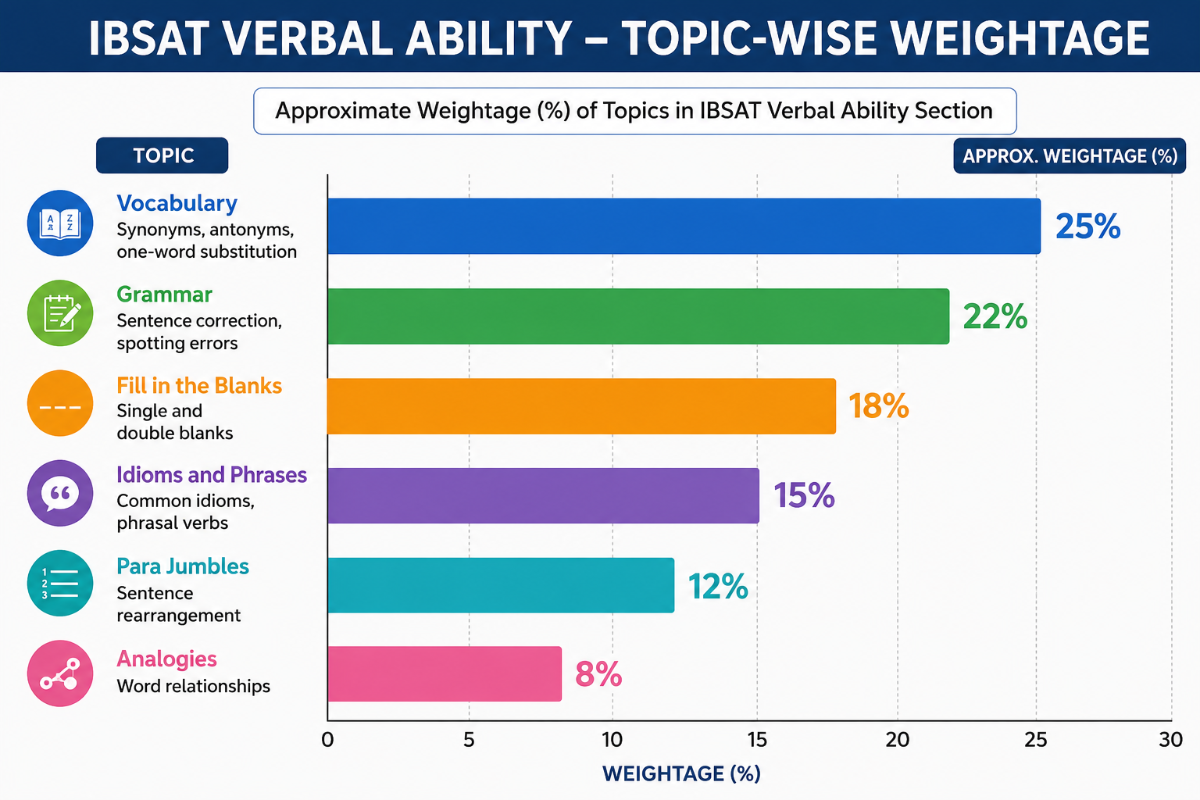
| Topic | Key Areas | Approx. Weightage (%) |
|---|---|---|
| Vocabulary | Synonyms, antonyms, one-word substitution | 25% |
| Grammar | Sentence correction, spotting errors | 22% |
| Fill in the Blanks | Single and double blanks | 18% |
| Idioms and Phrases | Common idioms, phrasal verbs | 15% |
| Para Jumbles | Sentence rearrangement | 12% |
| Analogies | Word relationships | 8% |
Also Check:
IBSAT Reading Comprehension Syllabus
Reading Comprehension section has 30 questions.
- Students get passages followed by questions.
- The passages cover topics like business, economy, science, and current issues.
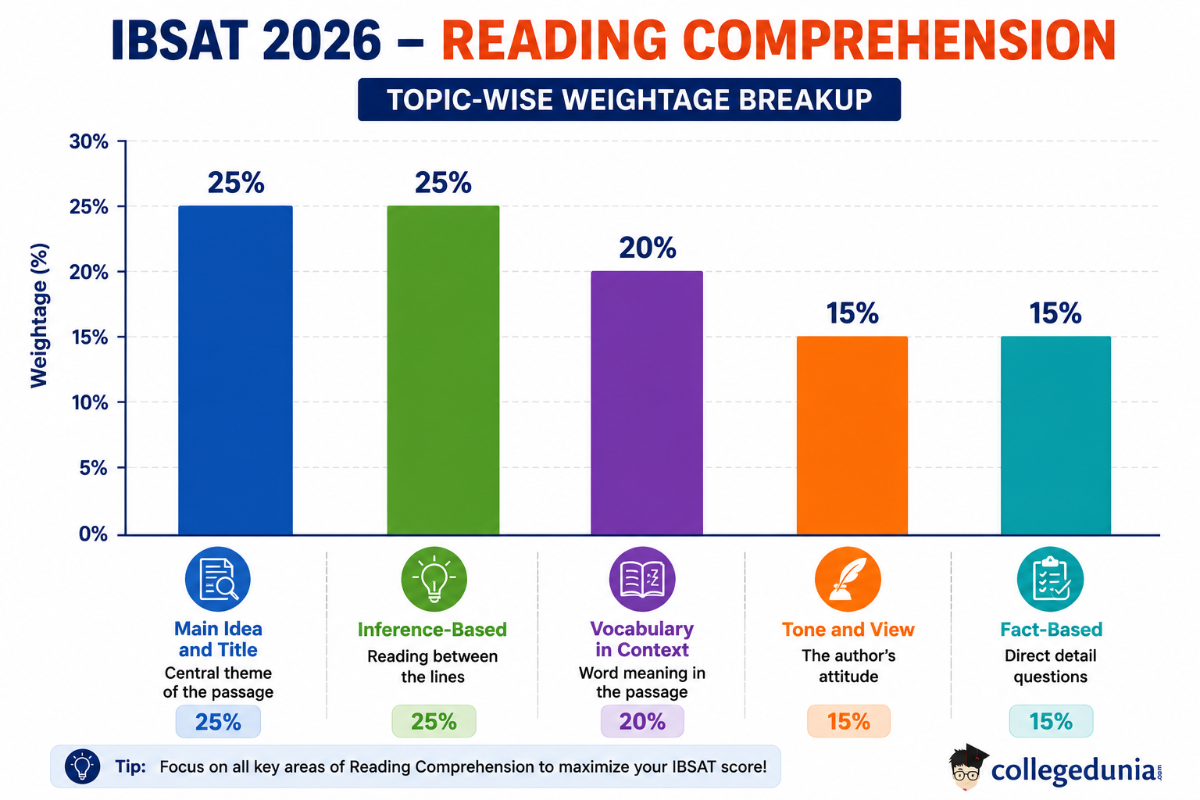
| Question Type | Key Areas | Approx. Weightage (%) |
|---|---|---|
| Main Idea and Title | Central theme of the passage | 25% |
| Inference-Based | Reading between the lines | 25% |
| Vocabulary in Context | Word meaning in the passage | 20% |
| Tone and View | The author's attitude | 15% |
| Fact-Based | Direct detail questions | 15% |
Also Check:
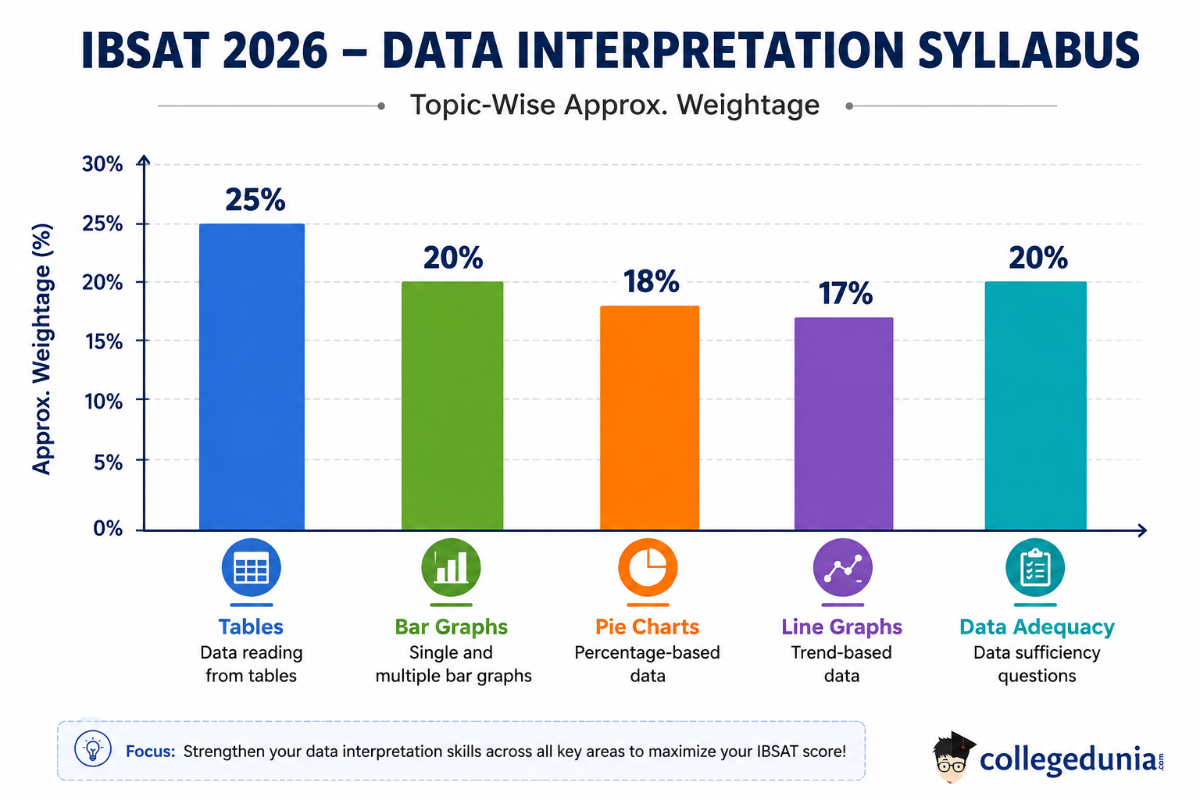
IBSAT Data Interpretation and Data Adequacy Syllabus
The Data Adequacy and Data Interpretation section has 30 questions.
- It tests how students read and use data.
- Unlike CAT, IBSAT does not have a separate Logical Reasoning section.
- Data Interpretation questions come in sets, so one solved set can fetch you 4 to 5 marks at once.
- Data Adequacy questions ask whether the given data is enough to solve a problem.
- Regular practice helps students get faster at reading charts.
| Topic | Key Areas | Approx. Weightage (%) |
|---|---|---|
| Tables | Data reading from tables | 25% |
| Bar Graphs | Single and multiple bar graphs | 20% |
| Pie Charts | Percentage-based data | 18% |
| Line Graphs | Trend-based data | 17% |
| Data Adequacy | Data sufficiency questions | 20% |
Also Check:
- IBSAT Data Adequacy and Data Interpretation Sample Paper 2026
- IBSAT 2026 Exam Analysis, Check Section-wise Difficulty Level, Ideal Attempts, Cut off
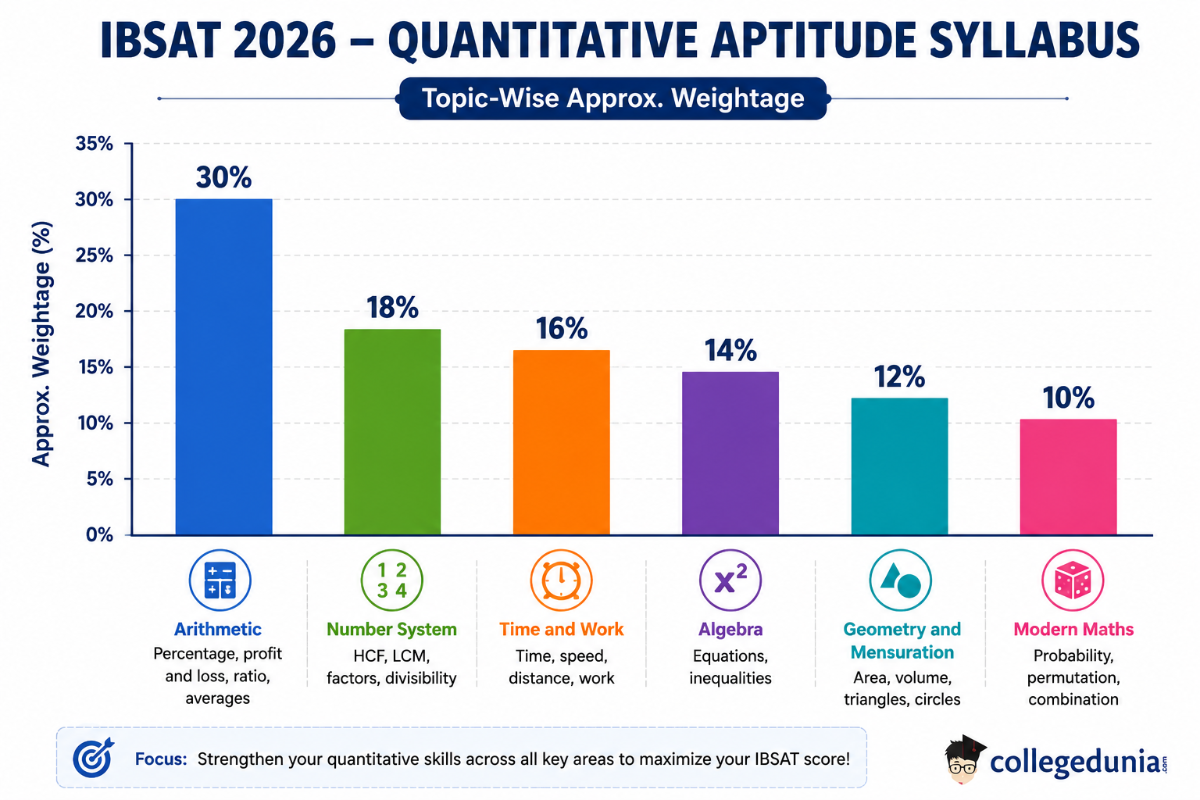
IBSAT Quantitative Aptitude Syllabus
The Quantitative Aptitude section has 30 questions.
- It tests students math and problem-solving skills.
- Most questions come from Class 10 level math, so students do not need advanced study.
- Students should revise formulas and solve timed sets to build speed.
- Since there is no negative marking, they can attempt every Quant question.
| Topic | Key Areas | Approx. Weightage (%) |
|---|---|---|
| Arithmetic | Percentage, profit and loss, ratio, averages | 30% |
| Number System | HCF, LCM, factors, divisibility | 18% |
| Time and Work | Time, speed, distance, work | 16% |
| Algebra | Equations, inequalities | 14% |
| Geometry and Mensuration | Area, volume, triangles, circles | 12% |
| Modern Maths | Probability, permutation, combination | 10% |
Also Check:
IBSAT Syllabus 2026: Section-Wise Weightage
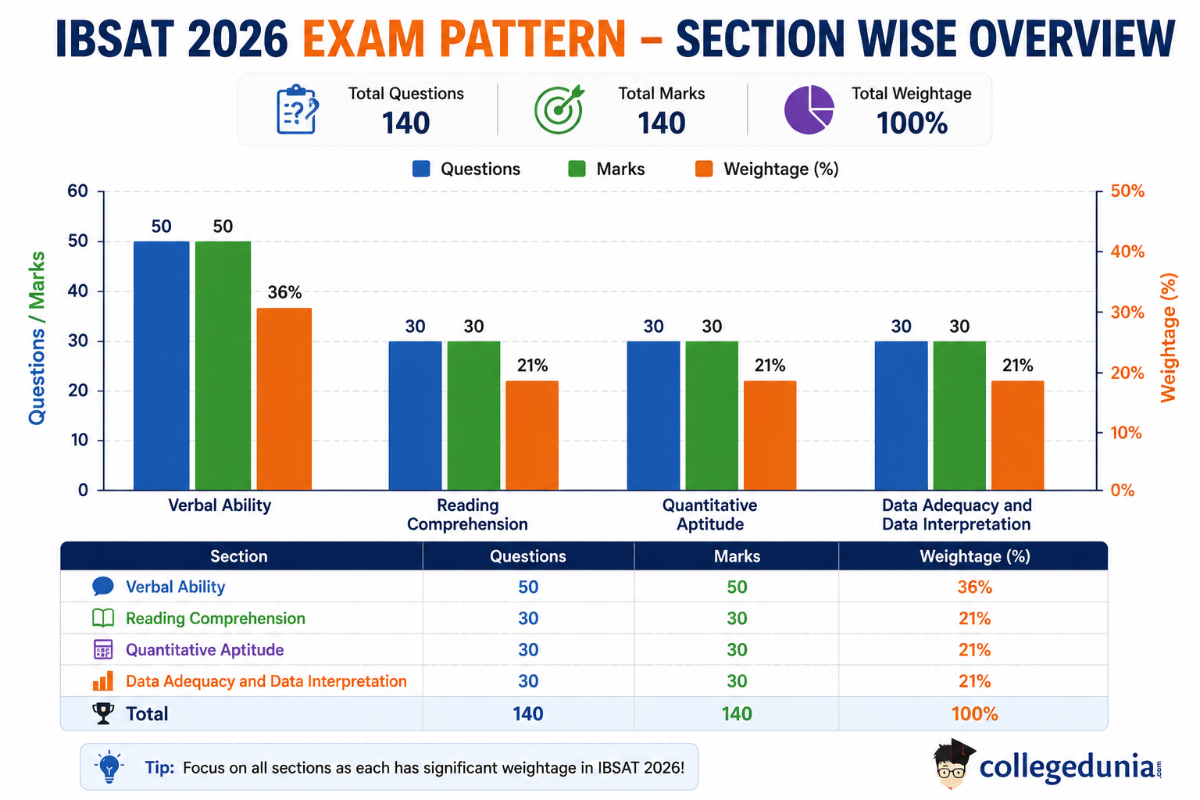
The IBSAT weightage is based on the fixed exam pattern and past year trends.
- Verbal Ability has the most questions, while the other three sections carry 30 each.
| Section | Questions | Marks | Weightage (%) |
|---|---|---|---|
| Verbal Ability | 50 | 50 | 36% |
| Reading Comprehension | 30 | 30 | 21% |
| Quantitative Aptitude | 30 | 30 | 21% |
| Data Adequacy and Data Interpretation | 30 | 30 | 21% |
| Total | 140 | 140 | 100% |
Also Check:
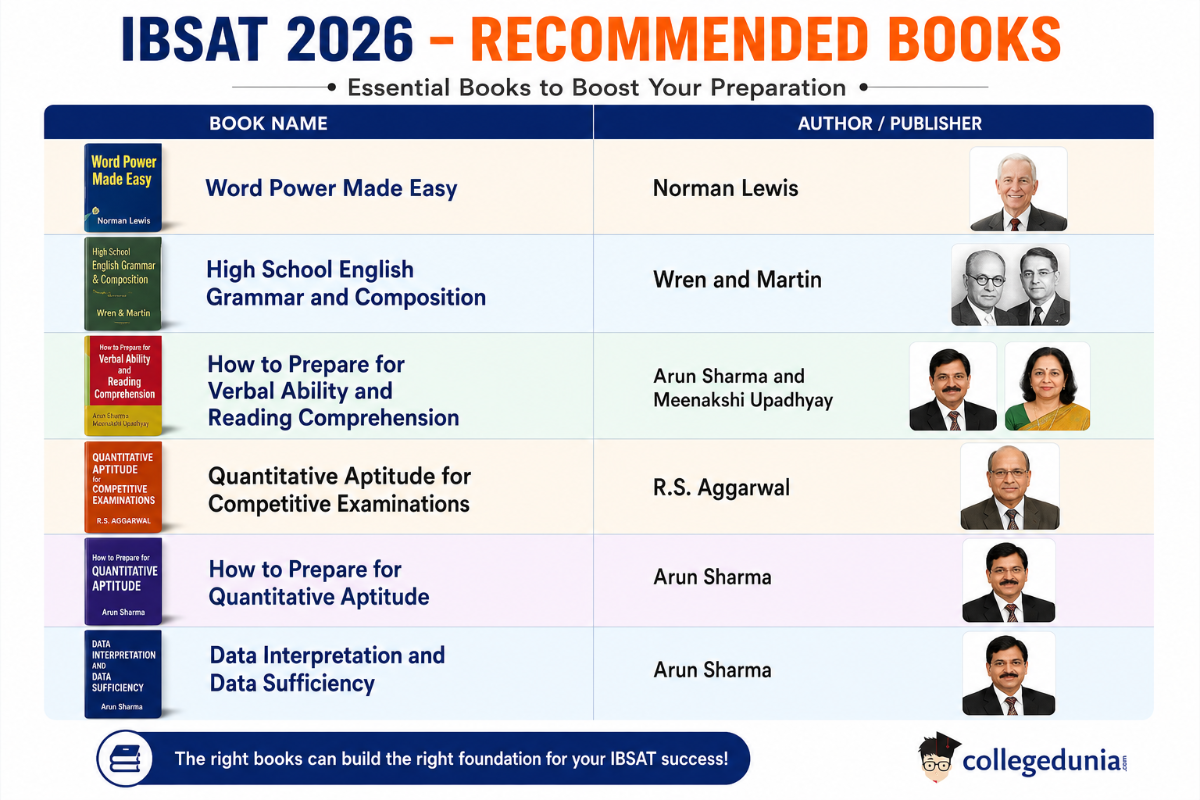
Best Books to Cover the IBSAT Syllabus 2026
The right books make the students IBSAT 2026 preparation easier.
- Since the syllabus is close to CAT, using popular CAT and MBA prep books can also help.
- The table below lists trusted books for each section.
| Section | Book Name | Author / Publisher |
|---|---|---|
| Verbal Ability | Word Power Made Easy | Norman Lewis |
| Verbal Ability | High School English Grammar and Composition | Wren and Martin |
| Reading Comprehension | How to Prepare for Verbal Ability and Reading Comprehension | Arun Sharma and Meenakshi Upadhyay |
| Quantitative Aptitude | Quantitative Aptitude for Competitive Examinations | R.S. Aggarwal |
| Quantitative Aptitude | How to Prepare for Quantitative Aptitude | Arun Sharma |
| Data Interpretation | Data Interpretation and Data Sufficiency | Arun Sharma |
Preparation Tips to Cover the IBSAT Syllabus 2026
IBSAT 2026 preparation does not need years of coaching.
- Since the paper is easier than CAT, a focused three to 4-month plan works well.
Here are section-wise tips to help you score high.
Verbal Ability and Reading Comprehension
| Section | No. of Questions | Important Topics | Key Preparation Tips |
|---|---|---|---|
| Verbal Ability | 50 | Synonyms, Antonyms, Idioms & Phrases, Error Detection, Sentence Completion, Para Jumbles, One Word Substitution, Cloze Test, Analogies |
|
Quantitative Aptitude
| Section | No. of Questions | Important Topics | Key Preparation Tips |
|---|---|---|---|
| Quantitative Aptitude | 30 | Arithmetic (Percentages, Profit & Loss, Ratios, Time & Work, SI/CI), Number System, Algebra, Geometry, Averages, Probability |
|
Data Interpretation & Data Adequacy
| Section | No. of Questions | Important Topics | Key Preparation Tips |
|---|---|---|---|
| Data Interpretation & Data Adequacy | 30 | Bar Graphs, Pie Charts, Line Graphs, Tables, Caselets, Data Sufficiency |
|
Reading Comprehension
| Section | No. of Questions | Important Topics | Key Preparation Tips |
|---|---|---|---|
| Reading Comprehension | 30 | Passages (usually 6–7), Inference questions, Main Idea, Author’s Tone, Vocabulary in Context |
|
How to Cover the IBSAT Syllabus 2026 While Managing College or Work?
Completing the IBSAT Syllabus 2026 alongside your daily responsibilities is possible with a practical study plan.
Whether you are a college student or a working professional, studying consistently for a few hours every day and taking regular mock tests can help you complete the syllabus on time.
IBSAT Syllabus 2026 Preparation Tips for College Students
| Activity | Suggested Plan |
|---|---|
| Study Time | Study for 2–3 hours daily after college or during free periods. |
| Weekly Goal | Complete one topic from each section every week. |
| Weekend Plan | Revise the week's topics and attempt one full-length mock test. |
| Focus Areas | Spend extra time on Quantitative Aptitude and Reading Comprehension. |
| Revision | Revise vocabulary and formulas for 20–30 minutes every day. |
| Time Management | Avoid last-minute preparation by following a fixed study schedule. |
IBSAT Syllabus 2026 Preparation Tips for Working Professionals
| Activity | Suggested Plan |
|---|---|
| Study Time | Study for 1.5–2 hours on weekdays and 4–5 hours on weekends. |
| Daily Routine | Focus on one section each day instead of studying all subjects together. |
| Commute Time | Use travel breaks to improve vocabulary or read short RC passages. |
| Mock Tests | Take one full-length mock test every weekend and analyse mistakes. |
| Revision | Keep short notes for formulas, grammar rules, and important concepts. |
| Time Management | Follow a realistic schedule and maintain consistency instead of studying for long hours occasionally. |
IBSAT Syllabus 2026: Latest YouTube Videos
Students can use YouTube videos to understand the IBSAT syllabus and strategy better.
- The videos below cover the exam pattern, section-wise syllabus, and preparation tips.
- The IBSAT format stays the same for 2026, so these videos are still useful.
- Students should treat these videos as extra help, not a full study plan.
- Pair them with sample papers and mock tests for the best result.
| Video Title | What It Covers | Watch Link |
|---|---|---|
| IBSAT Eligibility, Placements, Fees, and All IBS Campuses Complete Guide | Eligibility, pattern, section-wise syllabus, and selection process | |
| Insights into ICFAI Business School (IBS): IBSAT, Admissions, and Placements | IBSAT exam, placement highlights, and what makes IBS Hyderabad stand out | |
| IBSAT MBA Entrance Exam: Registration and Exam Dates | Registration steps, key dates, and colleges accepting IBSAT |
IBSAT Sample Papers
| IBSAT Sample Paper | IBSAT Question Paper | Solution PDF |
|---|---|---|
| Sample Paper 1 | Download PDF | Check Solutions |
| Sample Paper 2 | Download PDF | Check Solutions |
| Sample Paper 3 | Download PDF | Check Solutions |
| DI Sample Paper | Download PDF | Check Solutions |
| Quant Sample Paper | Download PDF | Check Solutions |
| VA Sample Paper | Download PDF | Check Solutions |
IBSAT Syllabus 2026 FAQs
Ques. Is the IBSAT 2026 syllabus the same as last year's?
Ans. Yes, the IBSAT 2026 syllabus is the same as previous years. There are no changes in the sections or topics. It covers Verbal Ability, Reading Comprehension, Quant, and Data Interpretation.
Ques. Which section has the highest weightage in IBSAT 2026?
Ans. Verbal Ability has the highest weightage in IBSAT 2026. It carries 50 out of 140 questions, which is around 36% of the paper.
Ques. What subjects are on the IBSAT Exam?
Ans. The IBSAT Syllabus 2026 includes four subjects: Verbal Ability, Reading Comprehension, Quantitative Aptitude, and Data Interpretation & Data Sufficiency. These sections test your language, reasoning, mathematical, and analytical skills.
Ques. Does IBSAT have an official syllabus PDF?
Ans. No, ICFAI Business School does not release an official IBSAT syllabus PDF. Students should use the exam pattern and sample papers to plan your syllabus.
Ques. Is the IBSAT syllabus the same as the CAT syllabus?
Ans. The IBSAT syllabus is close to the CAT syllabus, but it has no General Awareness section. If you prepare for CAT, most of your work covers IBSAT too.
Ques. How many sections are there in the IBSAT 2026 syllabus?
Ans. There are four sections in the IBSAT 2026 syllabus. These are Verbal Ability, Reading Comprehension, Quantitative Aptitude, and Data Adequacy and Data Interpretation.
Ques. Is there a Logical Reasoning section in IBSAT 2026?
Ans. No, IBSAT 2026 does not have a separate Logical Reasoning section. Reasoning is tested only through the Data Adequacy and Data Interpretation section.
Ques. How many months are needed to cover the IBSAT syllabus?
Ans. Most students cover the IBSAT syllabus in three to four months. Since the paper is easier than CAT, a focused plan is enough to score well.
Ques. Which books are best for the IBSAT 2026 syllabus?
Ans. The books Word Power Made Easy, Wren and Martin, and Arun Sharma are best for IBSAT.
Ques. Is Quant difficult in the IBSAT 2026 exam?
Ans. No, Quant in IBSAT 2026 is easy to moderate. Most questions come from Class 10 math, so you do not need advanced study.
Ques. Can I use a calculator in the IBSAT 2026 exam?
Ans. No, you cannot use a calculator in the IBSAT 2026 exam. You should practice mental math and short tricks for speed.
Ques. Is IBSAT tougher than CAT?
Ans. No, IBSAT is generally considered easier than CAT because it has a moderate difficulty level and no negative marking. However, preparing well with the IBSAT Syllabus 2026 is still important to score high and secure admission.



Comments