



Content Writer-SME
The division in cell takes place through two processes: mitosis and meiosis. The comparison between mitosis and meiosis can also be done by the ultimate goals of both types of cell divisions. Genetic diversity and variation are the two ultimate goals of meiotic type of cell division.
- Mitosis is part of the cell cycle and occurs after replication of DNA in the S phase of interphase.
- A single diploid (2n) parent cell divides into four haploid (n) daughter cells by the specialized cell division process known as meiosis.
- Worn out and dead cells are replaced by mitosis while meiosis is mainly responsible for the production of egg cells and sperms.
- Mitosis and meiosis takes place during the gametes formation.
In this article, we will learn about the definitions and differences between mitosis and meiosis in more detail.
Difference between Mitosis and Meiosis
[Click Here for Sample Questions]
The processes of cell division known as mitosis and meiosis are essential for the growth, development, and reproduction of an organism. The differences between Mitosis and Meiosis are enlisted below:
| Basis of Comparison | Mitosis | Meiosis |
|---|---|---|
| Interphase | In the Interphase stage, the chromosomes replicate and genetically identical chromosomes are formed. | In the Interphase stage, there will be duplication of DNA, but the chromosomes are not visible. |
| Prophase-1 | After the development of two-identical sister chromatids, mitotic spindles are formed. | DuringProphase 1 stage, pairing of the homologous chromosomes takes place. The structure formed by the of chromosomes is called Chiasmata. |
| Metaphase | In the Metaphase plate, the chromosomes get arranged and adjusted. | In the Metaphase plate's equator, the Chromosomes get organized. |
| Anaphase | During Anaphase, the sister chromatids contract, and sets of daughter cells are observed at each pole. | During Anaphase stage, the homologous pairs move away at opposite poles. |
| Final Analysis | There are 2 daughter cells formed with the same number of chromosomes as in the parent. | There are 4 daughter cells formed, with half the number of chromosomes. |
| Occurrence | Nearly all cells. | Only germ or reproductive cells. |
| Mode of Reproduction | Asexual mode of reproduction. | Sexual mode of reproduction. |
| Function | Growth & repair. | Genetic diversity and variation. |
| Cytokinesis | The process of cytokinesis occurs in Telophase. | The process of cytokinesis occurs in Telophase I and Telophase II. |
| Discovered by | Mitosis was discovered by Walther Flemming. | Meiosis was discovered by Oscar Hertwig |
Mitosis and Meiosis Definition
[Click Here for Sample Questions]
The cell reproduction process is different in unicellular and multicellular organisms. The difference between mitosis and meiosis can be explained with the help of different stages of cell division.
- Mitosis is a process of replication or duplication of chromosomes in which identical daughter cells are produced.
- It is divided into preprophase, prophase, prometaphase, metaphase, anaphase, and telophase.
- Meiosis is another process of cell division, which creates copies of the same number of chromosomes in humans.
- The formation of sex cells is a characteristic feature of meiosis in living organisms.
- Meiosis is a two-step cell division process in which number of chromosomes reduces by half.
Mitosis and Meiosis Diagram
[Click Here for Sample Questions]
Identical daughter cells are produced during the mitosis phase. In humans, development of zygote into adult takes place through mitotic cell division. Meiosis has a probability of exhibiting genetic variations from DNA shuffling. Meiosis I and Meiosis II are two types of meiosis division. The difference between mitosis and meiosis can be best understood with the help of diagram given below:
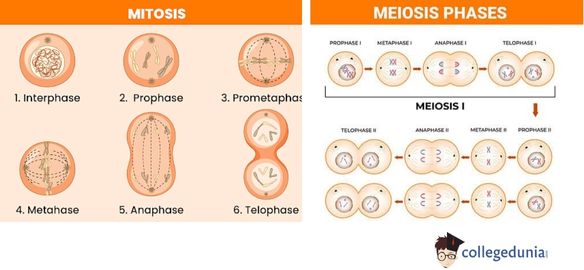
Mitosis and Meiosis Diagram
Similarities between Mitosis and Meiosis
[Click Here for Sample Questions]
Besides both being cell division processes, there are some other similarities between mitosis and meiosis are as follows:
- The synthesis of DNA is primarily common in both mitosis and meiosis.
- The process of mitosis and meiosis are divided into five distinct phases: Prophase, Metaphase, Anaphase, Telophase, and Cytokinesis.
- Once formed, the cardiac tissue or the nervous system cells will not replicate its daughter or sister cells.
- Both mitosis and meiosis takes place in the nucleus of the cell.
- The methods of cell division of mitosis and meiosis are visible only under an electron microscope.
Things to Remember
- Mitosis and Meiosis are two different processes of cell division
- Meiosis is for the genetic variation and is required for the continuity of the living organism.
- It plays an important role in repairing the genetic defect in germline cells
- Mitosis is for the growth and development of cells.
- It is responsible for transfering of a parent cell's genome into daughter cells.
Sample Questions
Ques. In which phase, the non-paired chromosomes are lined up in the center? (1 mark)
(A) Metaphase I
(B) Metaphase II
(C) Anaphase II
(D) Prophase I
Ans. B. Metaphase II
Explaination: Metaphase is a process of cell cycle in which chromosomes are at the condensed stage and align with the equator of the spindle poles.
Ques. The number of chromosomes in the Meiosis result is ______ the number of parent cells. (1 mark)
(A) Twice
(B) Half
(C) Equal
(D) None of the above
Ans. B. Half
Explaination: Meiosis is responsible for shuffling genes between two chromosomes which is transferred to genetic combinations in every gamete.
Ques. What is it called, when the two parents' cells join together to form offspring? (1 mark)
(A) Asexual reproduction
(B) Meiosis
(C) Sexual Reproduction
Ans. C. Sexual Reproduction
Explaination: Sexual Reproduction is defined as the process the production of new organisms by genetic information between two individuals of different sexes. In this zygote is composed of cells of two chromosomes.
Ques. What is Mitosis? (4 marks)
Ans. Mitosis is a process of replication or duplication of chromosomes. It is divided into preprophase, prophase, prometaphase, metaphase, anaphase, and telophase. In this two identical daughter cells are produced through this process.
- The process is further controlled by several genes.
- Any kind of irregularities in the genes may cause serious health issues like cancer.
- In this process, two diploid cells are formed.
- After the sister chromatids get separated, the spindle fibres get disconnected.
Ques. Explain the term meiosis? (4 marks)
Ans. Meiosis is another process of cell division, which creates copies of the same number of chromosomes in humans. This process results in the formation of sex cells. This is a two-step cell division procedure.
- Meiosis reduces the number of chromosomes by half, 46 to 23.
- Therefore, the new human embryo has 46 chromosomes.
- It has a probability of exhibiting genetic variations from DNA shuffling.
- These chromosomes are formed by the fusion of the egg and sperm.
- Meiosis I and Meiosis II are two types of meiosis division.
Ques. What is the difference between mitosis and meiosis? (5 marks)
Ans. The difference between mitosis and meiosis are as follows:
| Mitosis | Meiosis |
|---|---|
| In the Interphase stage, the chromosomes replicate and genetically identical sister chromosomes are formed. | In the Interphase stage, there will be duplication of DNA, but the chromosomes are not visible. |
| In Prophase 1 stage, the homologous sister chromosomes pair up. The pairing cross-over of non-sister chromatids is called Chiasmata. | After the development of two-identical sister chromatids, mitotic spindles are formed. |
| In the Metaphase plate, the chromosomes get arranged and adjusted. | In the Metaphase plate's equator, the Chromosomes get organized. |
| In the Anaphase stage, the homologous pairs move away as reverse poles. | In Anaphase, the sister fibers contract, and sets of daughter cells are observed at each pole. |
| There are 4 daughter cells formed, with half the number of chromosomes. | There are 2 daughter cells formed with the same number of chromosomes as in the parent |
Ques. What are the similarities between meiosis and mitosis? (3 marks)
Ans. The similarities between meiosis and mitosis are as follows:
- In both mitosis and meiosis, the synthesis of DNA is quite common.
- In the process, the nervous system will not duplicate into daughter or sister cells.
- The process is same for cardiac tissue.
- The methods of cell division are visible only under an electron microscope
Ques. Explain the stages of meiosis? (4 marks)
Ans. The stages of meiosis are as follows:
- Interphase: In this phase, each chromosome is replicated into two identical daughter chromatids. The phase does not take place technically.
- Prophase: In this phase, each of the chromosomes appears as two identical sisters. At this stage, chromosomes become condensed.
- Metaphase: In this phase, the chromosomes are assembled at the equator of the spindle.
- Anaphase: In this phase, the spindle fibre formed at the equator begins to contract in shape. This helps sister chromatids to become apart.
Ques. Explain the stages of mitosis? (4 marks)
Ans. The stages of mitosis are as follows:
- Interphase: In this phase, chromosomes are not visible during the cell division. In the process, DNA is duplicated or replicated.
- Prophase: In this phase, similar sister chromatids are exchanged with the non-sister chromatids. The crossing over between sister chromatids is called chiasmata.
- Metaphase: In this phase, chromosome shapes remain intact and remain in the state of bivalent.
- Anaphase: In this phase, the chromosome moves towards different positions of the equator at the spindle.
Ques. What is the difference between sexual and asexual reproduction? (3 marks)
Ans. The difference between sexual and asexual reproduction are as follows:
| Sexual Reproduction | Asexual Reproduction |
|---|---|
| In sexual reproduction, gamemetes are formed during the cell division. | In asexual reproduction, gametes are nor formed during the cell division. |
| Both meiosis and mitosis take place in this type of reproduction. | Only mitosis take place in this type of reproduction. |
| In this daughter cell inherit the characteristics of both the parents. | In this daughter cell inherit the characteristic of one parent cell. |
Ques. Explain the cell division of bacteria? (3 marks)
Ans. Cell division in bacteria takes place by the process of binary fission or budding. In this process, the divisome, which is a complex protein compound, is responsible for the cell division within the bacteria. During the process, the constriction of the bacteria's inner and outer membrane occurs. In the next phase, remodelling of the peptidoglycan cell wall takes place. The tubulin protein is responsible for the formation of contractile rings during the process of cell division of bacteria.
Ques. What is cell division? (2 marks)
Ans. Cell division is a type of cell cycle where parent cells interact and give rise to two daughter cells. This cell grows and replicates its chromosomes before the division of the parent cell takes place. It is divided into vegetative division and non-vegetative division. The process of cell division takes place in bacteria, eukaryotes and prokaryotes.
Ques. What is Spermatogenesis? (2 marks)
Ans. Spermatogenesis is defined as the cell division process which occurs during puberty at the bottom of the seminiferous tubules. The process is initiated inside male reproductive system. In male, the process begins at the basement membrane of tubules. with the help of meiosis primary spermatocyte cell divides into two secondary spermatocytes cells.
Ques. What is the difference between unicellular and multicellular organisms? (4 marks)
Ans. The difference between unicellular and multicellular organisms are as follows:
| Unicellular Organisms | Multicellular Organisms |
|---|---|
| In unicellular organism, there is only one cell. | In multicellular organisms, there are more than one cell. |
| It can perform one function at a time. | Since there are multiple cells, such organisms can perform multiple functions. |
| The lifespan of such organisms are short. | The lifespan of such organisms are long. |
| These organisms are microscopic in nature. | These organisms are macroscopic in nature. |
| For example: bacteria | For example: Human |





Comments