



Education Journalist | Study Abroad Lead
Canada will continue its international student cap in 2026, with Immigration, Refugees and Citizenship Canada (IRCC) projecting up to 408,000 study permits issued next year—including 155,000 for newly arriving students and 253,000 extensions for current/returning students. IRCC says the 2026 issuance target is 7% lower than 2025 and 16% lower than 2024 as Canada works to reduce its temporary resident population share to below 5% by end-2027.
For Indian applicants, the most immediate impact is on cohorts that still require a Provincial/Territorial Attestation Letter (PAL/TAL)—primarily undergraduate and many non-degree programs—because IRCC has now published province-wise targets and allocations tied to the cap.
Check:
- Canada Sets New Immigration Rules for Foreign Students and Workers in 2026
- Top Universities in Canada
Key changes announced
IRCC’s notice (dated November 25, 2025) confirms that from January 1, 2026, master’s and doctoral students enrolled at public DLIs will be PAL/TAL-exempt. Other PAL/TAL-exempt groups include K–12 students, select federal priority/vulnerable cohorts, and extensions at the same DLI and same study level.
IRCC’s national 2026 issuance targets by cohort are:
- Master’s & PhD at public DLIs (PAL/TAL-exempt): 49,000
- K–12 (PAL/TAL-exempt): 115,000
- Other PAL/TAL-exempt applicants: 64,000
- PAL/TAL-required cohorts: 180,000
- Total: 408,000
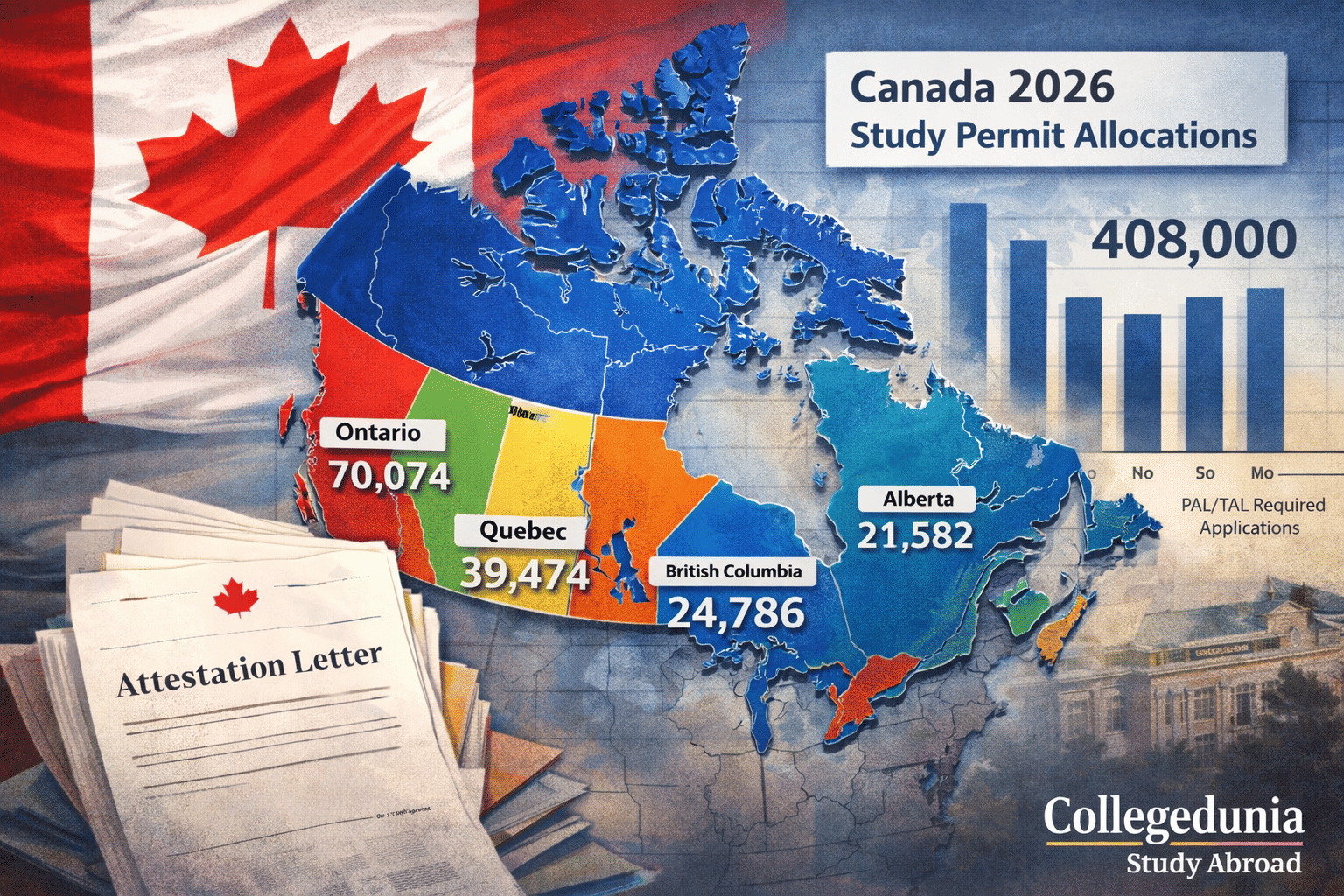
Province-wise targets for PAL/TAL-required cohorts (permits to be issued)
IRCC says up to 180,000 permits are expected to be issued to students who require a PAL/TAL, and it distributes this issuance target across provinces/territories.
| Province/Territory | 2026 target (PAL/TAL-required permits) |
|---|---|
| Ontario | 70,074 |
| Quebec | 39,474 |
| British Columbia | 24,786 |
| Alberta | 21,582 |
| Manitoba | 6,534 |
| Saskatchewan | 5,436 |
| Nova Scotia | 4,680 |
| New Brunswick | 3,726 |
| Newfoundland & Labrador | 2,358 |
| Prince Edward Island | 774 |
| NWT | 198 |
| Yukon | 198 |
| Nunavut | 180 |
Source: IRCC, Nov 25, 2025.
“Allocations” are higher than targets — here’s why
IRCC separately assigns 2026 allocations for PAL/TAL-required applications based on recent approval rates. These allocations reflect how many applications provinces/territories are expected to submit to reach issuance targets after refusals. The total allocation is 309,670 PAL/TAL-required applications.
Top allocations include Ontario (104,780), Quebec (93,069), B.C. (32,596) and Alberta (32,271).
Impact on Indian students
- Undergraduate and many non-degree applicants (PAL/TAL-required) face a tighter, province-linked pipeline, especially in Ontario and B.C., where demand is traditionally high.
- Master’s/PhD aspirants at public institutions get a clearer filing path from Jan 1, 2026 because the PAL/TAL requirement is removed for this group.
If you need a PAL/TAL, track your province’s stance on how it issues attestation letters because IRCC’s cap mechanics for 2026 hinge on those cohorts. Graduate applicants should still confirm their program and institution are within the public DLI category once IRCC publishes its “eligible public DLI programs” list.

1791978705.png?tr=w-305,h-145,c-force?h=40&w=40&mode=stretch)



Comments