


Education Journalist | Study Abroad Strategy Lead
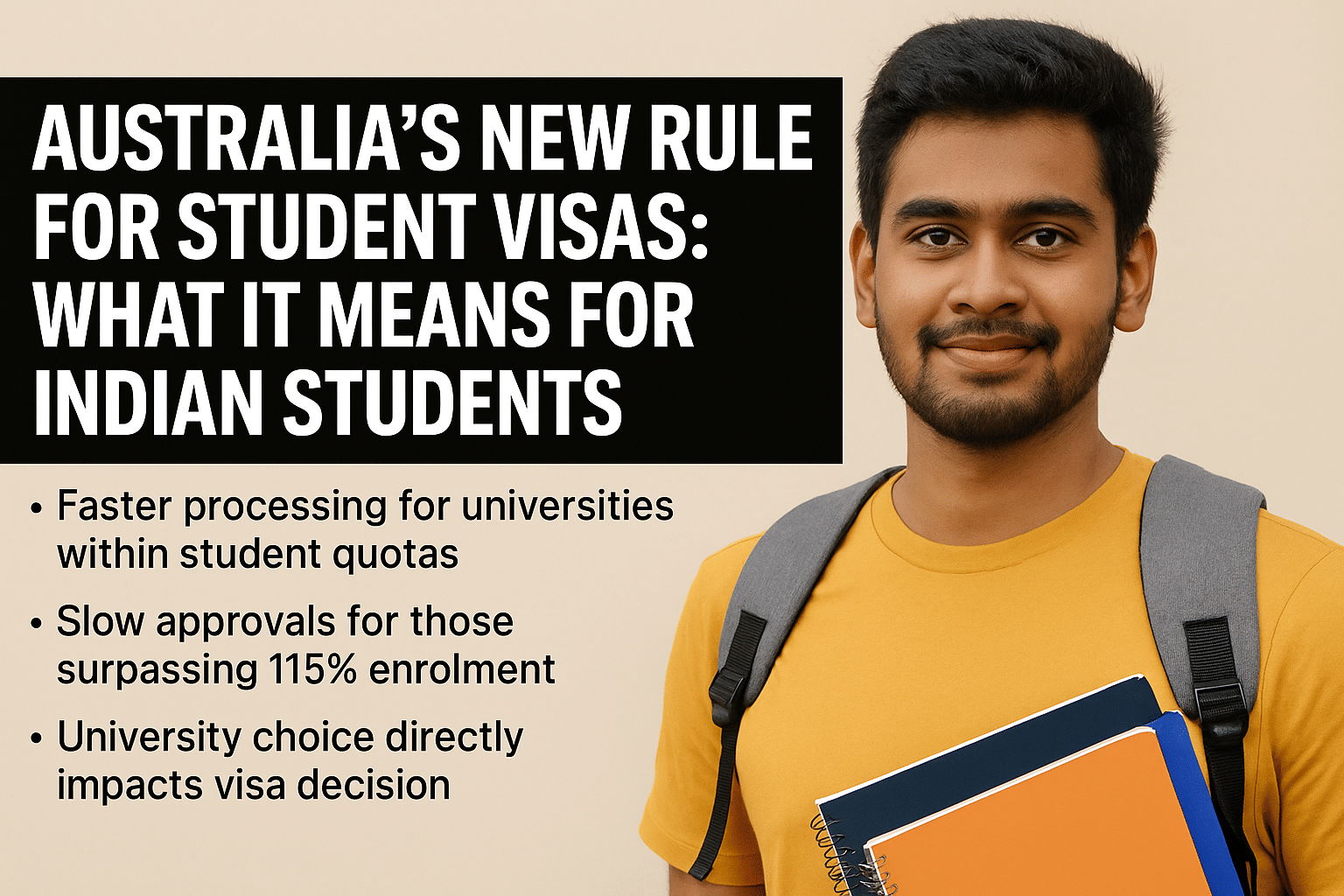
From November 14 onward, Australia will process student visa applications based on how responsibly universities manage their enrolments. The new “Ministerial Direction 115” could mean faster visas for some — and delays for others. The government says this approach aims to create a fairer, more balanced international education ecosystem by rewarding compliant providers and easing pressure on oversaturated metro universities. For Indian students, this means the choice of institution could now directly influence how quickly their visa is processed.
Check Out: Study in Australia for Indian Students
TL;DR
- Effective 14 Nov 2025: Australia’s MD 115 introduces “fast,” “standard,” and “slow” lanes for Australian student visa processing.
- Universities with over 115 % capacity = slower visas.
- Regional and compliant providers = faster approvals.
- Indian students should apply early and verify institution status before filing.
Check Out: Top Australian Universities
What’s Changing?
Australia’s Department of Home Affairs has replaced Ministerial Direction 111 with Ministerial Direction 115 (MD 115) — a major policy shift in how Subclass 500 student visas are prioritised. 1The new system creates three processing “lanes” tied to each institution’s share of international students:
| Priority Lane | Provider’s Enrolment Ratio | Processing Speed |
|---|---|---|
| Fast-Track (Lane 1) | Below 80 % of target | Quick approvals |
| Standard (Lane 2) | 80–115 % of target | Normal pace |
| Slow Lane (Lane 3) | Above 115 % of target | Delayed processing |
The rule applies to offshore applications lodged on or after 14 Nov 2025. Earlier filings stay under the old MD 111 criteria.
Why the 115 Rule Was Introduced?
Australia’s international-education sector had ballooned, straining accommodation and compliance systems. Between 2024 and 2025:
- Visa lodgements dropped 26 %, and
- Course commencements fell 16 %,
as the government moved to make growth more sustainable.
MD 115 is meant to reward providers who stay within limits and slow approvals for those over-recruiting, especially in metro hubs. It also nudges students toward regional universities and TAFEs with spare capacity.
Check Out: Intakes in Australia
Impact on Indian Students
For Indian aspirants eyeing the 2026 intake:
- Institution choice now affects speed. Pick a university already over 115 % of its target, and your visa may sit in the “slow lane.”
- Regional providers gain an advantage. Colleges in smaller cities may process faster under MD 115.
- Delays ≠ rejection. Slower doesn’t mean denied — it just changes queue position.
- Documents matter more. Complete financials and a strong SOP for Australia help avoid credibility interviews or extra scrutiny.
- Apply early. Expect a lag as the system transitions through late 2025; early applications avoid backlogs.
What’s Different from MD 111?
MD 115 adds a clear three-tier structure and introduces a formal “slow lane.”
Greater transparency — institutions can gauge which tier they fall into.
Regional balance becomes an explicit goal: smaller and vocational providers will see fairer access to student allocations.
For Indian Students: Quick Checklist
- Ask your university where it stands vs. its 2025–26 enrolment quota.
- Prefer regional or quota-compliant institutions for smoother processing.
- Confirm your offer and submit visa documents early (funds + GS proof + SOP).
- Track updates via Home Affairs or your university’s international office.
- Remember: MD 115 reshuffles priorities — it doesn’t close doors.





Comments