



Study Abroad Expert | Updated On - Sep 18, 2026
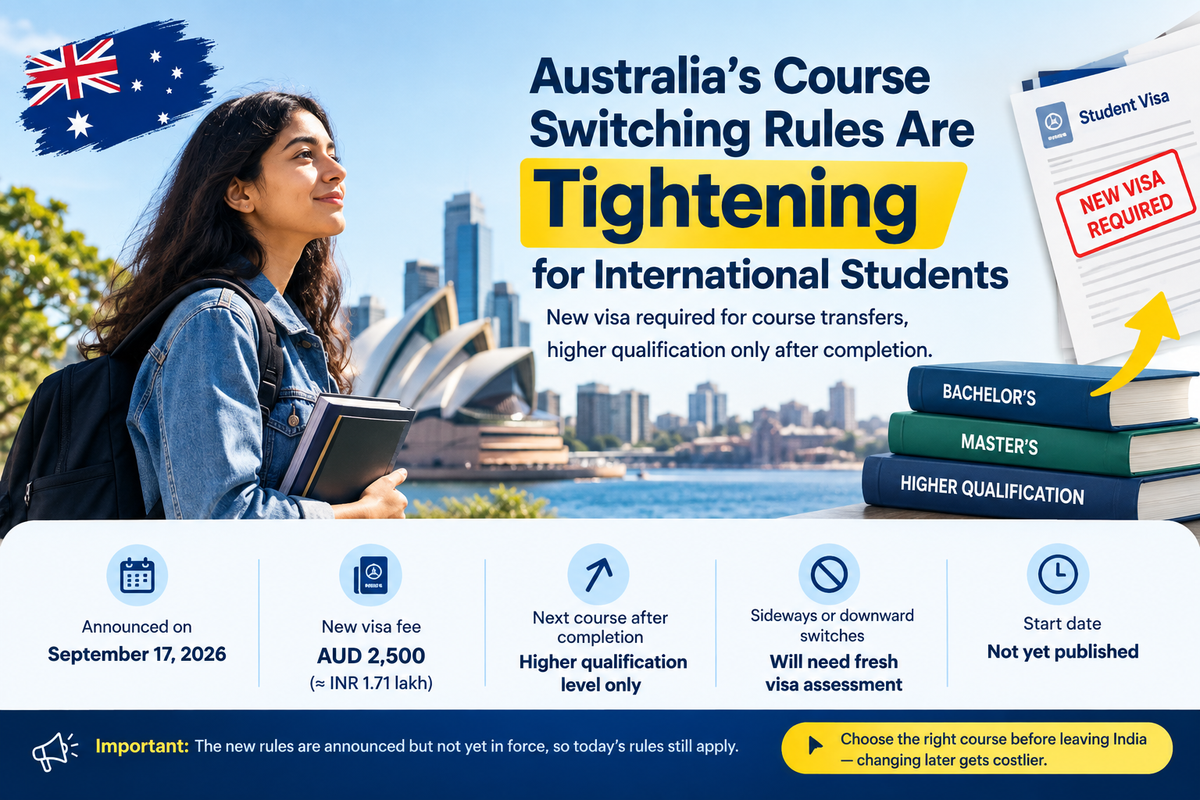
Australia's course switching rules are tightening for international students. On September 17, 2026, Minister Tony Burke said course transfers will need a new student visa. After finishing a course, students may only move up a qualification level. No start date has been published yet. A new visa costs AUD 2,500 (around INR 1.71 lakh) at today's fee.
- The new-visa rule is announced but not yet in force, so today's rules still apply.
- Moving up a level stays open, for example from bachelor's to master's.
- Sideways or downward switches will face a fresh visa assessment.
- Choose the right course before leaving India, because changing later gets costlier.
Check Australia Student Visa (Subclass 500) Guide
Quick Facts on Australia Course Switching Rules
| Parameter | Detail |
|---|---|
| Announced on | September 17, 2026 |
| Course transfers (announced) | New student visa required |
| Next course after completion (announced) | Higher qualification level only |
| Start date of the new rules | Not yet published |
| GDML closed to new overseas students | From October 5, 2026 |
| Standard Student visa fee | AUD 2,500 (around INR 1.71 lakh) since July 1, 2026 |
| Provider transfer lock (current rule) | First 6 months of the principal course |
Conversions based on an AUD-INR rate of INR 68.30 as of September 18, 2026. Rates fluctuate. Check the current rate before financial planning.
What the New Course Switching Rules Change
The announced rules add a visa check to every course transfer. Home Affairs Minister Tony Burke set out the plan at the National Press Club on September 17, 2026. His office listed it as stopping visa hopping and restricting family members on most student visas.
Visa hopping means moving from visa to visa or course to course, mainly to extend a stay. Burke said students who transfer courses will need to apply for a new visa. Students who complete a course will only be able to move to a higher qualification.
He gave the example of a bachelor's graduate applying for a master's course. Hopping between institutions for a migration outcome would "come to an end as a model," he said.
How the announced plan compares with today's position:
| Situation | Rule Today | Announced Change |
|---|---|---|
| Transfer to another course mid-study | New visa only for a lower-level or non-award course | New visa for course transfers |
| Next course after finishing | Any level on a new visa, subject to the Genuine Student test | Higher qualification level only |
| Partner and children | Can join as secondary applicants | Restricted on most student visas |
| Start date | In force now | Not yet published |
The government will make these changes through regulations and visa conditions, not new laws. No start date or transition rules had appeared as of September 18, 2026.
Course Switching Rules That Apply Right Now
Until the new rules start, four existing rules decide whether a course change is safe. The announcement does not replace them.
| Rule | What It Means | In Force Since |
|---|---|---|
| Visa condition 8202 | Stay at the same or a higher course level, or get a new visa | Current Student visa condition |
| Standard 7 transfer lock | No provider change in the first six months of the principal course without a release | National Code 2018 |
| CoE (Confirmation of Enrolment) for onshore visas | A letter of offer is no longer accepted | January 1, 2025 |
| No onshore switch from visitor or graduate visas | Holders must apply for a Student visa from outside Australia | July 1, 2024 |
Source: Home Affairs condition 8202 fact sheet, National Code 2018 Standard 7 and Home Affairs announcements.
Condition 8202 matters most for course changes. It requires enrolment at the same or higher Australian Qualifications Framework (AQF) level as the visa's course. The AQF is Australia's ladder of qualifications, where a bachelor's sits at level 7 and a master's at level 9.
Moving to a lower AQF level or a non-AQF award needs a new Student visa. This applies even at the same provider. The only exception is a move from a doctorate to a master's.
Standard 7 adds a timing lock. A new provider cannot enrol a transferring student before six calendar months of the principal course. The main exception is a written release from the current provider. The principal course is usually the last course in a study package.
Every new Student visa also goes through the Genuine Student requirement check.
Why Australia Is Targeting Course Hopping
The government says repeat course and visa changes let some people stay for years without a genuine study plan. Burke described visa hopping as a genuine problem in his speech.
The pattern built up over several years. Students on a second or later Student visa grew by over 30% to more than 150,000 in 2022-23. Then Home Affairs Minister Clare O'Neil cited that figure in June 2024.
She also cited Grattan Institute research showing 32% of Temporary Graduate visa holders returned to study when their visa expired. That finding backed the July 2024 ban on onshore Student visa applications from those holders.
Migration targets add pressure. Net overseas migration fell to 292,000 in the year to March 2026, down 47% from the post-Covid peak. The government now wants 245,000 in 2026-27 and 225,000 in 2027-28.
Source: Minister for Home Affairs statements.
Key Insight: The target is repeat hopping, not study itself. Students who move steadily up the qualification ladder remain the model the government describes.
Burke also argued that international education supports jobs across Australia. He warned that drastic cuts in any area would hurt the economy.
Course Closure Hits a Popular Switching Pathway
The government has already shut one course that thousands of students used to switch. It cancelled the CRICOS registration of the BSB80120 Graduate Diploma of Management (Learning), known as the GDML. CRICOS is Australia's register of courses open to international students.
From October 5, 2026, providers cannot issue new CoEs for the GDML or start new overseas students in it. Students who began before that date can finish. This is the first use of new course cancellation powers under the Education Services for Overseas Students (ESOS) Act.
| GDML Indicator | Figure |
|---|---|
| Transfers into the course in 2020 | 510 |
| Transfers into the course in 2025 | 4,000 |
| Transfers coming from higher education | 77% |
| VET (vocational) providers registered to deliver it | 452 |
| Active confirmed enrolments | 41,033 |
| Students currently studying it | 15,772 |
Source: Department of Education fact sheets and government figures reported by ABC News (September 2026).
Students could move into the GDML without always needing a new visa. Almost half of those approved to enrol in 2025 never started. Completion rates also trailed other VET courses.
Other postgraduate diplomas remain open and are compared in PG diploma courses in Australia.
Which Course Changes Stay Allowed in Australia
Moving up the qualification ladder stays open under both today's rules and the announced plan. Burke's own example was a bachelor's graduate starting a master's.
| Move | Today | Under the Announced Plan |
|---|---|---|
| Bachelor's graduate to a master's | Allowed | Allowed |
| Master's graduate to a diploma | Possible on a new visa, subject to the Genuine Student test | Not allowed |
| Mid-study switch at the same level | Allowed without a new visa, with the six-month lock for provider changes | New visa needed |
| Mid-study switch to a lower level | New visa needed | New visa needed |
| Doctorate to a master's | No new visa needed | Details not yet published |
Source: Home Affairs condition 8202 guidance and ABC News coverage of the September 17 speech.
What the announcement confirms and does not confirm:
- Confirms: a new visa for course transfers and higher-level moves after completion.
- Does not confirm: a start date or transition rules for current students.
- Does not confirm: the full list of exceptions, such as illness or provider closure.
The family change has clearer exceptions. Pacific and ASEAN nationals can still bring family. So can students in some courses such as PhDs. Families already in Australia will not be separated.
Students planning the bachelor's to master's route can compare options in MS in Australia.
What Course Switching Rules Mean for Indians
Indian students form one of the largest groups affected by the change. India accounted for 16% of the 680,582 international students in Australia in the year to May 2026. That is roughly 1.1 lakh students, second only to China. Master's by coursework was the most popular higher education level, at 43%. Management and commerce led enrolments in both universities and VET.
Source: Department of Education international student monthly summary (May 2026).
Each new Student visa costs AUD 2,500 (around INR 1.71 lakh) since July 1, 2026, as reported by Business Standard. The fee trend is broken down in Australia's visa fee hike for Indian students.
What a student told SBS Hindi: "A Melbourne computer science student said the constant rule changes felt overwhelming. She had to apply for a new visa just to finish one last unit."
Choosing a university and course that fit the full plan now matters more than a cheap first option.
How to Plan a Course Change Safely
A safe course change starts with the AQF level, the six-month lock and the right paperwork. The steps below follow today's rules, which apply until new regulations start.
- Compare the AQF level of the new course with the course on the visa grant.
- Count six calendar months from the start of the principal course.
- Ask the current provider for a written release if six months have not passed.
- Secure the new CoE before lodging any new Student visa application.
- Write down how the new course fits past study and career goals.
- Check Home Affairs updates before acting, since the new rules may start soon.
If the new course sits at a lower AQF level, then a new Student visa is needed today. That means paying AUD 2,500 and passing the Genuine Student test again. If the principal course started less than six months ago, then a provider change needs a written release. That means speaking to the current provider before accepting any new offer.
Current processing speeds for new applications are tracked in Australia's Student visa processing update.
What Happens Next on Course Switching Rules
The detailed course switching rules will come through regulations and ministerial directions. Home Affairs had not published a timetable as of September 18, 2026.
Burke also named reforms that would need new laws. They include an expression of interest system to control student arrivals. Labor has no clear path to pass those laws yet.
Key dates in Australia's crackdown on course and visa hopping:
| Date | What Happened |
|---|---|
| July 1, 2024 | Visitor and Temporary Graduate visa holders barred from onshore Student visa applications |
| January 1, 2025 | CoE required for onshore Student visa applications |
| July 1, 2026 | Standard Student visa fee rises to AUD 2,500 |
| September 2026 | GDML cancelled for new overseas students |
| September 17, 2026 | New-visa rule for course transfers announced |
| October 5, 2026 | GDML closed to new overseas students |
| To be confirmed | Start date for the course transfer rules |
If a February 2027 start is planned, then the first course should be the one to finish. That means settling the course choice before accepting the offer.
Also Check:
Australia's course switching rules are moving from a light touch to a visa check on every transfer. Students who finish a course will only be able to move up a qualification level. The start date and transition rules are still to come. Condition 8202, the six-month lock and the CoE rule decide what is safe until then. Indian students should pick a course they intend to finish before they leave home.
FAQs
Ques. What are Australia's new course switching rules?
Ans. Students who transfer courses will need a new Student visa. Students who finish a course will only be able to move to a higher qualification level. Minister Tony Burke announced both changes on September 17, 2026.
Ques. When do the new course switching rules start?
Ans. No start date has been published yet. The government plans to bring the changes in through regulations and visa conditions. Today's rules apply until then.
Ques. Can I change my course in Australia on a Student visa now?
Ans. Yes, within today's rules. The new course must be at the same or a higher AQF level, or a new visa is needed. Provider changes in the first six months of the principal course need a release.
Ques. Do I need a new visa to change to a lower-level course?
Ans. Yes. Moving to a lower AQF level or a non-AQF award breaches condition 8202 without a new Student visa. The only exception is a doctorate to a master's.
Ques. Can I move from a bachelor's to a master's in Australia?
Ans. Yes. Moving up a qualification level stays open under the announced plan. Burke used the bachelor's to master's route as his own example.
Ques. What is the six-month rule for changing providers?
Ans. Under Standard 7, a student cannot move to another provider before six calendar months of the principal course. A written release from the current provider is needed before then.
Ques. What happened to the Graduate Diploma of Management (Learning)?
Ans. It closes to new overseas students from October 5, 2026. Students who started before that date can finish. The government linked the course to heavy onshore transfers.
Ques. How much does a new Australian Student visa cost?
Ans. AUD 2,500 (around INR 1.71 lakh) for most applicants since July 1, 2026.
Ques. Can international students still bring family to Australia?
Ans. Mostly no, once the change starts. Family members will be restricted on most Student visas. Pacific and ASEAN nationals are exempt. So are some courses such as PhDs.
Ques. Will the new rules affect students already in Australia?
Ans. Transition rules have not been published. Burke said families already in Australia would not be separated. Current students should watch for Home Affairs updates before changing course.



Comments