



The Himachal Pradesh Board of School Education (HPBOSE) successfully conducted the Class 12 Chemistry Exam 2026 on March 23, 2026. HP Board Class 12 2026 Chemistry Question Paper with Solution PDF is now available for download.
The HP Board Class 12 Chemistry paper covered key topics from organic chemistry, inorganic chemistry, physical chemistry, and environmental chemistry. Students should focus on understanding chemical reactions, molecular structures, balancing equations, and applying chemical concepts. The exam is marked out of 100, with 60 marks for the theory paper and 40 for practical work and internal assessment.
HP Board Class 12 2026 Chemistry Question Paper with Solution PDF
| HP Board Class 12 Chemistry Question Paper 2026 with Solution PDF | Download PDF | Check Solution |

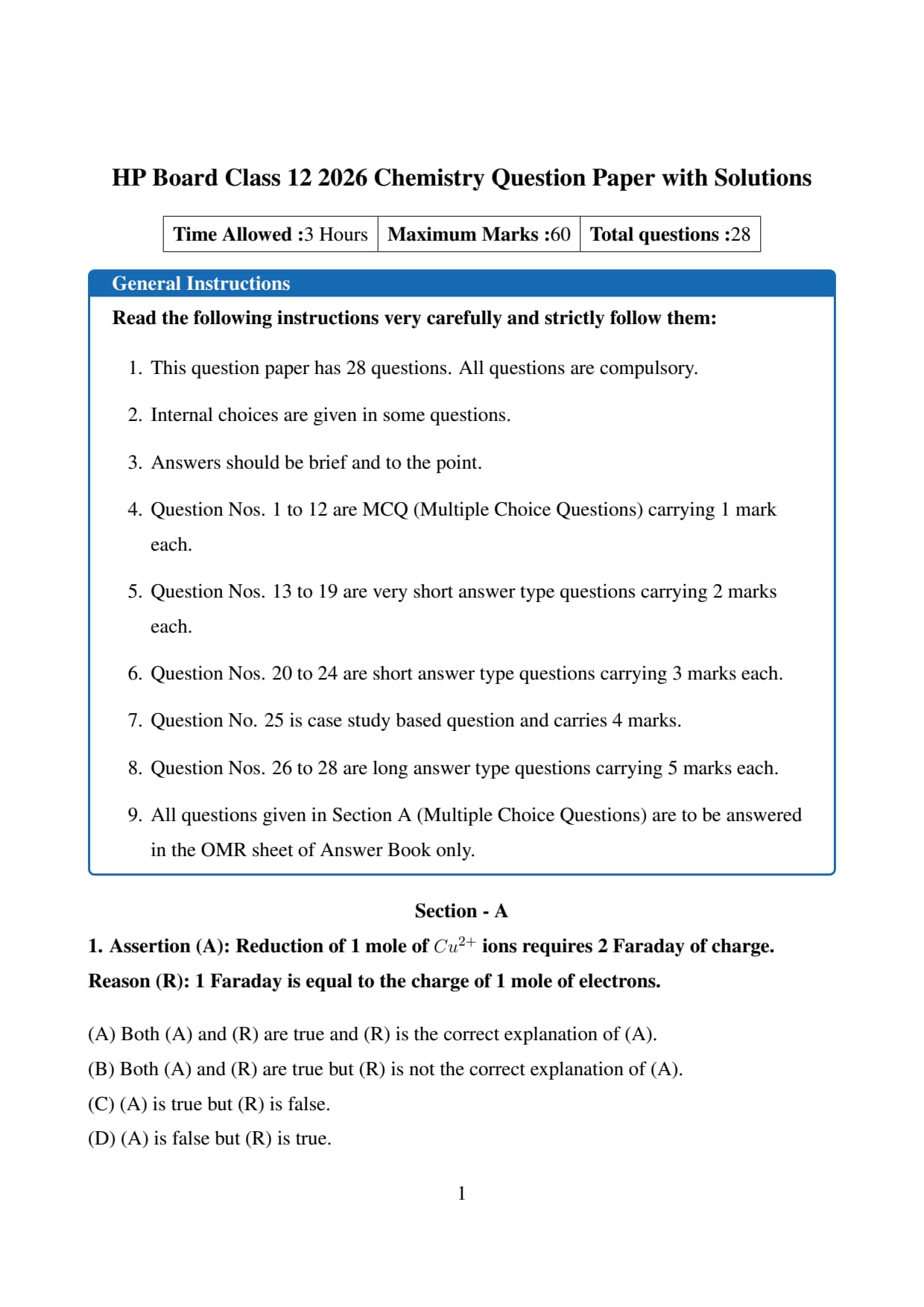
Assertion (A): Reduction of 1 mole of \(Cu^{2+}\) ions requires 2 Faraday of charge.
Reason (R): 1 Faraday is equal to the charge of 1 mole of electrons.
View Solution
Step 1: Understand the reduction of \(Cu^{2+}\).
The reduction of copper ion is represented as: \[ Cu^{2+} + 2e^- \rightarrow Cu \]
This equation shows that 1 mole of \(Cu^{2+}\) ions requires 2 moles of electrons for complete reduction.
Step 2: Recall the meaning of 1 Faraday.
1 Faraday is the charge carried by 1 mole of electrons. Therefore: \[ 1 mole of e^- = 1 Faraday \]
Hence, 2 moles of electrons will require: \[ 2 Faraday \]
Step 3: Evaluate Assertion and Reason.
The Assertion says that reduction of 1 mole of \(Cu^{2+}\) needs 2 Faraday of charge. This is correct.
The Reason says that 1 Faraday is equal to the charge of 1 mole of electrons. This is also correct.
Since the reduction needs 2 moles of electrons, and each mole of electrons carries 1 Faraday charge, the Reason correctly explains the Assertion.
Step 4: Conclusion.
Therefore, both Assertion and Reason are true, and the Reason is the correct explanation of the Assertion.
Final Answer: Both (A) and (R) are true and (R) is the correct explanation of (A). Quick Tip: Always use the half-reaction to count electrons. If 1 mole of ions needs 2 moles of electrons, then the charge required is 2 Faraday.
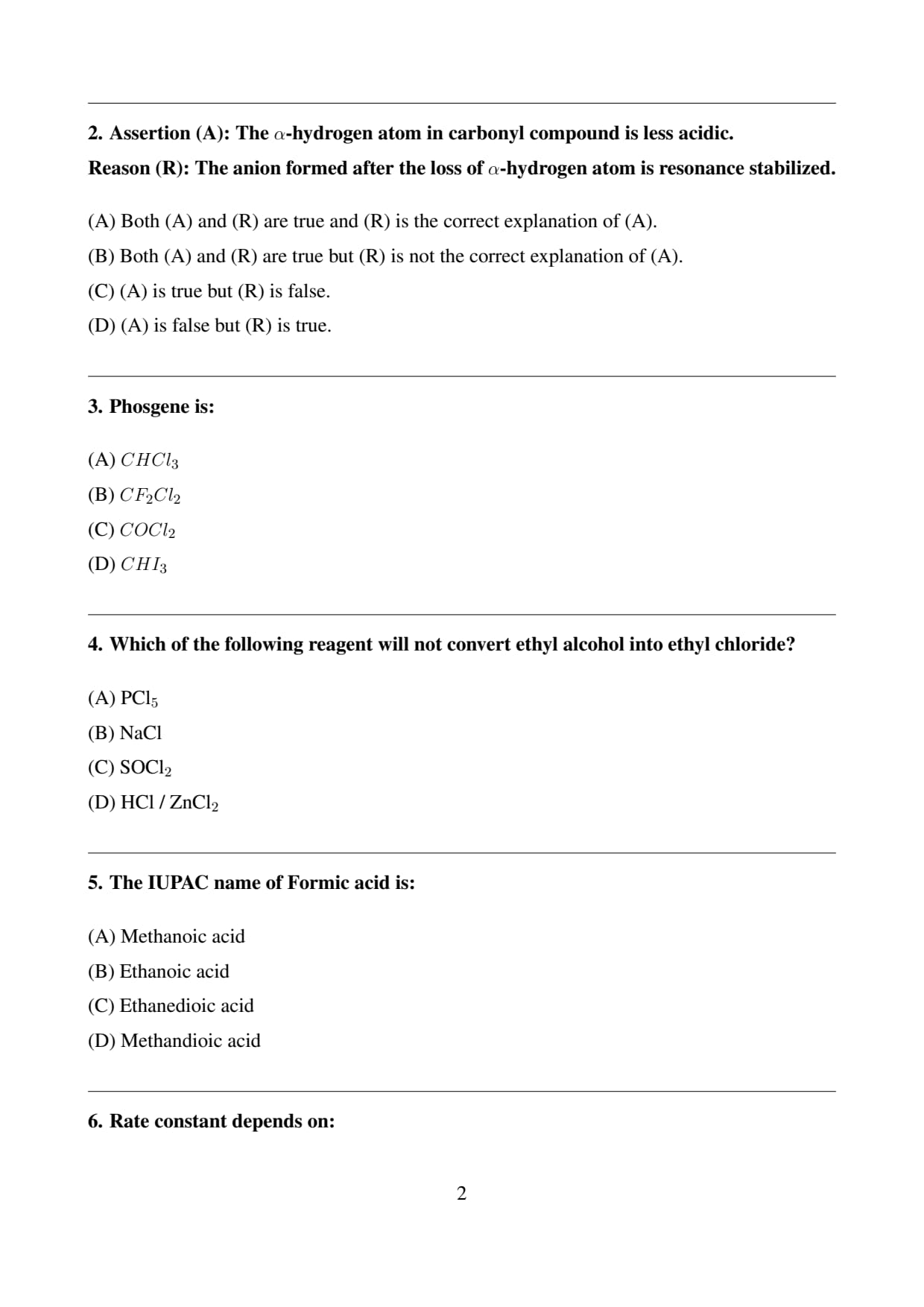
Assertion (A): The \(\alpha\)-hydrogen atom in carbonyl compound is less acidic.
Reason (R): The anion formed after the loss of \(\alpha\)-hydrogen atom is resonance stabilized.
View Solution
Step 1: Understand \(\alpha\)-hydrogen in carbonyl compounds.
In aldehydes and ketones, the hydrogen attached to the carbon next to the carbonyl group is called the \(\alpha\)-hydrogen. These hydrogens are comparatively acidic. They can be removed by a base to form an enolate ion.
Step 2: Check the Assertion.
The Assertion states that the \(\alpha\)-hydrogen atom in carbonyl compound is less acidic. This statement is incorrect because \(\alpha\)-hydrogen is actually more acidic than normal alkane hydrogen. Hence, the Assertion is false.
Step 3: Check the Reason.
When an \(\alpha\)-hydrogen is removed, the resulting anion is an enolate ion. This anion is stabilized by resonance: \[ Enolate ion \leftrightarrow Resonance structures \]
Because of this resonance stabilization, removal of \(\alpha\)-hydrogen becomes easier. So, the Reason is true.
Step 4: Conclusion.
Therefore, the Assertion is false, but the Reason is true.
Final Answer: (A) is false but (R) is true. Quick Tip: \(\alpha\)-Hydrogen in carbonyl compounds is acidic because the conjugate base formed after its removal is resonance stabilized.
Phosgene is:
View Solution
Step 1: Recall the common name Phosgene.
Phosgene is the common name of carbonyl chloride. It is a highly toxic compound that was historically used as a chemical warfare agent and is also important in industrial chemistry.
Step 2: Write its chemical formula.
Carbonyl chloride contains one carbonyl group and two chlorine atoms, so its molecular formula is: \[ COCl_2 \]
Step 3: Compare with the options.
(A) \(CHCl_3\): This is chloroform, not phosgene.
(B) \(CF_2Cl_2\): This is freon-12, not phosgene.
(C) \(COCl_2\): Correct. This is phosgene.
(D) \(CHI_3\): This is iodoform, not phosgene.
Step 4: Conclusion.
Therefore, phosgene is represented by the formula \(COCl_2\).
Final Answer: \(COCl_2\). Quick Tip: Remember these common names: \(CHCl_3\) is chloroform, \(CHI_3\) is iodoform, and \(COCl_2\) is phosgene.
Which of the following reagent will not convert ethyl alcohol into ethyl chloride?
View Solution
Step 1: Identify the reaction involved.
The question asks which reagent cannot convert ethyl alcohol \(\left(C_2H_5OH\right)\) into ethyl chloride \(\left(C_2H_5Cl\right)\). This is a substitution reaction in which the \(-OH\) group of alcohol is replaced by chlorine.
Step 2: Check the reagents that can perform this conversion.
Several chlorinating reagents are commonly used to convert alcohols into alkyl chlorides:
PCl\(_5\): Converts alcohol into alkyl chloride.
SOCl\(_2\): Also converts alcohol into alkyl chloride very effectively.
HCl / ZnCl\(_2\): This is Lucas reagent, which also helps in converting alcohol into alkyl chloride.
Step 3: Analyze the incorrect reagent.
NaCl is only a simple salt and does not act as a chlorinating agent for converting ethyl alcohol into ethyl chloride under normal conditions. It cannot replace the hydroxyl group of alcohol by chlorine in this reaction.
Step 4: Conclusion.
Therefore, the reagent which will not convert ethyl alcohol into ethyl chloride is NaCl.
Final Answer: NaCl. Quick Tip: For conversion of alcohols into alkyl chlorides, remember common reagents like \textbf{PCl\(_5\)}, \textbf{SOCl\(_2\)}, and \textbf{HCl / ZnCl\(_2\)}. A simple salt like \textbf{NaCl} does not do this reaction.
The IUPAC name of Formic acid is:
View Solution
Step 1: Recall the common name and structure.
Formic acid is the common name of the simplest carboxylic acid. Its chemical formula is: \[ HCOOH \]
It contains only one carbon atom.
Step 2: Apply IUPAC naming rules.
In IUPAC nomenclature, the root word for one carbon atom is meth-. Since it is a carboxylic acid, the suffix used is -anoic acid.
So, the IUPAC name becomes: \[ Methanoic acid \]
Step 3: Compare with the given options.
(A) Methanoic acid: Correct.
(B) Ethanoic acid: This is the IUPAC name of acetic acid.
(C) Ethanedioic acid: This is oxalic acid.
(D) Methandioic acid: Incorrect for formic acid.
Step 4: Conclusion.
Hence, the IUPAC name of formic acid is Methanoic acid.
Final Answer: Methanoic acid. Quick Tip: Formic acid is the simplest carboxylic acid with one carbon atom, so its IUPAC name is \textbf{methanoic acid}.
Rate constant depends on:
View Solution
Step 1: Understand the meaning of rate constant.
The rate constant \(k\) is the proportionality constant in the rate law of a chemical reaction. It relates the reaction rate to the concentration terms in the rate equation.
Step 2: Recall the factor affecting rate constant.
For a given reaction, the rate constant mainly depends on temperature. According to the Arrhenius equation, \[ k = A e^{-E_a/RT} \]
so when temperature changes, the value of \(k\) also changes.
Step 3: Check the other options.
Time: The rate constant does not directly depend on time.
Initial concentration: Rate may depend on concentration, but the rate constant itself does not.
None of the above: Incorrect, because temperature does affect the rate constant.
Step 4: Conclusion.
Therefore, the rate constant depends on temperature.
Final Answer: Temperature. Quick Tip: Remember: \textbf{rate} may depend on concentration, but \textbf{rate constant} mainly depends on \textbf{temperature}.
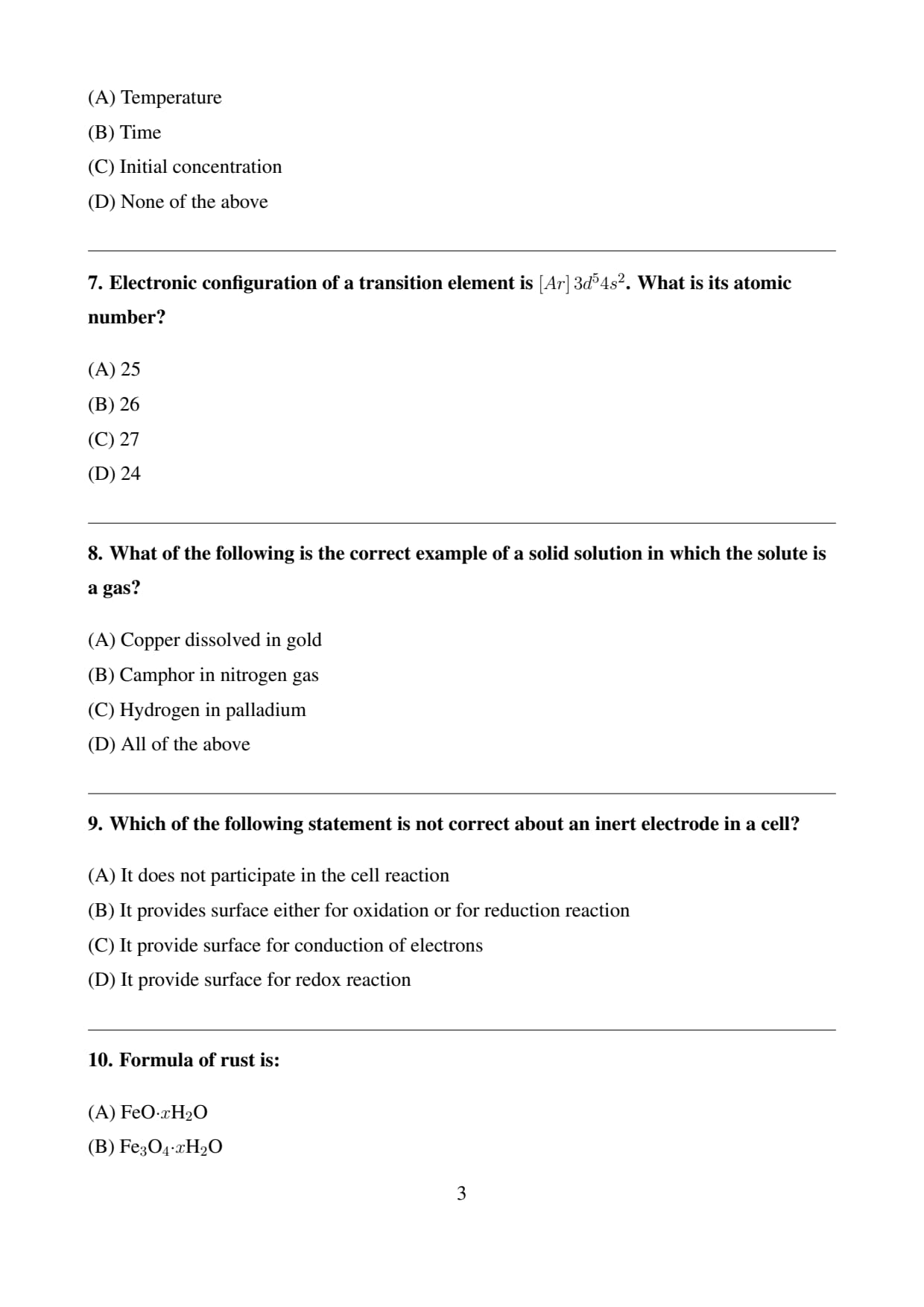
Electronic configuration of a transition element is \([Ar]\,3d^5 4s^2\). What is its atomic number?
View Solution
Step 1: Identify the number of electrons in \([Ar]\).
The noble gas configuration \([Ar]\) represents argon, which has: \[ 18 \]
electrons.
Step 2: Add the remaining electrons.
The given configuration is: \[ [Ar]\,3d^5 4s^2 \]
So, extra electrons beyond argon are: \[ 5 + 2 = 7 \]
Step 3: Find the total atomic number.
Total number of electrons: \[ 18 + 7 = 25 \]
For a neutral atom, the atomic number is equal to the total number of electrons. Therefore, \[ Z = 25 \]
Step 4: Conclusion.
Hence, the element with configuration \([Ar]\,3d^5 4s^2\) has atomic number 25. This element is manganese \((Mn)\).
Final Answer: \(25\). Quick Tip: To find atomic number from electronic configuration, first count the electrons in the noble gas core, then add the remaining electrons.
What of the following is the correct example of a solid solution in which the solute is a gas?
View Solution
Step 1: Understand the meaning of a solid solution.
A solid solution is a homogeneous mixture in which the solvent is a solid. The solute may be solid, liquid, or gas, but the final phase of the solution remains solid. The question specifically asks for a case where the solute is a gas and the medium is a solid.
Step 2: Check each option carefully.
Copper dissolved in gold: This is a solid in solid solution, not gas in solid.
Camphor in nitrogen gas: This is not a solid solution. Here the medium itself is gaseous.
Hydrogen in palladium: Hydrogen gas gets absorbed by solid palladium, forming a gas in solid solution.
All of the above: Incorrect, because only one option matches the condition.
Step 3: Use the standard example from chemistry.
A very common and well-known example of gas dissolved in a solid is hydrogen in palladium. Palladium can absorb a large amount of hydrogen within its structure.
Step 4: Conclusion.
Therefore, the correct example of a solid solution in which the solute is a gas is hydrogen in palladium.
Final Answer: Hydrogen in palladium. Quick Tip: Remember the common examples of types of solutions: \textbf{alloys} are solid in solid, while \textbf{hydrogen in palladium} is the classic example of gas in solid.
Which of the following statement is not correct about an inert electrode in a cell?
View Solution
Step 1: Understand what an inert electrode is.
An inert electrode is an electrode that does not itself take part chemically in the cell reaction. It only acts as a conducting surface. Common examples are platinum and graphite.
Step 2: Identify the role of an inert electrode.
An inert electrode mainly does the following:
provides a surface for either oxidation or reduction half-reaction,
conducts electrons,
remains chemically unchanged during the reaction.
Step 3: Analyze the options.
(A) Correct. It does not participate directly in the chemical reaction.
(B) Correct. It can provide a surface for oxidation or reduction reaction.
(C) Correct. It helps in conduction of electrons.
(D) Not correct in this context, because an inert electrode does not itself act as the site of the complete redox process together. It only provides a surface for one half-cell process at a time.
Step 4: Conclusion.
Hence, the statement which is not correct about an inert electrode is option (D).
Final Answer: It provide surface for redox reaction. Quick Tip: An inert electrode like platinum or graphite does not react chemically. It only provides a conducting surface for a half-cell reaction and helps electron transfer.
Formula of rust is:
View Solution
Step 1: Recall what rust is.
Rust is the reddish-brown substance formed when iron reacts slowly with oxygen and moisture in the presence of water. It is not a pure oxide only, but a hydrated iron(III) oxide.
Step 2: Write the general chemical formula.
The general formula of rust is: \[ Fe_2O_3 \cdot xH_2O \]
Here, \(x\) shows a variable amount of water molecules attached to iron(III) oxide.
Step 3: Compare with the options.
(A) FeO\(\cdot x\)H\(_2\)O: Incorrect. This is hydrated iron(II) oxide.
(B) Fe\(_3\)O\(_4\)\(\cdot x\)H\(_2\)O: Incorrect for the standard formula of rust.
(C) Fe\(_2\)O\(_3\)\(\cdot x\)H\(_2\)O: Correct.
(D) None of the above: Incorrect.
Step 4: Conclusion.
Therefore, the formula of rust is Fe\(_2\)O\(_3\)\(\cdot x\)H\(_2\)O.
Final Answer: \(Fe_2O_3 \cdot xH_2O\). Quick Tip: Rust is \textbf{hydrated ferric oxide}, so always remember its formula as \(Fe_2O_3 \cdot xH_2O\).
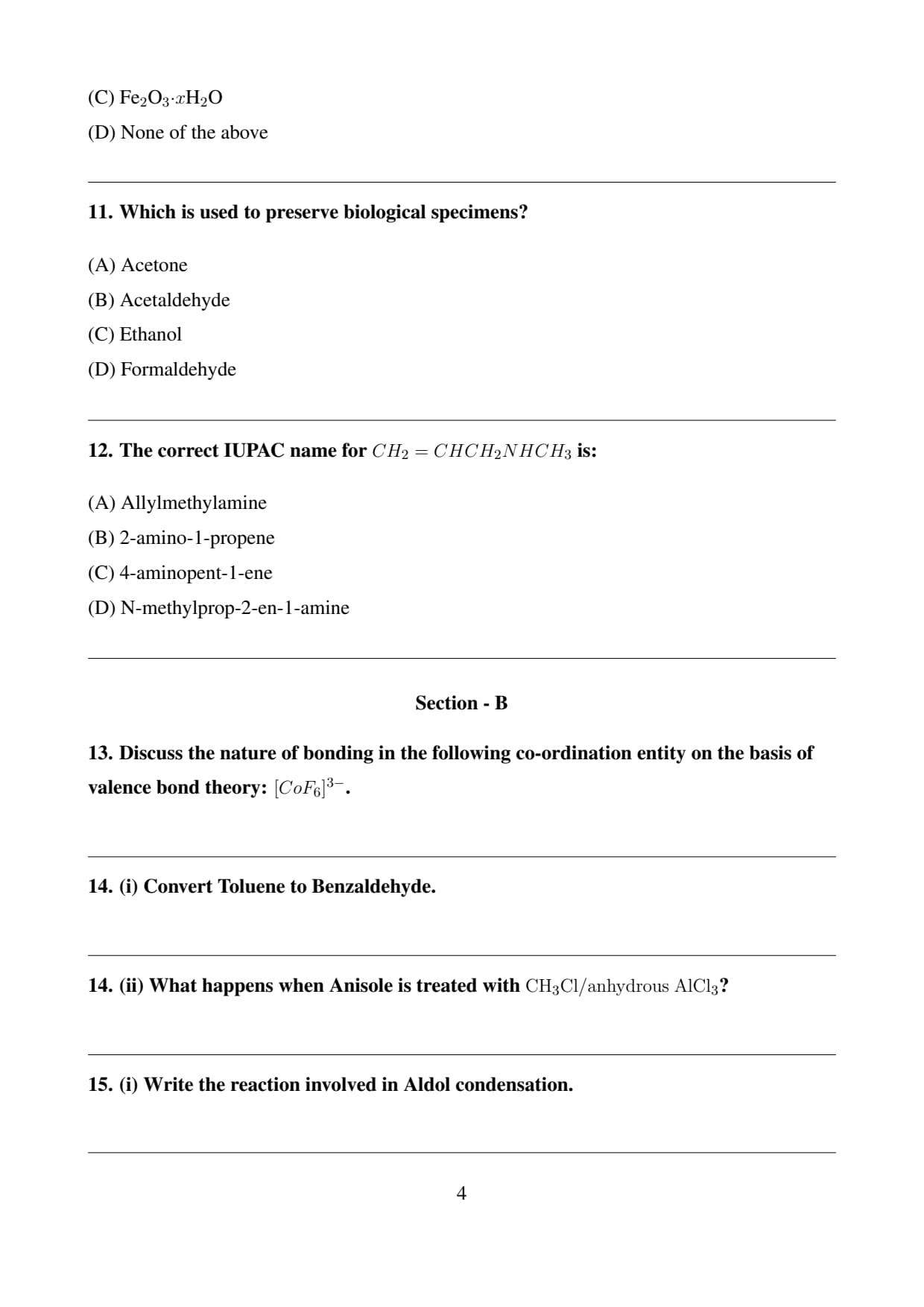
Which is used to preserve biological specimens?
View Solution
Step 1: Understand the requirement of preservation.
Biological specimens are preserved so that they do not decay due to the action of microorganisms or decomposition of tissues. The chemical used should prevent rotting and maintain the specimen for a long time.
Step 2: Recall the commonly used preservative.
Formaldehyde is widely used for preserving biological specimens. In laboratories and museums, it is generally used in the form of formalin, which is an aqueous solution of formaldehyde.
Step 3: Compare with other options.
Acetone: Mainly used as a solvent, not a standard biological preservative.
Acetaldehyde: Not commonly used for specimen preservation.
Ethanol: Can preserve some materials, but the standard answer for biological specimens is formaldehyde.
Formaldehyde: Correct, because it preserves tissues and prevents decomposition.
Step 4: Conclusion.
Hence, the substance used to preserve biological specimens is formaldehyde.
Final Answer: Formaldehyde. Quick Tip: \textbf{Formalin} is the common preservative used in biology labs, and it is a solution of \textbf{formaldehyde}.
The correct IUPAC name for \(CH_2 = CHCH_2NHCH_3\) is:
View Solution
Step 1: Identify the main carbon chain.
The given compound is: \[ CH_2 = CHCH_2NHCH_3 \]
The longest carbon chain attached to the functional group contains 3 carbon atoms and one double bond. So, the parent chain is propene.
Step 2: Locate the amine group and the double bond.
The functional group is an amine \((-NH-)\), and it is attached to the terminal carbon of the 3-carbon chain. Numbering is done from the end nearer to the amine group because amine is the principal functional group.
Thus, numbering starts from the carbon attached to nitrogen: \[ CH_2(NHCH_3)-CH=CH_2 \]
So:
the amine group is at carbon 1,
the double bond is between carbon 2 and carbon 3.
Hence, the parent name becomes: \[ prop-2-en-1-amine \]
Step 3: Identify the substituent on nitrogen.
The nitrogen atom is also attached to a methyl group \((CH_3)\).
A substituent attached directly to the nitrogen atom is written using the prefix N-.
So, the complete name becomes: \[ \textbf{N-methylprop-2-en-1-amine} \]
Step 4: Compare with the given options.
(A) Allylmethylamine: Incorrect. This is a common name, not the correct IUPAC name.
(B) 2-amino-1-propene: Incorrect. It does not correctly represent the nitrogen substitution and proper numbering.
(C) 4-aminopent-1-ene: Incorrect. The molecule has only 3 carbon atoms in the main chain, not 5.
(D) N-methylprop-2-en-1-amine: Correct. This follows IUPAC nomenclature properly.
Step 5: Conclusion.
Therefore, the correct IUPAC name of \(CH_2 = CHCH_2NHCH_3\) is N-methylprop-2-en-1-amine.
Final Answer: N-methylprop-2-en-1-amine. Quick Tip: When naming amines, first choose the longest carbon chain attached to nitrogen, then number from the end nearest the amine group. Any alkyl group directly attached to nitrogen is written with the prefix \textbf{N-}.
Discuss the nature of bonding in the following co-ordination entity on the basis of valence bond theory: \( [CoF_6]^{3-} \).
View Solution
Step 1: Find the oxidation state and electronic configuration of the central metal ion.
In the complex \( [CoF_6]^{3-} \), each fluoride ion \( F^- \) carries a charge of \( -1 \). Let the oxidation state of cobalt be \( x \). Then,
\[ x + 6(-1) = -3 \] \[ x - 6 = -3 \] \[ x = +3 \]
So, the central metal ion is \( Co^{3+} \). The atomic number of cobalt is \( 27 \), and its electronic configuration is
\[ Co = [Ar]\,3d^7 4s^2 \]
Therefore,
\[ Co^{3+} = [Ar]\,3d^6 \]
Step 2: Identify the nature of the ligand.
The ligand \( F^- \) is a weak field ligand. Weak field ligands do not cause pairing of electrons in the \( 3d \)-orbitals of the central metal ion. Hence, the electrons in \( Co^{3+} \) remain unpaired as far as possible according to Hund's rule.
Step 3: Determine the hybridisation.
Since \( F^- \) is a weak ligand, no pairing takes place in the \( 3d \)-orbitals. Therefore, the inner \( 3d \)-orbitals are not available for hybridisation. The complex uses one \( 4s \), three \( 4p \), and two \( 4d \) orbitals for hybridisation. Hence, the hybridisation is
\[ sp^3d^2 \]
This gives an outer orbital octahedral complex.
Step 4: Discuss the geometry and magnetic nature.
The hybridisation \( sp^3d^2 \) leads to an octahedral geometry. Since \( Co^{3+} \) has the configuration \( 3d^6 \) and no pairing is caused by the weak ligand \( F^- \), there are \( 4 \) unpaired electrons present. Therefore, the complex is paramagnetic in nature.
Step 5: State the nature of bonding according to valence bond theory.
According to valence bond theory, six pairs of electrons are donated by six fluoride ligands to the central \( Co^{3+} \) ion. These electron pairs occupy the six hybrid orbitals formed by \( sp^3d^2 \) hybridisation. Thus, \( [CoF_6]^{3-} \) is an outer orbital octahedral complex with paramagnetic character.
Quick Tip: Remember: \( F^- \) is a weak field ligand, so it does not pair up \( d \)-electrons. Therefore, \( [CoF_6]^{3-} \) forms an outer orbital complex with \( sp^3d^2 \) hybridisation and shows paramagnetic behaviour.
Convert Toluene to Benzaldehyde.
View Solution
Step 1: Identify the required conversion.
We have to convert toluene \((\mathrm{C_6H_5CH_3})\) into benzaldehyde \((\mathrm{C_6H_5CHO})\).
This means the methyl group \((-\mathrm{CH_3})\) attached to the benzene ring must be converted into an aldehyde group \((-\mathrm{CHO})\).
Step 2: Use controlled oxidation.
This conversion is carried out by controlled oxidation of toluene using chromyl chloride in carbon disulphide or carbon tetrachloride followed by hydrolysis. This reaction is known as the Etard reaction.
Step 3: Write the reaction.
The reaction is:
\[ \mathrm{C_6H_5CH_3 \xrightarrow[hydrolysis]{CrO_2Cl_2/CS_2} C_6H_5CHO} \]
Step 4: State the final conversion.
Hence, toluene is converted into benzaldehyde by Etard oxidation.
Quick Tip: Remember: Toluene to benzaldehyde is a controlled oxidation reaction and is commonly carried out by the Etard reaction using chromyl chloride.
What happens when Anisole is treated with \(\mathrm{CH_3Cl/anhydrous\ AlCl_3}\)?
View Solution
Step 1: Identify the type of reaction.
When anisole is treated with \(\mathrm{CH_3Cl}\) in the presence of anhydrous \(\mathrm{AlCl_3}\), it undergoes Friedel-Crafts alkylation.
Step 2: Understand the directing effect of anisole.
In anisole, the methoxy group \((-\mathrm{OCH_3})\) is an electron-donating group. It activates the benzene ring and directs the incoming methyl group to the ortho and para positions.
Step 3: State the products formed.
Therefore, anisole gives a mixture of ortho-methylanisole and para-methylanisole, with the para product being the major product.
Step 4: Write the reaction.
\[ \mathrm{C_6H_5OCH_3 \xrightarrow[anhyd.\ AlCl_3]{CH_3Cl} o-CH_3C_6H_4OCH_3 + p-CH_3C_6H_4OCH_3} \] Quick Tip: The \(-\mathrm{OCH_3}\) group in anisole is ortho-para directing, so electrophilic substitution mainly occurs at the ortho and para positions.
Write the reaction involved in Aldol condensation.
View Solution
Step 1: Understand what Aldol condensation is.
Aldol condensation is a reaction shown by aldehydes or ketones that contain at least one \( \alpha \)-hydrogen atom. In the presence of a dilute base, two molecules combine to form a \( \beta \)-hydroxy aldehyde or \( \beta \)-hydroxy ketone, known as an aldol.
Step 2: Write the common example of Aldol condensation.
A common example is the reaction of ethanal in the presence of dilute sodium hydroxide:
\[ 2\mathrm{CH_3CHO} \xrightarrow{dil. NaOH} \mathrm{CH_3CH(OH)CH_2CHO} \]
Step 3: Explain the product formed.
In this reaction, two molecules of ethanal combine to form \( \beta \)-hydroxy butanal, which is called aldol. This is the main reaction involved in Aldol condensation.
Step 4: Mention what happens on heating.
On heating, the aldol formed loses one molecule of water and gives an unsaturated aldehyde:
\[ \mathrm{CH_3CH(OH)CH_2CHO} \xrightarrow{\Delta} \mathrm{CH_3CH=CHCHO + H_2O} \]
Step 5: Write the final answer clearly.
Therefore, the reaction involved in Aldol condensation is:
\[ \boxed{2\mathrm{CH_3CHO} \xrightarrow{dil. NaOH} \mathrm{CH_3CH(OH)CH_2CHO}} \] Quick Tip: Remember: Aldol condensation is shown by aldehydes or ketones having \( \alpha \)-hydrogen, and it gives a \( \beta \)-hydroxy compound first.
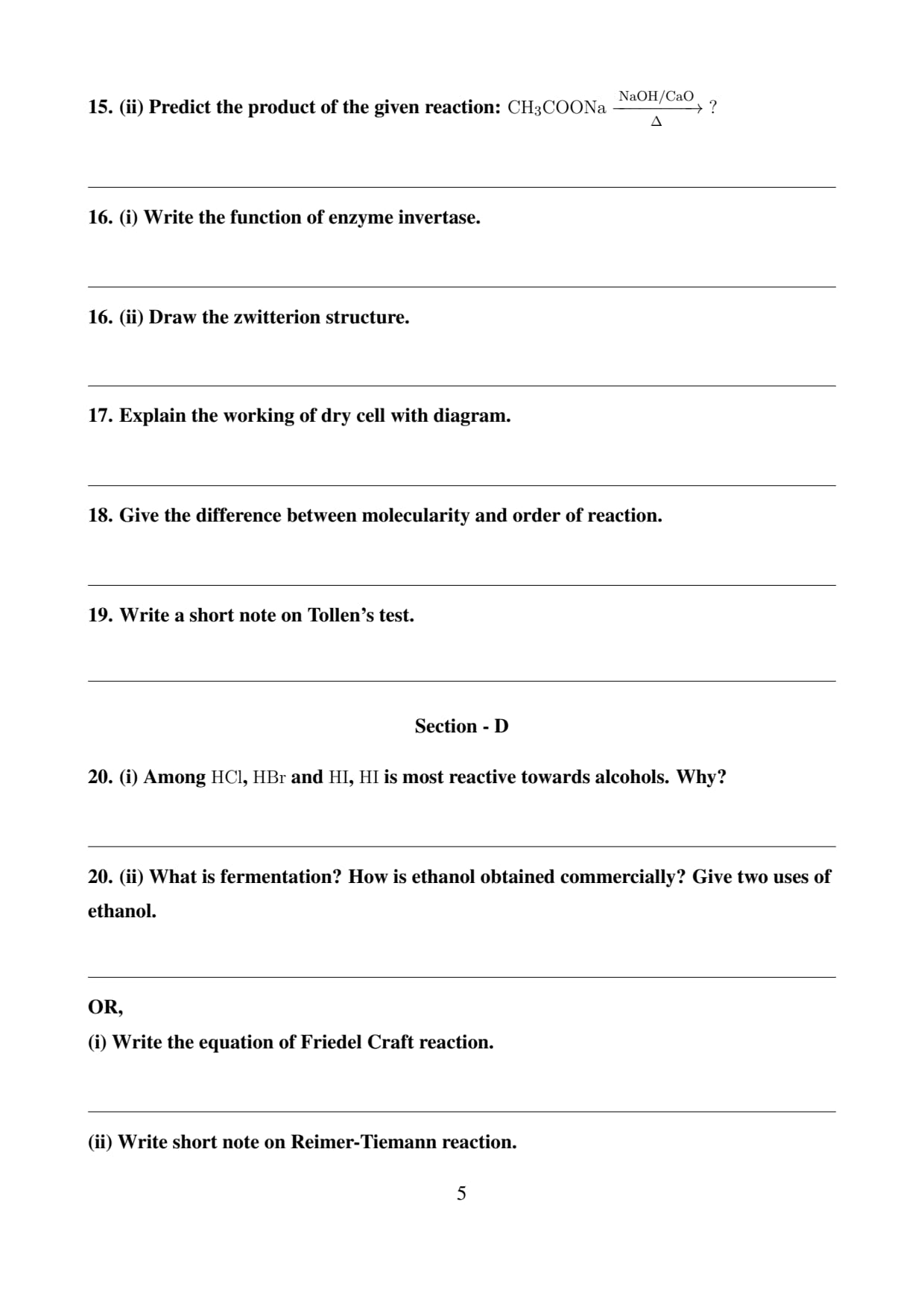
Predict the product of the given reaction: \( \mathrm{CH_3COONa \xrightarrow[\Delta]{NaOH/CaO} \ ?} \)
View Solution
Step 1: Identify the type of reaction.
The given reaction involves heating sodium acetate \( \mathrm{CH_3COONa} \) with soda lime, which is a mixture of \( \mathrm{NaOH} \) and \( \mathrm{CaO} \). This reaction is known as decarboxylation.
Step 2: Write the general rule of decarboxylation.
When a sodium salt of a carboxylic acid is heated with soda lime, the carboxyl group is removed, and an alkane with one carbon less than the original acid is formed. The general reaction is:
\[ \mathrm{RCOONa + NaOH \xrightarrow[\Delta]{CaO} RH + Na_2CO_3} \]
Step 3: Apply the rule to sodium acetate.
Here, \( \mathrm{R = CH_3} \). Therefore, sodium acetate will give methane as the hydrocarbon product after decarboxylation.
Step 4: Write the balanced chemical equation.
The balanced reaction is:
\[ \mathrm{CH_3COONa + NaOH \xrightarrow[\Delta]{CaO} CH_4 + Na_2CO_3} \]
Step 5: State the final product.
Hence, the product of the given reaction is:
\[ \boxed{\mathrm{CH_4}} \] Quick Tip: Remember: In soda lime decarboxylation, the product is an alkane with one carbon less than the sodium salt of the carboxylic acid.
Write the function of enzyme invertase.
View Solution
Step 1: Identify the enzyme invertase.
Invertase is an enzyme that catalyzes the hydrolysis of sucrose. It is also known as sucrase in many biological contexts.
Step 2: State the reaction it performs.
Invertase breaks down sucrose into its two simple sugar components, namely glucose and fructose. The reaction can be written as:
\[ \mathrm{Sucrose + H_2O \xrightarrow{invertase} Glucose + Fructose} \]
Step 3: Mention its function clearly.
Thus, the main function of invertase is to help in the digestion or conversion of sucrose into glucose and fructose, which can be easily utilized by the body or by microorganisms.
Step 4: State the final answer.
Hence, the function of enzyme invertase is to hydrolyse sucrose into glucose and fructose.
Quick Tip: Remember: Invertase acts on sucrose and converts it into glucose and fructose by hydrolysis.
Draw the zwitterion structure.
View Solution
Step 1: Understand what a zwitterion is.
A zwitterion is a dipolar ion that contains both a positive charge and a negative charge in the same molecule. Amino acids commonly exist in zwitterionic form in aqueous solution.
Step 2: Identify the charged groups.
In the zwitterion form of an amino acid, the amino group accepts a proton and becomes \(\mathrm{NH_3^+}\), while the carboxyl group loses a proton and becomes \(\mathrm{COO^-}\).
Step 3: Write the general zwitterion structure.
The general structure of a zwitterion of an amino acid is:
\[ \mathrm{^{+}H_3N-CH(R)-COO^{-}} \]
Step 4: Give a simple example.
For glycine, where \(R = H\), the zwitterion structure is:
\[ \mathrm{^{+}H_3N-CH_2-COO^{-}} \]
Step 5: State the final answer.
Hence, the zwitterion structure is represented as:
\[ \boxed{\mathrm{^{+}H_3N-CH(R)-COO^{-}}} \] Quick Tip: A zwitterion has both positive and negative charges in the same molecule. In amino acids, \(\mathrm{NH_3^+}\) and \(\mathrm{COO^-}\) are the charged groups.
Explain the working of dry cell with diagram.
View Solution
Step 1: Identify the main parts of a dry cell.
A dry cell is a primary electrochemical cell commonly used in torches, clocks, and radios. It consists of a zinc container which acts as the anode, a carbon rod in the centre which acts as the cathode, and a paste of ammonium chloride and zinc chloride as the electrolyte. Manganese dioxide is placed around the carbon rod as a depolarizer.
Step 2: Explain the function of the zinc container.
The outer zinc vessel acts as the negative electrode. During the working of the cell, zinc undergoes oxidation and releases electrons. These electrons flow through the external circuit and provide electric current.
Step 3: Explain the role of the carbon rod and manganese dioxide.
The carbon rod acts as the positive electrode. Manganese dioxide placed around it prevents the accumulation of hydrogen gas by acting as a depolarizer. This helps the cell to continue functioning properly without polarization.
Step 4: State the chemical changes during working.
When the cell works, zinc loses electrons and forms zinc ions. The electrolyte helps in the movement of ions. The electrons travel from zinc to carbon through the outer circuit, thereby producing current.
Step 5: Draw and label the diagram.
A simple labeled diagram of a dry cell is:
\[ \begin{array}{c} Carbon rod
\vert
\vert
\begin{array}{|c|} \hline MnO_2 + carbon
\hline NH_4Cl and ZnCl_2 paste
\hline Zinc container
\hline \end{array} \end{array} \]
Step 6: State the conclusion.
Thus, a dry cell works by converting chemical energy into electrical energy through oxidation-reduction reactions.
Quick Tip: Remember: In a dry cell, zinc acts as the anode, carbon acts as the cathode, and manganese dioxide acts as a depolarizer.
Give the difference between molecularity and order of reaction.
View Solution
Step 1: Define molecularity.
Molecularity of a reaction is the number of reacting species such as atoms, ions, or molecules that collide simultaneously in an elementary reaction to bring about a chemical change.
Step 2: Define order of reaction.
Order of reaction is the sum of the powers of the concentration terms of the reactants in the experimentally determined rate equation of a reaction.
Step 3: State the differences clearly.
The main differences are:
\begin{table[h!]
\centering
\footnotesize
\setlength{\tabcolsep{4pt
\renewcommand{\arraystretch{1.1
\resizebox{\textwidth{!{%
\begin{tabular{|c|p{5.2cm|p{5.2cm|
\hline
S.No. & Molecularity & Order of reaction
\hline
1 & Related only to elementary reactions & Applicable to the overall reaction
\hline
2 & Always a whole positive number & May be zero, fractional, or whole number
\hline
3 & Obtained from the reaction mechanism & Determined experimentally
\hline
4 & Can never be negative & Can be zero or fractional, but generally not negative
\hline
5 & Tells how many species collide & Tells how rate depends on concentration
\hline
\end{tabular%
\end{table
Step 4: State the conclusion.
Hence, molecularity is a theoretical concept based on collision in an elementary step, whereas order of reaction is an experimental quantity obtained from the rate law.
Quick Tip: Remember: Molecularity is about the number of particles colliding, while order is about the powers of concentration in the rate law.
Write a short note on Tollen's test.
View Solution
Step 1: Define Tollen's reagent.
Tollen's reagent is ammoniacal silver nitrate solution. It contains the complex ion \([\mathrm{Ag(NH_3)_2}]^{+}\), which acts as a mild oxidizing agent.
Step 2: State the purpose of Tollen's test.
Tollen's test is used to distinguish aldehydes from ketones. Aldehydes give a positive test, while ordinary ketones do not respond to this test.
Step 3: Explain the working of the test.
When an aldehyde is heated with Tollen's reagent, the aldehyde is oxidized to the corresponding carboxylate ion or carboxylic acid, and the silver ion is reduced to metallic silver. This metallic silver gets deposited on the inner wall of the test tube as a bright silver mirror.
Step 4: Write the observation and significance.
The formation of a shining silver mirror or a black precipitate of silver indicates the presence of an aldehyde group. Therefore, this is called the silver mirror test.
Step 5: Write the reaction.
A general reaction may be written as:
\[ \mathrm{RCHO + 2[Ag(NH_3)_2]^+ + 3OH^- \rightarrow RCOO^- + 2Ag + 4NH_3 + 2H_2O} \]
Step 6: State the conclusion.
Thus, Tollen's test is an important laboratory test for identifying aldehydes by the formation of a silver mirror.
Quick Tip: Remember: Tollen's reagent gives a silver mirror with aldehydes, so it is mainly used to distinguish aldehydes from ketones.
Among \( \mathrm{HCl} \), \( \mathrm{HBr} \) and \( \mathrm{HI} \), \( \mathrm{HI} \) is most reactive towards alcohols. Why?
View Solution
Step 1: Understand the reaction of alcohols with hydrogen halides.
Alcohols react with hydrogen halides to form alkyl halides. In this reaction, the halide ion acts as the nucleophile and attacks the carbon atom after the protonation of alcohol.
Step 2: Compare the bond strength in hydrogen halides.
The reactivity of hydrogen halides towards alcohols depends mainly on the strength of the \( \mathrm{H-X} \) bond. As we move from \( \mathrm{HCl} \) to \( \mathrm{HBr} \) to \( \mathrm{HI} \), the bond strength decreases because the size of the halogen atom increases.
Step 3: Explain why \( \mathrm{HI} \) is the most reactive.
In \( \mathrm{HI} \), the \( \mathrm{H-I} \) bond is the weakest among \( \mathrm{HCl} \), \( \mathrm{HBr} \), and \( \mathrm{HI} \). Therefore, it breaks most easily to give \( \mathrm{I^-} \) ions. This makes the reaction with alcohol faster.
Step 4: Mention the role of iodide ion.
The iodide ion \( \mathrm{I^-} \) is also a better nucleophile compared to \( \mathrm{Cl^-} \) and \( \mathrm{Br^-} \) in these reactions. Hence, it attacks more readily and helps in the formation of alkyl iodide.
Step 5: State the final reason.
Thus, \( \mathrm{HI} \) is most reactive towards alcohols because the \( \mathrm{H-I} \) bond is the weakest and it produces \( \mathrm{I^-} \) ion most easily, which is an effective nucleophile.
Quick Tip: Remember: Reactivity of hydrogen halides towards alcohols increases in the order \( \mathrm{HCl < HBr < HI} \) because bond strength decreases down the group.
What is fermentation? How is ethanol obtained commercially? Give two uses of ethanol.
View Solution
Step 1: Define fermentation.
Fermentation is the process in which sugars such as glucose are converted into ethanol and carbon dioxide by the action of enzymes present in yeast under anaerobic conditions.
Step 2: Write the reaction of fermentation.
The chemical reaction for fermentation is:
\[ \mathrm{C_6H_{12}O_6 \xrightarrow{yeast} 2C_2H_5OH + 2CO_2} \]
Step 3: Explain the commercial preparation of ethanol.
Commercially, ethanol is obtained by the fermentation of molasses, which is a by-product of the sugar industry. Molasses contains sugars that are first diluted with water and then allowed to ferment in the presence of yeast at a suitable temperature. The ethanol formed is then separated by distillation.
Step 4: Mention two uses of ethanol.
Two common uses of ethanol are:
\[ (a) It is used as a solvent in medicines, perfumes, and paints. \] \[ (b) It is used as a fuel or blended with petrol as power alcohol. \]
Step 5: Write the final answer clearly.
Thus, fermentation is the conversion of sugar into ethanol by yeast. Ethanol is obtained commercially by fermentation of molasses followed by distillation, and it is used as a solvent and as a fuel.
Quick Tip: Remember: Fermentation of molasses by yeast is the most common commercial method for preparing ethanol.
Write the equation of Friedel Craft reaction.
View Solution
Step 1: Understand the Friedel Craft reaction.
Friedel Craft reaction is an electrophilic substitution reaction in which an alkyl group or an acyl group is introduced into an aromatic ring in the presence of anhydrous \( \mathrm{AlCl_3} \) catalyst.
Step 2: Write the common Friedel Craft alkylation equation.
A common example of Friedel Craft alkylation is the reaction of benzene with methyl chloride in the presence of anhydrous aluminium chloride:
\[ \mathrm{C_6H_6 + CH_3Cl \xrightarrow{anhyd.\ AlCl_3} C_6H_5CH_3 + HCl} \]
Step 3: Identify the product formed.
In this reaction, benzene reacts with methyl chloride to form toluene. The catalyst \( \mathrm{AlCl_3} \) helps in generating the electrophile required for substitution.
Step 4: State the reaction clearly.
Thus, Friedel Craft reaction is the reaction in which an aromatic compound undergoes alkylation or acylation in the presence of a Lewis acid catalyst such as \( \mathrm{AlCl_3} \).
Step 5: Final answer.
Therefore, the equation of Friedel Craft reaction can be written as:
\[ \boxed{\mathrm{C_6H_6 + CH_3Cl \xrightarrow{anhyd.\ AlCl_3} C_6H_5CH_3 + HCl}} \] Quick Tip: Remember: Friedel Craft reaction always needs an aromatic ring and a Lewis acid catalyst like anhydrous \( \mathrm{AlCl_3} \).
Write short note on Reimer-Tiemann reaction.
View Solution
Step 1: Define the Reimer-Tiemann reaction.
Reimer-Tiemann reaction is the chemical reaction in which phenol, on treatment with chloroform and aqueous sodium hydroxide, gives salicylaldehyde as the major product after hydrolysis.
Step 2: Mention the reagent involved.
The important reagents used in this reaction are phenol, chloroform \( \mathrm{CHCl_3} \), and aqueous sodium hydroxide. The reaction proceeds through the formation of dichlorocarbene as the reactive intermediate.
Step 3: Write the reaction equation.
The reaction can be represented as follows:
\[ \mathrm{C_6H_5OH \xrightarrow[hydrolysis]{CHCl_3/NaOH} o-HOC_6H_4CHO} \]
Step 4: Explain the product.
In this reaction, the aldehyde group \( \mathrm{-CHO} \) is introduced mainly at the ortho position of phenol. Therefore, the main product formed is \( o \)-hydroxybenzaldehyde, also called salicylaldehyde.
Step 5: Final answer.
Thus, Reimer-Tiemann reaction is used for the introduction of the formyl group \( \mathrm{(-CHO)} \) into phenol, giving salicylaldehyde as the major product.
Quick Tip: Remember: Reimer-Tiemann reaction is a special reaction of phenol with \( \mathrm{CHCl_3} \) and \( \mathrm{NaOH} \) that introduces the \( \mathrm{-CHO} \) group mainly at the ortho position.
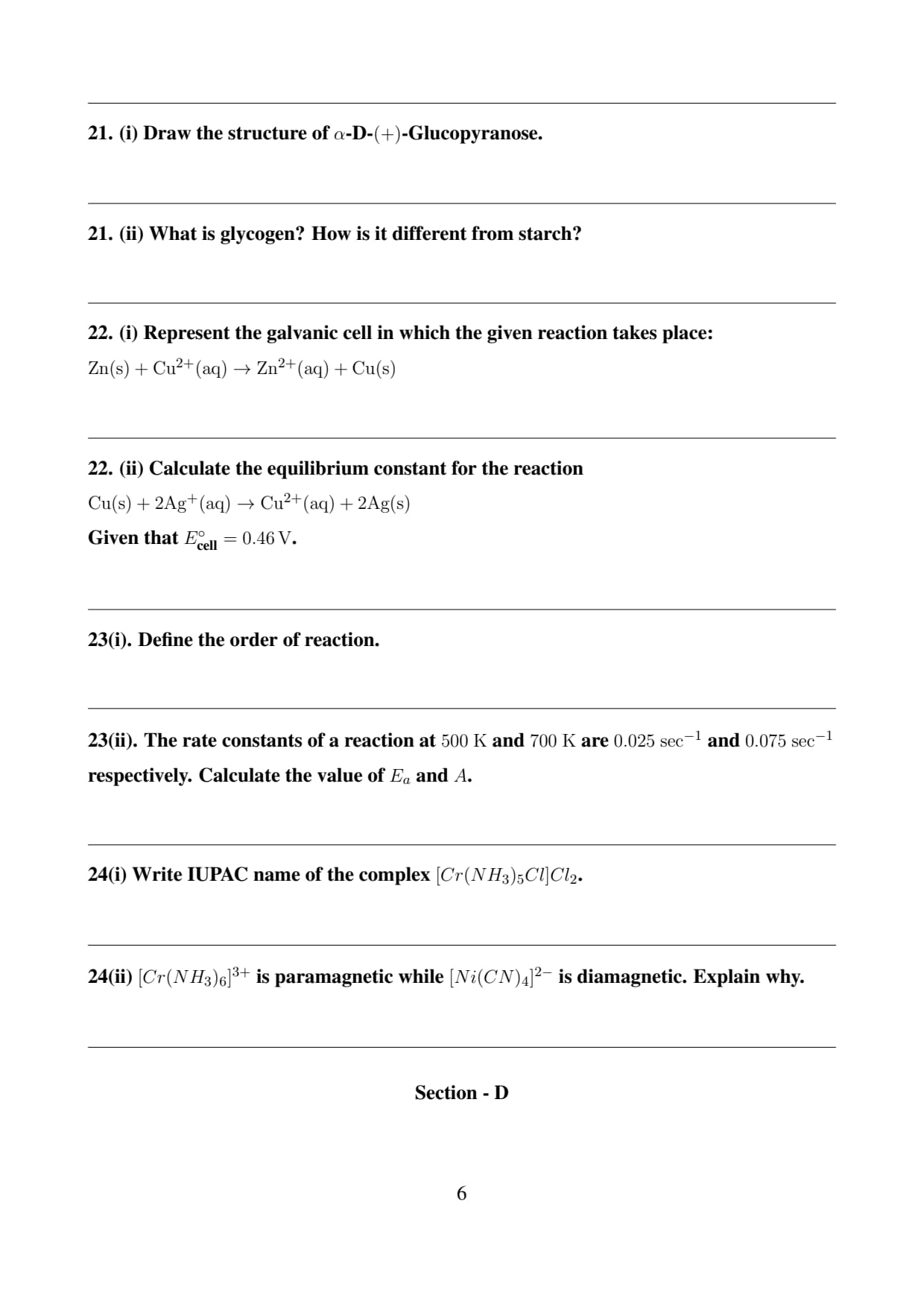
Draw the structure of \(\alpha\)-D-\((+)\)-Glucopyranose.
View Solution
Step 1: Understand what \(\alpha\)-D-\((+)\)-Glucopyranose is.
\(\alpha\)-D-\((+)\)-Glucopyranose is the six-membered cyclic hemiacetal form of D-glucose. It is formed when the aldehyde group at C-1 reacts with the hydroxyl group at C-5.
Step 2: Recall the Haworth structure rule for D-glucose.
In the Haworth projection of D-sugars, the \(\mathrm{CH_2OH}\) group at C-5 lies above the plane of the ring. In the \(\alpha\)-form, the hydroxyl group attached to the anomeric carbon C-1 lies below the plane of the ring.
Step 3: Write the arrangement of groups.
For \(\alpha\)-D-glucopyranose, the substituent positions are:
C-1: \(\mathrm{OH}\) below,
C-2: \(\mathrm{OH}\) below,
C-3: \(\mathrm{OH}\) above,
C-4: \(\mathrm{OH}\) below,
C-5: \(\mathrm{CH_2OH}\) above.
Step 4: Draw the structure.
The Haworth structure of \(\alpha\)-D-\((+)\)-Glucopyranose is:
\[ \begin{array}{c} \mathrm{\ \ \ \ \ \ \ O}
\mathrm{\ \ \ / \ \ \ \backslash}
\mathrm{C_5 \ \ \ \ \ C_1}
\mathrm{| \ \ \ \ \ \ \ |}
\mathrm{C_4 \ \ \ \ \ C_2}
\mathrm{\ \ \backslash \ \ /}
\mathrm{\ \ \ \ C_3} \end{array} \]
A more descriptive Haworth representation is:
\[ \mathrm{ \begin{array}{c} CH_2OH \uparrow at C_5
OH \downarrow at C_1
OH \downarrow at C_2
OH \uparrow at C_3
OH \downarrow at C_4 \end{array} } \]
Step 5: State the key feature.
Thus, in \(\alpha\)-D-glucopyranose, the anomeric hydroxyl group at C-1 is below the plane of the ring, while the \(\mathrm{CH_2OH}\) group is above the plane.
Quick Tip: Remember: In D-sugars, the \(\mathrm{CH_2OH}\) group is above the ring. In the \(\alpha\)-anomer, the \(\mathrm{OH}\) at the anomeric carbon is below the ring.
What is glycogen? How is it different from starch?
View Solution
Step 1: Define glycogen.
Glycogen is a polysaccharide made up of many \(\alpha\)-D-glucose units. It is the storage form of carbohydrate in animals and is mainly found in liver and muscles. It is commonly called animal starch.
Step 2: State the structure of glycogen.
In glycogen, glucose units are joined mainly by \(\alpha(1 \rightarrow 4)\) glycosidic bonds, and branching occurs through \(\alpha(1 \rightarrow 6)\) glycosidic bonds. It is highly branched.
Step 3: Define starch for comparison.
Starch is the storage polysaccharide of plants. It is made of two components: amylose and amylopectin. Amylose is mostly linear, while amylopectin is branched but less branched than glycogen.
Step 4: Write the differences between glycogen and starch.
The main differences are:
\begin{table[h!]
\centering
\footnotesize
\setlength{\tabcolsep{4pt
\renewcommand{\arraystretch{1.1
\resizebox{\textwidth{!{%
\begin{tabular{|c|p{5.2cm|p{5.2cm|
\hline
S.No. & Glycogen & Starch
\hline
1 & Storage polysaccharide of animals & Storage polysaccharide of plants
\hline
2 & Found in liver and muscles & Found in seeds, grains, and tubers
\hline
3 & Highly branched & Less branched overall
\hline
4 & Contains \( \alpha(1 \rightarrow 4) \) and \( \alpha(1 \rightarrow 6) \) bonds & Also contains these bonds, but branching is less frequent
\hline
5 & Called animal starch & Called plant starch
\hline
\end{tabular%
\end{table
Step 5: Conclude the answer.
Hence, glycogen is the animal storage polysaccharide and differs from starch mainly in source and degree of branching, glycogen being much more highly branched than starch.
Quick Tip: Remember: Glycogen is animal starch and is more highly branched than starch.
Represent the galvanic cell in which the given reaction takes place:
\( \mathrm{Zn(s) + Cu^{2+}(aq) \rightarrow Zn^{2+}(aq) + Cu(s)} \)
View Solution
Step 1: Identify oxidation and reduction half-reactions.
In the given reaction, zinc loses electrons and gets oxidised, while copper ions gain electrons and get reduced. Therefore, the half-reactions are:
\[ \mathrm{Zn(s) \rightarrow Zn^{2+}(aq) + 2e^-} \] \[ \mathrm{Cu^{2+}(aq) + 2e^- \rightarrow Cu(s)} \]
Step 2: Identify anode and cathode.
Oxidation takes place at the anode and reduction takes place at the cathode. Hence, zinc electrode acts as the anode and copper electrode acts as the cathode.
Step 3: Write the standard cell representation.
In cell notation, the anode is written on the left side and the cathode is written on the right side. A single vertical line represents phase boundary and a double vertical line represents the salt bridge.
Step 4: Represent the galvanic cell.
Therefore, the galvanic cell is represented as:
\[ \mathrm{Zn(s)\ |\ Zn^{2+}(aq)\ ||\ Cu^{2+}(aq)\ |\ Cu(s)} \]
Step 5: State the final answer clearly.
Hence, the required galvanic cell representation is:
\[ \boxed{\mathrm{Zn(s)\ |\ Zn^{2+}(aq)\ ||\ Cu^{2+}(aq)\ |\ Cu(s)}} \] Quick Tip: Remember: In galvanic cell notation, oxidation half-cell is written on the left and reduction half-cell is written on the right.
Calculate the equilibrium constant for the reaction
\( \mathrm{Cu(s) + 2Ag^{+}(aq) \rightarrow Cu^{2+}(aq) + 2Ag(s)} \)
Given that \( E^\circ_{cell} = 0.46 \, \mathrm{V} \).
View Solution
Step 1: Write the relation between standard cell potential and equilibrium constant.
The standard cell potential is related to the equilibrium constant by the formula:
\[ E^\circ_{cell} = \frac{0.0591}{n} \log K \]
where \( n \) is the number of electrons transferred in the balanced redox reaction.
Step 2: Find the value of \( n \).
For the reaction,
\[ \mathrm{Cu(s) \rightarrow Cu^{2+}(aq) + 2e^-} \] \[ \mathrm{2Ag^{+}(aq) + 2e^- \rightarrow 2Ag(s)} \]
Thus, the number of electrons transferred is:
\[ n = 2 \]
Step 3: Substitute the given values in the formula.
Given,
\[ E^\circ_{cell} = 0.46 \, \mathrm{V} \]
So,
\[ 0.46 = \frac{0.0591}{2} \log K \]
Step 4: Calculate the value of \( \log K \).
Rearranging, we get:
\[ \log K = \frac{0.46 \times 2}{0.0591} \] \[ \log K = \frac{0.92}{0.0591} \approx 15.57 \]
Step 5: Find the value of \( K \).
Now,
\[ K = 10^{15.57} \] \[ K \approx 3.7 \times 10^{15} \]
Step 6: Write the final answer.
Therefore, the equilibrium constant for the given reaction is:
\[ \boxed{K \approx 3.7 \times 10^{15}} \] Quick Tip: Remember: Use the formula \( E^\circ_{cell} = \dfrac{0.0591}{n} \log K \) at \( 25^\circ \mathrm{C} \) to find equilibrium constant from standard cell potential.
Define the order of reaction.
View Solution
Step 1: Recall the meaning of rate law.
For a chemical reaction, the rate is generally expressed in terms of concentration of reactants as a rate equation. The powers of concentration terms appear in this equation.
Step 2: Define order of reaction.
The order of a reaction is the sum of the powers of the molar concentrations of the reactants in the experimentally determined rate equation.
Step 3: Write the general form.
If for a reaction, the rate law is:
\[ Rate = k[A]^m[B]^n \]
then the order of the reaction is:
\[ m+n \]
Step 4: State the final definition.
Hence, the order of reaction is the total exponent of the concentration terms in the rate law expression.
Quick Tip: Remember: Order of reaction is obtained from the rate law, not directly from the balanced chemical equation.
The rate constants of a reaction at \(500\ \mathrm{K}\) and \(700\ \mathrm{K}\) are \(0.025\ \mathrm{sec^{-1}}\) and \(0.075\ \mathrm{sec^{-1}}\) respectively. Calculate the value of \(E_a\) and \(A\).
View Solution
Step 1: Write the given data.
We have:
\[ k_1 = 0.025\ \mathrm{sec^{-1}}, \qquad T_1 = 500\ \mathrm{K} \] \[ k_2 = 0.075\ \mathrm{sec^{-1}}, \qquad T_2 = 700\ \mathrm{K} \]
Step 2: Use the Arrhenius equation in logarithmic form.
The Arrhenius equation is:
\[ \ln\left(\frac{k_2}{k_1}\right)=\frac{E_a}{R}\left(\frac{1}{T_1}-\frac{1}{T_2}\right) \]
Substituting the values:
\[ \ln\left(\frac{0.075}{0.025}\right)=\frac{E_a}{8.314}\left(\frac{1}{500}-\frac{1}{700}\right) \]
Step 3: Simplify the expression.
Since,
\[ \frac{0.075}{0.025}=3 \]
and
\[ \ln 3 = 1.0986 \]
Also,
\[ \frac{1}{500}-\frac{1}{700}=\frac{700-500}{350000}=\frac{200}{350000}=0.0005714 \]
So,
\[ 1.0986=\frac{E_a}{8.314}\times 0.0005714 \]
Step 4: Calculate the activation energy \(E_a\).
\[ E_a=\frac{1.0986 \times 8.314}{0.0005714} \] \[ E_a \approx 15984\ \mathrm{J\,mol^{-1}} \]
Therefore,
\[ E_a \approx 1.60 \times 10^4\ \mathrm{J\,mol^{-1}} \]
or,
\[ E_a \approx 16\ \mathrm{kJ\,mol^{-1}} \]
Step 5: Use Arrhenius equation to calculate \(A\).
Now,
\[ k = A e^{-E_a/RT} \]
So,
\[ A = k e^{E_a/RT} \]
Using \(k_1 = 0.025\ \mathrm{sec^{-1}}\) at \(T_1=500\ \mathrm{K}\):
\[ A = 0.025 \times e^{\frac{15984}{8.314 \times 500}} \] \[ A = 0.025 \times e^{3.845} \] \[ A \approx 0.025 \times 46.75 \] \[ A \approx 1.17\ \mathrm{sec^{-1}} \]
Step 6: State the final answer.
Hence,
\[ \boxed{E_a \approx 16\ \mathrm{kJ\,mol^{-1}}} \]
and
\[ \boxed{A \approx 1.17\ \mathrm{sec^{-1}}} \] Quick Tip: For two temperatures, use the logarithmic Arrhenius equation to find \(E_a\). After that, substitute in \(k=Ae^{-E_a/RT}\) to calculate the frequency factor \(A\).
Write IUPAC name of the complex \( [Cr(NH_3)_5Cl]Cl_2 \).
View Solution
Step 1: Identify the coordination entity.
The given compound is \( [Cr(NH_3)_5Cl]Cl_2 \). Here, the complex ion is \( [Cr(NH_3)_5Cl]^{2+} \) and there are two chloride ions outside the coordination sphere.
Step 2: Find the oxidation state of chromium.
Let the oxidation state of chromium be \( x \). Ammonia is a neutral ligand and one chlorido ligand inside the coordination sphere has charge \( -1 \). Since the complex ion has charge \( +2 \), we get:
\[ x + 5(0) + (-1) = +2 \] \[ x - 1 = 2 \] \[ x = +3 \]
So, the oxidation state of chromium is \( +3 \).
Step 3: Name the ligands in alphabetical order.
The ligands present inside the coordination sphere are:
\[ \mathrm{NH_3} \rightarrow ammine \] \[ \mathrm{Cl^-} \rightarrow chlorido \]
Since five ammonia ligands are present, it is named pentaammine. One chlorido ligand is named chlorido. The ligands are written in alphabetical order as ammine before chlorido.
Step 4: Write the name of the metal with oxidation state.
The metal is chromium, so its name is written as chromium. The oxidation state is written in Roman numeral form as \( (III) \).
Step 5: Write the complete IUPAC name.
Hence, the IUPAC name of the compound is:
Pentaamminechloridochromium(III) chloride Quick Tip: In naming coordination compounds, first name the ligands in alphabetical order, then write the metal name with its oxidation state in Roman numerals.
\( [Cr(NH_3)_6]^{3+} \) is paramagnetic while \( [Ni(CN)_4]^{2-} \) is diamagnetic. Explain why.
View Solution
Step 1: Find the electronic configuration of the metal ion in \( [Cr(NH_3)_6]^{3+} \).
In \( [Cr(NH_3)_6]^{3+} \), ammonia is a neutral ligand. Therefore, chromium is in the \( +3 \) oxidation state. The atomic number of chromium is \( 24 \), so:
\[ Cr = [Ar]\,3d^5 4s^1 \] \[ Cr^{3+} = [Ar]\,3d^3 \]
Thus, \( Cr^{3+} \) has three unpaired electrons. Hence, \( [Cr(NH_3)_6]^{3+} \) is paramagnetic.
Step 2: Find the electronic configuration of the metal ion in \( [Ni(CN)_4]^{2-} \).
In \( [Ni(CN)_4]^{2-} \), each cyanide ligand has charge \( -1 \). Let the oxidation state of nickel be \( x \):
\[ x + 4(-1) = -2 \] \[ x - 4 = -2 \] \[ x = +2 \]
So, nickel is in the \( +2 \) oxidation state. The atomic number of nickel is \( 28 \), therefore:
\[ Ni = [Ar]\,3d^8 4s^2 \] \[ Ni^{2+} = [Ar]\,3d^8 \]
Step 3: Explain the effect of ligand strength.
The ligand \( CN^- \) is a strong field ligand. It causes pairing of electrons in the \( 3d \)-orbitals of \( Ni^{2+} \). As a result, all electrons become paired and the complex becomes diamagnetic.
Step 4: Mention the hybridisation and shape.
In \( [Ni(CN)_4]^{2-} \), because of strong field ligand \( CN^- \), pairing occurs and the complex undergoes \( dsp^2 \) hybridisation. Therefore, it forms a square planar complex, which has no unpaired electrons.
Step 5: State the final reason clearly.
Thus, \( [Cr(NH_3)_6]^{3+} \) is paramagnetic because \( Cr^{3+} \) has three unpaired electrons, whereas \( [Ni(CN)_4]^{2-} \) is diamagnetic because \( CN^- \) is a strong field ligand and causes pairing of all electrons in \( Ni^{2+} \).
Quick Tip: Weak or moderate ligands may leave unpaired electrons, making the complex paramagnetic, while strong field ligands like \( CN^- \) pair up electrons and often make the complex diamagnetic.
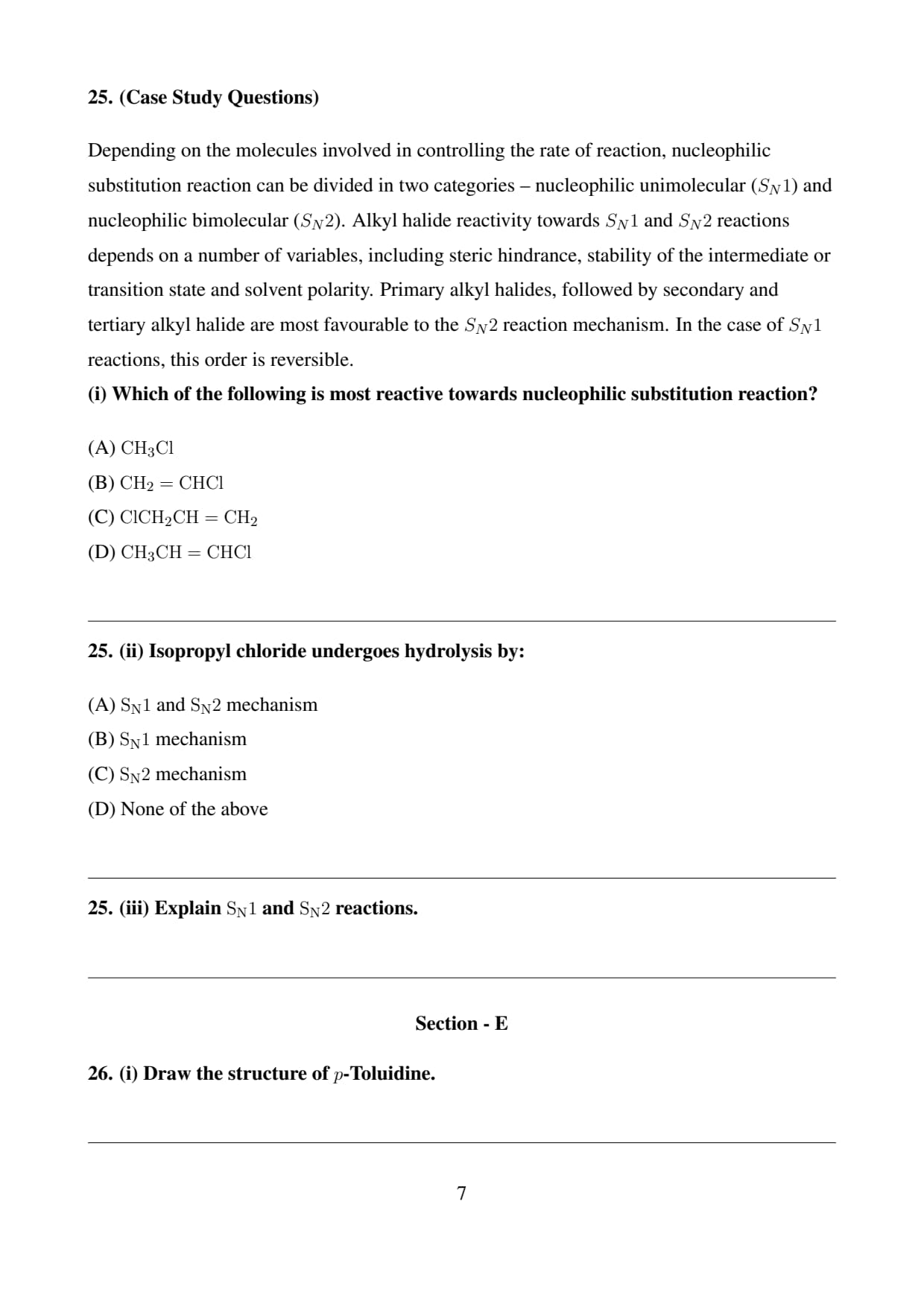
(Case Study Questions)
Depending on the molecules involved in controlling the rate of reaction, nucleophilic substitution reaction can be divided in two categories -- nucleophilic unimolecular (\(S_N1\)) and nucleophilic bimolecular (\(S_N2\)). Alkyl halide reactivity towards \(S_N1\) and \(S_N2\) reactions depends on a number of variables, including steric hindrance, stability of the intermediate or transition state and solvent polarity. Primary alkyl halides, followed by secondary and tertiary alkyl halide are most favourable to the \(S_N2\) reaction mechanism. In the case of \(S_N1\) reactions, this order is reversible.
Which of the following is most reactive towards nucleophilic substitution reaction?
View Solution
Step 1: Recall the reactivity towards nucleophilic substitution.
Alkyl halides generally undergo nucleophilic substitution reactions more easily than vinyl halides. Vinyl halides such as \(\mathrm{CH_2=CHCl}\) and \(\mathrm{CH_3CH=CHCl}\) are much less reactive because the carbon-halogen bond is attached directly to an \(\mathrm{sp^2}\)-hybridized carbon and has partial double bond character.
Step 2: Examine each option.
Option (A) \(\mathrm{CH_3Cl}\) is a methyl halide and is reactive, especially in \(\mathrm{S_N2}\) reactions.
Option (B) \(\mathrm{CH_2=CHCl}\) is a vinyl chloride, so it is less reactive.
Option (C) \(\mathrm{ClCH_2CH=CH_2}\) is an allyl halide. Allyl halides are highly reactive because the intermediate or transition state is resonance stabilized by the adjacent double bond.
Option (D) \(\mathrm{CH_3CH=CHCl}\) is also a vinyl halide, so it is less reactive.
Step 3: Identify the most reactive compound.
Among all the given compounds, allyl chloride \(\mathrm{ClCH_2CH=CH_2}\) is the most reactive towards nucleophilic substitution due to resonance stabilization.
Step 4: State the final answer.
Hence, the correct answer is:
\[ \boxed{(C)\ \mathrm{ClCH_2CH=CH_2}} \] Quick Tip: Allylic halides are more reactive in nucleophilic substitution because the allylic carbocation or transition state is resonance stabilized, whereas vinyl halides are very less reactive.
Isopropyl chloride undergoes hydrolysis by:
View Solution
Step 1: Identify the nature of isopropyl chloride.
Isopropyl chloride is a secondary alkyl halide. Secondary alkyl halides show intermediate behavior in nucleophilic substitution reactions.
Step 2: Recall the behavior of secondary halides.
Primary alkyl halides usually prefer the \(\mathrm{S_N2}\) mechanism, while tertiary alkyl halides usually prefer the \(\mathrm{S_N1}\) mechanism. Secondary alkyl halides can undergo both \(\mathrm{S_N1}\) and \(\mathrm{S_N2}\) depending on the reaction conditions.
Step 3: Apply to hydrolysis of isopropyl chloride.
During hydrolysis, isopropyl chloride being a secondary halide may react through either pathway. Therefore, it undergoes hydrolysis by both \(\mathrm{S_N1}\) and \(\mathrm{S_N2}\) mechanisms.
Step 4: State the final answer.
Hence, the correct answer is:
\[ \boxed{(A)\ \mathrm{S_N1}\ and\ \mathrm{S_N2}\ mechanism} \] Quick Tip: Remember: Secondary alkyl halides are borderline compounds. They may follow either \(\mathrm{S_N1}\) or \(\mathrm{S_N2}\) depending on solvent, nucleophile, and reaction conditions.
Explain \(\mathrm{S_N1}\) and \(\mathrm{S_N2}\) reactions.
View Solution
Step 1: Define \(\mathrm{S_N1}\) reaction.
\(\mathrm{S_N1}\) stands for substitution nucleophilic unimolecular reaction. In this mechanism, the reaction takes place in two steps. First, the leaving group departs and forms a carbocation. Then the nucleophile attacks the carbocation. Since the rate-determining step involves only one molecule, the rate depends only on the concentration of the substrate.
The rate law is:
\[ Rate = k[Alkyl halide] \]
Step 2: State the important features of \(\mathrm{S_N1}\).
\(\mathrm{S_N1}\) reactions are favored by tertiary alkyl halides because tertiary carbocations are more stable. These reactions are also favored in polar protic solvents. Since a planar carbocation intermediate is formed, racemization may occur in optically active compounds.
Step 3: Define \(\mathrm{S_N2}\) reaction.
\(\mathrm{S_N2}\) stands for substitution nucleophilic bimolecular reaction. In this mechanism, the reaction takes place in a single step. The nucleophile attacks the carbon atom from the side opposite to the leaving group, while the leaving group departs at the same time. Since both the substrate and the nucleophile are involved in the rate-determining step, the rate depends on both.
The rate law is:
\[ Rate = k[Alkyl halide][Nucleophile] \]
Step 4: State the important features of \(\mathrm{S_N2}\).
\(\mathrm{S_N2}\) reactions are favored by primary alkyl halides because steric hindrance is minimum. These reactions are favored by strong nucleophiles and polar aprotic solvents. Since the attack occurs from the back side, inversion of configuration takes place.
Step 5: Write the major differences.
The main differences between \(\mathrm{S_N1}\) and \(\mathrm{S_N2}\) are:
\[ \begin{array}{|c|c|c|} \hline Feature & \mathrm{S_N1} & \mathrm{S_N2}
\hline Mechanism & Two-step & One-step
\hline Rate law & k[RX] & k[RX][Nu^-]
\hline Intermediate & Carbocation formed & No intermediate
\hline Favored substrate & Tertiary halides & Primary halides
\hline Stereochemistry & Racemization & Inversion
\hline \end{array} \]
Step 6: Conclude the explanation.
Thus, \(\mathrm{S_N1}\) is a unimolecular substitution reaction involving carbocation formation, whereas \(\mathrm{S_N2}\) is a bimolecular substitution reaction occurring in one step by backside attack.
Quick Tip: \(\mathrm{S_N1}\) means one molecule controls the rate and usually involves carbocation formation. \(\mathrm{S_N2}\) means two species control the rate and the reaction occurs in one step with backside attack.
Draw the structure of \(p\)-Toluidine.
View Solution
Step 1: Understand what \(p\)-Toluidine is.
\(p\)-Toluidine is an aromatic amine derived from toluene. It contains a benzene ring with one amino group \((-\mathrm{NH_2})\) and one methyl group \((-\mathrm{CH_3})\).
Step 2: Identify the position of substituents.
The prefix \(p\) means para position. Therefore, the amino group and the methyl group are attached to the benzene ring at positions \(1\) and \(4\), opposite to each other.
Step 3: Write the structure.
Thus, the structure of \(p\)-Toluidine is:
\[ \mathrm{p-CH_3C_6H_4NH_2} \]
Step 4: Represent it diagrammatically.
A simple representation is:
\[ \begin{array}{c} \mathrm{NH_2}
\vert
\hexagon
\vert
\mathrm{CH_3} \end{array} \]
where \(\mathrm{NH_2}\) and \(\mathrm{CH_3}\) are in para positions.
Quick Tip: Remember: In para-substituted benzene compounds, the two groups are placed opposite to each other on the benzene ring.
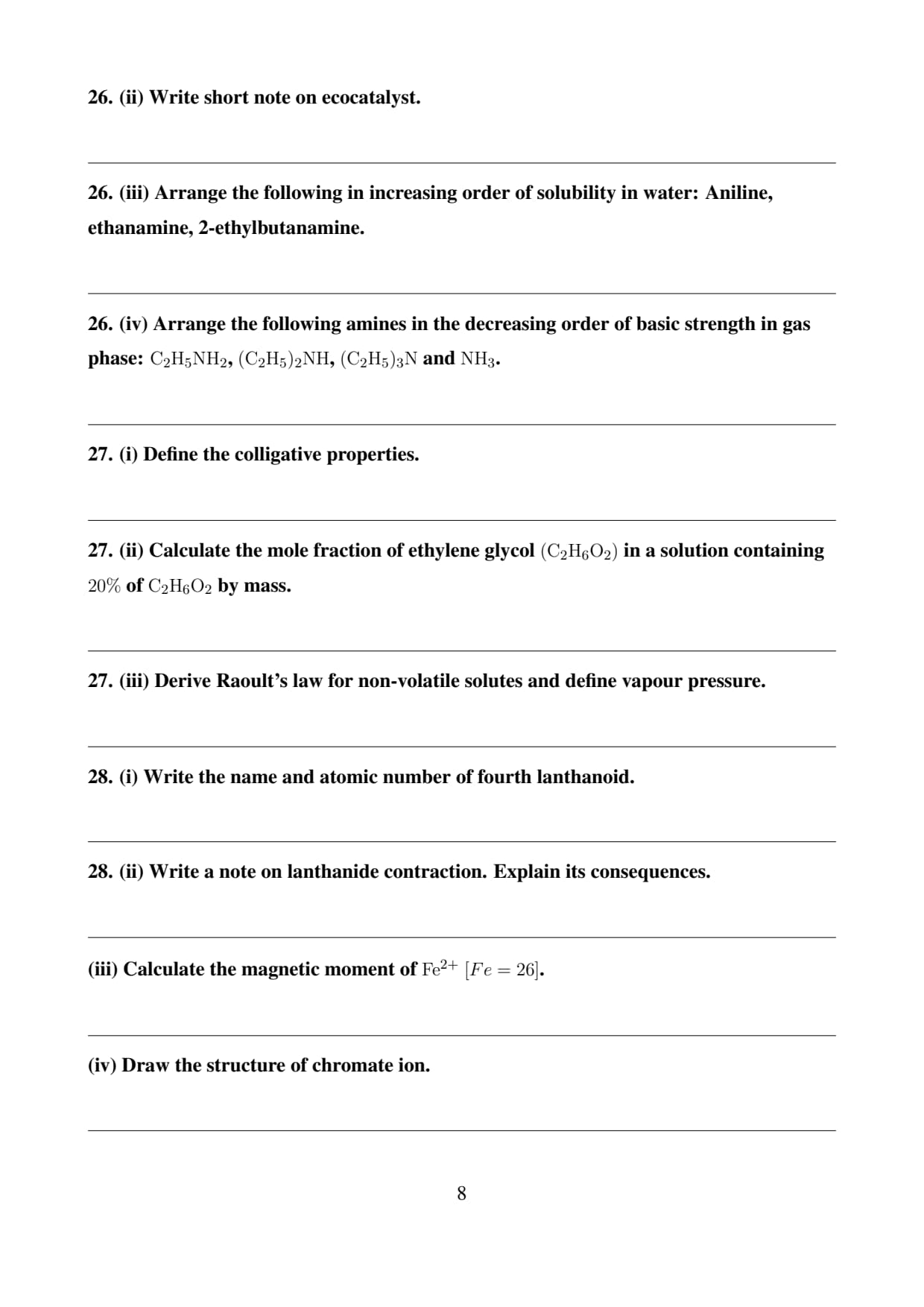
Write short note on ecocatalyst.
View Solution
Step 1: Define ecocatalyst.
An ecocatalyst is an environmentally friendly catalyst used to increase the rate of a chemical reaction without causing harmful effects on the environment. It supports green chemistry by reducing waste and pollution.
Step 2: State its importance.
Ecocatalysts are important because they make industrial and laboratory processes cleaner, safer, and more sustainable. They often help reactions proceed under mild conditions and reduce the need for toxic reagents.
Step 3: Mention the features of ecocatalysts.
The main features of ecocatalysts are:
\[ (a) less toxic, \quad (b) reusable, \quad (c) energy efficient, \quad (d) waste reducing \]
Step 4: State examples and use.
Examples may include biocatalysts, solid acid catalysts, and catalysts prepared from naturally available or recyclable materials. These are used in green synthesis and pollution control.
Step 5: Conclude the note.
Thus, ecocatalysts are valuable in modern chemistry because they improve reaction efficiency while protecting the environment.
Quick Tip: Ecocatalysts are related to green chemistry. Their main aim is to speed up reactions in an eco-friendly and sustainable way.
Arrange the following in increasing order of solubility in water: Aniline, ethanamine, 2-ethylbutanamine.
View Solution
Step 1: Recall the factor affecting solubility of amines.
The solubility of amines in water depends on their ability to form hydrogen bonds with water and on the size of the hydrophobic alkyl or aryl group attached to the amino group.
Step 2: Compare the given compounds.
Aniline contains a phenyl group, which is bulky and hydrophobic, so it is less soluble in water.
2-Ethylbutanamine has a long alkyl chain, which also reduces solubility.
Ethanamine has a small alkyl group, so it is the most soluble among the given compounds.
Step 3: Arrange in increasing order.
Hence, the increasing order of solubility in water is:
\[ \boxed{Aniline < 2-ethylbutanamine < ethanamine} \] Quick Tip: As the hydrophobic hydrocarbon part increases, the solubility of amines in water decreases. Smaller amines are more soluble.
Arrange the following amines in the decreasing order of basic strength in gas phase: \(\mathrm{C_2H_5NH_2}\), \(\mathrm{(C_2H_5)_2NH}\), \(\mathrm{(C_2H_5)_3N}\) and \(\mathrm{NH_3}\).
View Solution
Step 1: Recall the basis of basic strength in gas phase.
In the gas phase, the basic strength of amines mainly depends on the electron-donating inductive effect of alkyl groups. More alkyl groups push more electron density towards nitrogen, making the lone pair more available for protonation.
Step 2: Compare the given compounds.
\(\mathrm{NH_3}\) has no alkyl group, so it is the least basic.
\(\mathrm{C_2H_5NH_2}\) has one ethyl group.
\(\mathrm{(C_2H_5)_2NH}\) has two ethyl groups.
\(\mathrm{(C_2H_5)_3N}\) has three ethyl groups, so it shows the maximum \(+I\) effect in gas phase.
Step 3: Write the decreasing order.
Therefore, the decreasing order of basic strength in gas phase is:
\[ \boxed{\mathrm{(C_2H_5)_3N > (C_2H_5)_2NH > C_2H_5NH_2 > NH_3}} \] Quick Tip: In gas phase, solvation is absent, so the \(+I\) effect dominates. Therefore, tertiary amines are generally more basic than secondary and primary amines.
Define the colligative properties.
View Solution
Step 1: Understand the meaning of colligative properties.
Colligative properties are those properties of dilute solutions which depend only on the number of solute particles present in the solution and not on the chemical nature of the solute.
Step 2: Explain the basis of these properties.
These properties arise because the presence of solute particles affects the physical behaviour of the solvent, such as its vapour pressure, boiling point, freezing point, and osmotic pressure. The important point is that only the concentration or number of particles matters.
Step 3: Mention the common examples.
The main colligative properties are: lowering of vapour pressure, elevation of boiling point, depression in freezing point, and osmotic pressure.
Step 4: State the final definition clearly.
Therefore, colligative properties are the properties of solutions which depend only on the number of solute particles and not on their nature.
Quick Tip: Remember: Colligative properties depend on \textbf{how many} solute particles are present, not on \textbf{what} the solute is.
Calculate the mole fraction of ethylene glycol \( \left( \mathrm{C_2H_6O_2} \right) \) in a solution containing \( 20% \) of \( \mathrm{C_2H_6O_2} \) by mass.
View Solution
Step 1: Assume the mass of solution.
Since the solution contains \( 20% \) ethylene glycol by mass, let us assume that the total mass of the solution is \( 100 \, \mathrm{g} \). Then:
\[ Mass of ethylene glycol = 20 \, \mathrm{g} \] \[ Mass of water = 80 \, \mathrm{g} \]
Step 2: Calculate the molar masses.
The molecular formula of ethylene glycol is \( \mathrm{C_2H_6O_2} \). Its molar mass is:
\[ (2 \times 12) + (6 \times 1) + (2 \times 16) = 24 + 6 + 32 = 62 \, \mathrm{g\,mol^{-1}} \]
The molar mass of water is:
\[ 18 \, \mathrm{g\,mol^{-1}} \]
Step 3: Calculate the number of moles of each component.
Moles of ethylene glycol \( = \dfrac{20}{62} \):
\[ n_{\mathrm{C_2H_6O_2}} = \frac{20}{62} = 0.3226 \]
Moles of water \( = \dfrac{80}{18} \):
\[ n_{\mathrm{H_2O}} = \frac{80}{18} = 4.4444 \]
Step 4: Find the total number of moles.
\[ n_{total} = 0.3226 + 4.4444 = 4.7670 \]
Step 5: Calculate the mole fraction of ethylene glycol.
The mole fraction of ethylene glycol is given by:
\[ X_{\mathrm{C_2H_6O_2}} = \frac{n_{\mathrm{C_2H_6O_2}}}{n_{total}} \] \[ X_{\mathrm{C_2H_6O_2}} = \frac{0.3226}{4.7670} \] \[ X_{\mathrm{C_2H_6O_2}} \approx 0.0677 \]
Step 6: Write the final answer.
Hence, the mole fraction of ethylene glycol is:
\[ \boxed{0.068 approximately} \] Quick Tip: In percentage by mass problems, first assume \(100 \, \mathrm{g}\) of solution. This makes calculation of masses and moles much easier.
Derive Raoult's law for non-volatile solutes and define vapour pressure.
View Solution
Step 1: Define vapour pressure.
Vapour pressure is the pressure exerted by the vapour of a liquid when it is in dynamic equilibrium with its liquid phase at a given temperature in a closed vessel.
Step 2: Consider a solution containing a non-volatile solute.
Let a solution be prepared by dissolving a non-volatile solute in a volatile solvent. Since the solute is non-volatile, only the solvent contributes to the vapour pressure of the solution.
Step 3: State Raoult's law for the solvent.
According to Raoult's law, the partial vapour pressure of the solvent over the solution is directly proportional to the mole fraction of the solvent in the solution. Thus,
\[ p = p^\circ X_A \]
where \( p \) is the vapour pressure of the solution, \( p^\circ \) is the vapour pressure of the pure solvent, and \( X_A \) is the mole fraction of the solvent.
Step 4: Derive the lowering in vapour pressure.
The lowering in vapour pressure is given by:
\[ \Delta p = p^\circ - p \]
Substituting \( p = p^\circ X_A \), we get:
\[ \Delta p = p^\circ - p^\circ X_A \] \[ \Delta p = p^\circ (1 - X_A) \]
Since \( 1 - X_A = X_B \), where \( X_B \) is the mole fraction of the solute, we get:
\[ \Delta p = p^\circ X_B \]
Step 5: Write the relative lowering in vapour pressure.
Dividing both sides by \( p^\circ \), we get:
\[ \frac{\Delta p}{p^\circ} = X_B \]
Thus, the relative lowering in vapour pressure is equal to the mole fraction of the non-volatile solute.
Step 6: State the final result.
Hence, for a solution containing a non-volatile solute:
\[ p = p^\circ X_A \]
and
\[ \frac{p^\circ - p}{p^\circ} = X_B \]
This is Raoult's law for non-volatile solutes.
Quick Tip: Remember: In a solution with a non-volatile solute, only the solvent contributes to vapour pressure, and the relative lowering in vapour pressure equals the mole fraction of the solute.
Write the name and atomic number of fourth lanthanoid.
View Solution
Step 1: Recall the lanthanoid series.
The lanthanoid series generally includes the elements from cerium \((Z=58)\) to lutetium \((Z=71)\).
Step 2: Count the lanthanoids in order.
The first four lanthanoids are:
\[ \mathrm{Ce,\ Pr,\ Nd,\ Pm} \]
Step 3: Identify the fourth lanthanoid.
The fourth lanthanoid is promethium.
Step 4: Write its atomic number.
The atomic number of promethium is:
\[ 61 \]
Step 5: State the final answer.
Hence, the name of the fourth lanthanoid is Promethium and its atomic number is 61.
Quick Tip: Remember the order of early lanthanoids as Ce, Pr, Nd, Pm. This helps in identifying the fourth element quickly.
Write a note on lanthanide contraction. Explain its consequences.
View Solution
Step 1: Define lanthanide contraction.
Lanthanoid contraction refers to the gradual decrease in the atomic and ionic radii of lanthanoids from lanthanum to lutetium with increase in atomic number.
Step 2: State the cause of lanthanide contraction.
As we move across the lanthanoid series, electrons are added to the \(4f\)-subshell. The \(4f\) electrons have very poor shielding effect. Therefore, the effective nuclear charge experienced by the outer electrons increases steadily. This increased attraction pulls the electrons closer to the nucleus, causing a gradual decrease in size.
Step 3: Explain the first consequence.
One important consequence is the similarity in the properties of elements of the second transition series and the third transition series. Due to lanthanoid contraction, the atomic radii of elements of the \(5d\) series become nearly equal to those of the corresponding \(4d\) series elements. For example, zirconium and hafnium have almost identical sizes and similar chemical properties.
Step 4: Explain the second consequence.
Another consequence is the difficulty in the separation of lanthanoids. Since the sizes of successive lanthanoids differ only slightly, their chemical properties are very similar. Hence, their separation becomes quite difficult.
Step 5: Explain the third consequence.
Lanthanoid contraction also affects the basic strength of lanthanoid hydroxides. As the size of lanthanoid ions decreases from \(\mathrm{La^{3+}}\) to \(\mathrm{Lu^{3+}}\), the covalent character in hydroxides increases, so their basic strength decreases.
Step 6: State the conclusion.
Thus, lanthanoid contraction is the gradual decrease in size across the lanthanoid series due to poor shielding by \(4f\) electrons, and it leads to similarity in properties of transition elements, difficulty in separation of lanthanoids, and variation in basic strength of their compounds.
Quick Tip: Remember: Lanthanoid contraction occurs because \(4f\) electrons shield very poorly. As a result, size decreases gradually from \(\mathrm{La}\) to \(\mathrm{Lu}\).
Calculate the magnetic moment of \( \mathrm{Fe^{2+}} \) \([Fe = 26]\).
View Solution
Step 1: Write the electronic configuration of iron.
The atomic number of iron is \( 26 \). Therefore, the electronic configuration of \( \mathrm{Fe} \) is:
\[ \mathrm{Fe} = [Ar]\,3d^6 4s^2 \]
Step 2: Find the electronic configuration of \( \mathrm{Fe^{2+}} \).
To form \( \mathrm{Fe^{2+}} \), two electrons are removed first from the \( 4s \)-orbital. Hence, the electronic configuration becomes:
\[ \mathrm{Fe^{2+}} = [Ar]\,3d^6 \]
Step 3: Determine the number of unpaired electrons.
For the \( 3d^6 \) configuration, the number of unpaired electrons is \( 4 \). Thus,
\[ n = 4 \]
Step 4: Use the spin-only magnetic moment formula.
The magnetic moment is calculated by using the formula:
\[ \mu = \sqrt{n(n+2)} \, B.M. \]
Substituting \( n = 4 \), we get:
\[ \mu = \sqrt{4(4+2)} = \sqrt{4 \times 6} = \sqrt{24} \]
Step 5: Calculate the final value.
\[ \mu = \sqrt{24} \approx 4.90 \, B.M. \]
Therefore, the magnetic moment of \( \mathrm{Fe^{2+}} \) is:
\[ \boxed{4.90 \, B.M.} \] Quick Tip: Remember: For magnetic moment, first find the number of unpaired electrons and then apply \( \mu = \sqrt{n(n+2)} \) B.M.
Draw the structure of chromate ion.
View Solution
Step 1: Write the formula of chromate ion.
The formula of chromate ion is:
\[ \mathrm{CrO_4^{2-}} \]
Step 2: Identify the central atom and surrounding atoms.
In chromate ion, chromium \( \mathrm{Cr} \) is the central atom and it is surrounded by four oxygen atoms.
Step 3: State the geometry of the ion.
The chromate ion has a tetrahedral geometry. The four oxygen atoms are arranged around the central chromium atom in tetrahedral form.
Step 4: Draw the structural representation.
The structure of chromate ion can be represented as:
\[ \begin{array}{c} \ \ \ \ O
\ \ \ \ ||
O - Cr - O^-
\ \ \ \ |
\ \ \ \ O^-
\end{array} \]
One can also represent it as a tetrahedral ion with resonance among the \( \mathrm{Cr-O} \) bonds.
Step 5: Write the final statement.
Thus, chromate ion \( \mathrm{CrO_4^{2-}} \) has a tetrahedral structure with chromium at the centre and four oxygen atoms around it.
Quick Tip: Remember: Chromate ion \( \mathrm{CrO_4^{2-}} \) is tetrahedral in shape, just like sulfate ion \( \mathrm{SO_4^{2-}} \).



Comments