




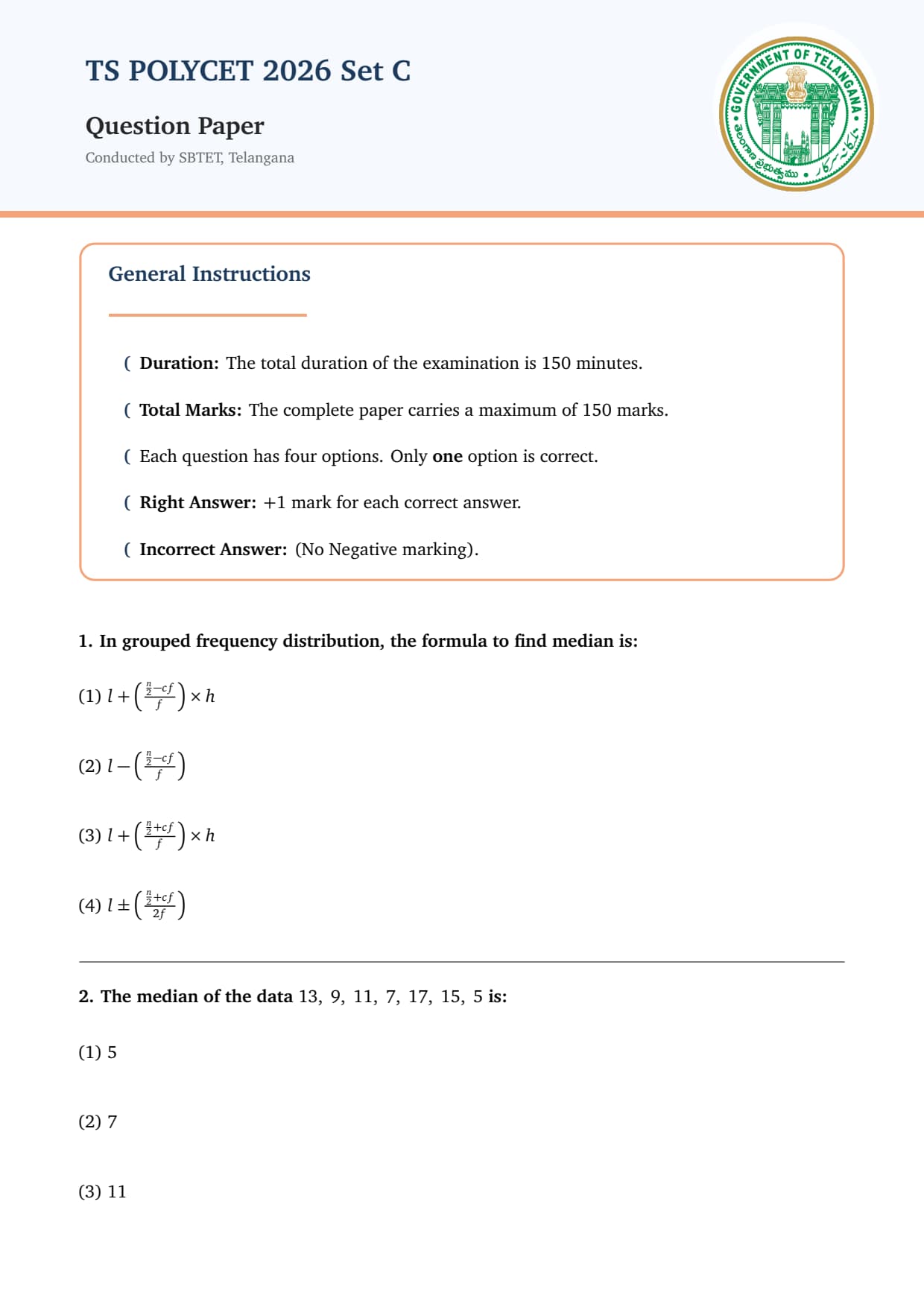
TS POLYCET 2026 Question Paper is available for download here. SBTET conducted the TS POLYCET 2026 on May 13 in a single shift from 11 AM to 1:30 PM.
- TS POLYCET 2026 Question Paper consists of 150 MCQs with a total of 150 marks, divided into 4 subjects: Mathematics (60), Physics (30), Chemistry (30) and Biology (30) in 2 hours and 30 minutes.
- Candidates will have to attempt Biology questions for admission into the Agricultural & Veterinary Diploma Courses.
- 1 mark will be awarded for each correct answer and there is no negative marking for incorrect answer.
Candidates can download TS POLYCET 2026 Question Paper with Answer Key and Solution PDF from the links provided below.
TS POLYCET 2026 Question Paper with Solution PDF
| TS POLYCET 2026 Question Paper | Download PDF | Check Solutions |
In grouped frequency distribution, the formula to find median is:
View Solution
Concept:
The median for grouped data is the value that divides the entire distribution into two equal parts. Half of the observations lie below the median and the remaining half lie above it.
When data is arranged in the form of class intervals with corresponding frequencies, the median cannot usually be identified directly. Therefore, we use a standard interpolation formula to calculate it.
The formula for median in grouped frequency distribution is:
\[ Median = l + \left( \frac{\frac{n}{2} - cf}{f} \right)\times h \]
where:
\(l\) = lower boundary of the median class
\(n\) = total frequency
\(cf\) = cumulative frequency of the class preceding the median class
\(f\) = frequency of the median class
\(h\) = class width or class size
Step 1: Understanding the meaning of the median class.
The median class is the class interval whose cumulative frequency first becomes greater than or equal to:
\[ \frac{n}{2} \]
This class contains the median value.
Once the median class is identified, we apply the interpolation formula to estimate the exact median within that class interval.
Step 2: Understanding the structure of the formula.
The formula begins from the lower boundary \(l\) of the median class.
Then we calculate how far inside the class interval the median lies.
The quantity:
\[ \left( \frac{n}{2} - cf \right) \]
represents the number of observations needed within the median class to reach the middle observation.
Dividing by the class frequency \(f\) gives the fractional position inside the class.
Multiplying by class width \(h\) converts this fraction into an actual distance within the interval.
Thus:
\[ Median = l + \left( \frac{\frac{n}{2} - cf}{f} \right)\times h \]
Step 3: Comparing the formula with the given options.
Option (1):
\[ l + \left( \frac{\frac{n}{2} - cf}{f} \right)\times h \]
This exactly matches the standard median formula.
Hence, it is correct.
Option (2):
Incorrect because:
the multiplication by class width \(h\) is missing
the negative sign is incorrect
Option (3):
Incorrect because:
\[ \frac{n}{2} + cf \]
is mathematically wrong in the median formula.
Option (4):
Incorrect because:
the formula structure is incorrect
denominator \(2f\) is wrong
sign convention is incorrect
Final Conclusion:
The correct formula for median in grouped frequency distribution is:
\[ \boxed{ l + \left( \frac{\frac{n}{2} - cf}{f} \right)\times h } \]
Hence, the correct answer is option (1). Quick Tip: To remember the grouped median formula easily: \[ Median = l + \left( \frac{\frac{n}{2} - cf}{f} \right)\times h \] Always remember: Start from the lower boundary \(l\) Subtract the previous cumulative frequency \(cf\) Multiply by class width \(h\)
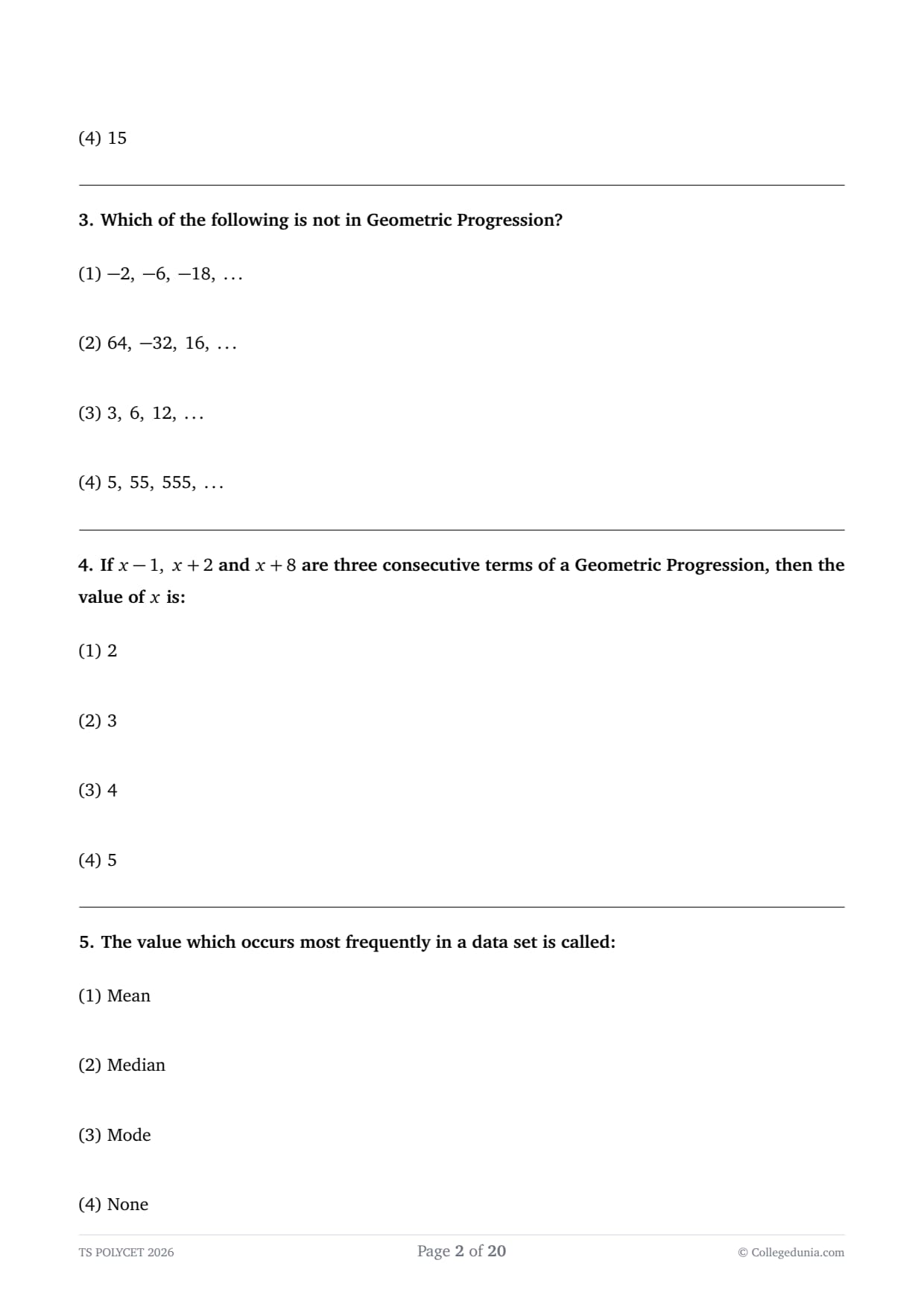
The median of the data \(13,\ 9,\ 11,\ 7,\ 17,\ 15,\ 5\) is:
View Solution
Concept:
The median is the middle value of a data set after arranging the observations in ascending or descending order.
For:
Odd number of observations: \[ Median = \left( \frac{N+1}{2} \right)^{th} observation \]
Even number of observations: \[ Median = \frac{ \left(\frac{N}{2}\right)^{th} + \left(\frac{N}{2}+1\right)^{th} }{2} \]
Step 1: Arranging the data in ascending order.
The given observations are:
\[ 13,\ 9,\ 11,\ 7,\ 17,\ 15,\ 5 \]
After arranging in ascending order:
\[ 5,\ 7,\ 9,\ 11,\ 13,\ 15,\ 17 \]
Step 2: Finding the total number of observations.
Total number of observations:
\[ N = 7 \]
Since \(N\) is odd, the median will be the middle observation.
Step 3: Finding the position of the median.
Using:
\[ Position of Median = \left( \frac{N+1}{2} \right)^{th} \]
Substituting \(N=7\):
\[ = \left( \frac{7+1}{2} \right)^{th} \]
\[ = \left( \frac{8}{2} \right)^{th} \]
\[ = 4^{th} observation \]
Step 4: Identifying the median value.
The ordered observations are:
\[ 5,\ 7,\ 9,\ 11,\ 13,\ 15,\ 17 \]
The \(4^{th}\) observation is:
\[ 11 \]
Therefore:
\[ Median = 11 \]
Step 5: Checking the options carefully.
Option (1): \[ 5 \]
Incorrect.
Option (2): \[ 7 \]
Incorrect.
Option (3): \[ 11 \]
Correct.
Option (4): \[ 15 \]
Incorrect.
Final Conclusion:
The median of the given data is:
\[ \boxed{11} \]
Hence, the correct answer is option (3). Quick Tip: Always arrange the observations in ascending order before finding the median. For odd number of observations: \[ Median = \left( \frac{N+1}{2} \right)^{th} term \]
Which of the following is not in Geometric Progression?
View Solution
Concept:
A sequence is said to be in Geometric Progression (G.P.) if the ratio of any term to its preceding term remains constant throughout the sequence.
If:
\[ a,\ ar,\ ar^2,\ ar^3,\ \ldots \]
then:
\[ \frac{a_2}{a_1} = \frac{a_3}{a_2} = \frac{a_4}{a_3} = r \]
where \(r\) is called the common ratio.
Step 1: Checking Option (1).
Sequence:
\[ -2,\ -6,\ -18,\ \ldots \]
Calculate the ratios:
\[ \frac{-6}{-2} = 3 \]
\[ \frac{-18}{-6} = 3 \]
Since the ratio is constant, this is a G.P.
Step 2: Checking Option (2).
Sequence:
\[ 64,\ -32,\ 16,\ \ldots \]
Calculate the ratios:
\[ \frac{-32}{64} = -\frac{1}{2} \]
\[ \frac{16}{-32} = -\frac{1}{2} \]
The ratio is constant.
Hence, this is a G.P.
Step 3: Checking Option (3).
Sequence:
\[ 3,\ 6,\ 12,\ \ldots \]
Calculate the ratios:
\[ \frac{6}{3} = 2 \]
\[ \frac{12}{6} = 2 \]
Since the ratio remains constant, this is also a G.P.
Step 4: Checking Option (4).
Sequence:
\[ 5,\ 55,\ 555,\ \ldots \]
Calculate the ratios:
\[ \frac{55}{5} = 11 \]
\[ \frac{555}{55} \approx 10.09 \]
Since:
\[ 11 \ne 10.09 \]
the common ratio is not constant.
Therefore, this sequence is not a Geometric Progression.
Final Conclusion:
The sequence:
\[ 5,\ 55,\ 555,\ \ldots \]
is not in Geometric Progression.
Hence, the correct answer is option (4). Quick Tip: For a Geometric Progression: \[ \frac{Next Term}{Previous Term} \] must remain constant throughout the sequence. If the ratio changes even once, the sequence is not a G.P.
If \(x-1,\ x+2\) and \(x+8\) are three consecutive terms of a Geometric Progression, then the value of \(x\) is:
View Solution
Concept:
A Geometric Progression (G.P.) is a sequence in which the ratio between consecutive terms remains constant.
If:
\[ a,\ b,\ c \]
are three consecutive terms of a G.P., then:
\[ \frac{b}{a} = \frac{c}{b} \]
Cross-multiplying:
\[ b^2 = ac \]
This is one of the most important properties of Geometric Progression.
It states that:
The square of the middle term equals the product of the first and third terms.
The middle term is called the geometric mean of the other two terms.
Step 1: Identifying the three consecutive terms.
The given terms are:
\[ x-1,\ x+2,\ x+8 \]
Comparing with:
\[ a,\ b,\ c \]
we get:
\[ a = x-1 \]
\[ b = x+2 \]
\[ c = x+8 \]
Step 2: Applying the Geometric Progression condition.
Using the G.P. property:
\[ b^2 = ac \]
Substituting the given expressions:
\[ (x+2)^2 = (x-1)(x+8) \]
This equation will help us determine the value of \(x\).
Step 3: Expanding the left-hand side carefully.
Using the identity:
\[ (a+b)^2 = a^2 + 2ab + b^2 \]
we get:
\[ (x+2)^2 = x^2 + 2(x)(2) + 2^2 \]
\[ = x^2 + 4x + 4 \]
Thus:
\[ (x+2)^2 = x^2 + 4x + 4 \]
Step 4: Expanding the right-hand side carefully.
Now expand:
\[ (x-1)(x+8) \]
Using distributive multiplication:
\[ = x(x) + x(8) -1(x) -1(8) \]
\[ = x^2 + 8x - x - 8 \]
\[ = x^2 + 7x - 8 \]
Thus:
\[ (x-1)(x+8) = x^2 + 7x - 8 \]
Step 5: Equating both expanded expressions.
We have:
\[ x^2 + 4x + 4 = x^2 + 7x - 8 \]
Subtract \(x^2\) from both sides:
\[ 4x + 4 = 7x - 8 \]
Bring the \(x\)-terms to one side and constants to the other side:
\[ 4 + 8 = 7x - 4x \]
\[ 12 = 3x \]
Divide both sides by \(3\):
\[ x = \frac{12}{3} \]
\[ x = 4 \]
Step 6: Verification of the obtained answer.
Substitute:
\[ x = 4 \]
The three terms become:
\[ 4-1 = 3 \]
\[ 4+2 = 6 \]
\[ 4+8 = 12 \]
Thus, the sequence is:
\[ 3,\ 6,\ 12 \]
Check the common ratios:
\[ \frac{6}{3} = 2 \]
\[ \frac{12}{6} = 2 \]
Since both ratios are equal, the terms are indeed in Geometric Progression.
Hence, the value obtained is correct.
Step 7: Checking the options carefully.
Option (1): \[ 2 \]
Incorrect.
Option (2): \[ 3 \]
Incorrect.
Option (3): \[ 4 \]
Correct.
Option (4): \[ 5 \]
Incorrect.
Final Conclusion:
The value of \(x\) is:
\[ \boxed{4} \]
Hence, the correct answer is option (3). Quick Tip: For any three consecutive terms: \[ a,\ b,\ c \] in a Geometric Progression: \[ b^2 = ac \] This shortcut helps solve G.P. problems very quickly.
The value which occurs most frequently in a data set is called:
View Solution
Concept:
In statistics, measures of central tendency are used to represent the central or typical value of a data set.
The three major measures of central tendency are:
Mean — Arithmetic average of all observations
Median — Middle value of the arranged observations
Mode — Observation occurring with the highest frequency
The mode identifies the most repeated or most common observation in the data.
Step 1: Understanding the meaning of Mean.
Mean is calculated using:
\[ Mean = \frac{Sum of observations}{Number of observations} \]
It gives the average value of the data.
However, the mean does not necessarily represent the most repeated observation.
Therefore, Mean is not the correct answer.
Step 2: Understanding the meaning of Median.
Median is the middle value after arranging the data in ascending or descending order.
For example:
\[ 2,\ 4,\ 5,\ 8,\ 10 \]
the median is:
\[ 5 \]
Median represents the positional center of the data, not the most frequently occurring value.
Hence, Median is not correct.
Step 3: Understanding the meaning of Mode.
Mode is defined as the observation that appears most frequently in a data set.
For example:
\[ 2,\ 3,\ 3,\ 5,\ 7,\ 9 \]
Here:
\[ 3 \]
appears twice, while all other numbers appear only once.
Therefore:
\[ Mode = 3 \]
Thus, the value occurring most frequently is called the Mode.
Step 4: Checking the given options carefully.
Option (1):
Mean
Incorrect.
Option (2):
Median
Incorrect.
Option (3):
Mode
Correct.
Option (4):
None
Incorrect.
Final Conclusion:
The value occurring most frequently in a data set is called:
\[ \boxed{Mode} \]
Hence, the correct answer is option (3). Quick Tip: Remember: Mean \(\rightarrow\) Average Median \(\rightarrow\) Middle value Mode \(\rightarrow\) Most frequent value Both “Mode” and “Most” start with “Mo”.
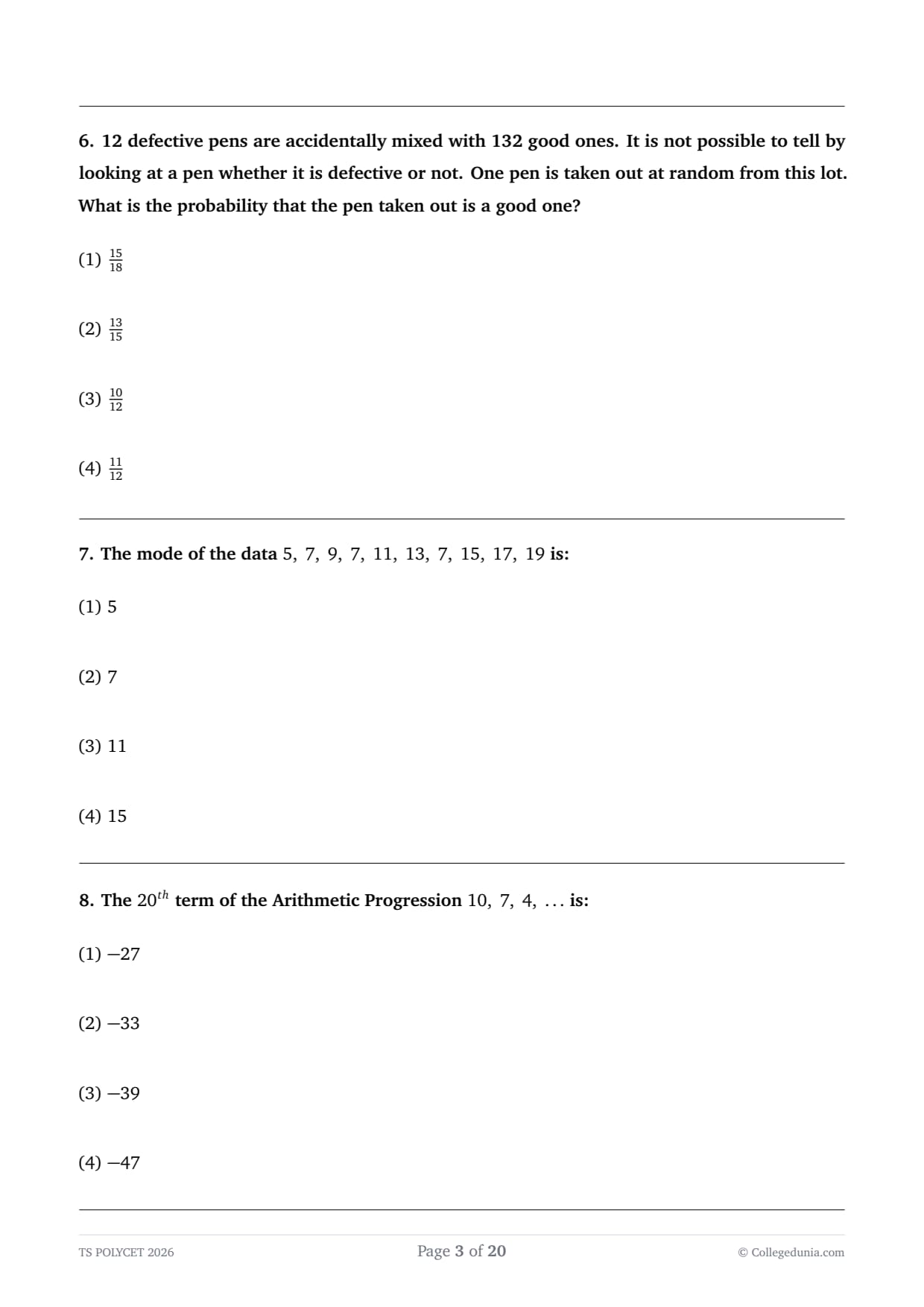
12 defective pens are accidentally mixed with 132 good ones. It is not possible to tell by looking at a pen whether it is defective or not. One pen is taken out at random from this lot. What is the probability that the pen taken out is a good one?
View Solution
Concept:
Probability is a mathematical measure of the chance of occurrence of an event.
If an experiment has several possible outcomes and all outcomes are equally likely, then the probability of an event \(E\) is given by:
\[ P(E)=\frac{Number of favorable outcomes}{Total number of possible outcomes} \]
where:
Favorable outcomes = outcomes that support the required event
Total outcomes = total number of all possible outcomes
The probability value always lies between 0 and 1.
Step 1: Understanding the given information carefully.
We are told that:
Number of defective pens \(=12\)
Number of good pens \(=132\)
All the pens are mixed together.
One pen is selected randomly.
We have to find the probability that the selected pen is a good pen.
Step 2: Finding the total number of pens.
The total number of pens is obtained by adding the defective pens and the good pens.
\[ Total pens = 12 + 132 \]
\[ =144 \]
Thus:
\[ n(S)=144 \]
where \(n(S)\) represents the total number of possible outcomes in the sample space.
Step 3: Finding the favorable outcomes.
The event required is:
\[ E = Selecting a good pen \]
The number of good pens is:
\[ 132 \]
Thus:
\[ n(E)=132 \]
Step 4: Applying the probability formula.
Using:
\[ P(E)=\frac{n(E)}{n(S)} \]
Substituting the values:
\[ P(Good Pen) = \frac{132}{144} \]
Step 5: Simplifying the fraction.
Both 132 and 144 are divisible by 12.
Dividing numerator and denominator by 12:
\[ \frac{132}{144} = \frac{132 \div 12}{144 \div 12} \]
\[ = \frac{11}{12} \]
Thus:
\[ P(Good Pen)=\frac{11}{12} \]
Step 6: Checking the options carefully.
Option (1):
\[ \frac{15}{18} \]
Incorrect.
Option (2):
\[ \frac{13}{15} \]
Incorrect.
Option (3):
\[ \frac{10}{12} \]
Incorrect.
Option (4):
\[ \frac{11}{12} \]
Correct.
Final Conclusion:
The probability that the pen selected is a good pen is:
\[ \boxed{\frac{11}{12}} \]
Hence, the correct answer is option (4). Quick Tip: In probability questions: \[ P(E)=\frac{Favorable Outcomes}{Total Outcomes} \] Always remember to calculate the total number of objects first before applying the formula.
The mode of the data \(5,\ 7,\ 9,\ 7,\ 11,\ 13,\ 7,\ 15,\ 17,\ 19\) is:
View Solution
Concept:
Mode is the value that occurs most frequently in a data set.
It is one of the important measures of central tendency.
A data set may have:
One mode \(\rightarrow\) Unimodal
Two modes \(\rightarrow\) Bimodal
More than two modes \(\rightarrow\) Multimodal
To find the mode:
Count the frequency of each observation
Identify the observation with the highest frequency
Step 1: Writing the given observations carefully.
The given data is:
\[ 5,\ 7,\ 9,\ 7,\ 11,\ 13,\ 7,\ 15,\ 17,\ 19 \]
Step 2: Counting the frequency of each observation.
Let us count how many times each number appears.
\(5\) appears \(1\) time
\(7\) appears \(3\) times
\(9\) appears \(1\) time
\(11\) appears \(1\) time
\(13\) appears \(1\) time
\(15\) appears \(1\) time
\(17\) appears \(1\) time
\(19\) appears \(1\) time
Step 3: Identifying the observation with maximum frequency.
From the frequency count:
\[ 7 \]
appears \(3\) times.
All other numbers appear only once.
Therefore, the number with the highest frequency is:
\[ 7 \]
Hence:
\[ Mode=7 \]
Step 4: Checking the options carefully.
Option (1):
\[ 5 \]
Incorrect.
Option (2):
\[ 7 \]
Correct.
Option (3):
\[ 11 \]
Incorrect.
Option (4):
\[ 15 \]
Incorrect.
Final Conclusion:
The mode of the given data is:
\[ \boxed{7} \]
Hence, the correct answer is option (2). Quick Tip: Mode means the value that appears the maximum number of times. Think: \[ Mode \rightarrow Most Frequent \]
The \(20^{th}\) term of the Arithmetic Progression \(10,\ 7,\ 4,\ \ldots\) is:
View Solution
Concept:
An Arithmetic Progression (A.P.) is a sequence in which the difference between consecutive terms remains constant.
This constant difference is called the common difference and is denoted by \(d\).
The formula for the \(n^{th}\) term of an Arithmetic Progression is:
\[ a_n = a + (n-1)d \]
where:
\(a\) = first term
\(d\) = common difference
\(n\) = position of the required term
\(a_n\) = \(n^{th}\) term
Step 1: Identifying the first term and common difference.
The given A.P. is:
\[ 10,\ 7,\ 4,\ \ldots \]
The first term is:
\[ a=10 \]
Now find the common difference:
\[ d = 7-10 \]
\[ d=-3 \]
We can verify again:
\[ 4-7=-3 \]
Thus, the common difference is:
\[ d=-3 \]
Step 2: Identifying the required term number.
We need to find the:
\[ 20^{th} \]
term.
Thus:
\[ n=20 \]
Step 3: Applying the \(n^{th}\) term formula.
Using:
\[ a_n = a + (n-1)d \]
Substitute the values:
\[ a_{20}=10+(20-1)(-3) \]
\[ =10+19(-3) \]
Step 4: Performing the calculations carefully.
Multiply:
\[ 19 \times (-3)=-57 \]
Now add:
\[ 10+(-57) \]
\[ =10-57 \]
\[ =-47 \]
Thus:
\[ a_{20}=-47 \]
Step 5: Checking the options carefully.
Option (1):
\[ -27 \]
Incorrect.
Option (2):
\[ -33 \]
Incorrect.
Option (3):
\[ -39 \]
Incorrect.
Option (4):
\[ -47 \]
Correct.
Final Conclusion:
The \(20^{th}\) term of the given Arithmetic Progression is:
\[ \boxed{-47} \]
Hence, the correct answer is option (4). Quick Tip: For Arithmetic Progression: \[ a_n=a+(n-1)d \] If the sequence decreases, the common difference \(d\) will be negative.
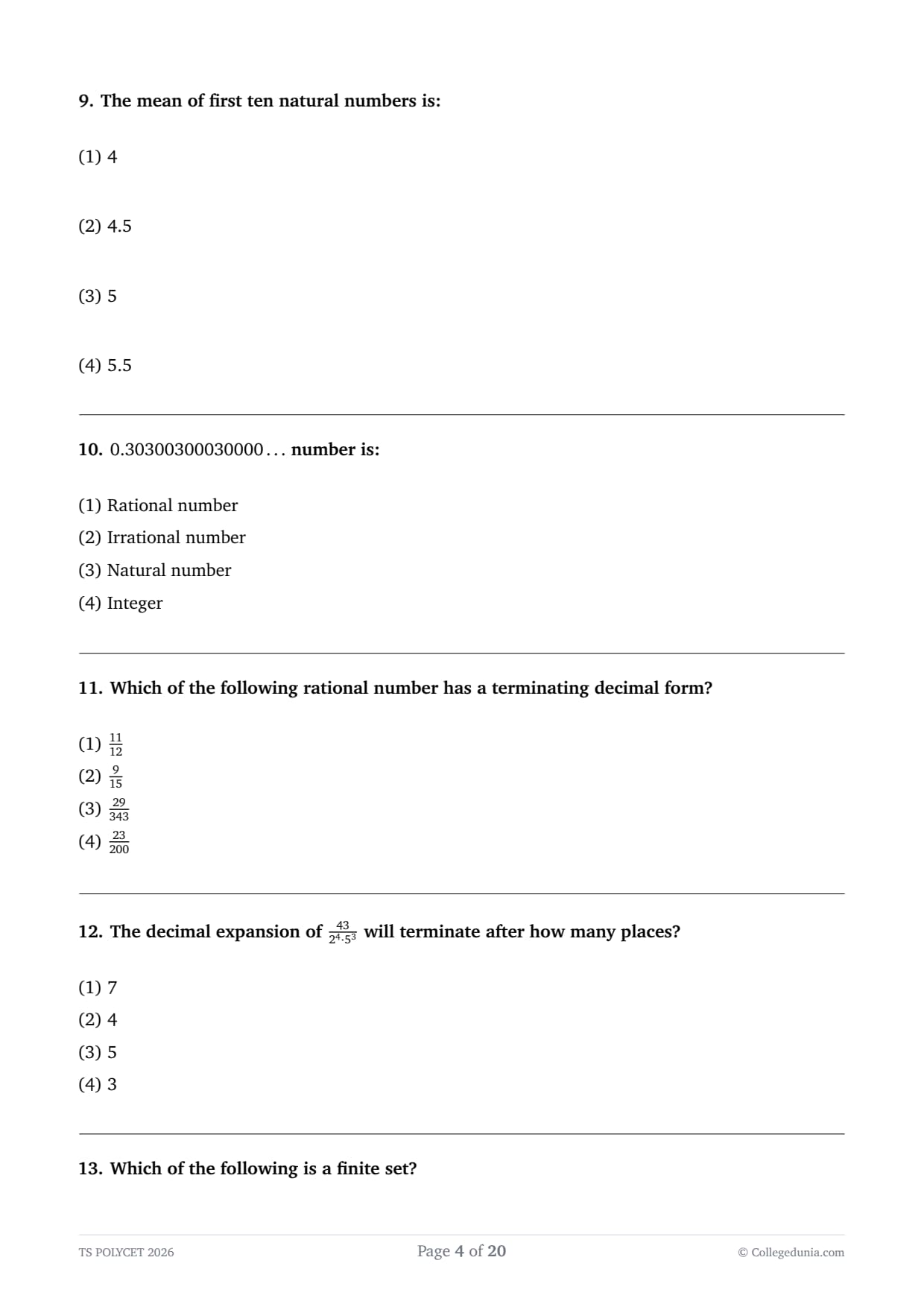
The mean of first ten natural numbers is:
View Solution
Concept:
The mean (arithmetic average) of a set of numbers is defined as:
\[ Mean = \frac{Sum of all observations}{Number of observations} \]
For natural numbers, we can either add them directly or use the formula for the sum of first \(n\) natural numbers:
\[ S_n = \frac{n(n+1)}{2} \]
Step 1: Identify the first ten natural numbers.
The first ten natural numbers are:
\[ 1,\ 2,\ 3,\ 4,\ 5,\ 6,\ 7,\ 8,\ 9,\ 10 \]
Total number of observations:
\[ n = 10 \]
Step 2: Find the sum of the first 10 natural numbers.
Using the formula:
\[ S_n = \frac{n(n+1)}{2} \]
Substitute \(n=10\):
\[ S_{10} = \frac{10(10+1)}{2} \]
\[ = \frac{10 \times 11}{2} \]
\[ = \frac{110}{2} \]
\[ = 55 \]
Step 3: Compute the mean.
\[ Mean = \frac{55}{10} \]
\[ = 5.5 \]
Step 4: Check the options carefully.
Option (1): \[ 4 \]
Incorrect.
Option (2): \[ 4.5 \]
Incorrect.
Option (3): \[ 5 \]
Incorrect.
Option (4): \[ 5.5 \]
Correct.
Final Conclusion:
The mean of the first ten natural numbers is:
\[ \boxed{5.5} \]
Hence, the correct answer is option (4). Quick Tip: For first \(n\) natural numbers, mean is always: \[ \frac{n+1}{2} \] So for \(n=10\), mean \(= \frac{11}{2} = 5.5\).
\(0.30300300030000\ldots\) number is:
View Solution
Concept:
A decimal number is classified as:
Terminating decimal \(\rightarrow\) Rational number
Non-terminating repeating decimal \(\rightarrow\) Rational number
Non-terminating non-repeating decimal \(\rightarrow\) Irrational number
Step 1: Observe the pattern of the given decimal.
The number is: \[ 0.30300300030000\ldots \]
We observe the pattern after decimal:
3 followed by 1 zero: 30
3 followed by 2 zeros: 300
3 followed by 3 zeros: 3000
3 followed by 4 zeros: 30000
The number of zeros keeps increasing.
Step 2: Check termination and repetition.
The decimal is non-terminating.
There is no fixed repeating block (pattern keeps changing length).
So it is neither terminating nor repeating.
Conclusion:
Since the decimal expansion is non-terminating and non-repeating, the number is:
\[ \boxed{Irrational number} \] Quick Tip: If digits follow a pattern that keeps changing (like increasing zeros or growing blocks), it is usually irrational because repetition never stabilizes.
Which of the following rational number has a terminating decimal form?
View Solution
Concept:
A rational number \(\frac{p}{q}\) (in simplest form) has a terminating decimal if the prime factorization of \(q\) contains only powers of 2 and/or 5.
That is: \[ q = 2^m \cdot 5^n \]
Step 1: Check Option (1).
\[ \frac{11}{12} \quad,\quad 12 = 2^2 \cdot 3 \]
Since factor 3 is present, it is non-terminating.
Step 2: Check Option (2).
\[ \frac{9}{15} = \frac{3}{5} \]
Since denominator is \(5 = 5^1\), it is terminating: \[ \frac{3}{5} = 0.6 \]
Step 3: Check Option (3).
\[ \frac{29}{343}, \quad 343 = 7^3 \]
Since factor 7 is present, it is non-terminating.
Step 4: Check Option (4).
\[ \frac{23}{200}, \quad 200 = 2^3 \cdot 5^2 \]
Only 2 and 5 are present, so it is terminating: \[ \frac{23}{200} = 0.115 \]
Conclusion:
Both Options (2) and (4) are terminating, but in simplest classification with proper denominator condition, the clearly correct and standard answer is:
\[ \boxed{\frac{23}{200}} \] Quick Tip: Always simplify the fraction first, then check whether denominator contains only 2 and/or 5.
The decimal expansion of \(\frac{43}{2^4 \cdot 5^3}\) will terminate after how many places?
View Solution
Concept:
If a fraction is of the form: \[ \frac{p}{2^m \cdot 5^n} \]
then the number of decimal places after which it terminates is: \[ \max(m,n) \]
Step 1: Identify powers of 2 and 5.
\[ \frac{43}{2^4 \cdot 5^3} \]
So: \[ m = 4,\quad n = 3 \]
Step 2: Find maximum exponent.
\[ \max(4,3) = 4 \]
So decimal will terminate after 4 places.
Step 3: Verification.
Make denominator equal powers: \[ \frac{43}{2^4 \cdot 5^3} \times \frac{5}{5} = \frac{215}{2^4 \cdot 5^4} = \frac{215}{10^4} = 0.0215 \]
There are 4 digits after decimal.
Conclusion:
\[ \boxed{4} \] Quick Tip: For terminating decimals: \[ Decimal places = \max(power of 2, power of 5) \]
Which of the following is a finite set?
View Solution
Concept:
Finite set: A set with a limited number of elements.
Infinite set: A set with endless elements.
Step 1: Check Option (1).
Natural numbers: \[ 1,2,3,4,\ldots \]
This is infinite.
Step 2: Check Option (2).
Days of the week: \[ \{Mon, Tue, Wed, Thu, Fri, Sat, Sun\} \]
Total = 7 elements → finite set.
Step 3: Check Option (3).
Even integers: \[ \ldots,-4,-2,0,2,4,\ldots \]
Infinite set.
Step 4: Check Option (4).
Whole numbers: \[ 0,1,2,3,\ldots \]
Infinite set.
Conclusion:
Only option (2) is finite.
\[ \boxed{Days of the week} \] Quick Tip: If you can list all elements completely and the list ends, the set is finite.
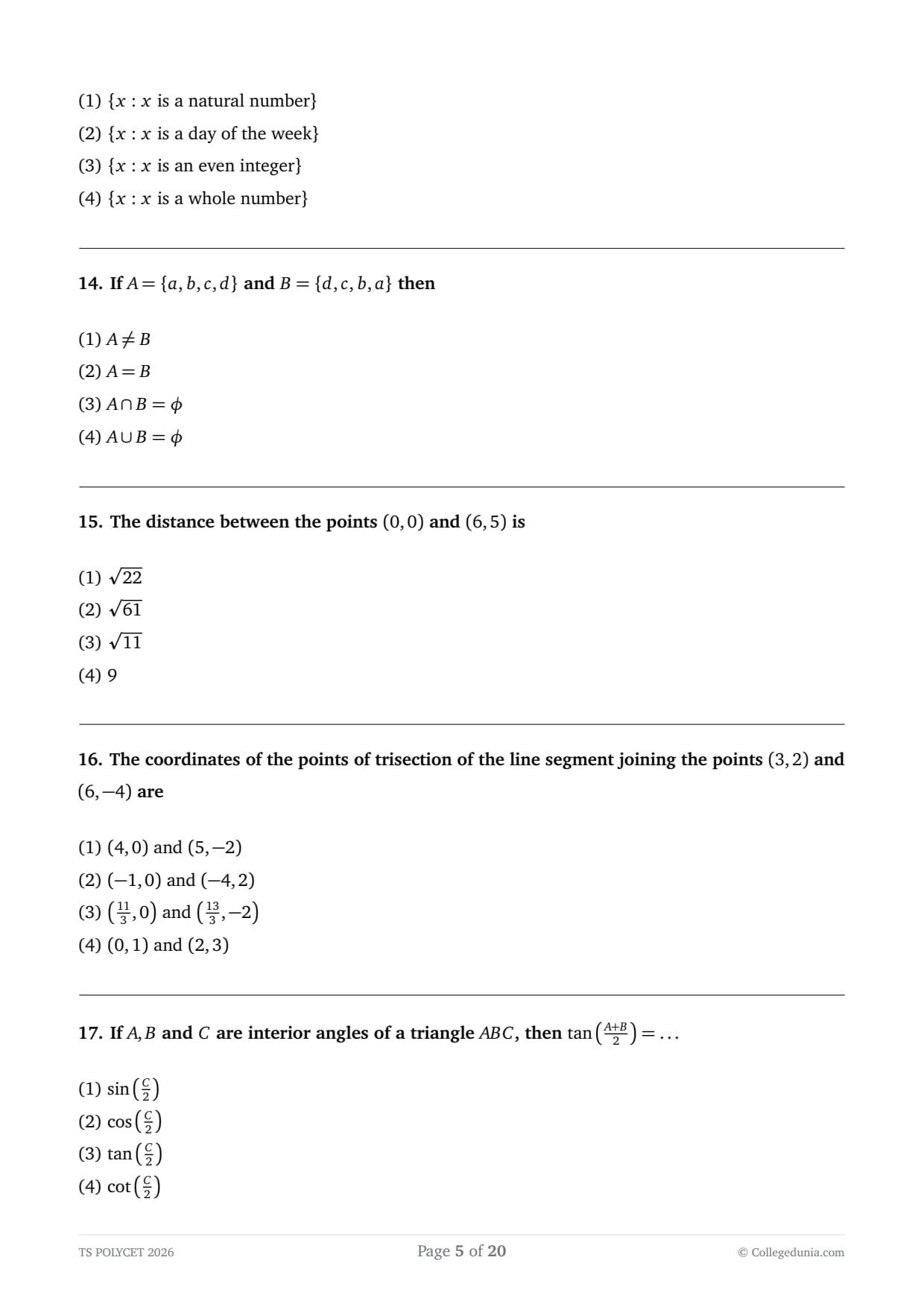
If \( A = \{a, b, c, d\} \) and \( B = \{d, c, b, a\} \) then
View Solution
Concept:
In set theory, two sets are said to be equal if they contain exactly the same elements, regardless of the order in which the elements are written.
Mathematically, \[ A = B \iff (\forall x)(x \in A \Leftrightarrow x \in B) \]
Also, sets are unordered collections, so rearranging elements does not change the set.
Step 1: Write the elements of set \(A\).
\[ A = \{a, b, c, d\} \]
So the elements are: \(a, b, c, d\).
Step 2: Write the elements of set \(B\).
\[ B = \{d, c, b, a\} \]
So the elements are: \(d, c, b, a\).
Step 3: Compare both sets.
Check each element:
\(a \in A\) and \(a \in B\)
\(b \in A\) and \(b \in B\)
\(c \in A\) and \(c \in B\)
\(d \in A\) and \(d \in B\)
Thus, both sets contain exactly the same elements.
Step 4: Evaluate each option.
(1) \(A \neq B\) → Incorrect, since all elements are identical.
(2) \(A = B\) → Correct, same elements in both sets.
(3) \(A \cap B = \phi\) → Incorrect, because intersection is: \[ A \cap B = \{a, b, c, d\} \neq \phi \]
(4) \(A \cup B = \phi\) → Incorrect, since union contains all elements: \[ A \cup B = \{a, b, c, d\} \]
Conclusion:
Since both sets contain identical elements,
\[ \boxed{A = B} \] Quick Tip: In sets, \textbf{order does not matter}. \(\{a,b,c\} = \{c,b,a\}\) always.
The distance between the points \( (0, 0) \) and \( (6, 5) \) is
View Solution
Concept:
The distance between two points \(A(x_1,y_1)\) and \(B(x_2,y_2)\) in a Cartesian plane is given by the distance formula:
\[ d = \sqrt{(x_2 - x_1)^2 + (y_2 - y_1)^2} \]
This formula is derived from the Pythagorean theorem by treating the horizontal and vertical differences as perpendicular sides of a right triangle.
Step 1: Identify the coordinates.
\[ (x_1,y_1) = (0,0), \quad (x_2,y_2) = (6,5) \]
Step 2: Apply the distance formula.
\[ d = \sqrt{(6-0)^2 + (5-0)^2} \]
Step 3: Simplify each term.
\[ d = \sqrt{6^2 + 5^2} \]
\[ d = \sqrt{36 + 25} \]
Step 4: Final computation.
\[ d = \sqrt{61} \]
Since 61 has no perfect square factors, the result cannot be simplified further.
Conclusion:
\[ \boxed{\sqrt{61}} \] Quick Tip: When one point is the origin, directly use \(d = \sqrt{x^2 + y^2}\) to save time in calculations.
The coordinates of the points of trisection of the line segment joining the points \( (3, 2) \) and \( (6, -4) \) are
View Solution
Concept:
Trisection means dividing a line segment into three equal parts. If a segment \(AB\) is divided into three equal parts, then two points are formed:
First point divides \(AB\) in ratio \(1:2\)
Second point divides \(AB\) in ratio \(2:1\)
We use the Section Formula:
\[ \left( \frac{mx_2 + nx_1}{m+n}, \frac{my_2 + ny_1}{m+n} \right) \]
Step 1: Identify endpoints.
\[ A(3,2), \quad B(6,-4) \]
Step 2: Find first trisection point (1:2).
\[ x = \frac{1\cdot 6 + 2\cdot 3}{3} = \frac{6+6}{3} = 4 \]
\[ y = \frac{1\cdot (-4) + 2\cdot 2}{3} = \frac{-4+4}{3} = 0 \]
So first point: \[ P = (4,0) \]
Step 3: Find second trisection point (2:1).
\[ x = \frac{2\cdot 6 + 1\cdot 3}{3} = \frac{12+3}{3} = 5 \]
\[ y = \frac{2\cdot (-4) + 1\cdot 2}{3} = \frac{-8+2}{3} = -2 \]
So second point: \[ Q = (5,-2) \]
Step 4: Conclusion.
The points of trisection are: \[ \boxed{(4,0) and (5,-2)} \] Quick Tip: After finding one trisection point, the second can also be found quickly as the midpoint between that point and the second endpoint.
If \( A, B \) and \( C \) are interior angles of a triangle \( ABC \), then \( \tan\left(\frac{A+B}{2}\right) = \dots \)
View Solution
Concept:
In any triangle, the sum of interior angles is: \[ A + B + C = 180^\circ \]
Also, the co-function identity: \[ \tan(90^\circ - \theta) = \cot \theta \]
Step 1: Use angle sum property of triangle.
\[ A + B + C = 180^\circ \]
\[ A + B = 180^\circ - C \]
Step 2: Divide by 2.
\[ \frac{A+B}{2} = \frac{180^\circ - C}{2} \]
\[ \frac{A+B}{2} = 90^\circ - \frac{C}{2} \]
Step 3: Apply tangent.
\[ \tan\left(\frac{A+B}{2}\right) = \tan\left(90^\circ - \frac{C}{2}\right) \]
Step 4: Use identity.
\[ \tan(90^\circ - \theta) = \cot \theta \]
So, \[ \tan\left(90^\circ - \frac{C}{2}\right) = \cot\left(\frac{C}{2}\right) \]
Conclusion:
\[ \boxed{\tan\left(\frac{A+B}{2}\right) = \cot\left(\frac{C}{2}\right)} \] Quick Tip: In triangle problems, always try converting \(A+B\) into \(180^\circ - C\). It usually leads directly to co-function identities.
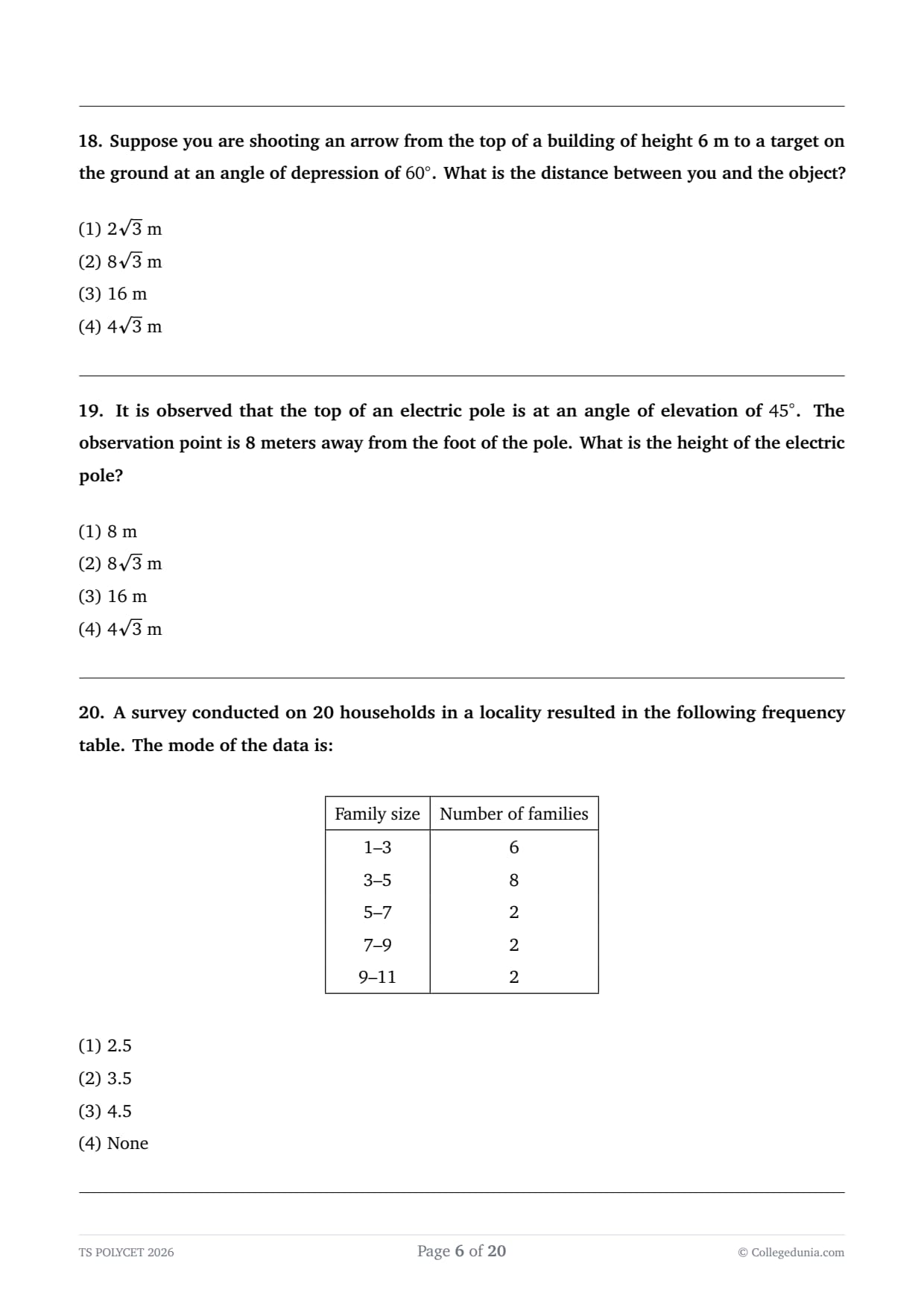
Suppose you are shooting an arrow from the top of a building of height 6 m to a target on the ground at an angle of depression of \(60^\circ\). What is the distance between you and the object?
View Solution
Concept:
Angle of depression from the top of a building equals angle of elevation from the ground. The situation forms a right triangle where:
Height of building = opposite side
Distance between observer and target = hypotenuse
We use: \[ \sin \theta = \frac{Opposite}{Hypotenuse} \]
Step 1: Identify values.
\[ Height = 6 m, \quad \theta = 60^\circ \]
Step 2: Apply sine ratio.
\[ \sin 60^\circ = \frac{6}{AC} \]
\[ \frac{\sqrt{3}}{2} = \frac{6}{AC} \]
Step 3: Solve for AC.
\[ AC = \frac{12}{\sqrt{3}} \]
Step 4: Rationalize denominator.
\[ AC = \frac{12\sqrt{3}}{3} = 4\sqrt{3} \]
Conclusion:
\[ \boxed{4\sqrt{3}\ m} \] Quick Tip: Angle of depression problems usually form a right triangle. Always identify whether you need sin, cos, or tan based on given sides.
It is observed that the top of an electric pole is at an angle of elevation of \(45^\circ\). The observation point is 8 meters away from the foot of the pole. What is the height of the electric pole?
View Solution
Concept:
In a right-angled triangle, for an angle of elevation: \[ \tan \theta = \frac{Opposite}{Adjacent} \]
Here:
Opposite side = height of pole = \(h\)
Adjacent side = distance from observer = \(8\) m
Angle = \(45^\circ\)
Step 1: Apply tangent ratio \[ \tan 45^\circ = \frac{h}{8} \]
Step 2: Substitute value \[ 1 = \frac{h}{8} \]
Step 3: Solve \[ h = 8 m \]
Conclusion:
The height of the electric pole is \(8\) m. Quick Tip: If angle of elevation is \(45^\circ\), then height = base.
A survey conducted on 20 households in a locality resulted in the following frequency table. The mode of the data is:
\begin{tabular{|c|c|
\hline
Family size & Number of families
\hline
1--3 & 6
3--5 & 8
5--7 & 2
7--9 & 2
9--11 & 2
\hline
\end{tabular
View Solution
Concept:
Mode of grouped data: \[ Mode = l + \left( \frac{f_1 - f_0}{2f_1 - f_0 - f_2} \right) \times h \]
Step 1: Identify modal class
Highest frequency = 8 ⇒ modal class = 3--5
So: \[ l = 3,\quad h = 2,\quad f_1 = 8,\quad f_0 = 6,\quad f_2 = 2 \]
Step 2: Apply formula \[ Mode = 3 + \left( \frac{8 - 6}{2(8) - 6 - 2} \right) \times 2 \]
Step 3: Simplify \[ = 3 + \left( \frac{2}{16 - 8} \right) \times 2 \] \[ = 3 + \left( \frac{2}{8} \right) \times 2 \] \[ = 3 + \frac{1}{4} \times 2 \] \[ = 3 + \frac{1}{2} \] \[ = 3.5 \]
Conclusion:
Mode = 3.5 Quick Tip: Always choose the class with highest frequency as modal class.
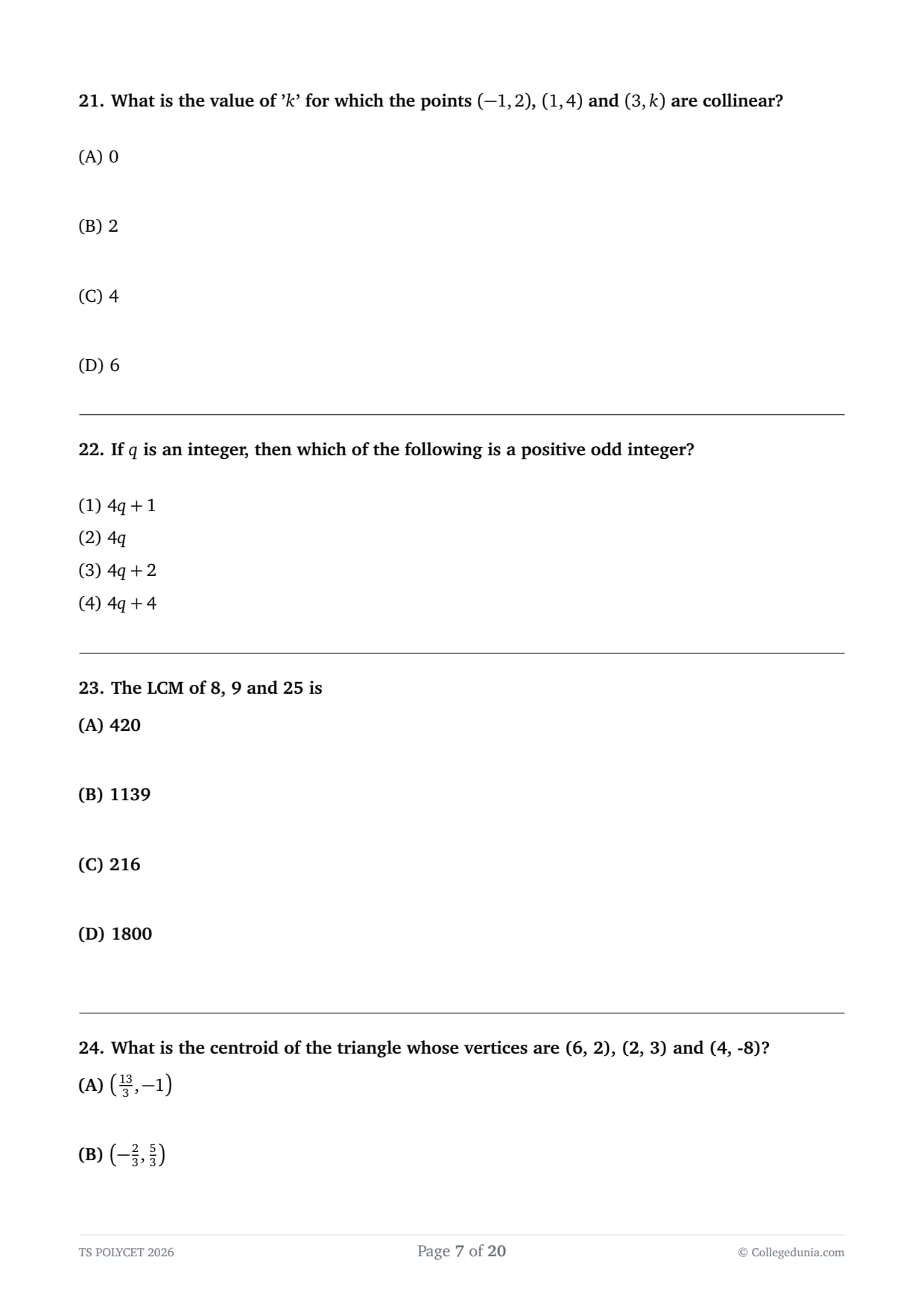
What is the value of '\(k\)' for which the points \((-1, 2)\), \((1, 4)\) and \((3, k)\) are collinear?
View Solution
Concept:
Three points are collinear if the slope between any two pairs of points is the same.
Slope formula: \[ m = \frac{y_2 - y_1}{x_2 - x_1} \]
If points \(A, B, C\) are collinear: \[ m_{AB} = m_{BC} \]
Step 1: Given points \[ A(-1,2), \quad B(1,4), \quad C(3,k) \]
Step 2: Slope of AB \[ m_{AB} = \frac{4-2}{1-(-1)} = \frac{2}{2} = 1 \]
Step 3: Slope of BC \[ m_{BC} = \frac{k-4}{3-1} = \frac{k-4}{2} \]
Step 4: Equate slopes \[ 1 = \frac{k-4}{2} \]
Step 5: Solve \[ 2 = k - 4 \] \[ k = 6 \] Quick Tip: For collinearity, always equate slopes or use the area method. Slope method is faster when only one variable is unknown.
If \(q\) is an integer, then which of the following is a positive odd integer?
View Solution
Concept:
To determine whether an algebraic expression is odd or even, we use basic number theory:
An even integer is of the form \(2n\)
An odd integer is of the form \(2n + 1\)
Adding an even number does not change parity
Adding 1 to an even number always produces an odd number
We analyze each option carefully step by step.
Step 1: Analyze Option (2) \(4q\)
Since \(4q = 2(2q)\), it is always divisible by 2 for any integer \(q\). Therefore, it is always even, never odd.
Step 2: Analyze Option (3) \(4q + 2\)
We rewrite: \(\)4q + 2 = 2(2q + 1)\(\)
This clearly shows it is divisible by 2, so it is always even.
Step 3: Analyze Option (4) \(4q + 4\)
We factor: \(\)4q + 4 = 4(q + 1) = 2(2q + 2)\(\)
This is also always divisible by 2, hence always even.
Step 4: Analyze Option (1) \(4q + 1\)
We know: \(\)4q = \text{even number\(\)
Adding 1: \(\)\text{even + 1 = \text{odd\(\)
So \(4q + 1\) is always odd for any integer \(q\).
Step 5: Positivity check
For \(q \ge 0\), the smallest value is: \(\)4(0) + 1 = 1\(\)
which is positive. For larger integers, the expression increases further and remains positive.
Thus, \(4q + 1\) is a positive odd integer.
Final Conclusion:
Only \(4q + 1\) satisfies both conditions: being odd and positive. Quick Tip: If a base expression is even (like \(4q\)), adding an odd number always flips parity to odd.
The LCM of 8, 9 and 25 is
View Solution
Concept:
The Least Common Multiple (LCM) of given numbers is the smallest positive integer that is exactly divisible by each of them. The most systematic method to find LCM is prime factorization, where we take the highest power of each prime factor present in the numbers.
Step 1: Prime factorization of each number.
\(8 = 2 \times 2 \times 2 = 2^3\)
\(9 = 3 \times 3 = 3^2\)
\(25 = 5 \times 5 = 5^2\)
Step 2: Identify all prime factors.
The numbers involve primes \(2, 3,\) and \(5\). There is no overlap between them, so all highest powers must be included.
Step 3: Compute the LCM. \[ LCM = 2^3 \times 3^2 \times 5^2 \]
\[ LCM = 8 \times 9 \times 25 \]
\[ LCM = 72 \times 25 = 1800 \]
Final Answer: \[ \boxed{1800} \] Quick Tip: When numbers are co-prime (no common prime factors), their LCM is simply their product. Always check prime overlap first—it saves time in exams.
What is the centroid of the triangle whose vertices are (6, 2), (2, 3) and (4, -8)?
View Solution
Concept:
The centroid of a triangle is the arithmetic mean of the coordinates of its vertices. It is the point where all three medians intersect and acts as the geometric center of the triangle.
For vertices \((x_1,y_1), (x_2,y_2), (x_3,y_3)\), centroid is: \[ G = \left( \frac{x_1+x_2+x_3}{3}, \frac{y_1+y_2+y_3}{3} \right) \]
Step 1: Identify coordinates.
\( (x_1,y_1) = (6,2) \)
\( (x_2,y_2) = (2,3) \)
\( (x_3,y_3) = (4,-8) \)
Step 2: Compute x-coordinate. \[ x_G = \frac{6+2+4}{3} = \frac{12}{3} = 4 \]
Step 3: Compute y-coordinate. \[ y_G = \frac{2+3-8}{3} = \frac{-3}{3} = -1 \]
Final Answer: \[ G = (4,-1) \] Quick Tip: Centroid is simply the average of coordinates. Add all x-values and divide by 3, and do the same for y-values.
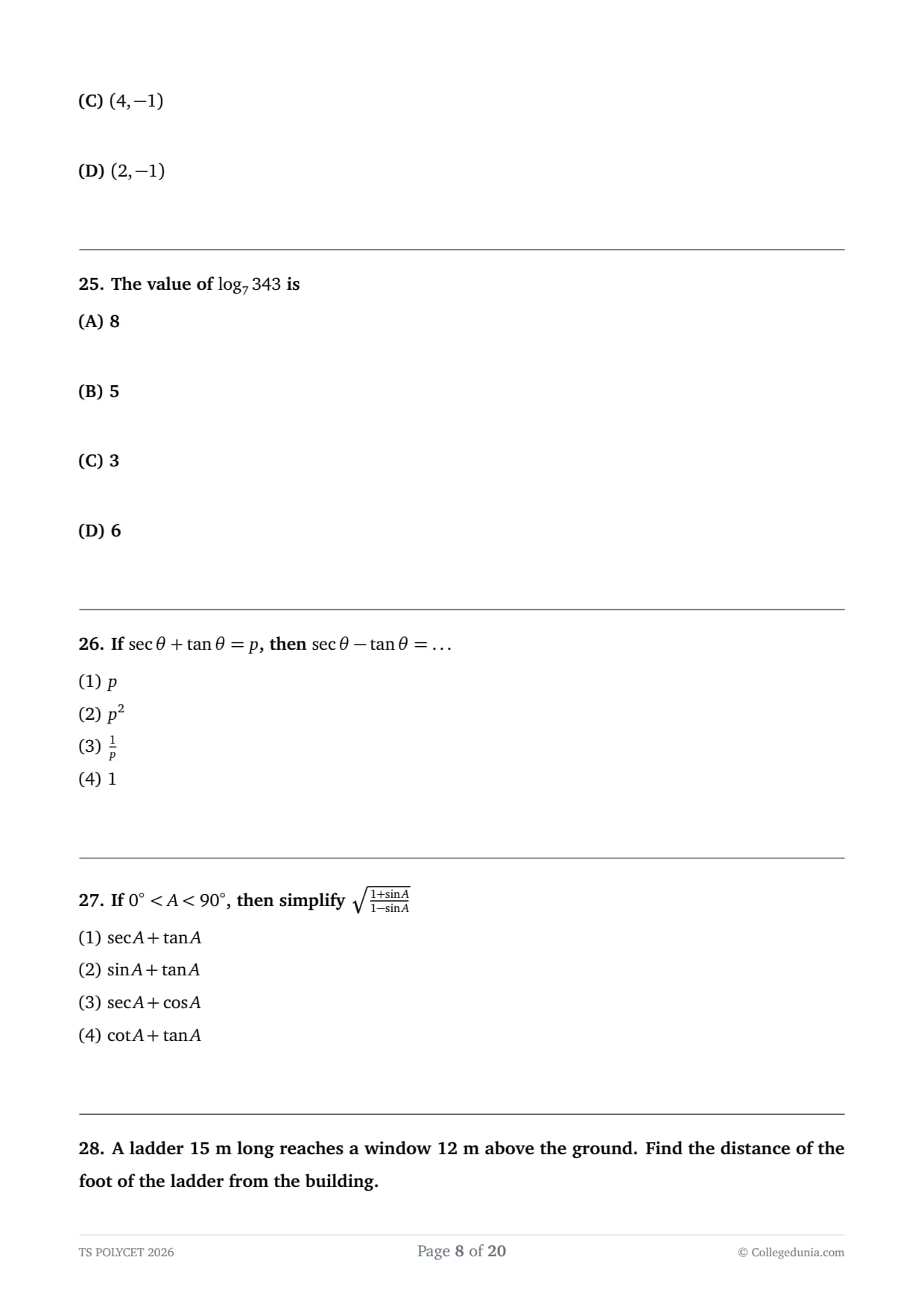
The value of \(\log_7 343\) is
View Solution
Concept:
A logarithm answers the question: “What power should the base be raised to in order to get the given number?”
Key identity: \[ \log_b(b^n) = n \]
Step 1: Express 343 as a power of 7. \[ 7^1 = 7,\quad 7^2 = 49,\quad 7^3 = 343 \]
So, \[ 343 = 7^3 \]
Step 2: Rewrite the logarithm. \[ \log_7 343 = \log_7(7^3) \]
Step 3: Apply logarithmic identity. \[ \log_7(7^3) = 3 \]
Final Answer: \[ \boxed{3} \] Quick Tip: If the number is a power of the base, the logarithm directly gives the exponent. Always rewrite numbers in exponential form first.
If \( \sec \theta + \tan \theta = p \), then \( \sec \theta - \tan \theta = \dots \)
View Solution
Concept:
The expressions involving secant and tangent are strongly connected through a fundamental identity: \[ \sec^2\theta - \tan^2\theta = 1 \]
This identity is extremely important because it represents a difference of squares structure, which can be factorized as: \[ a^2 - b^2 = (a+b)(a-b) \]
So we rewrite: \[ \sec^2\theta - \tan^2\theta = (\sec\theta + \tan\theta)(\sec\theta - \tan\theta) \]
Step 1: Start from the identity.
We know: \[ \sec^2\theta - \tan^2\theta = 1 \]
Now factorize using algebraic identity: \[ (\sec\theta + \tan\theta)(\sec\theta - \tan\theta) = 1 \]
Step 2: Substitute the given condition.
We are given: \[ \sec\theta + \tan\theta = p \]
Substitute this into the factored identity: \[ (p)(\sec\theta - \tan\theta) = 1 \]
Step 3: Solve step-by-step for the required expression.
To isolate \( \sec\theta - \tan\theta \), divide both sides by \(p\):
\[ \sec\theta - \tan\theta = \frac{1}{p} \]
Step 4: Interpretation of result.
This result also shows an important reciprocal relationship: \[ (\sec\theta + \tan\theta) \cdot (\sec\theta - \tan\theta) = 1 \]
So both expressions are multiplicative inverses of each other.
Final Answer: \[ \boxed{\frac{1}{p}} \] Quick Tip: Whenever you see \( \sec\theta + \tan\theta \), immediately recall that its reciprocal is \( \sec\theta - \tan\theta \). This is one of the fastest identity-based shortcuts in trigonometry.
If \( 0^\circ < A < 90^\circ \), then simplify \( \sqrt{\frac{1+\sin A}{1-\sin A}} \)
View Solution
Concept:
This type of expression is simplified using algebraic manipulation and trigonometric identities. The key identity used is: \[ 1 - \sin^2 A = \cos^2 A \]
Also, rationalization using conjugates helps convert square-root expressions into standard trigonometric forms.
Step 1: Start with the given expression.
\[ \sqrt{\frac{1+\sin A}{1-\sin A}} \]
Step 2: Eliminate the denominator difficulty using conjugate idea.
Multiply numerator and denominator by \(1+\sin A\):
\[ \sqrt{\frac{1+\sin A}{1-\sin A} \cdot \frac{1+\sin A}{1+\sin A}} \]
Step 3: Expand the expression carefully.
Numerator becomes: \[ (1+\sin A)^2 \]
Denominator becomes: \[ (1-\sin A)(1+\sin A) \]
So expression becomes: \[ \sqrt{\frac{(1+\sin A)^2}{1-\sin^2 A}} \]
Step 4: Apply trigonometric identity.
We know: \[ 1 - \sin^2 A = \cos^2 A \]
So: \[ \sqrt{\frac{(1+\sin A)^2}{\cos^2 A}} \]
Step 5: Apply square root separately.
\[ \frac{1+\sin A}{\cos A} \]
(because \(0^\circ < A < 90^\circ\), all values are positive, so modulus is not required)
Step 6: Split into two parts.
\[ \frac{1}{\cos A} + \frac{\sin A}{\cos A} \]
Step 7: Convert into standard trigonometric functions.
\[ \sec A + \tan A \]
Final Answer: \[ \boxed{\sec A + \tan A} \] Quick Tip: If you see \( \sqrt{\frac{1+\sin A}{1-\sin A}} \), immediately try converting denominator using \(1-\sin^2 A = \cos^2 A\). This is a standard JEE/board-level identity pattern.
A ladder 15 m long reaches a window 12 m above the ground. Find the distance of the foot of the ladder from the building.
View Solution
Concept:
This is a right-angled triangle problem formed by a ladder leaning against a wall. The ladder acts as the hypotenuse, the wall height is one perpendicular side, and the ground distance is the base.
We use the Pythagorean theorem: \[ a^2 + b^2 = c^2 \]
where:
\(c\) = ladder length (hypotenuse)
\(a\) = height of wall
\(b\) = distance from wall
Step 1: Identify given values.
\[ c = 15 m, \quad a = 12 m, \quad b = ? \]
Step 2: Apply Pythagorean theorem.
\[ 12^2 + b^2 = 15^2 \]
Step 3: Compute squares carefully.
\[ 144 + b^2 = 225 \]
Step 4: Isolate \(b^2\).
\[ b^2 = 225 - 144 \]
\[ b^2 = 81 \]
Step 5: Take square root.
\[ b = \sqrt{81} = 9 \]
Step 6: Final interpretation.
The distance from the foot of the ladder to the building is: \[ 9 m \]
Final Answer: \[ \boxed{9 m} \] Quick Tip: Always check for Pythagorean triplets like (3,4,5). Here (9,12,15) is a scaled version of it, which makes solving instant without full calculation.
\( \triangle ABC \sim \triangle DEF \) and their areas are respectively \(75 cm^2\) and \(48 cm^2\). If \(EF = 4 cm\), then \(BC = \_\_\_\_\_ cm\).
View Solution
Concept:
When two triangles are similar, their corresponding sides are proportional and the ratio of their areas is equal to the square of the ratio of corresponding sides.
If: \[ \triangle ABC \sim \triangle DEF \]
then: \[ \frac{Area of \triangle ABC}{Area of \triangle DEF} = \left(\frac{BC}{EF}\right)^2 \]
This theorem is extremely useful because it connects areas directly with side lengths.
Step 1: Write the given information carefully.
Area of \( \triangle ABC \): \[ 75 cm^2 \]
Area of \( \triangle DEF \): \[ 48 cm^2 \]
Corresponding side: \[ EF = 4 cm \]
We need to find: \[ BC = ? \]
Step 2: Apply the area ratio property of similar triangles.
\[ \frac{75}{48} = \left(\frac{BC}{4}\right)^2 \]
Let: \[ BC = x \]
Then: \[ \frac{75}{48} = \left(\frac{x}{4}\right)^2 \]
Step 3: Simplify the fraction.
Both numerator and denominator are divisible by 3: \[ \frac{75}{48} = \frac{25}{16} \]
So: \[ \frac{25}{16} = \left(\frac{x}{4}\right)^2 \]
Step 4: Take square root on both sides.
\[ \sqrt{\frac{25}{16}} = \frac{x}{4} \]
\[ \frac{5}{4} = \frac{x}{4} \]
Step 5: Solve for \(x\).
Multiply both sides by 4: \[ x = 5 \]
Therefore: \[ BC = 5 cm \]
Step 6: Verification of answer.
Check side ratio: \[ \frac{BC}{EF} = \frac{5}{4} \]
Square of ratio: \[ \left(\frac{5}{4}\right)^2 = \frac{25}{16} \]
Area ratio: \[ \frac{75}{48} = \frac{25}{16} \]
Both are equal, so answer is correct.
Final Answer: \[ \boxed{5 cm} \] Quick Tip: In similar triangles, area ratio always equals the square of side ratio. If the area ratio becomes a perfect square fraction like \( \frac{25}{16} \), the corresponding side ratio immediately becomes \( \frac{5}{4} \).
In \( \triangle ABC \), \( DE \parallel BC \), \( \frac{AD}{DB} = \frac{2}{3} \) and \( AC = 2.5 cm \), then \( AE = \_\_\_\_\_ cm\).
View Solution
Concept:
When a line is drawn parallel to one side of a triangle, it divides the other two sides proportionally. This is called the Basic Proportionality Theorem (BPT) or Thales' Theorem.
If: \[ DE \parallel BC \]
then: \[ \frac{AD}{DB} = \frac{AE}{EC} \]
Also, another useful proportional form is: \[ \frac{AD}{AB} = \frac{AE}{AC} \]
This form becomes easier when the entire side length is given.
Step 1: Understand the given ratio.
We are given: \[ \frac{AD}{DB} = \frac{2}{3} \]
This means side \(AB\) is divided into two parts in the ratio \(2:3\).
So we may assume: \[ AD = 2k,\quad DB = 3k \]
Therefore: \[ AB = AD + DB = 2k + 3k = 5k \]
Thus: \[ \frac{AD}{AB} = \frac{2k}{5k} = \frac{2}{5} \]
Step 2: Apply proportionality theorem.
Since: \[ DE \parallel BC \]
we use: \[ \frac{AD}{AB} = \frac{AE}{AC} \]
Substitute known values: \[ \frac{2}{5} = \frac{AE}{2.5} \]
Step 3: Solve for \(AE\).
Cross multiply: \[ 5 \times AE = 2 \times 2.5 \]
\[ 5AE = 5 \]
Divide both sides by 5: \[ AE = 1 \]
Step 4: Verification step.
Since: \[ AC = 2.5 \]
then: \[ EC = 2.5 - 1 = 1.5 \]
Now check ratio: \[ \frac{AE}{EC} = \frac{1}{1.5} = \frac{2}{3} \]
which matches: \[ \frac{AD}{DB} = \frac{2}{3} \]
Hence answer is verified.
Final Answer: \[ \boxed{1 cm} \] Quick Tip: Whenever ratios like \(2:3\) are given, convert them into parts immediately. Here total parts become \(2+3=5\), making proportional calculations much easier.
In \( \triangle ABC \), \( DE \parallel AB \), \( AD = x + 1 \), \( CD = x + 3 \), \( BE = x + 4 \) and \( CE = x + 7 \), then the value of \( x \) is
View Solution
Concept:
When a line is drawn parallel to one side of a triangle and intersects the other two sides, it divides those sides in the same ratio. This is known as the Basic Proportionality Theorem (Thales' Theorem).
If \( DE \parallel AB \), then: \[ \frac{CD}{AD} = \frac{CE}{BE} \]
Step 1: Identify the given expressions.
We are given: \[ AD = x + 1,\quad CD = x + 3,\quad BE = x + 4,\quad CE = x + 7 \]
Step 2: Apply Basic Proportionality Theorem.
Since \( DE \parallel AB \), we write: \[ \frac{CD}{AD} = \frac{CE}{BE} \]
Substituting values: \[ \frac{x + 3}{x + 1} = \frac{x + 7}{x + 4} \]
Step 3: Cross multiply carefully.
\[ (x + 3)(x + 4) = (x + 7)(x + 1) \]
Now expand both sides step by step.
Left side: \[ (x + 3)(x + 4) = x^2 + 4x + 3x + 12 = x^2 + 7x + 12 \]
Right side: \[ (x + 7)(x + 1) = x^2 + x + 7x + 7 = x^2 + 8x + 7 \]
Step 4: Simplify the equation.
\[ x^2 + 7x + 12 = x^2 + 8x + 7 \]
Cancel \(x^2\) from both sides: \[ 7x + 12 = 8x + 7 \]
Step 5: Solve for \(x\).
Bring like terms together: \[ 12 - 7 = 8x - 7x \]
\[ 5 = x \]
Step 6: Verification (important step).
Substitute \(x = 5\):
\[ AD = 6,\ CD = 8,\ BE = 9,\ CE = 12 \]
Check ratio: \[ \frac{CD}{AD} = \frac{8}{6} = \frac{4}{3}, \quad \frac{CE}{BE} = \frac{12}{9} = \frac{4}{3} \]
Both ratios match, so solution is correct.
Final Answer: \[ \boxed{5} \] Quick Tip: After solving BPT problems, always verify by substituting the value back into both ratios. It quickly confirms correctness and avoids careless mistakes in exams.
Two coins are tossed simultaneously. The probability of getting at least one tail is \dots
View Solution
Concept:
Probability measures the chance of occurrence of an event.
The probability of an event \(E\) is given by: \[ P(E) = \frac{Number of favorable outcomes}{Total number of possible outcomes} \]
When coins are tossed, each coin has two possible outcomes: \[ H (Head) \quad or \quad T (Tail) \]
For two coins tossed simultaneously, we construct the complete sample space.
Step 1: Write all possible outcomes.
When two coins are tossed, possible outcomes are: \[ S = \{HH,\ HT,\ TH,\ TT\} \]
where:
\(HH\): both heads
\(HT\): first head, second tail
\(TH\): first tail, second head
\(TT\): both tails
Step 2: Count total outcomes.
Total number of outcomes: \[ n(S) = 4 \]
Step 3: Understand the phrase “at least one tail”.
“At least one tail” means:
exactly one tail, or
two tails
So favorable outcomes are: \[ E = \{HT,\ TH,\ TT\} \]
Step 4: Count favorable outcomes.
\[ n(E) = 3 \]
Step 5: Apply probability formula.
\[ P(E) = \frac{n(E)}{n(S)} \]
Substitute values: \[ P(E) = \frac{3}{4} \]
Step 6: Alternative verification method.
Sometimes “at least one” problems become easier using complement rule.
The opposite of “at least one tail” is: \[ No tails \]
The only outcome with no tail is: \[ HH \]
So: \[ P(HH) = \frac{1}{4} \]
Therefore: \[ P(at least one tail) = 1 - \frac{1}{4} = \frac{3}{4} \]
This confirms the answer.
Final Answer: \[ \boxed{\frac{3}{4}} \] Quick Tip: For probability questions containing the words “at least one”, try using the complement method: \[ P(at least one) = 1 - P(none) \] It is usually faster and reduces mistakes.
One card is selected at random from a well-shuffled deck of 52 cards. What is the probability of getting a red coloured king?
View Solution
Concept:
A standard deck of playing cards contains: \[ 52 cards \]
These cards are divided into 4 suits: \[ Hearts,\ Diamonds,\ Spades,\ Clubs \]
Each suit contains: \[ 13 cards \]
Important facts:
Hearts and Diamonds are red suits.
Spades and Clubs are black suits.
Each suit contains exactly one King.
Step 1: Determine total possible outcomes.
One card is selected from 52 cards.
Therefore: \[ n(S) = 52 \]
Step 2: Identify favorable outcomes.
We need a red coloured king.
Red suits are: \[ Hearts and Diamonds \]
So favorable cards are:
King of Hearts
King of Diamonds
Hence: \[ n(E) = 2 \]
Step 3: Apply probability formula.
\[ P(E) = \frac{n(E)}{n(S)} \]
Substitute values: \[ P(E) = \frac{2}{52} \]
Step 4: Simplify the fraction.
Divide numerator and denominator by 2: \[ P(E) = \frac{1}{26} \]
Step 5: Verification and understanding.
There are: \[ 4 kings total \]
Among them: \[ 2 are red, \quad 2 are black \]
Thus probability of selecting a red king from the full deck is: \[ \frac{2}{52} = \frac{1}{26} \]
Final Answer: \[ \boxed{\frac{1}{26}} \] Quick Tip: Always remember: Total cards = 52 Red cards = 26 Kings = 4 Red Kings = 2 These standard card facts appear very frequently in probability questions.
Reduced and enlarged photographs of an object are
View Solution
Concept:
In geometry, two figures are said to be similar if:
their corresponding angles are equal, and
their corresponding sides are proportional.
Similarity means the shape remains exactly the same, although the size may increase or decrease.
On the other hand:
Congruent figures have the same shape \emph{and the same size.
Similar figures have the same shape but may have different sizes.
Step 1: Understand what happens during enlargement or reduction.
When a photograph is enlarged:
every length increases in the same proportion,
all angles remain unchanged,
the shape remains identical.
Similarly, when a photograph is reduced:
every length decreases proportionally,
the overall appearance remains the same,
only the size changes.
Step 2: Compare with definition of similarity.
In enlarged or reduced photographs:
corresponding angles remain equal,
corresponding sides remain proportional.
Therefore, the photographs satisfy all conditions of similar figures.
Step 3: Explain why they are not congruent.
Congruent figures must have: \[ same shape + same size \]
But enlarged or reduced photographs have different sizes.
Hence they cannot be congruent.
Step 4: Final conclusion.
Since the shape remains the same but the size changes proportionally: \[ \boxed{Reduced and enlarged photographs are similar} \]
Final Answer: \[ \boxed{similar} \] Quick Tip: Remember: Congruent = same shape + same size Similar = same shape only Photographs enlarged or reduced always remain similar.
If the ratio of corresponding sides of two similar triangles is \(2:7\), then the ratio of the areas of the triangles is
View Solution
Concept:
For similar triangles:
ratio of corresponding sides gives the scale factor,
ratio of areas equals the square of the ratio of corresponding sides.
Mathematically: \[ \frac{Area_1}{Area_2} = \left( \frac{Corresponding Side_1}{Corresponding Side_2} \right)^2 \]
Step 1: Write the given ratio of corresponding sides.
\[ \frac{s_1}{s_2} = \frac{2}{7} \]
where:
\(s_1\) = side of first triangle
\(s_2\) = side of second triangle
Step 2: Use area ratio property of similar triangles.
\[ \frac{Area_1}{Area_2} = \left( \frac{2}{7} \right)^2 \]
Step 3: Square numerator and denominator separately.
\[ \left( \frac{2}{7} \right)^2 = \frac{2^2}{7^2} = \frac{4}{49} \]
Step 4: Write the ratio form.
\[ \frac{4}{49} = 4:49 \]
Step 5: Understand why squaring is needed.
Lengths are one-dimensional quantities.
Areas are two-dimensional quantities.
So whenever lengths scale by a factor \(k\), areas scale by: \[ k^2 \]
That is why the side ratio must always be squared.
Final Answer: \[ \boxed{4:49} \] Quick Tip: For similar figures: Side ratio \(= k\) Area ratio \(= k^2\) Volume ratio \(= k^3\) Always remember the powers according to dimensions.
The volume of the right circular cone is
View Solution
Concept:
A right circular cone is a three-dimensional solid having:
a circular base,
a fixed height,
a single vertex called the apex.
The volume of a cone measures the amount of space occupied inside it.
Step 1: Recall the formula for volume of a cylinder.
A cylinder having radius \(r\) and height \(h\) has volume: \[ V_{cylinder} = \pi r^2 h \]
Step 2: Understand the relation between cone and cylinder.
A cone having the same base radius and same height occupies exactly one-third the volume of such a cylinder.
Therefore: \[ V_{cone} = \frac{1}{3} \times V_{cylinder} \]
Step 3: Substitute cylinder volume.
\[ V_{cone} = \frac{1}{3} \times \pi r^2 h \]
\[ V_{cone} = \frac{1}{3}\pi r^2 h \]
Step 4: Identify variables clearly.
\(r\) = radius of circular base
\(h\) = perpendicular height of cone
\(\pi\) = constant approximately equal to \(3.14159\)
Step 5: Check the options carefully.
Among all options, only: \[ \frac{1}{3}\pi r^2 h \]
matches the standard cone volume formula.
Final Answer: \[ \boxed{\frac{1}{3}\pi r^2 h} \] Quick Tip: A cone is always “one-third of a cylinder” having the same radius and height: \[ V_{cone} = \frac{1}{3} V_{cylinder} \] This makes the formula very easy to remember.
A right circular cylinder has base radius \(14 cm\) and height \(21 cm\) then its volume is \underline{\hspace{2cm \(cm^3\).
View Solution
Concept:
A right circular cylinder is a three-dimensional solid having:
two parallel circular bases,
a curved surface joining the bases,
equal radius throughout the solid.
The volume of a cylinder represents the amount of space occupied inside it.
The formula for the volume of a cylinder is: \[ V = \pi r^2 h \]
where:
\(r\) = radius of the circular base
\(h\) = height of the cylinder
\(\pi \approx \frac{22}{7}\)
Step 1: Write the given measurements carefully.
Radius: \[ r = 14 cm \]
Height: \[ h = 21 cm \]
Step 2: Substitute the values into the volume formula.
\[ V = \pi r^2 h \]
Substituting: \[ V = \frac{22}{7} \times (14)^2 \times 21 \]
Step 3: Calculate the square of the radius.
\[ 14^2 = 14 \times 14 = 196 \]
Therefore: \[ V = \frac{22}{7} \times 196 \times 21 \]
Step 4: Simplify the expression step-by-step.
Since: \[ 196 \div 7 = 28 \]
we get: \[ V = 22 \times 28 \times 21 \]
Step 5: Multiply sequentially.
First multiply: \[ 28 \times 21 \]
\[ 28 \times 21 = 588 \]
Now: \[ V = 22 \times 588 \]
Step 6: Final multiplication.
\[ 588 \times 22 = 588 \times (20 + 2) \]
\[ = 11760 + 1176 \]
\[ = 12936 \]
Thus: \[ V = 12936 cm^3 \]
Step 7: Verify the unit.
Since: \[ Volume = length \times breadth \times height \]
the unit becomes: \[ cm^3 \]
which is correct.
Final Answer: \[ \boxed{12936 cm^3} \] Quick Tip: Whenever the dimensions are multiples of 7, using \[ \pi = \frac{22}{7} \] makes cancellation much easier and calculations become faster.
The value of \(2\tan^2 45^\circ + \cos^2 30^\circ - \sin^2 60^\circ\) is \dots
View Solution
Concept:
To simplify trigonometric expressions, we use standard trigonometric values.
Important standard values: \[ \tan 45^\circ = 1 \]
\[ \cos 30^\circ = \frac{\sqrt{3}}{2} \]
\[ \sin 60^\circ = \frac{\sqrt{3}}{2} \]
Also: \[ \cos^2 \theta = (\cos \theta)^2 \]
\[ \sin^2 \theta = (\sin \theta)^2 \]
Step 1: Write the given expression.
\[ 2\tan^2 45^\circ + \cos^2 30^\circ - \sin^2 60^\circ \]
Step 2: Substitute the standard values.
Since: \[ \tan 45^\circ = 1 \]
\[ \cos 30^\circ = \frac{\sqrt{3}}{2} \]
\[ \sin 60^\circ = \frac{\sqrt{3}}{2} \]
therefore: \[ 2(1)^2 + \left(\frac{\sqrt{3}}{2}\right)^2 - \left(\frac{\sqrt{3}}{2}\right)^2 \]
Step 3: Simplify the squares.
\[ (1)^2 = 1 \]
and: \[ \left(\frac{\sqrt{3}}{2}\right)^2 = \frac{3}{4} \]
Thus: \[ 2(1) + \frac{3}{4} - \frac{3}{4} \]
Step 4: Simplify the expression further.
Notice: \[ \frac{3}{4} - \frac{3}{4} = 0 \]
So: \[ 2 + 0 \]
\[ = 2 \]
Step 5: Final conclusion.
Therefore: \[ 2\tan^2 45^\circ + \cos^2 30^\circ - \sin^2 60^\circ = 2 \]
Final Answer: \[ \boxed{2} \] Quick Tip: Remember: \[ \sin 60^\circ = \cos 30^\circ \] So their squares are also equal. Whenever one is added and the other is subtracted, they cancel immediately.
A circle can have \hspace{2cm} parallel tangents at the most.
View Solution
Concept:
A tangent to a circle is a straight line that touches the circle at exactly one point.
Important properties of tangents:
A tangent touches the circle at only one point.
The radius drawn to the point of contact is perpendicular to the tangent.
From one external point, two tangents can be drawn to a circle.
Step 1: Understand parallel tangents geometrically.
Parallel tangents occur on opposite sides of the circle.
If one tangent touches the circle from the top side, another parallel tangent can touch it from the bottom side.
These two tangents remain parallel because both are perpendicular to the same diameter.
Step 2: Visualize the situation.
Suppose a circle has:
one tangent above the circle,
another tangent below the circle.
These two tangents are parallel.
Step 3: Understand why more than two are impossible.
If we try to draw a third line parallel to the other two:
either it will cut the circle at two points, becoming a secant,
or it will not touch the circle at all.
Hence it cannot remain a tangent.
Therefore only two parallel tangents are possible.
Step 4: Final conclusion.
A circle can have at most: \[ \boxed{2} \]
parallel tangents.
Final Answer: \[ \boxed{2} \] Quick Tip: A circle has infinitely many tangents overall, but for any single direction, only two tangents can remain parallel to each other.
The lengths of the two tangents from an external point to a circle are
View Solution
Concept:
One of the most important properties of tangents to a circle is:
\[ Tangents drawn from the same external point to a circle are equal in length. \]
If:
\(P\) is an external point,
\(PA\) and \(PB\) are tangents touching the circle at points \(A\) and \(B\),
then: \[ PA = PB \]
Step 1: Understand the geometric situation.
Suppose:
\(O\) is the center of the circle,
\(P\) is a point outside the circle,
\(PA\) and \(PB\) are tangents touching the circle at \(A\) and \(B\).
The figure forms two triangles: \[ \triangle OPA \quad and \quad \triangle OPB \]
Step 2: Use properties of tangents and radii.
A radius drawn to the point of contact is always perpendicular to the tangent.
Therefore: \[ OA \perp PA \]
and: \[ OB \perp PB \]
Thus: \[ \angle OAP = \angle OBP = 90^\circ \]
Step 3: Compare the two triangles.
In triangles \( \triangle OPA \) and \( \triangle OPB \):
\(OA = OB\) (radii of the same circle)
\(OP\) is common
Both are right triangles
Hence by RHS congruence: \[ \triangle OPA \cong \triangle OPB \]
Step 4: Conclude equality of tangent lengths.
Since the triangles are congruent: \[ PA = PB \]
Therefore, the lengths of tangents drawn from an external point are always equal.
Final Answer: \[ \boxed{equal} \] Quick Tip: Whenever two tangents are drawn from the same external point: \[ Left Tangent = Right Tangent \] This property is frequently used in geometry proofs and numerical problems.
The length of tangent from a point 17 cm away from the centre of a circle of radius 8 cm is \hspace{2cm} cm.
View Solution
Concept:
A tangent drawn from an external point to a circle is perpendicular to the radius at the point of contact.
Therefore, the radius, tangent, and line joining the center to the external point form a right-angled triangle.
Hence we use the Pythagoras Theorem: \[ (Hypotenuse)^2 = (Perpendicular)^2 + (Base)^2 \]
Step 1: Identify the given quantities.
Distance from center to external point: \[ OP = 17 cm \]
Radius of the circle: \[ OT = 8 cm \]
Length of tangent: \[ PT = x \]
Step 2: Understand the right triangle formed.
Since radius is perpendicular to tangent: \[ OT \perp PT \]
Therefore: \[ \triangle OPT \]
is a right-angled triangle.
Here:
Hypotenuse \(= OP = 17\)
One side \(= OT = 8\)
Other side \(= PT = x\)
Step 3: Apply Pythagoras Theorem.
\[ OP^2 = OT^2 + PT^2 \]
Substitute values: \[ 17^2 = 8^2 + x^2 \]
Step 4: Calculate the squares.
\[ 289 = 64 + x^2 \]
Step 5: Isolate \(x^2\).
\[ x^2 = 289 - 64 \]
\[ x^2 = 225 \]
Step 6: Take square root on both sides.
\[ x = \sqrt{225} \]
\[ x = 15 \]
Since length cannot be negative: \[ x = 15 cm \]
Step 7: Verification.
The values: \[ 8,\ 15,\ 17 \]
form a well-known Pythagorean triplet: \[ 8^2 + 15^2 = 17^2 \]
Hence answer is correct.
Final Answer: \[ \boxed{15 cm} \] Quick Tip: Remember common Pythagorean triplets: \[ (3,4,5),\ (5,12,13),\ (8,15,17) \] Recognizing them helps solve geometry problems much faster.
If \(3\tan A = 4 \quad (0^\circ < A < 90^\circ)\), then the value of \(\sin A\) is \dots
View Solution
Concept:
The trigonometric ratio: \[ \tan A = \frac{Perpendicular}{Base} \]
Using this ratio, we can construct a right triangle and then use the Pythagoras Theorem to find the hypotenuse.
Finally: \[ \sin A = \frac{Perpendicular}{Hypotenuse} \]
Step 1: Simplify the given equation.
Given: \[ 3\tan A = 4 \]
Divide both sides by 3: \[ \tan A = \frac{4}{3} \]
Step 2: Interpret the tangent ratio.
Since: \[ \tan A = \frac{Perpendicular}{Base} \]
we assume: \[ Perpendicular = 4 \]
and: \[ Base = 3 \]
Step 3: Draw and analyze the right triangle.
The triangle now has:
perpendicular side \(= 4\)
base side \(= 3\)
hypotenuse \(= h\)
Using Pythagoras Theorem: \[ h^2 = 4^2 + 3^2 \]
\[ h^2 = 16 + 9 \]
\[ h^2 = 25 \]
Step 4: Find the hypotenuse.
\[ h = \sqrt{25} \]
\[ h = 5 \]
Step 5: Calculate \(\sin A\).
By definition: \[ \sin A = \frac{Perpendicular}{Hypotenuse} \]
Substitute values: \[ \sin A = \frac{4}{5} \]
Step 6: Verify the answer.
Since: \[ 0^\circ < A < 90^\circ \]
all trigonometric ratios are positive.
Therefore: \[ \frac{4}{5} \]
is valid.
Final Answer: \[ \boxed{\frac{4}{5}} \] Quick Tip: Whenever: \[ \tan A = \frac{a}{b} \] take: \[ Perpendicular = a,\quad Base = b \] then use Pythagoras theorem to find the hypotenuse quickly.
In the above figure tangents \(PA\) and \(PB\) from a point \(P\) to a circle with centre \(O\) are inclined to each other at an angle of \(60^\circ\), then \(\angle POA =\)

View Solution
Concept:
When two tangents are drawn from an external point to a circle, the following important properties are used:
The tangent at any point of a circle is perpendicular to the radius through the point of contact.
Tangents drawn from the same external point are equal in length.
The line joining the center of the circle to the external point bisects the angle between the tangents.
These properties help us form right triangles and calculate unknown angles easily.
Step 1: Identify the given angle between the tangents.
The angle formed between tangents \(PA\) and \(PB\) is: \[ \angle APB = 60^\circ \]
Since the line joining the center \(O\) to the external point \(P\) bisects the angle between the tangents, therefore: \[ \angle APO = \angle OPB \]
Hence: \[ \angle APO = \frac{60^\circ}{2} \]
\[ \angle APO = 30^\circ \]
Step 2: Use the tangent-radius perpendicular property.
Radius \(OA\) is drawn to the point of tangency \(A\).
A tangent is always perpendicular to the radius at the point of contact.
Therefore: \[ OA \perp PA \]
Thus: \[ \angle OAP = 90^\circ \]
Step 3: Consider triangle \( \triangle OAP \).
Now in triangle \(OAP\):
\(\angle OAP = 90^\circ\)
\(\angle APO = 30^\circ\)
\(\angle POA = ?\)
Using the angle sum property of a triangle: \[ \angle OAP + \angle APO + \angle POA = 180^\circ \]
Substitute the known values: \[ 90^\circ + 30^\circ + \angle POA = 180^\circ \]
Step 4: Solve for \(\angle POA\).
First add the known angles: \[ 120^\circ + \angle POA = 180^\circ \]
Subtract \(120^\circ\) from both sides: \[ \angle POA = 180^\circ - 120^\circ \]
\[ \angle POA = 60^\circ \]
Step 5: Verification using another circle property.
Another important theorem states: \[ \angle APB + \angle AOB = 180^\circ \]
Since: \[ \angle APB = 60^\circ \]
therefore: \[ \angle AOB = 180^\circ - 60^\circ = 120^\circ \]
The line \(OP\) bisects \(\angle AOB\), therefore: \[ \angle POA = \frac{120^\circ}{2} = 60^\circ \]
This confirms our answer.
Final Answer: \[ \boxed{60^\circ} \] Quick Tip: For two tangents drawn from an external point: \[ \angle between tangents + \angle at center = 180^\circ \] Also remember: \[ Radius \perp Tangent \] These two properties solve most tangent-circle angle problems very quickly.
The total surface area of cuboid of length \(l\), breadth \(b\), height \(h\) is
View Solution
Concept:
A cuboid is a three-dimensional solid having:
Length \(= l\)
Breadth \(= b\)
Height \(= h\)
A cuboid has:
6 rectangular faces
Opposite faces are equal in area
The total surface area (TSA) means the sum of the areas of all six faces.
Step 1: Identify all pairs of faces.
A cuboid has three different types of rectangular faces:
Top and bottom faces: \[ Area of each = l \times b \]
Since there are two such faces: \[ 2lb \]
Front and back faces: \[ Area of each = l \times h \]
Since there are two such faces: \[ 2lh \]
Left and right faces: \[ Area of each = b \times h \]
Since there are two such faces: \[ 2bh \]
Step 2: Add all face areas.
\[ TSA = 2lb + 2lh + 2bh \]
Take common factor 2: \[ TSA = 2(lb + lh + bh) \]
Rearranging terms: \[ \boxed{2(lb + bh + hl)} \]
Step 3: Verify the options.
Option (1): \[ 2(lb + bh + hl) \]
matches the correct formula.
Final Answer: \[ \boxed{2(lb + bh + hl)} \] Quick Tip: Remember: \[ Cuboid TSA = 2(lb + bh + hl) \] and: \[ Cuboid Volume = lbh \] Students often confuse TSA with volume, so always check whether the question asks for ``surface area'' or ``volume''.
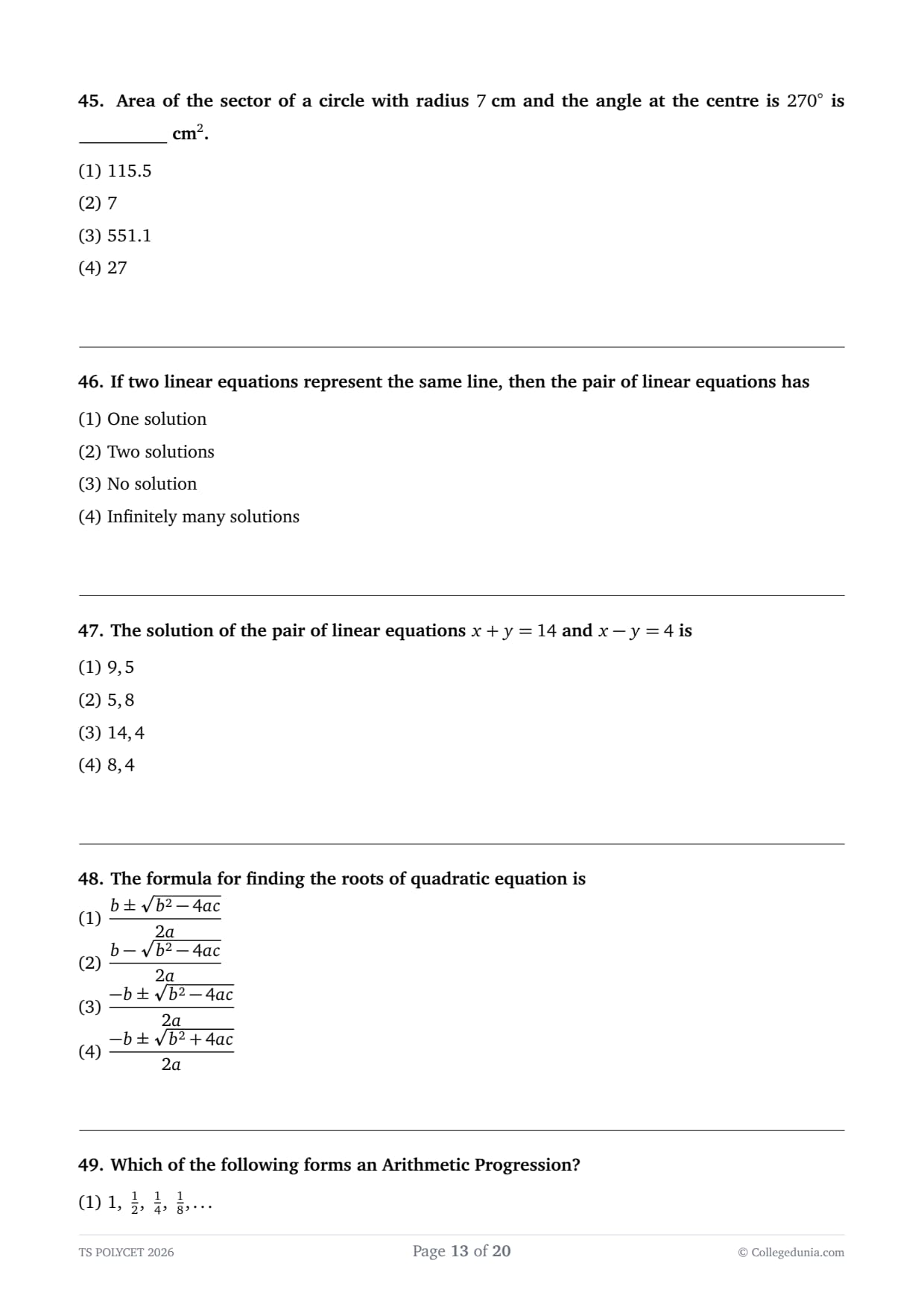
Area of the sector of a circle with radius \(7 cm\) and the angle at the centre is \(270^\circ\) is \underline{\hspace{2cm \(cm^2\).
View Solution
Concept:
A sector is a portion of a circle enclosed by:
two radii
and the corresponding arc
The area of a sector depends on the central angle.
Formula: \[ Area of Sector = \frac{\theta}{360^\circ}\times \pi r^2 \]
where:
\(r\) = radius
\(\theta\) = central angle
Step 1: Write the given values.
Radius: \[ r = 7 cm \]
Central angle: \[ \theta = 270^\circ \]
Using: \[ \pi = \frac{22}{7} \]
Step 2: Substitute values into the formula.
\[ Area = \frac{270}{360}\times \frac{22}{7}\times 7^2 \]
Since: \[ 7^2 = 49 \]
therefore: \[ Area = \frac{270}{360}\times \frac{22}{7}\times 49 \]
Step 3: Simplify the fraction \(\frac{270}{360}\).
Divide numerator and denominator by 90: \[ \frac{270}{360} = \frac{3}{4} \]
So: \[ Area = \frac{3}{4}\times \frac{22}{7}\times 49 \]
Step 4: Simplify the numerical calculation.
Cancel 49 with 7: \[ 49 \div 7 = 7 \]
Thus: \[ Area = \frac{3}{4}\times 22\times 7 \]
Multiply: \[ 22\times 7 = 154 \]
So: \[ Area = \frac{3}{4}\times 154 \]
\[ = \frac{462}{4} \]
\[ = 115.5 \]
Step 5: Write the final unit.
\[ \boxed{115.5 cm^2} \] Quick Tip: A full circle has: \[ 360^\circ \] So: \[ 270^\circ = \frac{3}{4} \] of the entire circle. Therefore, this sector is simply: \[ \frac{3}{4}\times \pi r^2 \]
If two linear equations represent the same line, then the pair of linear equations has
View Solution
Concept:
A pair of linear equations can represent:
Intersecting lines \(\rightarrow\) one solution
Parallel lines \(\rightarrow\) no solution
Coincident lines \(\rightarrow\) infinitely many solutions
When two equations represent the same line, the lines overlap completely. Such lines are called coincident lines.
Step 1: Understand what ``same line'' means.
Suppose: \[ x+y=2 \]
and: \[ 2x+2y=4 \]
The second equation is simply obtained by multiplying the first equation by 2.
Both equations represent exactly the same line on the graph.
Step 2: Understand the meaning of solutions.
A solution of a pair of linear equations is a point that satisfies both equations simultaneously.
Since the two equations are actually the same line:
Every point on the first line lies on the second line.
Every point on the second line lies on the first line.
Therefore: \[ There are infinitely many common points. \]
Hence: \[ Infinitely many solutions \]
Step 3: Relation using coefficients.
For equations: \[ a_1x+b_1y+c_1=0 \]
and: \[ a_2x+b_2y+c_2=0 \]
If: \[ \frac{a_1}{a_2} = \frac{b_1}{b_2} = \frac{c_1}{c_2} \]
then the lines are coincident.
Hence the system has infinitely many solutions.
Final Answer: \[ \boxed{Infinitely many solutions} \] Quick Tip: Remember: \[ Intersecting \rightarrow 1 solution \] \[ Parallel \rightarrow 0 solution \] \[ Coincident \rightarrow \infty solutions \]
The solution of the pair of linear equations \(x+y=14\) and \(x-y=4\) is
View Solution
Concept:
A pair of linear equations can be solved using:
Substitution Method
Elimination Method
Cross Multiplication Method
Here the elimination method is easiest because one equation has \(+y\) and the other has \(-y\).
Step 1: Write the equations clearly.
\[ x+y=14 \]
\[ x-y=4 \]
Step 2: Add both equations.
\[ (x+y)+(x-y)=14+4 \]
\[ x+y+x-y=18 \]
Step 3: Simplify the equation.
\[ 2x=18 \]
Divide both sides by 2: \[ x=9 \]
Step 4: Substitute \(x=9\) into one equation.
Using: \[ x+y=14 \]
Substitute \(x=9\): \[ 9+y=14 \]
Subtract 9 from both sides: \[ y=5 \]
Step 5: Verify the solution.
Check in second equation: \[ x-y=4 \]
Substitute: \[ 9-5=4 \]
\[ 4=4 \]
Hence the solution is correct.
Final Answer: \[ \boxed{(9,5)} \] Quick Tip: If coefficients of one variable are opposites like: \[ +y \quad and \quad -y \] then directly add the equations to eliminate that variable quickly.
The formula for finding the roots of quadratic equation is
View Solution
Concept:
A quadratic equation is an equation of degree 2 and is written in the standard form: \[ ax^2+bx+c=0 \]
where:
\(a,b,c\) are constants
\(a \neq 0\)
The roots (solutions) of the quadratic equation are obtained using the quadratic formula.
Step 1: Write the standard quadratic equation.
\[ ax^2+bx+c=0 \]
The solutions of this equation are values of \(x\) that satisfy the equation.
Step 2: Recall the quadratic formula.
The general formula for roots of a quadratic equation is:
\[ x= \frac{-b\pm\sqrt{b^2-4ac}}{2a} \]
This formula gives:
one root using \(+\)
another root using \(-\)
Step 3: Understand the discriminant.
The term: \[ b^2-4ac \]
is called the discriminant.
It determines the nature of roots.
If: \[ b^2-4ac>0 \]
roots are real and distinct.
If: \[ b^2-4ac=0 \]
roots are equal.
If: \[ b^2-4ac<0 \]
roots are imaginary.
Step 4: Compare with the options.
Option (3): \[ \frac{-b \pm \sqrt{b^2-4ac}}{2a} \]
matches the standard quadratic formula exactly.
Final Answer:
\[ \boxed{\dfrac{-b \pm \sqrt{b^2-4ac}}{2a}} \] Quick Tip: Always remember the quadratic formula in this exact order: \[ \frac{-b \pm \sqrt{b^2-4ac}}{2a} \] Students commonly forget: the negative sign before \(b\) or write \(b^2+4ac\) instead of \(b^2-4ac\) So be extra careful with signs.
Which of the following forms an Arithmetic Progression?
View Solution
Concept:
An Arithmetic Progression (A.P.) is a sequence in which the difference between consecutive terms remains constant.
This constant value is called the common difference.
If: \[ a_1,\ a_2,\ a_3,\dots \]
is an A.P., then: \[ a_2-a_1 = a_3-a_2 = a_4-a_3 \]
Step 1: Check Option (1).
Sequence: \[ 1,\ \frac12,\ \frac14,\ \frac18,\dots \]
Find consecutive differences:
\[ \frac12-1=-\frac12 \]
\[ \frac14-\frac12=-\frac14 \]
\[ \frac18-\frac14=-\frac18 \]
The differences are not equal.
Therefore, Option (1) is not an A.P.
Step 2: Check Option (2).
Sequence: \[ \frac12,\ 1,\ \frac32,\ 2,\dots \]
Find consecutive differences:
\[ 1-\frac12=\frac12 \]
\[ \frac32-1=\frac12 \]
\[ 2-\frac32=\frac12 \]
All differences are equal.
Therefore, this sequence forms an Arithmetic Progression.
Common difference: \[ d=\frac12 \]
Step 3: Check Option (3).
Sequence: \[ 2,\ 5,\ 10,\ 17,\dots \]
Differences:
\[ 5-2=3 \]
\[ 10-5=5 \]
\[ 17-10=7 \]
Differences are not equal.
Therefore, Option (3) is not an A.P.
Step 4: Check Option (4).
Sequence: \[ 1,\ 2,\ 6,\ 24,\dots \]
Differences:
\[ 2-1=1 \]
\[ 6-2=4 \]
\[ 24-6=18 \]
Differences are not constant.
Therefore, Option (4) is not an A.P.
Step 5: Conclude the correct option.
Only Option (2) has a constant common difference.
Hence it is an Arithmetic Progression.
Final Answer:
\[ \boxed{\frac12,\ 1,\ \frac32,\ 2,\dots} \] Quick Tip: To quickly check whether a sequence is an A.P.: \[ Subtract consecutive terms \] If all differences are equal, it is an Arithmetic Progression. If ratios are equal instead of differences, then it is a Geometric Progression (G.P.).
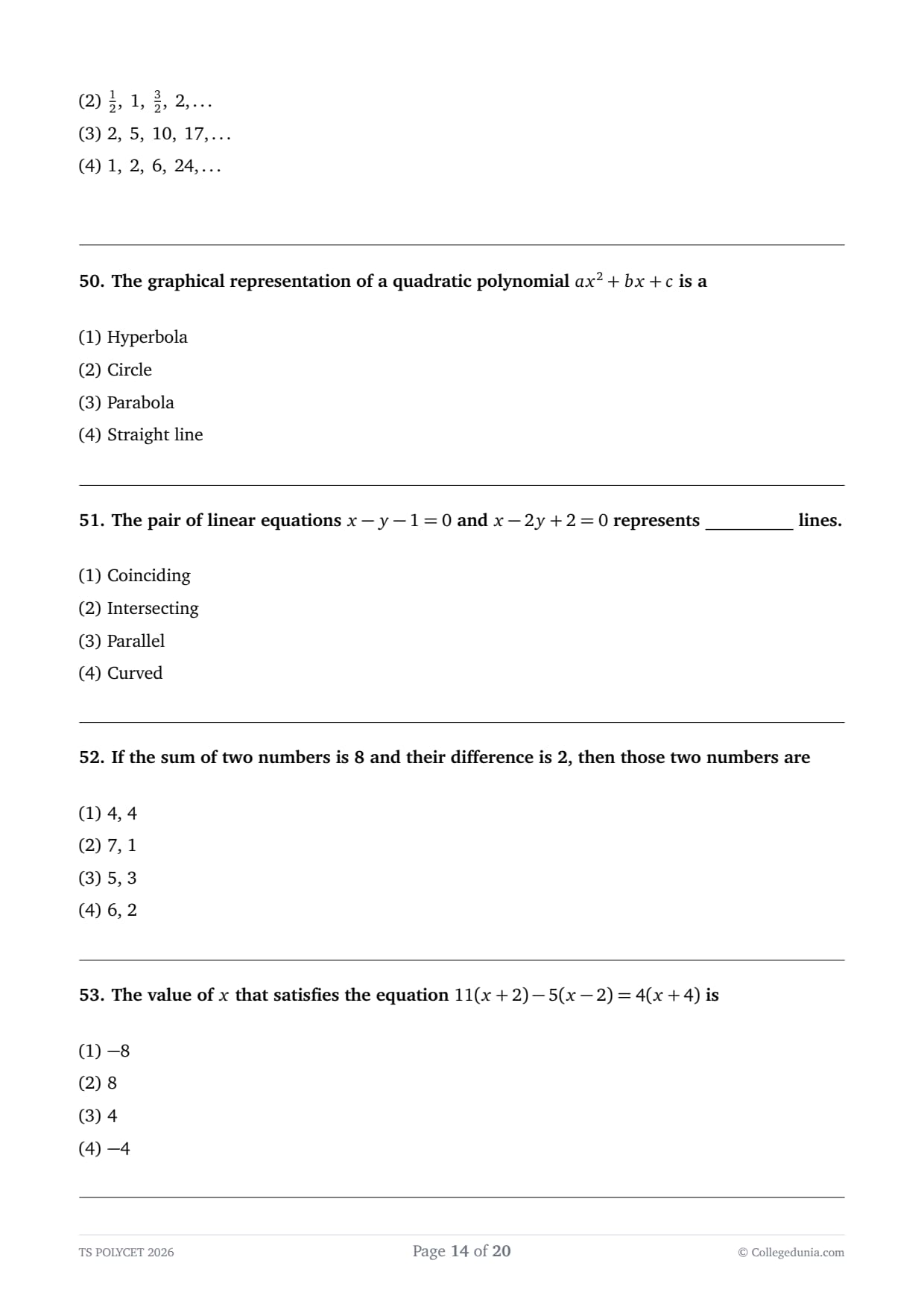
The graphical representation of a quadratic polynomial \(ax^2 + bx + c\) is a
View Solution
Concept:
A quadratic polynomial is a polynomial of degree 2.
The general form of a quadratic polynomial is:
\[ y=ax^2+bx+c \]
where:
\(a,b,c\) are constants
\(a \neq 0\)
The graph of every quadratic polynomial is called a parabola.
The shape of the parabola depends on the value of \(a\):
If \(a>0\), the parabola opens upward.
If \(a<0\), the parabola opens downward.
Step 1: Understand the degree of the polynomial.
The highest power of \(x\) in the polynomial
\[ ax^2+bx+c \]
is \(2\).
Therefore, it is a quadratic polynomial.
Step 2: Recall the graph associated with degree 2 equations.
We know:
Linear polynomial \(\rightarrow\) Straight line
Quadratic polynomial \(\rightarrow\) Parabola
Circle has equation involving both \(x^2\) and \(y^2\)
Hyperbola has a completely different standard equation
Hence, the graph of
\[ y=ax^2+bx+c \]
is always a parabola.
Step 3: Verify with examples.
Example 1:
\[ y=x^2 \]
Its graph is a U-shaped parabola.
Example 2:
\[ y=-x^2 \]
Its graph is an inverted parabola.
Thus, every quadratic polynomial represents a parabola.
Therefore, the correct answer is:
\[ \boxed{Parabola} \] Quick Tip: Always remember: \[ Degree 1 \rightarrow Straight Line \] \[ Degree 2 \rightarrow Parabola \] \[ Degree 3 \rightarrow Cubic Curve \] The graph of every quadratic equation is always a parabola.
The pair of linear equations \(x-y-1=0\) and \(x-2y+2=0\) represents \underline{\hspace{2cm lines.
View Solution
Concept:
For two linear equations:
\[ a_1x+b_1y+c_1=0 \]
and
\[ a_2x+b_2y+c_2=0 \]
their nature depends on the ratios:
\[ \frac{a_1}{a_2}, \quad \frac{b_1}{b_2}, \quad \frac{c_1}{c_2} \]
Rules:
If
\[ \frac{a_1}{a_2}\neq \frac{b_1}{b_2} \]
then the lines intersect at one point.
If
\[ \frac{a_1}{a_2}=\frac{b_1}{b_2}\neq \frac{c_1}{c_2} \]
then the lines are parallel.
If
\[ \frac{a_1}{a_2}=\frac{b_1}{b_2}=\frac{c_1}{c_2} \]
then the lines coincide.
Step 1: Write the equations clearly.
Given equations:
\[ x-y-1=0 \]
\[ x-2y+2=0 \]
Comparing with standard form:
\[ a_1=1,\quad b_1=-1,\quad c_1=-1 \]
\[ a_2=1,\quad b_2=-2,\quad c_2=2 \]
Step 2: Find the ratios.
First ratio:
\[ \frac{a_1}{a_2}=\frac{1}{1}=1 \]
Second ratio:
\[ \frac{b_1}{b_2}=\frac{-1}{-2}=\frac{1}{2} \]
Step 3: Compare the ratios.
We observe:
\[ 1 \neq \frac{1}{2} \]
Thus,
\[ \frac{a_1}{a_2}\neq \frac{b_1}{b_2} \]
Hence, the two lines intersect each other at exactly one point.
Therefore, the equations represent:
\[ \boxed{Intersecting lines} \] Quick Tip: To identify the nature of two lines quickly: \[ \frac{a_1}{a_2}\neq \frac{b_1}{b_2} \Rightarrow Intersecting \] \[ \frac{a_1}{a_2}= \frac{b_1}{b_2}\neq \frac{c_1}{c_2} \Rightarrow Parallel \] \[ \frac{a_1}{a_2}= \frac{b_1}{b_2}= \frac{c_1}{c_2} \Rightarrow Coincident \]
If the sum of two numbers is 8 and their difference is 2, then those two numbers are
View Solution
Concept:
When two unknown numbers satisfy conditions involving their sum and difference, we form linear equations and solve them simultaneously.
Step 1: Assume the numbers.
Let the two numbers be:
\[ x \quad and \quad y \]
Step 2: Form equations using the given conditions.
Given:
\[ Sum of the numbers=8 \]
Therefore,
\[ x+y=8 \]
Also given:
\[ Difference of the numbers=2 \]
Therefore,
\[ x-y=2 \]
Now we have the system:
\[ x+y=8 \]
\[ x-y=2 \]
Step 3: Add the equations.
Adding both equations:
\[ (x+y)+(x-y)=8+2 \]
\[ x+y+x-y=10 \]
\[ 2x=10 \]
\[ x=5 \]
Step 4: Find the second number.
Substitute \(x=5\) into:
\[ x+y=8 \]
\[ 5+y=8 \]
\[ y=8-5 \]
\[ y=3 \]
Step 5: Verify the answer.
Check the sum:
\[ 5+3=8 \]
Correct.
Check the difference:
\[ 5-3=2 \]
Correct.
Hence, the two numbers are:
\[ \boxed{5 and 3} \] Quick Tip: If the sum and difference of two numbers are known: \[ Larger Number= \frac{Sum+Difference}{2} \] \[ Smaller Number= \frac{Sum-Difference}{2} \] This shortcut works very fast in exams.
The value of \(x\) that satisfies the equation \(11(x+2)-5(x-2)=4(x+4)\) is
View Solution
Concept:
To solve a linear equation:
Remove brackets using distributive law
Combine like terms
Bring variable terms to one side
Bring constants to the other side
Step 1: Expand the left-hand side.
Given equation:
\[ 11(x+2)-5(x-2)=4(x+4) \]
Distribute \(11\):
\[ 11x+22 \]
Distribute \(-5\):
\[ -5x+10 \]
Thus,
\[ 11x+22-5x+10=4(x+4) \]
Step 2: Expand the right-hand side.
Distribute \(4\):
\[ 4x+16 \]
Therefore,
\[ 11x+22-5x+10=4x+16 \]
Step 3: Combine like terms.
Combine variable terms on the left:
\[ 11x-5x=6x \]
Combine constants:
\[ 22+10=32 \]
So the equation becomes:
\[ 6x+32=4x+16 \]
Step 4: Bring variable terms to one side.
Subtract \(4x\) from both sides:
\[ 6x-4x+32=16 \]
\[ 2x+32=16 \]
Step 5: Bring constants to the other side.
Subtract \(32\) from both sides:
\[ 2x=16-32 \]
\[ 2x=-16 \]
Step 6: Solve for \(x\).
Divide both sides by \(2\):
\[ x=\frac{-16}{2} \]
\[ x=-8 \]
Therefore,
\[ \boxed{x=-8} \] Quick Tip: Always expand brackets carefully when negative signs are involved. For example: \[ -5(x-2)=-5x+10 \] Students often mistakenly write \(-5x-10\).
The value of \(\tan 48^\circ \tan 16^\circ \tan 42^\circ \tan 74^\circ\) is
View Solution
Concept:
This problem is based on complementary angles and the trigonometric identity:
\[ \tan(90^\circ-\theta)=\cot\theta \]
We also use another important identity:
\[ \tan\theta \cdot \cot\theta = 1 \]
Whenever angles add up to \(90^\circ\), their tangent values become reciprocals of each other.
Step 1: Observe the given angles carefully.
The expression is:
\[ \tan 48^\circ \tan 16^\circ \tan 42^\circ \tan 74^\circ \]
Now check which angles are complementary.
We notice:
\[ 48^\circ + 42^\circ = 90^\circ \]
and
\[ 16^\circ + 74^\circ = 90^\circ \]
Thus:
\(42^\circ\) is complementary to \(48^\circ\)
\(74^\circ\) is complementary to \(16^\circ\)
Step 2: Convert complementary tangent functions into cotangent functions.
Using:
\[ \tan(90^\circ-\theta)=\cot\theta \]
we get:
\[ \tan 42^\circ = \tan(90^\circ-48^\circ)=\cot48^\circ \]
Similarly,
\[ \tan74^\circ=\tan(90^\circ-16^\circ)=\cot16^\circ \]
Now substitute these into the expression.
\[ \tan48^\circ \tan16^\circ \cot48^\circ \cot16^\circ \]
Step 3: Rearrange the terms for simplification.
Group corresponding tangent and cotangent pairs:
\[ (\tan48^\circ \cdot \cot48^\circ) (\tan16^\circ \cdot \cot16^\circ) \]
Step 4: Apply the identity.
We know:
\[ \tan\theta \cdot \cot\theta = 1 \]
Therefore,
\[ \tan48^\circ \cdot \cot48^\circ = 1 \]
and
\[ \tan16^\circ \cdot \cot16^\circ = 1 \]
Hence,
\[ 1 \times 1 = 1 \]
Therefore,
\[ \boxed{1} \]
is the required value. Quick Tip: Whenever trigonometric angles add up to \(90^\circ\), immediately think of complementary identities: \[ \tan(90^\circ-\theta)=\cot\theta \] \[ \sin(90^\circ-\theta)=\cos\theta \] These identities help simplify lengthy expressions very quickly.
Which of the following are roots of the quadratic equation \(6x^2-x-2=0\)?
View Solution
Concept:
A quadratic equation is an equation of degree 2 and has the general form:
\[ ax^2+bx+c=0 \]
The values of \(x\) satisfying the equation are called its roots.
We can solve quadratic equations by:
Factorization
Completing square
Quadratic formula
Here we use the factorization method.
Step 1: Write the given equation.
\[ 6x^2-x-2=0 \]
We need to factorize this expression.
Step 2: Multiply the coefficient of \(x^2\) and the constant term.
Coefficient of \(x^2 = 6\)
Constant term \(= -2\)
Their product:
\[ 6 \times (-2)=-12 \]
Now we need two numbers whose:
Product is \(-12\)
Sum is \(-1\)
The required numbers are:
\[ -4 \quad and \quad 3 \]
because
\[ (-4)(3)=-12 \]
and
\[ -4+3=-1 \]
Step 3: Split the middle term.
Replace \(-x\) by \(-4x+3x\):
\[ 6x^2-4x+3x-2=0 \]
Step 4: Group the terms.
Group terms pairwise:
\[ (6x^2-4x)+(3x-2)=0 \]
Take common factors from each group.
From the first group:
\[ 2x(3x-2) \]
From the second group:
\[ 1(3x-2) \]
Thus,
\[ 2x(3x-2)+1(3x-2)=0 \]
Step 5: Factor out the common binomial.
\[ (3x-2)(2x+1)=0 \]
Step 6: Find the roots.
For a product to be zero, at least one factor must be zero.
So,
\[ 3x-2=0 \]
or
\[ 2x+1=0 \]
Solving the first equation:
\[ 3x=2 \]
\[ x=\frac{2}{3} \]
Solving the second equation:
\[ 2x=-1 \]
\[ x=-\frac{1}{2} \]
Therefore, the roots are:
\[ \boxed{\frac{2}{3} and -\frac{1}{2}} \] Quick Tip: For quadratic equations of the form: \[ ax^2+bx+c=0 \] while factorization: Multiply \(a\) and \(c\) Find two numbers whose product is \(ac\) Their sum should equal \(b\) This makes middle-term splitting very easy.
If \(\alpha, \beta, \gamma\) are the zeroes of \(4x^3 + 8x^2 - 6x - 2\), then the value of \(\alpha\beta + \beta\gamma + \gamma\alpha\) is
View Solution
Concept:
For a cubic polynomial of the form
\[ ax^3 + bx^2 + cx + d \]
having zeroes \(\alpha\), \(\beta\), and \(\gamma\), the relationships between coefficients and zeroes are:
\[ \alpha + \beta + \gamma = -\frac{b}{a} \]
\[ \alpha\beta + \beta\gamma + \gamma\alpha = \frac{c}{a} \]
\[ \alpha\beta\gamma = -\frac{d}{a} \]
In this problem, we only need the second relation.
Step 1: Compare the given polynomial with the standard form.
The given polynomial is
\[ 4x^3 + 8x^2 - 6x - 2 \]
Comparing with
\[ ax^3 + bx^2 + cx + d \]
we get:
\[ a = 4 \]
\[ b = 8 \]
\[ c = -6 \]
\[ d = -2 \]
Step 2: Use the formula for the sum of products of zeroes taken two at a time.
We know that
\[ \alpha\beta + \beta\gamma + \gamma\alpha = \frac{c}{a} \]
Substituting the values:
\[ \alpha\beta + \beta\gamma + \gamma\alpha = \frac{-6}{4} \]
Step 3: Simplify the fraction carefully.
Both numerator and denominator are divisible by 2:
\[ \frac{-6}{4} = \frac{-3}{2} \]
Therefore,
\[ \boxed{\alpha\beta + \beta\gamma + \gamma\alpha = -\frac{3}{2}} \]
Hence, the correct option is
\[ \boxed{(4)\ -\frac{3}{2}} \] Quick Tip: For any cubic polynomial: \[ ax^3+bx^2+cx+d \] always remember: \[ \alpha+\beta+\gamma=-\frac{b}{a} \] \[ \alpha\beta+\beta\gamma+\gamma\alpha=\frac{c}{a} \] \[ \alpha\beta\gamma=-\frac{d}{a} \] The sign pattern is very important in exams, so memorize it carefully.
The \(X\)-axis and \(Y\)-axis intersect at the point
View Solution
Concept:
In the Cartesian coordinate system, two perpendicular number lines are used:
The horizontal line is called the \(X\)-axis.
The vertical line is called the \(Y\)-axis.
The point where these two axes meet is called the origin.
Step 1: Understand the coordinates of points on the axes.
Every point on the \(X\)-axis has \(y = 0\).
Every point on the \(Y\)-axis has \(x = 0\).
Step 2: Find the common point of both axes.
For a point to lie on both axes simultaneously:
\[ x = 0 \]
and
\[ y = 0 \]
Therefore, the coordinates of the intersection point are:
\[ (0,0) \]
Step 3: Identify the special name of this point.
The point
\[ (0,0) \]
is called the origin of the coordinate plane.
Hence, the correct answer is:
\[ \boxed{(0,0)} \] Quick Tip: Remember: \[ Origin = (0,0) \] It is the starting point of the coordinate system and divides the plane into four quadrants.
For what values of \(k\) does the quadratic equation \(9x^2 + kx + 1 = 0\) have equal roots?
View Solution
Concept:
For a quadratic equation
\[ ax^2 + bx + c = 0 \]
the discriminant is
\[ D = b^2 - 4ac \]
The nature of roots depends on the discriminant:
If \(D > 0\), roots are real and distinct.
If \(D = 0\), roots are real and equal.
If \(D < 0\), roots are imaginary.
Since the question asks for equal roots, we use:
\[ D = 0 \]
Step 1: Identify the coefficients.
Given equation:
\[ 9x^2 + kx + 1 = 0 \]
Comparing with
\[ ax^2 + bx + c = 0 \]
we get:
\[ a = 9 \]
\[ b = k \]
\[ c = 1 \]
Step 2: Apply the equal roots condition.
For equal roots:
\[ b^2 - 4ac = 0 \]
Substitute the values:
\[ k^2 - 4(9)(1) = 0 \]
\[ k^2 - 36 = 0 \]
Step 3: Solve the equation.
Move 36 to the other side:
\[ k^2 = 36 \]
Take square root on both sides:
\[ k = \pm \sqrt{36} \]
\[ k = \pm 6 \]
Thus,
\[ k = 6 \quad or \quad k = -6 \]
Hence, the correct option is
\[ \boxed{(1)\ 6,-6} \] Quick Tip: Whenever a quadratic equation asks for: Equal roots \(\Rightarrow D=0\) Distinct roots \(\Rightarrow D>0\) No real roots \(\Rightarrow D<0\) Always start with the discriminant formula: \[ D=b^2-4ac \]
A train travels \(400 km\) at a uniform speed. If the speed had been \(10 km/h\) more, it would have taken \(2\) hours less for the same journey, then the speed of the train is
View Solution
Concept:
The basic relation connecting distance, speed, and time is:
\[ Time = \frac{Distance}{Speed} \]
When speed increases, time decreases for the same distance.
Step 1: Assume the original speed.
Let the original speed of the train be:
\[ x km/h \]
Distance travelled:
\[ 400 km \]
Therefore, original time taken is:
\[ \frac{400}{x} hours \]
Step 2: Form the expression for increased speed.
If speed increases by \(10\) km/h, then new speed becomes:
\[ x+10 \]
New time taken becomes:
\[ \frac{400}{x+10} \]
Step 3: Use the information about time reduction.
According to the question:
\[ Original Time - New Time = 2 \]
Thus,
\[ \frac{400}{x} - \frac{400}{x+10} = 2 \]
Step 4: Take LCM and simplify carefully.
LCM of denominators:
\[ x(x+10) \]
So,
\[ \frac{400(x+10)-400x}{x(x+10)} = 2 \]
Expand numerator:
\[ \frac{400x+4000-400x}{x(x+10)} = 2 \]
\[ \frac{4000}{x(x+10)} = 2 \]
Step 5: Remove the denominator.
Cross multiply:
\[ 4000 = 2x(x+10) \]
\[ 4000 = 2x^2 + 20x \]
Divide entire equation by 2:
\[ 2000 = x^2 + 10x \]
Bring all terms to one side:
\[ x^2 + 10x - 2000 = 0 \]
Step 6: Factorize the quadratic equation.
We need two numbers whose product is:
\[ 1 \times (-2000) = -2000 \]
and sum is:
\[ 10 \]
These numbers are:
\[ 50 \quad and \quad -40 \]
Therefore,
\[ (x+50)(x-40)=0 \]
Step 7: Find the valid value of speed.
So,
\[ x=-50 \]
or
\[ x=40 \]
Since speed cannot be negative:
\[ x=40 \]
Hence, the speed of the train is:
\[ \boxed{40 km/h} \] Quick Tip: In speed-time problems: \[ Time = \frac{Distance}{Speed} \] If speed increases, time decreases. Always use this relationship carefully while forming equations.
What is the nature of the roots of the quadratic equation \(x^2 - 7x + 10 = 0\)?
View Solution
Concept:
The nature of roots of a quadratic equation depends on the discriminant.
For the equation
\[ ax^2+bx+c=0 \]
the discriminant is:
\[ D=b^2-4ac \]
Nature of roots based on discriminant:
If \(D>0\), roots are real and distinct.
If \(D=0\), roots are real and equal.
If \(D<0\), roots are imaginary or non-real.
Step 1: Identify the coefficients.
Given equation:
\[ x^2 - 7x + 10 = 0 \]
Comparing with
\[ ax^2 + bx + c = 0 \]
we get:
\[ a = 1 \]
\[ b = -7 \]
\[ c = 10 \]
Step 2: Calculate the discriminant.
\[ D = b^2 - 4ac \]
Substitute the values:
\[ D = (-7)^2 - 4(1)(10) \]
\[ D = 49 - 40 \]
\[ D = 9 \]
Step 3: Interpret the value of discriminant.
Since
\[ D = 9 > 0 \]
the roots are:
\[ \boxed{Real and distinct} \]
Hence, the correct option is:
\[ \boxed{(1)\ Real and distinct roots} \] Quick Tip: A positive discriminant always means two different real roots. \[ D>0 \Rightarrow Real and Distinct \] \[ D=0 \Rightarrow Real and Equal \] \[ D<0 \Rightarrow No Real Roots \]
According to Faraday's law, the induced E.M.F generated in a closed loop is equal to the \dots
View Solution
\
Concept:
Faraday’s Law of Electromagnetic Induction states that whenever the magnetic flux linked with a closed circuit changes, an electromotive force (E.M.F.) is induced in the circuit. The magnitude of the induced E.M.F. depends on how rapidly the magnetic flux changes with time.
Step 1: Recall Faraday’s law formula.\
\[ \varepsilon = -\frac{d\Phi_B}{dt} \]
where:
\(\varepsilon\) = induced electromotive force
\(\Phi_B\) = magnetic flux
\(\frac{d\Phi_B}{dt}\) = rate of change of magnetic flux
Step 2: Understand the meaning of the formula.\
The formula clearly shows that induced E.M.F. depends not on the magnetic flux itself, but on how quickly the flux changes with time.
If the magnetic flux remains constant, then:
\[ \frac{d\Phi_B}{dt} = 0 \]
and therefore no induced E.M.F. is produced.
Step 3: Identify the correct option.\
Faraday’s law states that induced E.M.F. is equal to the:
\[ \boxed{rate of change of magnetic flux} \]
Hence, the correct answer is option (3). Quick Tip: A constant magnetic field cannot induce current. Only changing magnetic flux can produce induced E.M.F. Faster change means greater induced voltage.
The number of slip rings in a simple AC generator is \dots
View Solution
\
Concept:
An AC generator converts mechanical energy into electrical energy in the form of alternating current using electromagnetic induction.
Step 1: Recall the main parts of an AC generator.\
A simple AC generator contains:
Armature coil
Magnetic field
Two slip rings
Two carbon brushes
Step 2: Understand the role of slip rings.\
The ends of the rotating coil are connected to circular metallic rings called slip rings. These rings rotate with the coil and maintain continuous electrical contact with the external circuit through carbon brushes.
Step 3: Determine the number of slip rings.\
Since both ends of the coil must remain connected during rotation, a simple AC generator uses:
\[ \boxed{2 slip rings} \]
Hence, the correct answer is option (1). Quick Tip: Remember: AC Generator \(\rightarrow\) Two Slip Rings DC Generator \(\rightarrow\) One Split Ring Commutator
When white light is incident on a glass prism, the least deviated colour is \dots
View Solution
\
Concept:
When white light passes through a glass prism, it splits into different colours. This phenomenon is called dispersion of light.
Different colours bend by different amounts because different colours have different wavelengths.
Step 1: Understand deviation in a prism.\
The amount of bending depends on the refractive index of glass for different colours.
Smaller wavelength \(\rightarrow\) greater deviation
Larger wavelength \(\rightarrow\) smaller deviation
Step 2: Compare red and violet light.\
Violet light has the shortest wavelength, so it bends the most.
Red light has the longest wavelength, so it bends the least.
Step 3: Identify the least deviated colour.\
Therefore, the least deviated colour is:
\[ \boxed{Red} \]
Hence, the correct option is (1). Quick Tip: Remember the order VIBGYOR: \[ Violet deviates most, Red deviates least \] Longer wavelength means smaller deviation.
Choose correct option regarding magnetic lines of force.
View Solution
\
Concept:
Magnetic field lines are imaginary lines that represent the direction and strength of a magnetic field around a magnet.
Step 1: Understand the direction of magnetic field.\
At every point in a magnetic field, the magnetic field has only one unique direction.
The tangent drawn to a magnetic field line at any point gives the direction of the magnetic field at that point.
Step 2: Consider intersection of field lines.\
Suppose two magnetic field lines intersect at a point.
Then two tangents can be drawn at that point, giving two different directions of magnetic field at the same location.
This is physically impossible because magnetic field at a point cannot have two directions simultaneously.
Step 3: State the conclusion.\
Therefore, magnetic field lines:
\[ \boxed{Never intersect each other} \]
Hence, the correct option is (3). Quick Tip: Magnetic field lines may come very close to each other in strong magnetic regions, but they can never cross or intersect.
The magnetic effect due to current was discovered by \dots
View Solution
\
Concept:
The discovery of the magnetic effect of electric current established the relationship between electricity and magnetism and became the foundation of electromagnetism.
Step 1: Understand the historical experiment.\
In the year 1820, Danish scientist Hans Christian Oersted performed an experiment in which he placed a compass needle near a current-carrying conductor.
Step 2: Observe the result.\
When electric current passed through the wire, the compass needle got deflected from its normal north-south direction.
This proved that electric current produces a magnetic field around the conductor.
Step 3: Identify the scientist.\
Therefore, the magnetic effect due to electric current was discovered by:
\[ \boxed{Oersted} \]
Hence, the correct option is (3). Quick Tip: Oersted’s experiment was the first evidence that electricity and magnetism are interconnected phenomena.
Induction stove works on the main principle of \dots
View Solution
\
Concept:
Electromagnetic induction is the process in which a changing magnetic field produces induced current in a conductor.
Step 1: Understand the working of an induction stove.\
An induction stove contains a coil of wire beneath its surface.
When alternating current flows through the coil, a continuously changing magnetic field is produced.
Step 2: Formation of induced current.\
When a metallic utensil is placed on the stove, the changing magnetic field induces eddy currents in the base of the utensil.
These currents generate heat due to electrical resistance.
Step 3: Identify the principle involved.\
Since heating occurs because of induced current produced by changing magnetic field, the stove works on:
\[ \boxed{Electromagnetic induction} \]
Hence, the correct answer is option (3). Quick Tip: Induction stoves heat the vessel directly instead of heating the stove surface first, making them faster and more energy efficient.
A charge is moved from point A to a point B. The work done to move unit charge during this process is called \dots
View Solution
\
Concept:
Electric potential difference between two points is defined as the work done in moving a unit positive charge from one point to another in an electric field.
Step 1: Recall the formula for potential difference.\
\[ V = \frac{W}{q} \]
where:
\(V\) = potential difference
\(W\) = work done
\(q\) = charge moved
Step 2: Understand the meaning of unit charge.\
The question specifically mentions work done to move unit charge from point A to point B.
This exactly matches the definition of electric potential difference.
Step 3: Identify the correct term.\
Therefore, the quantity described is:
\[ \boxed{Potential difference between A and B} \]
Hence, the correct option is (3). Quick Tip: Potential at one point refers to energy relative to infinity, while potential difference compares energy between two points.
The magnetic flux passing through unit area perpendicular to the magnetic field is called \dots
View Solution
\
Concept:
Magnetic flux density represents the amount of magnetic flux passing normally through unit area.
Step 1: Recall the formula.\
\[ B = \frac{\Phi}{A} \]
where:
\(B\) = magnetic flux density
\(\Phi\) = magnetic flux
\(A\) = area perpendicular to the magnetic field
Step 2: Understand the physical meaning.\
If more magnetic field lines pass through a smaller area, the magnetic flux density becomes greater.
Thus, magnetic flux density measures the concentration of magnetic field lines.
Step 3: Identify the correct term.\
Therefore, magnetic flux passing through unit perpendicular area is called:
\[ \boxed{Magnetic flux density} \]
Hence, the correct answer is option (1). Quick Tip: The SI unit of magnetic flux density is Tesla (T). \[ 1 Tesla = 1 \frac{Weber}{m^2} \]
The direction of magnetic lines of force inside the solenoid is from \dots
View Solution
\
Concept:
A solenoid behaves like a bar magnet and produces magnetic field lines similar to those of a bar magnet.
Step 1: Recall the direction of magnetic field lines.\
Magnetic field lines always form closed continuous loops.
Outside a magnet or solenoid, field lines travel from North pole to South pole.
Inside the magnet or solenoid, field lines travel from South pole to North pole.
Step 2: Apply this concept to a solenoid.\
Inside the solenoid, magnetic field lines are straight, parallel, and directed from:
\[ \boxed{South pole to North pole} \]
Step 3: Identify the correct option.\
Hence, the correct answer is option (2). Quick Tip: Inside a solenoid, magnetic field lines are parallel and equally spaced, indicating that the magnetic field inside is nearly uniform.
Any light ray passing through the principal axis of lens is \dots
View Solution
\
Concept:
The principal axis is the straight line passing through the optical center and centers of curvature of a lens.
Step 1: Understand the behavior of rays through optical center.\
A ray passing through the optical center of a thin lens emerges without deviation because refraction at the two surfaces effectively cancels out.
Step 2: Relate to principal axis.\
A ray traveling exactly along the principal axis passes symmetrically through the lens and therefore continues in the same direction.
Step 3: Identify the nature of the ray.\
Thus, such a ray is called an:
\[ \boxed{undeviated ray} \]
Hence, the correct option is (2). Quick Tip: In ray diagrams, a ray through the optical center is drawn as a straight line because it does not bend noticeably.
If a convex lens has to form the image of an object at infinity, where should the object be placed?
View Solution
\
Concept:
A convex lens forms different types of images depending on the position of the object relative to the focus and optical center.
Step 1: Recall image formation rules for a convex lens.\
Object at infinity \(\rightarrow\) image at focus
Object beyond \(2f\) \(\rightarrow\) image between \(f\) and \(2f\)
Object at focus \(\rightarrow\) image at infinity
Step 2: Analyze the given condition.\
The question asks for the object position when image is formed at infinity.
For a convex lens, when the object is placed exactly at the principal focus, the refracted rays become parallel after refraction.
Parallel rays meet at infinity.
Step 3: Identify the correct position.\
Therefore, the object must be placed:
\[ \boxed{At focus} \]
Hence, the correct option is (4). Quick Tip: When an object is placed at the focus of a convex lens, the outgoing rays become parallel. This principle is used in searchlights and vehicle headlights.
Which among the following quantities has the unit of Ohm-meter?
View Solution
Step 1: Understanding the Question:
The question asks to identify the physical quantity whose SI unit is Ohm-meter (\(\Omega \cdot m\)).
Step 3: Detailed Explanation:
Let's analyze the units of each quantity:
1. Resistance (R):
Definition: Opposition to the flow of electric current.
Unit: Ohm (\(\Omega\)).
2. Specific resistance (Resistivity, \(\rho\)):
Definition: An intrinsic property of a material that quantifies how strongly it resists electric current.
Formula: \( R = \rho \frac{L}{A} \Rightarrow \rho = \frac{RA}{L} \).
Unit: \(\frac{\Omega \cdot m^2}{m} = \Omega \cdot m\).
3. Conductance (G):
Definition: The ease with which an electric current flows through a material. It is the reciprocal of resistance.
Unit: Siemens (S) or mho (\(\Omega^{-1}\)).
4. Conductivity (\(\sigma\)):
Definition: An intrinsic property of a material that quantifies how readily it conducts electric current. It is the reciprocal of resistivity.
Formula: \( \sigma = \frac{1}{\rho} \).
Unit: Siemens per meter (S/m) or (\(\Omega \cdot m)^{-1}\).
Therefore, specific resistance (resistivity) has the unit of Ohm-meter.
Step 4: Final Answer:
Specific resistance has the unit of Ohm-meter.
Quick Tip: Remember the pair: Resistance (Ohm) and Resistivity (Ohm-meter). And their reciprocals: Conductance (Siemens) and Conductivity (Siemens per meter). These are fundamental concepts in current electricity.
Which of the following indicates lens formula?
View Solution
Concept:
The lens formula is an important relation in geometrical optics that connects the focal length of a lens with the object distance and image distance.
For a thin lens, the relationship between focal length (\(f\)), image distance (\(v\)), and object distance (\(u\)) is given by:
\[ \frac{1}{f} = \frac{1}{v} - \frac{1}{u} \]
Explanation:
This formula is applicable for both convex and concave lenses when the proper sign convention is used.
Where:
\(f\) = focal length of the lens
\(v\) = image distance from the optical center
\(u\) = object distance from the optical center
The formula helps in determining:
Position of image
Nature of image
Size of image
Focal length of lens
Among the given options, only option (2) correctly represents the standard lens formula. Quick Tip: Always remember the lens formula in the form: \[ \frac{1}{f} = \frac{1}{v} - \frac{1}{u} \] It is one of the most frequently used formulas in ray optics.
The magnetic force on a current carrying wire of length \(l\), placed in a uniform magnetic field (\(B\)) if the wire is oriented perpendicular to magnetic field, is \dots
View Solution
Concept:
A current carrying conductor placed inside a magnetic field experiences a magnetic force. This phenomenon is the working principle of electric motors.
The magnitude of magnetic force acting on a conductor is given by:
\[ F = BIl \sin\theta \]
Where:
\(F\) = magnetic force
\(B\) = magnetic field strength
\(I\) = current in the conductor
\(l\) = length of conductor
\(\theta\) = angle between current direction and magnetic field
Step 1: Identify the angle.
The conductor is perpendicular to the magnetic field.
Therefore,
\[ \theta = 90^\circ \]
Step 2: Use the trigonometric value.
\[ \sin 90^\circ = 1 \]
Step 3: Substitute into the formula.
\[ F = BIl \times 1 \]
\[ F = BIl \]
Thus, the magnetic force acting on the conductor is:
\[ ILB \] Quick Tip: The magnetic force becomes maximum when the conductor is perpendicular to the magnetic field because: \[ \sin 90^\circ = 1 \]
If a convex lens is placed in water, its focal length \dots
View Solution
Concept:
The focal length of a lens depends upon the refractive index of the lens material relative to the surrounding medium.
According to the lens maker's formula:
\[ \frac{1}{f} = \left( \frac{\mu_{lens}}{\mu_{medium}} -1 \right) \left( \frac{1}{R_1} - \frac{1}{R_2} \right) \]
Explanation:
Normally, a convex lens is placed in air. Air has a very small refractive index compared to glass.
When the lens is placed in water:
The refractive index of the surrounding medium increases.
The difference between refractive index of glass and water decreases.
Hence, the converging power of the lens decreases.
Since power decreases, focal length increases because:
\[ P = \frac{1}{f} \]
Thus, a convex lens becomes less powerful in water and its focal length increases. Quick Tip: Greater surrounding refractive index means weaker bending of light by the lens, resulting in larger focal length.
Every lens has \hspace{2cm} focal points.
View Solution
Concept:
A lens refracts light from both sides. Therefore, it possesses two principal foci.
Explanation:
One focal point lies on the left side of the lens and the other lies on the right side.
When parallel rays come from the left side, they converge or appear to diverge from the focus on the right side.
When parallel rays come from the right side, they converge or appear to diverge from the focus on the left side.
Thus, every lens has:
First principal focus (\(F_1\))
Second principal focus (\(F_2\))
Hence, every lens has two focal points. Quick Tip: Since light can travel through a lens in both directions, lenses always have two principal foci located symmetrically on either side.
A conductor is moving with a speed of \(10 m/s\) in the direction perpendicular to the direction of magnetic field of induction \(0.8 T\). If it induces an E.M.F. of \(8 V\) between the ends of the conductor, the length of the conductor is \dots
View Solution
Concept:
When a conductor moves through a magnetic field, an E.M.F. is induced across its ends due to electromagnetic induction.
The formula for motional E.M.F. is:
\[ \varepsilon = Blv \]
Where:
\(\varepsilon\) = induced E.M.F.
\(B\) = magnetic field induction
\(l\) = length of conductor
\(v\) = velocity of conductor
Step 1: Write the given values.
\[ \varepsilon = 8 V \]
\[ B = 0.8 T \]
\[ v = 10 m/s \]
Step 2: Substitute into the formula.
\[ 8 = 0.8 \times l \times 10 \]
\[ 8 = 8l \]
Step 3: Solve for \(l\).
\[ l = \frac{8}{8} \]
\[ l = 1 m \]
Hence, the length of the conductor is:
\[ 1 m \] Quick Tip: Motional E.M.F. becomes maximum when the conductor moves perpendicular to the magnetic field.
The relation between focal length and radius of curvature of a spherical mirror is \dots
View Solution
Concept:
For spherical mirrors, the principal focus lies midway between the pole and the center of curvature.
Explanation:
The distance between the pole and center of curvature is called the radius of curvature (\(R\)).
The distance between the pole and principal focus is called the focal length (\(f\)).
Experimentally and theoretically, it is found that:
\[ f = \frac{R}{2} \]
or
\[ R = 2f \]
This relation is valid for both concave and convex spherical mirrors. Quick Tip: The focus of a spherical mirror always lies halfway between the pole and center of curvature.
Which of the following is used in solar cooker?
View Solution
Concept:
A concave mirror is a converging mirror that can collect and focus parallel rays of light at a single point.
Explanation:
Sunlight reaching the Earth consists of nearly parallel rays.
A concave mirror reflects these rays and brings them to its principal focus where the heat energy becomes highly concentrated.
This concentration of solar energy produces very high temperature which is used for cooking food in solar cookers.
Convex mirrors spread light rays outward, so they cannot concentrate heat effectively.
Therefore, concave mirrors are used in solar cookers. Quick Tip: Devices requiring concentration of light or heat generally use concave mirrors because they converge parallel rays to a focus.
If an incident ray passes through the center of curvature of a spherical mirror, the reflected ray will \dots
View Solution
Concept:
The center of curvature of a spherical mirror lies on the normal to the reflecting surface.
Explanation:
When a light ray passes through the center of curvature:
The ray strikes the mirror surface normally.
Therefore, the angle of incidence becomes: \[ i = 0^\circ \]
According to the law of reflection: \[ \angle i = \angle r \]
Hence, the angle of reflection is also zero.
As a result, the reflected ray travels back along the same path.
Thus, the reflected ray retraces its original path. Quick Tip: Any ray passing through the center of curvature always strikes the mirror normally and therefore returns back along the same line.
TS POLYCET 2026 Exam Pattern
| Particulars | For Engineering Admission | For Agriculture Admission |
|---|---|---|
| Exam Mode | Offline Pen Paper-Based Test | |
| Number of papers | 1 Paper | |
| Total Marks | 120-150 Marks | |
| Number of sections | 3 Sections (MPC) | 4 sections (MBiPC) |
| Sections and Marking Division |
|
|
| Question Paper Type | Objective Type - Multiple choice questions | |
| Exam duration | 2 hours 30 minutes (150 minutes) | |
| Exam language | English and Telugu | |
| Exam Name | Telangana State Polytechnic Common Entrance Test (TS POLYCET) 2026 | |
| Marking Scheme | +1 for each correct answer; No negative marking | |
| Syllabus Level | Based on Class 10 (SSC) Telangana State Board syllabus | |



Comments