TS PGECET 2026 Textile Technology (TX) Question Paper is available for download here. JNTU Hyderabad on behalf of Telangana Council of Higher Education (TGCHE) conducted TS PGECET 2026 TX exam on May 30 in Shift 1 from 10 AM to 12 PM. TS PGECET TX Question Paper consists of 120 questions for 120 marks to be attempted in 2 hours.
- TS PGECET TX Question Paper 2026 is divided into 2 sections- Engineering Mathematics with 10 questions and Textile Technology domain with 110 questions.
- Each questions carries 1 mark each and there is no negative marking for incorrect answers.
Candidates can download TS PGECET 2026 TX Question Paper with Answer Key and Solution PDF from links provided below.
TS PGECET 2026 TX Question Paper with Solution PDF
Question 1:
Let the matrix
A = ⎡
⎣ 3 1 −1 2 ⎤
⎦
and
I = ⎡
⎣ 1 0 0 1 ⎤
⎦ ,
then
A2 − 5A + 7I =
- (A) 1/7 2-1 -13
- (B) 11 11
- (C) 00 00
- (D) 10 01
Question 2:
Let \(A\) and \(B\) be any two \(n\times n\) matrices and \[ tr(A)=\sum_{i=1}^{n}a_{ii}, \qquad tr(B)=\sum_{i=1}^{n}b_{ii}. \]
Consider the following statements:
Statement-I : \(tr(AB)=tr(BA)\).
Statement-II : \(tr(A+B)=tr(A)+tr(B)\).
Statement-III : If \(tr(A)=5,\; tr(A^{2})=13\), then \[ tr(A-I)^2=6, \]
where \(A_{3\times3}\) and \(I_{3\times3}\) are matrices.
Choose the correct option.
- (A) Statement-I only is true
- (B) Statement-I and Statement-II only are true
- (C) Statement-I and Statement-III only are true
- (D) Statement-I, Statement-II and Statement-III are all true
Question 3:
If \[ f(x,y,z,w)=x^{2}e^{2y+3z}\cos(4w), \]
then \[ \frac{\partial f}{\partial z} \]
at \((2,0,-2,1)\) is
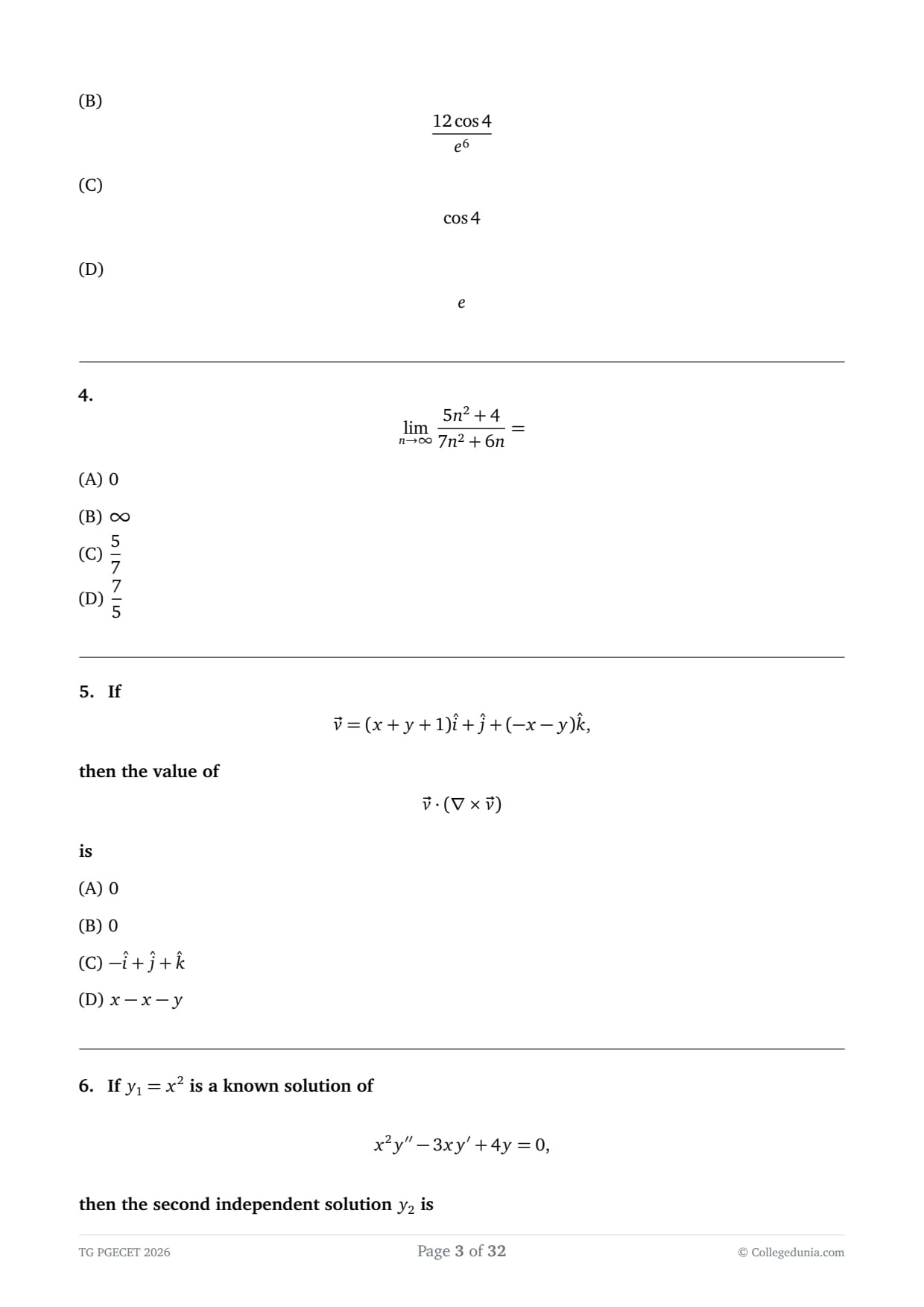
- (A) \[ \frac{8\cos4}{e^{4}} \]
- (B) \[ \frac{12\cos4}{e^{6}} \]
- (C) \[ \cos4 \]
- (D) \[ e \]
Question 4:
\[ \lim_{n\rightarrow\infty}\frac{5n^{2}+4}{7n^{2}+6n}= \]
- (A) \(0\)
- (B) \(\infty\)
- (C) \(\dfrac{5}{7}\)
- (D) \(\dfrac{7}{5}\)
Question 5:
If \[ \vec{v}=(x+y+1)\hat{i}+\hat{j}+(-x-y)\hat{k}, \]
then the value of \[ \vec{v}\cdot(\nabla\times\vec{v}) \]
is
- (A) \(0\)
- (B) \(0\)
- (C) \(-\hat{i}+\hat{j}+\hat{k}\)
- (D) \(x-x-y\)
Question 6:
If \(y_{1}=x^{2}\) is a known solution of \[ x^{2}y^{\prime\prime}-3xy^{\prime}+4y=0, \]
then the second independent solution \(y_{2}\) is
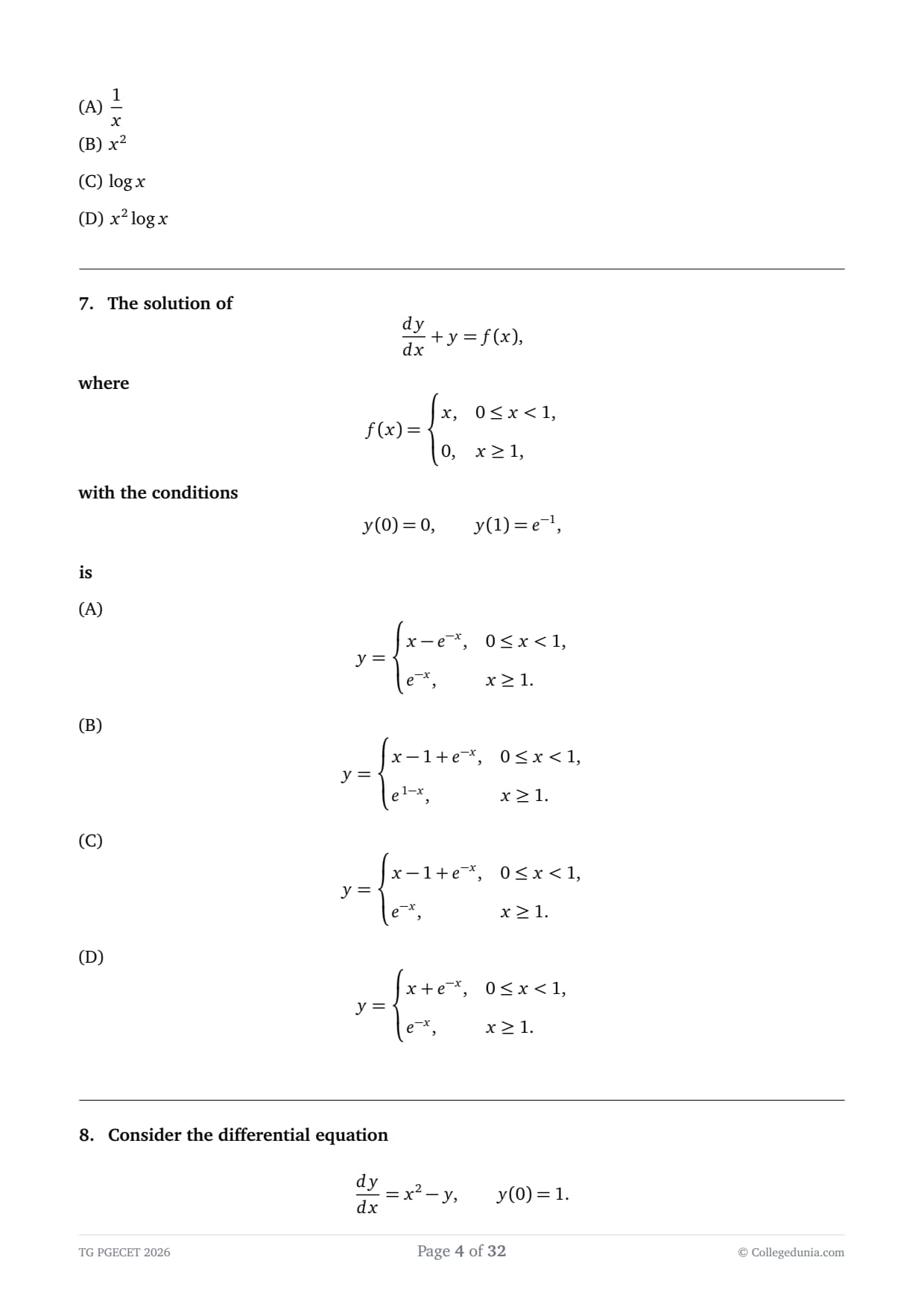
- (A) \(\dfrac{1}{x}\)
- (B) \(x^{2}\)
- (C) \(\log x\)
- (D) \(x^{2}\log x\)
Question 7:
The solution of \[ \frac{dy}{dx}+y=f(x), \]
where \[ f(x)= \begin{cases} x, & 0\le x<1,
0, & x\ge1, \end{cases} \]
with the conditions \[ y(0)=0,\qquad y(1)=e^{-1}, \]
is
- (A) \[ y= \begin{cases} x-e^{-x}, & 0\le x<1,
e^{-x}, & x\ge1. \end{cases} \]
- (B) \[ y= \begin{cases} x-1+e^{-x}, & 0\le x<1,
e^{\,1-x}, & x\ge1. \end{cases} \]
- (C) \[ y= \begin{cases} x-1+e^{-x}, & 0\le x<1,
e^{-x}, & x\ge1. \end{cases} \]
- (D) \[ y= \begin{cases} x+e^{-x}, & 0\le x<1,
e^{-x}, & x\ge1. \end{cases} \]
Question 8:
Consider the differential equation \[ \frac{dy}{dx}=x^{2}-y,\qquad y(0)=1. \]
Using the Simple Euler's Method with a step size of \(h=0.1\), the value of \(y(0.1)\) is
- (A) \(0.1\)
- (B) \(0.7\)
- (C) \(0.9\)
- (D) \(1.0\)
Question 9:
Assertion (A): If \(X\sim N(\mu,\sigma^{2})\), then \[ P(X<\mu)=0.5. \]
Reason (R): Normal distribution is symmetric about its mean.
- (A) Both A and R are true and R is the correct explanation of A.
- (B) Both A and R are true but R is not the correct explanation of A.
- (C) A is true but R is false.
- (D) A is false but R is true.
Question 10:
In the binomial distribution \(B(n,p)\), the variance \((\sigma^{2})\) and the mean \((\mu)\) are related by
- (A) \(\mu=\sigma^{2}\)
- (B) \(\mu=\sigma^{2}p^{2}\)
- (C) \(\sigma^{2}=\dfrac{\mu}{p}\)
- (D) \(\mu=\sigma^{2}+\mu p\)
Question 11:
The percentage of Moisture Regain of Silk is
- (A) \(6.2\)
- (B) \(7.5\)
- (C) \(4.25\)
- (D) \(11\)
Question 12:
The following is considered as one of the fibre properties, prior selection to Spinning of Cotton
- (A) Bending Rigidity
- (B) Fused Index
- (C) Maturity
- (D) Surface Friction
Question 13:
40's Cotton count refers to
- (A) Constant weight
- (B) Constant density
- (C) Constant length
- (D) Constant volume
Question 14:
Which of the following are having potential as Composite material from New Natural fibres?
- (A) Silk and Maize
- (B) Basalt and Coir
- (C) Jute and Alginate
- (D) Wool and Jute
Question 15:
Compared to Cotton, the special feature of Wool is
- (A) Moisture Regain
- (B) Density
- (C) Tenacity
- (D) DFE
Question 16:
The common type of Staple fibre produced during synthetic fibre manufacture is
- (A) \(1.2D \times 38 mm\)
- (B) \(1.5D \times 38 mm\)
- (C) \(2D \times 38 mm\)
- (D) \(1.4D \times 38 mm\)
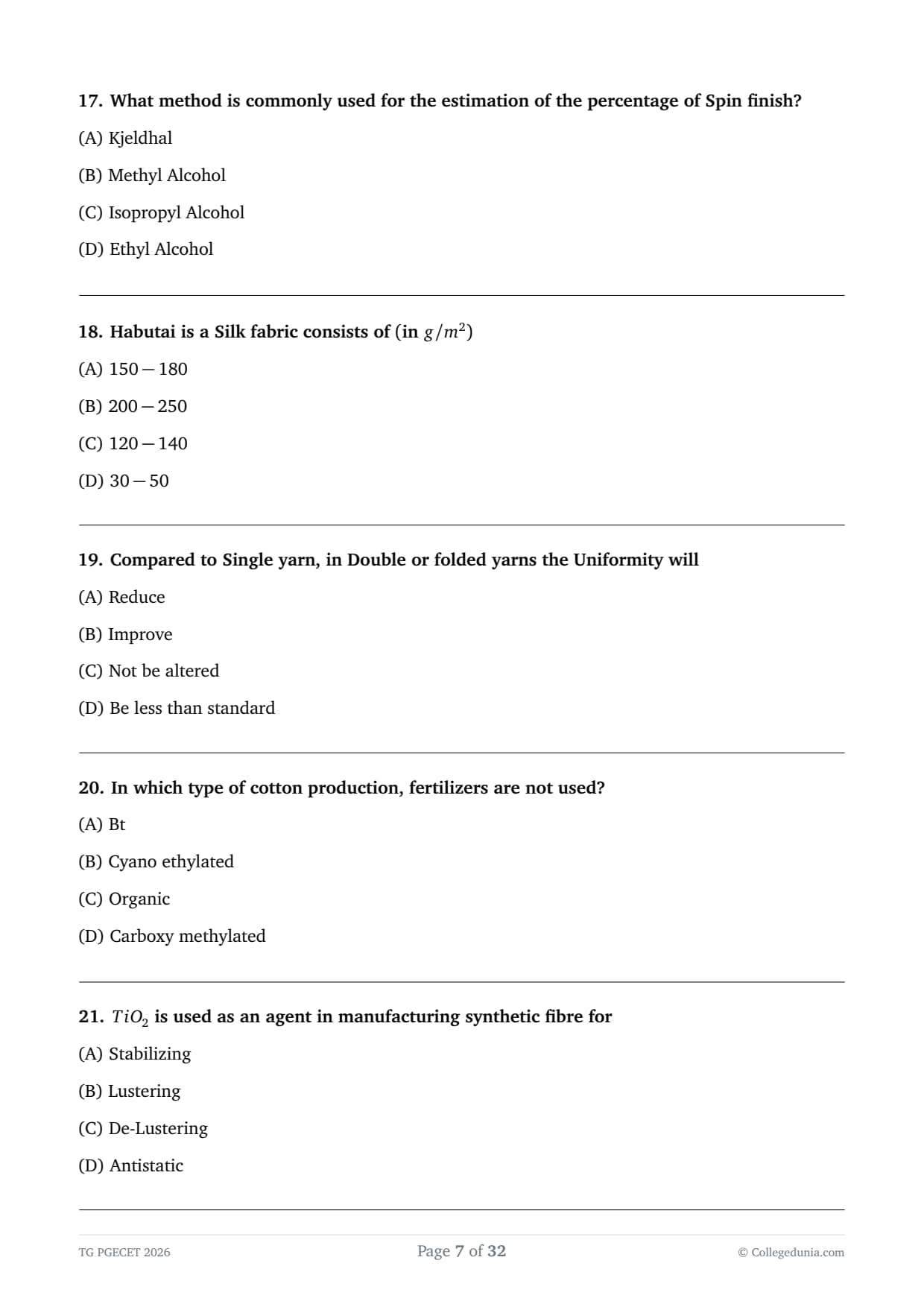
Question 17:
What method is commonly used for the estimation of the percentage of Spin finish?
- (A) Kjeldhal
- (B) Methyl Alcohol
- (C) Isopropyl Alcohol
- (D) Ethyl Alcohol
Question 18:
Habutai is a Silk fabric consists of \((in g/m^{2})\)
- (A) \(150-180\)
- (B) \(200-250\)
- (C) \(120-140\)
- (D) \(30-50\)
Question 19:
Compared to Single yarn, in Double or folded yarns the Uniformity will
- (A) Reduce
- (B) Improve
- (C) Not be altered
- (D) Be less than standard
Question 20:
In which type of cotton production, fertilizers are not used?
- (A) Bt
- (B) Cyano ethylated
- (C) Organic
- (D) Carboxy methylated
Question 21:
\(TiO_{2}\) is used as an agent in manufacturing synthetic fibre for
- (A) Stabilizing
- (B) Lustering
- (C) De-Lustering
- (D) Antistatic
Question 22:
Spinning speeds in Man-made fibre of \(10,000\ mpm\) results in the formation of which Yarn?
- (A) LOY
- (B) FOY
- (C) MOY
- (D) POY
Question 23:
In fibre length analysis, Dispersion or Scatter is useful to determine
- (A) Noil % at Comber
- (B) Setting in Card
- (C) Setting at Ring Frame
- (D) Speed Frame
Question 24:
Mercerisation of Cotton fabrics will result in
- (A) Decrease in Tensile strength and increase in Air-permeability
- (B) Increase in Crease recovery angle and increase in Bending rigidity
- (C) Increase in Drapability and decrease in Bending rigidity
- (D) Increase in Tensile strength and decrease in Crease recovery angle
Question 25:
Match the following:
![]()
- (A) \(A\!-\!III,\;B\!-\!VI,\;C\!-\!II,\;D\!-\!I\)
- (B) \(A\!-\!II,\;B\!-\!I,\;C\!-\!III,\;D\!-\!V\)
- (C) \(A\!-\!V,\;B\!-\!I,\;C\!-\!VI,\;D\!-\!III\)
- (D) \(A\!-\!VI,\;B\!-\!IV,\;C\!-\!I,\;D\!-\!V\)
Question 26:
In a Blowroom, a study was made to compare the fibre fracture using 2 Bladed and Kirschner beater. When the same mixing was processed using two Blowroom lines, the best statistical measure to choose is
- (A) t-Test
- (B) F-test
- (C) Chi-square Test
- (D) Kruskal--Wallis Test
Question 27:
Consider Shirting fabrics made from Varalakshmi Cotton and 14 tex Polyester Texturised yarns, then the bending rigidity of Polyester fabric when compared to Cotton is
- (A) \(2.5-2.9\)
- (B) \(3.2-3.4\)
- (C) \(3.5-3.8\)
- (D) \(4.1-4.5\)
Question 28:
A Control fabric has Numeri 6, after mercerization the expected value is
- (A) \(6.0\)
- (B) \(5.2\)
- (C) \(4.2\)
- (D) \(8.5\)
Question 29:
The constant used for conversion from Denier to Cotton system is
- (A) \(4315\)
- (B) \(2315\)
- (C) \(5315\)
- (D) \(6315\)
Question 30:
The production of Trilobal fibre in Man-made fibre is derived from the feature of
- (A) Silk
- (B) Nylon
- (C) Basalt
- (D) Wool
Question 31:
Tinting is done in one of the following cases
- (A) Mixing of Jayadhar and Virnar Cottons to a lot size of 2000 kg
- (B) Mixing of Polyester and Viscose to a lot size of 2000 kg
- (C) Mixing of Sivin and Varalakshmi Cottons to a lot size of 2000 kg
- (D) Mixing of LK-33 and DCH-32 Cottons to a lot size of 2000 kg
Question 32:
The drive for the feed lattice in Mixing Bale Opener is
- (A) Continuous
- (B) Intermittent
- (C) Interruptive
- (D) Higher
Question 33:
It is a quality control study (Routine), in which the examination is in three areas across the width of output in Carding
- (A) Snap
- (B) Nep
- (C) Waster Extraction
- (D) Breakage
Question 34:
In Carding, Point to Point action occurs between
- (A) Flat and Cylinder
- (B) Cylinder and Doffer
- (C) Licker in and Cylinder
- (D) Licker in and Doffer
Question 35:
In Comber preparatory, as the Pre-Comb draft increases, the Noil % will
- (A) First increase and then decrease
- (B) First decrease and then increase
- (C) Decrease
- (D) Increase
Question 36:
In Modern Comber, use of half moon shaped Web it is possible to achieve Combed Sliver with
- (A) High Production in terms of HOK
- (B) Low U%
- (C) High U%
- (D) High bulk
Question 37:
In Roving frame, the Sliver Breakage stop motion is based on one of the following principles
- (A) Mechanical
- (B) Opto-Mechanical
- (C) Pneumatic
- (D) Optical-Photoelectric
Question 38:
Long Trunk is observed in
- (A) Roving Frame
- (B) Carding
- (C) Scutcher
- (D) ERM Cleaner
Question 39:
In which of the following, number of teeth decides the Noil % in Comber
- (A) Circular Bevel
- (B) Worm Wheel
- (C) Ratchet
- (D) Helical gear
Question 40:
In Spinning Triangle the height is ZERO, it indicates
- (A) False Twist
- (B) True Twist
- (C) Twist contraction
- (D) Residual Twist
Question 41:
Use of Air Nozzle in Ring Frame results in
- (A) Reduction in Hairs / inch
- (B) Higher Count CV%
- (C) Lower Twist
- (D) Higher Count
Question 42:
Consider the following and choose the correct answer with respect to Twisting of yarn. Assertion [A]: Ring rail moves fast in one direction and slow in other direction. Reason [R]: Yarn Balance is obtained by winding and binding coils
- (A) [A] is true, but [R] is false
- (B) Both [A] and [R] are true
- (C) [A] is false, but [R] is true
- (D) Both [A] and [R] are false
Question 43:
Friction Spun yarns are characterized by
- (A) Low Uniformity
- (B) High Uniformity
- (C) High CSP
- (D) High Moisture absorption
Question 44:
Increase in Initial Nozzle pressure from \(1.5~kg/cm^{2}\) to \(2.5~kg/cm^{2}\) in Air Jet Spinning results in formation of which one of the following fibres?
- (A) More number of Core-wild and less number of Wrapper-wild
- (B) Less number of Core-wild and more number of Wrapper-wild
- (C) More number of Core-wild and more number of Wrapper-wild
- (D) Less number of Core-wild and less number of Wrapper-wild
Question 45:
Consider the following and choose the correct answer with respect to "In Draw Texturising" Assertion [A]: Temperature can be changed in Primary and Secondary Heaters with desired range. Reason [R]: Crimped Yarns need setting of crimp
- (A) [A] is true, but [R] is false
- (B) Both [A] and [R] are true
- (C) [A] is false, but [R] is true
- (D) Both [A] and [R] are false
Question 46:
A student records constant number of coils from empty to full bobbin. Then it is
- (A) Drum winders
- (B) Precision winders
- (C) Ply winders
- (D) Doubler winder
Question 47:
Scroopy sound is a test for identification of
- (A) Sizing unit
- (B) Sizing ingredient
- (C) Sizing treatment
- (D) Post sizing operation
Question 48:
Using more number of Sow boxes for a heavy set is also an example of
- (A) Single end sizing
- (B) Perfect drying methodology
- (C) Solvent sizing
- (D) Split drying
Question 49:
What is the polymer used as end CAP for beam press roller?
- (A) PET
- (B) Polyethylene
- (C) Nylon
- (D) CFRP
Question 50:
In Indiquip sizing machine, it is necessary to
- (A) Adjust the tension of warp
- (B) Reset after each set length
- (C) Clean after each set length
- (D) Submerge in Oil bath
Question 51:
Parallel Close winding is observed in the following winding principle
- (A) Plane
- (B) Precision
- (C) Cross winding
- (D) Drum
Question 52:
Match the following:
![]()
- (A) A-III, B-VI, C-II, D-I
- (B) A-II, B-I, C-III, D-V
- (C) A-V, B-I, C-VI, D-II
- (D) A-V, B-I, C-III, D-VI
Question 53:
Consider the following and choose the correct answer:
Assertion [A]: In Fully Automatic Cone / Spool / Cheese link winders a Compromise is reached between Spindle efficiency and Operative efficiency by mechanization of actions.
Reason [R]: Circular machines with Multi count can be with link winder
- (A) [A] is true, but [R] is false
- (B) Both [A] and [R] are true
- (C) [A] is false, but [R] is true
- (D) Both [A] and [R] are false
Question 54:
High unwinding yarn tension variation among the dead end columns is observed in
- (A) Unrolling Creel warping
- (B) V-Creel warping
- (C) Magazine Creel warping
- (D) Automatic Truck Creel warping
Question 55:
The percentage of size added to Warp in Cotton Poplin case is
- (A) 12 to 15%
- (B) 10 to 12%
- (C) 8 to 10%
- (D) 16 to 20%
Question 56:
Zaun Cup used in sizing by SQC team is for measuring
- (A) Temperature
- (B) Tension
- (C) Concentration
- (D) Viscosity
Question 57:
Lappers are normally expressed in terms of ends and length of warp like
- (A) 2000 meters and 3000 ends
- (B) 1000 meters and 3000 ends
- (C) 3000 meters and 1000 ends
- (D) 1000 meters and 2000 ends
Question 58:
It is necessary to produce a sized beam of medium set with \(6480+20\) selvedge ends. The best combination of number of ends and beam in Creel zone of sizing is
- (A) 500 X 12
- (B) 500 X 13
- (C) 540 X 12
- (D) 540 X 14
Question 59:
Selection of Reed and its count in weaving is related to
- (A) Total Number of Ends
- (B) % air Space of Reed
- (C) RH of Weaving Shed
- (D) Speed of Loom
Question 60:
In which looms, the maintenance cost is very high
- (A) Air Jet
- (B) Rapier
- (C) Gripper Projectile
- (D) Two Phase
Question 61:
Match the following:
![]()
- (A) A-III, B-VI, C-II, D-I
- (B) A-VI, B-III, C-I, D-II
- (C) A-V, B-I, C-VI, D-III
- (D) A-V, B-II, C-III, D-VI
Question 62:
Chinzing is a best example of
- (A) Backed Cloth
- (B) Leno on 10 picks
- (C) Wavy quilt
- (D) Extra Thread figuring
Question 63:
Double rows of diagonal lines are the special feature of
- (A) Huck-A-Buck
- (B) Ordinary Honey Comb
- (C) Moss Crepe
- (D) Terry / Turkish
Question 64:
There is an indirect relation between weave number, Number of heald shafts and maximum float size in
- (A) Huck-A-Buck
- (B) Moss Crepe
- (C) Honey Comb
- (D) Terry / Turkish
Question 65:
In the following one of the cross section is ODD
![]()
- (A) Option 1
- (B) Option 2
- (C) Option 3
- (D) Option 4
Question 66:
Jumber is found in
- (A) Cordouroy
- (B) Moleskein
- (C) Simple Leno
- (D) Simple Gauze
Question 67:
Interrupted take up motion is used in
- (A) Centre warp stitched double cloths
- (B) Centre weft stitched double cloths
- (C) Tubular double cloths
- (D) Cut double cloths
Question 68:
The following is a feature of Damask weaving
- (A) Inverted Jacquard
- (B) Split Harness
- (C) Alhambra Quilt
- (D) Shaker device
Question 69:
Match the following:
![]()
- (A) A-III, B-VI, C-IV, D-I
- (B) A-II, B-I, C-IV, D-VI
- (C) A-V, B-I, C-VI, D-II
- (D) A-VI, B-I, C-V, D-II
Question 70:
Lowest Knitting tension at Knit point is found in
- (A) 52° Non linear Cam
- (B) 45° Linear Cam
- (C) 52° Linear Cam
- (D) 45° Non Linear Cam
Question 71:
Spirality in weft knit can be assessed by
- (A) Photo copy method
- (B) Heat set method
- (C) Wash burns method
- (D) Star fish method
Question 72:
What type of gears are used to drive Cylinder in knitting machine?
- (A) Ratchet & Pawl
- (B) Bevel
- (C) Circular Helical
- (D) Spur
Question 73:
The values of 'G' of Knits as compared to Woven fabrics are
- (A) Moderately high
- (B) Very high
- (C) Lower
- (D) Moderately low
Question 74:
Spun Bond or SMS is found to a maximum application in
- (A) Mobi Tech
- (B) Medi Tech
- (C) Pack Tech
- (D) Build Tech
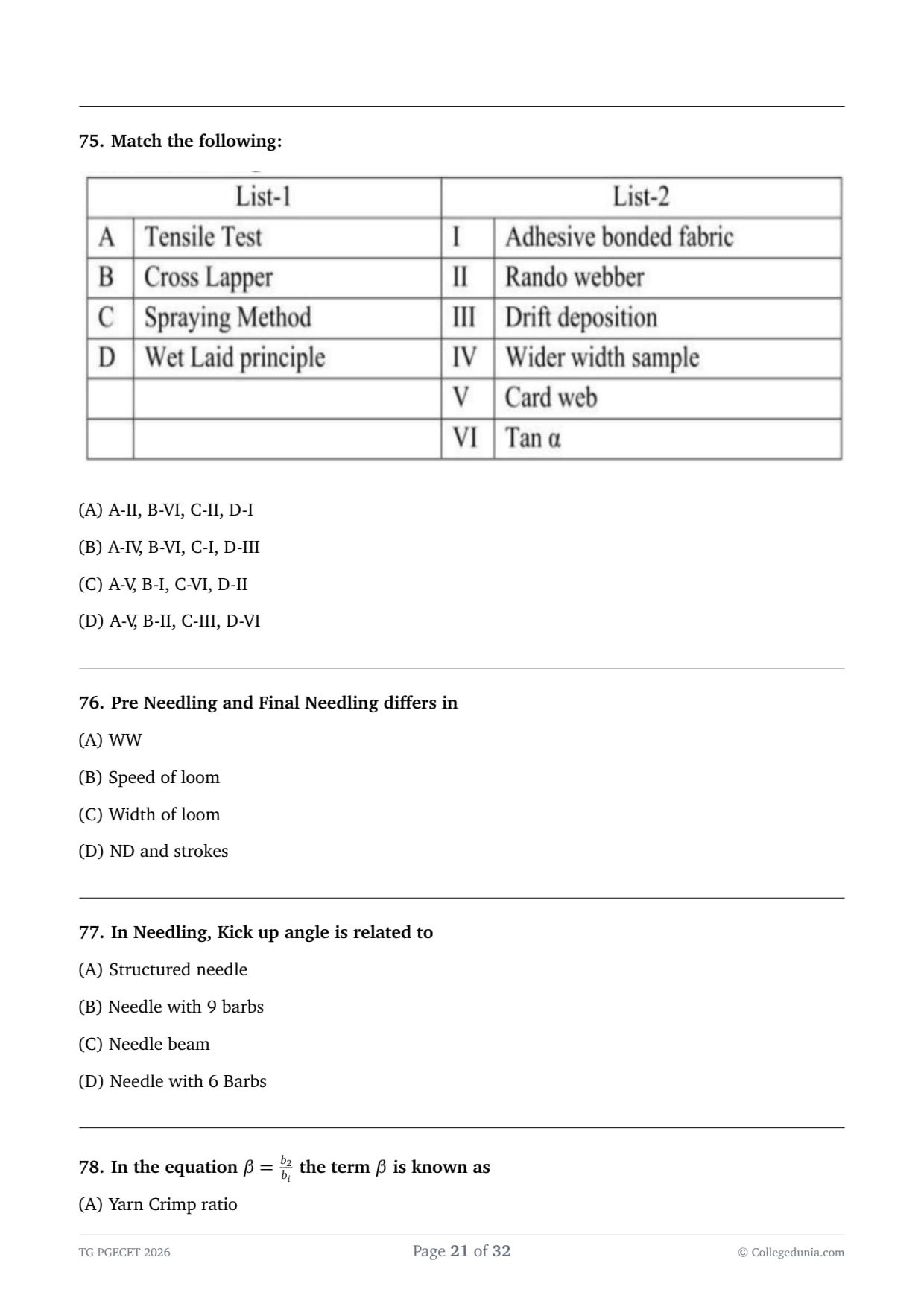
Question 75:
Match the following:
![]()
- (A) A-II, B-VI, C-II, D-I
- (B) A-IV, B-VI, C-I, D-III
- (C) A-V, B-I, C-VI, D-II
- (D) A-V, B-II, C-III, D-VI
Question 76:
Pre Needling and Final Needling differs in
- (A) WW
- (B) Speed of loom
- (C) Width of loom
- (D) ND and strokes
Question 77:
In Needling, Kick up angle is related to
- (A) Structured needle
- (B) Needle with 9 barbs
- (C) Needle beam
- (D) Needle with 6 Barbs
Question 78:
In the equation \(\beta=\frac{b_{2}}{b_{i}}\) the term \(\beta\) is known as
- (A) Yarn Crimp ratio
- (B) Fabric width
- (C) Yarn balance
- (D) Limits of twist
Question 79:
\(\phi=\int_{0}^{R}\int_{0}^{e_{f}}\varphi\epsilon_{f}d\epsilon_{f}\frac{2\pi~ r.dr}{Y_{y}}\) is related to
- (A) Fabric strength
- (B) Fibre Migration
- (C) Closed fibre spacing
- (D) Castigliano's theorem
Question 80:
The approximate lot size fed to a Jet Dyeing machine
- (A) 50–80 kg
- (B) 60–90 kg
- (C) 120–140 kg
- (D) exactly 100 kg
Question 81:
Which of the following is mandatory process for Rubia Wet processing?
- (A) 6-Bowl
- (B) 4-Bowl
- (C) 3-Bowl
- (D) 8-Bowl
Question 82:
Match the following:
![]()
- (A) A-III, B-VI, C-II, D-I
- (B) A-II, B-I, C-III, D-V
- (C) A-V, B-I, C-VI, D-II
- (D) A-II, B-V, C-I, D-VI
Question 83:
Consider the following and choose the correct answer:
Assertion [A]: Dye uptake increase with more quantity dye availability.
Reason [R]: In lower liquors for a given Dye, % mobility of dye molecules are high.
- (A) [A] is true, but [R] is false
- (B) Both [A] and [R] are true
- (C) [A] is false, but [R] is true
- (D) Both [A] and [R] are false
Question 84:
Which of the following is the only dyeing machine available in Industry with different MLR?
- (A) Jigger
- (B) Padding Mangle
- (C) Winch
- (D) Jet
Question 85:
A sort with 68/86 D, Polyester Crepe-de-Chine fabric requires the following for Dana Effect
- (A) Singeing
- (B) Drumming
- (C) Mercerizing
- (D) Polishing
Question 86:
The results of \(K/S\) values as measured by a student shows: 2, 4, 6, 8, 10... from different methods. What gives K/S value of 10?
- (A) Jigger
- (B) Pad Batch
- (C) Jet
- (D) Winch
Question 87:
Match the following:
![]()
- (A) A-III, B-VI, C-II, D-I
- (B) A-II, B-I, C-III, D-V
- (C) A-V, B-I, C-VI, D-II
- (D) A-VI, B-IV, C-II, D-I
Question 88:
For what fabric, in Singeing operation the value 'G' will be reduced?
- (A) Long Cloth
- (B) Cambric
- (C) Tussore
- (D) Poplin
Question 89:
A student records the loss of 50% in the following type of strength usage of Amylases in desizing
- (A) Tear
- (B) Tensile
- (C) Ballistic
- (D) Bursting
Question 90:
In a study, different material to liquor ratios were used like 1:1.5, 1:3, 1:5, 1:10, 1:15. Higher amount of dye is available for which of the following MLR ratio
- (A) 1:15
- (B) 1:1.5
- (C) 1:10
- (D) 1:3
Question 91:
The modern Twin Jet dyeing machine uses
- (A) Hydel Energy
- (B) Natural Fuel
- (C) Solar Energy
- (D) Wind Energy
Question 92:
In industry, the type of NaOH used is
- (A) Flakes
- (B) Pallets
- (C) LR grade
- (D) Solvent
Question 93:
In the following, one of the type of dyeing machine is available in different forms like long, short and medium sizes
- (A) Soft flow
- (B) Thermofixation
- (C) Stenter
- (D) Jet
Question 94:
In the following, one of the resources is extensively used for decolourisation of dye spent liquor
- (A) Sand
- (B) Fly Ash
- (C) Carbon Black
- (D) Husk
Question 95:
The following machine consists a Heat Exchanger
- (A) Printing & Finishing
- (B) Scouring & Bleaching
- (C) Jet Dyeing
- (D) Thermofixation
Question 96:
Tamponing Machine is used for
- (A) Cotton
- (B) Polyester
- (C) Silk
- (D) Acrylic
Question 97:
AC Commutator, DC Commutator, Motorized speed regulator etc., are the features of
- (A) Printing
- (B) Finishing
- (C) Jet Dyeing
- (D) Garment Dyeing
Question 98:
What type of Technical Textile is used in Thermotransfer Printing machine?
- (A) Dyneema
- (B) Nomex
- (C) PLA
- (D) PBT
Question 99:
In Printing Screen, which type of cloth is made in Plain weave?
- (A) Polyester & Nylon
- (B) Silk Bolting cloth
- (C) Nomex
- (D) HDPE
Question 100:
Nomenclature like Benninger, Roberto, Kusters are referred to which one of the following machines in Textile Wet Processing?
- (A) Padding Mangle
- (B) Dryers
- (C) Jet Dyeing
- (D) Winch dyeing
Question 101:
In dyed pad-batch method, compared to Woven's, the Knits will have
- (A) High G
- (B) Low W
- (C) Low G
- (D) High Koshi
Question 102:
A garment after dyeing in a top loading machine will have
- (A) High G
- (B) Low W
- (C) Low G
- (D) High Koshi
Question 103:
In the recent years, the following type of finishing of Denim is banned
- (A) Laser
- (B) Sand Blast
- (C) Puma Stone
- (D) Acid
Question 104:
In which method of printing, mismatch of motif is a common defect?
- (A) Rotary
- (B) Spray
- (C) Transfer
- (D) Flat Bed Screen
Question 105:
Match the following:
![]()
- (A) A-II, B-VI, C-II, D-I
- (B) A-VI, B-II, C-I, D-II
- (C) A-V, B-I, C-VI, D-III
- (D) A-IV, B-V, C-I, D-VI
Question 106:
In a knitted fabric, what is the type of defect in lock stitching that reduces the potential for stitch in a seam?
- (A) Slipped stitch
- (B) Unbalanced stitches
- (C) Breakage
- (D) Staggered stitching
Question 107:
The following is the process of stitching along the cut edge of a single ply of fabric to prevent raveling
- (A) Sagging
- (B) Serging
- (C) Grin
- (D) Safety stitch
Question 108:
Shirring is a
- (A) Gathered fabric
- (B) Scalloped fabric
- (C) Ruffled fabric
- (D) Knotted fabric
Question 109:
Which of the following tasks are required in the 'pre-award phase' of the purchasing cycle?
- (A) Identification of needs and producing specifications if required
- (B) Expediting, reviewing progress and processes
- (C) Reviewing quotations, gaining authorization and placing orders
- (D) Assessing supplier performance and checking invoice details if required
Question 110:
A Bill of Material (BOM) lists the
- (A) Times needed to perform all phases of production
- (B) Production schedules for all products
- (C) Components, ingredients and materials required to produce an item
- (D) Operations required to produce an item
Question 111:
Which of the following categories of materials handling equipment does a 'counter balanced type' belong to?
- (A) Gravity Conveyor
- (B) Fork lift Trucks
- (C) Picking Robot
- (D) Warehouse Trolley
Question 112:
A time phased stock replenishment plan for all levels of supply chain is called
- (A) DRP
- (B) ERP
- (C) MRPII
- (D) MRP
Question 113:
A Report that shows the resource requirement in a work center for all currently assigned works as well as all planned and expected orders is
- (A) MRP II report
- (B) Closed loop report
- (C) Back flush report
- (D) Load report
Question 114:
CMT stands for
- (A) Complete Makeover Time
- (B) Cut Makeover Time
- (C) Cut Make Trim
- (D) Complete Makeover Trim
Question 115:
A supply chain is essentially a sequence of linked
- (A) Customer and prospects
- (B) Supplier and manufacturer
- (C) Warehousing and wholesaling units
- (D) Events in the market process
Question 116:
The disruption of the fabric surface or the deformation of a garment leads to
- (A) Seam elasticity
- (B) Slubs
- (C) Distortion
- (D) Seam grain
Question 117:
Cording stitches are used for stitching
- (A) Temporary pleats
- (B) Permanent creases
- (C) Pleats
- (D) Gathers
Question 118:
The preproduction process of separating a spread into garment parts is called as
- (A) Spreading
- (B) Bundling
- (C) Cutting
- (D) Ticketing
Question 119:
Speed of the high-speed lock stitch machine ranges from
- (A) 6000-8000 spm
- (B) 1000-2000 spm
- (C) 3000-4000 spm
- (D) 2000-3000 spm
Question 120:
In which section of a garment unit, the measurements of the T-shirt can be adjusted, after it is sewn
- (A) Sewing
- (B) Trimming
- (C) Packing
- (D) Ironing
TS PGECET 2026 Exam Pattern
| Particulars |
Details |
| Exam Mode |
Computer-Based Test(CBT) |
| Question Type |
Multiple Choice Questions(MCQs) |
| Total Questions |
120 Questions |
| Total Marks |
120 Marks |
| Exam Duration |
2 Hours |
| Marking Scheme |
+1 mark for each correct answer |
| Negative Marking |
No Negative Marking |
| Language of Paper |
English |
TS PGECET 2026 Preparation Strategy













Comments