TS PGECET 2026 Electronics and Communication Engineering (EC) Question Paper is available for download here. JNTU Hyderabad on behalf of Telangana Council of Higher Education (TGCHE) conducted TS PGECET 2026 EC exam on May 29 in Shift 1 from 10 AM to 12 PM. TS PGECET EC Question Paper consists of 120 questions for 120 marks to be attempted in 2 hours.
- TS PGECET EC Question Paper 2026 is divided into 2 sections- Engineering Mathematics with 10 questions and Electronics and Communication Engineering domain with 110 questions.
- Each questions carries 1 mark each and there is no negative marking for incorrect answers.
Candidates can download TS PGECET 2026 EC Question Paper with Answer Key and Solution PDF from links provided below.
TS PGECET 2026 EC Question Paper with Solution PDF
Question 1:
If \(\{(2,-3,5), (1,\alpha,7), (3,\beta,3)\}\) is not a basis of the vector space \(\mathbb{R}^{3}\), then \((\alpha,\beta)\) lies on the locus
- (A) \(x^{2}+y=5\)
- (B) \(y^{2}+x=4\)
- (C) \(x+y+6=0\)
- (D) \(x^{2}+y^{2}=16\)
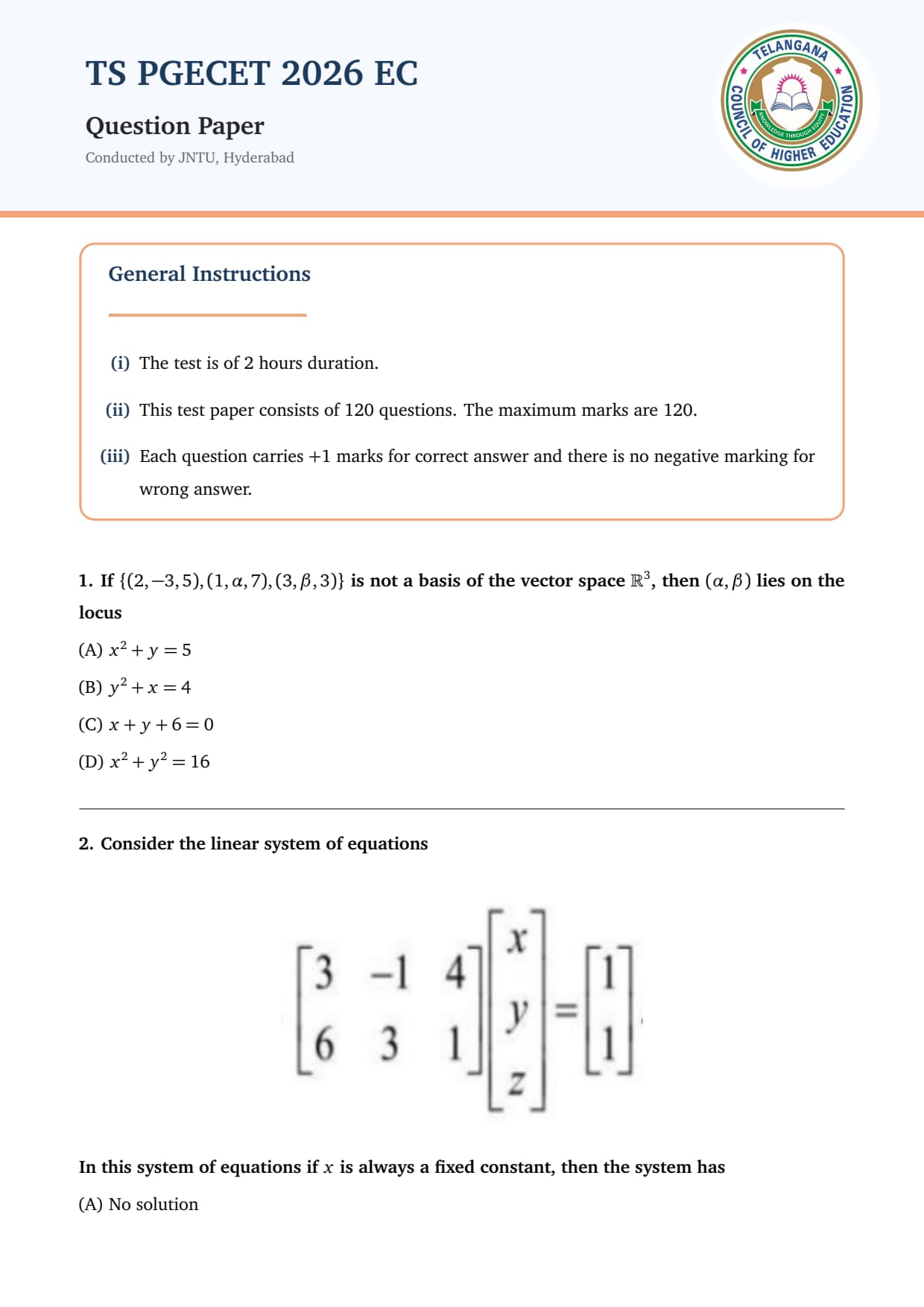
Question 2:
Consider the linear system of equations
![]()
In this system of equations if \(x\) is always a fixed constant, then the system has
- (A) No solution
- (B) Infinite solutions
- (C) Unique solution
- (D) Exactly two solutions
Question 3:
Evaluate \[ \iint_D x^2y\,dx\,dy, \]
where \[ D:\;x^2+y^2\le16. \]
- (A) \(2\times\frac{4^5}{15}\)
- (B) \(\pi\times\frac{4^5}{15}\)
- (C) \(0\)
- (D) \(\pi\times\frac{4^5}{25}\)
Question 4:
If \[ \overline{V}=x^{2}y\,\overline{i}-yz^{2}\,\overline{j}+xyz\,\overline{k} \]
is the linear velocity of a particle in circular motion at the point \((1,1,1)\), then its angular velocity is
- (A) \(-\frac{1}{2}(\overline{i}+\overline{j}+\overline{k})\)
- (B) \(0\)
- (C) \(\frac{1}{2}(3\overline{i}-\overline{j}-\overline{k})\)
- (D) \(\frac{1}{2}(\overline{i}+\overline{j}+\overline{k})\)
Question 5:
Evaluate \[ \oint_C \frac{z+2}{z^2+2z+2}\,dz, \]
where \(C\) is the circle \[ |z-\alpha|=1, \qquad \alpha=-1+\frac{3}{2}i. \]
- (A) \(0\)
- (B) \(2\pi i\)
- (C) \(\pi(1+i)\)
- (D) \(\pi(2-i)\)
Question 6:
If the solution of \[ \frac{d^2y}{dt^2} = -\frac54y+\frac{dy}{dt}, \]
satisfying \[ y(0)=1, \qquad \left(\frac{dy}{dt}\right)_{t=0}=0, \]
is \(y(t)\), then \(y(\pi)=\)
- (A) \(e^{-2\pi}\)
- (B) \(e^{\frac{\pi}{2}}\)
- (C) \(5e^{-2\pi}\)
- (D) \(4e^{\frac{\pi}{2}}\)
Question 7:
The differential equation \[ 2\frac{\partial^2 z}{\partial x^2} + 5\frac{\partial^2 z}{\partial x\partial y} + 2\frac{\partial^2 z}{\partial y^2} + 7\frac{\partial z}{\partial x} + \frac{\partial z}{\partial y} =0 \]
is classified as
- (A) Parabolic
- (B) Elliptic
- (C) Hyperbolic
- (D) Clairaut's equation
Question 8:
The joint probability density function of a two-dimensional random variable (X,Y) is
f(x, y) =
| { |
2, |
0 < x < 1, 0 < y < x |
| 0, |
otherwise. |
- (A) X and Y are independent
- (B) Marginal density function of X is x, 0 < x < 1
- (C) Marginal density function of Y is (1 − y), 0 < y < 1
- (D) X and Y are not independent
Question 9:
If \(\mu_1,\mu_2\) and \(\mu_3\) are the mean, median and mode respectively of a normal distribution, then \[ 3(Median)-2(Mode) = ? \]
- (A) \(\mu_1\)
- (B) \(\mu_2\)
- (C) \(\mu_3\)
- (D) \(0\)
Question 10:
Approximate positive root of the equation \[ x^2-7x+9=0 \]
using Newton-Raphson method with initial guess \(x_0=2\).
- (A) \(\frac{56}{33}\)
- (B) \(\frac{12}{5}\)
- (C) \(23\)
- (D) \(\frac{1}{2}\)
Question 11:
The equivalent resistance between the terminal points \(X\) and \(Y\) in the given circuit is
![]()
- (A) \(15~\Omega\)
- (B) \(\sqrt{3}~\Omega\)
- (C) \(40~\Omega\)
- (D) \(30~\Omega\)
Question 12:
For the given circuit, during maximum power transfer, the value of \(R\) and the magnitude of the power delivered to \(R\) are
![]()
- (A) \(5~\Omega\) and \(1~W\)
- (B) \(15~\Omega\) and \(10~W\)
- (C) \(2.12~\Omega\) and \(1.233~W\)
- (D) \(5.33~\Omega\) and \(0.188~W\)
Question 13:
In the given circuit, if Thevenin's equivalent resistance is \(2~\Omega\) when seen from the open terminals, then the value of \(R\) is
![]()
- (A) \(>1~\Omega\)
- (B) \(2~\Omega\)
- (C) \(4~\Omega\)
- (D) \(5~\Omega\)
Question 14:
A \(10~\Omega\) resistor, a \(1~H\) inductor and a \(1~F\) capacitor are connected in parallel. The combination is driven by a unit step current. Under steady-state conditions, the source current flows through
- (A) Resistor only
- (B) Inductor only
- (C) Capacitor only
- (D) Resistor, Inductor and Capacitor
Question 15:
The impulse response of an RL circuit is a
- (A) Rising exponential function
- (B) Decaying exponential function
- (C) Step function
- (D) Parabolic function
Question 16:
An RLC series circuit has \[ R=1\Omega,\quad L=1H,\quad C=1F. \]
Damping ratio of the circuit will be
- (A) Greater than unity
- (B) Unity
- (C) \(0.5\)
- (D) Zero
Question 17:
The condition for symmetry in ABCD two-port parameters is
- (A) \(A=B\)
- (B) \(A=D\)
- (C) \(B=C\)
- (D) \(B=D\)
Question 18:
What is the short-circuit impedance at port 1 for the given two-port network?
![]()
- (A) \(3.33~\Omega\)
- (B) \(4~\Omega\)
- (C) \(14~\Omega\)
- (D) \(23.33~\Omega\)
Question 19:
The form factor for DC supply voltage is always
- (A) Zero
- (B) Unity
- (C) Infinity
- (D) Any value between 0 and 1
Question 20:
The Fourier transform of a function \(f(at)\) is given by
- (A) aF(ω)
- (B) 2aF(ω)
- (C) 1⁄a F(ω/a)
- (D) 2⁄a F(ω)
Question 21:
If \(f(t)\) is a periodic waveform with even symmetry, then its Fourier series expansion does not contain
- (A) Sine terms
- (B) Cosine terms
- (C) Odd harmonics
- (D) Even harmonics
Question 22:
The Fourier transform of a signum function is
- (A) \(j\pi f\)
- (B) \(\dfrac{1}{j\pi f}\)
- (C) \(j\pi f+a\)
- (D) \(\dfrac{1}{j\pi f+a}\)
Question 23:
A square-law system is/has
- (A) Invertible
- (B) Not invertible
- (C) Distinct inputs must produce distinct outputs
- (D) \(x(t)\) and \(x(-t)\) produce distinct outputs
Question 24:
If the input is \[ x[n]=-u[n]+2u[n-3]-u[n-6] \]
and impulse response is \[ h[n]=u[n+1]-u[n-10] \]
of an LTI system, then the output \(y[n]\) in the interval \(5\le n\le9\) is
- (A) \(y[n]=0\)
- (B) \(y[n]=-(n+2)\)
- (C) \(y[n]=n-4\)
- (D) \(y[n]=n-9\)
Question 25:
Find the inverse Fourier Transform of \[ X(j\omega)=\frac{j\omega+1}{(j\omega)^2+5j\omega+6}. \]
- (A) \(2e^{3t}u(t)+e^{2t}u(t)\)
- (B) \(3e^{-3t}u(t)-2e^{-2t}u(t)\)
- (C) \(2e^{-2t}u(t)+3e^{-3t}u(t)\)
- (D) \(2e^{-3t}u(t)-e^{-2t}u(t)\)
Question 26:
The Fourier Transform of \[ \frac{d}{dt}\left(e^{-at}u(t)\right) \]
is
- (A) \(\delta(t)\)
- (B) \(-ae^{-at}u(t)\)
- (C) \(\dfrac{a}{a+j\omega}\)
- (D) \(\dfrac{j\omega}{a+j\omega}\)
Question 27:
Overlap in the shifted replicas of the original spectrum after sampling is termed
- (A) Offset
- (B) Bandwidth
- (C) Aliasing
- (D) Anti-aliasing
Question 28:
The Fourier Transform of the sampled signal is given by
- (A) The multiplication of shifted versions of the impulse signals
- (B) The original signal's Fourier Transform
- (C) A finite sum of unit step signal's Fourier Transform
- (D) An infinite sum of shifted versions of the original signal's Fourier Transform
Question 29:
Determine the conditions on the sampling interval \(T\) such that \[ x(t)=\frac{\cos(2\pi t)\sin(\pi t)}{\pi t} + \frac{2\sin(6\pi t)\sin(2\pi t)}{\pi t} \]
is uniquely represented by the discrete-time sequence \(x[n]=x(nT)\).
- (A) \(1\)
- (B) \(\frac16\)
- (C) \(\frac18\)
- (D) \(\frac1{12}\)
Question 30:
\(N\)-point DFT using FFT algorithms (radix-2) requires the following complex multiplications
- (A) \(N\)
- (B) \(2N\)
- (C) \(\log_2 N\)
- (D) \(N\log_2 N\)
Question 31:
A relaxed linear time-invariant system with impulse response \[ h(n)=a^n u(n), \qquad |a|<1 \]
when the input is a unit step sequence, \[ x(n)=u(n), \]
then the output \(y(\infty)\) of the system is
- (A) \(\dfrac{1+a^{(n+1)}}{1+a}\)
- (B) \(\dfrac{1-a^{(n-1)}}{1+a}\)
- (C) \(\dfrac{1-a^{(n+1)}}{1-a}\)
- (D) \(1-a\)
Question 32:
Determine the z-transform of the signal \[ x(n)=a^n(\sin\omega_0 n)u(n) \]
- (A) \[ \frac{az^{-1}\cos\omega_0} {1-2az^{-1}\sin\omega_0-a^2z^{-2}} ,\quad |z|>|a| \]
- (B) \[ \frac{az^{-1}\cos\omega_0} {1+2az^{-1}\cos\omega_0-a^2z^{-2}} ,\quad |z|<|a| \]
- (C) \[ \frac{az^{-1}\sin\omega_0} {1-2az^{-1}\cos\omega_0+a^2z^{-2}} ,\quad |z|>|a| \]
- (D) \[ \frac{az^{-1}\sin\omega_0} {1-2az^{-1}\cos\omega_0-a^2z^{-2}} ,\quad |z|<|a| \]
Question 33:
Determine the z-transform corresponding to the given pole-zero plot.
![]()
- (A)
X(z) = G (z + r cos ω0) (z − rejω0) (z − re−jω0) , |z| < r
- (B)
X(z) = G (z + r cos ω0) (z + rejω0) (z − re−jω0) , |z| < r
- (C)
X(z) = G z(z − r cos ω0) (z − rejω0) (z − re−jω0) , |z| > r
- (D)
X(z) = G z(z + r cos ω0) (z + rejω0) (z − re−jω0) , |z| > r
Question 34:
A linear time-invariant system is characterized by \[ H(z)=\frac{3-4z^{-1}} {1-3.5z^{-1}+1.5z^{-2}}. \]
Which of the following is not correct?
- (A) System is stable in \(\frac12<|z|<3\)
- (B) System is unstable in \(|z|>3\)
- (C) System is causal, its ROC is \(|z|>3\) and system is stable
- (D) System is anti-causal, its ROC is \(|z|<\frac12\) and system is unstable
Question 35:
If all the frequency components of the input signal undergo the same time delay, then the value of the group delay of the system is
- (A) Zero
- (B) Unity
- (C) Constant
- (D) Infinity
Question 36:
A typical resistance value for a 1-cubic centimeter sample of semiconductor is
- (A) \(>10~\Omega/cm^3\)
- (B) \(10^{-6}~\Omega/cm^3\)
- (C) \(10^{-16}~\Omega/cm^3\)
- (D) \(10^{-14}~\Omega/cm^3\)
Question 37:
The charge carriers move gradually from the region of high carrier density to low carrier density constitutes an electric current is
- (A) Drift current
- (B) Diffusion current
- (C) Leakage current
- (D) Current density
Question 38:
The forward resistance for silicon diode carrying a current of \(20~mA\) is
- (A) \(15~\Omega\)
- (B) \(35~\Omega\)
- (C) \(50~\Omega\)
- (D) \(20~k\Omega\)
Question 39:
The diode current equation is
- (A) \[ I_0\left(e^{\frac{V}{\eta V_T}}-1\right) \]
- (B) \[ I_0e^{-\frac{V}{\eta V_T}} \]
- (C) \[ I_0\left(e^{-\frac{V}{\eta V_T}}+1\right) \]
- (D) \(I\)
Question 40:
The maximum time for the diode to switch from ON to OFF is called
- (A) Rise time
- (B) Fall time
- (C) Saturation time
- (D) Reverse recovery time
Question 41:
Find the value of emitter current for a transistor with \[ \alpha_{dc}=0.98 \]
and \[ I_{CBO}=5~\mu A \]
when the base current is measured as \[ 100~\mu A. \]
- (A) \(5.25~mA\)
- (B) \(5.15~mA\)
- (C) \(4.9~mA\)
- (D) \(0.25~mA\)
Question 42:
The region of the V-I characteristic of JFET where \(I_D\) (drain current) is fairly constant is referred as
- (A) Cut-off
- (B) Pinch-off
- (C) Active
- (D) Saturation
Question 43:
For enhancement MOSFET, the gate-source voltage must have
- (A) Positive
- (B) Negative
- (C) Same polarity as the drain supply
- (D) Opposite polarity as the drain supply
Question 44:
The incorrect statement with respect to thin-film integrated circuits is
- (A) Depositing film of conducting material on the surface of a glass
- (B) Silk-screen printing techniques are employed to create the desired circuit pattern
- (C) Capacitors are produced by sandwiching a film of insulating oxide between two conducting films
- (D) Inductors are made by depositing a spiral formation of film
Question 45:
In discrete transistors the substrate is normally used as
- (A) Emitter
- (B) Collector
- (C) Base
- (D) Bias supply
Question 46:
Which of the following is correct with reference to the given diode limiter circuit?
![]()
- (A)
−VR2 < vi < VR1 ⇒ D1 OFF, D2 ON ⇒ vo = VR1
- (B)
vi < VR1 ⇒ D1 ON, D2 OFF ⇒ vo = VR1
- (C)
vi < VR2 ⇒ D1 OFF, D2 OFF ⇒ vo = vi
- (D)
−VR2 > vi ⇒ D1 OFF, D2 ON ⇒ vo = −VR2
Question 47:
In Emitter current bias, if \[ R_1||R_2 \]
is very much larger than \[ R_E, \]
then the circuit performance becomes like
- (A) Remains in the same bias circuit
- (B) Fixed current bias circuit
- (C) Collector to base bias circuit
- (D) Voltage divider bias circuit
Question 48:
Match the following:
![]()
- (A) \(A\!-\!II,\;B\!-\!IV,\;C\!-\!I,\;D\!-\!III\)
- (B) \(A\!-\!IV,\;B\!-\!III,\;C\!-\!II,\;D\!-\!I\)
- (C) \(A\!-\!III,\;B\!-\!I,\;C\!-\!IV,\;D\!-\!II\)
- (D) \(A\!-\!I,\;B\!-\!II,\;C\!-\!III,\;D\!-\!IV\)
Question 49:
The non-inverting amplifier circuit behaves very similar to the voltage follower circuit except that
- (A) Only a portion of output is fed back
- (B) High input impedance
- (C) Low output impedance
- (D) Very little voltage drop across \(R_1\)
Question 50:
Class AB operation is often used in power amplifiers in order to
- (A) Overcome a cross over distortion
- (B) Decrease distortion
- (C) Increase distortion
- (D) Introduce non-linearity
Question 51:
Calculate the circuit output resistance in the common drain amplifier with \[ r_d=100~k\Omega,\qquad g_m=990~\mu S \]
and \[ R_L=10~k\Omega. \]
- (A) \(322~\Omega\)
- (B) \(332~\Omega\)
- (C) \(990~\Omega\)
- (D) \(10~k\Omega\)
Question 52:
Under steady-state conditions, the clamping theorem states that
- (A) \[ \frac{A_f}{A_r} = \frac{R_f}{R} \]
- (B) \[ \frac{A_r}{A_f} = \frac{R_f}{R} \]
- (C) \[ \frac{A_f}{A_r} = \frac{R}{R_f} \]
- (D) \[ \frac{A_f}{A_r}=1 \]
Question 53:
The correct option with respect to IC 723 general purpose regulator is
- (A) Inherently low currents
- (B) Have in-built thermal protection
- (C) No short circuit current limits
- (D) Wide range of both positive or negative regulator voltage
Question 54:
In IC 555 timer, three \(5k\Omega\) internal resistors act as voltage divider, which provides bias voltage to the upper comparator and to the lower comparator in the order of (in \(V_{CC}\)).
- (A) \[ \frac{2}{3},\frac{1}{3} \]
- (B) \[ \frac{1}{3},\frac{1}{3} \]
- (C) \[ \frac{1}{3},\frac{2}{3} \]
- (D) \[ \frac{2}{5},\frac{1}{5} \]
Question 55:
The collector of the leading transistor connected to the emitter of the following transistor configuration is called
- (A) Emitter follower amplifier
- (B) Common emitter amplifier
- (C) Cascade amplifier
- (D) Cascode amplifier
Question 56:
\(A_I\) in the given circuit is
![]()
- (A) \(50\)
- (B) \(100\)
- (C) \(120\)
- (D) \(121\)
Question 57:
The maximum efficiency of a class A series-fed amplifier is
- (A) \(25%\)
- (B) \(50%\)
- (C) \(78.5%\)
- (D) \(82.3%\)
Question 58:
The required current gain in a transistor phase-shift oscillator is
- (A) \[ h_{fe}>29+23\frac{R_C}{R}+4\frac{R}{R_C} \]
- (B) \[ h_{fe}<29+23\frac{R_C}{R}+4\frac{R}{R_C} \]
- (C) \[ h_{fe}>23+29\frac{R}{R_C}+4\frac{R_C}{R} \]
- (D) \[ h_{fe}<23+29\frac{R}{R_C}+4\frac{R_C}{R} \]
Question 59:
A dc voltage supply provides \(60V\) when the output is unloaded. When connected to a load, the output drops to \(56V\). Determine the value of voltage regulation.
- (A) \(4.5%\)
- (B) \(7.1%\)
- (C) \(14%\)
- (D) \(15%\)
Question 60:
If an amplifier with gain of \(-1000\) and feedback of \[ \beta=-0.1 \]
has a gain change of \(20%\) due to temperature, calculate the change in gain of the feedback amplifier.
- (A) \(0.2%\)
- (B) \(0.1%\)
- (C) \(0.001%\)
- (D) \(0.0001%\)
Question 61:
The following circuit works like a
![]()
- (A) D Flip-flop
- (B) T Flip-flop
- (C) Frequency divider
- (D) Inverter
Question 62:
The SRAM from a memory-read perspective, is indeed a combinational circuit because
- (A) Its next state depends on its present state
- (B) A data retrieval is not affected by previous data retrievals
- (C) It is storage element
- (D) It operates in sequential fashion
Question 63:
The BCD code of decimal number 255 is
- (A) 0010 0101 0101
- (B) 1111 1111 1110
- (C) 1111 1111 1111
- (D) 0111 1111 1111
Question 64:
Using 8-bit numbers, find the 2's complement of -128.
- (A) 01111111
- (B) 11000111
- (C) 10000001
- (D) 10000000
Question 65:
The following circuit is equivalent of
![]()
- (A) AND Gate
- (B) OR Gate
- (C) NOR Gate
- (D) NAND Gate
Question 66:
Modulo-2 adder (without carry-out) works like
- (A) OR gate
- (B) XOR gate
- (C) XNOR gate
- (D) XNAND gate
Question 67:
The logical equation of tri-state buffer is \[ (E=enable,\;Z=high impedance) \]
- (A) \[ Y=E'Z+EX \]
- (B) \[ Y=E'Z'+EX' \]
- (C) \[ Y=Z'+EX \]
- (D) \[ Y=EZ+X \]
Question 68:
The modulo \(2^N\) counter consist of the following number of states and flip-flops respectively
- (A) \(2N-1\) and \(N-1\)
- (B) \(2^{2N}\) and \(N-1\)
- (C) \(2^{N-1}\) and \(N-1\)
- (D) \(2^N\) and \(N\)
Question 69:
Simplify the Boolean expression \[ ab'+bc+ac \]
- (A) \(ab'+bc\)
- (B) \(ab'+ac\)
- (C) \(bc+ac\)
- (D) \(a+b+c\)
Question 70:
PAL devices composed of
- (A) Fixed array of AND gates followed by a fixed array of OR gates
- (B) Programmable AND and OR gate arrays
- (C) Fixed array of AND gates followed by a programmable array of OR gates
- (D) Programmable array of AND gates followed by a fixed array of OR gates
Question 71:
Calculate the full scale output value of an 8-bit DAC for the 0 to 10 V range?
- (A) \(0.039~V\)
- (B) \(5~V\)
- (C) \(9.961~V\)
- (D) \(10~V\)
Question 72:
If the converter of Dual-slope ADC first integrates the analog input signal for a fixed duration, then the clock periods are
- (A) \(n\)
- (B) \(n-1\)
- (C) \(2^n\)
- (D) \(2^{n-1}\)
Question 73:
TRAP is addressed by
- (A) \(0016H\)
- (B) \(0024H\)
- (C) \(0033H\)
- (D) \(0034H\)
Question 74:
When the following is used, the CPU is bypassed for certain data transfers?
- (A) Polled I/O
- (B) DMA
- (C) TRAP
- (D) Software Interrupts
Question 75:
In 8086 microprocessor, the instruction used to copy the word from the top of the stack to the flag register is
- (A) PUSH
- (B) PUSHF
- (C) POP
- (D) POPF
Question 76:
The damped natural frequency of an underdamped system is given by
- (A) \(\omega_n\)
- (B) \(\omega_n\zeta^2\)
- (C) \(\omega_n\sqrt{1+\zeta^2}\)
- (D) \(\omega_n\sqrt{1-\zeta^2}\)
Question 77:
The following plot shows
![]()
- (A) Critical damped system
- (B) Under damped system
- (C) Over damped system
- (D) Undamped system
Question 78:
The range of steady state value for the rise time of underdamped system is
- (A) 0 to 90%
- (B) 10 to 90%
- (C) 0 to 100%
- (D) 10 to 100%
Question 79:
\(\displaystyle \lim_{s\rightarrow0}s^{2}G(s)\) defines
- (A) Positional error constant
- (B) Velocity error coefficient
- (C) Acceleration error constant
- (D) Mean square error coefficient
Question 80:
The steady state error for a type 1 system with input of \[ \frac{At^2}{2}u(t) \]
is
- (A) 0
- (B) \(\frac{1}{2}\)
- (C) 1
- (D) \(\infty\)
Question 81:
The control system with single pole at origin is
- (A) Unstable
- (B) Stable
- (C) Marginally stable
- (D) Absolutely stable
Question 82:
For the system \[ G(s)H(s)=\frac{K(s+a^{2})}{(s+b)^{2}}, \]
the break point is
- (A) \(a,b\)
- (B) \(-a,-b\)
- (C) \(\sqrt{ab}\)
- (D) \(-b\pm\sqrt{b^{2}-ab}\)
Question 83:
The incorrect option for a Closed loop control system output is
- (A) Decrease the effect of noise
- (B) Improves the overall stability
- (C) Sensitivity is reduced
- (D) Independent of variation in feedback parameter
Question 84:
The characteristic polynomial of a system is \[ s^3+2s^2+4s+K. \]
The system is marginally stable for
- (A) K = 0
- (B) K = 8
- (C) 0 < K < 4
- (D) 0 < K < 8
Question 85:
The root locus approaches straight lines as asymptotes approaches
- (A) Zero
- (B) Unity
- (C) Infinity
- (D) \(j\omega\) axis
Question 86:
Determine the transfer function \(\dfrac{C(s)}{R(s)}\) of the system shown below.
![]()
- (A) \[ \frac{G_{1}G_{2}G_{3}G_{4}} {(1+G_{1}G_{2}H_{1})(1+G_{3}G_{4}H_{2})+G_{2}G_{3}H_{3}} \]
- (B) \[ \frac{G_{1}G_{4}} {(1+G_{1}G_{2}H_{1}H_{2})+(1+G_{2}G_{3}G_{4}H_{3})} \]
- (C) \[ \frac{G_{1}G_{3}G_{4}} {(1+G_{1}G_{2}H_{1})(1+G_{3}G_{4})+(1+G_{2}G_{3}H_{2})} \]
- (D) \[ \frac{G_{1}G_{2}G_{3}} {(1+G_{1}G_{2}H_{1})(1+G_{3}G_{4})+(G_{2}G_{3}H_{3}+G_{4})} \]
Question 87:
For the following Routh's array, the system is
![]()
- (A) Unstable
- (B) Stable
- (C) Marginally stable
- (D) Conditionally stable
Question 88:
Error constants of a system are measure of
- (A) Relative stability
- (B) Transient state response
- (C) Steady state response
- (D) Marginal stability
Question 89:
The following are the effects of a phase-lead compensation except
- (A) Crossover frequency is increased
- (B) Rise time is increased
- (C) Settling time is reduced
- (D) More damping
Question 90:
The incorrect statement with respect to Bode Plots is
- (A) Gain margin and phase margin both are positive then system is stable
- (B) Gain margin is measured above the \(0\,dB\) axis, then system is unstable
- (C) If the phase margin is measured below the \(-180^\circ\) axis, the system is stable
- (D) Absolute and relative stability of only minimum-phase system can be determined
Question 91:
The total power in the two side-frequencies of the resulting AM is one third of the total power in the modulated wave when the modulation index is
- (A) \(25%\)
- (B) \(33%\)
- (C) \(>100%\)
- (D) \(66%\)
Question 92:
The quadrature null effect of the coherent detector occur at
- (A) \(\phi=0\)
- (B) \(\phi=\pm\frac{\pi}{2}\)
- (C) \(\phi=\pm\pi\)
- (D) \(\phi=2\pi\)
Question 93:
To develop the time-domain description of SSB modulation, the required mathematical tool is known as
- (A) Fourier transform
- (B) Hilbert transform
- (C) Discrete Cosine transform
- (D) Sine transform
Question 94:
In the transmission of television signals in practice, a controlled amount of carrier is added to the VSB modulated signal. This is done to use
- (A) An envelope detector for demodulation
- (B) A square wave detector for demodulation
- (C) A square wave detector for modulation
- (D) A product modulation for modulation
Question 95:
Prior to sampling, the type of filter used to attenuate high frequency components of the signal that lie outside the band of interest is
- (A) Lowpass aliasing
- (B) Highpass aliasing
- (C) Lowpass anti-aliasing
- (D) Highpass anti-aliasing
Question 96:
Which of the following is used to correct the aperture effect due to flat-top sampling in the sample-and-hold circuit of PAM demodulation?
- (A) Amplifier
- (B) Low pass filter
- (C) Band pass filter
- (D) Equalizer
Question 97:
A FDM system is used to multiplex 24 independent voice signals. SSB modulation is used for the transmission. Given that each voice signal is allotted a bandwidth of 4 kHz, calculate the overall transmission bandwidth of the channel?
- (A) \(6~kHz\)
- (B) \(8~kHz\)
- (C) \(96~kHz\)
- (D) \(192~kHz\)
Question 98:
A TDM system is used to multiplex four independent voice signals each sampled at the rate of 8 kHz using PAM. The system incorporates a synchronizing pulse train for its proper operation. Calculate the transmission bandwidth?
- (A) \(8~kHz\)
- (B) \(16~kHz\)
- (C) \(32~kHz\)
- (D) \(40~kHz\)
Question 99:
What are the conditions for distortion less transmission through a system?
- (A) Gain is linear and phase is constant
- (B) Gain and phase should be linear
- (C) Gain and phase must be constant
- (D) Gain must be constant and phase should be linear
Question 100:
A random process is stationary
- (A) If all statistical properties do not change with time
- (B) If the future values of any sample function can be predicted from present values only
- (C) Future values cannot be predicted
- (D) If the future values of any sample function can be predicted from past values only
Question 101:
The random process \(X(t)=A\cos(\omega_0 t+\theta)\) is wide-sense stationary, where \(A\) and \(\omega_0\) are constants and \(\theta\) is a uniformly distributed random variable on the interval \((0,2\pi)\). Then the mean value is
- (A) \(>0\)
- (B) \(1\)
- (C) \(\pi\)
- (D) \(0\)
Question 102:
The following are properties of auto correlation except
- (A) \(|R_{XX}(\tau)|\le R_{XX}(0)\)
- (B) \(|R_{XX}(-\tau)|=R_{XX}(\tau)\)
- (C) \(|R_{XX}(\tau)|=E[x(t)]\)
- (D) If \(x(t)\) has a periodic component, then \(R_{XX}(\tau)\) will have a periodic component with the same period
Question 103:
A receiver connected to an antenna whose resistance is \(50~\Omega\) has an equivalent noise resistance of \(30~\Omega\). Calculate the receiver's noise figure?
- (A) \(0.6\)
- (B) \(1.0\)
- (C) \(1.6\)
- (D) \(2.0\)
Question 104:
Which of the following is not correct if the intermediate frequency is too high?
- (A) Poor selectivity
- (B) Poor adjacent channel rejection
- (C) Increase tracking difficulties
- (D) Poor image frequency rejection
Question 105:
The problem of reducing the gain of receiver for weak signals is avoided by
- (A) No AGC
- (B) Ideal AGC
- (C) Simple AGC
- (D) Delayed AGC
Question 106:
In communication receivers, the filter used to reduce receiver gain at some specific frequency is
- (A) Low pass
- (B) High pass
- (C) Band pass
- (D) Notch
Question 107:
The Foster-Seeley discriminator along with amplitude limiter is called
- (A) Envelope detector
- (B) Ratio detector
- (C) Balanced modulator
- (D) Square-law modulator
Question 108:
A four level PAM has a input data rate of \(2400~bits/s\) then the symbol rate is
- (A) \(600~symbols/s\)
- (B) \(1200~symbols/s\)
- (C) \(2400~symbols/s\)
- (D) \(9600~symbols/s\)
Question 109:
Match the following: A: ASK, B: APK, C: PSK, D: FSK
- (A) A-IV, B-I, C-II, D-III
- (B) A-III, B-II, C-I, D-IV
- (C) A-II, B-III, C-IV, D-I
- (D) A-I, B-IV, C-III, D-II
Question 110:
If the rows of channel matrix are all equal to each other, then the channel capacity is
- (A) \(0\)
- (B) \(1\)
- (C) \(\infty\)
- (D) Equal to bandwidth of channel
Question 111:
The Gauss's law for magnetic fields is
- (A) \(\nabla \cdot E = 0\)
- (B) \(\nabla \cdot H = 0\)
- (C) \(\nabla \cdot B = 0\)
- (D) \(\nabla \cdot D = 0\)
Question 112:
Identify the polarisation of the wave given, \(E_x=2\cos\omega t\), \(E_y=2\sin\omega t\)
and the phase difference is \(+90^\circ\)
- (A) Left hand circularly polarized
- (B) Right hand circularly polarized
- (C) Left hand elliptically polarized
- (D) Right hand elliptically polarized
Question 113:
The characteristic impedance of the medium is
- (A) \(120\pi\)
- (B) \(120\pi\left(\frac{\mu_r}{\epsilon_r}\right)\)
- (C) \(\mu_r\epsilon_r\)
- (D) \(\epsilon_r\)
Question 114:
The depth of penetration decreases, if
- (A) Conductivity decreases
- (B) Relative permeability decreases
- (C) Frequency increases
- (D) Phase velocity decreases
Question 115:
Snell's law states that (\(n_1\) is the index of refraction of the first medium and \(n_2\) is that of second, \(\theta_t\) is the angle of refraction and \(\theta_i\) is angle of incidence)
- (A) \(n_1\sin\theta_i=0\)
- (B) \(n_2\sin\theta_t=0\)
- (C) \(n_2\sin\theta_t=n_1\sin\theta_i\)
- (D) \(n_2\sin\theta_t=-n_1\sin\theta_i\)
Question 116:
For a lossy transmission line, the characteristic impedance does not depend on
- (A) Operating frequency of the line
- (B) Length of the line
- (C) Conductivity of the conductors
- (D) Conductivity of the dielectric separating the conductors
Question 117:
A rectangular waveguide with dimensions \(a=2.5\) cm, \(b=1\) cm is operating below 15 GHz. If the guide is filled with a medium characterized by \(\sigma=0\), \(\epsilon=4\epsilon_0\), \(\mu_r=1\), calculate the cutoff frequency of dominant mode?
- (A) \(3\) GHz
- (B) \(9\) GHz
- (C) \(12\) GHz
- (D) \(15\) GHz
Question 118:
Find the maximum gain of a \(\frac{\lambda}{2}\) wire dipole operating at 30 MHz?
- (A) \(1\)
- (B) \(1.64\)
- (C) \(10.23\)
- (D) \(30.33\)
Question 119:
The S-parameters are used at microwave frequencies because of the following reasons, except
- (A) Equipment is readily available to measure total voltage and total current
- (B) Short and open circuits are difficult to achieve over a broad band of frequencies
- (C) Logical variables to use at the microwave frequencies are travelling waves
- (D) More stable Active devices are used at short or open circuits
Question 120:
The fraction of time that the transmitter is transmitting during one radar cycle is called
- (A) Pulse Repeating Frequency
- (B) Pulse Repetition Interval
- (C) Pulses Per Second
- (D) Duty Factor
TS PGECET 2026 Exam Pattern
| Particulars |
Details |
| Exam Mode |
Computer-Based Test(CBT) |
| Question Type |
Multiple Choice Questions(MCQs) |
| Total Questions |
120 Questions |
| Total Marks |
120 Marks |
| Exam Duration |
2 Hours |
| Marking Scheme |
+1 mark for each correct answer |
| Negative Marking |
No Negative Marking |
| Language of Paper |
English |
TS PGECET 2026 Preparation Strategy








Comments