TS PGECET 2026 Electrical Engineering (EE) Question Paper is available for download here. JNTU Hyderabad on behalf of Telangana Council of Higher Education (TGCHE) conducted TS PGECET 2026 EE exam on June 1 in Shift 2 from 2 PM to 4 PM. TS PGECET EE Question Paper consists of 120 questions for 120 marks to be attempted in 2 hours.

  • TS PGECET EE Question Paper 2026 is divided into 2 sections- Engineering Mathematics with 10 questions and Electrical Engineering domain with 110 questions.
  • Each questions carries 1 mark each and there is no negative marking for incorrect answers.

Candidates can download TS PGECET 2026 EE Question Paper with Answer Key and Solution PDF from links provided below.

TS PGECET 2026 EE Question Paper with Solution PDF

TS PGECET EE Question Paper 2026 Download PDF Check Solutions


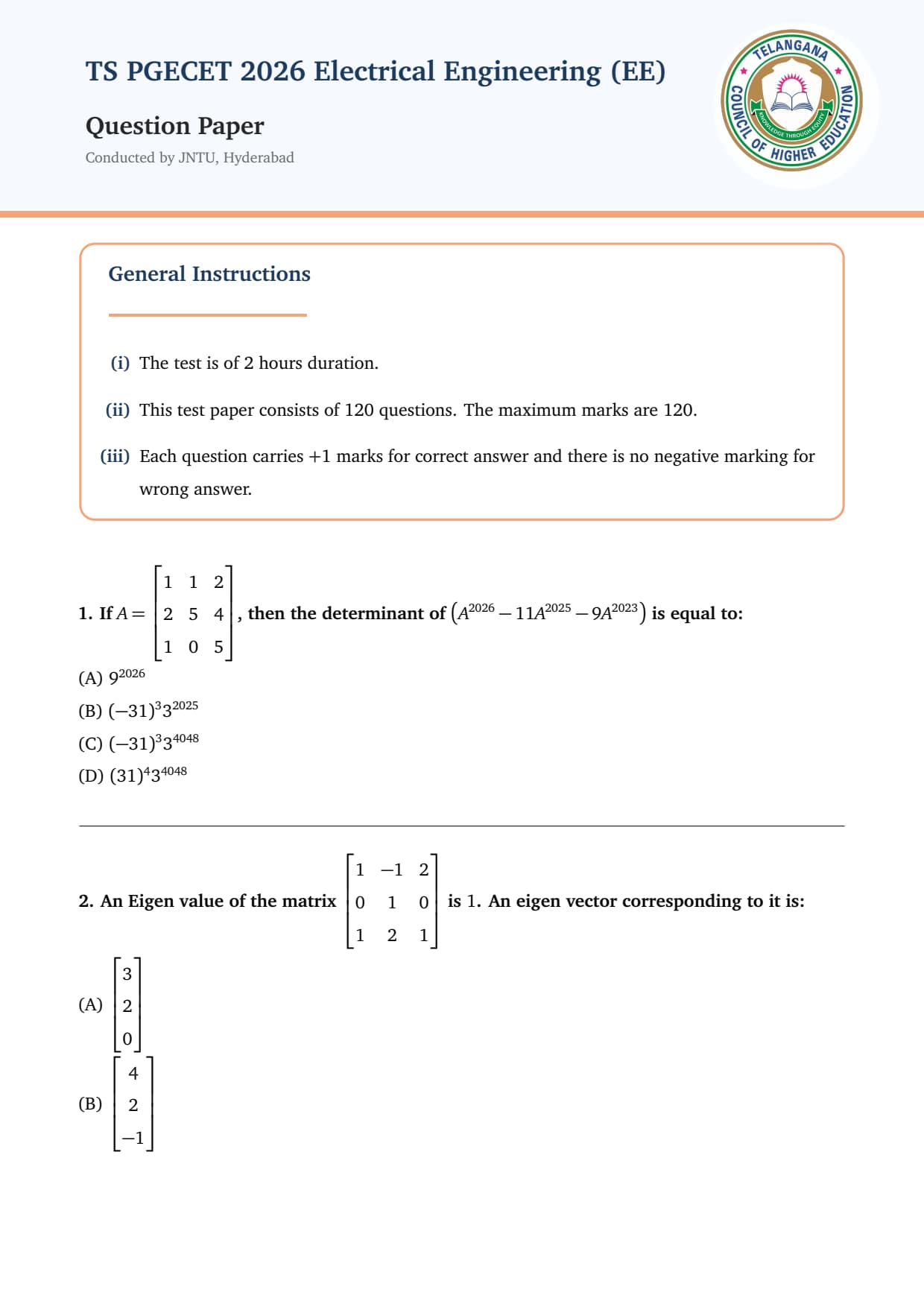
Question 1:

If \(A = \begin{bmatrix} 1 & 1 & 2
2 & 5 & 4
1 & 0 & 5 \end{bmatrix}\), then the determinant of \((A^{2026} - 11A^{2025} - 9A^{2023})\) is equal to:

  • (A) \(9^{2026}\)
  • (B) \((-31)^3 3^{2025}\)
  • (C) \((-31)^3 3^{4048}\)
  • (D) \((31)^4 3^{4048}\)

Question 2:

An Eigen value of the matrix \(\begin{bmatrix} 1 & -1 & 2
0 & 1 & 0
1 & 2 & 1 \end{bmatrix}\) is \(1\). An eigen vector corresponding to it is:

  • (A) \(\begin{bmatrix} 3
    2
    0 \end{bmatrix}\)
  • (B) \(\begin{bmatrix} 4
    2
    -1 \end{bmatrix}\)
  • (C) \(\begin{bmatrix} -4
    2
    1 \end{bmatrix}\)
  • (D) \(\begin{bmatrix} 3
    0
    1 \end{bmatrix}\)

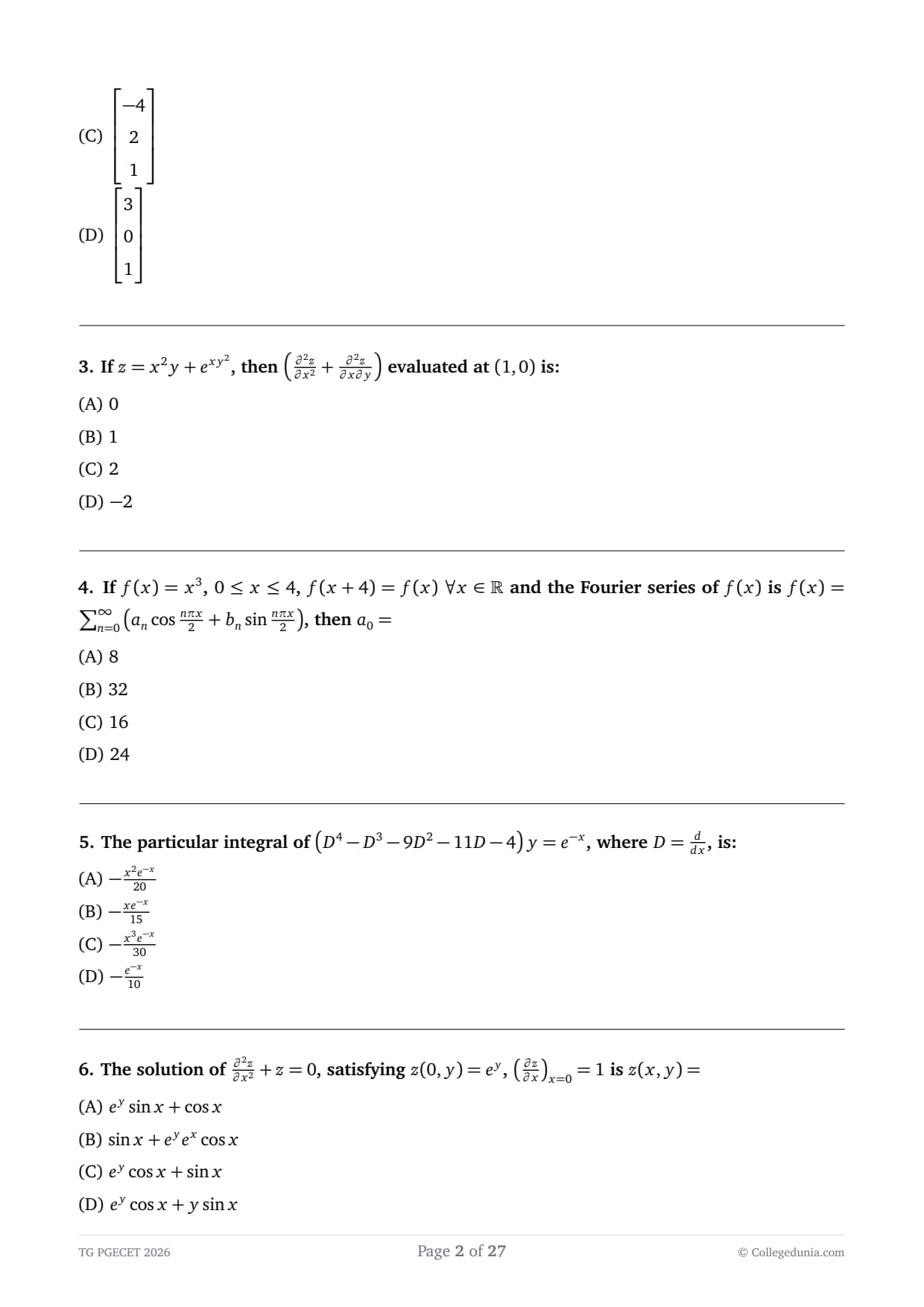
Question 3:

If \(z = x^2 y + e^{xy^2}\), then \((\frac{\partial^2 z}{\partial x^2} + \frac{\partial^2 z}{\partial x \partial y})\) evaluated at \((1,0)\) is:

  • (A) \(0\)
  • (B) \(1\)
  • (C) \(2\)
  • (D) \(-2\)

Question 4:

If \(f(x) = x^3\), \(0 \le x \le 4\), \(f(x+4) = f(x)\) \(\forall x \in \mathbb{R}\) and the Fourier series of \(f(x)\) is \(f(x) = \sum_{n=0}^{\infty} (a_n \cos \frac{n\pi x}{2} + b_n \sin \frac{n\pi x}{2})\), then \(a_0 =\)

  • (A) \(8\)
  • (B) \(32\)
  • (C) \(16\)
  • (D) \(24\)

Question 5:

The particular integral of \((D^4 - D^3 - 9D^2 - 11D - 4)y = e^{-x}\), where \(D = \frac{d}{dx}\), is:

  • (A) \(-\frac{x^2 e^{-x}}{20}\)
  • (B) \(-\frac{x e^{-x}}{15}\)
  • (C) \(-\frac{x^3 e^{-x}}{30}\)
  • (D) \(-\frac{e^{-x}}{10}\)

Question 6:

The solution of \(\frac{\partial^2 z}{\partial x^2} + z = 0\), satisfying \(z(0,y) = e^y\), \((\frac{\partial z}{\partial x})_{x=0} = 1\) is \(z(x,y) = \)

  • (A) \(e^y \sin x + \cos x\)
  • (B) \(\sin x + e^y e^x \cos x\)
  • (C) \(e^y \cos x + \sin x\)
  • (D) \(e^y \cos x + y \sin x\)

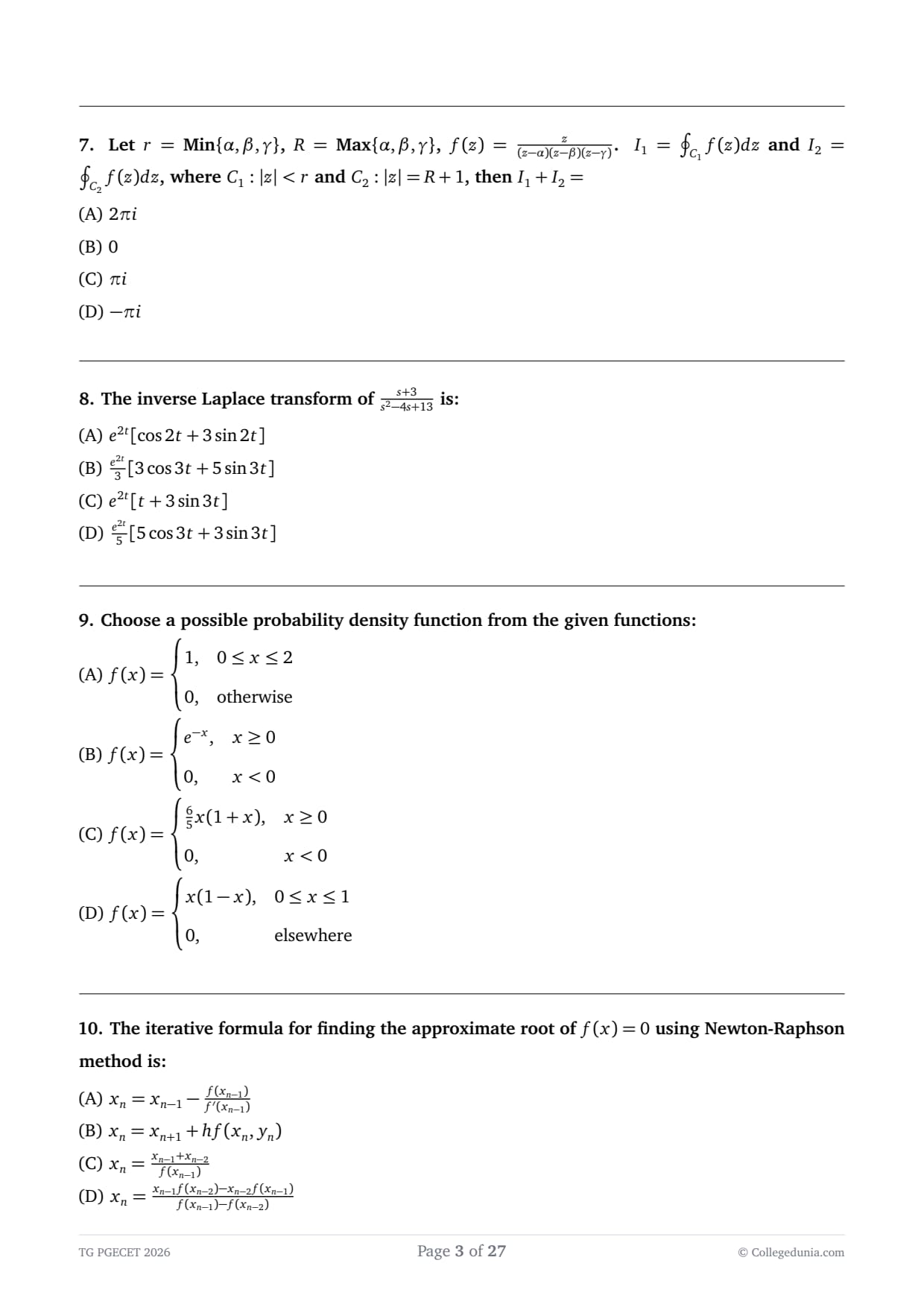
Question 7:

Let \(r = Min\{\alpha, \beta, \gamma\}\), \(R = Max\{\alpha, \beta, \gamma\}\), \(f(z) = \frac{z}{(z-\alpha)(z-\beta)(z-\gamma)}\). \(I_1 = \oint_{C_1} f(z)dz\) and \(I_2 = \oint_{C_2} f(z)dz\), where \(C_1 : |z| < r\) and \(C_2 : |z| = R+1\), then \(I_1 + I_2 = \)

  • (A) \(2\pi i\)
  • (B) \(0\)
  • (C) \(\pi i\)
  • (D) \(-\pi i\)

Question 8:

The inverse Laplace transform of \(\frac{s+3}{s^2 - 4s + 13}\) is:

  • (A) \(e^{2t} [\cos 2t + 3\sin 2t]\)
  • (B) \(\frac{e^{2t}}{3} [3\cos 3t + 5\sin 3t]\)
  • (C) \(e^{2t} [t + 3\sin 3t]\)
  • (D) \(\frac{e^{2t}}{5} [5\cos 3t + 3\sin 3t]\)

Question 9:

Choose a possible probability density function from the given functions:

  • (A) \(f(x) = \begin{cases} 1, & 0 \le x \le 2
    0, & otherwise \end{cases}\)
  • (B) \(f(x) = \begin{cases} e^{-x}, & x \ge 0
    0, & x < 0 \end{cases}\)
  • (C) \(f(x) = \begin{cases} \frac{6}{5}x(1+x), & x \ge 0
    0, & x < 0 \end{cases}\)
  • (D) \(f(x) = \begin{cases} x(1-x), & 0 \le x \le 1
    0, & elsewhere \end{cases}\)

Question 10:

The iterative formula for finding the approximate root of \(f(x) = 0\) using Newton-Raphson method is:

  • (A) \(x_n = x_{n-1} - \frac{f(x_{n-1})}{f'(x_{n-1})}\)
  • (B) \(x_n = x_{n+1} + h f(x_n, y_n)\)
  • (C) \(x_n = \frac{x_{n-1} + x_{n-2}}{f(x_{n-1})}\)
  • (D) \(x_n = \frac{x_{n-1}f(x_{n-2}) - x_{n-2}f(x_{n-1})}{f(x_{n-1}) - f(x_{n-2})}\)

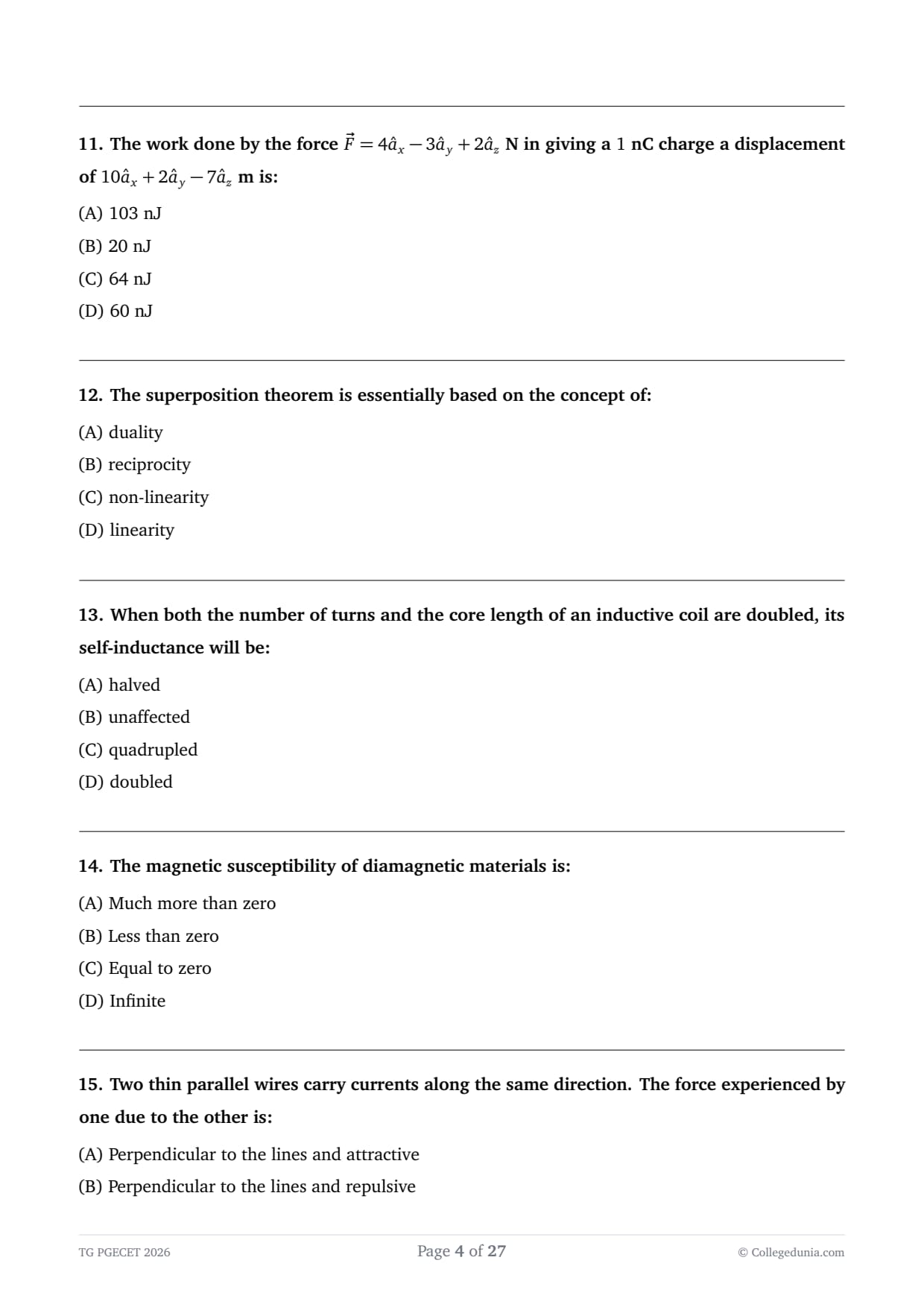
Question 11:

The work done by the force \(\vec{F} = 4\hat{a}_x - 3\hat{a}_y + 2\hat{a}_z N\) in giving a \(1 nC\) charge a displacement of \(10\hat{a}_x + 2\hat{a}_y - 7\hat{a}_z m\) is:

  • (A) \(103 nJ\)
  • (B) \(20 nJ\)
  • (C) \(64 nJ\)
  • (D) \(60 nJ\)

Question 12:

The superposition theorem is essentially based on the concept of:

  • (A) duality
  • (B) reciprocity
  • (C) non-linearity
  • (D) linearity

Question 13:

When both the number of turns and the core length of an inductive coil are doubled, its self-inductance will be:

  • (A) halved
  • (B) unaffected
  • (C) quadrupled
  • (D) doubled

Question 14:

The magnetic susceptibility of diamagnetic materials is:

  • (A) Much more than zero
  • (B) Less than zero
  • (C) Equal to zero
  • (D) Infinite

Question 15:

Two thin parallel wires carry currents along the same direction. The force experienced by one due to the other is:

  • (A) Perpendicular to the lines and attractive
  • (B) Perpendicular to the lines and repulsive
  • (C) Zero
  • (D) Parallel to the lines

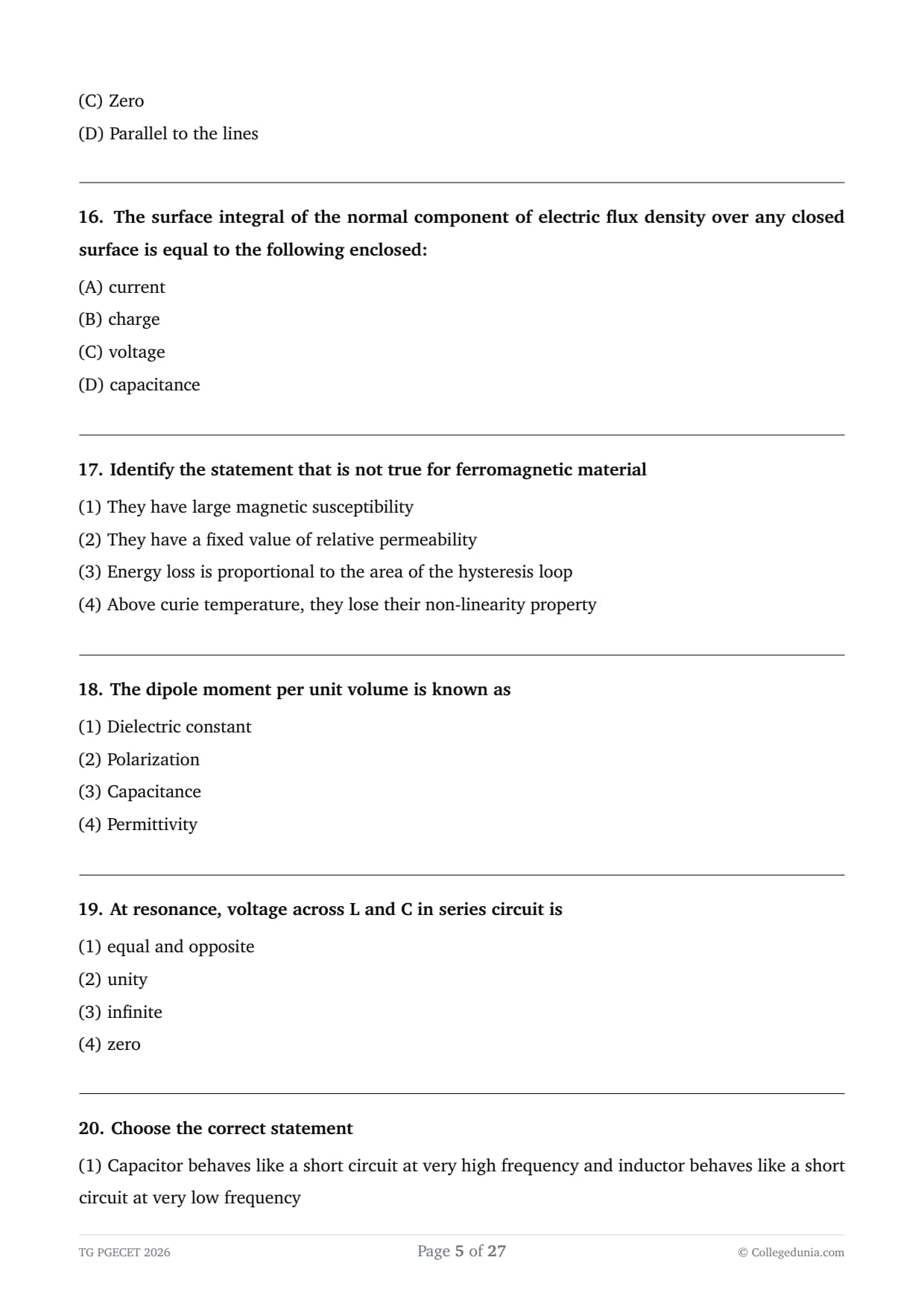
Question 16:

The surface integral of the normal component of electric flux density over any closed surface is equal to the following enclosed:

  • (A) current
  • (B) charge
  • (C) voltage
  • (D) capacitance

Question 17:

Identify the statement that is not true for ferromagnetic material

  • (1) They have large magnetic susceptibility
  • (2) They have a fixed value of relative permeability
  • (3) Energy loss is proportional to the area of the hysteresis loop
  • (4) Above curie temperature, they lose their non-linearity property

Question 18:

The dipole moment per unit volume is known as

  • (1) Dielectric constant
  • (2) Polarization
  • (3) Capacitance
  • (4) Permittivity

Question 19:

At resonance, voltage across L and C in series circuit is

  • (1) equal and opposite
  • (2) unity
  • (3) infinite
  • (4) zero

Question 20:

Choose the correct statement

  • (1) Capacitor behaves like a short circuit at very high frequency and inductor behaves like a short circuit at very low frequency
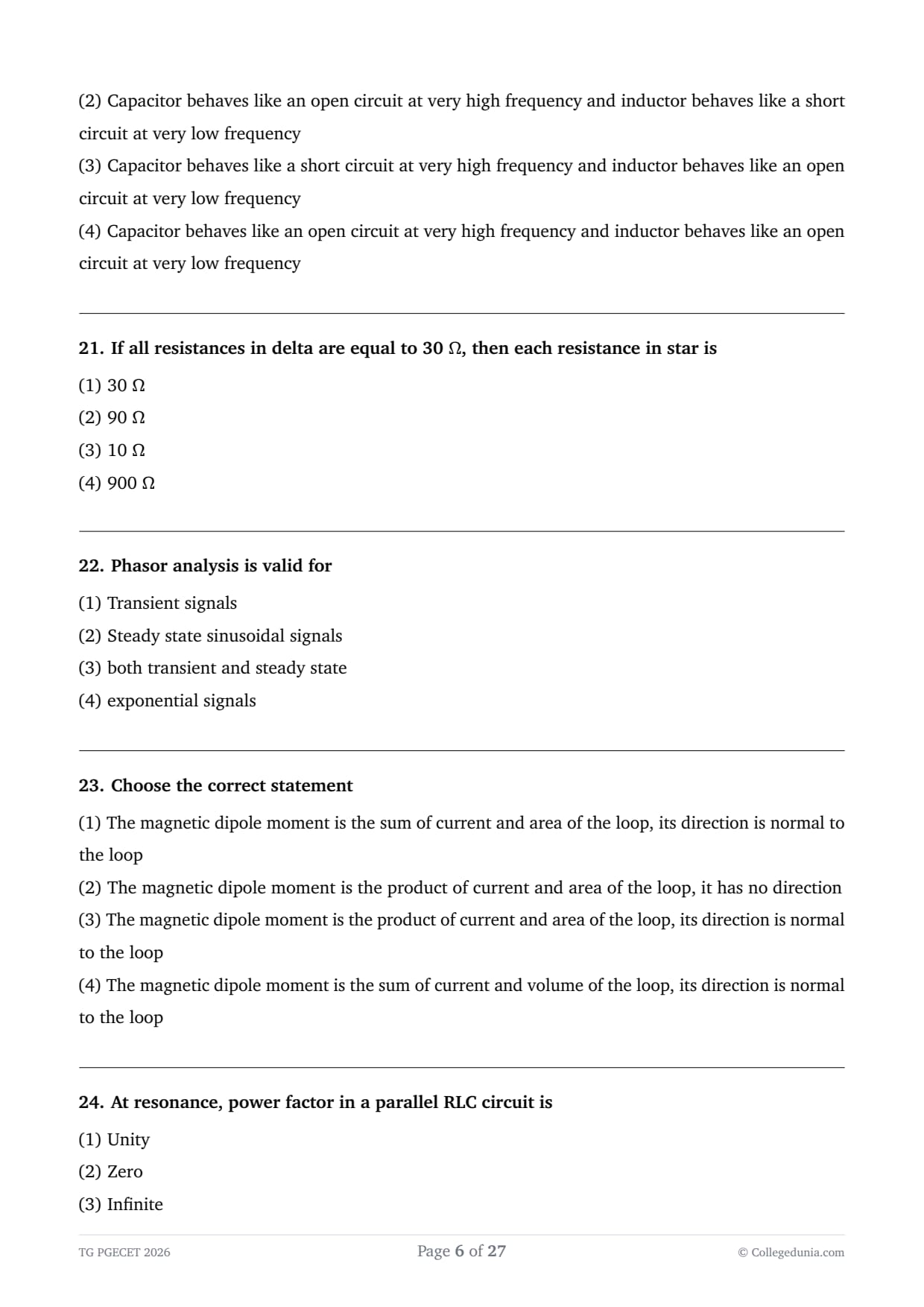
  • (2) Capacitor behaves like an open circuit at very high frequency and inductor behaves like a short circuit at very low frequency
  • (3) Capacitor behaves like a short circuit at very high frequency and inductor behaves like an open circuit at very low frequency
  • (4) Capacitor behaves like an open circuit at very high frequency and inductor behaves like an open circuit at very low frequency

Question 21:

If all resistances in delta are equal to 30 \(\Omega\), then each resistance in star is

  • (1) 30 \(\Omega\)
  • (2) 90 \(\Omega\)
  • (3) 10 \(\Omega\)
  • (4) 900 \(\Omega\)

Question 22:

Phasor analysis is valid for

  • (1) Transient signals
  • (2) Steady state sinusoidal signals
  • (3) both transient and steady state
  • (4) exponential signals

Question 23:

Choose the correct statement

  • (1) The magnetic dipole moment is the sum of current and area of the loop, its direction is normal to the loop
  • (2) The magnetic dipole moment is the product of current and area of the loop, it has no direction
  • (3) The magnetic dipole moment is the product of current and area of the loop, its direction is normal to the loop
  • (4) The magnetic dipole moment is the sum of current and volume of the loop, its direction is normal to the loop

Question 24:

At resonance, power factor in a parallel RLC circuit is

  • (1) Unity
  • (2) Zero
  • (3) Infinite
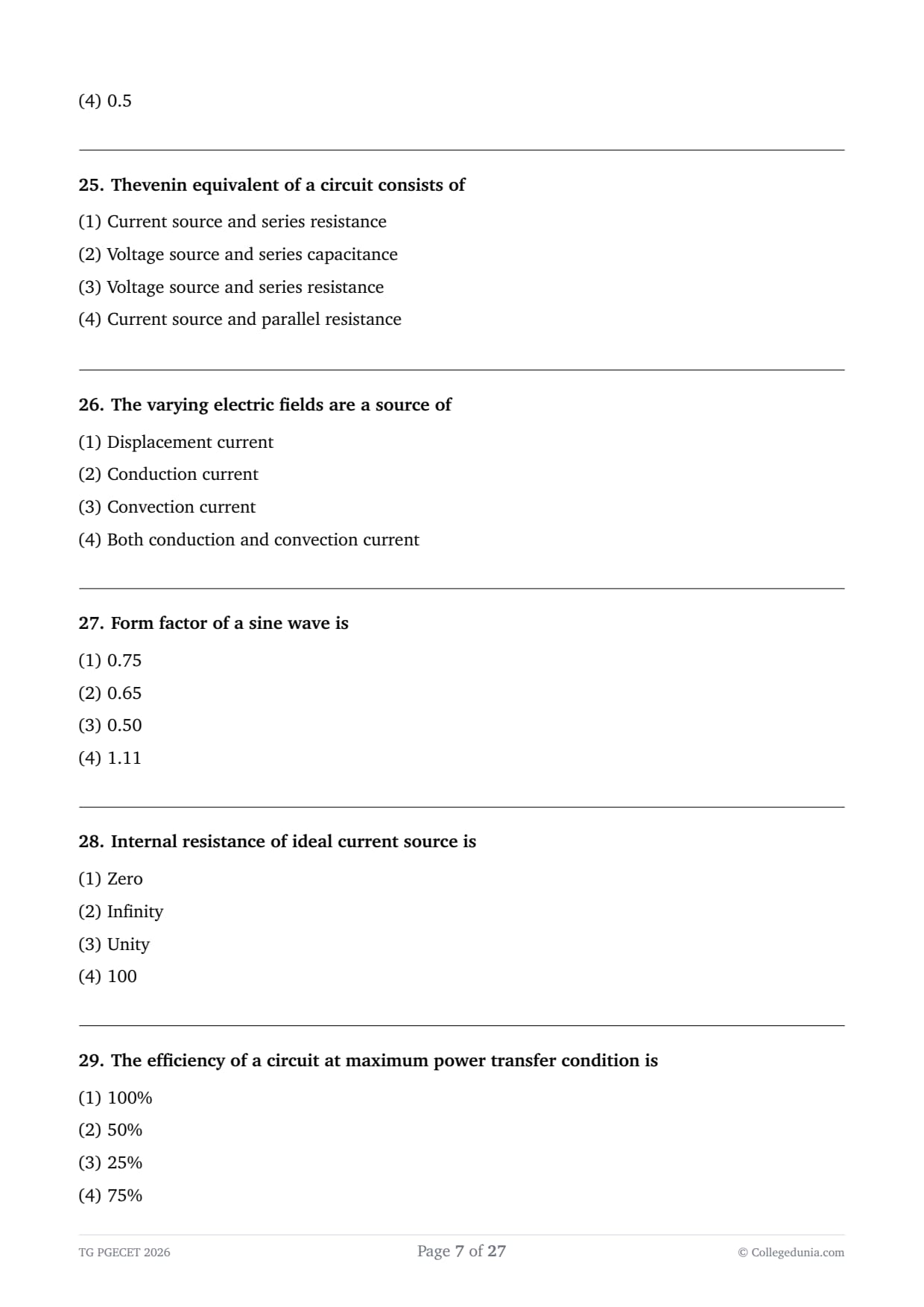
  • (4) 0.5

Question 25:

Thevenin equivalent of a circuit consists of

  • (1) Current source and series resistance
  • (2) Voltage source and series capacitance
  • (3) Voltage source and series resistance
  • (4) Current source and parallel resistance

Question 26:

The varying electric fields are a source of

  • (1) Displacement current
  • (2) Conduction current
  • (3) Convection current
  • (4) Both conduction and convection current

Question 27:

Form factor of a sine wave is

  • (1) 0.75
  • (2) 0.65
  • (3) 0.50
  • (4) 1.11

Question 28:

Internal resistance of ideal current source is

  • (1) Zero
  • (2) Infinity
  • (3) Unity
  • (4) 100

Question 29:

The efficiency of a circuit at maximum power transfer condition is

  • (1) 100%
  • (2) 50%
  • (3) 25%
  • (4) 75%

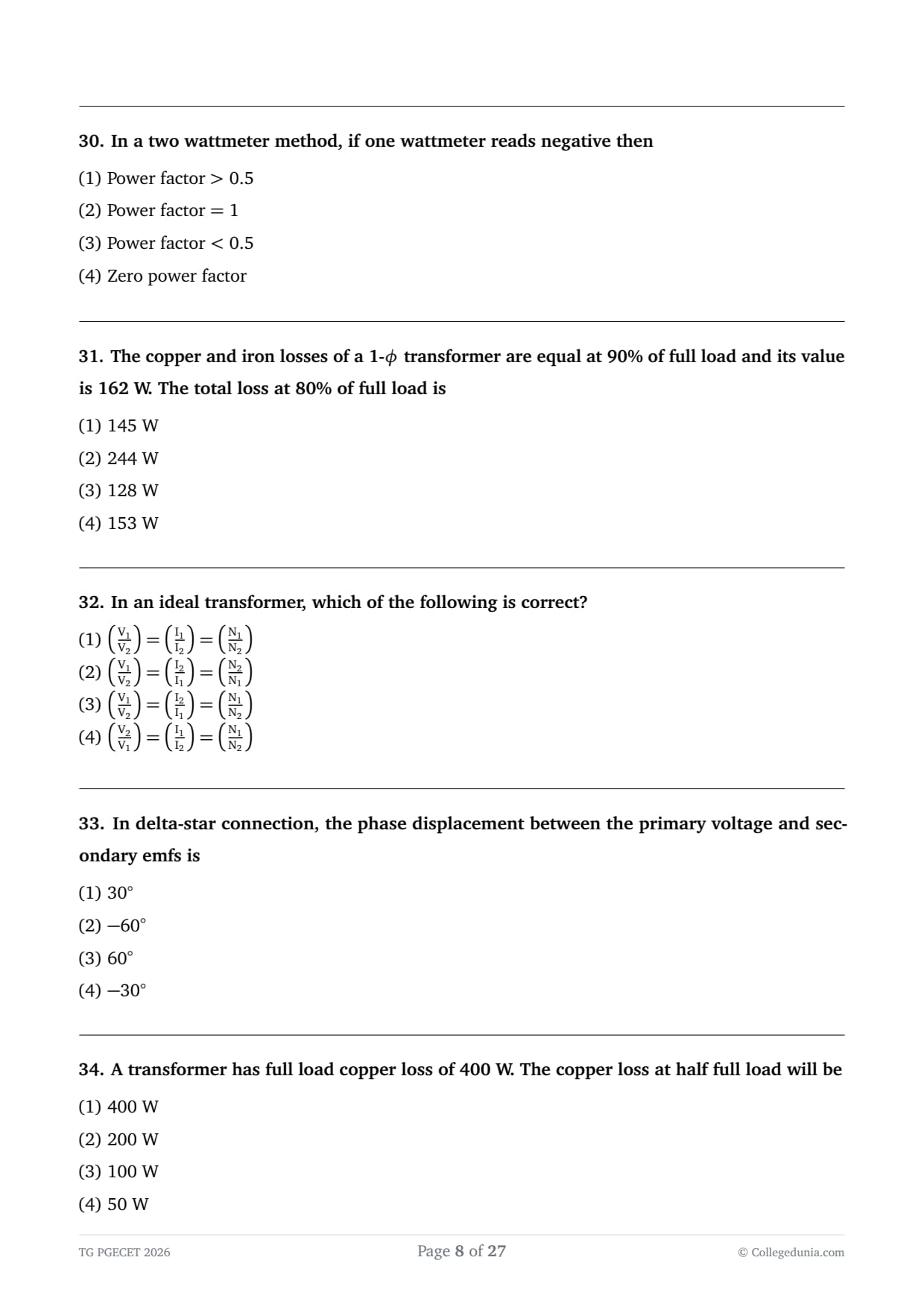
Question 30:

In a two wattmeter method, if one wattmeter reads negative then

  • (1) Power factor \(> 0.5\)
  • (2) Power factor \(= 1\)
  • (3) Power factor \(< 0.5\)
  • (4) Zero power factor

Question 31:

The copper and iron losses of a \(1\)-\(\phi\) transformer are equal at \(90%\) of full load and the total loss at that load is \(162\) W. The total loss at \(80%\) of full load is

  • (1) 145 W
  • (2) 244 W
  • (3) 128 W
  • (4) 153 W

Question 32:

In an ideal transformer, which of the following is correct?

  • (1) \( (\frac{V_1}{V_2}) = (\frac{I_1}{I_2}) = (\frac{N_1}{N_2}) \)
  • (2) \( (\frac{V_1}{V_2}) = (\frac{I_2}{I_1}) = (\frac{N_2}{N_1}) \)
  • (3) \( (\frac{V_1}{V_2}) = (\frac{I_2}{I_1}) = (\frac{N_1}{N_2}) \)
  • (4) \( (\frac{V_2}{V_1}) = (\frac{I_1}{I_2}) = (\frac{N_1}{N_2}) \)

Question 33:

In delta-star connection, the phase displacement between the primary voltage and secondary emfs is

  • (1) \( 30^\circ \)
  • (2) \( -60^\circ \)
  • (3) \( 60^\circ \)
  • (4) \( -30^\circ \)

Question 34:

A transformer has full load copper loss of 400 W. The copper loss at half full load will be

  • (1) \( 400 W \)
  • (2) \( 200 W \)
  • (3) \( 100 W \)
  • (4) \( 50 W \)

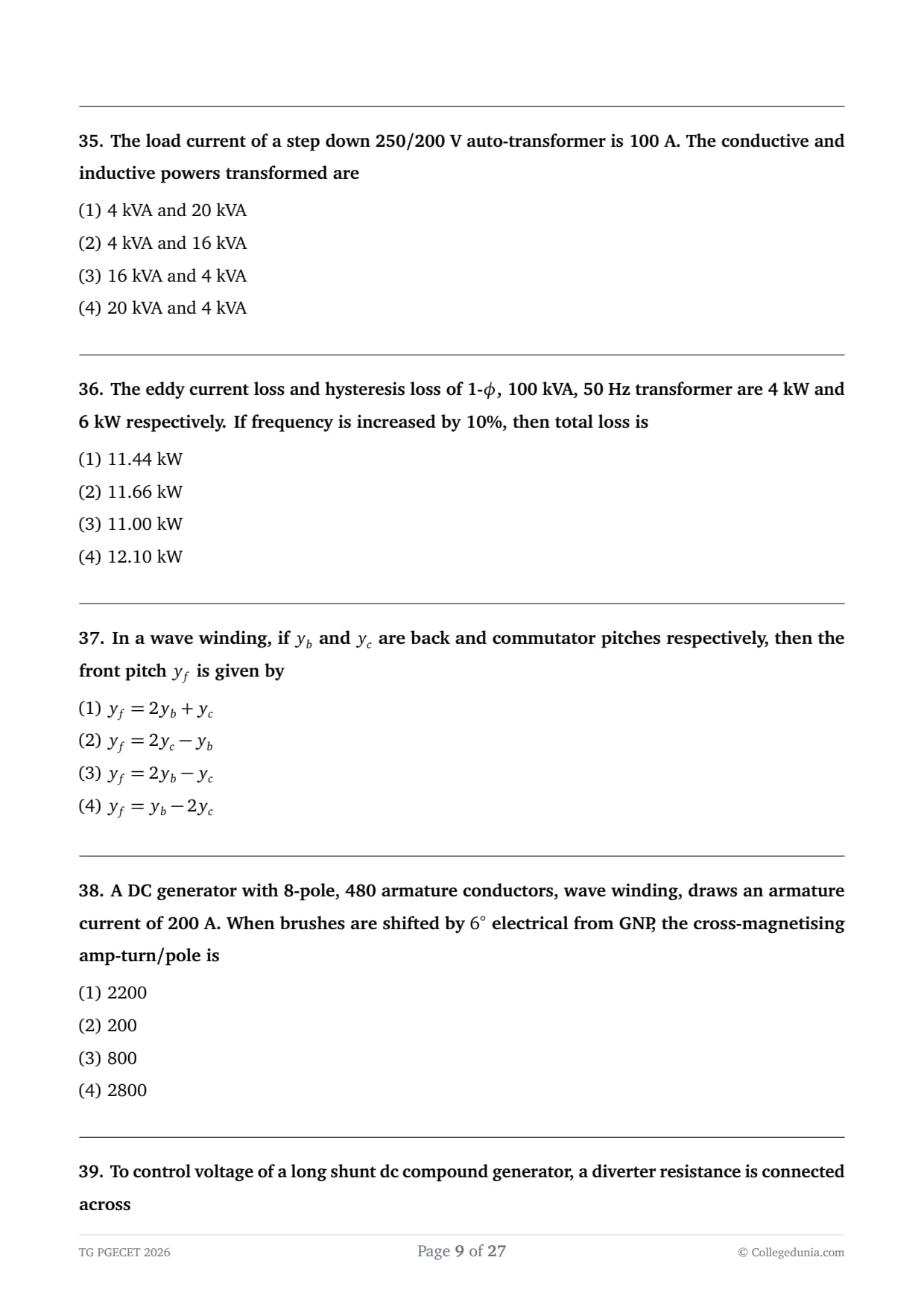
Question 35:

The load current of a step down 250/200 V auto-transformer is 100 A. The conductive and inductive powers transformed are

  • (1) \( 4 kVA and 20 kVA \)
  • (2) \( 4 kVA and 16 kVA \)
  • (3) \( 16 kVA and 4 kVA \)
  • (4) \( 20 kVA and 4 kVA \)

Question 36:

The eddy current loss and hysteresis loss of 1-\(\phi\), 100 kVA, 50 Hz transformer are 4 kW and 6 kW respectively. If frequency is increased by 10%, then total loss is

  • (1) \( 11.44 kW \)
  • (2) \( 11.66 kW \)
  • (3) \( 11.00 kW \)
  • (4) \( 12.10 kW \)

Question 37:

In a wave winding, if \( y_b \) and \( y_c \) are back and commutator pitches respectively, then the front pitch \( y_f \) is given by

  • (1) \( y_f = 2y_b + y_c \)
  • (2) \( y_f = 2y_c - y_b \)
  • (3) \( y_f = 2y_b - y_c \)
  • (4) \( y_f = y_b - 2y_c \)

Question 38:

A DC generator with 8-pole, 480 armature conductors, wave winding, draws an armature current of 200 A. When brushes are shifted by \( 6^\circ \) electrical from GNP, the cross-magnetising amp-turn/pole is

  • (1) \( 2200 \)
  • (2) \( 200 \)
  • (3) \( 800 \)
  • (4) \( 2800 \)

Question 39:

To control voltage of a long shunt dc compound generator, a diverter resistance is connected across

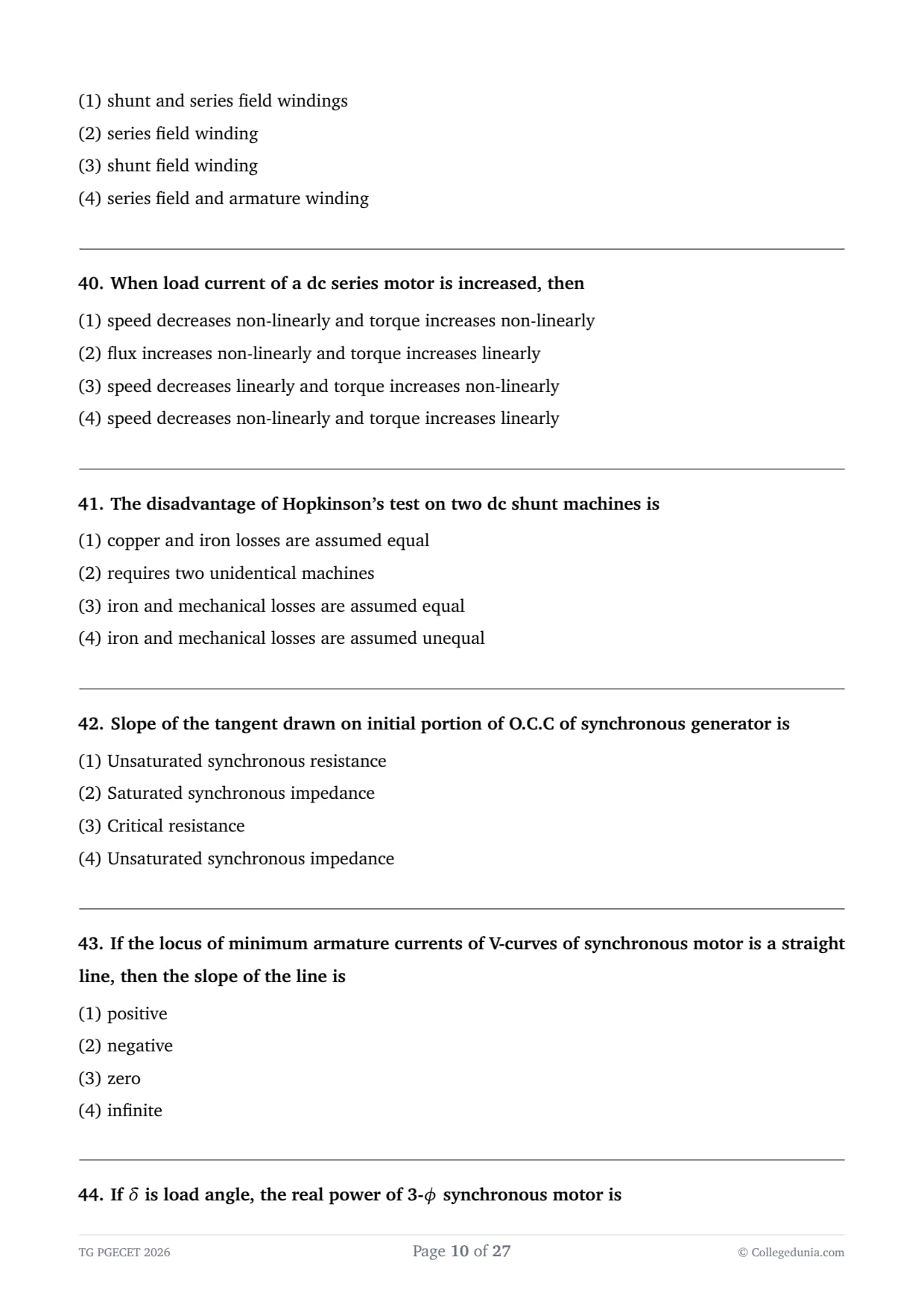
  • (1) \( shunt and series field windings \)
  • (2) \( series field winding \)
  • (3) \( shunt field winding \)
  • (4) \( series field and armature winding \)

Question 40:

When load current of a dc series motor is increased, then

  • (1) \( speed decreases non-linearly and torque increases non-linearly \)
  • (2) \( flux increases non-linearly and torque increases linearly \)
  • (3) \( speed decreases linearly and torque increases non-linearly \)
  • (4) \( speed decreases non-linearly and torque increases linearly \)

Question 41:

The disadvantage of Hopkinson's test on two dc shunt machines is

  • (1) \( copper and iron losses are assumed equal \)
  • (2) \( requires two unidentical machines \)
  • (3) \( iron and mechanical losses are assumed equal \)
  • (4) \( iron and mechanical losses are assumed unequal \)

Question 42:

Slope of the tangent drawn on initial portion of O.C.C of synchronous generator is

  • (1) \( Unsaturated synchronous resistance \)
  • (2) \( Saturated synchronous impedance \)
  • (3) \( Critical resistance \)
  • (4) \( Unsaturated synchronous impedance \)

Question 43:

If the locus of minimum armature currents of V-curves of synchronous motor is a straight line, then the slope of the line is

  • (1) \( positive \)
  • (2) \( negative \)
  • (3) \( zero \)
  • (4) \( infinite \)

Question 44:

If \( \delta \) is load angle, the real power of 3-\(\phi\) synchronous motor is

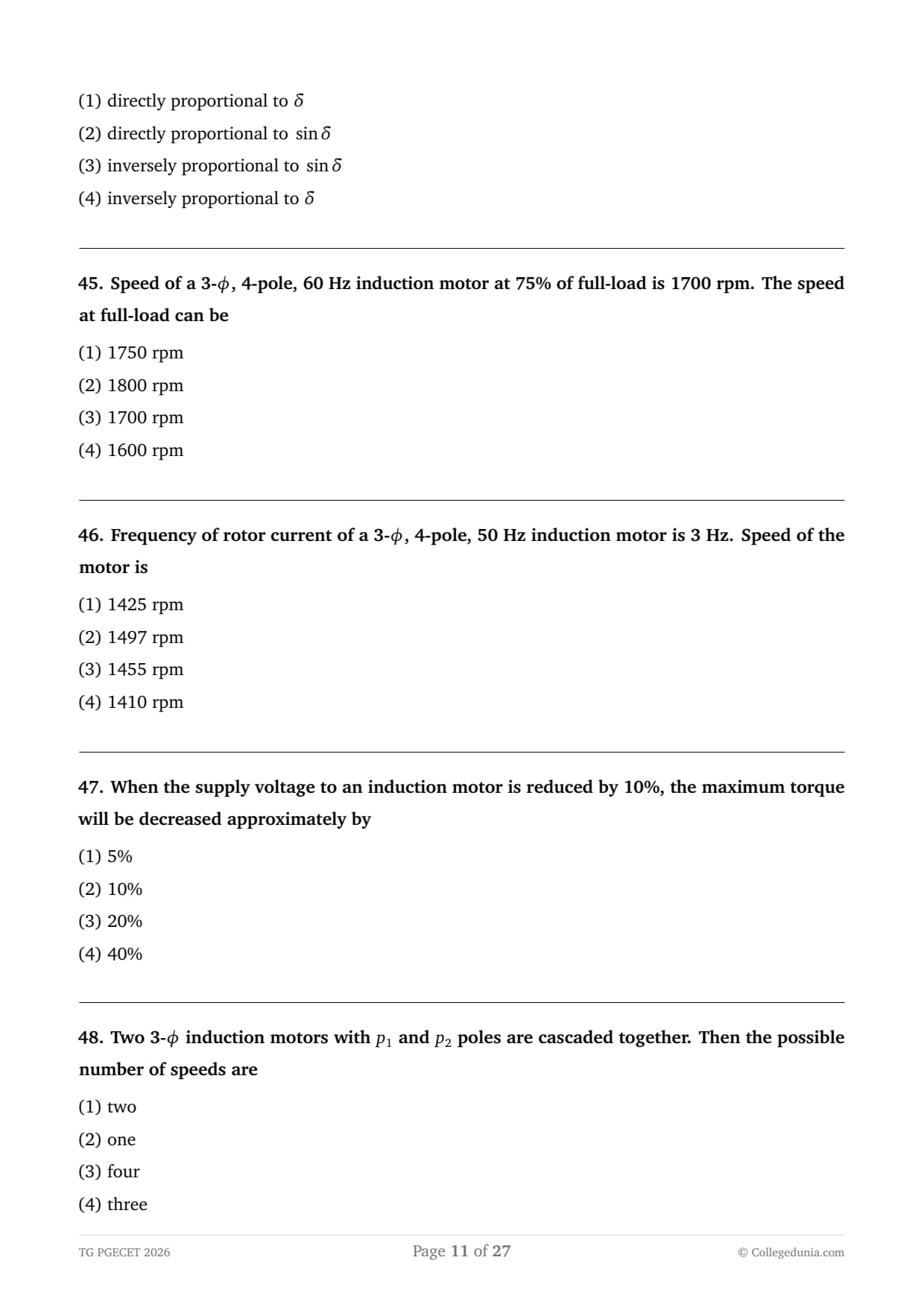
  • (1) \( directly proportional to \delta \)
  • (2) \( directly proportional to \sin\delta \)
  • (3) \( inversely proportional to \sin\delta \)
  • (4) \( inversely proportional to \delta \)

Question 45:

Speed of a 3-\(\phi\), 4-pole, 60 Hz induction motor at 75% of full-load is 1700 rpm. The speed at full-load can be

  • (1) \( 1750 rpm \)
  • (2) \( 1800 rpm \)
  • (3) \( 1700 rpm \)
  • (4) \( 1600 rpm \)

Question 46:

Frequency of rotor current of a 3-\(\phi\), 4-pole, 50 Hz induction motor is 3 Hz. Speed of the motor is

  • (1) \( 1425 rpm \)
  • (2) \( 1497 rpm \)
  • (3) \( 1455 rpm \)
  • (4) \( 1410 rpm \)

Question 47:

When the supply voltage to an induction motor is reduced by 10%, the maximum torque will be decreased approximately by

  • (1) \( 5% \)
  • (2) \( 10% \)
  • (3) \( 20% \)
  • (4) \( 40% \)

Question 48:

Two 3-\(\phi\) induction motors with \( p_1 \) and \( p_2 \) poles are cascaded together. Then the possible number of speeds are

  • (1) \( two \)
  • (2) \( one \)
  • (3) \( four \)
  • (4) \( three \)

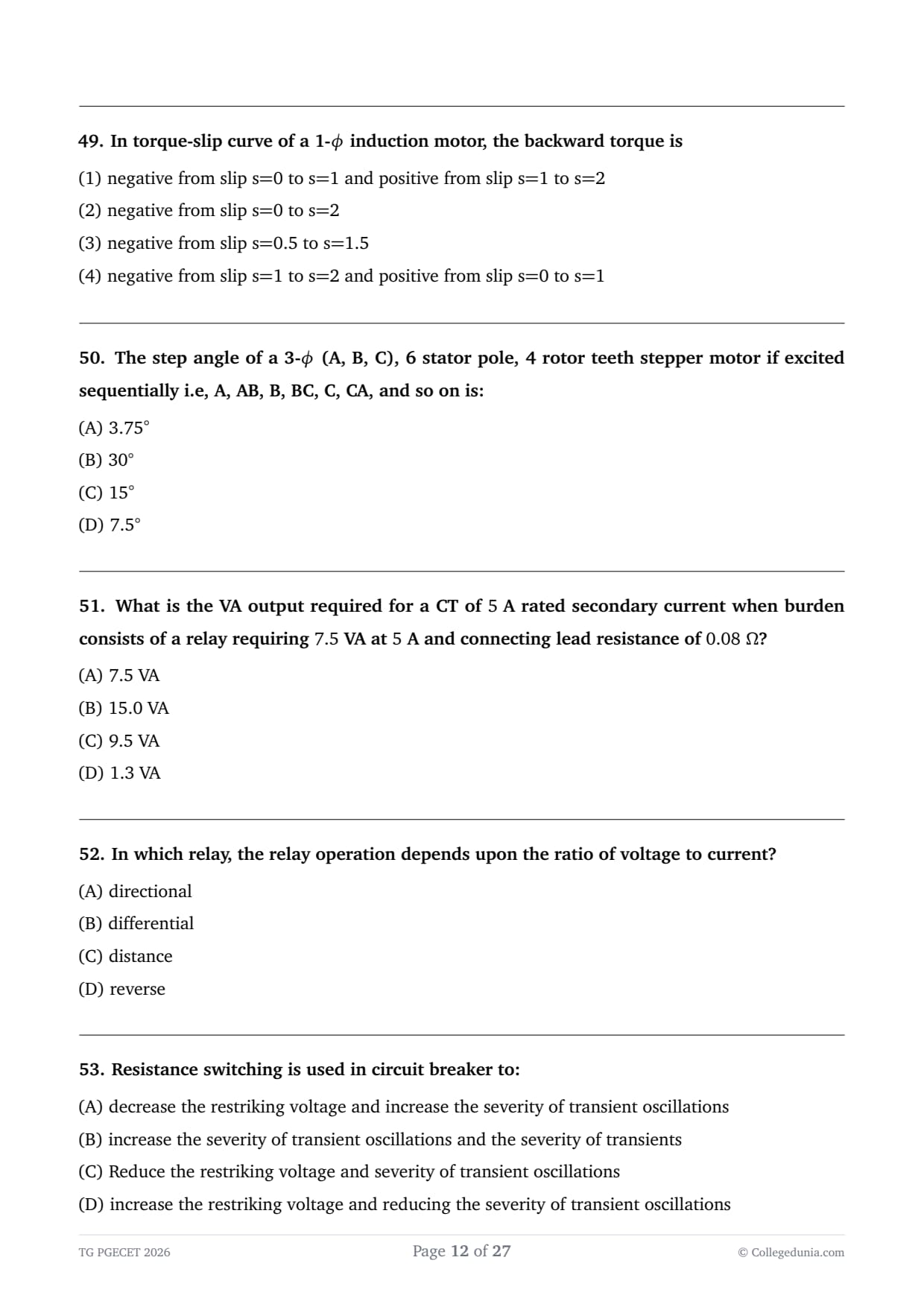
Question 49:

In torque-slip curve of a 1-\(\phi\) induction motor, the backward torque is

  • (1) \( negative from slip s=0 to s=1 and positive from slip s=1 to s=2 \)
  • (2) \( negative from slip s=0 to s=2 \)
  • (3) \( negative from slip s=0.5 to s=1.5 \)
  • (4) \( negative from slip s=1 to s=2 and positive from slip s=0 to s=1 \)

Question 50:

The step angle of a 3-\(\phi\) (A, B, C), 6 stator pole, 4 rotor teeth stepper motor if excited sequentially i.e, A, AB, B, BC, C, CA, and so on is:

  • (A) \(3.75^\circ\)
  • (B) \(30^\circ\)
  • (C) \(15^\circ\)
  • (D) \(7.5^\circ\)

Question 51:

What is the VA output required for a CT of \(5 A\) rated secondary current when burden consists of a relay requiring \(7.5 VA\) at \(5 A\) and connecting lead resistance of \(0.08 \Omega\)?

  • (A) \(7.5 VA\)
  • (B) \(15.0 VA\)
  • (C) \(9.5 VA\)
  • (D) \(1.3 VA\)

Question 52:

In which relay, the relay operation depends upon the ratio of voltage to current?

  • (A) directional
  • (B) differential
  • (C) distance
  • (D) reverse

Question 53:

Resistance switching is used in circuit breaker to:

  • (A) decrease the restriking voltage and increase the severity of transient oscillations
  • (B) increase the severity of transient oscillations and the severity of transients
  • (C) Reduce the restriking voltage and severity of transient oscillations
  • (D) increase the restriking voltage and reducing the severity of transient oscillations

Question 54:

For an \(n^{th}\) order system to be state controllable, which of the following is not a correct statement?

  • (A) The controllability matrix must be of rank \(n\)
  • (B) The controllability matrix must contain \(n\) linearly independent column vectors
  • (C) The controllability matrix must contain \(n\) linearly dependent column vectors
  • (D) The determinant of the controllability matrix is non-zero (i.e., the matrix is non-singular)

Question 55:

A generating station has a maximum demand of \(25\,MW\), a load factor of \(60%\), and a plant capacity factor of \(50%\). What is the reserve capacity of the plant?

  • (A) \(25\,MW\)
  • (B) \(15\,MW\)
  • (C) \(7.5\,MW\)
  • (D) \(5\,MW\)

Question 56:

The current densities in human bodies lying in the proximity of transmission lines are:

  • (A) induced by electric fields are much lower than those induced by magnetic fields
  • (B) induced by electric fields only
  • (C) induced by electric fields are much higher than those induced by magnetic fields
  • (D) induced by magnetic fields only

Question 57:

The characteristics of rate of convergence of Gauss-Seidel method and Newton-Raphson method respectively are

  • (A) linear, linear
  • (B) quadratic, quadratic
  • (C) quadratic, linear
  • (D) linear, quadratic

Question 58:

In case of the compensation of the power transmission lines, for the same voltage boost, the reactive power capacity of a shunt capacitor is ____________ that of a series capacitor.

  • (A) equal to
  • (B) greater than
  • (C) less than
  • (D) half of

Question 59:

Under steady state short circuit conditions, the armature reaction of a synchronous generator is:

  • (A) Cross-magnetizing
  • (B) Demagnetizing
  • (C) Magnetizing
  • (D) Partially cross-magnetizing

Question 60:

A fully transposed transmission line has

  • (A) Zero sequence impedance larger than the positive sequence impedance
  • (B) Zero sequence impedance smaller than the positive sequence impedance
  • (C) Zero sequence impedance equal to positive sequence impedance
  • (D) Positive sequence impedance is larger than the negative sequence impedance

Question 61:

The swing equation of a synchronous generator is

  • (A) Linear, second order differential equation
  • (B) Non-linear, second order differential equation
  • (C) Non-linear, second order algebraic equation
  • (D) Non-linear, first order differential equation

Question 62:

In nuclear reactors, the most commonly used neutron absorber is:

  • (A) Uranium
  • (B) Hydrogen
  • (C) Boron
  • (D) Oxygen

Question 63:

The insulation resistance of a single core cable is \(160 M\Omega/km\). The insulation resistance for \(4 km\) length is

  • (A) \(640 M\Omega\)
  • (B) \(160 M\Omega\)
  • (C) \(40 M\Omega\)
  • (D) \(80 M\Omega\)

Question 64:

The insulators used in transmission lines at river and road crossing are:

  • (A) Strain type
  • (B) Suspension type
  • (C) Pin type
  • (D) Cup type

Question 65:

The effect of increase in temperature on transmission lines:

  • (A) Sag and tension of conductor decreases
  • (B) Sag and tension of conductor increases
  • (C) Sag increases and tension of the conductor decreases
  • (D) Sag decreases and tension of the conductor increases

Question 66:

In distribution systems, the size of conductor is determined by using:

  • (A) Faraday's law
  • (B) Kelvin's law
  • (C) Ohm's law
  • (D) Kirchhoff's law

Question 67:

Bonding of the cable is done to:

  • (A) Decrease the effective R and L
  • (B) Increase the effective R and L
  • (C) Decrease the effective R but increase L
  • (D) Increase the effective R but reduce L

Question 68:

The most frequently occurred fault in the power system is:

  • (A) L-L-G
  • (B) L-L
  • (C) L-L-L
  • (D) L-G

Question 69:

The transfer function model of a system is the reshaping of the differential equations of which type of system?

  • (A) linear time varying
  • (B) linear time invariant
  • (C) non-linear time invariant
  • (D) non-linear time varying

Question 70:

The per unit value of a \(2 \Omega\) resistor at \(100 MVA\) base and \(10 kV\) base voltage is

  • (A) \(2\)
  • (B) \(4\)
  • (C) \(0.5\)
  • (D) \(0.2\)

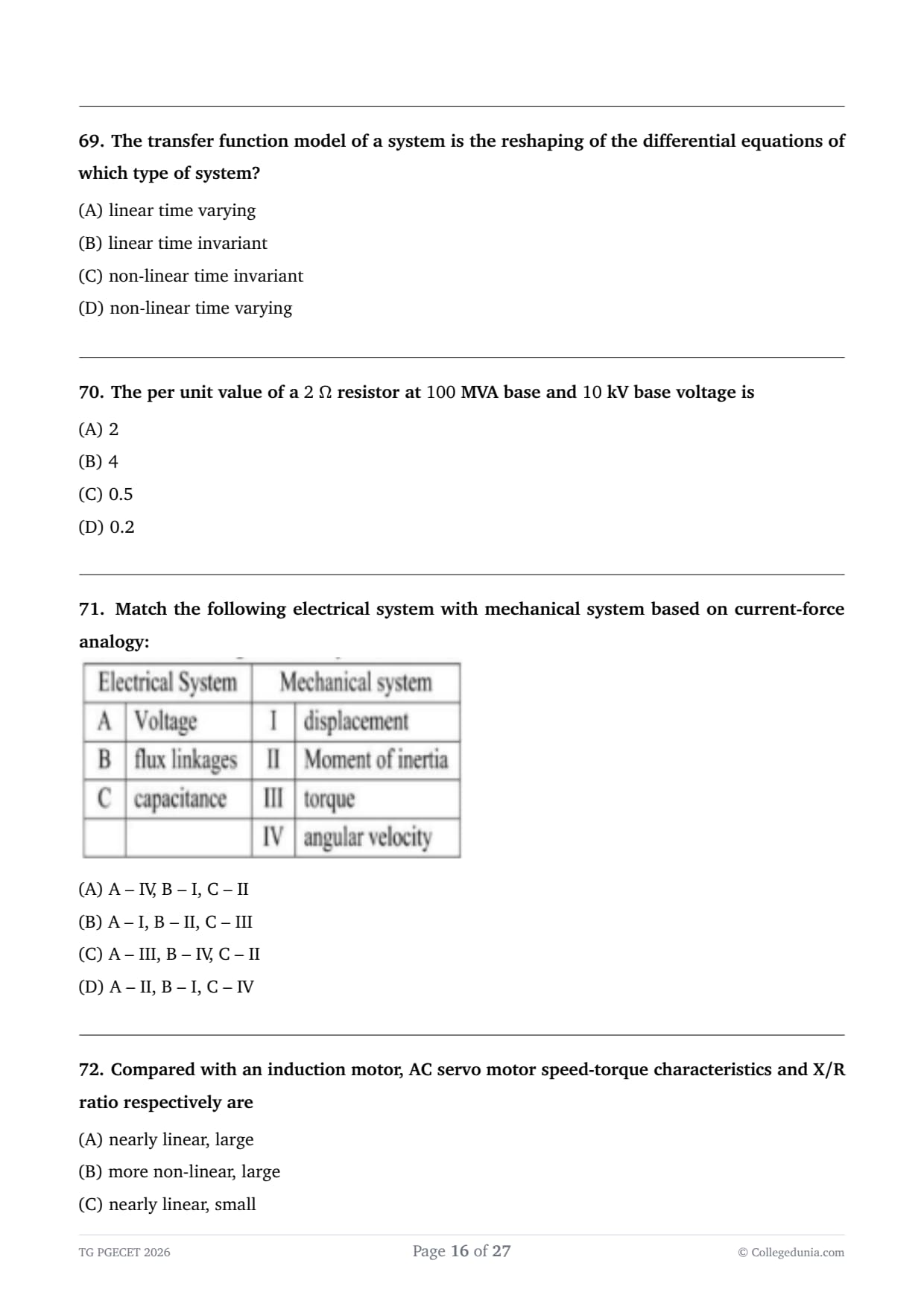
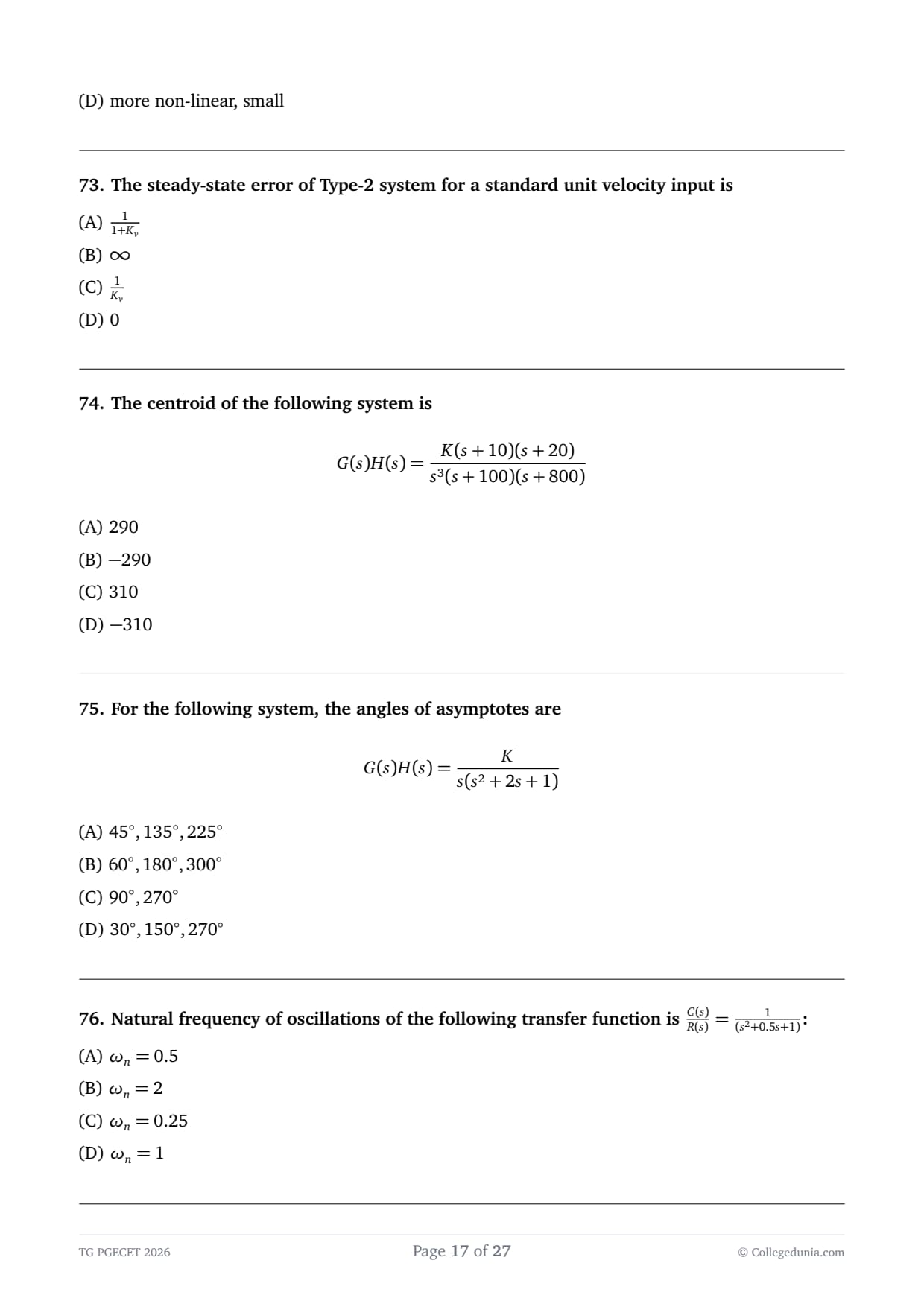
Question 71:

Match the following electrical system with mechanical system based on current-force analogy:

  • (A) A -- IV, B -- I, C -- II
  • (B) A -- I, B -- II, C -- III
  • (C) A -- III, B -- IV, C -- II
  • (D) A -- II, B -- I, C -- IV

Question 72:

Compared with an induction motor, AC servo motor speed-torque characteristics and X/R ratio respectively are

  • (A) nearly linear, large
  • (B) more non-linear, large
  • (C) nearly linear, small
  • (D) more non-linear, small

Question 73:

The steady-state error of Type-2 system for a standard unit velocity input is

  • (A) \(\frac{1}{1+K_v}\)
  • (B) \(\infty\)
  • (C) \(\frac{1}{K_v}\)
  • (D) \(0\)

Question 74:

The centroid of the following system is \[ G(s)H(s) = \frac{K(s+10)(s+20)}{s^3(s+100)(s+800)} \]

  • (A) \(290\)
  • (B) \(-290\)
  • (C) \(310\)
  • (D) \(-310\)

Question 75:

For the following system, the angles of asymptotes are \[ G(s)H(s) = \frac{K}{s(s^2+2s+1)} \]

  • (A) \(45^\circ, 135^\circ, 225^\circ\)
  • (B) \(60^\circ, 180^\circ, 300^\circ\)
  • (C) \(90^\circ, 270^\circ\)
  • (D) \(30^\circ, 150^\circ, 270^\circ\)

Question 76:

Natural frequency of oscillations of the following transfer function is \(\frac{C(s)}{R(s)} = \frac{1}{(s^2 + 0.5s + 1)}\):

  • (A) \(\omega_n = 0.5\)
  • (B) \(\omega_n = 2\)
  • (C) \(\omega_n = 0.25\)
  • (D) \(\omega_n = 1\)

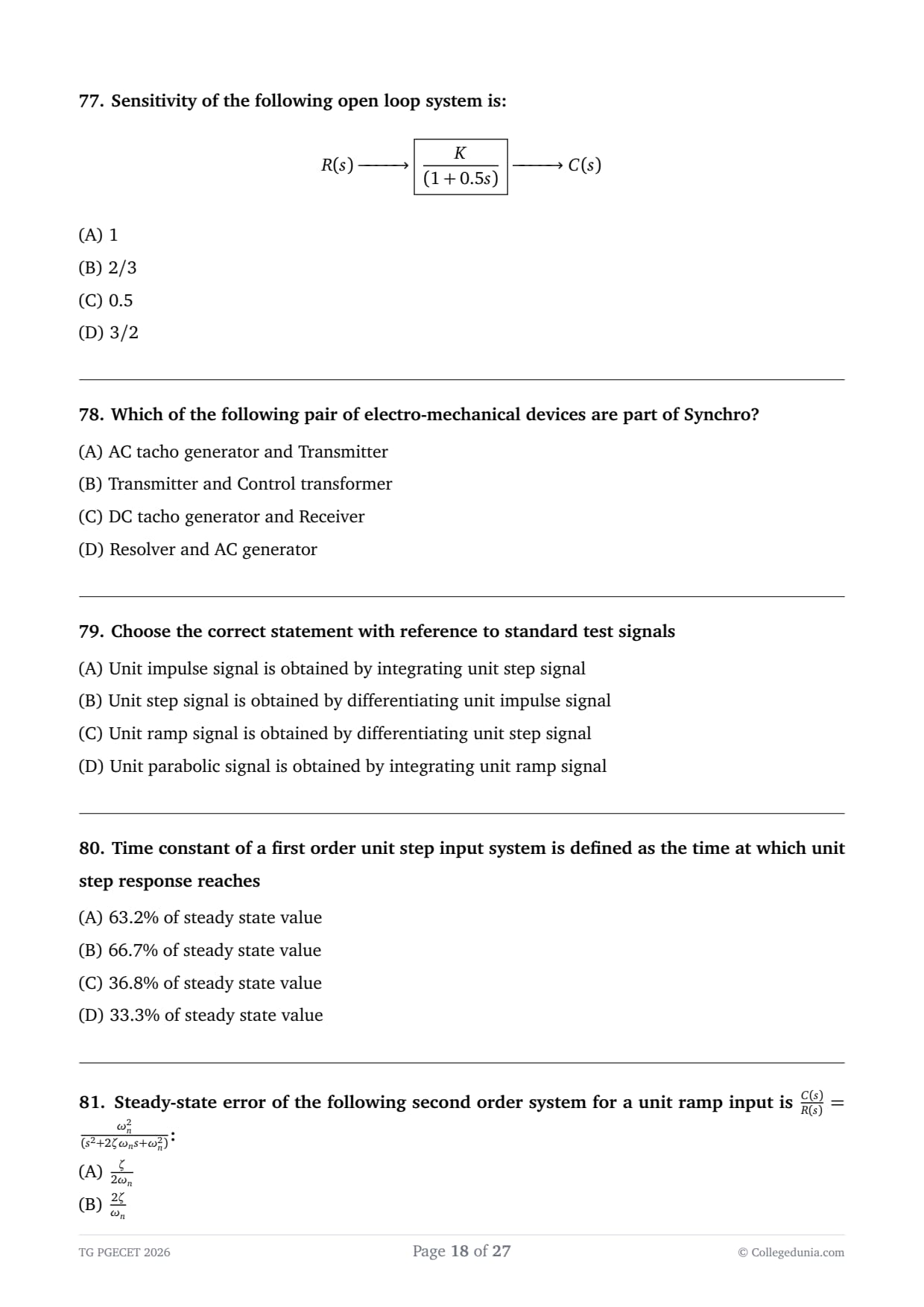
Question 77:

Sensitivity of the following open loop system is: \[ R(s) \xrightarrow{\hspace{1cm}} \boxed{\frac{K}{(1+0.5s)}} \xrightarrow{\hspace{1cm}} C(s) \]

  • (A) 1
  • (B) 2/3
  • (C) 0.5
  • (D) 3/2
Correct Answer: (A) 1
View Solution


Concept:
The sensitivity of a system's overall transfer function \(T(s)\) with respect to variations in a parameter \(P\) is defined mathematically as the ratio of the percentage change in \(T(s)\) to the percentage change in \(P\): \[ S^{T}_{P} = \frac{\partial T(s) / T(s)}{\partial P / P} = \frac{\partial T(s)}{\partial P} \frac{P}{T(s)} \]
For any standard open-loop configuration where the total forward transfer function is simply \(T(s) = G(s)\), any fractional change in the system components reflects entirely and directly into the overall transmission. Let us evaluate this parameter-wise for confirmation.


Step 1: Determine the overall transmission function of the system.
The given system is an open-loop block with a forward path gain function: \[ T(s) = G(s) = \frac{K}{1 + 0.5s} \]


Step 2: Calculate sensitivity with respect to the parameter matrix variable \(K\).
Using the definition of sensitivity \(S^{T}_{K}\): \[ S^{T}_{K} = \frac{\partial T(s)}{\partial K} \frac{K}{T(s)} \]
Differentiating \(T(s)\) with respect to \(K\): \[ \frac{\partial T(s)}{\partial K} = \frac{\partial}{\partial K}[\frac{K}{1 + 0.5s}] = \frac{1}{1 + 0.5s} \]
Now substitute this back into the sensitivity expression: \[ S^{T}_{K} = (\frac{1}{1 + 0.5s}) \frac{K}{(\frac{K}{1 + 0.5s})} \]
Canceling out identical terms in the numerator and denominator: \[ S^{T}_{K} = (\frac{1}{1 + 0.5s}) (\frac{1 + 0.5s}{1}) = 1 \]
Hence, the sensitivity of this open loop system is exactly 1, confirming option (A). Quick Tip: An fundamental law of control engineering states that the sensitivity of any open-loop system with respect to variations in its forward path parameter is always equal to unity (\(1\)). This happens because there is no feedback loop present to compensate or damp down any parameter deviations.


Question 78:

Which of the following pair of electro-mechanical devices are part of Synchro?

  • (A) AC tacho generator and Transmitter
  • (B) Transmitter and Control transformer
  • (C) DC tacho generator and Receiver
  • (D) Resolver and AC generator

Question 79:

Choose the correct statement with reference to standard test signals

  • (A) Unit impulse signal is obtained by integrating unit step signal
  • (B) Unit step signal is obtained by differentiating unit impulse signal
  • (C) Unit ramp signal is obtained by differentiating unit step signal
  • (D) Unit parabolic signal is obtained by integrating unit ramp signal

Question 80:

Time constant of a first order unit step input system is defined as the time at which unit step response reaches

  • (A) \(63.2%\) of steady state value
  • (B) \(66.7%\) of steady state value
  • (C) \(36.8%\) of steady state value
  • (D) \(33.3%\) of steady state value

Question 81:

Steady-state error of the following second order system for a unit ramp input is \(\frac{C(s)}{R(s)} = \frac{\omega_n^2}{(s^2 + 2\zeta\omega_n s + \omega_n^2)}\):

  • (A) \(\frac{\zeta}{2\omega_n}\)
  • (B) \(\frac{2\zeta}{\omega_n}\)
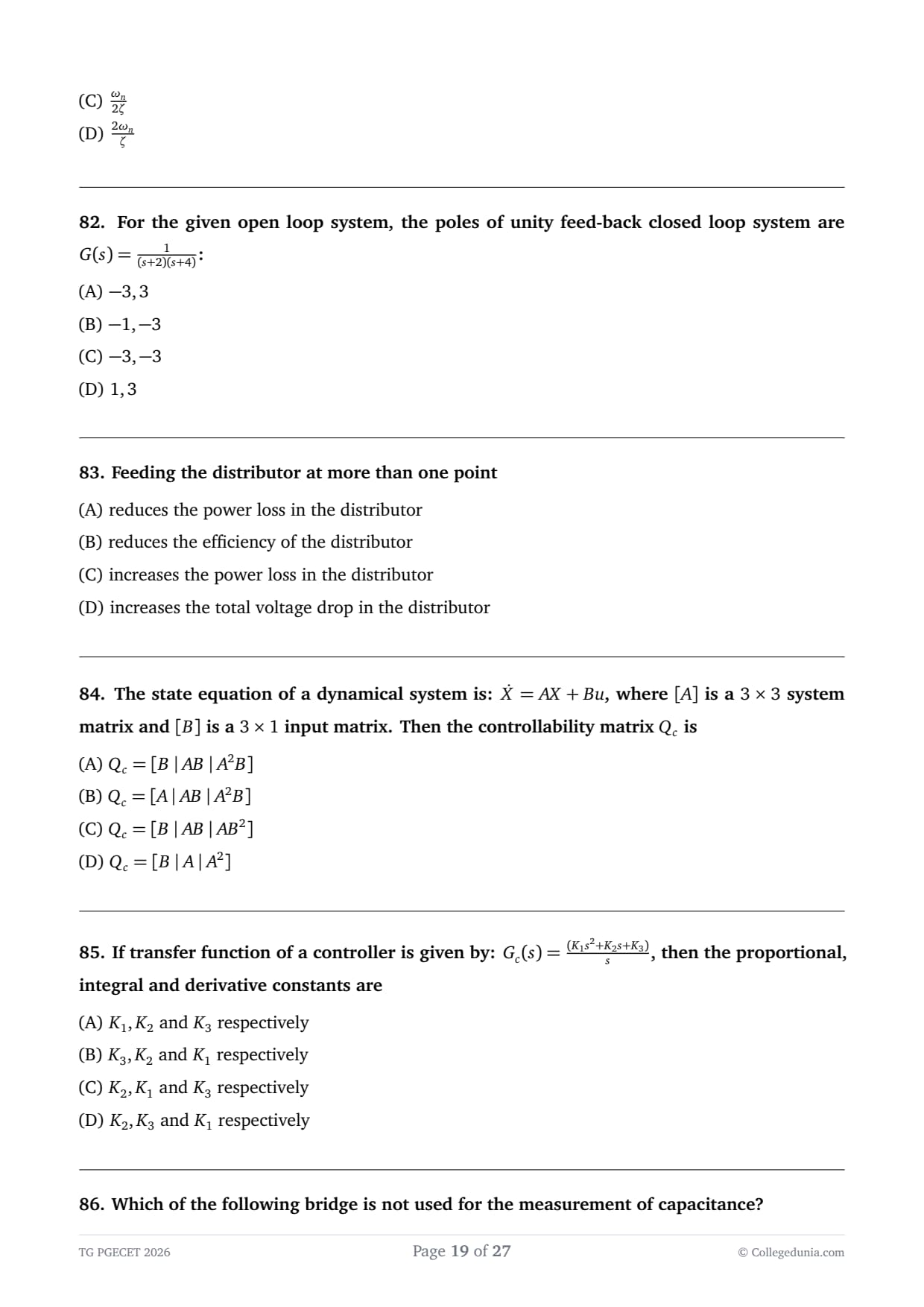
  • (C) \(\frac{\omega_n}{2\zeta}\)
  • (D) \(\frac{2\omega_n}{\zeta}\)

Question 82:

For the given open loop system, the poles of unity feed-back closed loop system are \(G(s) = \frac{1}{(s+2)(s+4)}\):

  • (A) \(-3, 3\)
  • (B) \(-1, -3\)
  • (C) \(-3, -3\)
  • (D) \(1, 3\)

Question 83:

Feeding the distributor at more than one point

  • (A) reduces the power loss in the distributor
  • (B) reduces the efficiency of the distributor
  • (C) increases the power loss in the distributor
  • (D) increases the total voltage drop in the distributor

Question 84:

The state equation of a dynamical system is: \(\dot{X} = AX + Bu\), where \([A]\) is a \(3 3\) system matrix and \([B]\) is a \(3 1\) input matrix. Then the controllability matrix \(Q_c\) is

  • (A) \(Q_c = [B \mid AB \mid A^2B]\)
  • (B) \(Q_c = [A \mid AB \mid A^2B]\)
  • (C) \(Q_c = [B \mid AB \mid AB^2]\)
  • (D) \(Q_c = [B \mid A \mid A^2]\)

Question 85:

If transfer function of a controller is given by: \(G_c(s) = \frac{(K_1s^2 + K_2s + K_3)}{s}\), then the proportional, integral and derivative constants are

  • (A) \(K_1, K_2\) and \(K_3\) respectively
  • (B) \(K_3, K_2\) and \(K_1\) respectively
  • (C) \(K_2, K_1\) and \(K_3\) respectively
  • (D) \(K_2, K_3\) and \(K_1\) respectively

Question 86:

Which of the following bridge is not used for the measurement of capacitance?

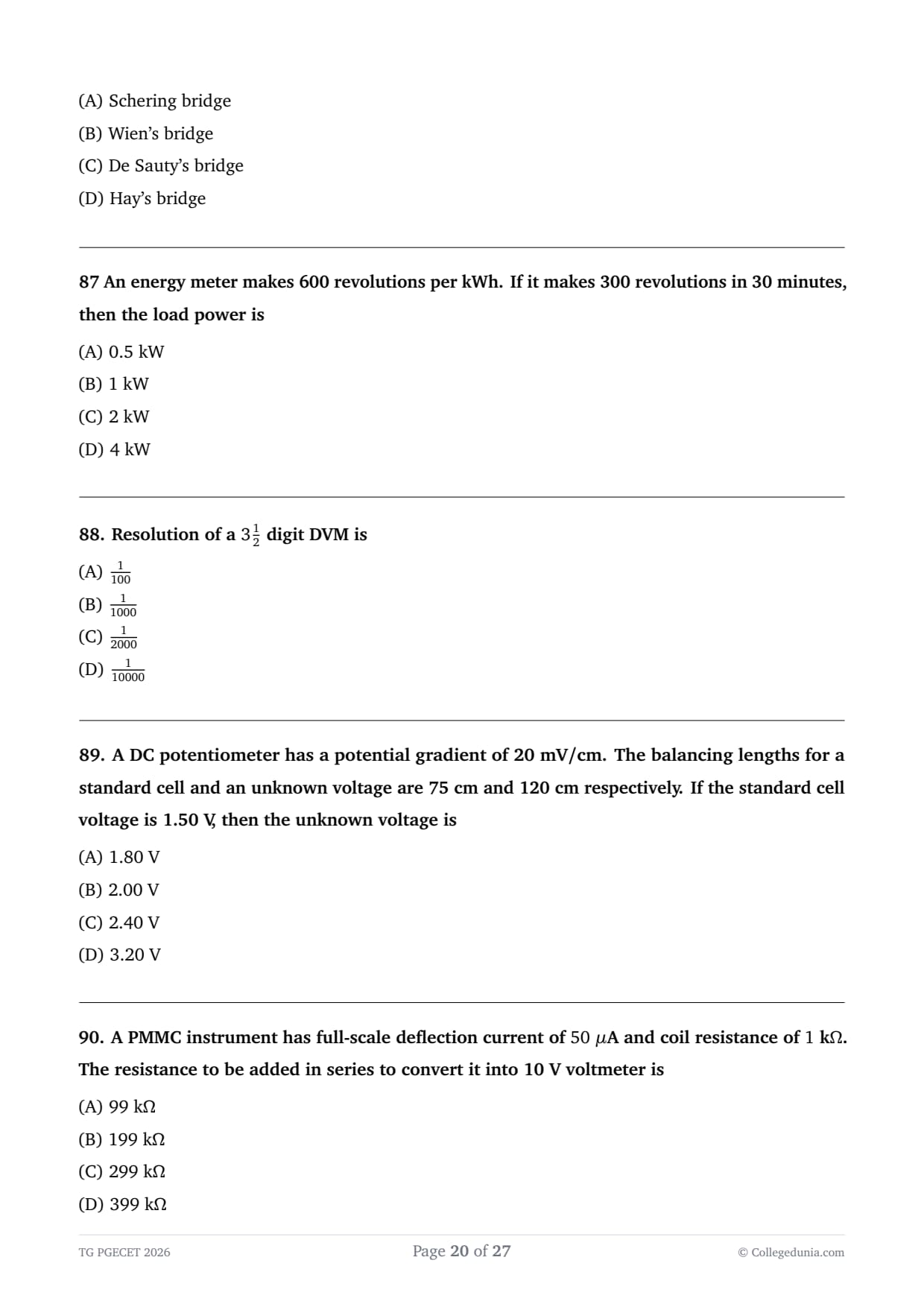
  • (A) Schering bridge
  • (B) Wien's bridge
  • (C) De Sauty's bridge
  • (D) Hay's bridge

Question 87:

An energy meter makes 600 revolutions per kWh. If it makes 300 revolutions in 30 minutes, then the load power is

  • (A) 0.5 kW
  • (B) 1 kW
  • (C) 2 kW
  • (D) 4 kW

Question 88:

Resolution of a \(3\frac{1}{2}\) digit DVM is

  • (A) \(\frac{1}{100}\)
  • (B) \(\frac{1}{1000}\)
  • (C) \(\frac{1}{2000}\)
  • (D) \(\frac{1}{10000}\)

Question 89:

A DC potentiometer has a potential gradient of 20 mV/cm. The balancing lengths for a standard cell and an unknown voltage are 75 cm and 120 cm respectively. If the standard cell voltage is 1.50 V, then the unknown voltage is

  • (A) 1.80 V
  • (B) 2.00 V
  • (C) 2.40 V
  • (D) 3.20 V

Question 90:

A PMMC instrument has full-scale deflection current of \(50\ \) and coil resistance of \(1\ k\Omega\). The resistance to be added in series to convert it into 10 V voltmeter is

  • (A) \(99\ k\Omega\)
  • (B) \(199\ k\Omega\)
  • (C) \(299\ k\Omega\)
  • (D) \(399\ k\Omega\)

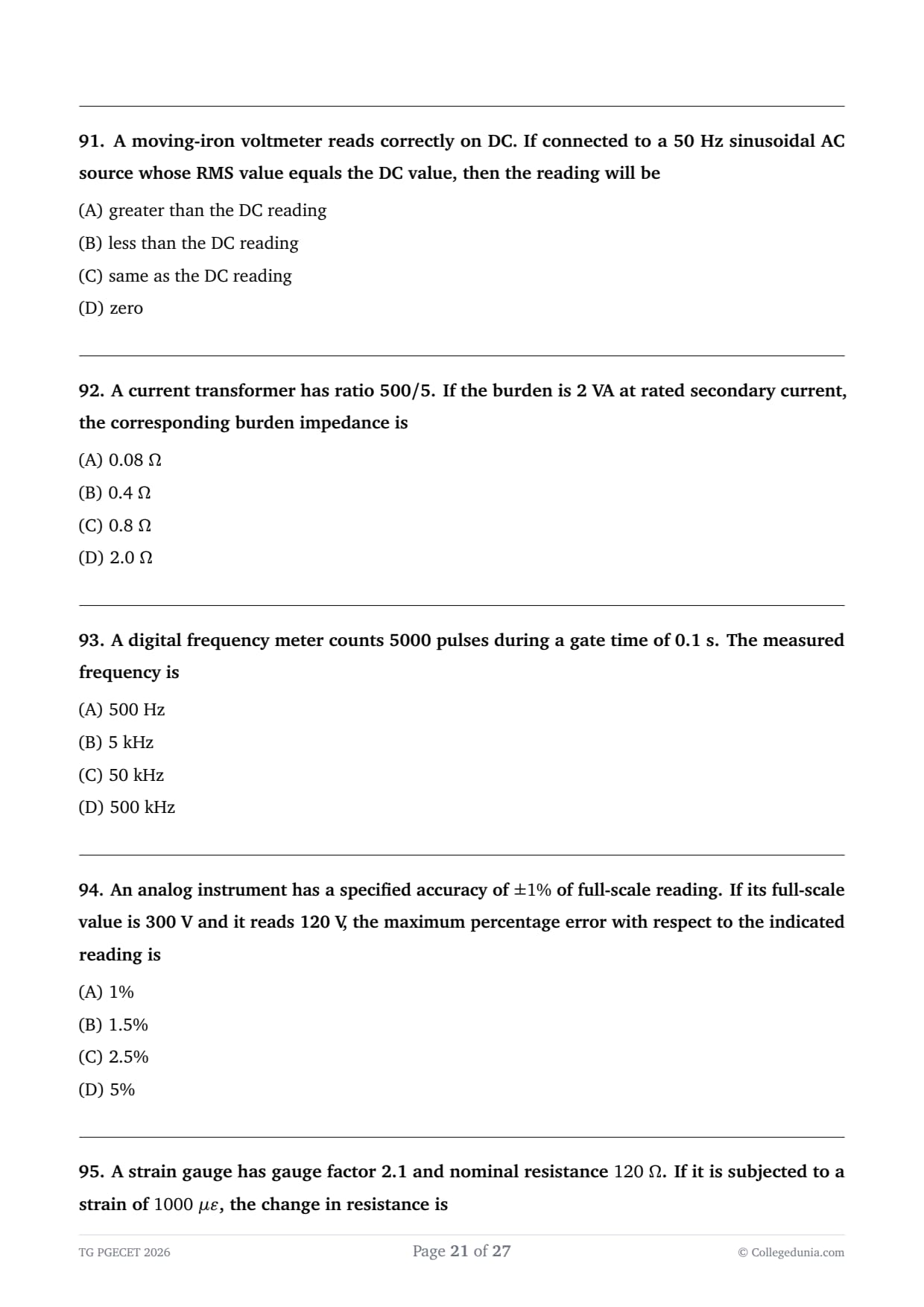
Question 91:

A moving-iron voltmeter reads correctly on DC. If connected to a 50 Hz sinusoidal AC source whose RMS value equals the DC value, then the reading will be

  • (A) greater than the DC reading
  • (B) less than the DC reading
  • (C) same as the DC reading
  • (D) zero

Question 92:

A current transformer has ratio 500/5. If the burden is 2 VA at rated secondary current, the corresponding burden impedance is

  • (A) \(0.08\ \Omega\)
  • (B) \(0.4\ \Omega\)
  • (C) \(0.8\ \Omega\)
  • (D) \(2.0\ \Omega\)

Question 93:

A digital frequency meter counts 5000 pulses during a gate time of 0.1 s. The measured frequency is

  • (A) 500 Hz
  • (B) 5 kHz
  • (C) 50 kHz
  • (D) 500 kHz

Question 94:

An analog instrument has a specified accuracy of \(\pm 1%\) of full-scale reading. If its full-scale value is 300 V and it reads 120 V, the maximum percentage error with respect to the indicated reading is

  • (A) \(1%\)
  • (B) \(1.5%\)
  • (C) \(2.5%\)
  • (D) \(5%\)

Question 95:

A strain gauge has gauge factor 2.1 and nominal resistance \(120\ \Omega\). If it is subjected to a strain of \(1000\ \mu\varepsilon\), the change in resistance is

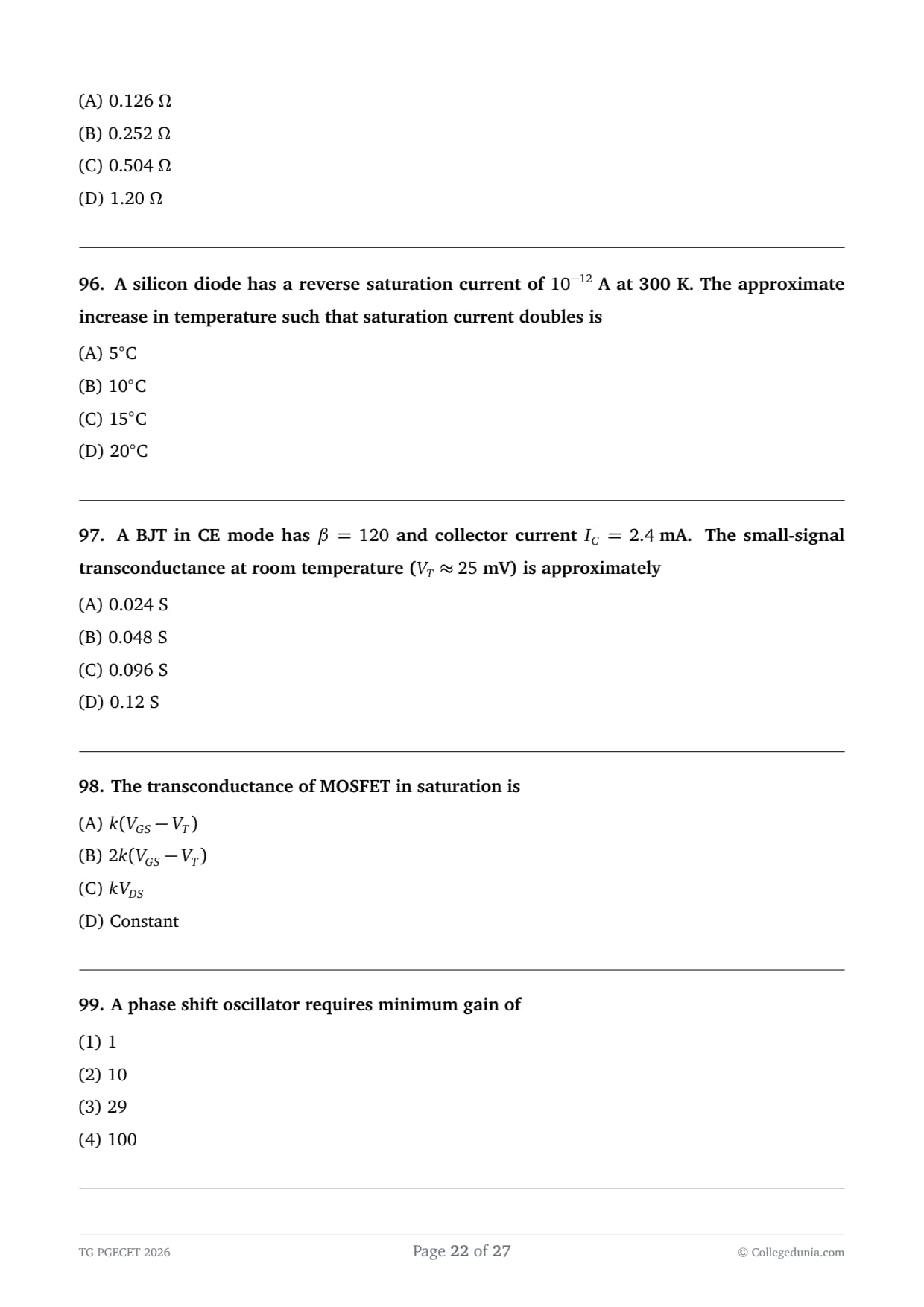
  • (A) \(0.126\ \Omega\)
  • (B) \(0.252\ \Omega\)
  • (C) \(0.504\ \Omega\)
  • (D) \(1.20\ \Omega\)

Question 96:

A silicon diode has a reverse saturation current of \(10^{-12} A\) at 300 K. The approximate increase in temperature such that saturation current doubles is

  • (A) \(5^\)
  • (B) \(10^\)
  • (C) \(15^\)
  • (D) \(20^\)

Question 97:

A BJT in CE mode has \(\beta = 120\) and collector current \(I_C = 2.4 mA\). The small-signal transconductance at room temperature (\(V_T 25 mV\)) is approximately

  • (A) 0.024 S
  • (B) 0.048 S
  • (C) 0.096 S
  • (D) 0.12 S

Question 98:

The transconductance of MOSFET in saturation is

  • (A) \(k(V_{GS} - V_T)\)
  • (B) \(2k(V_{GS} - V_T)\)
  • (C) \(kV_{DS}\)
  • (D) Constant

Question 99:

A phase shift oscillator requires minimum gain of

  • (1) \(1 \)
  • (2) \(10 \)
  • (3) \(29 \)
  • (4) \(100 \)

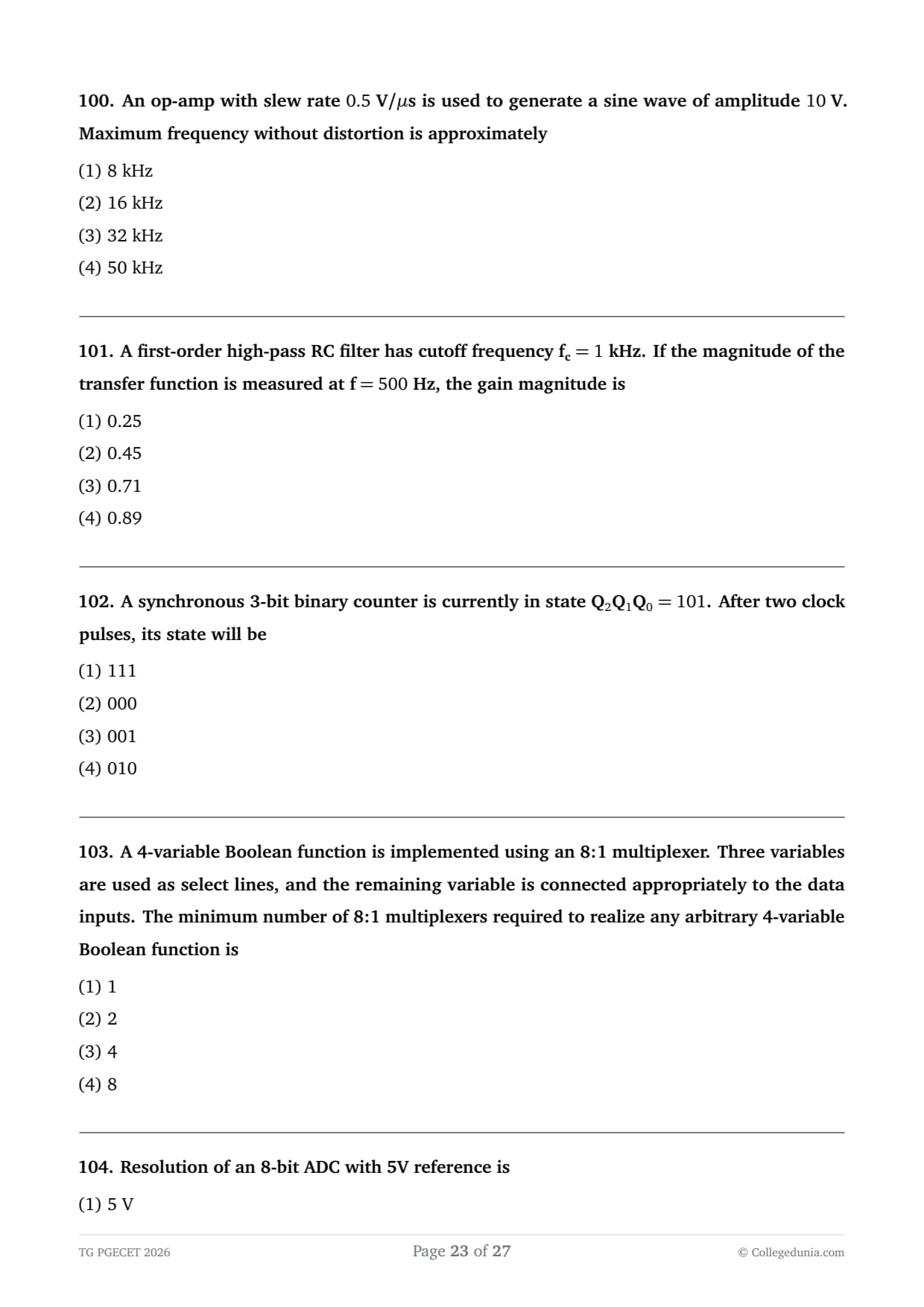
Question 100:

An op-amp with slew rate \( 0.5 V/ \) is used to generate a sine wave of amplitude \( 10 V \). Maximum frequency without distortion is approximately

  • (1) \(8 kHz \)
  • (2) \(16 kHz \)
  • (3) \(32 kHz \)
  • (4) \(50 kHz \)

Question 101:

A first-order high-pass RC filter has cutoff frequency \(f_c=1 kHz\). If the magnitude of the transfer function is measured at \(f=500 Hz\), the gain magnitude is

  • (1) \(0.25 \)
  • (2) \(0.45 \)
  • (3) \(0.71 \)
  • (4) \(0.89 \)

Question 102:

A synchronous 3-bit binary counter is currently in state \(Q_2Q_1Q_0=101\). After two clock pulses, its state will be

  • (1) \(111 \)
  • (2) \(000 \)
  • (3) \(001 \)
  • (4) \(010 \)

Question 103:

A 4-variable Boolean function is implemented using an 8:1 multiplexer. Three variables are used as select lines, and the remaining variable is connected appropriately to the data inputs. The minimum number of 8:1 multiplexers required to realize any arbitrary 4-variable Boolean function is

  • (1) \(1 \)
  • (2) \(2 \)
  • (3) \(4 \)
  • (4) \(8 \)

Question 104:

Resolution of an 8-bit ADC with 5V reference is

  • (1) \(5 V \)
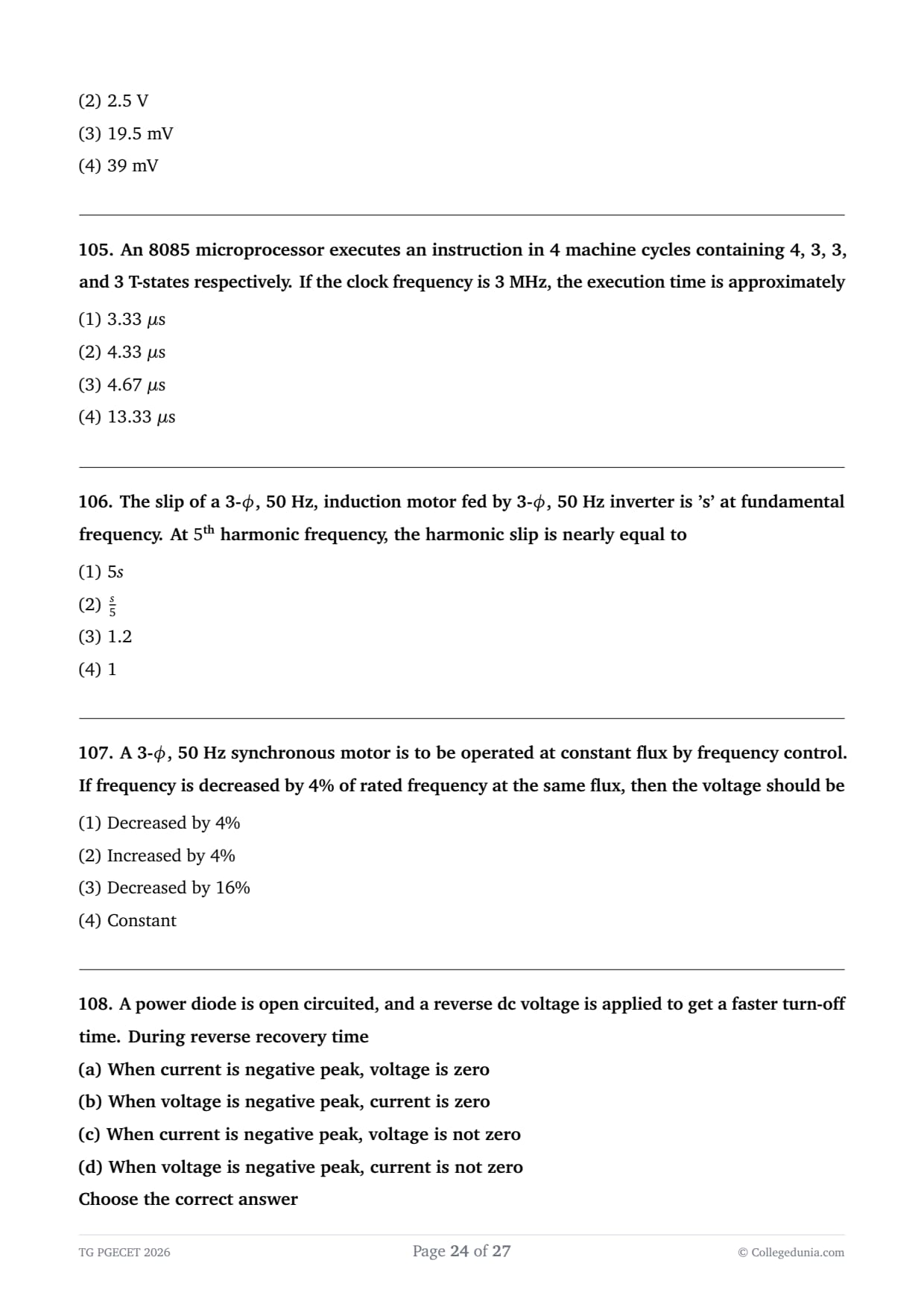
  • (2) \(2.5 V \)
  • (3) \(19.5 mV \)
  • (4) \(39 mV \)

Question 105:

An 8085 microprocessor executes an instruction in 4 machine cycles containing 4, 3, 3, and 3 T-states respectively. If the clock frequency is 3 MHz, the execution time is approximately

  • (1) \(3.33\  \)
  • (2) \(4.33\  \)
  • (3) \(4.67\ \)
  • (4) \(13.33\ \)

Question 106:

The slip of a 3-\(\phi\), 50 Hz, induction motor fed by 3-\(\phi\), 50 Hz inverter is 's' at fundamental frequency. At \(5^{th}\) harmonic frequency, the harmonic slip is nearly equal to

  • (1) \(5s \)
  • (2) \(\frac{s}{5} \)
  • (3) \(1.2 \)
  • (4) \(1 \)

Question 107:

A 3-\(\phi\), 50 Hz synchronous motor is to be operated at constant flux by frequency control. If frequency is decreased by 4% of rated frequency at the same flux, then the voltage should be

  • (1) \( Decreased by 4% \)
  • (2) \( Increased by 4% \)
  • (3) \( Decreased by 16% \)
  • (4) \( Constant \)

Question 108:

A power diode is open circuited, and a reverse dc voltage is applied to get a faster turn-off time. During reverse recovery time

(a) When current is negative peak, voltage is zero

(b) When voltage is negative peak, current is zero

(c) When current is negative peak, voltage is not zero

(d) When voltage is negative peak, current is not zero

Choose the correct answer

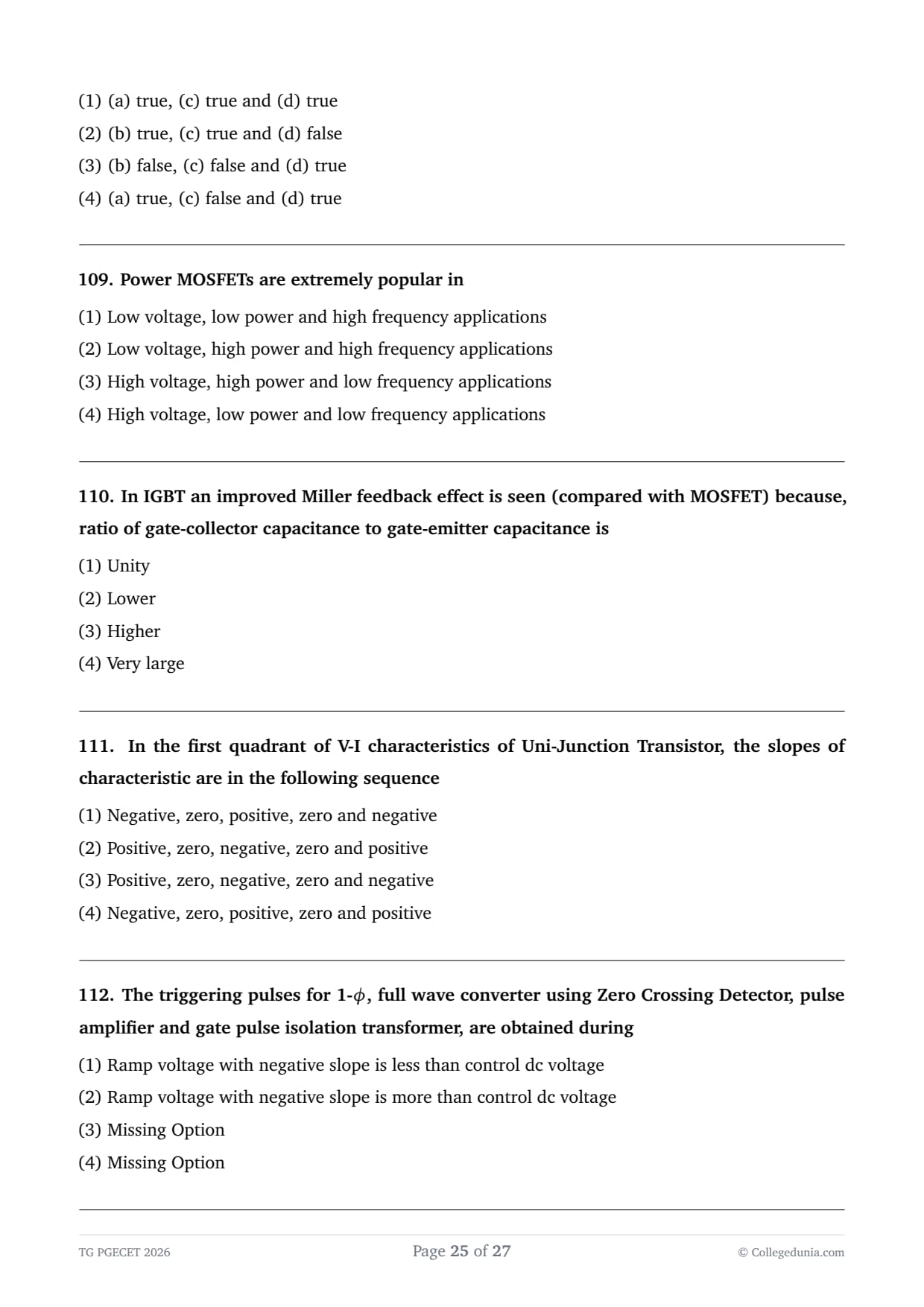
  • (1) \( (a) true, (c) true and (d) true \)
  • (2) \( (b) true, (c) true and (d) false \)
  • (3) \( (b) false, (c) false and (d) true \)
  • (4) \( (a) true, (c) false and (d) true \)

Question 109:

Power MOSFETs are extremely popular in

  • (1) \( Low voltage, low power and high frequency applications \)
  • (2) \( Low voltage, high power and high frequency applications \)
  • (3) \( High voltage, high power and low frequency applications \)
  • (4) \( High voltage, low power and low frequency applications \)

Question 110:

In IGBT an improved Miller feedback effect is seen (compared with MOSFET) because, ratio of gate-collector capacitance to gate-emitter capacitance is

  • (1) \( Unity \)
  • (2) \( Lower \)
  • (3) \( Higher \)
  • (4) \( Very large \)

Question 111:

In the first quadrant of V-I characteristics of Uni-Junction Transistor, the slopes of characteristic are in the following sequence

  • (1) \( Negative, zero, positive, zero and negative \)
  • (2) \( Positive, zero, negative, zero and positive \)
  • (3) \( Positive, zero, negative, zero and negative \)
  • (4) \( Negative, zero, positive, zero and positive \)

Question 112:

The triggering pulses for 1-\(\phi\), full wave converter using Zero Crossing Detector, pulse amplifier and gate pulse isolation transformer, are obtained during

  • (1) \( Ramp voltage with negative slope is less than control dc voltage \)
  • (2) \( Ramp voltage with negative slope is more than control dc voltage \)
  • (3) Missing Option
  • (4) Missing Option

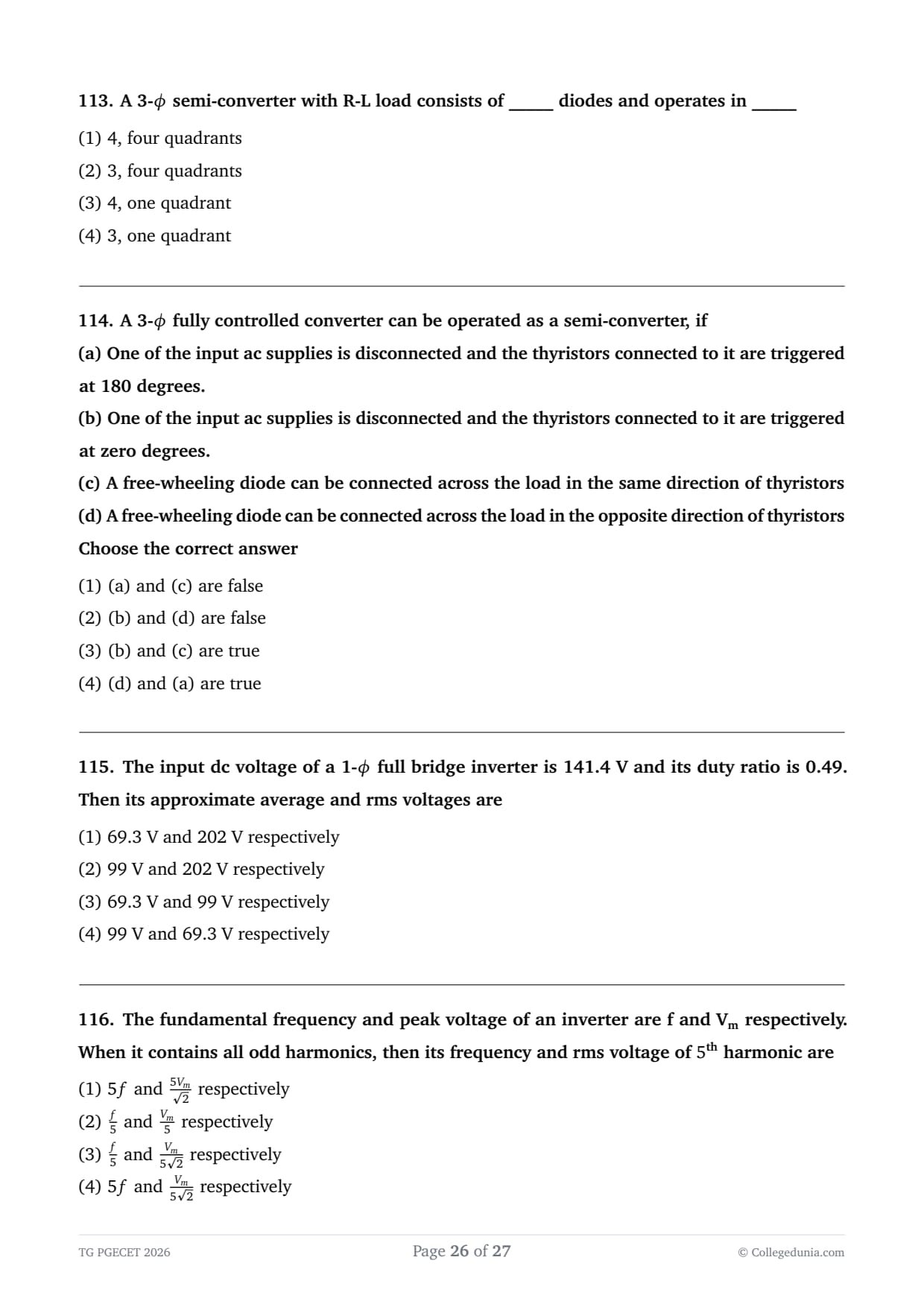
Question 113:

A 3-\(\phi\) semi-converter with R-L load consists of _____ diodes and operates in _____

  • (1) \( 4, four quadrants \)
  • (2) \( 3, four quadrants \)
  • (3) \( 4, one quadrant \)
  • (4) \( 3, one quadrant \)

Question 114:

A 3-\(\phi\) fully controlled converter can be operated as a semi-converter, if

(a) One of the input ac supplies is disconnected and the thyristors connected to it are triggered at 180 degrees.

(b) One of the input ac supplies is disconnected and the thyristors connected to it are triggered at zero degrees.

(c) A free-wheeling diode can be connected across the load in the same direction of thyristors

(d) A free-wheeling diode can be connected across the load in the opposite direction of thyristors

Choose the correct answer

  • (1) \( (a) and (c) are false \)
  • (2) \( (b) and (d) are false \)
  • (3) \( (b) and (c) are true \)
  • (4) \( (d) and (a) are true \)

Question 115:

The input dc voltage of a 1-\(\phi\) full bridge inverter is 141.4 V and its duty ratio is 0.49. Then its approximate average and rms voltages are

  • (1) \( 69.3 V and 202 V respectively \)
  • (2) \( 99 V and 202 V respectively \)
  • (3) \( 69.3 V and 99 V respectively \)
  • (4) \( 99 V and 69.3 V respectively \)

Question 116:

The fundamental frequency and peak voltage of an inverter are f and \(V_m\) respectively. When it contains all odd harmonics, then its frequency and rms voltage of \(5^{th}\) harmonic are

  • (1) \( 5f and \frac{5V_m}{\sqrt{2}} respectively \)
  • (2) \( \frac{f}{5} and \frac{V_m}{5} respectively \)
  • (3) \( \frac{f}{5} and \frac{V_m}{5\sqrt{2}} respectively \)
  • (4) \( 5f and \frac{V_m}{5\sqrt{2}} respectively \)

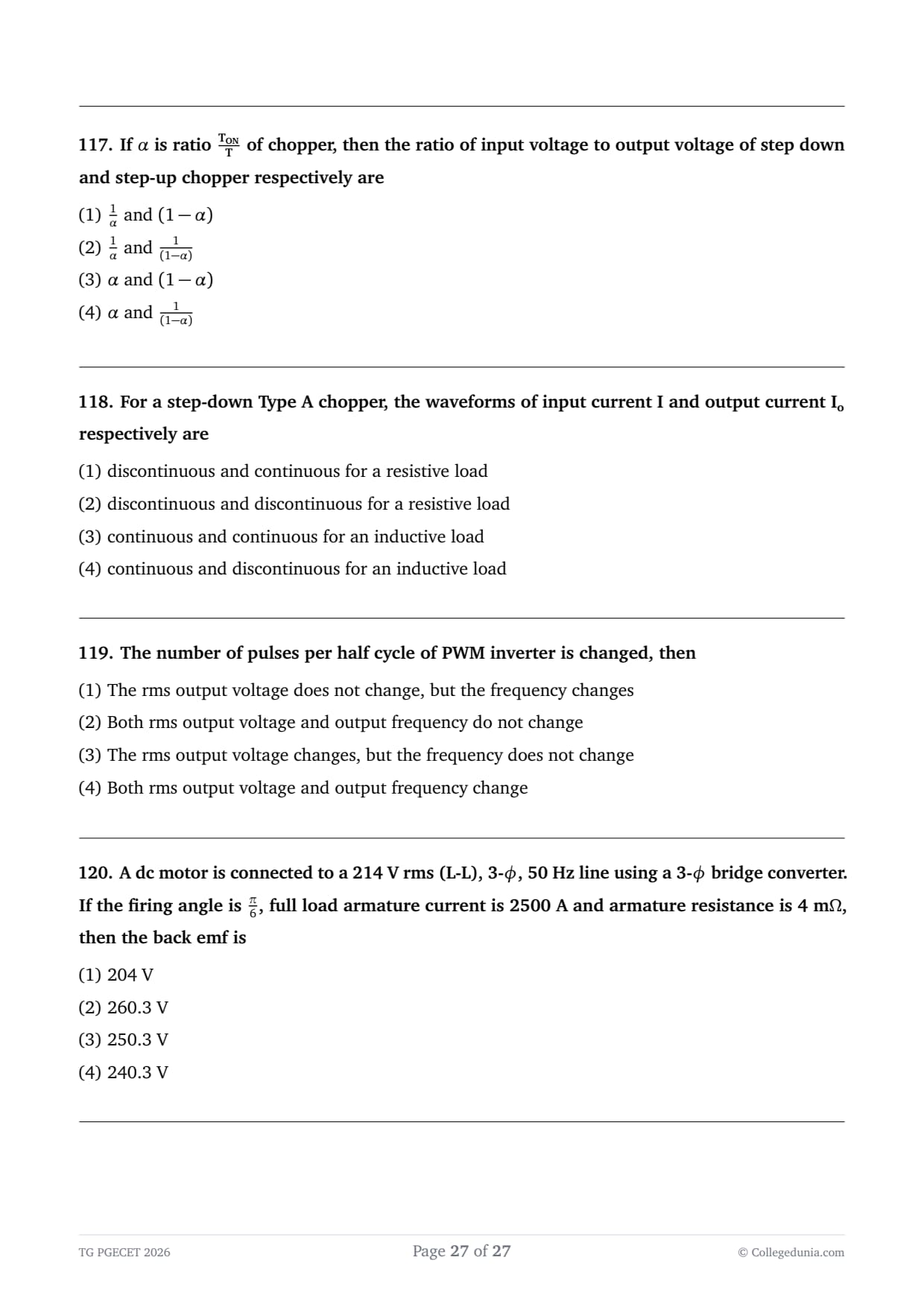
Question 117:

If \(\alpha\) is ratio \(\frac{T_{ON}}{T}\) of chopper, then the ratio of input voltage to output voltage of step down and step-up chopper respectively are

  • (1) \( \frac{1}{\alpha} and (1-\alpha) \)
  • (2) \( \frac{1}{\alpha} and \frac{1}{(1-\alpha)} \)
  • (3) \( \alpha and (1-\alpha) \)
  • (4) \( \alpha and \frac{1}{(1-\alpha)} \)

Question 118:

For a step-down Type A chopper, the waveforms of input current I and output current \(I_o\) respectively are

  • (1) \( discontinuous and continuous for a resistive load \)
  • (2) \( discontinuous and discontinuous for a resistive load \)
  • (3) \( continuous and continuous for an inductive load \)
  • (4) \( continuous and discontinuous for an inductive load \)

Question 119:

The number of pulses per half cycle of PWM inverter is changed, then

  • (1) \( The rms output voltage does not change, but the frequency changes \)
  • (2) \( Both rms output voltage and output frequency do not change \)
  • (3) \( The rms output voltage changes, but the frequency does not change \)
  • (4) \( Both rms output voltage and output frequency change \)

Question 120:

A dc motor is connected to a 214 V rms (L-L), 3-\(\phi\), 50 Hz line using a 3-\(\phi\) bridge converter. If the firing angle is \(\frac{\pi}{6}\), full load armature current is 2500 A and armature resistance is 4 m\(\Omega\), then the back emf is

  • (1) \( 204 V \)
  • (2) \( 260.3 V \)
  • (3) \( 250.3 V \)
  • (4) \( 240.3 V \)

TS PGECET 2026 Exam Pattern

Particulars Details
Exam Mode Computer-Based Test(CBT)
Question Type Multiple Choice Questions(MCQs)
Total Questions 120 Questions
Total Marks 120 Marks
Exam Duration 2 Hours
Marking Scheme +1 mark for each correct answer
Negative Marking No Negative Marking
Language of Paper English

TS PGECET 2026 Preparation Strategy