TS PGECET 2026 Computer Science and Information Technology (CS) Question Paper is available for download here. JNTU Hyderabad on behalf of Telangana Council of Higher Education (TGCHE) conducted TS PGECET 2026 CS exam on May 29 in Shift 2 from 2 PM to 4 PM. TS PGECET CS Question Paper consists of 120 questions for 120 marks to be attempted in 2 hours.
- TS PGECET CS Question Paper 2026 is divided into 2 sections- Engineering Mathematics with 10 questions and Computer Science and Information Technology domain with 110 questions.
- Each questions carries 1 mark each and there is no negative marking for incorrect answers.
Candidates can download TS PGECET 2026 CS Question Paper with Answer Key and Solution PDF from links provided below.
TS PGECET 2026 CS Question Paper with Solution PDF
Question 1:
Let \(A\) and \(B\) be \(n\times n\) real matrices. Which of the following statements is correct?
- (A) \(rank(A+B)=rank(A)+rank(B)\)
- (B) \(rank(A+B)\le rank(A)+rank(B)\)
- (C) \(rank(A+B)=\min\{rank(A),rank(B)\}\)
- (D) \(rank(A+B)=\max\{rank(A),rank(B)\}\)
Question 2:
On the Argand plane, eigenvalues of any unitary matrix lie on
- (A) Real axis
- (B) Imaginary axis
- (C) A unit circle with centre at origin
- (D) Outside a unit circle with centre at origin
Question 3:
If \(\alpha, \beta\) are two distinct eigenvalues of a matrix \(A\), then the corresponding eigenvectors are
- (A) Linearly dependent
- (B) Linearly independent
- (C) Orthogonal
- (D) Orthonormal
Question 4:
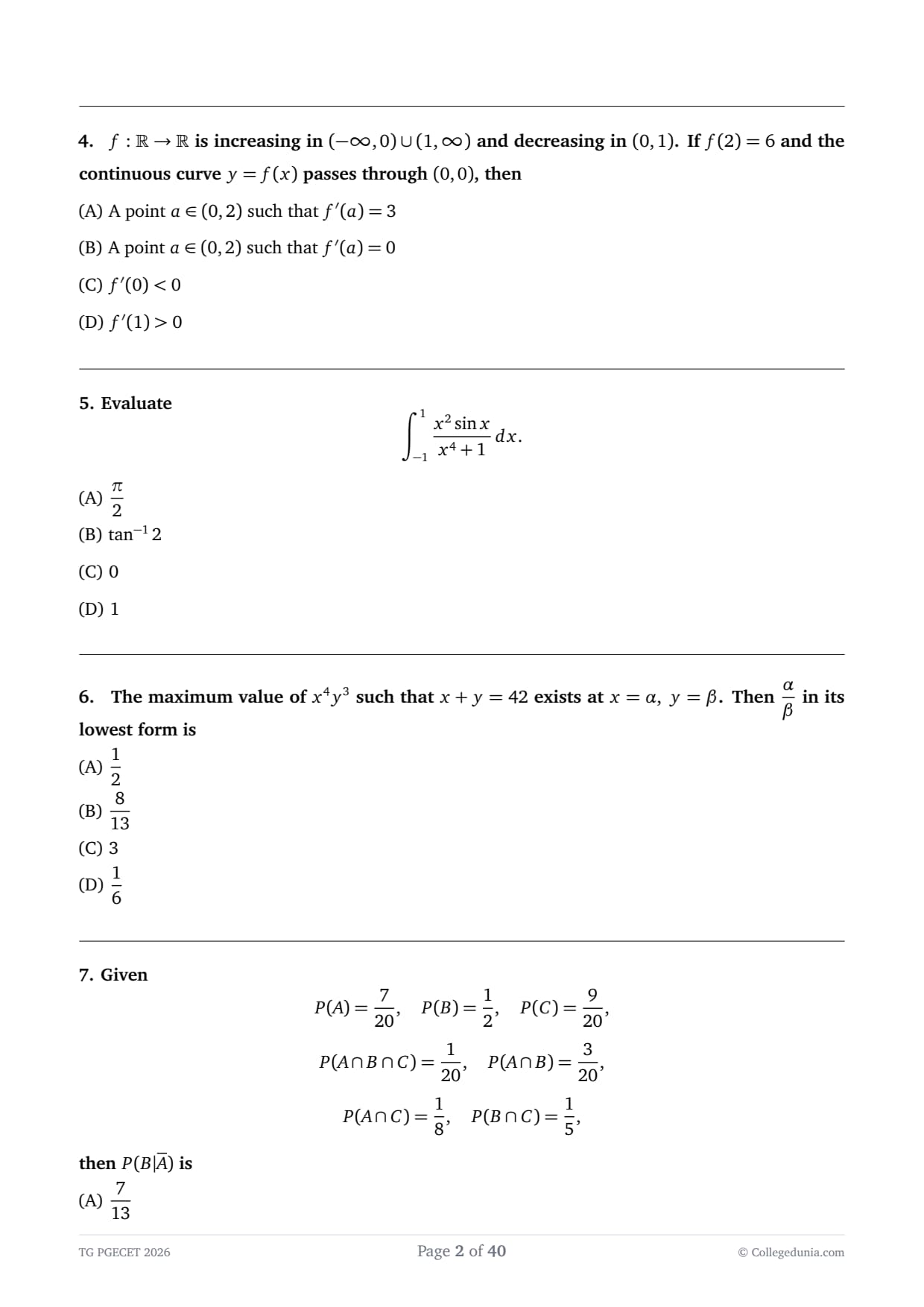
\(f:\mathbb{R}\rightarrow\mathbb{R}\) is increasing in \((-\infty,0)\cup(1,\infty)\) and decreasing in \((0,1)\). If \(f(2)=6\) and the continuous curve \(y=f(x)\) passes through \((0,0)\), then
- (A) A point \(a\in(0,2)\) such that \(f'(a)=3\)
- (B) A point \(a\in(0,2)\) such that \(f'(a)=0\)
- (C) \(f'(0)<0\)
- (D) \(f'(1)>0\)
Question 5:
Evaluate \[ \int_{-1}^{1}\frac{x^{2}\sin x}{x^{4}+1}\,dx. \]
- (A) \(\dfrac{\pi}{2}\)
- (B) \(\tan^{-1}2\)
- (C) \(0\)
- (D) \(1\)
Question 6:
The maximum value of \(x^{4}y^{3}\) such that \(x+y=42\) exists at \(x=\alpha,\; y=\beta\). Then \(\dfrac{\alpha}{\beta}\) in its lowest form is
- (A) \(\dfrac{1}{2}\)
- (B) \(\dfrac{8}{13}\)
- (C) \(3\)
- (D) \(\dfrac{1}{6}\)
Question 7:
Given \[ P(A)=\frac{7}{20}, \quad P(B)=\frac{1}{2}, \quad P(C)=\frac{9}{20}, \] \[ P(A\cap B\cap C)=\frac{1}{20}, \quad P(A\cap B)=\frac{3}{20}, \] \[ P(A\cap C)=\frac{1}{8}, \quad P(B\cap C)=\frac{1}{5}, \]
then \(P(B|\overline{A})\) is
- (A) \(\dfrac{7}{13}\)
- (B) \(\dfrac{11}{20}\)
- (C) \(\dfrac{19}{40}\)
- (D) \(\dfrac{7}{15}\)
Question 8:
If \(Z\) is a standard normal variable,
P(Z > z1) = α,
P(Z < z2) = β
and z2 < z1, then a possible value of
P(z2 < Z < z1)
is
- (A) \(\alpha-\beta\)
- (B) \(0.5+(\alpha+\beta)\)
- (C) \(1-(\alpha+\beta)\)
- (D) \(|\beta-\alpha|\)
Question 9:
The probability density function of a continuous random variable is \[ f(x)= \begin{cases} \dfrac35 e^{-3x/5}, & x>0
0, & x\le0 \end{cases} \]
The mean of the distribution is
- (A) \(1\)
- (B) \(5\)
- (C) \(2\)
- (D) \(3\)
Question 10:
For a Binomial distribution, mean is \(15\) and variance is \(6\). If \[ P(X\ge2) = 1-\left(\frac25\right)^{25}k, \]
then \(k=\)
- (A) \(2^{24}\)
- (B) \(\dfrac{77}{2}\)
- (C) \(\left(\dfrac25\right)^{24}\)
- (D) \(\dfrac{78}{5}\)
Question 11:
The tautology [ (p∧ (p→q)) → q ]
is the basis of the following rule of inference:
- (A) Modus Ponens
- (B) Modus Tollens
- (C) De Morgan Law
- (D) Morgan Tonen
Question 12:
Which among the following represents idempotent law?
- (A) (A ∪ ∅ = A)
- (B) (A ∪ A = A)
- (C) (A ∪ A' = ∅)
- (D) (A ∪ B = B)
Question 13:
Let \(f\) and \(g\) be the functions from the set of integers to the set of integers defined by \[ f(x)=2x+3 \]
and \[ g(x)=3x+2. \]
What is the composition of \(f\) and \(g\)?
- (A) \(6x+7\)
- (B) \(6x+11\)
- (C) \(8x+11\)
- (D) \(8x+7\)
Question 14:
Suppose that there are eight runners in a race. The winner receives a gold medal, the second-place finisher receives a silver medal, and the third-place finisher receives a bronze medal. How many different ways are there to award these medals, if all possible outcomes of the race can occur and there are no ties?
- (A) \(56\)
- (B) \(336\)
- (C) \(126\)
- (D) \(456\)
Question 15:
How many different strings can be made by reordering the letters of the word SUCCESS?
- (A) \(512\)
- (B) \(56\)
- (C) \(420\)
- (D) \(24\)
Question 16:
What is the solution of the recurrence relation \[ a_n=6a_{n-1}-9a_{n-2} \]
with initial conditions \[ a_0=1,\qquad a_1=6? \]
- (A) \(a_n=3^n+n\times 3^n\)
- (B) \(a_n=1-2^n+2\times 3^n\)
- (C) \(a_n=2^n+3^n\)
- (D) \(a_n=3^n\)
Question 17:
What is \(R^3\) of \[ R=\{(1,1),(2,1),(3,2),(4,3)\}? \]
- (A) \(\{(1,1),(2,1),(3,1),(4,2)\}\)
- (B) \(\{(1,1),(2,1),(3,2),(4,3)\}\)
- (C) \(\{(1,1),(2,1),(3,1),(4,1)\}\)
- (D) \(\{(1,2),(2,1),(3,1),(4,3)\}\)
Question 18:
How many relations are there on a set with \(3\) elements?
- (A) \(8\)
- (B) \(128\)
- (C) \(512\)
- (D) \(256\)
Question 19:
What is the Four Colour Theorem?
- (A) The chromatic number of a wheel graph is no greater than four
- (B) The chromatic number of a planar graph is no greater than four
- (C) The chromatic number of a bipartite graph is no greater than four
- (D) The chromatic number of a planar graph is equal to four
Question 20:
Choose the correct statement about connected components.
- (A) A connected component of a graph is a maximal connected subgraph of that graph
- (B) A connected component of a graph is a Hamiltonian circuit
- (C) A connected component of a graph may be Euler but not Hamiltonian
- (D) A complete directed graph will not have connected component
Question 21:
Which gate is used for Boolean addition?
- (A) AND gate
- (B) OR gate
- (C) XOR gate
- (D) NOT gate
Question 22:
Which type of charts are used in Boolean function simplification?
- (A) PERT chart
- (B) PIE chart
- (C) K maps
- (D) Heat maps
Question 23:
Which flip flop is used as a push button switch?
- (A) SR flip flop
- (B) JK flip flop
- (C) D flip flop
- (D) T flip flop
Question 24:
How many NAND gates are required to implement a full adder?
- (A) Eight
- (B) Ten
- (C) Six
- (D) Nine
Question 25:
What is the product of \[ 1.11\times2^3 \]
and \[ 1.0101\times2^6 ? \]
- (A) \(1.0010011\times2^{10}\)
- (B) \(1.0010011\times2^{9}\)
- (C) \(11.1101\times2^{18}\)
- (D) \(11.1101\times2^{9}\)
Question 26:
The symbolic notation used to describe the microoperation transfers among registers is called
- (A) Microprogram control
- (B) Strobe control
- (C) Register transfer language
- (D) Bus arbitration language
Question 27:
What is the output of selective complement operation of 1010 and 1100?
- (A) 1110
- (B) 0110
- (C) 0010
- (D) 1010
Question 28:
Which of the following register holds memory operand?
- (A) Program counter
- (B) Memory register
- (C) Data register
- (D) Instruction register
Question 29:
What is the correct description of CIL instruction?
- (A) Circulate left DR and D
- (B) Circulate left AC and E
- (C) Circulate left AR and D
- (D) Circulate left AR and E
Question 30:
Choose typical program control instructions.
- (A) BR, SKP, RET, TST
- (B) BR, BUN, CALL, XCG
- (C) JMP, BUN, LDA, XCG
- (D) CALL, RET, OUT, IN
Question 31:
Consider the following statements about interrupts.
Statement-I: Internal interrupts are synchronous with the program while external interrupts are asynchronous.
Statement-II: Internal interrupts are called traps.
The correct answer is
- (A) Statement-I is true, but Statement-II is false
- (B) Both Statement-I and Statement-II are true
- (C) Statement-I is false, but Statement-II is true
- (D) Both Statement-I and Statement-II are false
Question 32:
What type of conflicts arise when an instruction depends on the result of a previous instruction, but this result is not yet available?
- (A) Data dependency
- (B) Instruction dependency
- (C) Operator dependency
- (D) Branch dependency
Question 33:
In strobe control method, the strobe pulse is controlled by which unit in the CPU?
- (A) BIOS
- (B) Clock pulses
- (C) ALU
- (D) Program Counter
Question 34:
Choose the most common auxiliary memory device.
- (A) RAM and ROM
- (B) Cache and Registers
- (C) Cache and magnetic disks
- (D) Magnetic disks and tapes
Question 35:
How many stages are there in Pipeline included in a RISC processor?
Question 36:
Which data structure is used in recursive function implementation?
- (A) Stack
- (B) Queue
- (C) Tree
- (D) Graph
Question 37:
Choose the set of storage classes in C language.
- (A) Auto, register, static, extern
- (B) Auto, static, global, extern
- (C) Register, cache, main, extern
- (D) Disk, tape, drum, flash drive
Question 38:
The correct set of graph representation is
- (A) Stack, queue, matrix, graph
- (B) Adjacency matrix, sparse list, edge list
- (C) Adjacency matrix, adjacency list, edge list
- (D) Incidence matrix, skip list, dictionary
Question 39:
Executing a program written in C involves a series of steps. Choose the correct sequence.
- (A) d, a, b, c
- (B) a, d, c, b
- (C) c, a, b, d
- (D) a, d, b, c
Question 40:
Consider the following statements about C program.
Statement-I: Every program statement must end with a semicolon.
Statement-II: Compiler directives do not end with a semicolon.
The correct answer is
- (A) Both Statement-I and Statement-II are true
- (B) Both Statement-I and Statement-II are false
- (C) Statement-I is true, but Statement-II is false
- (D) Statement-I is false, but Statement-II is true
Question 41:
Which of the following is invalid floating point constant?
- (A) \(0.65e4\)
- (B) \(1.5e+5\)
- (C) \(18E+3.5\)
- (D) \(-1.2E-1\)
Question 42:
Which binary search tree traversal gives the sorted order of its elements?
- (A) Level order
- (B) Pre-order
- (C) Post-order
- (D) In-order
Question 43:
What is the output of the following recursive function?
\[ \texttt{int func1(int num1,int num2)} \]
\[ \texttt{return (num2==0)? num1 : func1(num2,num1%num2);} \]
- (A) Factorial of num1
- (B) Fibonacci numbers from num1 to num2
- (C) GCD of num1 and num2
- (D) LCM of num1 and num2
Question 44:
Match the C operators with their meaning.
![]()
- (A) P-I, Q-II, R-III, S-IV
- (B) P-II, Q-I, R-III, S-IV
- (C) P-II, Q-III, R-IV, S-I
- (D) P-III, Q-II, R-IV, S-I
Question 45:
Which data structure is used to find largest number in data streams?
- (A) Linked List
- (B) Heap
- (C) Splay Tree
- (D) 2-3 Tree
Question 46:
What is the time complexity in Big-Oh notation for \[ f(n)=a_{m}n^{m}+\cdots+a_{1}n+a_{0}? \]
- (A) \(O(n^2)\)
- (B) \(O(n^3)\)
- (C) \(O(2^n)\)
- (D) \(O(n^m)\)
Question 47:
Choose the pair of sorting algorithms using divide and conquer strategy.
- (A) Bubble Sort, Quick Sort
- (B) Merge Sort, Quick Sort
- (C) Merge Sort, Bucket Sort
- (D) Bubble Sort, Selection Sort
Question 48:
Find the optimal solution for knapsack instance \[ n=3,\quad m=20, \] \[ (p_1,p_2,p_3)=(25,24,15) \]
and \[ (w_1,w_2,w_3)=(18,15,10). \]
- (A) \((0,\frac{2}{3},1)\)
- (B) \((\frac{1}{2},\frac{1}{3},\frac{1}{4})\)
- (C) \((0,1,\frac{1}{2})\)
- (D) \((1,1,1)\)
Question 49:
Which algorithm design strategy is used to find single source shortest paths?
- (A) Divide and Conquer
- (B) Divide and Merge
- (C) Greedy Approach
- (D) Branch and Bound
Question 50:
What is the purpose of Bellman-Ford algorithm?
- (A) Detecting single source shortest paths in a weighted graph with negative weights
- (B) Detecting all pairs shortest paths in a weighted graph with negative weights
- (C) Detecting single source shortest paths in undirected graph without negative weights
- (D) Detecting all pairs shortest paths in a weighted graph without negative weights
Question 51:
What is the size of the set of all subsets of \(n\) elements in sum of subsets problem?
- (A) \(n^2\)
- (B) \(2\)
- (C) \(n\)
- (D) \(2^n\)
Question 52:
What is the cost of the minimum spanning tree of the below graph using Prim's algorithm?
![]()
- (A) \(99\)
- (B) \(97\)
- (C) \(92\)
- (D) \(90\)
Question 53:
Match the following algorithms with their worst-case time complexities.
![]()
- (A) A-III, B-II, C-I
- (B) A-II, B-III, C-I
- (C) A-I, B-II, C-III
- (D) A-I, B-III, C-II
Question 54:
Choose all design strategies to solve different types of knapsack problems?
- (A) a, b, c only
- (B) b, c, d only
- (C) a, b, c, d only
- (D) b, c, d, e only
Question 55:
Which sorting algorithm has the same time complexity for all the cases-best, average, worst?
- (A) Bubble Sort
- (B) Quick Sort
- (C) Radix Sort
- (D) Merge Sort
Question 56:
The diagram given below refers to a non-deterministic finite state automaton that accepts the language having
![]()
- (A) All words that contain the repetition of \(ab\) and end with \(a\)
- (B) All words that contain the substring \(ba\) and end with \(a\)
- (C) All words that end with \(a\)
- (D) All words that end with \(b\)
Question 57:
Which of the following regular expressions denote a language comprising all possible strings of even length over the alphabet \(\{0,1\}\)?
- (A) \((0+1)^*\)
- (B) \((0+1)(0+1)^*\)
- (C) \((00+01+10+11)^*\)
- (D) \((0+1)(0+1)(0+1)^*\)
Question 58:
The following CFG generates strings of terminals that have
![]()
- (A) Equal number of \(a\)'s and \(b\)'s
- (B) Odd number of \(a\)'s and \(b\)'s
- (C) Even number of \(a\)'s and \(b\)'s
- (D) Odd number of \(a\)'s and even number of \(b\)'s
Question 59:
Which language can be accepted by a PDA but not by an FA?
- (A) \(\{a^*b^*\}\)
- (B) \((ab)^*\)
- (C) \(\{a^n b^n \mid n\ge0\}\)
- (D) \(\{a,b\}^*\)
Question 60:
Suppose a language \(L_1\) has 2 states and \(L_2\) has 2 states. After using the cross product construction method, we have a machine \(M\). The total number of states in \(M\) are
Question 61:
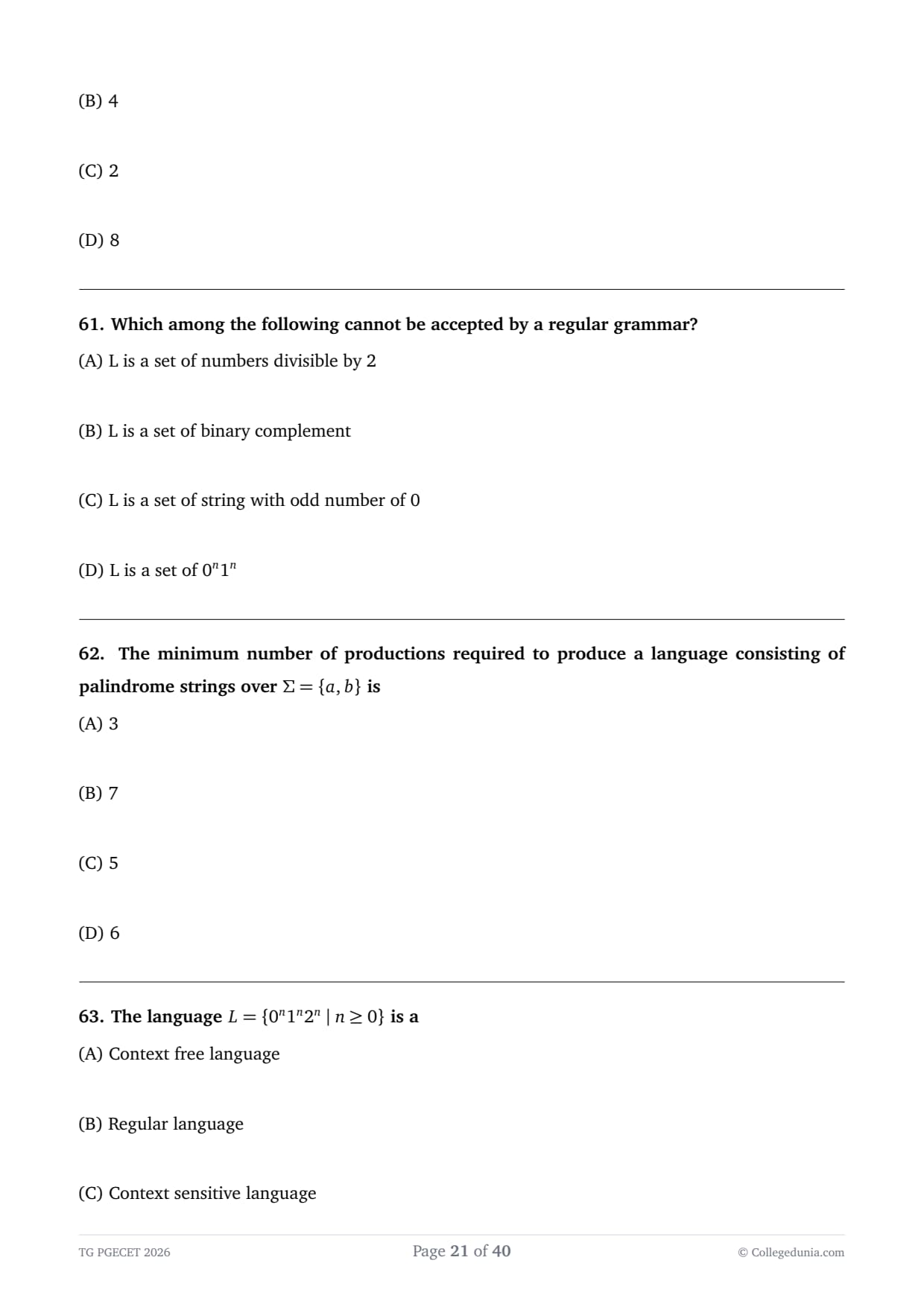
Which among the following cannot be accepted by a regular grammar?
- (A) L is a set of numbers divisible by 2
- (B) L is a set of binary complement
- (C) L is a set of string with odd number of 0
- (D) L is a set of \(0^n1^n\)
Question 62:
The minimum number of productions required to produce a language consisting of palindrome strings over \(\Sigma=\{a,b\}\) is
Question 63:
The language \(L=\{0^n1^n2^n\mid n\ge0\}\) is a
- (A) Context free language
- (B) Regular language
- (C) Context sensitive language
- (D) Recursively enumerable language
Question 64:
The number of internal states of a Universal Turing Machine should be at least
- (A) One
- (B) Two
- (C) Three
- (D) Four
Question 65:
Given a TM \(M\), a state \(q\), and input \(w\), determine whether computation of \(M\) on \(w\) ever visits state \(q\).
- (A) Problem is decidable
- (B) Problem is undecidable but partially decidable
- (C) Problem is undecidable and not even partially decidable
- (D) Problem is not a decision problem
Question 66:
A compiler which runs on one machine and produces target code for another machine is called as
- (A) Crisp Compiler
- (B) Compact Compiler
- (C) Overlap Compiler
- (D) Cross Compiler
Question 67:
For the grammar
\[ E\rightarrow E*F\;|\;F+E\;|\;F \]
\[ F\rightarrow F-F\;|\;id \]
Which statement is true?
- (A) * has higher precedence than +
- (B) - has higher precedence than *
- (C) + and - have same precedence
- (D) + has higher precedence than *
Question 68:
Which of the following parser is most powerful?
- (A) Predictive Parser
- (B) SLR Parser
- (C) CLR Parser
- (D) LALR Parser
Question 69:
Consider the following Syntax Directed Translation Scheme, with non-terminals \(\{S,A\}\) and terminals \(\{a,b\}\):
![]()
The output printed by a bottom-up parser for the input \(aab\) is
- (A) \(1\;3\;2\)
- (B) \(2\;2\;3\)
- (C) \(2\;3\;1\)
- (D) \(3\;2\;1\)
Question 70:
If the value of an attribute is obtained from its children, then it is called
- (A) Synthesized Attribute
- (B) Inherited Attribute
- (C) Simple Attribute
- (D) Derived Attribute
Question 71:
The control link in an activation record points to
- (A) The first instruction of the program
- (B) The activation record of the called procedure
- (C) The activation record of the calling procedure
- (D) The heap memory
Question 72:
Which one of the following is prefix representation of the infix expression \(P*(Q+R)/S\)?
- (A) \(/ * P + Q R S\)
- (B) \(P+Q/R*S\)
- (C) \(*+*PQ/RS\)
- (D) \(/+QR*PS\)
Question 73:
Which addressing mode provides the fastest access?
- (A) Direct
- (B) Indirect
- (C) Register
- (D) Indexed
Question 74:
The output of code generation is usually
- (A) Abstract syntax tree
- (B) Assembly or machine code
- (C) Three-address code
- (D) Symbol table
Question 75:
Which technique replaces a sequence of instructions with a faster one?
- (A) Syntax Analysis
- (B) Code Expansion
- (C) Peephole Optimization
- (D) Parsing
Question 76:
In which one of the following modes, the hardware allows privileged instruction to be executed?
- (A) Kernel mode
- (B) Shell mode
- (C) VM mode
- (D) User mode
Question 77:
Which among the following is a light weight process?
- (A) Zombie process
- (B) Daemon process
- (C) Thread
- (D) Orphan process
Question 78:
Choose the correct statements about fork and vfork system calls.
Statement-I: vfork is faster than fork.
Statement-II: fork is safer than vfork.
Statement-III: vfork shares parent's memory, fork copies memory.
- (A) Statement-I and Statement-II only
- (B) Statement-II and Statement-III only
- (C) Statement-I and Statement-III only
- (D) Statement-I, Statement-II and Statement-III
Question 79:
Which CPU scheduling algorithm uses time quantum for processes?
- (A) Shortest Job First
- (B) First Come First Serve
- (C) Round Robin
- (D) Shortest Remaining Job Next
Question 80:
Which page replacement algorithm suffers with Belady's anomaly?
- (A) Least Recently Used (LRU)
- (B) Most Frequently Used (MFU)
- (C) Optimal
- (D) First-In First-Out (FIFO)
Question 81:
For which deadlock management strategy, the Ostrich algorithm is used?
- (A) Deadlock prevention
- (B) Deadlock avoidance
- (C) Deadlock ignorance
- (D) Deadlock detection
Question 82:
Consider a disk queue with requests for I/O to blocks on cylinders as 98, 183, 37, 122, 14, 124, 65, 67 and head starts at 53. What are the total head movements for FCFS and SSTF algorithms?
- (A) 258 and 208
- (B) 640 and 236
- (C) 640 and 258
- (D) 258 and 236
Question 83:
What is the major problem with priority scheduling algorithm?
- (A) Starvation
- (B) Deadlocks
- (C) High turnaround time
- (D) More process suspensions
Question 84:
A solution to the critical section problem should satisfy three requirements. Choose the correct set from the following:
\[ I. Mutual Exclusion \]
\[ II. Progress \]
\[ III. Hold and Wait \]
\[ IV. Circular Wait \]
\[ V. Bounded Waiting \]
- (A) I, II, III
- (B) I, II, IV
- (C) I, II, V
- (D) I, III, IV
Question 85:
What is the solution for the problem of external fragmentation?
- (A) Demand Paging
- (B) Compaction
- (C) Context Switching
- (D) Deadcode
Question 86:
Choose a procedural language from the following
- (A) Plain SQL
- (B) QBE
- (C) Relational Algebra
- (D) Relational Calculus
Question 87:
Which DBMS component handles disk space allocation?
- (A) Buffer manager
- (B) File manager
- (C) DDL interpreter
- (D) Query processor
Question 88:
What is the notation for class hierarchies in ER diagrams?
- (A) Rectangle
- (B) Double rectangle
- (C) Triangle
- (D) Rhombus
Question 89:
Which file organization is preferred for only insertion operations?
- (A) Sorted file
- (B) Hash file
- (C) Ordered file
- (D) Heap file
Question 90:
Which normal form is based on the concept of multivalued dependency?
- (A) First Normal Form
- (B) Boyce-Codd Normal Form
- (C) Fourth Normal Form
- (D) Sixth Normal Form
Question 91:
Choose a recovery mechanism from the following:
- (A) 2PL
- (B) ARIES
- (C) Blind write
- (D) Validation based protocol
Question 92:
Which among the following is a multilevel indexing technique?
- (A) B+ tree
- (B) Linear probing
- (C) Linear hashing
- (D) Extendible hashing
Question 93:
What is the motivation for concurrent execution of database transaction?
- (A) Increasing response time
- (B) Increasing throughput
- (C) Decreasing throughput
- (D) Decreased queries
Question 94:
Which SQL clause is used to apply conditions on groups?
- (A) WHERE
- (B) WITH
- (C) SELECT
- (D) HAVING
Question 95:
Consider two tables R and S with cardinalities \(m\) and \(n\) respectively. What is the maximum cardinality of the result of relational algebraic operation \(R \cup S\)?
- (A) \(m\times n\)
- (B) \(m+n\)
- (C) \(\max(m,n)\)
- (D) \(m\)
Question 96:
Which OSI layer operates Hypertext Transfer Protocol (HTTP)?
- (A) Data Link
- (B) Application
- (C) Transfer
- (D) Transport
Question 97:
Which algorithm controls congestion?
- (A) Dijkstra
- (B) Tunnelling
- (C) Leaky Bucket
- (D) Sliding Window
Question 98:
What is the maximum size of TCP header?
- (A) 20 bytes
- (B) 32 bytes
- (C) 64 bytes
- (D) 60 bytes
Question 99:
The set of functions of Data Link Layer are
- (A) Framing, Error Control, Flow Control
- (B) Framing, Routing, Tunnelling
- (C) Framing, Error Control, Tunnelling
- (D) Error Control, Flow Control, Congestion Control
Question 100:
Match the devices to the OSI layer in which they operate.
![]()
- (A) A-I, B-II, C-III, D-IV
- (B) A-II, B-I, C-II, D-IV
- (C) A-IV, B-III, C-II, D-I
- (D) A-II, B-III, C-I, D-IV
Question 101:
Which among the following is an interior gateway routing protocol?
- (A) BGP
- (B) OSPF
- (C) PPP
- (D) HTTP
Question 102:
In Cryptography, Caesar cipher is a
- (A) Substitution cipher
- (B) Kirchhoff's principle
- (C) Kerberos
- (D) Transposition cipher
Question 103:
How many keys are used in common legacy Triple DES algorithm of cryptography?
- (A) One
- (B) Two
- (C) Three
- (D) Four
Question 104:
Which of the following scheme helps to provide nonrepudiation?
- (A) RSA algorithm
- (B) One Time Pad
- (C) Digital Signature
- (D) Substitution Cipher
Question 105:
Choose the correct set for wireless transmission in physical layer
- (A) Radio waves, Infrared, Microwave, Light
- (B) Twisted pair, Coaxial cable, Magnetic media, Fibre optics
- (C) Coaxial cable, RFID, Sensors, IoT
- (D) Modem, Access point, Hub, Switch
Question 106:
Which software process model has sprints and scrum meetings?
- (A) Waterfall model
- (B) Unified process
- (C) Agile
- (D) Extreme
Question 107:
KLOC is a metric for
- (A) Process
- (B) Project
- (C) Product
- (D) People
Question 108:
Which UML diagram is isomorphic to sequence diagram?
- (A) State chart diagram
- (B) Class diagram
- (C) Object diagram
- (D) Collaboration diagram
Question 109:
Which design concept allows internal code change without affecting the behaviour?
- (A) Refactoring
- (B) Coupling
- (C) Cohesion
- (D) Modularity
Question 110:
The process for finding and fixing errors in the source code is called
- (A) Testing
- (B) Compiling
- (C) Quality Check
- (D) Debugging
Question 111:
What is a name-value pair that a web server sends to a client machine as a part of HTTP response?
- (A) Cookie
- (B) Session
- (C) Bookmark
- (D) Document object
Question 112:
XML document contains two types of markups. Choose the correct option
- (A) Tags and styles
- (B) Styles and events
- (C) Tags and references
- (D) Tags and events
Question 113:
Which XML parser performs event-oriented parsing?
- (A) DOM parser
- (B) SAX parser
- (C) AJAX parser
- (D) JSP parser
Question 114:
Which XML data modelling approach supports a variety of data types?
- (A) XML DTD
- (B) XML SAX
- (C) XML Instance
- (D) XML Schema
Question 115:
Which among the following is a non-XML expression language used to address parts of an XML document?
- (A) XPath
- (B) XSLT
- (C) XQL
- (D) XSL
Question 116:
Which JSP directive has errorPage, buffer, autoFlush attributes?
- (A) page
- (B) include
- (C) taglib
- (D) exception
Question 117:
JSP has nine standard implicit objects. Choose the incorrect option from the following?
- (A) Session
- (B) Application
- (C) Exception
- (D) Presentation
Question 118:
Which of the following is a XML based network protocol, used for exchanging structured data between nodes?
- (A) HTTP
- (B) SOAP
- (C) WSDL
- (D) ARP
Question 119:
Choose the set of Web services communication models
- (A) I, II only
- (B) I, III only
- (C) I, III, IV only
- (D) I, V only
Question 120:
The base specification of WSDL defines three WSDL binding extensions. Choose the incorrect option
- (A) SOAP binding
- (B) MIME binding
- (C) HTTP GET & POST binding
- (D) SOAP RPC binding
TS PGECET 2026 Exam Pattern
| Particulars |
Details |
| Exam Mode |
Computer-Based Test(CBT) |
| Question Type |
Multiple Choice Questions(MCQs) |
| Total Questions |
120 Questions |
| Total Marks |
120 Marks |
| Exam Duration |
2 Hours |
| Marking Scheme |
+1 mark for each correct answer |
| Negative Marking |
No Negative Marking |
| Language of Paper |
English |
TS PGECET 2026 Preparation Strategy
Comments