




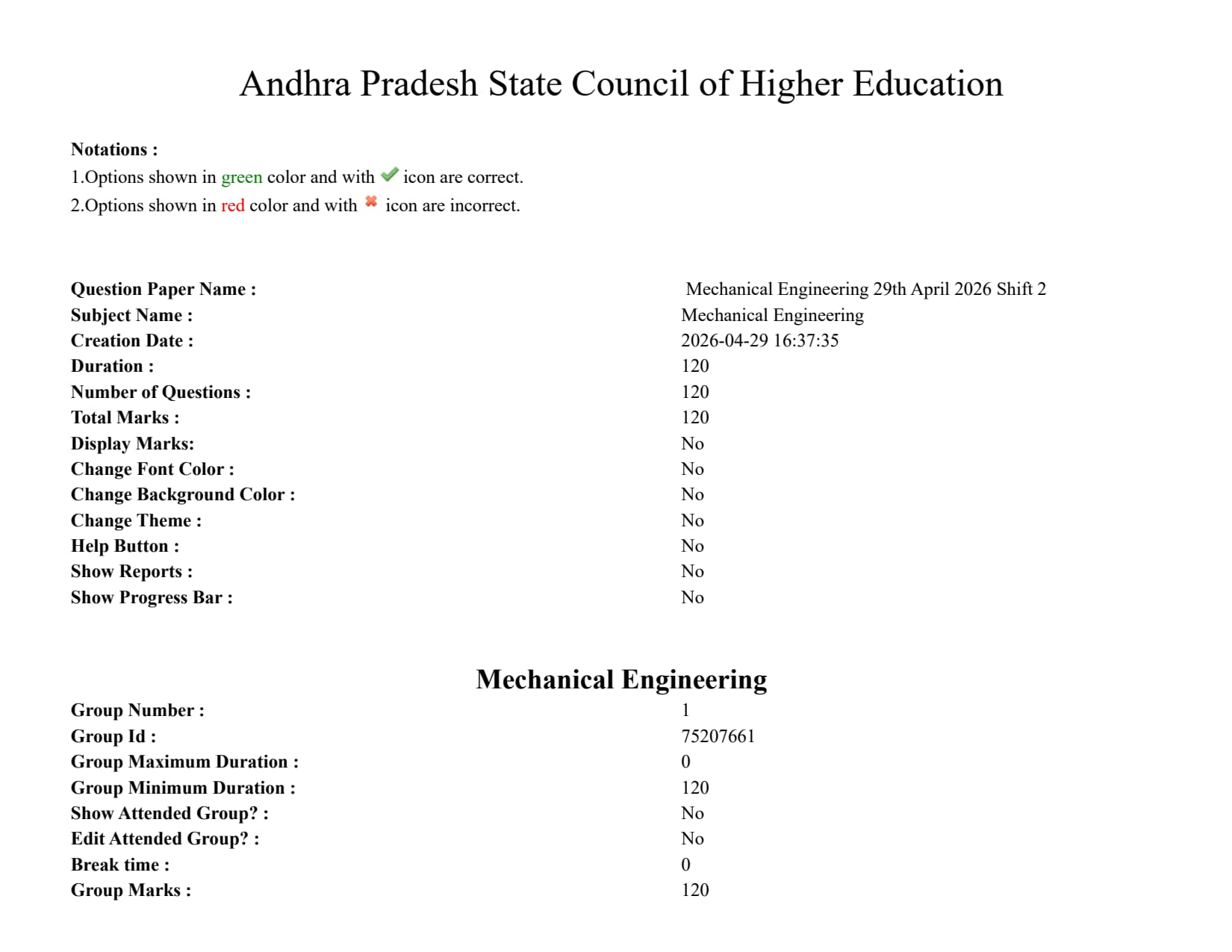
AP PGECET 2026 Mechanical Engineering Question Paper is available for download here. Andhra University, Visakhapatnam on behalf of APSCHE conducted AP PGECET 2026 Mechanical Engineering exam on April 29 in Shift 2. AP PGECET is a state-level entrance exam conducted online for admission into M.Tech./M.Pharm./Pharm.D (PB) courses.
- AP PGECET Question Paper consists of 120 questions divided into two sections- Mathematics and Engineering Domain Specific.
- Each correct answer answer carries 1 mark and there is no negative marking for incorrect answer.
Candidates can download AP PGECET 2026 Mechanical Engineering Question Paper with Answer Key and Solution PDF from the links provided below.
AP PGECET 2026 Mechanical Engineering Question Paper with Solutions
| AP PGECET 2026 Mechanical Engineering Question Paper | Download PDF | Check Solution |
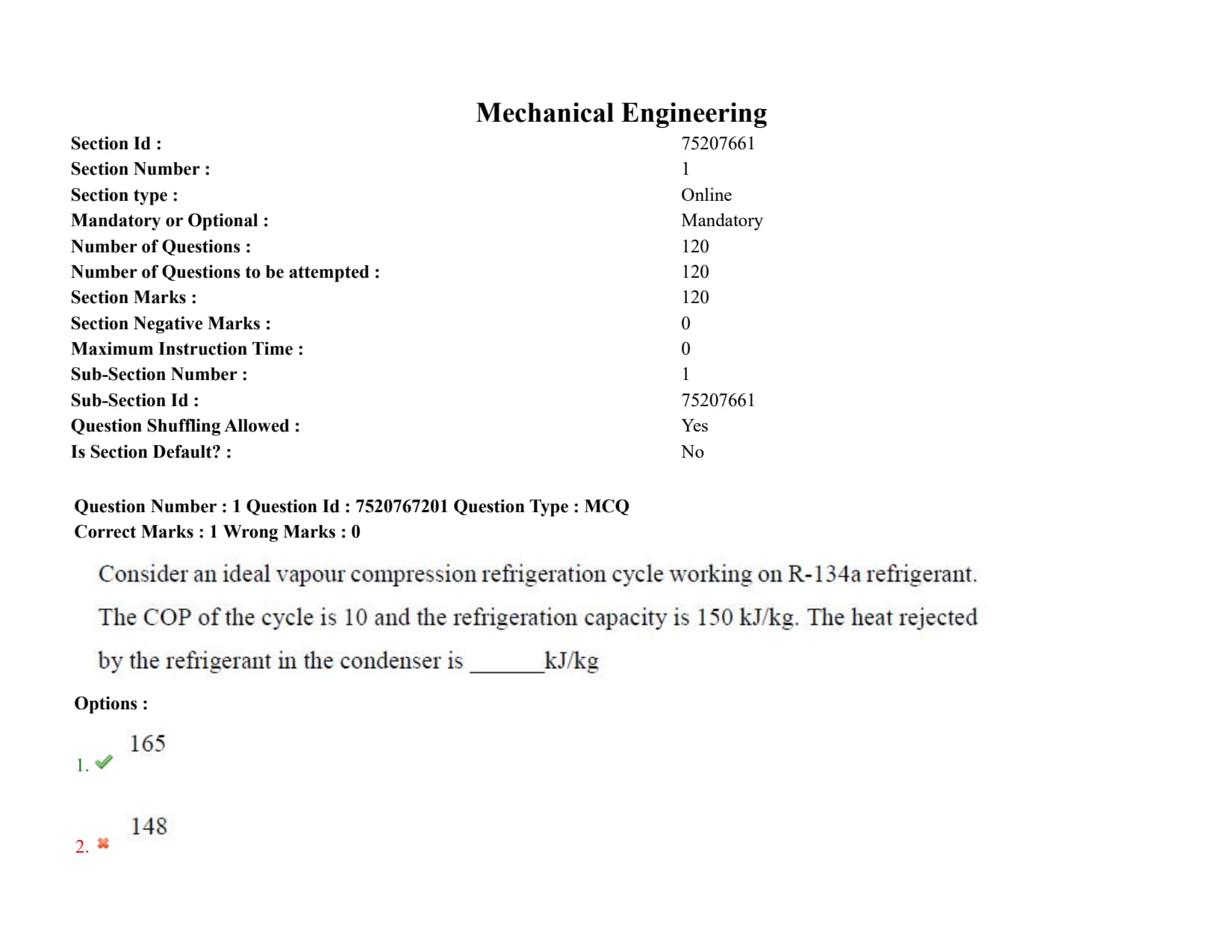
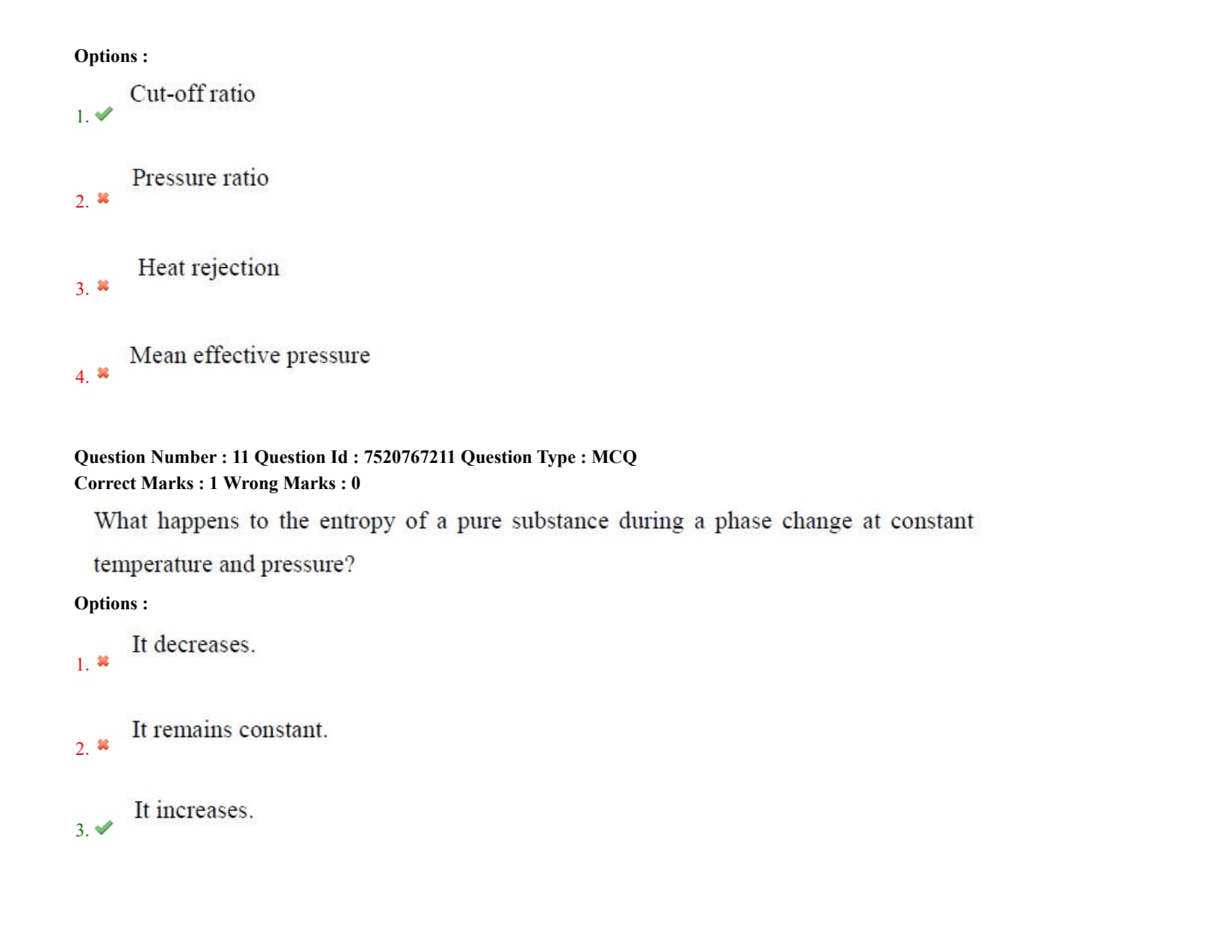
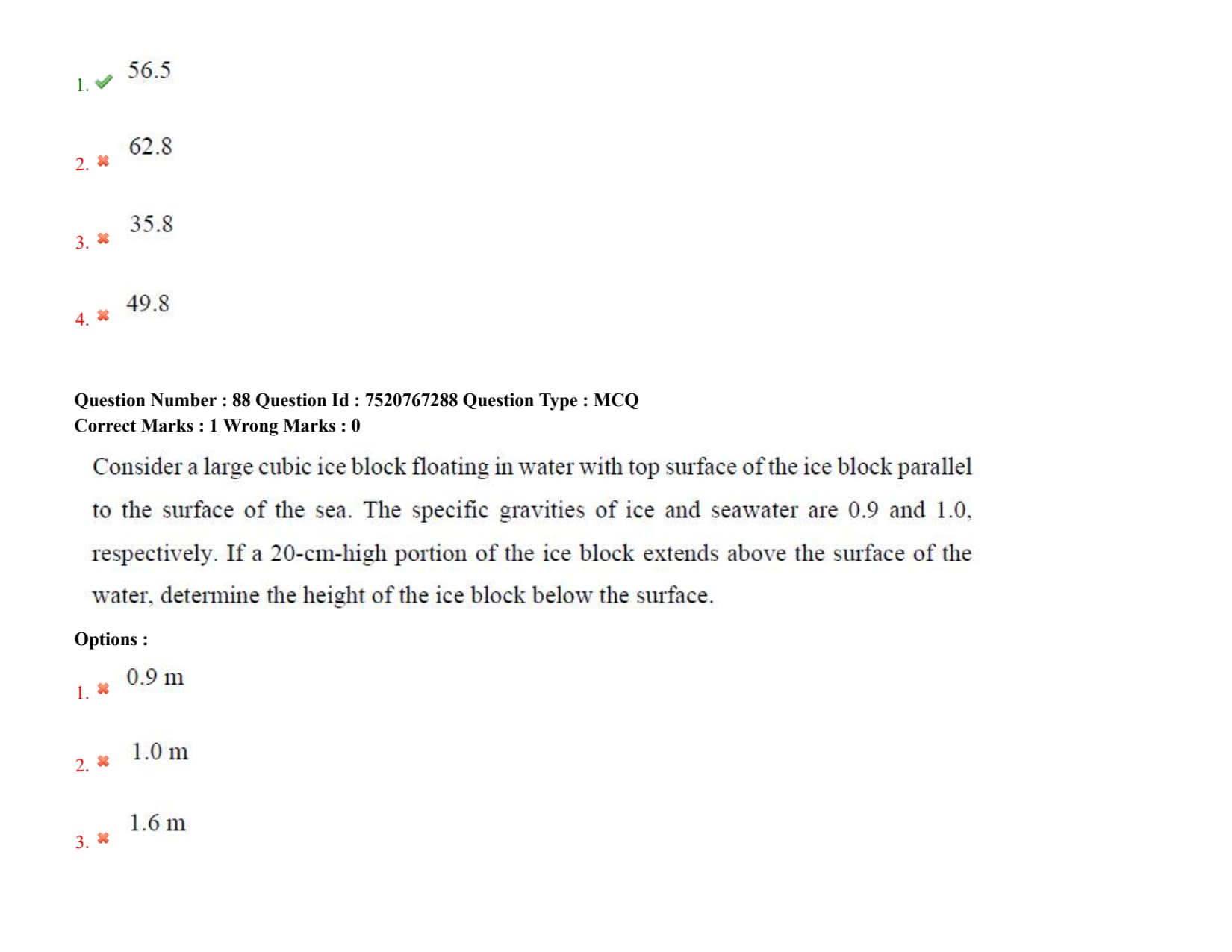
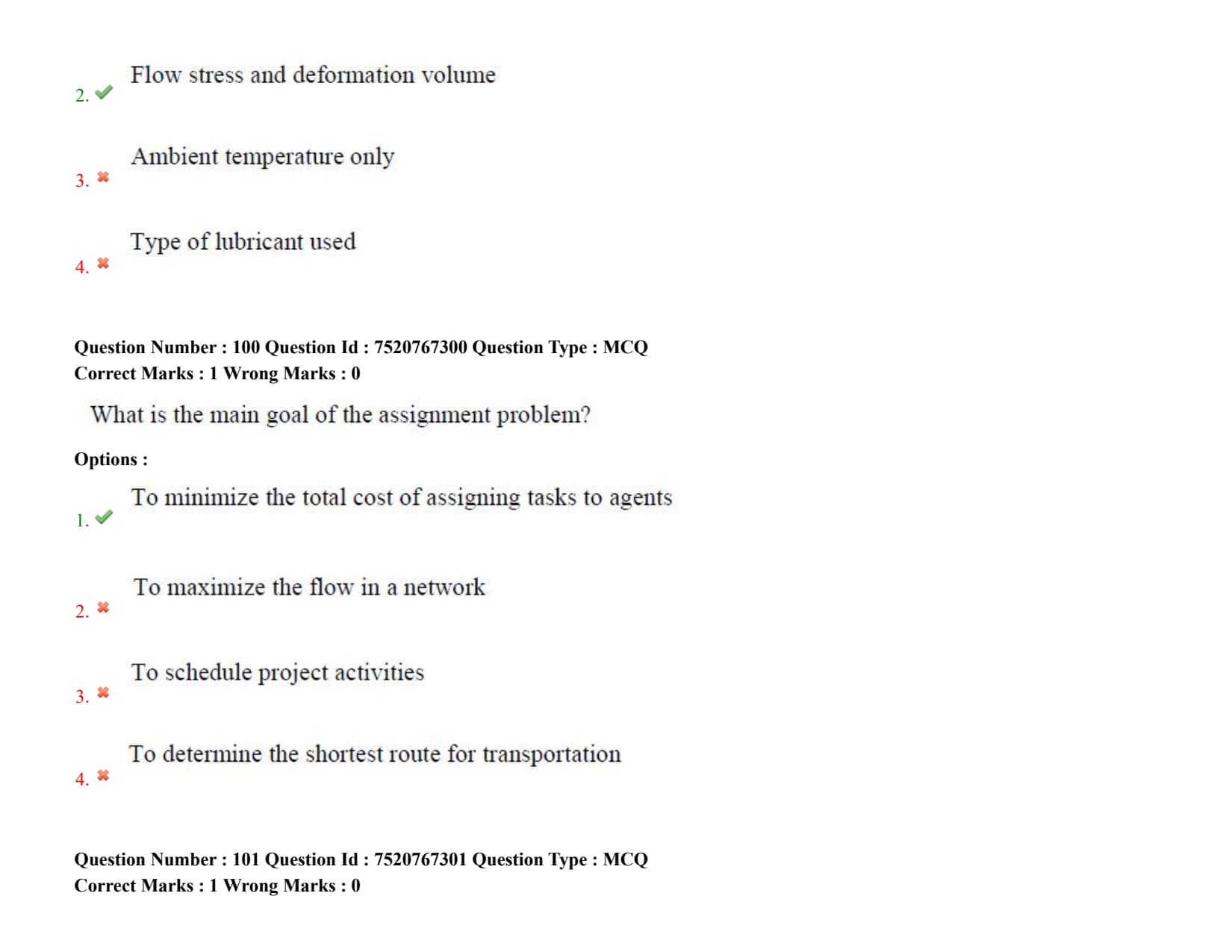
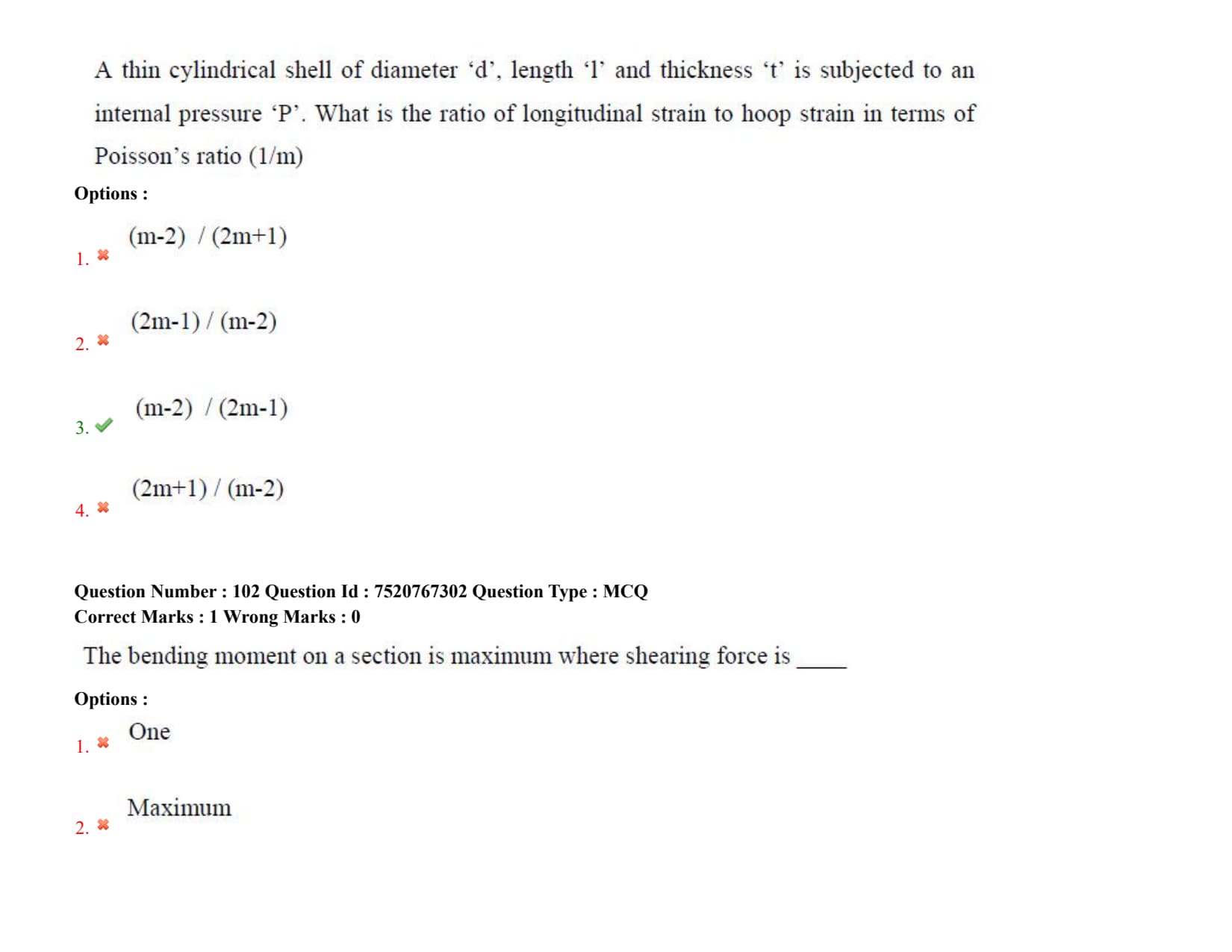
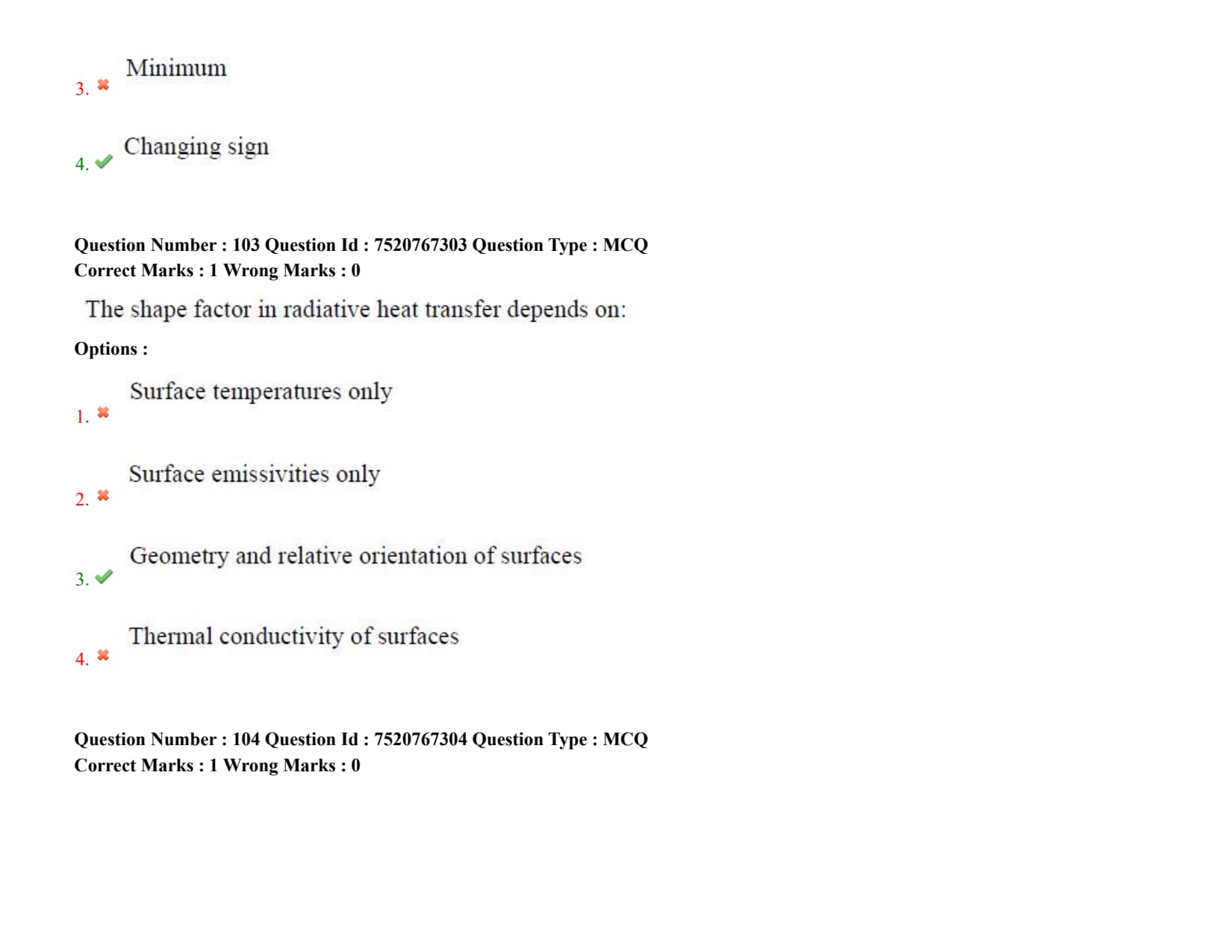
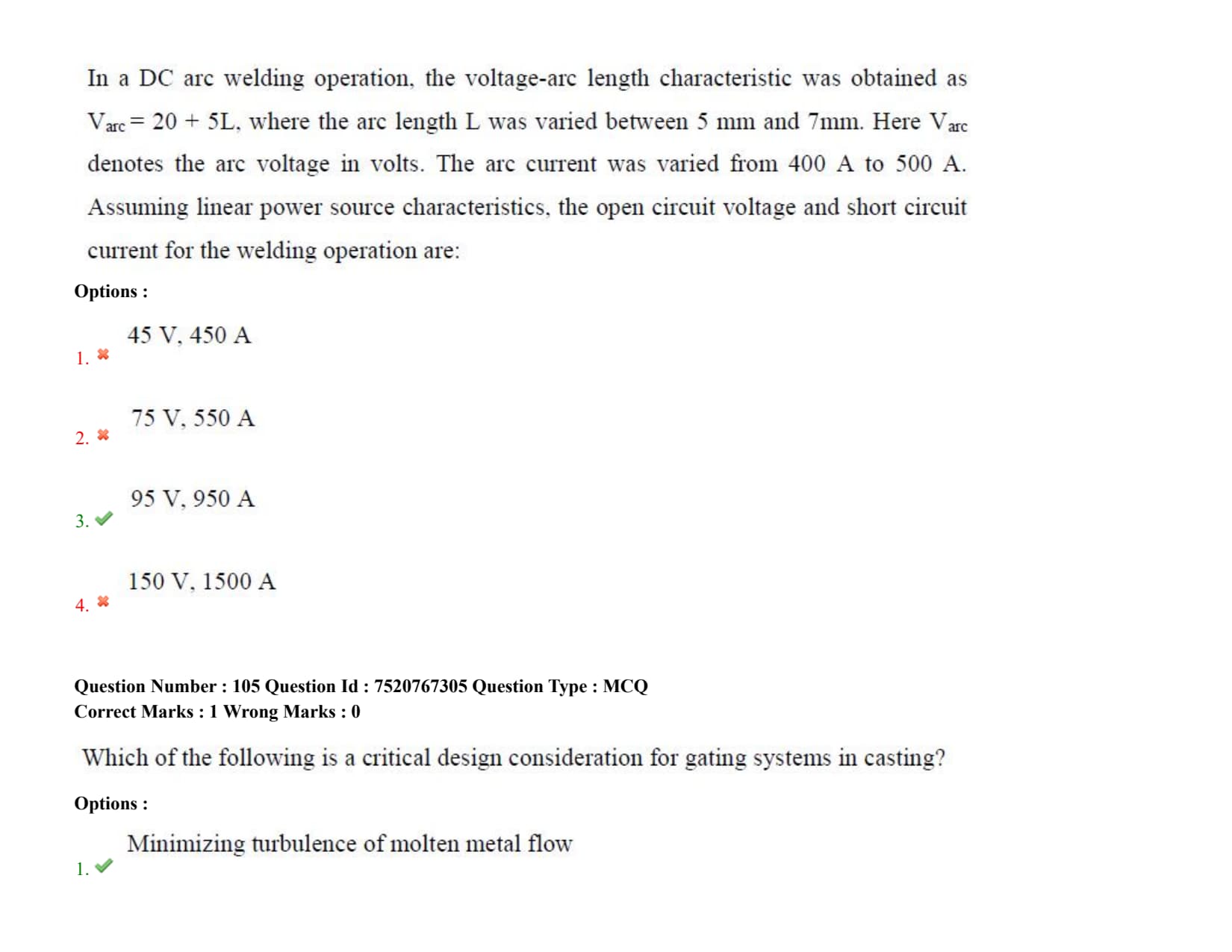
Consider an ideal vapour compression refrigeration cycle working on R-134a refrigerant. The COP of the cycle is 10 and the refrigeration capacity is 150 kJ/kg. The heat rejected by the refrigerant in the condenser is _______ kJ/kg.
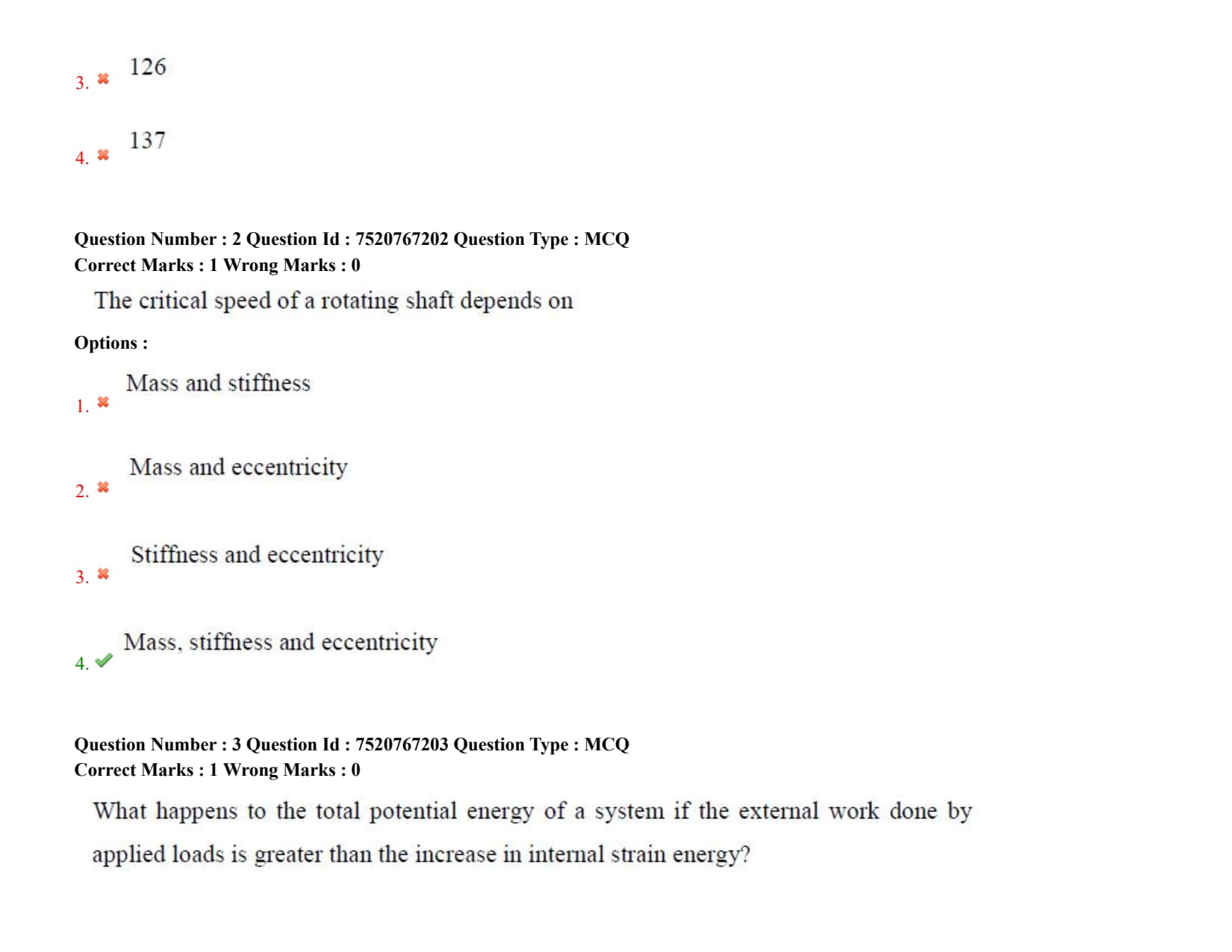
The critical speed of a rotating shaft depends on
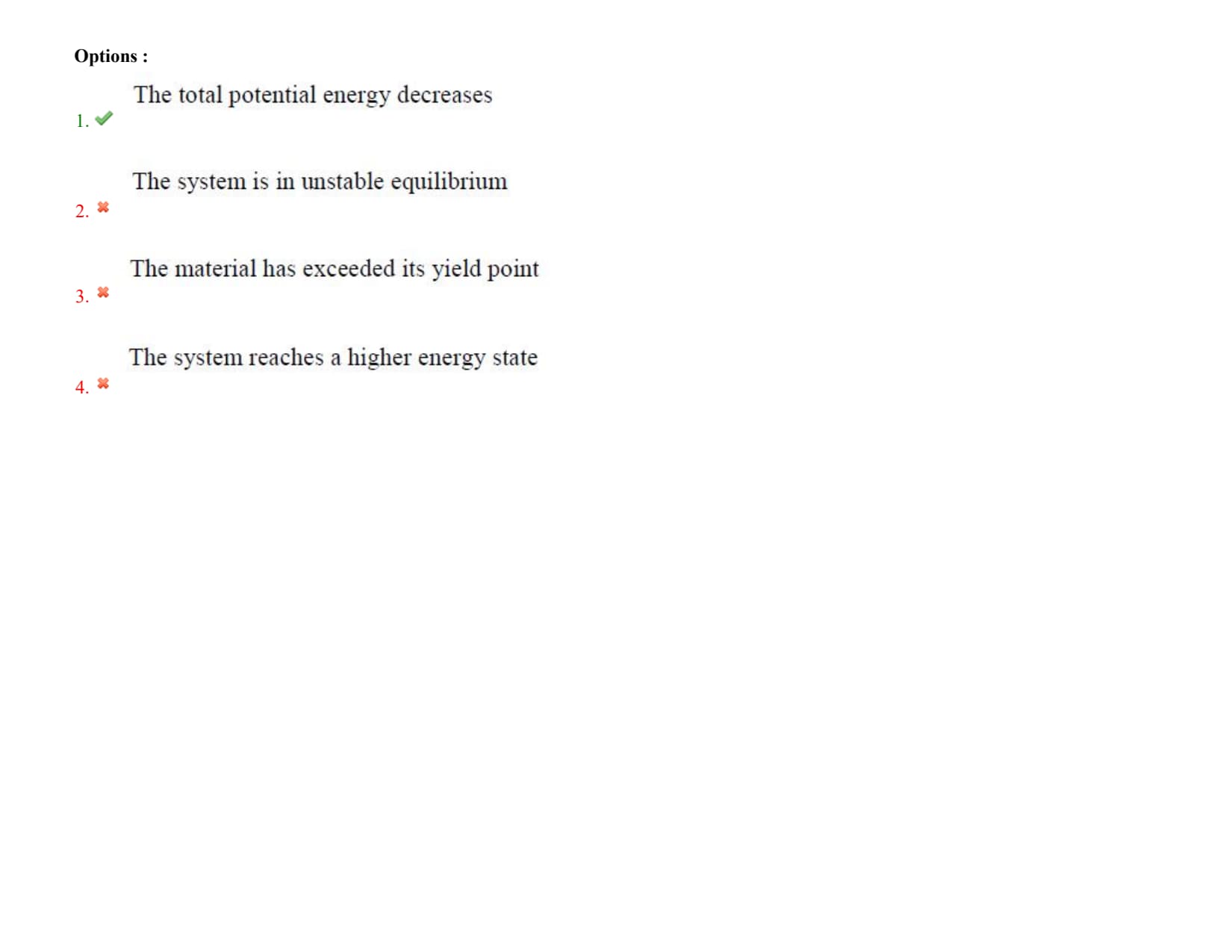
What happens to the total potential energy of a system if the external work done by applied loads is greater than the increase in internal strain energy?
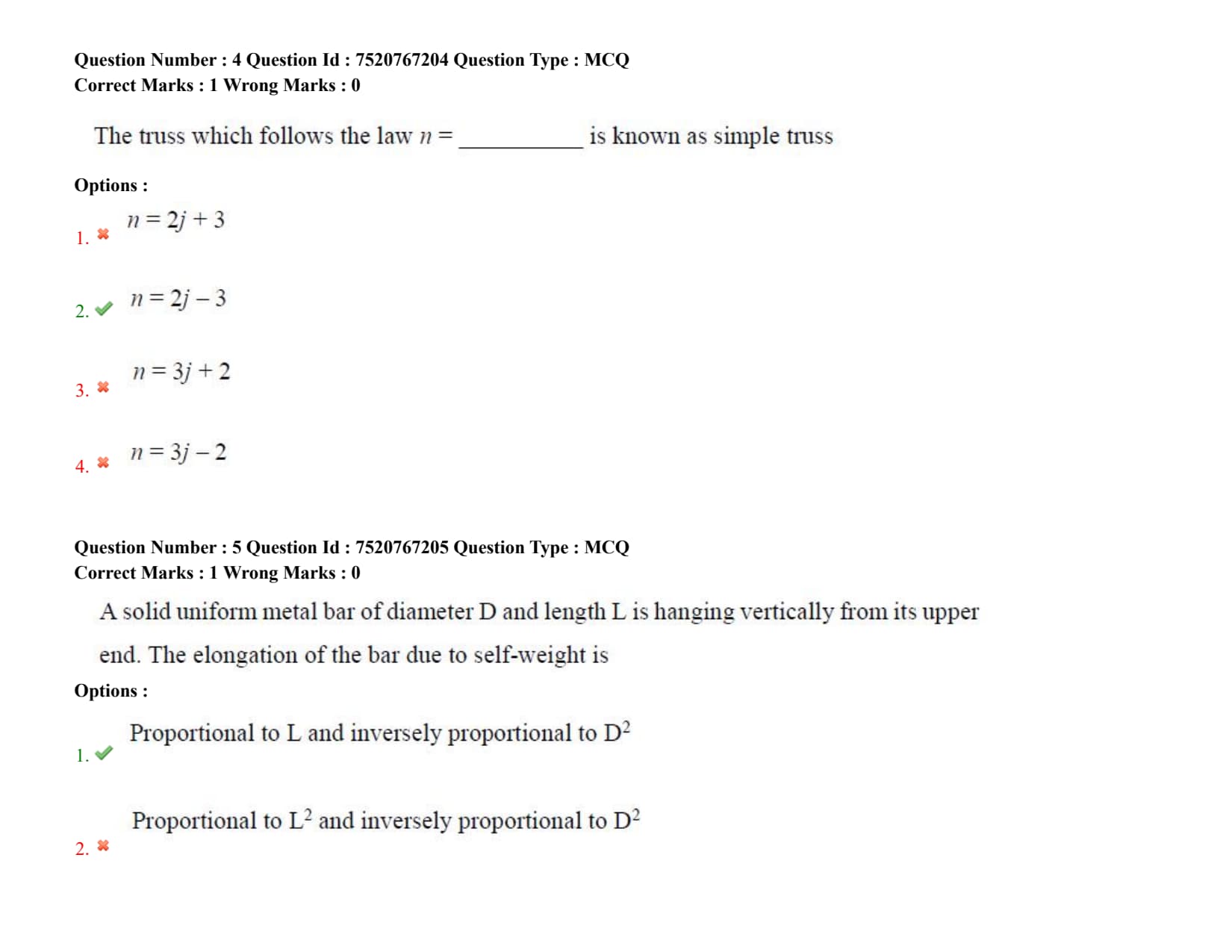
The truss which follows the law \(n =\) _________ is known as simple truss
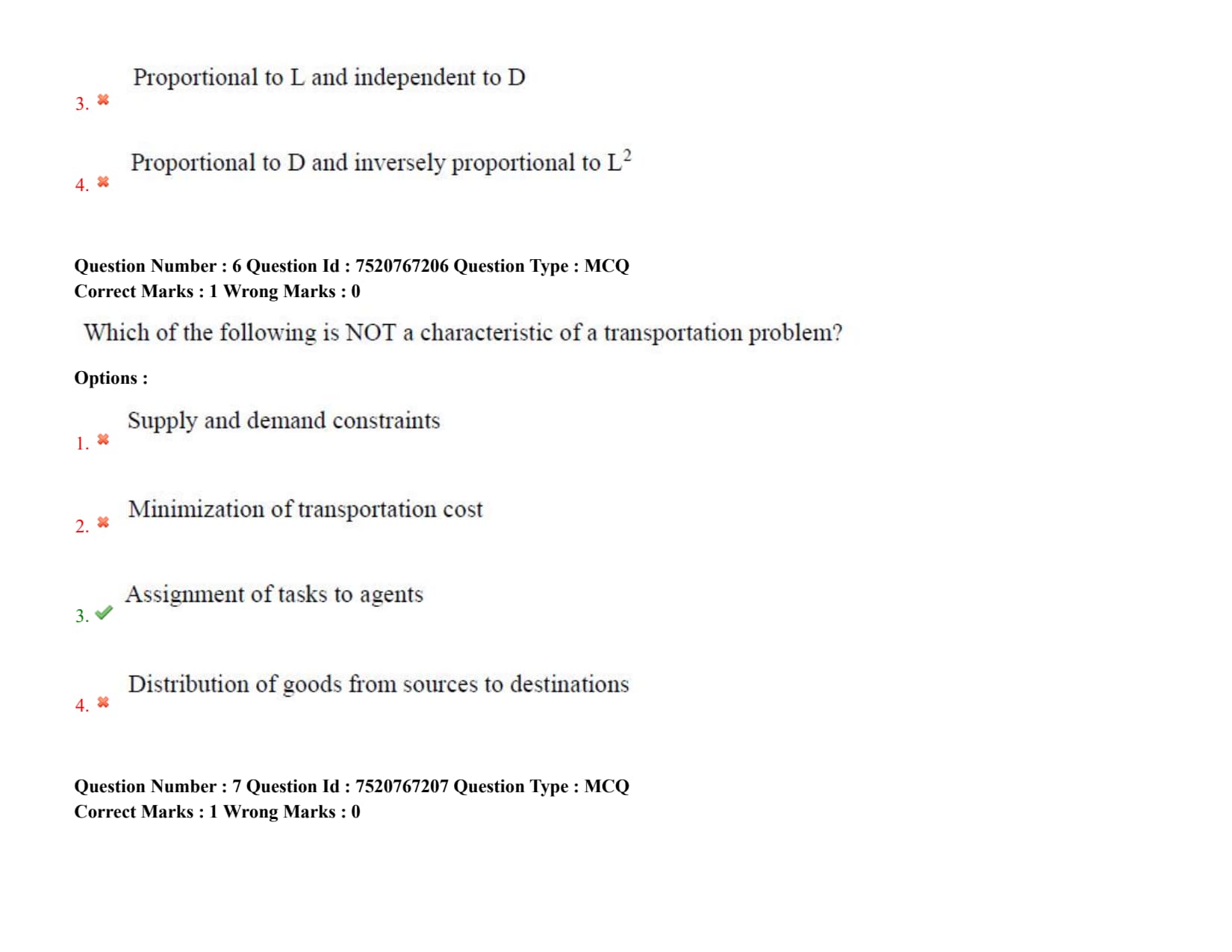
A solid uniform metal bar of diameter D and length L is hanging vertically from its upper end. The elongation of the bar due to self-weight is
Which of the following is NOT a characteristic of a transportation problem?
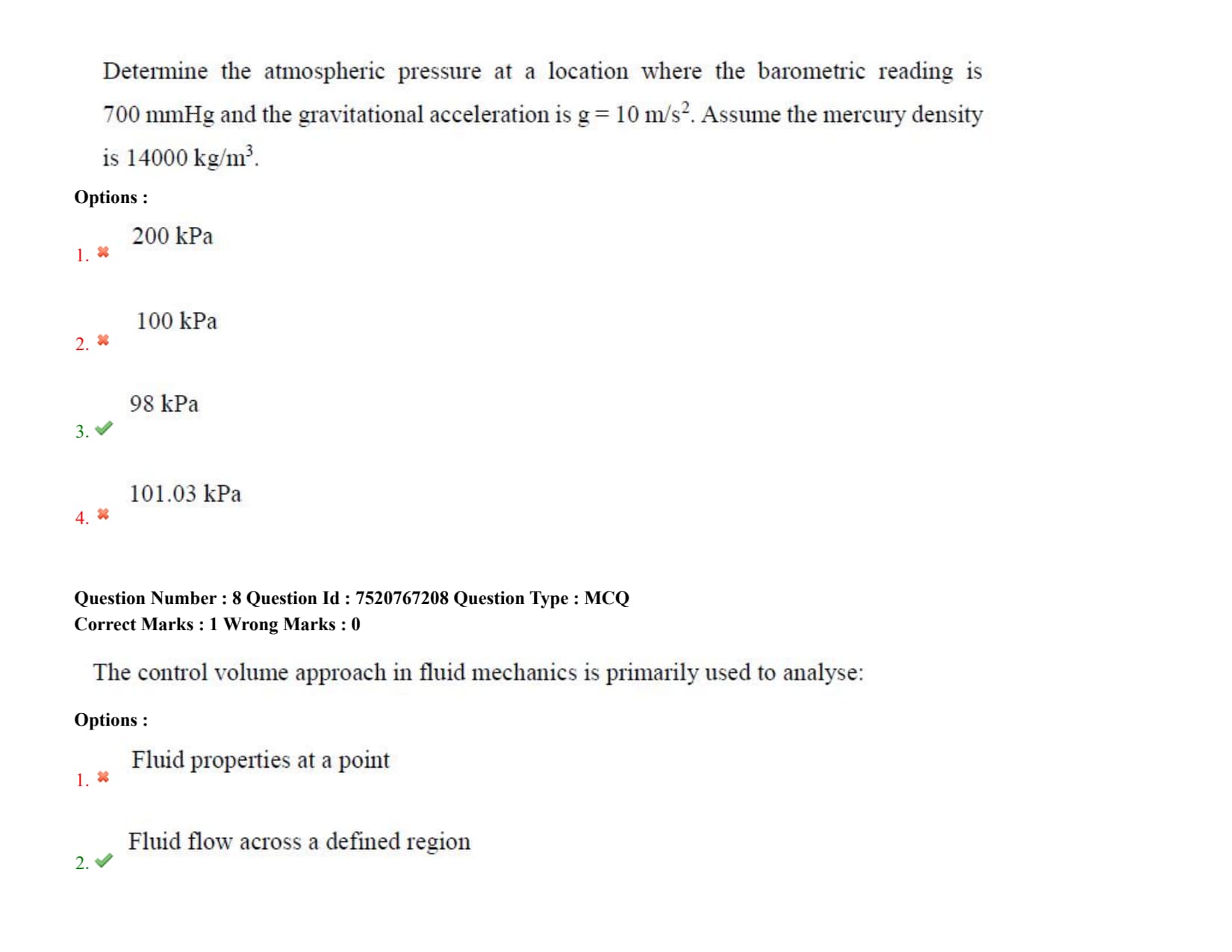
Determine the atmospheric pressure at a location where the barometric reading is 700 mmHg and the gravitational acceleration is \(g = 10 m/s^2\). Assume the mercury density is \(14000 kg/m^3\).
The control volume approach in fluid mechanics is primarily used to analyse:
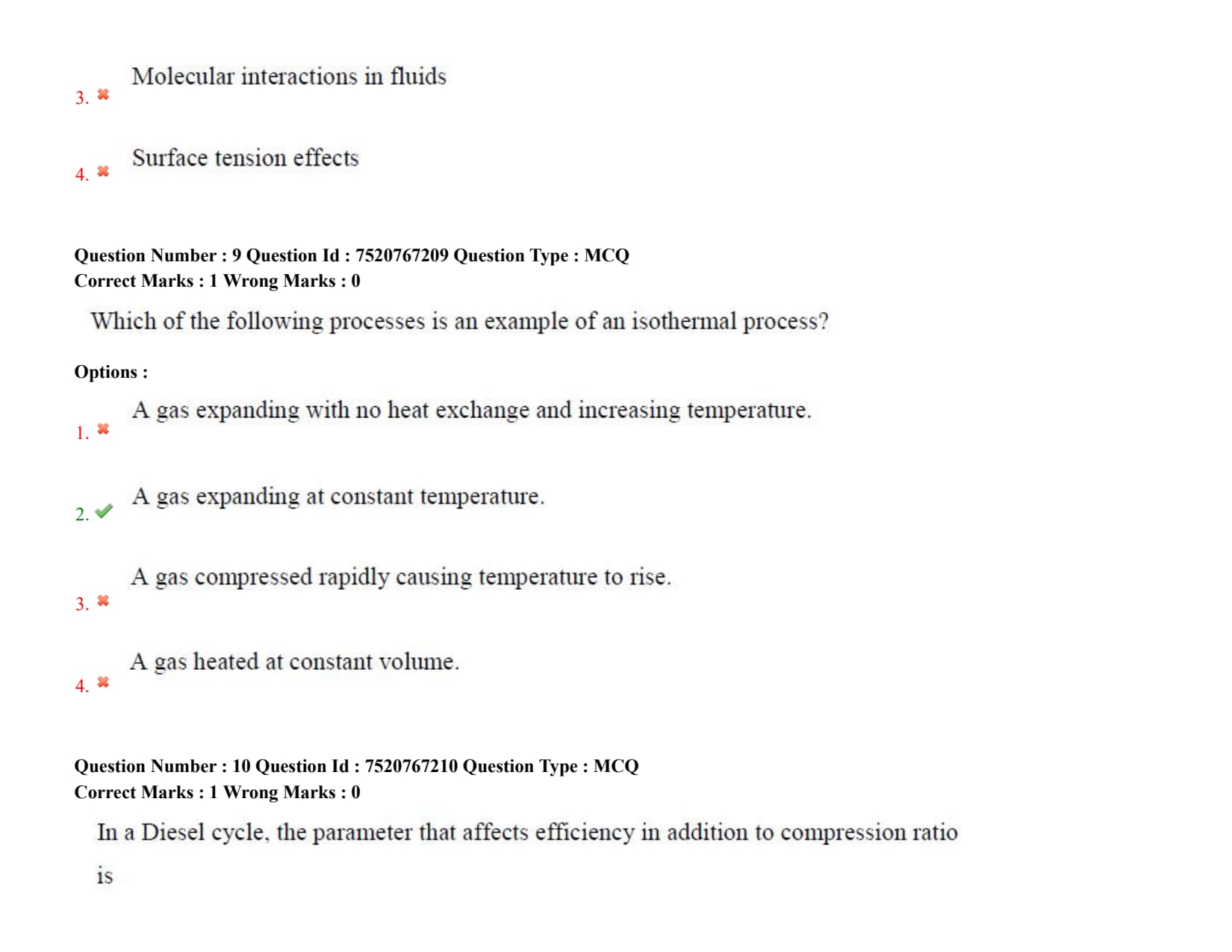
Which of the following processes is an example of an isothermal process?
In a Diesel cycle, the parameter that affects efficiency in addition to compression ratio is
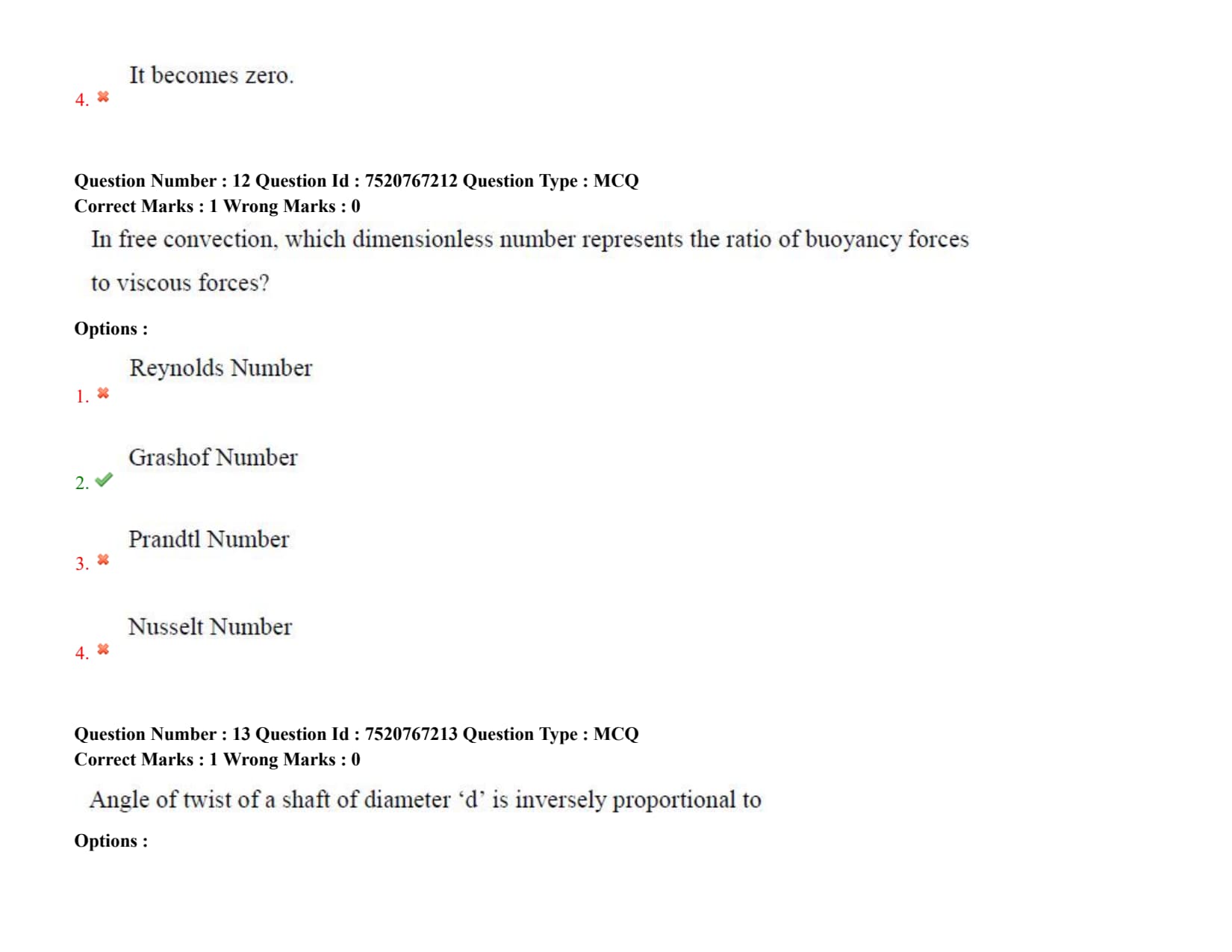
What happens to the entropy of a pure substance during a phase change at constant temperature and pressure?
In free convection, which dimensionless number represents the ratio of buoyancy forces to viscous forces?
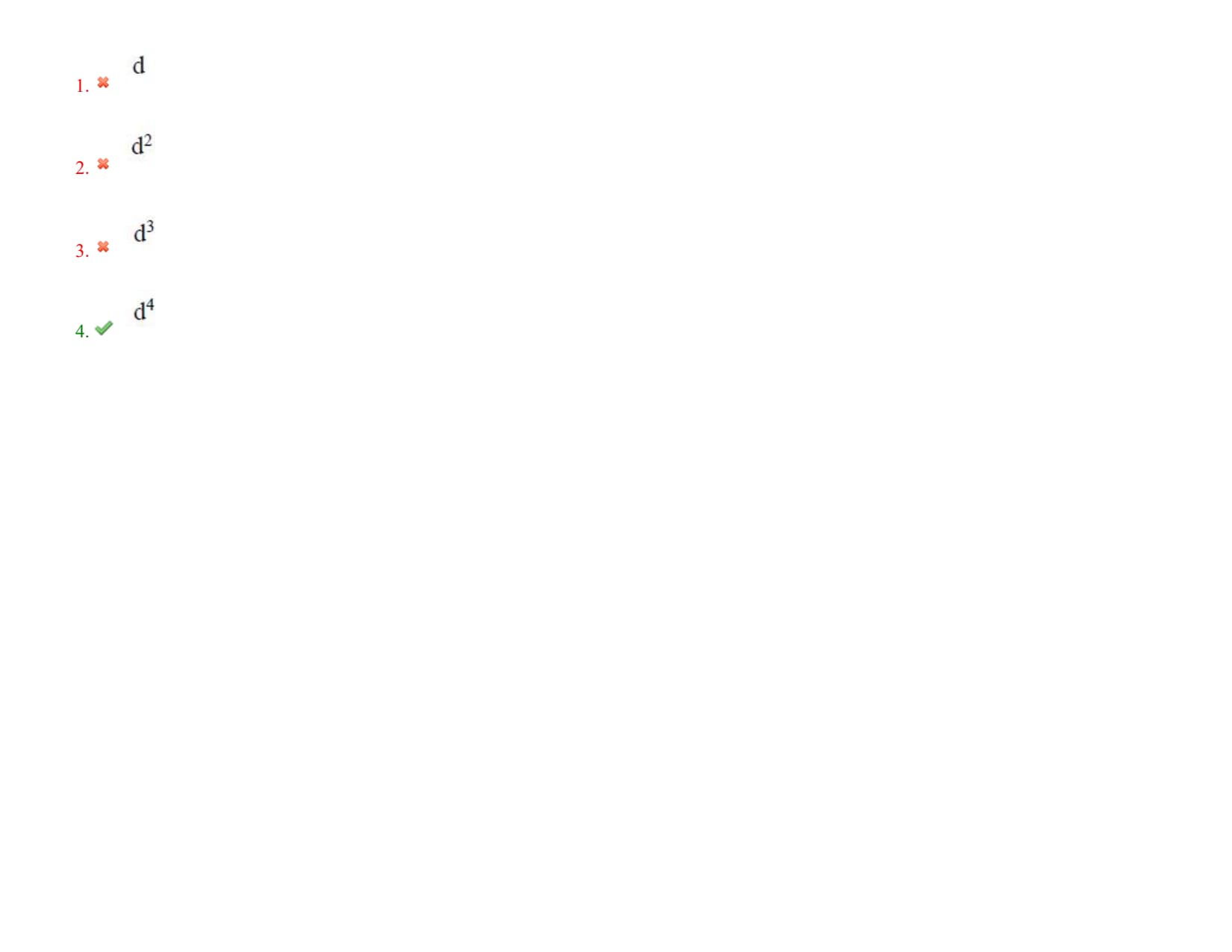
Angle of twist of a shaft of diameter 'd' is inversely proportional to
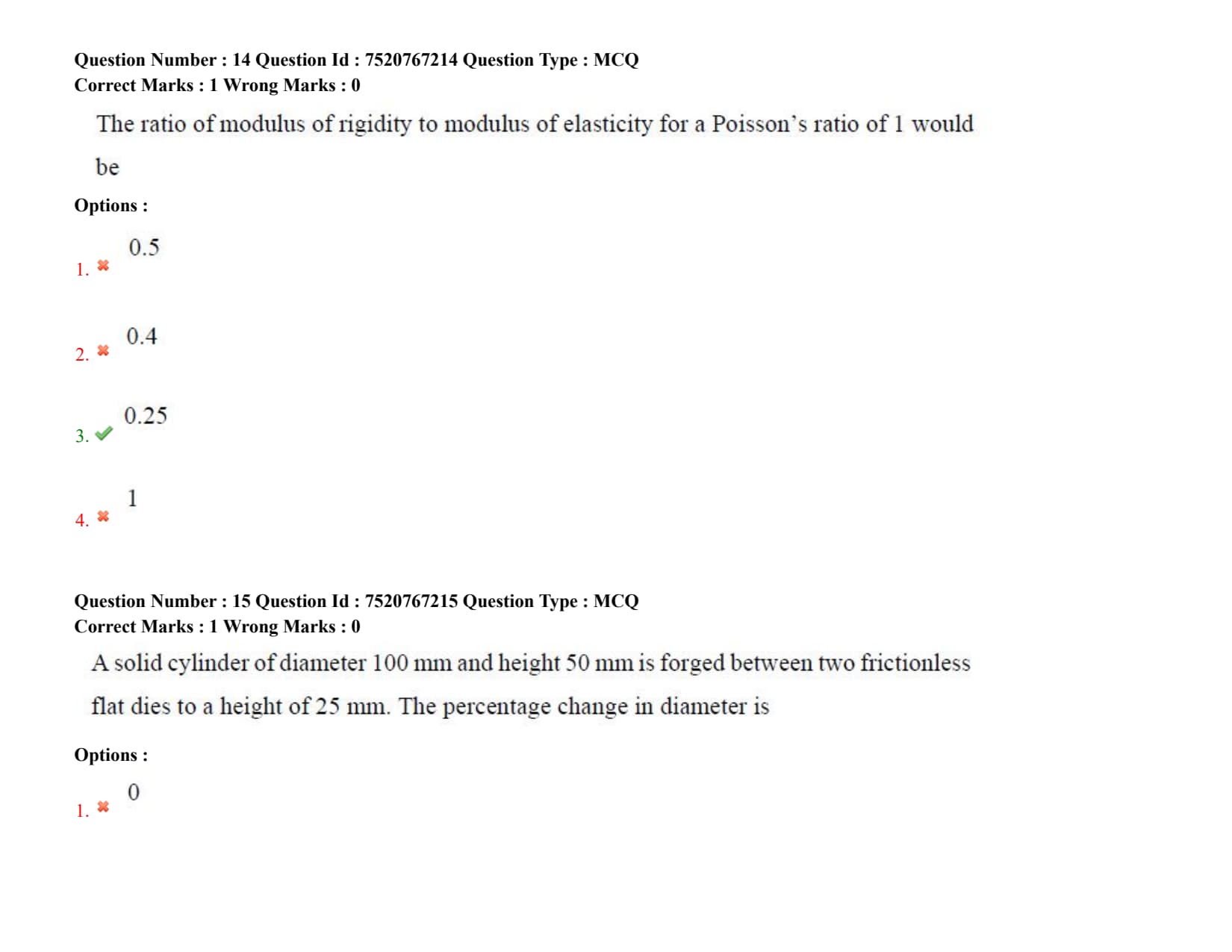
The ratio of modulus of rigidity to modulus of elasticity for a Poisson's ratio of 1 would be
A solid cylinder of diameter 100 mm and height 50 mm is forged between two frictionless flat dies to a height of 25 mm. The percentage change in diameter is
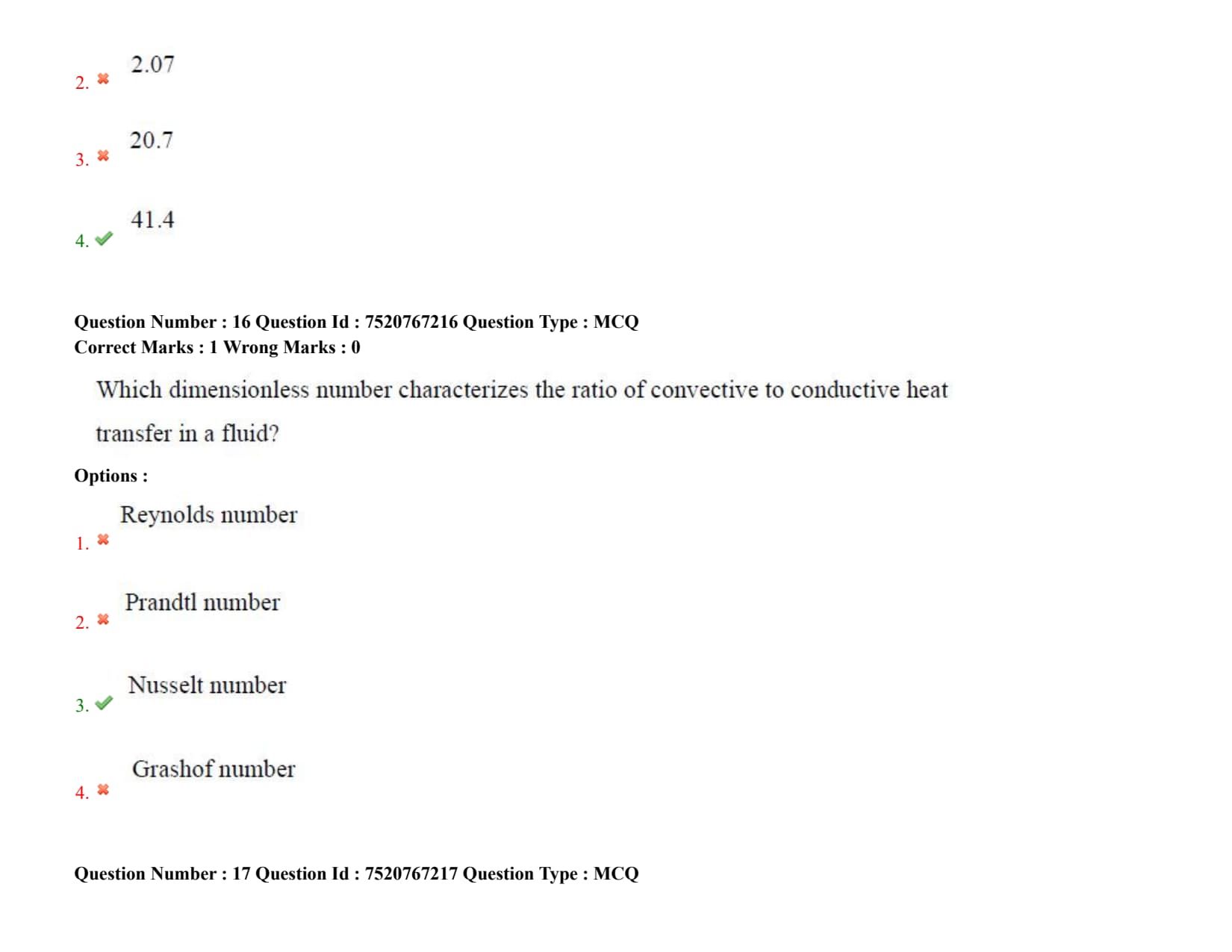
Which dimensionless number characterizes the ratio of convective to conductive heat transfer in a fluid?
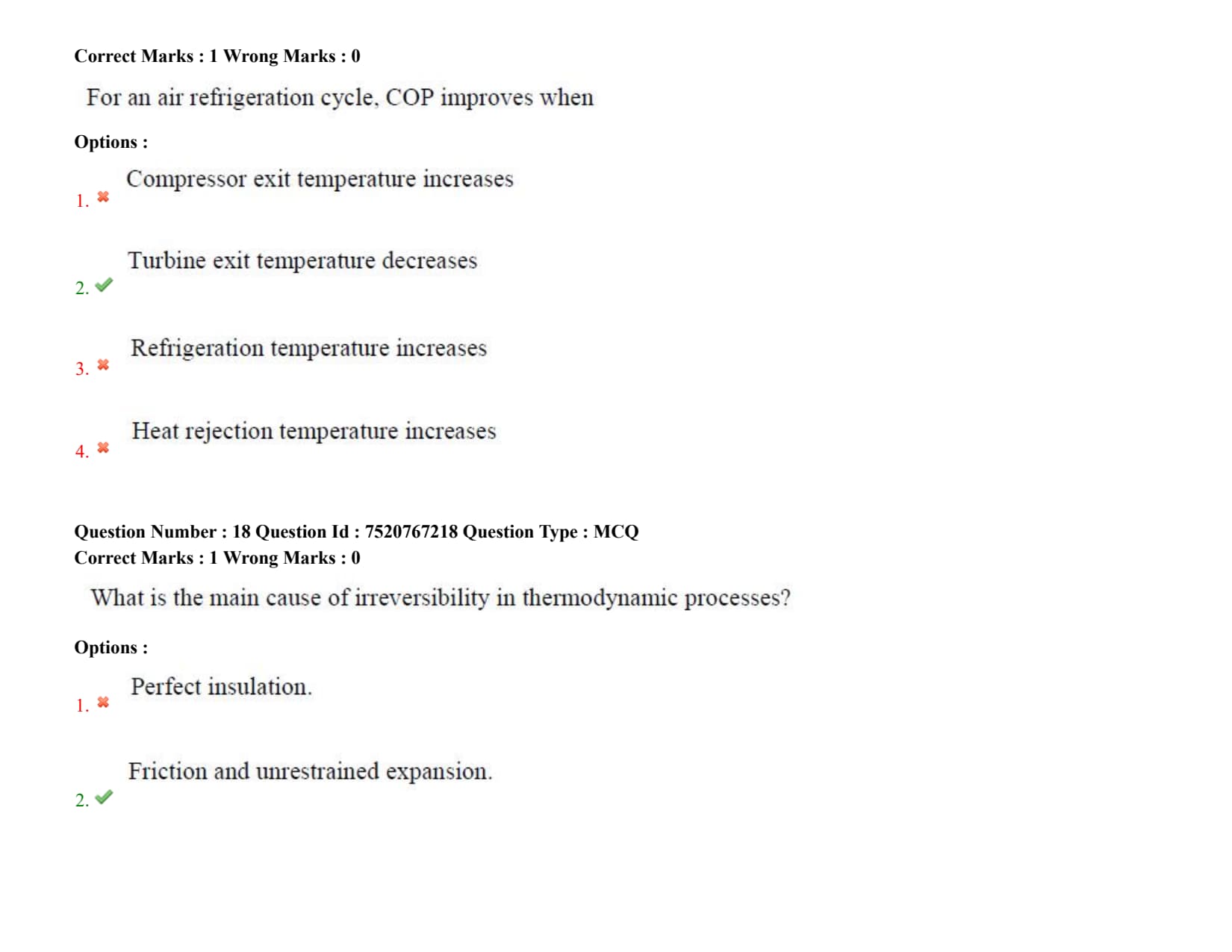
For an air refrigeration cycle, COP improves when
What is the main cause of irreversibility in thermodynamic processes?
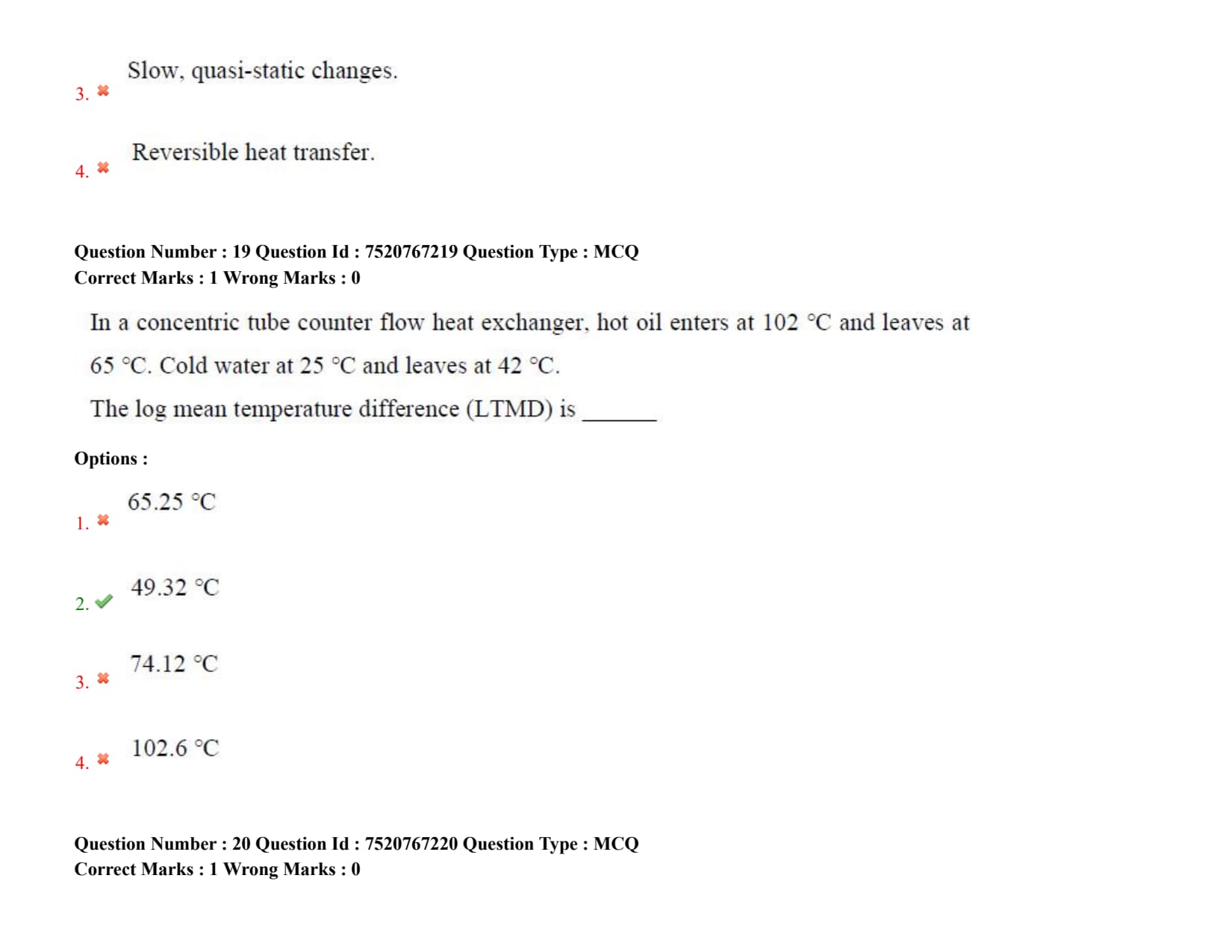
In a concentric tube counter flow heat exchanger, hot oil enters at \(102 ^{\circ}C\) and leaves at \(65 ^{\circ}C\). Cold water at \(25 ^{\circ}C\) and leaves at \(42 ^{\circ}C\). The log mean temperature difference (LTMD) is _______
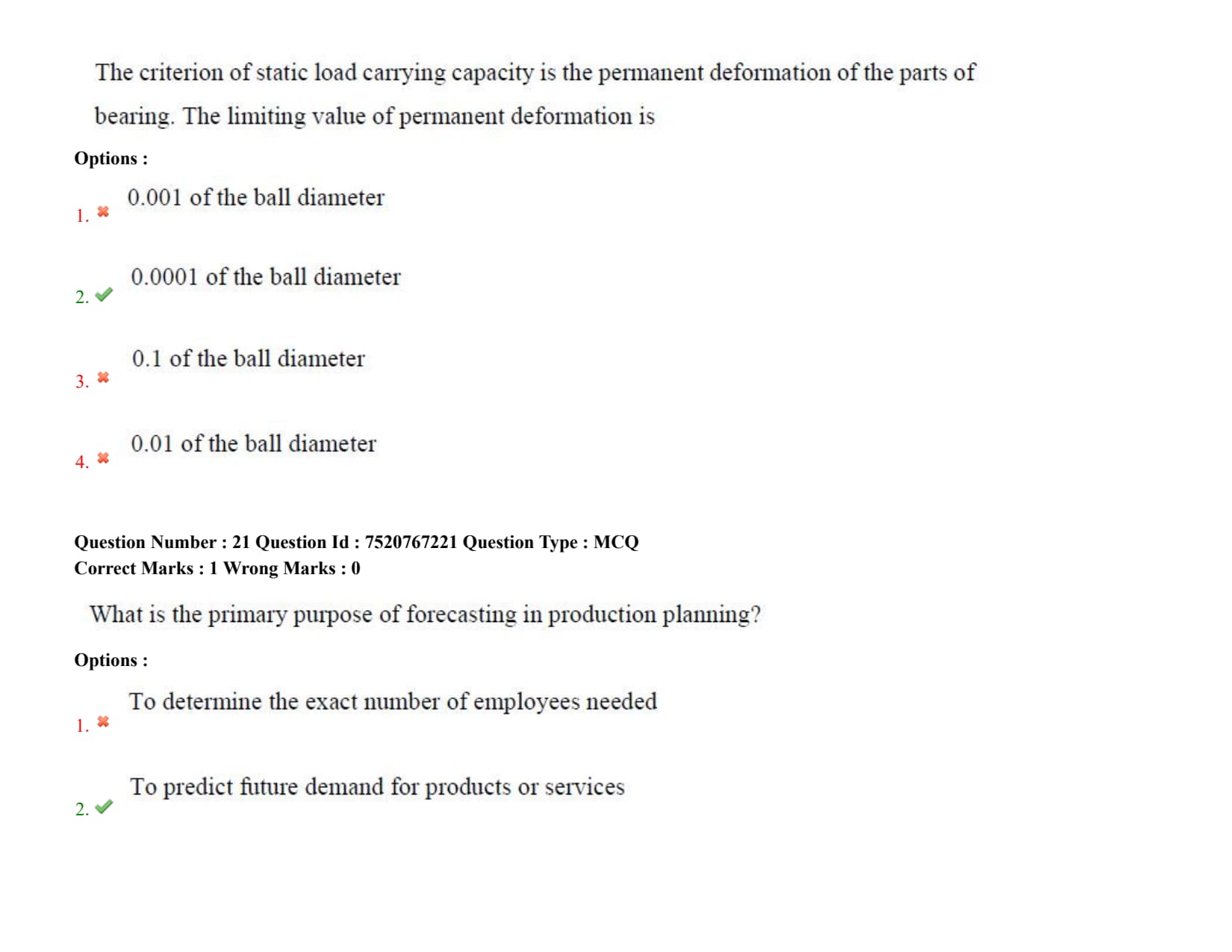
The criterion of static load carrying capacity is the permanent deformation of the parts of bearing. The limiting value of permanent deformation is
What is the primary purpose of forecasting in production planning?
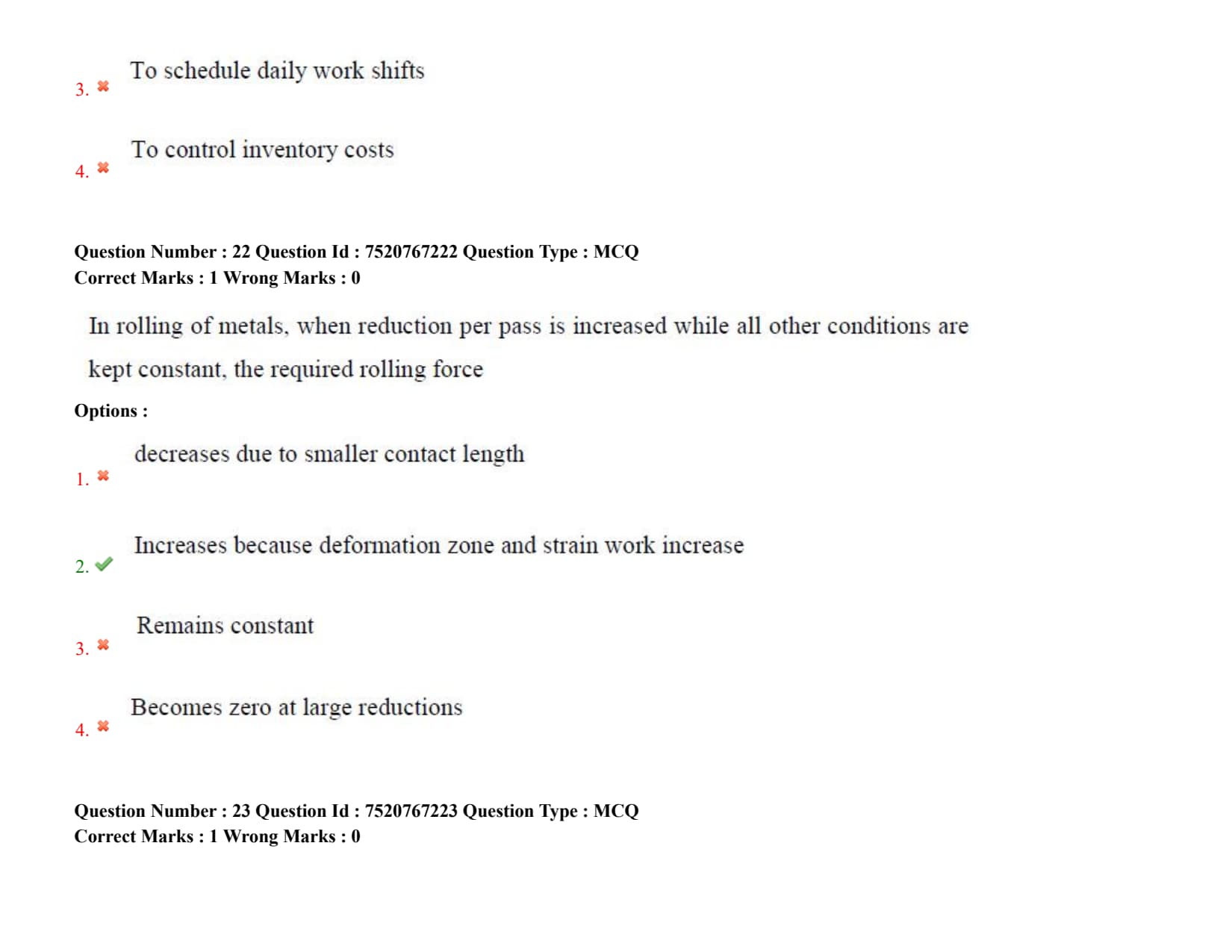
In rolling of metals, when reduction per pass is increased while all other conditions are kept constant, the required rolling force
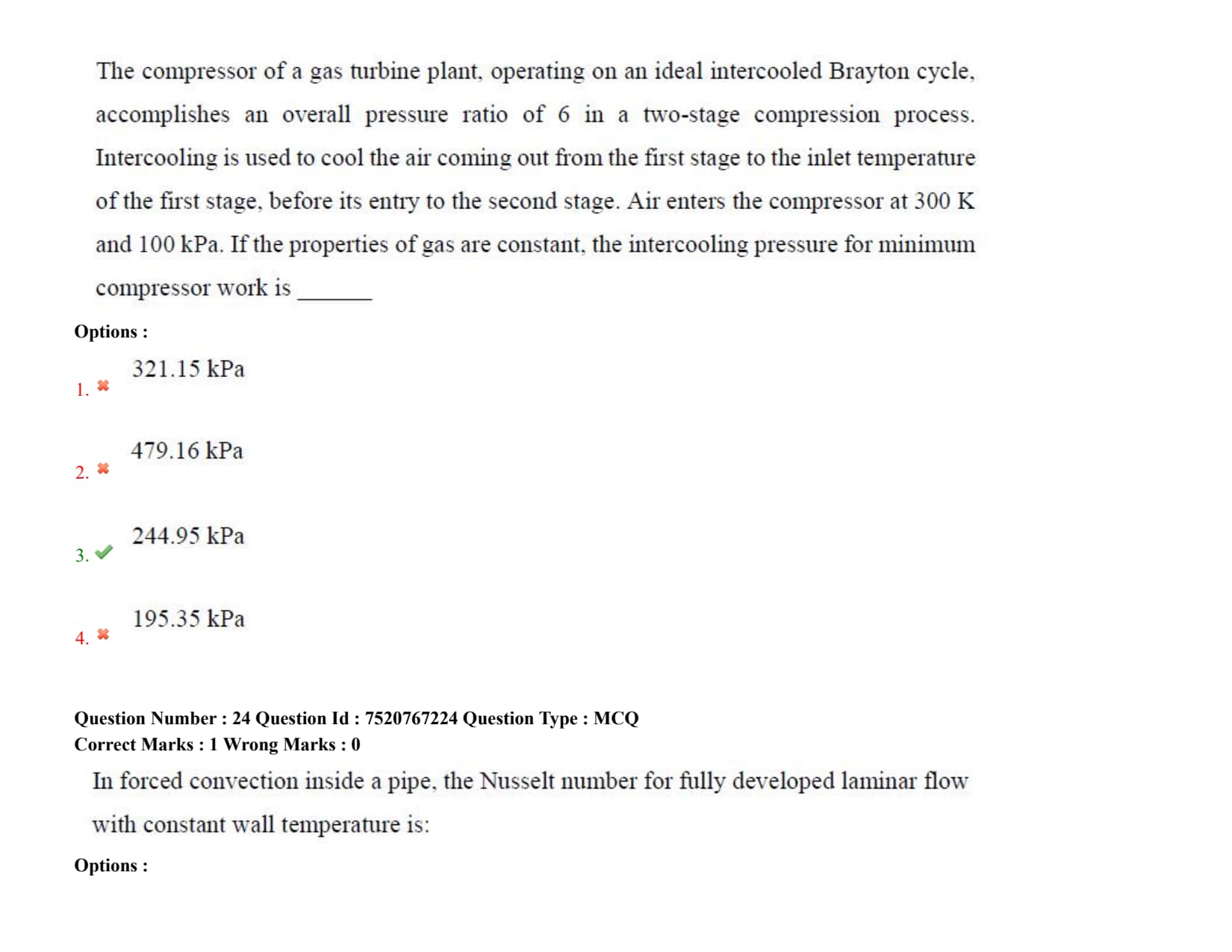
The compressor of a gas turbine plant, operating on an ideal intercooled Brayton cycle, accomplishes an overall pressure ratio of 6 in a two-stage compression process. Intercooling is used to cool the air coming out from the first stage to the inlet temperature of the first stage, before its entry to the second stage. Air enters the compressor at 300 K and 100 kPa. If the properties of gas are constant, the intercooling pressure for minimum compressor work is _______
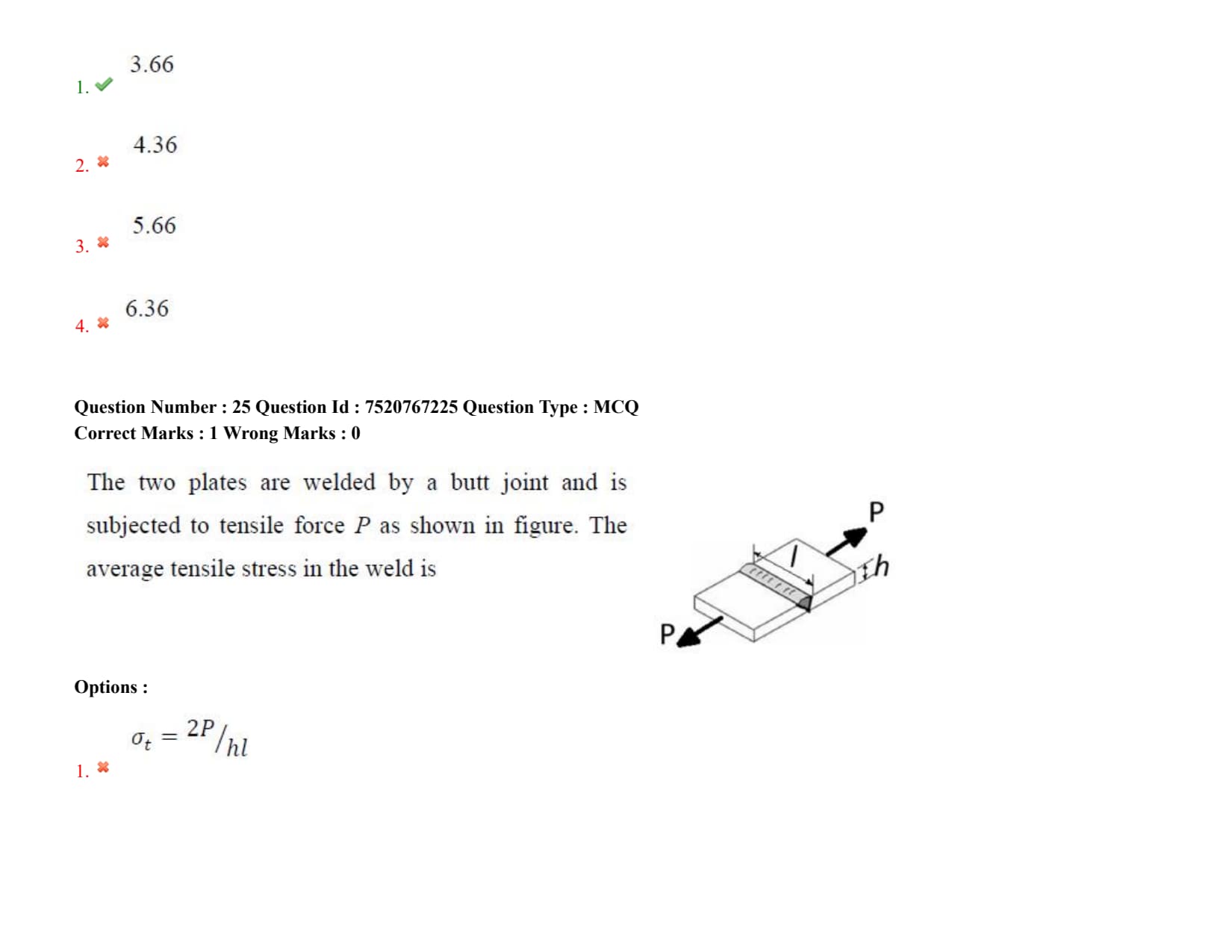
In forced convection inside a pipe, the Nusselt number for fully developed laminar flow with constant wall temperature is:
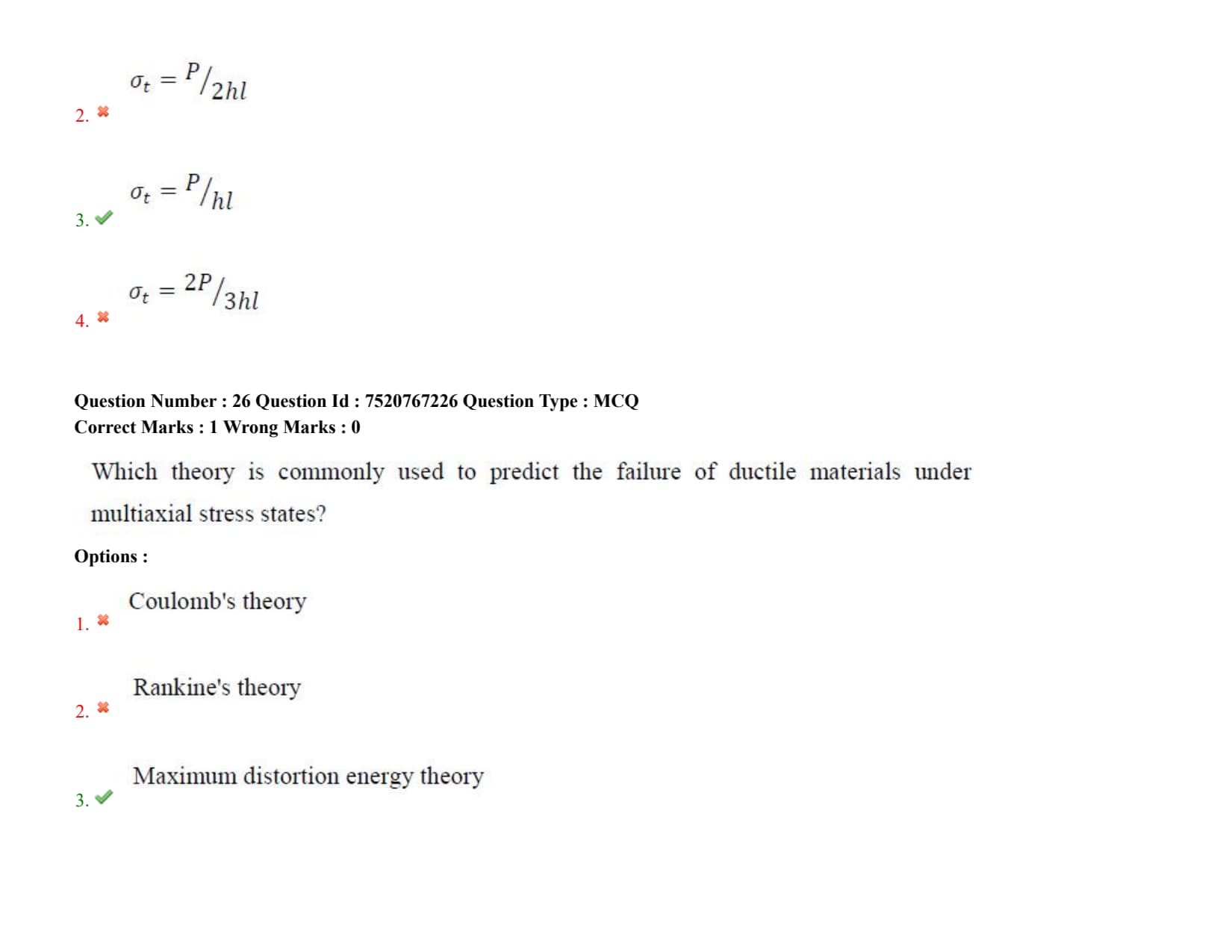
The two plates are welded by a butt joint and is subjected to tensile force P as shown in figure. The average tensile stress in the weld is

Which theory is commonly used to predict the failure of ductile materials under multiaxial stress states?
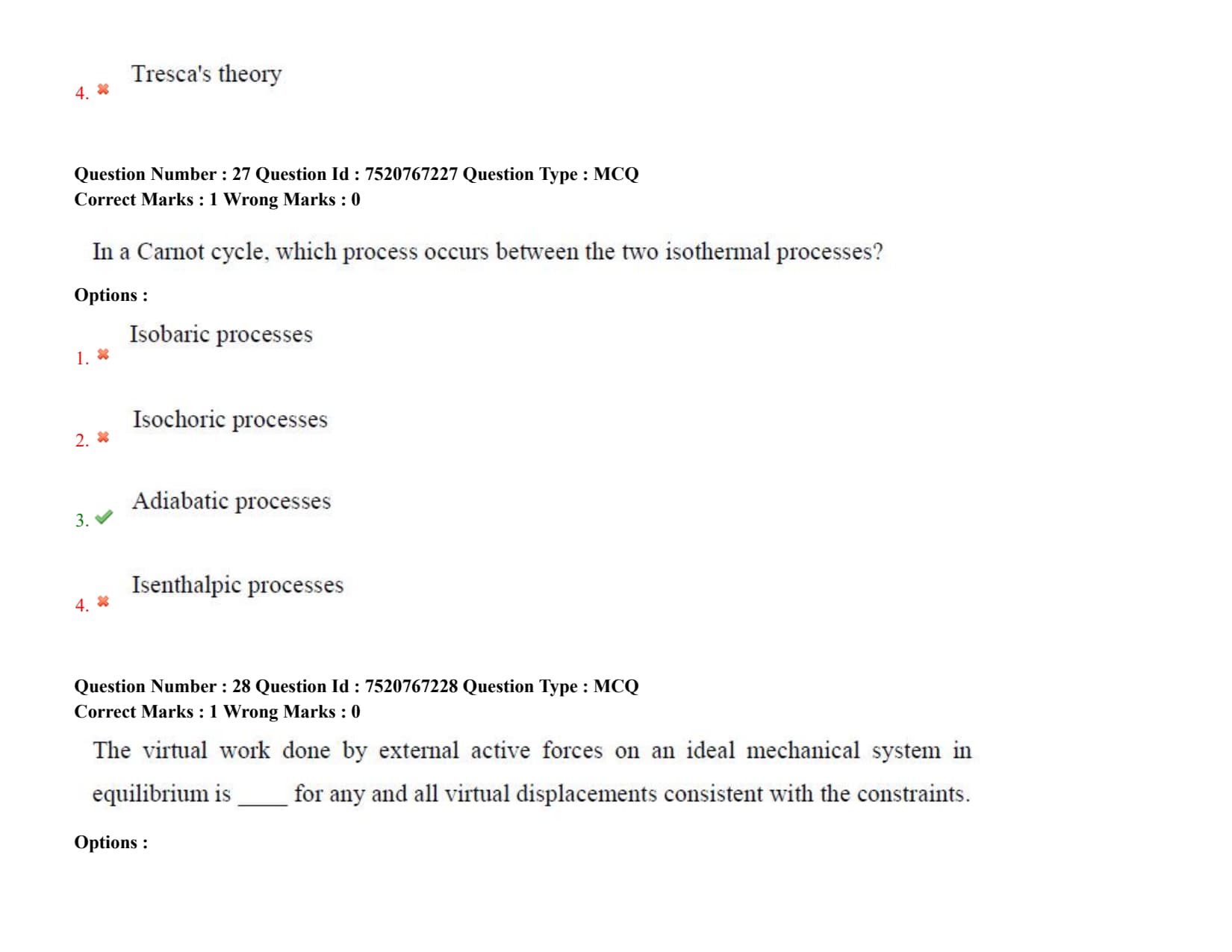
In a Carnot cycle, which process occurs between the two isothermal processes?
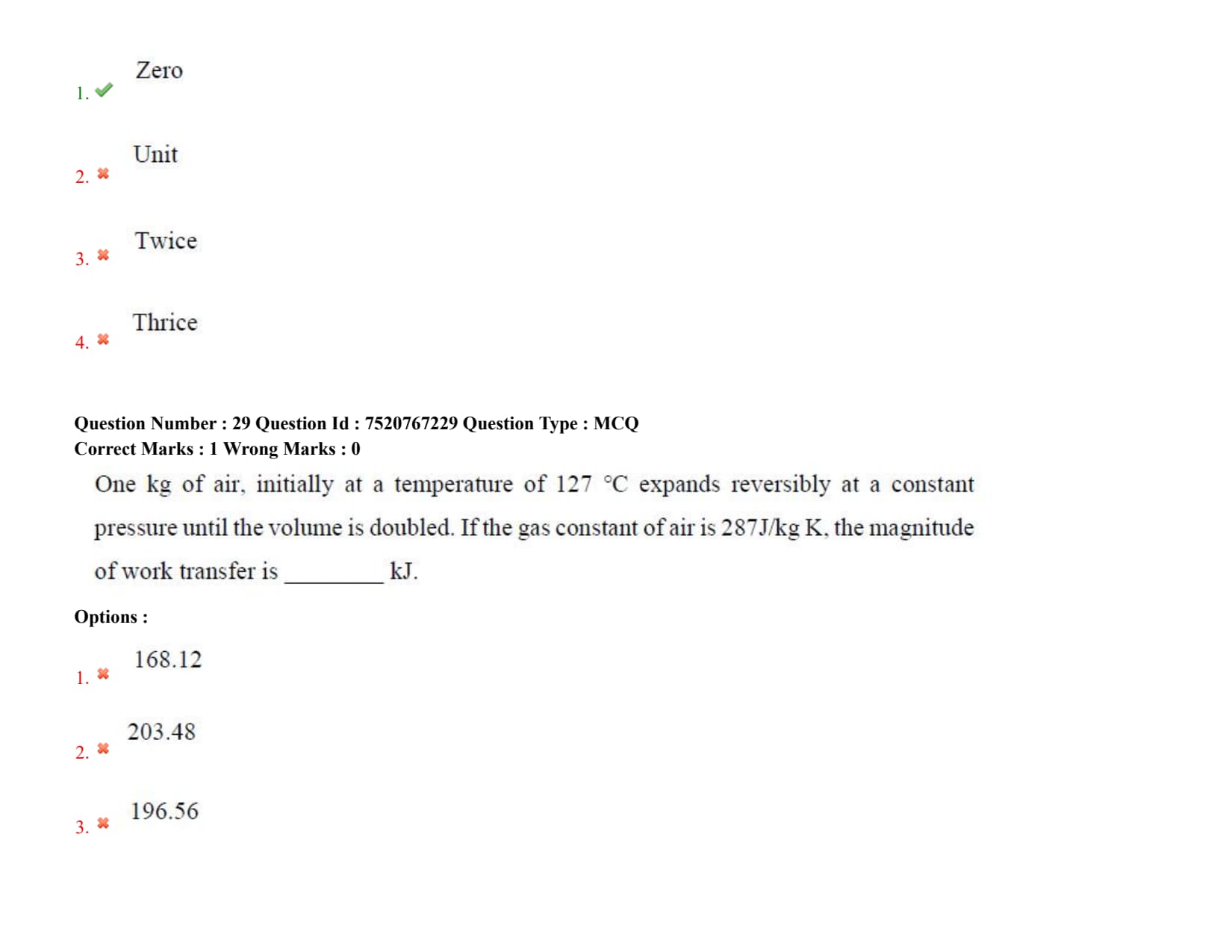
The virtual work done by external active forces on an ideal mechanical system in equilibrium is ______ for any and all virtual displacements consistent with the constraints.
One kg of air, initially at a temperature of \(127 ^{\circ}C\) expands reversibly at a constant pressure until the volume is doubled. If the gas constant of air is \(287 J/kg K\), the magnitude of work transfer is _______ kJ.
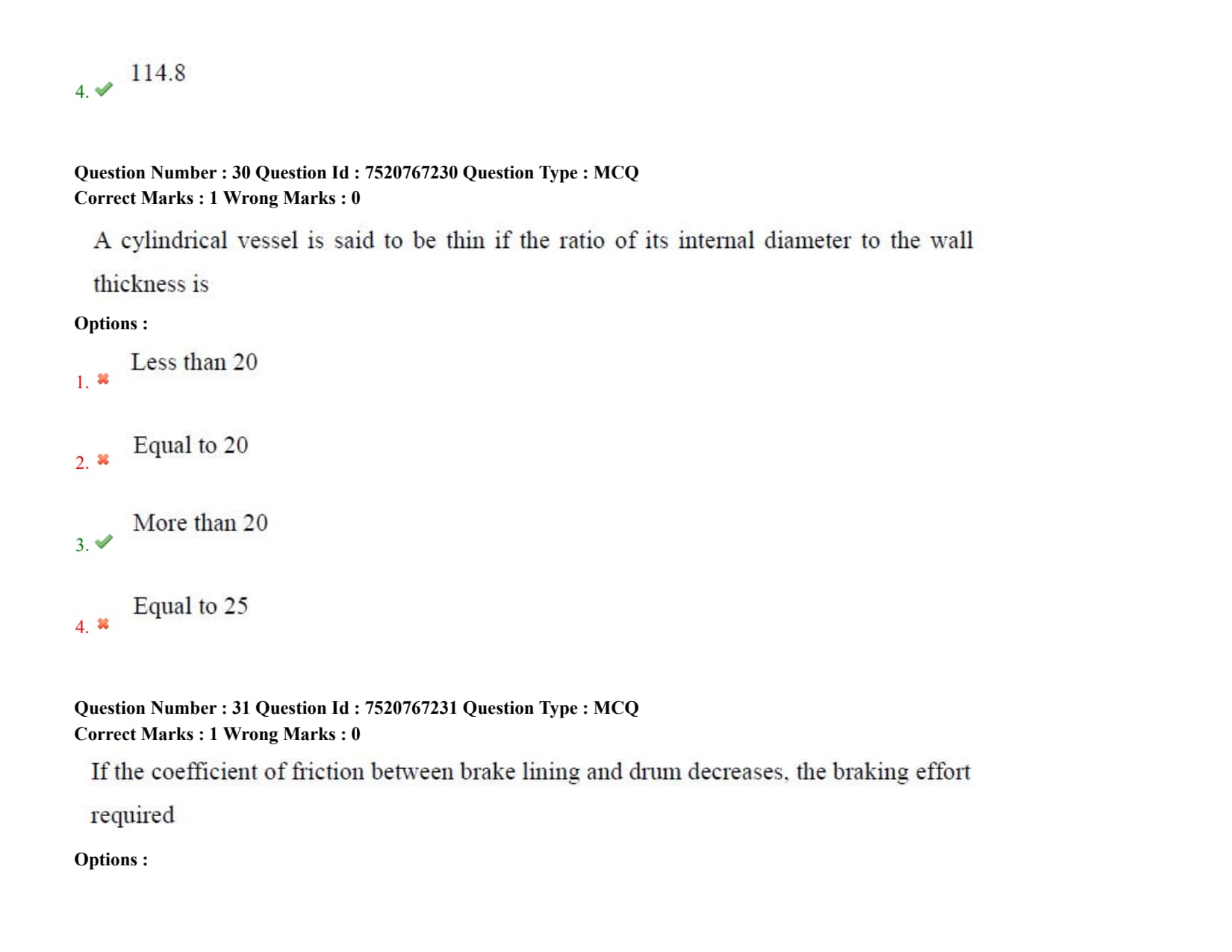
A cylindrical vessel is said to be thin if the ratio of its internal diameter to the wall thickness is
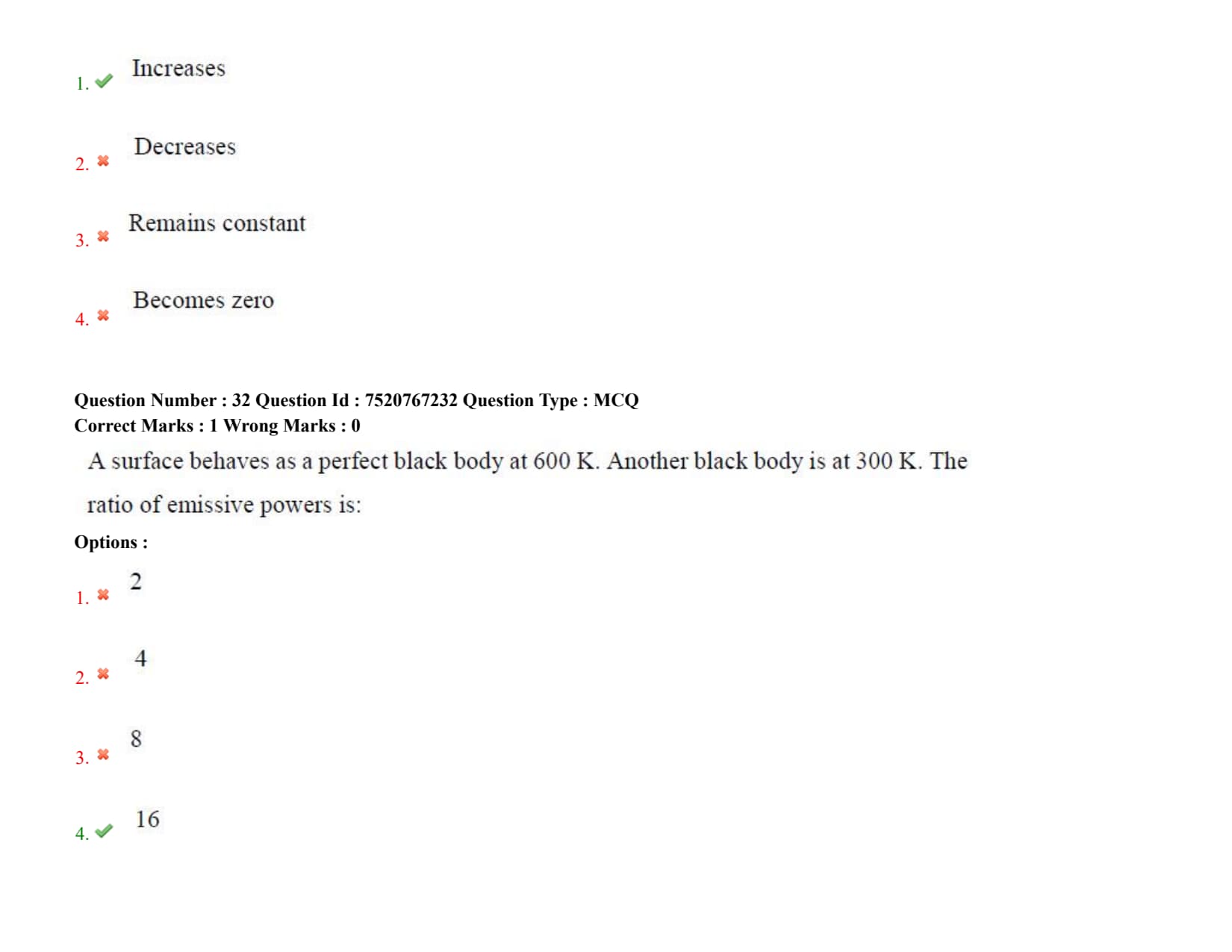
If the coefficient of friction between brake lining and drum decreases, the braking effort required
A surface behaves as a perfect black body at 600 K. Another black body is at 300 K. The ratio of emissive powers is:
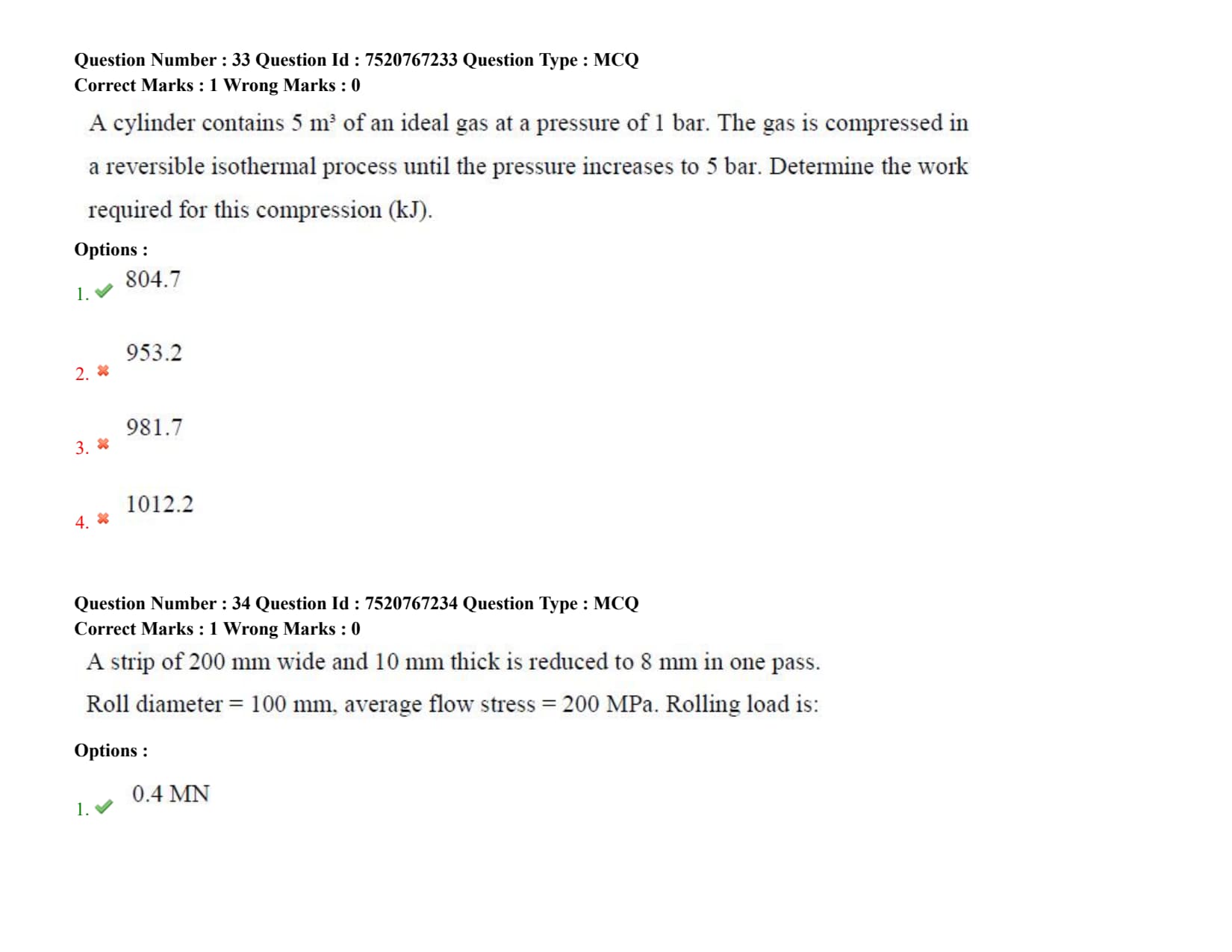
A cylinder contains \(5 m^3\) of an ideal gas at a pressure of 1 bar. The gas is compressed in a reversible isothermal process until the pressure increases to 5 bar. Determine the work required for this compression (kJ).
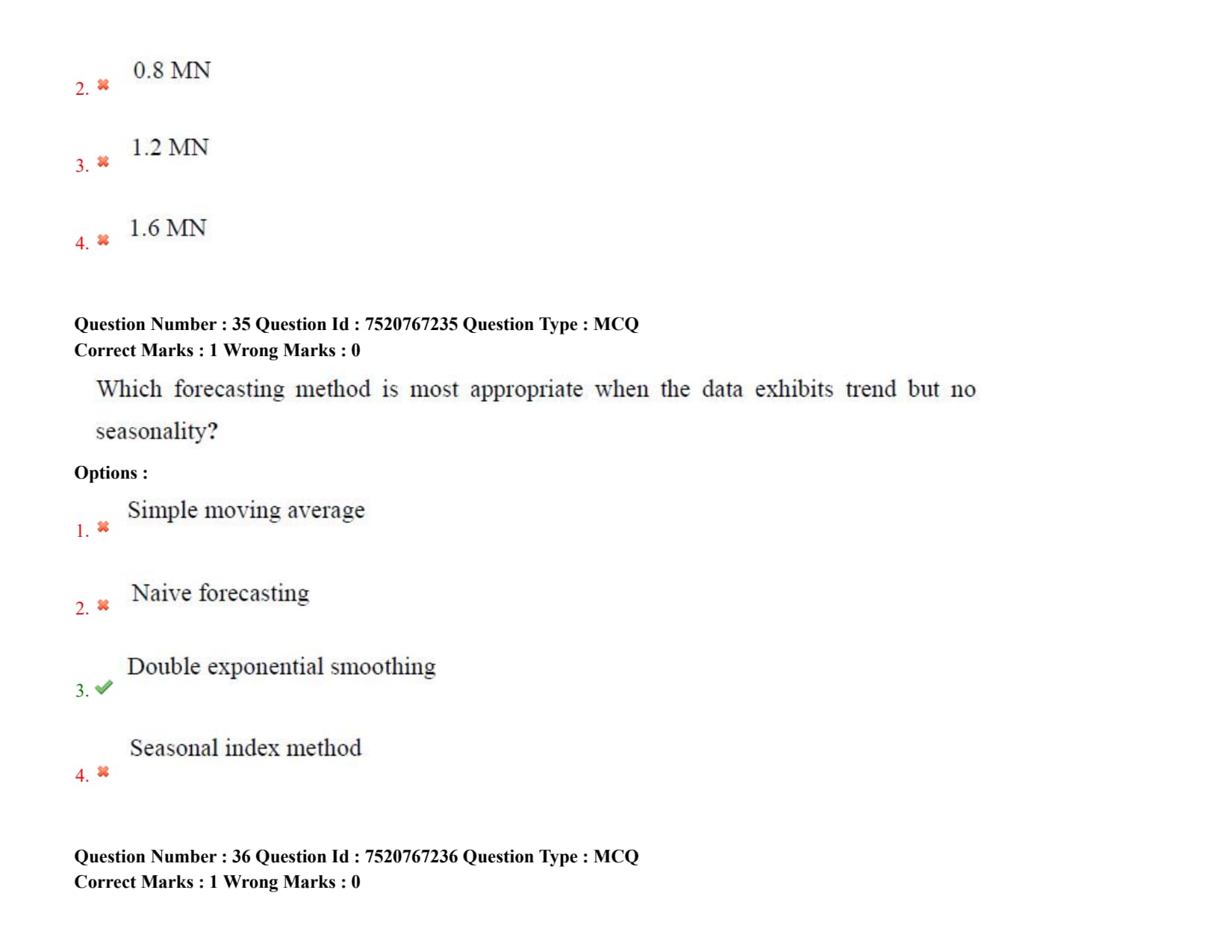
A strip of 200 mm wide and 10 mm thick is reduced to 8 mm in one pass. Roll diameter = 100 mm, average flow stress = 200 MPa. Rolling load is:
Which forecasting method is most appropriate when the data exhibits trend but no seasonality?
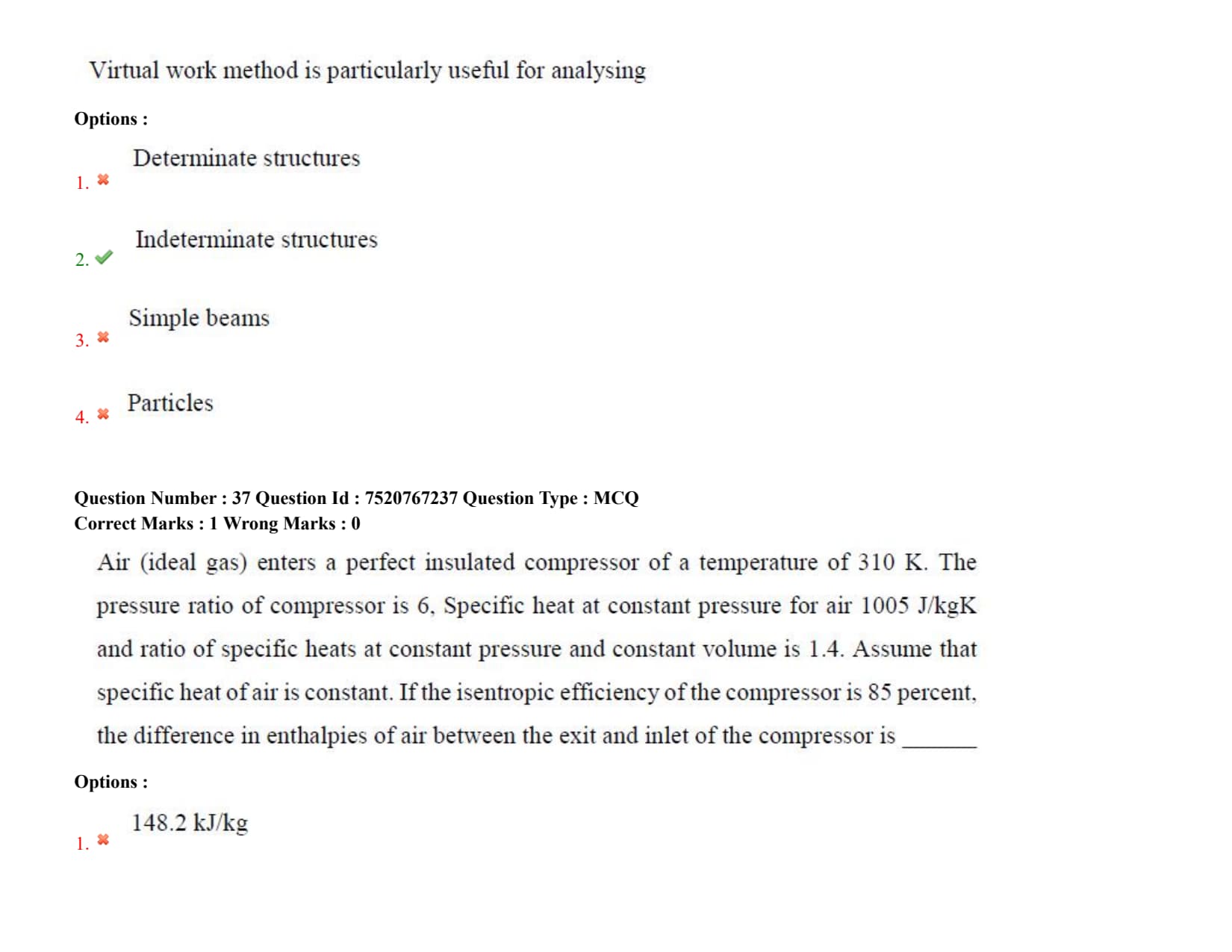
Virtual work method is particularly useful for analysing
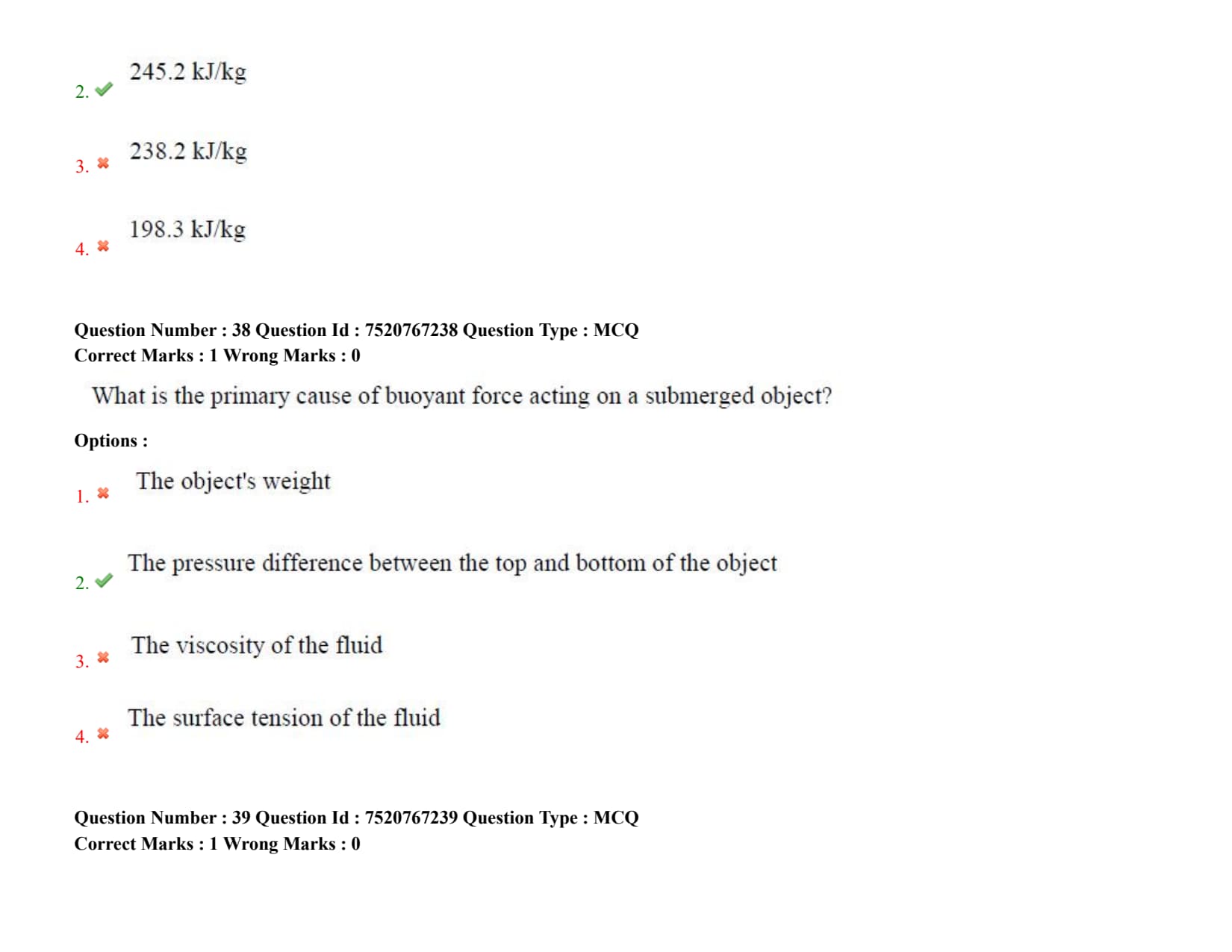
Air (ideal gas) enters a perfect insulated compressor of a temperature of 310 K. The pressure ratio of compressor is 6, Specific heat at constant pressure for air 1005 J/kgK and ratio of specific heats at constant pressure and constant volume is 1.4. Assume that specific heat of air is constant. If the isentropic efficiency of the compressor is 85 percent, the difference in enthalpies of air between the exit and inlet of the compressor is _______
What is the primary cause of buoyant force acting on a submerged object?
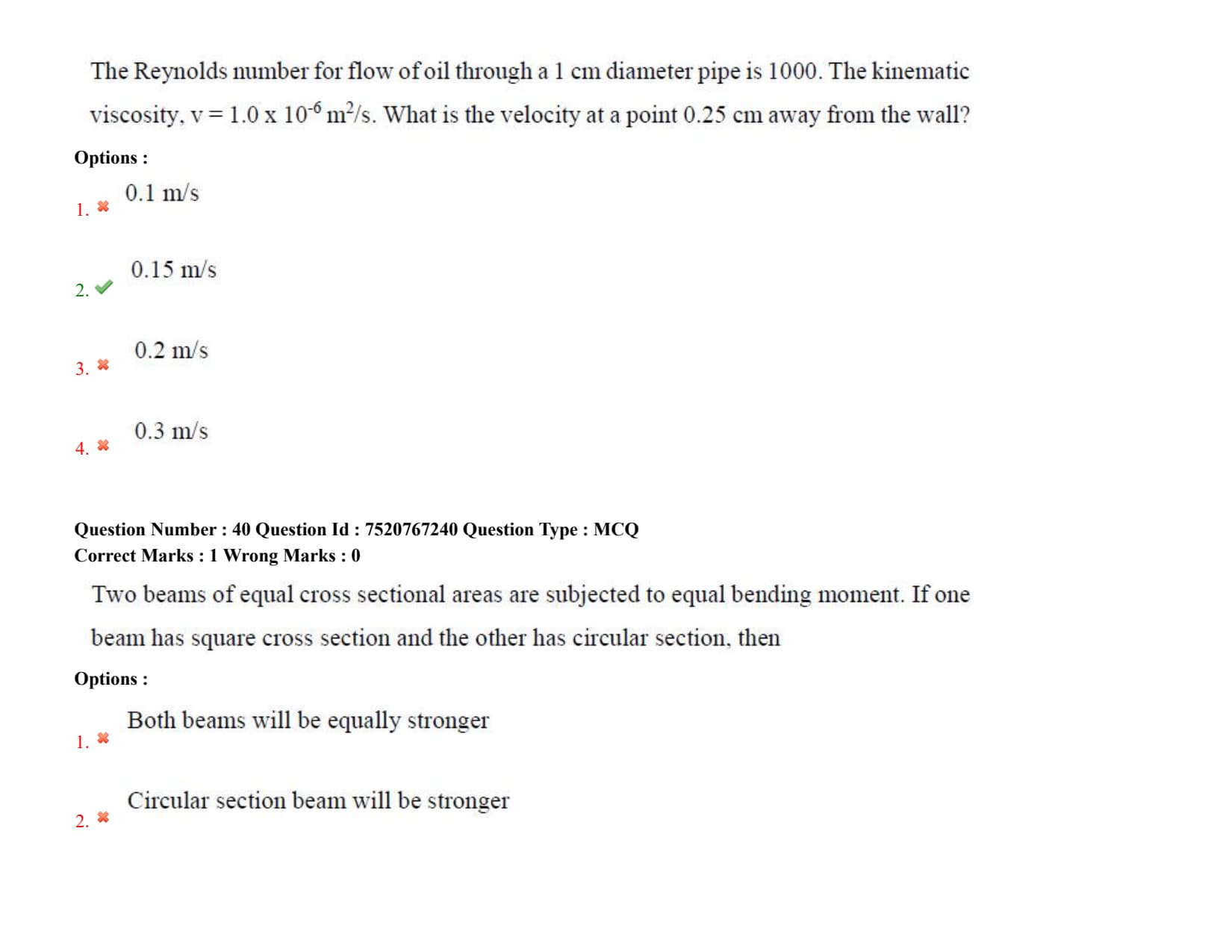
The Reynolds number for flow of oil through a 1 cm diameter pipe is 1000. The kinematic viscosity, \(\nu = 1.0 \times 10^{-6} m^2/s\). What is the velocity at a point 0.25 cm away from the wall?
Two beams of equal cross sectional areas are subjected to equal bending moment. If one beam has square cross section and the other has circular section, then
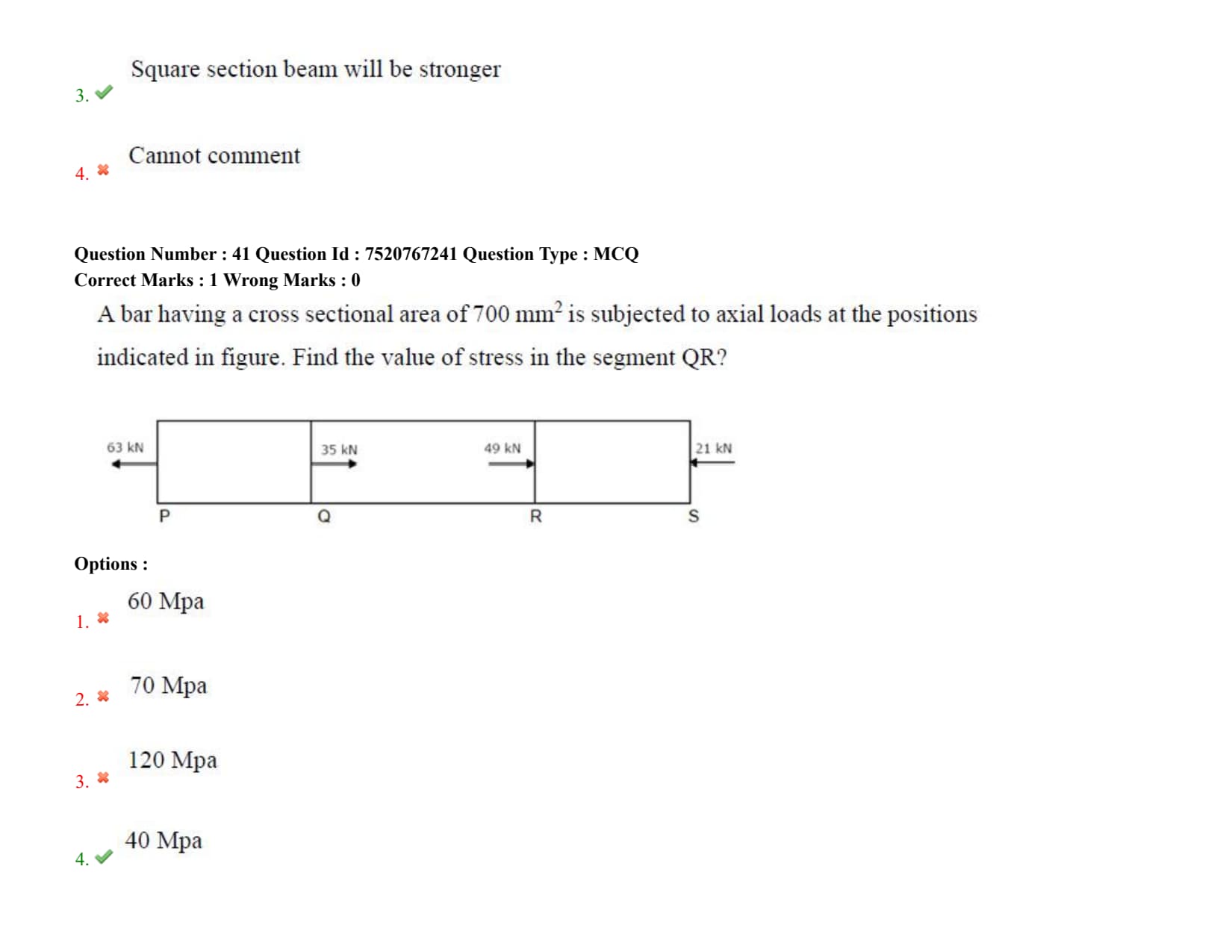
A bar having a cross sectional area of \(700 mm^2\) is subjected to axial loads at the positions indicated in figure. Find the value of stress in the segment QR?

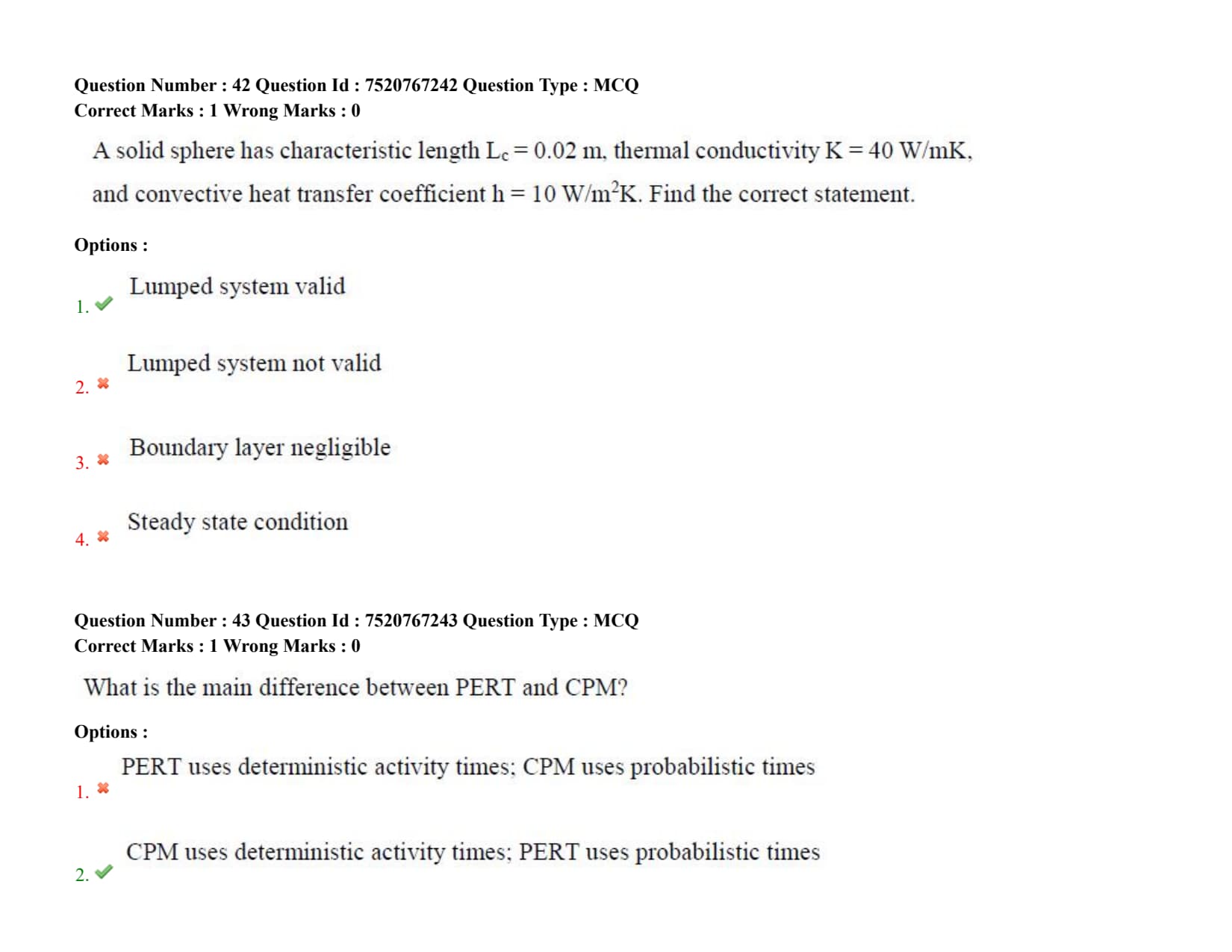
A solid sphere has characteristic length \(L_c = 0.02 m\), thermal conductivity \(K = 40 W/mK\), and convective heat transfer coefficient \(h = 10 W/m^2K\). Find the correct statement.
What is the main difference between PERT and CPM?
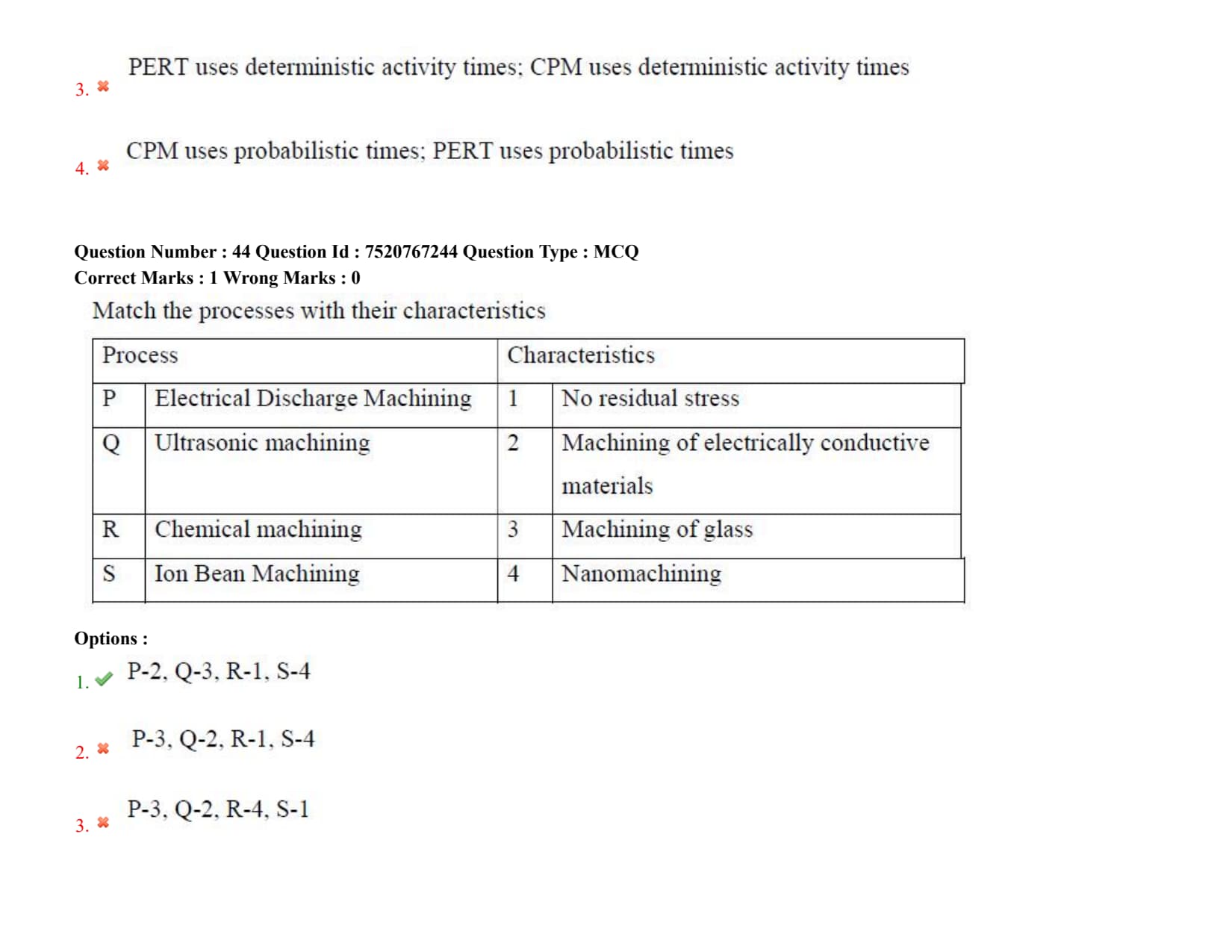
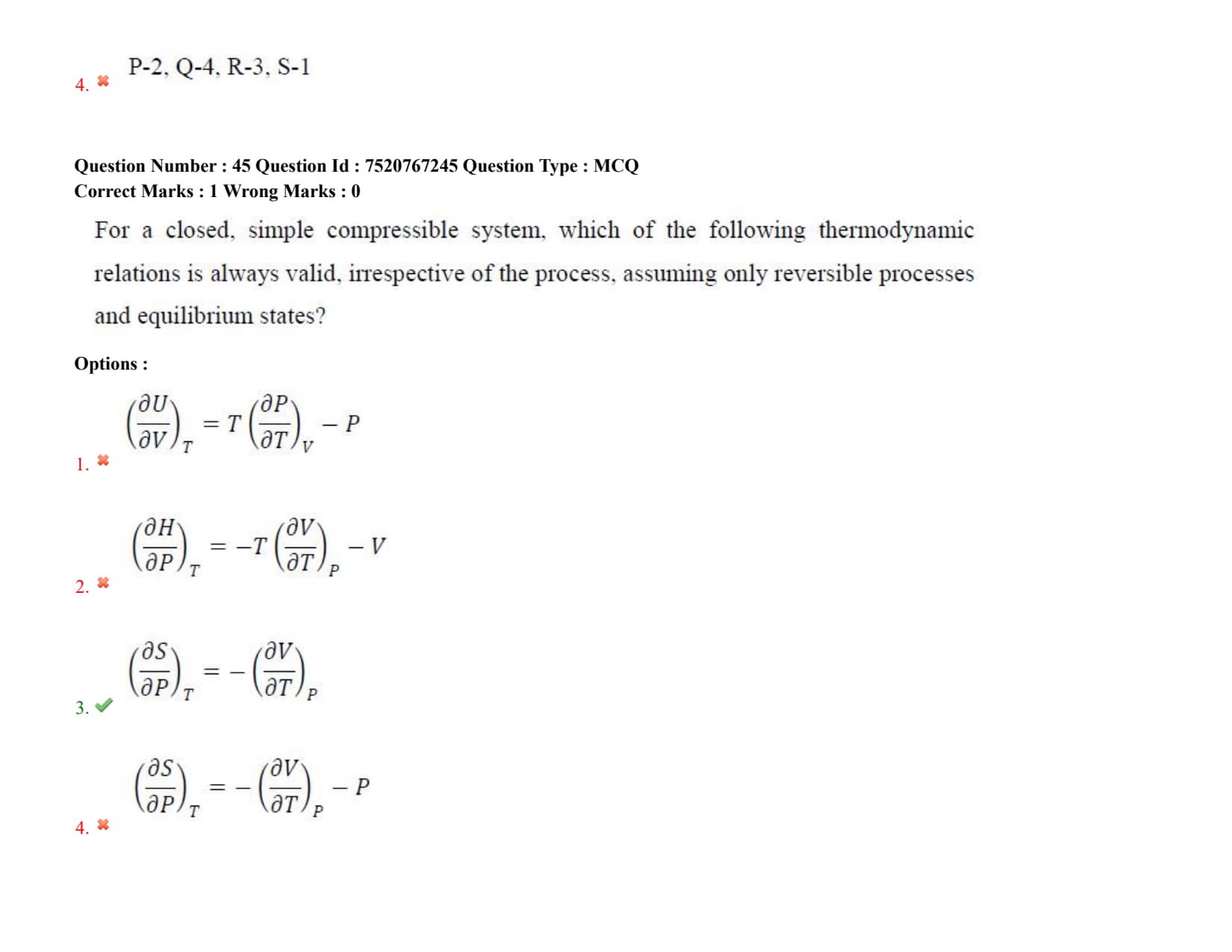
Match the processes with their characteristics:

For a closed, simple compressible system, which of the following thermodynamic relations is always valid, irrespective of the process, assuming only reversible processes and equilibrium states?
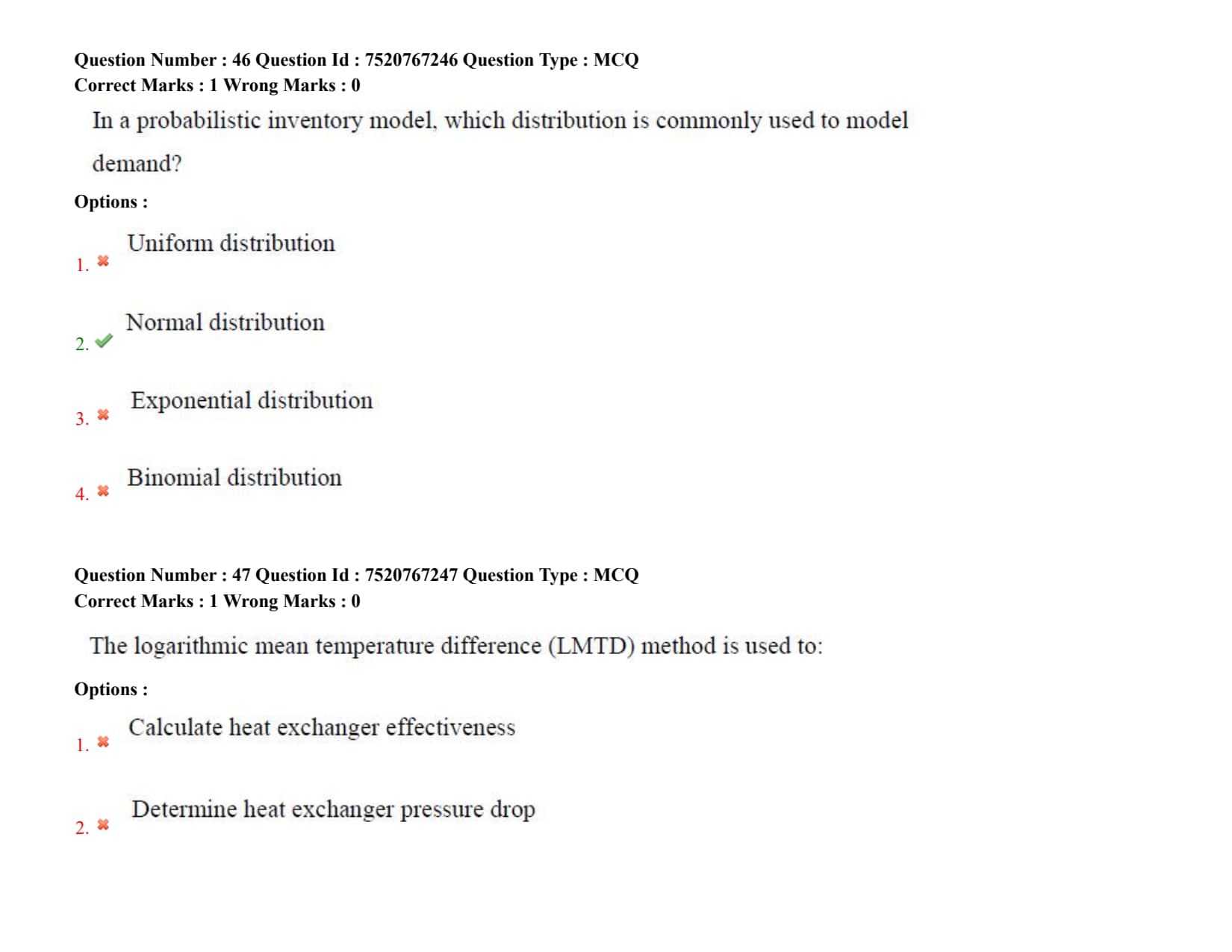
In a probabilistic inventory model, which distribution is commonly used to model demand?
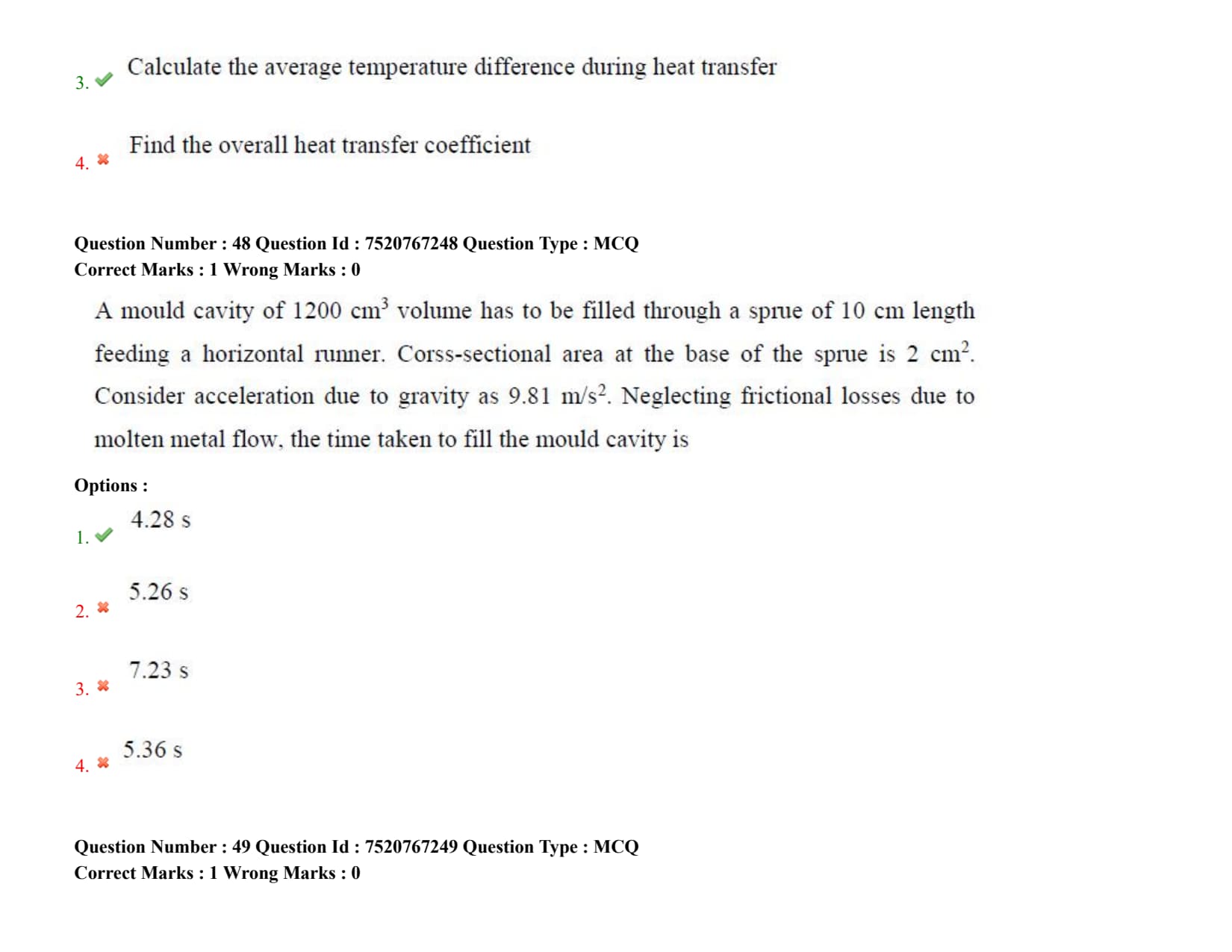
The logarithmic mean temperature difference (LMTD) method is used to:
A mould cavity of \(1200 cm^3\) volume has to be filled through a sprue of \(10 cm\) length feeding a horizontal runner. Cross-sectional area at the base of the sprue is \(2 cm^2\). Consider acceleration due to gravity as \(9.81 m/s^2\). Neglecting frictional losses due to molten metal flow, the time taken to fill the mould cavity is
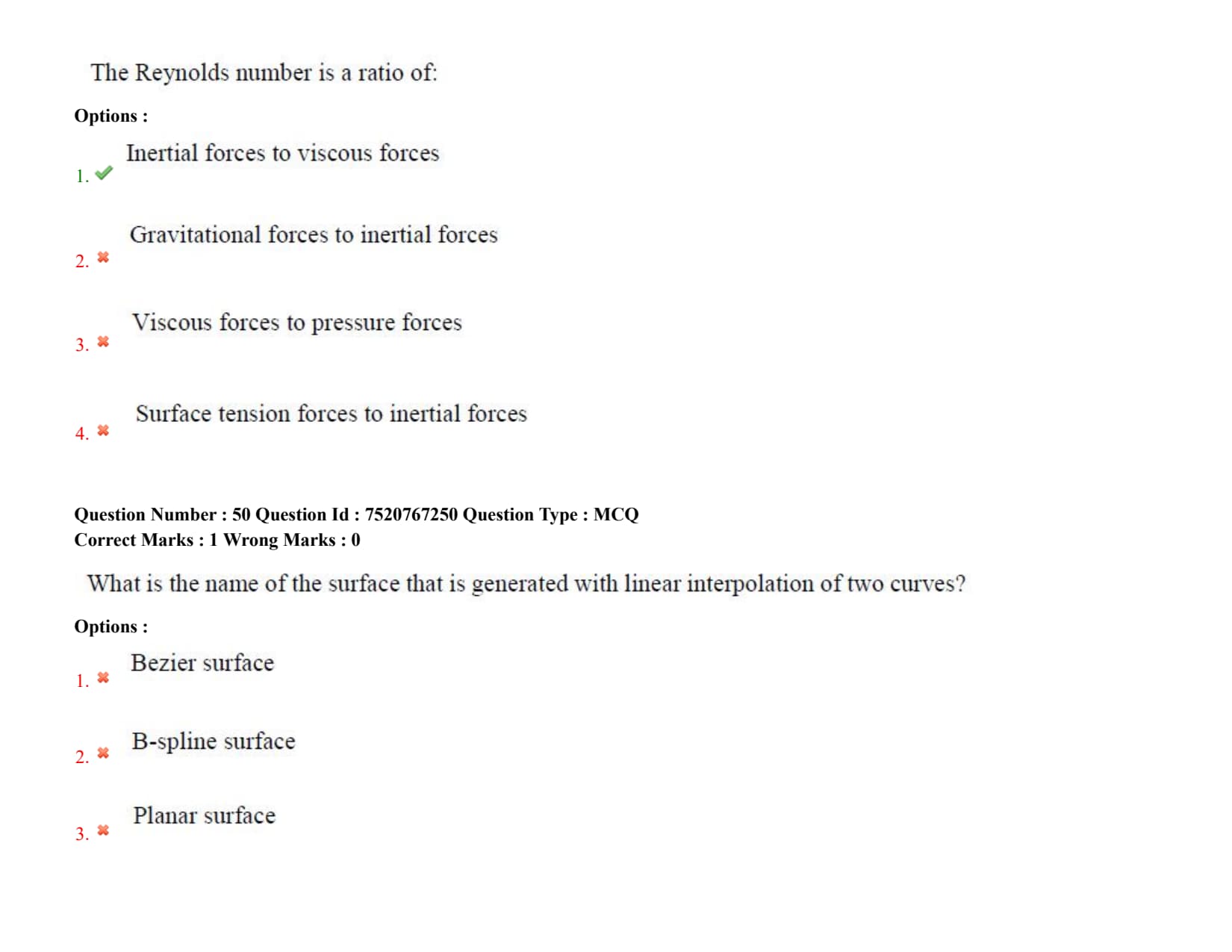
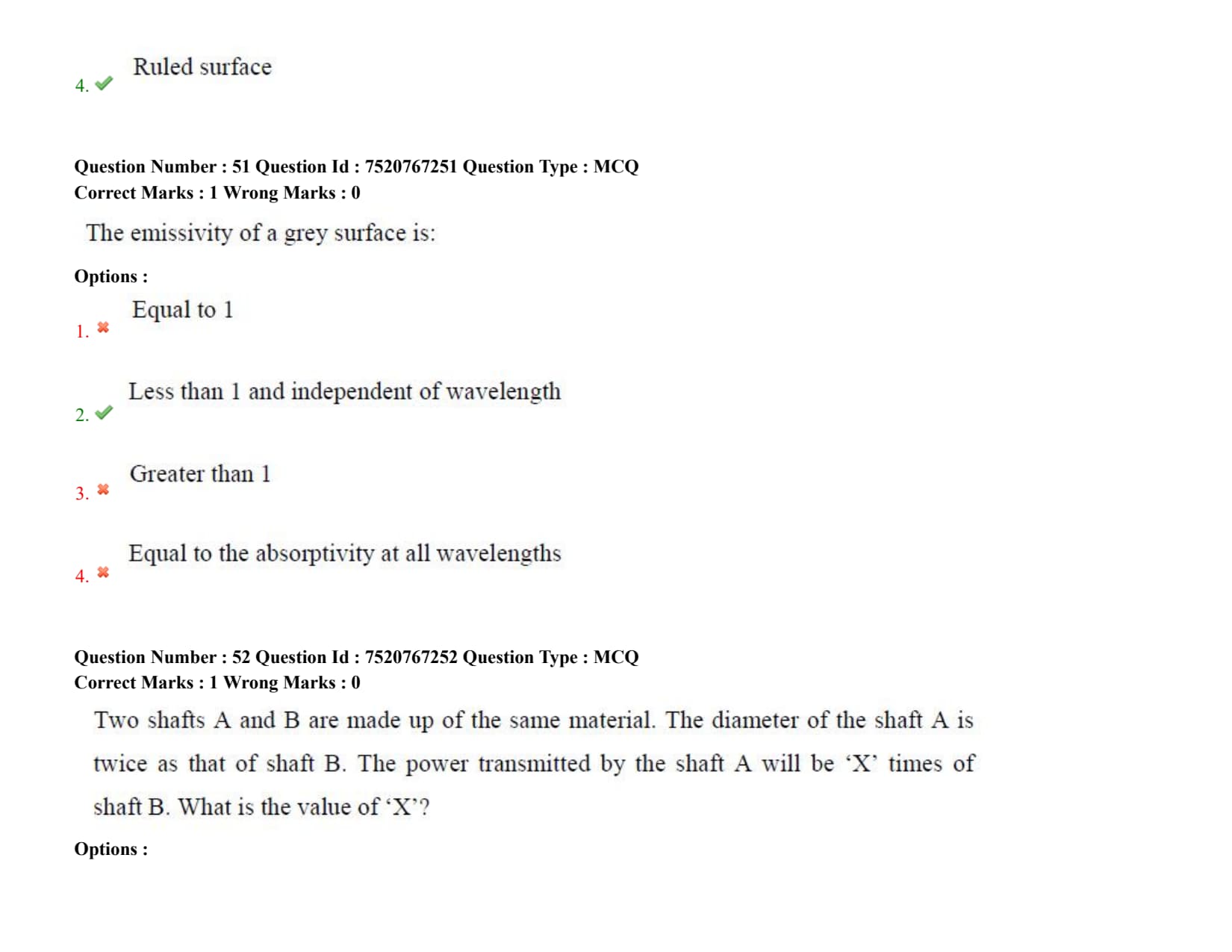
The Reynolds number is a ratio of:
What is the name of the surface that is generated with linear interpolation of two curves?
The emissivity of a grey surface is:
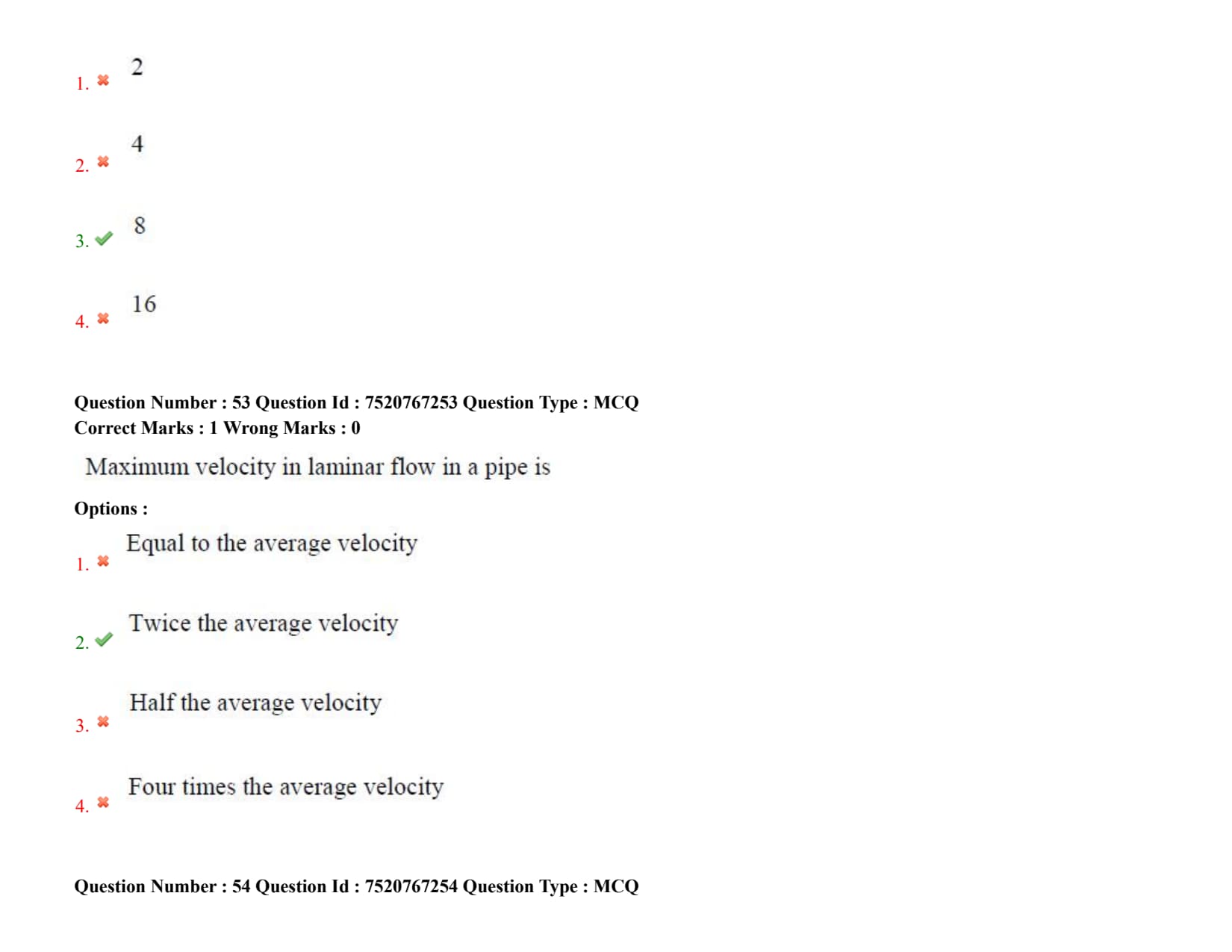
Two shafts A and B are made up of the same material. The diameter of the shaft A is twice as that of shaft B. The power transmitted by the shaft A will be 'X' times of shaft B. What is the value of 'X'?
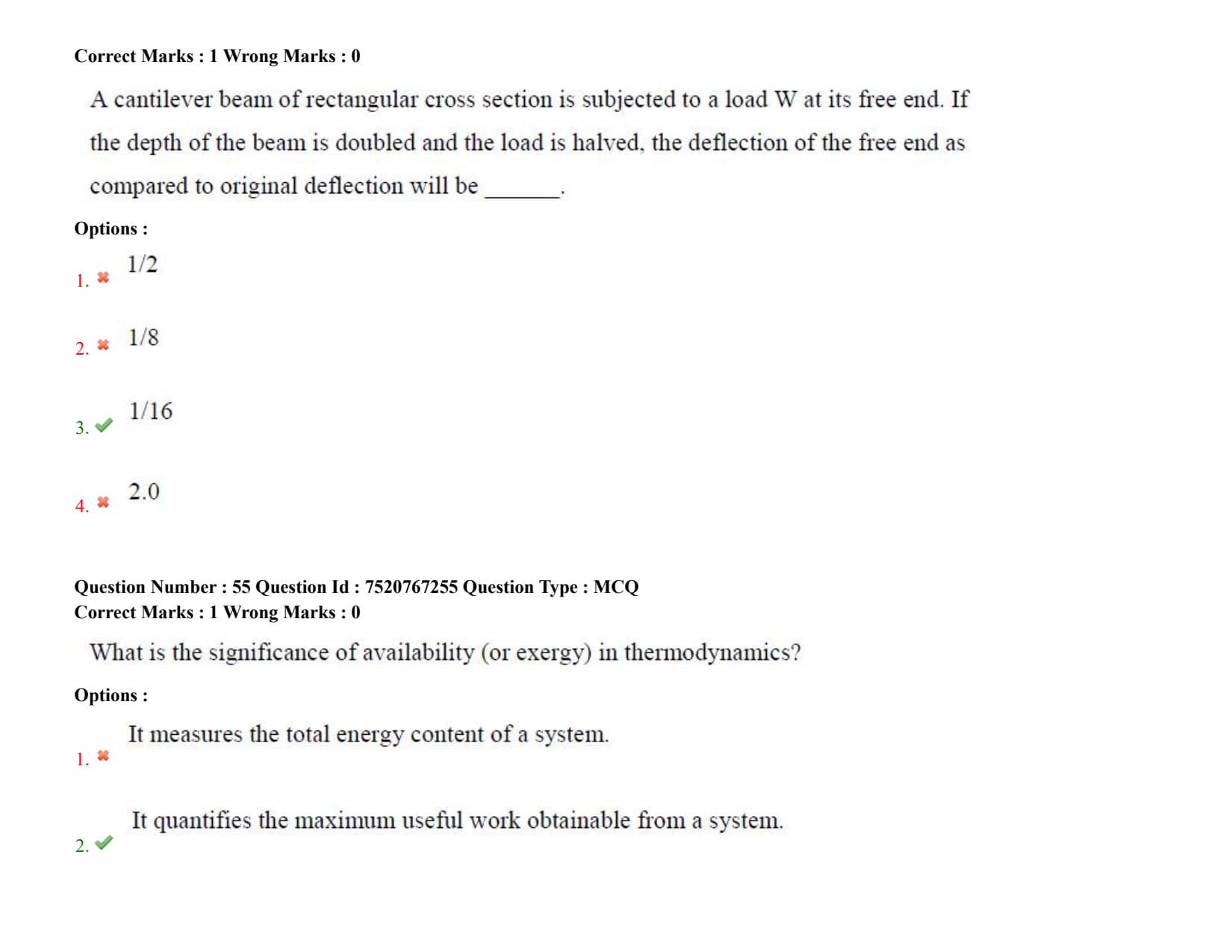
Maximum velocity in laminar flow in a pipe is
A cantilever beam of rectangular cross section is subjected to a load W at its free end. If the depth of the beam is doubled and the load is halved, the deflection of the free end as compared to original deflection will be _______.
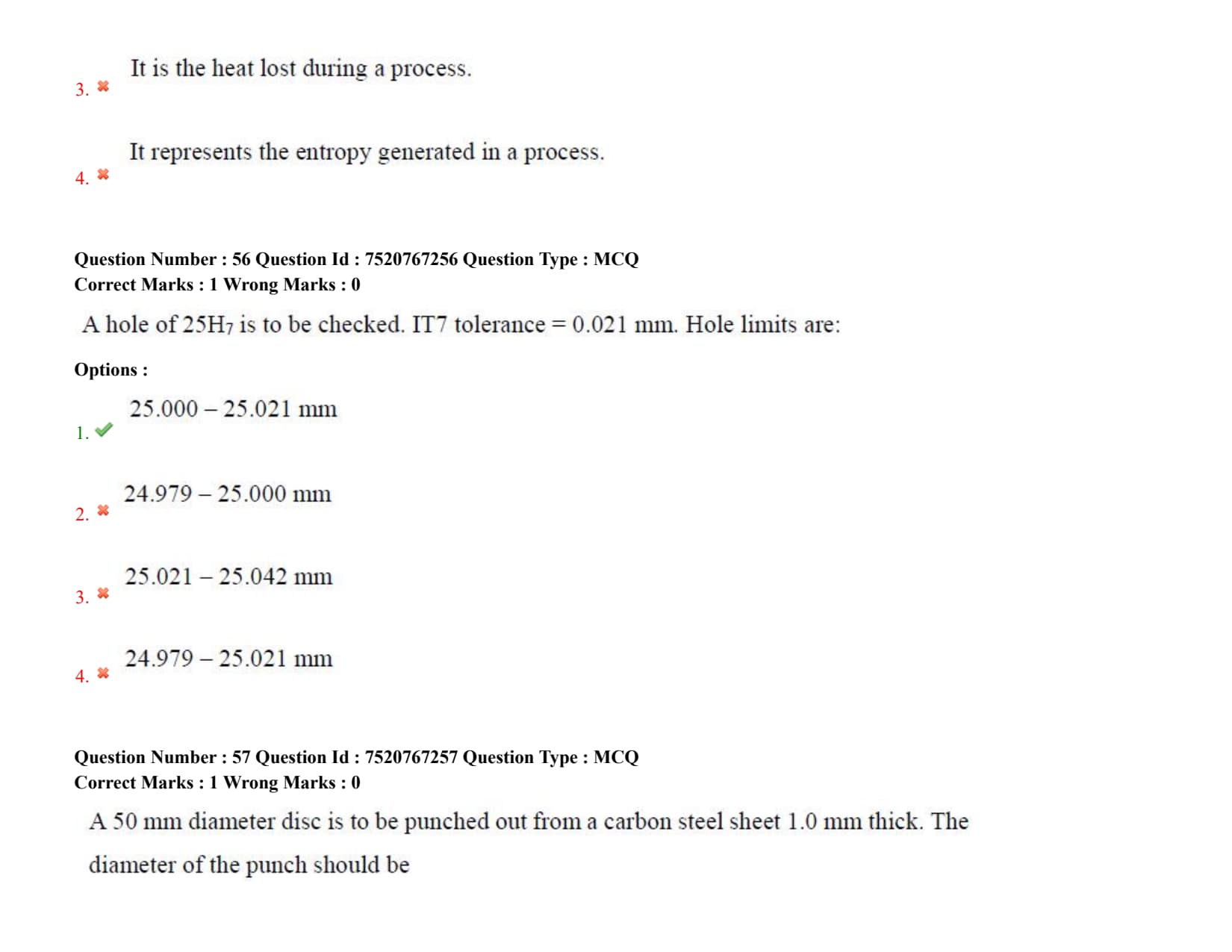
What is the significance of availability (or exergy) in thermodynamics?
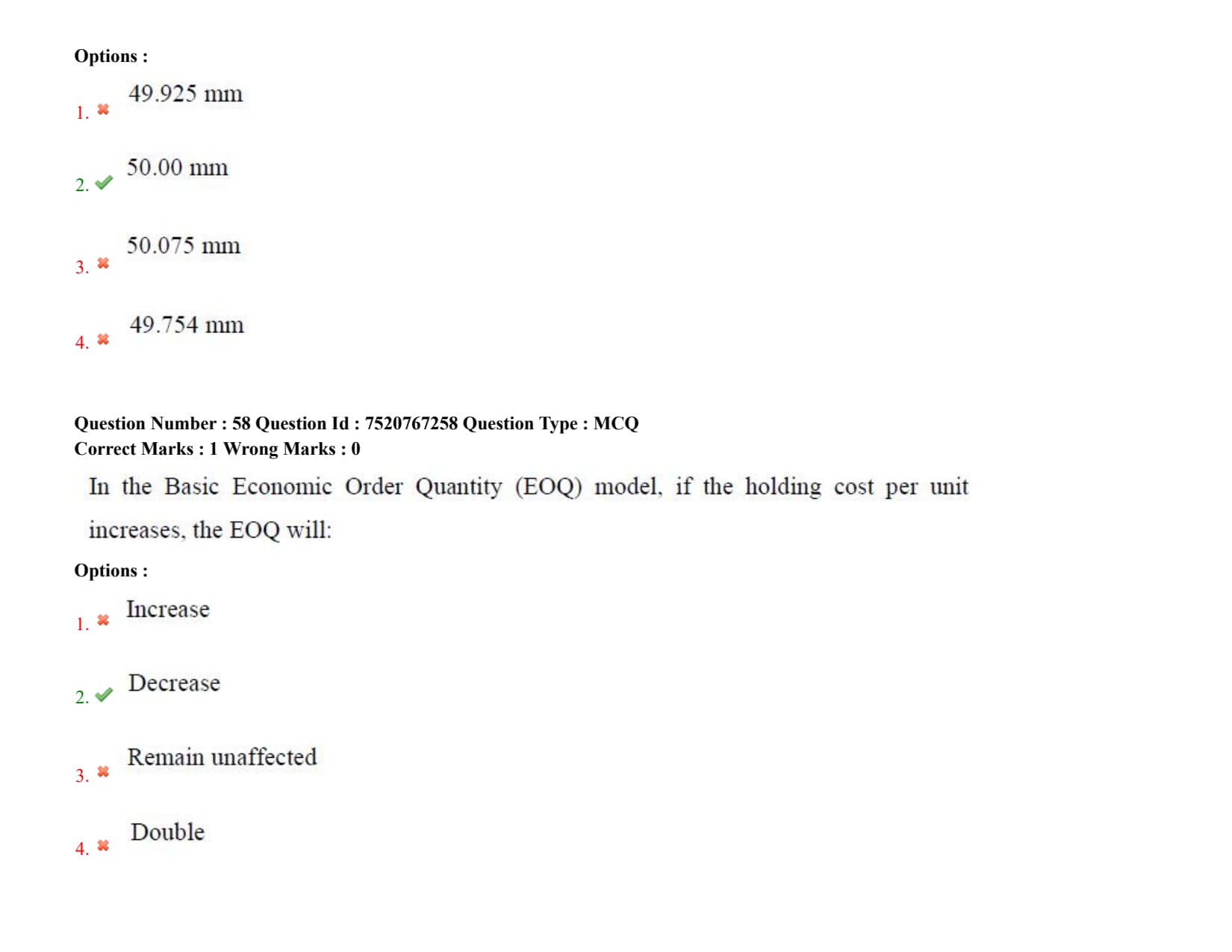
A hole of \(25H_7\) is to be checked. IT7 tolerance = \(0.021 mm\). Hole limits are:
A 50 mm diameter disc is to be punched out from a carbon steel sheet 1.0 mm thick. The diameter of the punch should be
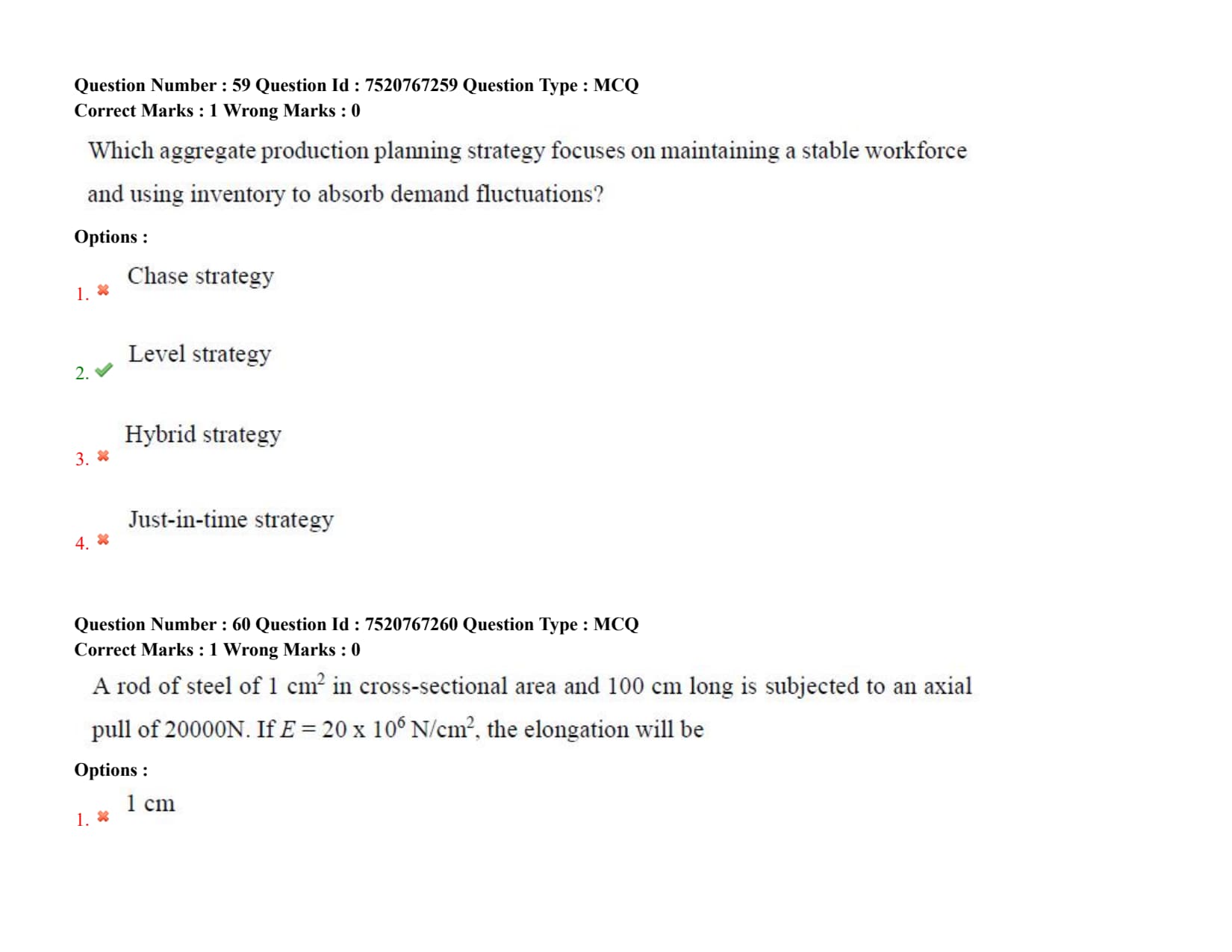
In the Basic Economic Order Quantity (EOQ) model, if the holding cost per unit increases, the EOQ will:
Which aggregate production planning strategy focuses on maintaining a stable workforce and using inventory to absorb demand fluctuations?
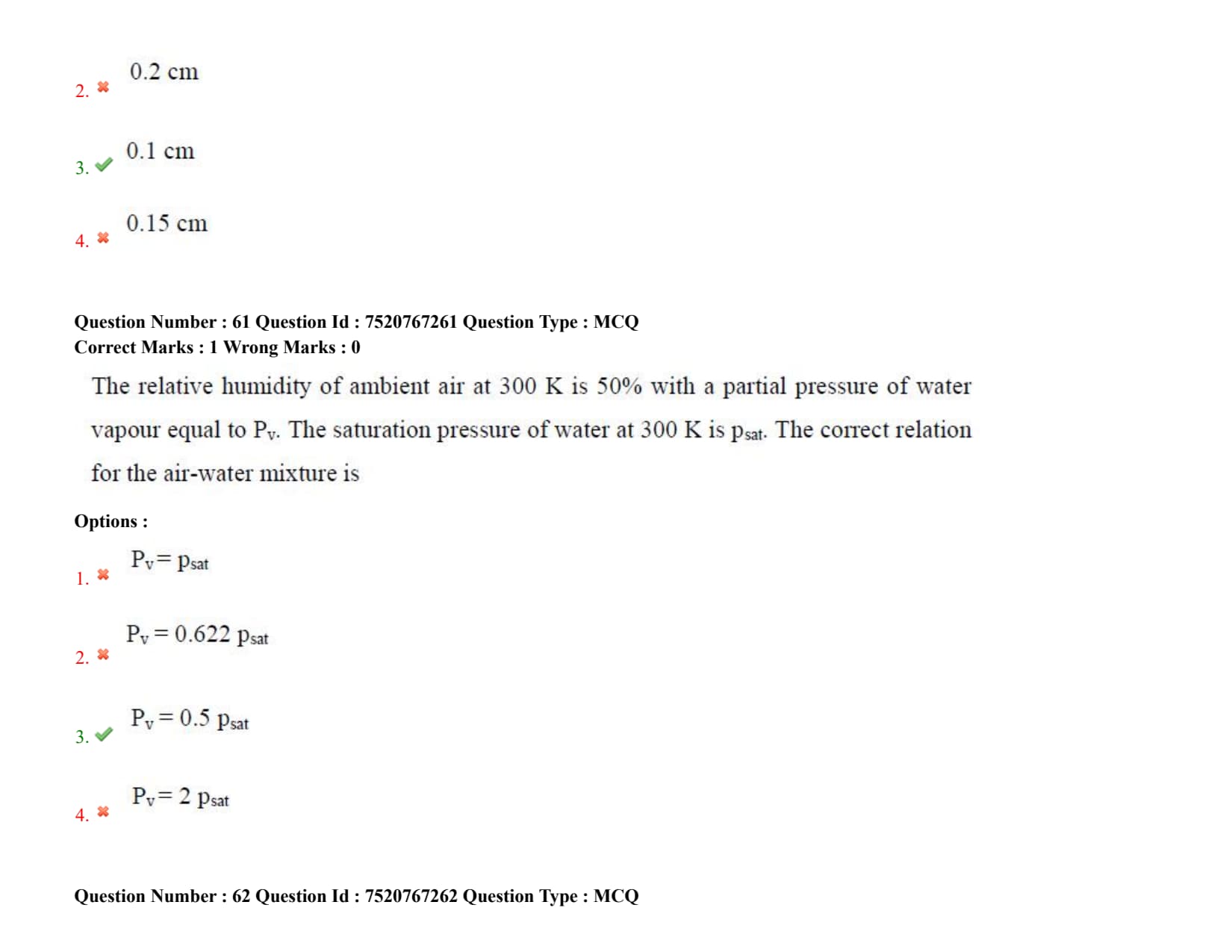
A rod of steel of \(1 cm^{2}\) in cross-sectional area and \(100 cm\) long is subjected to an axial pull of \(20000 N\). If \(E = 20 \times 10^{6} N/cm^{2}\), the elongation will be
The relative humidity of ambient air at \(300 K\) is \(50%\) with a partial pressure of water vapour equal to \(P_{v}\). The saturation pressure of water at \(300 K\) is \(p_{sat}\). The correct relation for the air-water mixture is
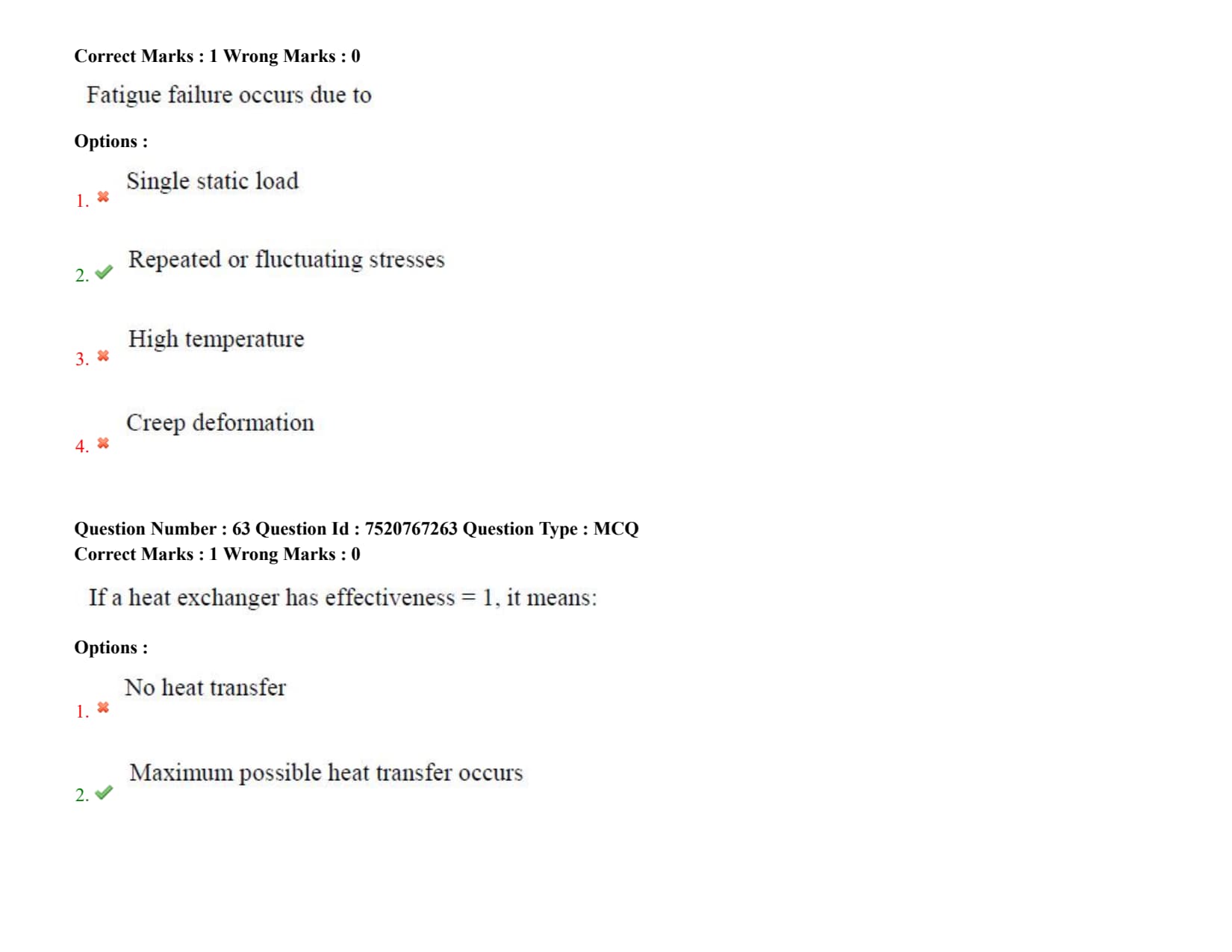
Fatigue failure occurs due to
If a heat exchanger has effectiveness = 1, it means:
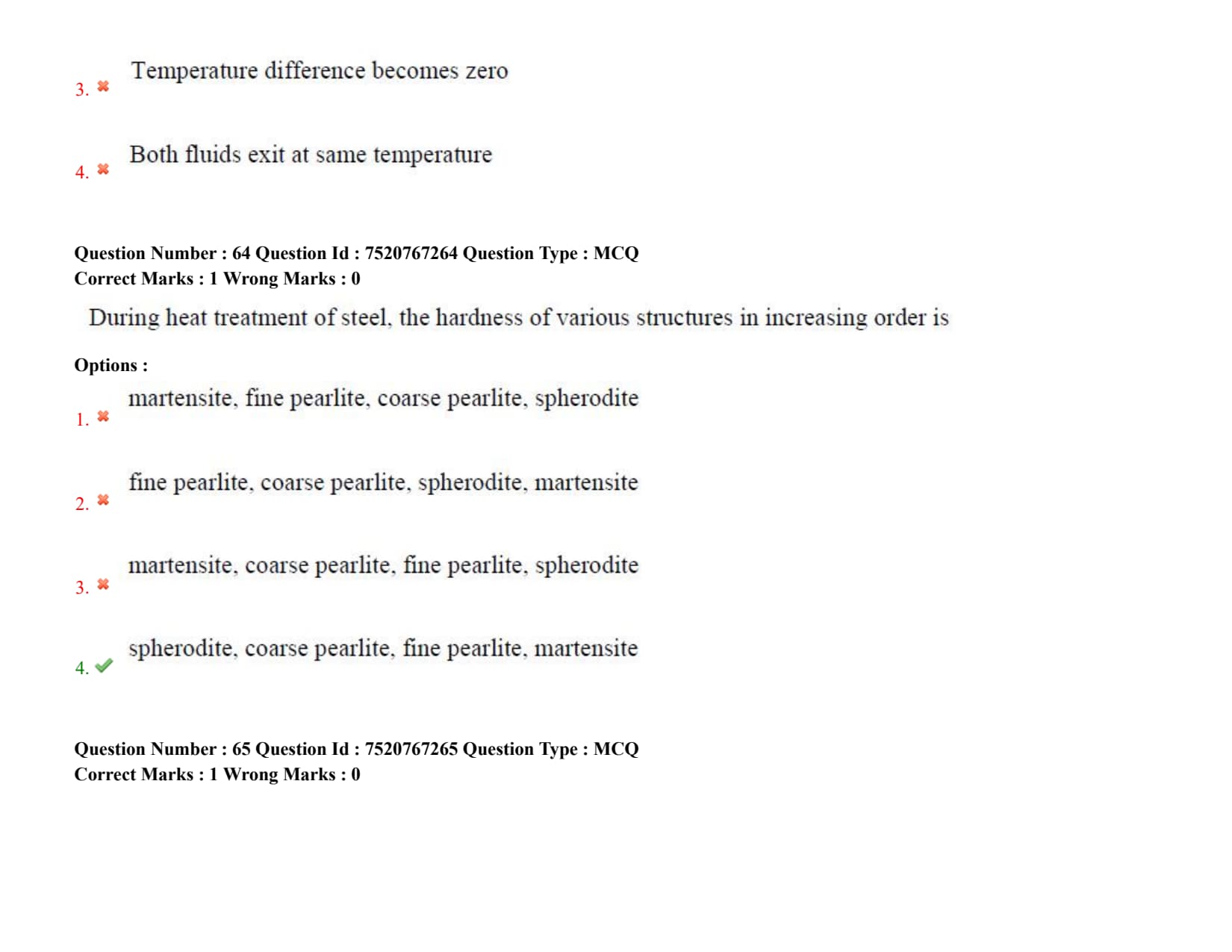
During heat treatment of steel, the hardness of various structures in increasing order is
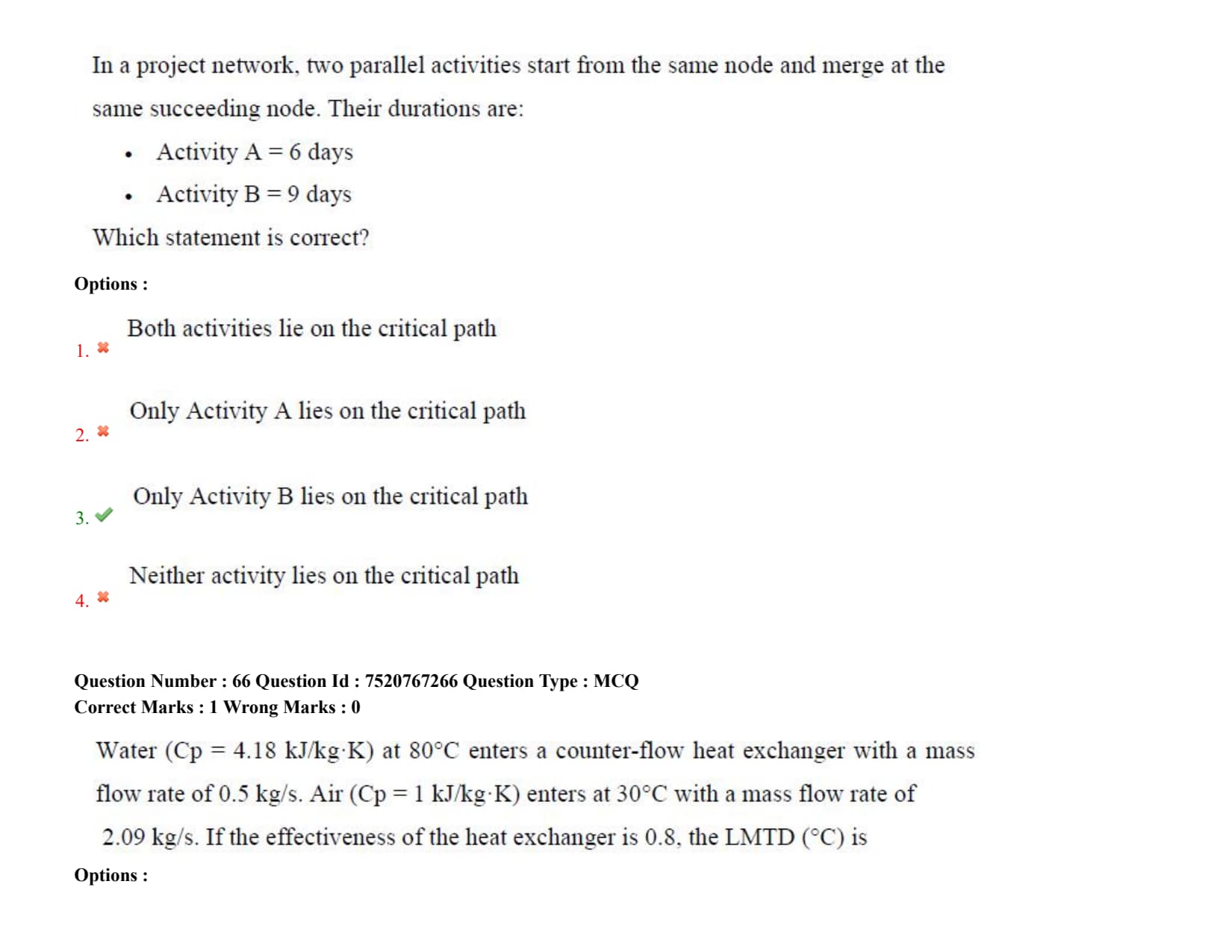
In a project network, two parallel activities start from the same node and merge at the same succeeding node. Their durations are: Activity A = 6 days, Activity B = 9 days. Which statement is correct?
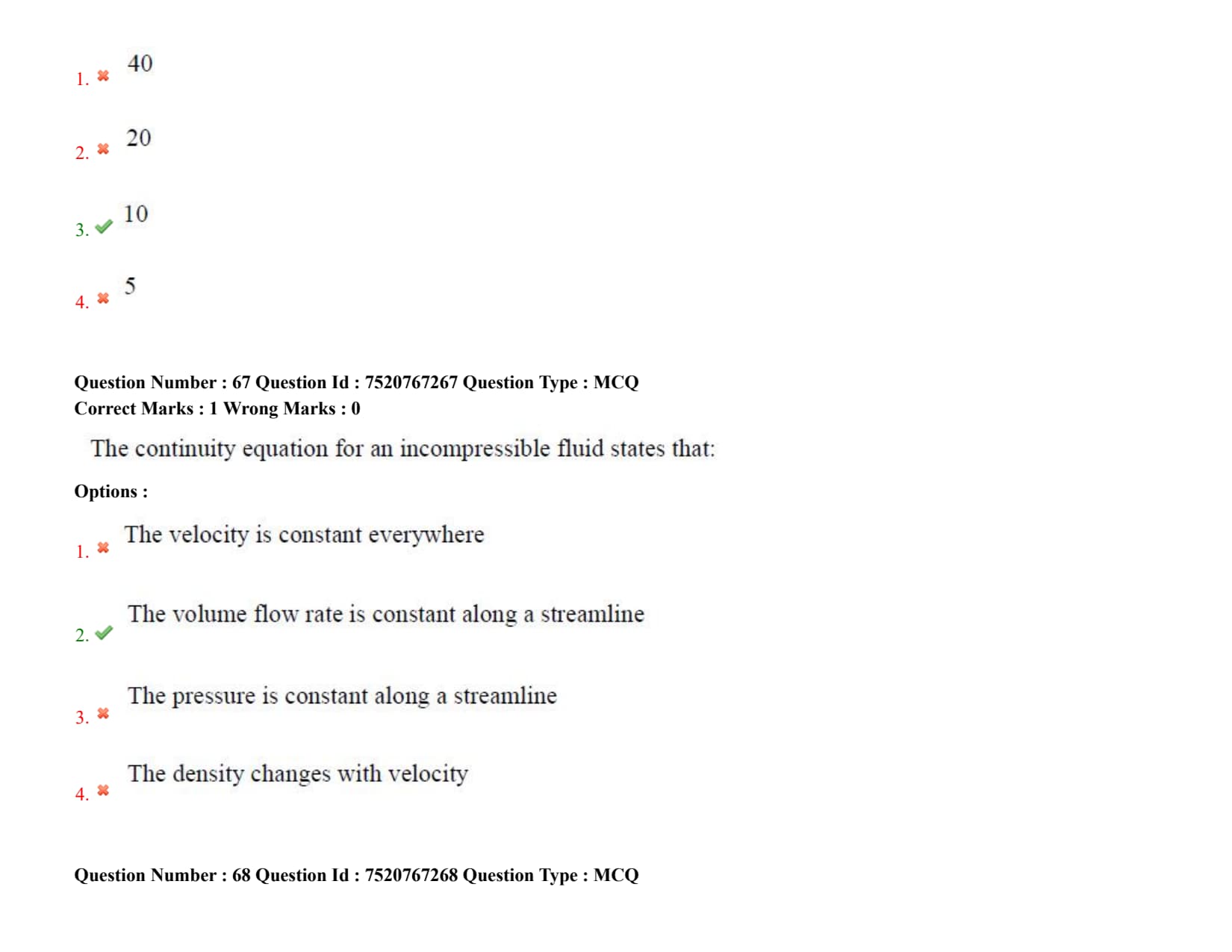
Water (\(C_{p} = 4.18 kJ/kg\cdotK\)) at \(80^\circC\) enters a counter-flow heat exchanger with a mass flow rate of \(0.5 kg/s\). Air (\(C_{p} = 1 kJ/kg\cdotK\)) enters at \(30^\circC\) with a mass flow rate of \(2.09 kg/s\). If the effectiveness of the heat exchanger is 0.8, the LMTD (\(^\circC\)) is
The continuity equation for an incompressible fluid states that:
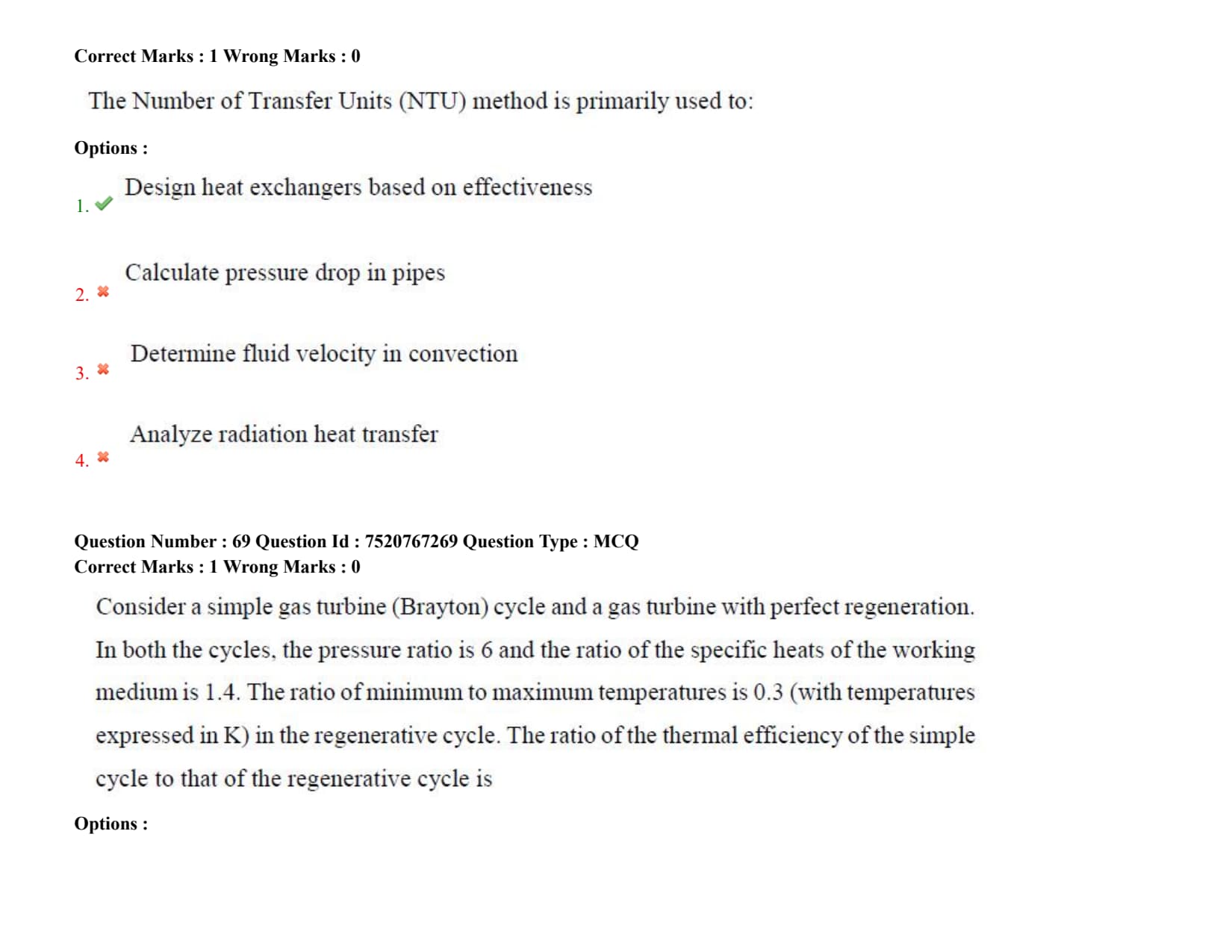
The Number of Transfer Units (NTU) method is primarily used to:
Consider a simple gas turbine (Brayton) cycle and a gas turbine with perfect regeneration. In both the cycles, the pressure ratio is 6 and the ratio of the specific heats of the working medium is 1.4. The ratio of minimum to maximum temperatures is 0.3 (with temperatures expressed in K) in the regenerative cycle. The ratio of the thermal efficiency of the simple cycle to that of the regenerative cycle is
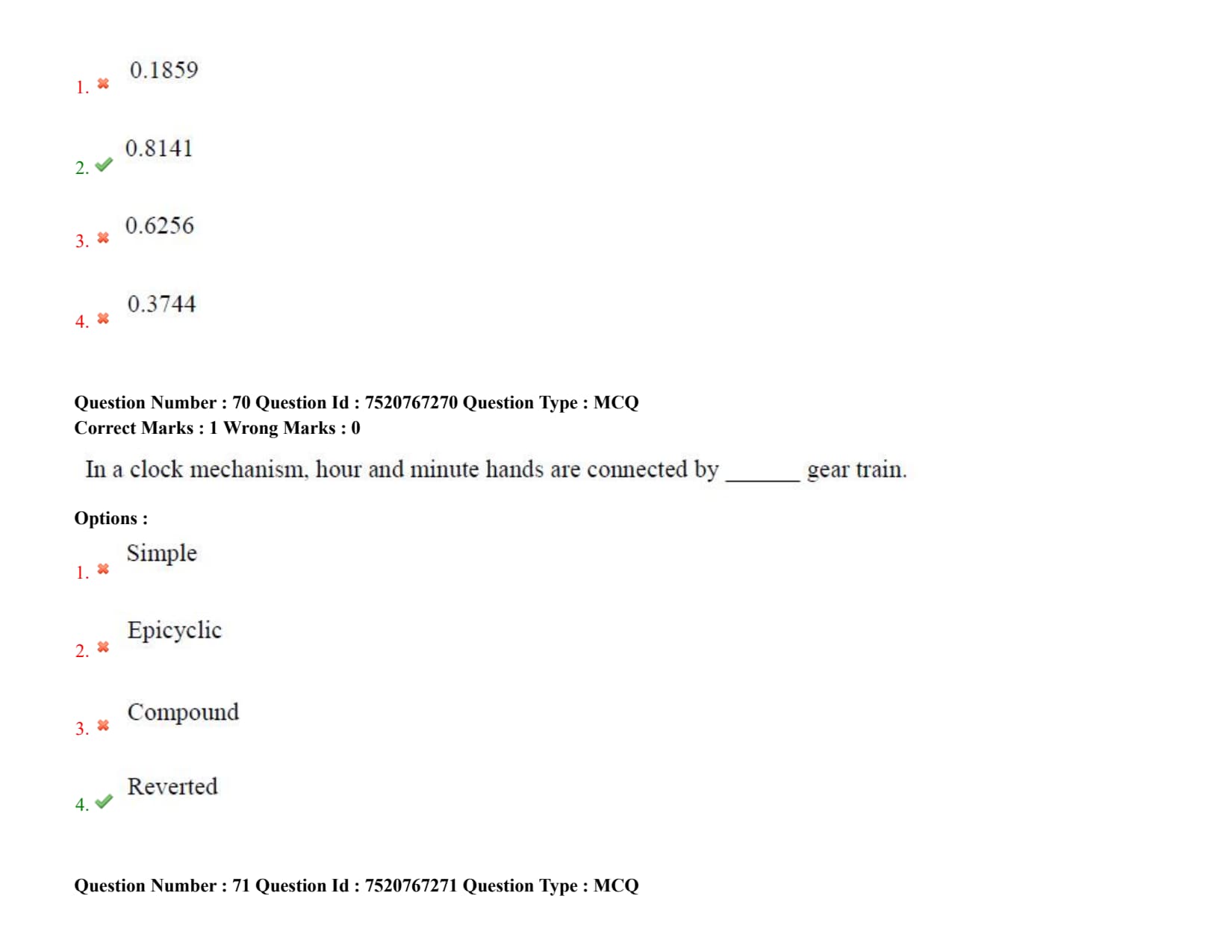
In a clock mechanism, hour and minute hands are connected by _________ gear train.
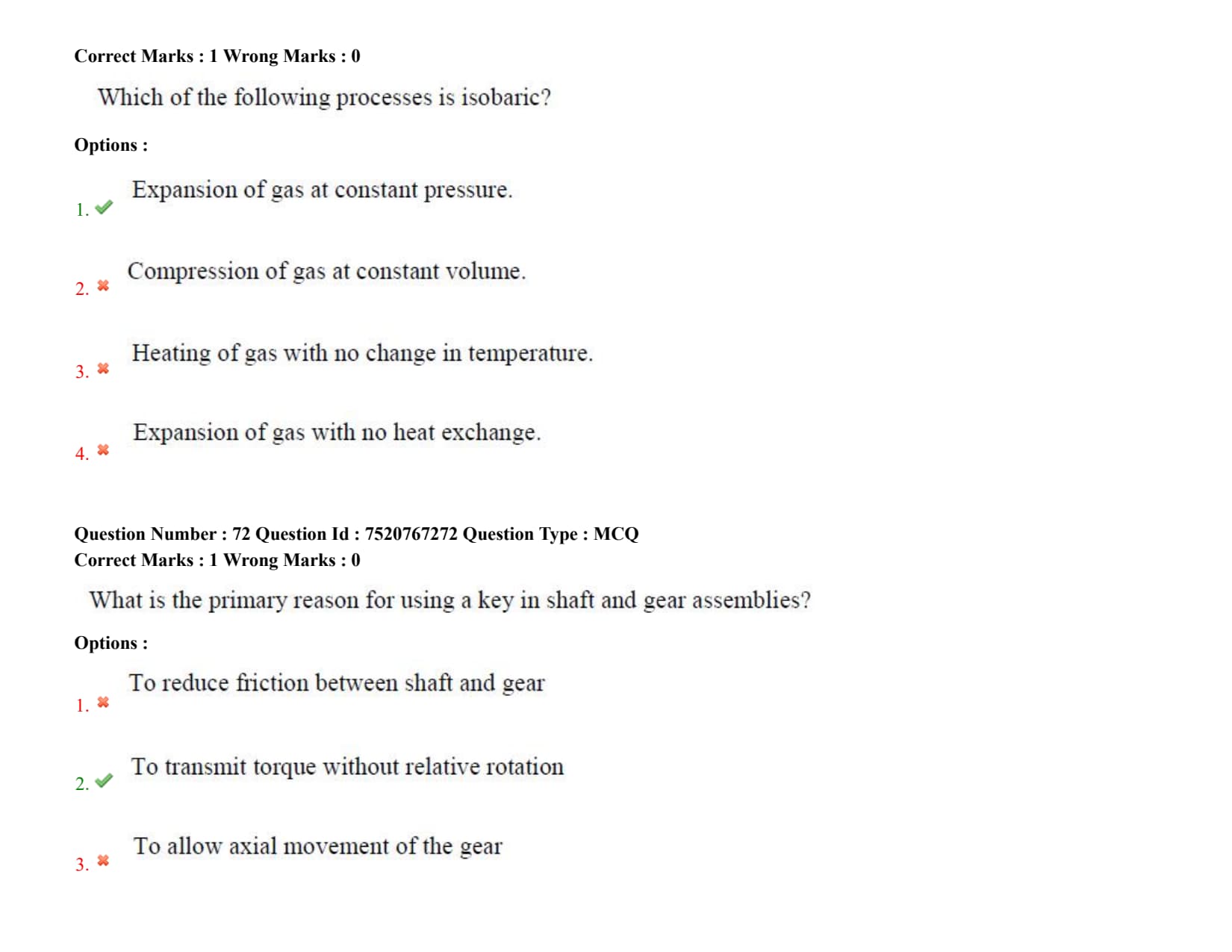
Which of the following processes is isobaric?
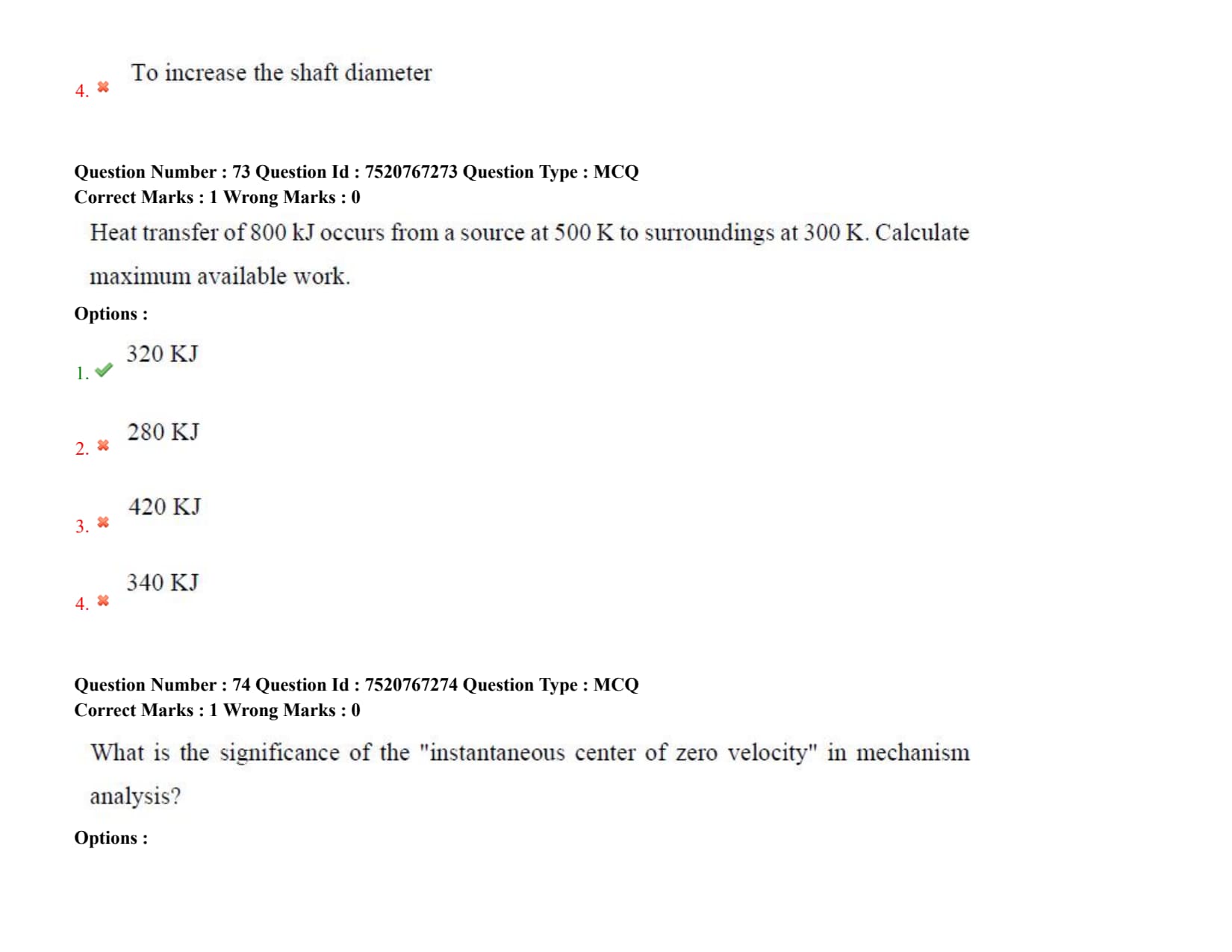
What is the primary reason for using a key in shaft and gear assemblies?
Heat transfer of 800 kJ occurs from a source at 500 K to surroundings at 300 K. Calculate maximum available work.
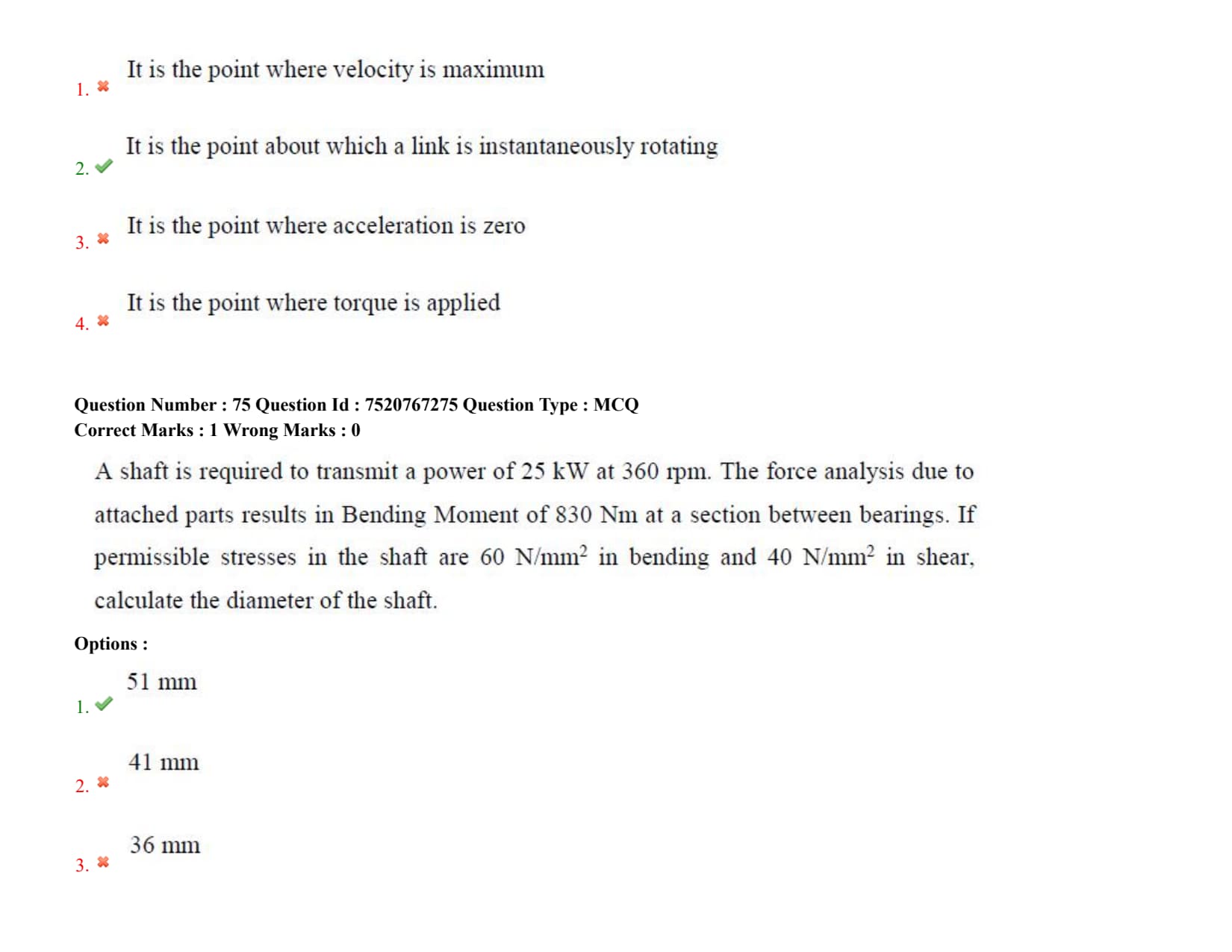
What is the significance of the "instantaneous center of zero velocity" in mechanism analysis?
A shaft is required to transmit a power of 25 kW at 360 rpm. The force analysis due to attached parts results in Bending Moment of 830 Nm at a section between bearings. If permissible stresses in the shaft are 60 N/mm\(^2\) in bending and 40 N/mm\(^2\) in shear, calculate the diameter of the shaft.
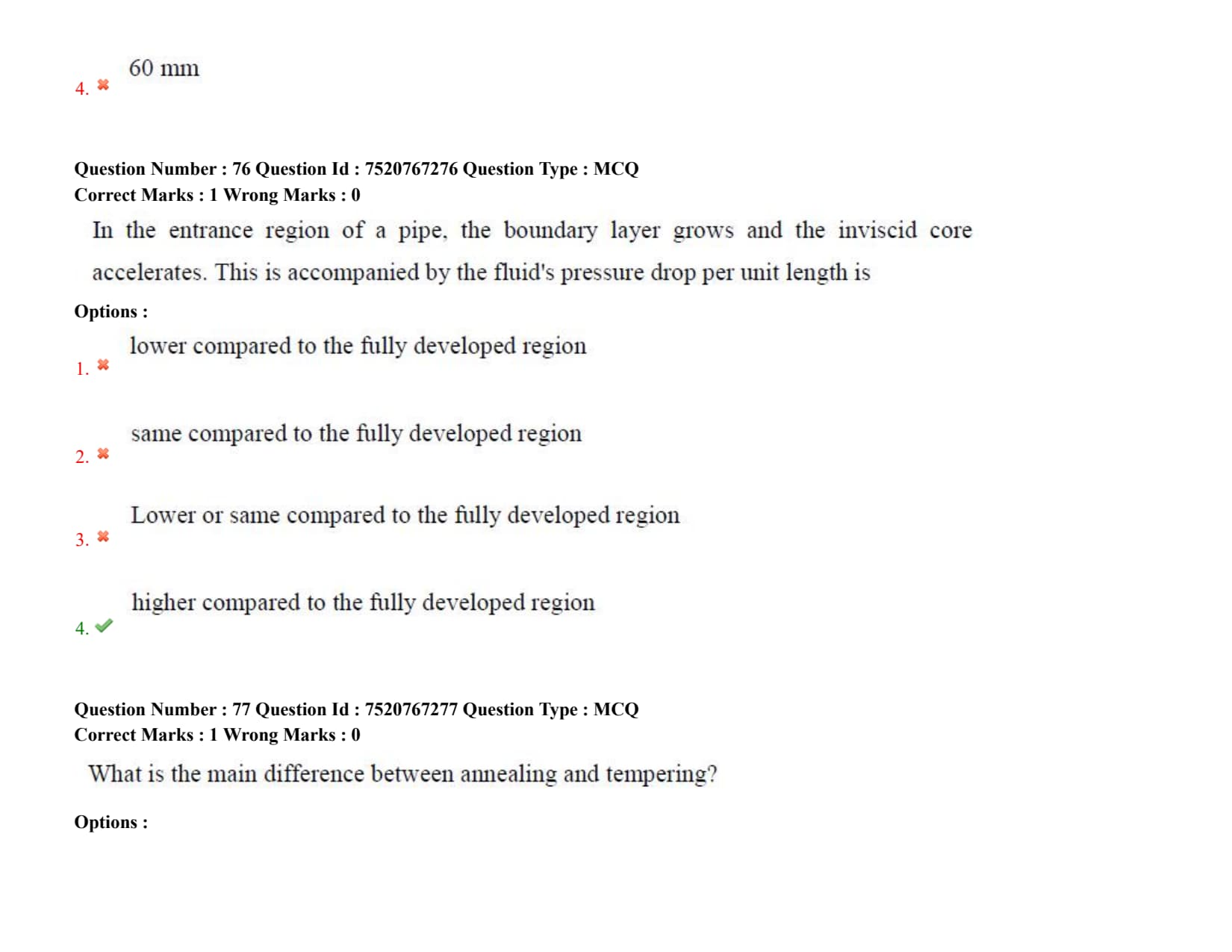
In the entrance region of a pipe, the boundary layer grows and the inviscid core accelerates. This is accompanied by the fluid's pressure drop per unit length is
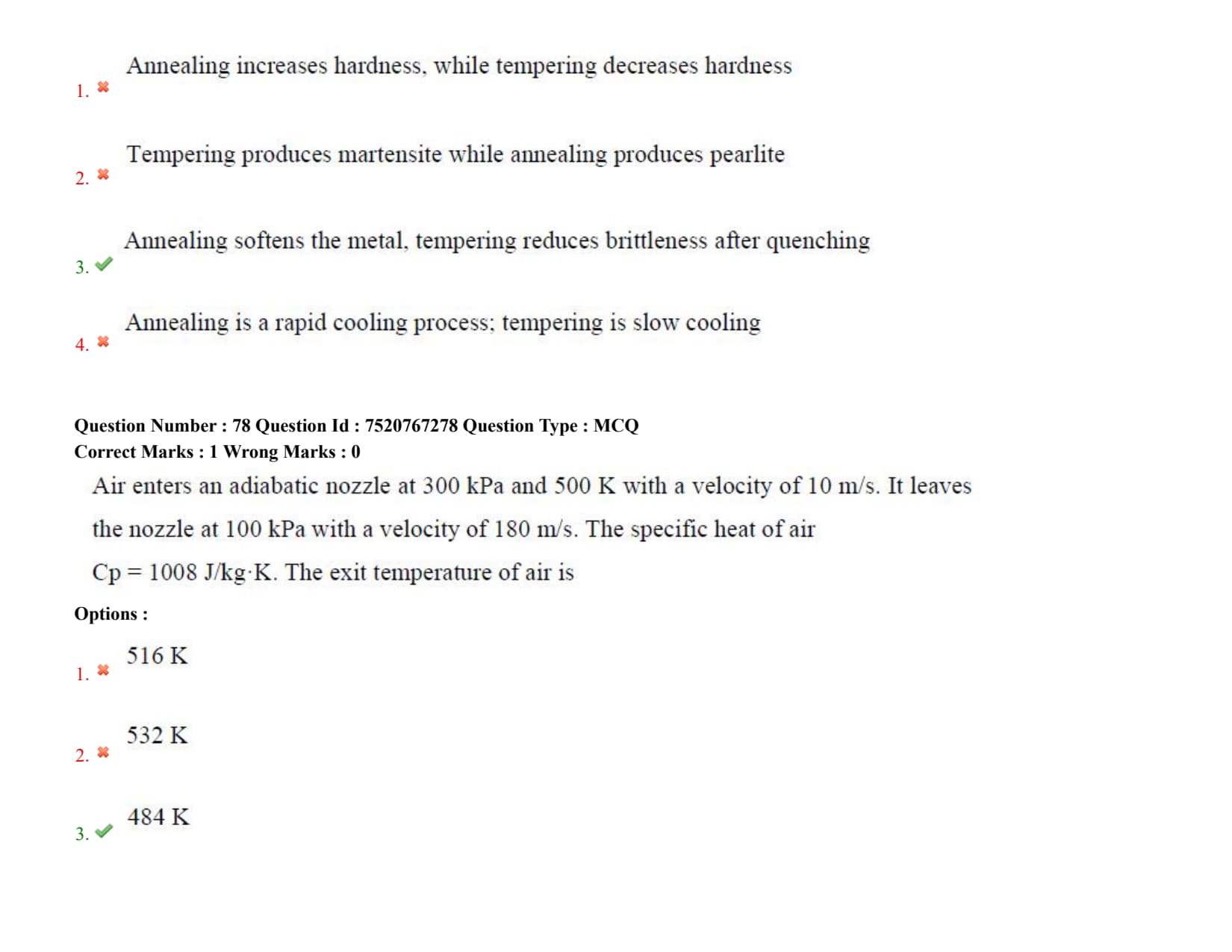
What is the main difference between annealing and tempering?
Air enters an adiabatic nozzle at 300 kPa and 500 K with a velocity of 10 m/s. It leaves the nozzle at 100 kPa with a velocity of 180 m/s. The specific heat of air \(C_{p} = 1008 J/kg\cdotK\). The exit temperature of air is
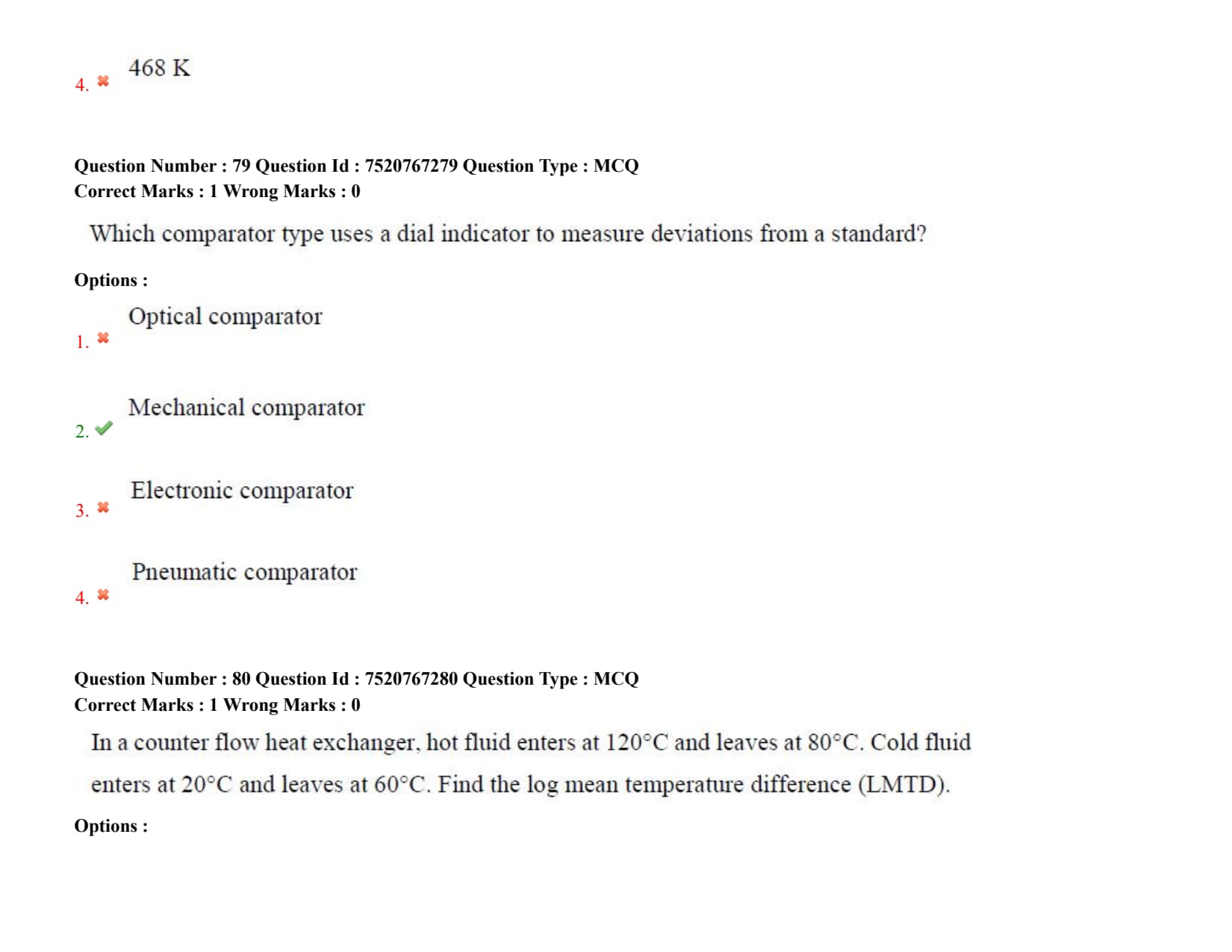
Which comparator type uses a dial indicator to measure deviations from a standard?
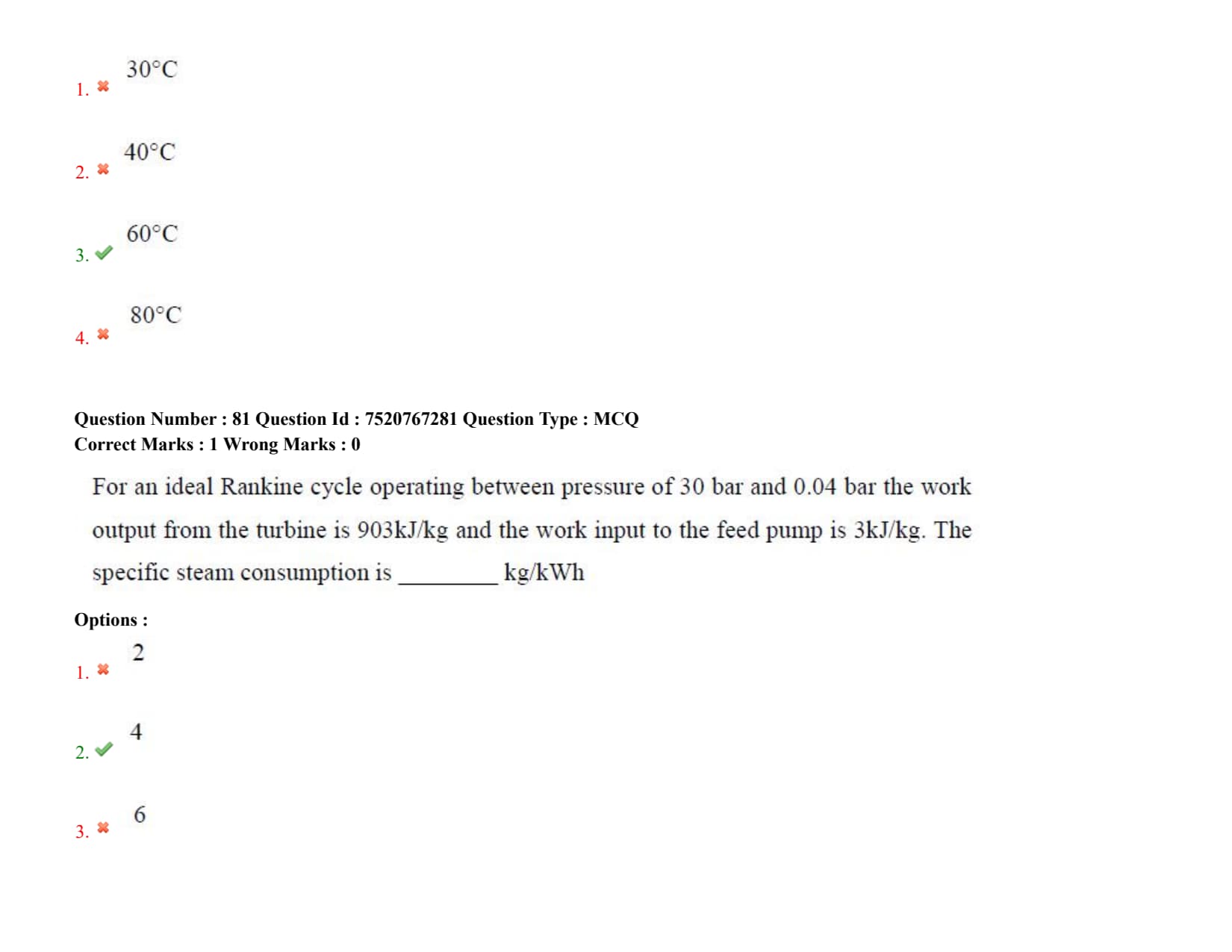
In a counter flow heat exchanger, hot fluid enters at \(120^\circC\) and leaves at \(80^\circC\). Cold fluid enters at \(20^\circC\) and leaves at \(60^\circC\). Find the log mean temperature difference (LMTD).
For an ideal Rankine cycle operating between pressure of 30 bar and 0.04 bar the work output from the turbine is 903kJ/kg and the work input to the feed pump is 3kJ/kg. The specific steam consumption is ________ kg/kWh
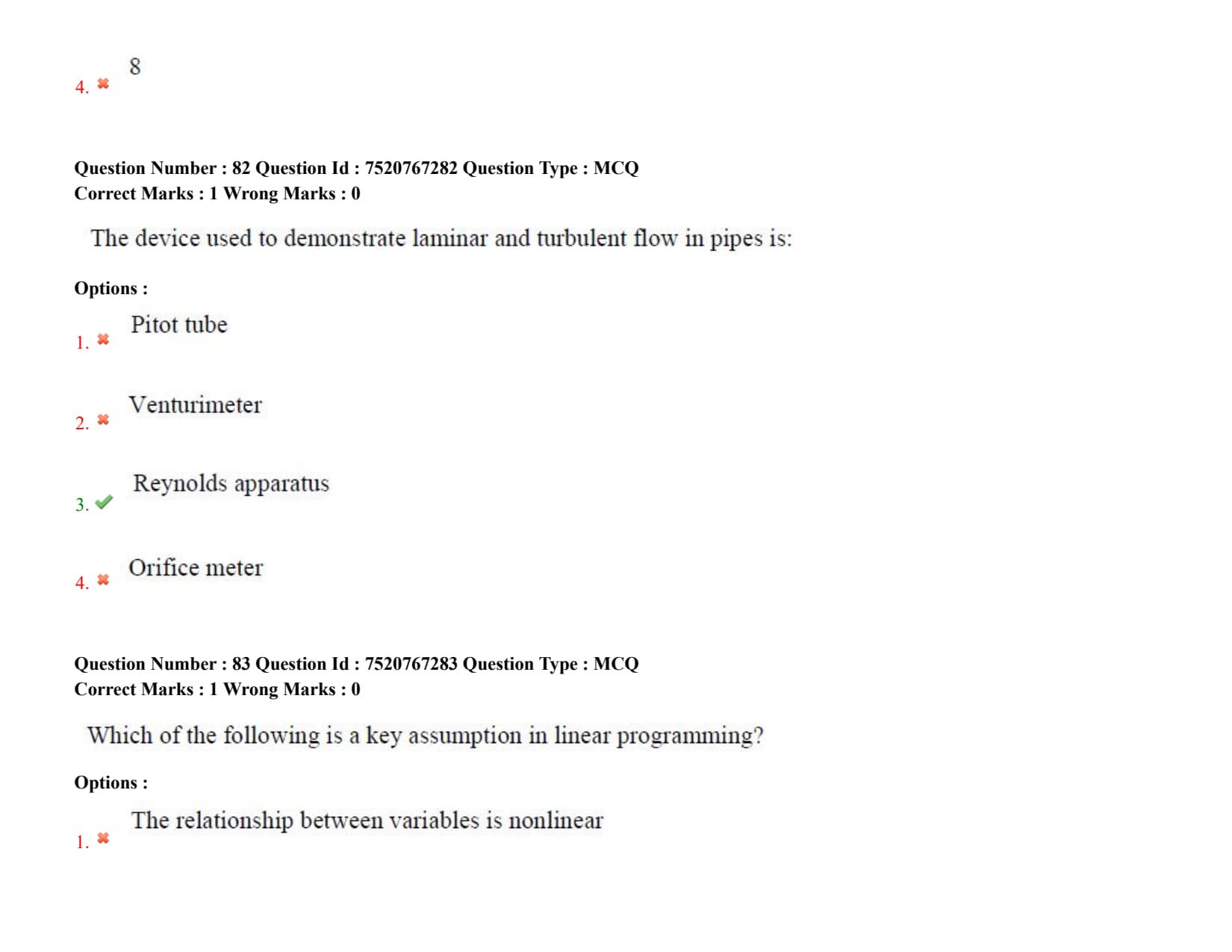
The device used to demonstrate laminar and turbulent flow in pipes is:
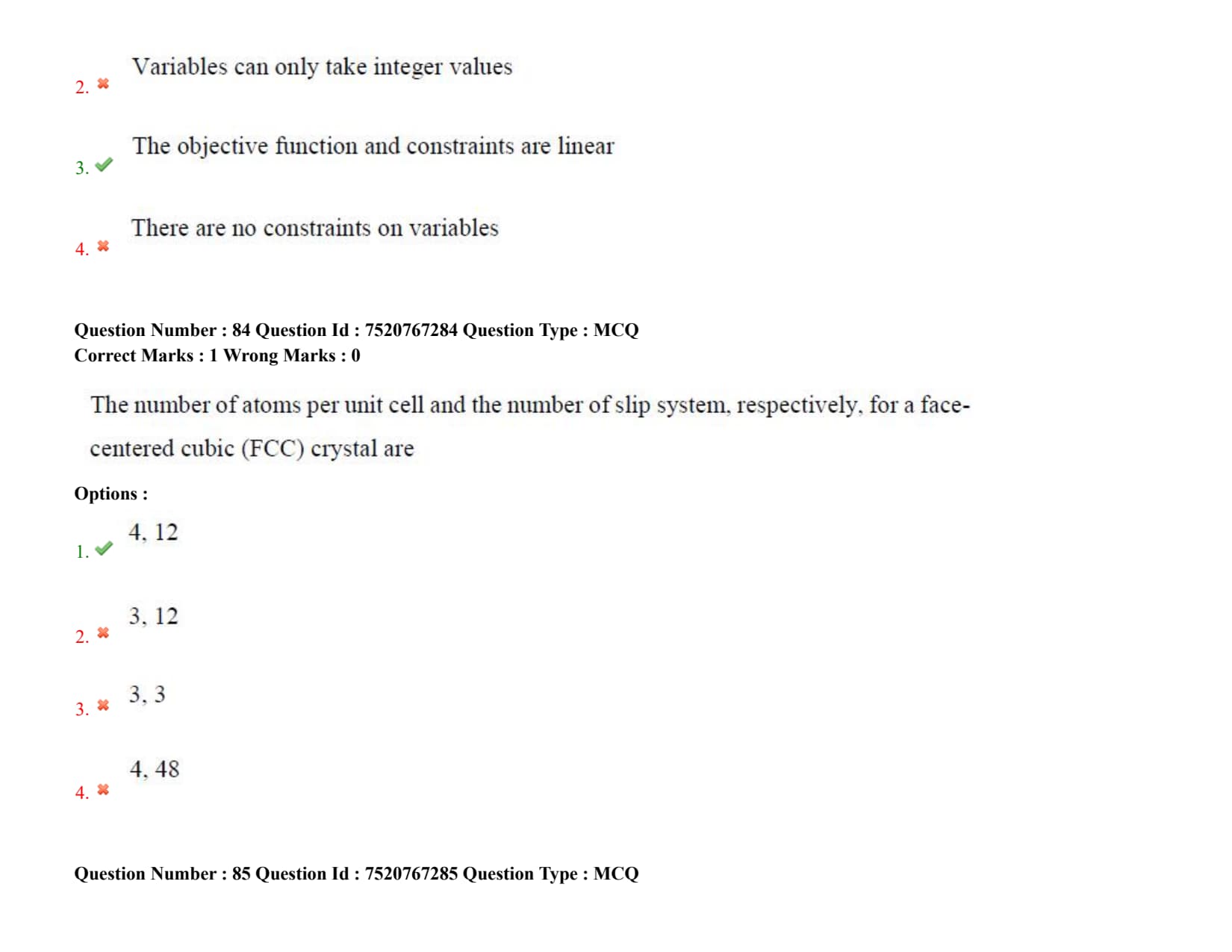
Which of the following is a key assumption in linear programming?
The number of atoms per unit cell and the number of slip system, respectively, for a face-centered cubic (FCC) crystal are
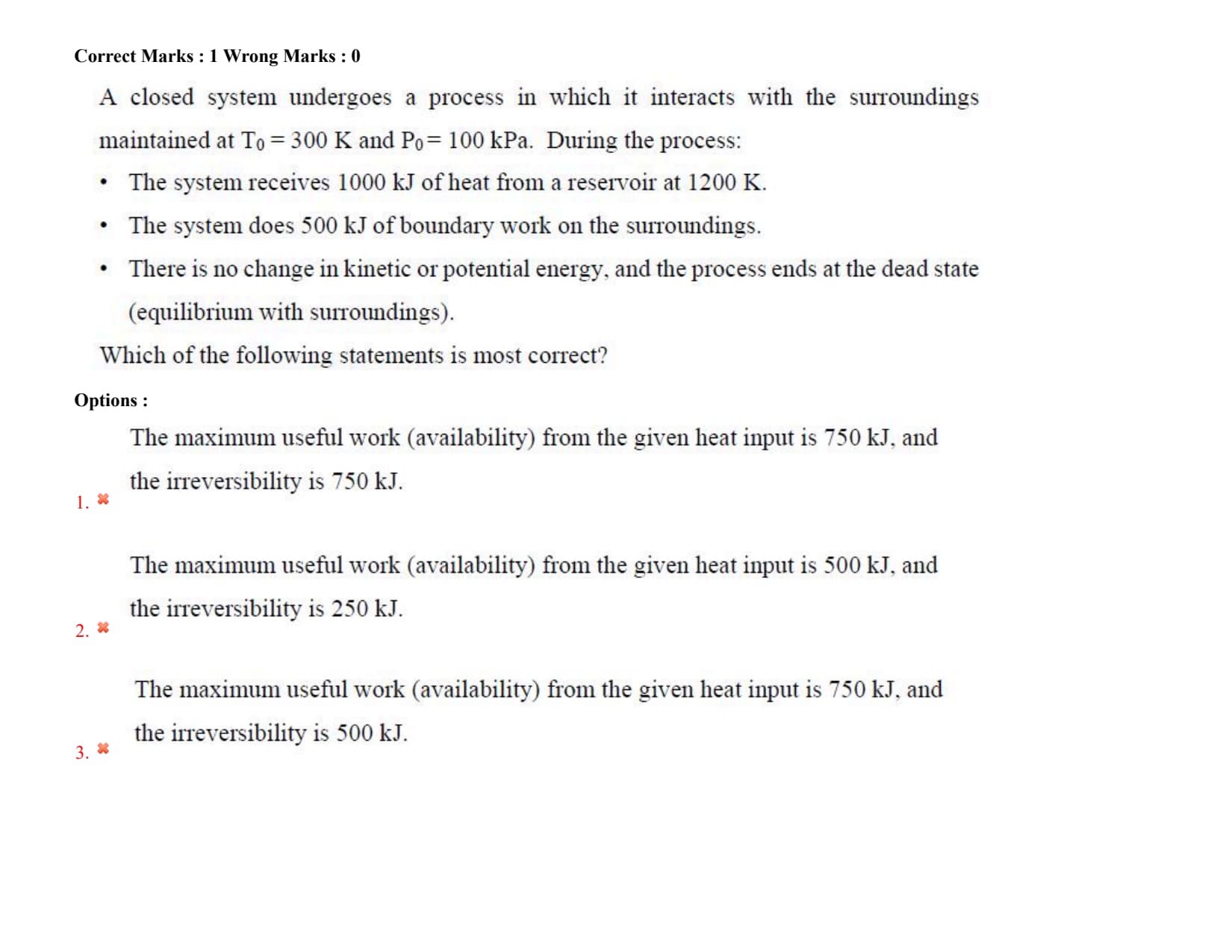
A closed system undergoes a process in which it interacts with the surroundings maintained at \(T_{0} = 300 K\) and \(P_{0} = 100 kPa\). During the process:
\(\bullet\) The system receives 1000 kJ of heat from a reservoir at 1200 K.
\(\bullet\) The system does 500 kJ of boundary work on the surroundings.
\(\bullet\) There is no change in kinetic or potential energy, and the process ends at the dead state (equilibrium with surroundings).
Which of the following statements is most correct?
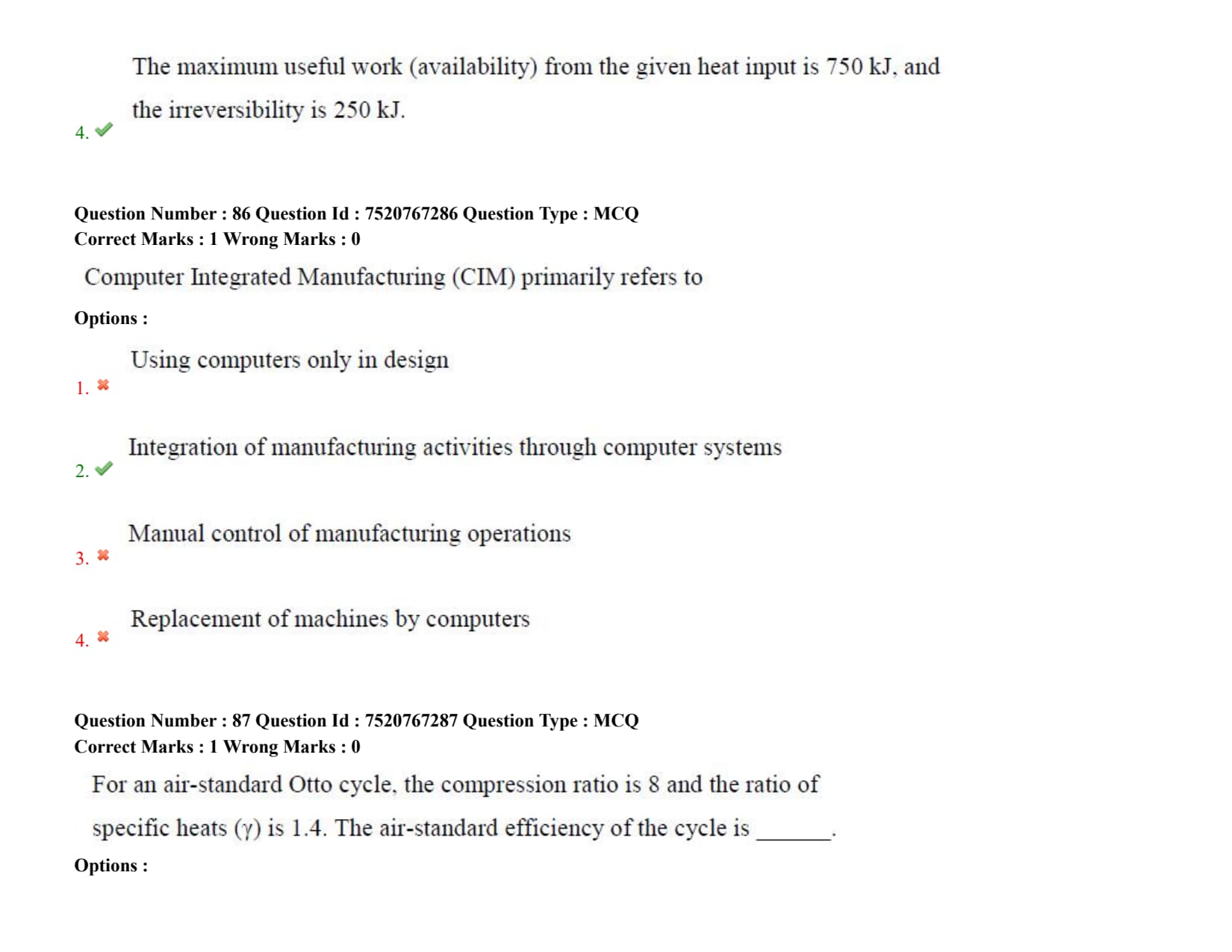
Computer Integrated Manufacturing (CIM) primarily refers to
For an air-standard Otto cycle, the compression ratio is 8 and the ratio of specific heats (\(\gamma\)) is 1.4. The air-standard efficiency of the cycle is _______.
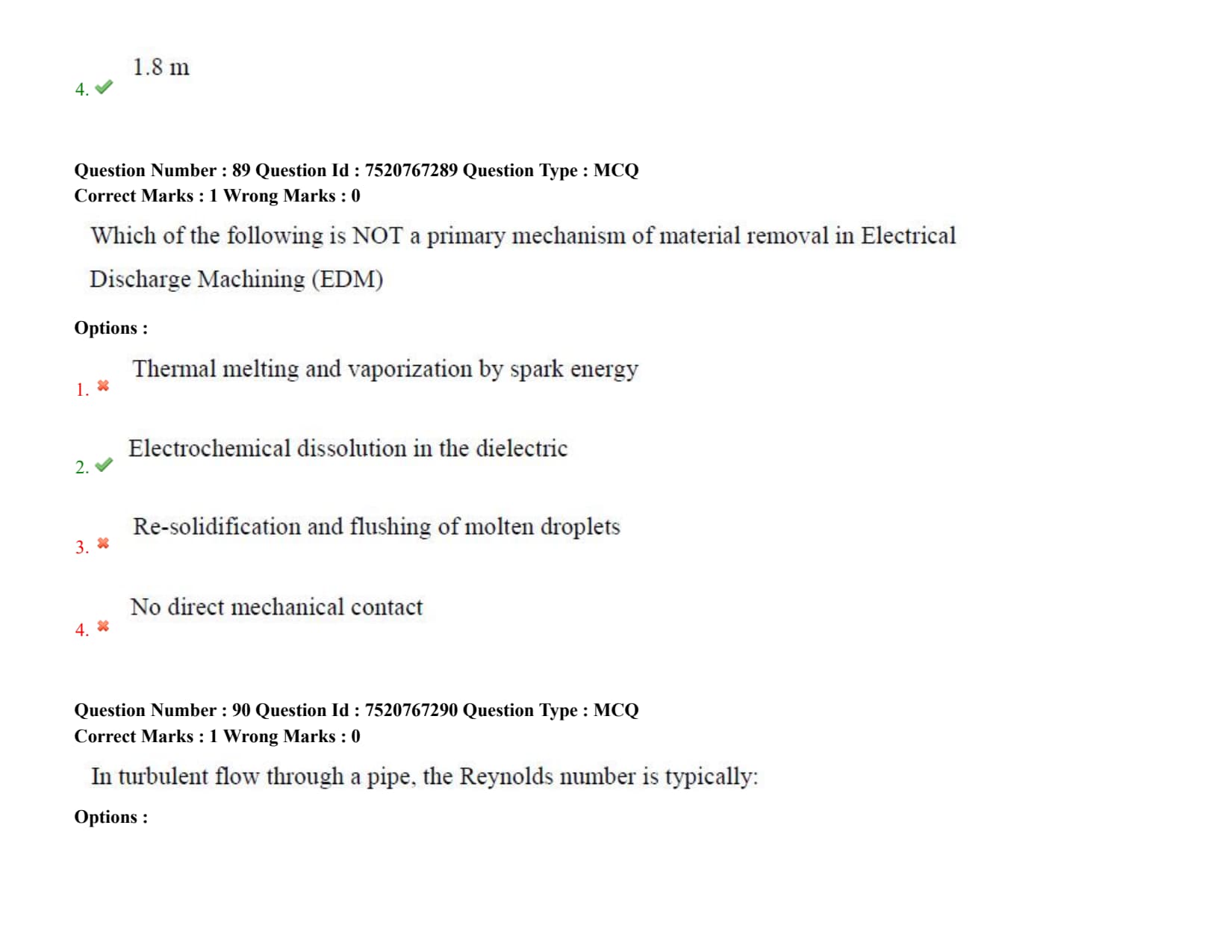
Consider a large cubic ice block floating in water with top surface of the ice block parallel to the surface of the sea. The specific gravities of ice and seawater are 0.9 and 1.0, respectively. If a 20-cm-high portion of the ice block extends above the surface of the water, determine the height of the ice block below the surface.
Which of the following is NOT a primary mechanism of material removal in Electrical Discharge Machining (EDM)
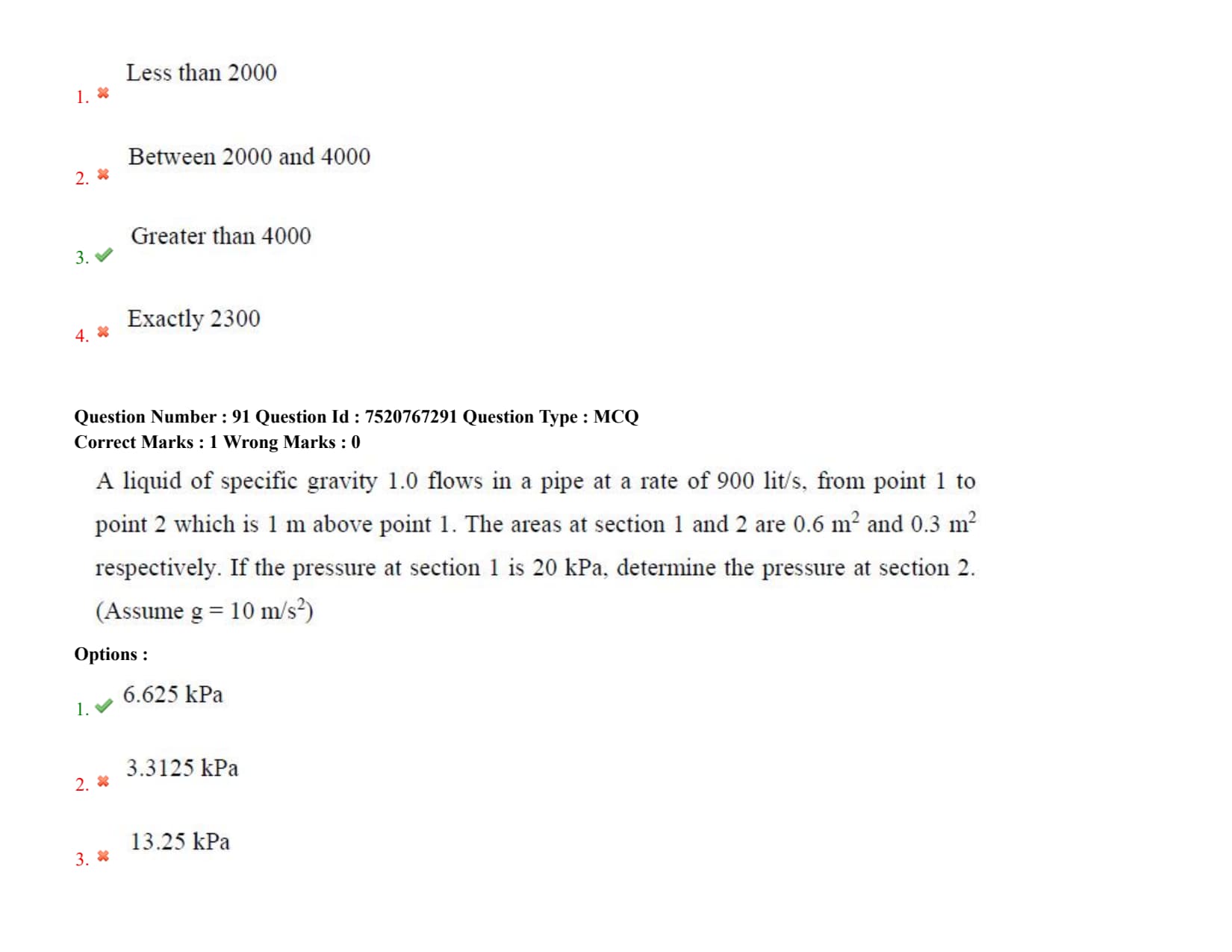
In turbulent flow through a pipe, the Reynolds number is typically:
A liquid of specific gravity 1.0 flows in a pipe at a rate of 900 lit/s, from point 1 to point 2 which is 1 m above point 1. The areas at section 1 and 2 are 0.6 m\(^2\) and 0.3 m\(^2\) respectively. If the pressure at section 1 is 20 kPa, determine the pressure at section 2. (Assume g = 10 m/s\(^2\))
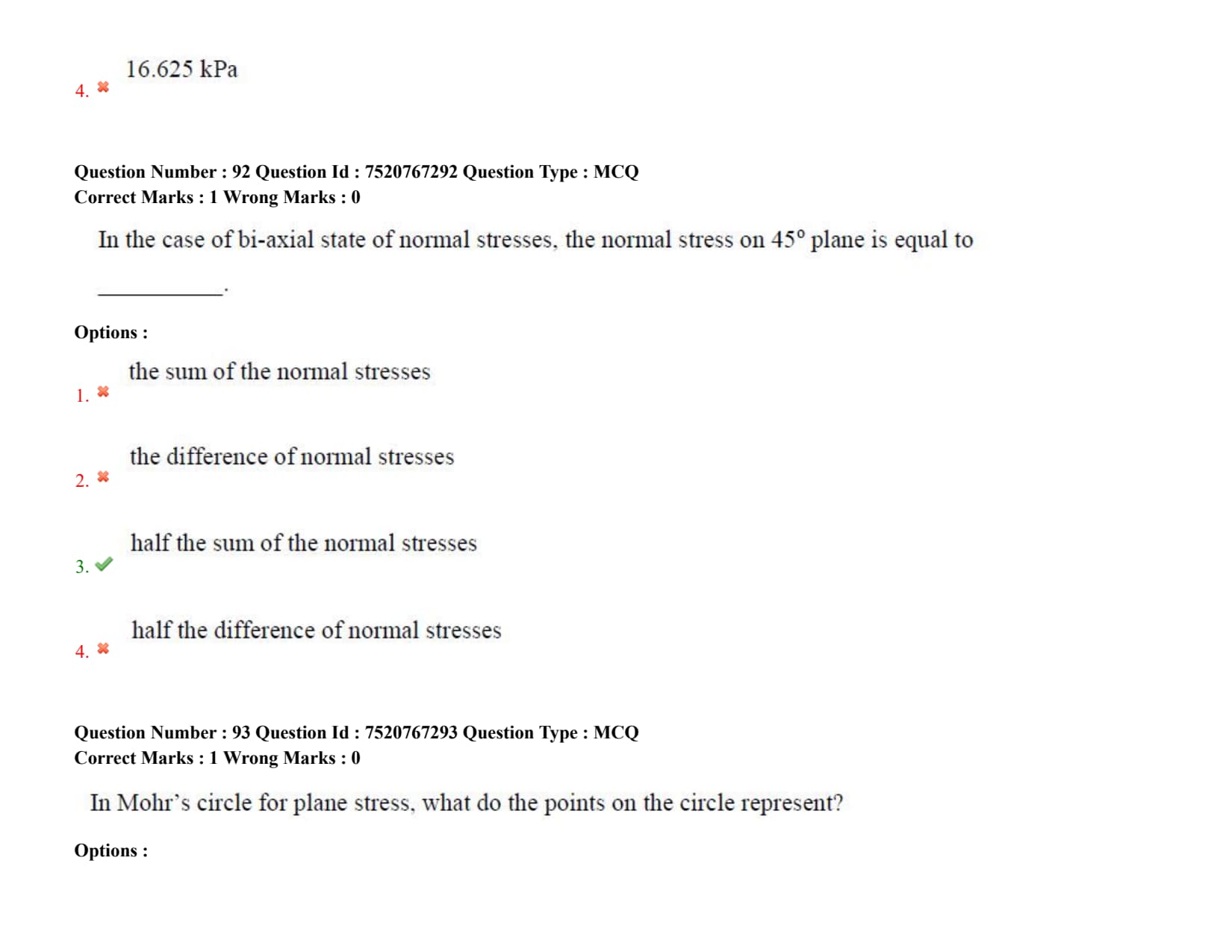
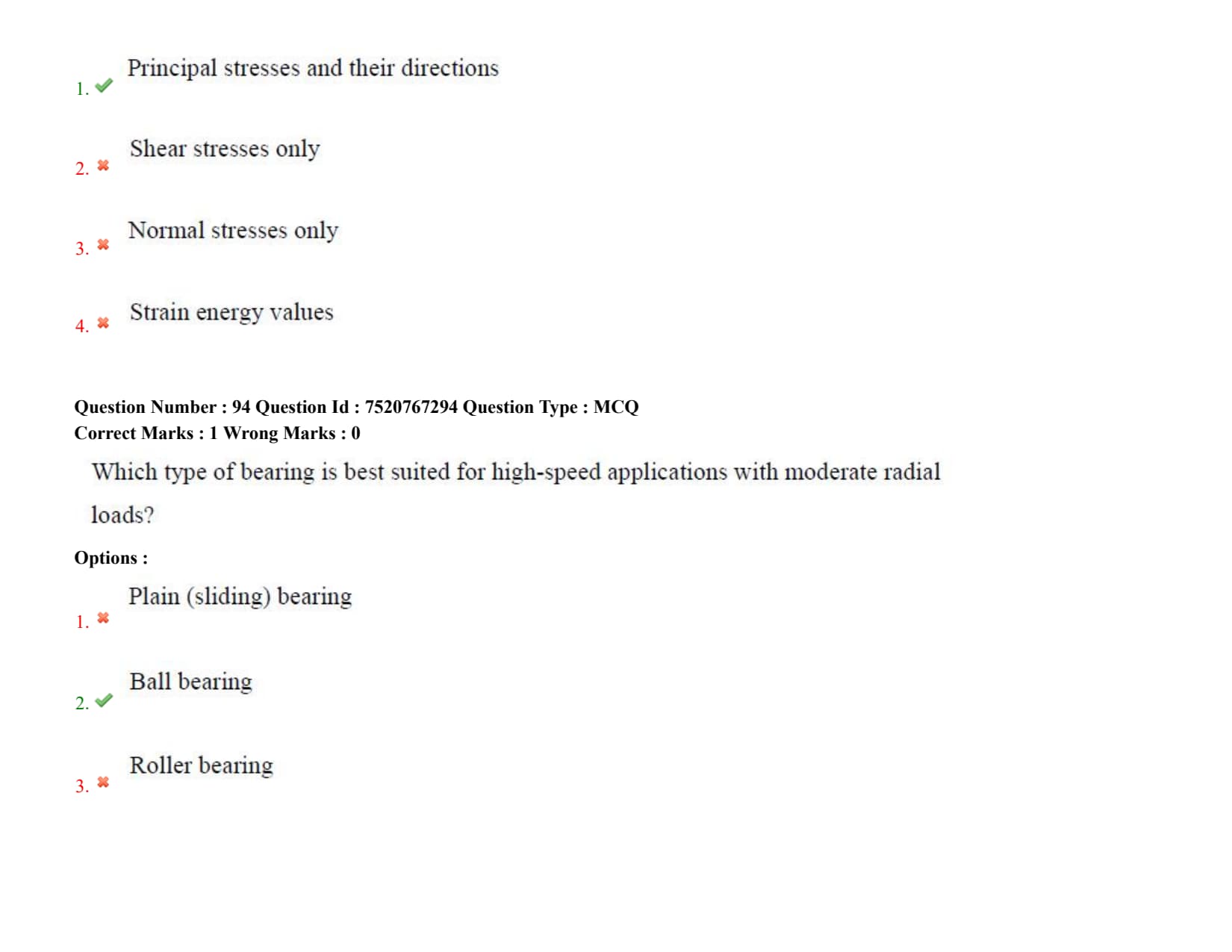
In the case of bi-axial state of normal stresses, the normal stress on 45\(^\circ\) plane is equal to ________.
In Mohr's circle for plane stress, what do the points on the circle represent?
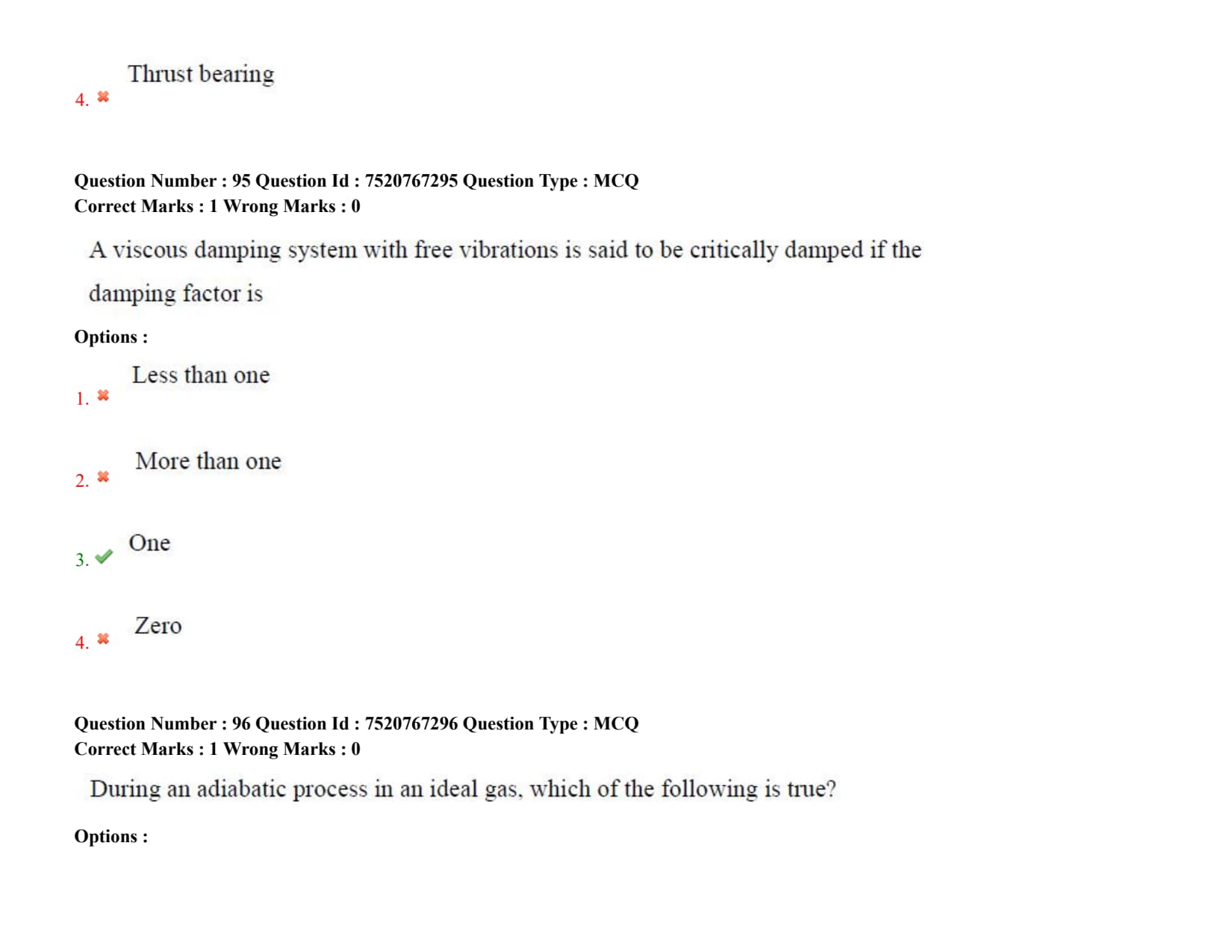
Which type of bearing is best suited for high-speed applications with moderate radial loads?
A viscous damping system with free vibrations is said to be critically damped if the damping factor is
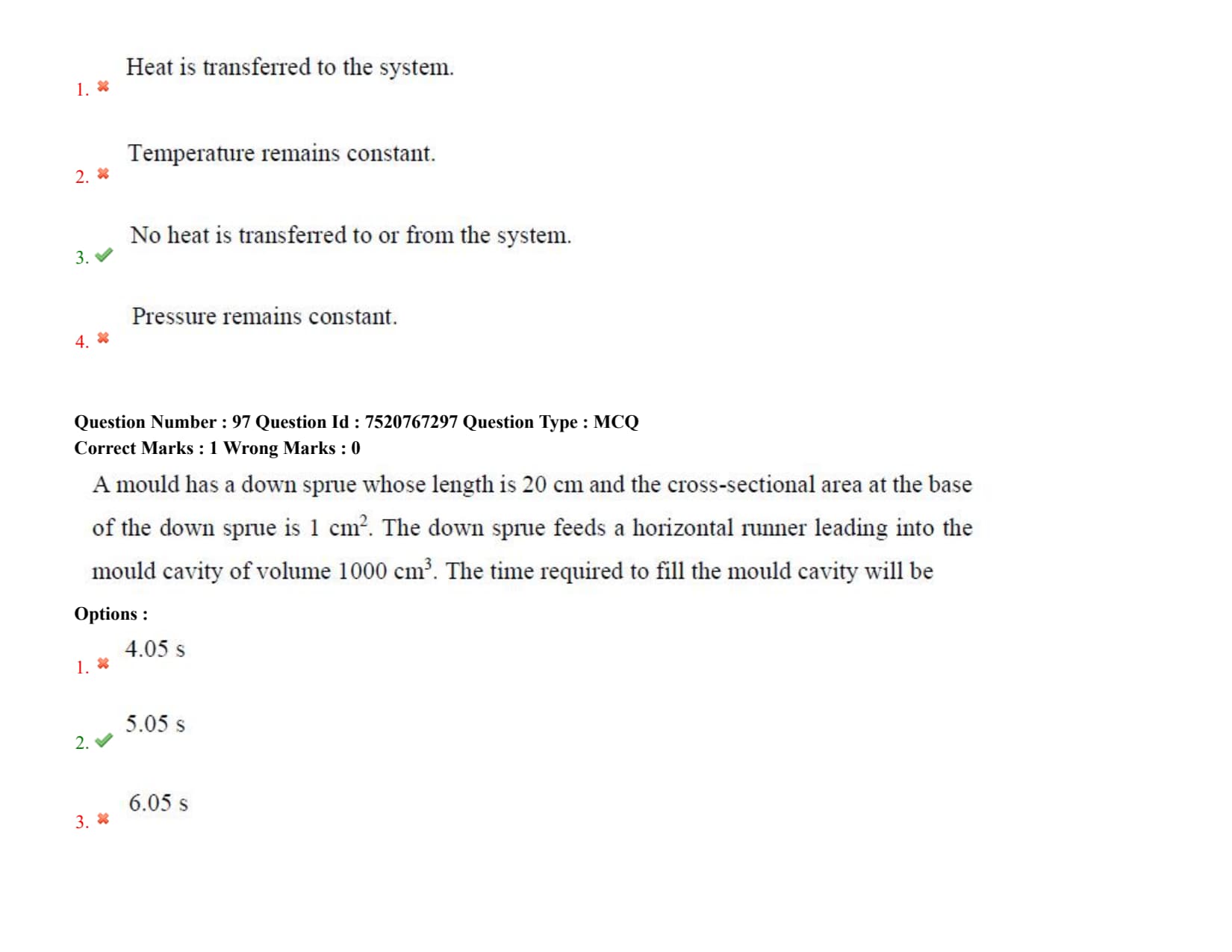
During an adiabatic process in an ideal gas, which of the following is true?
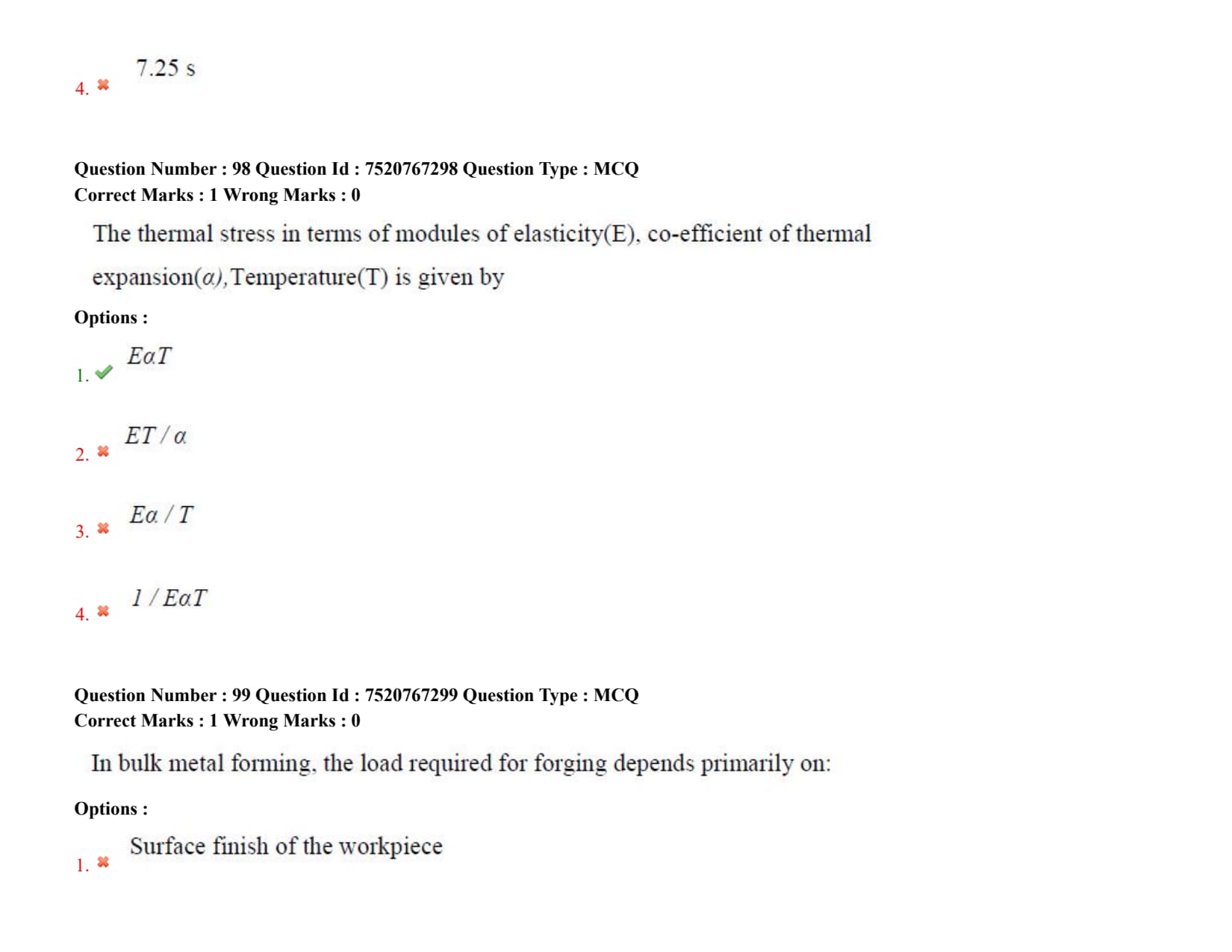
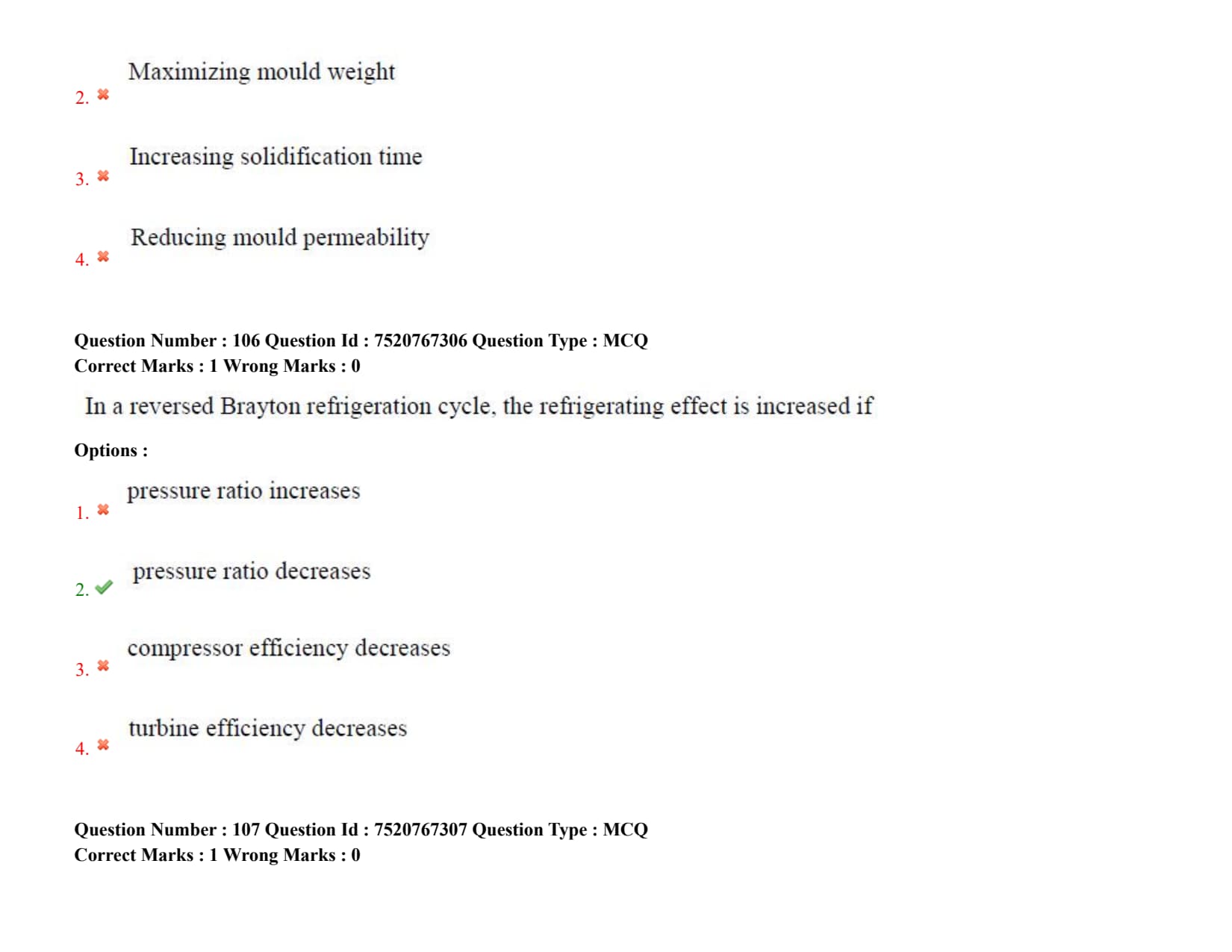
A mould has a down sprue whose length is 20 cm and the cross-sectional area at the base of the down sprue is 1 cm\(^2\). The down sprue feeds a horizontal runner leading into the mould cavity of volume 1000 cm\(^3\). The time required to fill the mould cavity will be
The thermal stress in terms of modules of elasticity(E), co-efficient of thermal expansion(\(\alpha\)), Temperature(T) is given by
In bulk metal forming, the load required for forging depends primarily on:
What is the main goal of the assignment problem?
A thin cylindrical shell of diameter 'd', length 'l' and thickness 't' is subjected to an axial or internal pressure 'P'. What is the ratio of longitudinal strain to hoop strain in terms of Poisson's ratio (1/m)
The bending moment on a section is maximum where shearing force is ________
The shape factor in radiative heat transfer depends on:
In a DC arc welding operation, the voltage-arc length characteristic was obtained as \(V_{arc} = 20 + 5L\), where the arc length L was varied between 5 mm and 7mm. Here \(V_{arc}\) denotes the arc voltage in volts. The arc current was varied from 400 A to 500 A. Assuming linear power source characteristics, the open circuit voltage and short circuit current for the welding operation are:
Which of the following is a critical design consideration for gating systems in casting?
In a reversed Brayton refrigeration cycle, the refrigerating effect is increased if
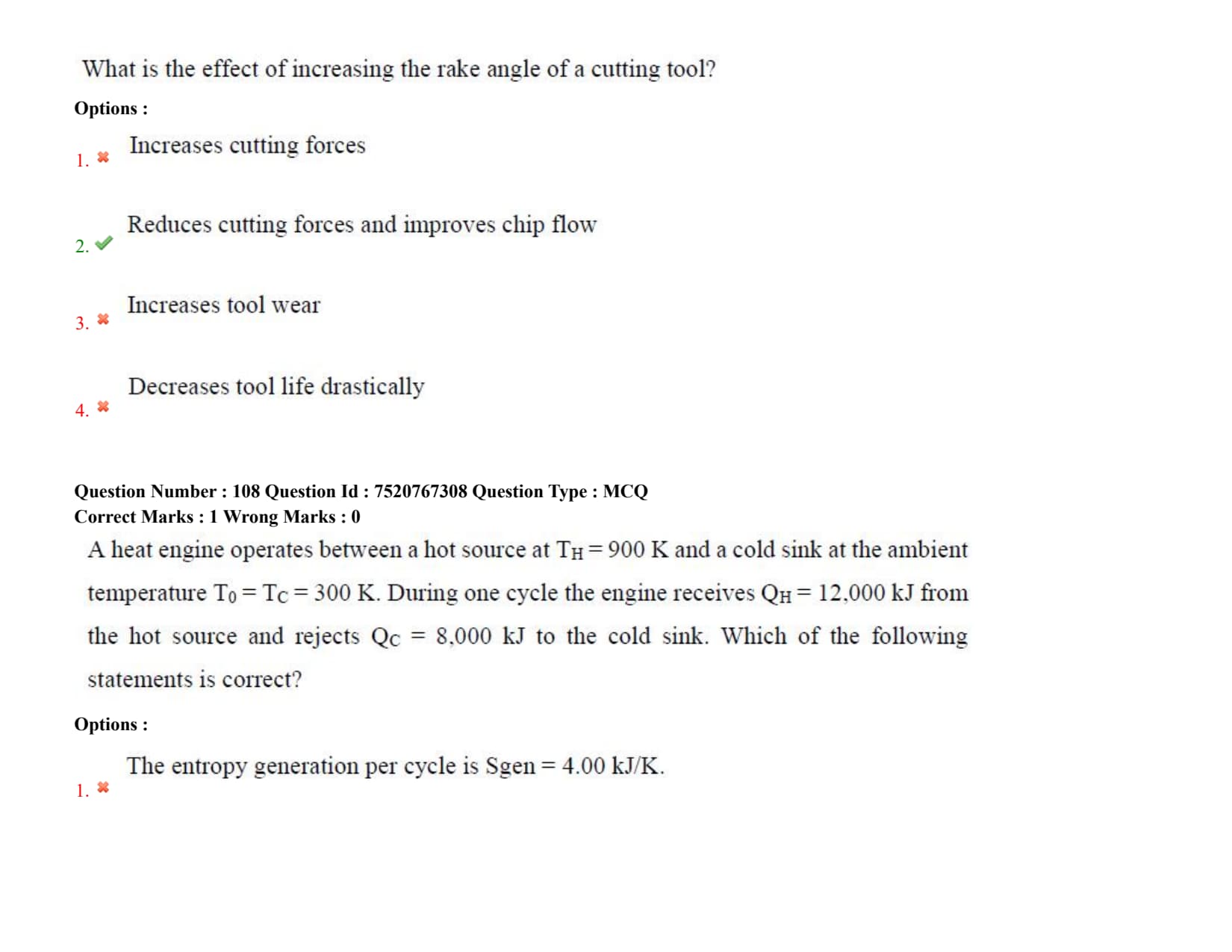
What is the effect of increasing the rake angle of a cutting tool?
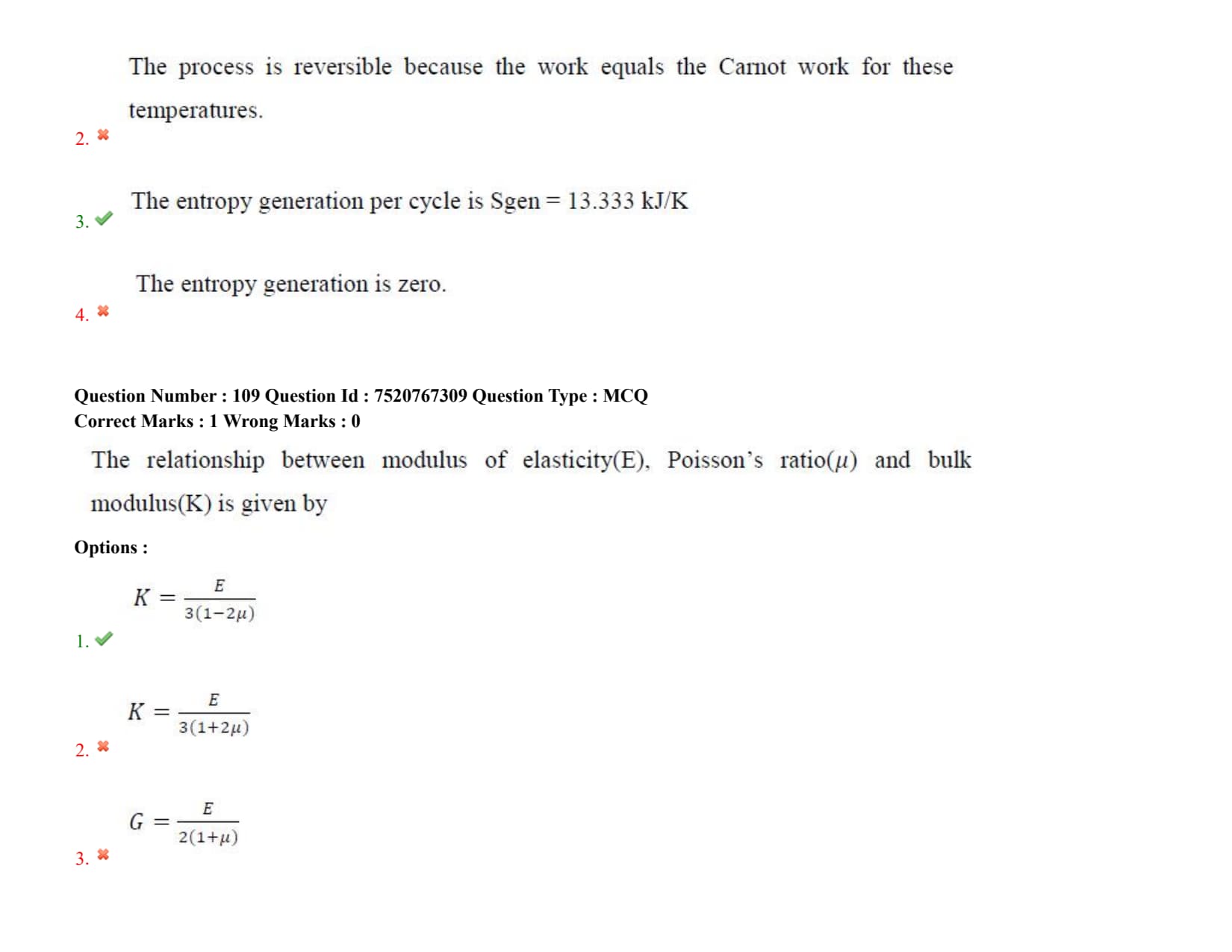
A heat engine operates between a hot source at \(T_{H} = 900 K\) and a cold sink at the ambient temperature \(T_{0} = T_{C} = 300 K\). During one cycle the engine receives \(Q_{H} = 12,000 kJ\) from the hot source and rejects \(Q_{C} = 8,000 kJ\) to the cold sink. Which of the following statements is correct?
The relationship between modulus of elasticity(E), Poisson's ratio(\(\mu\)) and bulk modulus(K) is given by
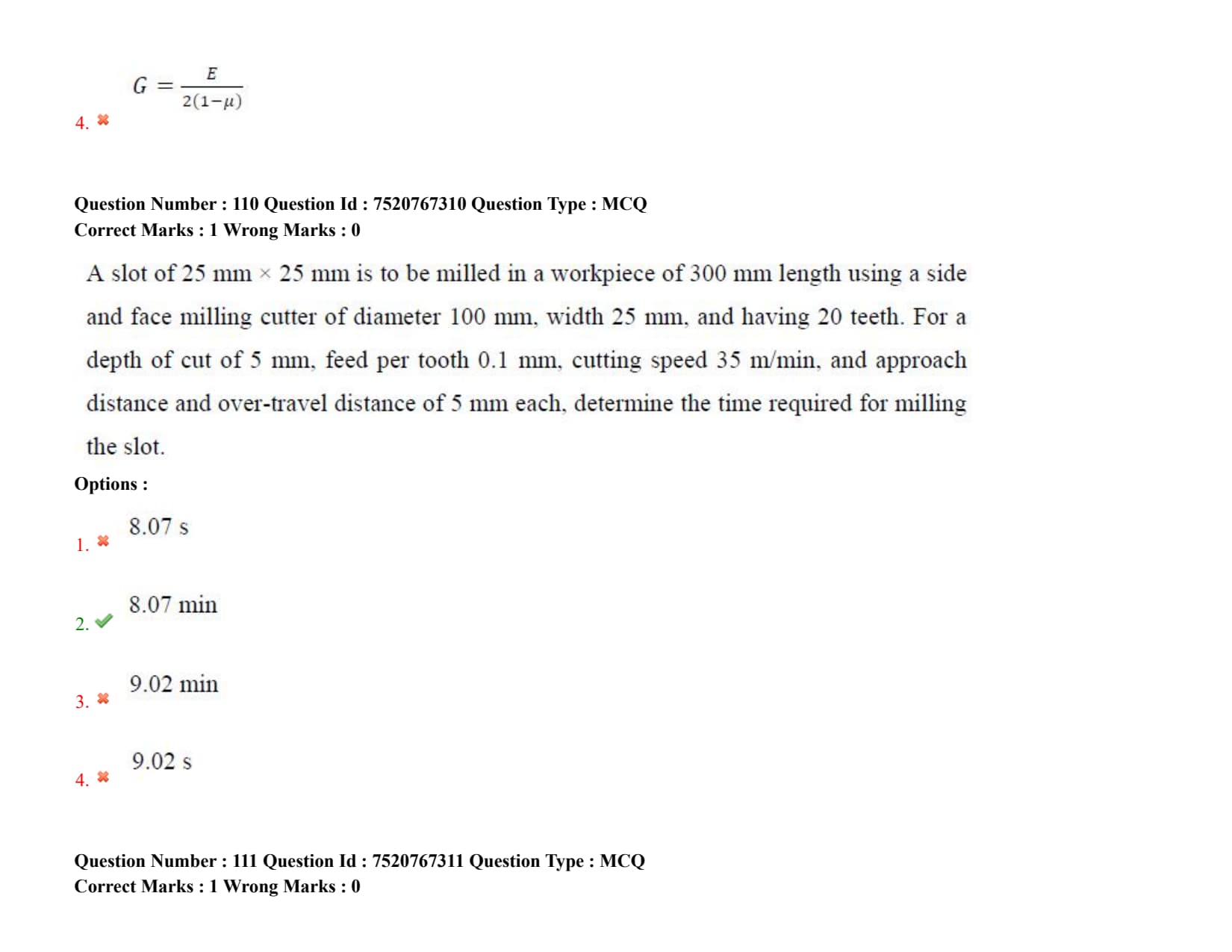
A slot of 25 mm \(\times\) 25 mm is to be milled in a workpiece of 300 mm length using a side and face milling cutter of diameter 100 mm, width 25 mm, and having 20 teeth. For a depth of cut of 5 mm, feed per tooth 0.1 mm, cutting speed 35 m/min, and approach distance and over-travel distance of 5 mm each, determine the time required for milling the slot.
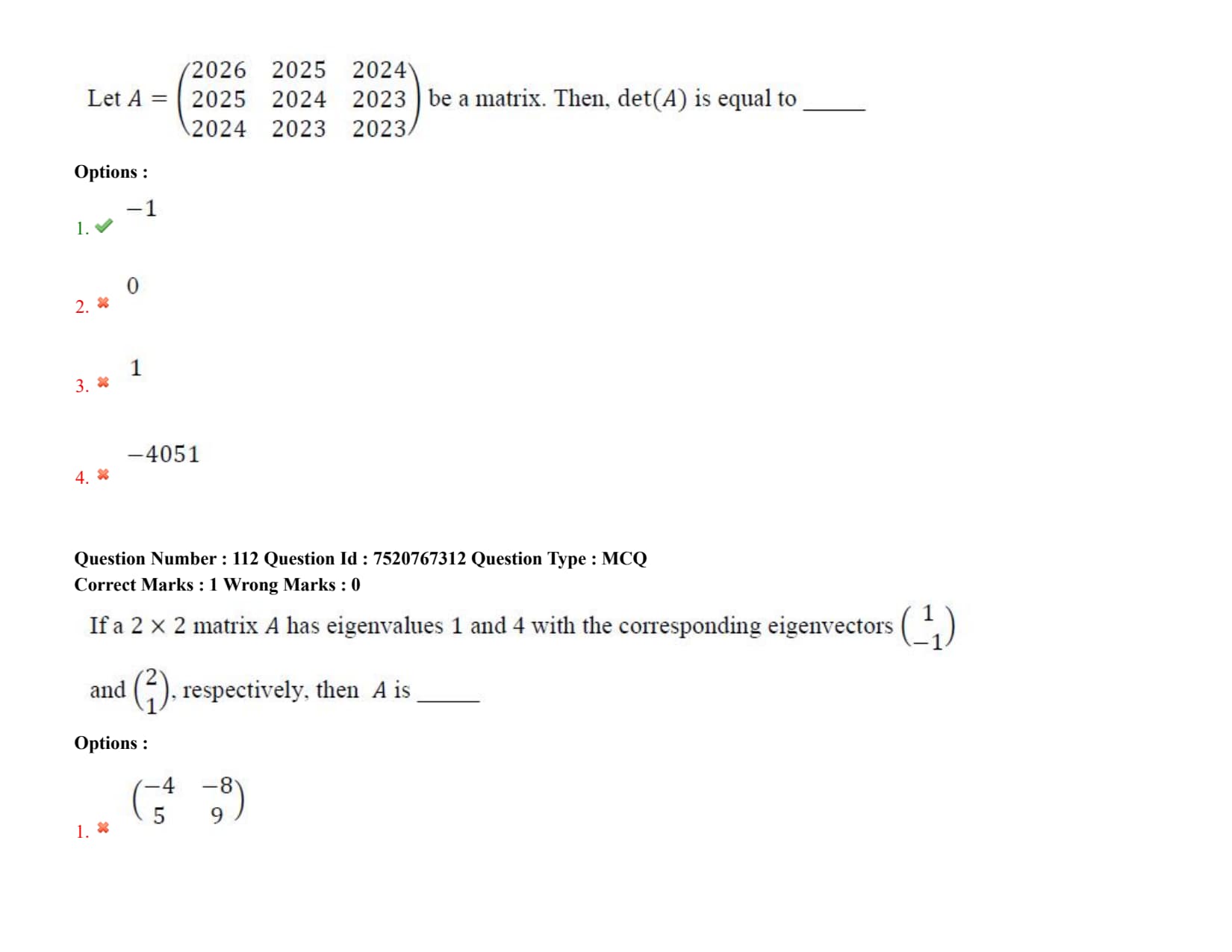
Let \(A = \begin{pmatrix} 2026 & 2025 & 2024 \\
2025 & 2024 & 2023 \\
2024 & 2023 & 2023 \end{pmatrix}\) be a matrix. Then, \(\det(A)\) is equal to _______
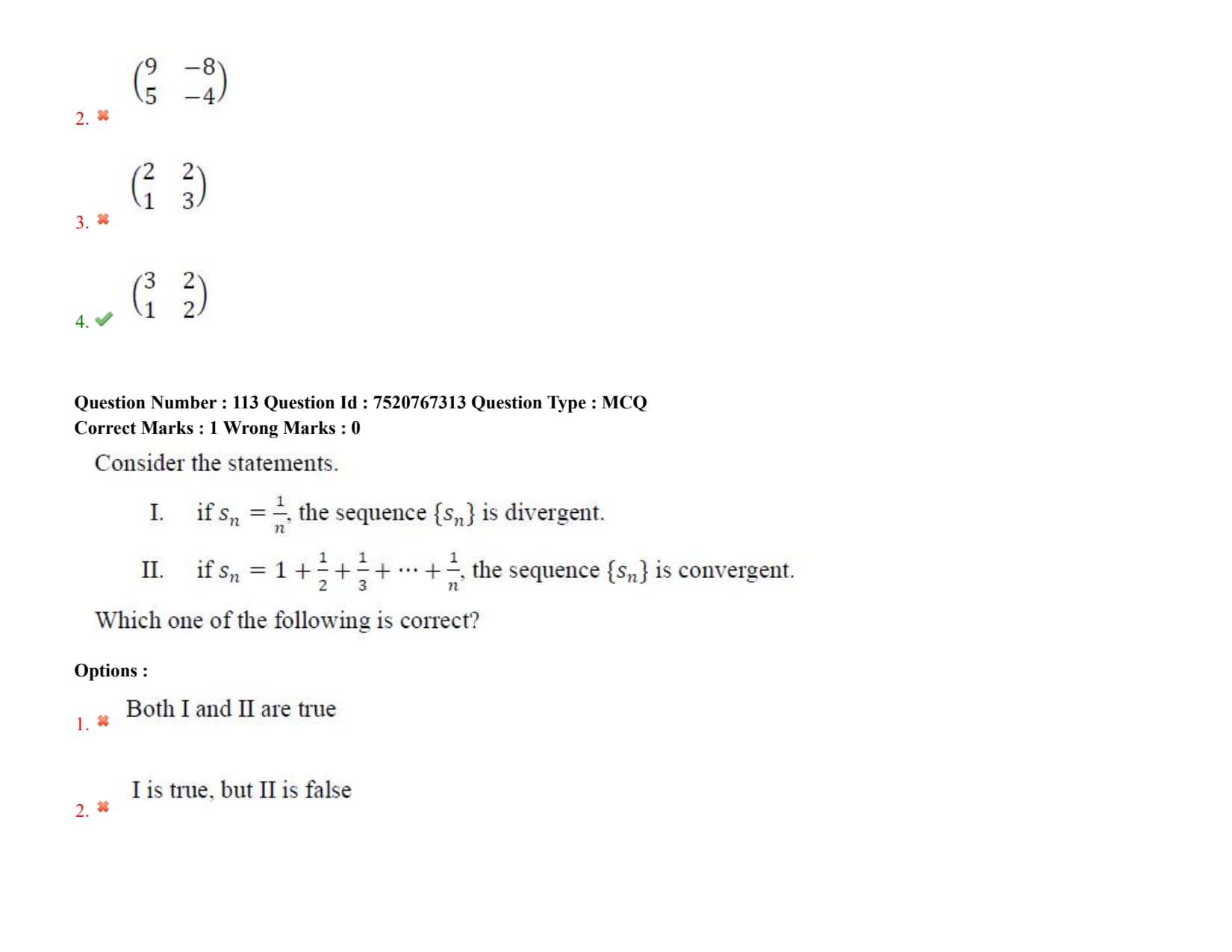
If a \(2 \times 2\) matrix \(A\) has eigenvalues 1 and 4 with the corresponding eigenvectors \(\begin{pmatrix} 1 \\
-1 \end{pmatrix}\) and \(\begin{pmatrix} 2 \\
1 \end{pmatrix}\), respectively, then \(A\) is ________
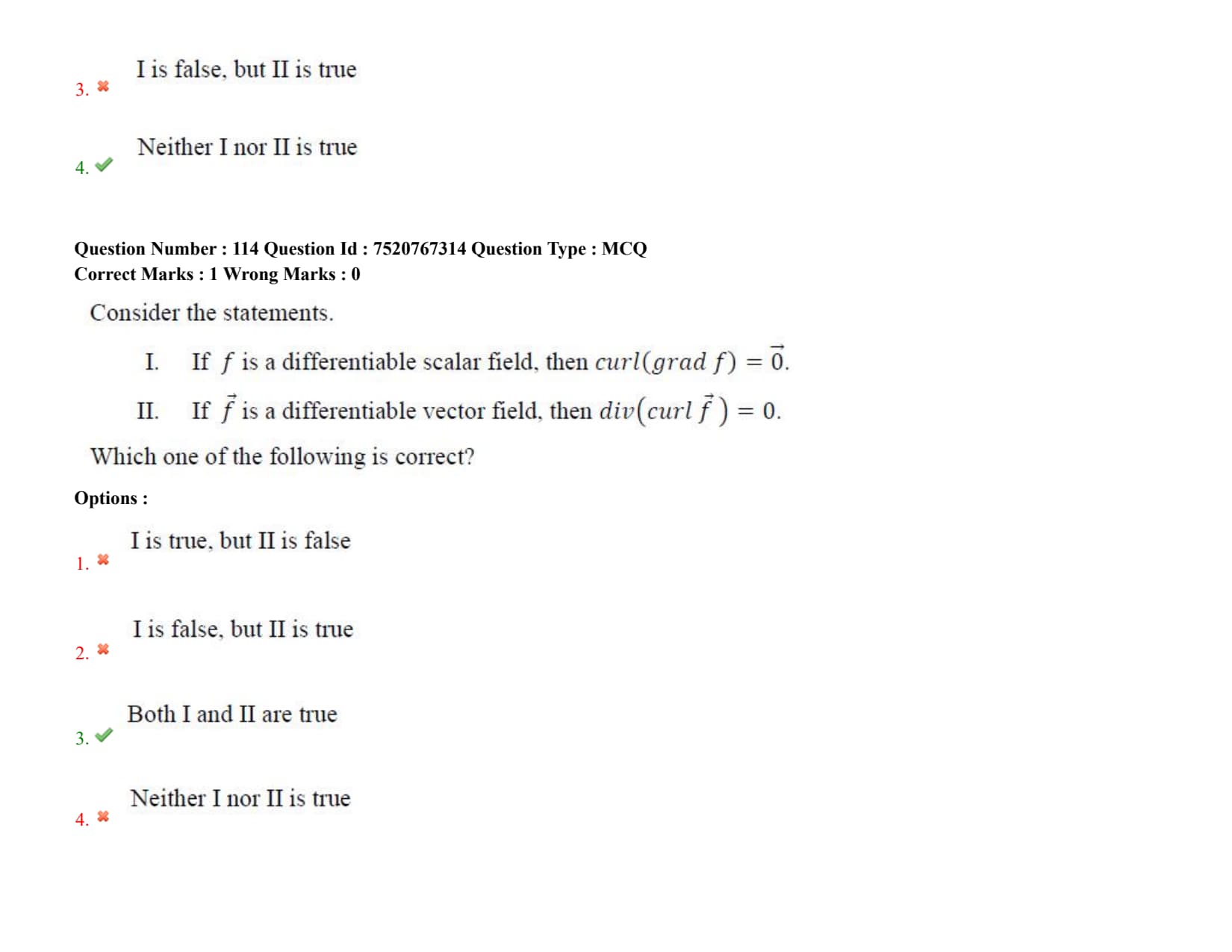
Consider the statements.
I. if \(s_{n} = \frac{1}{n}\), the sequence \(\{s_{n}\}\) is divergent.
II. if \(s_{n} = 1 + \frac{1}{2} + \frac{1}{3} + \dots + \frac{1}{n}\), the sequence \(\{s_{n}\}\) is convergent.
Which one of the following is correct?
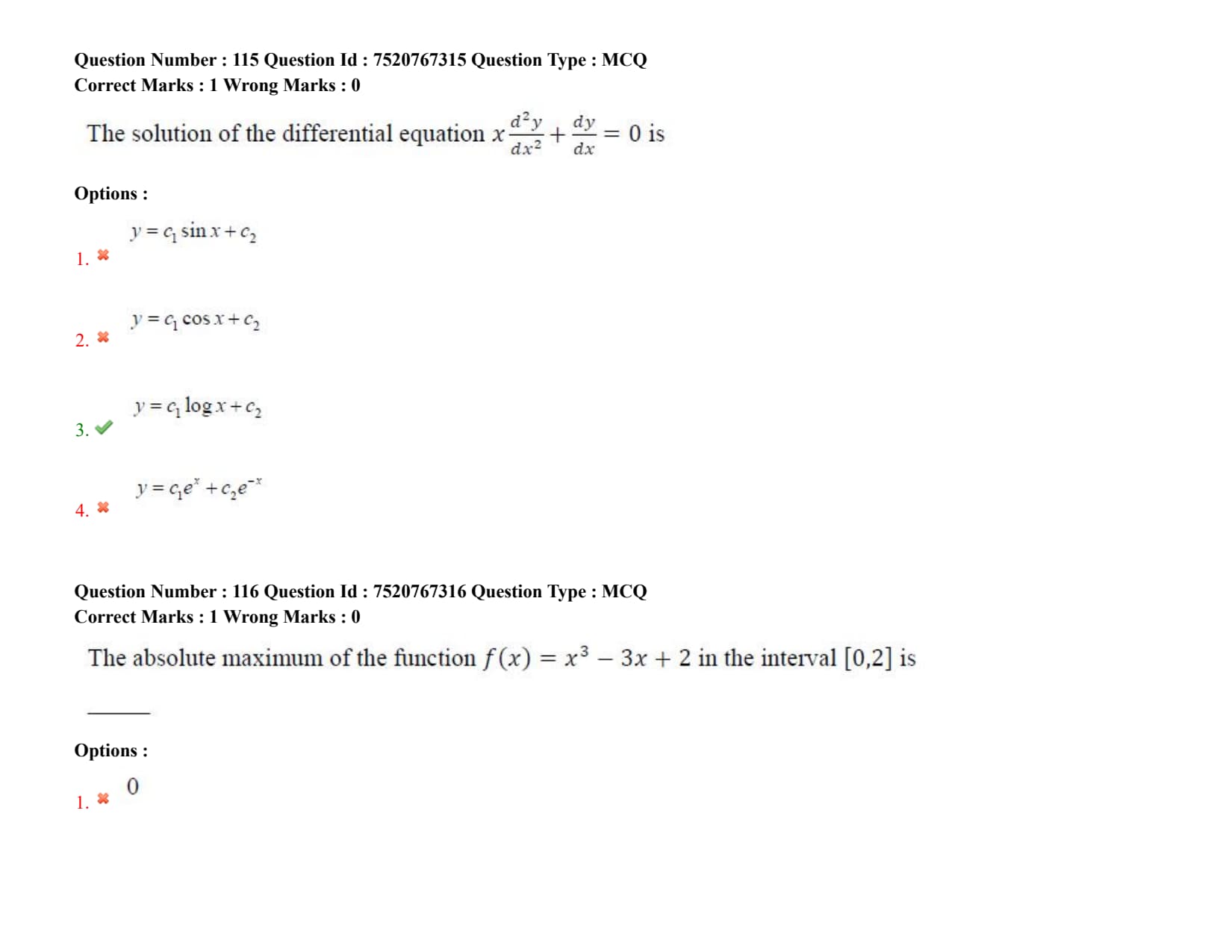
Consider the statements.
I. If \(f\) is a differentiable scalar field, then \(curl(grad\, f) = \vec{0}\).
II. If \(\vec{f}\) is a differentiable vector field, then \(div(curl\, \vec{f}) = 0\).
Which one of the following is correct?
The solution of the differential equation \(x \frac{d^{2} y}{dx^{2}} + \frac{dy}{dx} = 0\) is
The absolute maximum of the function \(f(x) = x^{3} - 3x + 2\) in the interval \([0, 2]\) is ________
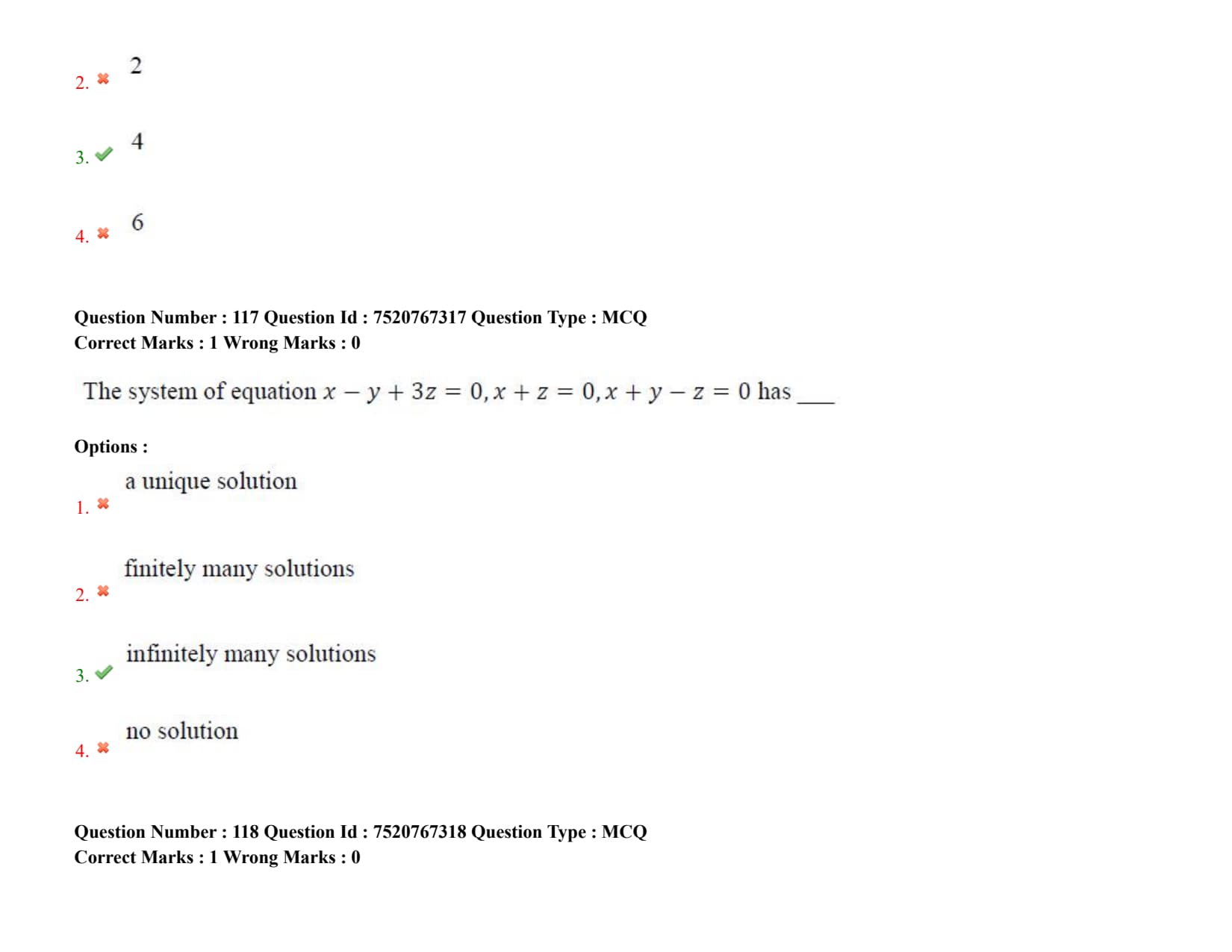
The system of equation \(x - y + 3z = 0, x + z = 0, x + y - z = 0\) has _______
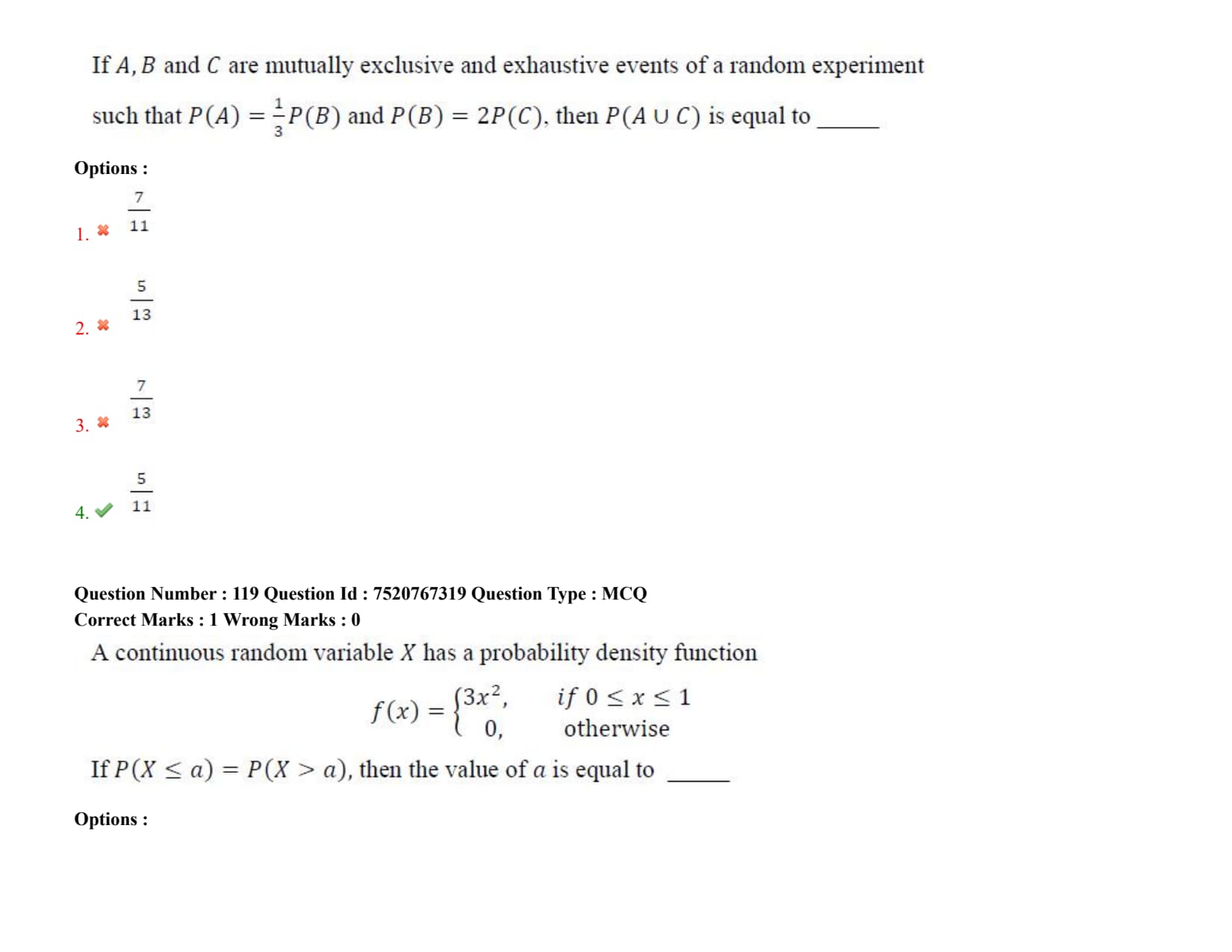
If A, B and C are mutually exclusive and exhaustive events of a random experiment such that \(P(A) = \frac{1}{3} P(B)\) and \(P(B) = 2 P(C)\), then \(P(A \cup C)\) is equal to _______
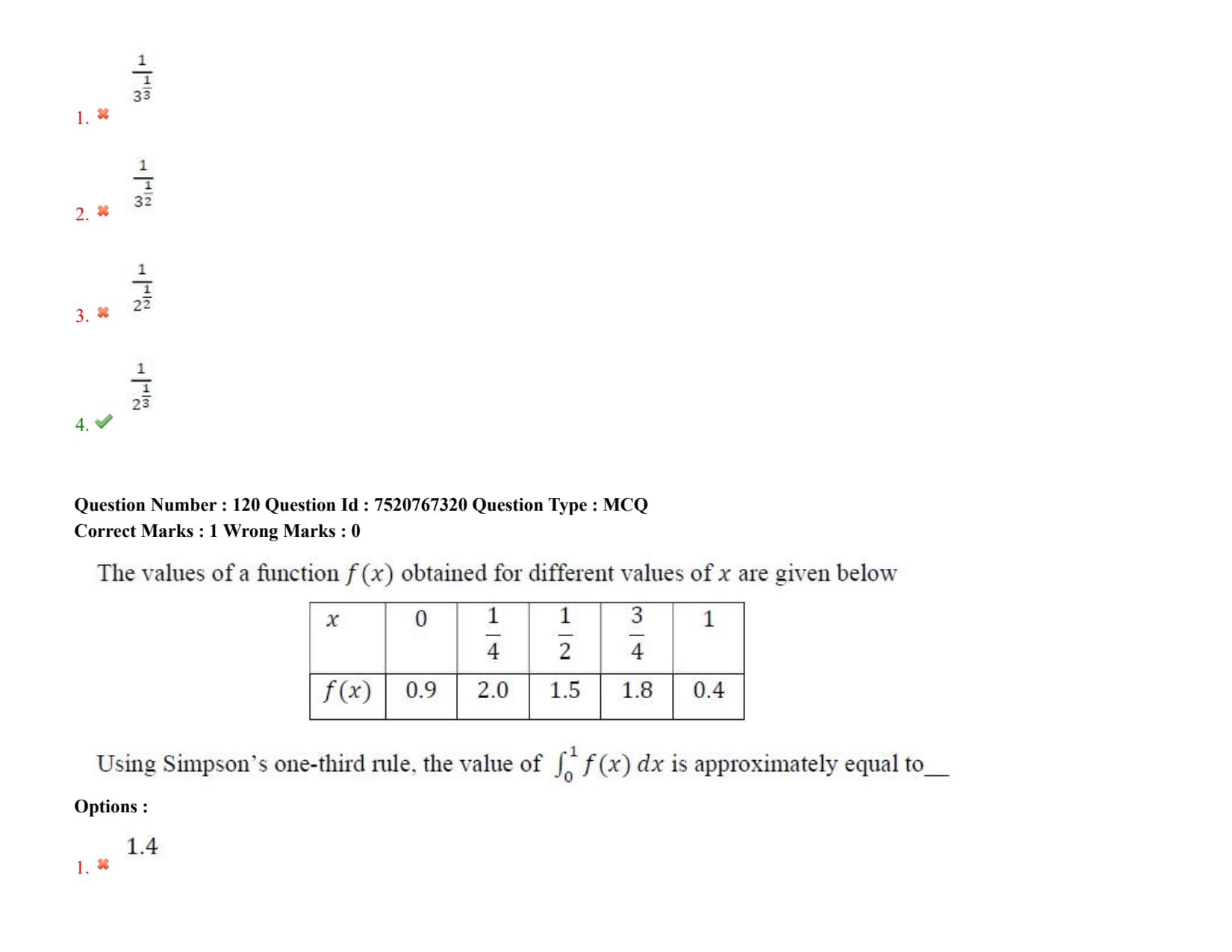
A continuous random variable X has a probability density function \[ f(x) = \begin{cases} 3x^{2}, & if 0 \leq x \leq 1
0, & otherwise \end{cases} \] If \(P(X \leq a) = P(X > a)\), then the value of a is equal to _______
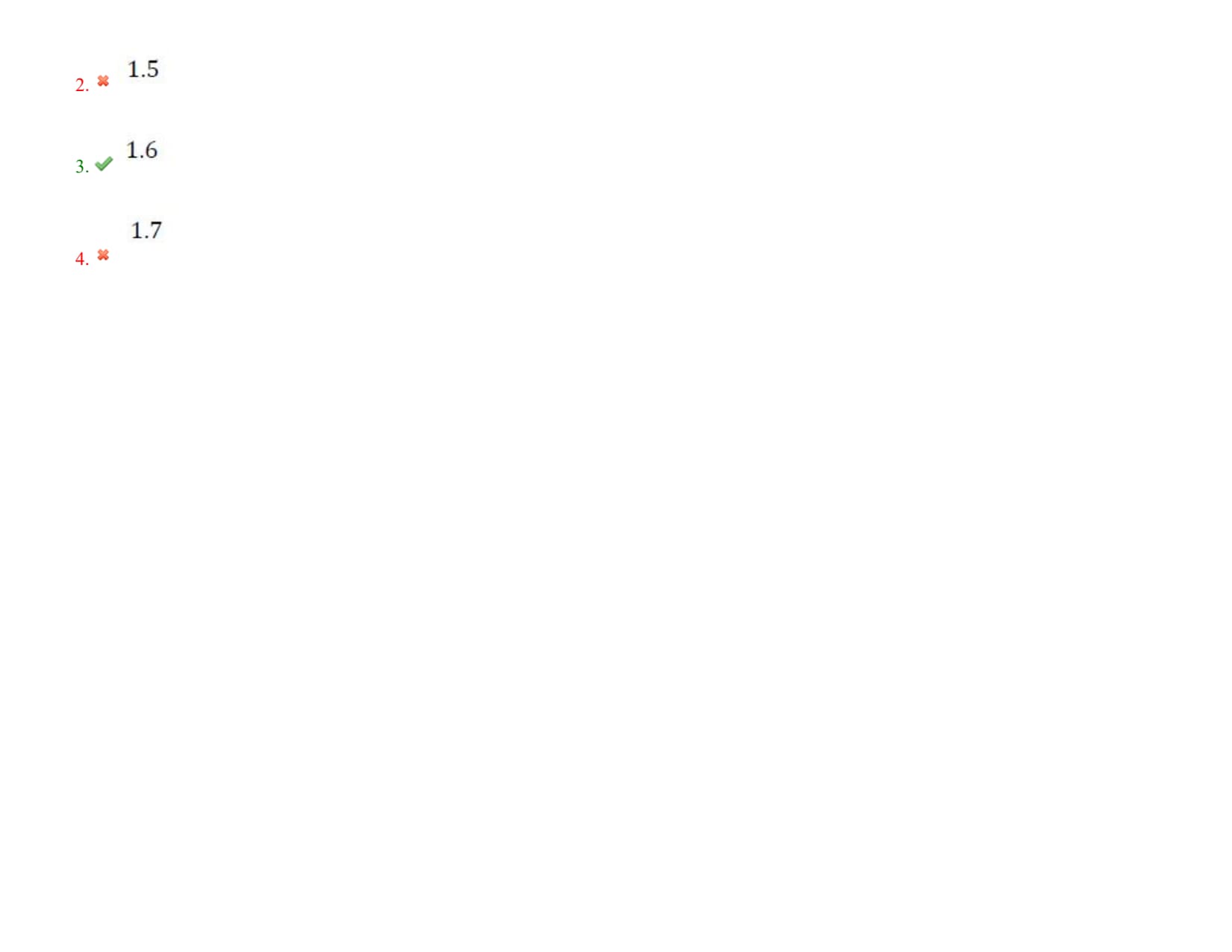
The values of a function \(f(x)\) obtained for different values of x are given below

Using Simpson's one-third rule, the value of \(\int_{0}^{1} f(x) dx\) is approximately equal to ______
AP PGECET 2026 Mechanical Engineering Topic-wise weightage
| Major Subject | Approx. Number of Questions | Expected % (Approx.) |
|---|---|---|
| Engineering Mathematics | 12–18 | 10–15% |
| Applied Mechanics & Design | 14–18 | 12–15% |
| Fluid Mechanics & Thermal Sciences | 18–22 | 15–18% |
| Manufacturing & Industrial Engineering | 18–22 | 15–18% |
| Theory of Machines | 10–14 | 8–12% |
| Machine Design | 10–14 | 8–12% |



Comments