AP PGECET 2026 Instrumentation Engineering Question Paper is available for download here. Andhra University, Visakhapatnam on behalf of APSCHE conducted AP PGECET 2026 Instrumentation Engineering exam on April 30 in Shift 1. AP PGECET is a state-level entrance exam conducted online for admission into M.Tech./M.Pharm./Pharm.D (PB) courses.

  • AP PGECET Question Paper consists of 120 questions divided into two sections- Mathematics and Engineering Domain Specific.
  • Each correct answer answer carries 1 mark and there is no negative marking for incorrect answer.

Candidates can download AP PGECET 2026 Instrumentation Engineering Question Paper with Answer Key and Solution PDF from the links provided below.

AP PGECET 2026 Instrumentation Engineering Question Paper with Solutions

AP PGECET 2026 Instrumentation Engineering Question Paper Download PDF Check Solution

Question 1:

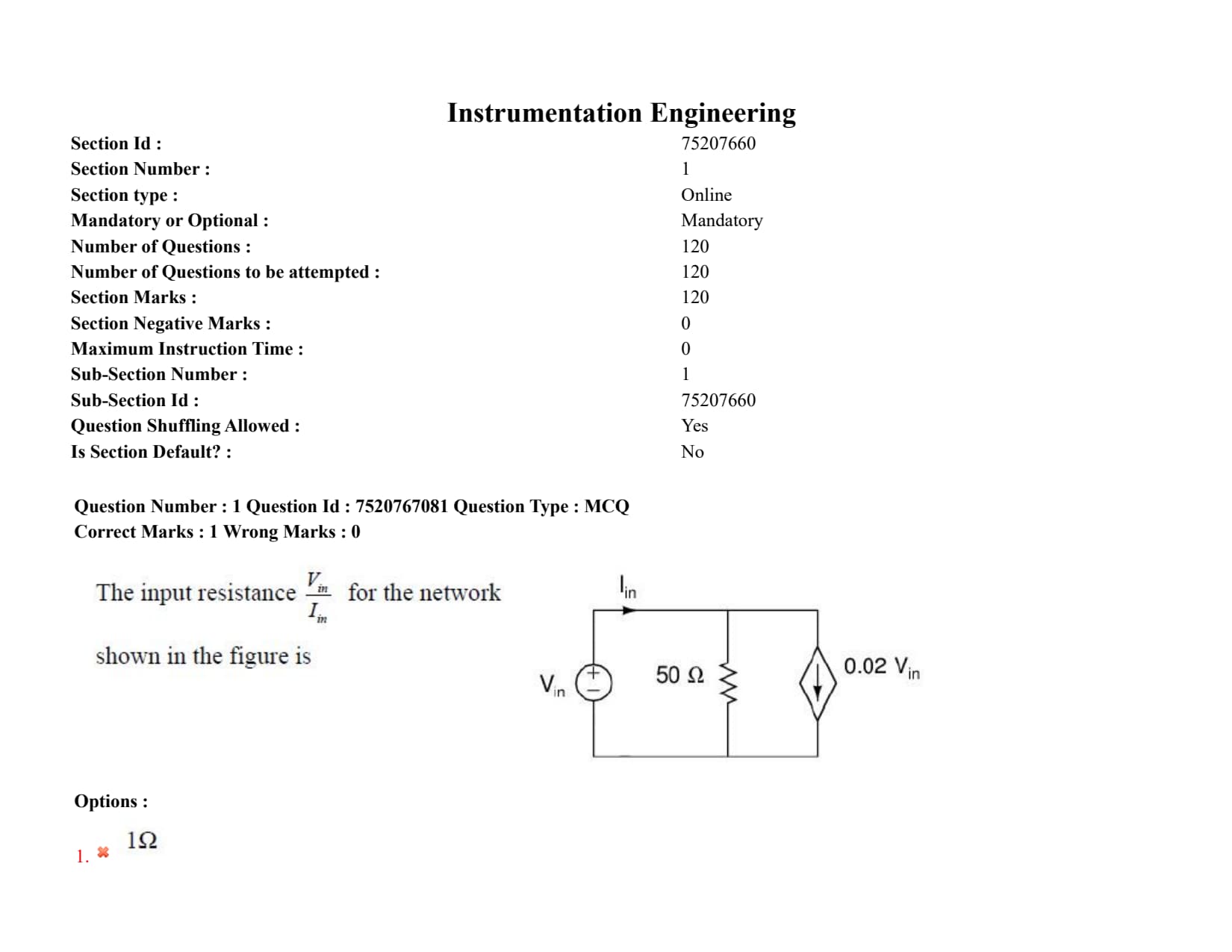
The input resistance \(V_{in} / I_{in}\) for the network shown in the figure is

  • (A) \(1\ \Omega\)
  • (B) \(500\ \Omega\)
  • (C) \(25\ \Omega\)
  • (D) \(50\ \Omega\)

Question 2:

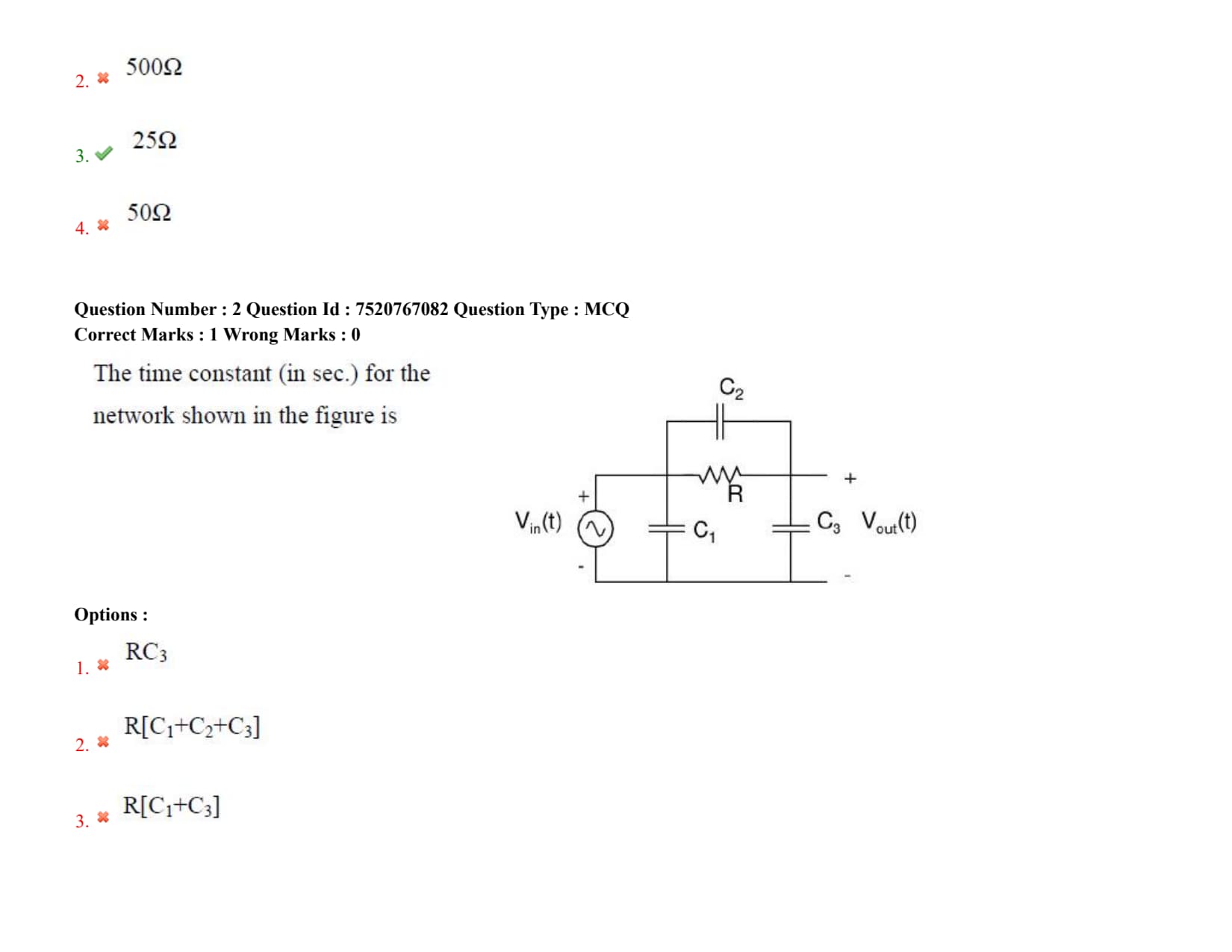
The time constant (in sec.) for the network shown in the figure is

  • (A) \(RC_3\)
  • (B) \(R[C_1+C_2+C_3]\)
  • (C) \(R[C_1+C_3]\)
  • (D) \(R[C_2+C_3]\)

Question 3:

The unit of reactive power is

  • (A) Watt
  • (B) Ampere
  • (C) Volt
  • (D) VAR

Question 4:

A circuit which resonates at \(1 MHz\) has Q of 100. Bandwidth between half-power point is

  • (A) \(10 KHz\)
  • (B) \(100 KHz\)
  • (C) \(10 Hz\)
  • (D) \(100 Hz\)

Question 5:

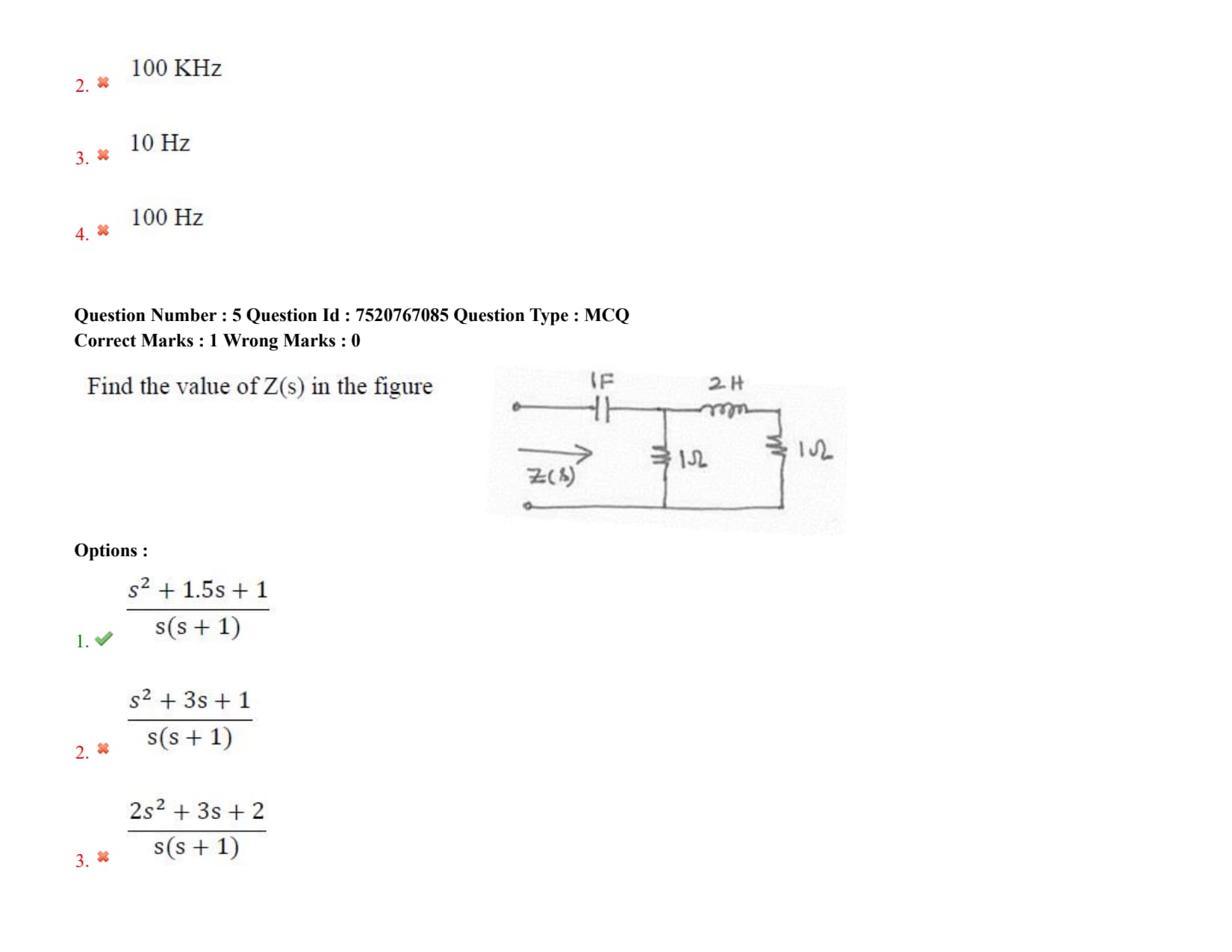
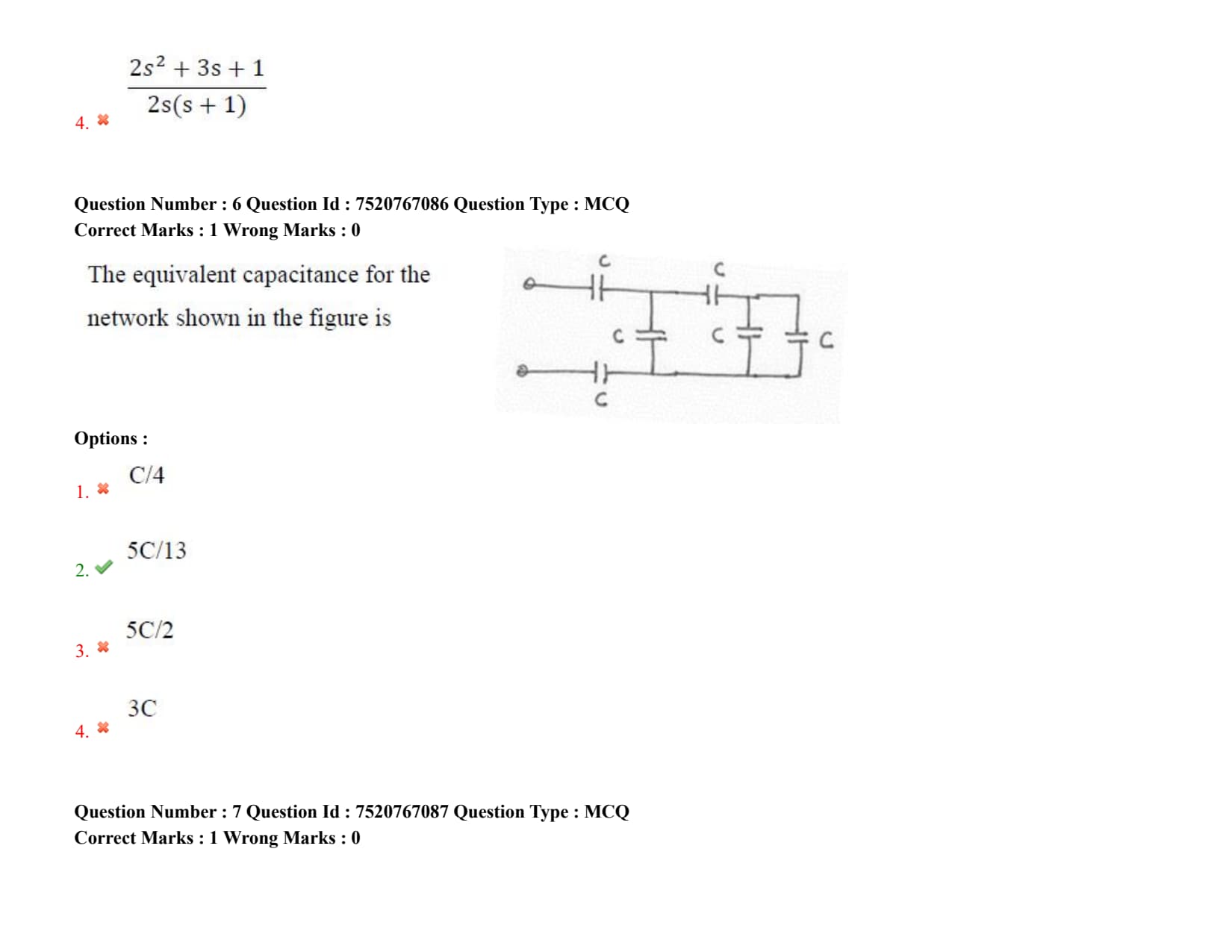
Find the value of Z(s) in the figure

  • (A) \(\frac{s^2 + 1.5s + 1}{s(s+1)}\)
  • (B) \(\frac{s^2 + 3s + 1}{s(s+1)}\)
  • (C) \(\frac{2s^2 + 3s + 2}{s(s+1)}\)
  • (D) \(\frac{2s^2 + 3s + 1}{2s(s+1)}\)

Question 6:

The equivalent capacitance for the network shown in the figure is

  • (A) \(C/4\)
  • (B) \(5C/13\)
  • (C) \(5C/2\)
  • (D) \(3C\)

Question 7:

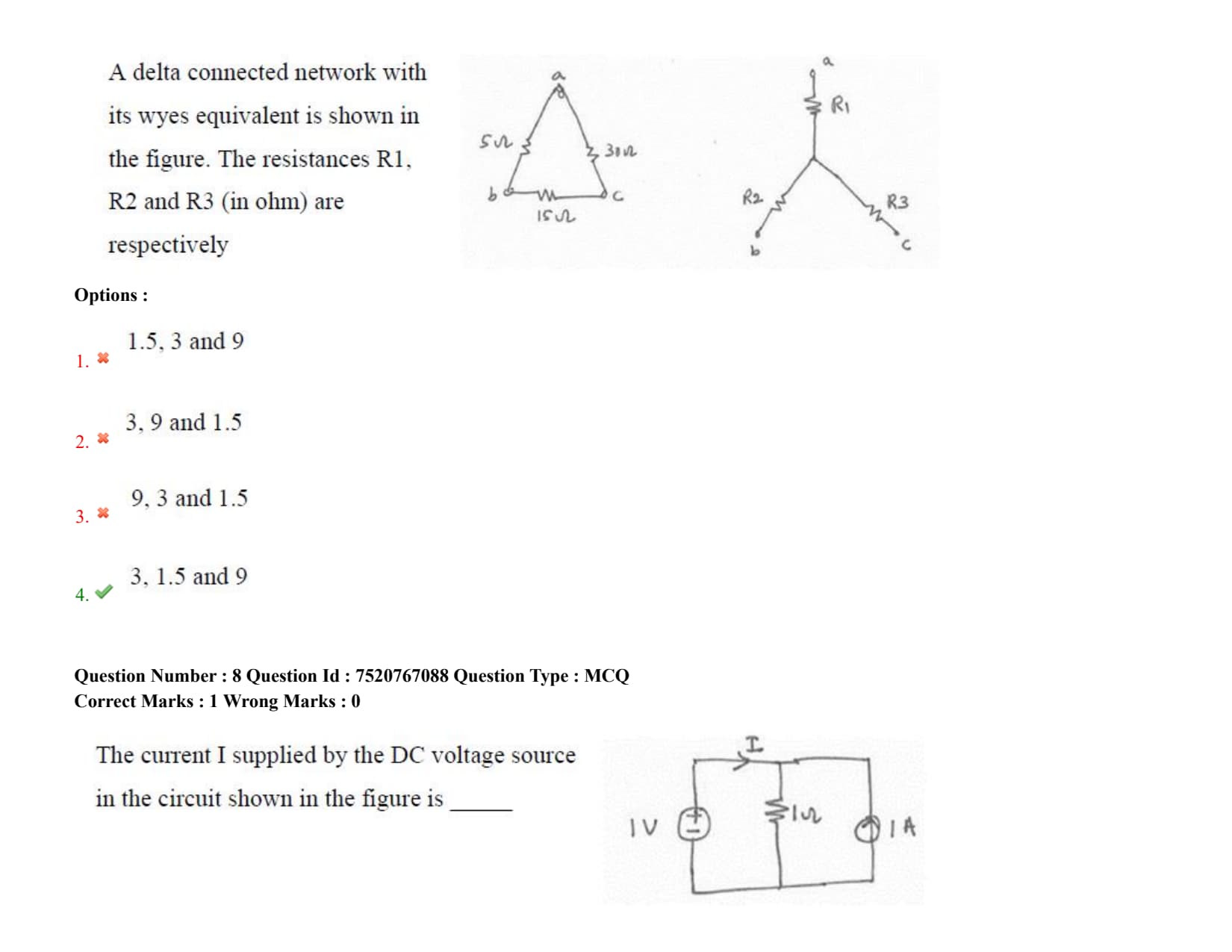
A delta connected network with its wyes equivalent is shown in the figure. The resistances R1, R2 and R3 (in ohm) are respectively

  • (A) \(1.5, 3 and 9\)
  • (B) \(3, 9 and 1.5\)
  • (C) \(9, 3 and 1.5\)
  • (D) \(3, 1.5 and 9\)

Question 8:

The current I supplied by the DC voltage source in the circuit shown in the figure is ______

  • (A) zero
  • (B) \(0.5 A\)
  • (C) \(1 A\)
  • (D) \(2 A\)

Question 9:

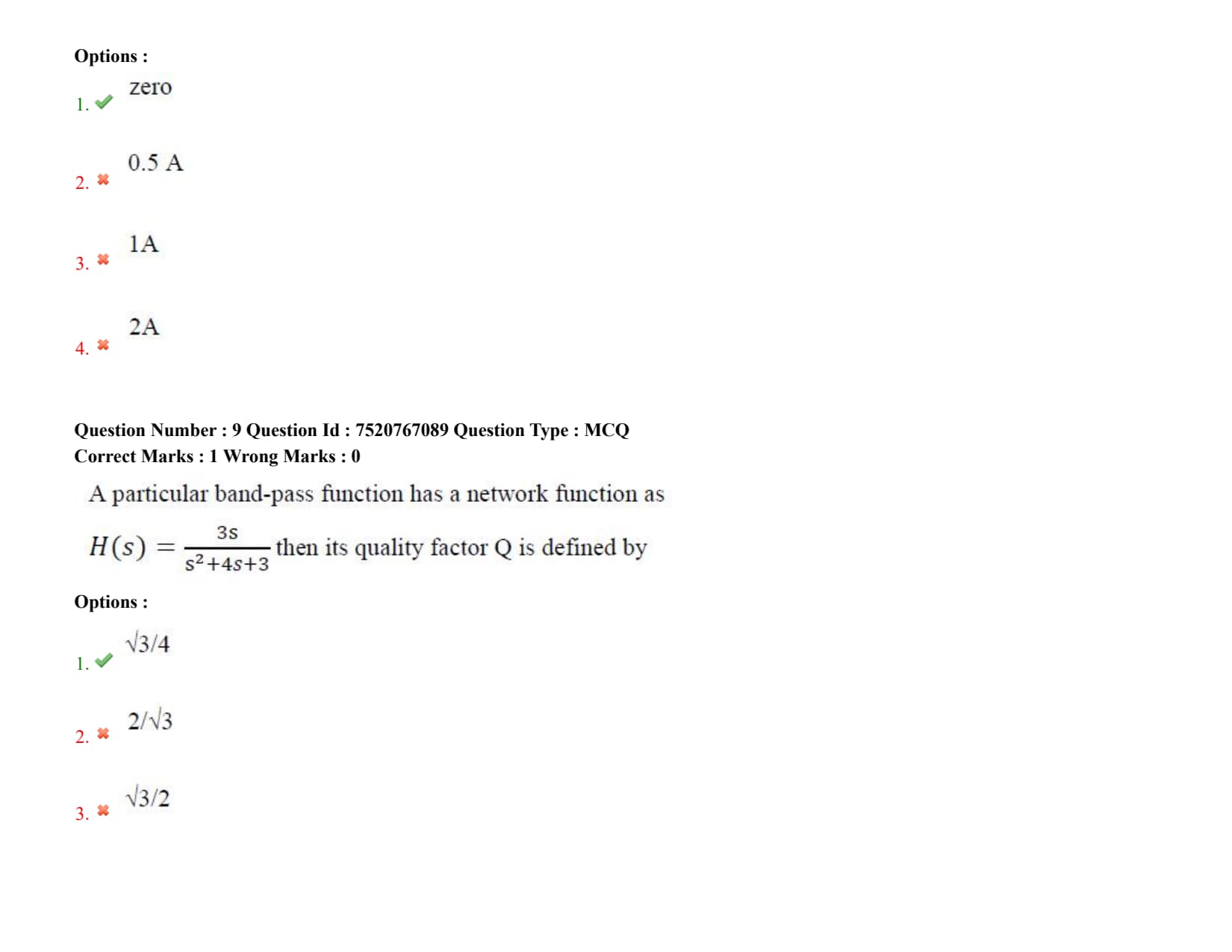
A particular band-pass function has a network function as \(H(s) = \frac{3s}{s^2+4s+3}\) then its quality factor Q is defined by

  • (A) \(\sqrt{3}/4\)
  • (B) \(2/\sqrt{3}\)
  • (C) \(\sqrt{3}/2\)
  • (D) \(4/\sqrt{3}\)

Question 10:

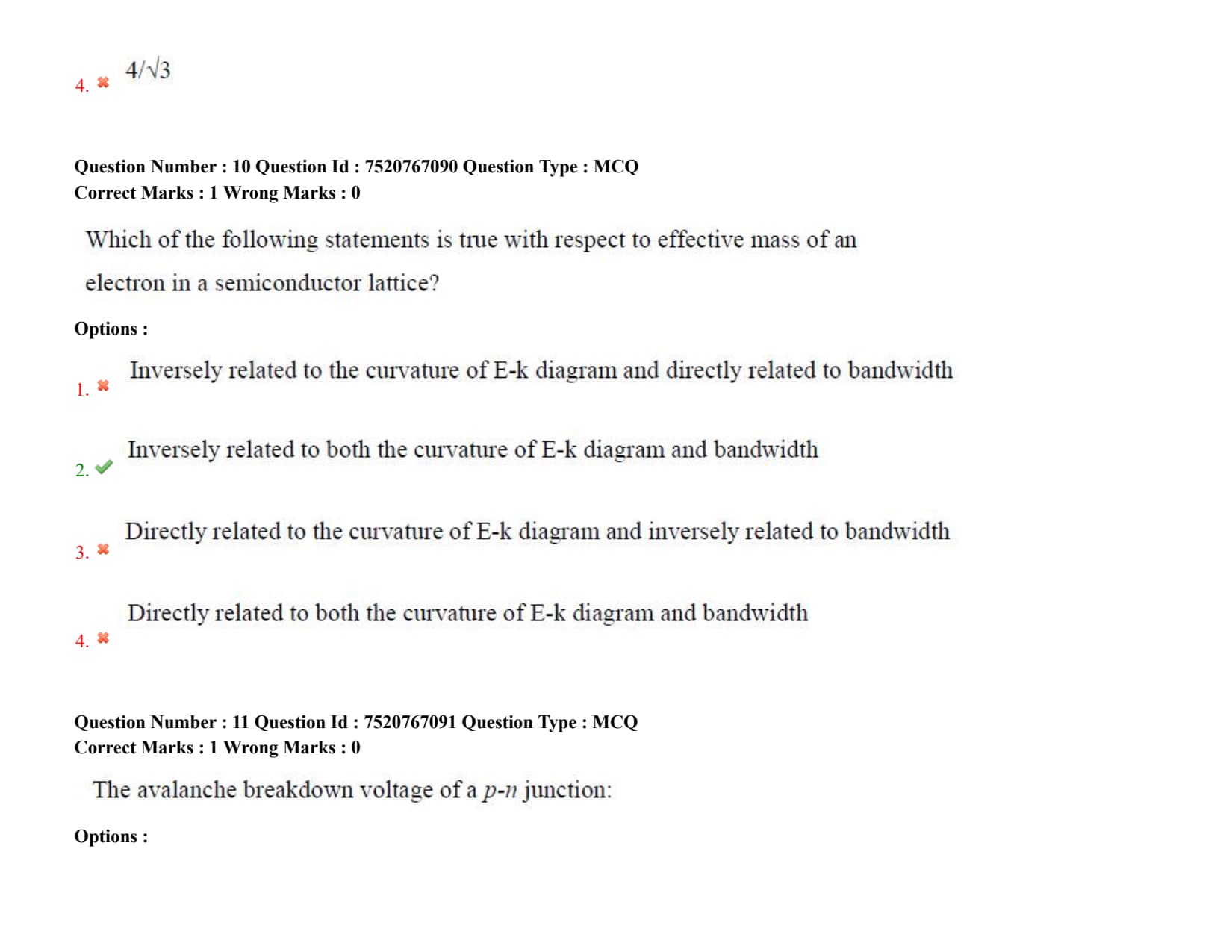
Which of the following statements is true with respect to effective mass of an electron in a semiconductor lattice?

  • (A) Inversely related to the curvature of E-k diagram and directly related to bandwidth
  • (B) Inversely related to both the curvature of E-k diagram and bandwidth
  • (C) Directly related to the curvature of E-k diagram and inversely related to bandwidth
  • (D) Directly related to both the curvature of E-k diagram and bandwidth

Question 11:

The avalanche breakdown voltage of a p-n junction:

  • (A) Increases with increase in doping and also with increase in band gap
  • (B) Decreases with increase in doping and also with decrease in band gap
  • (C) Increases with decrease in band gap and also with increase in doping
  • (D) Decreases with increase in band gap and also with increase in doping

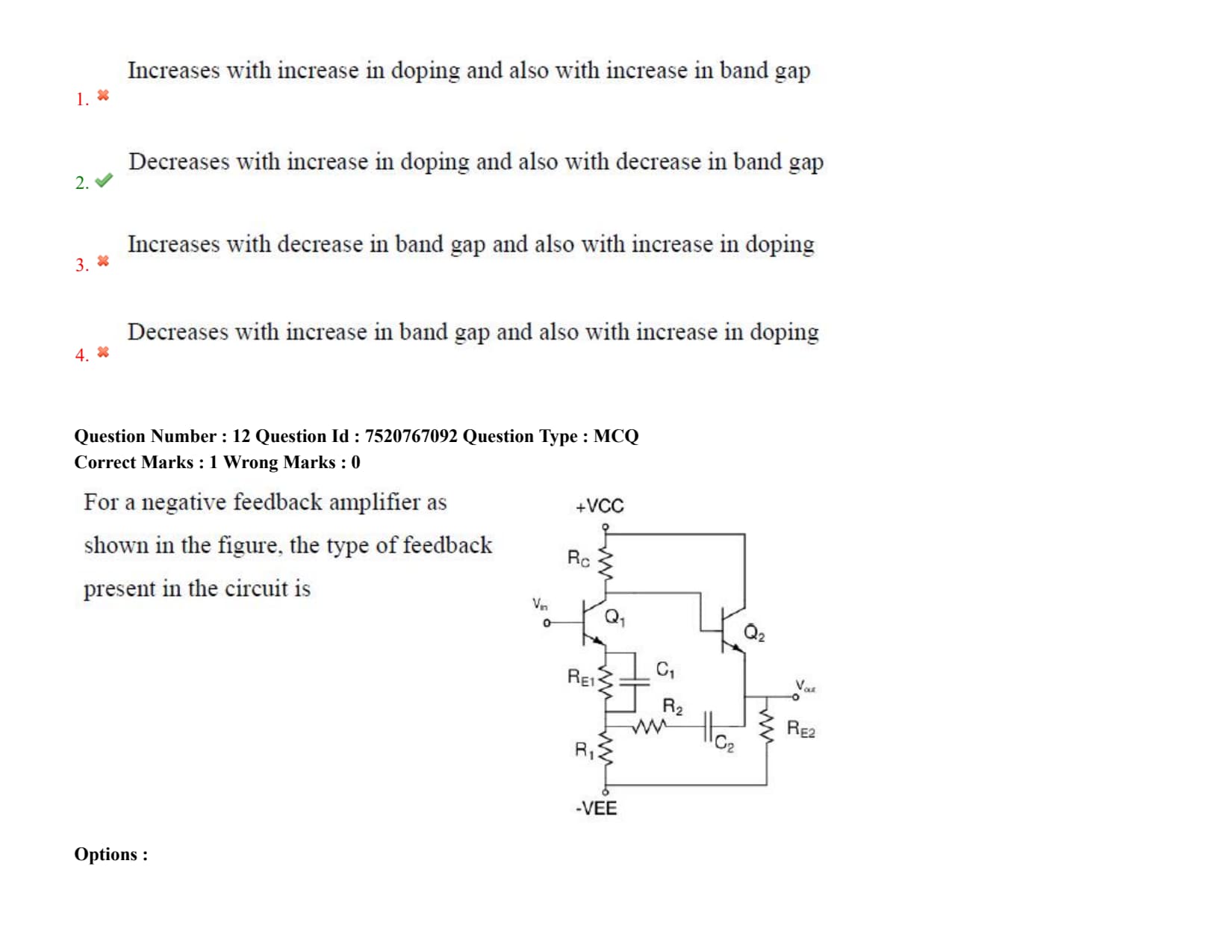
Question 12:

For a negative feedback amplifier as shown in the figure, the type of feedback present in the circuit is

  • (A) Series-Shunt feedback
  • (B) Series-Series feedback
  • (C) Shunt-Shunt feedback
  • (D) Shunt-Series feedback

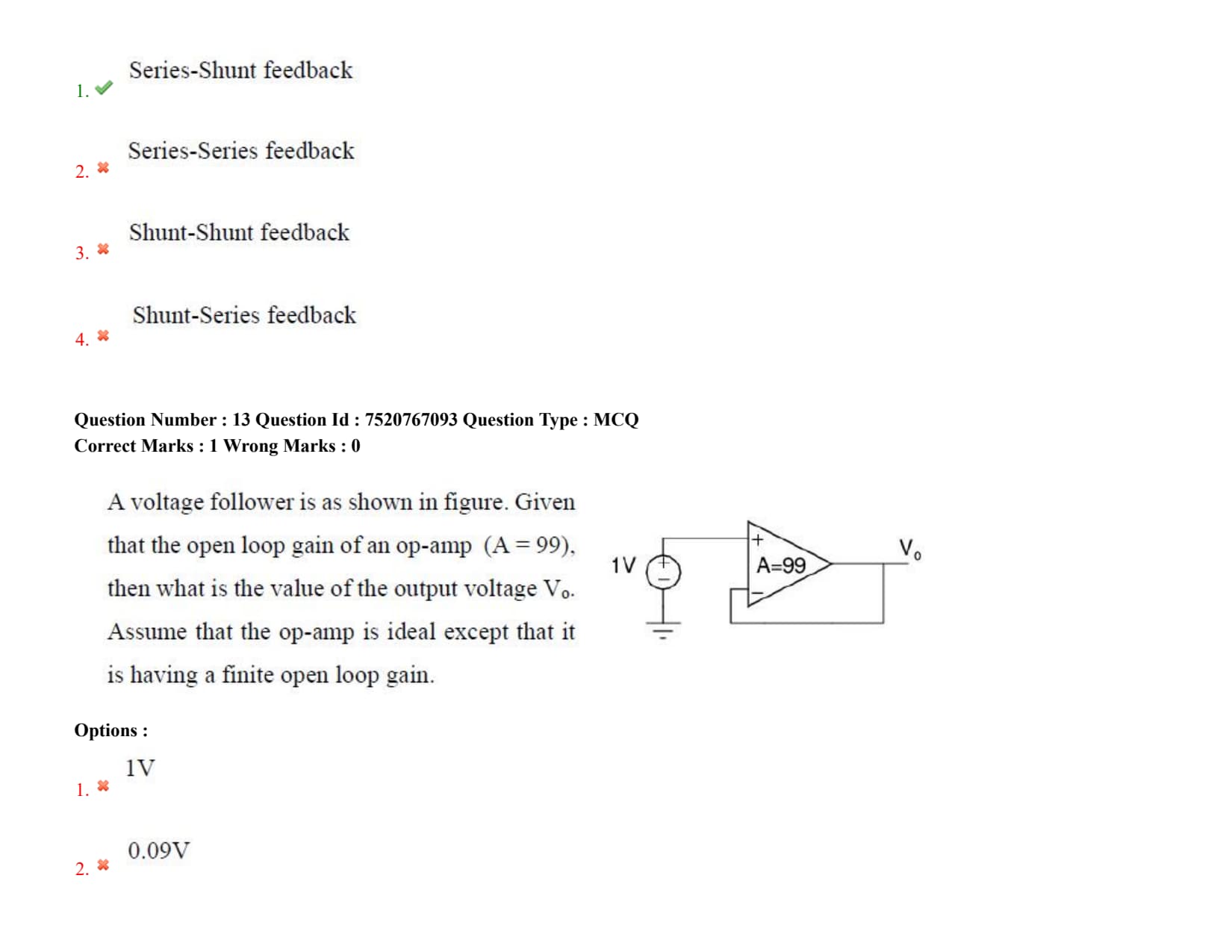
Question 13:

A voltage follower is as shown in figure. Given that the open loop gain of an op-amp (A = 99), then what is the value of the output voltage \(V_o\). Assume that the op-amp is ideal except that it is having a finite open loop gain.

  • (A) \(1 V\)
  • (B) \(0.09 V\)
  • (C) \(0.99 V\)
  • (D) \(0.9 V\)

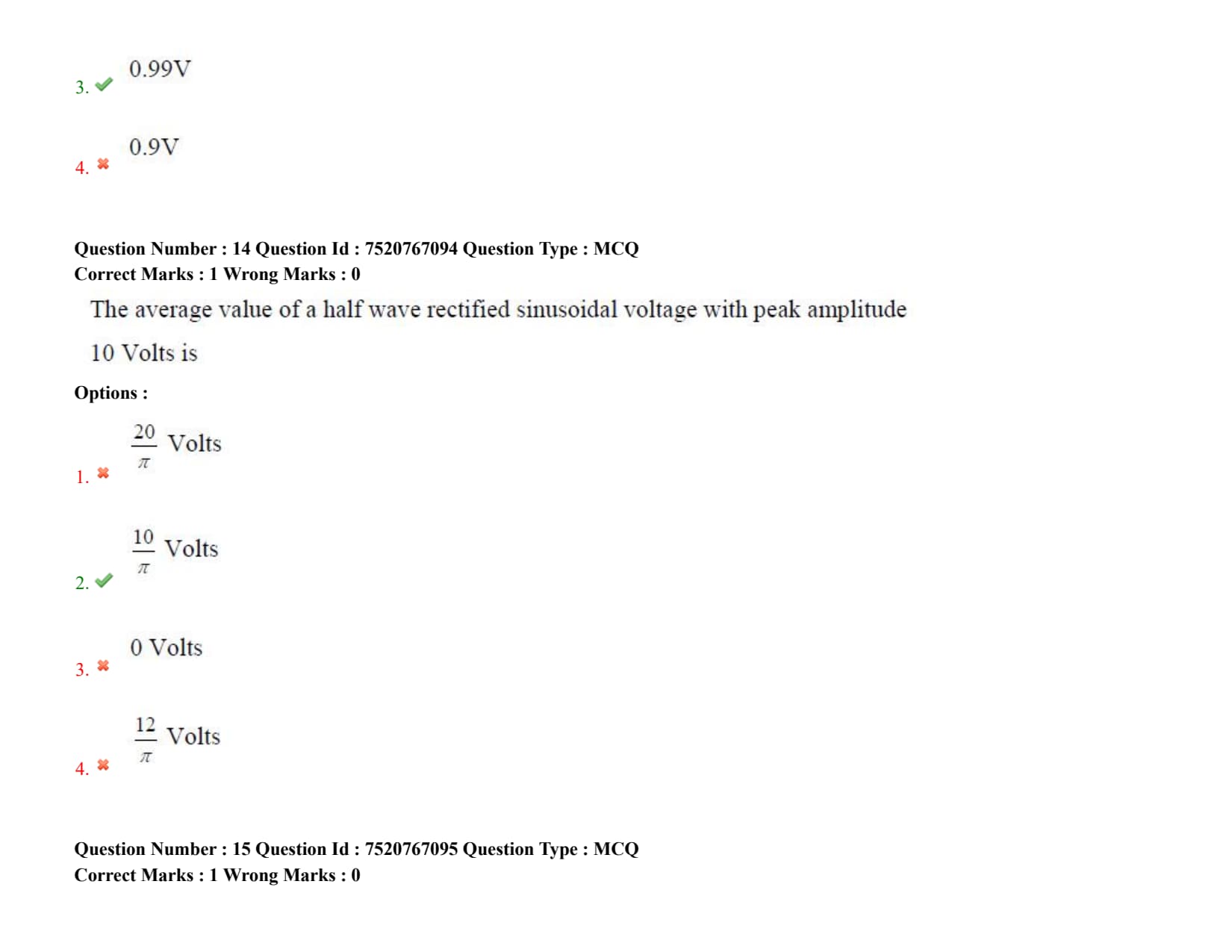
Question 14:

The average value of a half wave rectified sinusoidal voltage with peak amplitude 10 Volts is

  • (A) \(\frac{20}{\pi}\) Volts
  • (B) \(\frac{10}{\pi}\) Volts
  • (C) \(0\) Volts
  • (D) \(\frac{12}{\pi}\) Volts

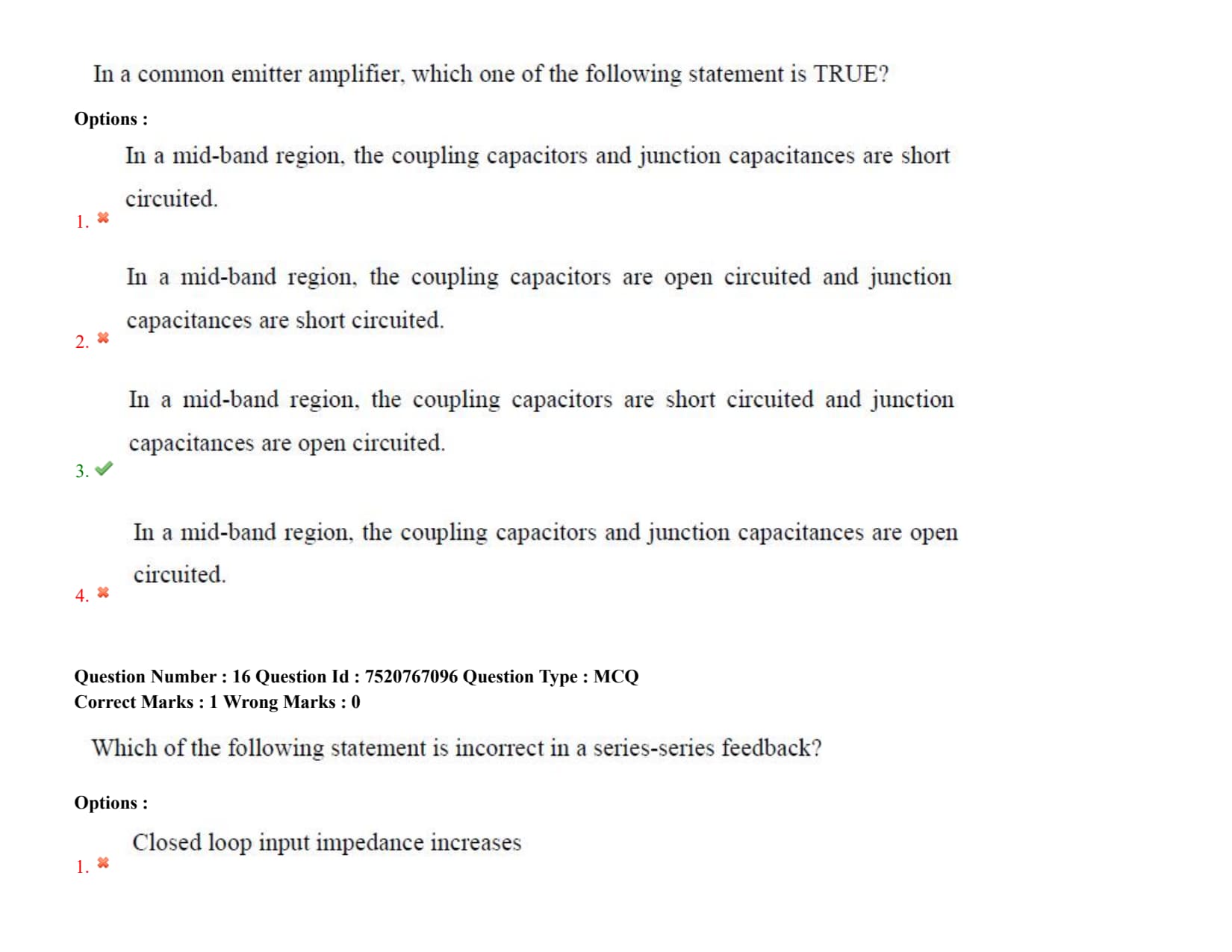
Question 15:

In a common emitter amplifier, which one of the following statement is TRUE?

  • (A) In a mid-band region, the coupling capacitors and junction capacitances are short circuited.
  • (B) In a mid-band region, the coupling capacitors are open circuited and junction capacitances are short circuited.
  • (C) In a mid-band region, the coupling capacitors are short circuited and junction capacitances are open circuited.
  • (D) In a mid-band region, the coupling capacitors and junction capacitances are open circuited.

Question 16:

Which of the following statement is incorrect in a series-series feedback?

  • (A) Closed loop input impedance increases
  • (B) Closed loop output impedance increases
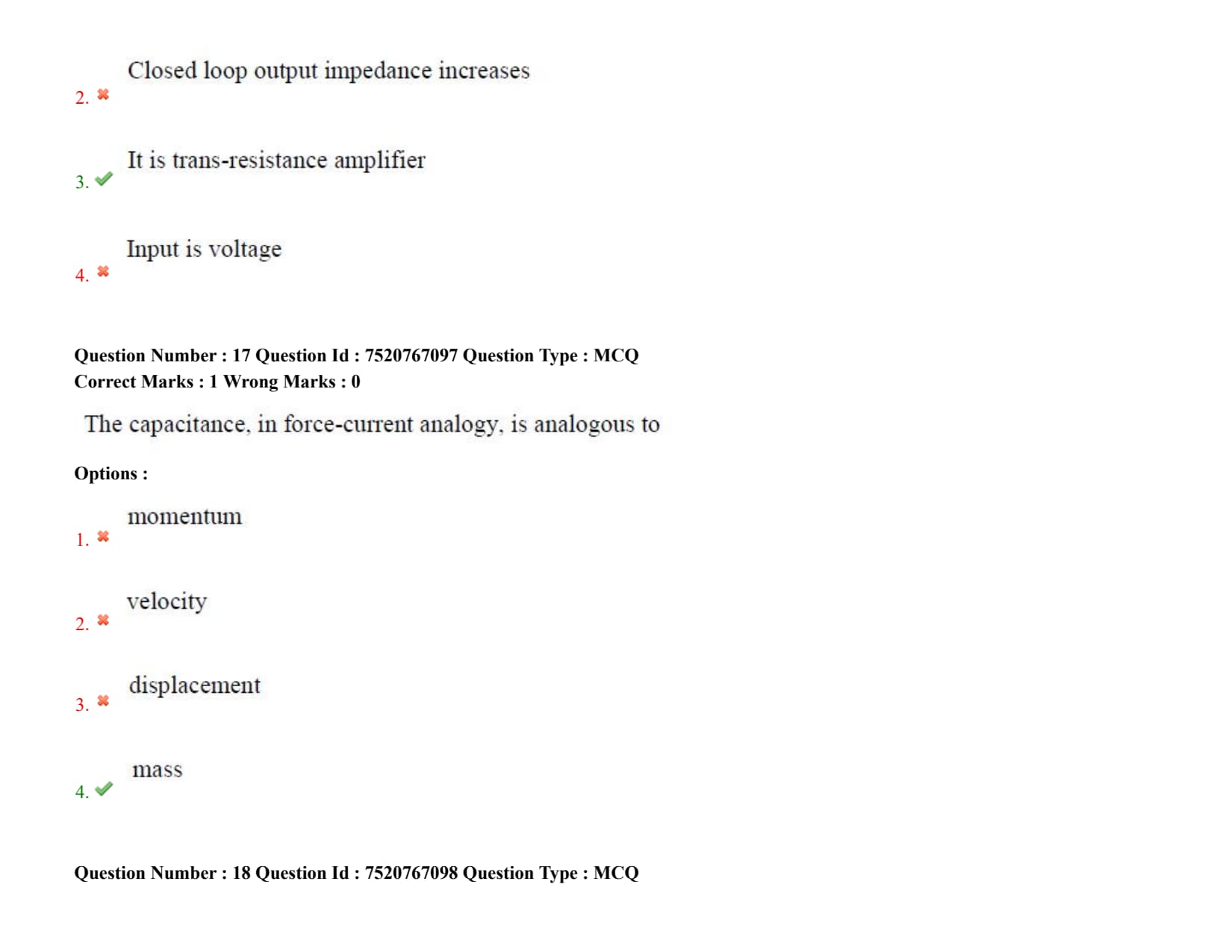
  • (C) It is trans-resistance amplifier
  • (D) Input is voltage

Question 17:

The capacitance, in force-current analogy, is analogous to

  • (A) momentum
  • (B) velocity
  • (C) displacement
  • (D) mass

Question 18:

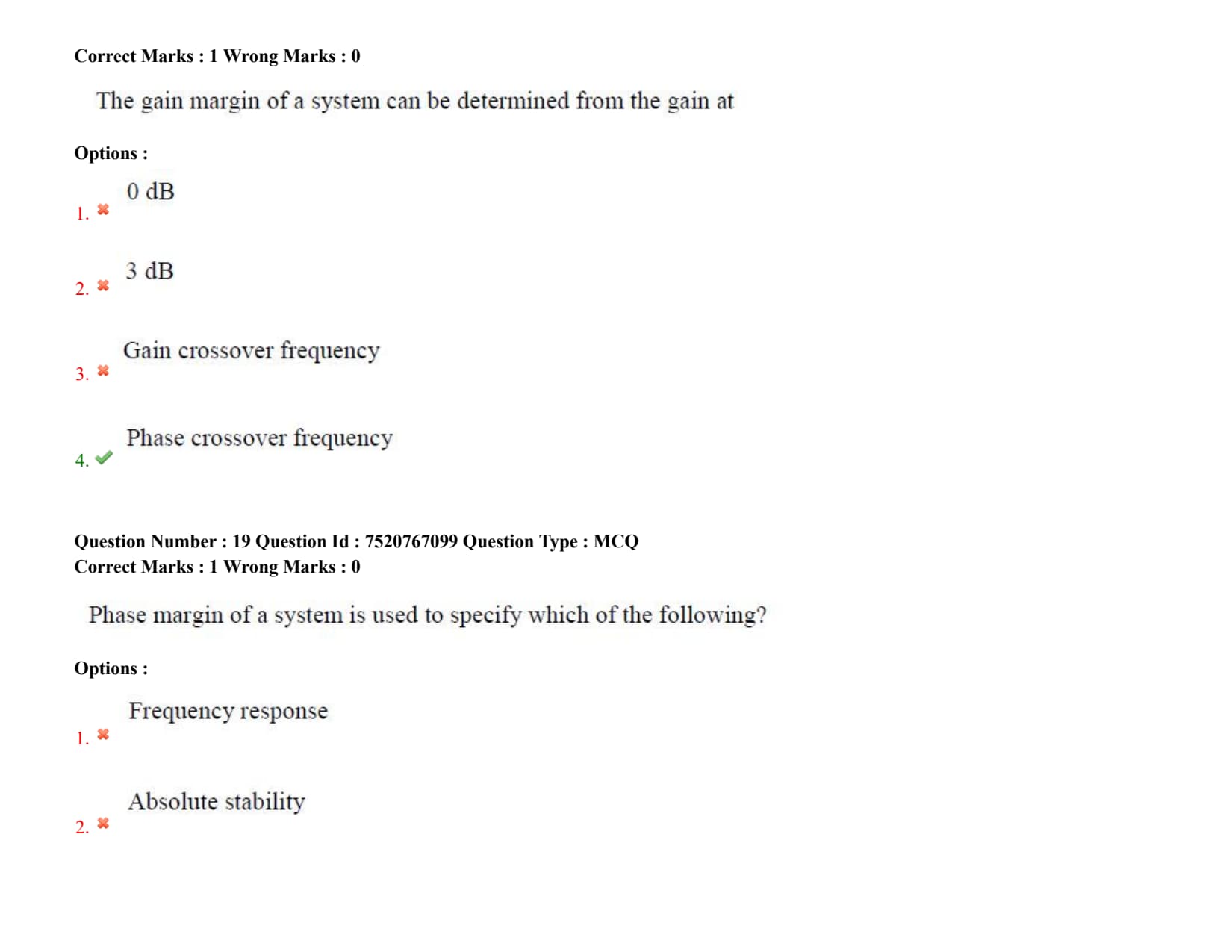
The gain margin of a system can be determined from the gain at

  • (A) \(0 dB\)
  • (B) \(3 dB\)
  • (C) Gain crossover frequency
  • (D) Phase crossover frequency

Question 19:

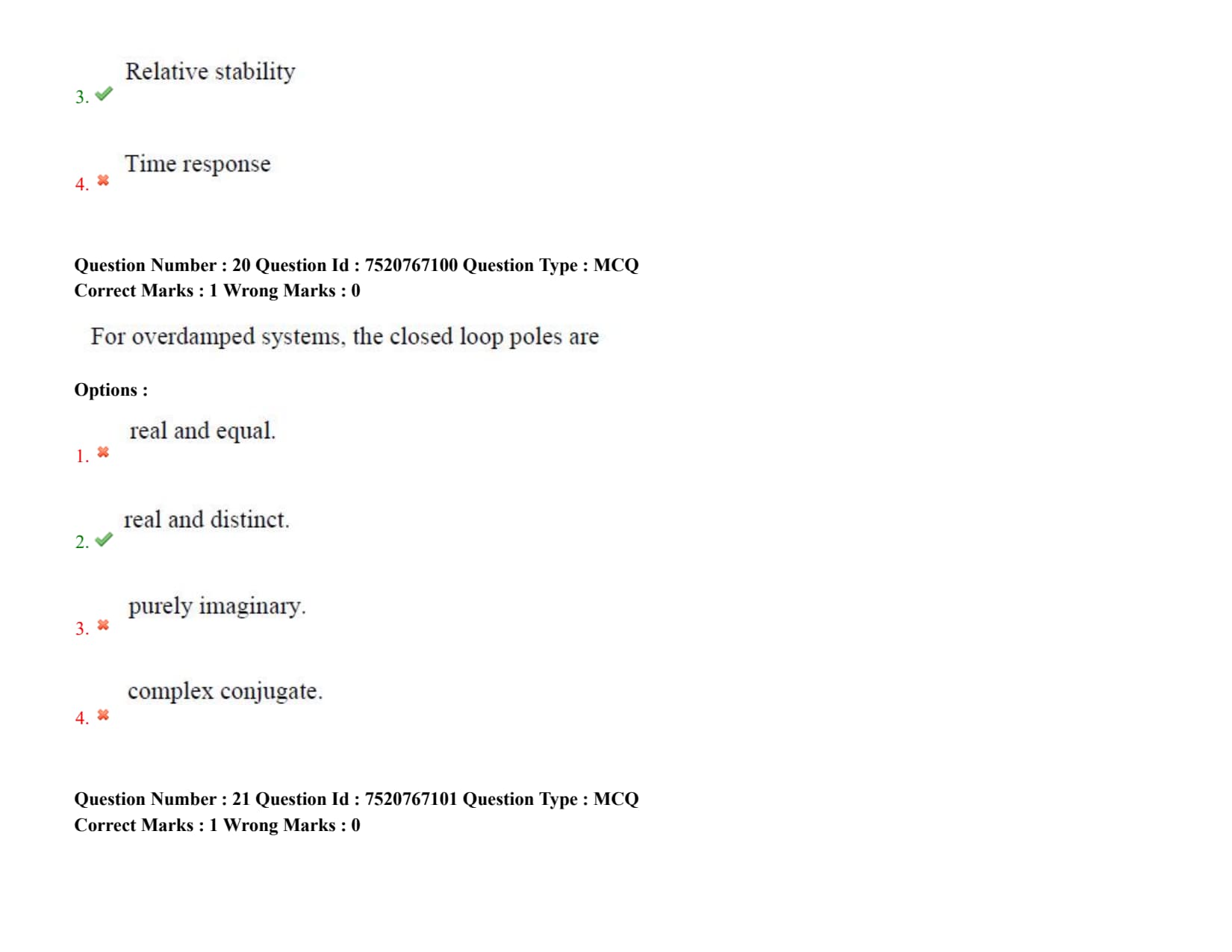
Phase margin of a system is used to specify which of the following?

  • (A) Frequency response
  • (B) Absolute stability
  • (C) Relative stability
  • (D) Time response

Question 20:

For overdamped systems, the closed loop poles are

  • (A) real and equal.
  • (B) real and distinct.
  • (C) purely imaginary.
  • (D) complex conjugate.

Question 21:

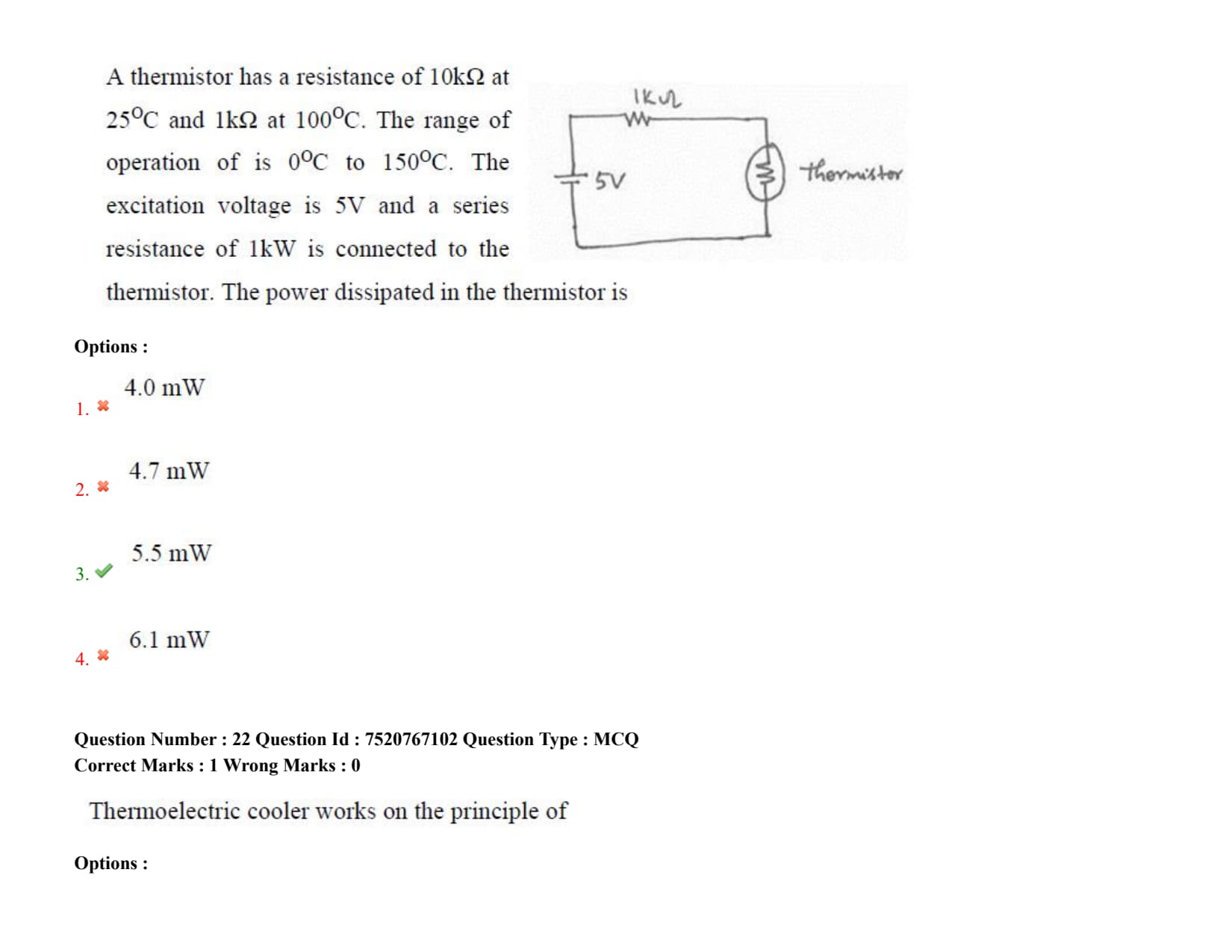
A thermistor has a resistance of \(10 k\Omega\) at \(25°C\) and \(1 k\Omega\) at \(100°C\). The range of operation of is \(0°C\) to \(150°C\). The excitation voltage is \(5V\) and a series resistance of \(1 k\Omega\) is connected to the thermistor. The power dissipated in the thermistor is

  • (A) \(4.0 mW\)
  • (B) \(4.7 mW\)
  • (C) \(5.5 mW\)
  • (D) \(6.1 mW\)

Question 22:

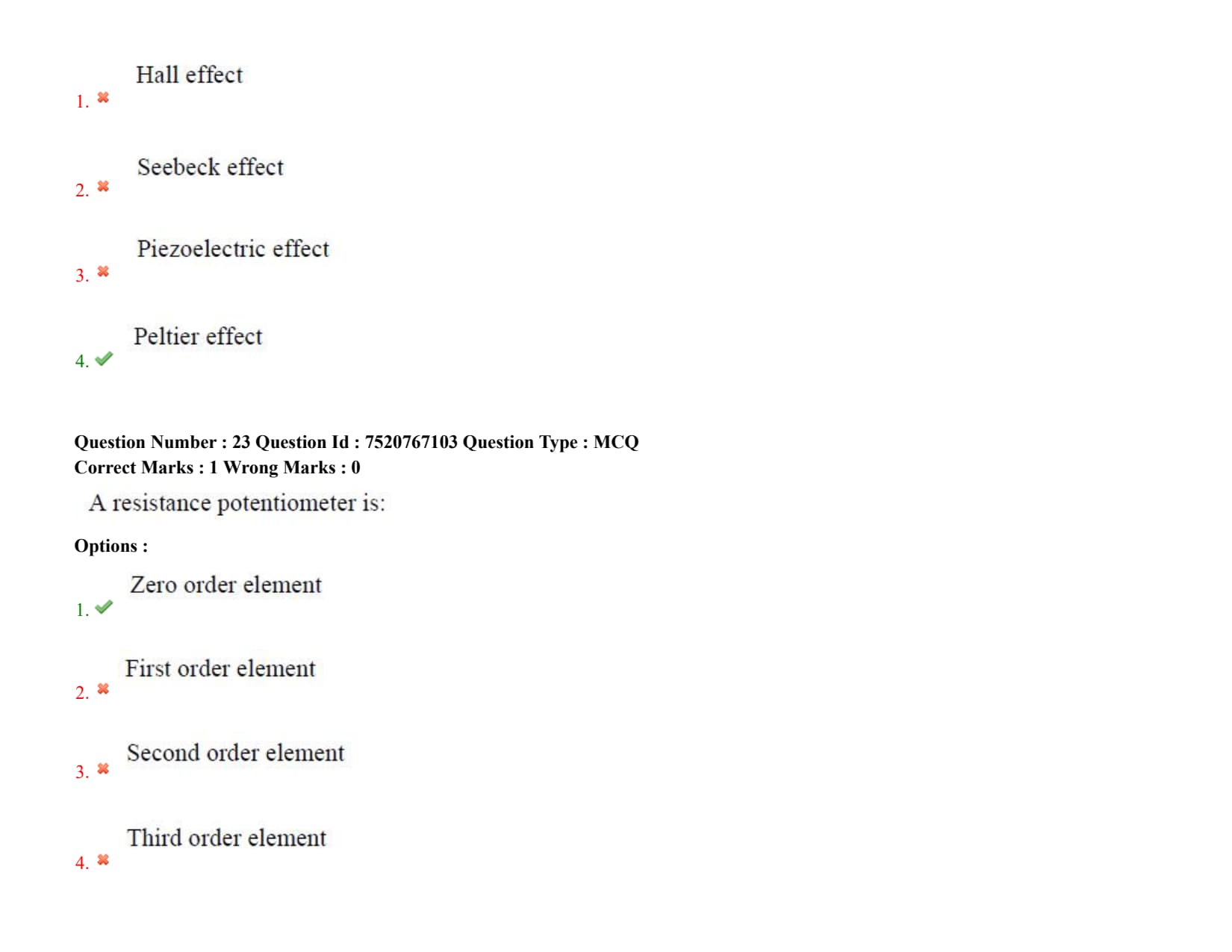
Thermoelectric cooler works on the principle of

  • (A) Hall effect
  • (B) Seebeck effect
  • (C) Piezoelectric effect
  • (D) Peltier effect

Question 23:

A resistance potentiometer is:

  • (A) Zero order element
  • (B) First order element
  • (C) Second order element
  • (D) Third order element

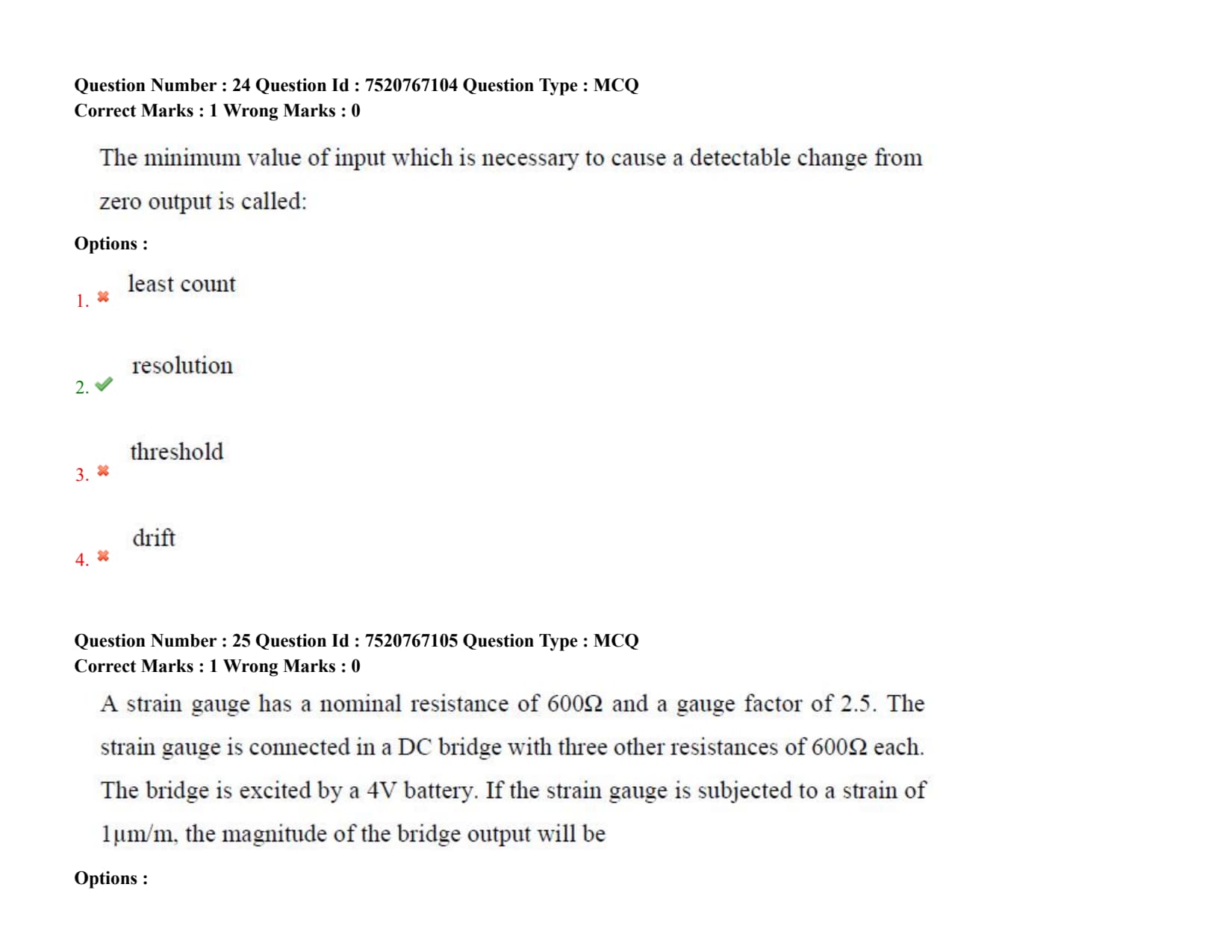
Question 24:

The minimum value of input which is necessary to cause a detectable change from zero output is called:

  • (A) least count
  • (B) resolution
  • (C) threshold
  • (D) drift

Question 25:

A strain gauge has a nominal resistance of \(600\ \Omega\) and a gauge factor of 2.5. The strain gauge is connected in a DC bridge with three other resistances of \(600\ \Omega\) each. The bridge is excited by a \(4 V\) battery. If the strain gauge is subjected to a strain of \(1\ \mu m/m\), the magnitude of the bridge output will be

  • (A) zero
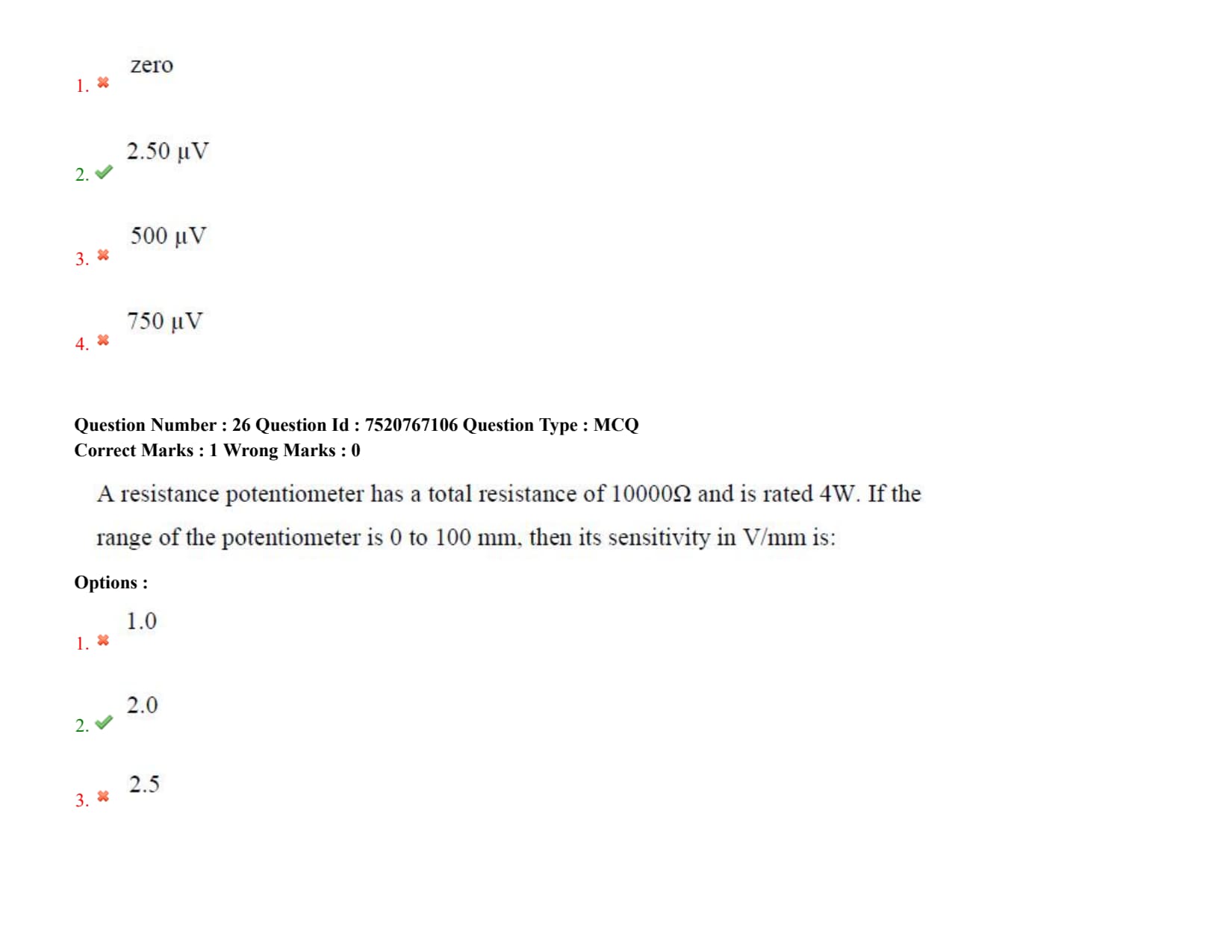
  • (B) \(2.50\ \mu V\)
  • (C) \(500\ \mu V\)
  • (D) \(750\ \mu V\)

Question 26:

A resistance potentiometer has a total resistance of \(10000\ \Omega\) and is rated \(4 W\). If the range of the potentiometer is \(0\) to \(100 mm\), then its sensitivity in \(V/mm\) is:

  • (A) 1.0
  • (B) 2.0
  • (C) 2.5
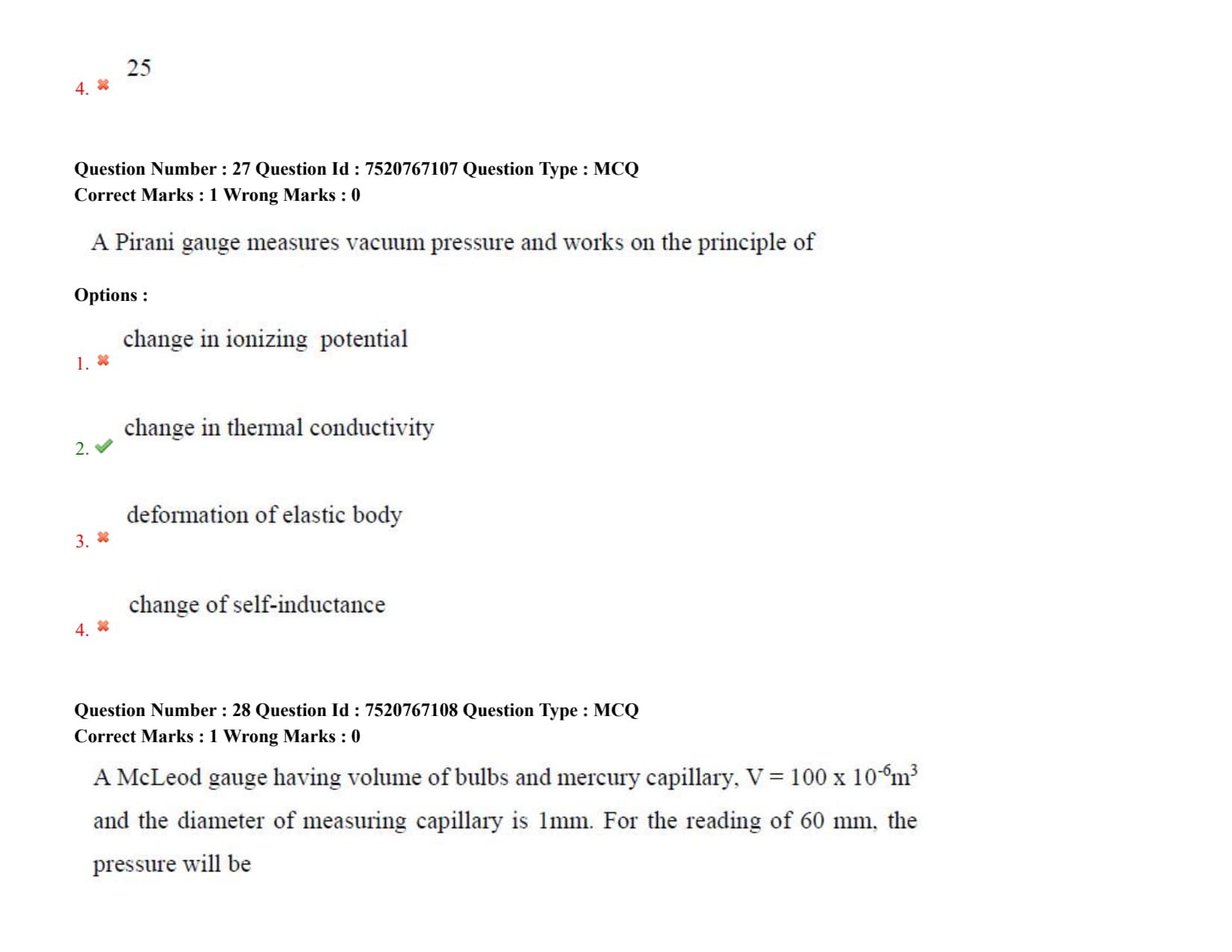
  • (D) 25

Question 27:

A Pirani gauge measures vacuum pressure and works on the principle of

  • (A) change in ionizing potential
  • (B) change in thermal conductivity
  • (C) deformation of elastic body
  • (D) change of self-inductance

Question 28:

A McLeod gauge having volume of bulbs and mercury capillary, \(V = 100 \times 10^{-6} m^3\) and the diameter of measuring capillary is \(1 mm\). For the reading of \(60 mm\), the pressure will be

  • (A) \(14\ \mu m\)
  • (B) \(28\ \mu m\)
  • (C) \(42\ \mu m\)
  • (D) \(56\ \mu m\)

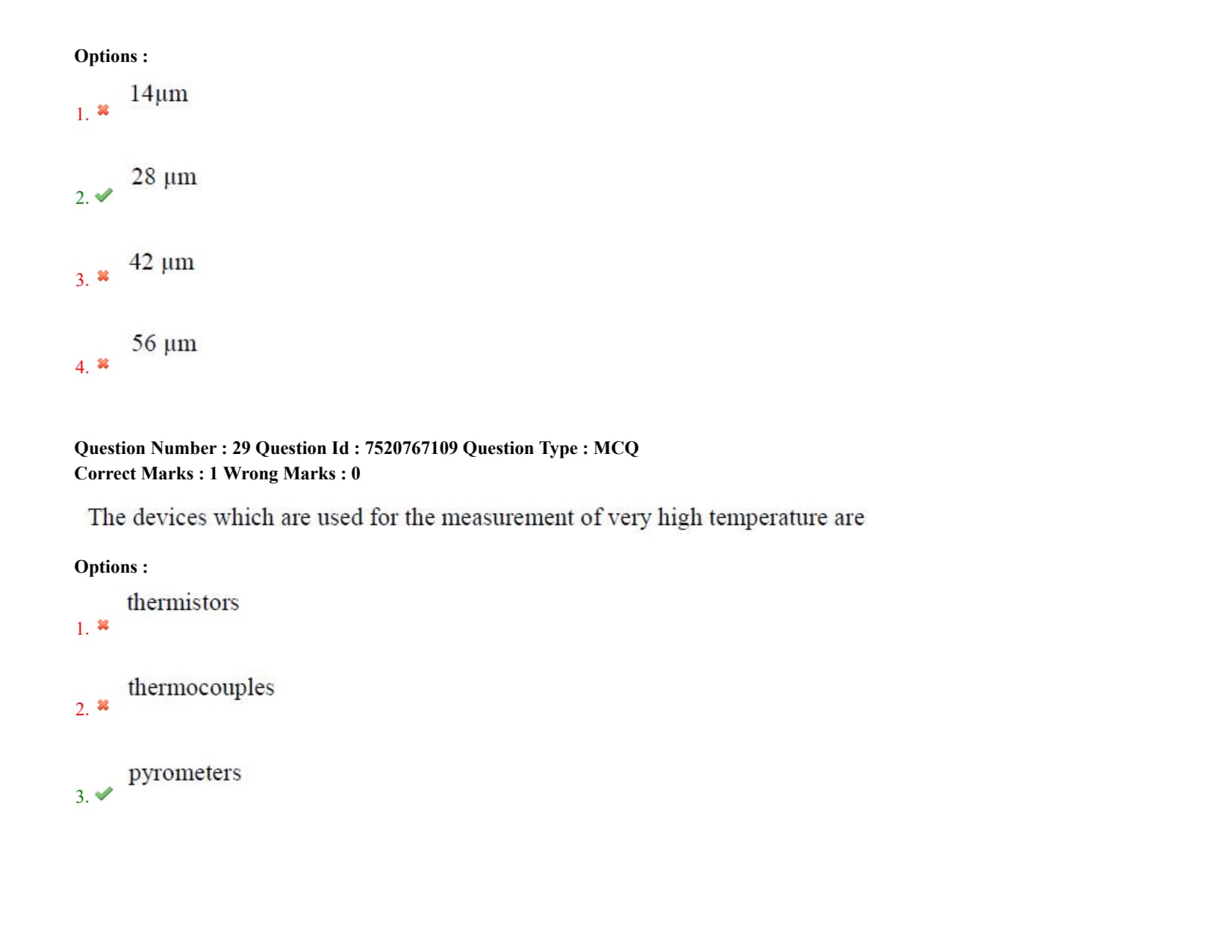
Question 29:

The devices which are used for the measurement of very high temperature are

  • (A) thermistors
  • (B) thermocouples
  • (C) pyrometers
  • (D) RTDs

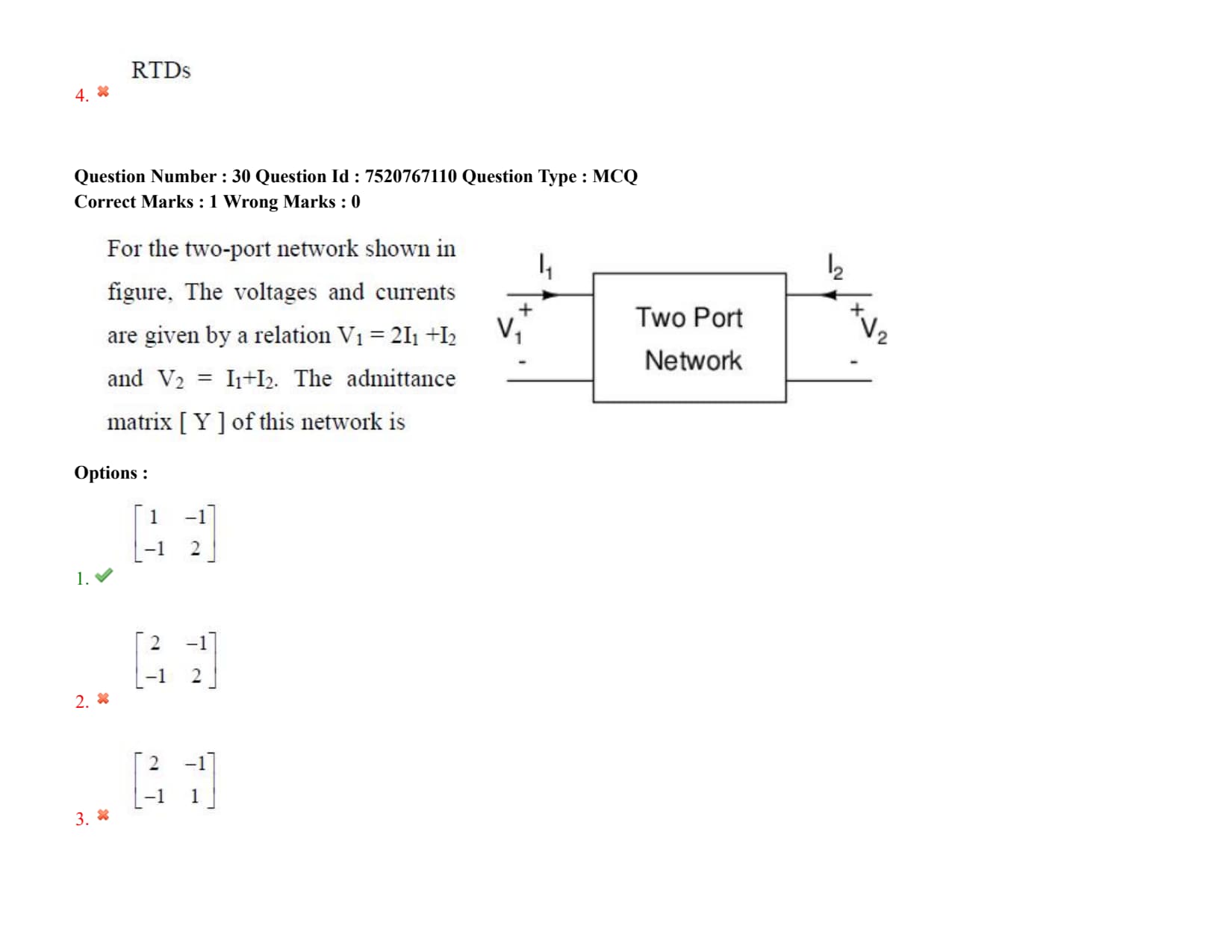
Question 30:

For the two-port network shown in figure, The voltages and currents are given by a relation \(V_1 = 2 I_1 + I_2\) and \(V_2 = I_1 + I_2\). The admittance matrix \([Y]\) of this network is

  • (A) \(\begin{bmatrix} 1 & -1 \\
    -1 & 2 \end{bmatrix}\)
  • (B) \(\begin{bmatrix} 2 & -1 \\
    -1 & 2 \end{bmatrix}\)
  • (C) \(\begin{bmatrix} 2 & -1 \\
    -1 & 1 \end{bmatrix}\)
  • (D) \(\begin{bmatrix} -1 & -1 \\
    -1 & 2 \end{bmatrix}\)

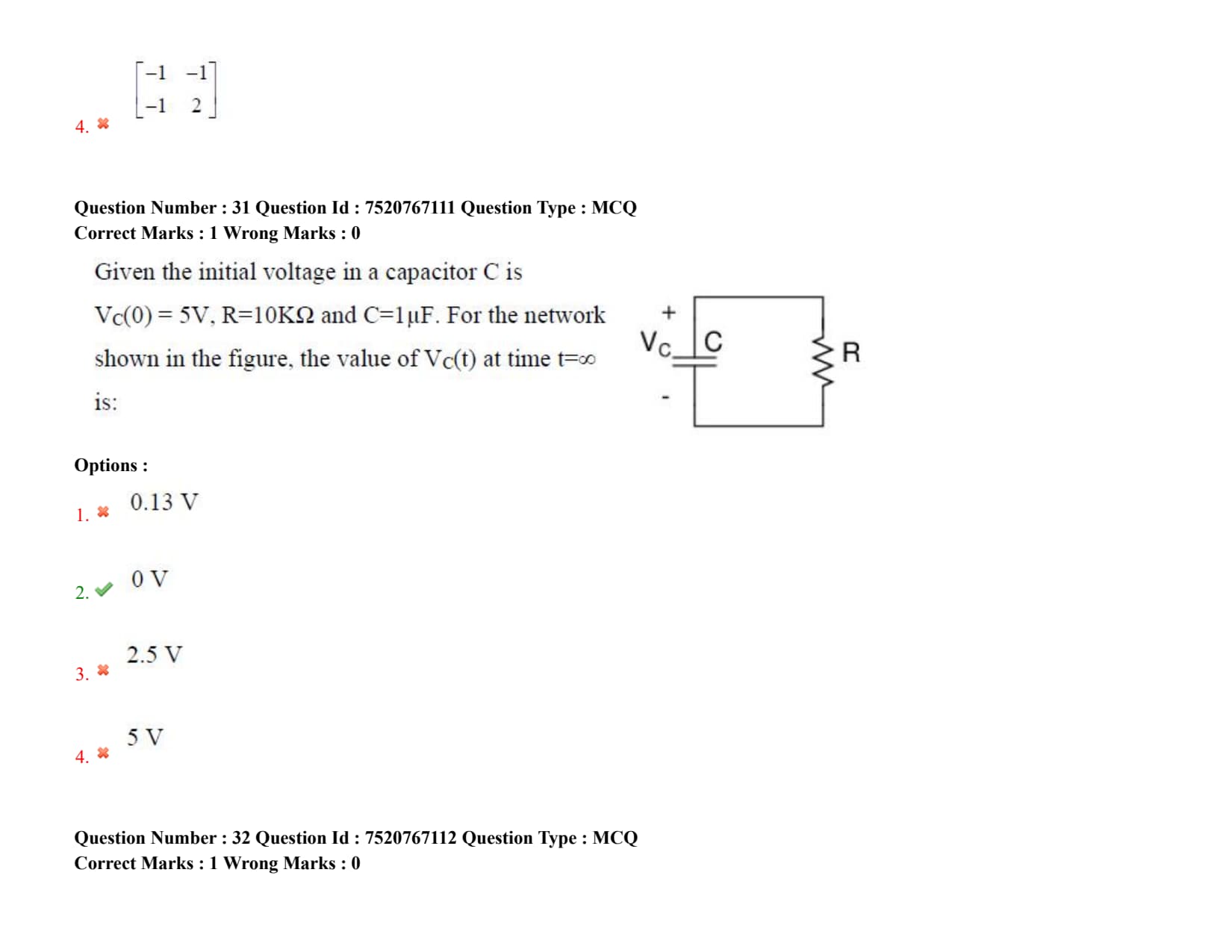
Question 31:

Given the initial voltage in a capacitor C is \(V_C(0) = 5V\), \(R=10 K\Omega\) and \(C=1\ \mu F\). For the network shown in the figure, the value of \(V_C(t)\) at time \(t=\infty\) is:

  • (A) \(0.13 V\)
  • (B) \(0 V\)
  • (C) \(2.5 V\)
  • (D) \(5 V\)

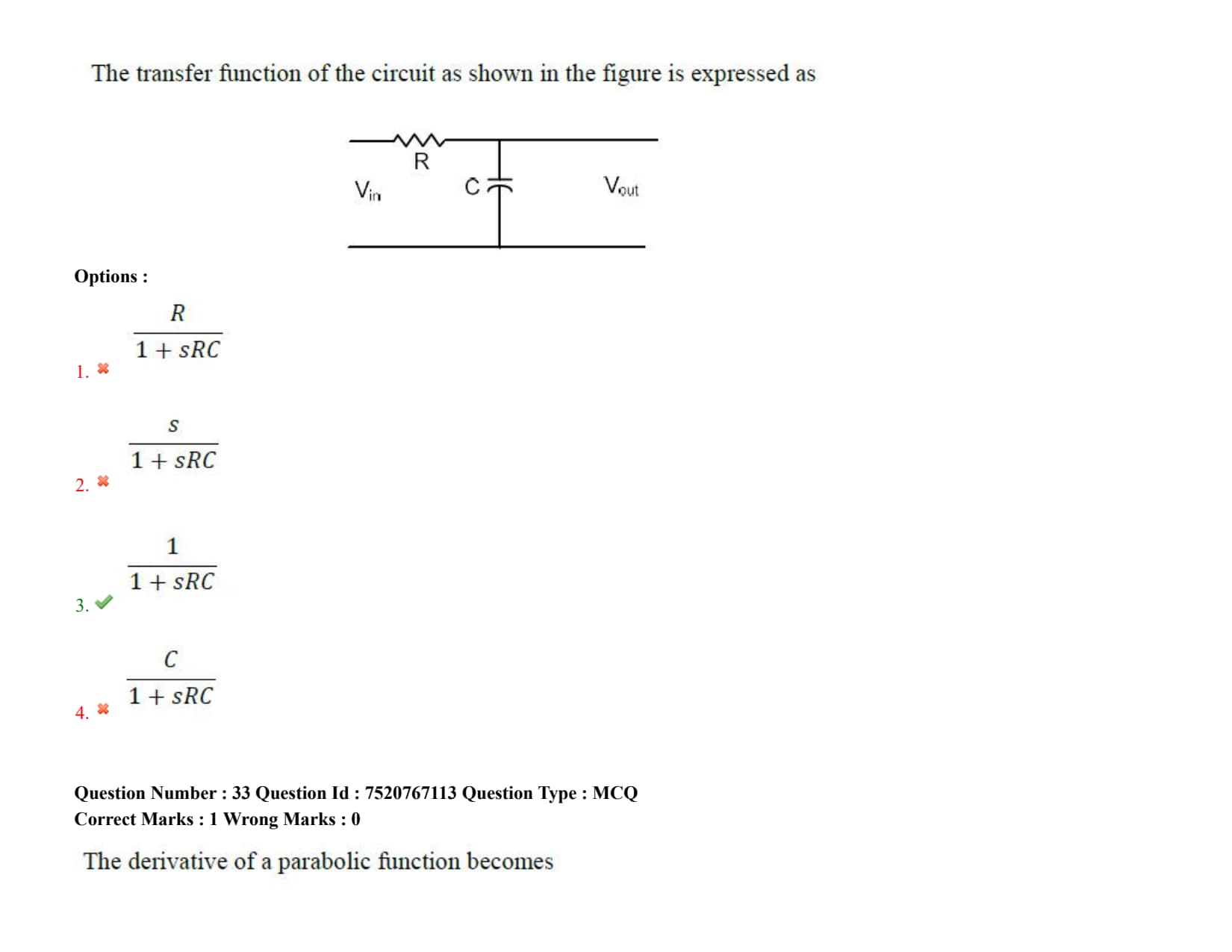
Question 32:

The transfer function of the circuit as shown in the figure is expressed as

  • (A) \(\frac{R}{1 + sRC}\)
  • (B) \(\frac{s}{1 + sRC}\)
  • (C) \(\frac{1}{1 + sRC}\)
  • (D) \(\frac{C}{1 + sRC}\)

Question 33:

The derivative of a parabolic function becomes

  • (A) unit-impulse function
  • (B) ramp function
  • (C) gate function
  • (D) triangular function

Question 34:

If the phase margin of a system is zero degrees, then the system is

  • (A) stable.
  • (B) unstable.
  • (C) marginally stable.
  • (D) conditionally stable.

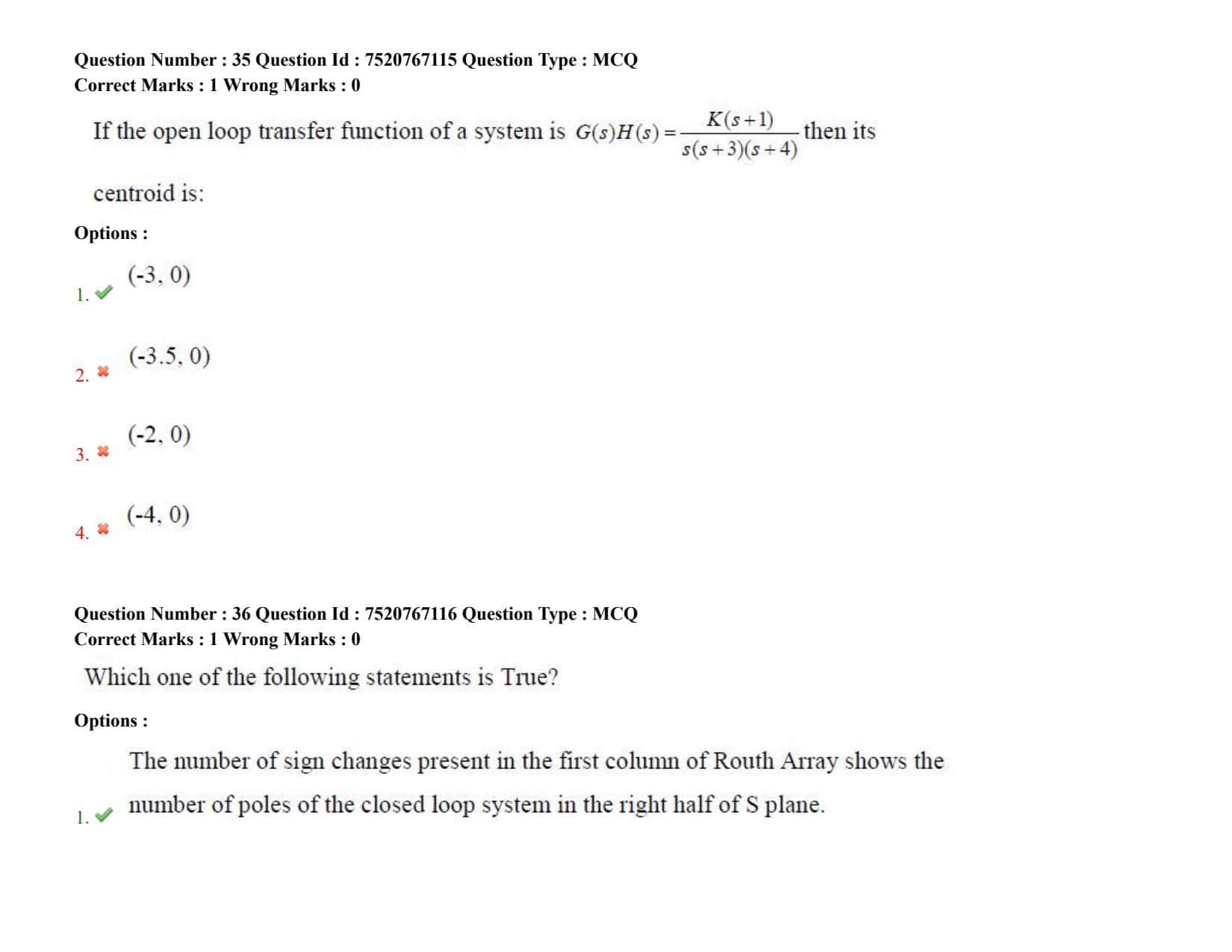
Question 35:

If the open loop transfer function of a system is \(G(s)H(s) = \frac{K(s+1)}{s(s+3)(s+4)}\) then its centroid is:

  • (A) \((-3, 0)\)
  • (B) \((-3.5, 0)\)
  • (C) \((-2, 0)\)
  • (D) \((-4, 0)\)

Question 36:

Which one of the following statements is True?

  • (A) The number of sign changes present in the first column of Routh Array shows the number of poles of the closed loop system in the right half of S plane.
  • (B) The number of sign changes present in the first column of Routh Array shows the number of zeros of the closed loop system in the right half of S plane.
  • (C) The number of sign changes present in the first column of Routh Array shows the number of zeros of the open loop system in the right half of S plane.
  • (D) The number of sign changes present in the first column of Routh Array shows the number of poles of the open loop system in the right half of S plane.

Question 37:

For critically damped system, the value of the damping ratio \(\zeta\) is:

  • (A) 0
  • (B) \(>1\)
  • (C) \(<1\)
  • (D) 1

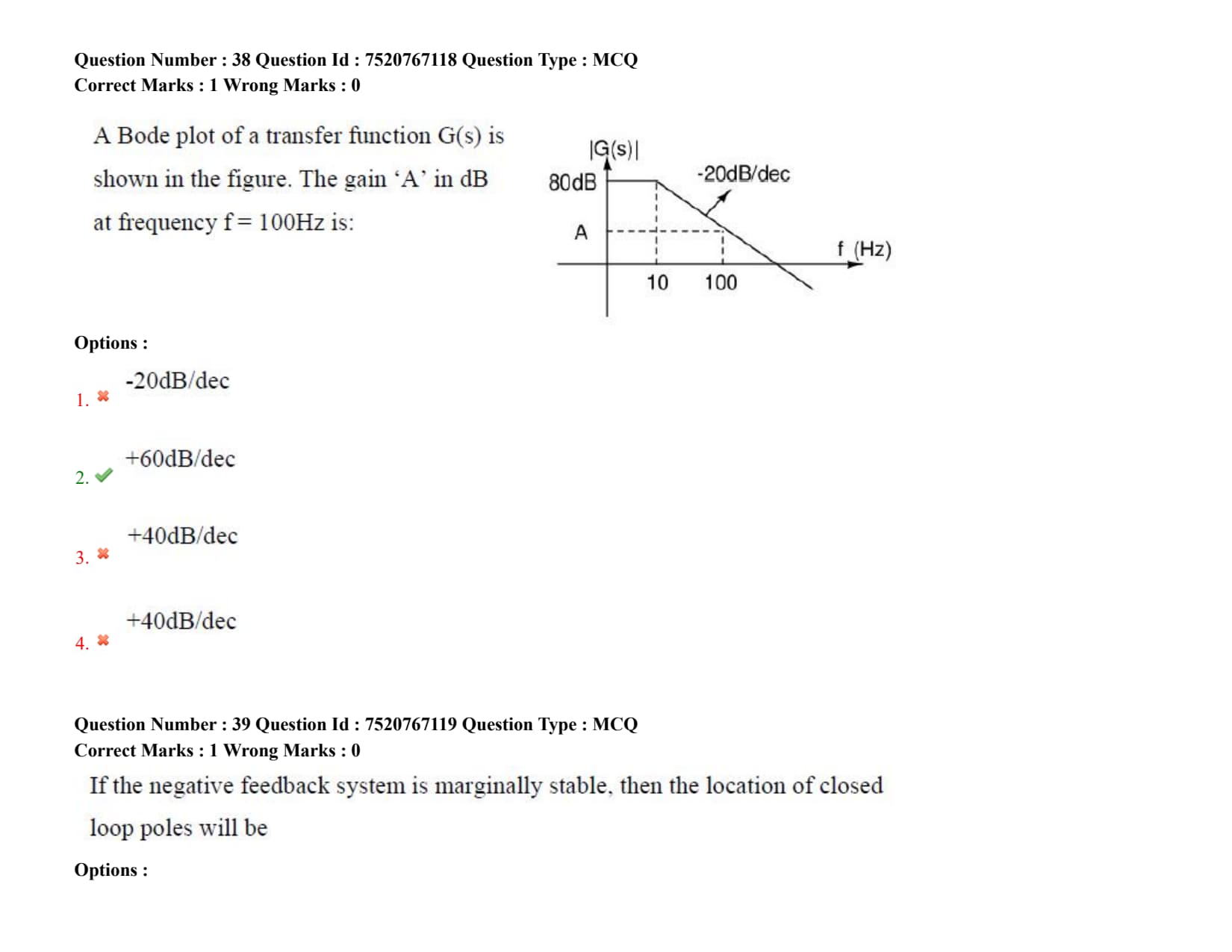
Question 38:

A Bode plot of a transfer function G(s) is shown in the figure. The gain 'A' in dB at frequency f = 100Hz is:

  • (A) \(-20 dB/dec\)
  • (B) \(+60 dB/dec\)
  • (C) \(+40 dB/dec\)
  • (D) \(+40 dB/dec\)

Question 39:

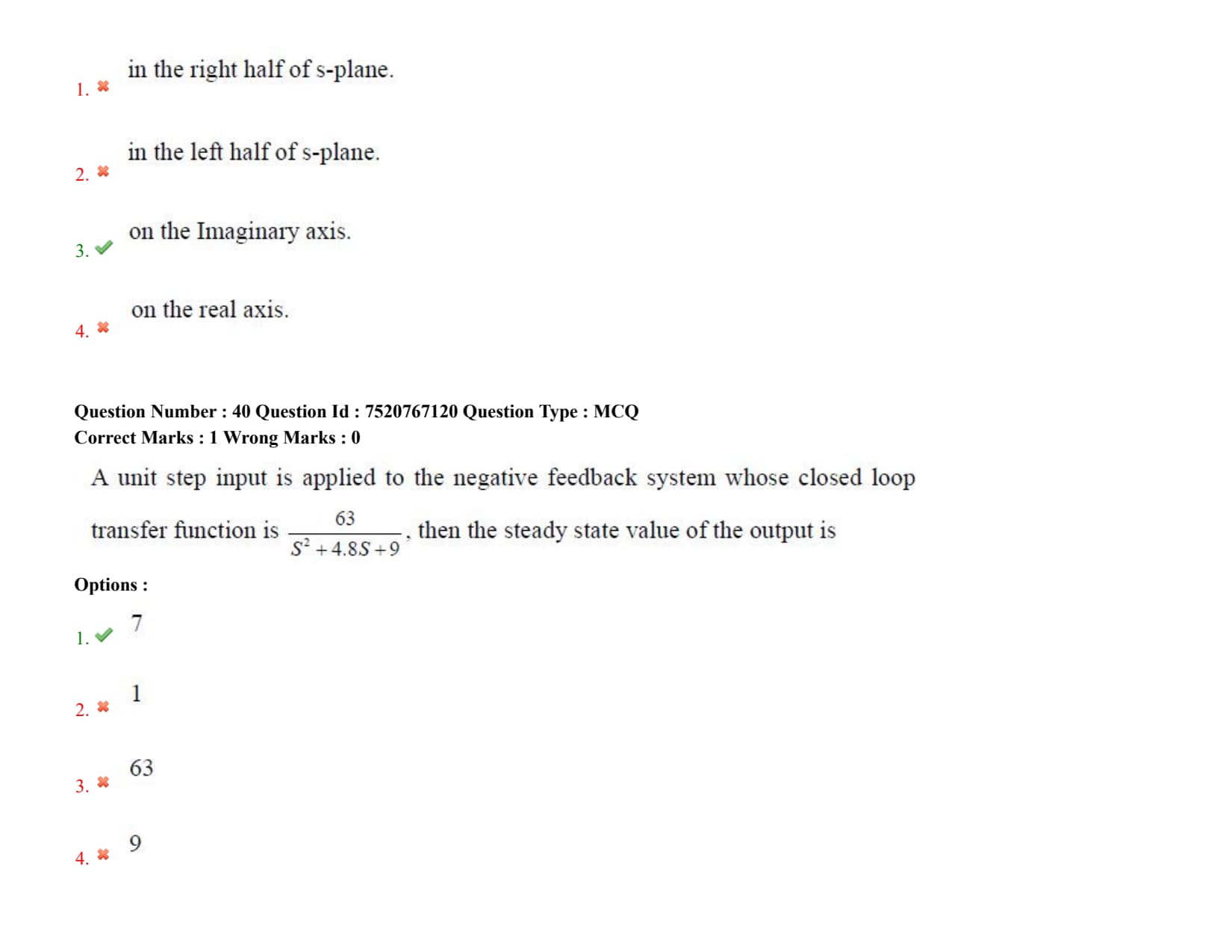
If the negative feedback system is marginally stable, then the location of closed loop poles will be

  • (A) in the right half of s-plane.
  • (B) in the left half of s-plane.
  • (C) on the Imaginary axis.
  • (D) on the real axis.

Question 40:

A unit step input is applied to the negative feedback system whose closed loop transfer function is \(\frac{63}{S^2 + 4.8S + 9}\), then the steady state value of the output is

  • (A) 7
  • (B) 1
  • (C) 63
  • (D) 9

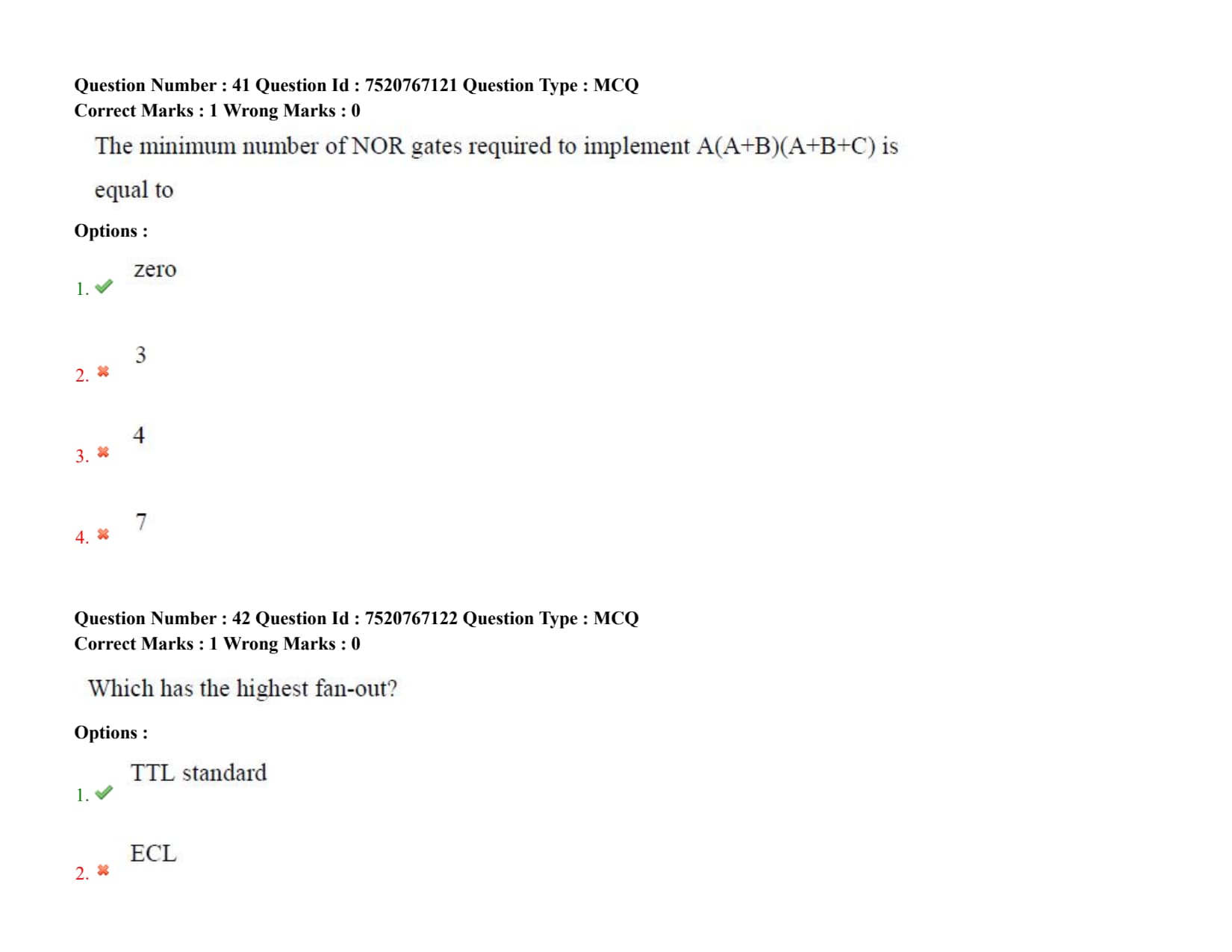
Question 41:

The minimum number of NOR gates required to implement A(A+B)(A+B+C) is equal to

  • (A) zero
  • (B) 3
  • (C) 4
  • (D) 7

Question 42:

Which has the highest fan-out?

  • (A) TTL standard
  • (B) ECL
  • (C) Schottky TTL
  • (D) CMOS+

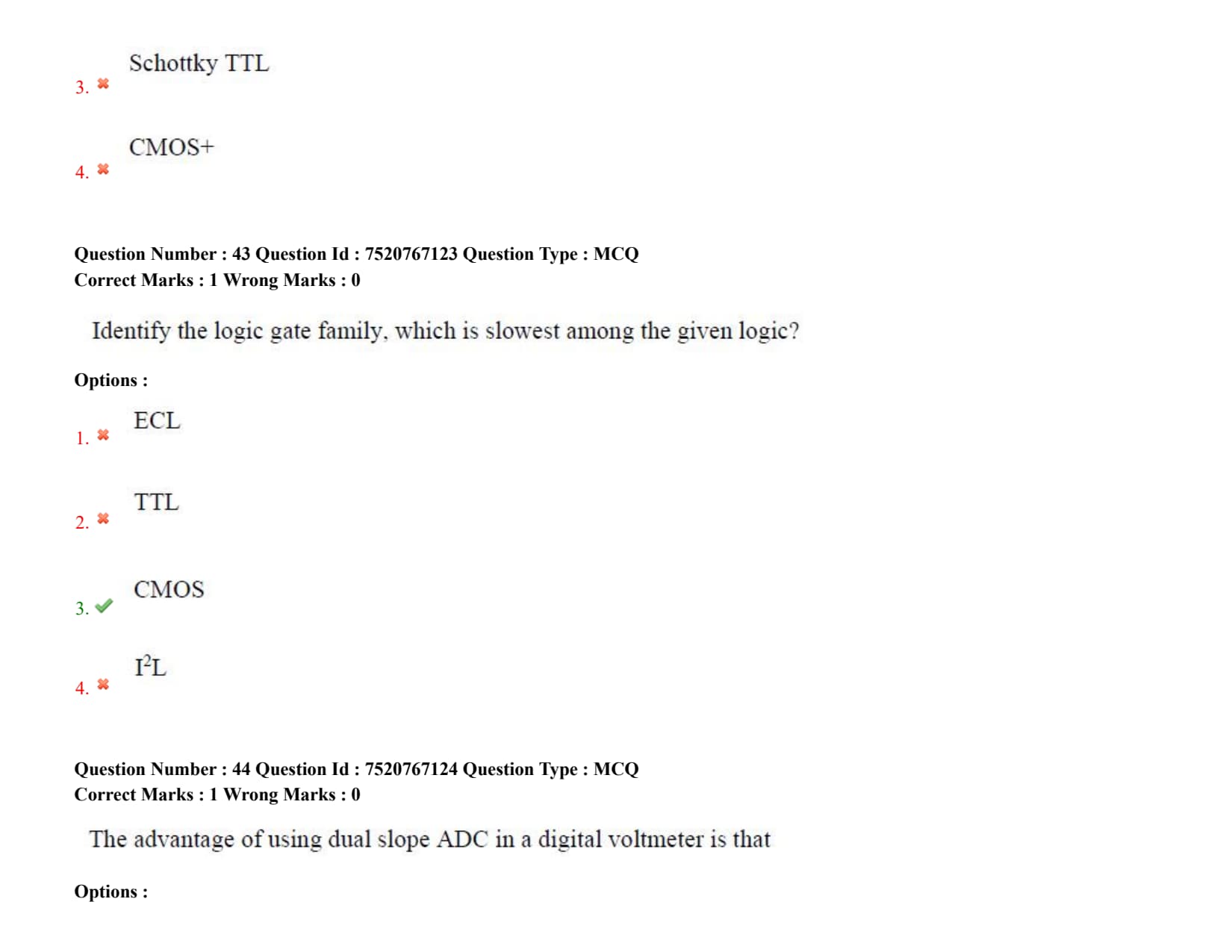
Question 43:

Identify the logic gate family, which is slowest among the given logic?

  • (A) ECL
  • (B) TTL
  • (C) CMOS
  • (D) \(I^2L\)

Question 44:

The advantage of using dual slope ADC in a digital voltmeter is that

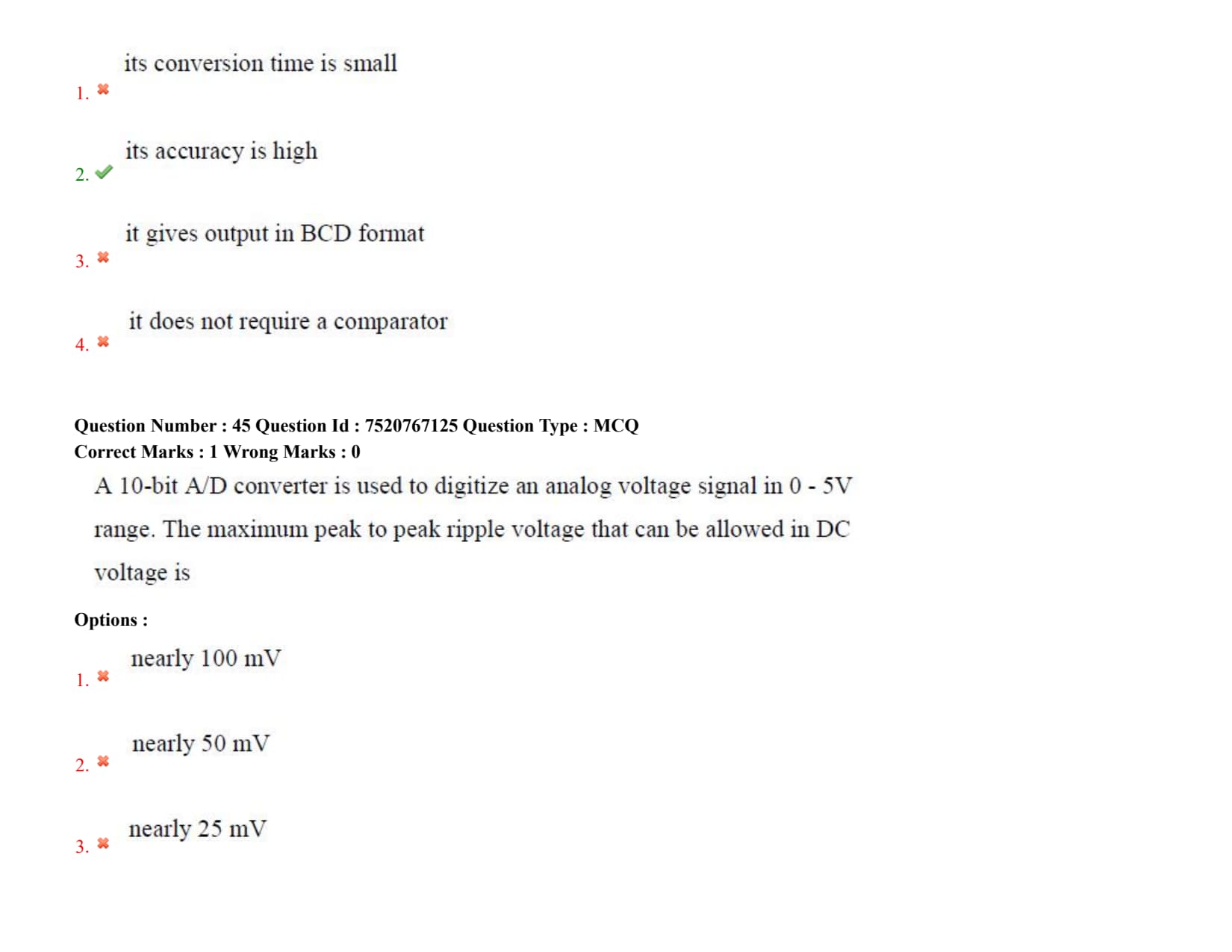
  • (A) its conversion time is small
  • (B) its accuracy is high
  • (C) it gives output in BCD format
  • (D) it does not require a comparator

Question 45:

A 10-bit A/D converter is used to digitize an analog voltage signal in \(0 - 5V\) range. The maximum peak to peak ripple voltage that can be allowed in DC voltage is

  • (A) nearly \(100 mV\)
  • (B) nearly \(50 mV\)
  • (C) nearly \(25 mV\)
  • (D) nearly \(5 mV\)

Question 46:

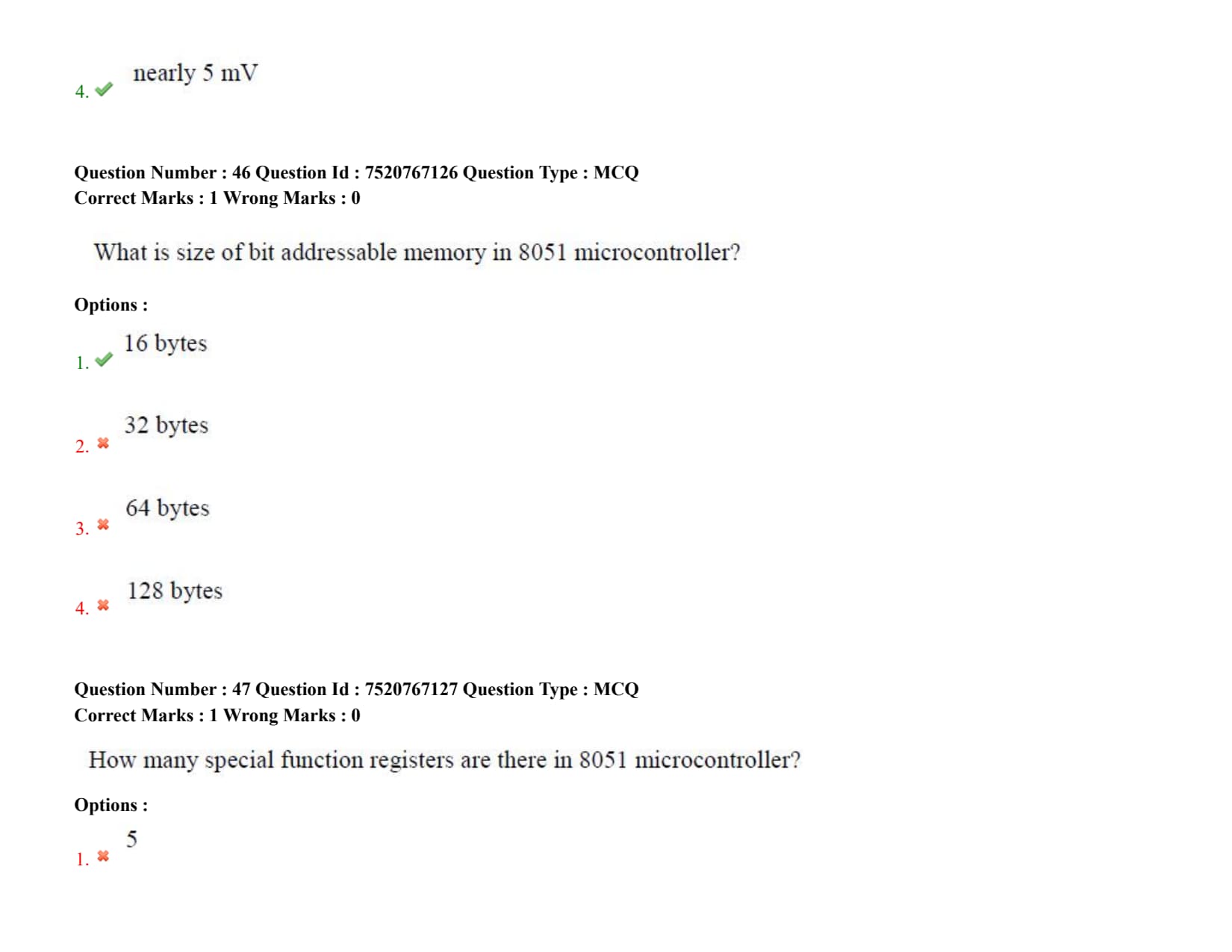
What is size of bit addressable memory in 8051 microcontroller?

  • (A) 16 bytes
  • (B) 32 bytes
  • (C) 64 bytes
  • (D) 128 bytes

Question 47:

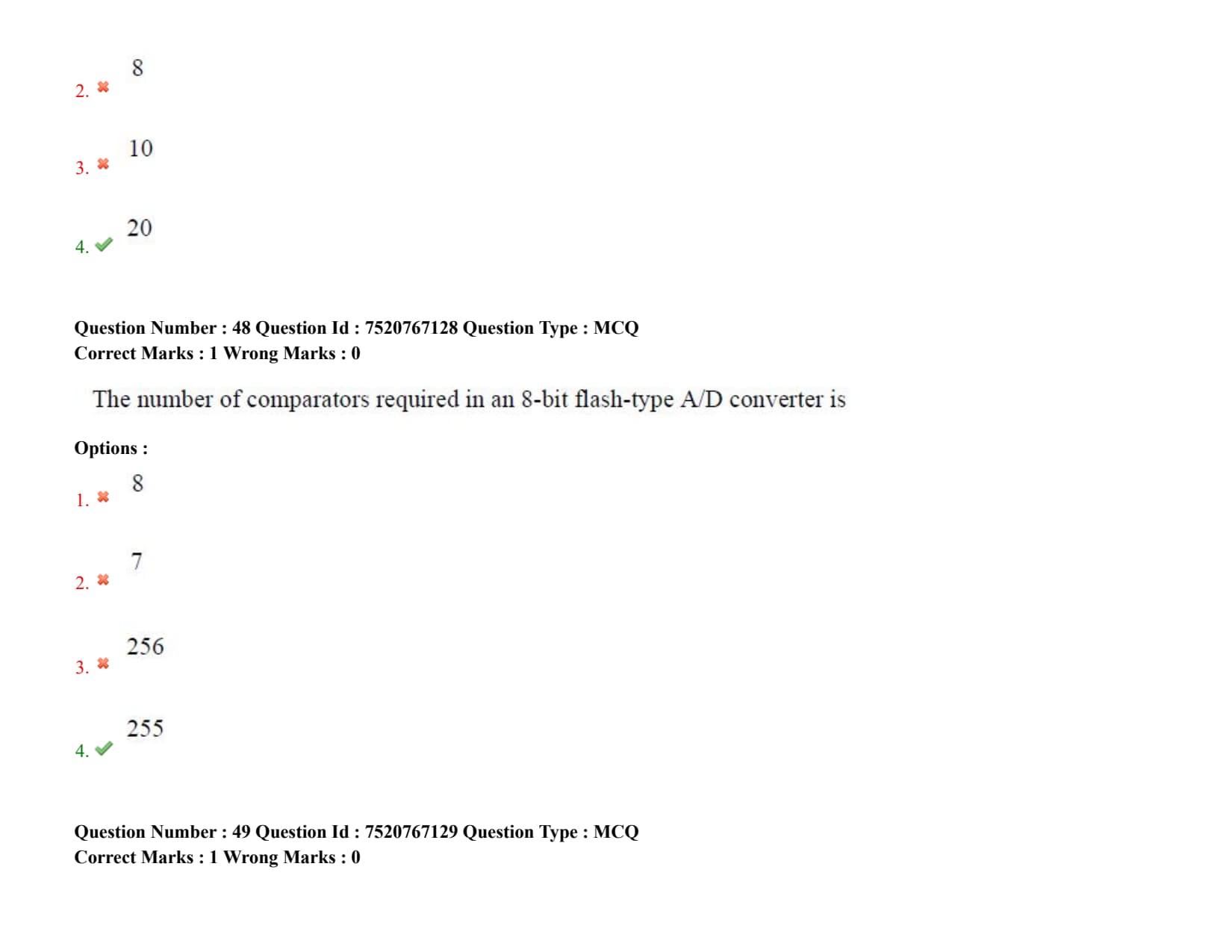
How many special function registers are there in 8051 microcontroller?

  • (A) 5
  • (B) 8
  • (C) 10
  • (D) 20

Question 48:

The number of comparators required in an 8-bit flash-type A/D converter is

  • (A) 8
  • (B) 7
  • (C) 256
  • (D) 255

Question 49:

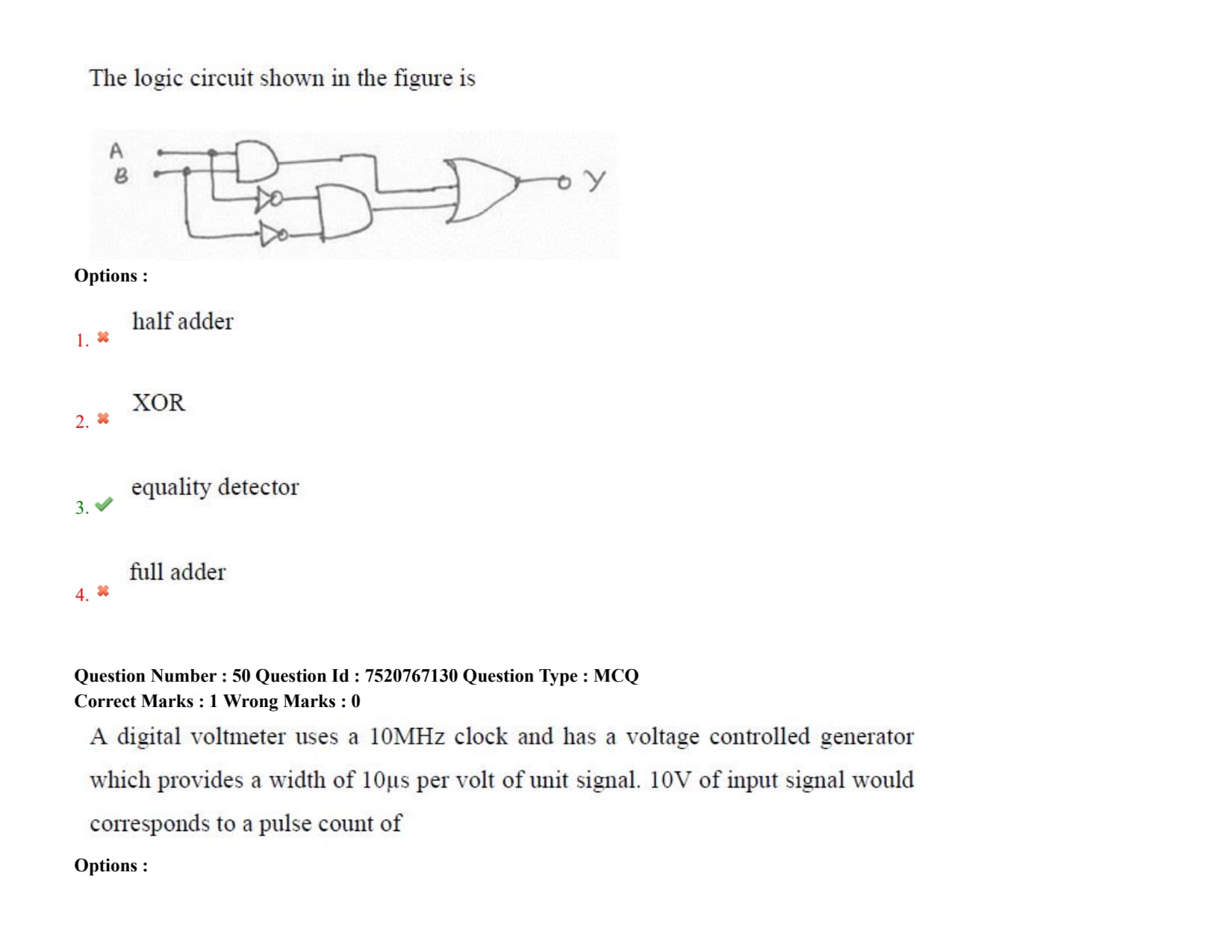
The logic circuit shown in the figure is

  • (A) half adder
  • (B) XOR
  • (C) equality detector
  • (D) full adder

Question 50:

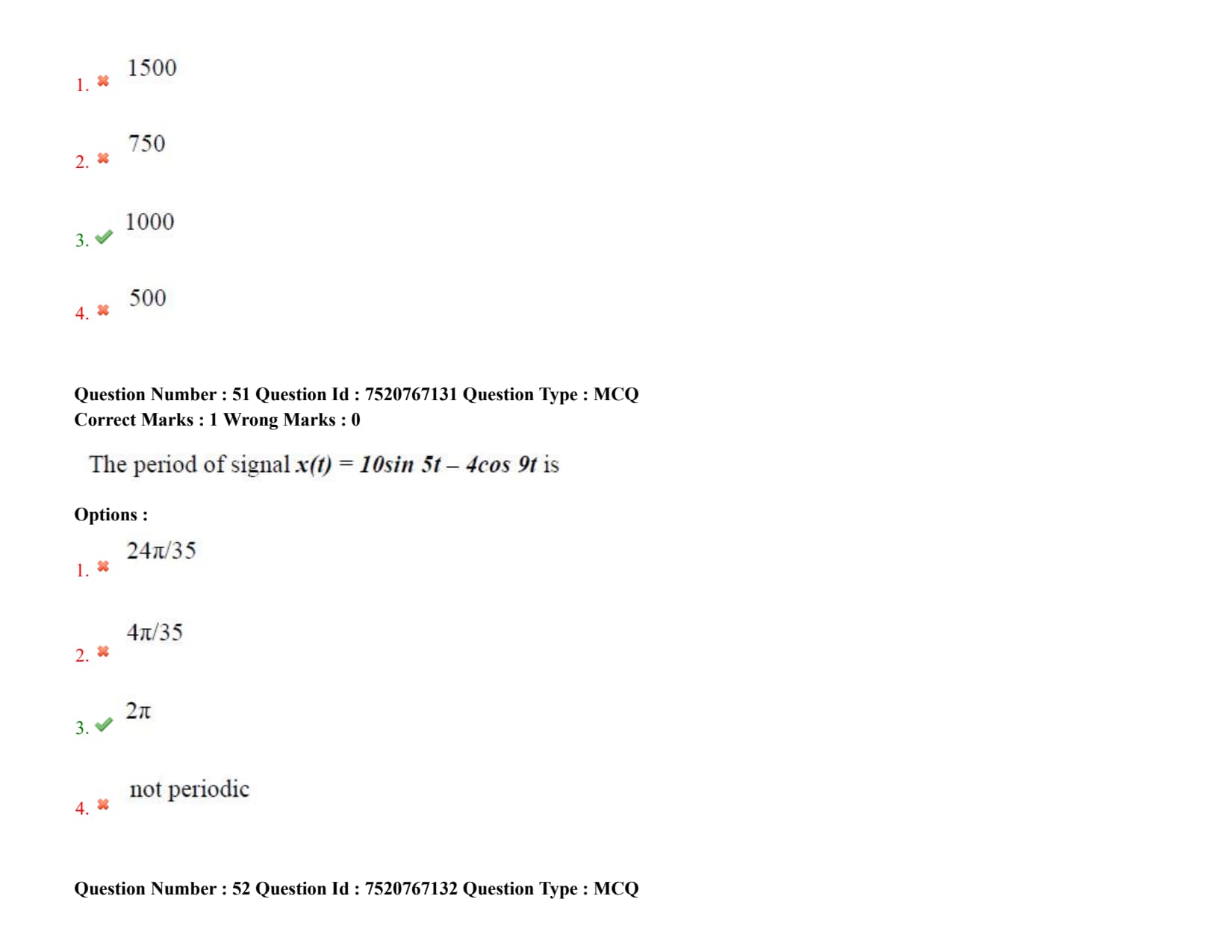
A digital voltmeter uses a 10MHz clock and has a voltage controlled generator which provides a width of \(10\mu s\) per volt of unit signal. 10V of input signal would corresponds to a pulse count of

  • (A) 1500
  • (B) 750
  • (C) 1000
  • (D) 500

Question 51:

The period of signal \(x(t) = 10\sin 5t - 4\cos 9t\) is

  • (A) \(24\pi/35\)
  • (B) \(4\pi/35\)
  • (C) \(2\pi\)
  • (D) not periodic

Question 52:

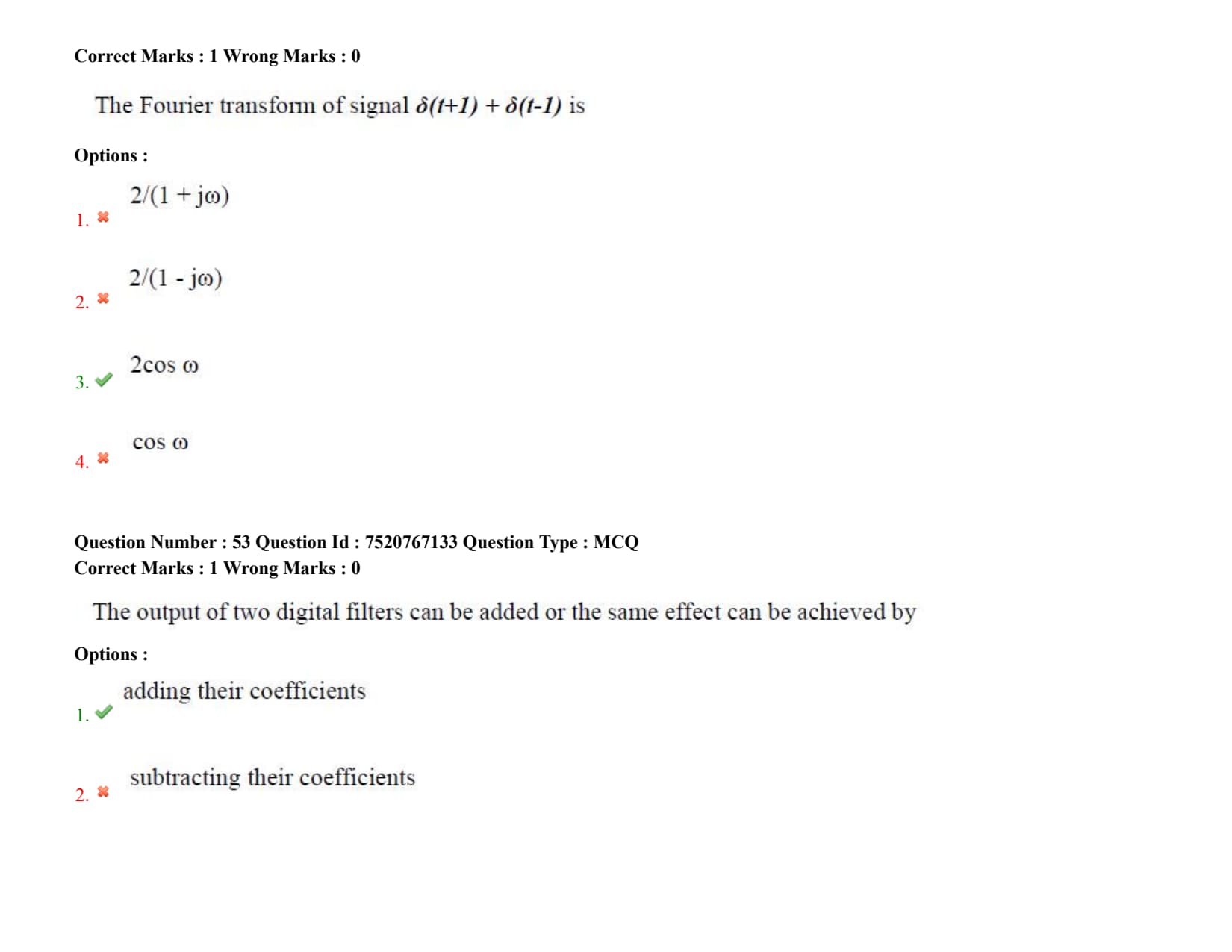
The Fourier transform of signal \(\delta(t+1) + \delta(t-1)\) is

  • (A) \(2/(1 + j\omega)\)
  • (B) \(2/(1 - j\omega)\)
  • (C) \(2\cos \omega\)
  • (D) \(\cos \omega\)

Question 53:

The output of two digital filters can be added or the same effect can be achieved by

  • (A) adding their coefficients
  • (B) subtracting their coefficients
  • (C) Convolving their coefficients
  • (D) averaging their coefficients and then using Blackman window

Question 54:

Which of the following pulse modulation is analog?

  • (A) PCM
  • (B) Differential PCM
  • (C) PWM
  • (D) Delta

Question 55:

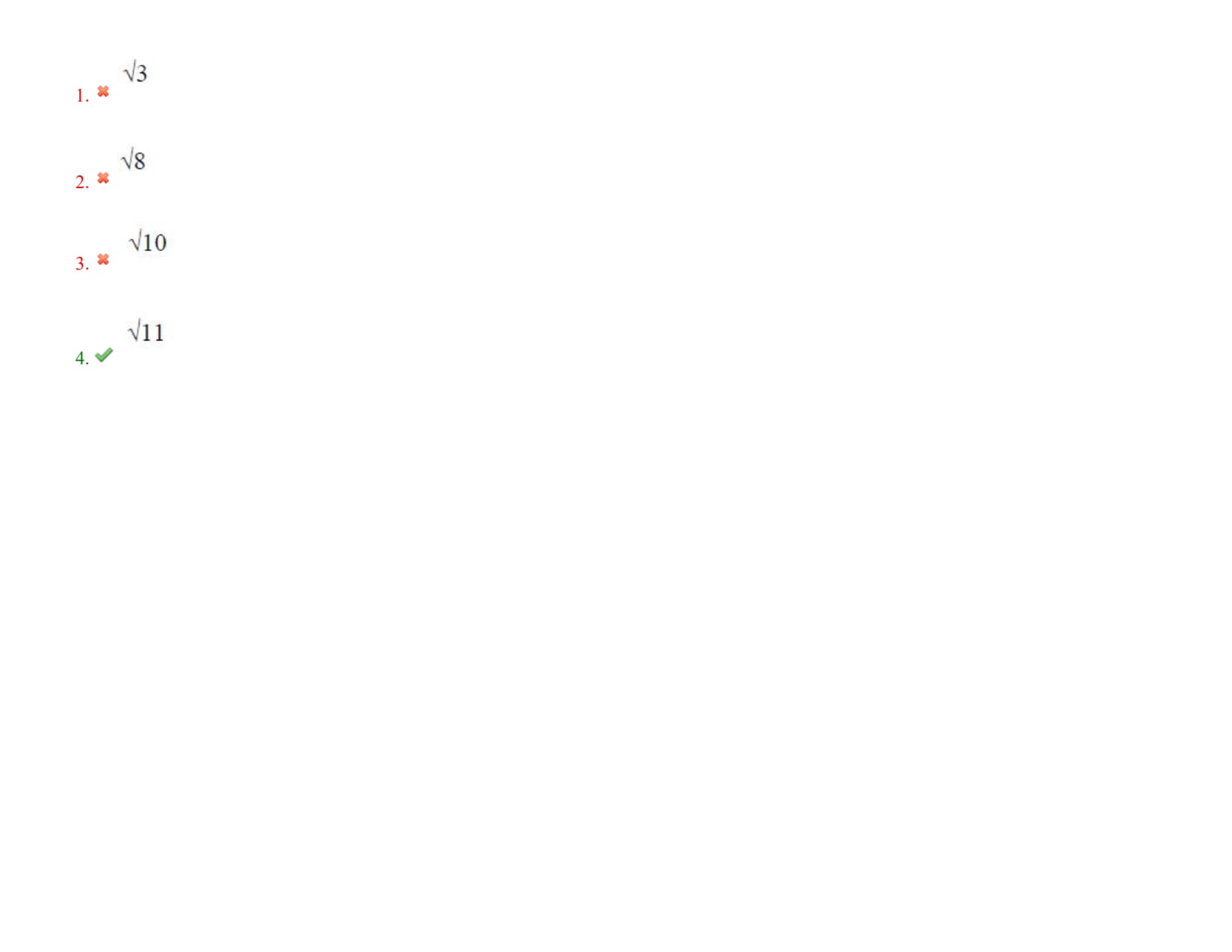
The root mean squared value of \(x(t) = 3 + 2\sin(t)\cos(2t)\) is

  • (A) \(\sqrt{3}\)
  • (B) \(\sqrt{8}\)
  • (C) \(\sqrt{10}\)
  • (D) \(\sqrt{11}\)

Question 56:

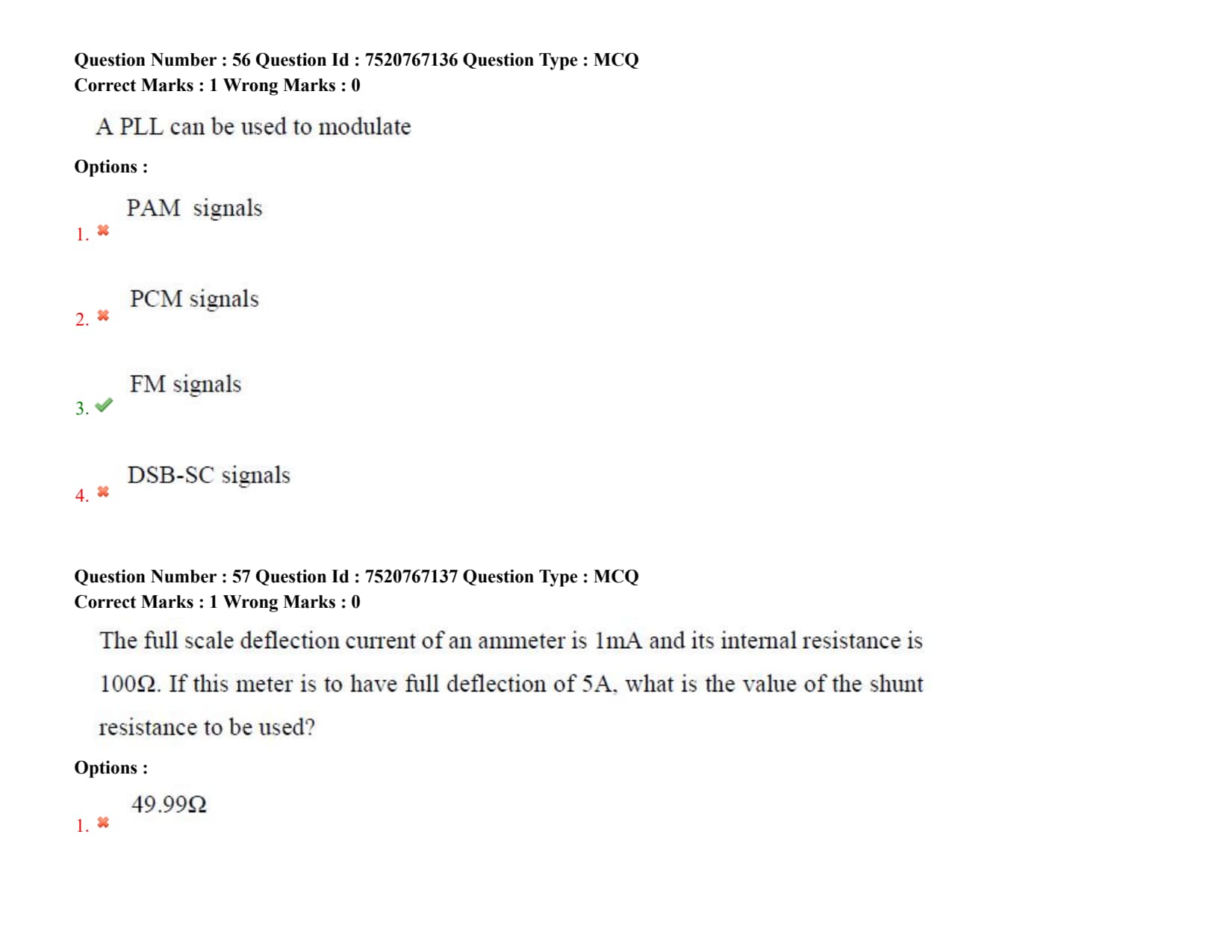
A PLL can be used to modulate

  • (A) PAM signals
  • (B) PCM signals
  • (C) FM signals
  • (D) DSB-SC signals

Question 57:

The full scale deflection current of an ammeter is 1mA and its internal resistance is \(100\Omega\). If this meter is to have full deflection of 5A, what is the value of the shunt resistance to be used?

  • (A) \(49.99\Omega\)
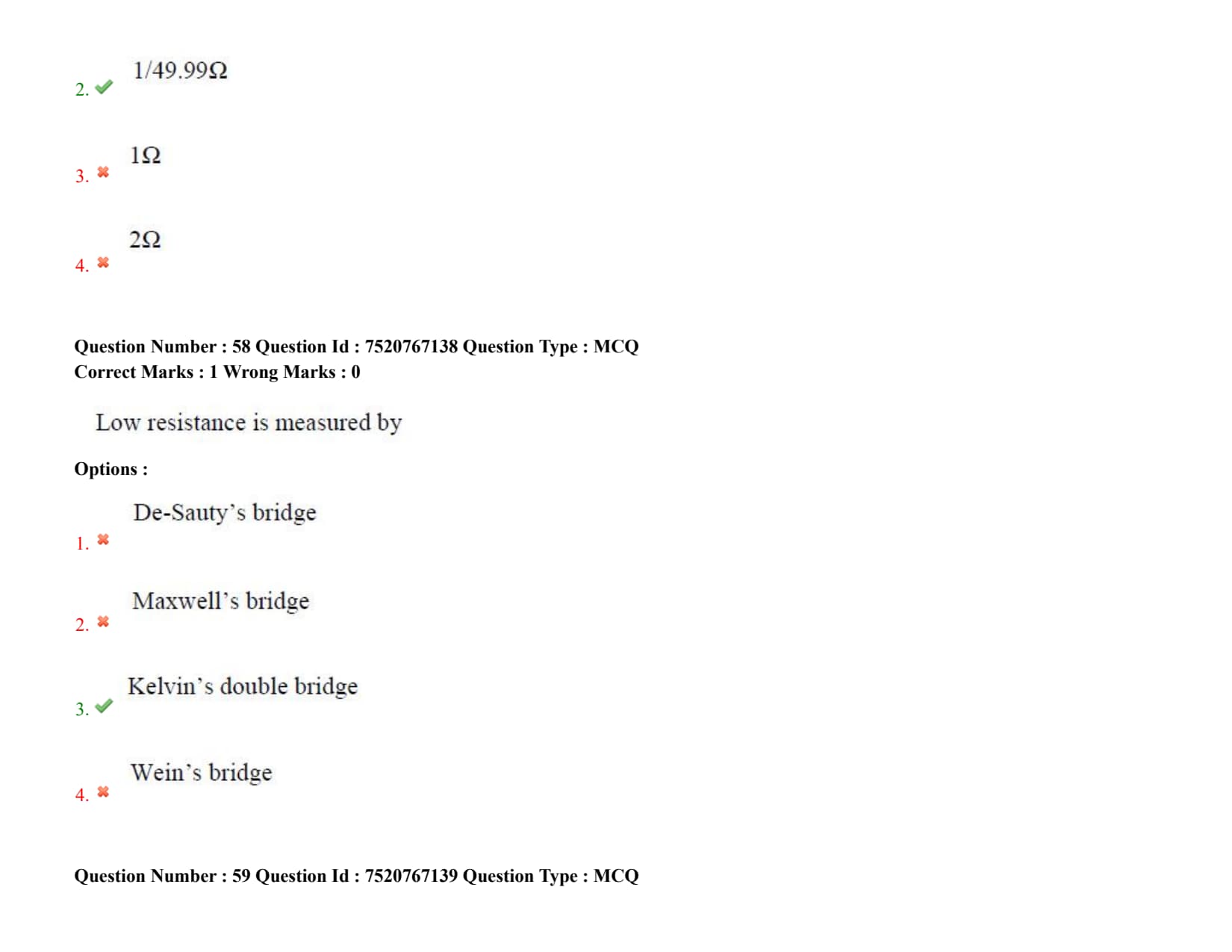
  • (B) \(1/49.99\Omega\)
  • (C) \(1\Omega\)
  • (D) \(2\Omega\)

Question 58:

Low resistance is measured by

  • (A) De-Sauty's bridge
  • (B) Maxwell's bridge
  • (C) Kelvin's double bridge
  • (D) Wein's bridge

Question 59:

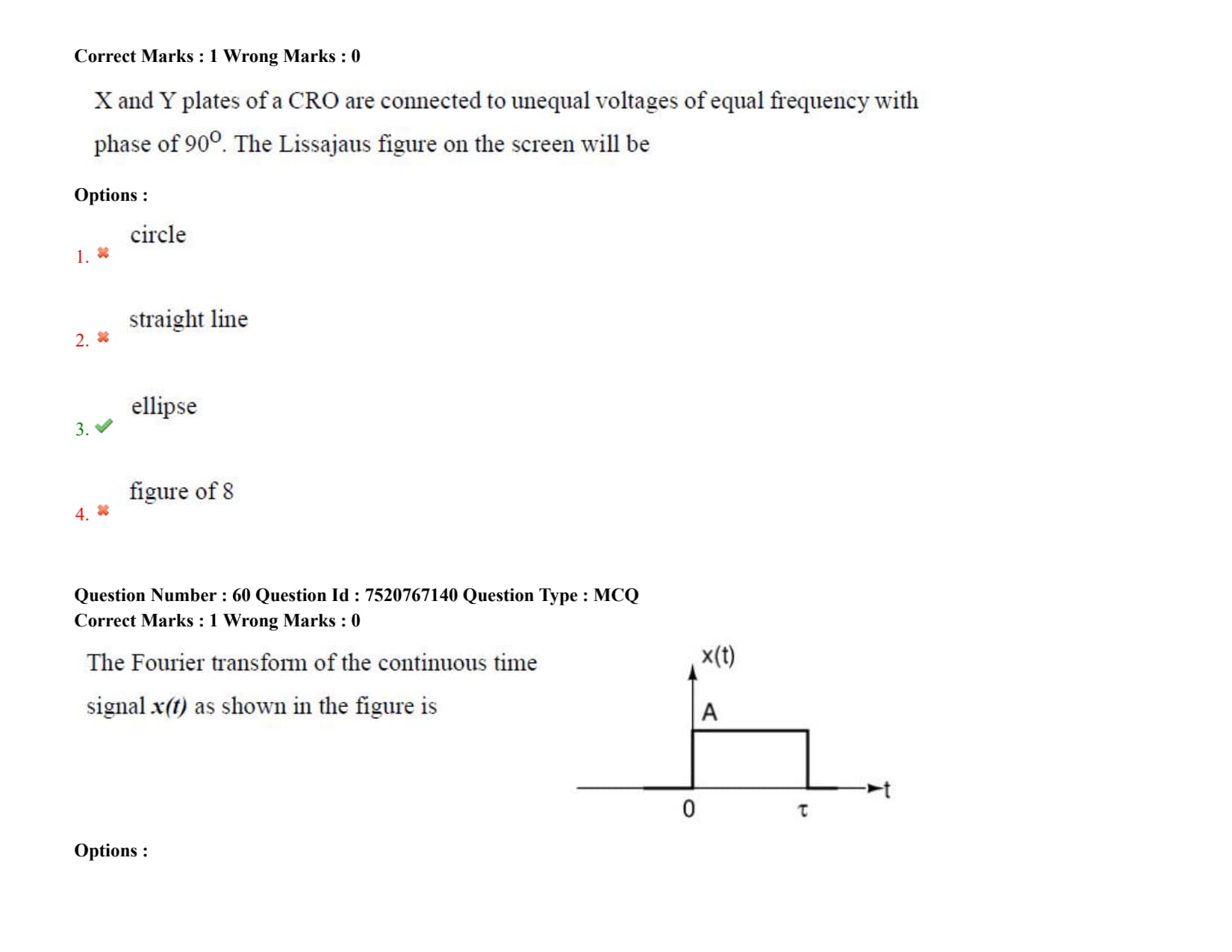
X and Y plates of a CRO are connected to unequal voltages of equal frequency with phase of \(90^\circ\). The Lissajous figure on the screen will be

  • (A) circle
  • (B) straight line
  • (C) ellipse
  • (D) figure of 8

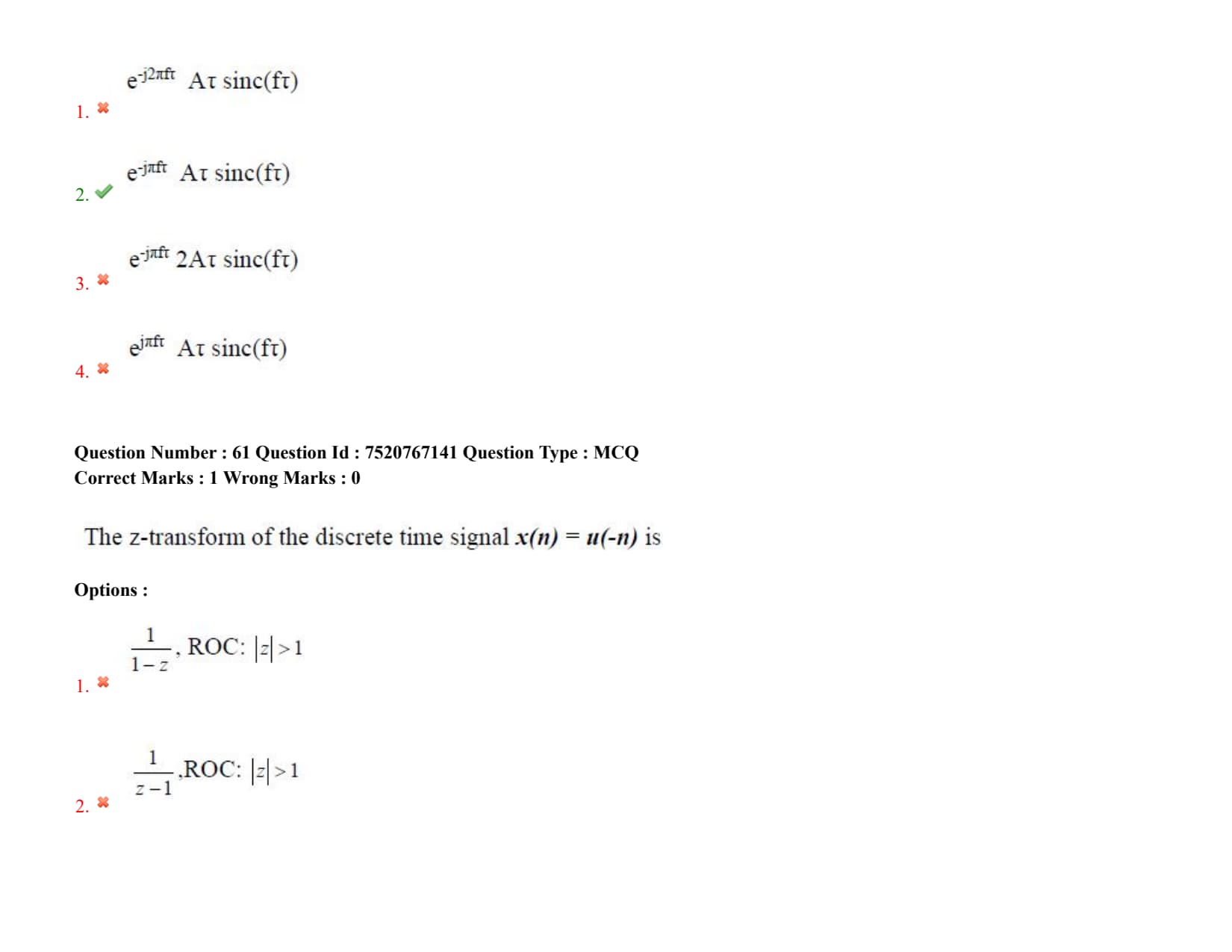
Question 60:

The Fourier transform of the continuous time signal \(x(t)\) as shown in the figure is

  • (A) \(e^{-j2\pi f\tau} A \tau sinc(f\tau)\)
  • (B) \(e^{-j\pi f\tau} A \tau sinc(f\tau)\)
  • (C) \(e^{-j\pi f\tau} 2A \tau sinc(f\tau)\)
  • (D) \(e^{j\pi f\tau} A \tau sinc(f\tau)\)

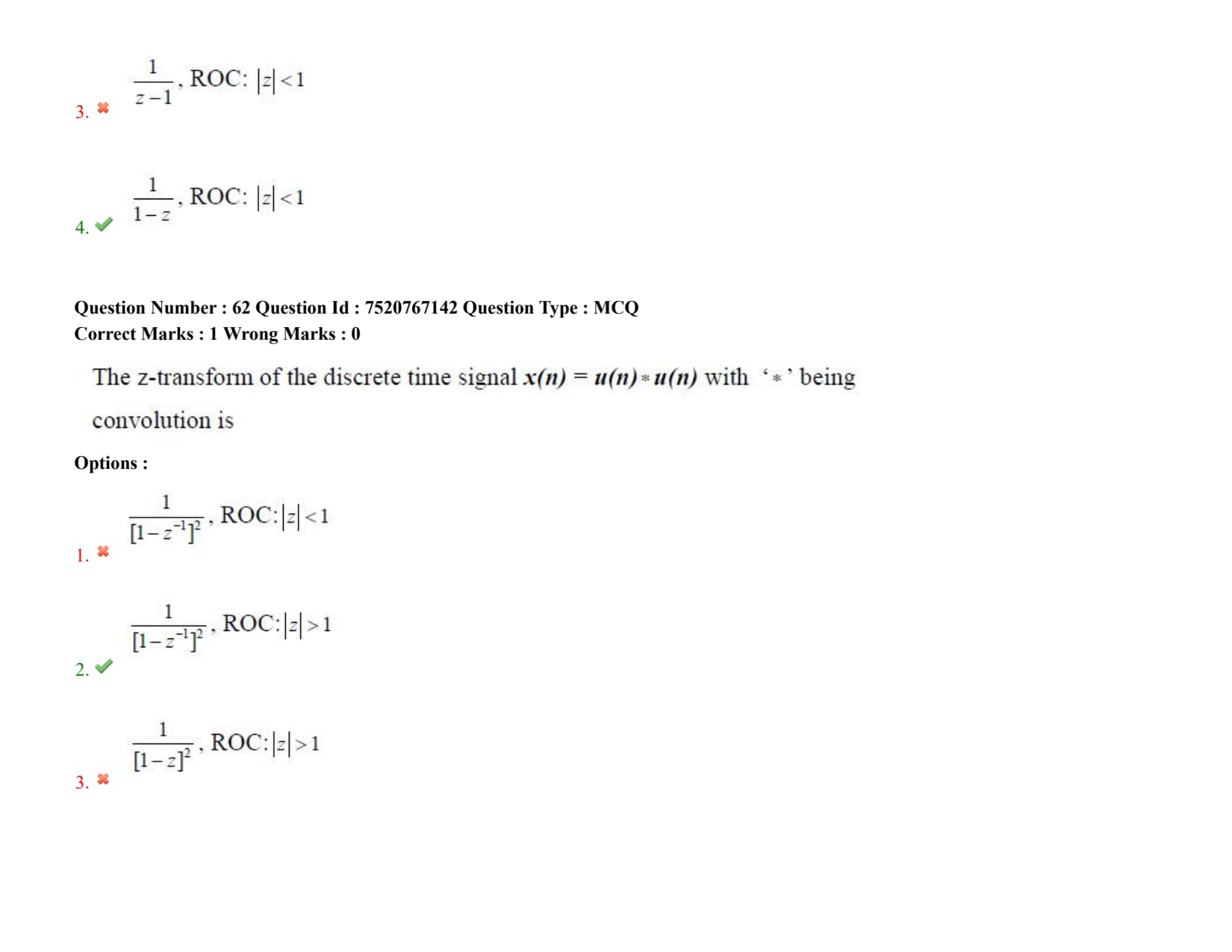
Question 61:

The z-transform of the discrete time signal \(x(n) = u(-n)\) is

  • (A) \(\frac{1}{1-z}\), ROC: \(|z| > 1\)
  • (B) \(\frac{1}{z-1}\), ROC: \(|z| > 1\)
  • (C) \(\frac{1}{z-1}\), ROC: \(|z| < 1\)
  • (D) \(\frac{1}{1-z}\), ROC: \(|z| < 1\)

Question 62:

The z-transform of the discrete time signal \(x(n) = u(n) * u(n)\) with '\(*\)' being convolution is

  • (A) \(\frac{1}{[1-z^{-1}]^2}\), ROC: \(|z| < 1\)
  • (B) \(\frac{1}{[1-z^{-1}]^2}\), ROC: \(|z| > 1\)
  • (C) \(\frac{1}{[1-z]^2}\), ROC: \(|z| > 1\)
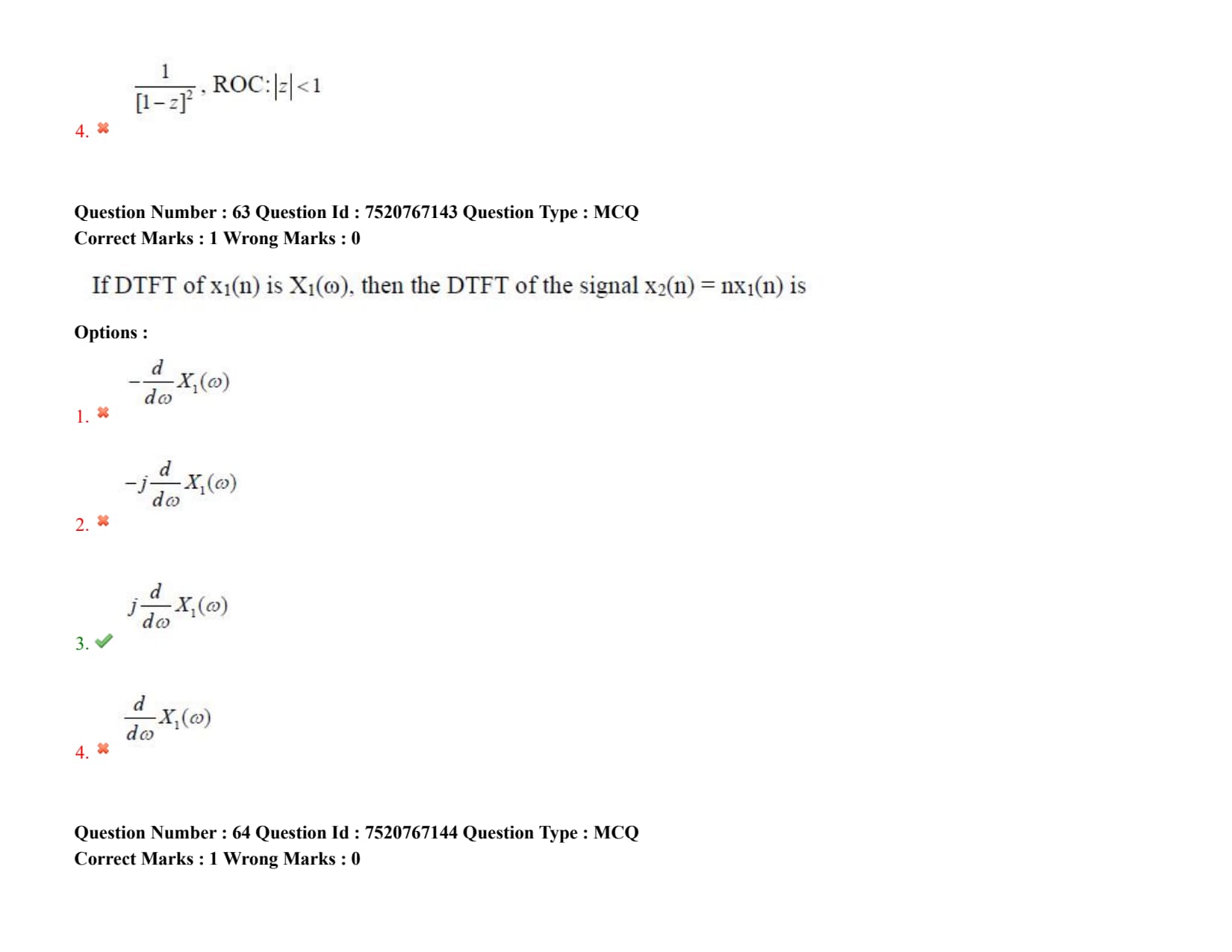
  • (D) \(\frac{1}{[1-z]^2}\), ROC: \(|z| < 1\)

Question 63:

If DTFT of \(x_1(n)\) is \(X_1(\omega)\), then the DTFT of the signal \(x_2(n) = nx_1(n)\) is

  • (A) \(-\frac{d}{d\omega} X_1(\omega)\)
  • (B) \(-j \frac{d}{d\omega} X_1(\omega)\)
  • (C) \(j \frac{d}{d\omega} X_1(\omega)\)
  • (D) \(\frac{d}{d\omega} X_1(\omega)\)

Question 64:

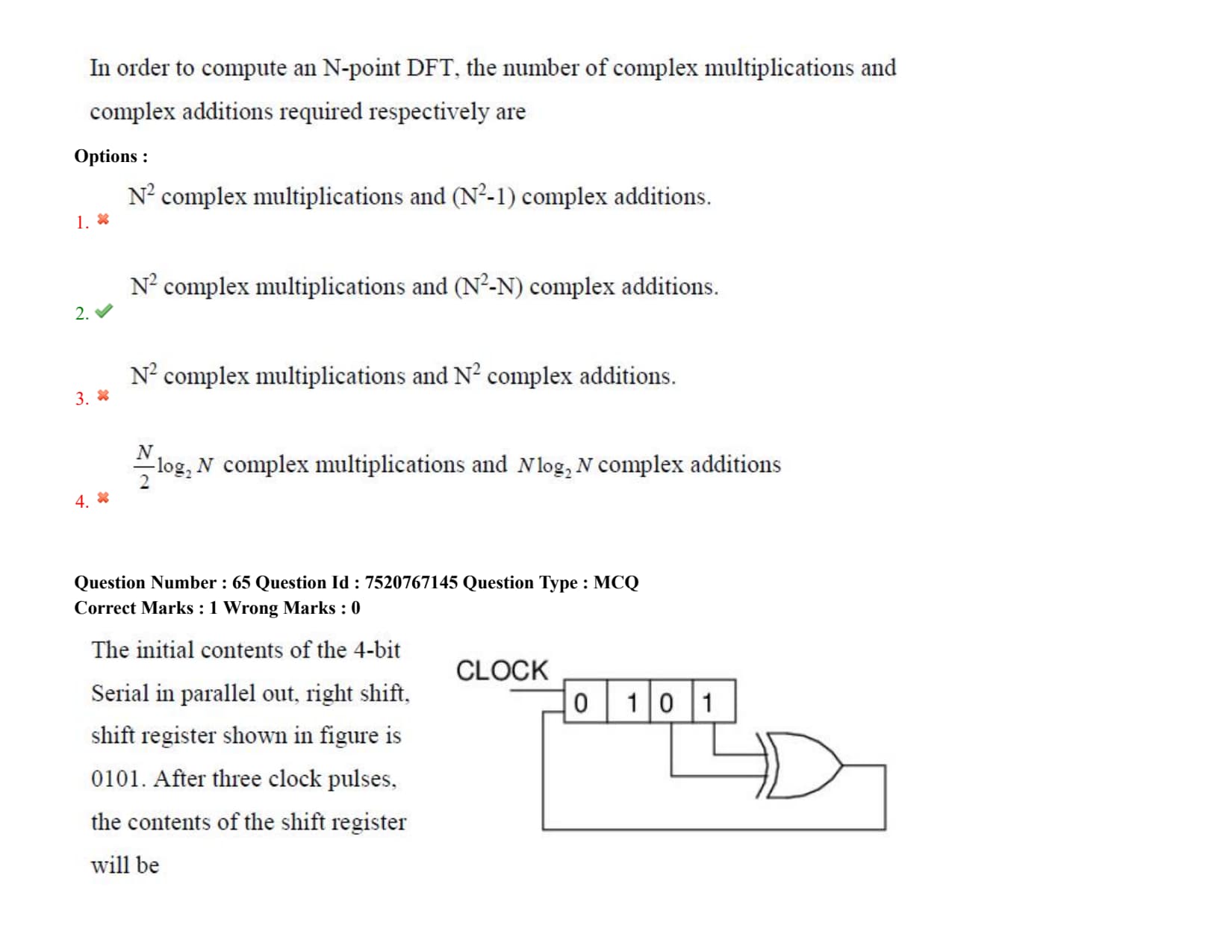
In order to compute an N-point DFT, the number of complex multiplications and complex additions required respectively are

  • (A) \(N^2\) complex multiplications and \((N^2-1)\) complex additions.
  • (B) \(N^2\) complex multiplications and \((N^2-N)\) complex additions.
  • (C) \(N^2\) complex multiplications and \(N^2\) complex additions.
  • (D) \(\frac{N}{2}\log_2 N\) complex multiplications and \(N\log_2 N\) complex additions.

Question 65:

The initial contents of the 4-bit Serial in parallel out, right shift, shift register shown in figure is 0101. After three clock pulses, the contents of the shift register will be

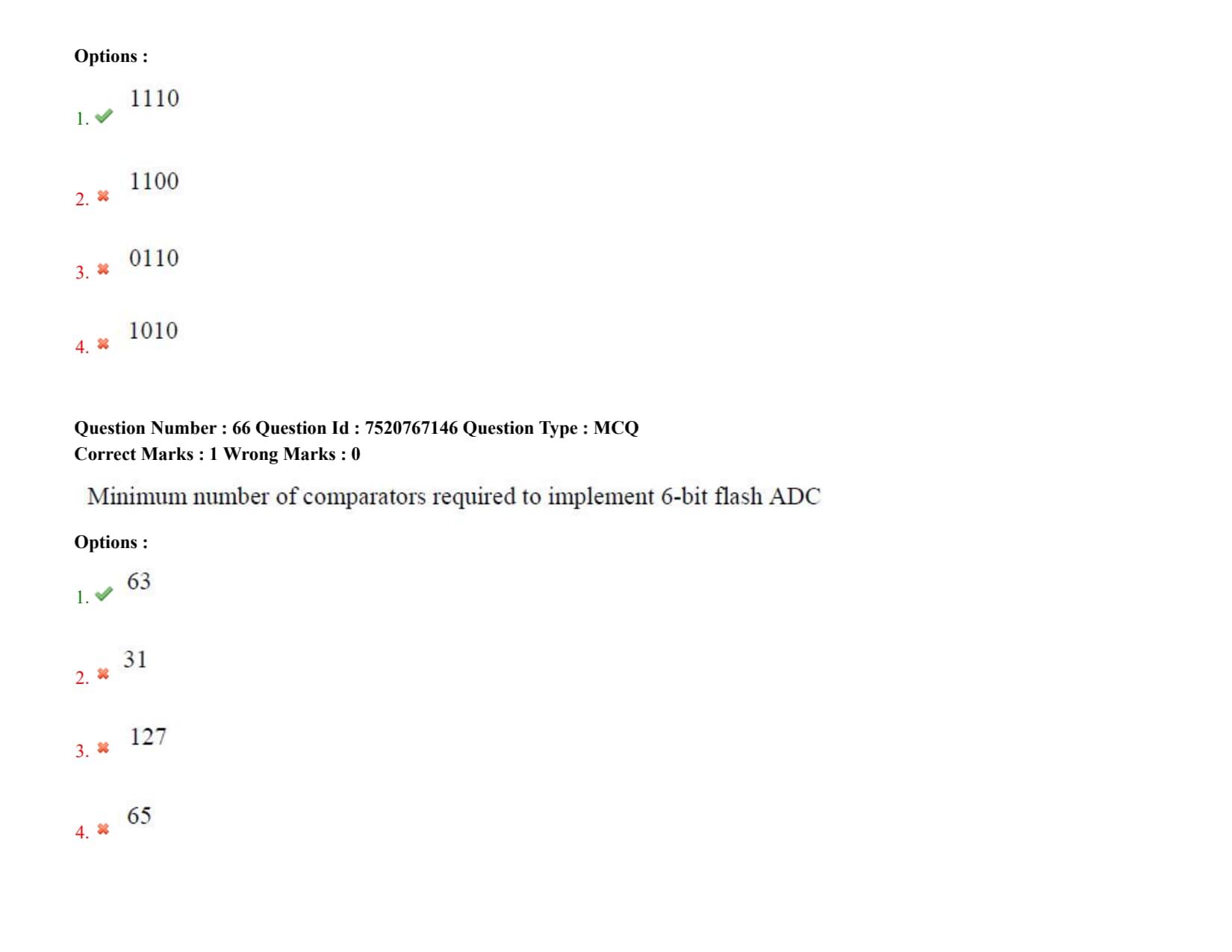
  • (A) 1110
  • (B) 1100
  • (C) 0110
  • (D) 1010

Question 66:

Minimum number of comparators required to implement 6-bit flash ADC

  • (A) 63
  • (B) 31
  • (C) 127
  • (D) 65

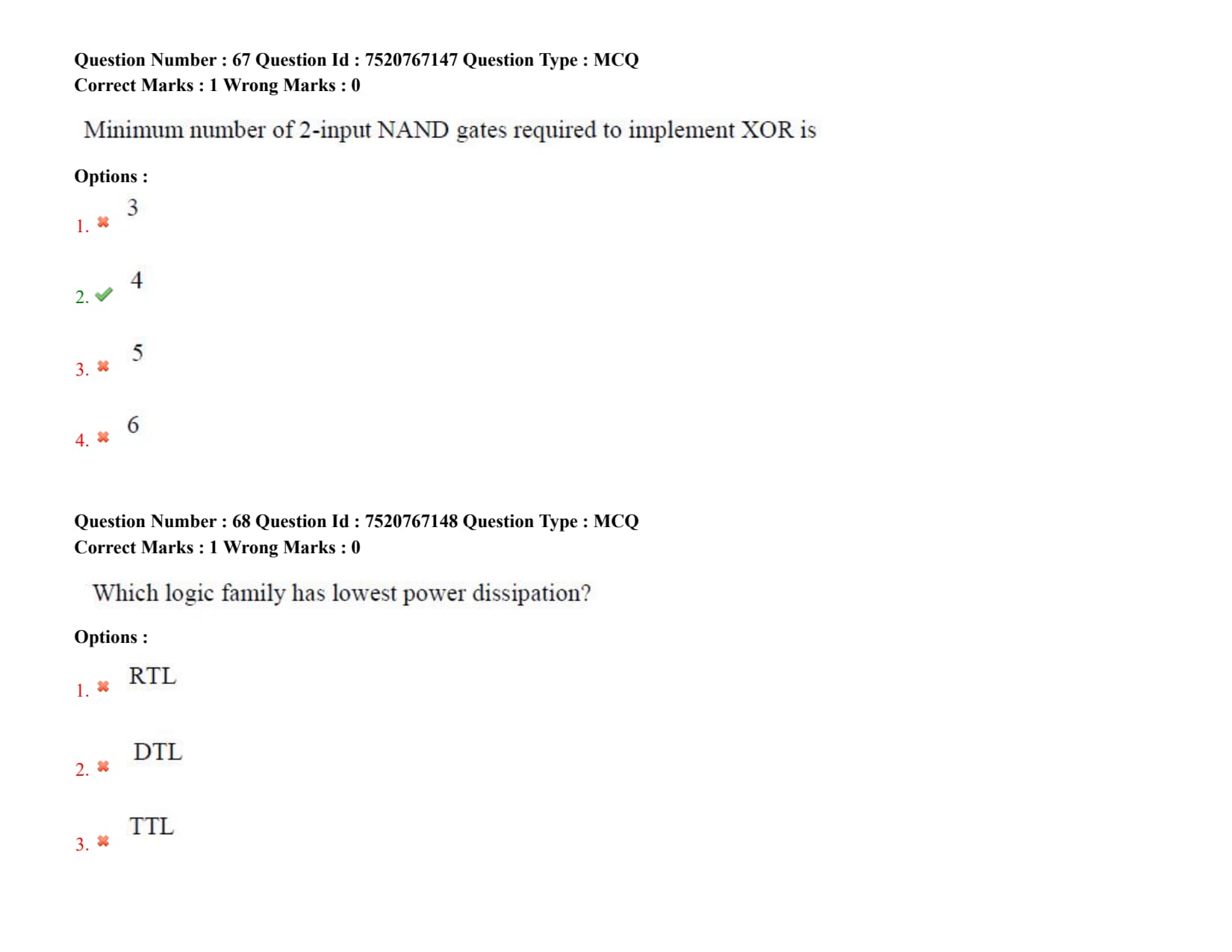
Question 67:

Minimum number of 2-input NAND gates required to implement XOR is

  • (A) 3
  • (B) 4
  • (C) 5
  • (D) 6

Question 68:

Which logic family has lowest power dissipation?

  • (A) RTL
  • (B) DTL
  • (C) TTL
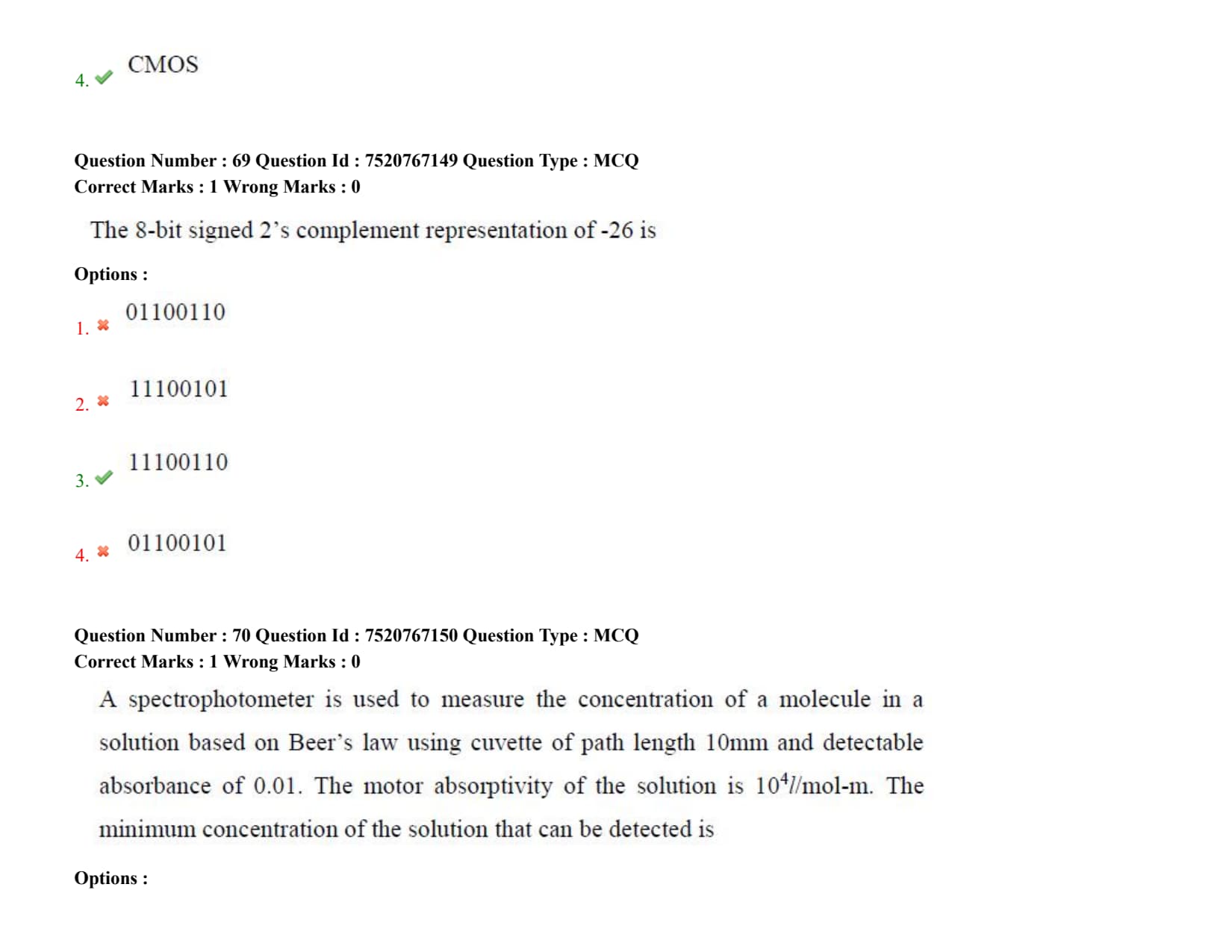
  • (D) CMOS

Question 69:

The 8-bit signed 2's complement representation of -26 is

  • (A) 01100110
  • (B) 11100101
  • (C) 11100110
  • (D) 01100101

Question 70:

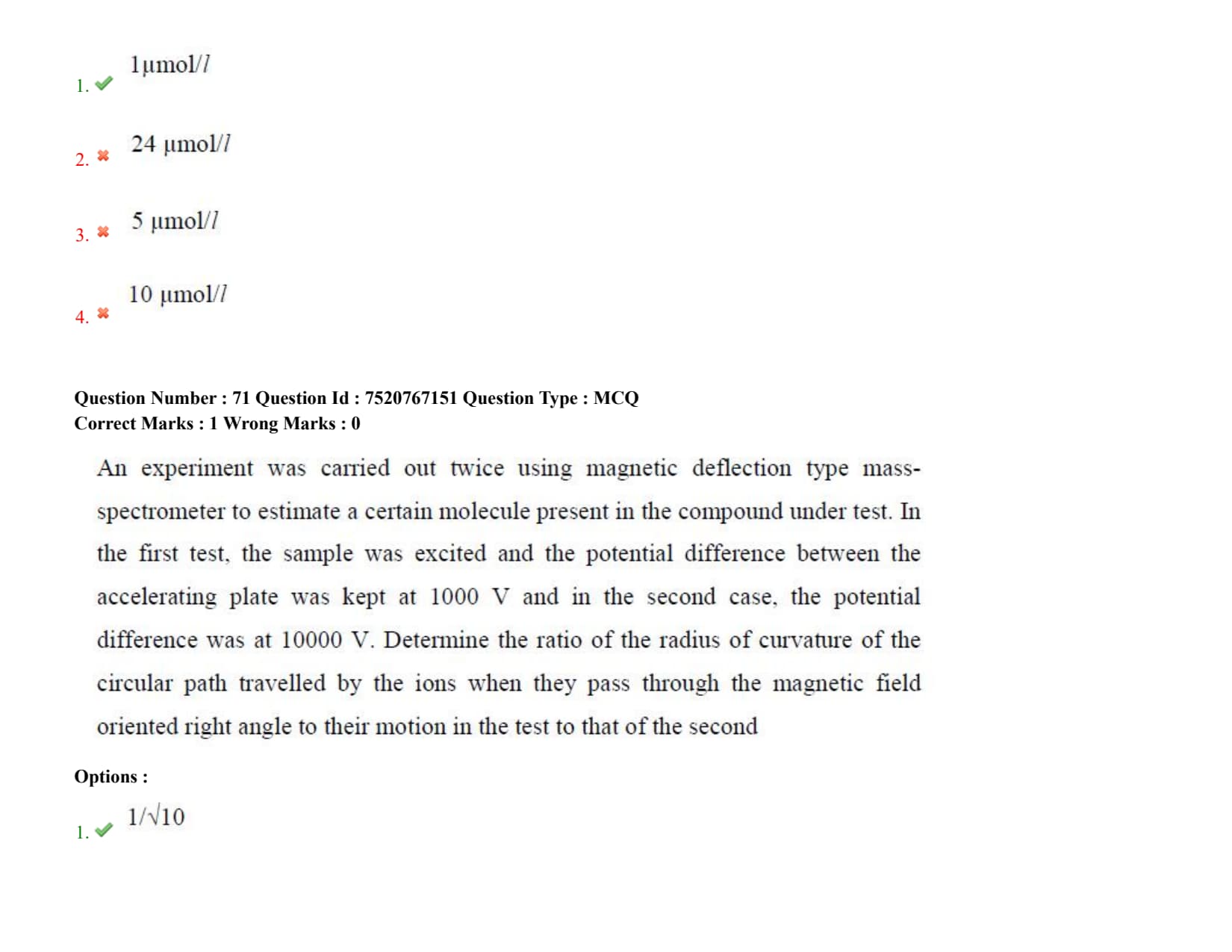
A spectrophotometer is used to measure the concentration of a molecule in a solution based on Beer's law using cuvette of path length 10mm and detectable absorbance of 0.01. The molar absorptivity of the solution is \(10^4\) l/mol-m. The minimum concentration of the solution that can be detected is

  • (A) \(1\mu mol/l\)
  • (B) \(24\mu mol/l\)
  • (C) \(5\mu mol/l\)
  • (D) \(10\mu mol/l\)

Question 71:

An experiment was carried out twice using magnetic deflection type mass-spectrometer to estimate a certain molecule present in the compound under test. In the first test, the sample was excited and the potential difference between the accelerating plate was kept at 1000 V and in the second case, the potential difference was at 10000 V. Determine the ratio of the radius of curvature of the circular path travelled by the ions when they pass through the magnetic field oriented right angle to their motion in the test to that of the second

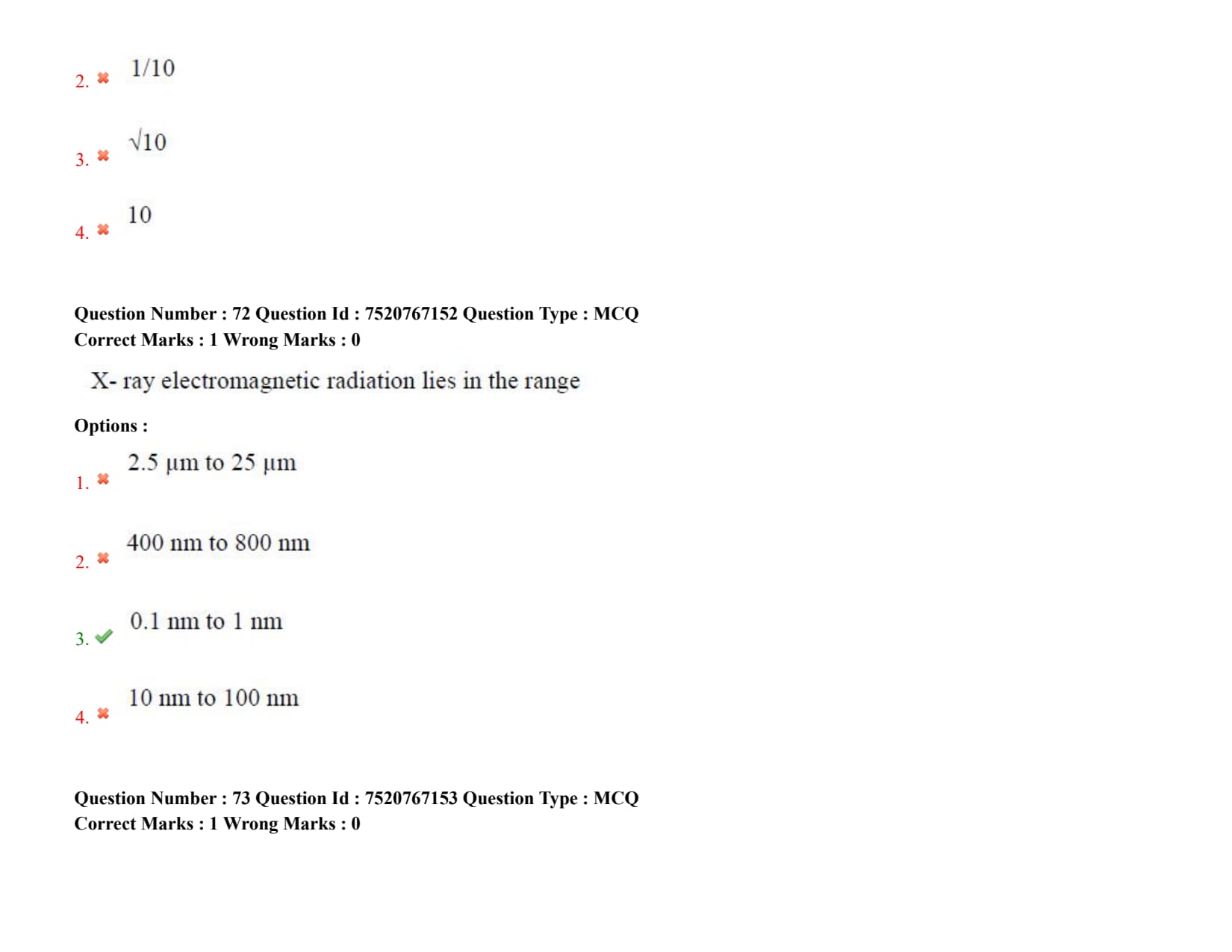
  • (A) \(1/\sqrt{10}\)
  • (B) \(1/10\)
  • (C) \(\sqrt{10}\)
  • (D) \(10\)

Question 72:

X-ray electromagnetic radiation lies in the range

  • (A) \(2.5\ \mu m\) to \(25\ \mu m\)
  • (B) \(400 nm\) to \(800 nm\)
  • (C) \(0.1 nm\) to \(1 nm\)
  • (D) \(10 nm\) to \(100 nm\)

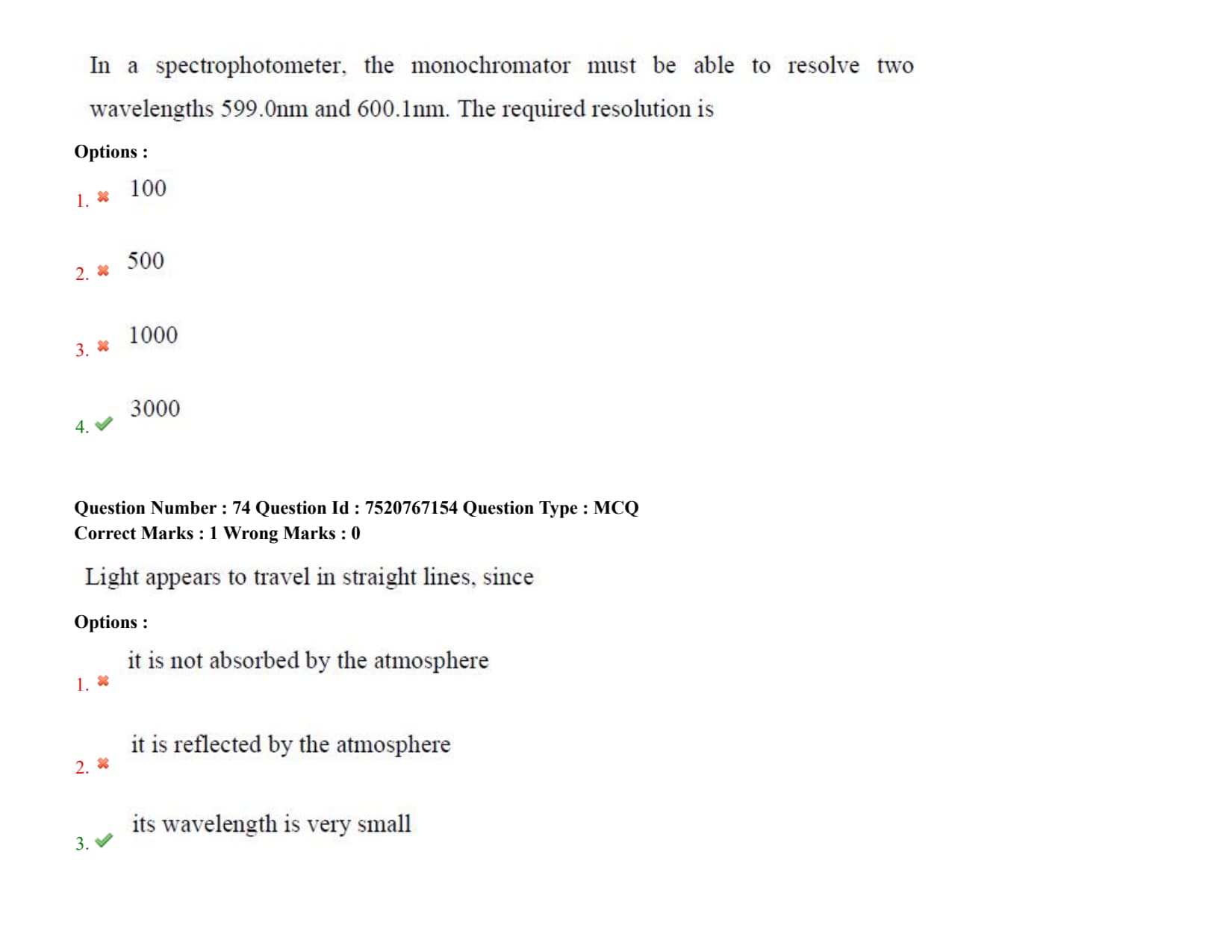
Question 73:

In a spectrophotometer, the monochromator must be able to resolve two wavelengths 599.0nm and 600.1nm. The required resolution is

  • (A) 100
  • (B) 500
  • (C) 1000
  • (D) 3000

Question 74:

Light appears to travel in straight lines, since

  • (A) it is not absorbed by the atmosphere
  • (B) it is reflected by the atmosphere
  • (C) its wavelength is very small
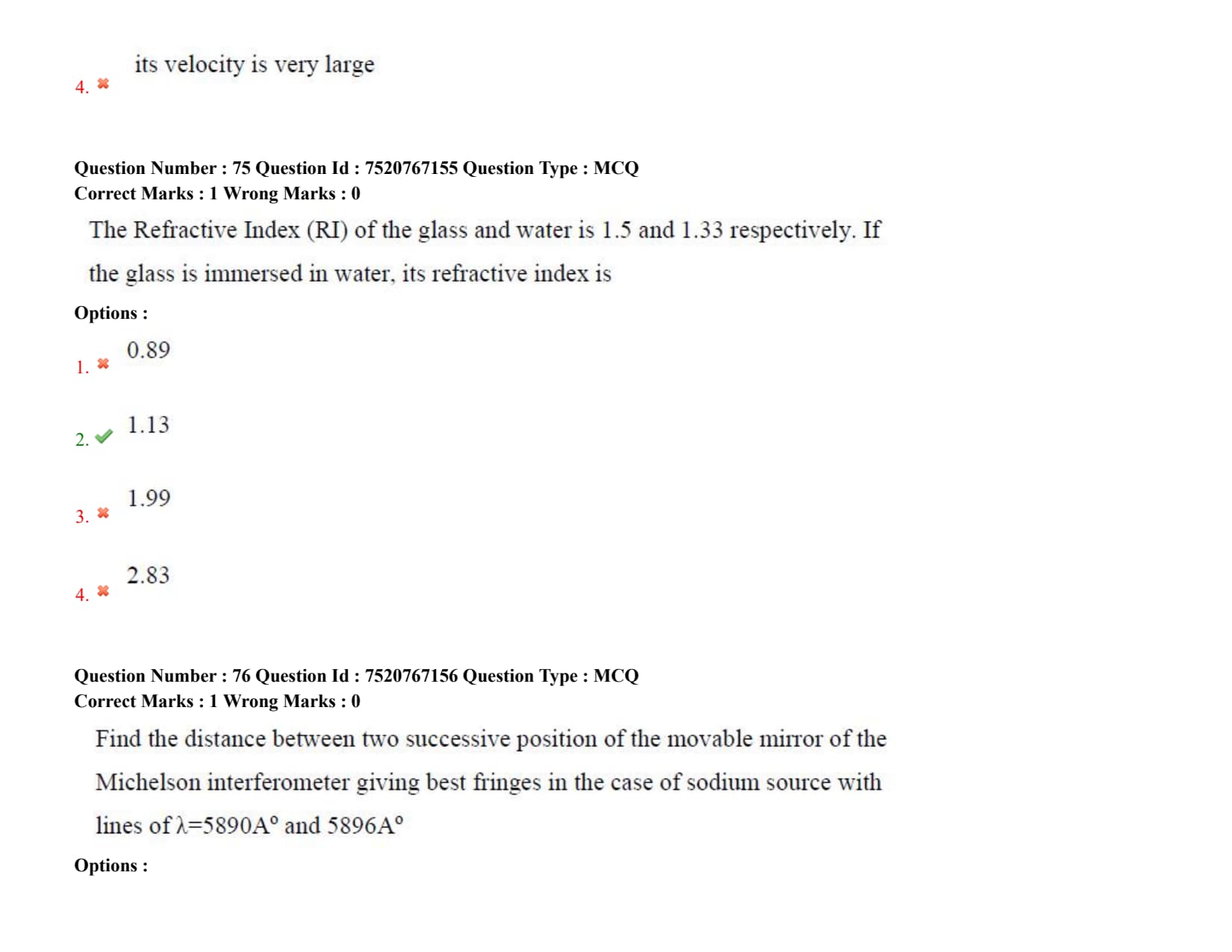
  • (D) its velocity is very large

Question 75:

The Refractive Index (RI) of the glass and water is 1.5 and 1.33 respectively. If the glass is immersed in water, its refractive index is

  • (A) 0.89
  • (B) 1.13
  • (C) 1.99
  • (D) 2.83

Question 76:

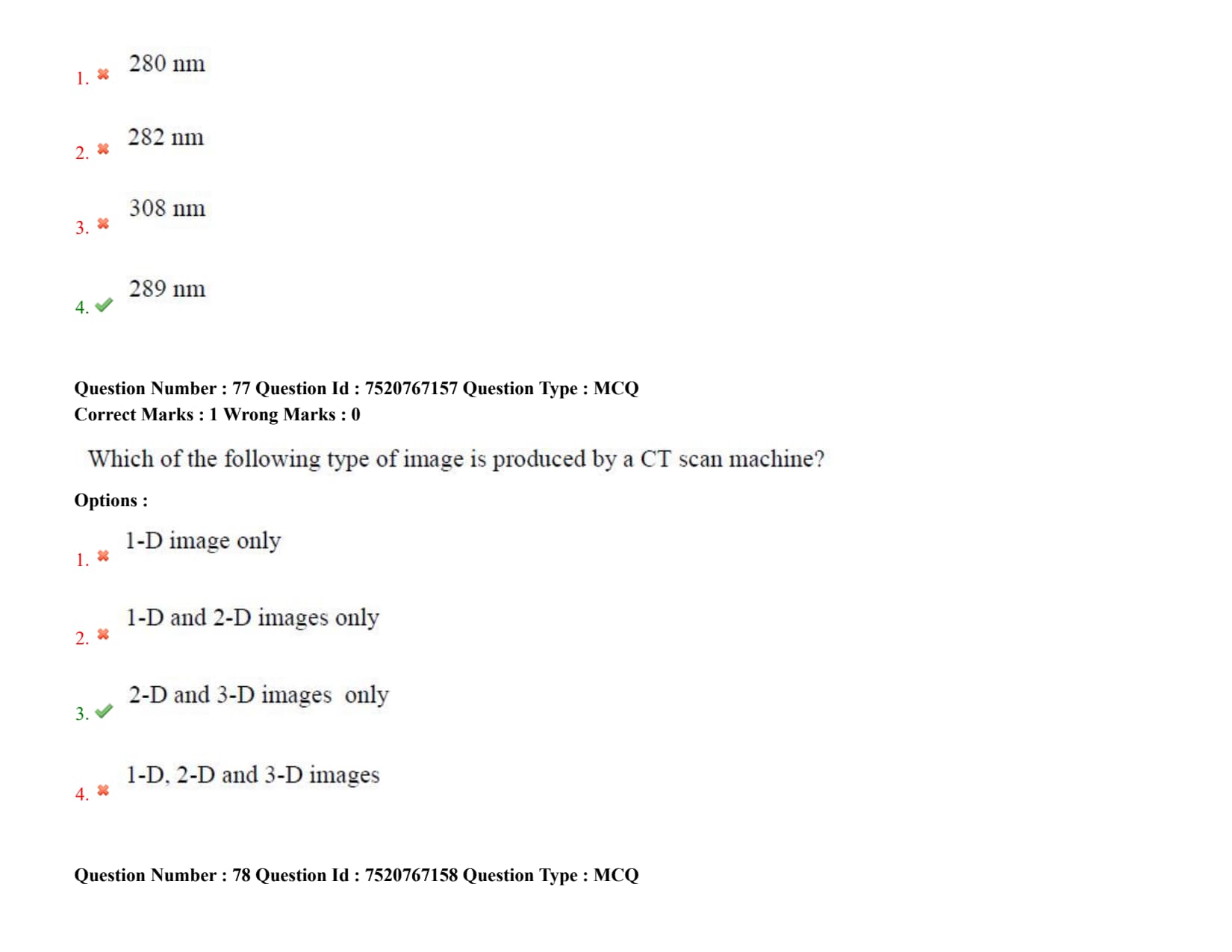
Find the distance between two successive position of the movable mirror of the Michelson interferometer giving best fringes in the case of sodium source with lines of \(\lambda=5890A^\circ\) and \(5896A^\circ\)

  • (A) \(280 nm\)
  • (B) \(282 nm\)
  • (C) \(308 nm\)
  • (D) \(289 nm\)

Question 77:

Which of the following type of image is produced by a CT scan machine?

  • (A) 1-D image only
  • (B) 1-D and 2-D images only
  • (C) 2-D and 3-D images only
  • (D) 1-D, 2-D and 3-D images

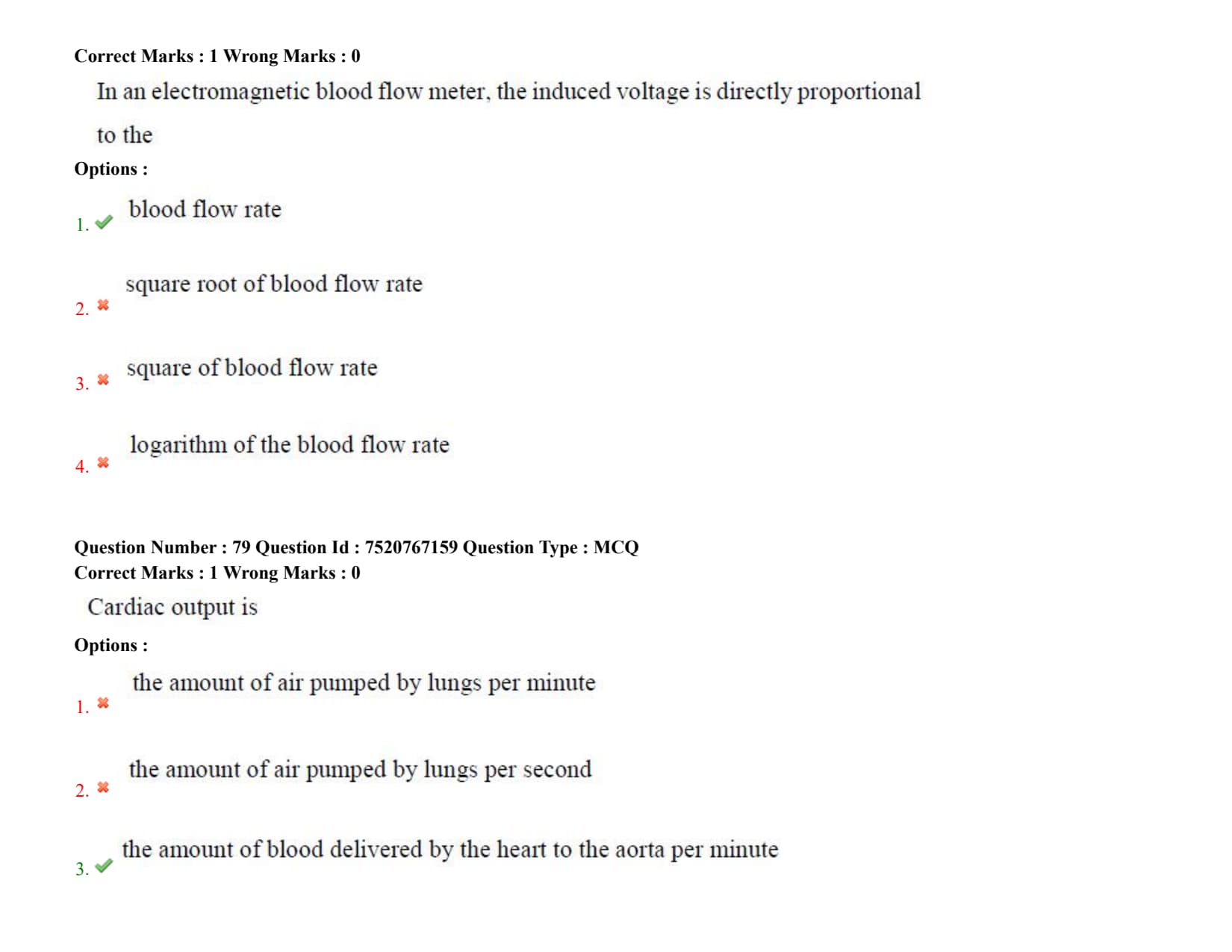
Question 78:

In an electromagnetic blood flow meter, the induced voltage is directly proportional to the

  • (A) blood flow rate
  • (B) square root of blood flow rate
  • (C) square of blood flow rate
  • (D) logarithm of the blood flow rate

Question 79:

Cardiac output is

  • (A) the amount of air pumped by lungs per minute
  • (B) the amount of air pumped by lungs per second
  • (C) the amount of blood delivered by the heart to the aorta per minute
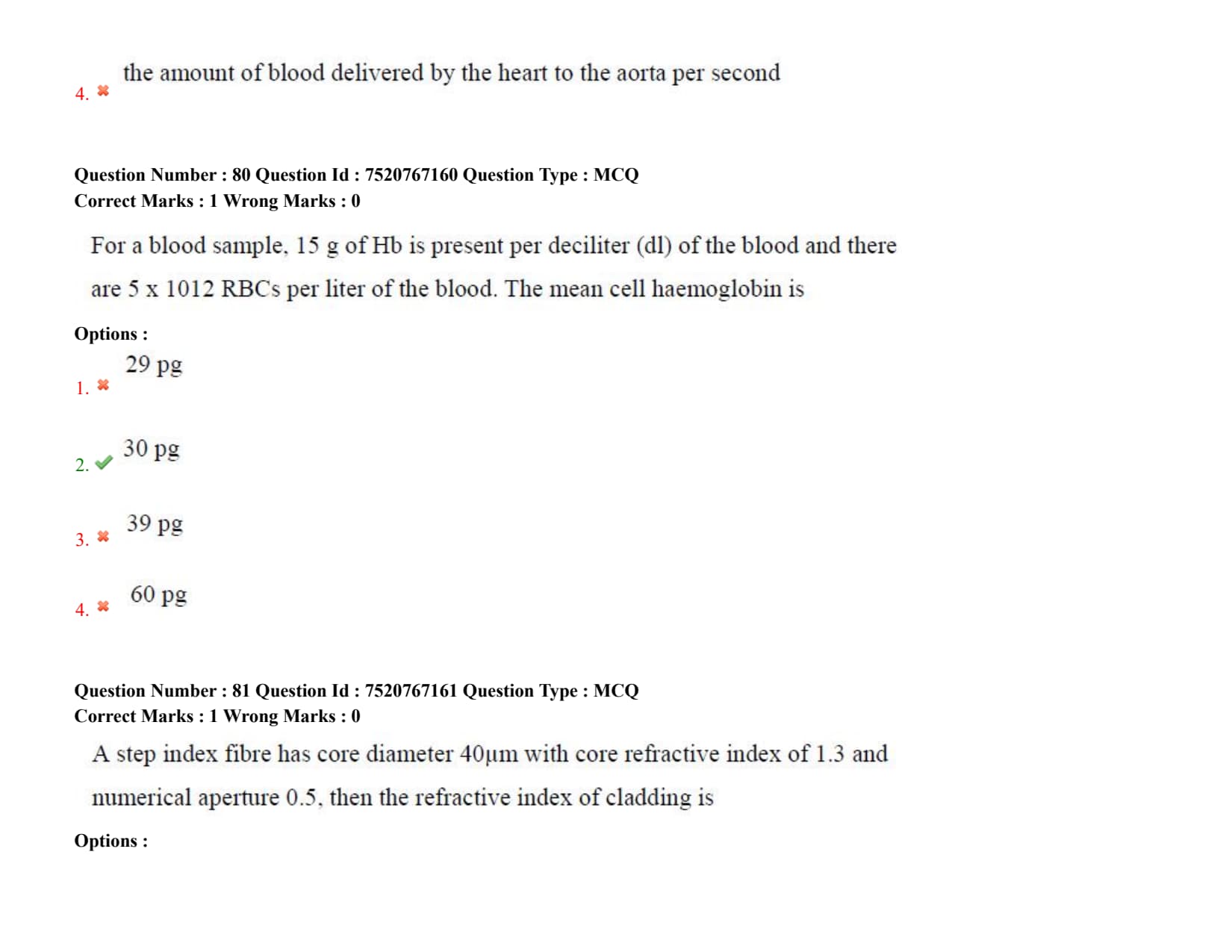
  • (D) the amount of blood delivered by the heart to the aorta per second

Question 80:

For a blood sample, 15 g of Hb is present per deciliter (dl) of the blood and there are 5 x 10¹² RBC's per liter of the blood. The mean cell haemoglobin is

  • (A) 29 pg
  • (B) 30 pg
  • (C) 39 pg
  • (D) 60 pg

Question 81:

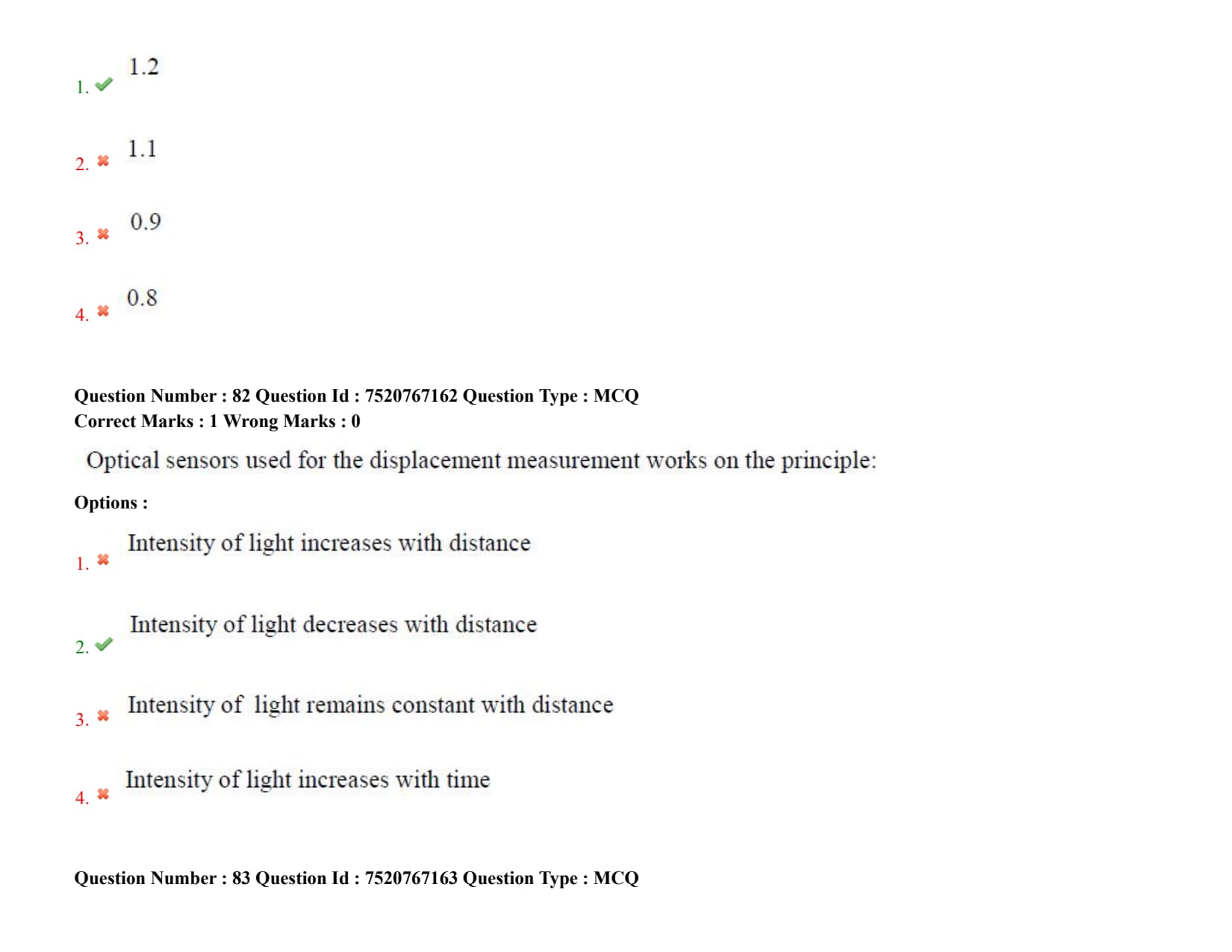
A step index fibre has core diameter 40\(\mu\)m with core refractive index of 1.3 and numerical aperture 0.5, then the refractive index of cladding is

  • (A) 1.2
  • (B) 1.1
  • (C) 0.9
  • (D) 0.8

Question 82:

Optical sensors used for the displacement measurement works on the principle:

  • (A) Intensity of light increases with distance
  • (B) Intensity of light decreases with distance
  • (C) Intensity of light remains constant with distance
  • (D) Intensity of light increases with time

Question 83:

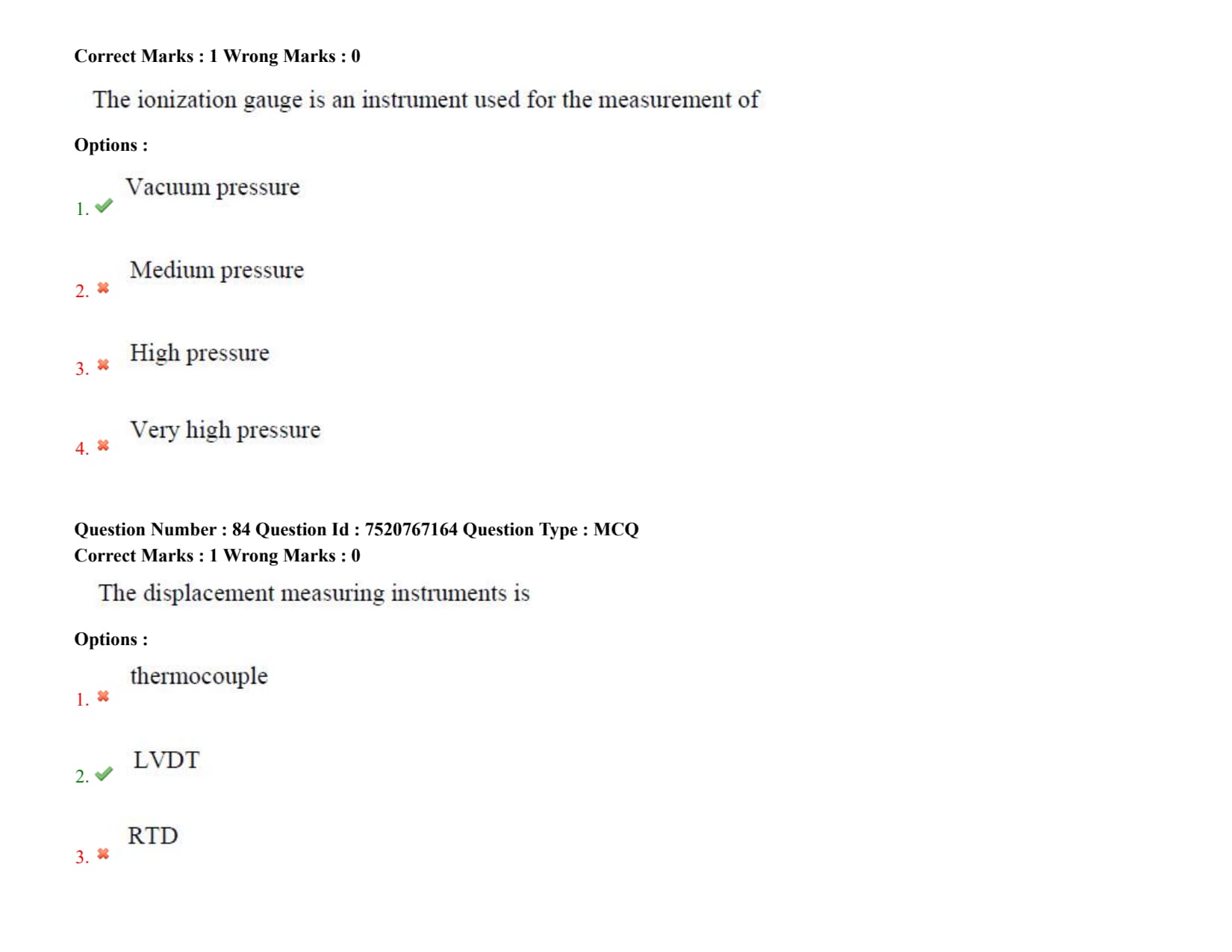
The ionization gauge is an instrument used for the measurement of

  • (A) Vacuum pressure
  • (B) Medium pressure
  • (C) High pressure
  • (D) Very high pressure

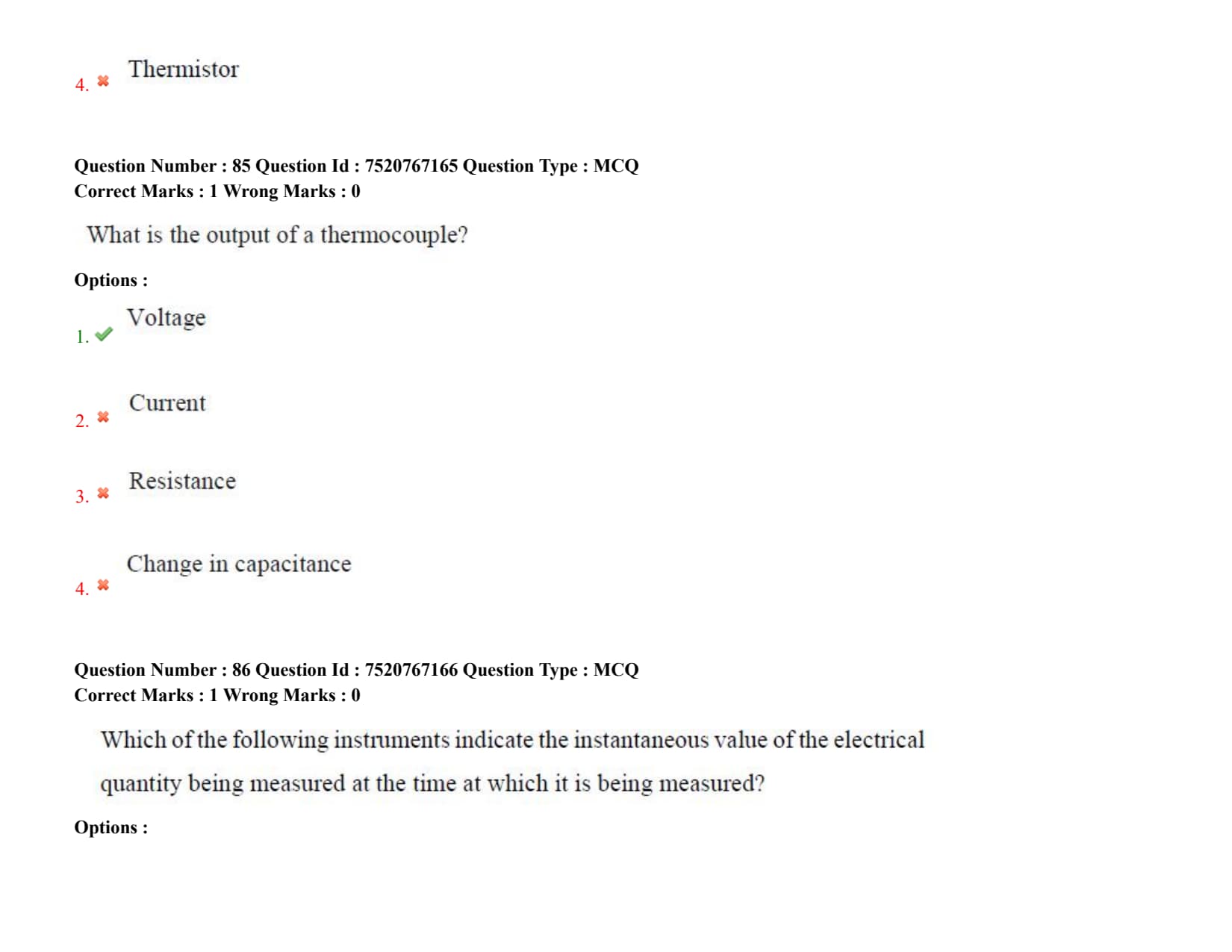
Question 84:

The displacement measuring instruments is

  • (A) thermocouple
  • (B) LVDT
  • (C) RTD
  • (D) Thermistor

Question 85:

What is the output of a thermocouple?

  • (A) Voltage
  • (B) Current
  • (C) Resistance
  • (D) Change in capacitance

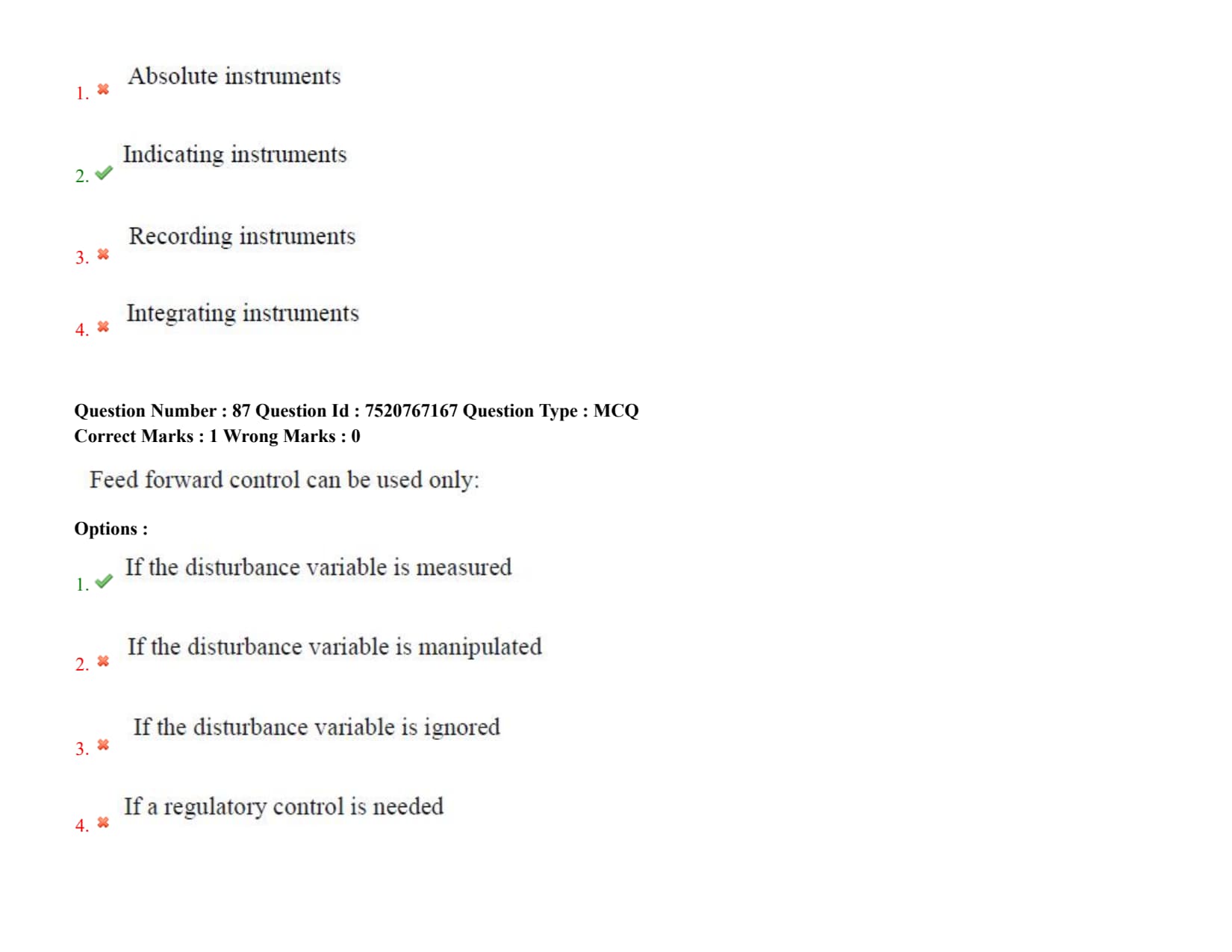
Question 86:

Which of the following instruments indicate the instantaneous value of the electrical quantity being measured at the time at which it is being measured?

  • (A) Absolute instruments
  • (B) Indicating instruments
  • (C) Recording instruments
  • (D) Integrating instruments

Question 87:

Feed forward control can be used only:

  • (A) If the disturbance variable is measured
  • (B) If the disturbance variable is manipulated
  • (C) If the disturbance variable is ignored
  • (D) If a regulatory control is needed

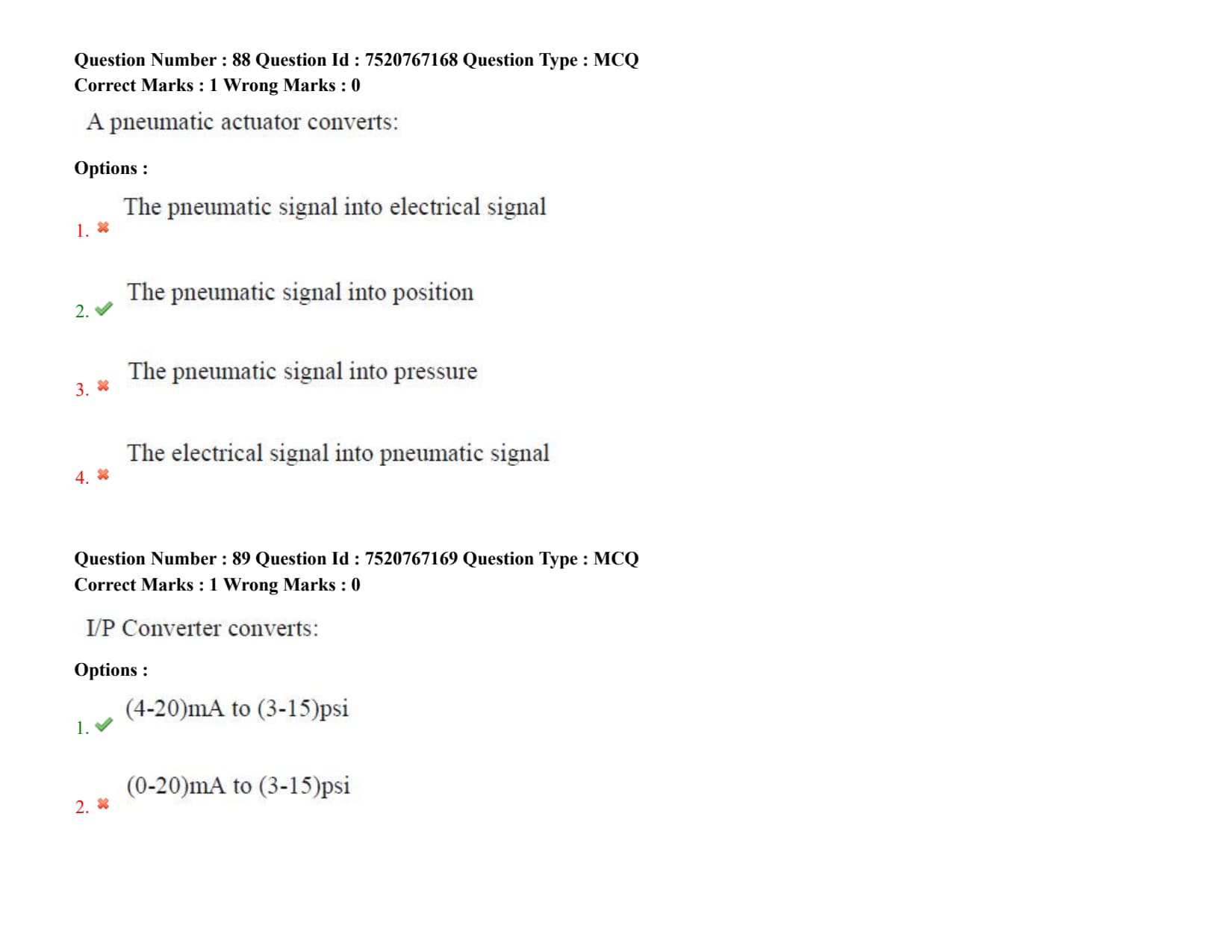
Question 88:

A pneumatic actuator converts:

  • (A) The pneumatic signal into electrical signal
  • (B) The pneumatic signal into position
  • (C) The pneumatic signal into pressure
  • (D) The electrical signal into pneumatic signal

Question 89:

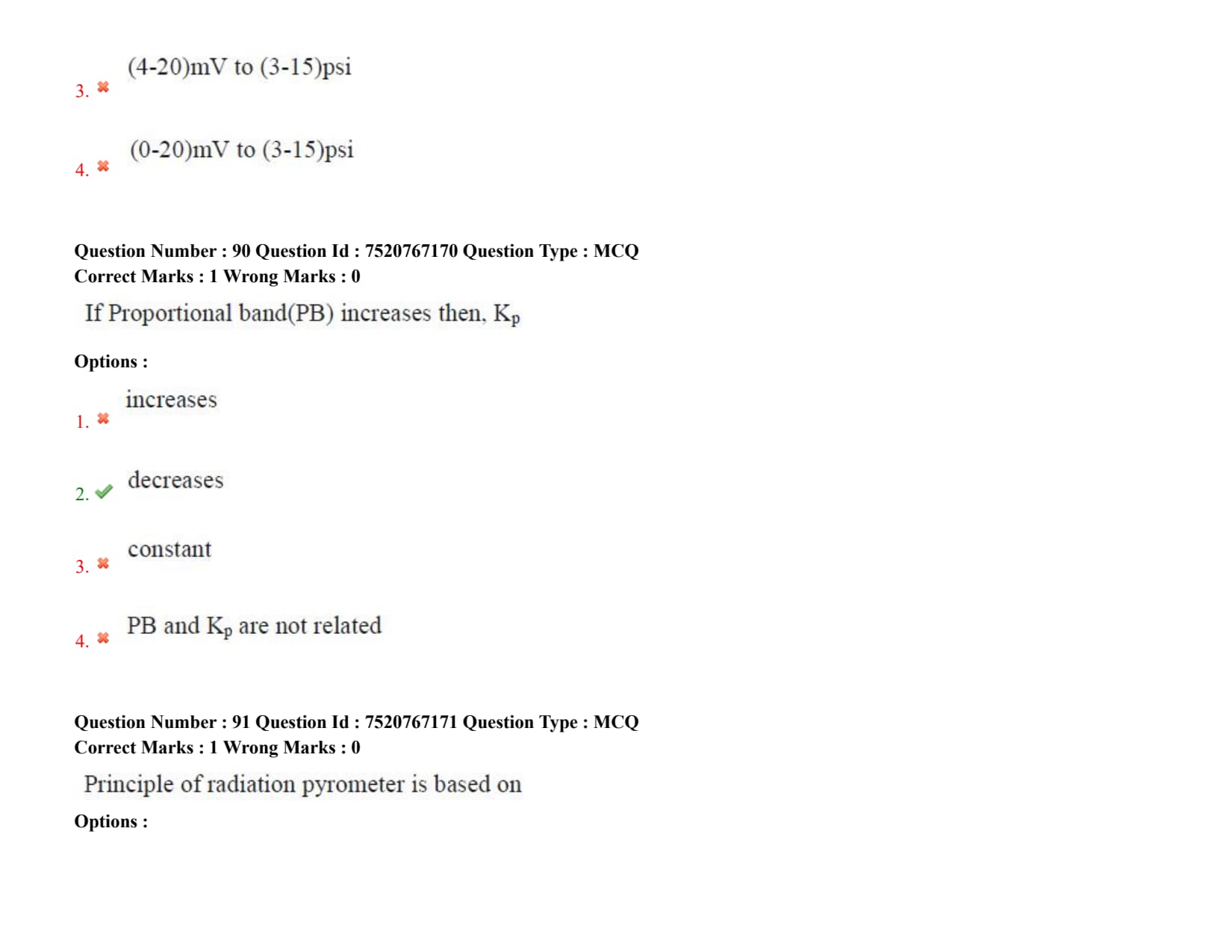
I/P Converter converts:

  • (A) (4-20)mA to (3-15)psi
  • (B) (0-20)mA to (3-15)psi
  • (C) (4-20)mV to (3-15)psi
  • (D) (0-20)mV to (3-15)psi

Question 90:

If Proportional band(PB) increases then, \(K_p\)

  • (A) increases
  • (B) decreases
  • (C) constant
  • (D) PB and \(K_p\) are not related

Question 91:

Principle of radiation pyrometer is based on

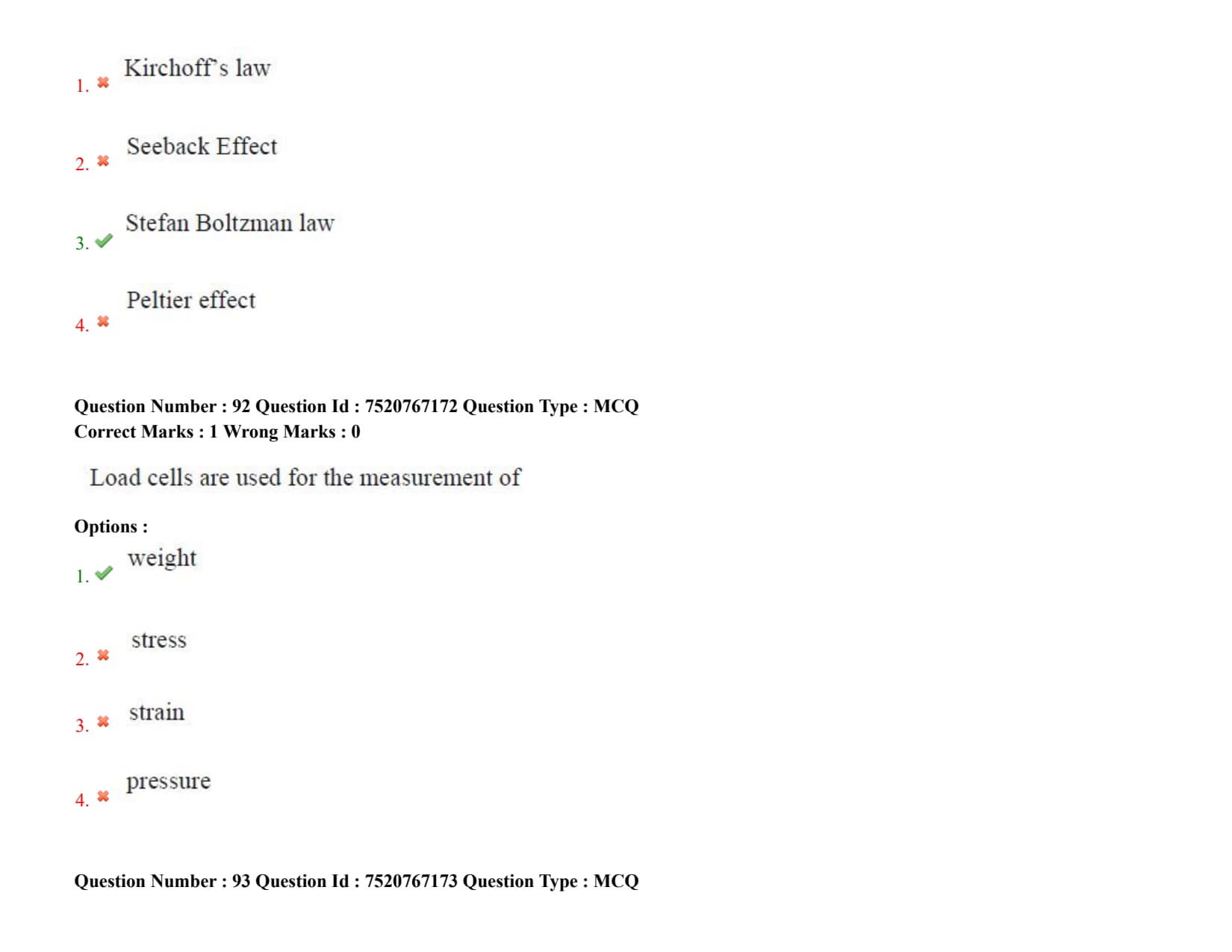
  • (A) Kirchoff's law
  • (B) Seeback Effect
  • (C) Stefan Boltzman law
  • (D) Peltier effect

Question 92:

Load cells are used for the measurement of

  • (A) weight
  • (B) stress
  • (C) strain
  • (D) pressure

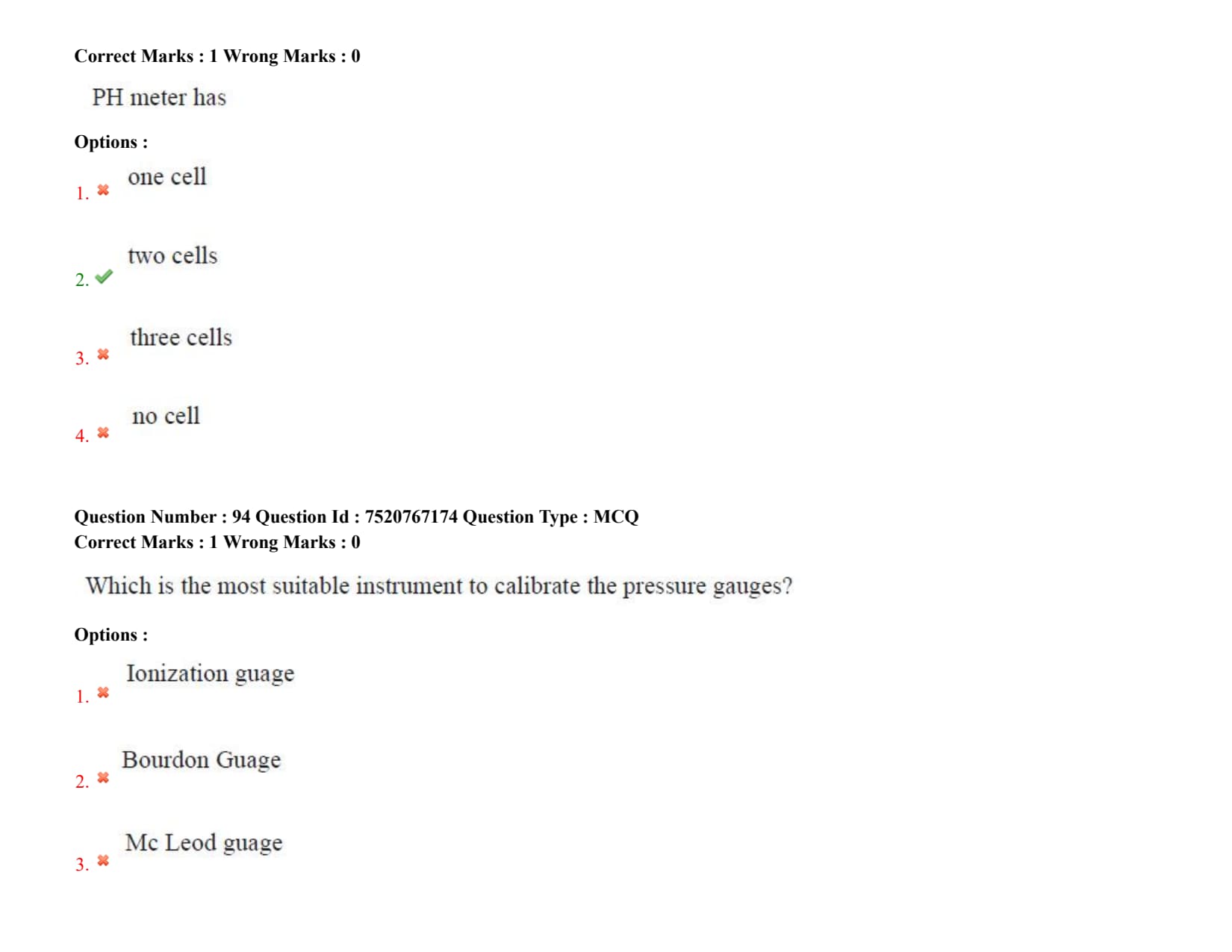
Question 93:

PH meter has

  • (A) one cell
  • (B) two cells
  • (C) three cells
  • (D) no cell

Question 94:

Which is the most suitable instrument to calibrate the pressure gauges?

  • (A) Ionization guage
  • (B) Bourdon Guage
  • (C) Mc Leod guage
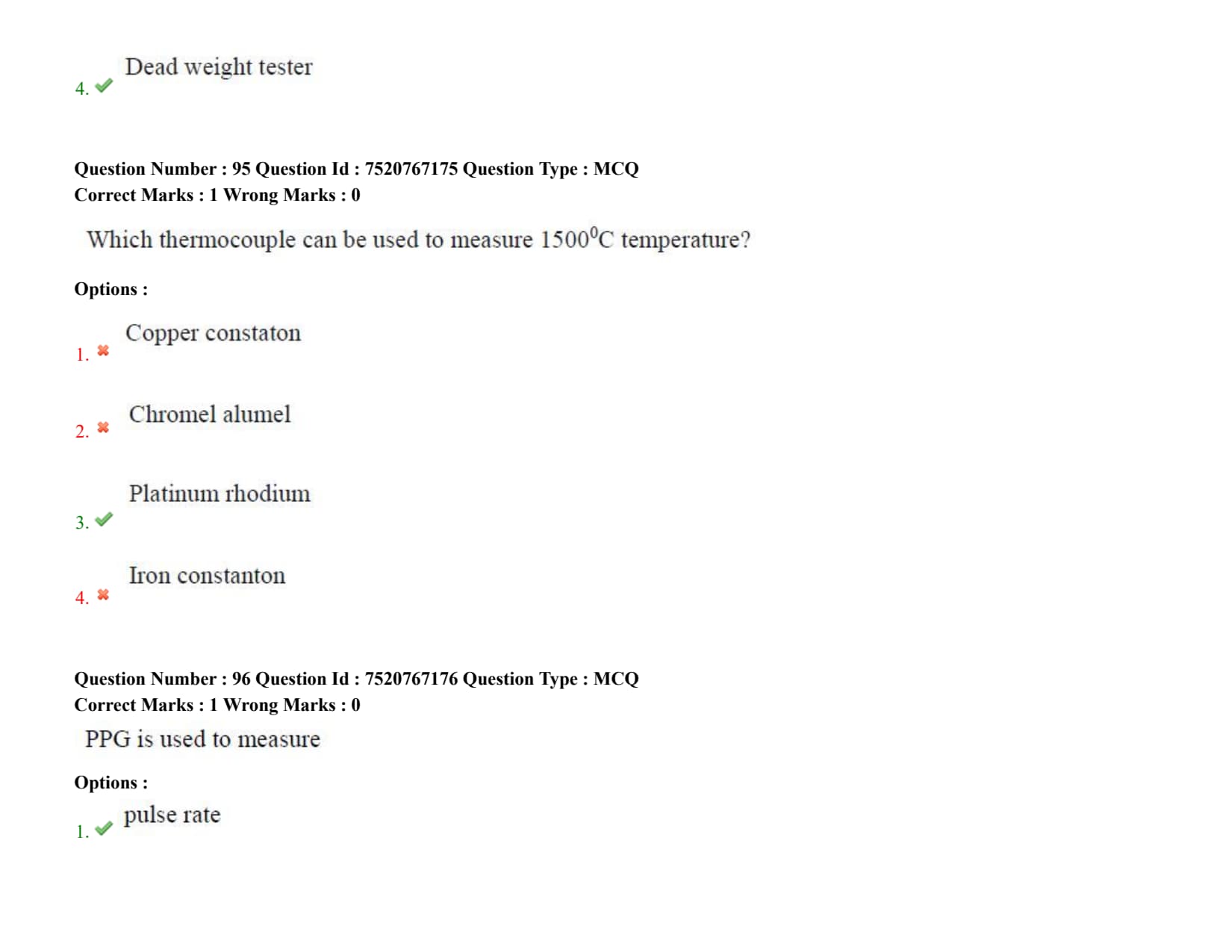
  • (D) Dead weight tester

Question 95:

Which thermocouple can be used to measure \(1500^{\circ}C\) temperature?

  • (A) Copper constaton
  • (B) Chromel alumel
  • (C) Platinum rhodium
  • (D) Iron constanton

Question 96:

PPG is used to measure

  • (A) pulse rate
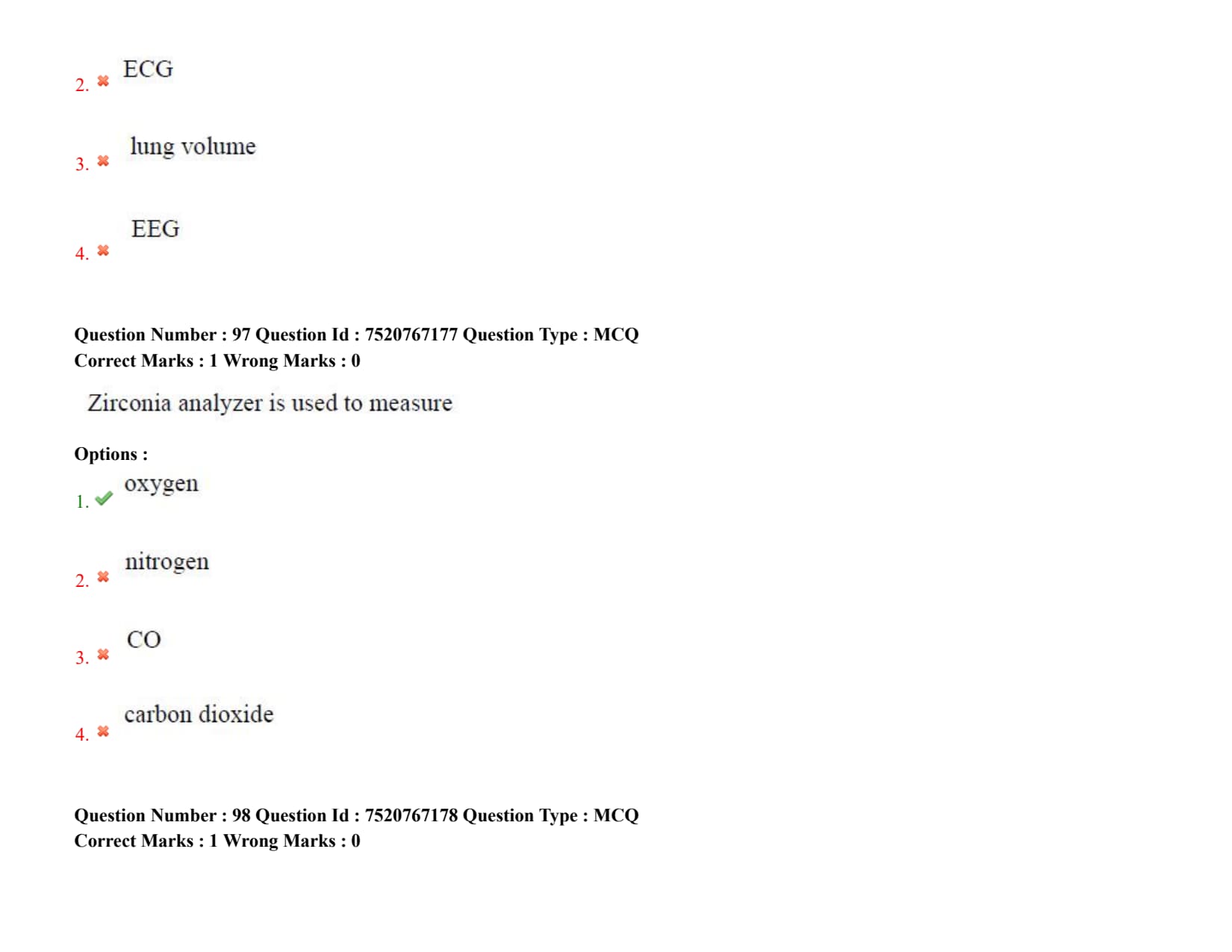
  • (B) ECG
  • (C) lung volume
  • (D) EEG

Question 97:

Zirconia analyzer is used to measure

  • (A) oxygen
  • (B) nitrogen
  • (C) CO
  • (D) carbon dioxide

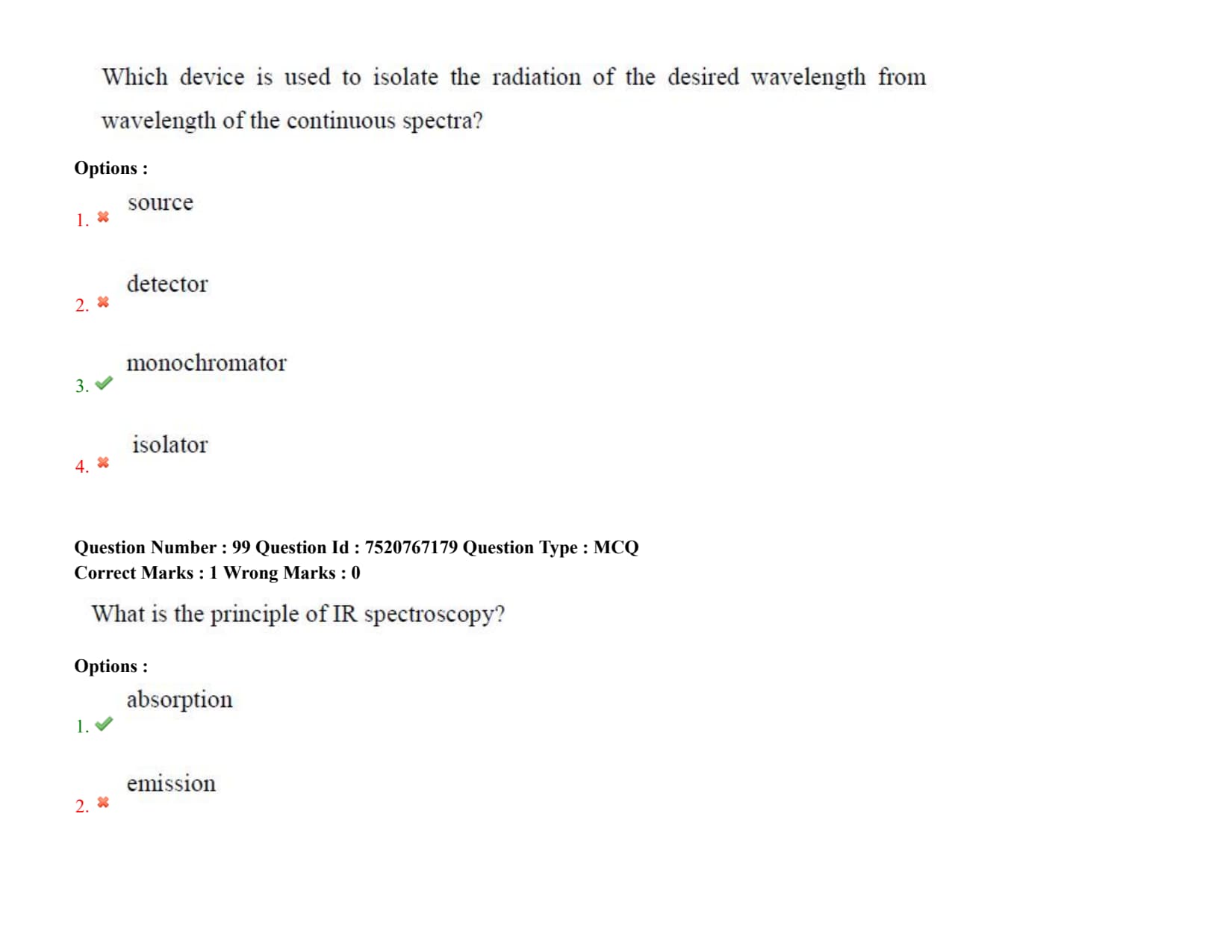
Question 98:

Which device is used to isolate the radiation of the desired wavelength from wavelength of the continuous spectra?

  • (A) source
  • (B) detector
  • (C) monochromator
  • (D) isolator

Question 99:

What is the principle of IR spectroscopy?

  • (A) absorption
  • (B) emission
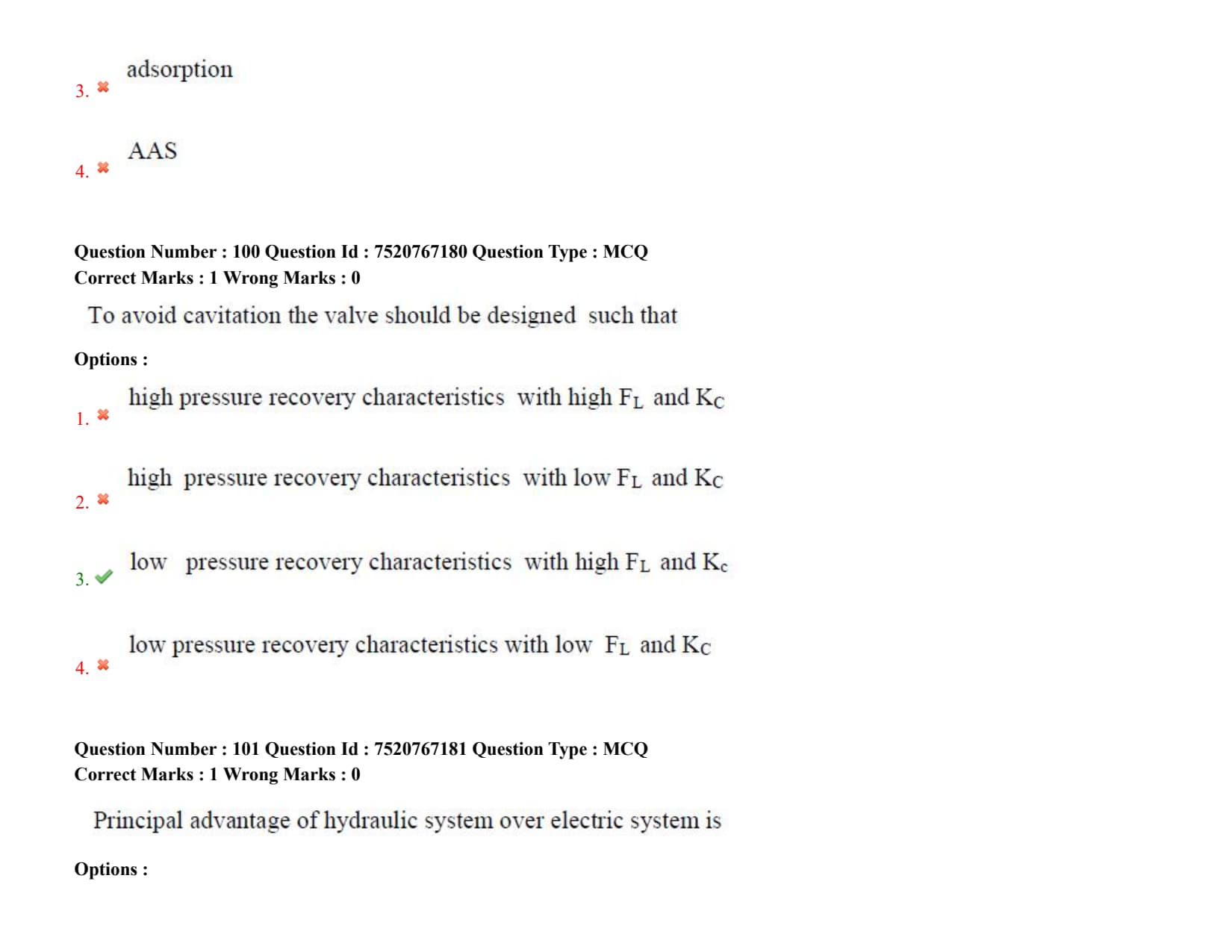
  • (C) adsorption
  • (D) AAS

Question 100:

To avoid cavitation the valve should be designed such that

  • (A) high pressure recovery characteristics with high \(F_L\) and \(K_c\)
  • (B) high pressure recovery characteristics with low \(F_L\) and \(K_c\)
  • (C) low pressure recovery characteristics with high \(F_L\) and \(K_c\)
  • (D) low pressure recovery characteristics with low \(F_L\) and \(K_c\)

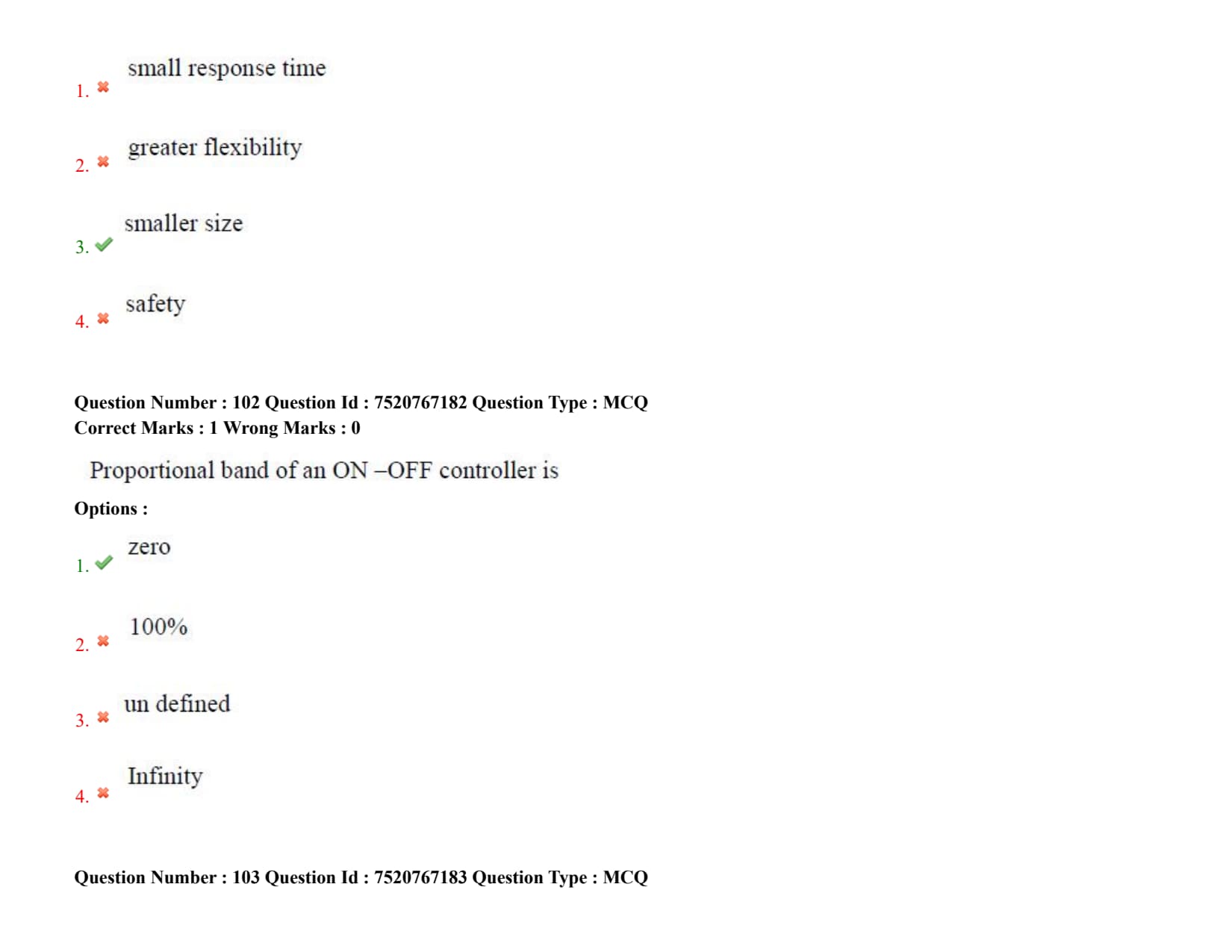
Question 101:

Principal advantage of hydraulic system over electric system is

  • (A) small response time
  • (B) greater flexibility
  • (C) smaller size
  • (D) safety

Question 102:

Proportional band of an ON--OFF controller is

  • (A) zero
  • (B) 100%
  • (C) un defined
  • (D) Infinity

Question 103:

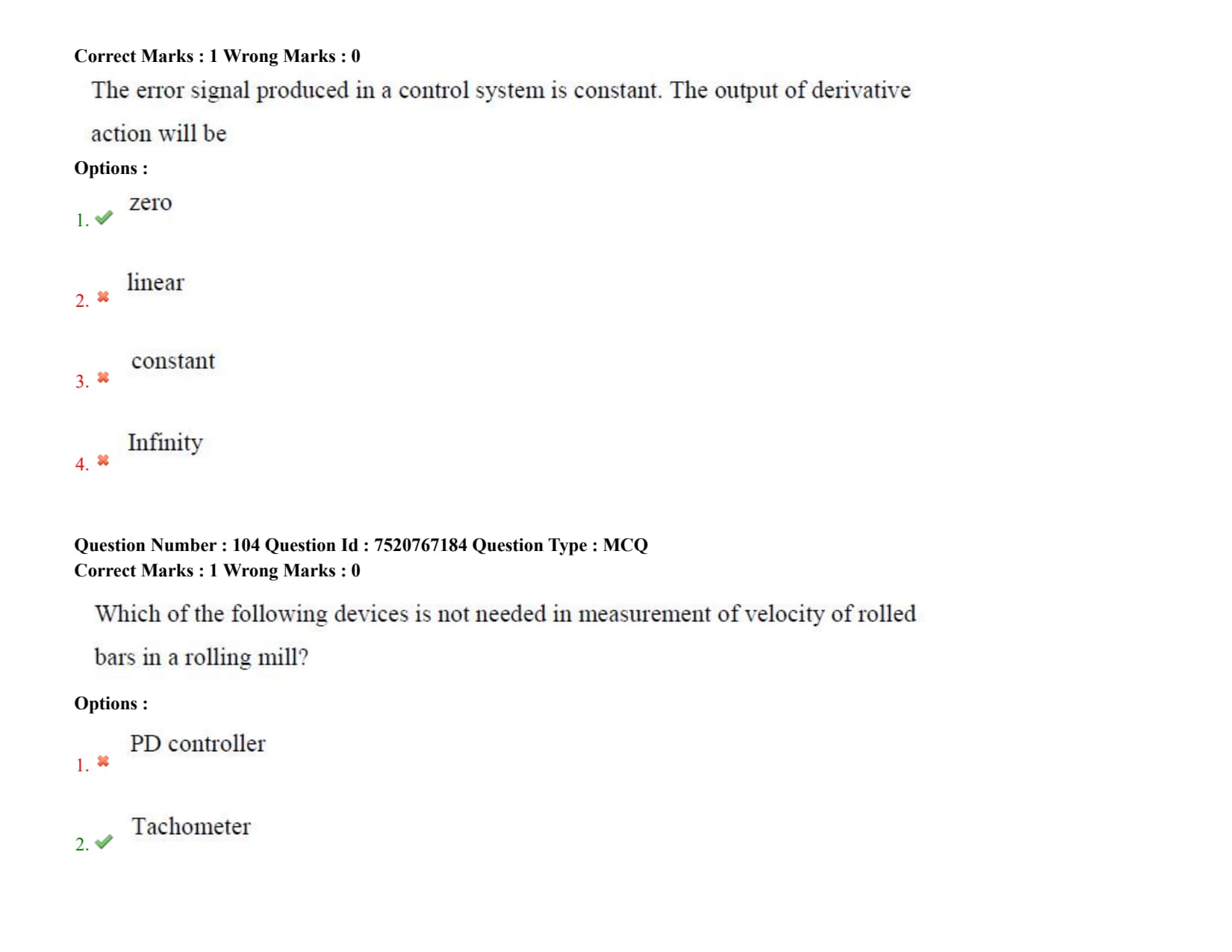
The error signal produced in a control system is constant. The output of derivative action will be

  • (A) zero
  • (B) linear
  • (C) constant
  • (D) Infinity

Question 104:

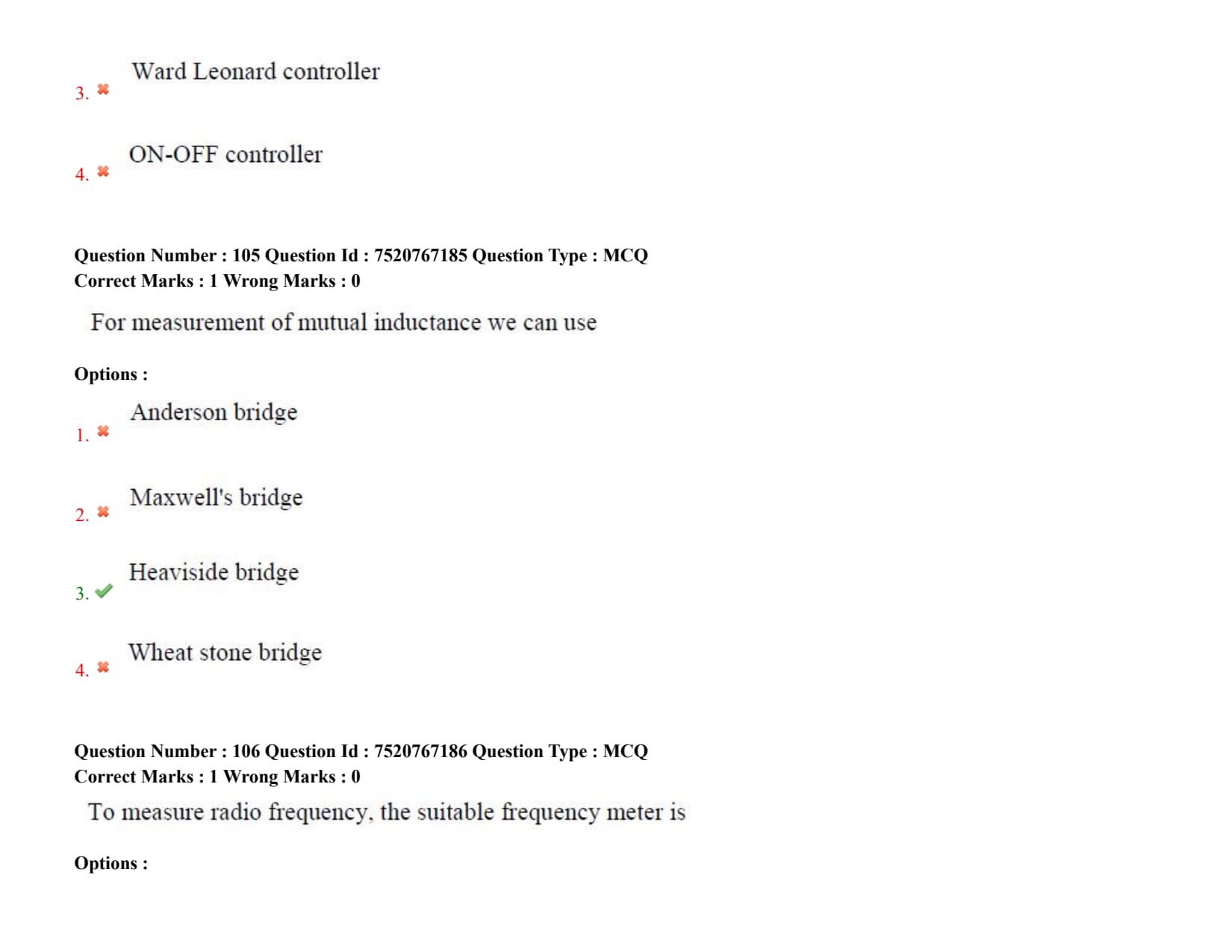
Which of the following devices is not needed in measurement of velocity of rolled bars in a rolling mill?

  • (A) PD controller
  • (B) Tachometer
  • (C) Ward Leonard controller
  • (D) ON-OFF controller

Question 105:

For measurement of mutual inductance we can use

  • (A) Anderson bridge
  • (B) Maxwell's bridge
  • (C) Heaviside bridge
  • (D) Wheat stone bridge

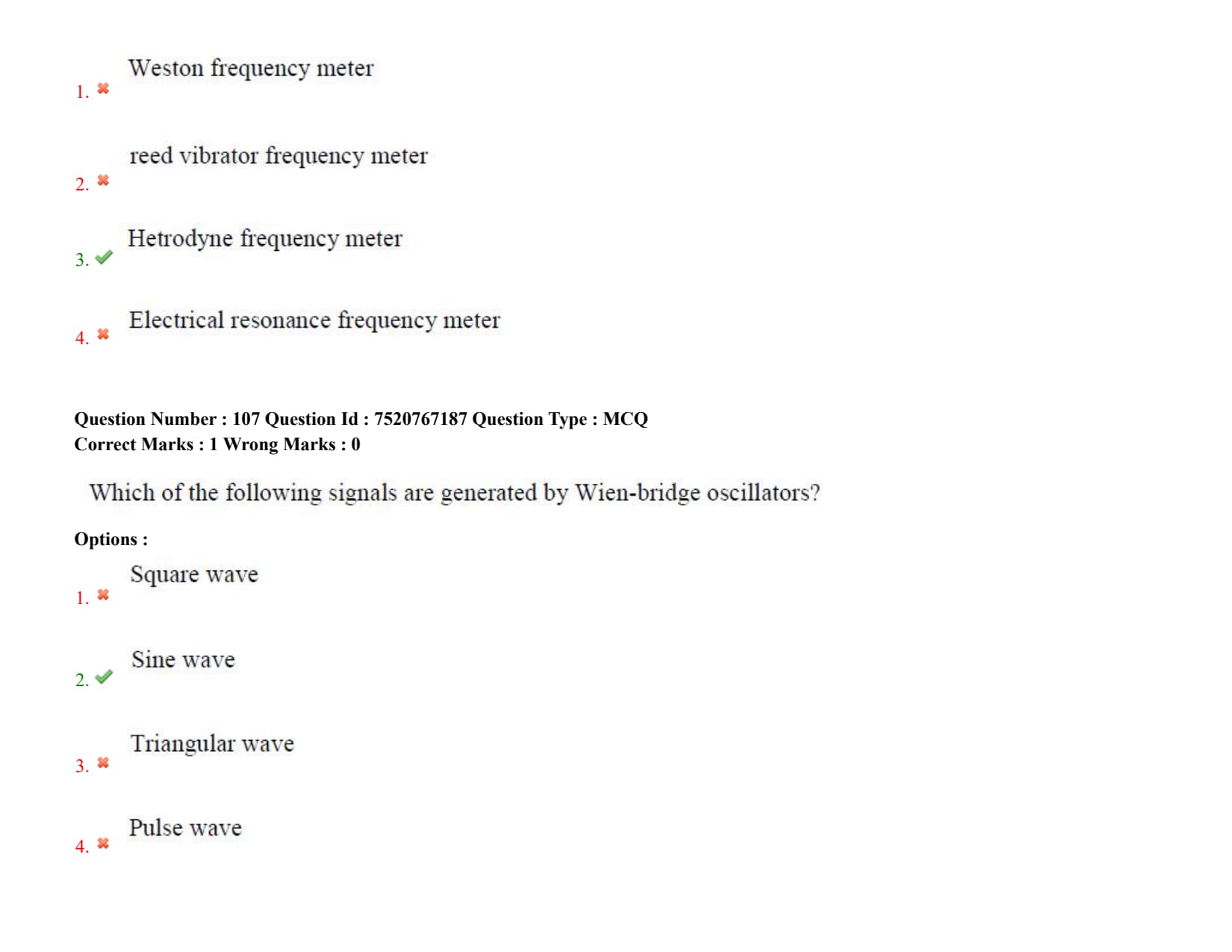
Question 106:

To measure radio frequency, the suitable frequency meter is

  • (A) Weston frequency meter
  • (B) reed vibrator frequency meter
  • (C) Hetrodyne frequency meter
  • (D) Electrical resonance frequency meter

Question 107:

Which of the following signals are generated by Wien-bridge oscillators?

  • (A) Square wave
  • (B) Sine wave
  • (C) Triangular wave
  • (D) Pulse wave

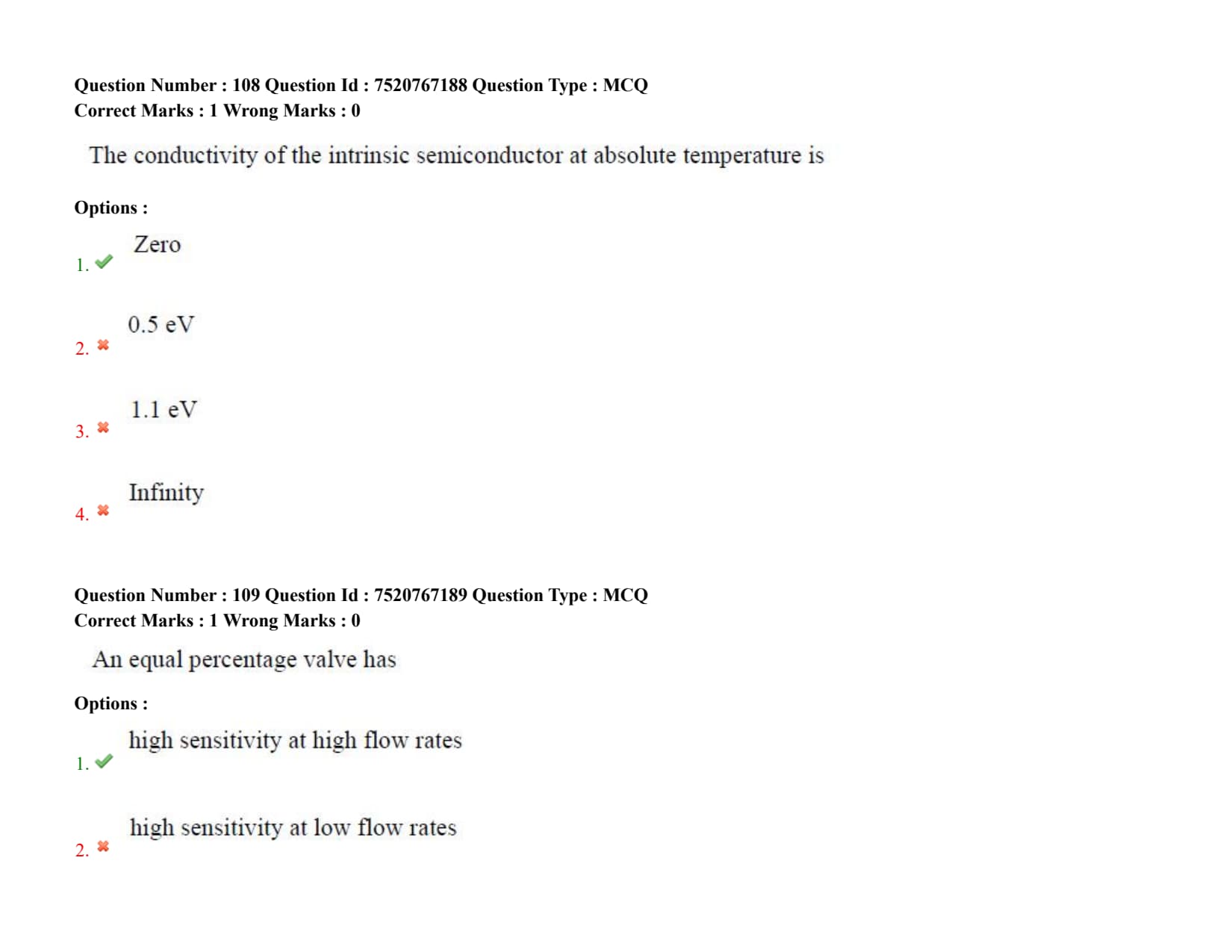
Question 108:

The conductivity of the intrinsic semiconductor at absolute temperature is

  • (A) Zero
  • (B) 0.5 eV
  • (C) 1.1 eV
  • (D) Infinity

Question 109:

An equal percentage valve has

  • (A) high sensitivity at high flow rates
  • (B) high sensitivity at low flow rates
  • (C) low sensitivity at high flow rates
  • (D) low sensitivity at low flow rates

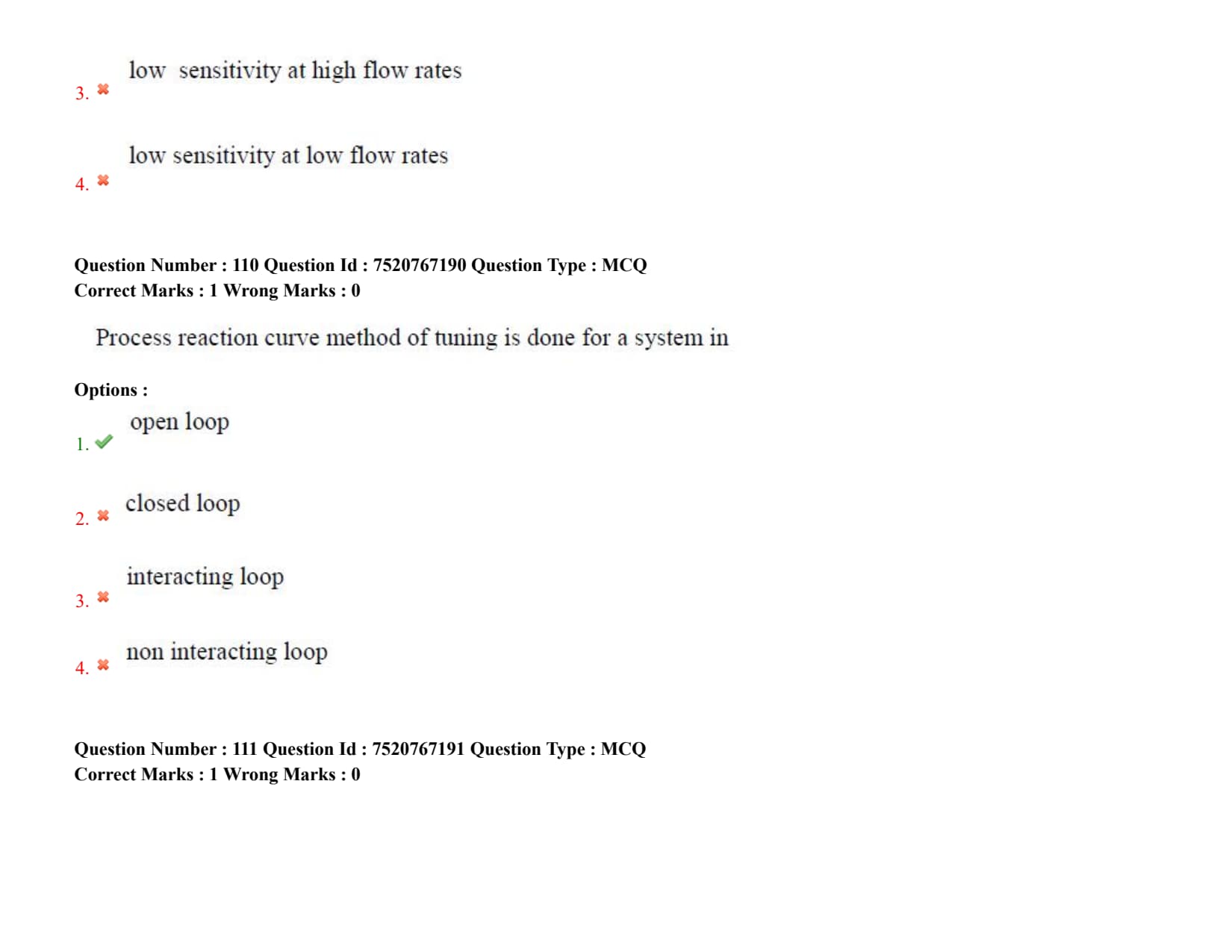
Question 110:

Process reaction curve method of tuning is done for a system in

  • (A) open loop
  • (B) closed loop
  • (C) interacting loop
  • (D) non interacting loop

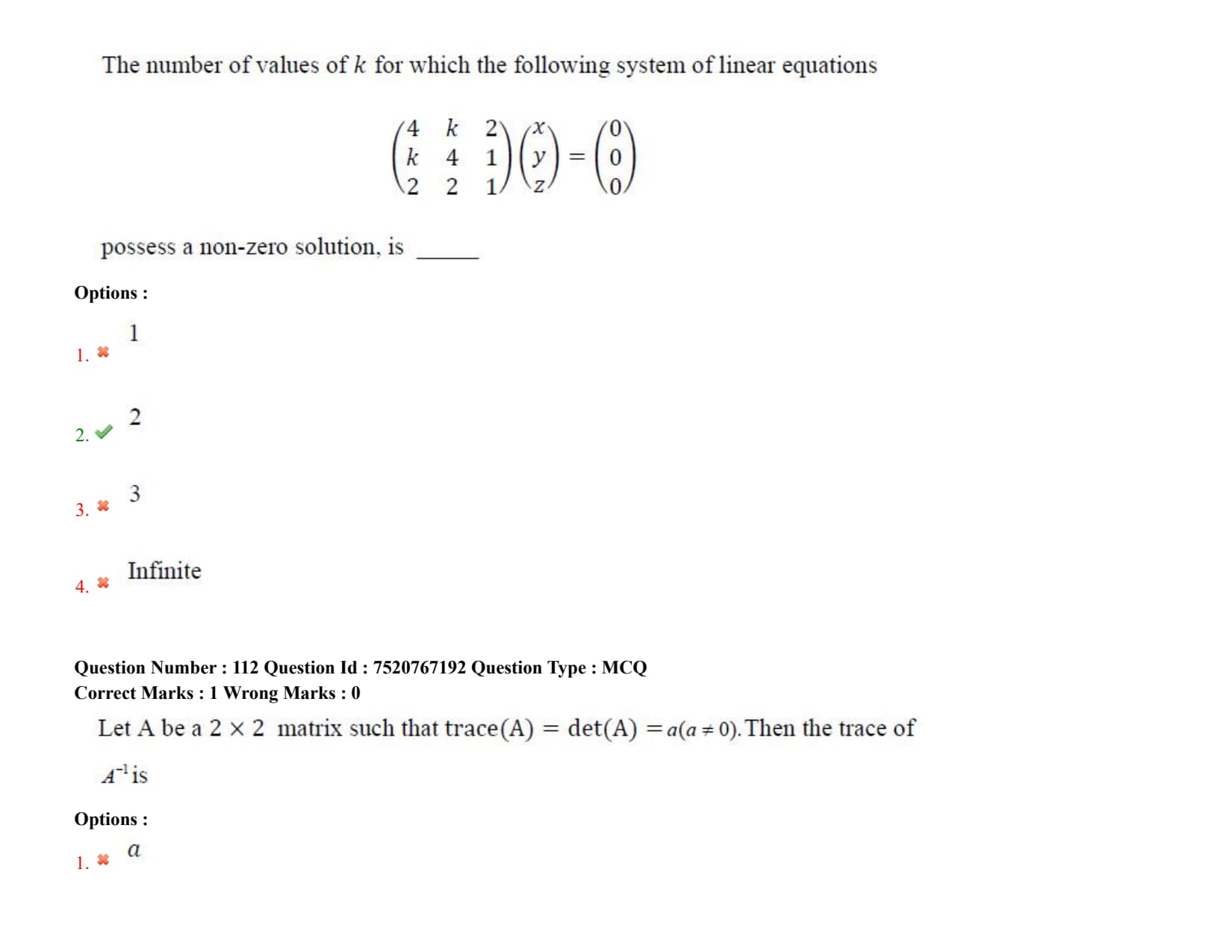
Question 111:

The number of values of \(k\) for which the following system of linear equations: \[ \begin{pmatrix} 4 & k & 2 \\
k & 4 & 1 \\
2 & 2 & 1 \end{pmatrix} \begin{pmatrix} x \\
y \\
z \end{pmatrix} = \begin{pmatrix} 0 \\
0 \\
0 \end{pmatrix} \]
possess a non-zero solution, is _______

  • (A) 1
  • (B) 2
  • (C) 3
  • (D) Infinite

Question 112:

Let \(A\) be a \(2 \times 2\) matrix such that \(trace(A) = \det(A) = a (a \neq 0)\). Then the trace of \(A^{-1}\) is

  • (A) \(a\)
  • (B) 1
  • (C) \(1/a\)
  • (D) \(-1/a\)

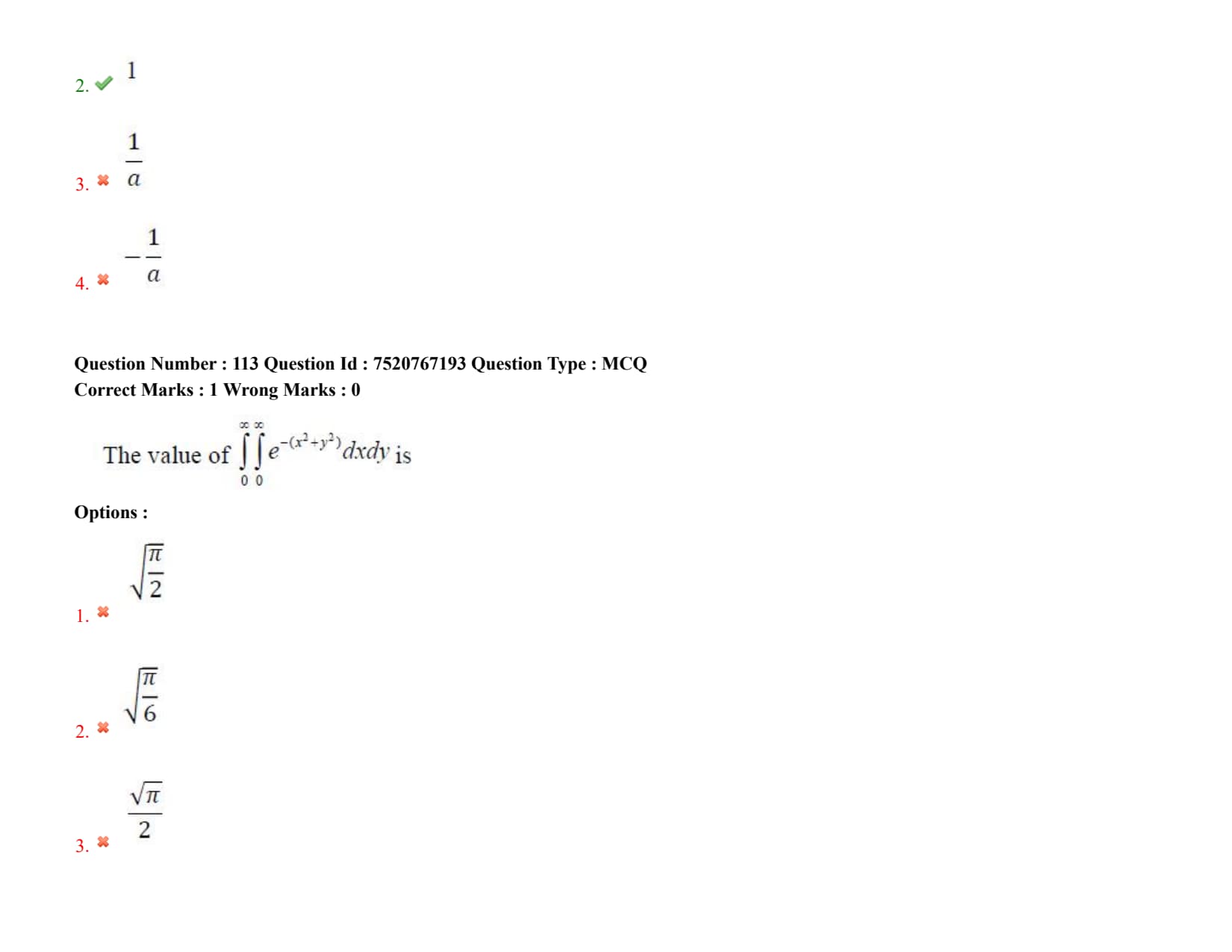
Question 113:

The value of \(\int_0^{\infty} \int_0^{\infty} e^{-(x^2+y^2)} dx dy\) is

  • (A) \(\frac{\pi}{2}\)
  • (B) \(\frac{\pi}{6}\)
  • (C) \(\frac{\sqrt{\pi}}{2}\)
  • (D) \(\frac{\pi}{4}\)

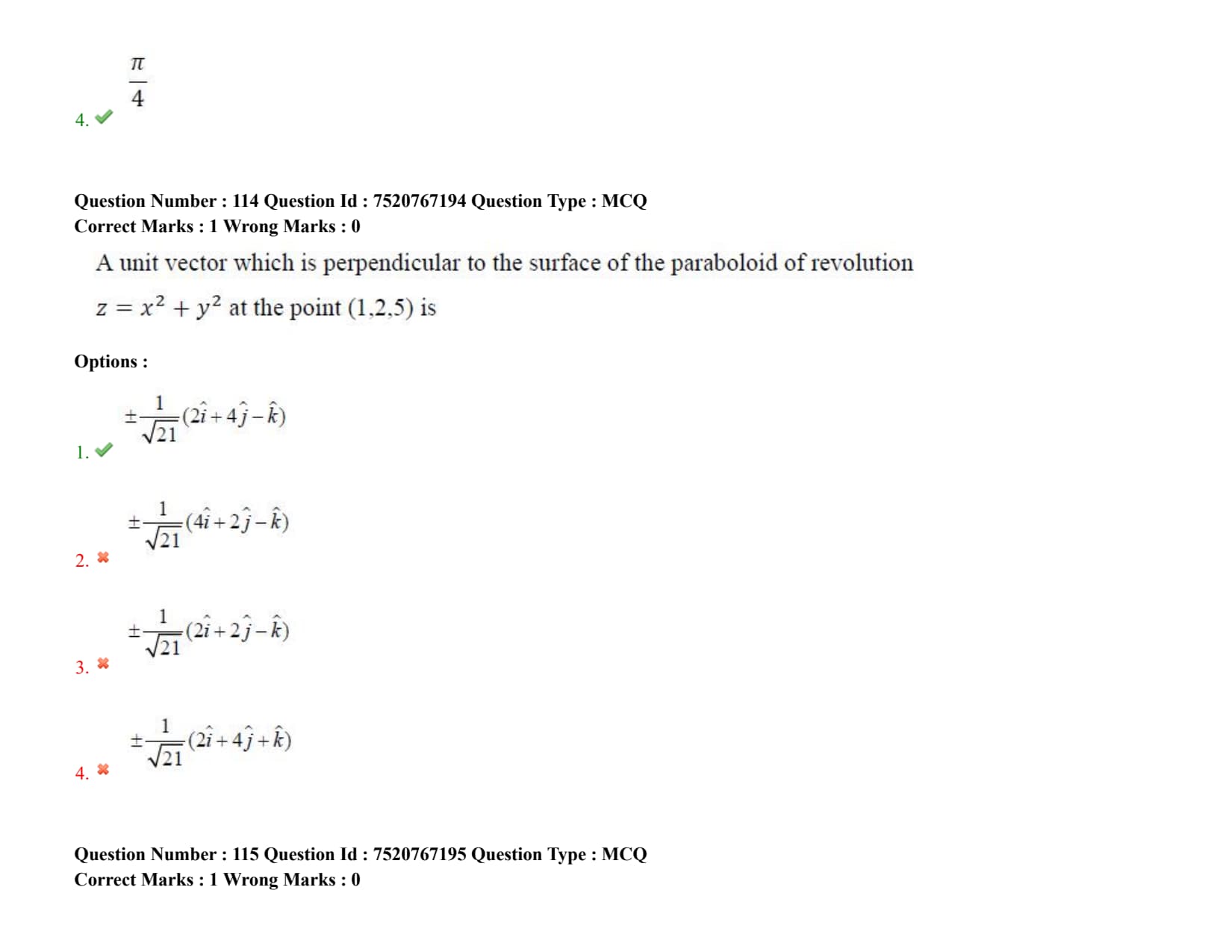
Question 114:

A unit vector which is perpendicular to the surface of the paraboloid of revolution \(z = x^2 + y^2\) at the point (1,2,5) is

  • (A) \(\pm \frac{1}{\sqrt{21}} (2\hat{i} + 4\hat{j} - \hat{k})\)
  • (B) \(\pm \frac{1}{\sqrt{21}} (4\hat{i} + 2\hat{j} - \hat{k})\)
  • (C) \(\pm \frac{1}{\sqrt{21}} (2\hat{i} + 2\hat{j} - \hat{k})\)
  • (D) \(\pm \frac{1}{\sqrt{21}} (2\hat{i} + 4\hat{j} + \hat{k})\)

Question 115:

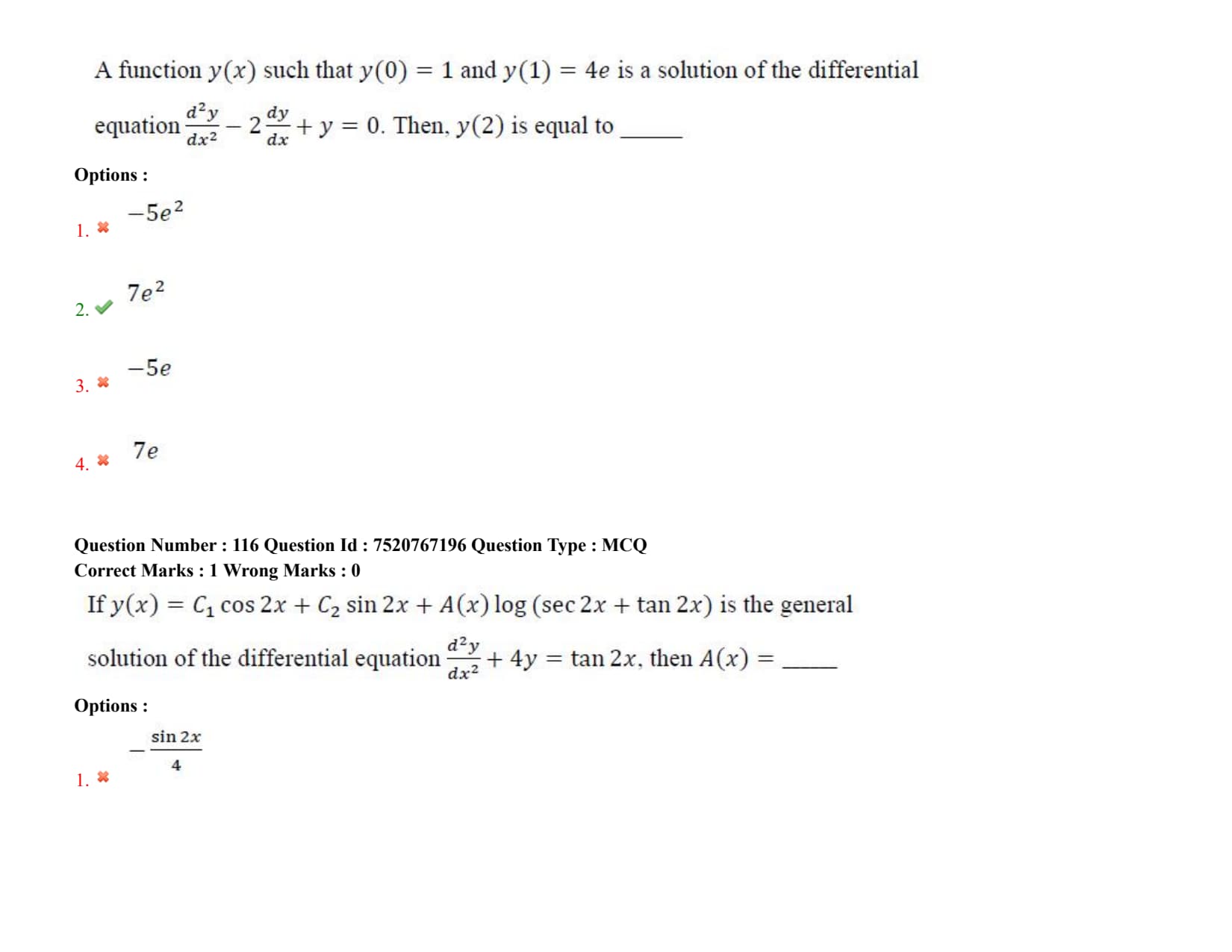
A function \(y(x)\) such that \(y(0) = 1\) and \(y(1) = 4e\) is a solution of the differential equation \(\frac{d^2y}{dx^2} - 2\frac{dy}{dx} + y = 0\). Then, \(y(2)\) is equal to _______

  • (A) \(-5e^2\)
  • (B) \(7e^2\)
  • (C) \(-5e\)
  • (D) \(7e\)

Question 116:

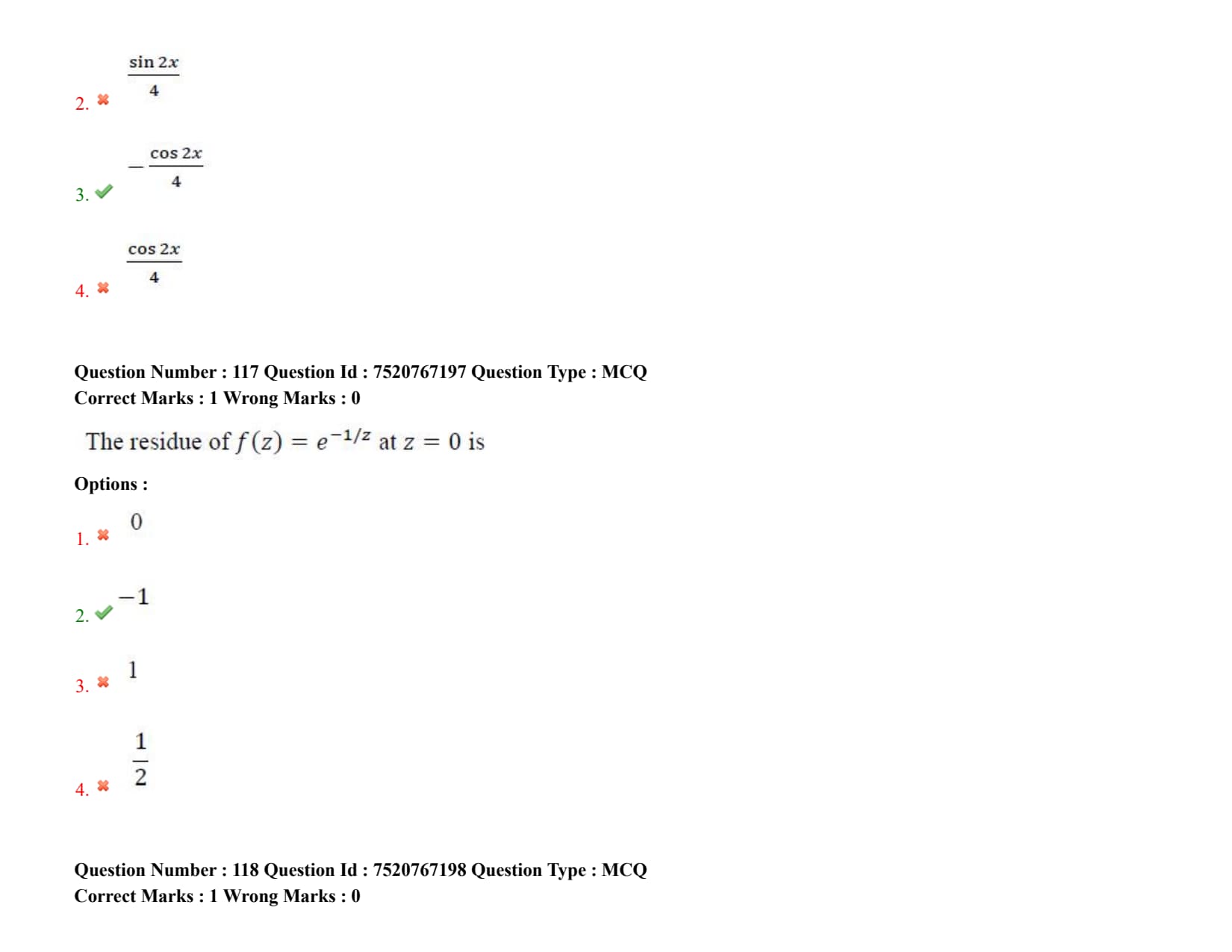
If \(y(x) = C_1 \cos 2x + C_2 \sin 2x + A(x) \log (\sec 2x + \tan 2x)\) is the general solution of the differential equation \(\frac{d^2y}{dx^2} + 4y = \tan 2x\), then \(A(x) = \_\_\_\_\_\_\_\)

  • (A) \(-\frac{\sin 2x}{4}\)
  • (B) \(\frac{\sin 2x}{4}\)
  • (C) \(-\frac{\cos 2x}{4}\)
  • (D) \(\frac{\cos 2x}{4}\)

Question 117:

The residue of \(f(z) = e^{-1/z}\) at \(z = 0\) is

  • (A) 0
  • (B) \(-1\)
  • (C) 1
  • (D) \(\frac{1}{2}\)

Question 118:

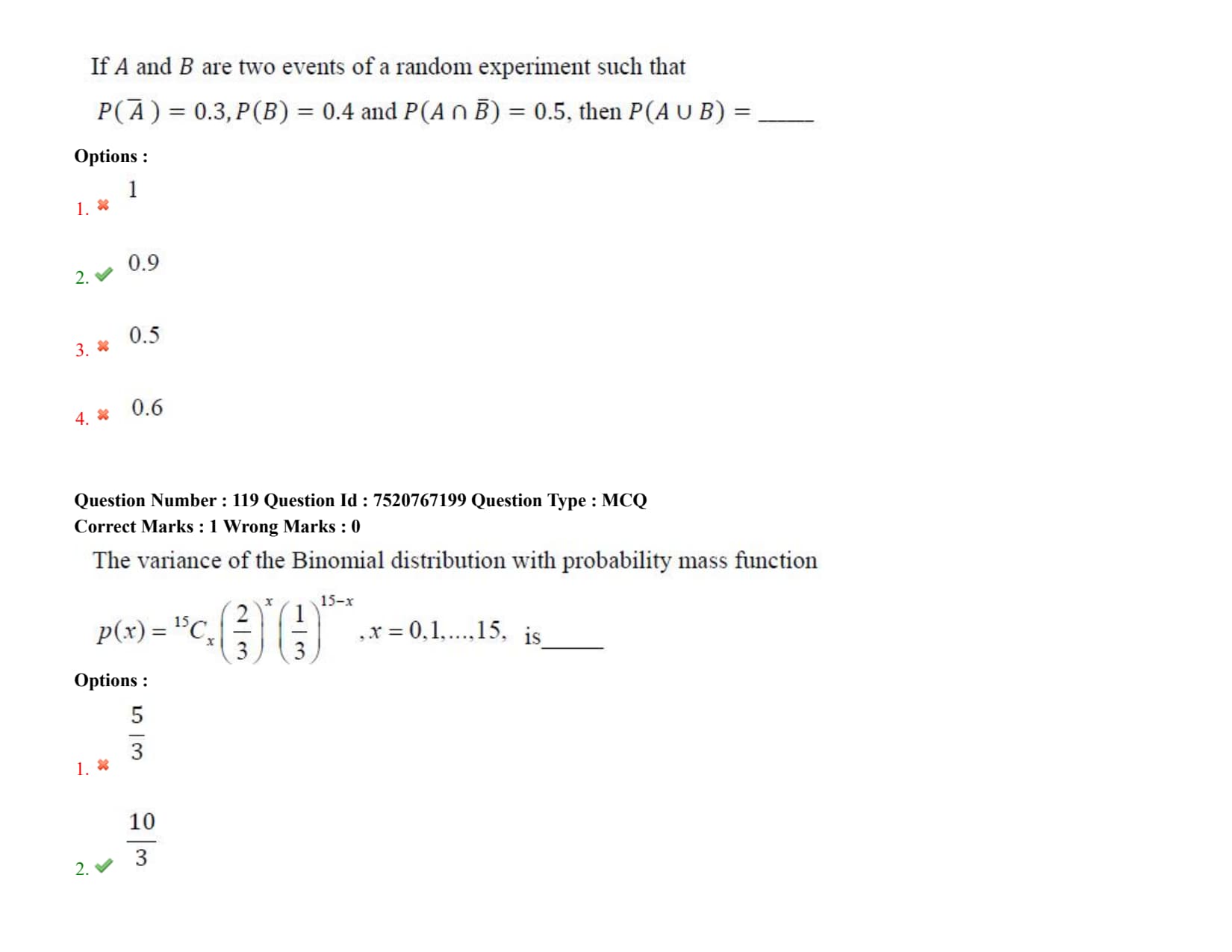
If \(A\) and \(B\) are two events of a random experiment such that \(P(\bar{A}) = 0.3\), \(P(B) = 0.4\) and \(P(A \cap \bar{B}) = 0.5\), then \(P(A \cup B) = \_\_\_\_\_\_\_\)

  • (A) 1
  • (B) 0.9
  • (C) 0.5
  • (D) 0.6

Question 119:

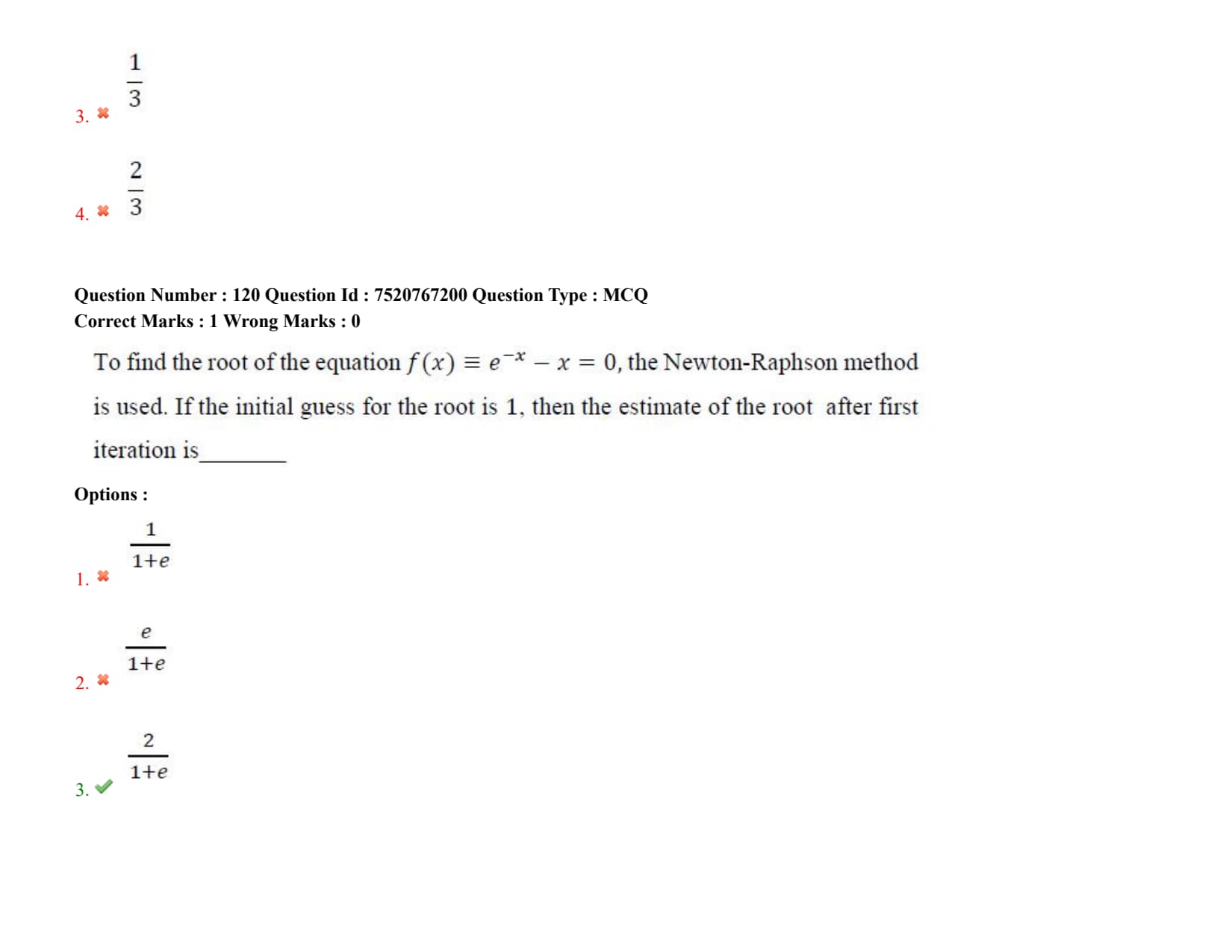
The variance of the Binomial distribution with probability mass function \(p(x) = {}^{15}C_x \left(\frac{2}{3}\right)^x \left(\frac{1}{3}\right)^{15-x}\), \(x = 0,1,\dots,15\), is _______

  • (A) \(\frac{5}{3}\)
  • (B) \(\frac{10}{3}\)
  • (C) \(\frac{1}{3}\)
  • (D) \(\frac{2}{3}\)

Question 120:

To find the root of the equation \(f(x) \equiv e^{-x} - x = 0\), the Newton-Raphson method is used. If the initial guess for the root is 1, then the estimate of the root after first iteration is _______

  • (A) \(\frac{1}{1+e}\)
  • (B) \(\frac{e}{1+e}\)
  • (C) \(\frac{2}{1+e}\)
  • (D) \(\frac{2e}{1+e}\)

AP PGECET 2026 Instrumentation Engineering Topic-wise weightage

Major Subject Approx. Number of Questions Expected % (Approx.)
Engineering Mathematics 16–20 13–17%
Basics of Circuits & Measurement Systems 12–16 10–13%
Transducers & Mechanical Measurement 16–20 13–17%
Analog Electronics 10–14 8–12%
Digital Electronics 10–14 8–12%
Signals, Systems & Communications 10–14 8–12%
Electrical & Electronic Measurements 10–14 8–12%
Control Systems & Process Control 10–14 8–12%
Analytical, Optical & Biomedical Instrumentation 10–14 8–12%

AP PGECET 2026 Preparation Strategy