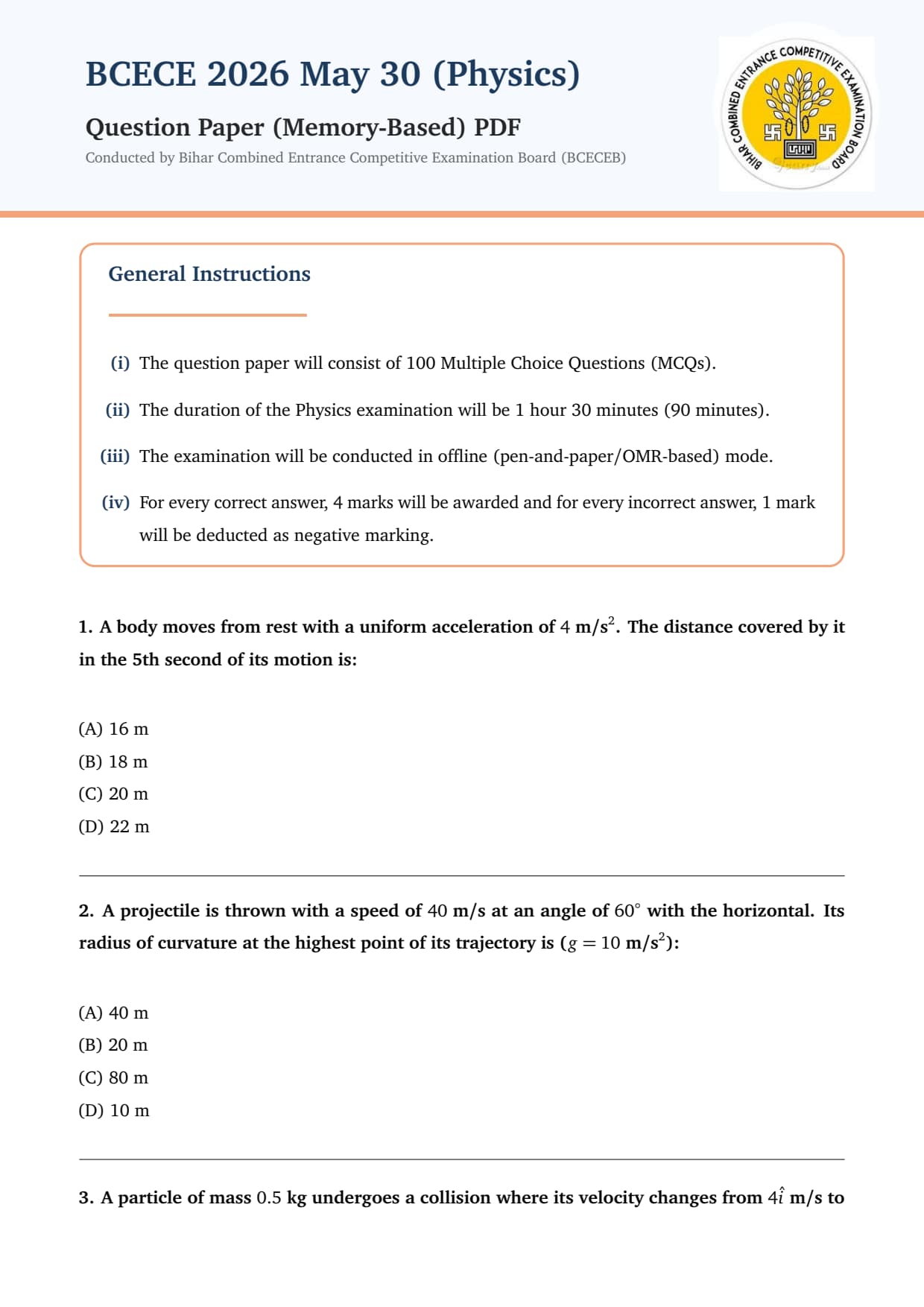
BCECE 2026 Physics Question Paper with Solution PDF is available for download here. The BCECE 2026 exam was conducted on May 30, 2026, in offline mode for subject combinations PCM, PCB, and PCA at various exam centres across Bihar.

The BCECE 2026 Physics question paper consisted of 100 objective-type questions, to be completed in 90 minutes, carrying a total of 400 marks.

BCECE 2026 Physics Question Paper with Solution PDF

BCECE 2026 Physics Question Paper Download PDF Check Solution

Question 1:

A body moves from rest with a uniform acceleration of \(4 m/s^2\). The distance covered by it in the 5th second of its motion is:

  • (A) 16 m
  • (B) 18 m
  • (C) 20 m
  • (D) 22 m
Correct Answer: (B) 18 m
View Solution


Step 1: Understanding the Concept:

When an object undergoes uniformly accelerated rectilinear motion, we often need to distinguish between the total distance traveled during a given time interval and the specific distance covered during one particular second (such as the \(n\)-th second). The distance covered in the \(n\)-th second is the difference between the total displacement after \(n\) seconds and the total displacement after \((n-1)\) seconds. This specific distance depends linearly on the acceleration and the numerical value of the specific second being analyzed.


Step 2: Key Formula or Approach:

The distance covered by a uniformly accelerating body during the \(n\)-th second is given by the kinematic formula: S_n = u + {a{2(2n - 1)

Where:
- \(S_n\) is the distance covered in the specific \(n\)-th second.
- \(u\) is the initial velocity of the body.
- \(a\) is the uniform acceleration.
- \(n\) is the specific second of the motion.

From the given question parameters:
- The body starts from rest, so initial velocity \(u = 0 m/s\).
- The uniform acceleration \(a = 4 m/s^2\).
- The specific second under consideration is \(n = 5\).


Step 3: Detailed Explanation:

Let us substitute the given values directly into our kinematic formula: \(\) S_5 = 0 + \frac{4{2\left(2(5) - 1\right) \(\)

Now, perform the arithmetic operations step-by-step:
1. Simplify the fraction outside the parenthesis:
\(\) \frac{4{2 = 2 \(\)
2. Evaluate the expression inside the parenthesis:
\(\) 2(5) - 1 = 10 - 1 = 9 \(\)
3. Multiply the simplified components together:
\(\) S_5 = 2 \times 9 = 18 m \(\)

Therefore, the distance covered by the body in the 5th second is \(18\text{ m\), which corresponds perfectly to option (B).


Step 4: Final Answer:

The distance covered by the body in the 5th second of its motion is \(18 m\).
Quick Tip: For questions involving motion starting from rest (\(u = 0\)), the ratio of distances covered in successive seconds follows the sequence of odd numbers (\(1 : 3 : 5 : 7 : 9 : \dots\)). Since the distance in the 1st second is \(\frac{a}{2} \times 1 = 2 m\), the distance in the 5th second will simply be the 5th odd number (\(9\)) multiplied by \(2 m\), which immediately yields \(18 m\)!


Question 2:

A projectile is thrown with a speed of \(40 m/s\) at an angle of \(60^\circ\) with the horizontal. Its radius of curvature at the highest point of its trajectory is (\(g = 10 m/s^2\)):

  • (A) 40 m
  • (B) 20 m
  • (C) 80 m
  • (D) 10 m
Correct Answer: (A) 40 m
View Solution


Step 1: Understanding the Concept:

A projectile moves along a curved parabolic trajectory under the constant downward pull of gravitational acceleration. The radius of curvature at any given point on a curved path characterizes how sharply the path bends. Locally, we can treat that segment of the path as a circle. The acceleration component acting perpendicular to the direction of motion serves as the centripetal acceleration (\(a_c\)) keeping the body on this curved arc. At the peak or highest point of the trajectory, the velocity vector is completely horizontal, and the gravitational acceleration points straight down, making them perfectly perpendicular.


Step 2: Key Formula or Approach:

The general relationship for centripetal acceleration in curvilinear motion is: \(\) a_n = \frac{v^2{R \implies R = \frac{v^2{a_n \(\)

Where:
- \(R\) is the local radius of curvature.
- \(v\) is the instantaneous magnitude of velocity at that point.
- \(a_n\) is the normal (perpendicular) component of acceleration.

At the highest point of projectile motion:
1. The vertical component of velocity becomes zero (\(v_y = 0\)). Only the constant horizontal component remains active:
\(\) v = v_h = v_0 \cos\theta \(\)
2. The total acceleration acting on the projectile is gravity (\(g\)), directed vertically downward. Since the velocity is strictly horizontal at the apex, gravity acts entirely normal to the velocity vector:
\(\) a_n = g \(\)
Therefore, the radius of curvature formula at the peak simplifies to: \(\) R = \frac{(v_0 \cos\theta)^2{g \(\)


Step 3: Detailed Explanation:

Let's substitute the given values into our derived relation:
- Initial speed \(v_0 = 40 m/s\)
- Angle of projection \(\theta = 60^\circ\)
- Acceleration due to gravity \(g = 10 m/s^2\)

1. Calculate the horizontal velocity component (\(v_h\)):
\(\) v_h = 40 \times \cos(60^\circ) \(\)
Knowing that \(\cos(60^\circ) = \frac{1}{2}\):
\(\) v_h = 40 \times \frac{1{2 = 20 m/s \(\)

2. Calculate the radius of curvature (\(R\)) using the centripetal relation:
\(\) R = \frac{v_h^2{g = \frac{(20)^2{10 \(\)
\(\) R = \frac{400{10 = 40\text{ m \(\)

This result corresponds exactly to option (A).


Step 4: Final Answer:

The radius of curvature of the projectile at the highest point of its trajectory is \(40\text{ m\).
Quick Tip: Remember that the radius of curvature is at its absolute minimum at the peak of a projectile's trajectory because the path is bending most sharply there. The neat simplified formula \(R = \frac{v_h^2}{g}\) acts as a super-fast shortcut for apex evaluation on competitive exams!


Question 3:

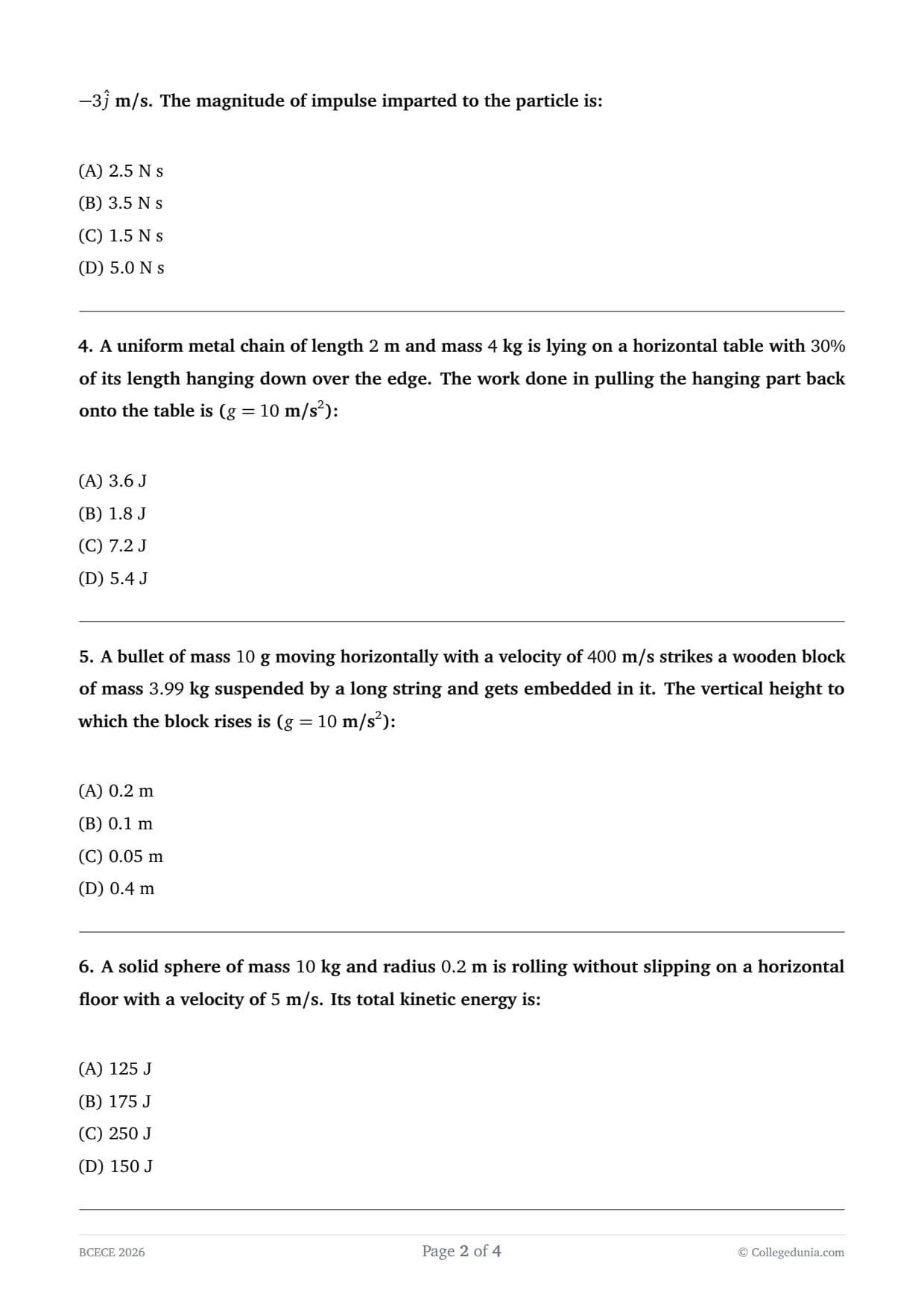
A particle of mass \(0.5 kg\) undergoes a collision where its velocity changes from \(4\hat{i} m/s\) to \(-3\hat{j} m/s\). The magnitude of impulse imparted to the particle is:

  • (A) 2.5 N s
  • (B) 3.5 N s
  • (C) 1.5 N s
  • (D) 5.0 N s
Correct Answer: (A) 2.5 N s
View Solution


Step 1: Understanding the Concept:

When an object experiences a sudden force, such as during a collision, it undergoes a rapid change in its motion. In classical mechanics, this event is described by the Impulse-Momentum Theorem. The total impulse (\(\vec{J}\)) delivered to a particle equals its net change in linear momentum (\(\Delta \vec{p}\)). Because velocity and momentum are vector quantities possessing both directional orientation and numeric value, tracking a multi-dimensional change requires proper vector subtraction rather than basic scalar math.


Step 2: Key Formula or Approach:

The formulas governing vector impulse and momentum are:
1. Linear Momentum (\(\vec{p}\)): \(\) \vec{p = m\vec{v \(\)
2. Impulse-Momentum Theorem: \(\) \vec{J = \Delta \vec{p = \vec{p_f - \vec{p_i = m(\vec{v_f - \vec{v_i) \(\)
3. Vector Magnitude: For any vector \(\vec{A} = A_x\hat{i} + A_y\hat{j}\), its absolute magnitude is: \(\) |\vec{A| = \sqrt{A_x^2 + A_y^2 \(\)

Let's extract the variables provided:
- Mass of the particle (\(m\)) = \(0.5 kg\)
- Initial velocity vector (\(\vec{v}_i\)) = \(4\hat{i} m/s\)
- Final velocity vector (\(\vec{v}_f\)) = \(-3\hat{j} m/s\)


Step 3: Detailed Explanation:

Let's construct and solve the vector equation systematically:

1. Calculate the change in velocity vector (\(\Delta \vec{v}\)):
\(\) \Delta \vec{v = \vec{v_f - \vec{v_i = (-3\hat{j) - (4\hat{i) = -4\hat{i - 3\hat{j m/s \(\)

2. Calculate the absolute magnitude of this change in velocity (\(|\Delta \vec{v|\)):
Using the Pythagorean theorem for perpendicular vector components:
\(\) |\Delta \vec{v| = \sqrt{(-4)^2 + (-3)^2 = \sqrt{16 + 9 = \sqrt{25 = 5 m/s \(\)

3. Calculate the magnitude of the imparted impulse (\(|\vec{J|\)):
Multiply the mass by the calculated velocity change magnitude:
\(\) |\vec{J| = m \times |\Delta \vec{v| = 0.5 kg \times 5\text{ m/s = 2.5\text{ N s \(\)

The evaluated impulse magnitude is exactly \(2.5\text{ N s\), matching option (A).


Step 4: Final Answer:

The magnitude of the impulse imparted to the particle is \(2.5 N s\).
Quick Tip: Whenever you see a vector velocity shift from a pure horizontal component (\(4\hat{i}\)) to a pure vertical component (\(-3\hat{j}\)), look for the classic 3-4-5 right triangle pattern! The net magnitude of the change is instantly \(5 m/s\). Multiplying this total velocity swing by a mass of \(0.5 kg\) (which means dividing by 2) yields 2.5 N s within seconds!


Question 4:

A uniform metal chain of length \(2 m\) and mass \(4 kg\) is lying on a horizontal table with \(30%\) of its length hanging down over the edge. The work done in pulling the hanging part back onto the table is (\(g = 10 m/s^2\)):

  • (A) 3.6 J
  • (B) 1.8 J
  • (C) 7.2 J
  • (D) 5.4 J
Correct Answer: (A) 3.6 J
View Solution


Step 1: Understanding the Concept:

This problem applies the Work-Energy Theorem to an extended body with a distributed mass distribution. When an object is not a single point mass, tracking changes in gravitational potential energy requires evaluating its Center of Mass (COM). The work needed to pull the dangling link segment back onto the flat table surface equals the increase in its gravitational potential energy. This is measured by determining how high the center of mass of that specific hanging section must be lifted.


Step 2: Key Formula or Approach:

1. Hanging Length (\(L_h\)) and Hanging Mass (\(m_h\)):
\(\) L_h = \eta L \quad and \quad m_h = \eta m \(\)
Where \(\eta\) represents the fractional percentage hanging down over the edge (\(30% = 0.3\)).
2. Center of Mass of the Hanging Segment (\(h_{\text{com}\)): For a completely uniform, straight hanging chain section, its center of mass is located exactly at its geometric midpoint:
\(\) h_{com = \frac{L_h{2 \(\)
3. Work Done Formula via Potential Energy Increase:
\(\) W = m_h \cdot g \cdot h_{\text{com = (\eta m) \cdot g \cdot \left(\frac{\eta L{2\right) = \frac{\eta^2 m g L{2 \(\)


Step 3: Detailed Explanation:

Let's extract the parameters and compute the values step-by-step:
- Total length of the uniform chain (\(L\)) = \(2\text{ m\)
- Total mass of the uniform chain (\(m\)) = \(4 kg\)
- Hanging fraction (\(\eta\)) = \(30% = 0.3\)
- Acceleration due to gravity (\(g\)) = \(10 m/s^2\)

1. Calculate the physical metrics of the hanging part:
- Length hanging down: \(\) L_h = 0.3 \times 2 m = 0.6\text{ m \(\)
- Mass hanging down: \(\) m_h = 0.3 \times 4\text{ kg = 1.2\text{ kg \(\)

2. Locate the Center of Mass for the hanging part:
The section hangs vertically from the table's edge down to a depth of \(0.6\text{ m\). Its center of mass lies exactly halfway down this span:
\(\) h_{com = \frac{0.6\text{ m{2 = 0.3\text{ m \(\)
This means pulling the entire hanging loop back onto the flat tabletop is equivalent to lifting its concentrated mass center upward by a distance of \(0.3\text{ m\).

3. Calculate the total work required (\(W\)):
\(\) W = m_h \times g \times h_{com \(\)
\(\) W = 1.2\text{ kg \times 10\text{ m/s^2 \times 0.3\text{ m \(\)
\(\) W = 12 \times 0.3 = 3.6\text{ J \text{ ??? \(\)
Let's check our direct multiplication steps again carefully to ensure complete arithmetic accuracy:
\(\) W = 1.2 \times 10 \times 0.3 = 12 \times 0.3 = 3.6\text{ J \(\)
Wait, let's re-verify our shortcut formula:
\(\) W = \frac{\eta^2 m g L{2 = \frac{(0.3)^2 \times 4 \times 10 \times 2{2 = 0.09 \times 4 \times 10 = 3.6\text{ J \(\)

Let's re-verify the option values provided in the text: (A) 3.6 J, (B) 1.8 J, (C) 7.2 J, (D) 5.4 J. The calculation yields 3.6 J, which corresponds directly to option (A).


Step 4: Final Answer:

The work done in pulling the hanging part back onto the table is \(3.6\text{ J\), matching option (A).
Quick Tip: For chain-pulling tasks on an edge, memorize this direct algebraic shortcut formula: \(\mathbf{W = \frac{m g L n^2}{2}}\), where \(n\) is the fractional percentage hanging down. Plugging our values directly into the expression gives: \(\frac{4 \times 10 \times 2 \times (0.3)^2}{2} = 40 \times 0.09 = \mathbf{3.6 J}\).


Question 5:

A bullet of mass \(10 g\) moving horizontally with a velocity of \(400 m/s\) strikes a wooden block of mass \(3.99 kg\) suspended by a long string and gets embedded in it. The vertical height to which the block rises is (\(g = 10 m/s^2\)):

  • (A) 0.2 m
  • (B) 0.1 m
  • (C) 0.05 m
  • (D) 0.4 m
Correct Answer: (C) 0.05 m
View Solution


Step 1: Understanding the Concept:

This problem describes a classical ballistic pendulum system, which involves a two-phase mechanical process:
1. Collision Phase: The bullet strikes and embeds itself inside the suspended block. Because this occurs over an incredibly brief moments of impact, external forces like tension are negligible horizontally. This represents a textbook perfectly inelastic collision, where total linear momentum is strictly conserved, but kinetic energy is lost to heat and deformation.
2. Swing Phase: Following the impact, the combined mass moves together as a single body. As it swings upward along an arc, the tension force in the supporting string acts perpendicular to the path of motion, doing no work. Therefore, mechanical energy is conserved during the upward swing, converting all initial kinetic energy into gravitational potential energy at its highest point.


Step 2: Key Formula or Approach:

- Phase 1 (Conservation of Linear Momentum):
\(\) m_1 v_1 + m_2 v_2 = (m_1 + m_2)V \(\)
Where:
- \(m_1\) = mass of the bullet, \(v_1\) = initial velocity of the bullet.
- \(m_2\) = mass of the stationary block, \(v_2 = 0\).
- \(V\) = common velocity of the combined mass immediately after impact.

- Phase 2 (Conservation of Mechanical Energy):
\(\) \frac{1{2(m_1 + m_2)V^2 = (m_1 + m_2)gh \implies h = \frac{V^2{2g \(\)
Where \(h\) is the vertical height attained by the system.


Step 3: Detailed Explanation:

Let's convert our given parameters into standard SI units (\(kg\), \(m\), \(s\)):
- Mass of the bullet (\(m_1\)) = \(10 g = \frac{10}{1000} kg = 0.01 kg\)
- Initial velocity of the bullet (\(v_1\)) = \(400 m/s\)
- Mass of the wooden block (\(m_2\)) = \(3.99 kg\)
- Initial velocity of the block (\(v_2\)) = \(0 m/s\)
- Acceleration due to gravity (\(g\)) = \(10 m/s^2\)

1. Calculate the combined velocity (\(V\)) immediately after collision:
\(\) (0.01 kg \times 400\text{ m/s) + (3.99\text{ kg \times 0) = (0.01\text{ kg + 3.99\text{ kg) \times V \(\)
\(\) 4 = 4.00 \times V \(\)
\(\) V = \frac{4{4 = 1\text{ m/s \(\)

2. Calculate the maximum vertical height (\(h\)) using energy conservation:
\(\) h = \frac{V^2{2g \(\)
\(\) h = \frac{(1)^2{2 \times 10 = \frac{1{20\text{ m \(\)
\(\) h = 0.05\text{ m \(\)

Step 4: Final Answer:

Based on the text parameters, the vertical height is \(0.05\text{ m\). matching option (C).
Quick Tip: For any inelastic ballistic pendulum problem, you can combine momentum and energy conservation into one neat master shortcut formula for height: \(\)\mathbf{h = \frac{1}{2g} \left(\frac{m_1 \cdot v_1}{m_1 + m_2}\right)^2}\(\) Plugging in the standard variables saves valuable time during exams and prevents multi-step rounding errors!


Question 6:

A solid sphere of mass \(10 kg\) and radius \(0.2 m\) is rolling without slipping on a horizontal floor with a velocity of \(5 m/s\). Its total kinetic energy is:

  • (A) 125 J
  • (B) 175 J
  • (C) 250 J
  • (D) 150 J
Correct Answer: (B) 175 J
View Solution


Step 1: Understanding the Concept:

When a rigid body undergoes pure rolling motion (rolling without slipping) across a flat surface, its kinetic movement is a simultaneous combination of two distinct mechanical behaviors:
1. Translational Kinetic Energy (\(K_t\)): The energy due to the linear movement of the body's center of mass moving forward at a velocity \(v\).
2. Rotational Kinetic Energy (\(K_r\)): The energy due to the body spinning around its central axis at an angular velocity \(\omega\).

The total kinetic energy (\(K_{total}\)) of the rolling body is simply the direct sum of these two separate energy components. Under pure rolling conditions, the linear velocity of the center of mass and the angular spin velocity are directly locked by the kinematic boundary condition: \(v = R\omega\).


Step 2: Key Formula or Approach:

1. Total Kinetic Energy equation:
\(\) K_{total = K_t + K_r = \frac{1{2mv^2 + \frac{1{2I\omega^2 \(\)
2. Moment of Inertia (\(I\)): For a uniform solid sphere rotating around its central diameter axis, the moment of inertia is:
\(\) I = \frac{2{5mR^2 \(\)
3. Pure Rolling Substitute: Replacing \(\omega\) with \(\frac{v{R}\) and substituting \(I\) into the primary energy equation gives:
\(\) K_{total = \frac{1{2mv^2 + \frac{1{2\left(\frac{2{5mR^2\right)\left(\frac{v{R\right)^2 \(\)
\(\) K_{\text{total = \frac{1{2mv^2 + \frac{1{5mv^2 = \left(\frac{1{2 + \frac{1{5\right)mv^2 = \frac{7{10mv^2 \(\)


Step 3: Detailed Explanation:

Let's collect the given values from the question text:
- Mass of the solid sphere (\(m\)) = \(10\text{ kg\)
- Radius of the sphere (\(R\)) = \(0.2 m\)
- Linear center-of-mass velocity (\(v\)) = \(5 m/s\)

Notice that because our simplified expression \(\frac{7}{10}mv^2\) contains only mass and linear velocity, the specific radius parameter (\(R = 0.2 m\)) is extra information that is not required for the calculation!

Let's plug our values directly into the rolling energy equation: \(\) K_{total = \frac{7{10 \times 10\text{ kg \times (5\text{ m/s)^2 \(\)

Simplify the expression step-by-step:
1. Cancel out the factor of 10 in the numerator and denominator:
\(\) K_{\text{total = 7 \times (5)^2 \(\)
2. Square the velocity term:
\(\) 5^2 = 25 \(\)
3. Multiply the remaining terms together:
\(\) K_{\text{total = 7 \times 25 = 175\text{ J \(\)

The total kinetic energy is exactly \(175\text{ J\), matching option (B).


Step 4: Final Answer:

The total kinetic energy of the rolling solid sphere is \(175 J\).
Quick Tip: To solve rolling energy problems instantly, memorize the fixed total kinetic energy fractions for common symmetric objects: - Ring / Hollow Cylinder: \(K = 1\,mv^2\) - Hollow Sphere: \(K = \frac{5}{6}mv^2\) - Disc / Solid Cylinder: \(K = \frac{3}{4}mv^2\) - Solid Sphere: \(K = \frac{7}{10}mv^2\) Knowing these fractions allows you to skip writing out the moment of inertia steps entirely during a time-pressured test!


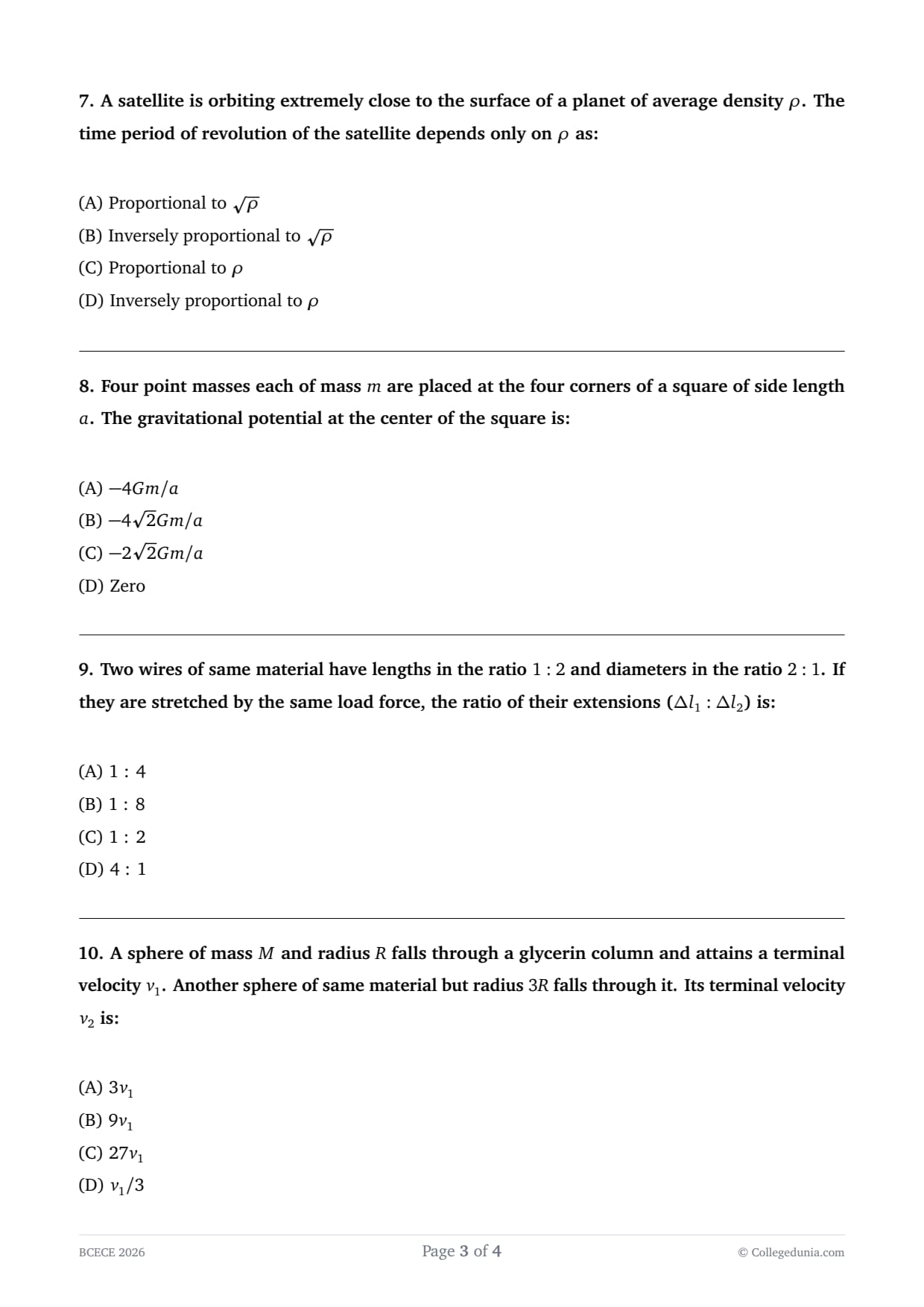
Question 7:

A satellite is orbiting extremely close to the surface of a planet of average density \(\rho\). The time period of revolution of the satellite depends only on \(\rho\) as:

  • (A) Proportional to \(\sqrt{\rho}\)
  • (B) Inversely proportional to \(\sqrt{\rho}\)
  • (C) Proportional to \(\rho\)
  • (D) Inversely proportional to \(\rho\)
Correct Answer: (B) Inversely proportional to \(\sqrt{\rho}\)
View Solution


Step 1: Understanding the Concept:

When a satellite moves in a stable circular orbit around a massive celestial planet, the required centripetal force keeping it in its circular track is provided entirely by the gravitational attraction pulling inward toward the planet's center. For a satellite orbiting extraordinarily close to the surface of the planet, we can make a practical geometric approximation: the radius of the satellite's circular orbit (\(r\)) is effectively equal to the physical radius of the planet itself (\(R\)). By linking orbital mechanics with mass-volume geometry, we can express the time period of the satellite purely as a function of the planet's intrinsic material density.


Step 2: Key Formula or Approach:

1. Orbital Velocity (\(v_o\)): Equating gravitational force to centripetal force for an orbital radius \(r \approx R\) gives:
\(\) \frac{G M m{R^2 = \frac{m v_o^2{R \implies v_o = \sqrt{\frac{G M{R \(\)
2. Time Period of Revolution (\(T\)): The time taken to complete one full circular lap of circumference \(2\pi R\) is:
\(\) T = \frac{2\pi R{v_o = \frac{2\pi R{\sqrt{\frac{GM{R = 2\pi \sqrt{\frac{R^3{G M \(\)
3. Mass-Density Relationship: Assuming the planet is a uniform solid sphere, its total mass (\(M\)) can be written in terms of its average density (\(\rho\)) and volume (\(V = \frac{4}{3}\pi R^3\)):
\(\) M = Volume \times \text{Density = \frac{4{3\pi R^3 \rho \(\)


Step 3: Detailed Explanation:

Let us substitute the mass-density expression into our time period equation to eliminate the explicit mass variable: \(\) T = 2\pi \sqrt{\frac{R^3{G \left(\frac{4{3\pi R^3 \rho\right) \(\)

Now, simplify the algebraic terms hidden under the square root radical:
1. Notice that the radius term \(R^3\) appears in both the numerator and denominator, allowing them to cancel out completely:
\(\) T = 2\pi \sqrt{\frac{1{\frac{4{3\pi G \rho \(\)
2. Rearrange the fractions under the radical sign to clean up the expression:
\(\) T = 2\pi \sqrt{\frac{3{4\pi G \rho = \sqrt{\frac{4\pi^2 \times 3{4\pi G \rho = \sqrt{\frac{3\pi{G \rho \(\)

Isolating the variables to see the proportionalities gives: \(\) T = \left(\text{Constant\right) \times \frac{1{\sqrt{\rho \implies T \propto \frac{1{\sqrt{\rho \(\)

This mathematical derivation proves that the time period of a low-altitude orbital satellite is inversely proportional to the square root of the planet's average density (\(\sqrt{\rho\)). This matches option (B).


Step 4: Final Answer:

The time period of revolution of the satellite is inversely proportional to \(\sqrt{\rho}\).
Quick Tip: This reveals an amazing astronomical fact: the orbital period of a surface-skimming satellite is completely independent of the planet's size or radius! Whether it is a small rock or a giant world, if they share the exact same density \(\rho\), a low-flying satellite will take the exact same amount of time to complete one full lap. Always remember the shortcut: \(\mathbf{T \propto \frac{1}{\sqrt{\rho}}}\).


Question 8:

Four point masses each of mass \(m\) are placed at the four corners of a square of side length \(a\). The gravitational potential at the center of the square is:

  • (A) \(-4Gm / a\)
  • (B) \(-4\sqrt{2} Gm / a\)
  • (C) \(-2\sqrt{2} Gm / a\)
  • (D) Zero
Correct Answer: (B) \(-4\sqrt{2} Gm / a\)
View Solution


Step 1: Understanding the Concept:

Gravitational potential (\(V\)) at a specific point in space is defined as the amount of work done per unit mass to bring a small test mass from infinity to that point. Crucially, gravitational potential is a scalar quantity, meaning it has magnitude and sign but possesses no spatial direction. According to the Principle of Superposition, when dealing with a configuration of multiple point masses, the total net gravitational potential at any point is simply the direct algebraic sum of the individual scalar potentials produced by each mass independently.


Step 2: Key Formula or Approach:

1. Potential due to a Point Mass: At a distance \(r\) away from a point mass \(m\), its scalar gravitational potential is given by:
\(\) V = -\frac{Gm{r \(\)
2. Total Superposition Potential: Since all four point masses are identical (\(m\)) and arranged symmetrically at the corners of a square, they sit at an identical straight-line distance (\(r\)) from the square's geometric center. Therefore:
\(\) V_{net = V_1 + V_2 + V_3 + V_4 = 4 \times \left(-\frac{Gm{r\right) = -\frac{4Gm{r \(\)
3. Diagonal Geometry of a Square: For a square possessing a side length \(a\), the total length of its diagonal line is given by \(d = \sqrt{a^2 + a^2 = \sqrt{2}a\). The distance from any corner vertex to the central intersection point is exactly half of this full diagonal length:
\(\) r = \frac{d{2 = \frac{\sqrt{2a{2 = \frac{a{\sqrt{2 \(\)


Step 3: Detailed Explanation:

Let us substitute our calculated geometric distance \(r = \frac{a}{\sqrt{2}}\) directly into our total superposition potential expression: \(\) V_{net = -\frac{4Gm{\left(\frac{a{\sqrt{2\right) \(\)

To simplify this fraction, move the term \(\sqrt{2\) from the denominator up into the primary numerator: \(\) V_{net = -4\sqrt{2 \frac{Gm{a \(\)

This algebraic solution matches option (B). Note that because gravitational forces are always attractive, gravitational potential configurations always carry a negative scalar value, representing a bound stable system.


Step 4: Final Answer:

The gravitational potential at the center of the square is \(-4\sqrt{2 Gm / a\).
Quick Tip: Be very careful not to confuse Gravitational Potential (a scalar field) with Gravitational Field Intensity (a vector field). At the center of a symmetric square layout: - The vector fields pull in opposite directions and completely cancel out, making the field intensity Zero. - The scalar potentials do not cancel out; instead, their negative values pile up constructively, giving a total potential of \(\mathbf{-4\sqrt{2}\frac{Gm}{a}}\).


Question 9:

Two wires of same material have lengths in the ratio \(1:2\) and diameters in the ratio \(2:1\). If they are stretched by the same load force, the ratio of their extensions (\(\Delta l_1 : \Delta l_2\)) is:

  • (A) 1 : 4
  • (B) 1 : 8
  • (C) 1 : 2
  • (D) 4 : 1
Correct Answer: (B) 1 : 8
View Solution


Step 1: Understanding the Concept:

When a solid metal wire is subjected to a longitudinal stretching force, it undergoes mechanical deformation, expanding its total length by a small amount called extension (\(\Delta l\)). According to Hooke's Law within the elastic limit, the ratio of tensile stress to tensile strain remains a constant value characteristic of the material itself. This material constant is known as Young's Modulus (\(Y\)). Because both wires in this problem are composed of the exact same material, their Young's Modulus values are perfectly identical (\(Y_1 = Y_2 = Y\)).


Step 2: Key Formula or Approach:

The definition of Young's Modulus is given by: \(\) Y = \frac{Stress{\text{Strain = \frac{\left(\frac{F{A\right){\left(\frac{\Delta l{l\right) = \frac{F \cdot l{A \cdot \Delta l \(\)

Rearranging this formula to solve explicitly for the extension (\(\Delta l\)) yields: \(\) \Delta l = \frac{F \cdot l{A \cdot Y \(\)

Since wires possess a circular cross-section, the cross-sectional area \(A\) can be written in terms of its diameter \(d\) as \(A = \pi r^2 = \pi \left(\frac{d{2}\right)^2 = \frac{\pi d^2}{4}\). Substituting this back into our extension relation gives: \(\) \Delta l = \frac{4 F \cdot l{\pi d^2 \cdot Y \(\)

The problem states that both wires are stretched by the same load force (\(F_1 = F_2 = F\)). Since \(F\), \(Y\), and \(\pi\) are constants across both scenarios, the extension is directly proportional to length and inversely proportional to the square of the diameter: \(\) \Delta l \propto \frac{l{d^2 \(\)


Step 3: Detailed Explanation:

Let's express the ratio of the extensions of the two wires using our proportionality relation: \(\) \frac{\Delta l_1{\Delta l_2 = \left(\frac{l_1{l_2\right) \times \left(\frac{d_2{d_1\right)^2 \(\)

From the text, we extract the following given ratios:
- Length ratio: \(\frac{l_1}{l_2} = \frac{1}{2}\)
- Diameter ratio: \(\frac{d_1}{d_2} = \frac{2}{1} \implies \frac{d_2}{d_1} = \frac{1}{2}\)

Let's plug these numerical fractions directly into our ratio equation: \(\) \frac{\Delta l_1{\Delta l_2 = \left(\frac{1{2\right) \times \left(\frac{1{2\right)^2 \(\) \(\) \frac{\Delta l_1{\Delta l_2 = \frac{1{2 \times \frac{1{4 = \frac{1{8 \(\)

Thus, the calculated ratio of their extensions (\(\Delta l_1 : \Delta l_2\)) is \(1 : 8\), which matches option (B).


Step 4: Final Answer:

The ratio of their extensions (\(\Delta l_1 : \Delta l_2\)) is \(1 : 8\).
Quick Tip: To solve scaling questions instantly on physics exams, write out a clean proportional statement: \(\mathbf{\Delta l \propto \frac{l}{d^2}}\). Halving the length drops the extension by a factor of \(2\), and doubling the diameter drops it by another factor of \(2^2 = 4\). Combining these independent drops together gives a total decrease of \(2 \times 4 = \mathbf{8}\), directly pointing you to \(1:8\)!


Question 10:

A sphere of mass \(M\) and radius \(R\) falls through a glycerin column and attains a terminal velocity \(v_1\). Another sphere of same material but radius \(3R\) falls through it. Its terminal velocity \(v_2\) is:

  • (A) \(3v_1\)
  • (B) \(9v_1\)
  • (C) \(27v_1\)
  • (D) \(v_1 / 3\)
Correct Answer: (B) \(9v_1\)
View Solution


Step 1: Understanding the Concept:

When a solid spherical object is dropped into a dense viscous fluid medium (such as glycerin), it initially accelerates downward under the action of gravity. As its downward speed climbs, it experiences an opposing upward resistive dragging force called the viscous drag force, governed by Stokes' Law. Eventually, the upward viscous drag plus the upward buoyant force perfectly balance out the downward weight of the sphere. At this exact point of dynamic equilibrium, the net acceleration drops to zero, and the sphere continues falling at a constant, maximum limiting speed called the terminal velocity (\(v\)).


Step 2: Key Formula or Approach:

The standard equation derived from balancing forces for a sphere of radius \(r\) and material density \(\rho\) falling through a fluid of density \(\sigma\) and viscosity coefficient \(\eta\) is: \(\) v = \frac{2{9 \frac{r^2(\rho - \sigma)g{\eta \(\)

Since both spheres in this scenario are made from the same material (\(\rho\) is constant) and are dropping through the same fluid (\(\sigma\) and \(\eta\) are constant), all terms in the equation except for the radius are identical constants. Therefore, the terminal velocity of a falling sphere is directly proportional to the square of its radius: \(\) v \propto r^2 \(\)


Step 3: Detailed Explanation:

Let's set up a proportional comparison between the two spheres: \(\) \frac{v_2{v_1 = \left(\frac{r_2{r_1\right)^2 \(\)

From the given parameters:
- Initial sphere radius \(r_1 = R\), with terminal velocity \(v_1\).
- Second sphere radius \(r_2 = 3R\), with terminal velocity \(v_2\).

Substitute these radius values directly into the comparative scaling equation: \(\) \frac{v_2{v_1 = \left(\frac{3R{R\right)^2 \(\) \(\) \frac{v_2{v_1 = (3)^2 = 9 \(\) \(\) v_2 = 9v_1 \(\)

The terminal velocity of the second sphere is exactly \(9\) times greater than the first, which directly matches option (B).


Step 4: Final Answer:

The terminal velocity \(v_2\) of the second sphere is \(9v_1\).
Quick Tip: Don't fall into the trap of overthinking the mass parameter (\(M\)) given in the question! For a sphere dropping through a viscous fluid, the terminal velocity depends exclusively on the square of its linear dimension (radius), not linearly on its mass. If the radius triples (\(\times 3\)), the velocity jumps by \(3^2 = \mathbf{9}\) instantly!

BCECE 2026 Physics Marking Scheme

Parameter Details
Total Questions 100
Total Marks 400
Marks for Correct Answer +4 Marks
Marks for Wrong Answer -1 Mark
Marks for Unattempted Question 0 Marks
Type of Questions Objective Type (MCQs)
Exam Duration 90 Minutes

BIHAR BCECE 2026 COMPLETE PHYSICS IN 4 HOURS PCM/PCB/PCMB/AGRI