BCECE 2026 Biology Question Paper with Solution PDF is available for download here. The BCECE 2026 exam was conducted on May 30, 2026, in offline mode for subject combinations PCM, PCB, and PCA at various exam centres across Bihar.

The BCECE 2026 Biology question paper consisted of 100 objective-type questions, to be completed in 90 minutes, carrying a total of 400 marks.

Also Check: BCECE 2026 Chemistry Question Paper with Solutions

BCECE 2026 Biology Question Paper with Solution PDF

BCECE 2026 Biology Question Paper Download PDF Check Solution


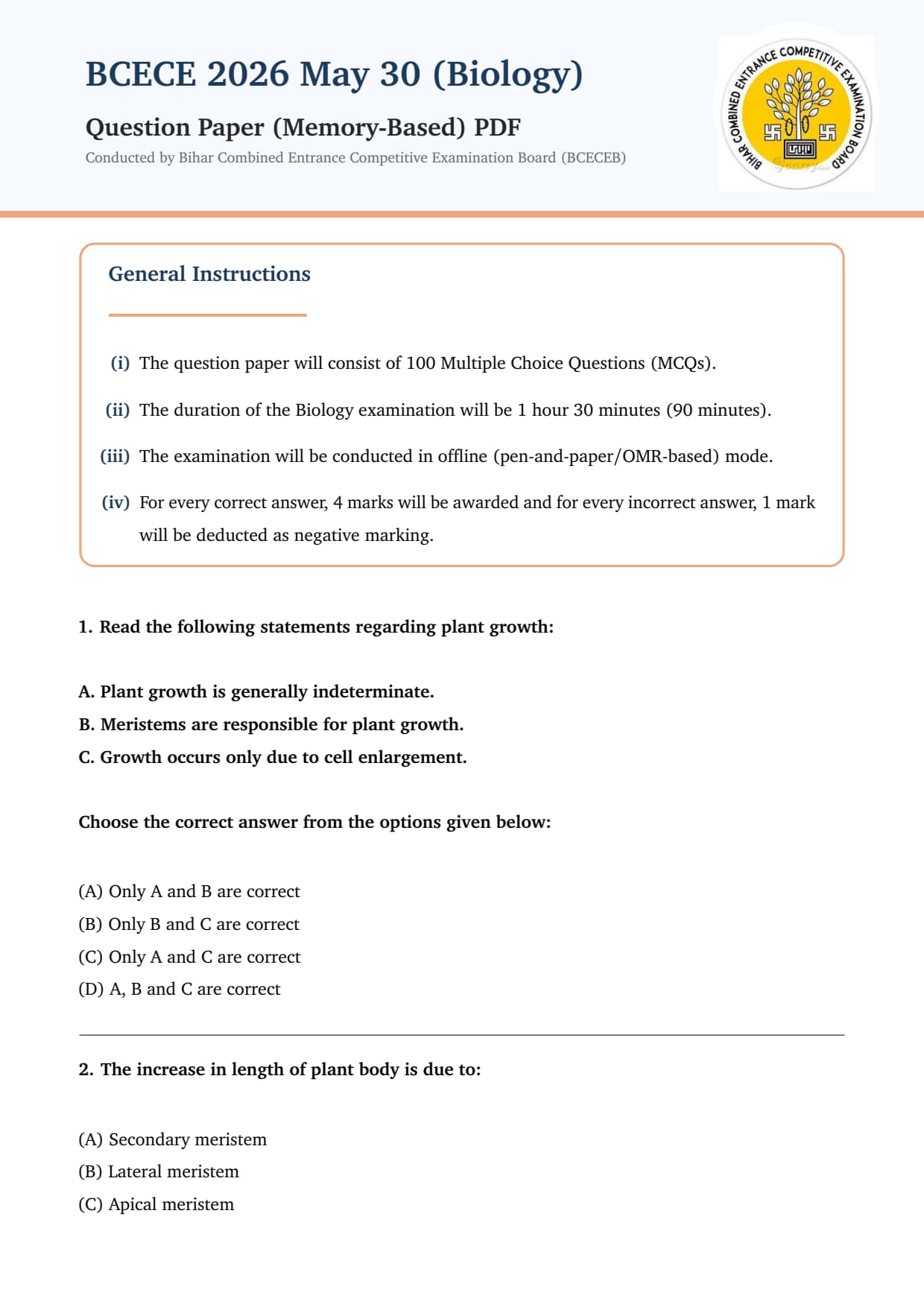
Question 1:

Read the following statements regarding plant growth:


A. Plant growth is generally indeterminate.

B. Meristems are responsible for plant growth.

C. Growth occurs only due to cell enlargement.


Choose the correct answer from the options given below:

  • (A) Only A and B are correct
  • (B) Only B and C are correct
  • (C) Only A and C are correct
  • (D) A, B and C are correct
Correct Answer: (A) Only A and B are correct
View Solution


Step 1: Understanding the Concept:

Plant growth is a unique biological process characterized by a permanent, irreversible increase in the size of an organism, its organs, or individual cells. Unlike animals, which exhibit determinate growth (stopping at a definitive adult stage), plants possess open, dynamic systems. Growth at the cellular level involves multiple sequential developmental phases rather than just a single metabolic mechanism.


Step 2: Detailed Explanation:

Let's analyze each statement independently to evaluate its scientific accuracy:

- Statement A: "Plant growth is generally indeterminate." (Correct)
Plants retain an extraordinary capacity for unlimited growth throughout their entire life cycle. This open form of development occurs because they keep active embryonic tissues at specific locations, allowing them to constantly add new organs like leaves, branches, and roots.

- Statement B: "Meristems are responsible for plant growth." (Correct)
The specialized regions of active, self-renewing, and rapidly dividing cells are called meristems. The continuous addition of new cells to the plant body is driven entirely by these localized tissues.

- Statement C: "Growth occurs only due to cell enlargement." (Incorrect)
Cellular growth actually takes place in three distinct, sequential steps:
1. Phase of Cell Division (Merismatic): Cells constantly multiply via mitosis.
2. Phase of Cell Elongation (Enlargement): Cells uptake water into large vacuoles, expanding their physical volume.
3. Phase of Cell Maturation (Differentiation): Cells thicken their walls and specialize for specific functional structural roles.
The word "only" makes this statement false, as enlargement cannot sustain growth without continuous cell division.

Therefore, statements A and B are correct, which corresponds directly to option (A).


Step 3: Final Answer:

The correct option is (A) Only A and B are correct.
Quick Tip: Be on high alert for absolute qualifiers like "only", "always", or "never" in biological statements! Growth is a multifaceted process requiring cell division to provide the raw numbers, and cell enlargement to provide the physical volume. One cannot function without the other!


Question 2:

The increase in length of plant body is due to:

  • (A) Secondary meristem
  • (B) Lateral meristem
  • (C) Apical meristem
  • (D) Cork cambium
Correct Answer: (C) Apical meristem
View Solution


Step 1: Understanding the Concept:

Meristematic tissues are classified based on their specific position within the plant body and the direction of growth they promote. This structural distribution creates a division of labor: one group drives upward and downward vertical extension (primary growth), while another group drives outward horizontal thickening (secondary growth).


Step 2: Detailed Explanation:

Let's analyze the functions of the different meristems listed:
- (A) Secondary meristem & (B) Lateral meristem: These terms refer to tissues located along the lateral sides of stems and roots, running parallel to the organs. They divide periclinally to add thickness, girth, or diameter to the plant axis.
- (C) Apical meristem: These are located at the absolute tips or apexes of the growing shoots (Shoot Apical Meristem - SAM) and roots (Root Apical Meristem - RAM). The active division of these cells drives the elongation of the plant along its main vertical axis, directly resulting in an increase in length. This vertical extension constitutes the plant's primary growth.
- (D) Cork cambium: A specific type of lateral secondary meristem that replaces the outer damaged epidermis with protective cork tissue as the plant grows wider.

Thus, the elongation or increase in length is explicitly driven by the apical meristem. This matches option (C).


Step 3: Final Answer:

The increase in length of the plant body is due to the Apical meristem.
Quick Tip: To easily remember the direction of plant growth on your exams, link the anatomical positions to their physical directions: - Apex / Apical \(\implies\) Think of the "Apex" or top peak, which drives Vertical Length. - Lateral \(\implies\) Think of the "Latitude" or sides, which drives Horizontal Width/Girth.


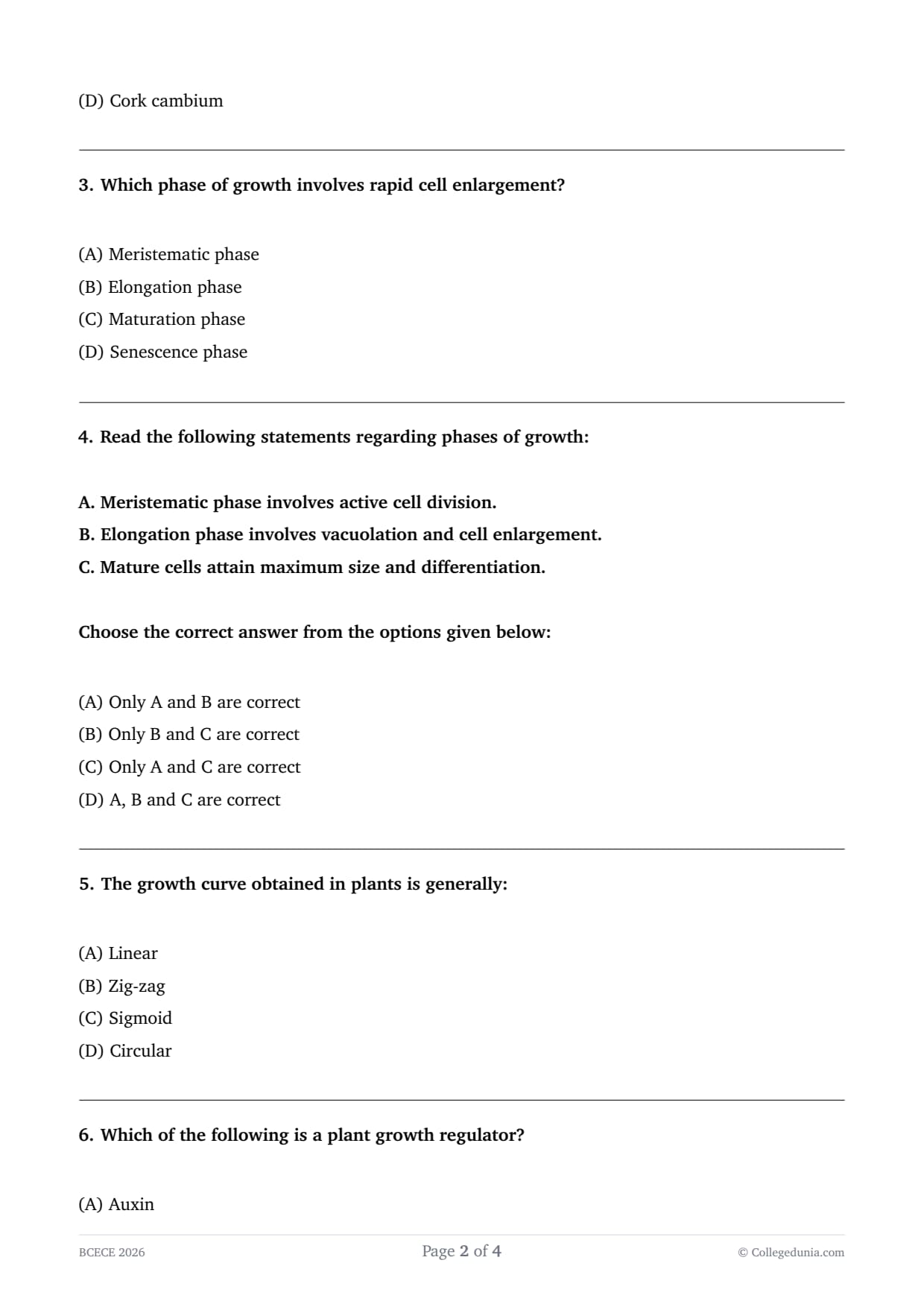
Question 3:

Which phase of growth involves rapid cell enlargement?

  • (A) Meristematic phase
  • (B) Elongation phase
  • (C) Maturation phase
  • (D) Senescence phase
Correct Answer: (B) Elongation phase
View Solution


Step 1: Understanding the Concept:

The root or shoot tip of a plant exhibits a distinct gradient of growth. If we examine the cells moving backward from the absolute tip, we can divide the growing region into three continuous zones or phases of growth. Each zone represents a progressive stage of cellular development, showing specific structural and metabolic changes as cells transition from newly divided units into fully functional tissues.


Step 2: Detailed Explanation:

Let's analyze the characteristics of each developmental phase to identify where rapid expansion occurs:
- (A) Meristematic phase: Located at the absolute apex. The cells here are small, possess dense protoplasm with large conspicuous nuclei, and have thin primary cellulosic cell walls. Their primary function is active, continuous cell division, not expansion.
- (B) Elongation phase: Located just behind the meristematic zone. As new cells are pushed into this region, they begin to take up large amounts of water, forming large internal vacuoles (increased vacuolation). This influx of turgor pressure causes a rapid expansion and enlargement of the cell, significantly increasing its length and overall volume. New wall material is also deposited to support this stretching.
- (C) Maturation phase: Located further away from the apex, behind the zone of elongation. In this zone, cells stop expanding and undergo structural modifications (differentiation) to perform specific functional roles (like becoming xylem vessels or epidermal cells).
- (D) Senescence phase: Represents the final developmental stage leading to metabolic decline and cellular death.

Therefore, rapid cell enlargement is the defining hallmark of the Elongation phase. This matches option (B).


Step 3: Final Answer:

The phase of growth that involves rapid cell enlargement is the Elongation phase.
Quick Tip: To easily remember the sequence and core features of these zones, think of it as a factory production line: 1. Meristematic \(\implies\) The Manufacturing phase (making new raw cells). 2. Elongation \(\implies\) The Stretching phase (inflating cell size via vacuoles). 3. Maturation \(\implies\) The Specialization phase (hardening walls and assigning permanent jobs).


Question 4:

Read the following statements regarding phases of growth:


A. Meristematic phase involves active cell division.

B. Elongation phase involves vacuolation and cell enlargement.

C. Mature cells attain maximum size and differentiation.


Choose the correct answer from the options given below:

  • (A) Only A and B are correct
  • (B) Only B and C are correct
  • (C) Only A and C are correct
  • (D) A, B and C are correct
Correct Answer: (D) A, B and C are correct
View Solution


Step 1: Understanding the Concept:

The progression of a plant cell from its origin in a meristem to its final structural form follows a highly ordered developmental path. This sequence involves three consecutive phases: the meristematic phase, the elongation phase, and the maturation phase. Each phase features distinct physical and physiological changes within the cells.


Step 2: Detailed Explanation:

Let's evaluate the scientific correctness of each statement independently:

- Statement A: "Meristematic phase involves active cell division." (Correct)
Cells in the meristematic zone are constantly undergoing mitotic cell division. They are tightly packed, thin-walled, and structurally simple, acting as the continuous source of new cells for the plant body.

- Statement B: "Elongation phase involves vacuolation and cell enlargement." (Correct)
Directly behind the dividing zone, cells stop actively splitting and begin to rapidly grow in size. This expansion is driven by increased vacuolation (the fusion and enlargement of fluid-filled vacuoles) and the systematic deposition of new cellulose fibers into the expanding cell wall.

- Statement C: "Mature cells attain maximum size and differentiation." (Correct)
Once cells leave the elongation zone, they enter the maturation phase. Here, they reach their maximum physical dimensions, their cell walls undergo maximal thickening, and they undergo differentiation—a process where they take on permanent structural shapes and specialized biological functions (e.g., forming protective bark or water-conducting pipes).

Since statements A, B, and C are all completely factually correct, option (D) is the correct choice.


Step 3: Final Answer:

The correct option is (D) A, B and C are correct.
Quick Tip: When answering questions about plant growth phases, trace the structural changes mentally: Cell Division (A) naturally creates a tiny new cell \(\rightarrow\) Vacuolation (B) stretches that tiny cell out like a balloon \(\rightarrow\) Differentiation (C) thickens its walls to fix it into its final adult form. This logical flow helps confirm that all three descriptions are true!


Question 5:

The growth curve obtained in plants is generally:

  • (A) Linear
  • (B) Zig-zag
  • (C) Sigmoid
  • (D) Circular
Correct Answer: (C) Sigmoid
View Solution


Step 1: Understanding the Concept:

When the growth of a plant organ or an entire organism is measured over a period of time and plotted on a graph (such as plotting weight, height, or cell number against time), it forms a characteristic geometric pattern. This distribution path is called a growth curve. In natural environments where resources become finite over time, living systems exhibit an open-ended growth trajectory that eventually stabilizes as the organism reaches maturity.


Step 2: Detailed Explanation:

Let's analyze the phases that compose a typical plant growth curve:
1. Lag Phase: The initial period of growth where the rate is relatively slow as cells prepare for active division and adapt to their internal or external conditions.
2. Log or Exponential Phase: A period of rapid, geometric acceleration. Here, cells divide and multiply at a maximum rate because nutrients and space are abundant.
3. Stationary Phase: As the plant approaches maturity or resources (like light, water, and nutrients) become limited, the growth rate begins to slow down until it reaches an equilibrium where net growth stops.


When these three consecutive phases are plotted sequentially on a line graph, they form a classic S-shaped curve, also mathematically known as a Sigmoid curve. This pattern is a fundamental characteristic of living organisms growing in a natural ecosystem. This matches option (C).


Step 3: Final Answer:

The growth curve obtained in plants is generally Sigmoid.
Quick Tip: To remember this concept easily, think of the letter 'S' for Sigmoid and associate it with Shape! A natural plant growth graph always traces an S-curve, starting with a slow creep (Lag), shooting straight up (Log), and flattening out at the top (Stationary).


Question 6:

Which of the following is a plant growth regulator?

  • (A) Auxin
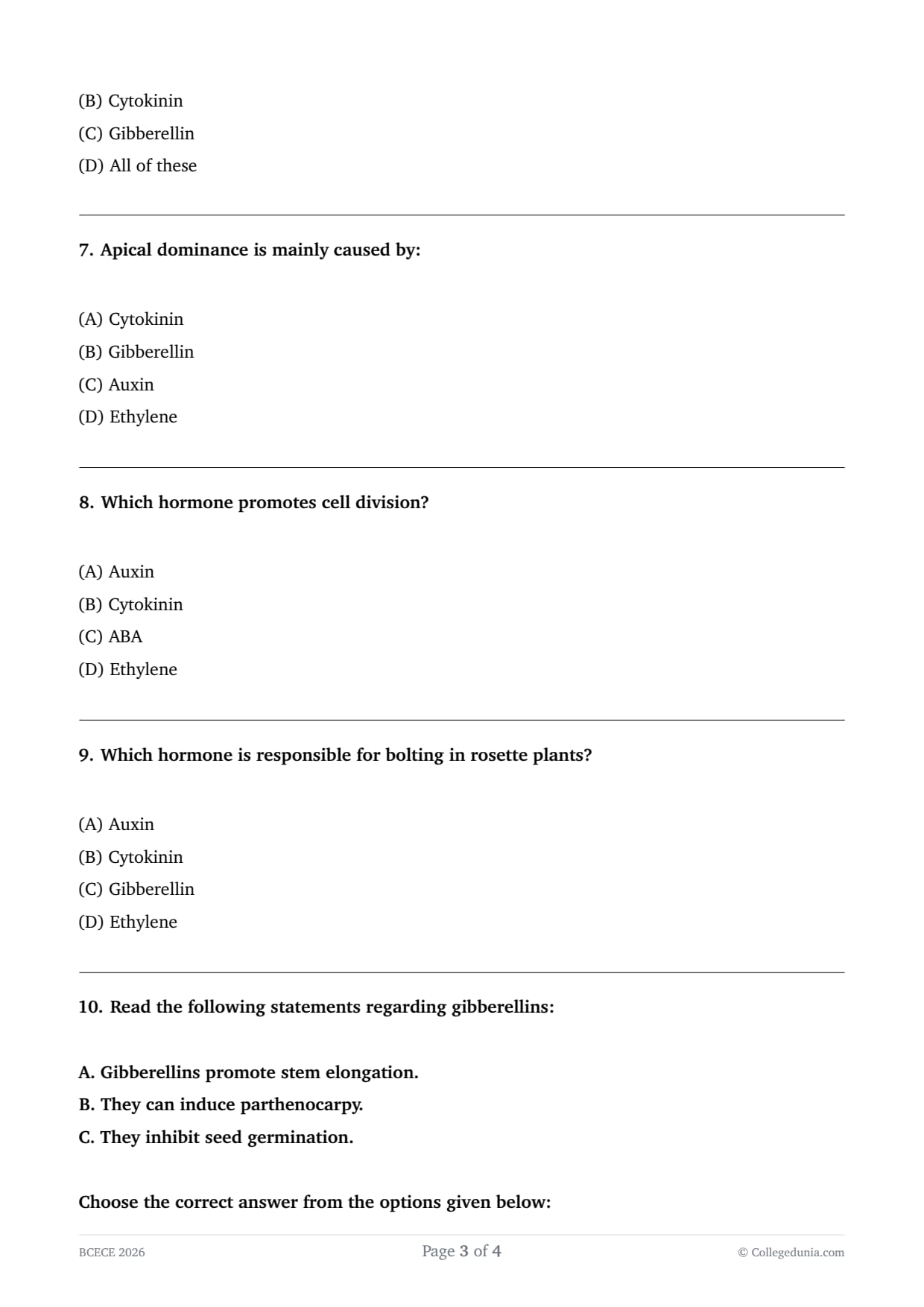
  • (B) Cytokinin
  • (C) Gibberellin
  • (D) All of these
Correct Answer: (D) All of these
View Solution


Step 1: Understanding the Concept:

Plant Growth Regulators (PGRs), also widely known as phytohormones, are simple, small chemical molecules produced in minute quantities by plant tissues. They travel throughout the plant body to control, alter, and regulate various physiological and developmental processes—such as cell division, elongation, seed dormancy, flowering, fruit ripening, and leaf fall.


Step 2: Detailed Explanation:

Let's examine the primary functions of each chemical substance listed in the options:
- (A) Auxin: The first discovered plant hormone, primarily synthesized at growing shoot tips. It plays a critical role in apical dominance, cell elongation, and phototropic bending.
- (B) Cytokinin: A hormone that promotes active cytokinesis (cell division). It is found in abundance in areas undergoing rapid division, such as root apexes and developing coconut milk, and helps delay leaf senescence.
- (C) Gibberellin: A vast family of acidic hormones that promote internodal stem elongation, break seed dormancy, and induce bolting (sudden elongation of stems) in rosette plants.

Since Auxin, Cytokinin, and Gibberellin are all major classes of naturally occurring phytohormones that regulate plant development, they collectively fit the definition of plant growth regulators. This makes option (D) the correct choice.


Step 3: Final Answer:

All of the listed options (Auxin, Cytokinin, and Gibberellin) are plant growth regulators.
Quick Tip: To easily master the five primary Plant Growth Regulators for your biology exams, split them into two clear functional groups: 1. The Promoters (Growth Boosters): Auxins, Gibberellins, and Cytokinins. 2. The Inhibitors (Stress Responders): Abscisic Acid (ABA) and Ethylene. This functional breakdown helps you spot them instantly in any multiple-choice list!


Question 7:

Apical dominance is mainly caused by:

  • (A) Cytokinin
  • (B) Gibberellin
  • (C) Auxin
  • (D) Ethylene
Correct Answer: (C) Auxin
View Solution


Step 1: Understanding the Concept:

In many vascular plants, the growing terminal apex (the absolute top shoot tip) exerts a powerful inhibitory control over the development of lateral or axillary buds located further down the stem. This physiological phenomenon is called apical dominance. Because the main central stem grows much faster and suppresses the side branches, the plant takes on a tall, conical, Christmas-tree-like structural shape.


Step 2: Detailed Explanation:

Let's look at the hormonal mechanism that drives this process:
1. The terminal shoot apical meristem actively synthesizes high concentrations of the plant hormone Auxin (primarily Indole-3-acetic acid, or IAA).
2. Due to gravity and specialized cellular transport proteins, this auxin flows downward along the main stem axis.
3. The continuous downward flow of auxin triggers specific biochemical pathways that actively suppress the growth of axillary buds, keeping them dormant.
4. If a gardener trims away the terminal tip (decapitation), the primary source of auxin is removed. With auxin levels dropped, the lateral buds are released from dormancy and begin dividing rapidly, causing the plant to grow bushy and dense.

Therefore, apical dominance is directly maintained by auxin. This matches option (C).


Step 3: Final Answer:

Apical dominance is mainly caused by Auxin.
Quick Tip: To easily remember this for your botanical exams, associate Auxin with the Apex! Since Auxin is made at the Apex, it rules over the rest of the plant stem, enforcing Apical dominance. If you want a plant to grow wide instead of tall, chop the apex off to break the spell!


Question 8:

Which hormone promotes cell division?

  • (A) Auxin
  • (B) Cytokinin
  • (C) ABA
  • (D) Ethylene
Correct Answer: (B) Cytokinin
View Solution


Step 1: Understanding the Concept:

Cell division, or mitosis, is the fundamental biological driver behind tissue formation, organ growth, and structural development in all multicellular living organisms. In the plant kingdom, specialized chemical messengers trigger the various stages of the cell cycle—including DNA replication, spindle fiber assembly, and the final splitting of the cytoplasm (cytokinesis).


Step 2: Detailed Explanation:

Let's evaluate the primary functional roles of each phytohormone option:
- (A) Auxin: Primarily promotes cell elongation, apical dominance, and root initiation, working alongside other hormones to guide tissue differentiation.
- (B) Cytokinin: This class of hormones was discovered specifically during research into chemical agents that could trigger cell splitting in tissue cultures. The very name Cytokinin is derived directly from cytokinesis (the division of cytoplasm during mitosis). It actively coordinates with auxin to drive rapid cell division in regions like root apexes, developing shoot buds, and young endosperm tissues.
- (C) ABA (Abscisic Acid): Known primarily as a growth inhibitor and "stress hormone," it induces seed dormancy and triggers stomatal closure during droughts.
- (D) Ethylene: A gaseous hormone that primarily regulates fruit ripening, triple response movements, and senescent tissue aging.

Because cell division and cytokinesis are the defining functions of Cytokinin, it is the correct answer. This matches option (B).


Step 3: Final Answer:

The hormone that promotes cell division is Cytokinin.
Quick Tip: This is one of the easiest etymological links to memorize in biology: Cytokinin drives Cytokinesis! Whenever a test question mentions rapid cell division, tissue culture proliferation, or breaking apical dominance to start fresh growth, look immediately for Cytokinin.


Question 9:

Which hormone is responsible for bolting in rosette plants?

  • (A) Auxin
  • (B) Cytokinin
  • (C) Gibberellin
  • (D) Ethylene
Correct Answer: (C) Gibberellin
View Solution


Step 1: Understanding the Concept:

Certain plants, such as cabbage, beet, and lettuce, exhibit a compressed growth habit known as a rosette. In these plants, the internodes are highly reduced, causing the leaves to grow clustered together tightly near the soil surface. Under specific environmental conditions (like changes in day length or temperature) or upon targeted chemical treatment, these plants undergo a dramatic developmental shift where their stems suddenly stretch out just prior to flowering. This rapid, premature elongation of internodes is biologically termed bolting.


Step 2: Detailed Explanation:

Let's look at the hormonal mechanism that triggers this dramatic elongation:
- Gibberellins (GAs) are plant growth regulators that primarily target internodal regions by stimulating both rapid cell division and cell elongation.
- In rosette plants, the natural production of gibberellin is genetically restricted during regular vegetative growth, keeping the plant compact.
- When gibberellin is applied artificially to a rosette plant, it overcomes this genetic restriction, causing the compressed internodes to expand. The stem shoots upward rapidly, inducing bolting and triggering immediate flowering.

Therefore, Gibberellin is the specific phytohormone responsible for this process. This matches option (C).


Step 3: Final Answer:

The hormone responsible for bolting in rosette plants is Gibberellin.
Quick Tip: To easily remember this on an exam, use this simple sound-association trick: Gibberellins make things Giant! Whether it is making individual grape stalks longer, stretching out sugarcane stalks, or causing a flat cabbage rosette to bolt upward into a tall tower, Gibberellin is always your go-to hormone for stem elongation.


Question 10:

Read the following statements regarding gibberellins:


A. Gibberellins promote stem elongation.

B. They can induce parthenocarpy.

C. They inhibit seed germination.


Choose the correct answer from the options given below:

  • (A) Only A and B are correct
  • (B) Only B and C are correct
  • (C) Only A and C are correct
  • (D) A, B and C are correct
Correct Answer: (A) Only A and B are correct
View Solution


Step 1: Understanding the Concept:

Gibberellins represent a vast family of naturally occurring acidic plant hormones (labeled as \(GA_1\), \(GA_2\), \(GA_3\), etc.) that control various aspects of plant development. To evaluate multi-statement hormone questions, you must distinguish between their growth-promoting actions (like axis stretching and tissue manipulation) and their regulatory interactions during a seed's life cycle.


Step 2: Detailed Explanation:

Let's analyze the validity of each statement systematically:

- Statement A: "Gibberellins promote stem elongation." (Correct)
This is the classic primary function of gibberellins. They increase the length of the axis in plants like sugarcane, grapes, and rosette structures by accelerating cell wall loosening and elongation in internodal tissues.

- Statement B: "They can induce parthenocarpy." (Correct)
Parthenocarpy is the development of fruits without prior fertilization, resulting in seedless varieties. Gibberellins are highly effective at inducing seedless fruit development in crops like tomatoes, apples, and pears, often performing this role even more effectively than auxins.

- Statement C: "They inhibit seed germination." (Incorrect)
This statement is factually backward. Gibberellins actually promote and trigger seed germination. When a seed absorbs water, gibberellins are released to activate hydrolytic enzymes (like \(\alpha\)-amylase). These enzymes break down stored starch into simple sugars to feed the growing embryo, effectively breaking seed dormancy. The hormone that inhibits germination and enforces dormancy is Abscisic Acid (ABA).

Since statements A and B are correct, while statement C is incorrect, the correct choice is option (A).


Step 3: Final Answer:

The correct option is (A) Only A and B are correct.
Quick Tip: Think of Gibberellin and Abscisic Acid (ABA) as two bitter rivals fighting a constant tug-of-war inside a seed: - Gibberellin acts as the "Wake-Up" signal that breaks dormancy and starts germination. - ABA acts as the "Sleep" signal that keeps the seed dormant during harsh conditions. Knowing this functional opposition helps you spot incorrect statements about dormancy instantly!

BCECE 2026 Biology Marking Scheme

Parameter Details
Total Questions 100
Total Marks 400
Marks for Correct Answer +4 Marks
Marks for Wrong Answer -1 Mark
Marks for Unattempted Question 0 Marks
Type of Questions Objective Type (MCQs)
Exam Duration 90 Minutes

BIHAR BCECE 2026 Mathematics PYQs