




The Verbal Ability section of the ICFAI Business School Aptitude Test (IBSAT) evaluates a candidate’s command over the English language. It includes questions on grammar, vocabulary, sentence correction, idioms, and verbal reasoning, designed to assess accuracy, comprehension, and effective communication skills crucial for management studies.
IBSAT Verbal Ability Sample Paper with Answer Key PDF
| IBSAT Verbal Ability Sample Paper PDF | Download PDF | Check Solutions |
IBSAT Verbal Ability Question Paper with Solutions
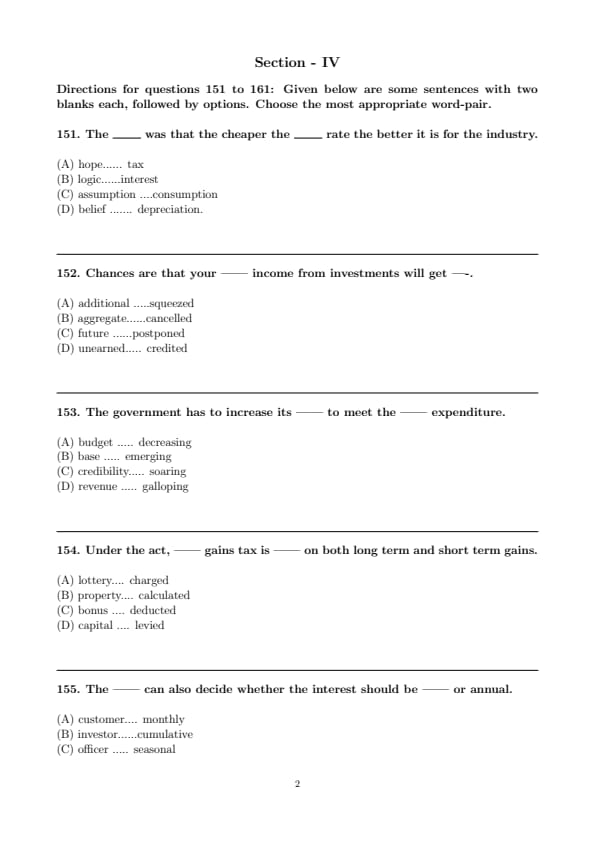
The _________ was that the cheaper the _________ rate the better it is for the industry.
Chances are that your _________ income from investments will get _________.
The government has to increase its _________ to meet the _________ expenditure.
Under the act, _________ gains tax is _________ on both long term and short term gains.
The _________ can also decide whether the interest should be _________ or annual.
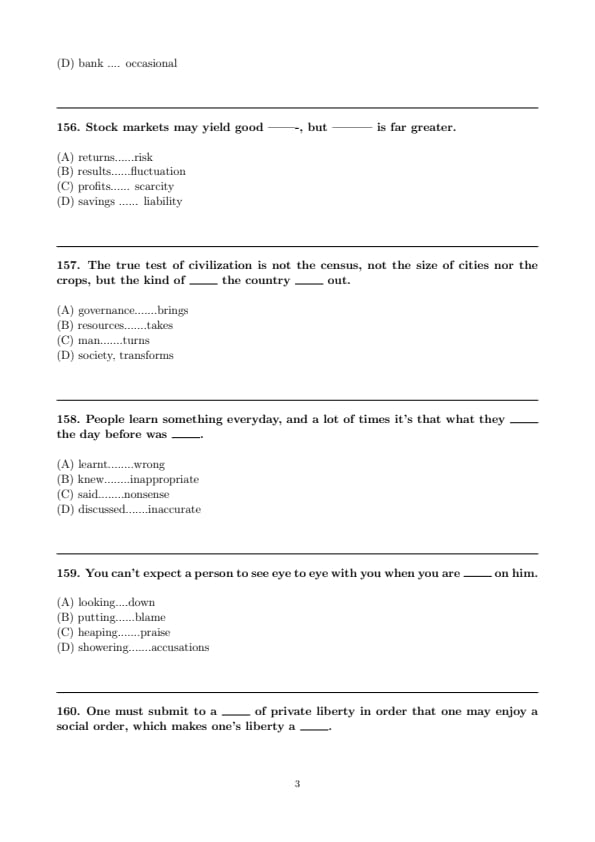
Stock markets may yield good _________, but _________ is far greater.
The true test of civilization is not the census, not the size of cities nor the crops, but the kind of _________ the country _________ out.
People learn something everyday, and a lot of times it's that what they _________ the day before was _________.
You can't expect a person to see eye to eye with you when you are _________ on him.
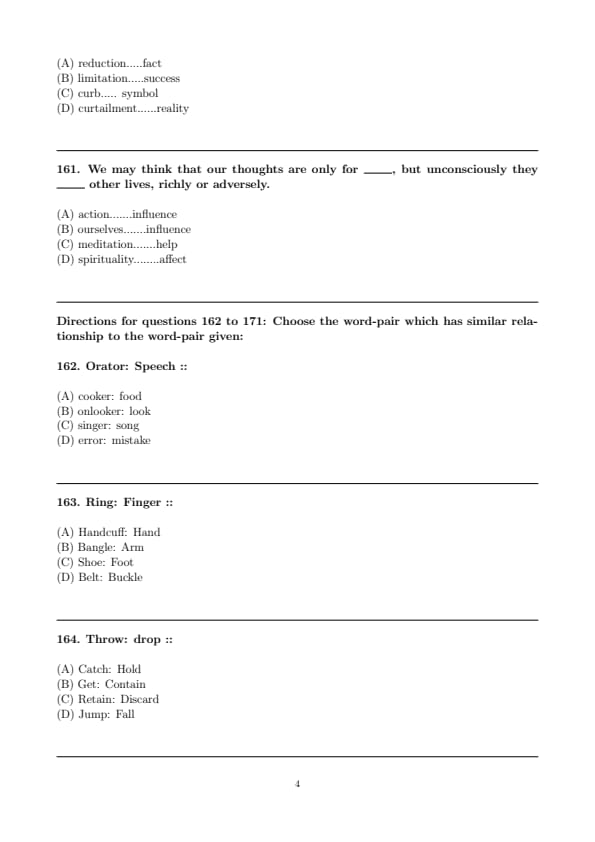
One must submit to a _________ of private liberty in order that one may enjoy a social order, which makes one's liberty a _________.
We may think that our thoughts are only for _________, but unconsciously they _________ other lives, richly or adversely.
Orator: Speech ::
Ring: Finger ::
Throw: drop ::
View Solution
Step 1: Understanding the Relationship
The relationship between Throw and drop is that they are two related actions of releasing an object. To "throw" is to release with force, while to "drop" is to release without force. They represent a pair of similar actions with a difference in intensity or manner.
Step 2: Analyzing the Options
We need to find another pair of related actions.
(A) Catch and Hold are two related actions of securing an object. To "catch" is to actively intercept a moving object, and to "hold" is to keep it in one's possession. This pairing of related actions in the same domain (securing an object) is analogous to the original pair (releasing an object).
(B) To get is to acquire, and to contain is to have something inside. The relationship is not as direct as the given pair.
(C) Retain and Discard are antonyms (to keep vs. to throw away).
(D) Jump is a self-propelled action, while fall is usually an involuntary action due to gravity. They are not two different ways of performing the same basic task.
Step 3: Final Answer
The pair Catch: Hold presents two related actions for securing an object, which is analogous to Throw: drop presenting two related actions for releasing an object.
Quick Tip: Sometimes, the relationship isn't a simple category like "synonym" or "antonym." It can be about actions within the same domain. Classify the given pair (e.g., "actions of releasing") and look for an option that fits a similar classification (e.g., "actions of securing").
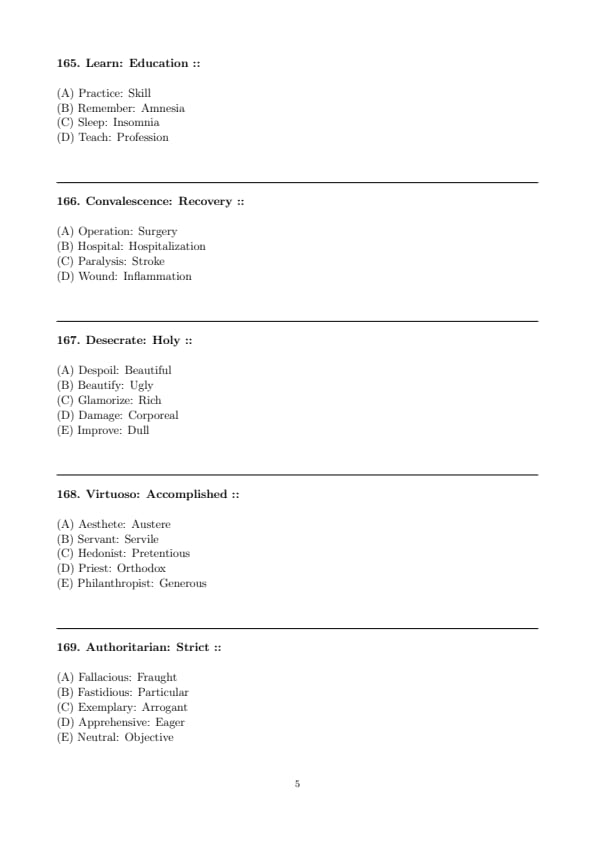
Learn: Education ::
Convalescence: Recovery ::
Desecrate: Holy ::
Virtuoso: Accomplished ::
Authoritarian: Strict ::
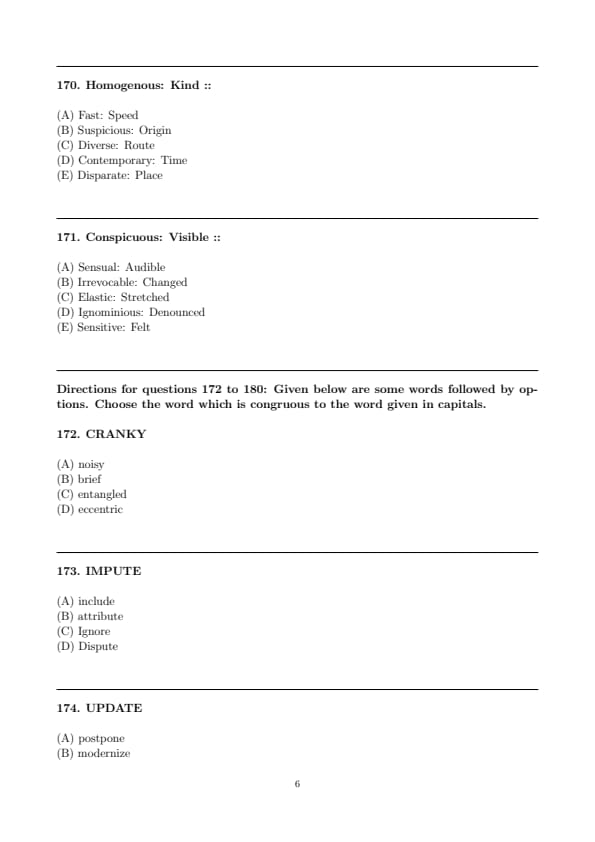
Homogenous: Kind ::
Conspicuous: Visible ::
CRANKY
IMPUTE
UPDATE
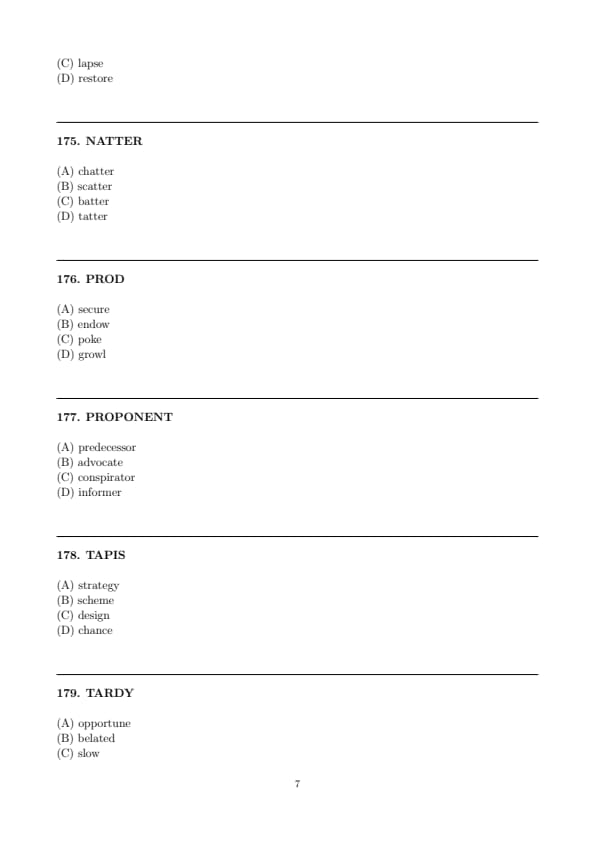
NATTER
PROD
PROPONENT
TAPIS
TARDY
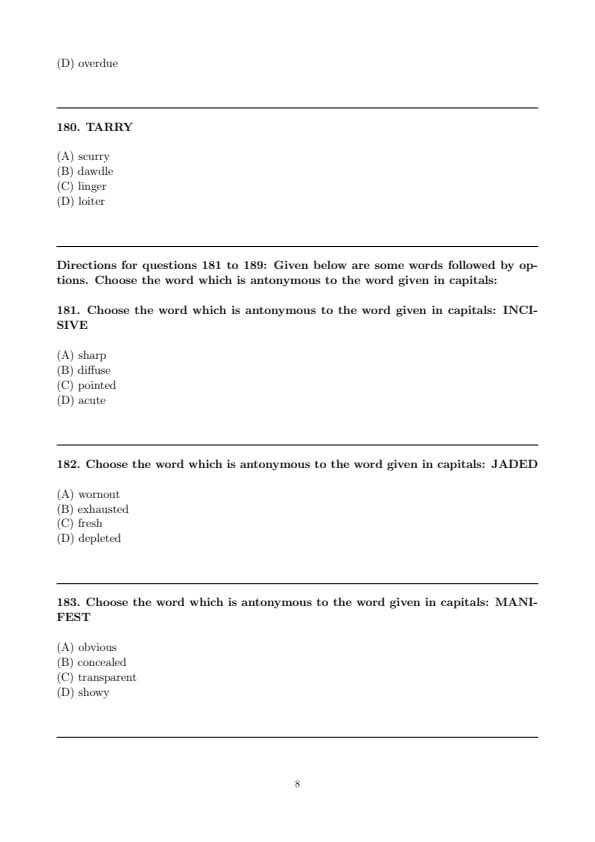
TARRY
INCISIVE
JADED
MANIFEST
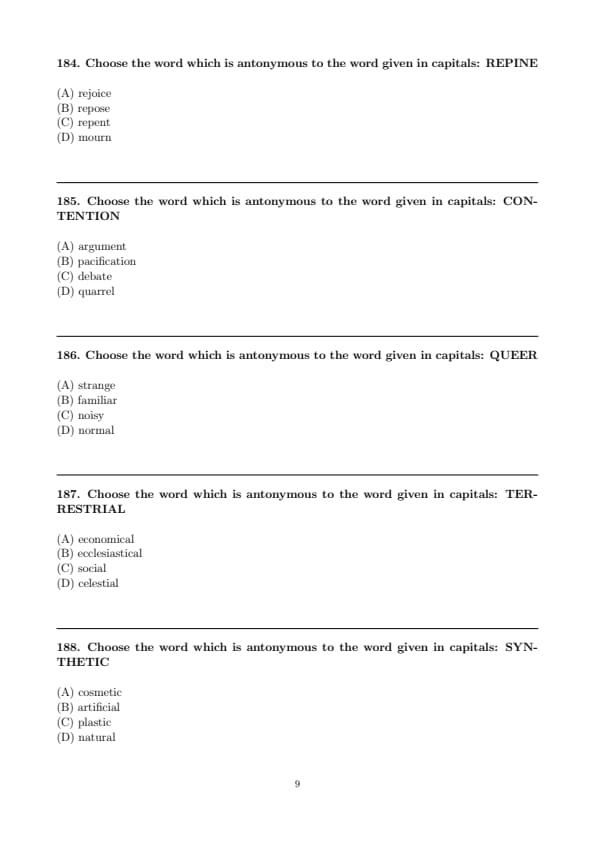
REPINE
CONTENTION
QUEER
TERRESTRIAL
SYNTHETIC
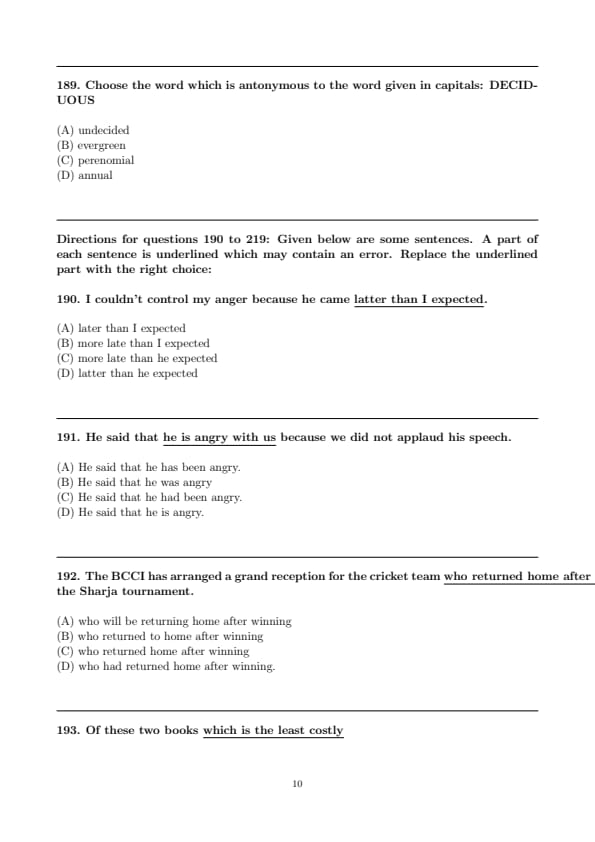
DECIDUOUS
I couldn't control my anger because he came latter than I expected.
He said that he is angry with us because we did not applaud his speech.
The BCCI has arranged a grand reception for the cricket team who returned home after winning
the Sharja tournament.
Of these two books which is the least costly
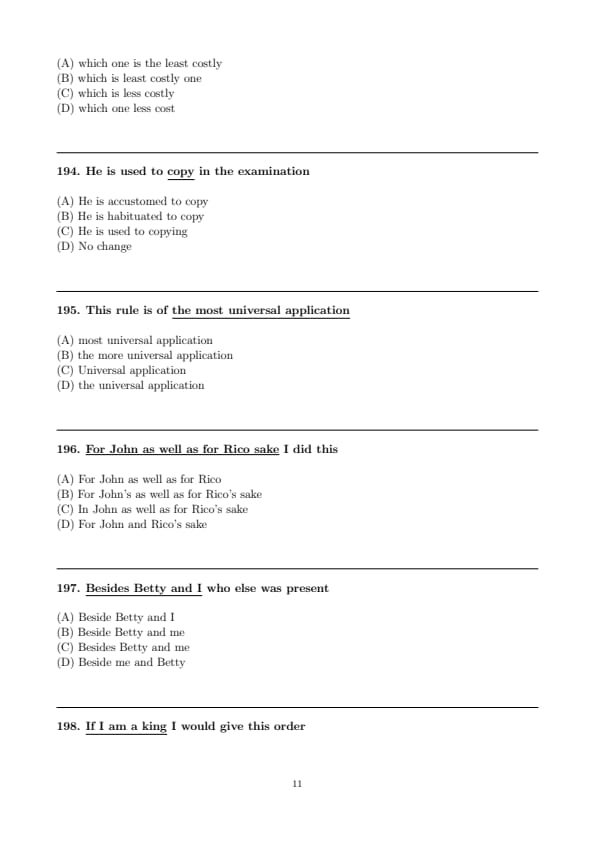
He is used to copy in the examination
This rule is of the most universal application
For John as well as for Rico sake I did this
Besides Betty and I who else was present
If I am a king I would give this order
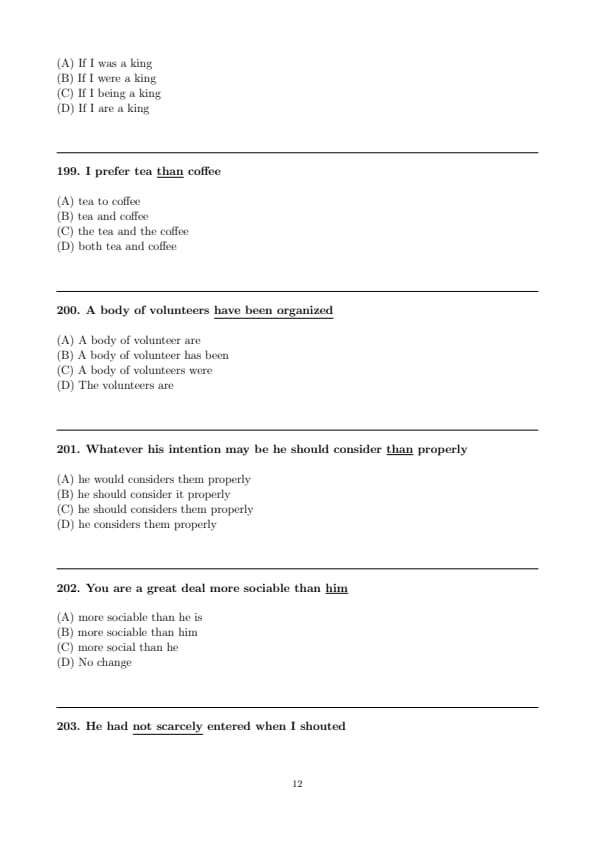
I prefer tea than coffee
A body of volunteers have been organized
Whatever his intention may be he should consider than properly
You are a great deal more sociable than him
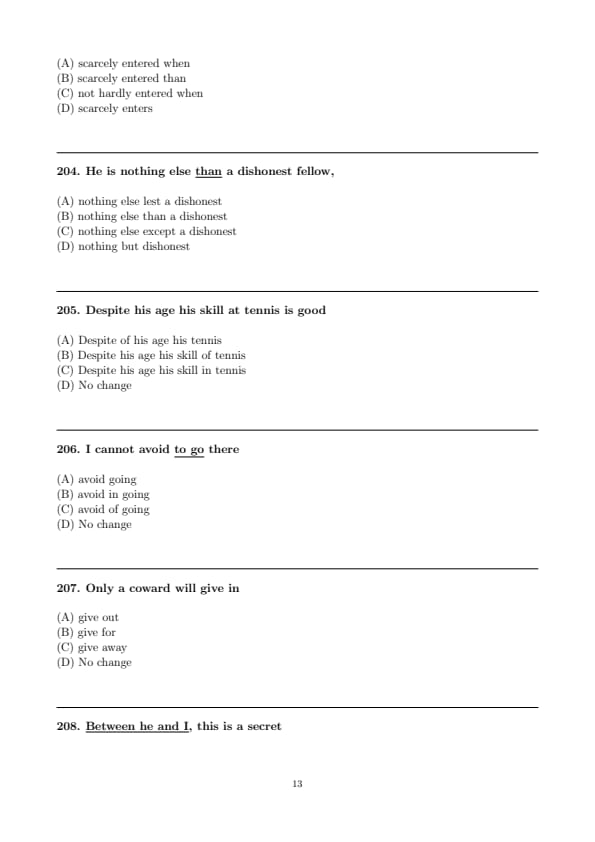
He had not scarcely entered when I shouted
He is nothing else than a dishonest fellow,
Despite his age his skill at tennis is good
I cannot avoid to go there
Only a coward will give in
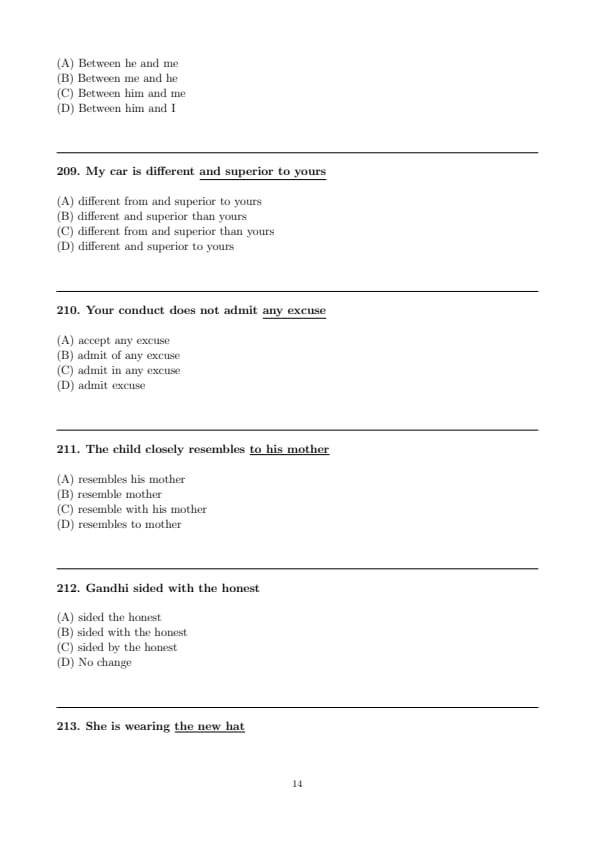
Between he and I, this is a secret
My car is different and superior to yours
Your conduct does not admit any excuse
The child closely resembles to his mother
Gandhi sided with the honest
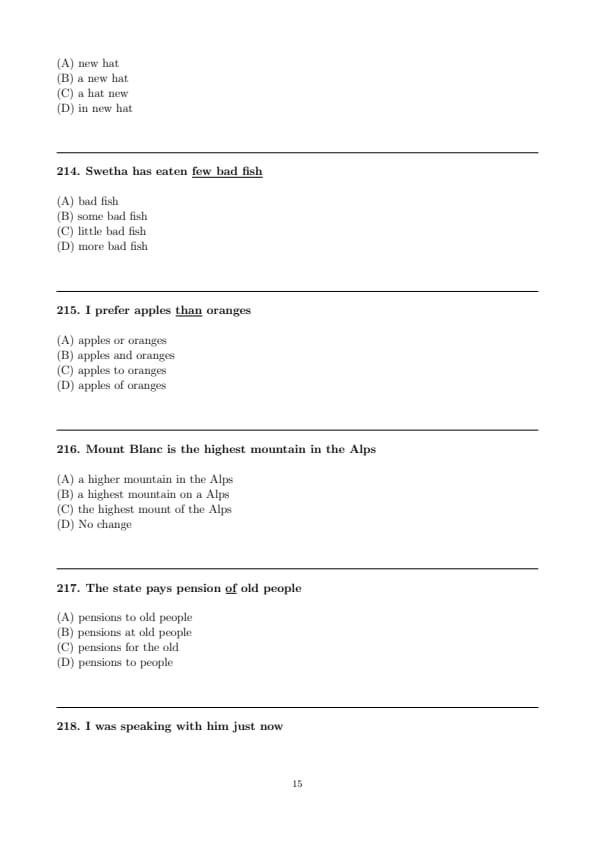
She is wearing the new hat
Swetha has eaten few bad fish
I prefer apples than oranges
Mount Blanc is the highest mountain in the Alps
The state pays pension of old people
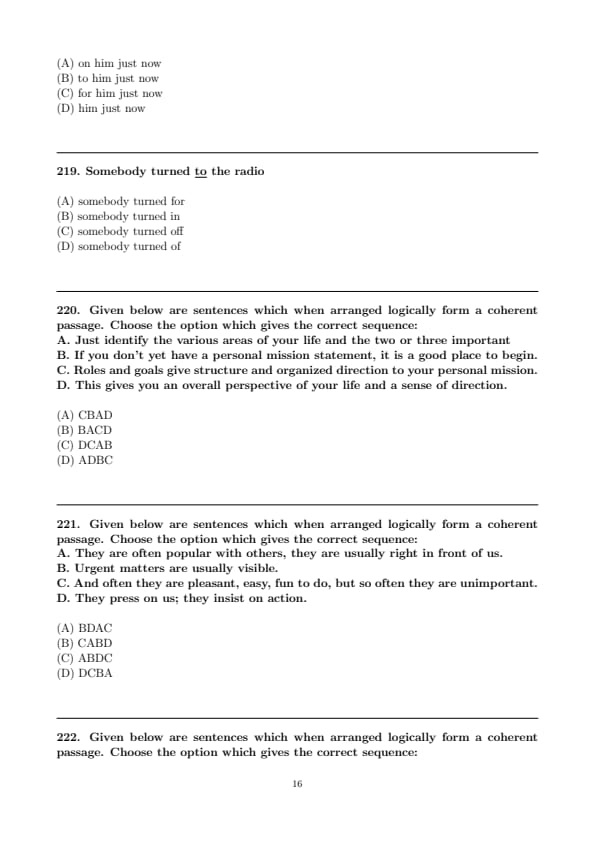
I was speaking with him just now
Somebody turned to the radio
Given below are sentences which when arranged logically form a coherent passage. Choose the option which gives the correct sequence:
A. Just identify the various areas of your life and the two or three important
B. If you don't yet have a personal mission statement, it is a good place to begin.
C. Roles and goals give structure and organized direction to your personal mission.
D. This gives you an overall perspective of your life and a sense of direction.
Given below are sentences which when arranged logically form a coherent passage. Choose the option which gives the correct sequence:
A. They are often popular with others, they are usually right in front of us.
B. Urgent matters are usually visible.
C. And often they are pleasant, easy, fun to do, but so often they are unimportant.
D. They press on us; they insist on action.
Given below are sentences which when arranged logically form a coherent passage. Choose the option which gives the correct sequence:
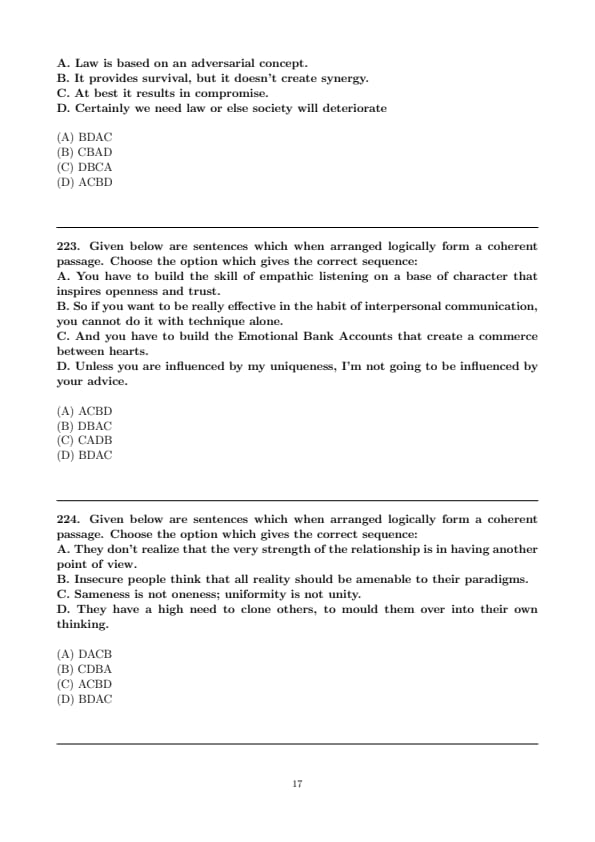
A. Law is based on an adversarial concept.
B. It provides survival, but it doesn't create synergy.
C. At best it results in compromise.
D. Certainly we need law or else society will deteriorate
Given below are sentences which when arranged logically form a coherent passage. Choose the option which gives the correct sequence:
A. You have to build the skill of empathic listening on a base of character that inspires openness and trust.
B. So if you want to be really effective in the habit of interpersonal communication, you cannot do it with technique alone.
C. And you have to build the Emotional Bank Accounts that create a commerce between hearts.
D. Unless you are influenced by my uniqueness, I'm not going to be influenced by your advice.
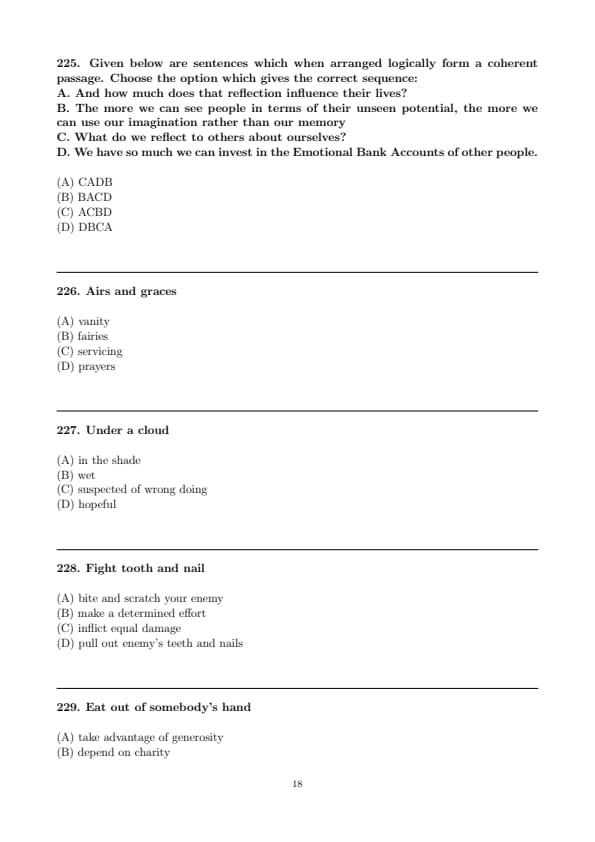
Given below are sentences which when arranged logically form a coherent passage. Choose the option which gives the correct sequence:
A. They don't realize that the very strength of the relationship is in having another point of view.
B. Insecure people think that all reality should be amenable to their paradigms.
C. Sameness is not oneness; uniformity is not unity.
D. They have a high need to clone others, to mould them over into their own thinking.
Given below are sentences which when arranged logically form a coherent passage. Choose the option which gives the correct sequence:
A. And how much does that reflection influence their lives?
B. The more we can see people in terms of their unseen potential, the more we can use our imagination rather than our memory
C. What do we reflect to others about ourselves?
D. We have so much we can invest in the Emotional Bank Accounts of other people.
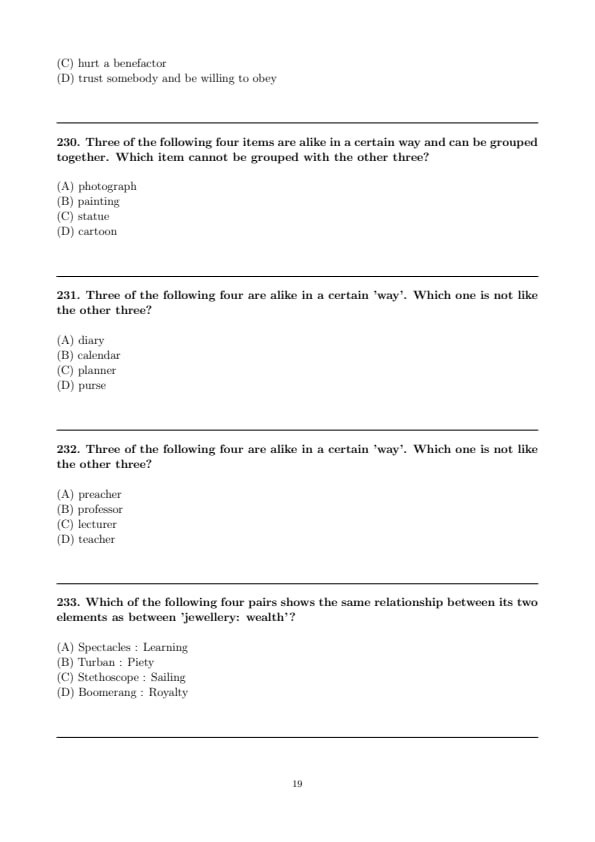
Airs and graces
Under a cloud
Fight tooth and nail
Eat out of somebody's hand
Three of the following four items are alike in a certain way and can be grouped together. Which item cannot be grouped with the other three?
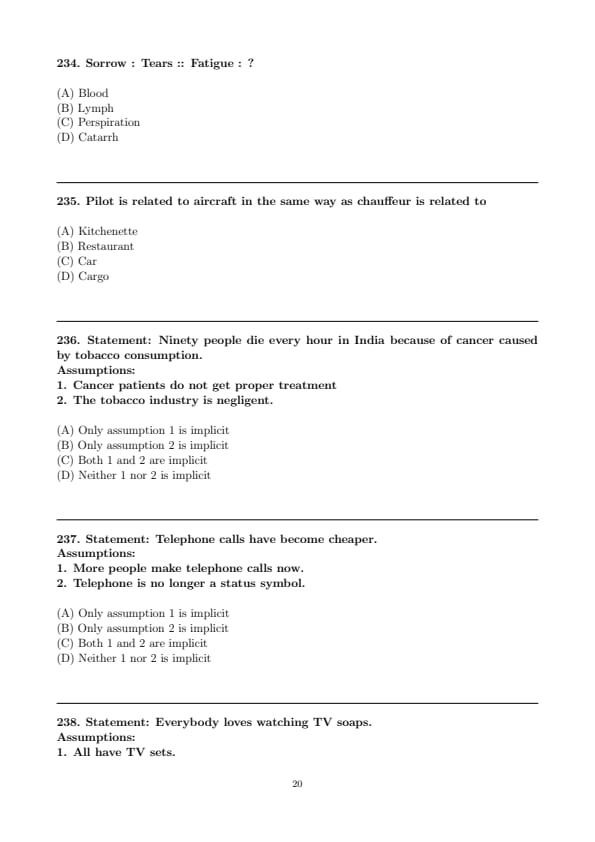
Three of the following four are alike in a certain 'way'. Which one is not like the other three?
Three of the following four are alike in a certain 'way'. Which one is not like the other three?
Which of the following four pairs shows the same relationship between its two elements as between 'jewellery: wealth'?
Sorrow : Tears :: Fatigue : ?
Pilot is related to aircraft in the same way as chauffeur is related to
Statement: Ninety people die every hour in India because of cancer caused by tobacco consumption.
Assumptions:
1. Cancer patients do not get proper treatment
2. The tobacco industry is negligent.
View Solution
Step 1: Understanding the Question:
We need to determine which of the given assumptions is implicit in the statement. An implicit assumption is something that the speaker takes for granted or presupposes for the statement to be true.
Step 2: Detailed Explanation:
Analyzing the Statement: The statement is a statistical fact. It links a cause (tobacco consumption) to an effect (death from cancer) and quantifies it (ninety people per hour in India).
Analyzing Assumption 1: "Cancer patients do not get proper treatment."
The statement says people die *because of cancer*. It does not provide any information about the quality or availability of medical treatment. People can die from cancer even with the best possible treatment. Therefore, the statement does not presuppose that treatment is improper. This assumption is not implicit.
Analyzing Assumption 2: "The tobacco industry is negligent."
The statement focuses on the consequences of consuming tobacco, not on the actions or ethics of the industry that produces it. While one might argue that selling a product that causes death is negligent, the statement itself does not rely on this assumption. The statement is a factual report on health outcomes, not a judgment on the industry. This assumption is not implicit.
Step 3: Final Answer:
Since neither assumption is necessarily true for the statement to hold, Neither 1 nor 2 is implicit.
Quick Tip: In statement-assumption questions, stick strictly to what the statement logically presupposes. Do not bring in your own general knowledge or moral judgments. The statement here is a statistic and does not assume anything about treatment or industry negligence.
Statement: Telephone calls have become cheaper.
Assumptions:
1. More people make telephone calls now.
2. Telephone is no longer a status symbol.
View Solution
Step 1: Understanding the Question:
We need to evaluate which assumption is implicit in the given statement. The statement is a simple declaration of fact.
Step 2: Detailed Explanation:
Analyzing the Statement: The statement simply says that the price of making telephone calls has decreased.
Analyzing Assumption 1: "More people make telephone calls now."
This is a possible consequence or effect of telephone calls becoming cheaper. According to the law of demand, a lower price usually leads to higher quantity demanded. However, it is not an assumption. The statement about the price being cheaper is true regardless of how many people are making calls. It is an inference, not a presupposition.
Analyzing Assumption 2: "Telephone is no longer a status symbol."
This is also a likely consequence. When something becomes cheap and widely accessible, it often loses its value as a status symbol. But the statement itself does not depend on this being true. The price can drop whether it's a status symbol or not. Therefore, this is not an implicit assumption.
Step 3: Final Answer:
Both assumptions are potential outcomes of the statement, not prerequisites for it. Thus, Neither 1 nor 2 is implicit.
Quick Tip: Distinguish between an assumption and an inference/conclusion. An assumption is something the speaker must believe is true *before* making the statement. An inference is something that follows *from* the statement. Both points here are inferences, not assumptions.
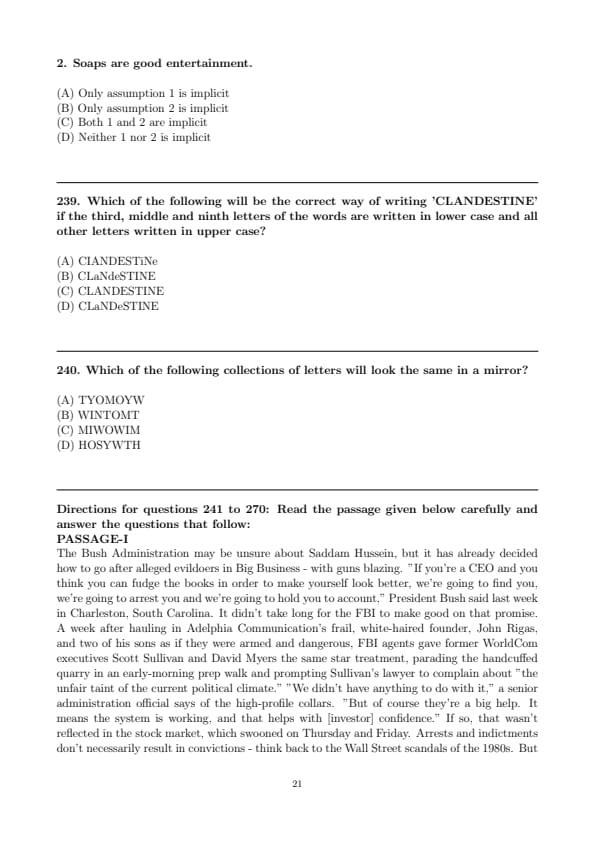
Statement: Everybody loves watching TV soaps.
Assumptions:
1. All have TV sets.
2. Soaps are good entertainment.
View Solution
Step 1: Understanding the Question:
We must determine which assumptions are implicitly made in the sweeping statement provided.
Step 2: Detailed Explanation:
Analyzing the Statement: The statement makes a universal claim: "Everybody loves watching TV soaps."
Analyzing Assumption 1: "All have TV sets."
For "everybody" to love "watching" TV soaps, it is necessary that everybody has the means to watch them. Having a TV set (or access to one) is a prerequisite for the act of watching. Therefore, the speaker must be assuming that everyone has the capability to watch TV. This assumption is implicit.
Analyzing Assumption 2: "Soaps are good entertainment."
The verb "loves" implies a strong positive feeling. If everybody loves watching something, the speaker must assume that this something provides a positive experience, such as being good entertainment. The reason for loving to watch them is their entertainment value. This assumption is also implicit.
Step 3: Final Answer:
The statement presupposes both the means (access to TV) and the motive (entertainment value). Therefore, Both 1 and 2 are implicit.
Quick Tip: When a statement makes a strong, universal claim (using words like "all," "everybody," "always"), look for the necessary conditions that must be true for such a claim to be made.
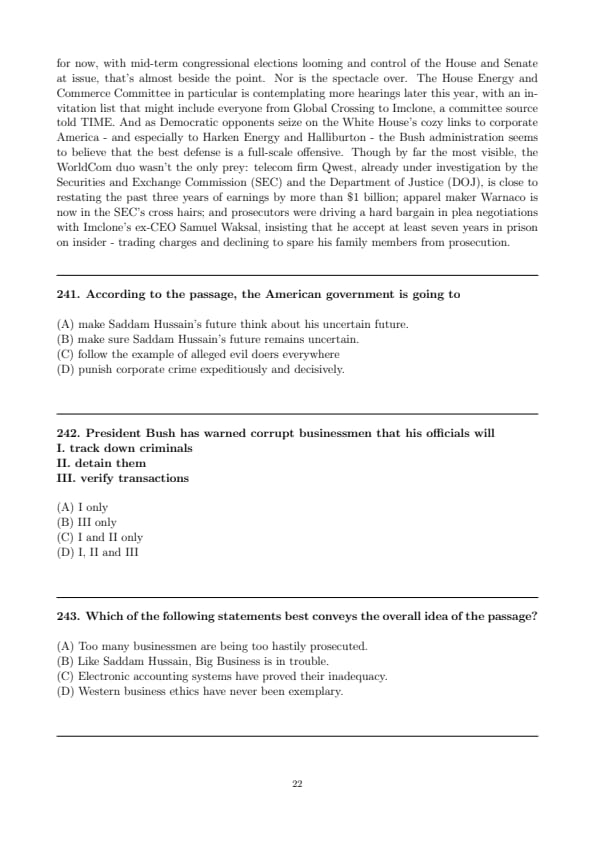
Which of the following will be the correct way of writing 'CLANDESTINE' if the third, middle and ninth letters of the words are written in lower case and all other letters written in upper case?
View Solution
Step 1: Understanding the Question:
We need to modify the word 'CLANDESTINE' according to a specific rule about capitalization.
Step 2: Key Approach:
1. Identify the letters at the specified positions.
2. Change them to lower case.
3. Keep all other letters in upper case.
Step 3: Detailed Explanation:
The word is CLANDESTINE. It has 11 letters.
C(1) L(2) A(3) N(4) D(5) E(6) S(7) T(8) I(9) N(10) E(11)
Rule 1: The third letter must be in lower case.
The 3rd letter is 'A'. It becomes 'a'.
Rule 2: The middle letter must be in lower case.
For an 11-letter word, the middle letter is the \((11+1)/2 = 6^{th}\) letter.
The 6th letter is 'E'. It becomes 'e'.
Rule 3: The ninth letter must be in lower case.
The 9th letter is 'I'. It becomes 'i'.
Applying all rules:
The resulting word should be: CLaNDeSTiNE.
Checking the options:
(A) CIANDESTiNe - Incorrect.
(B) CLaNdeSTINE - Incorrect, as the 9th letter 'I' is uppercase.
(C) CLANDESTINE - Incorrect.
(D) CLaNDeSTINE - Incorrect, as the 9th letter 'I' is uppercase. (Options B and D appear identical).
There seems to be a typographical error in the question or the options, as none of the options perfectly match the derived answer CLaNDeSTiNE. However, option (B) correctly changes the 3rd ('a') and middle ('e') letters. It is the closest match and likely the intended answer, assuming there was an error in the "ninth letter" part of the instruction.
Step 4: Final Answer:
Based on the closest match, we select option (B) CLaNdeSTINE, which fulfills the first two conditions.
Quick Tip: In competitive exams, if you find a discrepancy between your calculated answer and the options, re-read the question carefully. If the discrepancy persists, choose the option that is the "most correct" or fulfills the most conditions.
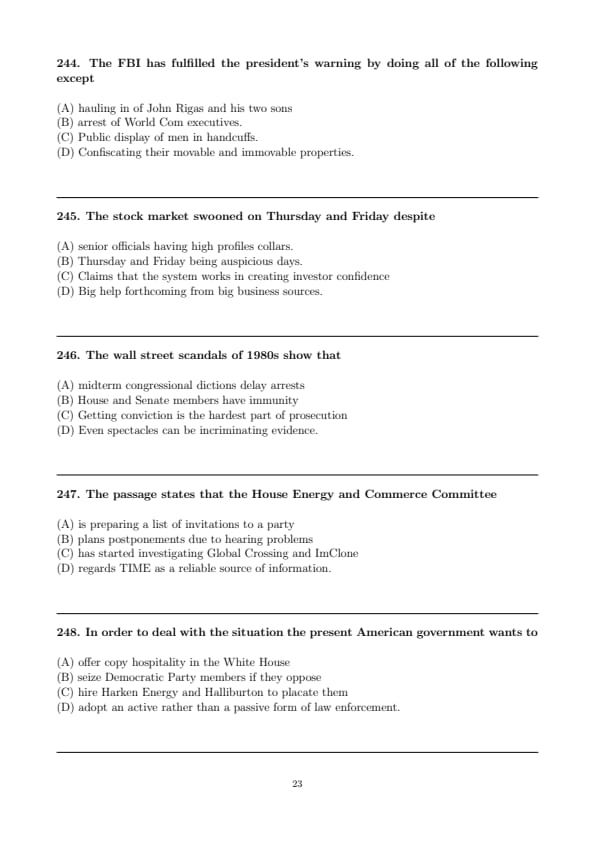
Which of the following collections of letters will look the same in a mirror?
View Solution
Step 1: Understanding the Question:
We are looking for a word that appears unchanged when viewed in a mirror. This involves lateral inversion.
Step 2: Key Concept:
For a word to look the same in a mirror, two conditions must be met:
1. Letter Symmetry: All letters in the word must be vertically symmetrical. The letters that are unchanged by mirror reflection are A, H, I, M, O, T, U, V, W, X, Y.
2. Word Symmetry: The word itself must be a palindrome (reads the same forwards and backwards), because a mirror reverses the order of the letters.
Step 3: Detailed Explanation:
Let's check each option against these two conditions.
(A) TYOMOYW:
- Letter Symmetry: T, Y, O, M, O, Y, W are all vertically symmetrical. (Condition 1 is met).
- Word Symmetry: Is it a palindrome? The first letter is 'T' and the last is 'W'. T \(\neq\) W. It is not a palindrome. (Condition 2 is not met).
(B) WINTOMT:
- Letter Symmetry: The letter 'N' is not vertically symmetrical. (Condition 1 is not met).
(C) MIWOWIM:
- Letter Symmetry: M, I, W, O, W, I, M are all vertically symmetrical. (Condition 1 is met).
- Word Symmetry: Is it a palindrome? It reads the same forwards and backwards. (Condition 2 is met).
Since both conditions are met, MIWOWIM will look the same in a mirror.
(D) HOSYWTH:
- Letter Symmetry: The letter 'S' is not vertically symmetrical. (Condition 1 is not met).
Step 4: Final Answer:
The only option that is a palindrome and consists entirely of vertically symmetrical letters is MIWOWIM.
Quick Tip: To solve mirror image word problems quickly, first scan for any non-symmetrical letters (like B, C, D, E, F, G, J, K, L, N, P, Q, R, S, Z). If found, eliminate the option. Then, for the remaining options, check if they are palindromes.
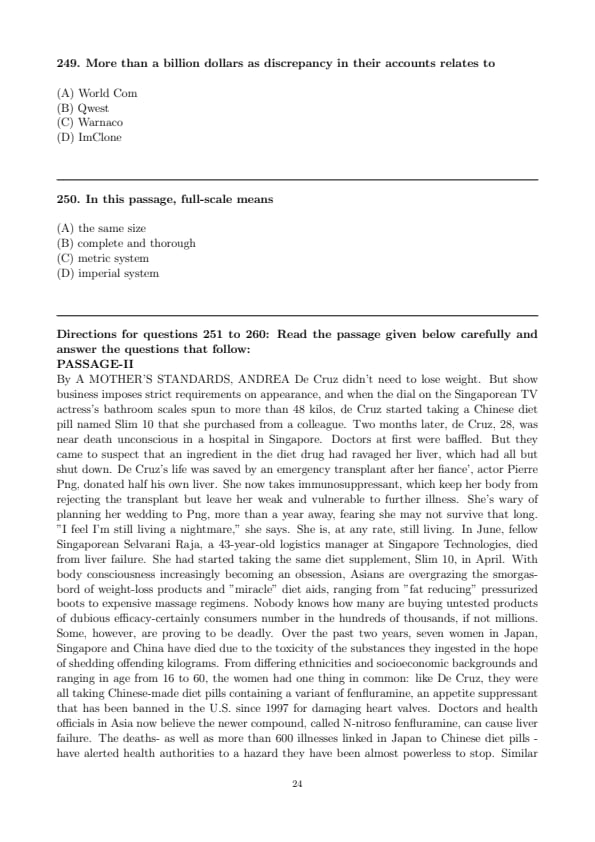
According to the passage, the American government is going to
President Bush has warned corrupt businessmen that his officials will
I. track down criminals
II. detain them
III. verify transactions
Which of the following statements best conveys the overall idea of the passage?
The FBI has fulfilled the president's warning by doing all of the following except
The stock market swooned on Thursday and Friday despite
The wall street scandals of 1980s show that
The passage states that the House Energy and Commerce Committee
In order to deal with the situation the present American government wants to
More than a billion dollars as discrepancy in their accounts relates to
In this passage, full-scale means
According to the passage, the show business
Andrea de Cruz became seriously ill after
The doctors who treated Andrea
Andrea's life was saved by Pierre Png, who.
Immunosuppressant have the effect of
The wedding of Andrea De Cruz to Pierre Png
The fate of Selvarani Raja was to
In this passage, the word regimens means
In the passage, the word toxicity means
Diet drugs have caused death in
I. China
II. Korea
III. Hong Kong
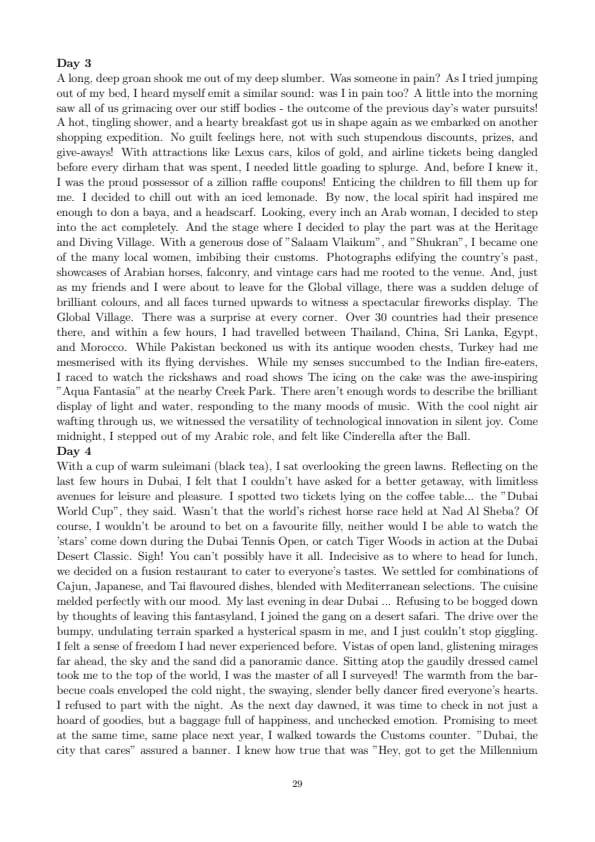
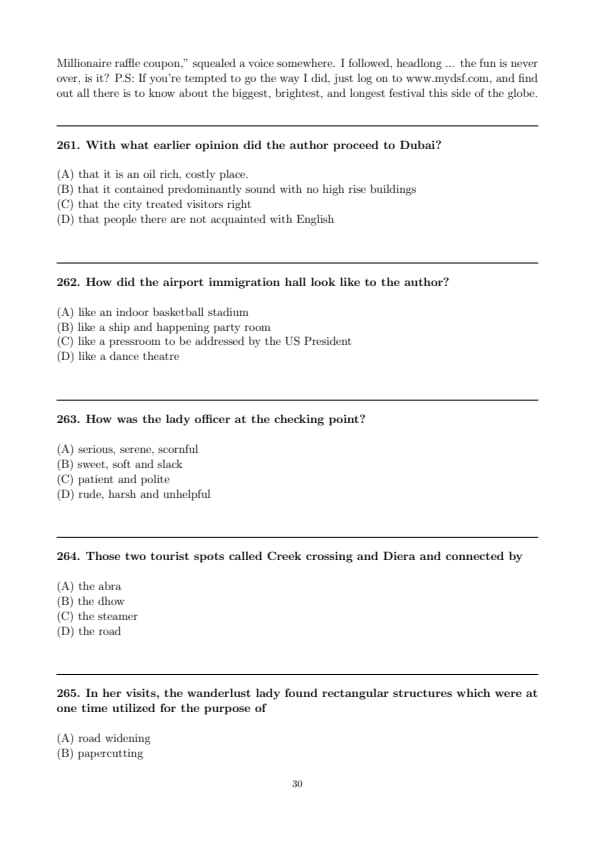
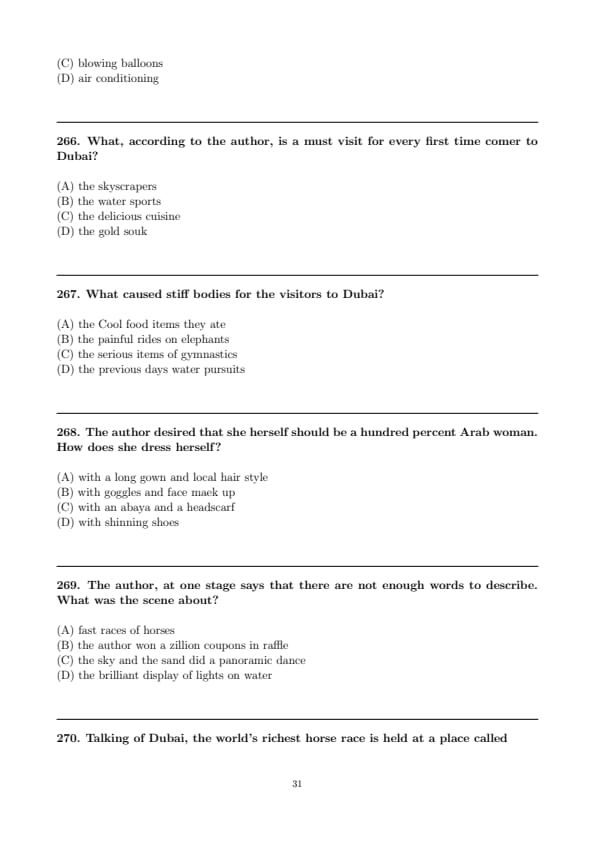
With what earlier opinion did the author proceed to Dubai?
How did the airport immigration hall look like to the author?
How was the lady officer at the checking point?
Those two tourist spots called Creek crossing and Diera and connected by
In her visits, the wanderlust lady found rectangular structures which were at one time utilized for the purpose of
What, according to the author, is a must visit for every first time comer to Dubai?
What caused stiff bodies for the visitors to Dubai?
The author desired that she herself should be a hundred percent Arab woman. How does she dress herself?
The author, at one stage says that there are not enough words to describe. What was the scene about?
Talking of Dubai, the world's richest horse race is held at a place called




Comments