




The IBSAT 2018 question paper with solutions is available for free download. IBSAT (ICFAI Business School Aptitude Test) is conducted by ICFAI Foundation for Higher Education for admission to IBS Hyderabad and its constituent campuses. The paper carried 140 questions across Verbal Ability, Reading Comprehension, Quantitative Aptitude, and Data Adequacy & Data Interpretation, attempted in 2 hours.
| IBSAT 2018 Question Paper with Solutions | Download PDF | Check Solutions |
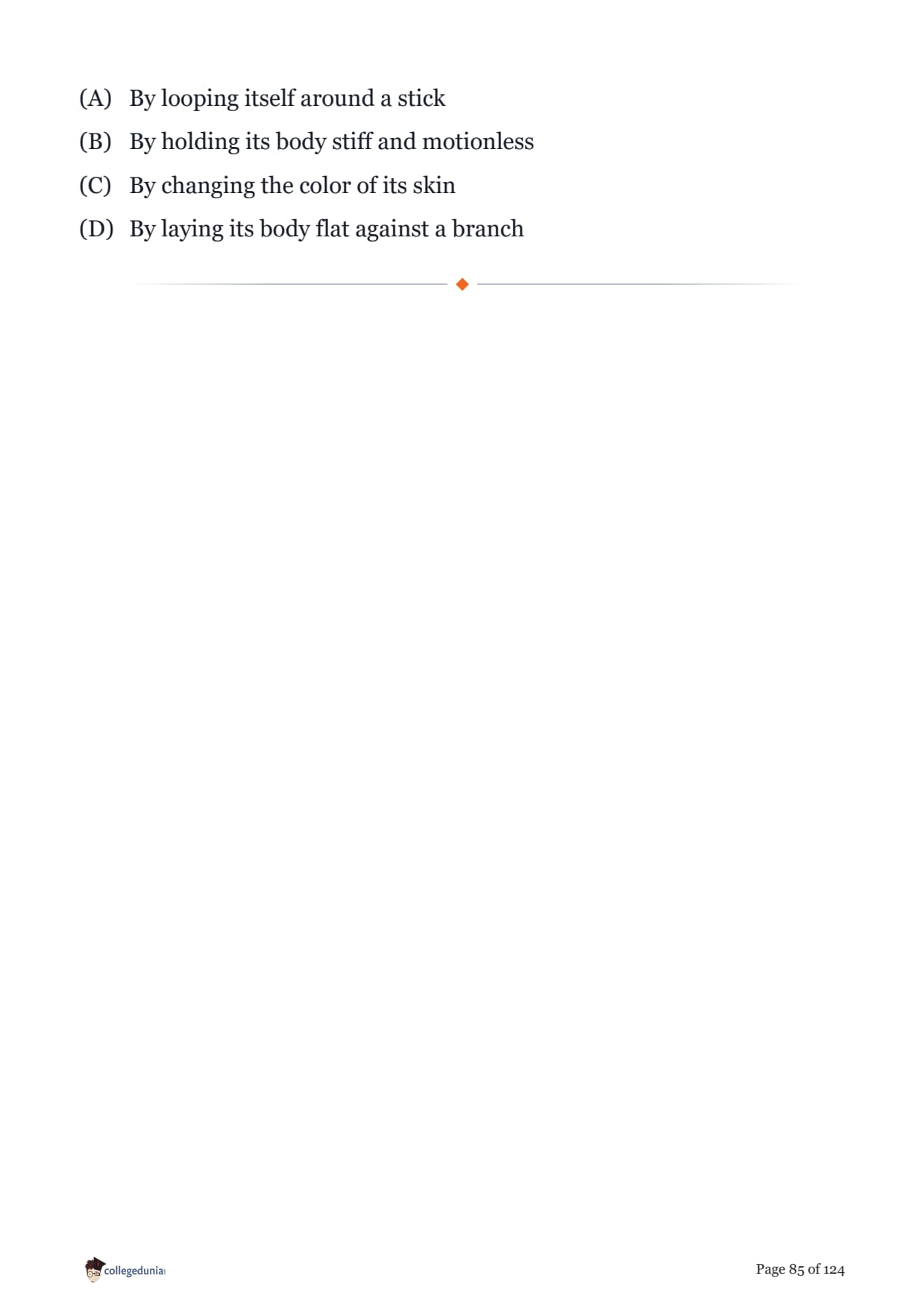
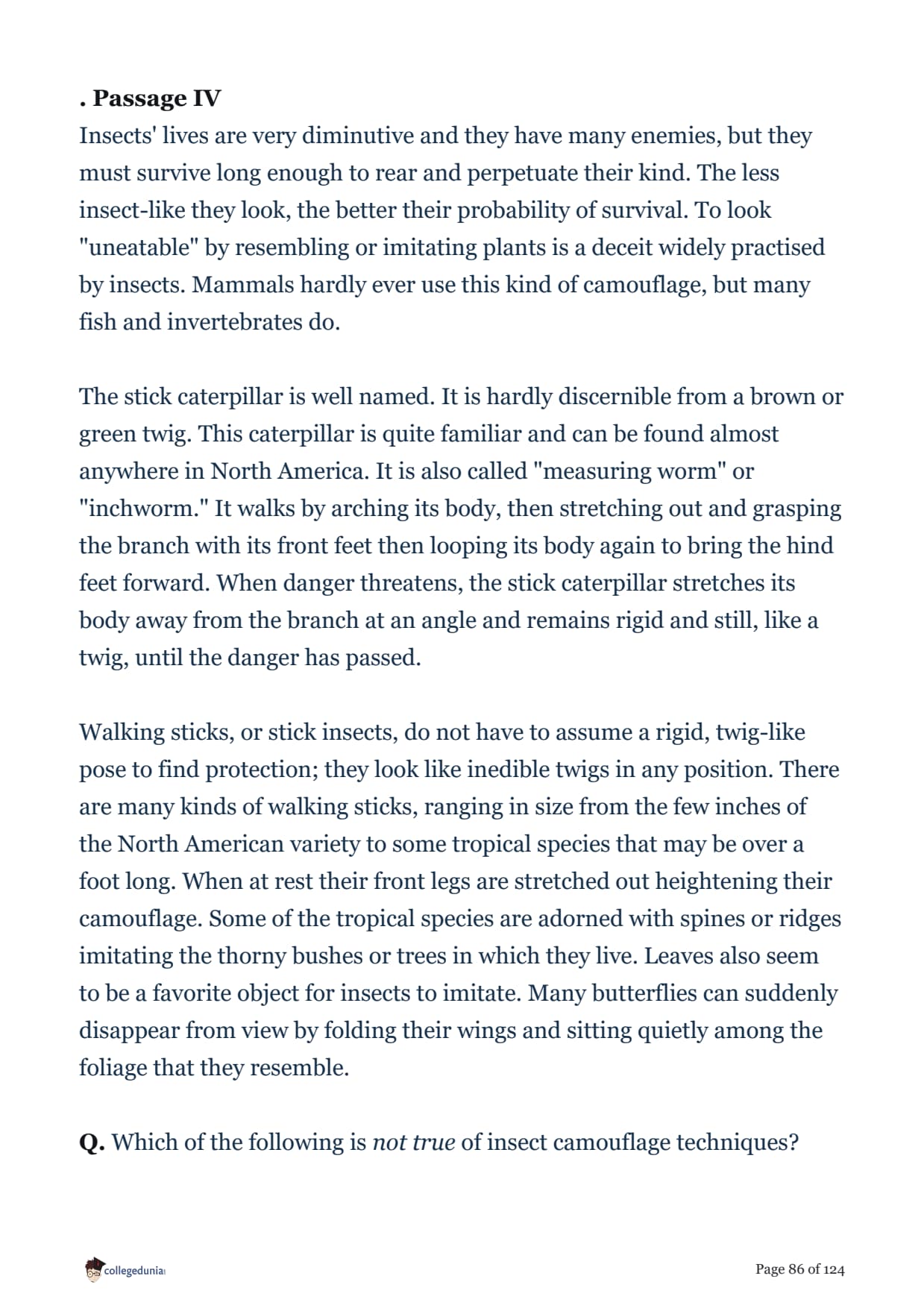
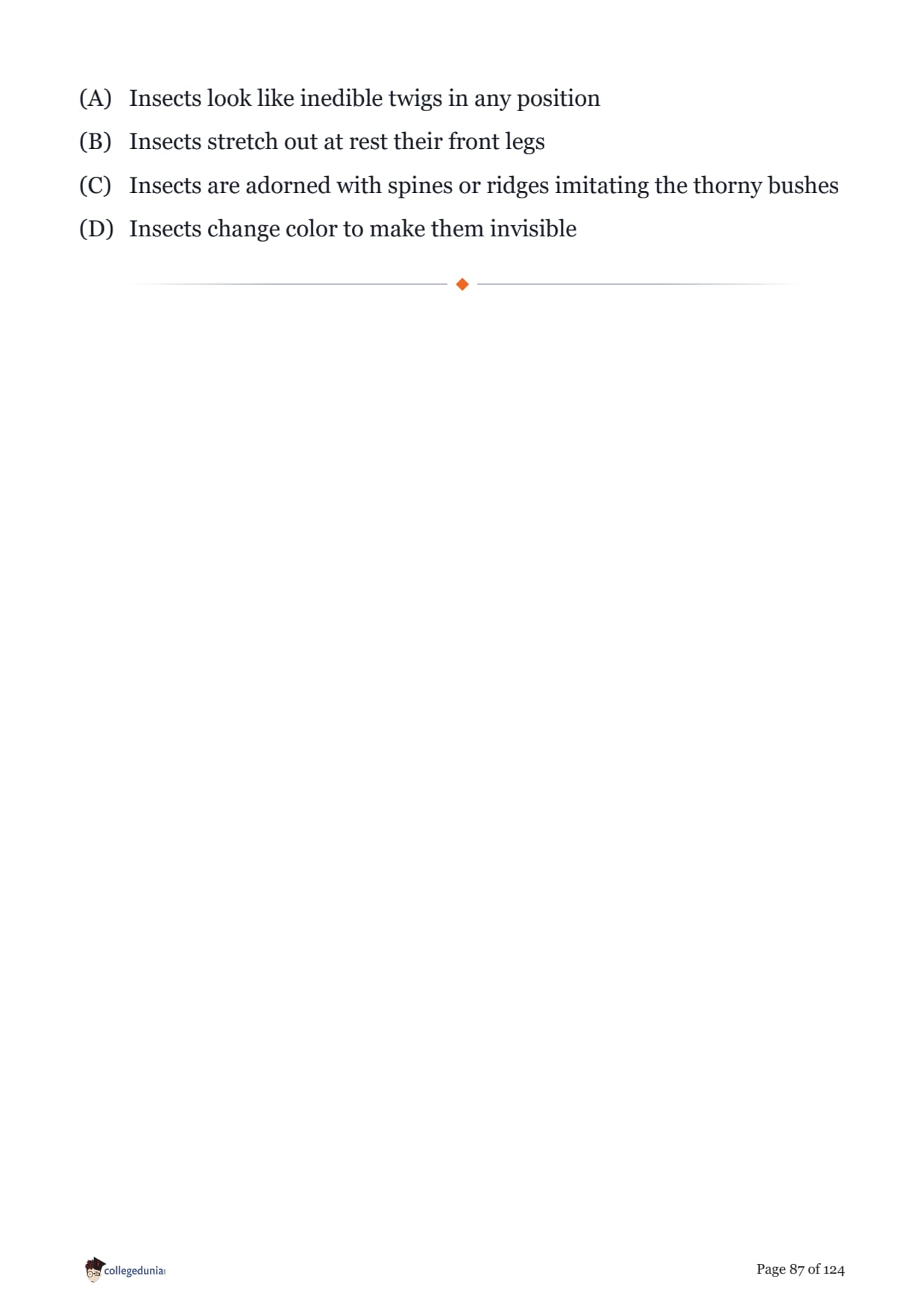
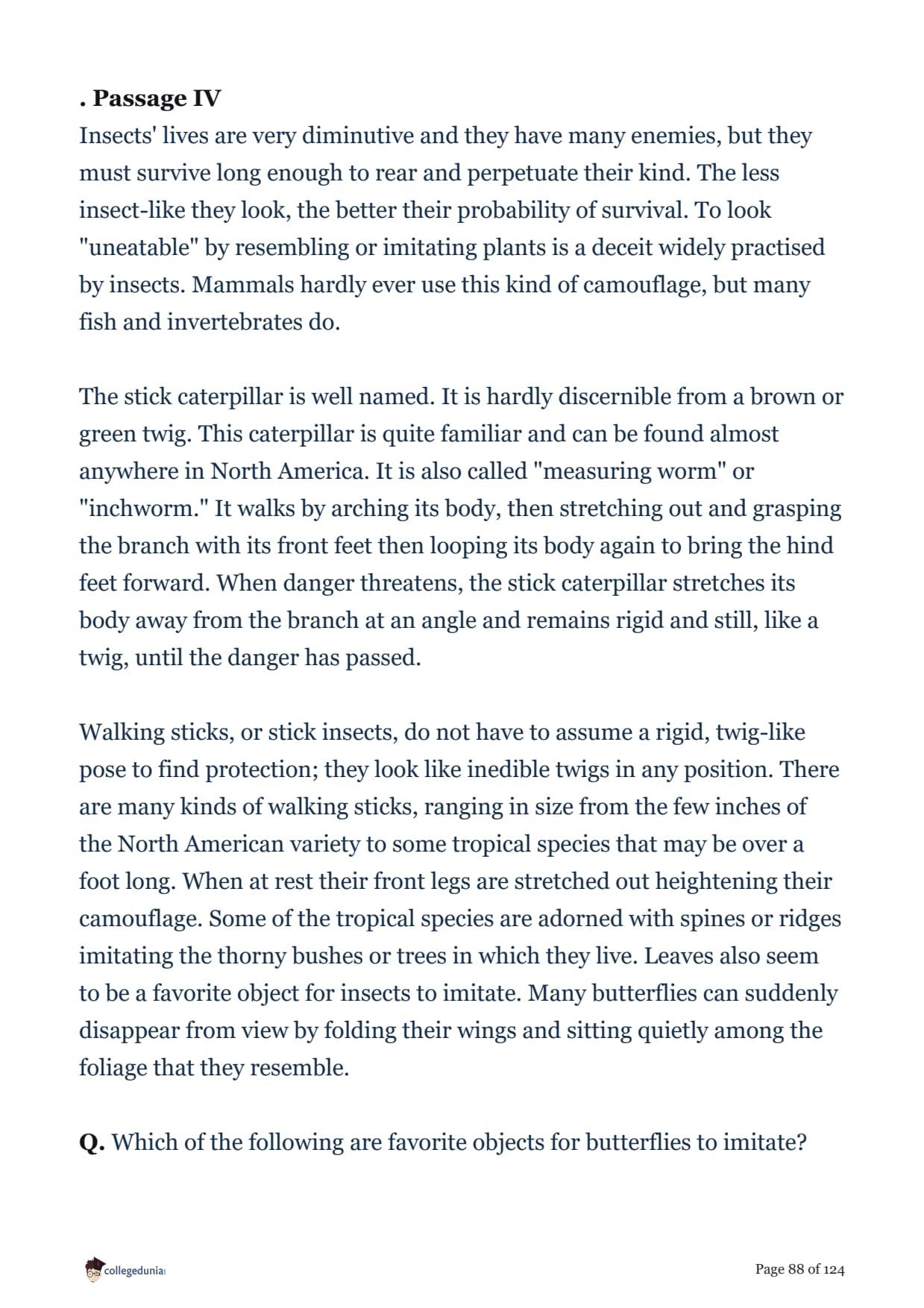
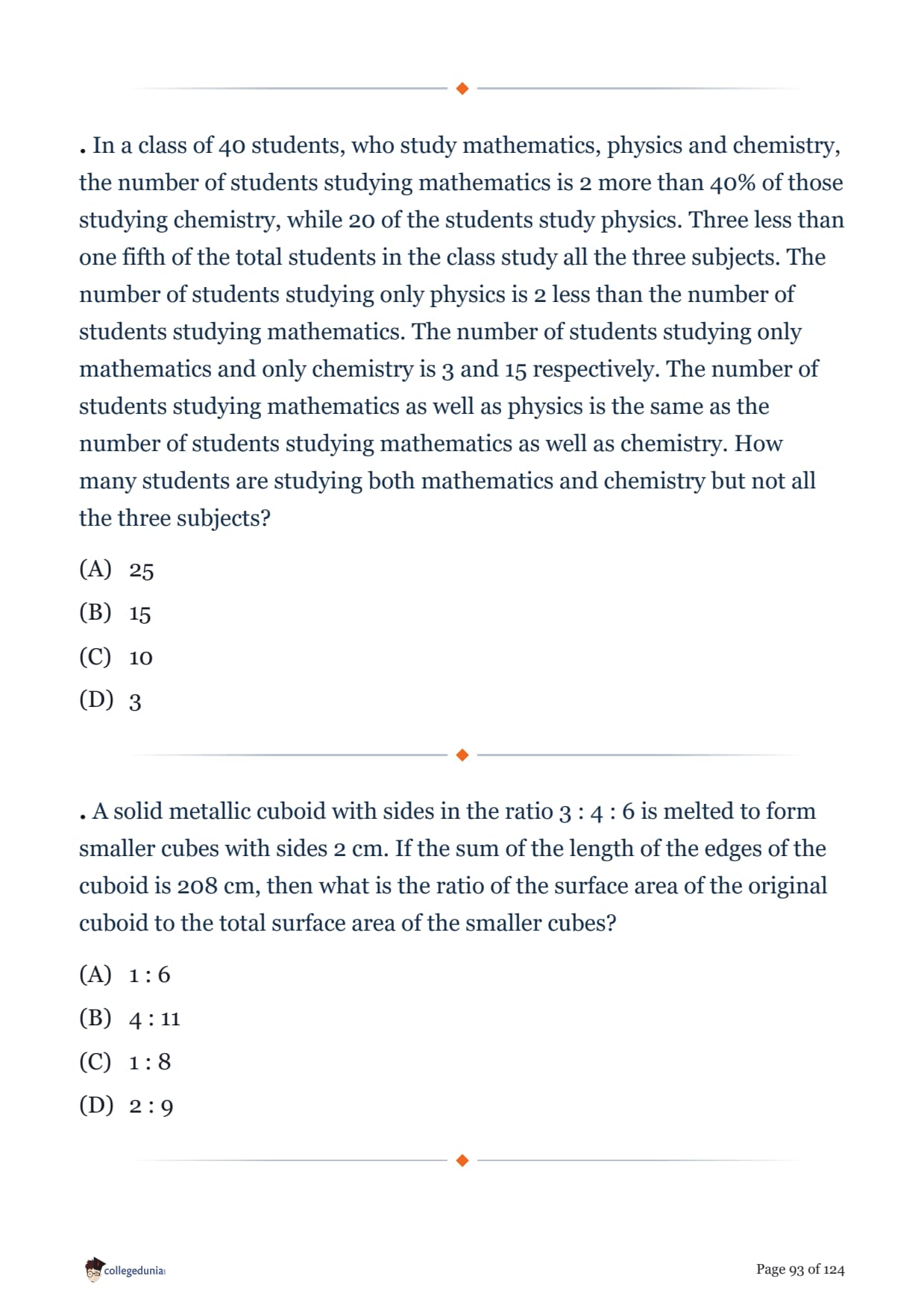
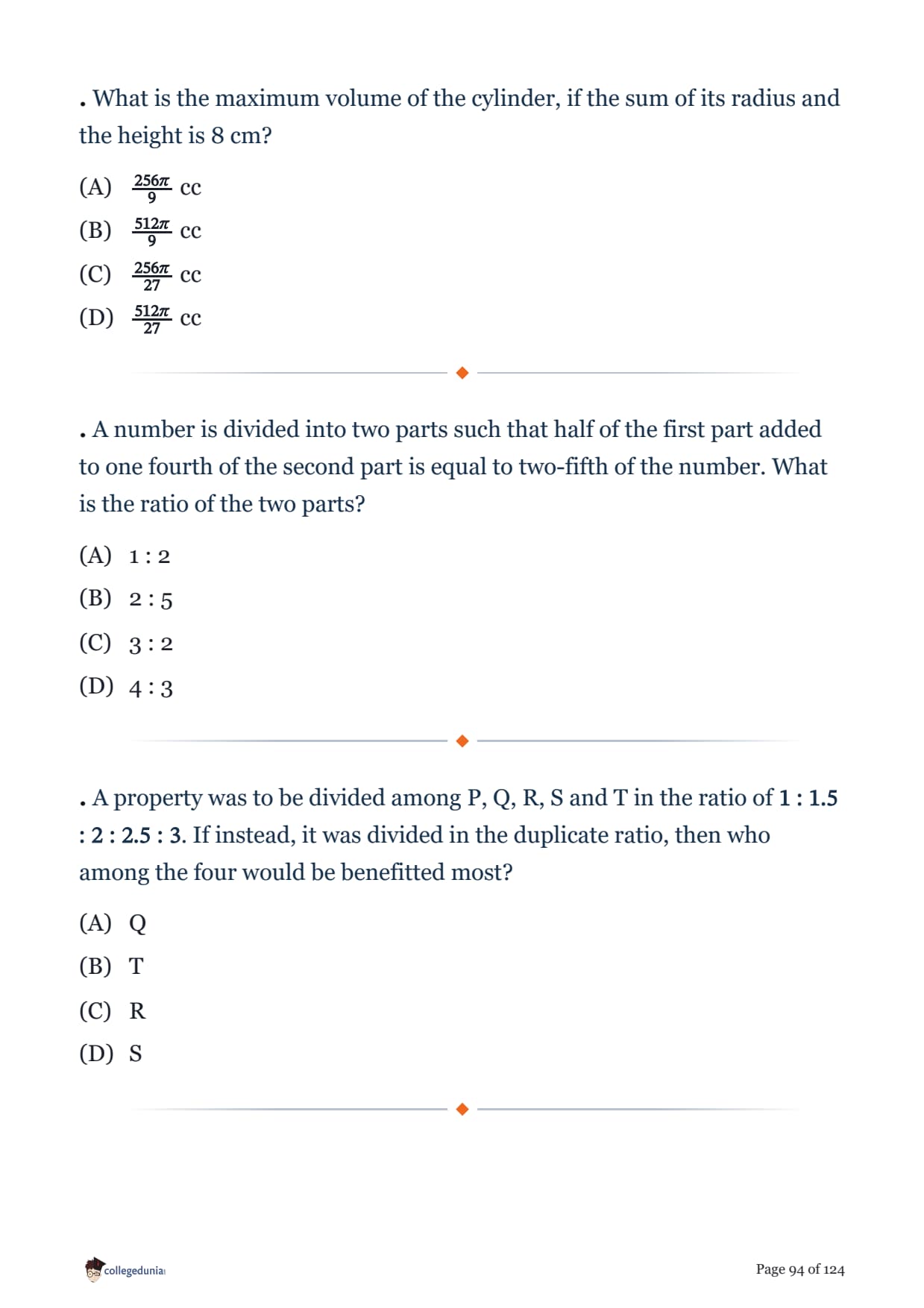
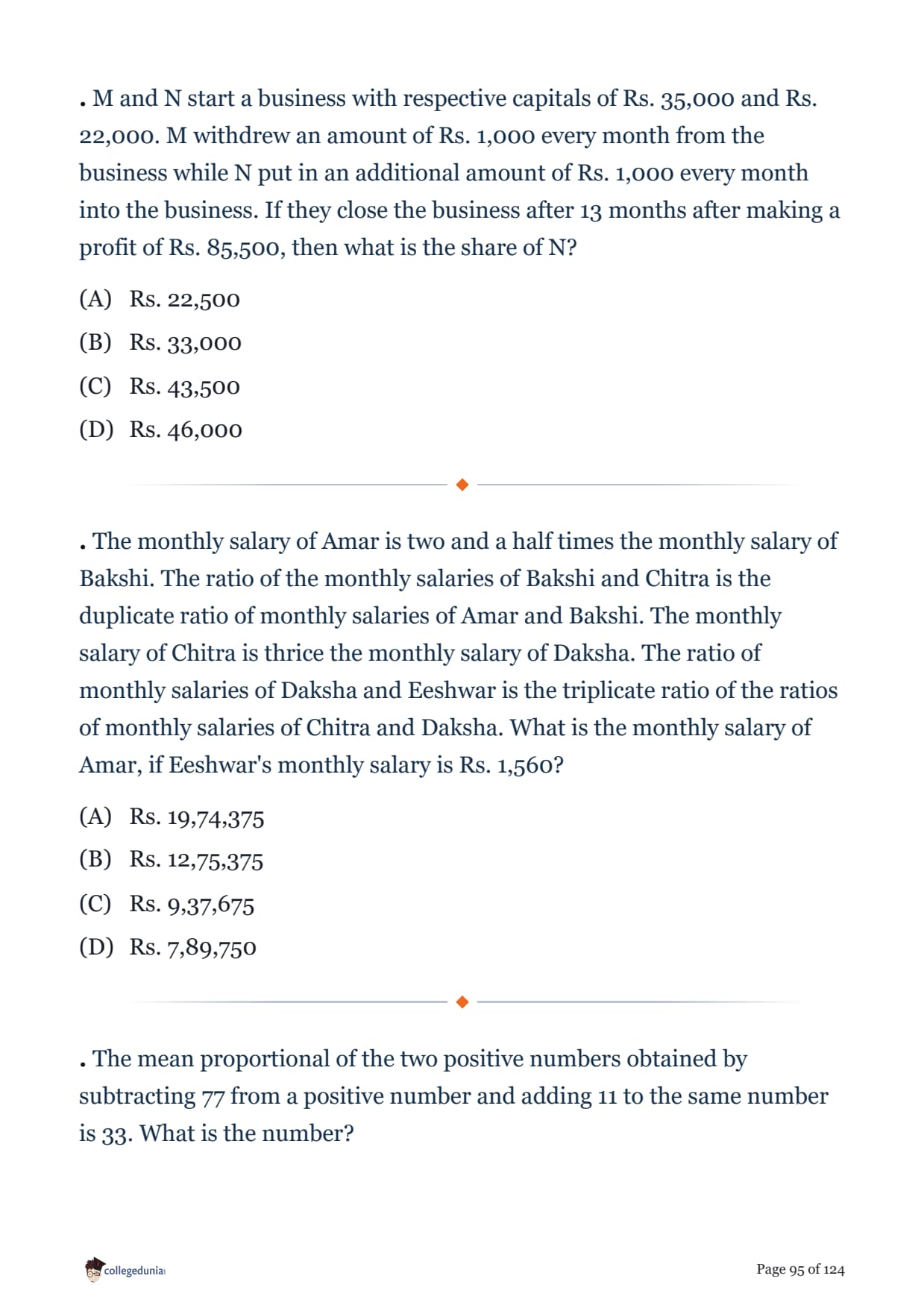
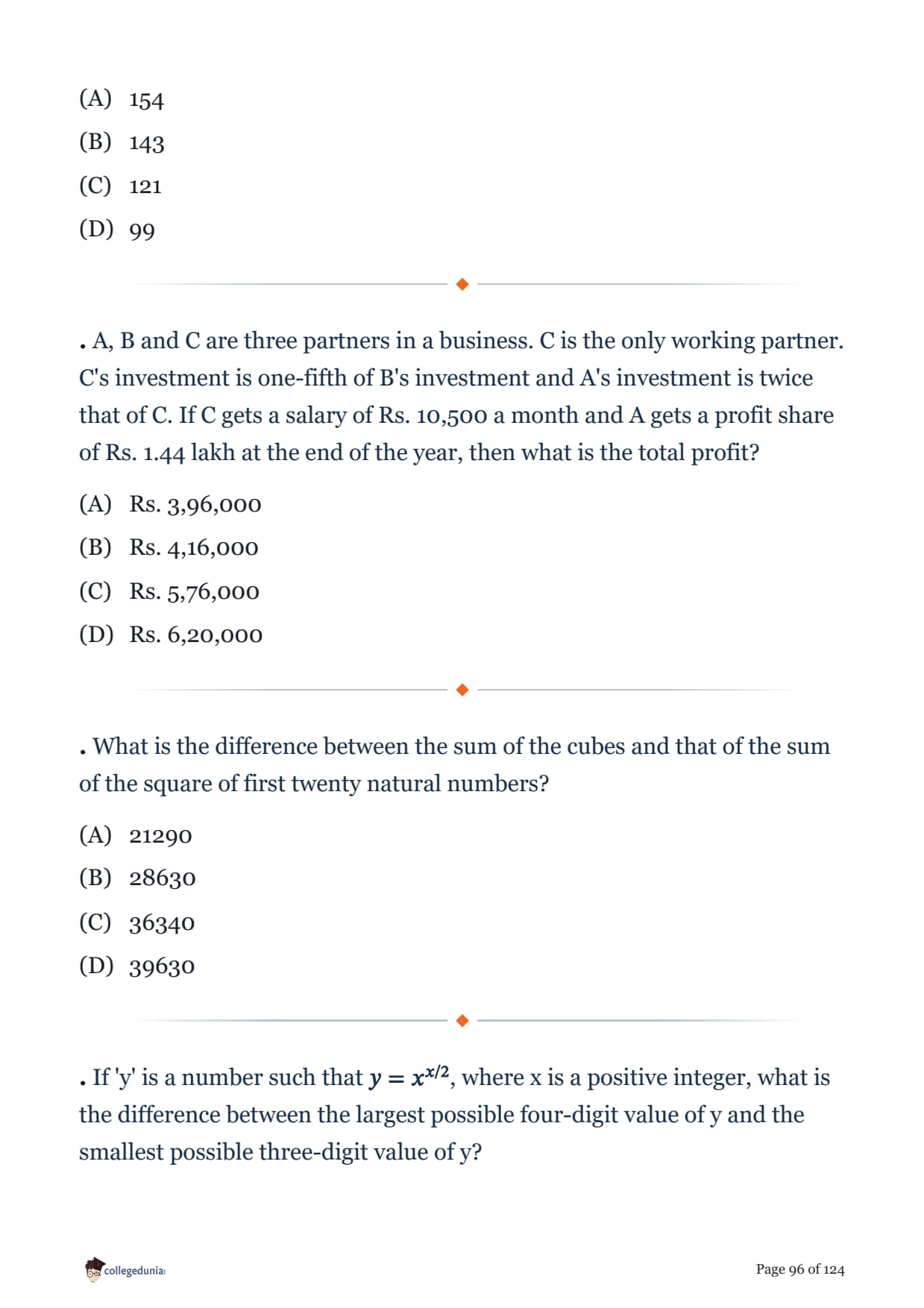
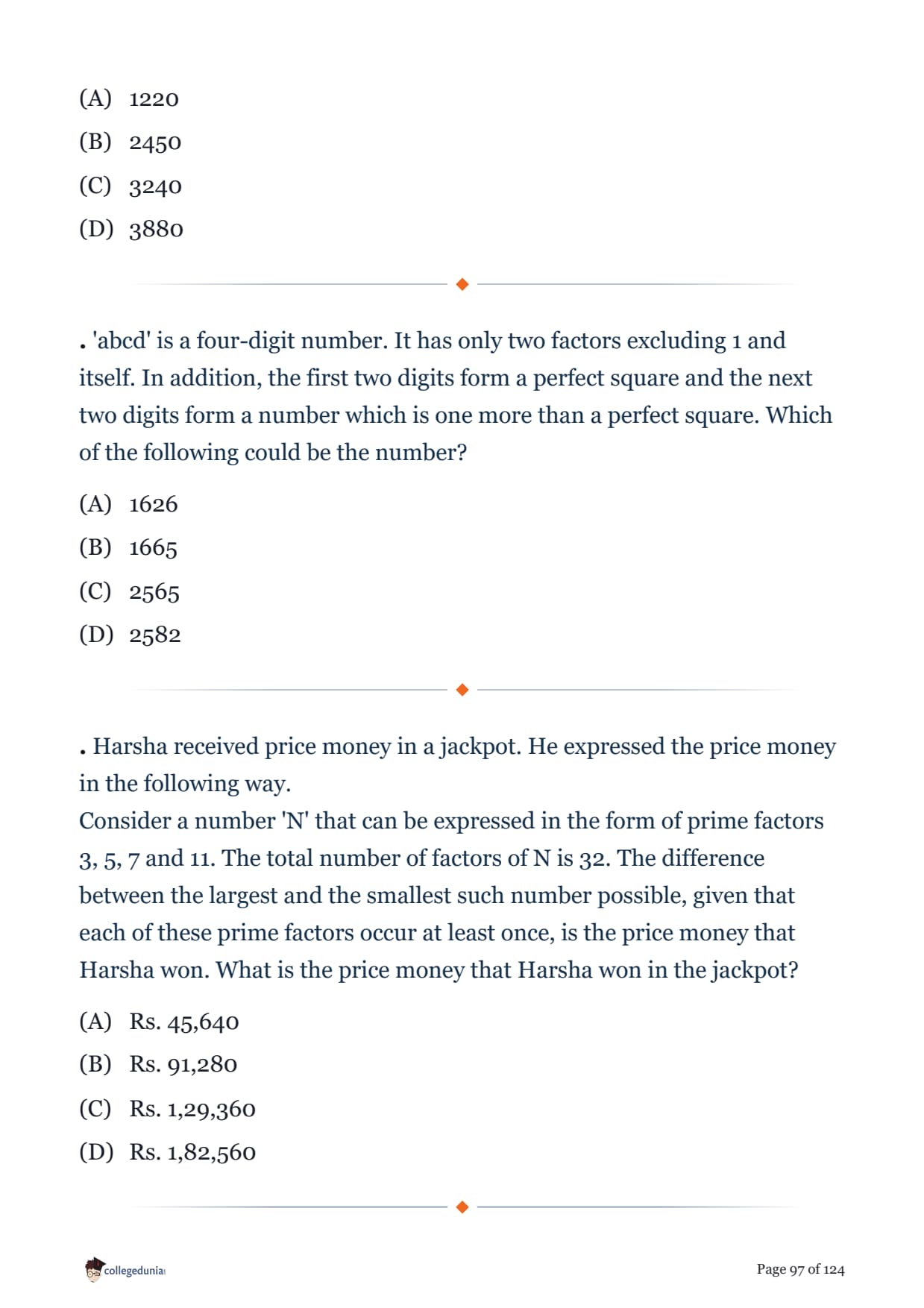
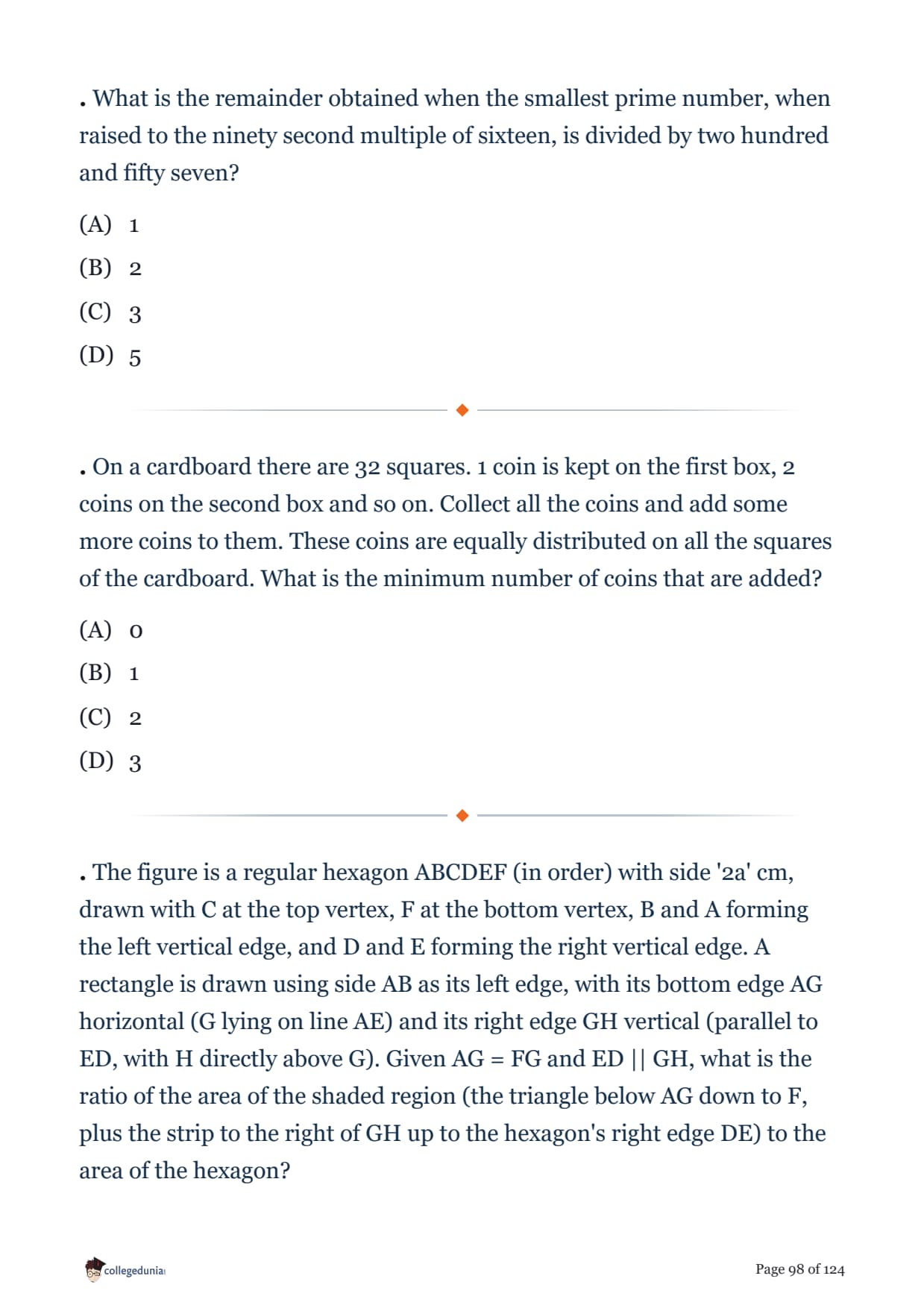
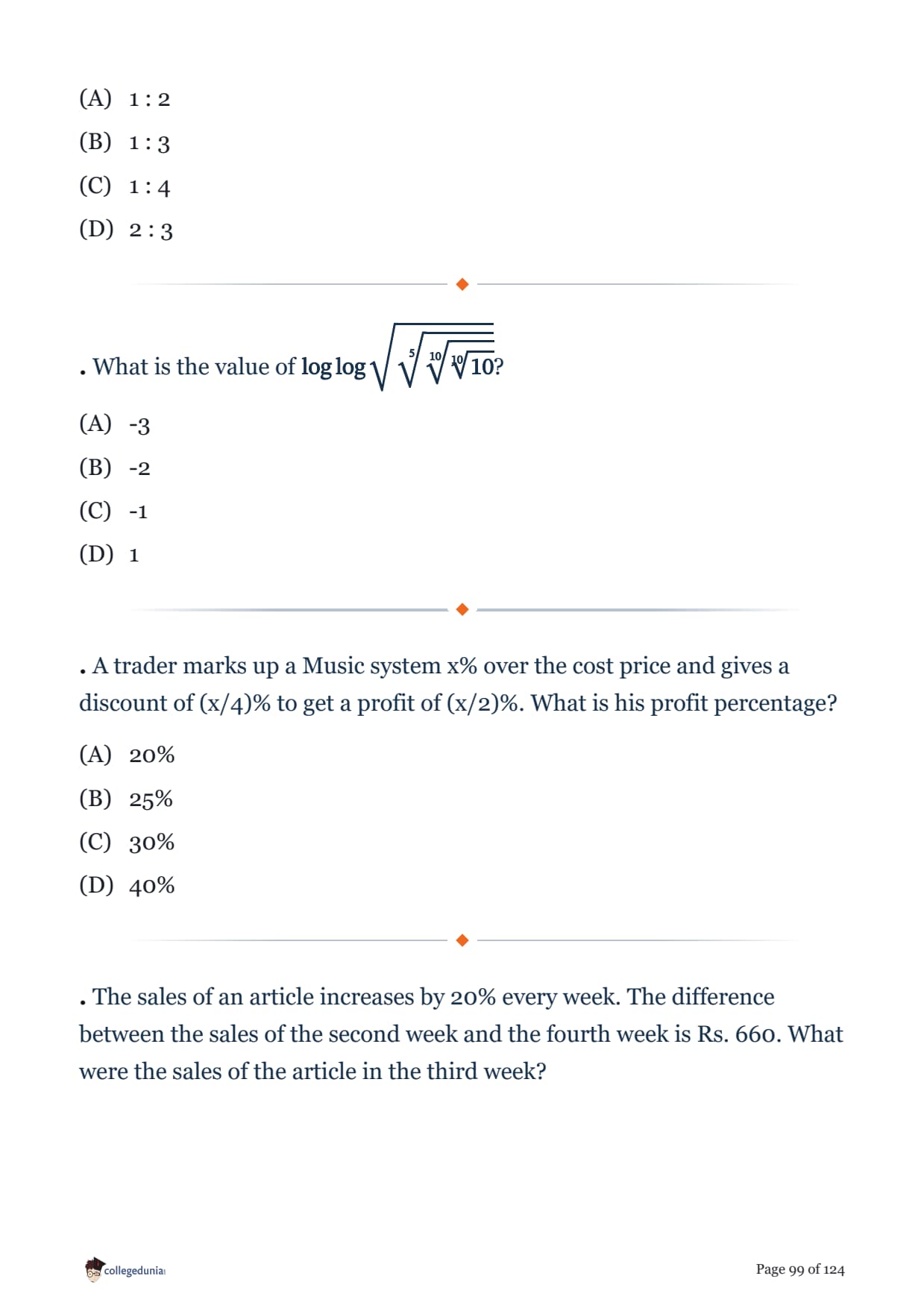
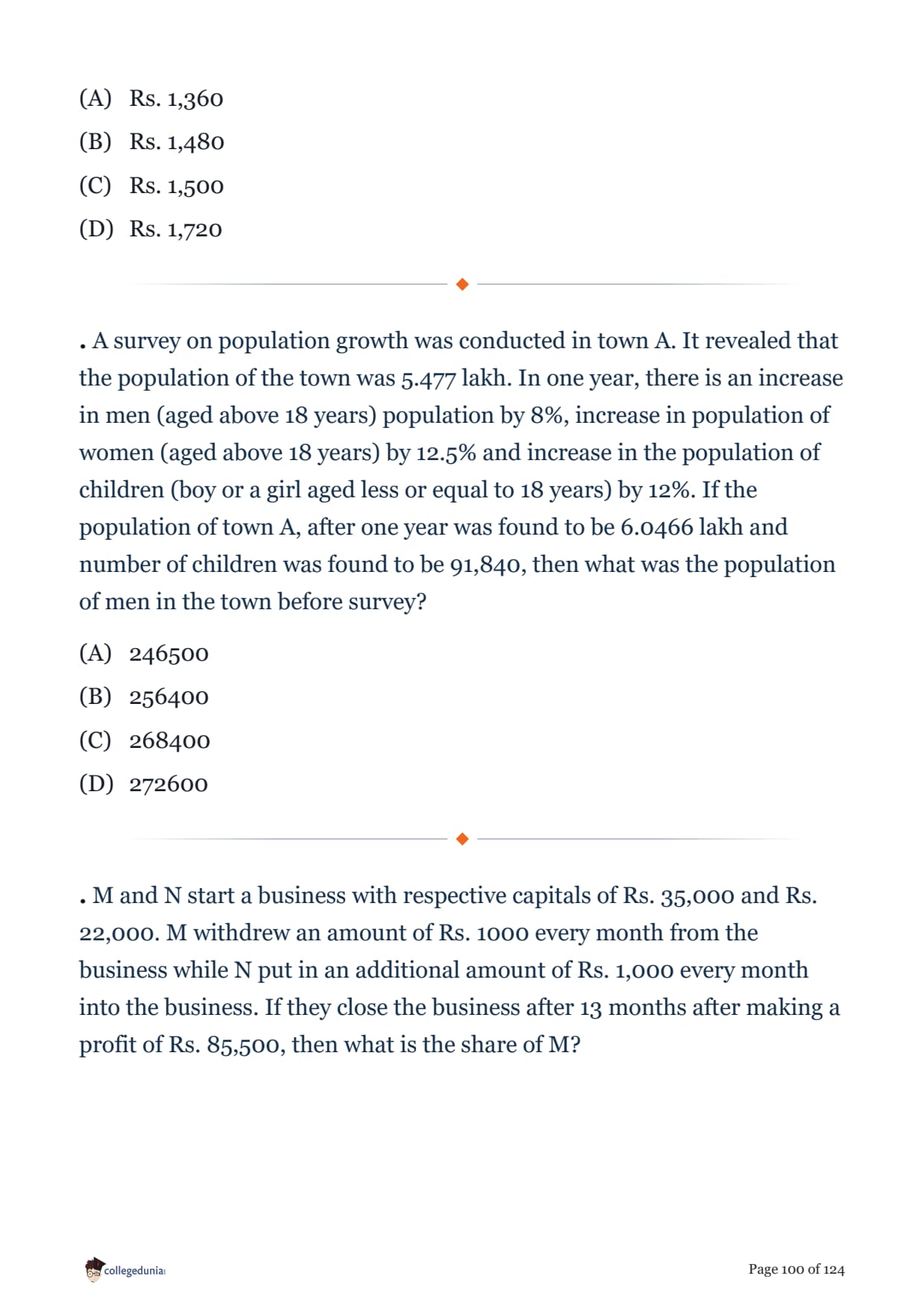
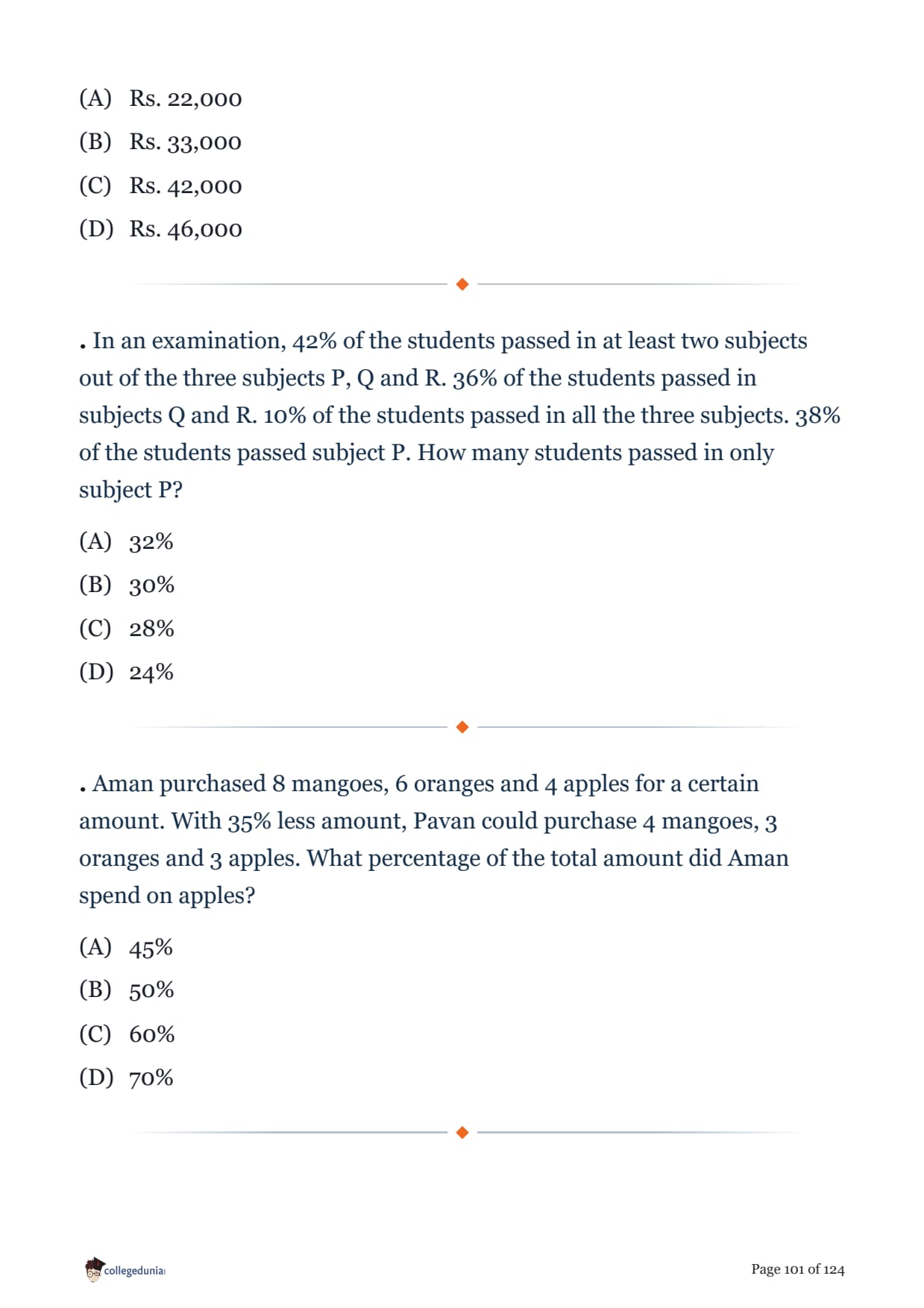
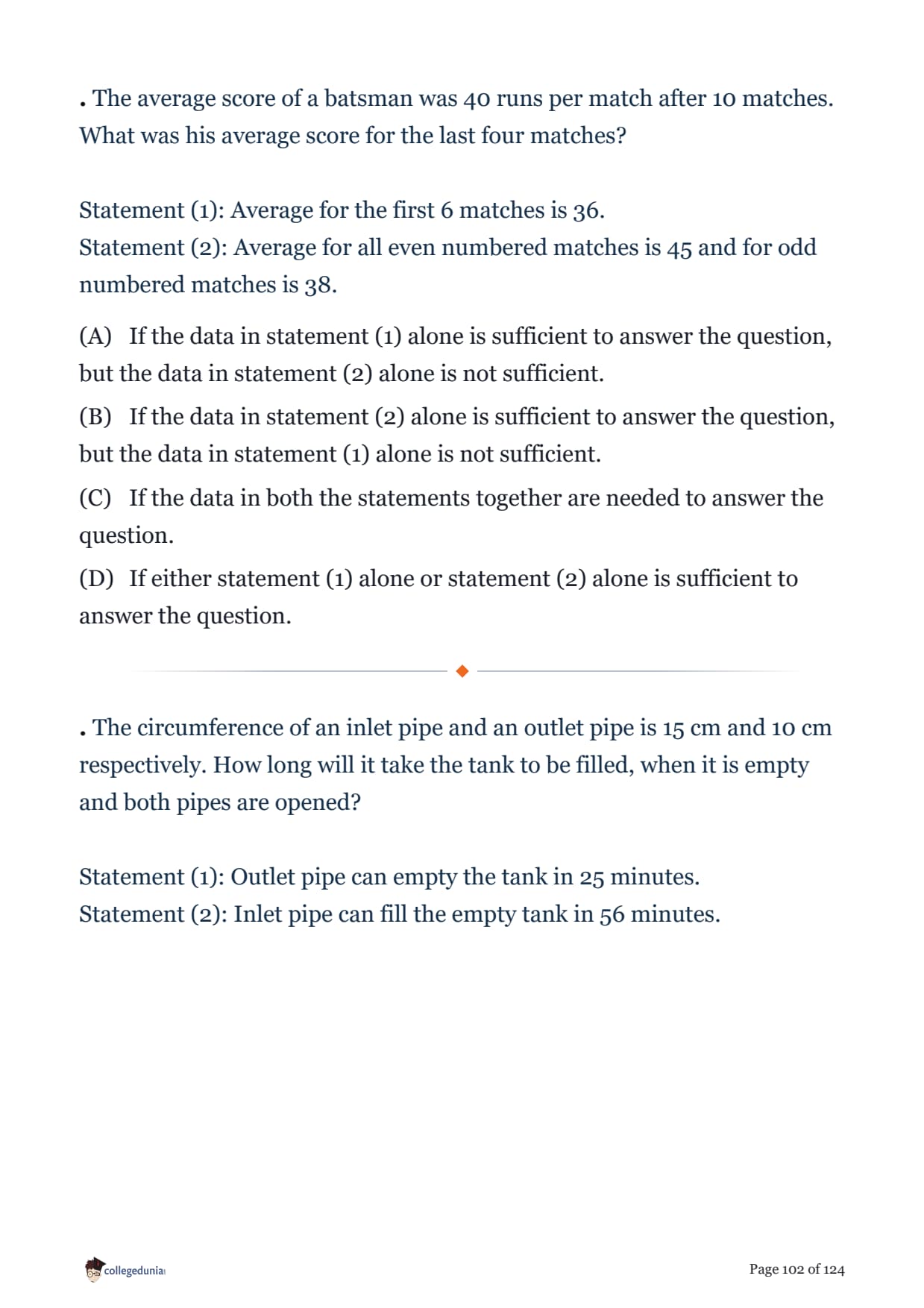
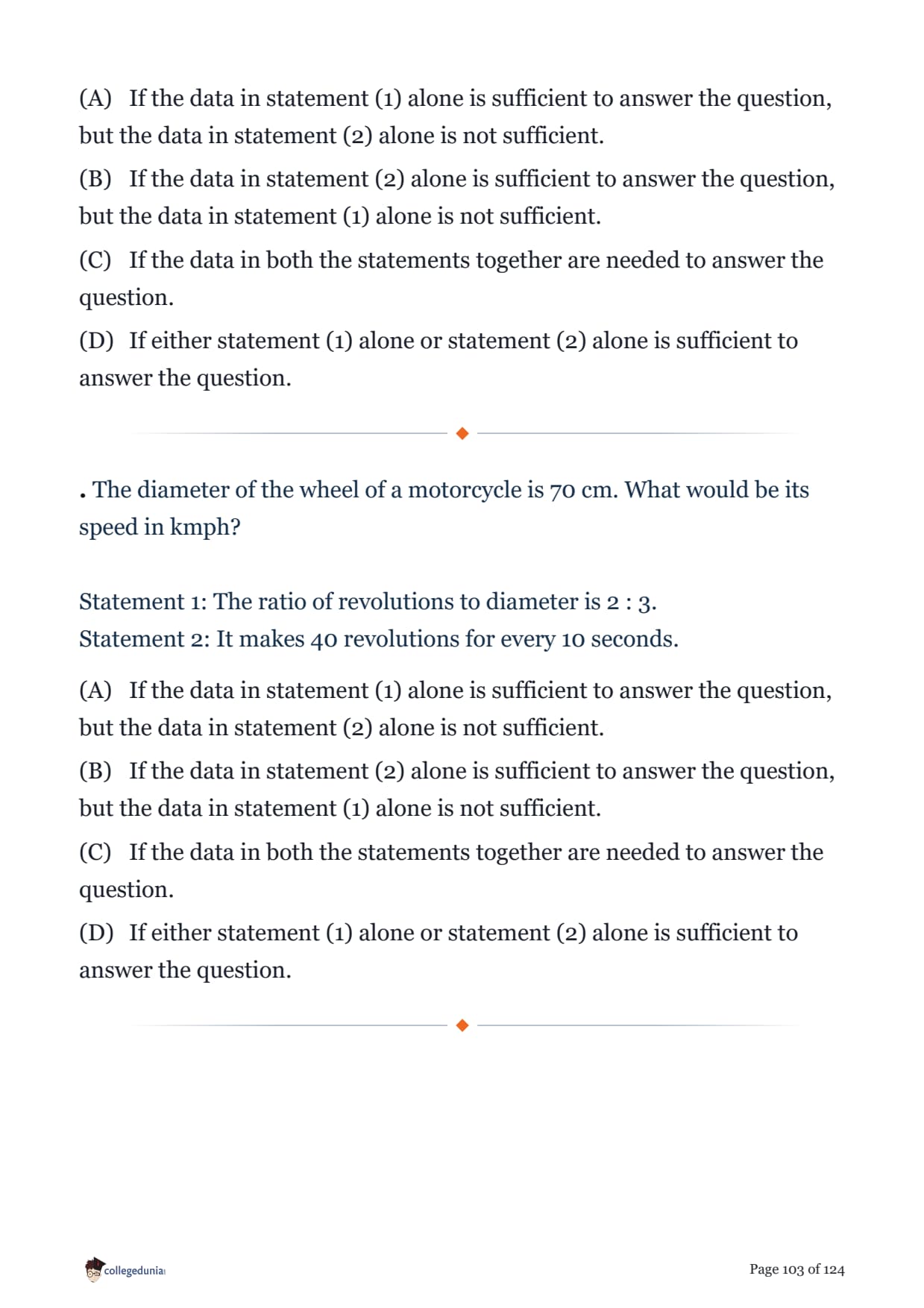
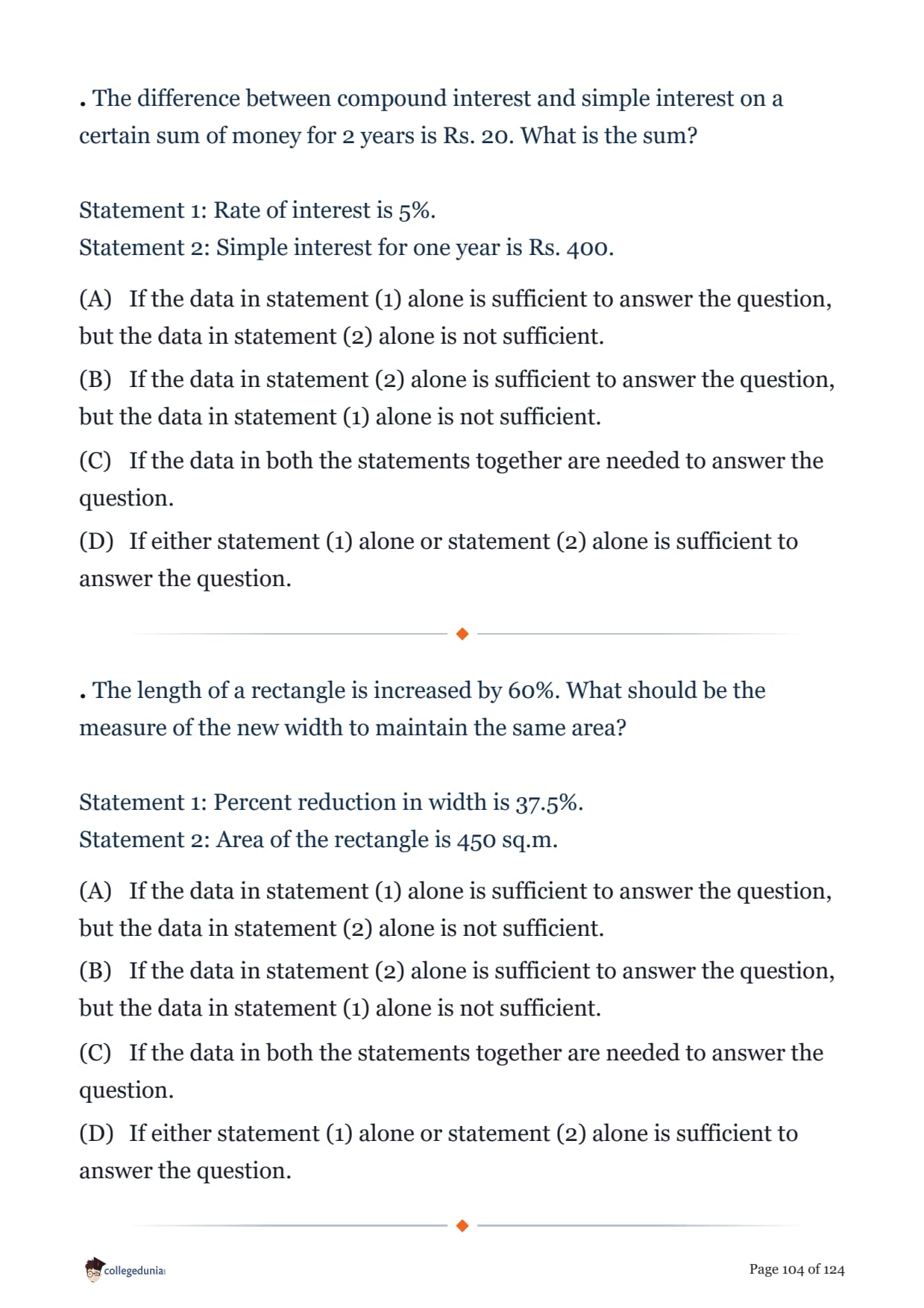
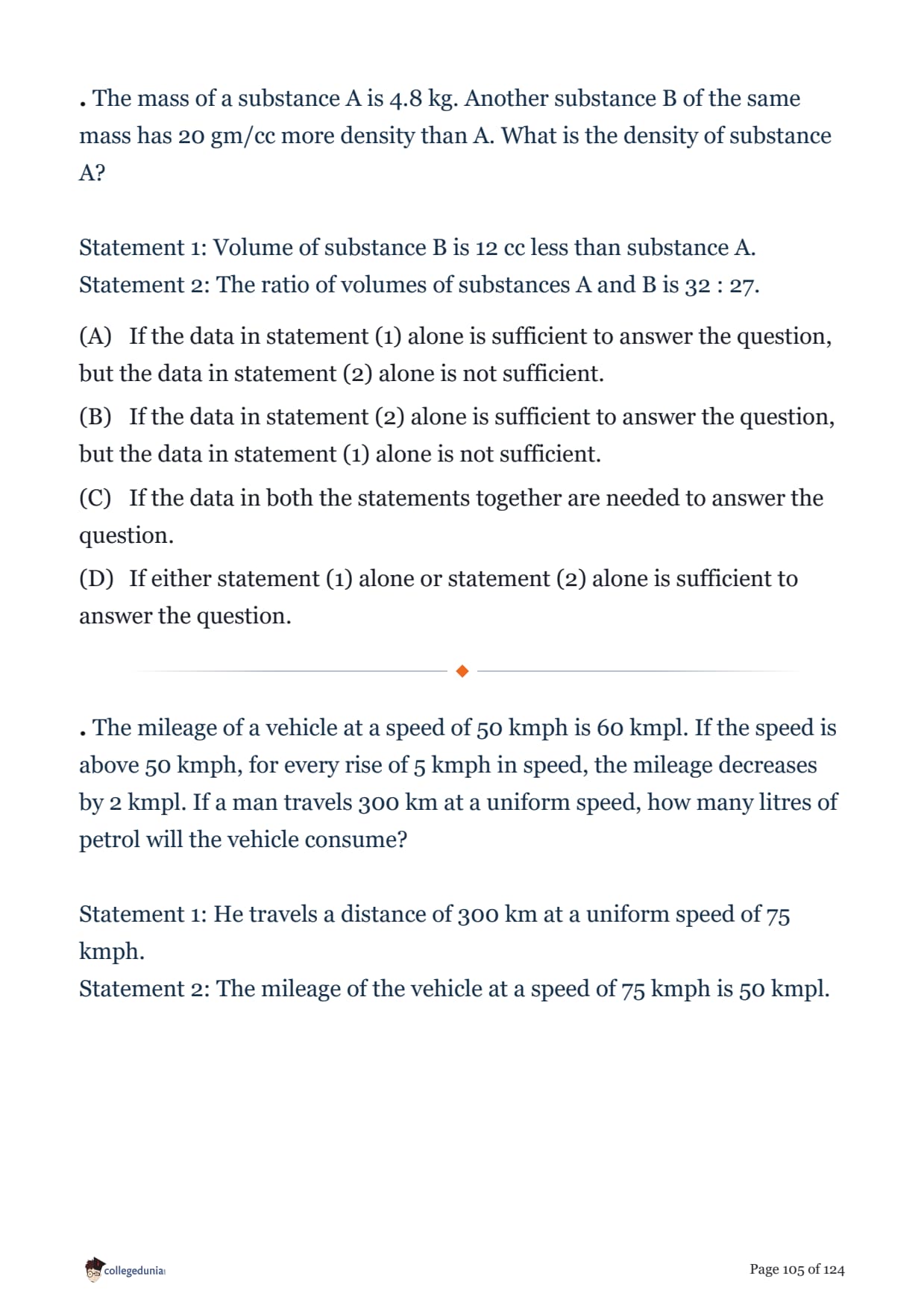
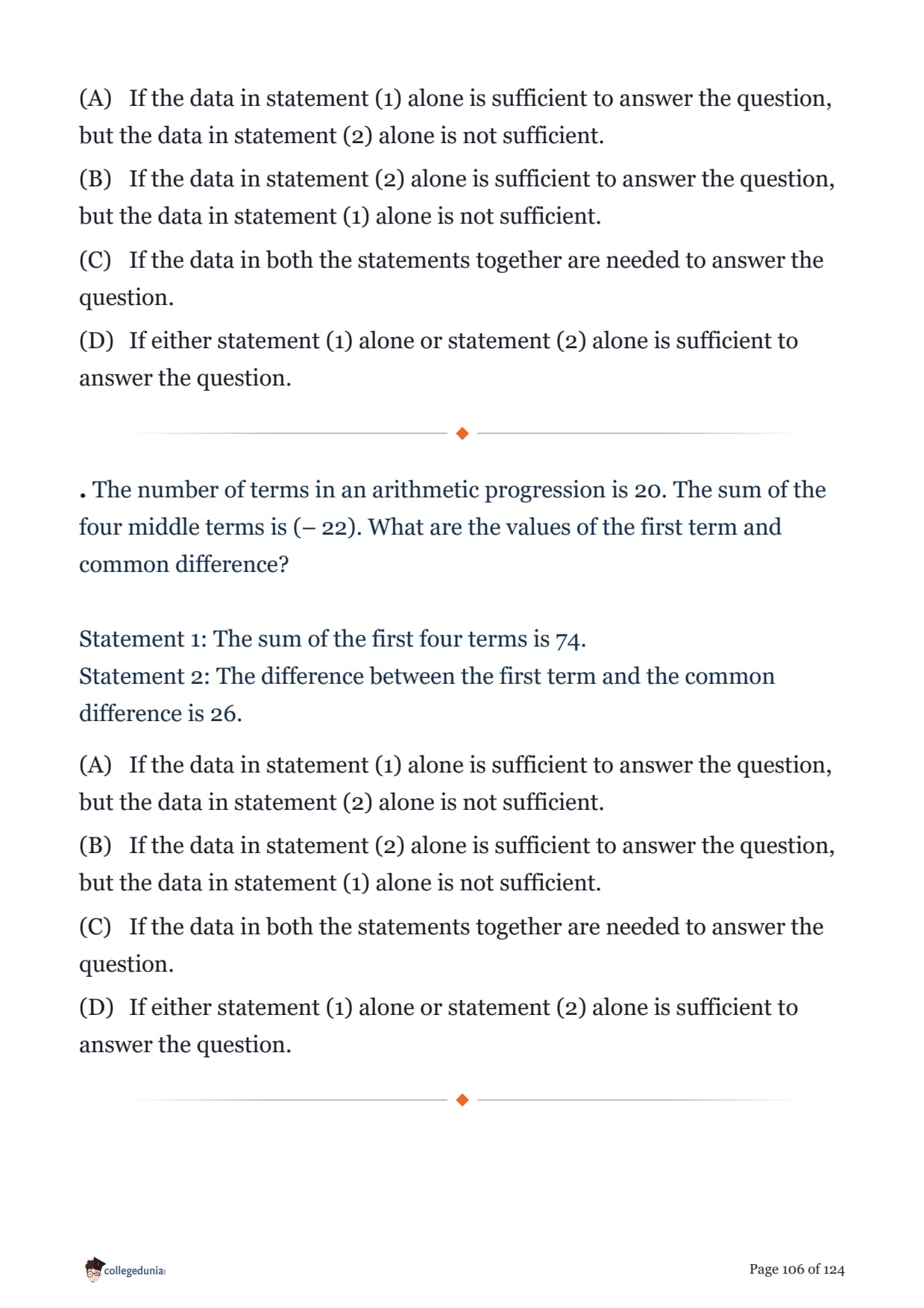
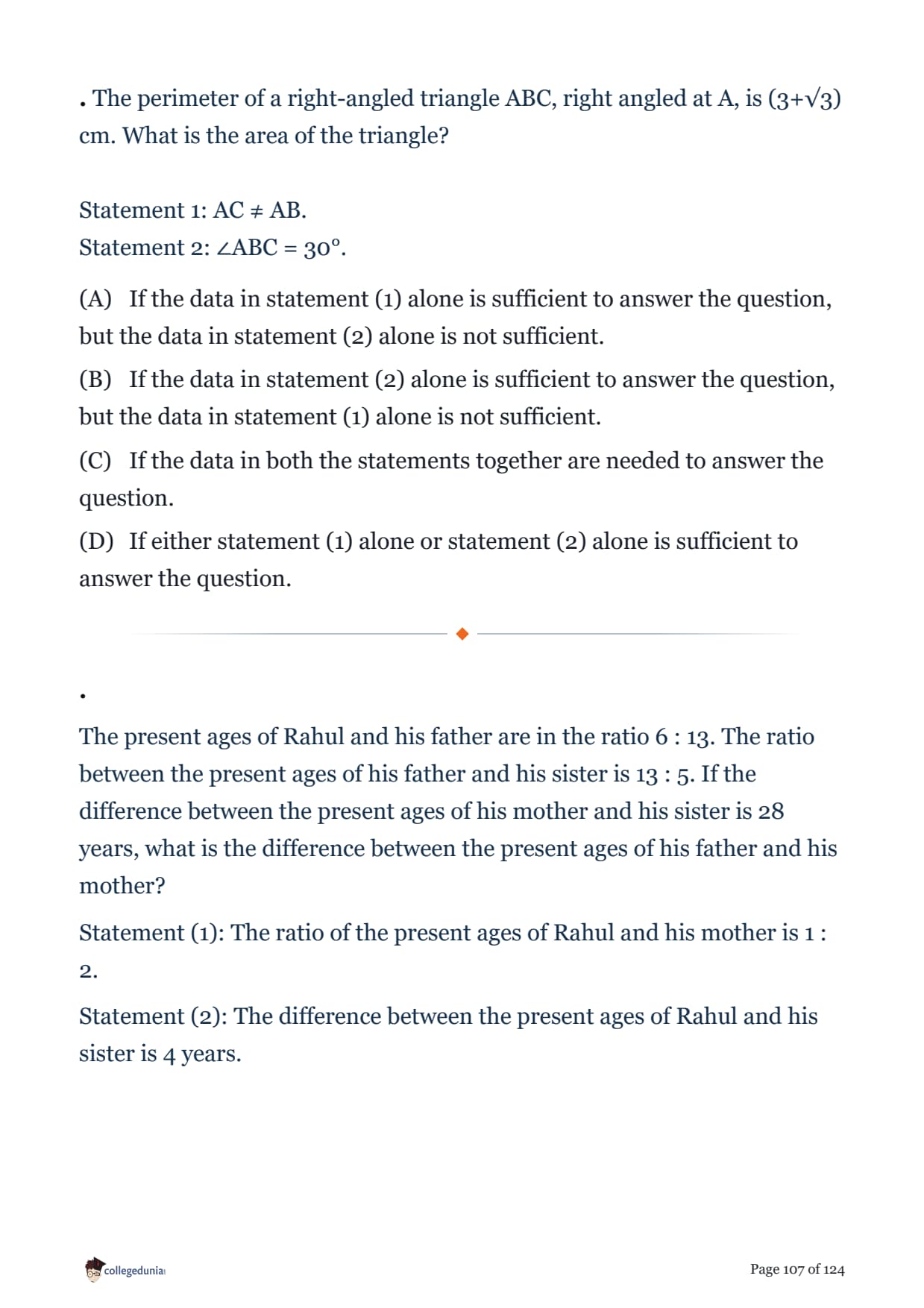
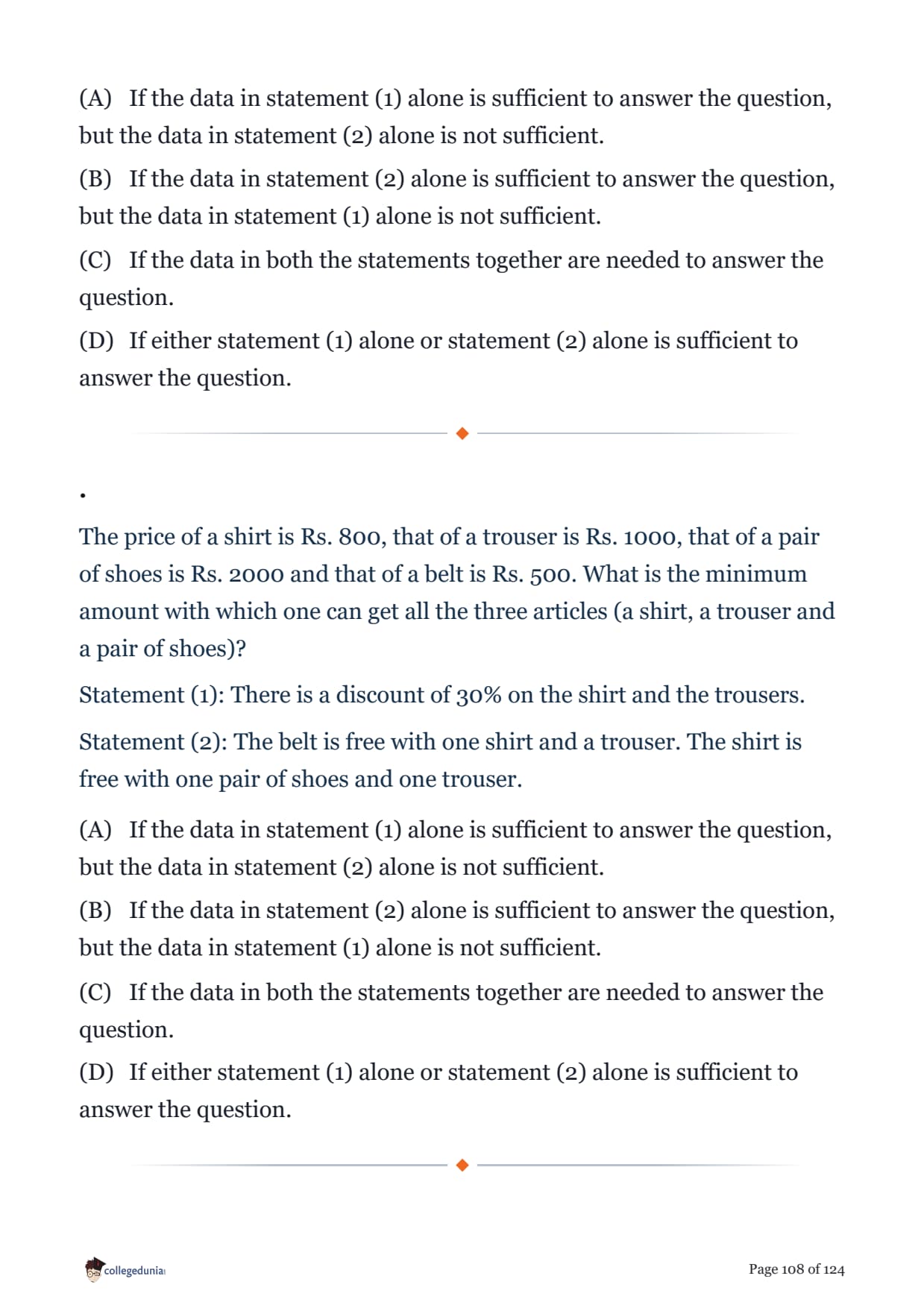
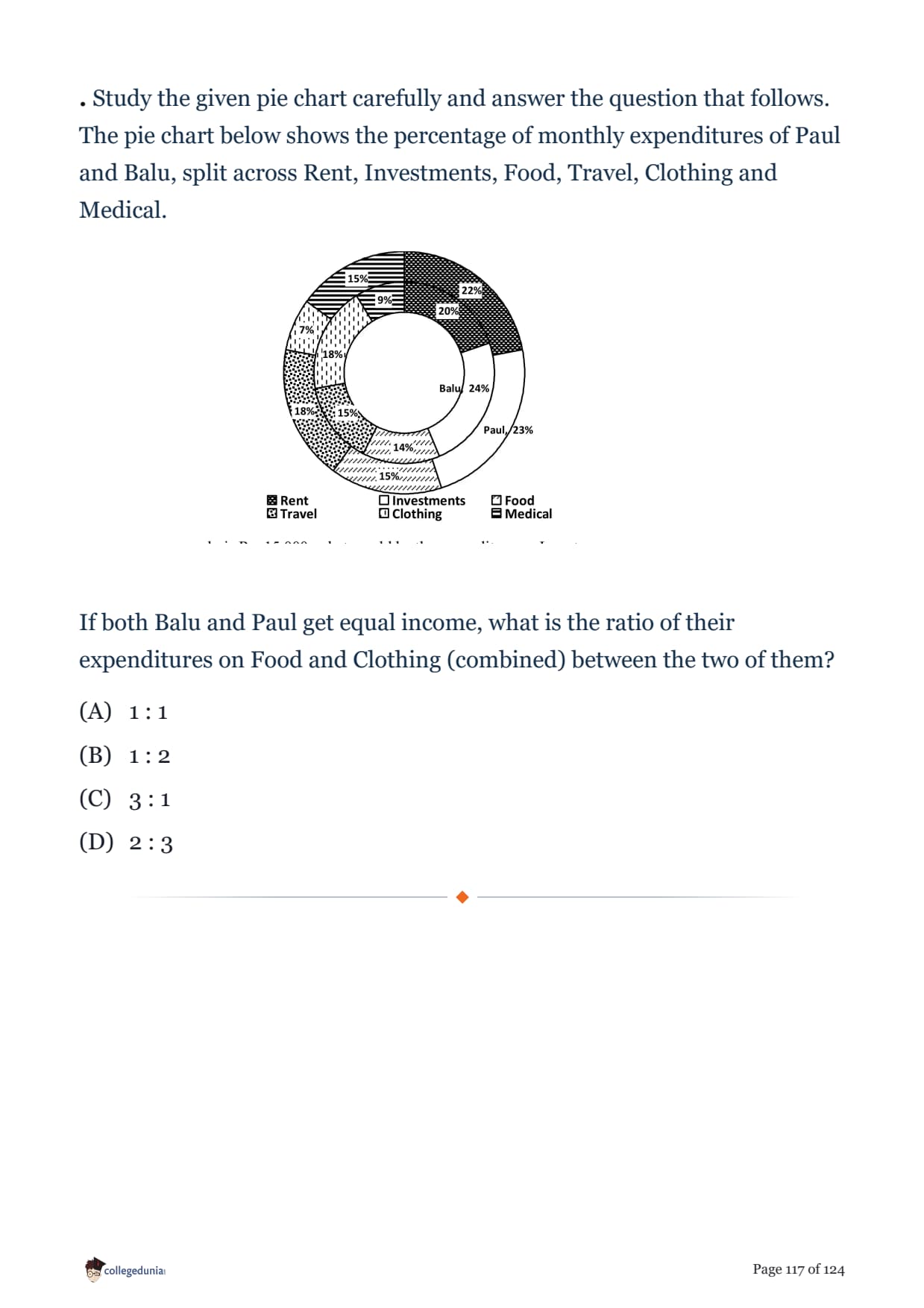
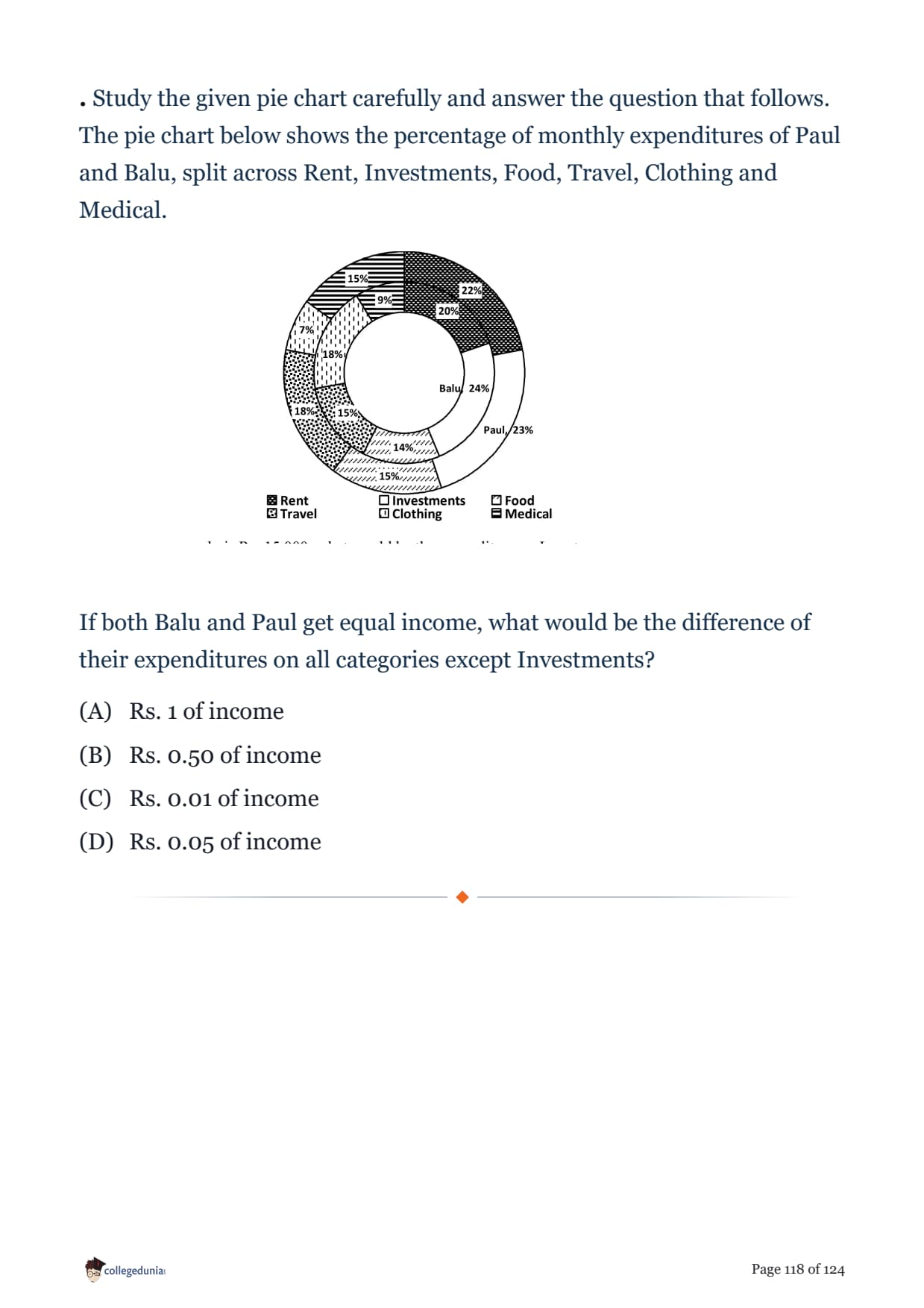
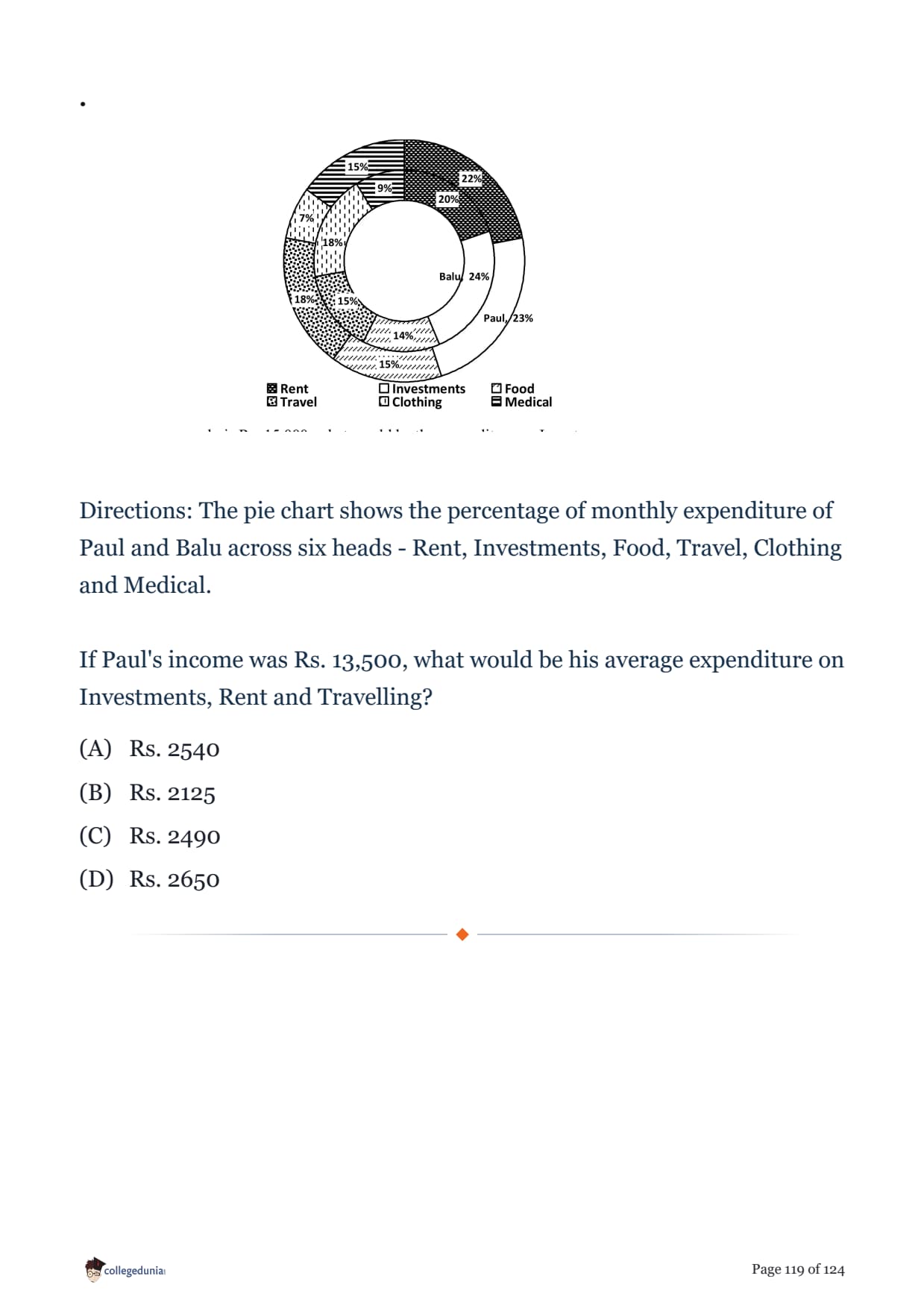
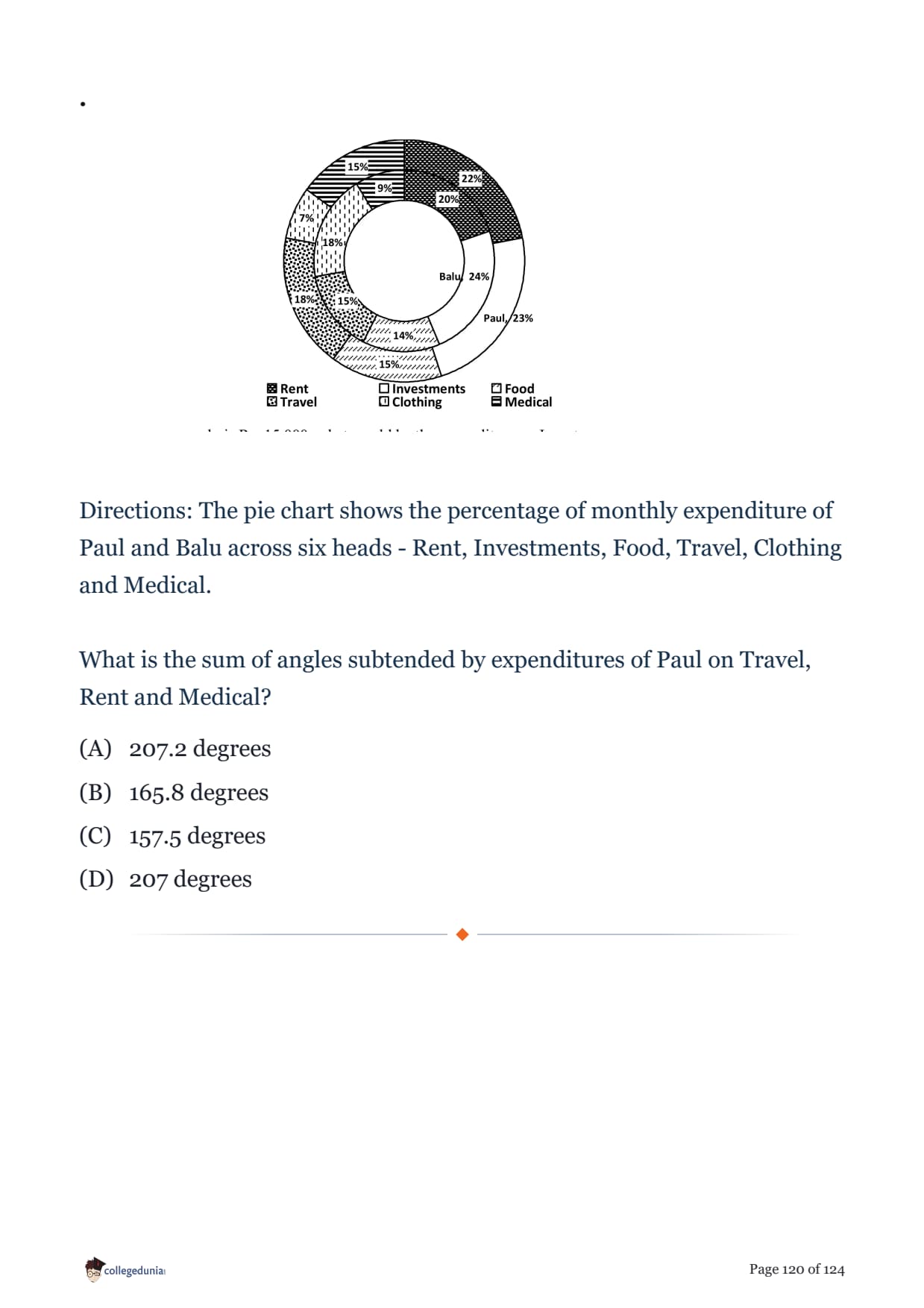
IBSAT 2018 Questions with Solutions
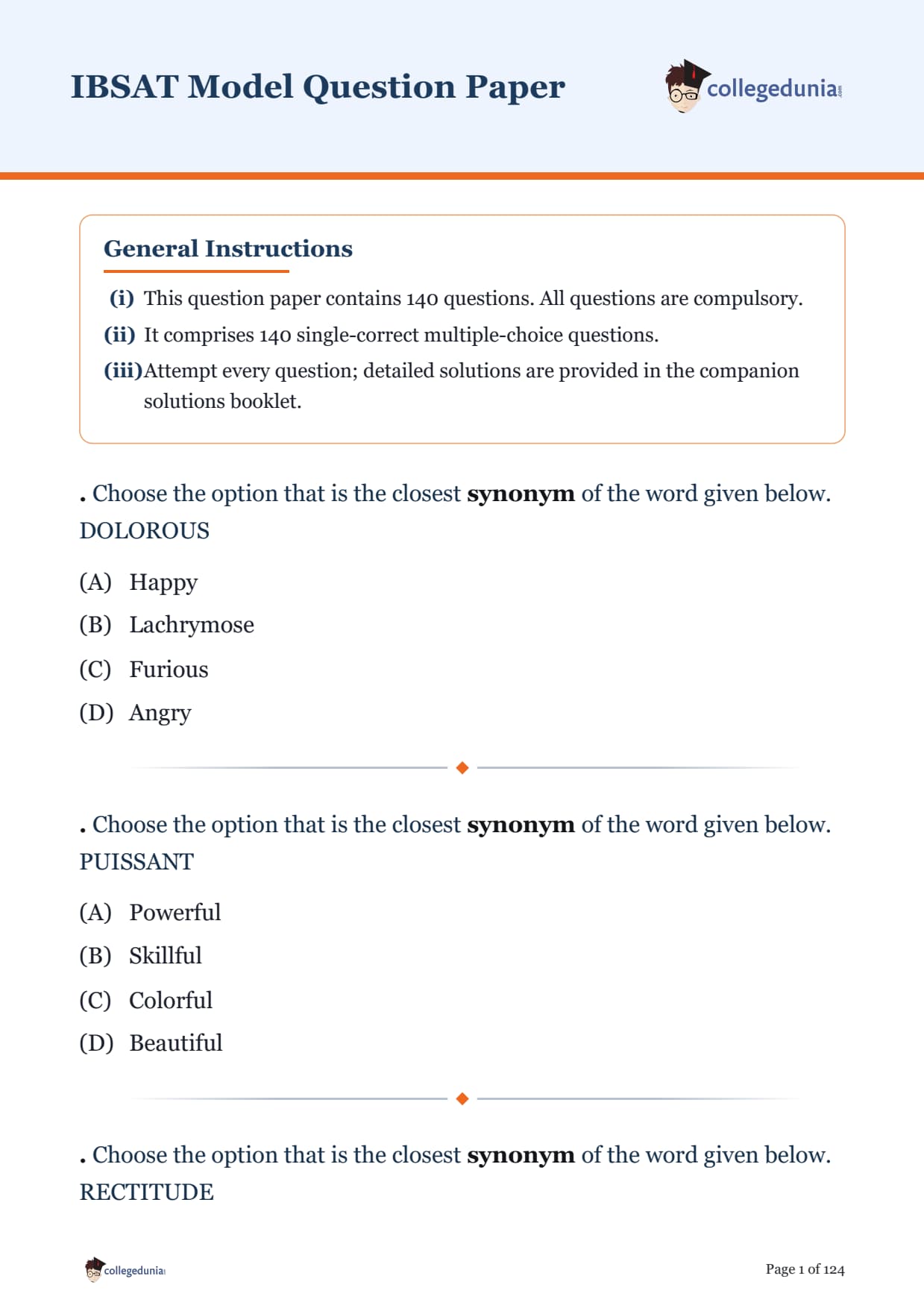
Choose the option that is the closest synonym of the word given below.
DOLOROUS
Choose the option that is the closest synonym of the word given below.
PUISSANT
Choose the option that is the closest synonym of the word given below.
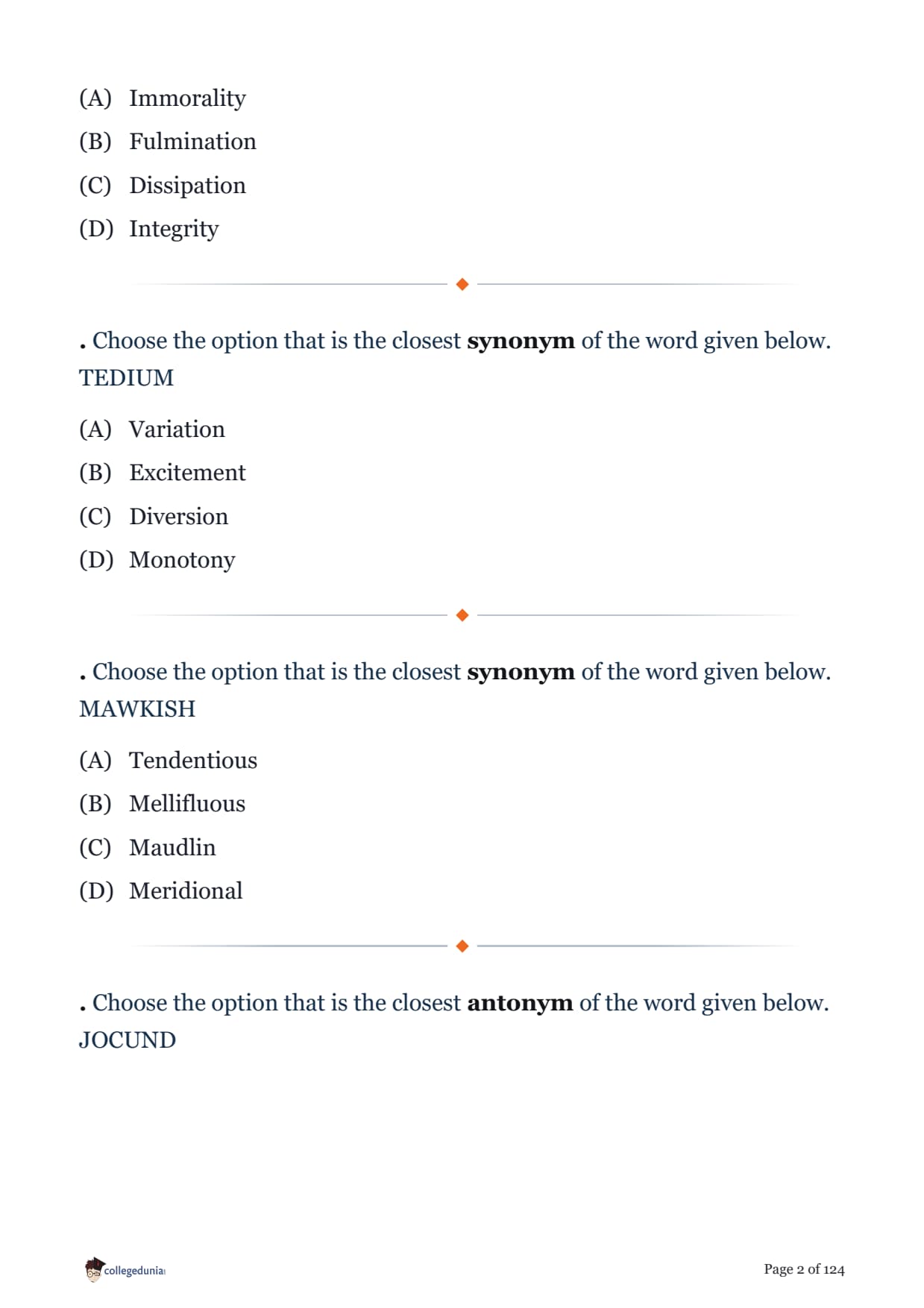
RECTITUDE
Choose the option that is the closest synonym of the word given below.
TEDIUM
Choose the option that is the closest synonym of the word given below.
MAWKISH
Choose the option that is the closest antonym of the word given below.
JOCUND
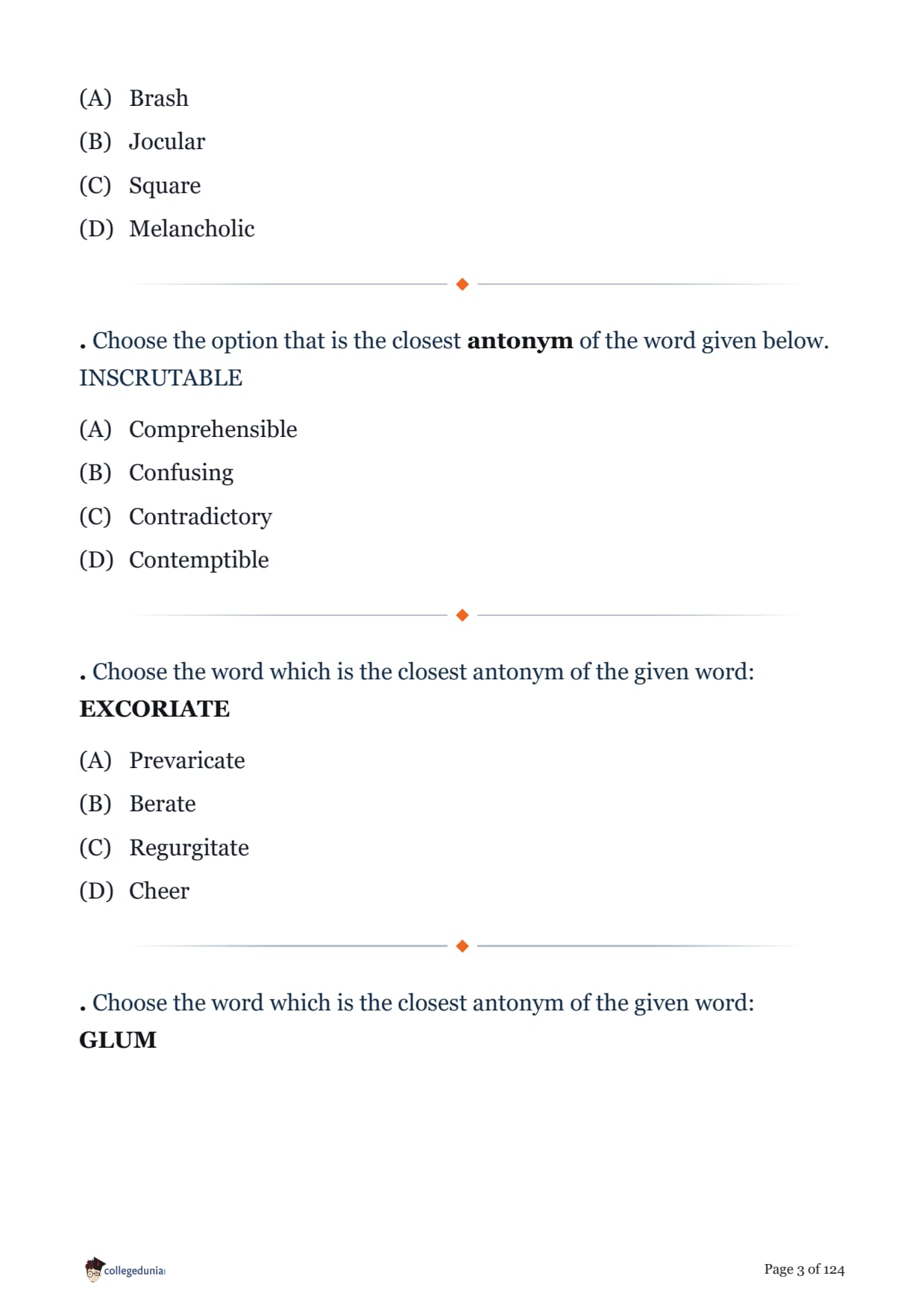
Choose the option that is the closest antonym of the word given below.
INSCRUTABLE
Choose the word which is the closest antonym of the given word:
EXCORIATE
Choose the word which is the closest antonym of the given word:
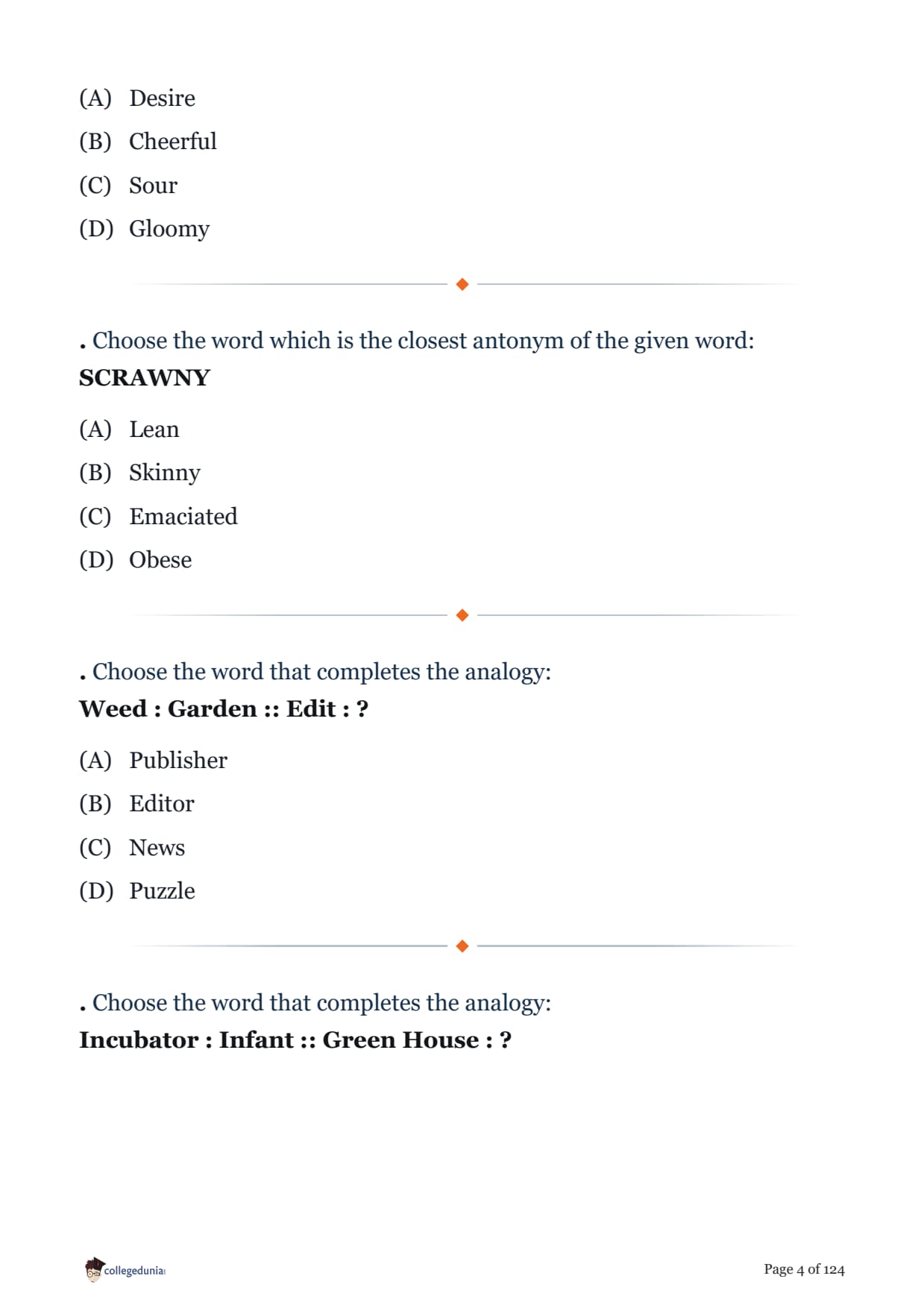
GLUM
Choose the word which is the closest antonym of the given word:
SCRAWNY
Choose the word that completes the analogy:
Weed : Garden :: Edit : ?
Choose the word that completes the analogy:
Incubator : Infant :: Green House : ?
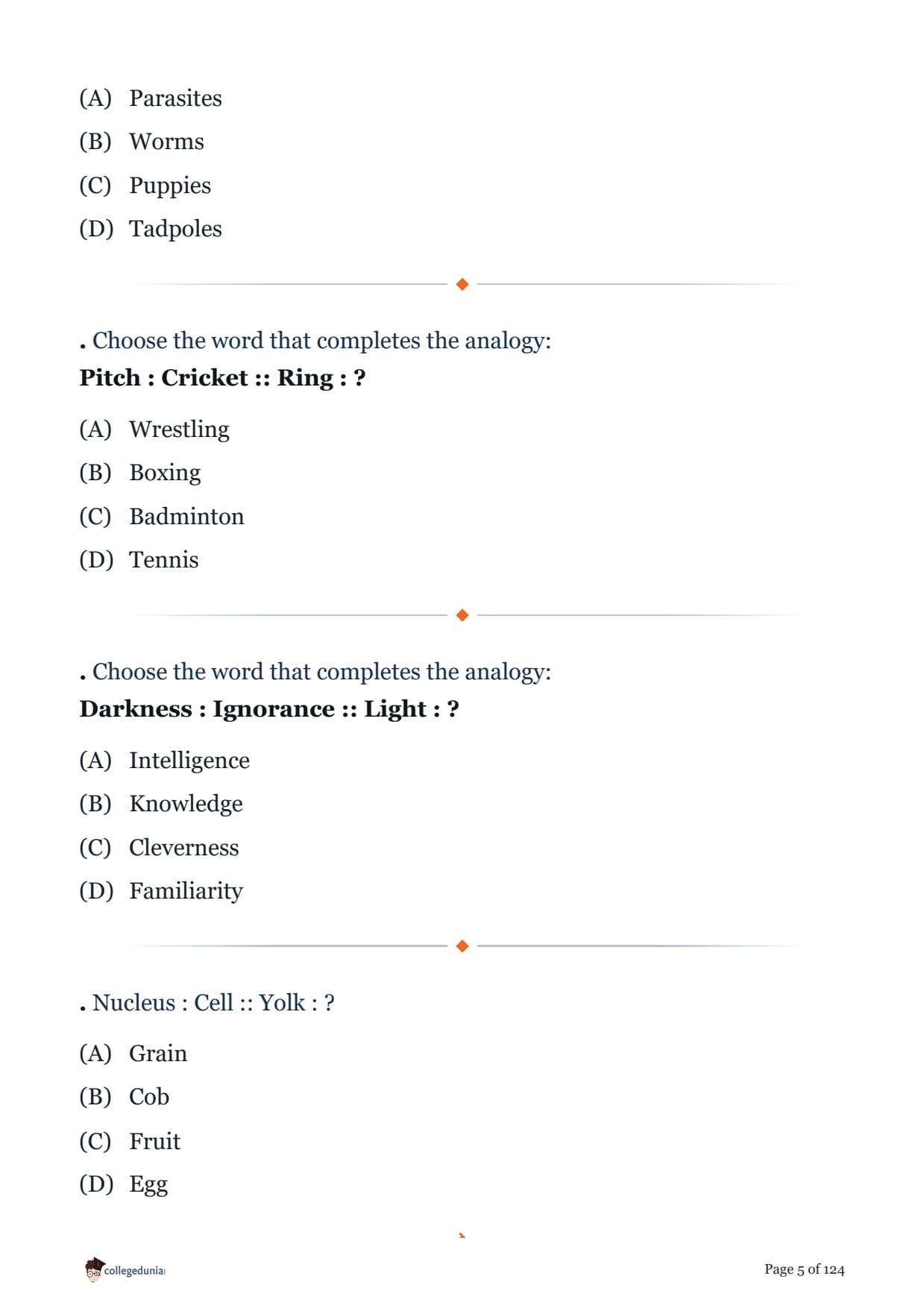
Choose the word that completes the analogy:
Pitch : Cricket :: Ring : ?
Choose the word that completes the analogy:
Darkness : Ignorance :: Light : ?
Nucleus : Cell :: Yolk : ?
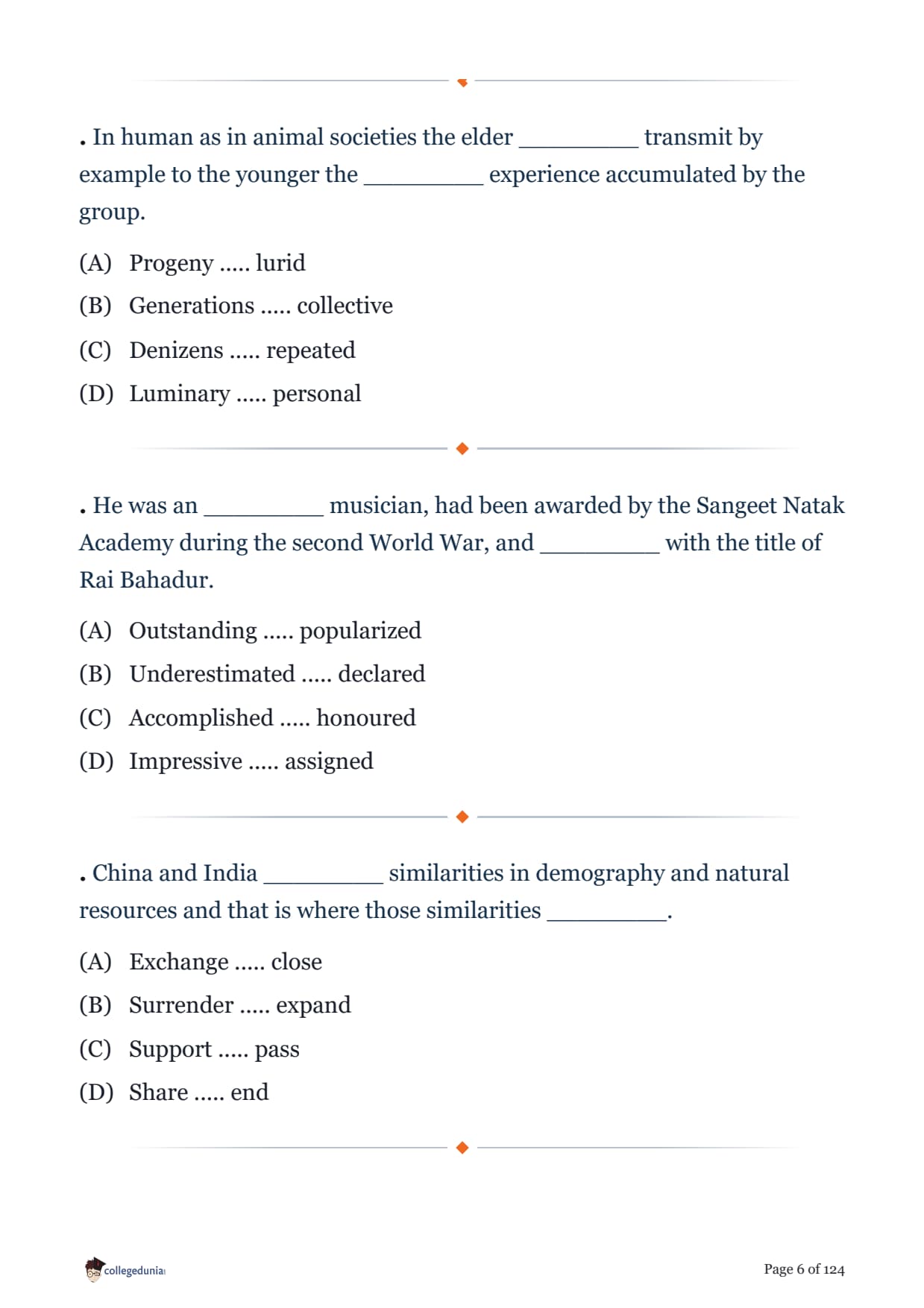
In human as in animal societies the elder ________ transmit by example to the younger the ________ experience accumulated by the group.
He was an ________ musician, had been awarded by the Sangeet Natak Academy during the second World War, and ________ with the title of Rai Bahadur.
China and India ________ similarities in demography and natural resources and that is where those similarities ________.
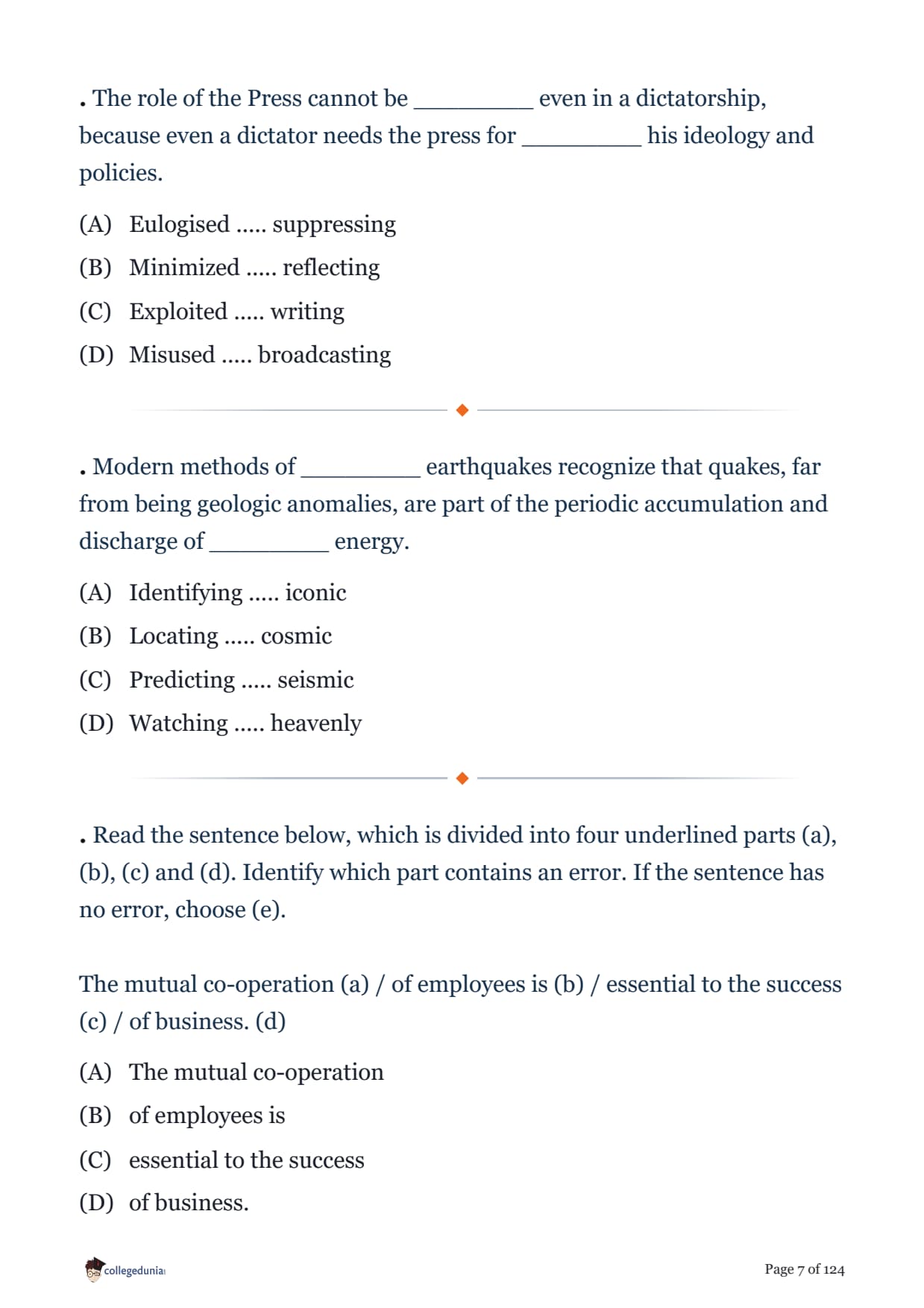
The role of the Press cannot be ________ even in a dictatorship, because even a dictator needs the press for ________ his ideology and policies.
Modern methods of ________ earthquakes recognize that quakes, far from being geologic anomalies, are part of the periodic accumulation and discharge of ________ energy.
Read the sentence below, which is divided into four underlined parts (a), (b), (c) and (d). Identify which part contains an error. If the sentence has no error, choose (e).
The mutual co-operation (a) / of employees is (b) / essential to the success (c) / of business. (d)
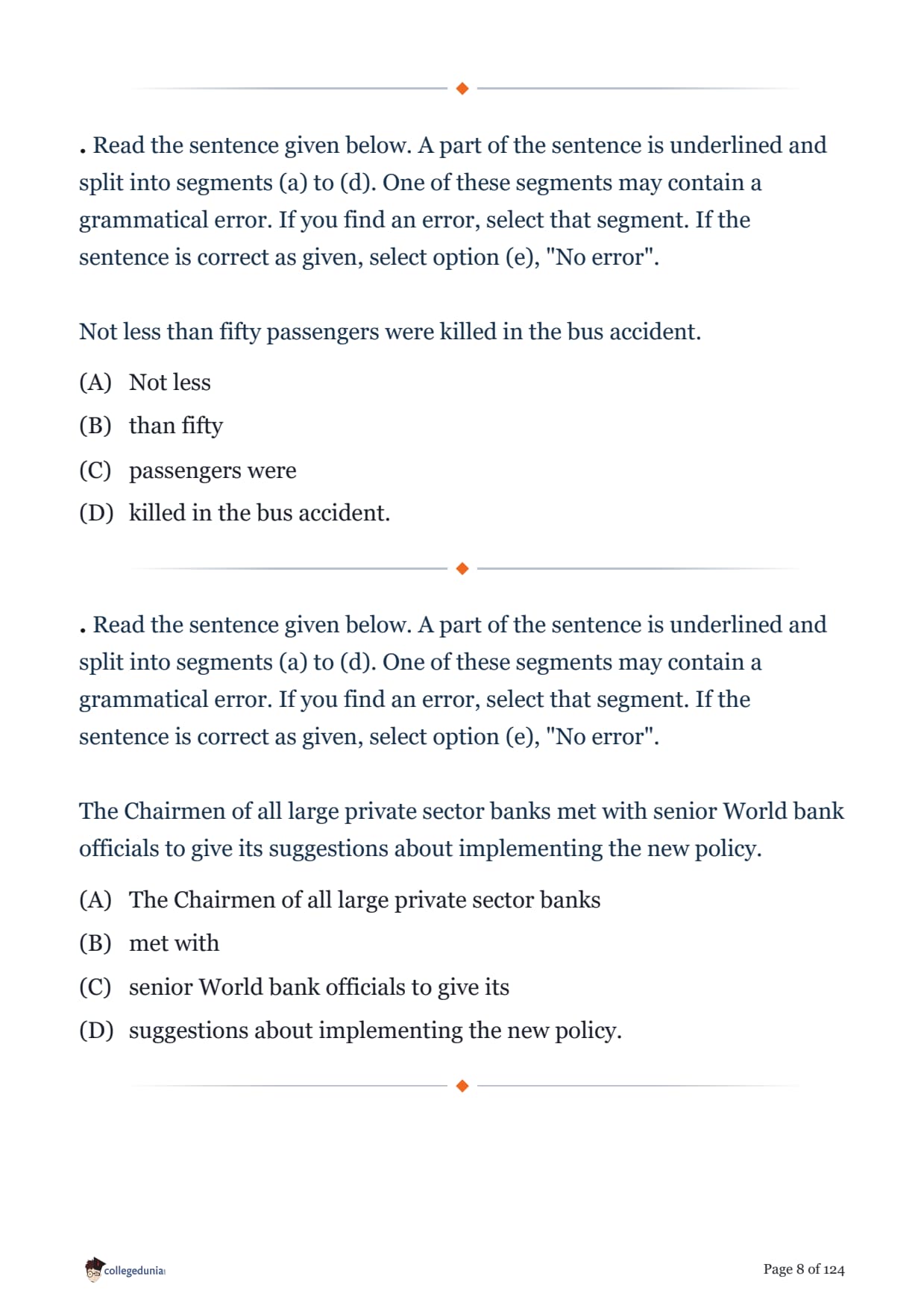
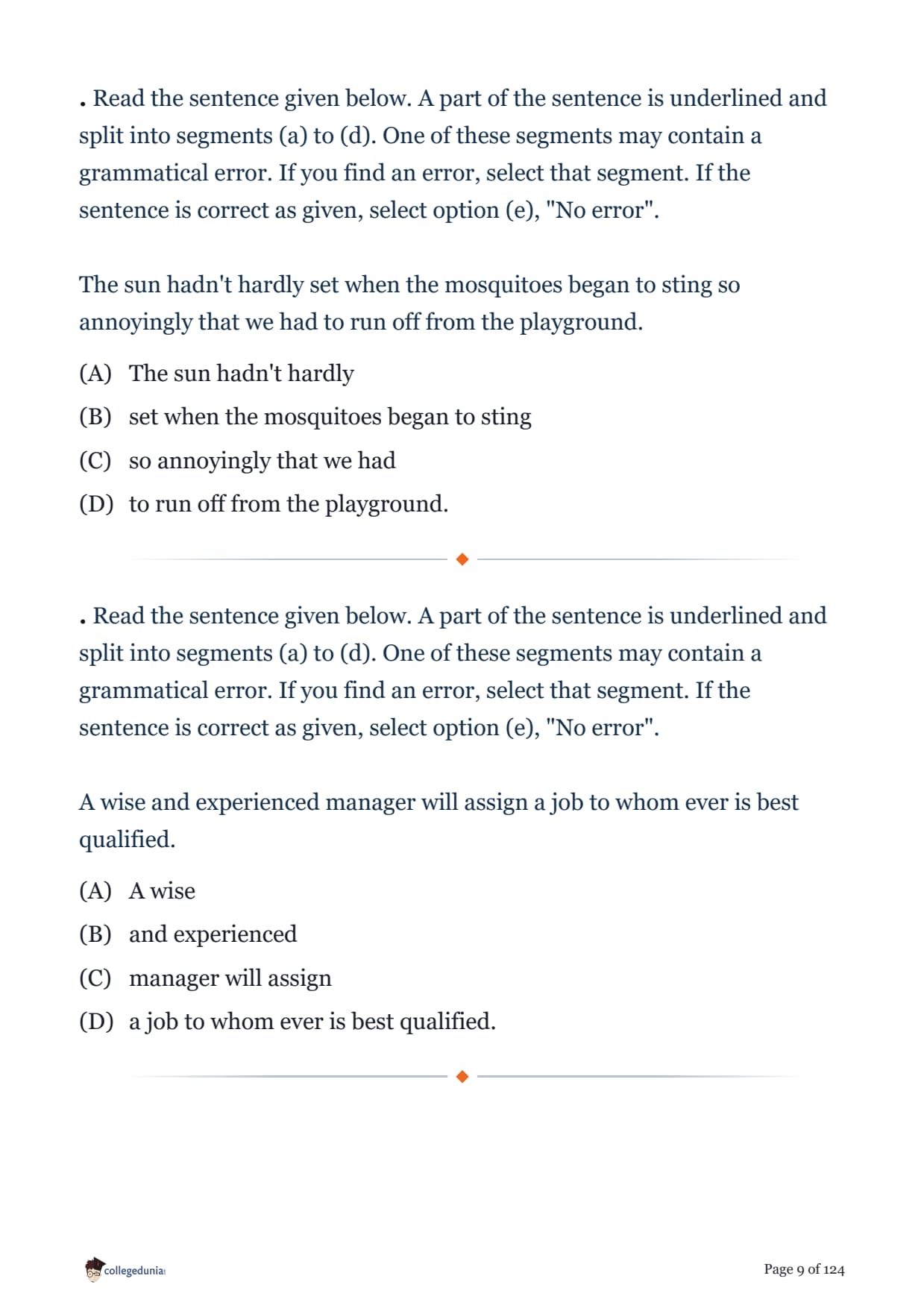
Read the sentence given below. A part of the sentence is underlined and split into segments (a) to (d). One of these segments may contain a grammatical error. If you find an error, select that segment. If the sentence is correct as given, select option (e), "No error".
Not less than fifty passengers were killed in the bus accident.
Read the sentence given below. A part of the sentence is underlined and split into segments (a) to (d). One of these segments may contain a grammatical error. If you find an error, select that segment. If the sentence is correct as given, select option (e), "No error".
The Chairmen of all large private sector banks met with senior World bank officials to give its suggestions about implementing the new policy.
Read the sentence given below. A part of the sentence is underlined and split into segments (a) to (d). One of these segments may contain a grammatical error. If you find an error, select that segment. If the sentence is correct as given, select option (e), "No error".
The sun hadn't hardly set when the mosquitoes began to sting so annoyingly that we had to run off from the playground.
Read the sentence given below. A part of the sentence is underlined and split into segments (a) to (d). One of these segments may contain a grammatical error. If you find an error, select that segment. If the sentence is correct as given, select option (e), "No error".
A wise and experienced manager will assign a job to whom ever is best qualified.
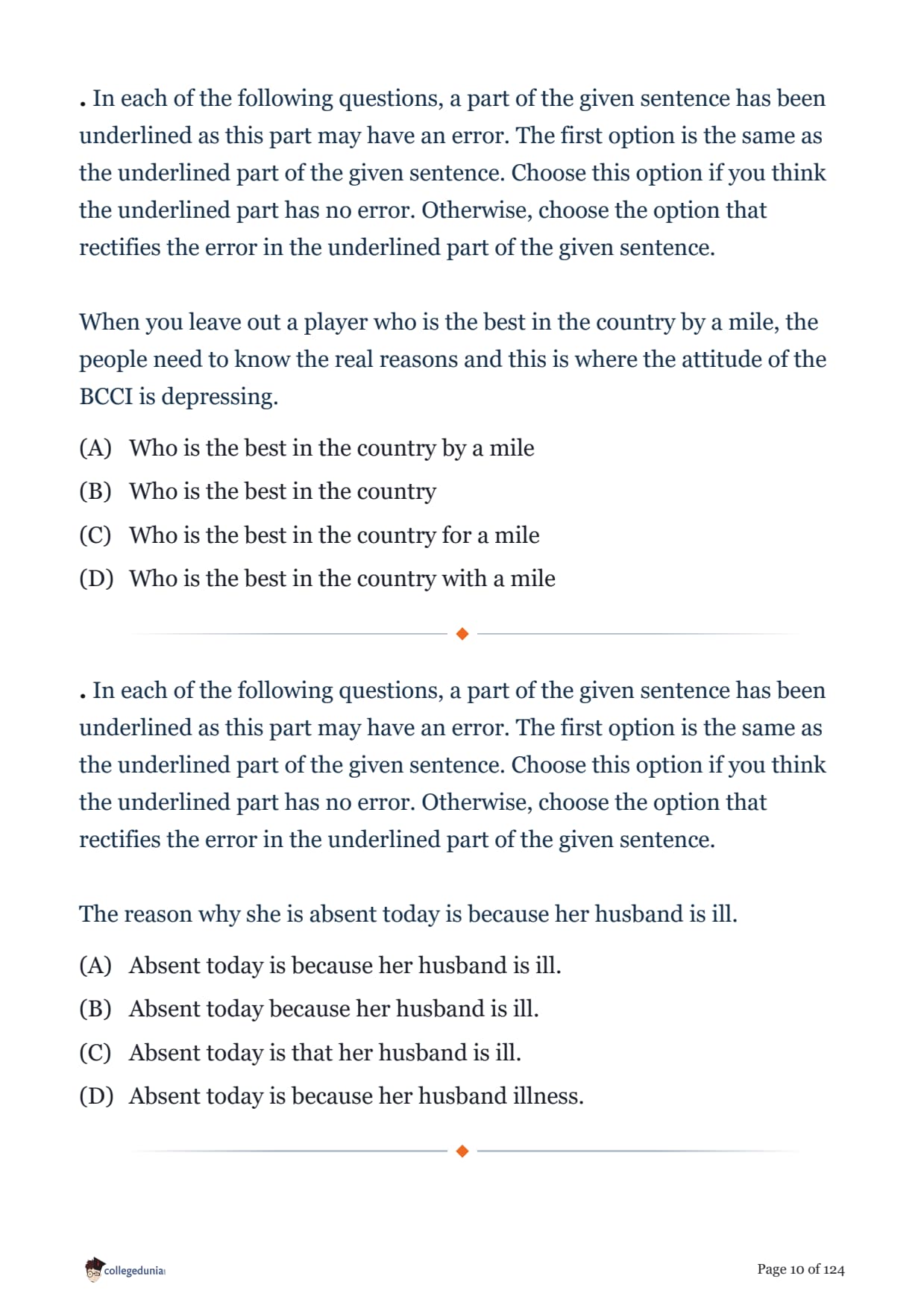
In each of the following questions, a part of the given sentence has been underlined as this part may have an error. The first option is the same as the underlined part of the given sentence. Choose this option if you think the underlined part has no error. Otherwise, choose the option that rectifies the error in the underlined part of the given sentence.
When you leave out a player who is the best in the country by a mile, the people need to know the real reasons and this is where the attitude of the BCCI is depressing.
In each of the following questions, a part of the given sentence has been underlined as this part may have an error. The first option is the same as the underlined part of the given sentence. Choose this option if you think the underlined part has no error. Otherwise, choose the option that rectifies the error in the underlined part of the given sentence.
The reason why she is absent today is because her husband is ill.
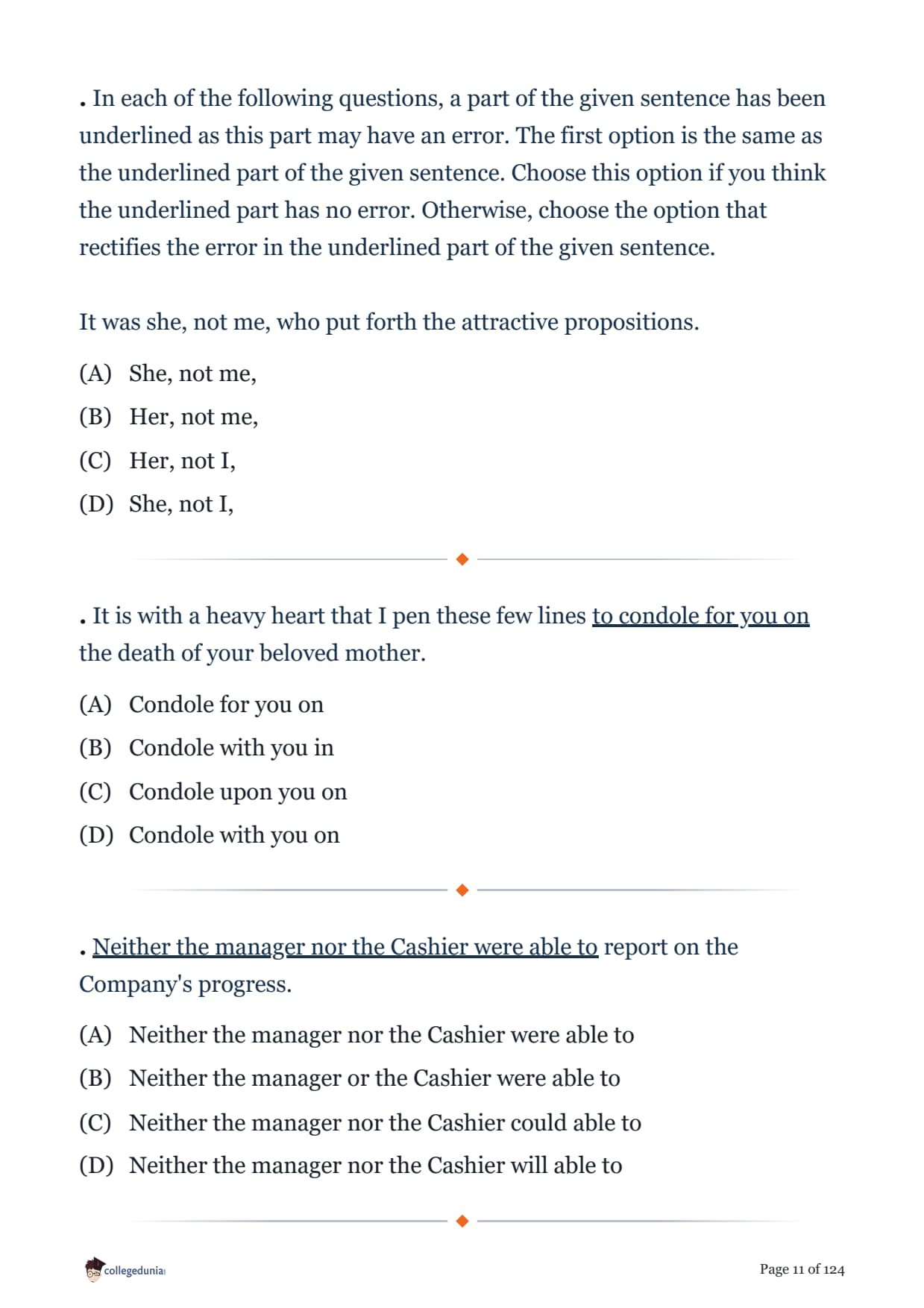
In each of the following questions, a part of the given sentence has been underlined as this part may have an error. The first option is the same as the underlined part of the given sentence. Choose this option if you think the underlined part has no error. Otherwise, choose the option that rectifies the error in the underlined part of the given sentence.
It was she, not me, who put forth the attractive propositions.
It is with a heavy heart that I pen these few lines to condole for you on the death of your beloved mother.
Neither the manager nor the Cashier were able to report on the Company's progress.
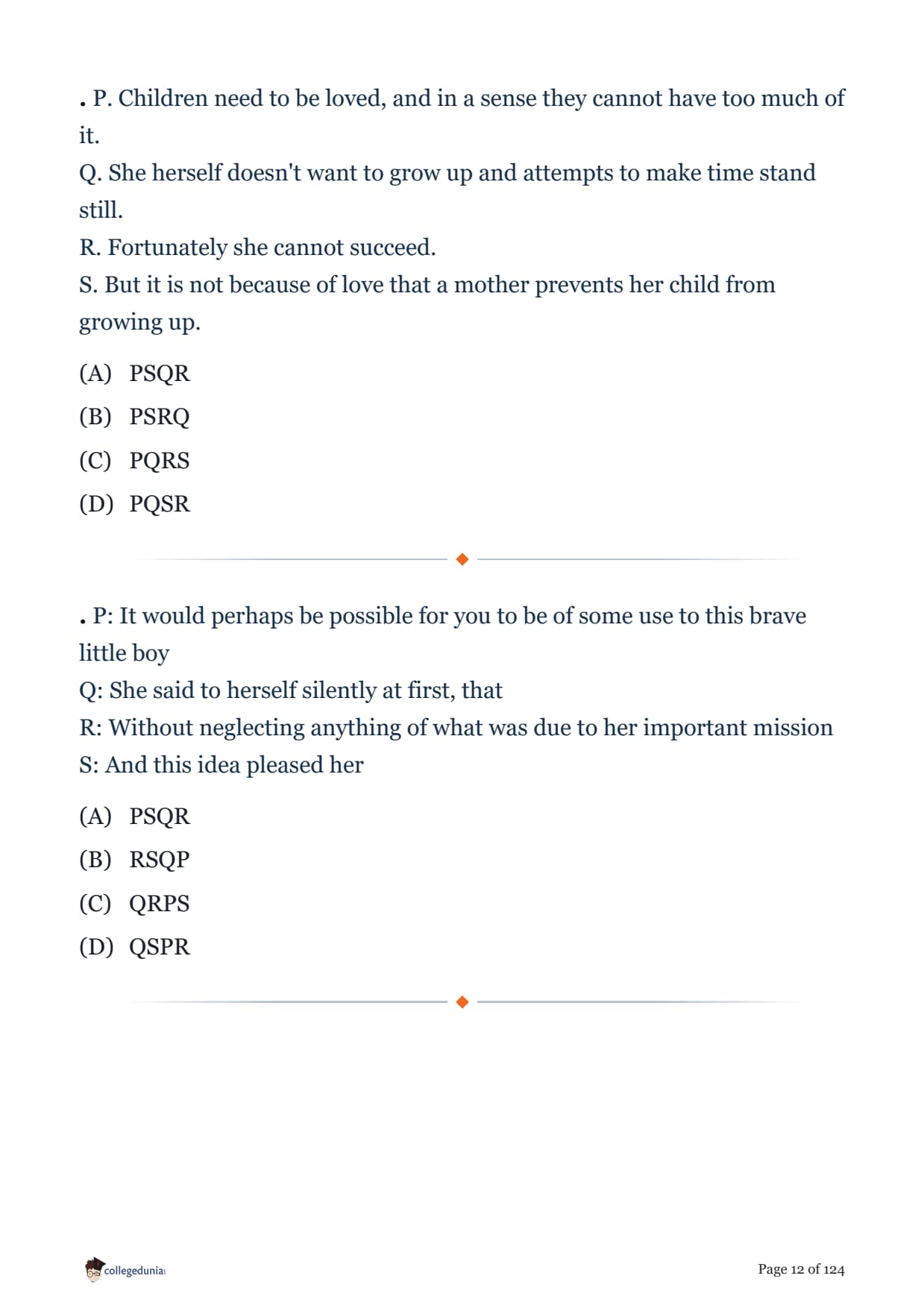
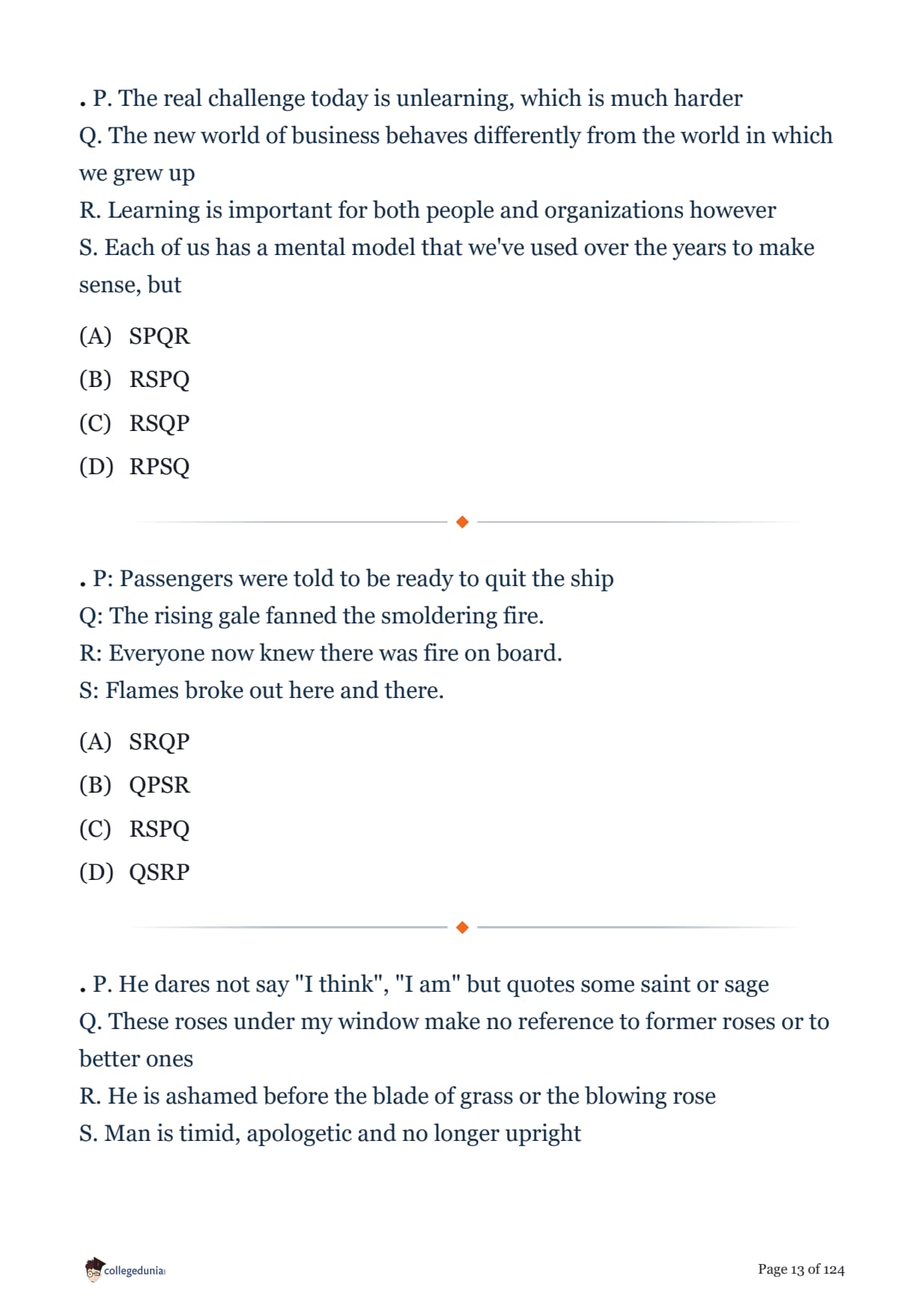
P. Children need to be loved, and in a sense they cannot have too much of it.
Q. She herself doesn't want to grow up and attempts to make time stand still.
R. Fortunately she cannot succeed.
S. But it is not because of love that a mother prevents her child from growing up.
P: It would perhaps be possible for you to be of some use to this brave little boy
Q: She said to herself silently at first, that
R: Without neglecting anything of what was due to her important mission
S: And this idea pleased her
P. The real challenge today is unlearning, which is much harder
Q. The new world of business behaves differently from the world in which we grew up
R. Learning is important for both people and organizations however
S. Each of us has a mental model that we've used over the years to make sense, but
P: Passengers were told to be ready to quit the ship
Q: The rising gale fanned the smoldering fire.
R: Everyone now knew there was fire on board.
S: Flames broke out here and there.
P. He dares not say "I think", "I am" but quotes some saint or sage
Q. These roses under my window make no reference to former roses or to better ones
R. He is ashamed before the blade of grass or the blowing rose
S. Man is timid, apologetic and no longer upright
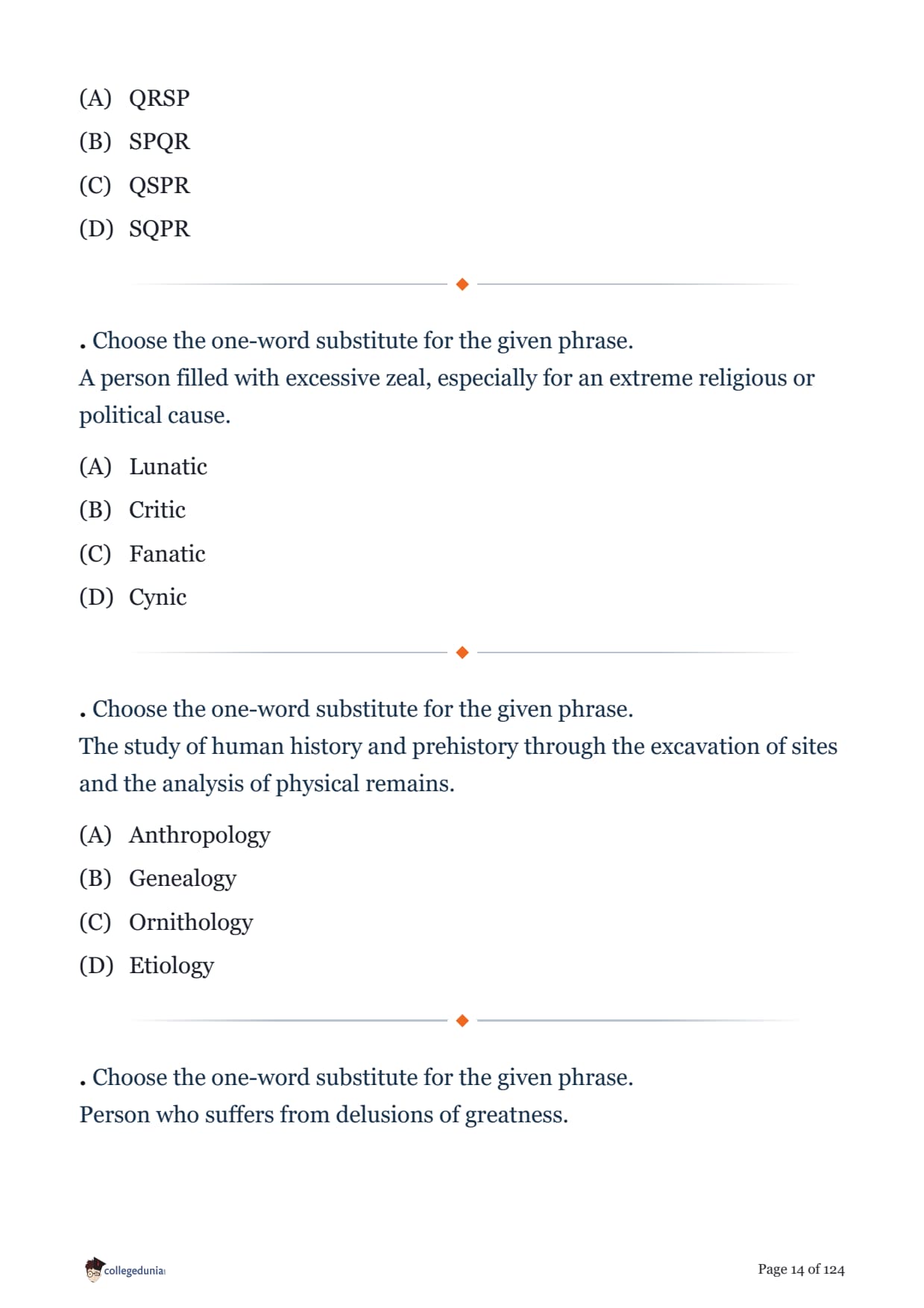
Choose the one-word substitute for the given phrase.
A person filled with excessive zeal, especially for an extreme religious or political cause.
Choose the one-word substitute for the given phrase.
The study of human history and prehistory through the excavation of sites and the analysis of physical remains.
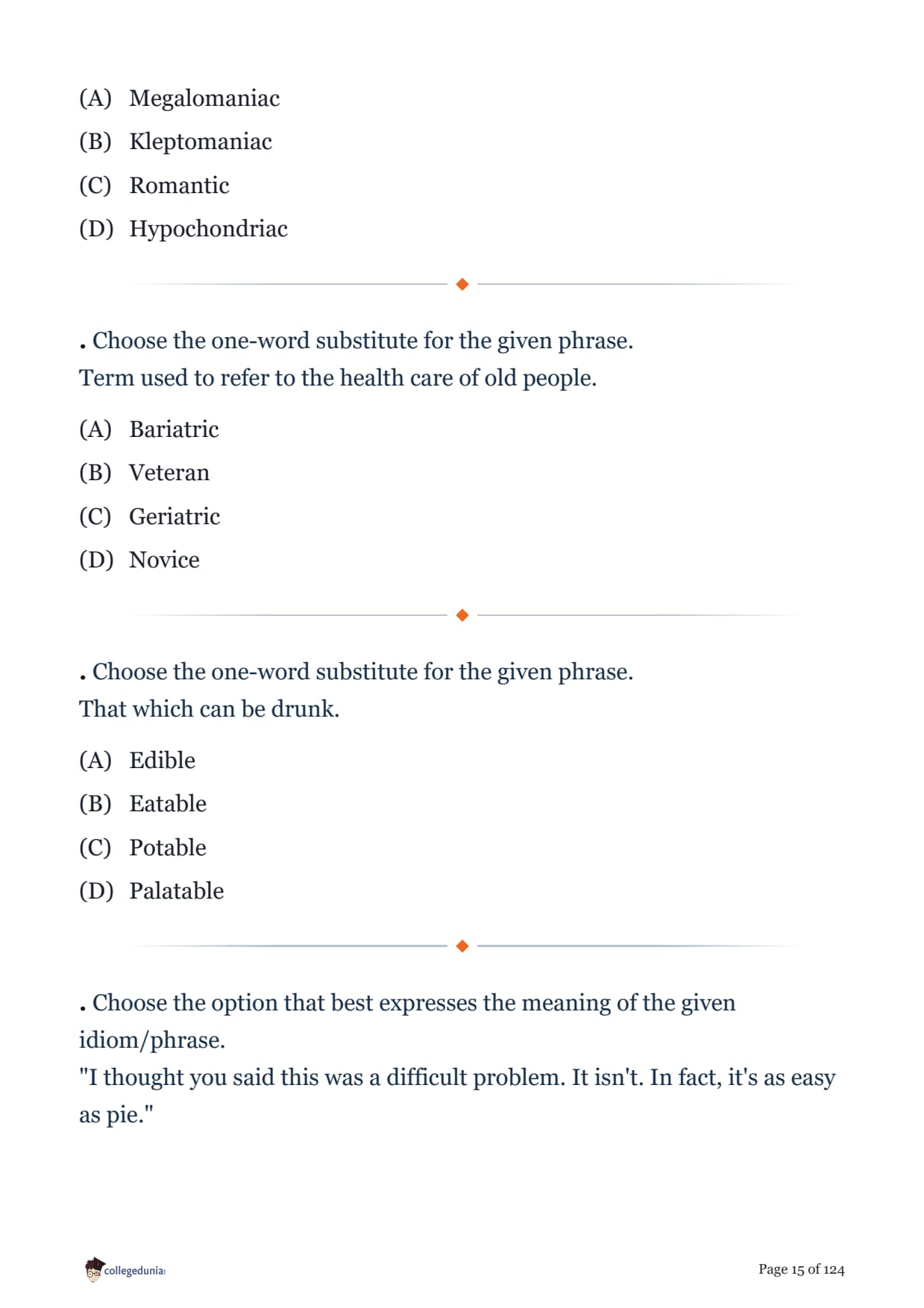
Choose the one-word substitute for the given phrase.
Person who suffers from delusions of greatness.
Choose the one-word substitute for the given phrase.
Term used to refer to the health care of old people.
Choose the one-word substitute for the given phrase.
That which can be drunk.
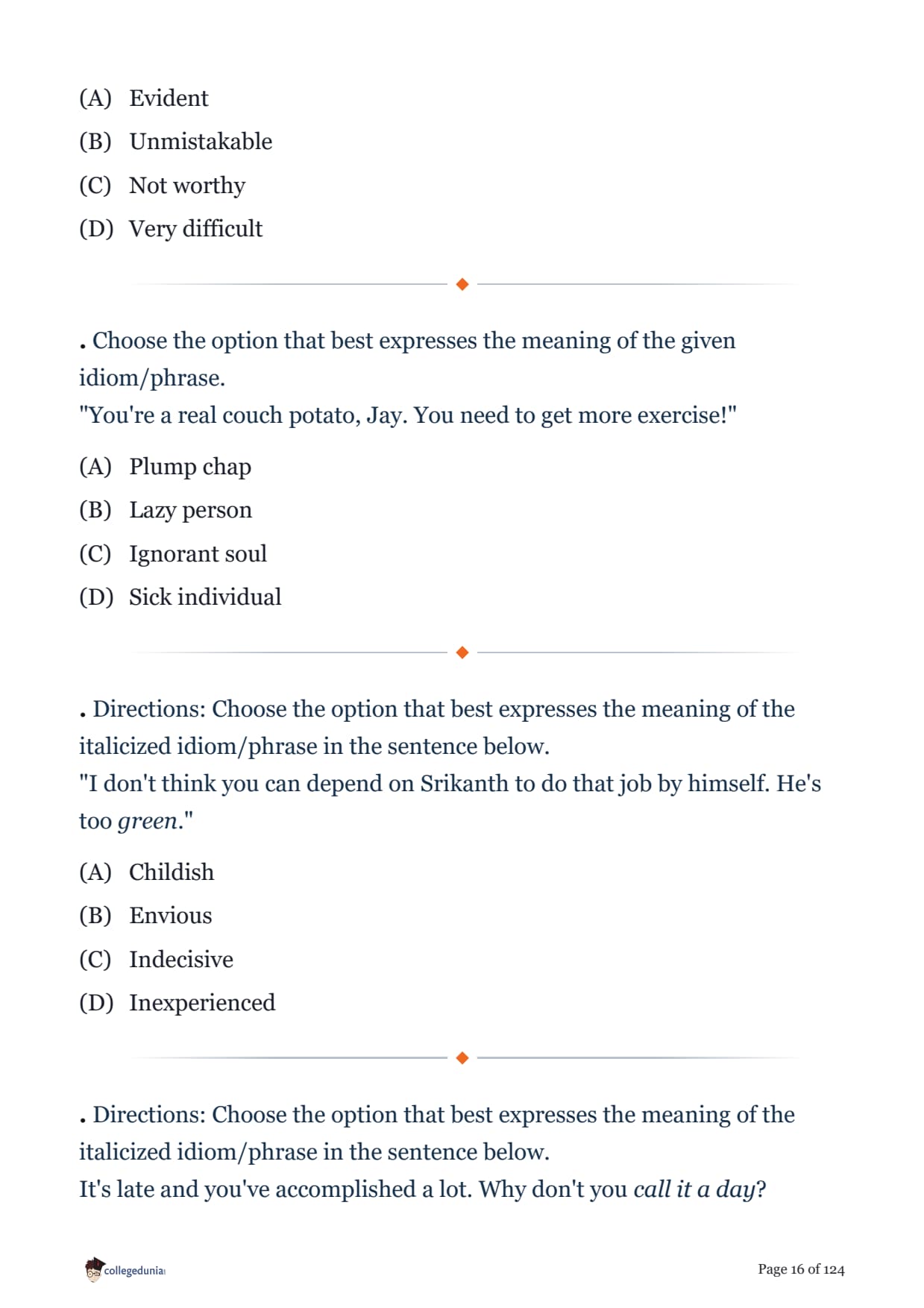
Choose the option that best expresses the meaning of the given idiom/phrase.
"I thought you said this was a difficult problem. It isn't. In fact, it's as easy as pie."
Choose the option that best expresses the meaning of the given idiom/phrase.
"You're a real couch potato, Jay. You need to get more exercise!"
Directions: Choose the option that best expresses the meaning of the italicized idiom/phrase in the sentence below.
"I don't think you can depend on Srikanth to do that job by himself. He's too green."
Directions: Choose the option that best expresses the meaning of the italicized idiom/phrase in the sentence below.
It's late and you've accomplished a lot. Why don't you call it a day?
Directions: Choose the option that best expresses the meaning of the italicized idiom/phrase in the sentence below.
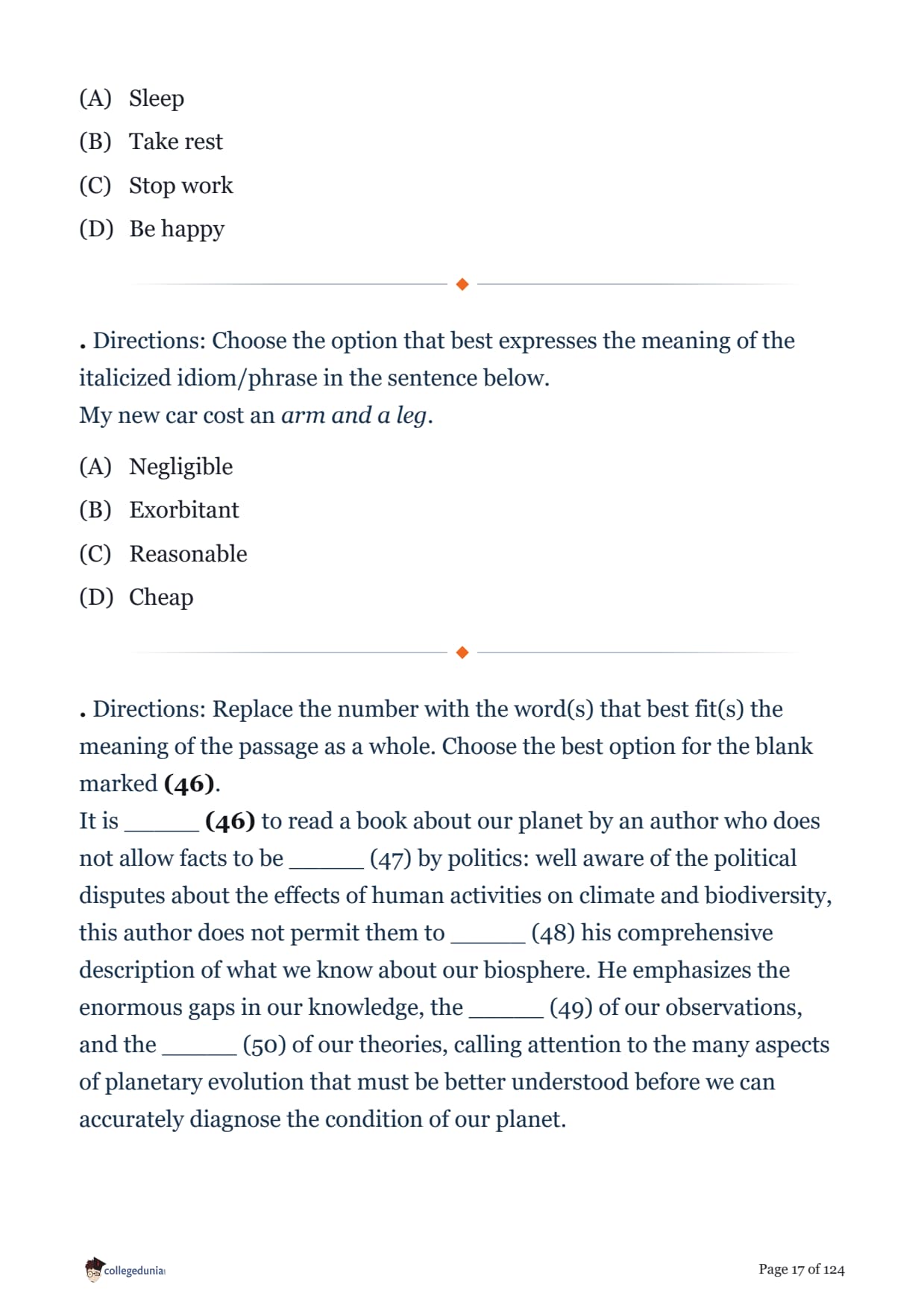
My new car cost an arm and a leg.
Directions: Replace the number with the word(s) that best fit(s) the meaning of the passage as a whole. Choose the best option for the blank marked (46).
It is _____ (46) to read a book about our planet by an author who does not allow facts to be _____ (47) by politics: well aware of the political disputes about the effects of human activities on climate and biodiversity, this author does not permit them to _____ (48) his comprehensive description of what we know about our biosphere. He emphasizes the enormous gaps in our knowledge, the _____ (49) of our observations, and the _____ (50) of our theories, calling attention to the many aspects of planetary evolution that must be better understood before we can accurately diagnose the condition of our planet.
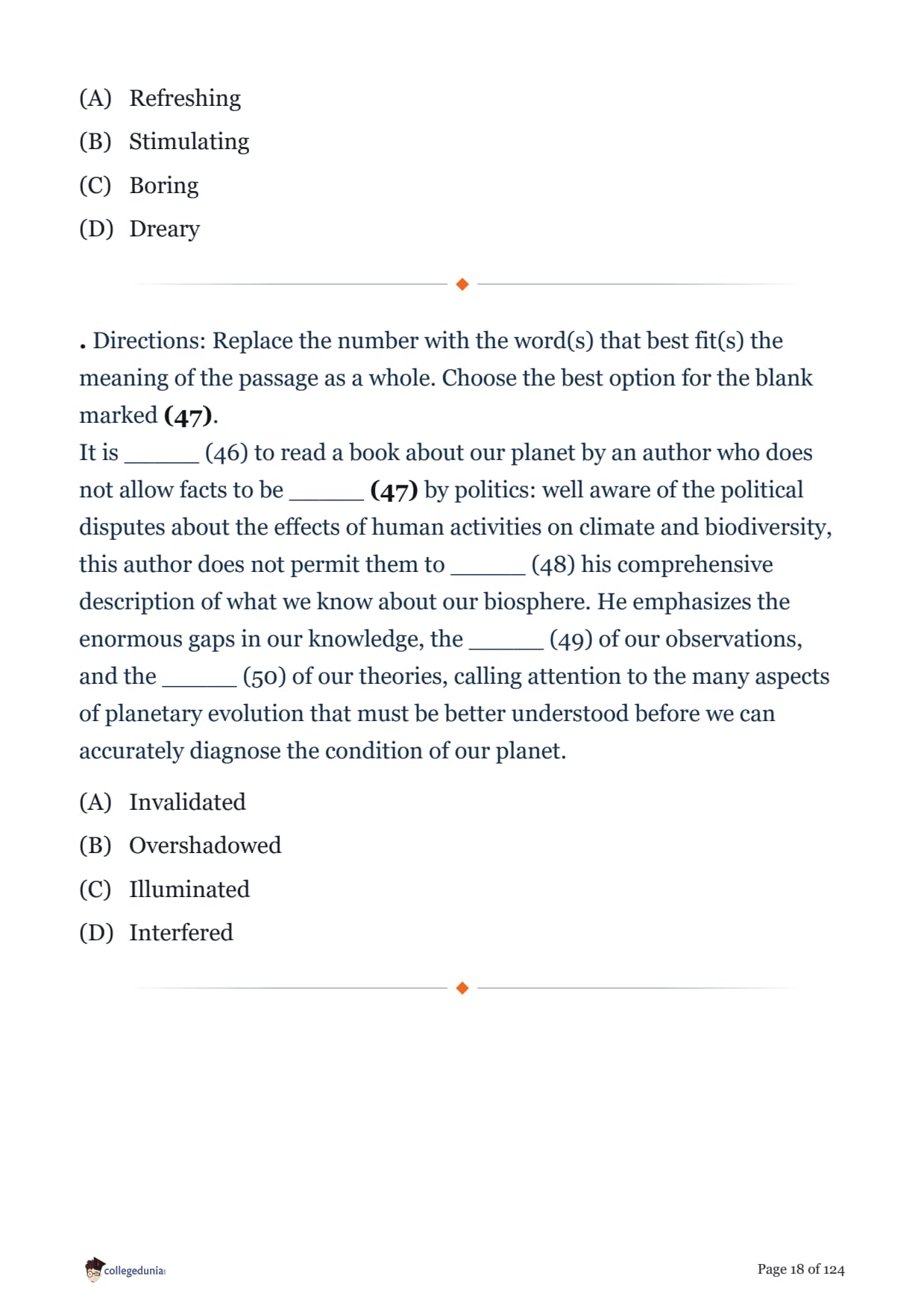
Directions: Replace the number with the word(s) that best fit(s) the meaning of the passage as a whole. Choose the best option for the blank marked (47).
It is _____ (46) to read a book about our planet by an author who does not allow facts to be _____ (47) by politics: well aware of the political disputes about the effects of human activities on climate and biodiversity, this author does not permit them to _____ (48) his comprehensive description of what we know about our biosphere. He emphasizes the enormous gaps in our knowledge, the _____ (49) of our observations, and the _____ (50) of our theories, calling attention to the many aspects of planetary evolution that must be better understood before we can accurately diagnose the condition of our planet.
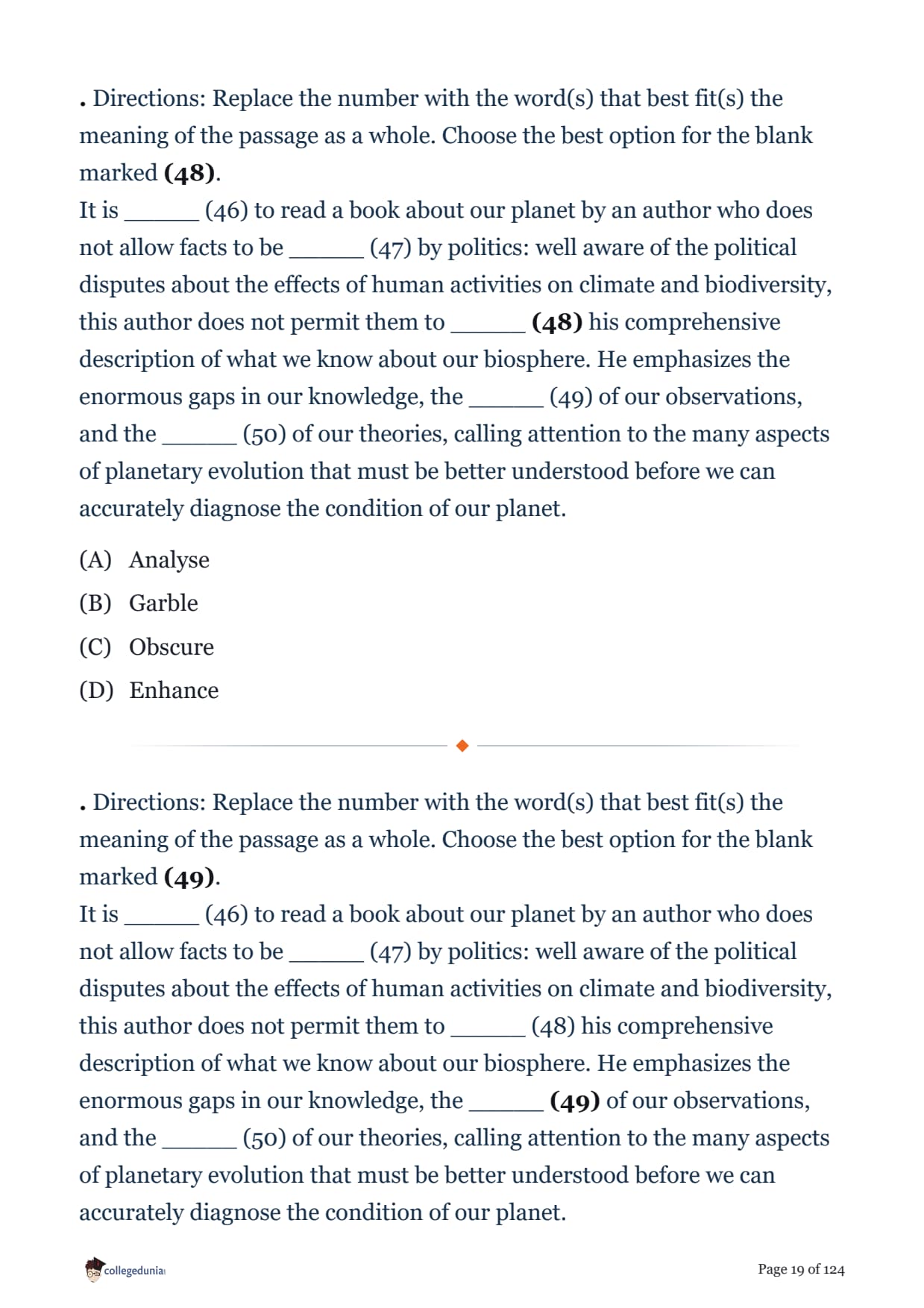
Directions: Replace the number with the word(s) that best fit(s) the meaning of the passage as a whole. Choose the best option for the blank marked (48).
It is _____ (46) to read a book about our planet by an author who does not allow facts to be _____ (47) by politics: well aware of the political disputes about the effects of human activities on climate and biodiversity, this author does not permit them to _____ (48) his comprehensive description of what we know about our biosphere. He emphasizes the enormous gaps in our knowledge, the _____ (49) of our observations, and the _____ (50) of our theories, calling attention to the many aspects of planetary evolution that must be better understood before we can accurately diagnose the condition of our planet.
Directions: Replace the number with the word(s) that best fit(s) the meaning of the passage as a whole. Choose the best option for the blank marked (49).
It is _____ (46) to read a book about our planet by an author who does not allow facts to be _____ (47) by politics: well aware of the political disputes about the effects of human activities on climate and biodiversity, this author does not permit them to _____ (48) his comprehensive description of what we know about our biosphere. He emphasizes the enormous gaps in our knowledge, the _____ (49) of our observations, and the _____ (50) of our theories, calling attention to the many aspects of planetary evolution that must be better understood before we can accurately diagnose the condition of our planet.
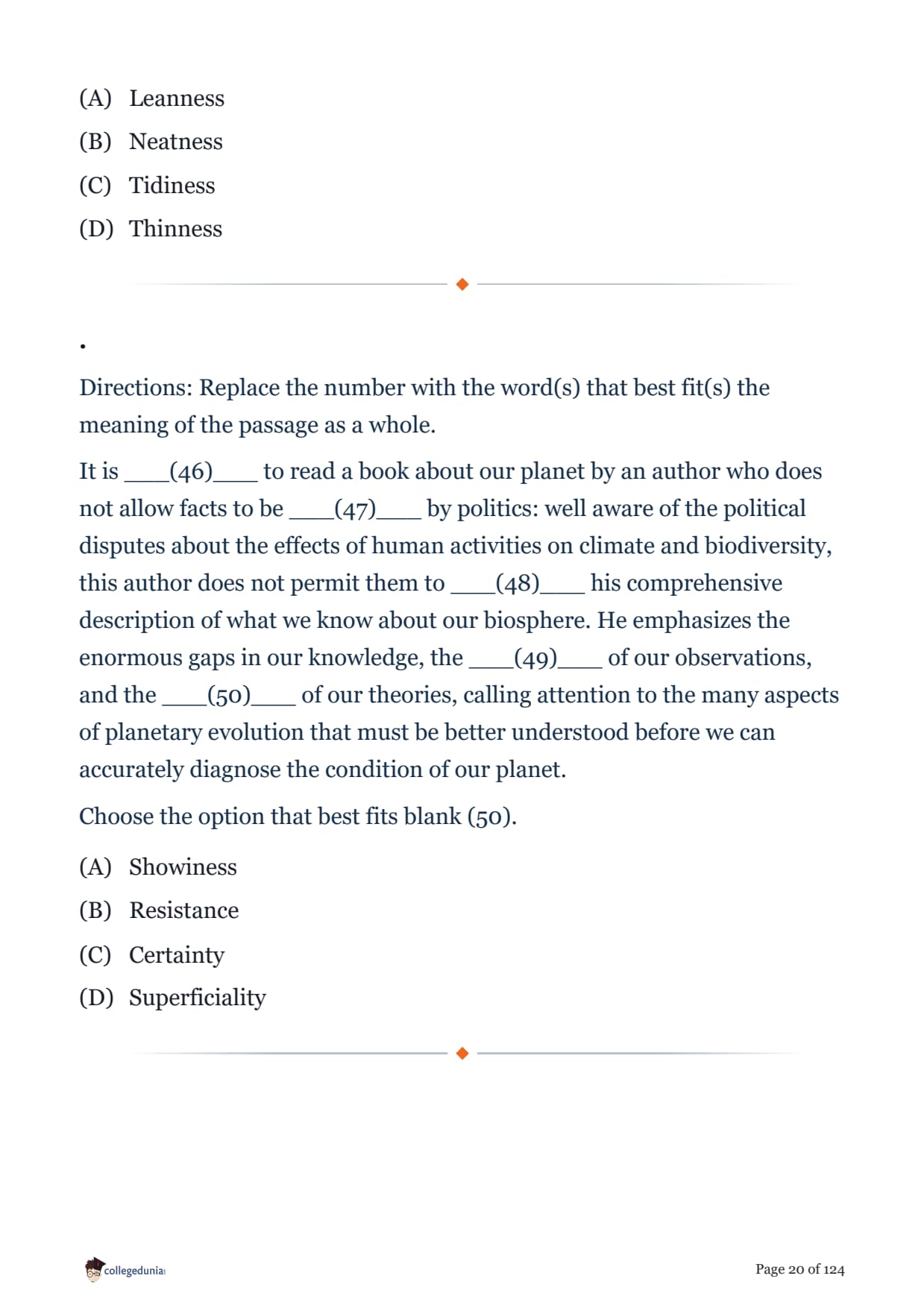
Directions: Replace the number with the word(s) that best fit(s) the meaning of the passage as a whole.
It is ___(46)___ to read a book about our planet by an author who does not allow facts to be ___(47)___ by politics: well aware of the political disputes about the effects of human activities on climate and biodiversity, this author does not permit them to ___(48)___ his comprehensive description of what we know about our biosphere. He emphasizes the enormous gaps in our knowledge, the ___(49)___ of our observations, and the ___(50)___ of our theories, calling attention to the many aspects of planetary evolution that must be better understood before we can accurately diagnose the condition of our planet.
Choose the option that best fits blank (50).
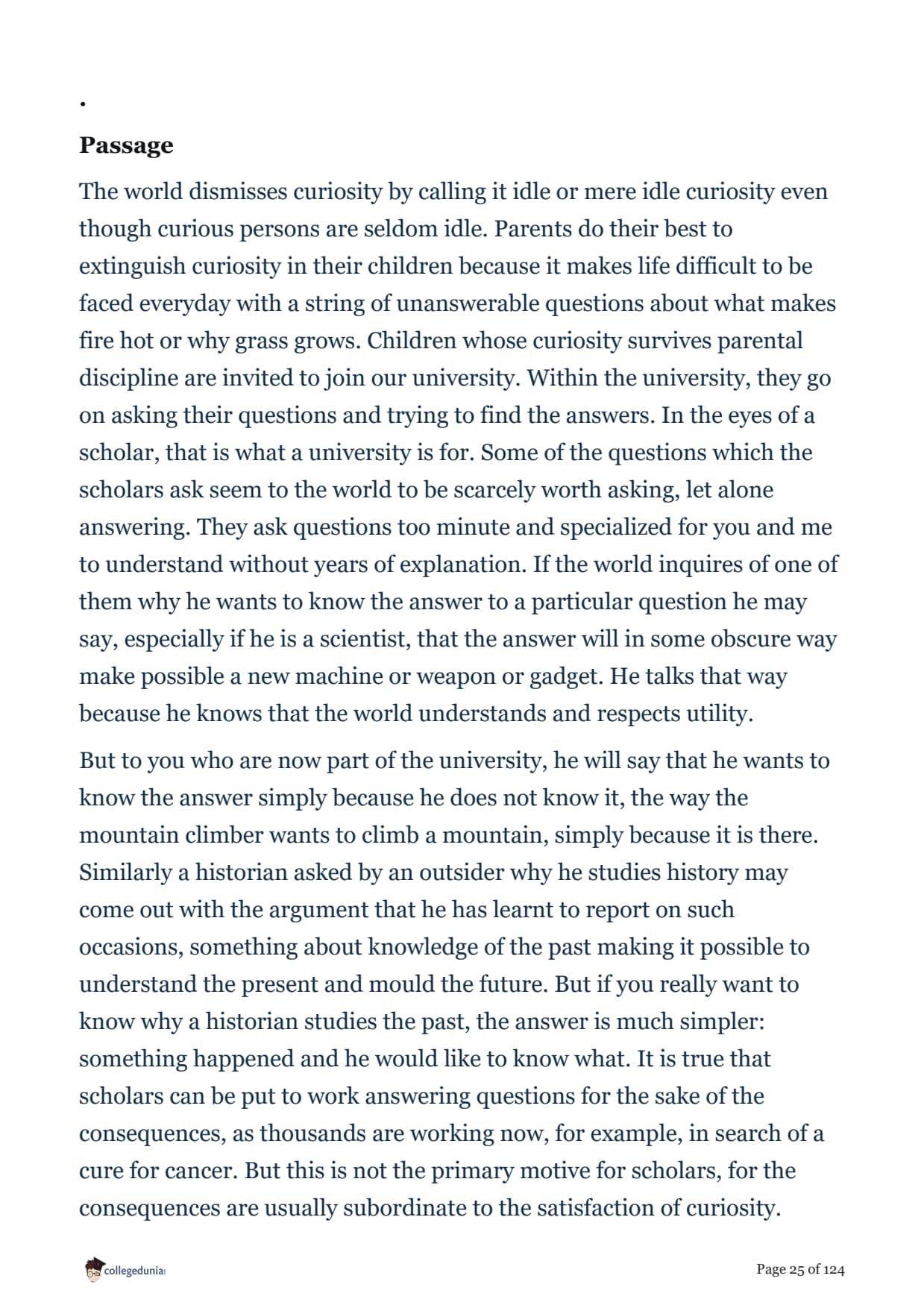
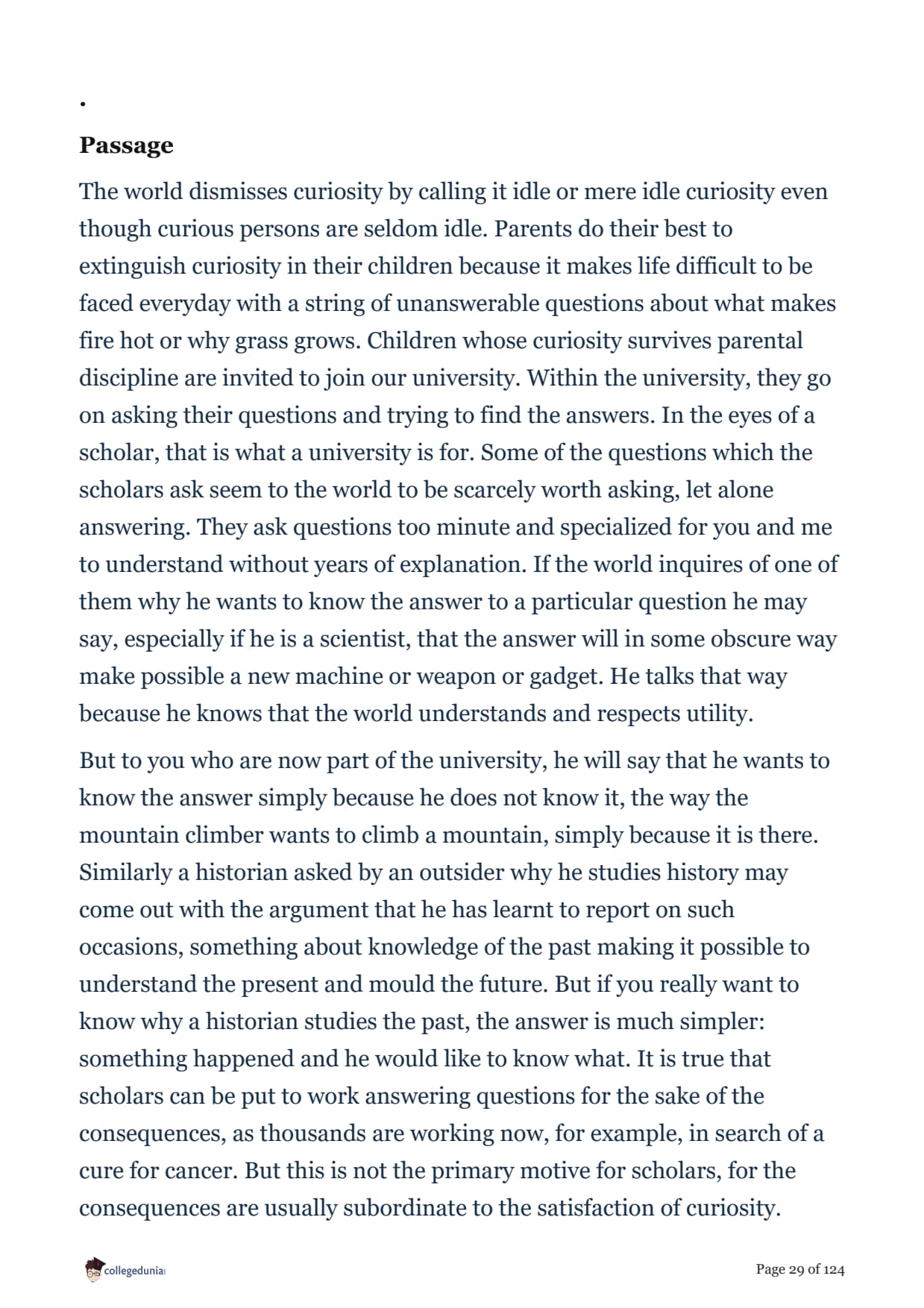
Passage
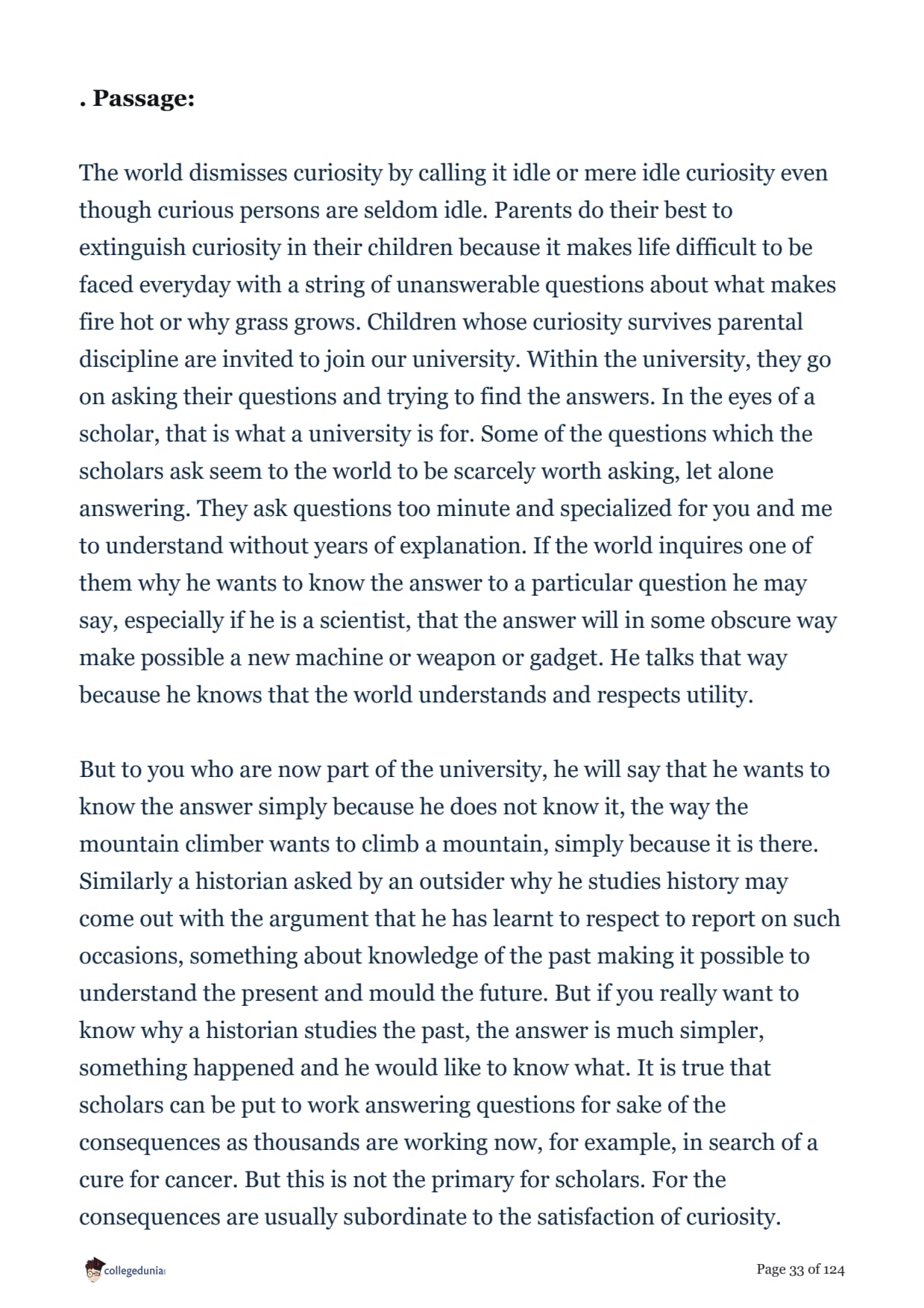
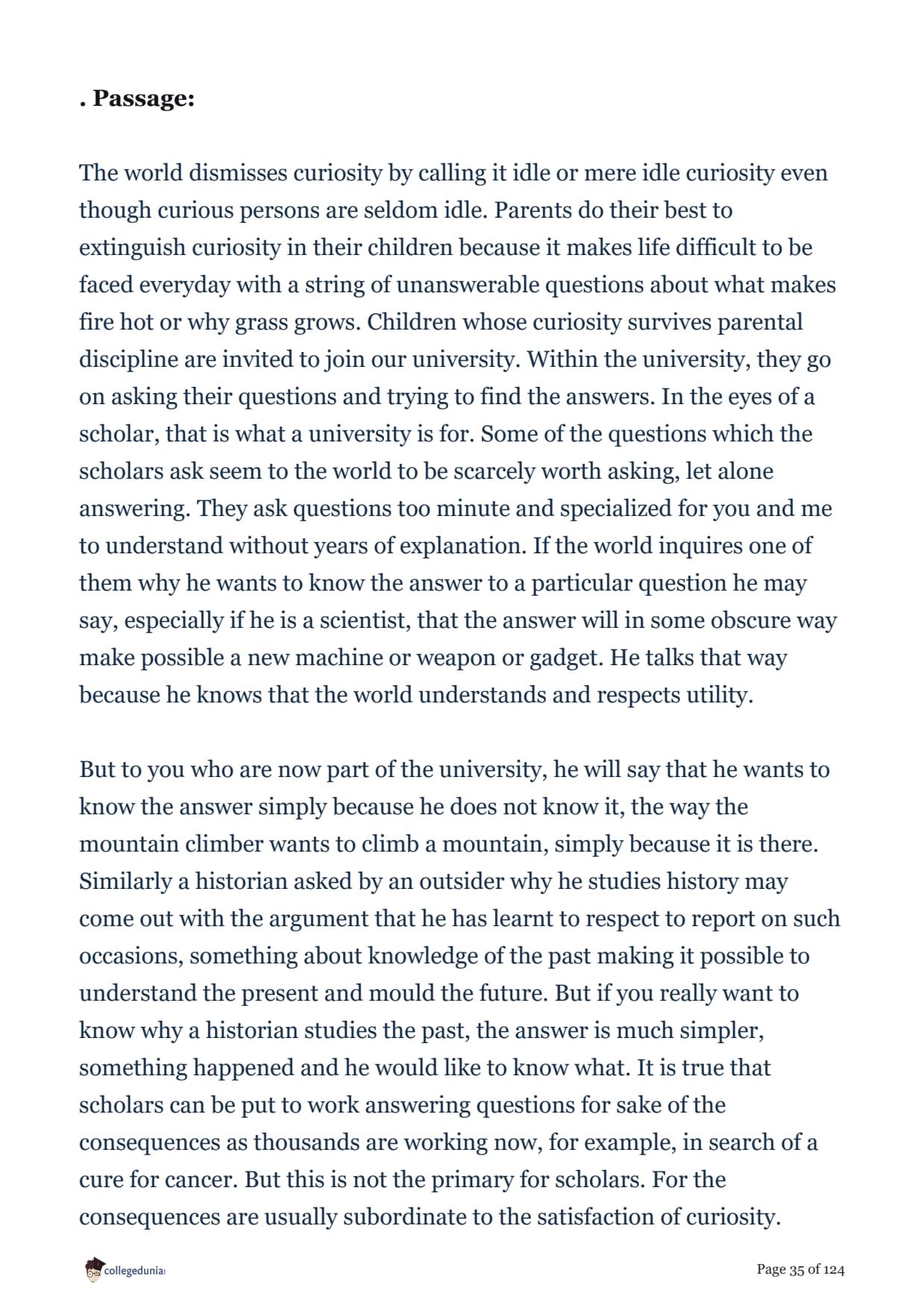
The world dismisses curiosity by calling it idle or mere idle curiosity even though curious persons are seldom idle. Parents do their best to extinguish curiosity in their children because it makes life difficult to be faced everyday with a string of unanswerable questions about what makes fire hot or why grass grows. Children whose curiosity survives parental discipline are invited to join our university. Within the university, they go on asking their questions and trying to find the answers. In the eyes of a scholar, that is what a university is for. Some of the questions which the scholars ask seem to the world to be scarcely worth asking, let alone answering. They ask questions too minute and specialized for you and me to understand without years of explanation. If the world inquires of one of them why he wants to know the answer to a particular question he may say, especially if he is a scientist, that the answer will in some obscure way make possible a new machine or weapon or gadget. He talks that way because he knows that the world understands and respects utility.
But to you who are now part of the university, he will say that he wants to know the answer simply because he does not know it, the way the mountain climber wants to climb a mountain, simply because it is there. Similarly a historian asked by an outsider why he studies history may come out with the argument that he has learnt to report on such occasions, something about knowledge of the past making it possible to understand the present and mould the future. But if you really want to know why a historian studies the past, the answer is much simpler: something happened and he would like to know what. It is true that scholars can be put to work answering questions for the sake of the consequences, as thousands are working now, for example, in search of a cure for cancer. But this is not the primary motive for scholars, for the consequences are usually subordinate to the satisfaction of curiosity.
Q51. Children whose curiosity survives parental discipline means
Passage
The world dismisses curiosity by calling it idle or mere idle curiosity even though curious persons are seldom idle. Parents do their best to extinguish curiosity in their children because it makes life difficult to be faced everyday with a string of unanswerable questions about what makes fire hot or why grass grows. Children whose curiosity survives parental discipline are invited to join our university. Within the university, they go on asking their questions and trying to find the answers. In the eyes of a scholar, that is what a university is for. Some of the questions which the scholars ask seem to the world to be scarcely worth asking, let alone answering. They ask questions too minute and specialized for you and me to understand without years of explanation. If the world inquires of one of them why he wants to know the answer to a particular question he may say, especially if he is a scientist, that the answer will in some obscure way make possible a new machine or weapon or gadget. He talks that way because he knows that the world understands and respects utility.
But to you who are now part of the university, he will say that he wants to know the answer simply because he does not know it, the way the mountain climber wants to climb a mountain, simply because it is there. Similarly a historian asked by an outsider why he studies history may come out with the argument that he has learnt to report on such occasions, something about knowledge of the past making it possible to understand the present and mould the future. But if you really want to know why a historian studies the past, the answer is much simpler: something happened and he would like to know what. It is true that scholars can be put to work answering questions for the sake of the consequences, as thousands are working now, for example, in search of a cure for cancer. But this is not the primary motive for scholars, for the consequences are usually subordinate to the satisfaction of curiosity.
Q52. Pick out the word which is a close synonym of 'Extinguish' as used in the passage.
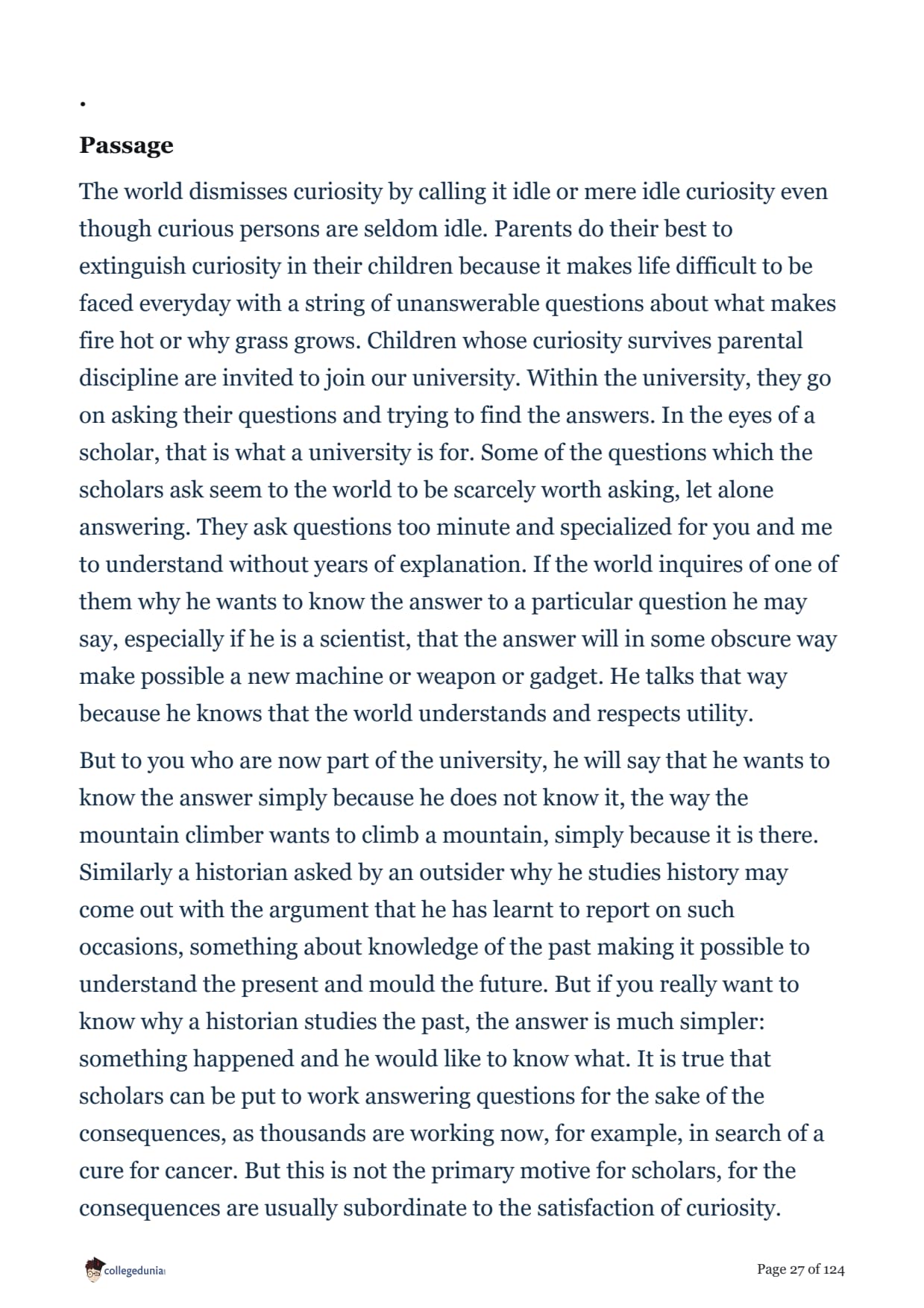
Passage
The world dismisses curiosity by calling it idle or mere idle curiosity even though curious persons are seldom idle. Parents do their best to extinguish curiosity in their children because it makes life difficult to be faced everyday with a string of unanswerable questions about what makes fire hot or why grass grows. Children whose curiosity survives parental discipline are invited to join our university. Within the university, they go on asking their questions and trying to find the answers. In the eyes of a scholar, that is what a university is for. Some of the questions which the scholars ask seem to the world to be scarcely worth asking, let alone answering. They ask questions too minute and specialized for you and me to understand without years of explanation. If the world inquires of one of them why he wants to know the answer to a particular question he may say, especially if he is a scientist, that the answer will in some obscure way make possible a new machine or weapon or gadget. He talks that way because he knows that the world understands and respects utility.
But to you who are now part of the university, he will say that he wants to know the answer simply because he does not know it, the way the mountain climber wants to climb a mountain, simply because it is there. Similarly a historian asked by an outsider why he studies history may come out with the argument that he has learnt to report on such occasions, something about knowledge of the past making it possible to understand the present and mould the future. But if you really want to know why a historian studies the past, the answer is much simpler: something happened and he would like to know what. It is true that scholars can be put to work answering questions for the sake of the consequences, as thousands are working now, for example, in search of a cure for cancer. But this is not the primary motive for scholars, for the consequences are usually subordinate to the satisfaction of curiosity.
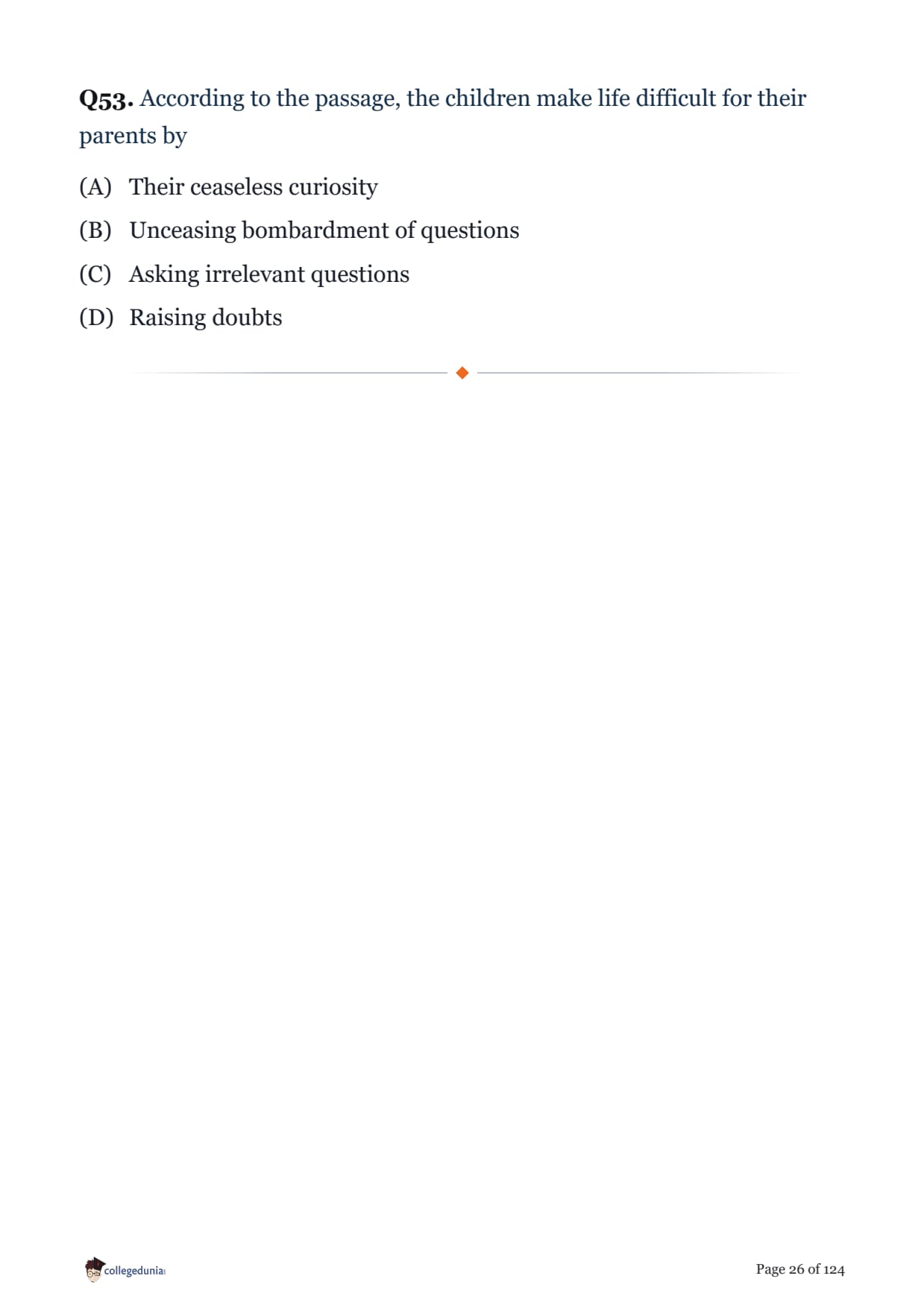
Q53. According to the passage, the children make life difficult for their parents by
Passage
The world dismisses curiosity by calling it idle or mere idle curiosity even though curious persons are seldom idle. Parents do their best to extinguish curiosity in their children because it makes life difficult to be faced everyday with a string of unanswerable questions about what makes fire hot or why grass grows. Children whose curiosity survives parental discipline are invited to join our university. Within the university, they go on asking their questions and trying to find the answers. In the eyes of a scholar, that is what a university is for. Some of the questions which the scholars ask seem to the world to be scarcely worth asking, let alone answering. They ask questions too minute and specialized for you and me to understand without years of explanation. If the world inquires of one of them why he wants to know the answer to a particular question he may say, especially if he is a scientist, that the answer will in some obscure way make possible a new machine or weapon or gadget. He talks that way because he knows that the world understands and respects utility.
But to you who are now part of the university, he will say that he wants to know the answer simply because he does not know it, the way the mountain climber wants to climb a mountain, simply because it is there. Similarly a historian asked by an outsider why he studies history may come out with the argument that he has learnt to report on such occasions, something about knowledge of the past making it possible to understand the present and mould the future. But if you really want to know why a historian studies the past, the answer is much simpler: something happened and he would like to know what. It is true that scholars can be put to work answering questions for the sake of the consequences, as thousands are working now, for example, in search of a cure for cancer. But this is not the primary motive for scholars, for the consequences are usually subordinate to the satisfaction of curiosity.
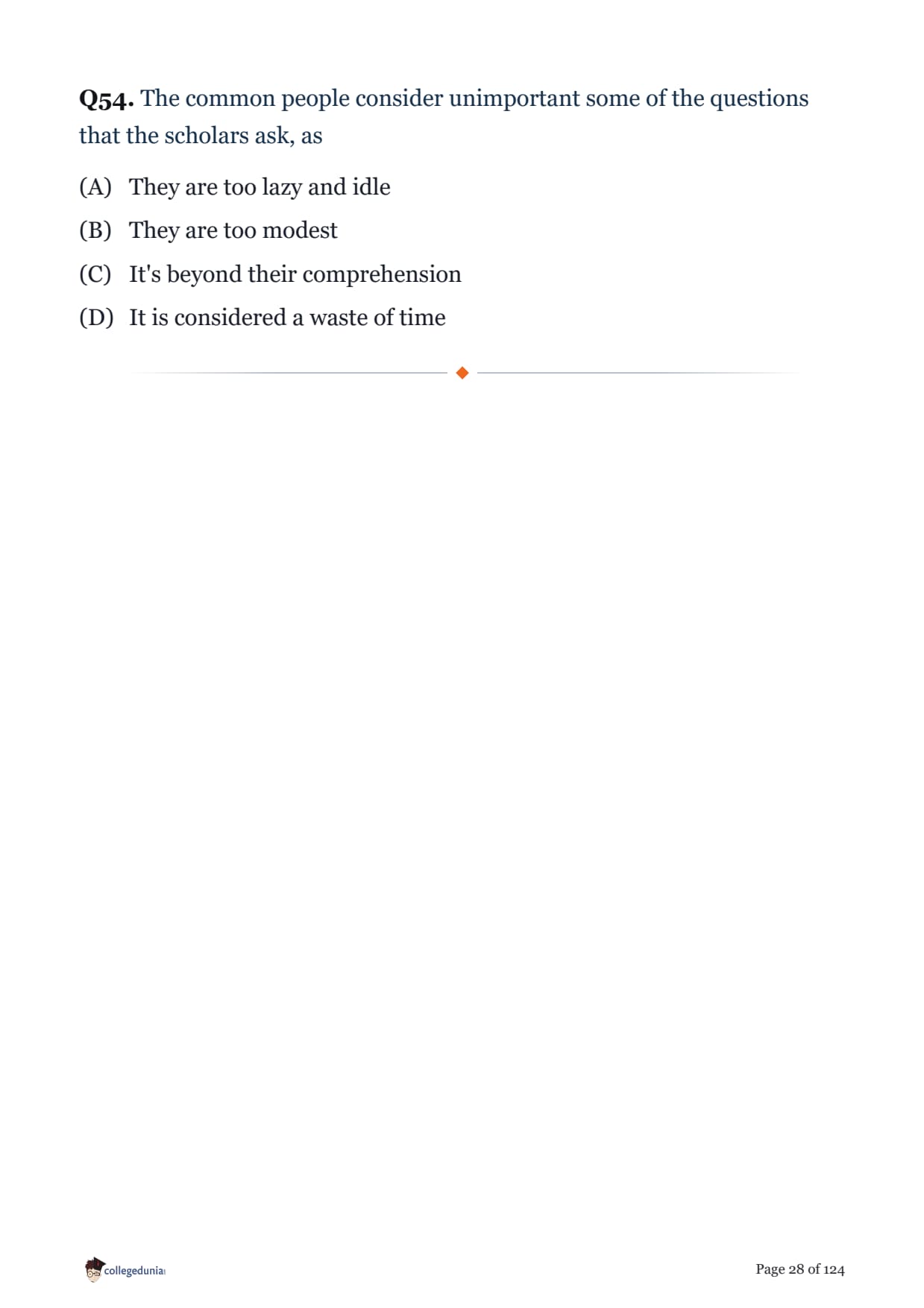
Q54. The common people consider unimportant some of the questions that the scholars ask, as
Passage
The world dismisses curiosity by calling it idle or mere idle curiosity even though curious persons are seldom idle. Parents do their best to extinguish curiosity in their children because it makes life difficult to be faced everyday with a string of unanswerable questions about what makes fire hot or why grass grows. Children whose curiosity survives parental discipline are invited to join our university. Within the university, they go on asking their questions and trying to find the answers. In the eyes of a scholar, that is what a university is for. Some of the questions which the scholars ask seem to the world to be scarcely worth asking, let alone answering. They ask questions too minute and specialized for you and me to understand without years of explanation. If the world inquires of one of them why he wants to know the answer to a particular question he may say, especially if he is a scientist, that the answer will in some obscure way make possible a new machine or weapon or gadget. He talks that way because he knows that the world understands and respects utility.
But to you who are now part of the university, he will say that he wants to know the answer simply because he does not know it, the way the mountain climber wants to climb a mountain, simply because it is there. Similarly a historian asked by an outsider why he studies history may come out with the argument that he has learnt to report on such occasions, something about knowledge of the past making it possible to understand the present and mould the future. But if you really want to know why a historian studies the past, the answer is much simpler: something happened and he would like to know what. It is true that scholars can be put to work answering questions for the sake of the consequences, as thousands are working now, for example, in search of a cure for cancer. But this is not the primary motive for scholars, for the consequences are usually subordinate to the satisfaction of curiosity.
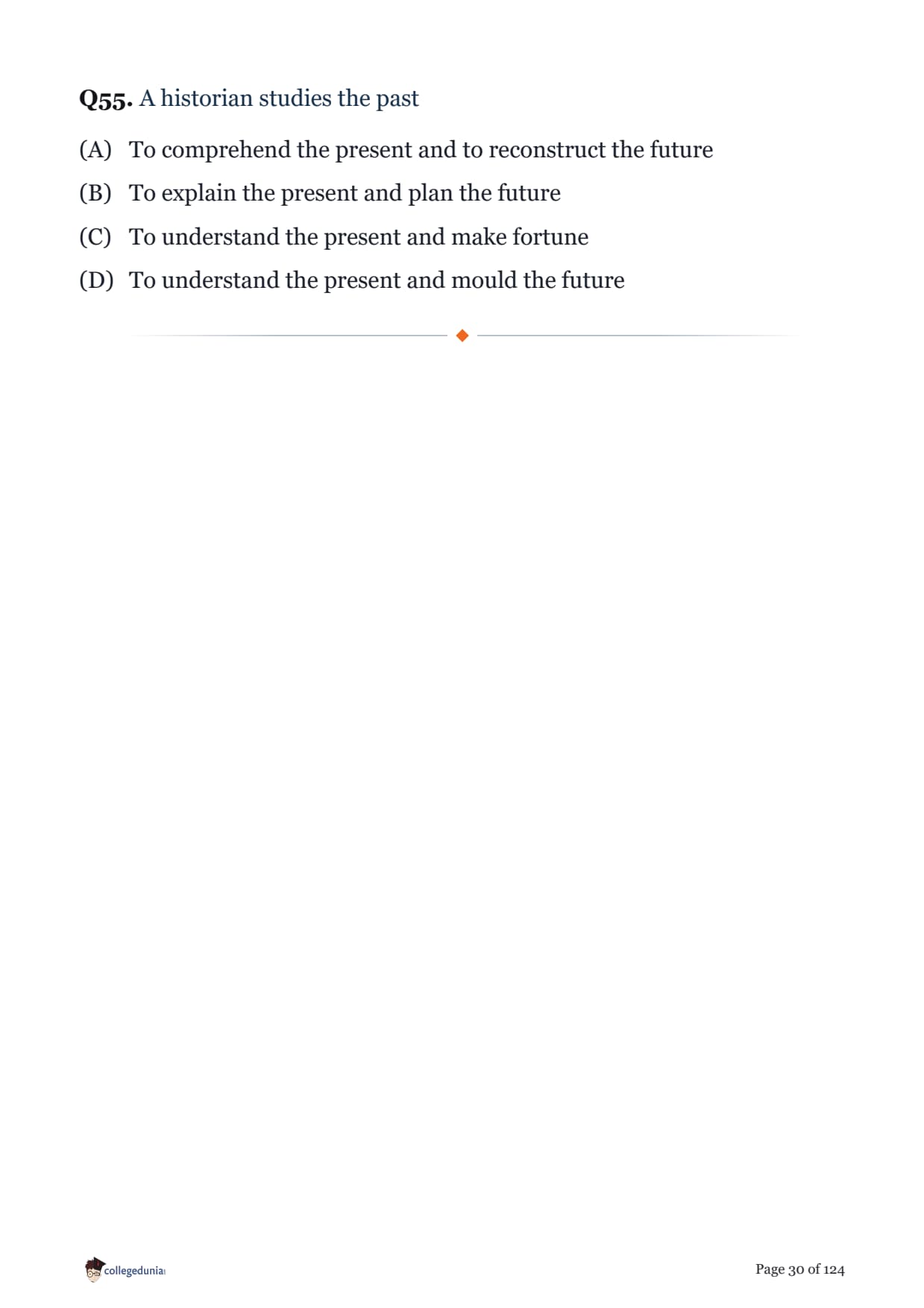
Q55. A historian studies the past
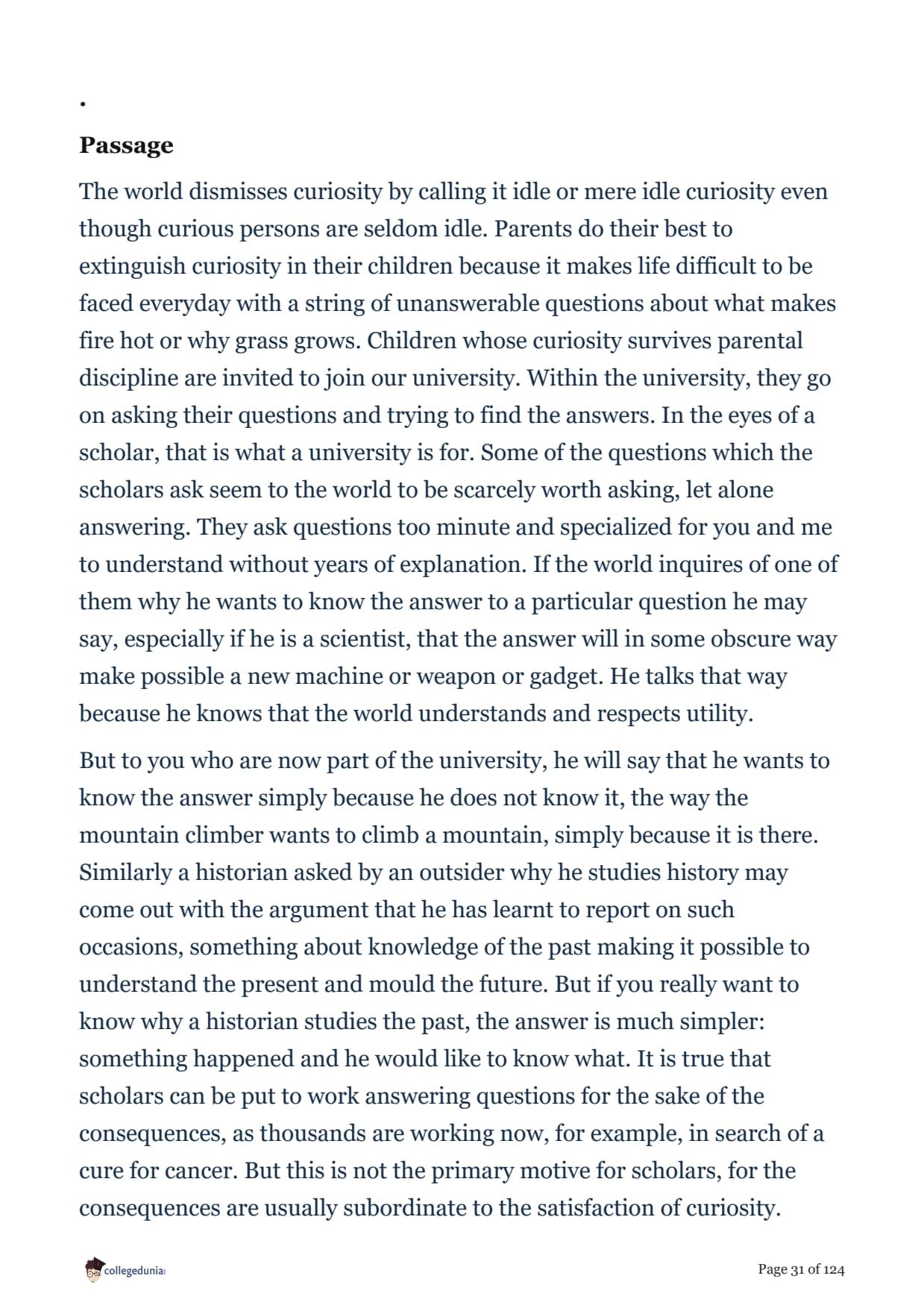
Passage
The world dismisses curiosity by calling it idle or mere idle curiosity even though curious persons are seldom idle. Parents do their best to extinguish curiosity in their children because it makes life difficult to be faced everyday with a string of unanswerable questions about what makes fire hot or why grass grows. Children whose curiosity survives parental discipline are invited to join our university. Within the university, they go on asking their questions and trying to find the answers. In the eyes of a scholar, that is what a university is for. Some of the questions which the scholars ask seem to the world to be scarcely worth asking, let alone answering. They ask questions too minute and specialized for you and me to understand without years of explanation. If the world inquires of one of them why he wants to know the answer to a particular question he may say, especially if he is a scientist, that the answer will in some obscure way make possible a new machine or weapon or gadget. He talks that way because he knows that the world understands and respects utility.
But to you who are now part of the university, he will say that he wants to know the answer simply because he does not know it, the way the mountain climber wants to climb a mountain, simply because it is there. Similarly a historian asked by an outsider why he studies history may come out with the argument that he has learnt to report on such occasions, something about knowledge of the past making it possible to understand the present and mould the future. But if you really want to know why a historian studies the past, the answer is much simpler: something happened and he would like to know what. It is true that scholars can be put to work answering questions for the sake of the consequences, as thousands are working now, for example, in search of a cure for cancer. But this is not the primary motive for scholars, for the consequences are usually subordinate to the satisfaction of curiosity.
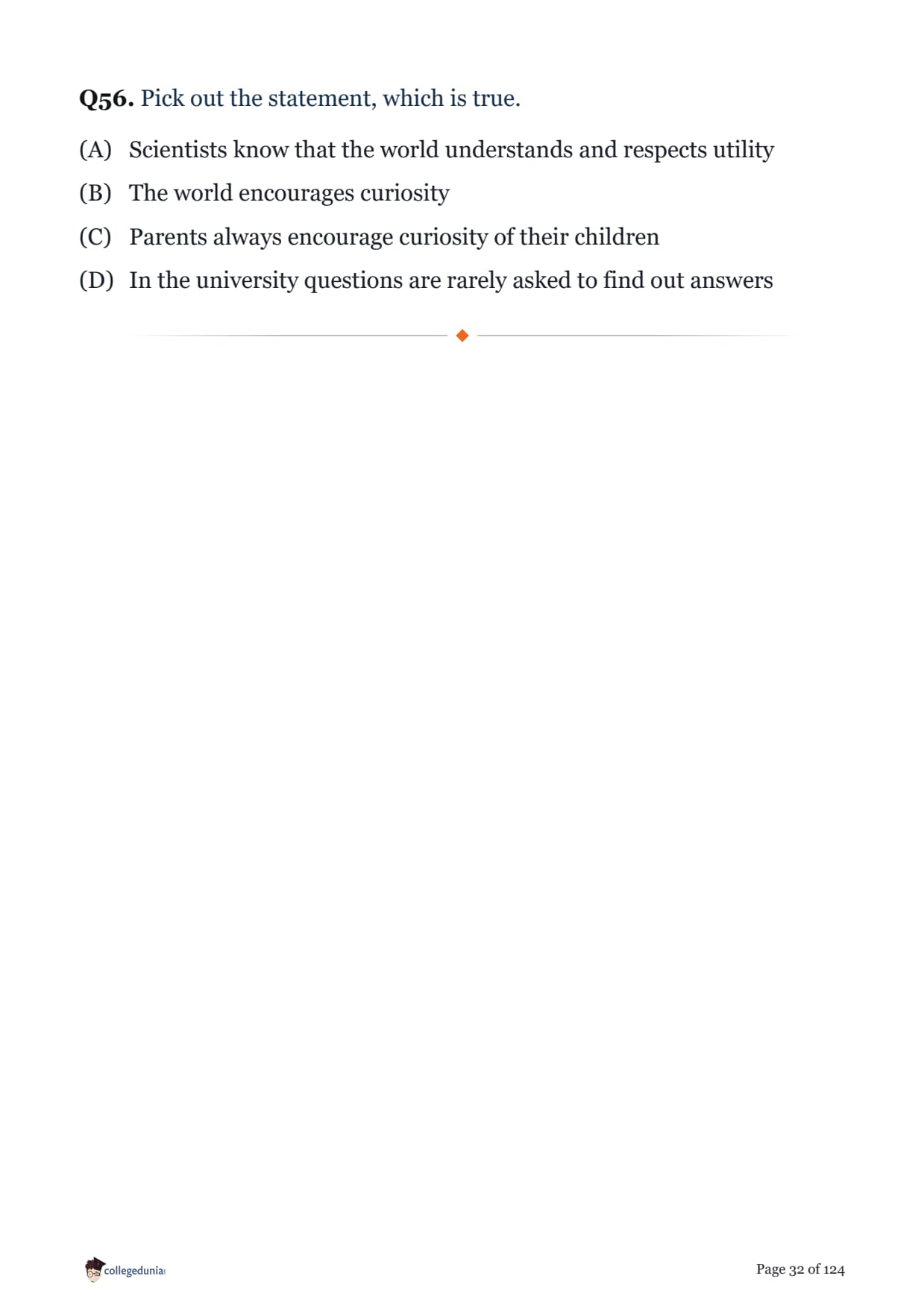
Q56. Pick out the statement, which is true.
Passage:
The world dismisses curiosity by calling it idle or mere idle curiosity even though curious persons are seldom idle. Parents do their best to extinguish curiosity in their children because it makes life difficult to be faced everyday with a string of unanswerable questions about what makes fire hot or why grass grows. Children whose curiosity survives parental discipline are invited to join our university. Within the university, they go on asking their questions and trying to find the answers. In the eyes of a scholar, that is what a university is for. Some of the questions which the scholars ask seem to the world to be scarcely worth asking, let alone answering. They ask questions too minute and specialized for you and me to understand without years of explanation. If the world inquires one of them why he wants to know the answer to a particular question he may say, especially if he is a scientist, that the answer will in some obscure way make possible a new machine or weapon or gadget. He talks that way because he knows that the world understands and respects utility.
But to you who are now part of the university, he will say that he wants to know the answer simply because he does not know it, the way the mountain climber wants to climb a mountain, simply because it is there. Similarly a historian asked by an outsider why he studies history may come out with the argument that he has learnt to respect to report on such occasions, something about knowledge of the past making it possible to understand the present and mould the future. But if you really want to know why a historian studies the past, the answer is much simpler, something happened and he would like to know what. It is true that scholars can be put to work answering questions for sake of the consequences as thousands are working now, for example, in search of a cure for cancer. But this is not the primary for scholars. For the consequences are usually subordinate to the satisfaction of curiosity.
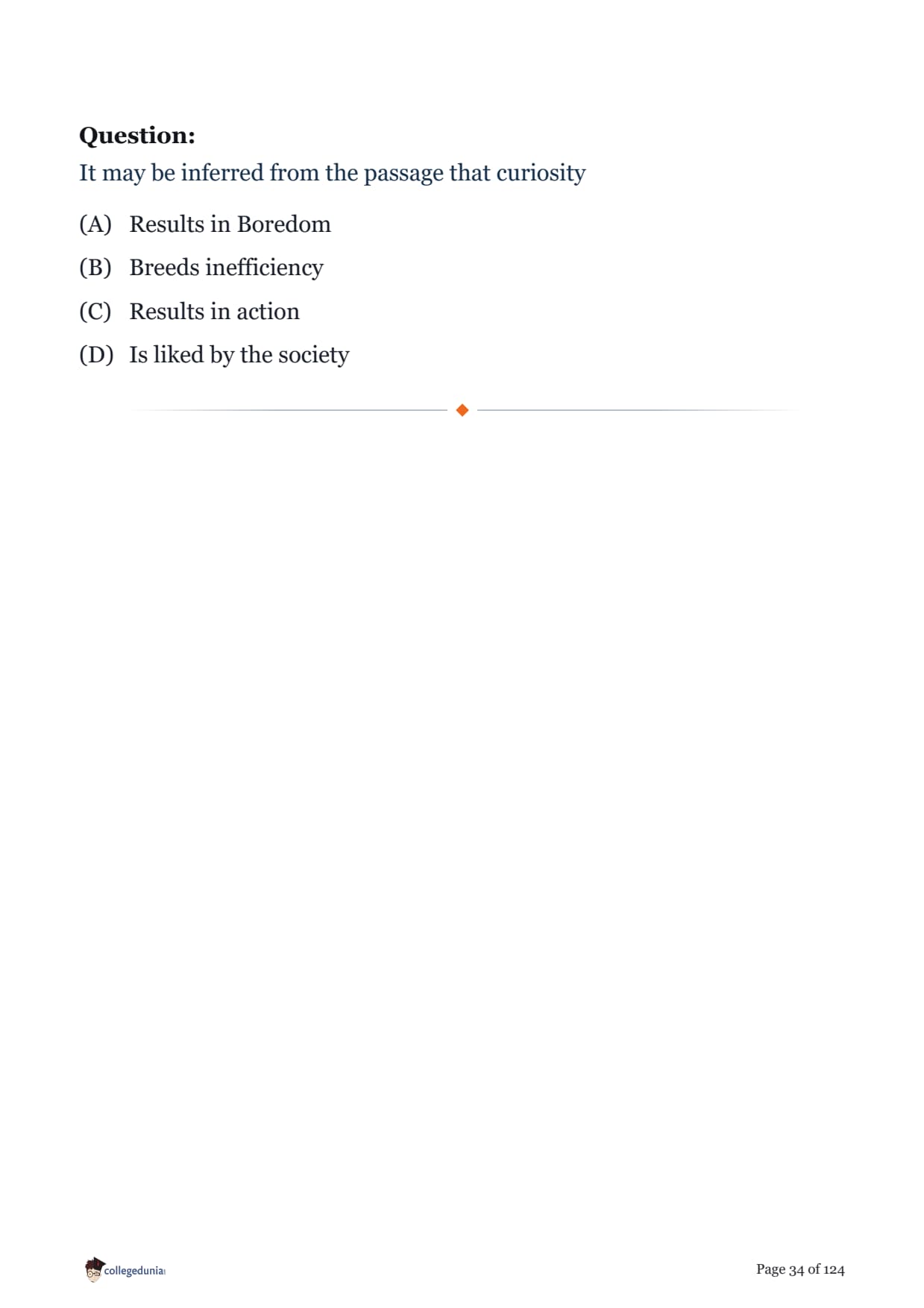
Question:
It may be inferred from the passage that curiosity
Passage:
The world dismisses curiosity by calling it idle or mere idle curiosity even though curious persons are seldom idle. Parents do their best to extinguish curiosity in their children because it makes life difficult to be faced everyday with a string of unanswerable questions about what makes fire hot or why grass grows. Children whose curiosity survives parental discipline are invited to join our university. Within the university, they go on asking their questions and trying to find the answers. In the eyes of a scholar, that is what a university is for. Some of the questions which the scholars ask seem to the world to be scarcely worth asking, let alone answering. They ask questions too minute and specialized for you and me to understand without years of explanation. If the world inquires one of them why he wants to know the answer to a particular question he may say, especially if he is a scientist, that the answer will in some obscure way make possible a new machine or weapon or gadget. He talks that way because he knows that the world understands and respects utility.
But to you who are now part of the university, he will say that he wants to know the answer simply because he does not know it, the way the mountain climber wants to climb a mountain, simply because it is there. Similarly a historian asked by an outsider why he studies history may come out with the argument that he has learnt to respect to report on such occasions, something about knowledge of the past making it possible to understand the present and mould the future. But if you really want to know why a historian studies the past, the answer is much simpler, something happened and he would like to know what. It is true that scholars can be put to work answering questions for sake of the consequences as thousands are working now, for example, in search of a cure for cancer. But this is not the primary for scholars. For the consequences are usually subordinate to the satisfaction of curiosity.
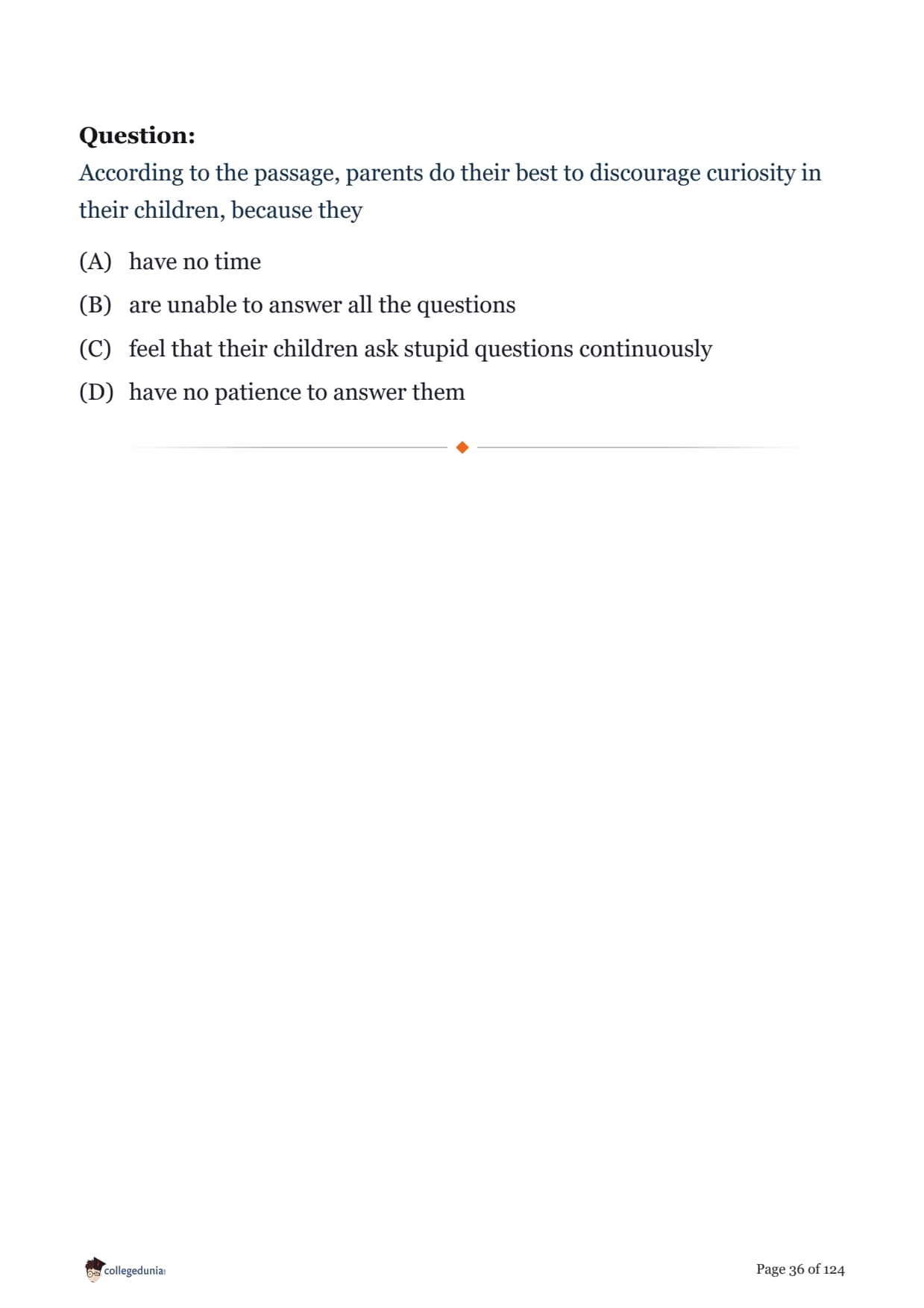
Question:
According to the passage, parents do their best to discourage curiosity in their children, because they
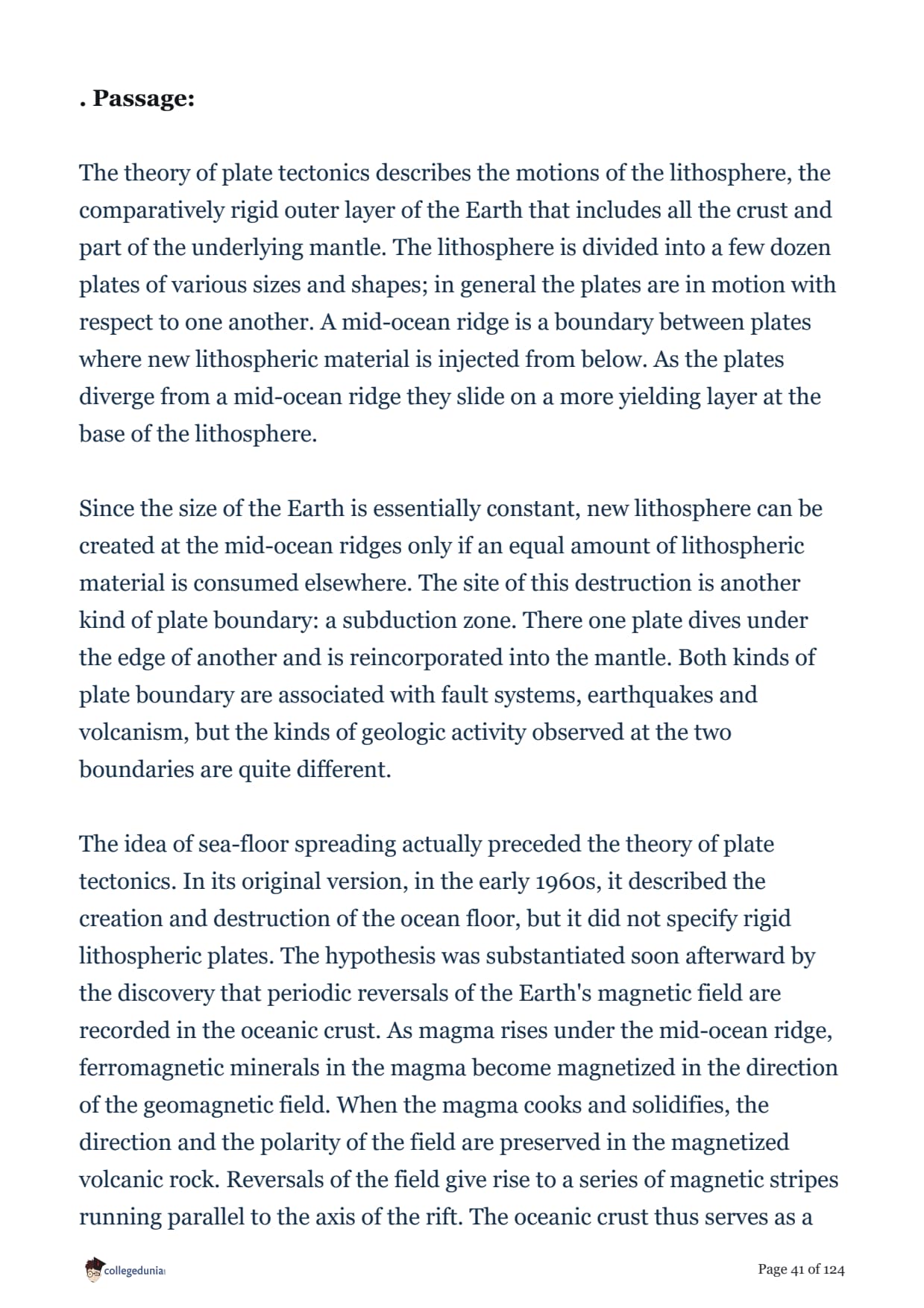
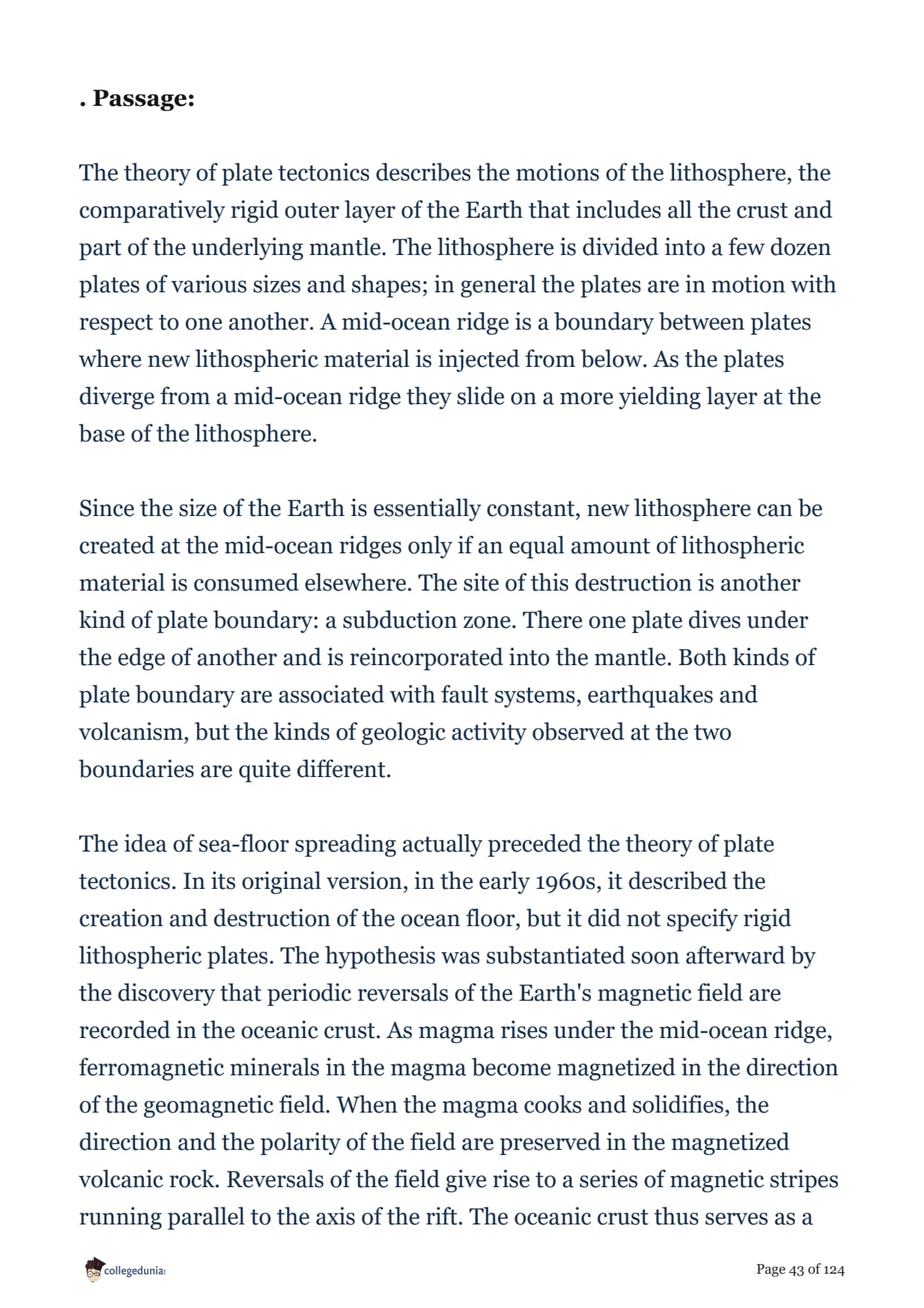
Passage:
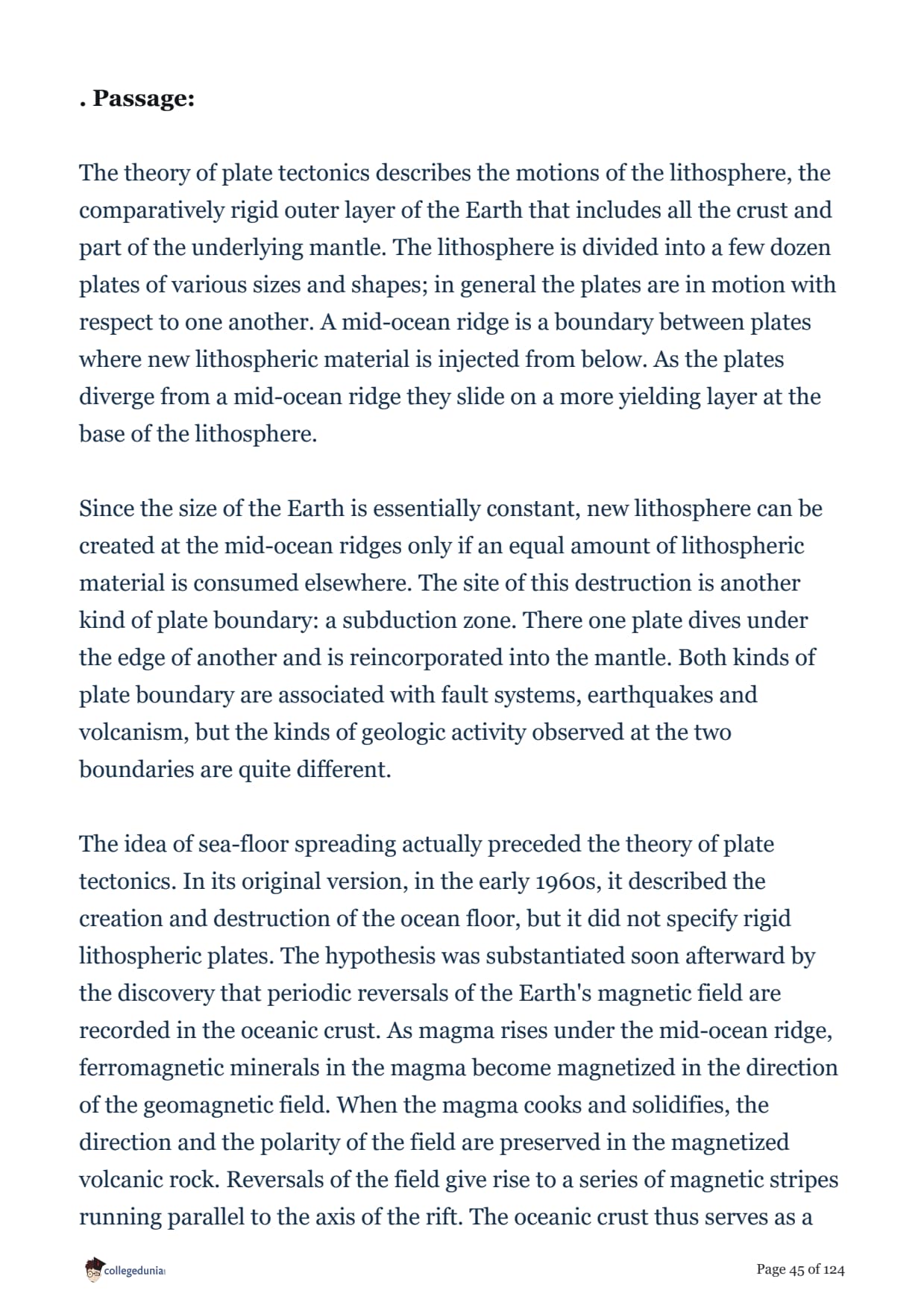
The theory of plate tectonics describes the motions of the lithosphere, the comparatively rigid outer layer of the Earth that includes all the crust and part of the underlying mantle. The lithosphere is divided into a few dozen plates of various sizes and shapes; in general the plates are in motion with respect to one another. A mid-ocean ridge is a boundary between plates where new lithospheric material is injected from below. As the plates diverge from a mid-ocean ridge they slide on a more yielding layer at the base of the lithosphere.
Since the size of the Earth is essentially constant, new lithosphere can be created at the mid-ocean ridges only if an equal amount of lithospheric material is consumed elsewhere. The site of this destruction is another kind of plate boundary: a subduction zone. There one plate dives under the edge of another and is reincorporated into the mantle. Both kinds of plate boundary are associated with fault systems, earthquakes and volcanism, but the kinds of geologic activity observed at the two boundaries are quite different.
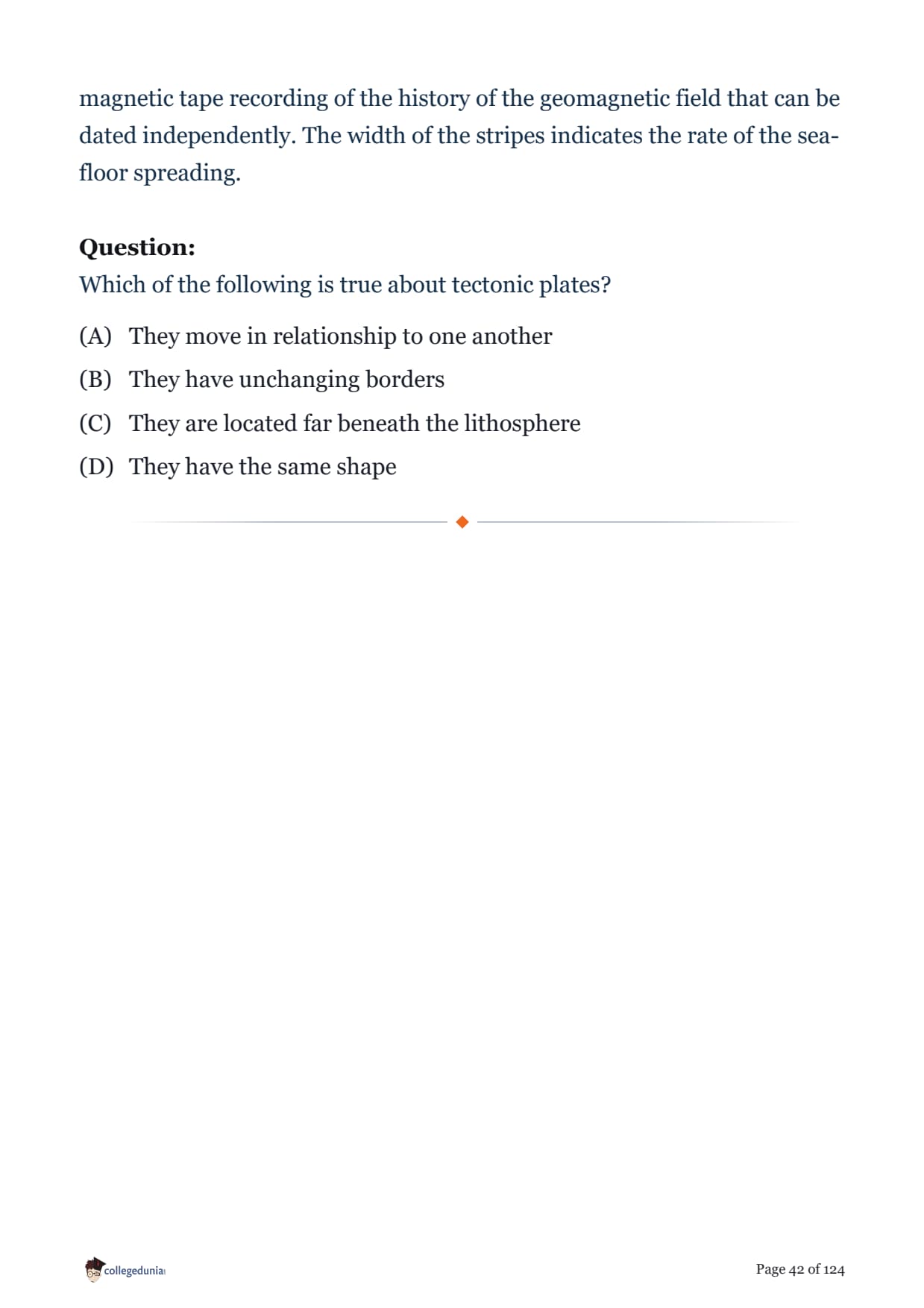
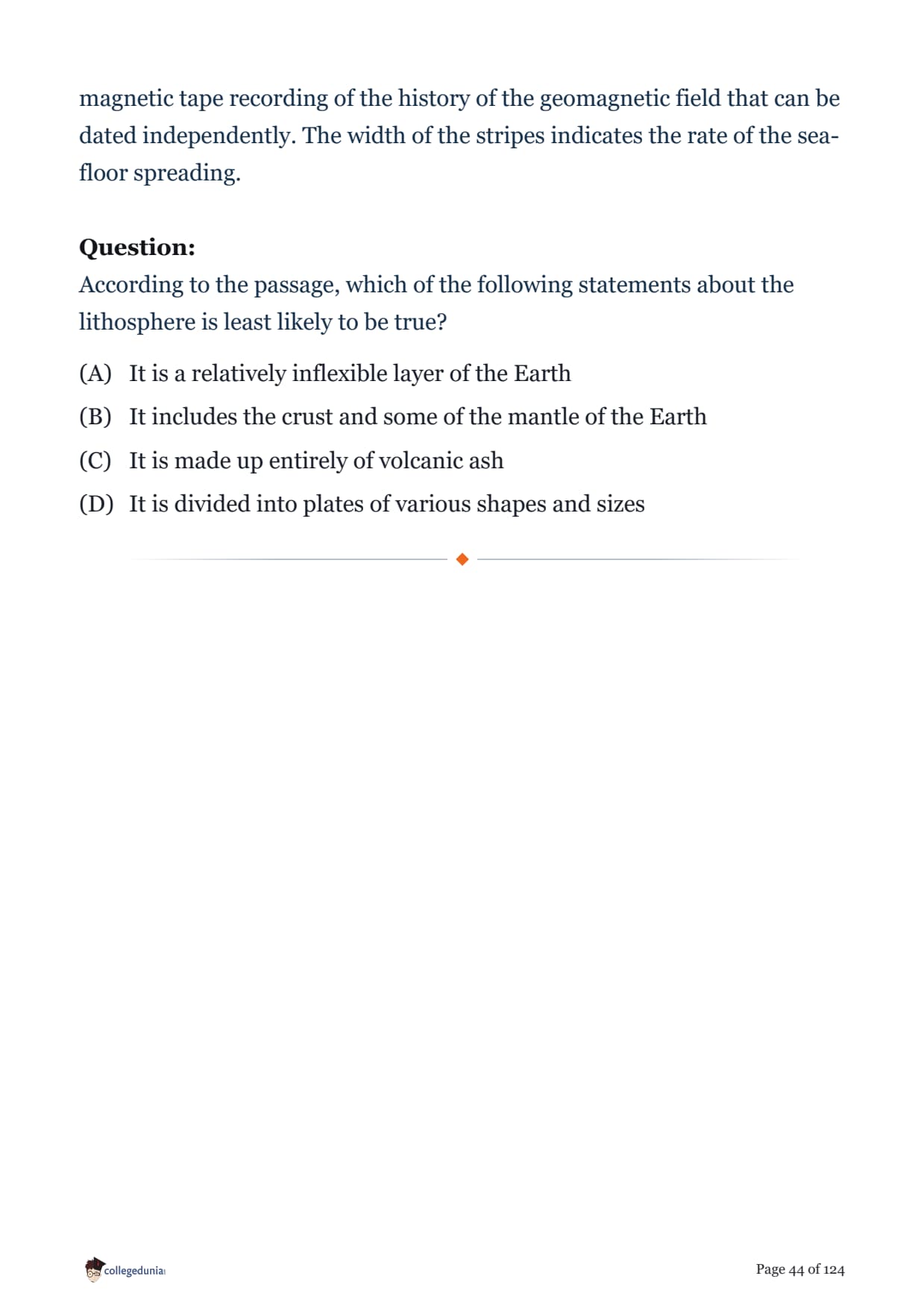
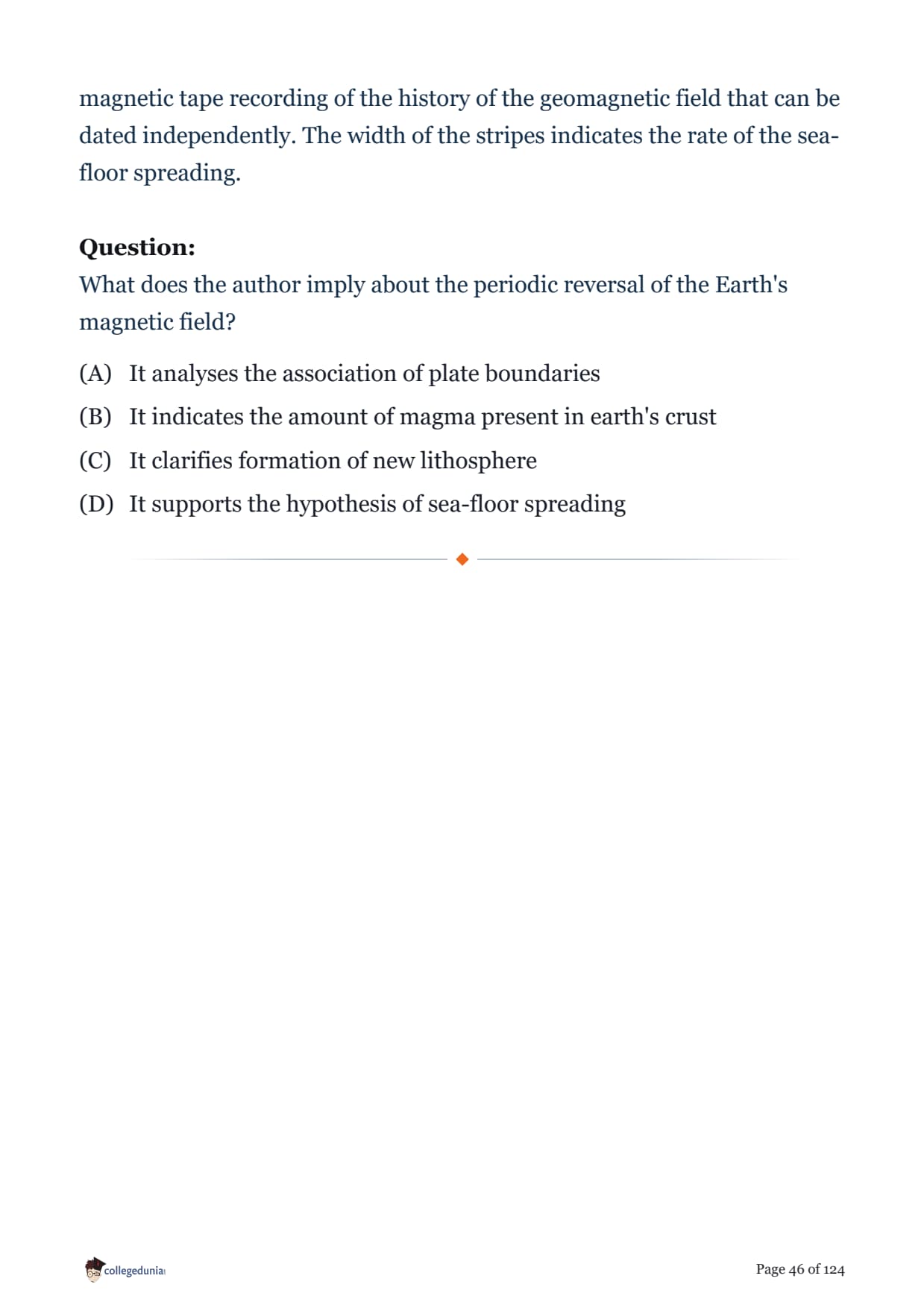
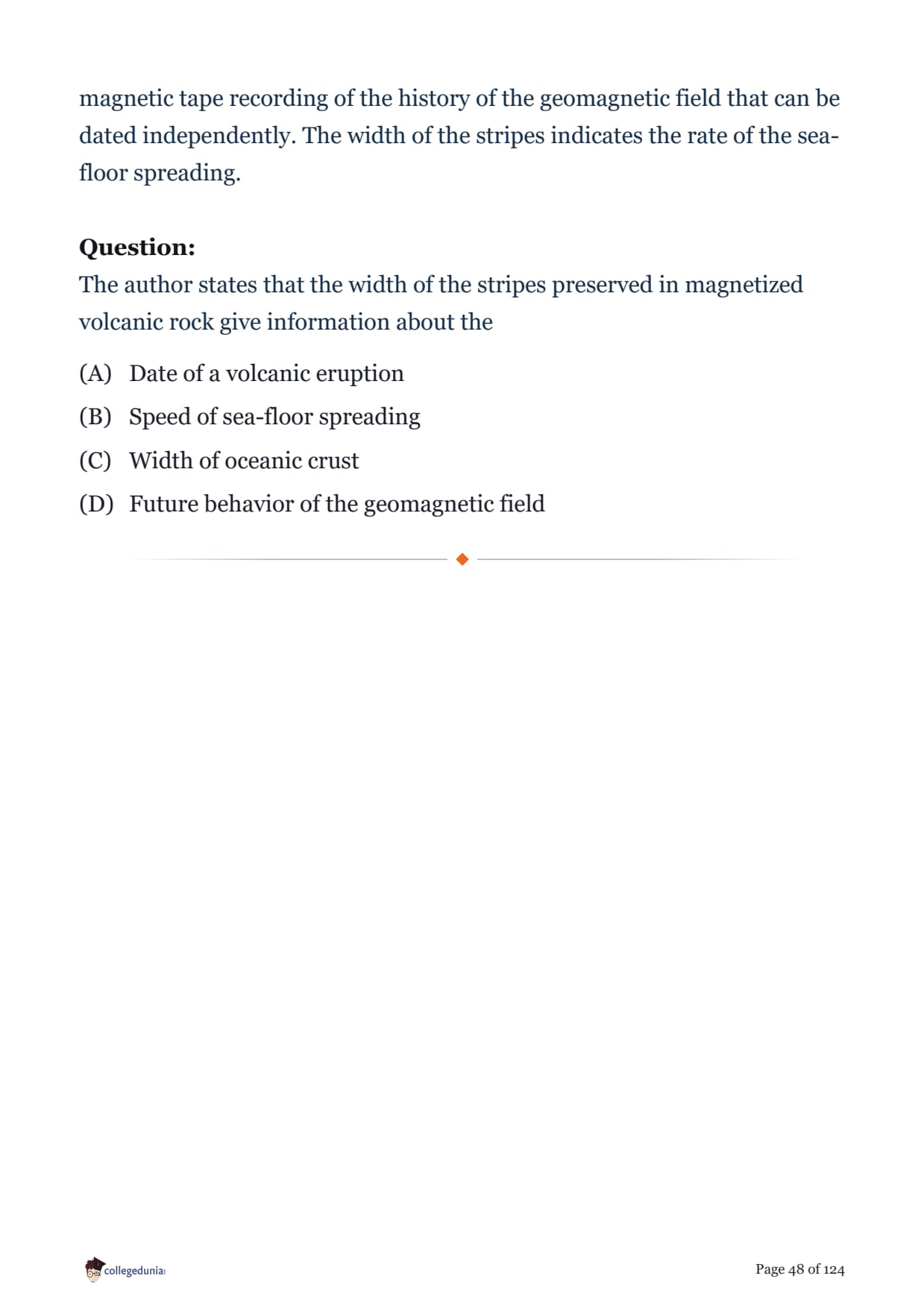
The idea of sea-floor spreading actually preceded the theory of plate tectonics. In its original version, in the early 1960s, it described the creation and destruction of the ocean floor, but it did not specify rigid lithospheric plates. The hypothesis was substantiated soon afterward by the discovery that periodic reversals of the Earth's magnetic field are recorded in the oceanic crust. As magma rises under the mid-ocean ridge, ferromagnetic minerals in the magma become magnetized in the direction of the geomagnetic field. When the magma cooks and solidifies, the direction and the polarity of the field are preserved in the magnetized volcanic rock. Reversals of the field give rise to a series of magnetic stripes running parallel to the axis of the rift. The oceanic crust thus serves as a magnetic tape recording of the history of the geomagnetic field that can be dated independently. The width of the stripes indicates the rate of the sea-floor spreading.
Question:
What is the core theme of the passage?
Passage:
The theory of plate tectonics describes the motions of the lithosphere, the comparatively rigid outer layer of the Earth that includes all the crust and part of the underlying mantle. The lithosphere is divided into a few dozen plates of various sizes and shapes; in general the plates are in motion with respect to one another. A mid-ocean ridge is a boundary between plates where new lithospheric material is injected from below. As the plates diverge from a mid-ocean ridge they slide on a more yielding layer at the base of the lithosphere.
Since the size of the Earth is essentially constant, new lithosphere can be created at the mid-ocean ridges only if an equal amount of lithospheric material is consumed elsewhere. The site of this destruction is another kind of plate boundary: a subduction zone. There one plate dives under the edge of another and is reincorporated into the mantle. Both kinds of plate boundary are associated with fault systems, earthquakes and volcanism, but the kinds of geologic activity observed at the two boundaries are quite different.
The idea of sea-floor spreading actually preceded the theory of plate tectonics. In its original version, in the early 1960s, it described the creation and destruction of the ocean floor, but it did not specify rigid lithospheric plates. The hypothesis was substantiated soon afterward by the discovery that periodic reversals of the Earth's magnetic field are recorded in the oceanic crust. As magma rises under the mid-ocean ridge, ferromagnetic minerals in the magma become magnetized in the direction of the geomagnetic field. When the magma cooks and solidifies, the direction and the polarity of the field are preserved in the magnetized volcanic rock. Reversals of the field give rise to a series of magnetic stripes running parallel to the axis of the rift. The oceanic crust thus serves as a magnetic tape recording of the history of the geomagnetic field that can be dated independently. The width of the stripes indicates the rate of the sea-floor spreading.
Question:
Which of the following can be created at mid-ocean ridges?
Passage:
The theory of plate tectonics describes the motions of the lithosphere, the comparatively rigid outer layer of the Earth that includes all the crust and part of the underlying mantle. The lithosphere is divided into a few dozen plates of various sizes and shapes; in general the plates are in motion with respect to one another. A mid-ocean ridge is a boundary between plates where new lithospheric material is injected from below. As the plates diverge from a mid-ocean ridge they slide on a more yielding layer at the base of the lithosphere.
Since the size of the Earth is essentially constant, new lithosphere can be created at the mid-ocean ridges only if an equal amount of lithospheric material is consumed elsewhere. The site of this destruction is another kind of plate boundary: a subduction zone. There one plate dives under the edge of another and is reincorporated into the mantle. Both kinds of plate boundary are associated with fault systems, earthquakes and volcanism, but the kinds of geologic activity observed at the two boundaries are quite different.
The idea of sea-floor spreading actually preceded the theory of plate tectonics. In its original version, in the early 1960s, it described the creation and destruction of the ocean floor, but it did not specify rigid lithospheric plates. The hypothesis was substantiated soon afterward by the discovery that periodic reversals of the Earth's magnetic field are recorded in the oceanic crust. As magma rises under the mid-ocean ridge, ferromagnetic minerals in the magma become magnetized in the direction of the geomagnetic field. When the magma cooks and solidifies, the direction and the polarity of the field are preserved in the magnetized volcanic rock. Reversals of the field give rise to a series of magnetic stripes running parallel to the axis of the rift. The oceanic crust thus serves as a magnetic tape recording of the history of the geomagnetic field that can be dated independently. The width of the stripes indicates the rate of the sea-floor spreading.
Question:
Which of the following is true about tectonic plates?
Passage:
The theory of plate tectonics describes the motions of the lithosphere, the comparatively rigid outer layer of the Earth that includes all the crust and part of the underlying mantle. The lithosphere is divided into a few dozen plates of various sizes and shapes; in general the plates are in motion with respect to one another. A mid-ocean ridge is a boundary between plates where new lithospheric material is injected from below. As the plates diverge from a mid-ocean ridge they slide on a more yielding layer at the base of the lithosphere.
Since the size of the Earth is essentially constant, new lithosphere can be created at the mid-ocean ridges only if an equal amount of lithospheric material is consumed elsewhere. The site of this destruction is another kind of plate boundary: a subduction zone. There one plate dives under the edge of another and is reincorporated into the mantle. Both kinds of plate boundary are associated with fault systems, earthquakes and volcanism, but the kinds of geologic activity observed at the two boundaries are quite different.
The idea of sea-floor spreading actually preceded the theory of plate tectonics. In its original version, in the early 1960s, it described the creation and destruction of the ocean floor, but it did not specify rigid lithospheric plates. The hypothesis was substantiated soon afterward by the discovery that periodic reversals of the Earth's magnetic field are recorded in the oceanic crust. As magma rises under the mid-ocean ridge, ferromagnetic minerals in the magma become magnetized in the direction of the geomagnetic field. When the magma cooks and solidifies, the direction and the polarity of the field are preserved in the magnetized volcanic rock. Reversals of the field give rise to a series of magnetic stripes running parallel to the axis of the rift. The oceanic crust thus serves as a magnetic tape recording of the history of the geomagnetic field that can be dated independently. The width of the stripes indicates the rate of the sea-floor spreading.
Question:
According to the passage, which of the following statements about the lithosphere is least likely to be true?
Passage:
The theory of plate tectonics describes the motions of the lithosphere, the comparatively rigid outer layer of the Earth that includes all the crust and part of the underlying mantle. The lithosphere is divided into a few dozen plates of various sizes and shapes; in general the plates are in motion with respect to one another. A mid-ocean ridge is a boundary between plates where new lithospheric material is injected from below. As the plates diverge from a mid-ocean ridge they slide on a more yielding layer at the base of the lithosphere.
Since the size of the Earth is essentially constant, new lithosphere can be created at the mid-ocean ridges only if an equal amount of lithospheric material is consumed elsewhere. The site of this destruction is another kind of plate boundary: a subduction zone. There one plate dives under the edge of another and is reincorporated into the mantle. Both kinds of plate boundary are associated with fault systems, earthquakes and volcanism, but the kinds of geologic activity observed at the two boundaries are quite different.
The idea of sea-floor spreading actually preceded the theory of plate tectonics. In its original version, in the early 1960s, it described the creation and destruction of the ocean floor, but it did not specify rigid lithospheric plates. The hypothesis was substantiated soon afterward by the discovery that periodic reversals of the Earth's magnetic field are recorded in the oceanic crust. As magma rises under the mid-ocean ridge, ferromagnetic minerals in the magma become magnetized in the direction of the geomagnetic field. When the magma cooks and solidifies, the direction and the polarity of the field are preserved in the magnetized volcanic rock. Reversals of the field give rise to a series of magnetic stripes running parallel to the axis of the rift. The oceanic crust thus serves as a magnetic tape recording of the history of the geomagnetic field that can be dated independently. The width of the stripes indicates the rate of the sea-floor spreading.
Question:
What does the author imply about the periodic reversal of the Earth's magnetic field?
Passage:
The theory of plate tectonics describes the motions of the lithosphere, the comparatively rigid outer layer of the Earth that includes all the crust and part of the underlying mantle. The lithosphere is divided into a few dozen plates of various sizes and shapes; in general the plates are in motion with respect to one another. A mid-ocean ridge is a boundary between plates where new lithospheric material is injected from below. As the plates diverge from a mid-ocean ridge they slide on a more yielding layer at the base of the lithosphere.
Since the size of the Earth is essentially constant, new lithosphere can be created at the mid-ocean ridges only if an equal amount of lithospheric material is consumed elsewhere. The site of this destruction is another kind of plate boundary: a subduction zone. There one plate dives under the edge of another and is reincorporated into the mantle. Both kinds of plate boundary are associated with fault systems, earthquakes and volcanism, but the kinds of geologic activity observed at the two boundaries are quite different.
The idea of sea-floor spreading actually preceded the theory of plate tectonics. In its original version, in the early 1960s, it described the creation and destruction of the ocean floor, but it did not specify rigid lithospheric plates. The hypothesis was substantiated soon afterward by the discovery that periodic reversals of the Earth's magnetic field are recorded in the oceanic crust. As magma rises under the mid-ocean ridge, ferromagnetic minerals in the magma become magnetized in the direction of the geomagnetic field. When the magma cooks and solidifies, the direction and the polarity of the field are preserved in the magnetized volcanic rock. Reversals of the field give rise to a series of magnetic stripes running parallel to the axis of the rift. The oceanic crust thus serves as a magnetic tape recording of the history of the geomagnetic field that can be dated independently. The width of the stripes indicates the rate of the sea-floor spreading.
Question:
The author states that the width of the stripes preserved in magnetized volcanic rock give information about the
Passage:
The theory of plate tectonics describes the motions of the lithosphere, the comparatively rigid outer layer of the Earth that includes all the crust and part of the underlying mantle. The lithosphere is divided into a few dozen plates of various sizes and shapes; in general the plates are in motion with respect to one another. A mid-ocean ridge is a boundary between plates where new lithospheric material is injected from below. As the plates diverge from a mid-ocean ridge they slide on a more yielding layer at the base of the lithosphere.
Since the size of the Earth is essentially constant, new lithosphere can be created at the mid-ocean ridges only if an equal amount of lithospheric material is consumed elsewhere. The site of this destruction is another kind of plate boundary: a subduction zone. There one plate dives under the edge of another and is reincorporated into the mantle. Both kinds of plate boundary are associated with fault systems, earthquakes and volcanism, but the kinds of geologic activity observed at the two boundaries are quite different.
The idea of sea-floor spreading actually preceded the theory of plate tectonics. In its original version, in the early 1960s, it described the creation and destruction of the ocean floor, but it did not specify rigid lithospheric plates. The hypothesis was substantiated soon afterward by the discovery that periodic reversals of the Earth's magnetic field are recorded in the oceanic crust. As magma rises under the mid-ocean ridge, ferromagnetic minerals in the magma become magnetized in the direction of the geomagnetic field. When the magma cooks and solidifies, the direction and the polarity of the field are preserved in the magnetized volcanic rock. Reversals of the field give rise to a series of magnetic stripes running parallel to the axis of the rift. The oceanic crust thus serves as a magnetic tape recording of the history of the geomagnetic field that can be dated independently. The width of the stripes indicates the rate of the sea-floor spreading.
Question:
Since the size of the Earth is essentially constant, new lithosphere can be created at the mid-ocean ridges only when
Passage:
The theory of plate tectonics describes the motions of the lithosphere, the comparatively rigid outer layer of the Earth that includes all the crust and part of the underlying mantle. The lithosphere is divided into a few dozen plates of various sizes and shapes; in general the plates are in motion with respect to one another. A mid-ocean ridge is a boundary between plates where new lithospheric material is injected from below. As the plates diverge from a mid-ocean ridge they slide on a more yielding layer at the base of the lithosphere.
Since the size of the Earth is essentially constant, new lithosphere can be created at the mid-ocean ridges only if an equal amount of lithospheric material is consumed elsewhere. The site of this destruction is another kind of plate boundary: a subduction zone. There one plate dives under the edge of another and is reincorporated into the mantle. Both kinds of plate boundary are associated with fault systems, earthquakes and volcanism, but the kinds of geologic activity observed at the two boundaries are quite different.
The idea of sea-floor spreading actually preceded the theory of plate tectonics. In its original version, in the early 1960s, it described the creation and destruction of the ocean floor, but it did not specify rigid lithospheric plates. The hypothesis was substantiated soon afterward by the discovery that periodic reversals of the Earth's magnetic field are recorded in the oceanic crust. As magma rises under the mid-ocean ridge, ferromagnetic minerals in the magma become magnetized in the direction of the geomagnetic field. When the magma cooks and solidifies, the direction and the polarity of the field are preserved in the magnetized volcanic rock. Reversals of the field give rise to a series of magnetic stripes running parallel to the axis of the rift. The oceanic crust thus serves as a magnetic tape recording of the history of the geomagnetic field that can be dated independently. The width of the stripes indicates the rate of the sea-floor spreading.
Question:
Which of the following serve(s) as a magnetic tape recording of the history of the geomagnetic field?
Passage:
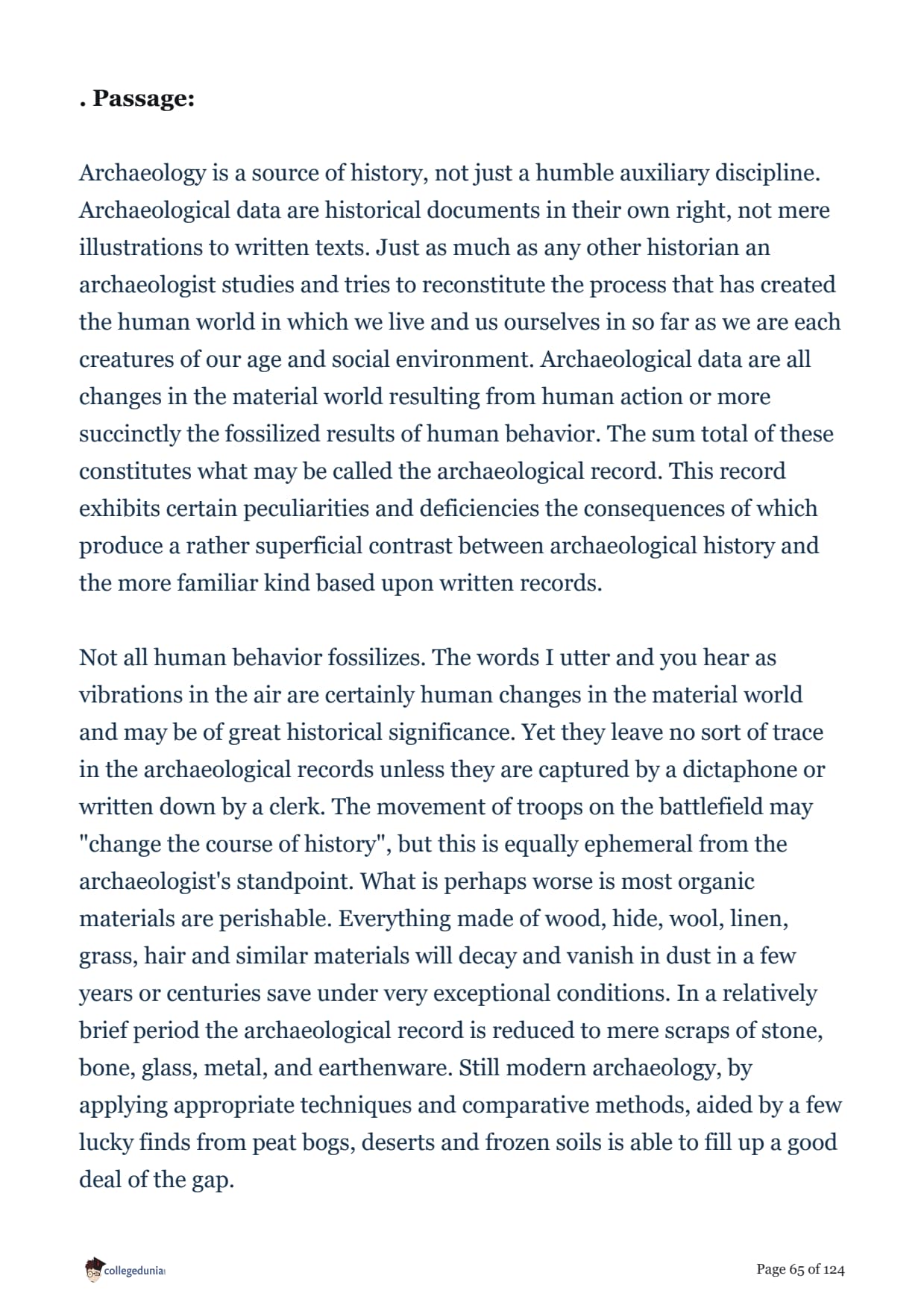
Archaeology is a source of history, not just a humble auxiliary discipline. Archaeological data are historical documents in their own right, not mere illustrations to written texts. Just as much as any other historian, an archaeologist studies and tries to reconstitute the process that has created the human world in which we live and us ourselves in so far as we are each creatures of our age and social environment. Archaeological data are all changes in the material world resulting from human action, or more succinctly, the fossilized results of human behavior. The sum total of these constitutes what may be called the archaeological record. This record exhibits certain peculiarities and deficiencies, the consequences of which produce a rather superficial contrast between archaeological history and the more familiar kind based upon written records.
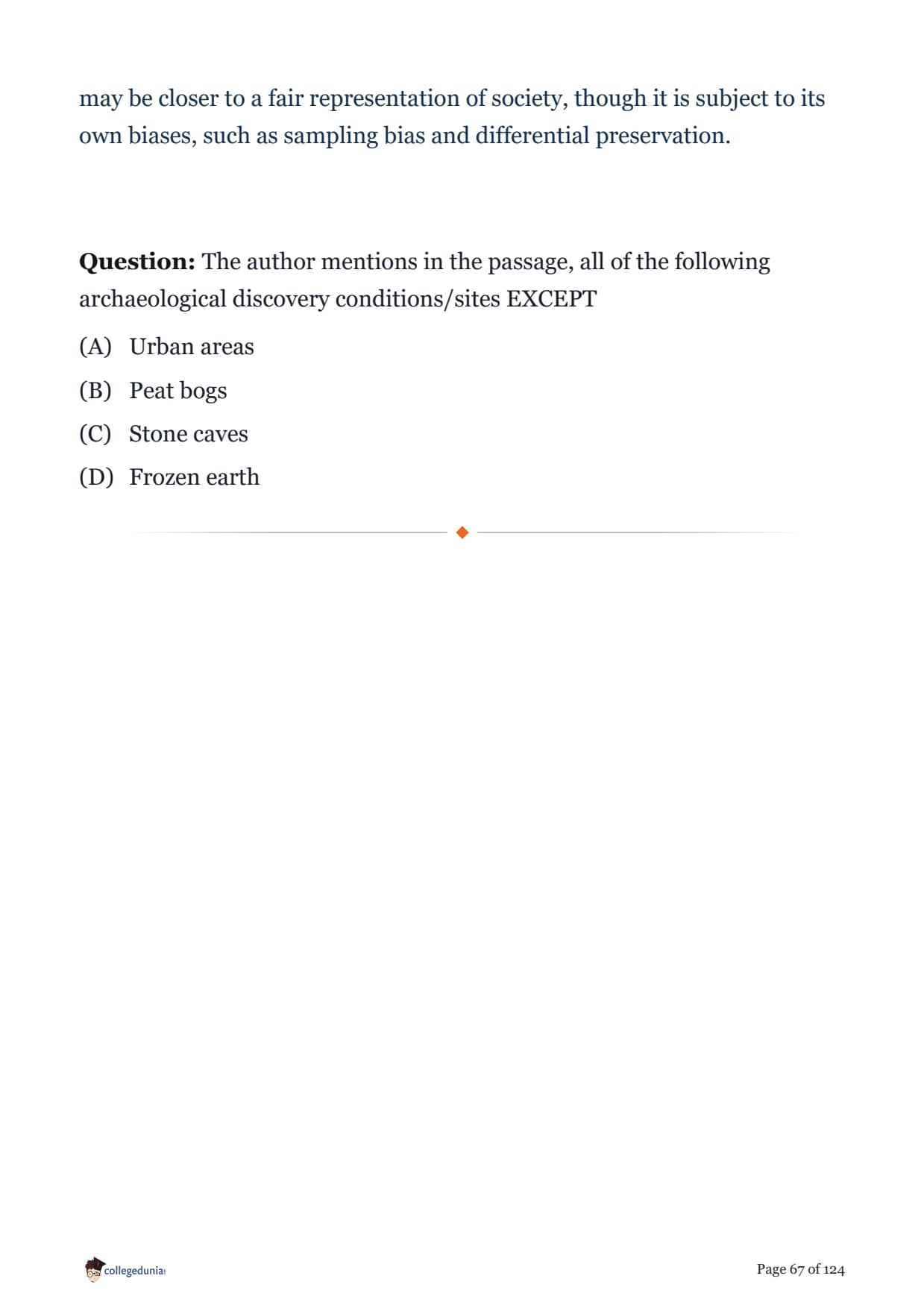
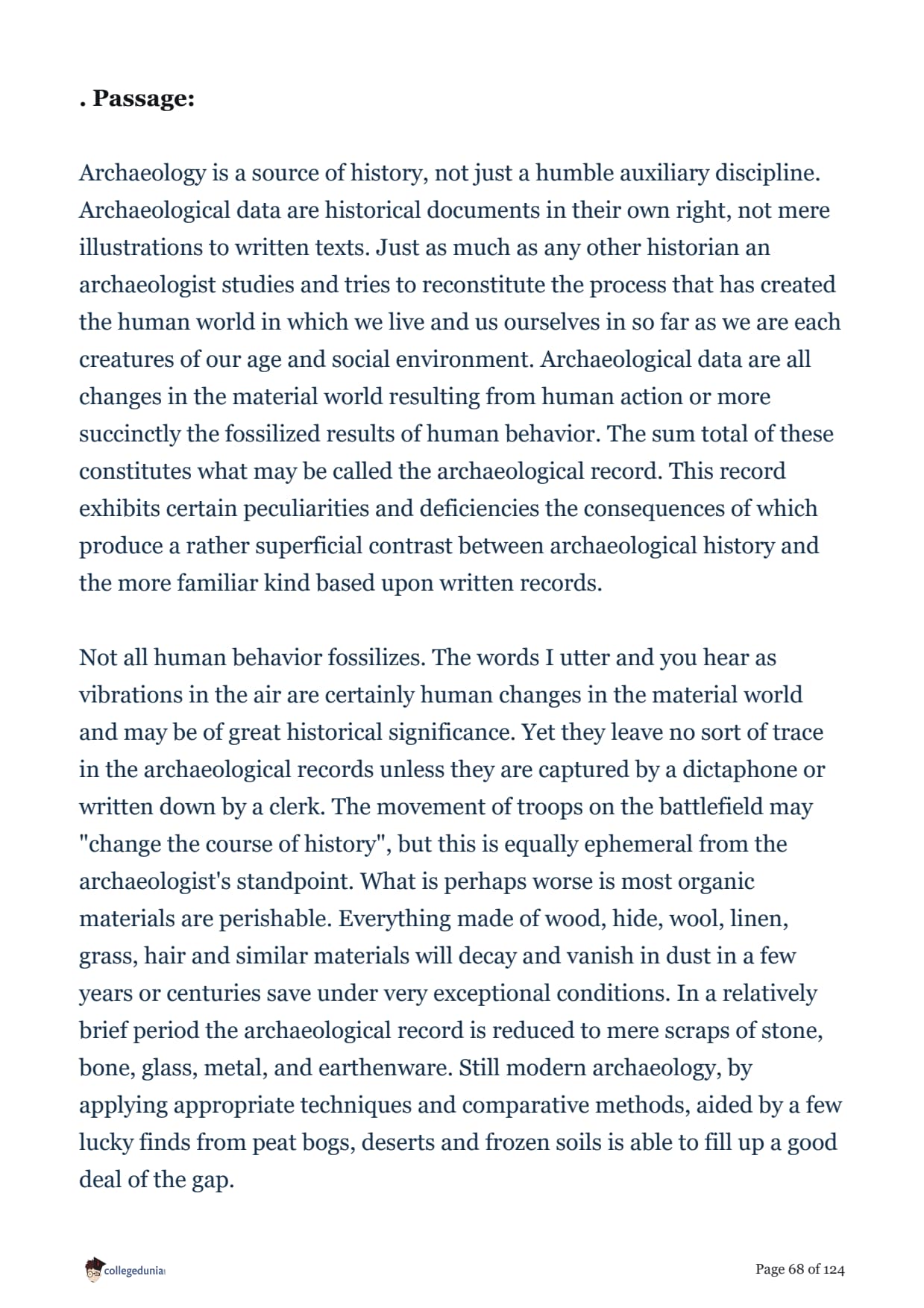
Not all human behavior fossilizes. The words I utter and you hear as vibrations in the air are certainly human changes in the material world and may be of great historical significance. Yet they leave no sort of trace in the archaeological records unless they are captured by a dictaphone or written down by a clerk. The movement of troops on the battlefield may "change the course of history", but this is equally ephemeral from the archaeologist's standpoint. What is perhaps worse is most organic materials are perishable. Everything made of wood, hide, wool, linen, grass, hair and similar materials will decay and vanish in dust in a few years or centuries save under very exceptional conditions. In a relatively brief period the archaeological record is reduced to mere scraps of stone, bone, glass, metal, and earthenware. Still, modern archaeology, by applying appropriate techniques and comparative methods, aided by a few lucky finds from peat bogs, deserts and frozen soils, is able to fill up a good deal of the gap.
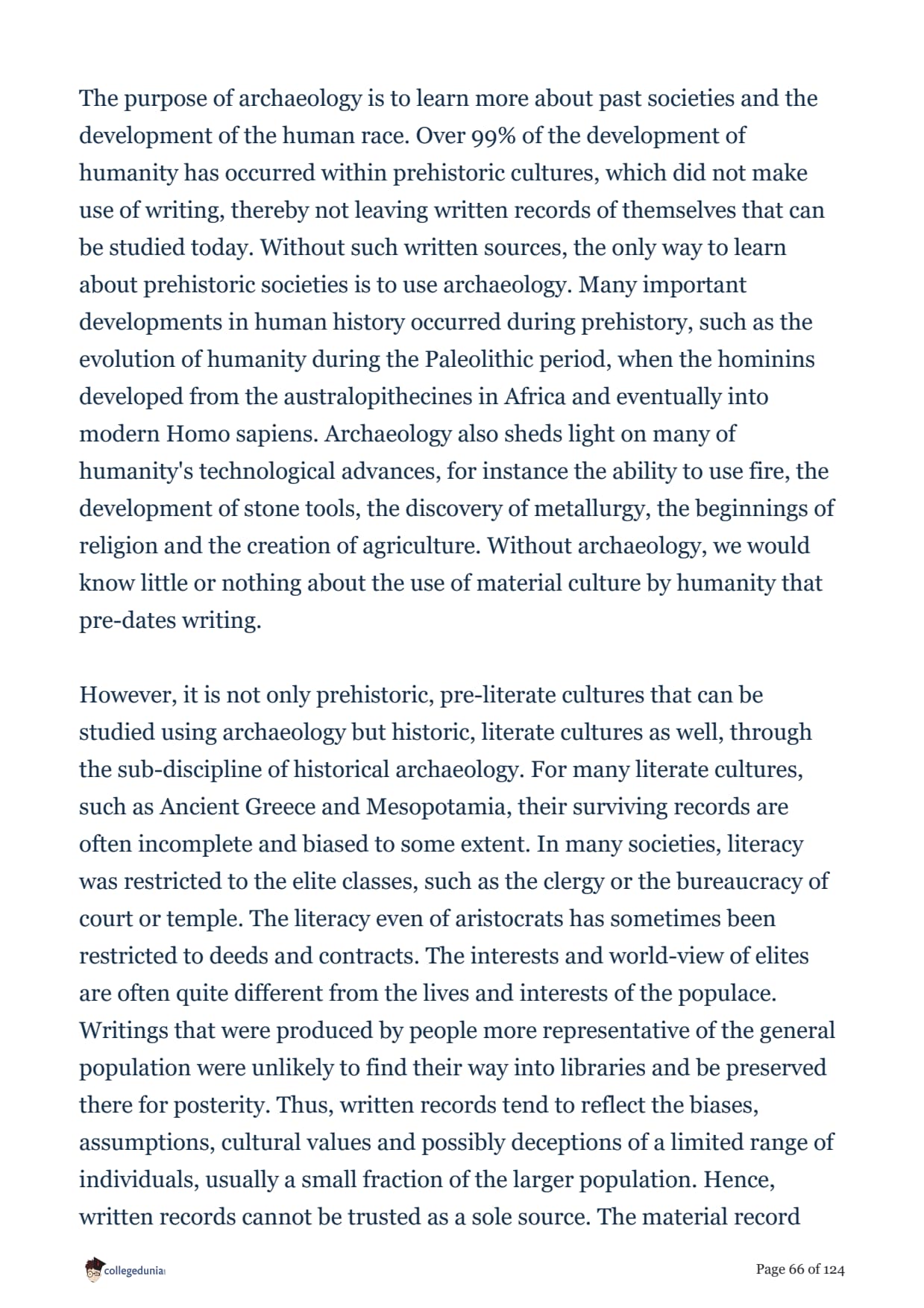
The purpose of archaeology is to learn more about past societies and the development of the human race. Over 99% of the development of humanity has occurred within prehistoric cultures, which did not make use of writing, thereby not leaving written records of themselves that can be studied today. Without such written sources, the only way to learn about prehistoric societies is to use archaeology. Many important developments in human history occurred during prehistory, such as the evolution of humanity during the Paleolithic period, when the hominins developed from the australopithecines in Africa and eventually into modern Homo sapiens. Archaeology also sheds light on many of humanity's technological advances, for instance the ability to use fire, the development of stone tools, the discovery of metallurgy, the beginnings of religion, and the creation of agriculture. Without archaeology, we would know little or nothing about the use of material culture by humanity that pre-dates writing.
However, it is not only prehistoric, pre-literate cultures that can be studied using archaeology but historic, literate cultures as well, through the sub-discipline of historical archaeology. For many literate cultures, such as Ancient Greece and Mesopotamia, their surviving records are often incomplete and biased to some extent. In many societies, literacy was restricted to the elite classes, such as the clergy or the bureaucracy of court or temple. The literacy even of aristocrats has sometimes been restricted to deeds and contracts. The interests and world-view of elites are often quite different from the lives and interests of the populace. Writings that were produced by people more representative of the general population were unlikely to find their way into libraries and be preserved there for posterity. Thus, written records tend to reflect the biases, assumptions, cultural values and possibly deceptions of a limited range of individuals, usually a small fraction of the larger population. Hence, written records cannot be trusted as a sole source. The material record may be closer to a fair representation of society, though it is subject to its own biases, such as sampling bias and differential preservation.
Identify from the following, statement that denotes the main purpose of the passage.
Passage:
Archaeology is a source of history, not just a humble auxiliary discipline. Archaeological data are historical documents in their own right, not mere illustrations to written texts. Just as much as any other historian, an archaeologist studies and tries to reconstitute the process that has created the human world in which we live and us ourselves in so far as we are each creatures of our age and social environment. Archaeological data are all changes in the material world resulting from human action, or more succinctly, the fossilized results of human behavior. The sum total of these constitutes what may be called the archaeological record. This record exhibits certain peculiarities and deficiencies, the consequences of which produce a rather superficial contrast between archaeological history and the more familiar kind based upon written records.
Not all human behavior fossilizes. The words I utter and you hear as vibrations in the air are certainly human changes in the material world and may be of great historical significance. Yet they leave no sort of trace in the archaeological records unless they are captured by a dictaphone or written down by a clerk. The movement of troops on the battlefield may "change the course of history", but this is equally ephemeral from the archaeologist's standpoint. What is perhaps worse is most organic materials are perishable. Everything made of wood, hide, wool, linen, grass, hair and similar materials will decay and vanish in dust in a few years or centuries save under very exceptional conditions. In a relatively brief period the archaeological record is reduced to mere scraps of stone, bone, glass, metal, and earthenware. Still, modern archaeology, by applying appropriate techniques and comparative methods, aided by a few lucky finds from peat bogs, deserts and frozen soils, is able to fill up a good deal of the gap.
The purpose of archaeology is to learn more about past societies and the development of the human race. Over 99% of the development of humanity has occurred within prehistoric cultures, which did not make use of writing, thereby not leaving written records of themselves that can be studied today. Without such written sources, the only way to learn about prehistoric societies is to use archaeology. Many important developments in human history occurred during prehistory, such as the evolution of humanity during the Paleolithic period, when the hominins developed from the australopithecines in Africa and eventually into modern Homo sapiens. Archaeology also sheds light on many of humanity's technological advances, for instance the ability to use fire, the development of stone tools, the discovery of metallurgy, the beginnings of religion, and the creation of agriculture. Without archaeology, we would know little or nothing about the use of material culture by humanity that pre-dates writing.
However, it is not only prehistoric, pre-literate cultures that can be studied using archaeology but historic, literate cultures as well, through the sub-discipline of historical archaeology. For many literate cultures, such as Ancient Greece and Mesopotamia, their surviving records are often incomplete and biased to some extent. In many societies, literacy was restricted to the elite classes, such as the clergy or the bureaucracy of court or temple. The literacy even of aristocrats has sometimes been restricted to deeds and contracts. The interests and world-view of elites are often quite different from the lives and interests of the populace. Writings that were produced by people more representative of the general population were unlikely to find their way into libraries and be preserved there for posterity. Thus, written records tend to reflect the biases, assumptions, cultural values and possibly deceptions of a limited range of individuals, usually a small fraction of the larger population. Hence, written records cannot be trusted as a sole source. The material record may be closer to a fair representation of society, though it is subject to its own biases, such as sampling bias and differential preservation.
The only way to learn about prehistoric societies is through the study of
Passage:
Archaeology is a source of history, not just a humble auxiliary discipline. Archaeological data are historical documents in their own right, not mere illustrations to written texts. Just as much as any other historian, an archaeologist studies and tries to reconstitute the process that has created the human world in which we live and us ourselves in so far as we are each creatures of our age and social environment. Archaeological data are all changes in the material world resulting from human action, or more succinctly, the fossilized results of human behavior. The sum total of these constitutes what may be called the archaeological record. This record exhibits certain peculiarities and deficiencies, the consequences of which produce a rather superficial contrast between archaeological history and the more familiar kind based upon written records.
Not all human behavior fossilizes. The words I utter and you hear as vibrations in the air are certainly human changes in the material world and may be of great historical significance. Yet they leave no sort of trace in the archaeological records unless they are captured by a dictaphone or written down by a clerk. The movement of troops on the battlefield may "change the course of history", but this is equally ephemeral from the archaeologist's standpoint. What is perhaps worse is most organic materials are perishable. Everything made of wood, hide, wool, linen, grass, hair and similar materials will decay and vanish in dust in a few years or centuries save under very exceptional conditions. In a relatively brief period the archaeological record is reduced to mere scraps of stone, bone, glass, metal, and earthenware. Still, modern archaeology, by applying appropriate techniques and comparative methods, aided by a few lucky finds from peat bogs, deserts and frozen soils, is able to fill up a good deal of the gap.
The purpose of archaeology is to learn more about past societies and the development of the human race. Over 99% of the development of humanity has occurred within prehistoric cultures, which did not make use of writing, thereby not leaving written records of themselves that can be studied today. Without such written sources, the only way to learn about prehistoric societies is to use archaeology. Many important developments in human history occurred during prehistory, such as the evolution of humanity during the Paleolithic period, when the hominins developed from the australopithecines in Africa and eventually into modern Homo sapiens. Archaeology also sheds light on many of humanity's technological advances, for instance the ability to use fire, the development of stone tools, the discovery of metallurgy, the beginnings of religion, and the creation of agriculture. Without archaeology, we would know little or nothing about the use of material culture by humanity that pre-dates writing.
However, it is not only prehistoric, pre-literate cultures that can be studied using archaeology but historic, literate cultures as well, through the sub-discipline of historical archaeology. For many literate cultures, such as Ancient Greece and Mesopotamia, their surviving records are often incomplete and biased to some extent. In many societies, literacy was restricted to the elite classes, such as the clergy or the bureaucracy of court or temple. The literacy even of aristocrats has sometimes been restricted to deeds and contracts. The interests and world-view of elites are often quite different from the lives and interests of the populace. Writings that were produced by people more representative of the general population were unlikely to find their way into libraries and be preserved there for posterity. Thus, written records tend to reflect the biases, assumptions, cultural values and possibly deceptions of a limited range of individuals, usually a small fraction of the larger population. Hence, written records cannot be trusted as a sole source. The material record may be closer to a fair representation of society, though it is subject to its own biases, such as sampling bias and differential preservation.
'Yet they leave no sort of trace in the archaeological records unless they are captured by a dictaphone or written down by a clerk'. The word 'they' in this sentence refers to
Passage:
Archaeology is a source of history, not just a humble auxiliary discipline. Archaeological data are historical documents in their own right, not mere illustrations to written texts. Just as much as any other historian, an archaeologist studies and tries to reconstitute the process that has created the human world in which we live and us ourselves in so far as we are each creatures of our age and social environment. Archaeological data are all changes in the material world resulting from human action, or more succinctly, the fossilized results of human behavior. The sum total of these constitutes what may be called the archaeological record. This record exhibits certain peculiarities and deficiencies, the consequences of which produce a rather superficial contrast between archaeological history and the more familiar kind based upon written records.
Not all human behavior fossilizes. The words I utter and you hear as vibrations in the air are certainly human changes in the material world and may be of great historical significance. Yet they leave no sort of trace in the archaeological records unless they are captured by a dictaphone or written down by a clerk. The movement of troops on the battlefield may "change the course of history", but this is equally ephemeral from the archaeologist's standpoint. What is perhaps worse is most organic materials are perishable. Everything made of wood, hide, wool, linen, grass, hair and similar materials will decay and vanish in dust in a few years or centuries save under very exceptional conditions. In a relatively brief period the archaeological record is reduced to mere scraps of stone, bone, glass, metal, and earthenware. Still, modern archaeology, by applying appropriate techniques and comparative methods, aided by a few lucky finds from peat bogs, deserts and frozen soils, is able to fill up a good deal of the gap.
The purpose of archaeology is to learn more about past societies and the development of the human race. Over 99% of the development of humanity has occurred within prehistoric cultures, which did not make use of writing, thereby not leaving written records of themselves that can be studied today. Without such written sources, the only way to learn about prehistoric societies is to use archaeology. Many important developments in human history occurred during prehistory, such as the evolution of humanity during the Paleolithic period, when the hominins developed from the australopithecines in Africa and eventually into modern Homo sapiens. Archaeology also sheds light on many of humanity's technological advances, for instance the ability to use fire, the development of stone tools, the discovery of metallurgy, the beginnings of religion, and the creation of agriculture. Without archaeology, we would know little or nothing about the use of material culture by humanity that pre-dates writing.
However, it is not only prehistoric, pre-literate cultures that can be studied using archaeology but historic, literate cultures as well, through the sub-discipline of historical archaeology. For many literate cultures, such as Ancient Greece and Mesopotamia, their surviving records are often incomplete and biased to some extent. In many societies, literacy was restricted to the elite classes, such as the clergy or the bureaucracy of court or temple. The literacy even of aristocrats has sometimes been restricted to deeds and contracts. The interests and world-view of elites are often quite different from the lives and interests of the populace. Writings that were produced by people more representative of the general population were unlikely to find their way into libraries and be preserved there for posterity. Thus, written records tend to reflect the biases, assumptions, cultural values and possibly deceptions of a limited range of individuals, usually a small fraction of the larger population. Hence, written records cannot be trusted as a sole source. The material record may be closer to a fair representation of society, though it is subject to its own biases, such as sampling bias and differential preservation.
Which of the following is not an example of an organic material?
Passage:
Archaeology is a source of history, not just a humble auxiliary discipline. Archaeological data are historical documents in their own right, not mere illustrations to written texts. Just as much as any other historian an archaeologist studies and tries to reconstitute the process that has created the human world in which we live and us ourselves in so far as we are each creatures of our age and social environment. Archaeological data are all changes in the material world resulting from human action or more succinctly the fossilized results of human behavior. The sum total of these constitutes what may be called the archaeological record. This record exhibits certain peculiarities and deficiencies the consequences of which produce a rather superficial contrast between archaeological history and the more familiar kind based upon written records.
Not all human behavior fossilizes. The words I utter and you hear as vibrations in the air are certainly human changes in the material world and may be of great historical significance. Yet they leave no sort of trace in the archaeological records unless they are captured by a dictaphone or written down by a clerk. The movement of troops on the battlefield may "change the course of history", but this is equally ephemeral from the archaeologist's standpoint. What is perhaps worse is most organic materials are perishable. Everything made of wood, hide, wool, linen, grass, hair and similar materials will decay and vanish in dust in a few years or centuries save under very exceptional conditions. In a relatively brief period the archaeological record is reduced to mere scraps of stone, bone, glass, metal, and earthenware. Still modern archaeology, by applying appropriate techniques and comparative methods, aided by a few lucky finds from peat bogs, deserts and frozen soils is able to fill up a good deal of the gap.
The purpose of archaeology is to learn more about past societies and the development of the human race. Over 99% of the development of humanity has occurred within prehistoric cultures, which did not make use of writing, thereby not leaving written records of themselves that can be studied today. Without such written sources, the only way to learn about prehistoric societies is to use archaeology. Many important developments in human history occurred during prehistory, such as the evolution of humanity during the Paleolithic period, when the hominins developed from the australopithecines in Africa and eventually into modern Homo sapiens. Archaeology also sheds light on many of humanity's technological advances, for instance the ability to use fire, the development of stone tools, the discovery of metallurgy, the beginnings of religion and the creation of agriculture. Without archaeology, we would know little or nothing about the use of material culture by humanity that pre-dates writing.
However, it is not only prehistoric, pre-literate cultures that can be studied using archaeology but historic, literate cultures as well, through the sub-discipline of historical archaeology. For many literate cultures, such as Ancient Greece and Mesopotamia, their surviving records are often incomplete and biased to some extent. In many societies, literacy was restricted to the elite classes, such as the clergy or the bureaucracy of court or temple. The literacy even of aristocrats has sometimes been restricted to deeds and contracts. The interests and world-view of elites are often quite different from the lives and interests of the populace. Writings that were produced by people more representative of the general population were unlikely to find their way into libraries and be preserved there for posterity. Thus, written records tend to reflect the biases, assumptions, cultural values and possibly deceptions of a limited range of individuals, usually a small fraction of the larger population. Hence, written records cannot be trusted as a sole source. The material record may be closer to a fair representation of society, though it is subject to its own biases, such as sampling bias and differential preservation.
Passage:
Archaeology is a source of history, not just a humble auxiliary discipline. Archaeological data are historical documents in their own right, not mere illustrations to written texts. Just as much as any other historian an archaeologist studies and tries to reconstitute the process that has created the human world in which we live and us ourselves in so far as we are each creatures of our age and social environment. Archaeological data are all changes in the material world resulting from human action or more succinctly the fossilized results of human behavior. The sum total of these constitutes what may be called the archaeological record. This record exhibits certain peculiarities and deficiencies the consequences of which produce a rather superficial contrast between archaeological history and the more familiar kind based upon written records.
Not all human behavior fossilizes. The words I utter and you hear as vibrations in the air are certainly human changes in the material world and may be of great historical significance. Yet they leave no sort of trace in the archaeological records unless they are captured by a dictaphone or written down by a clerk. The movement of troops on the battlefield may "change the course of history", but this is equally ephemeral from the archaeologist's standpoint. What is perhaps worse is most organic materials are perishable. Everything made of wood, hide, wool, linen, grass, hair and similar materials will decay and vanish in dust in a few years or centuries save under very exceptional conditions. In a relatively brief period the archaeological record is reduced to mere scraps of stone, bone, glass, metal, and earthenware. Still modern archaeology, by applying appropriate techniques and comparative methods, aided by a few lucky finds from peat bogs, deserts and frozen soils is able to fill up a good deal of the gap.
The purpose of archaeology is to learn more about past societies and the development of the human race. Over 99% of the development of humanity has occurred within prehistoric cultures, which did not make use of writing, thereby not leaving written records of themselves that can be studied today. Without such written sources, the only way to learn about prehistoric societies is to use archaeology. Many important developments in human history occurred during prehistory, such as the evolution of humanity during the Paleolithic period, when the hominins developed from the australopithecines in Africa and eventually into modern Homo sapiens. Archaeology also sheds light on many of humanity's technological advances, for instance the ability to use fire, the development of stone tools, the discovery of metallurgy, the beginnings of religion and the creation of agriculture. Without archaeology, we would know little or nothing about the use of material culture by humanity that pre-dates writing.
However, it is not only prehistoric, pre-literate cultures that can be studied using archaeology but historic, literate cultures as well, through the sub-discipline of historical archaeology. For many literate cultures, such as Ancient Greece and Mesopotamia, their surviving records are often incomplete and biased to some extent. In many societies, literacy was restricted to the elite classes, such as the clergy or the bureaucracy of court or temple. The literacy even of aristocrats has sometimes been restricted to deeds and contracts. The interests and world-view of elites are often quite different from the lives and interests of the populace. Writings that were produced by people more representative of the general population were unlikely to find their way into libraries and be preserved there for posterity. Thus, written records tend to reflect the biases, assumptions, cultural values and possibly deceptions of a limited range of individuals, usually a small fraction of the larger population. Hence, written records cannot be trusted as a sole source. The material record may be closer to a fair representation of society, though it is subject to its own biases, such as sampling bias and differential preservation.
Passage:
Archaeology is a source of history, not just a humble auxiliary discipline. Archaeological data are historical documents in their own right, not mere illustrations to written texts. Just as much as any other historian an archaeologist studies and tries to reconstitute the process that has created the human world in which we live and us ourselves in so far as we are each creatures of our age and social environment. Archaeological data are all changes in the material world resulting from human action or more succinctly the fossilized results of human behavior. The sum total of these constitutes what may be called the archaeological record. This record exhibits certain peculiarities and deficiencies the consequences of which produce a rather superficial contrast between archaeological history and the more familiar kind based upon written records.
Not all human behavior fossilizes. The words I utter and you hear as vibrations in the air are certainly human changes in the material world and may be of great historical significance. Yet they leave no sort of trace in the archaeological records unless they are captured by a dictaphone or written down by a clerk. The movement of troops on the battlefield may "change the course of history", but this is equally ephemeral from the archaeologist's standpoint. What is perhaps worse is most organic materials are perishable. Everything made of wood, hide, wool, linen, grass, hair and similar materials will decay and vanish in dust in a few years or centuries save under very exceptional conditions. In a relatively brief period the archaeological record is reduced to mere scraps of stone, bone, glass, metal, and earthenware. Still modern archaeology, by applying appropriate techniques and comparative methods, aided by a few lucky finds from peat bogs, deserts and frozen soils is able to fill up a good deal of the gap.
The purpose of archaeology is to learn more about past societies and the development of the human race. Over 99% of the development of humanity has occurred within prehistoric cultures, which did not make use of writing, thereby not leaving written records of themselves that can be studied today. Without such written sources, the only way to learn about prehistoric societies is to use archaeology. Many important developments in human history occurred during prehistory, such as the evolution of humanity during the Paleolithic period, when the hominins developed from the australopithecines in Africa and eventually into modern Homo sapiens. Archaeology also sheds light on many of humanity's technological advances, for instance the ability to use fire, the development of stone tools, the discovery of metallurgy, the beginnings of religion and the creation of agriculture. Without archaeology, we would know little or nothing about the use of material culture by humanity that pre-dates writing.
However, it is not only prehistoric, pre-literate cultures that can be studied using archaeology but historic, literate cultures as well, through the sub-discipline of historical archaeology. For many literate cultures, such as Ancient Greece and Mesopotamia, their surviving records are often incomplete and biased to some extent. In many societies, literacy was restricted to the elite classes, such as the clergy or the bureaucracy of court or temple. The literacy even of aristocrats has sometimes been restricted to deeds and contracts. The interests and world-view of elites are often quite different from the lives and interests of the populace. Writings that were produced by people more representative of the general population were unlikely to find their way into libraries and be preserved there for posterity. Thus, written records tend to reflect the biases, assumptions, cultural values and possibly deceptions of a limited range of individuals, usually a small fraction of the larger population. Hence, written records cannot be trusted as a sole source. The material record may be closer to a fair representation of society, though it is subject to its own biases, such as sampling bias and differential preservation.
Passage:
Archaeology is a source of history, not just a humble auxiliary discipline. Archaeological data are historical documents in their own right, not mere illustrations to written texts. Just as much as any other historian an archaeologist studies and tries to reconstitute the process that has created the human world in which we live and us ourselves in so far as we are each creatures of our age and social environment. Archaeological data are all changes in the material world resulting from human action or more succinctly the fossilized results of human behavior. The sum total of these constitutes what may be called the archaeological record. This record exhibits certain peculiarities and deficiencies the consequences of which produce a rather superficial contrast between archaeological history and the more familiar kind based upon written records.
Not all human behavior fossilizes. The words I utter and you hear as vibrations in the air are certainly human changes in the material world and may be of great historical significance. Yet they leave no sort of trace in the archaeological records unless they are captured by a dictaphone or written down by a clerk. The movement of troops on the battlefield may "change the course of history", but this is equally ephemeral from the archaeologist's standpoint. What is perhaps worse is most organic materials are perishable. Everything made of wood, hide, wool, linen, grass, hair and similar materials will decay and vanish in dust in a few years or centuries save under very exceptional conditions. In a relatively brief period the archaeological record is reduced to mere scraps of stone, bone, glass, metal, and earthenware. Still modern archaeology, by applying appropriate techniques and comparative methods, aided by a few lucky finds from peat bogs, deserts and frozen soils is able to fill up a good deal of the gap.
The purpose of archaeology is to learn more about past societies and the development of the human race. Over 99% of the development of humanity has occurred within prehistoric cultures, which did not make use of writing, thereby not leaving written records of themselves that can be studied today. Without such written sources, the only way to learn about prehistoric societies is to use archaeology. Many important developments in human history occurred during prehistory, such as the evolution of humanity during the Paleolithic period, when the hominins developed from the australopithecines in Africa and eventually into modern Homo sapiens. Archaeology also sheds light on many of humanity's technological advances, for instance the ability to use fire, the development of stone tools, the discovery of metallurgy, the beginnings of religion and the creation of agriculture. Without archaeology, we would know little or nothing about the use of material culture by humanity that pre-dates writing.
However, it is not only prehistoric, pre-literate cultures that can be studied using archaeology but historic, literate cultures as well, through the sub-discipline of historical archaeology. For many literate cultures, such as Ancient Greece and Mesopotamia, their surviving records are often incomplete and biased to some extent. In many societies, literacy was restricted to the elite classes, such as the clergy or the bureaucracy of court or temple. The literacy even of aristocrats has sometimes been restricted to deeds and contracts. The interests and world-view of elites are often quite different from the lives and interests of the populace. Writings that were produced by people more representative of the general population were unlikely to find their way into libraries and be preserved there for posterity. Thus, written records tend to reflect the biases, assumptions, cultural values and possibly deceptions of a limited range of individuals, usually a small fraction of the larger population. Hence, written records cannot be trusted as a sole source. The material record may be closer to a fair representation of society, though it is subject to its own biases, such as sampling bias and differential preservation.
Passage:
Archaeology is a source of history, not just a humble auxiliary discipline. Archaeological data are historical documents in their own right, not mere illustrations to written texts. Just as much as any other historian an archaeologist studies and tries to reconstitute the process that has created the human world in which we live and us ourselves in so far as we are each creatures of our age and social environment. Archaeological data are all changes in the material world resulting from human action or more succinctly the fossilized results of human behavior. The sum total of these constitutes what may be called the archaeological record. This record exhibits certain peculiarities and deficiencies the consequences of which produce a rather superficial contrast between archaeological history and the more familiar kind based upon written records.
Not all human behavior fossilizes. The words I utter and you hear as vibrations in the air are certainly human changes in the material world and may be of great historical significance. Yet they leave no sort of trace in the archaeological records unless they are captured by a dictaphone or written down by a clerk. The movement of troops on the battlefield may "change the course of history", but this is equally ephemeral from the archaeologist's standpoint. What is perhaps worse is most organic materials are perishable. Everything made of wood, hide, wool, linen, grass, hair and similar materials will decay and vanish in dust in a few years or centuries save under very exceptional conditions. In a relatively brief period the archaeological record is reduced to mere scraps of stone, bone, glass, metal, and earthenware. Still modern archaeology, by applying appropriate techniques and comparative methods, aided by a few lucky finds from peat bogs, deserts and frozen soils is able to fill up a good deal of the gap.
The purpose of archaeology is to learn more about past societies and the development of the human race. Over 99% of the development of humanity has occurred within prehistoric cultures, which did not make use of writing, thereby not leaving written records of themselves that can be studied today. Without such written sources, the only way to learn about prehistoric societies is to use archaeology. Many important developments in human history occurred during prehistory, such as the evolution of humanity during the Paleolithic period, when the hominins developed from the australopithecines in Africa and eventually into modern Homo sapiens. Archaeology also sheds light on many of humanity's technological advances, for instance the ability to use fire, the development of stone tools, the discovery of metallurgy, the beginnings of religion and the creation of agriculture. Without archaeology, we would know little or nothing about the use of material culture by humanity that pre-dates writing.
However, it is not only prehistoric, pre-literate cultures that can be studied using archaeology but historic, literate cultures as well, through the sub-discipline of historical archaeology. For many literate cultures, such as Ancient Greece and Mesopotamia, their surviving records are often incomplete and biased to some extent. In many societies, literacy was restricted to the elite classes, such as the clergy or the bureaucracy of court or temple. The literacy even of aristocrats has sometimes been restricted to deeds and contracts. The interests and world-view of elites are often quite different from the lives and interests of the populace. Writings that were produced by people more representative of the general population were unlikely to find their way into libraries and be preserved there for posterity. Thus, written records tend to reflect the biases, assumptions, cultural values and possibly deceptions of a limited range of individuals, usually a small fraction of the larger population. Hence, written records cannot be trusted as a sole source. The material record may be closer to a fair representation of society, though it is subject to its own biases, such as sampling bias and differential preservation.
Passage:
Insects' lives are very diminutive and they have many enemies, but they must survive long enough to rear and perpetuate their kind. The less insect-like they look, the better their probability of survival. To look "uneatable" by resembling or imitating plants is a deceit widely practised by insects. Mammals hardly ever use this kind of camouflage, but many fish and invertebrates do.
The stick caterpillar is well named. It is hardly discernible from a brown or green twig. This caterpillar is quite familiar and can be found almost anywhere in North America. It is also called "measuring worm" or "inchworm." It walks by arching its body, then stretching out and grasping the branch with its front feet then looping its body again to bring the hind feet forward. When danger threatens, the stick caterpillar stretches its body away from the branch at an angle and remains rigid and still, like a twig, until the danger has passed.
Walking sticks, or stick insects, do not have to assume a rigid, twig-like pose to find protection; they look like inedible twigs in any position. There are many kinds of walking sticks, ranging in size from the few inches of the North American variety to some tropical species that may be over a foot long. When at rest their front legs are stretched out, heightening their camouflage. Some of the tropical species are adorned with spines or ridges imitating the thorny bushes or trees in which they live. Leaves also seem to be a favorite object for insects to imitate. Many butterflies can suddenly disappear from view by folding their wings and sitting quietly among the foliage that they resemble.
Passage:
Insects' lives are very diminutive and they have many enemies, but they must survive long enough to rear and perpetuate their kind. The less insect-like they look, the better their probability of survival. To look "uneatable" by resembling or imitating plants is a deceit widely practised by insects. Mammals hardly ever use this kind of camouflage, but many fish and invertebrates do.
The stick caterpillar is well named. It is hardly discernible from a brown or green twig. This caterpillar is quite familiar and can be found almost anywhere in North America. It is also called "measuring worm" or "inchworm." It walks by arching its body, then stretching out and grasping the branch with its front feet then looping its body again to bring the hind feet forward. When danger threatens, the stick caterpillar stretches its body away from the branch at an angle and remains rigid and still, like a twig, until the danger has passed.
Walking sticks, or stick insects, do not have to assume a rigid, twig-like pose to find protection; they look like inedible twigs in any position. There are many kinds of walking sticks, ranging in size from the few inches of the North American variety to some tropical species that may be over a foot long. When at rest their front legs are stretched out, heightening their camouflage. Some of the tropical species are adorned with spines or ridges imitating the thorny bushes or trees in which they live. Leaves also seem to be a favorite object for insects to imitate. Many butterflies can suddenly disappear from view by folding their wings and sitting quietly among the foliage that they resemble.
Passage IV
Insects' lives are very diminutive and they have many enemies, but they must survive long enough to rear and perpetuate their kind. The less insect-like they look, the better their probability of survival. To look "uneatable" by resembling or imitating plants is a deceit widely practised by insects. Mammals hardly ever use this kind of camouflage, but many fish and invertebrates do.
The stick caterpillar is well named. It is hardly discernible from a brown or green twig. This caterpillar is quite familiar and can be found almost anywhere in North America. It is also called "measuring worm" or "inchworm." It walks by arching its body, then stretching out and grasping the branch with its front feet then looping its body again to bring the hind feet forward. When danger threatens, the stick caterpillar stretches its body away from the branch at an angle and remains rigid and still, like a twig, until the danger has passed.
Walking sticks, or stick insects, do not have to assume a rigid, twig-like pose to find protection; they look like inedible twigs in any position. There are many kinds of walking sticks, ranging in size from the few inches of the North American variety to some tropical species that may be over a foot long. When at rest their front legs are stretched out heightening their camouflage. Some of the tropical species are adorned with spines or ridges imitating the thorny bushes or trees in which they live. Leaves also seem to be a favorite object for insects to imitate. Many butterflies can suddenly disappear from view by folding their wings and sitting quietly among the foliage that they resemble.
Q. How does the stick caterpillar make itself look like a twig?
Passage IV
Insects' lives are very diminutive and they have many enemies, but they must survive long enough to rear and perpetuate their kind. The less insect-like they look, the better their probability of survival. To look "uneatable" by resembling or imitating plants is a deceit widely practised by insects. Mammals hardly ever use this kind of camouflage, but many fish and invertebrates do.
The stick caterpillar is well named. It is hardly discernible from a brown or green twig. This caterpillar is quite familiar and can be found almost anywhere in North America. It is also called "measuring worm" or "inchworm." It walks by arching its body, then stretching out and grasping the branch with its front feet then looping its body again to bring the hind feet forward. When danger threatens, the stick caterpillar stretches its body away from the branch at an angle and remains rigid and still, like a twig, until the danger has passed.
Walking sticks, or stick insects, do not have to assume a rigid, twig-like pose to find protection; they look like inedible twigs in any position. There are many kinds of walking sticks, ranging in size from the few inches of the North American variety to some tropical species that may be over a foot long. When at rest their front legs are stretched out heightening their camouflage. Some of the tropical species are adorned with spines or ridges imitating the thorny bushes or trees in which they live. Leaves also seem to be a favorite object for insects to imitate. Many butterflies can suddenly disappear from view by folding their wings and sitting quietly among the foliage that they resemble.
Q. Which of the following is not true of insect camouflage techniques?
Passage IV
Insects' lives are very diminutive and they have many enemies, but they must survive long enough to rear and perpetuate their kind. The less insect-like they look, the better their probability of survival. To look "uneatable" by resembling or imitating plants is a deceit widely practised by insects. Mammals hardly ever use this kind of camouflage, but many fish and invertebrates do.
The stick caterpillar is well named. It is hardly discernible from a brown or green twig. This caterpillar is quite familiar and can be found almost anywhere in North America. It is also called "measuring worm" or "inchworm." It walks by arching its body, then stretching out and grasping the branch with its front feet then looping its body again to bring the hind feet forward. When danger threatens, the stick caterpillar stretches its body away from the branch at an angle and remains rigid and still, like a twig, until the danger has passed.
Walking sticks, or stick insects, do not have to assume a rigid, twig-like pose to find protection; they look like inedible twigs in any position. There are many kinds of walking sticks, ranging in size from the few inches of the North American variety to some tropical species that may be over a foot long. When at rest their front legs are stretched out heightening their camouflage. Some of the tropical species are adorned with spines or ridges imitating the thorny bushes or trees in which they live. Leaves also seem to be a favorite object for insects to imitate. Many butterflies can suddenly disappear from view by folding their wings and sitting quietly among the foliage that they resemble.
Q. Which of the following are favorite objects for butterflies to imitate?
A, B and C are three associates in a firm. A invests Rs. 6,000, B invests Rs. 9,000 and C invests Rs. 12,000. A and B are the working partners and get 10% and 20% of the profit respectively as their salary, and the remaining profit is distributed in the ratio of their capitals. If the profit made at the end of the year is Rs. 27,000, then what is the share of A?
If \((b+c)\), \((c+a)\), \((a+b)\) are in harmonic progression, then \(a^2, b^2, c^2\) are
In the figure below, the unknown side of the triangle is the diameter of the circle. What is the area of the unshaded region? (Figure not drawn to scale)
Figure description: A circle with a marked centre. A horizontal chord through the centre (a diameter) forms the base of an inscribed triangle. The two slanted sides of the triangle, going from the two ends of this diameter up to a single apex point on the circle, are labelled 15 and 20. The third (unknown, horizontal) side of the triangle is the diameter of the circle itself. No portion of the figure is shaded/hatched.
Given three circles with centres O1, O2 and O3. OE and OF are the tangents drawn from an external point O to the three circles as shown in the figure below. OE = 24 cm, O3E = 2O2C = 4O1A = 7 cm. Find O2G : O1H. (Figure not drawn to scale)
Figure description: Two straight lines meet at an external point O, forming a narrow wedge. Three circles of decreasing size, centred at O3 (largest, farthest from O), O2 (medium), and O1 (smallest, nearest O), sit inside this wedge, each tangent to both slanted lines. The two tangent lines touch the largest circle at E (upper) and F (lower), the medium circle at C (upper) and D (lower), and the smallest circle at A (upper) and B (lower). The centres O3, O2, O1 and the point O all lie on one horizontal axis. The vertical line joining E and F crosses this horizontal axis at right angles at point G (between O3 and O2); the vertical line joining C and D crosses the axis at right angles at point H (between O2 and O1); the vertical line joining A and B crosses the axis at right angles at point I (between O1 and O).
A, B and C are three associates in a firm. A invests Rs. 6,000, B invests Rs. 9,000 and C invests Rs. 12,000. A and B are the working partners and get 10% and 20% of the profit respectively as their salary, and the remaining profit is distributed in the ratio of their capitals. If the profit made at the end of the year is Rs. 27,000, then what is the share of C?
Two solid pyramids are melted together. These pyramids had a number of edges equal to the length of each of their edges, both equal to 8 units. They are moulded to form a hexagonal pyramid with the length of each side of the base equal to 8 units. What is the slant height of the new pyramid?
The figure below is a regular hexagon ABCDEF with side '2a' cm, where AB and DE are its two vertical sides. A rectangle is drawn using AB as one side, with its other two (unlabelled) corners G (on the same level as B) and H (on the same level as A), where AG = FG and ED \( \parallel \) GH. What is the area of the shaded region (the region between the rectangle and the hexagon's boundary)?
In a class of 40 students, who study mathematics, physics and chemistry, the number of students studying mathematics is 2 more than 40% of those studying chemistry, while 20 of the students study physics. Three less than one fifth of the total students in the class study all the three subjects. The number of students studying only physics is 2 less than the number of students studying mathematics. The number of students studying only mathematics and only chemistry is 3 and 15 respectively. The number of students studying mathematics as well as physics is the same as the number of students studying mathematics as well as chemistry. How many students are studying both mathematics and chemistry but not all the three subjects?
A solid metallic cuboid with sides in the ratio 3 : 4 : 6 is melted to form smaller cubes with sides 2 cm. If the sum of the length of the edges of the cuboid is 208 cm, then what is the ratio of the surface area of the original cuboid to the total surface area of the smaller cubes?
What is the maximum volume of the cylinder, if the sum of its radius and the height is 8 cm?
A number is divided into two parts such that half of the first part added to one fourth of the second part is equal to two-fifth of the number. What is the ratio of the two parts?
A property was to be divided among P, Q, R, S and T in the ratio of \(1 : 1.5 : 2 : 2.5 : 3\). If instead, it was divided in the duplicate ratio, then who among the four would be benefitted most?
M and N start a business with respective capitals of Rs. 35,000 and Rs. 22,000. M withdrew an amount of Rs. 1,000 every month from the business while N put in an additional amount of Rs. 1,000 every month into the business. If they close the business after 13 months after making a profit of Rs. 85,500, then what is the share of N?
The monthly salary of Amar is two and a half times the monthly salary of Bakshi. The ratio of the monthly salaries of Bakshi and Chitra is the duplicate ratio of monthly salaries of Amar and Bakshi. The monthly salary of Chitra is thrice the monthly salary of Daksha. The ratio of monthly salaries of Daksha and Eeshwar is the triplicate ratio of the ratios of monthly salaries of Chitra and Daksha. What is the monthly salary of Amar, if Eeshwar's monthly salary is Rs. 1,560?
The mean proportional of the two positive numbers obtained by subtracting 77 from a positive number and adding 11 to the same number is 33. What is the number?
A, B and C are three partners in a business. C is the only working partner. C's investment is one-fifth of B's investment and A's investment is twice that of C. If C gets a salary of Rs. 10,500 a month and A gets a profit share of Rs. 1.44 lakh at the end of the year, then what is the total profit?
What is the difference between the sum of the cubes and that of the sum of the square of first twenty natural numbers?
If 'y' is a number such that \(y=x^{x/2}\), where x is a positive integer, what is the difference between the largest possible four-digit value of y and the smallest possible three-digit value of y?
'abcd' is a four-digit number. It has only two factors excluding 1 and itself. In addition, the first two digits form a perfect square and the next two digits form a number which is one more than a perfect square. Which of the following could be the number?
Harsha received price money in a jackpot. He expressed the price money in the following way.
Consider a number 'N' that can be expressed in the form of prime factors 3, 5, 7 and 11. The total number of factors of N is 32. The difference between the largest and the smallest such number possible, given that each of these prime factors occur at least once, is the price money that Harsha won. What is the price money that Harsha won in the jackpot?
What is the remainder obtained when the smallest prime number, when raised to the ninety second multiple of sixteen, is divided by two hundred and fifty seven?
On a cardboard there are 32 squares. 1 coin is kept on the first box, 2 coins on the second box and so on. Collect all the coins and add some more coins to them. These coins are equally distributed on all the squares of the cardboard. What is the minimum number of coins that are added?
The figure is a regular hexagon ABCDEF (in order) with side '2a' cm, drawn with C at the top vertex, F at the bottom vertex, B and A forming the left vertical edge, and D and E forming the right vertical edge. A rectangle is drawn using side AB as its left edge, with its bottom edge AG horizontal (G lying on line AE) and its right edge GH vertical (parallel to ED, with H directly above G). Given AG = FG and ED || GH, what is the ratio of the area of the shaded region (the triangle below AG down to F, plus the strip to the right of GH up to the hexagon's right edge DE) to the area of the hexagon?
What is the value of \(\log\log\sqrt{\sqrt[5]{\sqrt[10]{\sqrt[10]{10}}}}\)?
A trader marks up a Music system x% over the cost price and gives a discount of (x/4)% to get a profit of (x/2)%. What is his profit percentage?
The sales of an article increases by 20% every week. The difference between the sales of the second week and the fourth week is Rs. 660. What were the sales of the article in the third week?
A survey on population growth was conducted in town A. It revealed that the population of the town was 5.477 lakh. In one year, there is an increase in men (aged above 18 years) population by 8%, increase in population of women (aged above 18 years) by 12.5% and increase in the population of children (boy or a girl aged less or equal to 18 years) by 12%. If the population of town A, after one year was found to be 6.0466 lakh and number of children was found to be 91,840, then what was the population of men in the town before survey?
M and N start a business with respective capitals of Rs. 35,000 and Rs. 22,000. M withdrew an amount of Rs. 1000 every month from the business while N put in an additional amount of Rs. 1,000 every month into the business. If they close the business after 13 months after making a profit of Rs. 85,500, then what is the share of M?
In an examination, 42% of the students passed in at least two subjects out of the three subjects P, Q and R. 36% of the students passed in subjects Q and R. 10% of the students passed in all the three subjects. 38% of the students passed subject P. How many students passed in only subject P?
Aman purchased 8 mangoes, 6 oranges and 4 apples for a certain amount. With 35% less amount, Pavan could purchase 4 mangoes, 3 oranges and 3 apples. What percentage of the total amount did Aman spend on apples?
The average score of a batsman was 40 runs per match after 10 matches. What was his average score for the last four matches?
Statement (1): Average for the first 6 matches is 36.
Statement (2): Average for all even numbered matches is 45 and for odd numbered matches is 38.
The circumference of an inlet pipe and an outlet pipe is 15 cm and 10 cm respectively. How long will it take the tank to be filled, when it is empty and both pipes are opened?
Statement (1): Outlet pipe can empty the tank in 25 minutes.
Statement (2): Inlet pipe can fill the empty tank in 56 minutes.
The diameter of the wheel of a motorcycle is 70 cm. What would be its speed in kmph?
Statement 1: The ratio of revolutions to diameter is 2 : 3.
Statement 2: It makes 40 revolutions for every 10 seconds.
The difference between compound interest and simple interest on a certain sum of money for 2 years is Rs. 20. What is the sum?
Statement 1: Rate of interest is 5%.
Statement 2: Simple interest for one year is Rs. 400.
The length of a rectangle is increased by 60%. What should be the measure of the new width to maintain the same area?
Statement 1: Percent reduction in width is 37.5%.
Statement 2: Area of the rectangle is 450 sq.m.
The mass of a substance A is 4.8 kg. Another substance B of the same mass has 20 gm/cc more density than A. What is the density of substance A?
Statement 1: Volume of substance B is 12 cc less than substance A.
Statement 2: The ratio of volumes of substances A and B is 32 : 27.
The mileage of a vehicle at a speed of 50 kmph is 60 kmpl. If the speed is above 50 kmph, for every rise of 5 kmph in speed, the mileage decreases by 2 kmpl. If a man travels 300 km at a uniform speed, how many litres of petrol will the vehicle consume?
Statement 1: He travels a distance of 300 km at a uniform speed of 75 kmph.
Statement 2: The mileage of the vehicle at a speed of 75 kmph is 50 kmpl.
The number of terms in an arithmetic progression is 20. The sum of the four middle terms is (– 22). What are the values of the first term and common difference?
Statement 1: The sum of the first four terms is 74.
Statement 2: The difference between the first term and the common difference is 26.
The perimeter of a right-angled triangle ABC, right angled at A, is (3+√3) cm. What is the area of the triangle?
Statement 1: AC ≠ AB.
Statement 2: ∠ABC = 30°.
The present ages of Rahul and his father are in the ratio 6 : 13. The ratio between the present ages of his father and his sister is 13 : 5. If the difference between the present ages of his mother and his sister is 28 years, what is the difference between the present ages of his father and his mother?
Statement (1): The ratio of the present ages of Rahul and his mother is 1 : 2.
Statement (2): The difference between the present ages of Rahul and his sister is 4 years.
The price of a shirt is Rs. 800, that of a trouser is Rs. 1000, that of a pair of shoes is Rs. 2000 and that of a belt is Rs. 500. What is the minimum amount with which one can get all the three articles (a shirt, a trouser and a pair of shoes)?
Statement (1): There is a discount of 30% on the shirt and the trousers.
Statement (2): The belt is free with one shirt and a trouser. The shirt is free with one pair of shoes and one trouser.
The ratio of the present ages of father and son is 6 : 1. What is the present age of the son?
Statement (1): The ratio of the ages of father and son after 5 years is 7 : 2.
Statement (2): The difference of their present ages is 25 years.
The speed of a river is 5 kmph. How long will it take to reach a point that is 11 km upstream?
Statement (1): Relative speed = 8 kmph
Statement (2): Speed of man in still water = 6 kmph
The swimming pool is fitted with three pipes. The first two pipes operating simultaneously can fill the pool in half the time taken by the third pipe alone to fill the pool. What is the time taken by the three pipes individually to fill the pool?
Statement (1): The ratio between the time taken by the first and third pipes is 3 : 4.
Statement (2): The second pipe takes 12 hours more than the first pipe working alone and 8 hours more than third pipe working alone.
There are two concentric circles such that the area of the outer circle is four times the area of the inner circle. If A, B and C are three distinct points on the perimeter of the outer circle such that AB and AC are tangents of the inner circle, what is the area of the triangle ABC?
Statement (1): The area of the outer circle is 12 sq.cm
Statement (2): The area of the region between the two circles is 9 sq.cm
Directions: The following pie diagram shows the marks obtained by Raju in his tenth class examinations, with a total of 554 marks. The values mentioned on the pie diagram are the central angles, in degrees, corresponding to each subject.

The subjects and their corresponding central angles, as read from the chart, are: 1st Language = 90°, Hindi = 60°, English = 63°, Mathematics = 72°, Science = 75°, Social = 80°.
The subject in which he scored \(16\frac{2}{3}\%\) of the marks is:
Study the given pie chart carefully and answer the question that follows.
The pie chart below shows the marks scored by Raju in his tenth class, with a total of 554 marks. The values shown are in degrees.
The subject in which he scored approximately 97 marks is
Study the given pie chart carefully and answer the question that follows.
The pie chart below shows the marks scored by Raju in his tenth class, with a total of 554 marks. The values shown are in degrees.
Of the total marks, in which subject is his scoring percentage the highest?
Study the given pie chart carefully and answer the question that follows.
The pie chart below shows the marks scored by Raju in his tenth class, with a total of 554 marks. The values shown are in degrees.
What is the difference between the marks obtained in 1st Language, Hindi and Mathematics, and the marks obtained in Science, Social and English?
Study the given pie chart carefully and answer the question that follows.
The pie chart below shows the marks scored by Raju in his tenth class, with a total of 554 marks. The values shown are in degrees.
Of the total marks, in which subject is his scoring percentage the lowest?
Study the given pie chart carefully and answer the question that follows.
The pie chart below shows the percentage of monthly expenditures of Paul and Balu, split across Rent, Investments, Food, Travel, Clothing and Medical.

If the salary of Balu is Rs. 15,000, what would be the expenditure on Investments and Food?
Study the given pie chart carefully and answer the question that follows.
The pie chart below shows the percentage of monthly expenditures of Paul and Balu, split across Rent, Investments, Food, Travel, Clothing and Medical.
If both Balu and Paul get equal income, what is the ratio of their expenditures on Food and Clothing (combined) between the two of them?
Study the given pie chart carefully and answer the question that follows.
The pie chart below shows the percentage of monthly expenditures of Paul and Balu, split across Rent, Investments, Food, Travel, Clothing and Medical.
If both Balu and Paul get equal income, what would be the difference of their expenditures on all categories except Investments?
Directions: The pie chart shows the percentage of monthly expenditure of Paul and Balu across six heads - Rent, Investments, Food, Travel, Clothing and Medical.
If Paul's income was Rs. 13,500, what would be his average expenditure on Investments, Rent and Travelling?
Directions: The pie chart shows the percentage of monthly expenditure of Paul and Balu across six heads - Rent, Investments, Food, Travel, Clothing and Medical.
What is the sum of angles subtended by expenditures of Paul on Travel, Rent and Medical?

Directions: The line graph shows the monthly average Sensex report from May'14 to November'14.
In which month did the average Sensex reading show a greater decrease during the given period?
Directions: The line graph shows the monthly average Sensex report from May'14 to November'14.
What is the ratio between the highest reading and lowest reading of the Sensex report during the given period? (approximately)
Directions: The line graph shows the monthly average Sensex report from May'14 to November'14.
If it was expected that there would be a huge increase of 20% in the average Sensex reading over that of August, what is the expected average Sensex reading?
Directions: The line graph shows the monthly average Sensex report from May'14 to November'14.
What is the percentage decrease in the Sensex reading from May to November?
Directions: The line graph shows the monthly average Sensex report from May'14 to November'14.
For how many months has the report shown performance below the monthly average report for the given period?
IBSAT Exam Pattern and Marking Scheme Explained
As per the information bulletin on the official website (ibsindia.org), IBSAT is an online, home-proctored MCQ test with no sectional time limit, so you can move freely between sections.
- Total questions: 140 MCQs across 4 sections
- Duration: 2 hours (120 minutes) for the whole paper
- Total marks: 140, one mark per question
- Marking scheme: +1 for a correct answer, no negative marking for a wrong or skipped question
- Question types: single-best-answer MCQs with 5 options each (a to e), unlike the usual 4-option format
High-Weightage Sections in IBSAT to Focus On First
Verbal Ability alone decides more of your score than any other section, so it pays to lock that down before the rest.
- Verbal Ability (50 of 140 questions, about 33% weightage): synonyms, antonyms, analogies, sentence completion, para jumbles, one-word substitution, and error spotting
- Reading Comprehension (30 of 140, about 21%): 3-4 passages with inference, vocabulary-in-context, and detail-based questions
- Quantitative Aptitude (30 of 140, about 21%): percentages, profit and loss, time and work, ratios, number systems, and partnership
- Data Sufficiency (15 of 140, about 10%): a fixed 5-choice format asking whether statement 1, statement 2, both, either, or neither is enough to answer
- Data Interpretation (15 of 140, about 10%): pie charts and line graphs, usually 2-3 sets of 5 questions each
IBSAT 2018 Question Paper Analysis Video
Source: MBA Preparation - TarkaShastra
How to Use This IBSAT 2018 Question Paper for Practice
Treat this as a full-length timed mock before you touch the official IBSAT mock test on ibsindia.org.
- Attempt all 140 questions in one sitting within 2 hours, exactly like the real test
- Since there is no negative marking, attempt every question rather than skipping unsure ones
- Check your answers against the solutions PDF and redo every Data Sufficiency question you got wrong, since that format trips up most first-timers
- Re-attempt only the sections where you lost the most marks before moving to the next mock
IBSAT Good Attempts and Score Benchmark
- Students converging IBS Hyderabad typically clear 110-120 correct answers out of 140
- Since Verbal Ability and Reading Comprehension together hold 80 of the 140 questions, a strong English score does more for your total than a strong Quant score
- Use this paper to check whether you are hitting that 110+ range before exam day
IBSAT 2018 Question Paper FAQs
Ques. How difficult was the IBSAT 2018 question paper?
Ans. The overall difficulty was moderate. Verbal Ability and Reading Comprehension were relatively easier, while Quantitative Aptitude and Data Interpretation were easy to moderate, with a few tougher data sufficiency questions.
Ques. How many options does each IBSAT question have?
Ans. Five options (a to e), not the usual four you see in most other MBA entrance exams. This paper keeps that same 5-option format throughout.
Ques. Is there negative marking in IBSAT?
Ans. No. Each correct answer gets +1 mark, and there is no penalty for a wrong or unattempted question, so attempt every question in the paper.
Ques. Which section carries the highest weightage in IBSAT?
Ans. Verbal Ability, with 50 of the 140 questions, about 33% of the paper. Reading Comprehension and Quantitative Aptitude follow at roughly 21% each, and Data Adequacy & Data Interpretation makes up the remaining 20%, split evenly between data sufficiency and chart-based DI.
Ques. How is data sufficiency scored differently from a normal IBSAT question?
Ans. It uses the same five options every time: statement 1 alone is enough, statement 2 alone is enough, both together are needed, either alone is enough, or neither is enough. You are not solving for a final number, only judging whether the given information is sufficient.
Ques. Where can I download the IBSAT 2018 question paper with solutions for free?
Ans. Use the Download PDF and Check Solutions links in the table above on Collegedunia. For official notifications and admission details, visit the ICFAI Foundation for Higher Education website at ibsindia.org.



Comments