




XAT 2027 QADI section is expected to have around 28 questions with Arithmetic and Data Interpretation together for 45–55% of the section based on XAT 2022–2025 paper trends.
- Arithmetic is expected to contribute around 6–10 questions while Data Interpretation is expected to account for nearly 5–9 questions in the QADI section.
- Part 1 of XAT 2027 is expected to have a common time limit of 170 minutes for VALA, Decision Making and QADI.
- XAT 2027 follows a -0.25 mark penalty for every incorrect answer while leaving more than eight questions unanswered in Part 1 attracts an additional -0.10 mark for each extra unattempted question.
- The QADI section is generally considered more challenging than the CAT Quantitative Aptitude section because of its conceptual approach, multi step problem solving and higher level of difficulty.
Related Links:
- XAT 2027: Registration Opens on 15th July 2026, Syllabus, Exam Pattern and XLRI Cutoff
- XAT Exam Dates 2027: Expected Registration Date, Exam Dates, and Admit Card Schedule
- XAT Quantitative Aptitude and Data Interpretation (QADI): Syllabus, Important Topics, Analysis, Preparation

Key Summary
- XAT 2027 registration is expected to begin in 15 July 2026 while the examination is scheduled to be conducted on 3 January 2027.
- XLRI Jamshedpur conducts XAT which includes Verbal and Logical Ability (VALA), Decision Making (DM), Quantitative Ability and Data Interpretation (QADI) and General Knowledge (GK) sections.
- Candidates should prioritise Arithmetic, Data Interpretation, and Algebra during XAT 2027 QADI preparation, as these topics have consistently contributed the highest number of questions in recent examinations.
- Regular practice of previous years' XAT papers and timed mock tests can help candidates improve question selection, calculation speed, and overall accuracy in the QADI section.
XAT 2027 QADI Section Overview
The QADI section is part of Part 1 of XAT 2027, along with Verbal and Logical Ability (VALA) and Decision Making (DM).
- Candidates will have a combined 170 minutes to complete the VALA, Decision Making, and QADI sections, with the flexibility to move between these sections during the examination.
- XAT applies an additional 0.10 mark penalty for every unattempted question after the first eight unanswered questions across Part 1.
- Candidates should balance attempts and accuracy in the QADI section, as leaving too many questions unanswered can also reduce the overall score.
- The table below presents the expected structure of the QADI section based on the XAT 2022–2025 examination pattern.
| Particulars | Details |
|---|---|
| Section Name | Quantitative Ability and Data Interpretation (QADI) |
| Part | Part 1 (along with VALA and Decision Making) |
| Number of Questions |
~28 (based on XAT 2022–2026 trends) |
| Time Allotted |
170 minutes combined with VALA and Decision Making |
| Marks per Correct Answer | +1 |
| Negative Marking (Wrong Answer) | -0.25 |
| Penalty for Unattempted (beyond 8 in Part 1) | -0.10 per question |
| Difficulty Level | Moderate to High |
Source: XAT Official Site
Also Read
XAT Cutoff- Check XLRI Section-wise Cutoff, Score vs Percentile and Good ScoreXAT QADI Topic-wise Weightage Based on Previous Years
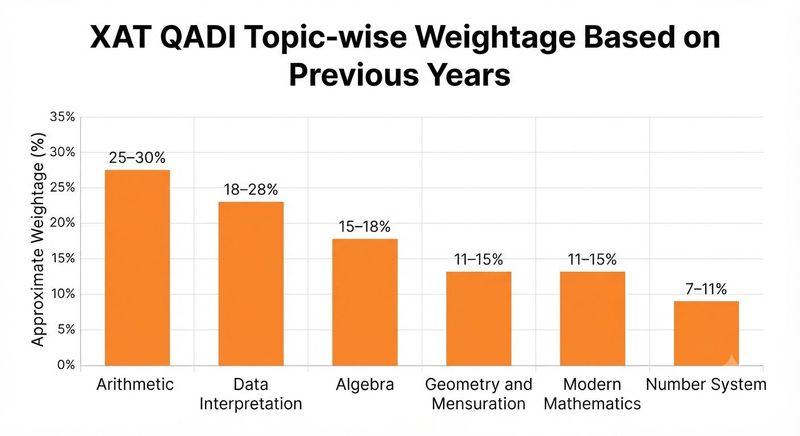
Arithmetic and Data Interpretation are expected to contribute the highest number of questions in the QADI section, accounting for nearly 45–55% of the paper based on previous years' trends.
- Candidates targeting a 90+ percentile in XAT 2027 should prioritise Arithmetic and Data Interpretation before focusing on Algebra, Geometry, and the remaining topics.
- The table below presents the expected topic-wise weightage for the XAT 2027 QADI section based on the analysis of XAT 2022, 2023, 2024, and 2025 question papers.
| Topic | Expected Questions (XAT 2027) | Approximate Weightage | Priority Level |
|---|---|---|---|
| Arithmetic | 6–8 | 25–30% | Very High |
| Data Interpretation | 5–8 | 18–28% | Very High |
| Algebra | 4–5 | 15–18% | High |
| Geometry and Mensuration | 3–4 | 11–15% | Medium |
| Modern Mathematics | 3–4 | 11–15% | Medium |
| Number System | 2–3 | 7–11% | Low to Medium |
Also Read
XAT 2027 95 Percentile: Section-Wise Strategy and 6-Month PlanQues. Can candidates score well in XAT 2027 QADI by focusing only on high-weightage topics?
Ans. Focusing on Arithmetic, Data Interpretation, and Algebra can help candidates cover a significant portion of the XAT 2027 QADI section, as these topics are expected to contribute nearly 60–70% of the questions. However, candidates should also prepare Geometry, Modern Mathematics, and Number System to avoid missing scoring opportunities and improve their overall percentile.
Important Topics in XAT Quantitative Ability
The Quantitative Ability component of QADI spans five major topic areas. Here are the most important sub-topics within each, ranked by frequency of appearance in previous XAT papers.
1. Arithmetic (Very High Priority)
Arithmetic is the single largest topic in XAT QADI every year. The sub-topics that appear most consistently include:
- Percentages, Profit and Loss, and Discount
- Ratio, Proportion and Partnership
- Time, Speed and Distance including Trains and Boats and Streams
- Time and Work, and Pipes and Cisterns
- Simple and Compound Interest
- Averages, Mixtures and Alligation
2. Algebra (High Priority)
XAT Algebra problems are conceptual rather than computation heavy. Focus on these sub-topics:
- Linear and Quadratic Equations
- Inequalities and Modulus Functions
- Functions and their Properties
- Sequences and Series which is AP, GP and HP
- Logarithms, Surds and Indices
3. Geometry and Mensuration (Medium Priority)
Geometry problems in XAT often involve non-standard configurations that require theorem application. Key sub-topics include:
- Properties of Lines, Angles and Triangles (including similarity and congruence)
- Circles: Tangents, Chords and Arc Lengths
- Quadrilaterals and Polygons
- Coordinate Geometry: Straight Lines and Distance
- 3D Mensuration: Spheres, Cones, Cylinders and Prisms
4. Modern Mathematics (Medium Priority)
Modern Math in XAT frequently tests application-based problems. The three core areas are:
- Permutation and Combination: including arrangement and selection problems
- Probability: Classical, Conditional and Bayes’ Theorem
- Set Theory and Venn Diagrams
5. Number System (Low to Medium Priority)
Number System questions appear 2–4 times in XAT QADI. Though fewer, they can be tricky and time-consuming. Focus on:
- HCF and LCM applications
- Divisibility Rules and Remainders
- Units Digit and Cyclicity
- Number of Factors, Perfect Squares and Co-prime Numbers
Also Read
Best Books for XAT 2027 Preparation: Verbal, Decision Making and QuantQues. Is Geometry important for XAT 2027 Quantitative Ability preparation?
Ans. Yes. Although Geometry and Mensuration carry a medium weightage in XAT 2027 QADI, candidates should prepare topics such as Triangles, Circles, Quadrilaterals, Coordinate Geometry, and 3D Mensuration. Geometry questions in XAT often require theorem-based reasoning and conceptual application rather than direct formula substitution.
Ques. Which Number System topics are most frequently asked in XAT 2027 QADI?
Ans. Candidates should prepare HCF and LCM, Divisibility Rules, Remainders, Units Digit and Cyclicity, Number of Factors, Perfect Squares, and Co-prime Numbers for XAT 2027 QADI. Although Number System contributes fewer questions than Arithmetic or Algebra, these topics appear regularly and can help candidates improve their overall score with focused preparation.
Important Topics in XAT Data Interpretation
Data Interpretation (DI) in XAT 2027 evaluates a candidate's ability to analyse data and solve calculation-based questions using tables, charts, and graphs within the available time.
- Data Interpretation sets in XAT are generally more calculation-intensive and require multiple steps to arrive at the correct answer.
- Caselet-based and mixed-chart questions have appeared regularly in recent XAT examinations and are expected to remain important for XAT 2027.
- Candidates can improve calculation speed by organising text-based information into a simple table before solving the questions in a Data Interpretation set.
| DI Format | Frequency in Previous Years | Average Questions per Set | Difficulty |
|---|---|---|---|
| Tables | Very High | 3–4 |
Moderate to High |
| Bar Charts | High | 3–4 | Moderate |
| Caselet / Text-based DI |
Very High |
3–5 | High |
| Mixed Charts (2 or more formats) | High | 3–4 | High |
| Line Graphs | Medium | 2–3 | Moderate |
| Pie Charts | Medium | 2–3 | Moderate to High |

Also Read
XAT 2027: How to Score 95+ Percentile – Section-Wise Strategy and Time Management TipsQues. Which Data Interpretation set types are asked most frequently in XAT 2027?
Ans. Based on previous years' trends, Tables and Caselet (Text-based) Data Interpretation are expected to be the most frequently tested formats in XAT 2027 QADI. Bar Charts and Mixed Charts also appear regularly and usually require multiple calculations. Candidates should prioritise these DI formats during preparation to maximise their score.
Ques. How can candidates improve speed in XAT 2027 Data Interpretation?
Ans. Candidates can improve their XAT 2027 Data Interpretation performance by practising calculation-intensive sets regularly and organising lengthy caselet information into simple tables before solving the questions. Developing strong calculation speed, approximation techniques, and time management skills can help candidates solve DI sets more accurately within the available exam time.
Year-wise QADI Analysis: XAT 2022–2025
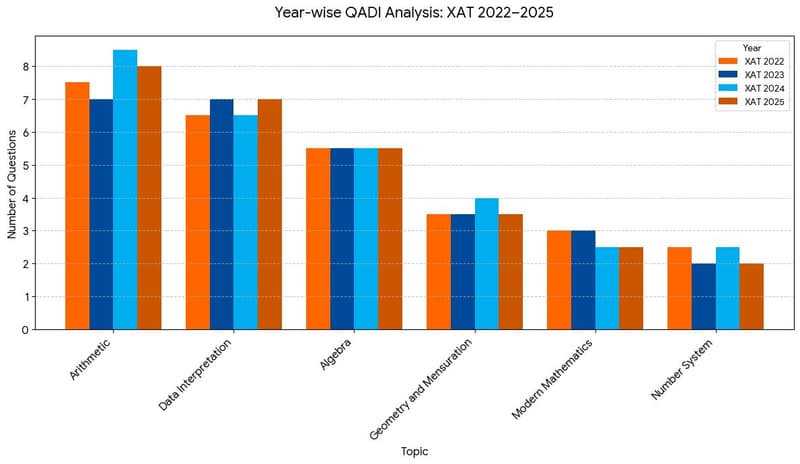
The QADI section has consistently included around 27–28 questions in recent XAT examinations.
- Arithmetic has remained the highest-weightage topic in QADI, while Data Interpretation has consistently contributed a significant share of the section.
- Algebra has maintained a steady presence in recent XAT papers, whereas Geometry, Modern Mathematics, and Number System have continued to contribute a comparatively smaller number of questions.
- The table below presents the expected topic-wise distribution of questions in the XAT 2027 QADI section based on the analysis of the XAT 2022–2025 question papers.
| Topic | XAT 2022 | XAT 2023 | XAT 2024 | XAT 2025 |
|---|---|---|---|---|
| Arithmetic | 7 | 6 | 7 | 8-9 |
| Data Interpretation | 6 | 7 | 6-7 | 6-8 |
| Algebra | 5 | 5-6 | 5 | 5-6 |
| Geometry and Mensuration | 3-4 | 3-4 | 4 | 3-4 |
| Modern Mathematics | 3 | 3 | 3 | 2-3 |
| Number System | 2-3 | 2 | 2-3 | 2 |
| Total | 27-28 | 28 | 27-28 | 28 |
Ques. Which topics have shown consistent weightage in XAT QADI from 2022 to 2025?
Ans. Arithmetic, Data Interpretation, and Algebra have shown the most consistent weightage in XAT QADI between 2022 and 2025. Arithmetic has contributed around 6–9 questions, Data Interpretation around 6–8 questions, and Algebra around 5–6 questions in most years. Candidates should prioritise these topics before preparing Geometry, Modern Mathematics, and Number System.
Preparation Tips for XAT 2027 QADI
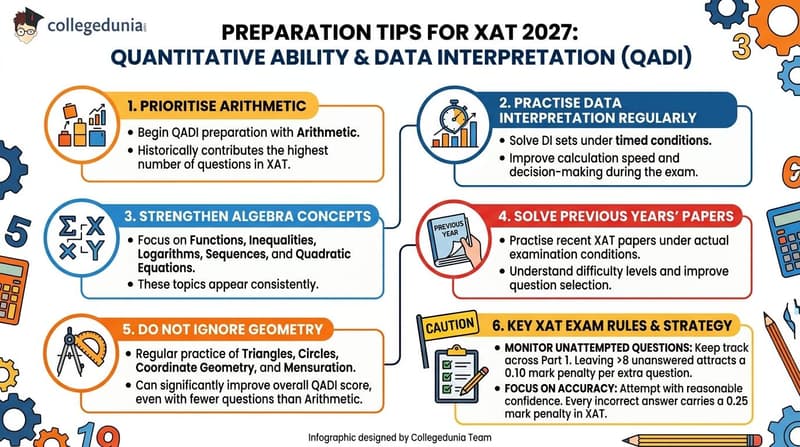
- Prioritise Arithmetic: Candidates should begin QADI preparation with Arithmetic, as it has consistently contributed the highest number of questions in recent XAT examinations.
- Practise Data Interpretation Regularly: Candidates should solve Data Interpretation sets under timed conditions to improve calculation speed and decision-making during the examination.
- Strengthen Algebra Concepts: Focus on topics such as Functions, Inequalities, Logarithms, Sequences, and Quadratic Equations, as these have appeared consistently in previous XAT papers.
- Solve Previous Years' Papers: Candidates should practise XAT question papers from recent years under actual examination conditions to understand the difficulty level and improve question selection.
- Do Not Ignore Geometry: Geometry contributes fewer questions than Arithmetic, but regular practice of Triangles, Circles, Coordinate Geometry, and Mensuration can improve the overall QADI score.
- Monitor Unattempted Questions: Candidates should keep track of unattempted questions across Part 1, as leaving more than eight questions unanswered attracts an additional 0.10 mark penalty for every extra unattempted question.
- Focus on Accuracy: Candidates should attempt questions with reasonable confidence, as every incorrect answer carries a 0.25 mark penalty in XAT.
Also Read
XAT Score vs Percentile- Check Section Wise Score, Top College Cutoff for last 5 yearsQues. In which order should candidates prepare topics for XAT 2027 QADI?
Ans. Candidates should begin XAT 2027 QADI preparation with Arithmetic, followed by Data Interpretation and Algebra, as these topics have contributed the highest number of questions in recent XAT examinations. After building a strong foundation in these areas, candidates should prepare Geometry, Modern Mathematics, and Number System to complete the syllabus.
Ques. How important are previous year question papers for XAT 2027 QADI preparation?
Ans. Previous years' XAT question papers are one of the most effective resources for XAT 2027 QADI preparation. Solving recent papers under timed conditions helps candidates understand the actual difficulty level, improve question selection, strengthen time management, and identify frequently tested concepts in Quantitative Ability and Data Interpretation.
XAT 2027 QADI: Reddit Discussion
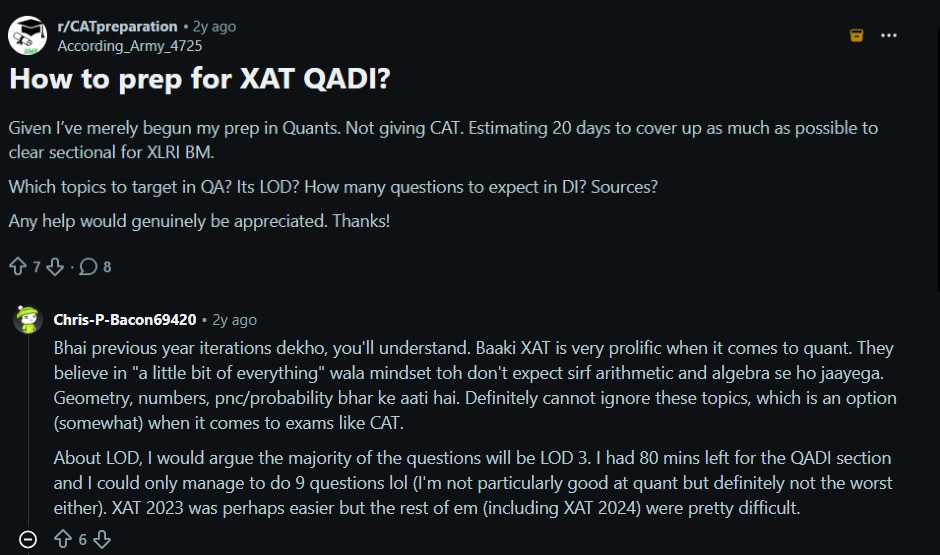
- The discussion focused on preparing for the XAT QADI section, with candidates seeking guidance on important Quant topics, difficulty level, Data Interpretation weightage, and the best resources to clear the sectional cutoff for XLRI BM.
- Another Reddit user advised candidates to analyse previous years' XAT papers, noting that QADI covers a wide range of topics including Arithmetic, Algebra, Geometry, Number System, and Permutation & Probability. The user also mentioned that the Quant questions are generally of a high difficulty level, making comprehensive preparation more effective than focusing on only a few topics.
XAT 2027 QADI FAQs
Ques. How many questions are there in the XAT 2027 QADI section?
Ans. Based on XAT 2022–2025 trends, the Quantitative Ability and Data Interpretation (QADI) section in XAT 2027 is expected to contain around 28 questions. While the exact number will be confirmed in the official XAT notification, the QADI section has consistently included 27–28 questions in recent examination cycles.
Ques. Which topic has the highest weightage in XAT QADI?
Ans. Arithmetic is expected to carry the highest weightage in the XAT 2027 QADI section, contributing approximately 7–9 questions based on previous years' trends. Data Interpretation is also a high-priority area, generally accounting for 6–8 questions, making both topics essential for candidates aiming for a high percentile.
Ques. Is XAT QADI harder than CAT Quantitative Aptitude?
Ans. Yes. XAT QADI is generally considered more challenging than CAT Quantitative Aptitude because it includes conceptually demanding quantitative questions along with Data Interpretation sets that require detailed calculations and analytical thinking. Candidates also need to manage time efficiently across all Part 1 sections, as XAT does not have sectional time limits.
Ques. What is the negative marking rule in XAT QADI?
Ans. Every incorrect answer in the XAT 2027 QADI section is expected to attract a 0.25-mark negative marking. In addition, if candidates leave more than eight questions unattempted across Part 1, an extra 0.10 mark is deducted for each additional unattempted question beyond the permitted limit, according to the XAT marking scheme.
Ques. How much time should I allocate to QADI in XAT Part 1?
Ans. Since XAT Part 1 provides 170 minutes without sectional time restrictions, candidates generally allocate 50–60 minutes to the QADI section. However, candidates should adjust their time based on individual strengths in Quantitative Ability, Decision Making, and Verbal Ability to maximise the overall score.
Ques. Where can I access previous year XAT QADI papers for practice?
Ans. Candidates can access previous years' XAT question papers, including the QADI section, through the official XAT website and other authorised preparation resources after they are made available. Practising papers from the last several years under timed conditions helps candidates understand the latest exam pattern, difficulty level, and frequently tested topics in XAT Quantitative Ability and Data Interpretation.



Comments