




Candidates targeting a 95 percentile in XAT 2027 are expected to score around 35–40 marks in Part 1 based on recent examination trends.
- XAT 2027 is to be held in 3 January 2027 giving the candidates around six months to prepare themselves if they start preparing themselves from July 2026.
- The first part of XAT 2027 is expected to contain 75 questions from VALA, Decision Making and QADI while Part 2 would contain 20 General Knowledge questions which would not count in the percentile calculation process.
- Candidates aiming for a 95 percentile should focus on maintaining high accuracy while attempting a balanced number of questions as every incorrect answer attracts 0.25 mark negative marking.
- XAT also applies an additional 0.10 mark penalty for every unattempted question after the first eight unanswered questions across Part 1.
- Candidates securing around the 95 percentile in XAT 2027 are expected to become eligible for the next stage of admission at XLRI Jamshedpur and several other leading management institutes accepting XAT scores.
Related Links:
- XAT 2027: Registration Opens on 15th July 2026, Syllabus, Exam Pattern and XLRI Cutoff
- XAT Exam Dates 2027: Expected Registration Date, Exam Dates, and Admit Card Schedule
- XAT Score vs Percentile- Check Section Wise Score, Top College Cutoff for last 5 years

Key Summary
- XLRI Jamshedpur conducts XAT, which includes Verbal and Logical Ability (VALA), Decision Making (DM), Quantitative Ability and Data Interpretation (QADI), and General Knowledge (GK).
- Candidates should build a balanced preparation strategy across Verbal and Logical Ability, Decision Making, Quantitative Ability and Data Interpretation, and General Knowledge instead of relying on a single high-scoring section.
- Regular mock test analysis, previous years' XAT papers, and section-wise performance tracking can help candidates improve accuracy, identify weak areas, and strengthen their overall exam strategy.
- Following monthly preparation milestones and revising formulas, shortcuts, and Decision Making frameworks during the final weeks can help candidates stay on track for a competitive XAT 2027 score.
XAT 2027 Exam Pattern at a Glance
XAT 2027 is expected to follow the examination pattern of recent years, with Part 1 consisting of 75 scored questions from Verbal and Logical Ability, Decision Making, and Quantitative Ability and Data Interpretation.
- Candidates will receive one mark for every correct answer, while each incorrect response will attract a 0.25 mark penalty.
- XAT also applies an additional 0.10 mark deduction for every unattempted question after the first eight unanswered questions across Part 1.
- The table below presents the expected XAT 2027 exam pattern and marking scheme based on recent examination trends.
- The additional penalty for unattempted questions makes question selection and attempt strategy an important part of XAT 2027 preparation.
| Section | Expected Questions | Time Allocation | Counted for Percentile |
|---|---|---|---|
| Verbal and Logical Ability (VLA) | 26 | 170 minutes combined (Parts 1) | Yes |
| Decision Making (DM) | 21 | Yes | |
| Quantitative Ability and Data Interpretation (QA and DI) | 28 | Yes | |
| General Knowledge (GK) | 20 | 10 minutes | No |
| Total Scored Questions | 95 | 180 minutes | — |

Also Read
XAT 2027 Safe Score: Percentile for XLRI, XIMB and Top CollegesWhat 95 Percentile in XAT Requires
Candidates aiming for a 95+ percentile should focus on maintaining high accuracy instead of attempting every question, as a balanced attempt strategy has consistently produced better results in recent XAT examinations.
- Managing the number of unattempted questions is equally important in XAT, as leaving more than eight questions unanswered in Part 1 attracts an additional penalty under the marking scheme.
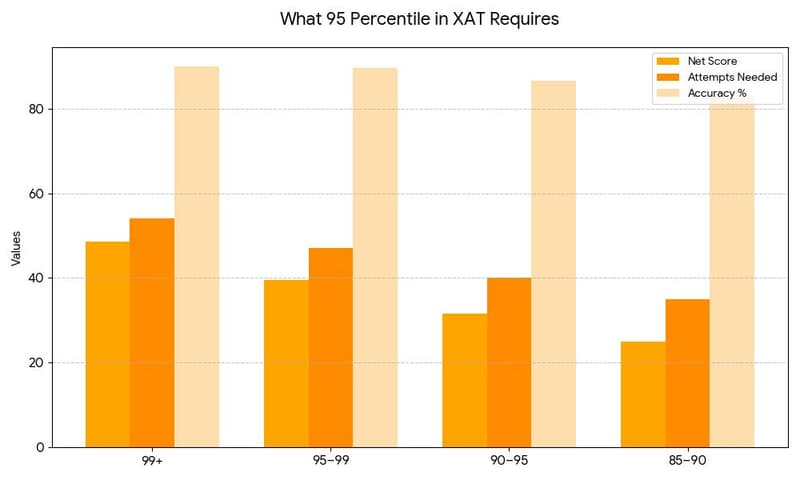
- The table below presents the expected score range, attempts, and accuracy required for different percentile levels in XAT 2027, based on the analysis of XAT 2025 and XAT 2026 trends.
| Percentile Band (Expected) | Estimated Net Score (out of 75) | Approx. Attempts Needed | Required Accuracy |
|---|---|---|---|
| 99+ | 45–52 | 50–58 | 90%+ |
| 95–99 | 35–44 | 42–52 | 87–92% |
| 90–95 | 28–35 | 35–45 | 84–89% |
| 85–90 | 22–28 | 30–40 | 80–86% |
Also Read
XAT 2027: How to Score 95+ Percentile – Section-Wise Strategy and Time Management TipsQues. How many questions should candidates attempt to score 95 percentile in XAT 2027?
Ans. Based on the analysis of XAT 2025 and XAT 2026, candidates targeting a 95–99 percentile in XAT 2027 should aim to attempt approximately 42–52 questions in Part 1 while maintaining 87–92% accuracy. Attempting more questions with low accuracy may reduce the overall score because of the negative marking and the penalty for excessive unattempted questions.
Ques. Is accuracy more important than the number of attempts in XAT 2027?
Ans. Yes. Accuracy is one of the most important factors for achieving a high percentile in XAT 2027. Candidates targeting 95+ percentile should focus on selecting the right questions instead of attempting every question. A balanced attempt strategy with high accuracy and careful management of unattempted questions generally produces better results than making excessive guesses under the XAT marking scheme.
Section-Wise Preparation Strategy for XAT 2027
Verbal and Logical Ability (VLA)
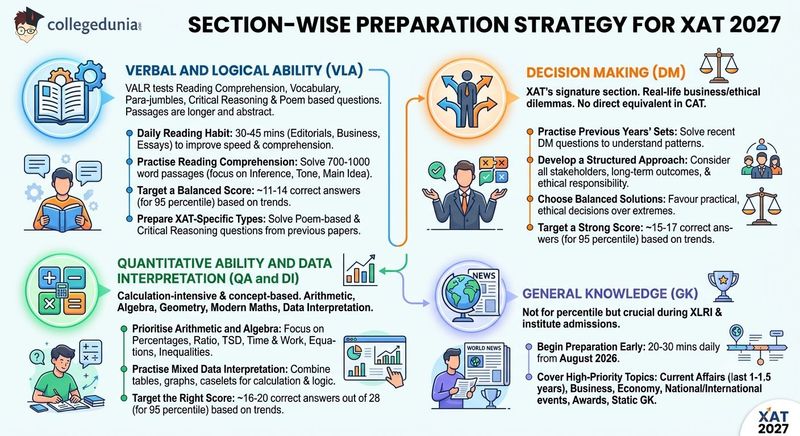
VALR tests reading comprehension, vocabulary, para-jumbles, critical reasoning and poem based questions. XAT passages are often longer and more abstract than in other MBA entrance exams.
- Build a Daily Reading Habit: Candidates should spend 30–45 minutes every day reading editorials, business articles, and analytical essays to improve reading speed and comprehension.
- Practise Reading Comprehension: Regular practice of 700–1000-word Reading Comprehension passages can help candidates improve accuracy in inference, author's tone, and main idea questions.
- Prepare XAT-Specific Question Types: Candidates should solve poem-based and critical reasoning questions from previous years' XAT papers, as these question types are unique to the examination.
- Target a Balanced Score: Candidates aiming for a 95 percentile should target around 11–14 correct answers in the Verbal and Logical Ability (VALR) section based on recent XAT trends.
Decision Making (DM)
Decision Making is XAT’s signature section with no direct equivalent in CAT or other exams. It presents real-life business/ethical dilemmas.
- Practise Previous Years' Decision Making Sets: Candidates should solve XAT Decision Making questions from recent years to understand the recurring question pattern and improve decision-making skills.
- Develop a Structured Approach: Candidates should evaluate every Decision Making question by considering the interests of all stakeholders, long-term outcomes, and ethical responsibility before selecting an answer.
- Choose Balanced Solutions: Decision Making questions in XAT generally favour practical, balanced, and ethically sound decisions over extreme or unrealistic options.
- Target a Strong Score: Candidates aiming for a 95 percentile should target around 15–17 correct answers in the Decision Making section based on recent XAT trends.
Quantitative Ability and Data Interpretation (QA and DI)
The QADI section is known for its calculation-intensive and concept-based questions covering Arithmetic, Algebra, Geometry, Modern Mathematics, and Data Interpretation.
- Prioritise Arithmetic and Algebra: Candidates should begin QADI preparation with Arithmetic and Algebra, giving special attention to Percentages, Ratio and Proportion, Time, Speed and Distance, Time and Work, Equations, and Inequalities, as these topics form the foundation of the section.
- Practise Mixed Data Interpretation Sets: Candidates should regularly solve Data Interpretation sets that combine tables, graphs, and caselets, as these questions require both calculation skills and logical analysis.
- Target the Right Score: Candidates aiming for a 95 percentile should target around 16–20 correct answers out of 28 in the QADI section, based on recent XAT trends.
General Knowledge (GK)
General Knowledge section is not considered for the XAT percentile, it remains important during the admission process at XLRI and several other XAT-accepting institutes.
- Begin GK Preparation Early: Candidates should allocate 20–30 minutes every day for General Knowledge preparation from August 2026 onwards.
- Cover High-Priority Topics: Candidates should focus on current affairs from the last 1–1.5 years, along with business and economy, national and international events, awards, and static General Knowledge.
Also Read
Best Books for XAT 2027 Preparation: Verbal, Decision Making and QuantQues. What should be the section-wise target for 95 percentile in XAT 2027?
Ans. Candidates targeting a 95 percentile in XAT 2027 should aim for a balanced performance across all Part 1 sections. Based on recent XAT trends, a competitive target is 11–14 correct answers in Verbal and Logical Ability (VALR), 15–17 correct answers in Decision Making (DM), and 16–20 correct answers in Quantitative Ability and Data Interpretation (QADI). Consistent performance across sections generally improves the overall percentile more than relying on a single high-scoring section.
6-Month Study Plan: July 2026 to January 2027
Candidates should aim for a Part 1 net score of around 26–30 by the end of September, 30–34 by the end of October, and 35–40 by the end of December based on recent XAT score trends.
- Consistently achieving these monthly score milestones can keep candidates on track for a 95 percentile in XAT 2027.
| Month | Primary Focus Areas | Weekly Study Hours |
|---|---|---|
| July 2026 |
Concept foundation — Arithmetic, Algebra basics, Grammar & RC approach; start DM familiarisation with XAT 2018–2020 sets |
12–15 hrs |
| August 2026 |
Complete QA & DI syllabus; Advanced VLA (Critical Reasoning, Poetry, Para-jumbles); DM sets 2020–2022; start GK current affairs |
15–18 hrs |
| September 2026 |
Full-length sectional tests; Data Sufficiency & mixed DI practice; first 2–3 full-length XAT mocks + thorough analysis |
18–20 hrs |
| October 2026 |
2 full-length mocks per week + detailed analysis; target weak areas; DM speed & accuracy drills |
20–22 hrs |
| November 2026 |
Intensive mock series — 3 full-length mocks per week; refine time management & section order; solve XAT 2023–2026 papers |
22–25 hrs |
| December 2026 – January 2027 |
Revision of formulas, shortcuts & DM frameworks; 2 mocks per week; final GK revision; avoid new topics in the last 2 weeks |
18–20 hrs |
Also Read
XAT 2027 VLA: Chapter-Wise Weightage and High-Scoring TopicsQues. What should candidates focus on during the last month before XAT 2027?
Ans. During December 2026 and the final weeks before XAT 2027, candidates should prioritise revision instead of learning new topics. The focus should be on revising formulas, shortcuts, Decision Making frameworks, and General Knowledge, while attempting two full-length mock tests per week. In the last two weeks, candidates should avoid starting new topics and concentrate on strengthening accuracy, speed, and overall exam strategy.
Mock Test Strategy for XAT 2027
Candidates need to analyze each mock test as they give the mock test to get better score in XAT 2027.
- Start Mock Tests at the Right Time: Candidates should begin full-length XAT mock tests from September 2026 after completing the core concepts.
- Take Regular Mocks: Candidates should attempt around 20–30 full-length mock tests between September 2026 and January 2027.
- Analyse Every Mock: Candidates should review incorrect answers, skipped questions, and time-management mistakes after every mock to improve performance.
- Track Performance: Maintain a record of section-wise scores, accuracy, and unattempted questions to identify weak areas and monitor progress.
- Follow Exam Conditions: Attempt mock tests in the 170-minute Part 1 + 10-minute GK format without interruptions.
- Practise Previous Years' Papers: Candidates should solve at least 6–8 XAT papers from 2020–2026 to understand the actual difficulty level and question pattern.
- Revise in the Final Weeks: During the last two weeks, focus on revision, accuracy, and strengthening familiar topics instead of learning new ones.
Also Read
XAT 2027 Decision Making: Topics, Question Types and How to PrepareQues. When should candidates start taking full-length XAT 2027 mock tests?
Ans. Candidates should begin taking full-length XAT 2027 mock tests from September 2026, after completing the core concepts of Quantitative Ability, Verbal Ability, and Decision Making. Starting mocks after the conceptual foundation is complete helps candidates evaluate their preparation accurately, improve section-wise strategy, and identify weak areas well before the examination.
Ques. How should candidates analyse XAT 2027 mock tests to improve their percentile?
Ans. After every XAT 2027 mock test, candidates should analyse every incorrect answer, skipped question, and time-management mistake instead of focusing only on the score. Maintaining a record of section-wise scores, accuracy, and unattempted questions helps identify recurring mistakes, improve question selection, and develop an effective exam strategy for achieving a higher percentile.
XAT 2027 Preparation: Reddit Discussion
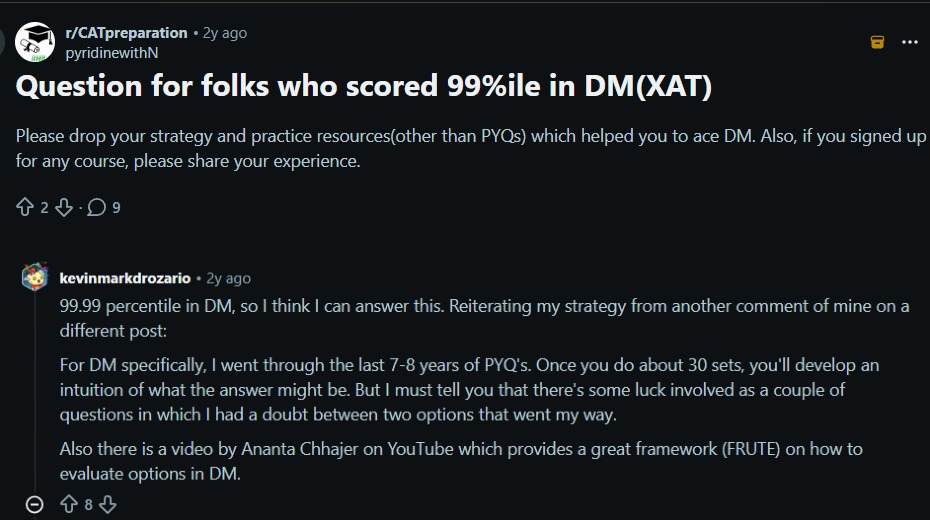
- The discussion focused on how to score a high percentile in the XAT Decision Making (DM) section, with candidates seeking effective preparation strategies, practice resources, and coaching recommendations beyond previous years' papers.
- Another Reddit user, who claimed to have scored 99.99 percentile in DM, recommended solving the last 7–8 years of XAT Decision Making PYQs to build decision-making intuition. The user also suggested using Ananta Chhajer's FRUTE framework to evaluate answer choices systematically while acknowledging that some degree of luck can influence close decision-making questions.
XAT 2027 Preparation FAQs
Ques. What net score is needed for 95 percentile in XAT 2027?
Ans. Based on recent XAT trends, a net score of approximately 35–40 marks in Part 1 (Verbal Ability and Logical Reasoning, Decision Making, and Quantitative Ability & Data Interpretation) is expected to be competitive for a 95 percentile in XAT 2027. The actual score required may vary depending on the overall difficulty level of the examination and candidates' performance.
Ques. Is 6 months enough to prepare for XAT 2027?
Ans. Yes. Six months of focused preparation is generally sufficient for XAT 2027, provided candidates follow a structured study plan. Candidates with prior preparation for CAT or GMAT can utilise the overlap in Quantitative Ability and Verbal Ability while dedicating additional time to the Decision Making section, which is unique to XAT.
Ques. How should I prepare for the XAT Decision Making section?
Ans. Candidates should prepare the XAT Decision Making section by practising previous years' XAT question papers and analysing business and ethical case-based scenarios. Developing the ability to balance ethical considerations, stakeholder interests, and practical business outcomes can help candidates perform well in this section.
Ques. How many mock tests should I take before XAT 2027?
Ans. Candidates should aim to attempt 20–30 full-length mock tests before XAT 2027, along with several previous years' XAT papers under timed conditions. Analysing each mock test to identify conceptual mistakes, improve question selection, and strengthen time management is equally important for improving overall performance.
Ques. Does GK score count toward XAT 2027 percentile?
Ans. No. The General Knowledge (GK) section is not considered while calculating the XAT 2027 percentile. However, the GK score may be considered by XLRI and some other participating institutes during the final admission process, making regular GK preparation beneficial for candidates.
Ques. Which colleges can I target with 95 percentile in XAT 2027?
Ans. Candidates securing around a 95 percentile in XAT 2027 may become eligible for the selection process of leading management institutes such as XLRI Jamshedpur, XIMB Bhubaneswar, IMT Ghaziabad, TAPMI Manipal, and several other XAT-accepting B-schools. The final shortlist depends on factors such as sectional performance, institute-specific admission criteria, and the overall candidate profile.



Comments